

SawJan
20 个内容

SawJan
举报
屏蔽用户
实盘交易

SOL 持有者
低频交易者
4.6 年
8 关注
28 粉丝
21 点赞
帖子
投资组合
·
--
📉 加密货币市场动态:空方略占上风
加密货币市场呈现温和下行压力,过去 24 小时内,主要资产均处于跌势。
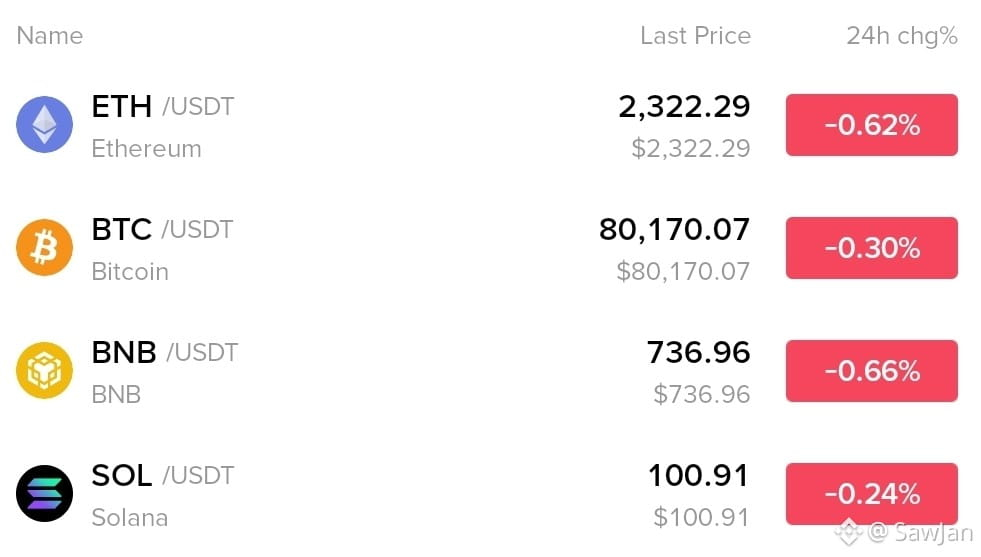
📊 市场概况:🔹 BTC:$80,170.07 | -0.30% 🔹 ETH:$2,322.29 | -0.62% 🔹 BNB:$736.96 | -0.66% 🔹 SOL:$100.91 | -0.24%
🔍 数据说明了什么?
• 比特币表现出相对强势,在这四种资产中跌幅最小。 • 以太坊和 BNB 面临略大的抛售压力,其中 BNB 跌幅最大。 • Solana 表现出相对韧性,跌幅最小,为 -0.24%。
🧠 我的看法:
这看起来更像是一次温和的市场回调,而非趋势即将发生重大逆转的明确迹象。不过,仅凭 24 小时的市场表现,还不足以确认下一步走势。
接下来值得关注的重点是 BTC 的价格稳定性、交易量,以及 ETH、BNB 和 SOL 能否收复短期跌幅。
接下来的走势比当前的红色 K 线更重要。👀
我们看到的是健康回调,还是更深度回撤的开始?
#Bitcoin #Ethereum #BNB #Solana #CryptoMarket
57
·
--
📉 加密市场动态:空头略占上风
加密市场呈现温和下行压力,主要资产过去24小时均收跌。
📊 市场概况:
🔹 BTC:$80,170.07 | -0.30%
🔹 ETH:$2,322.29 | -0.62%
🔹 BNB:$736.96 | -0.66%
🔹 SOL:$100.91 | -0.24%
🔍 数据告诉了我们什么?
• 比特币相对强势,在这四种资产中跌幅最小。
• 以太坊和BNB面临的抛售压力略大,其中BNB跌幅最大。
• Solana表现出相对韧性,跌幅仅为-0.24%,是四者中最小的。
🧠 我的看法:
这看起来更像是一次温和的市场回调,而非趋势即将重大逆转的明确信号。不过,仅凭24小时的市场表现,还不足以确认下一步走势。
接下来值得关注的关键因素包括BTC价格能否保持稳定、交易量变化,以及ETH、BNB和SOL能否收复短期失地。
接下来的走势比当前的红色蜡烛更重要。👀
我们看到的是健康回调,还是更深度回落的开始?
#bitcoin #Ethereum #BNB #solana #CryptoMarket
79
·
--
看跌
今天不是绿色,全部都是红色 😬
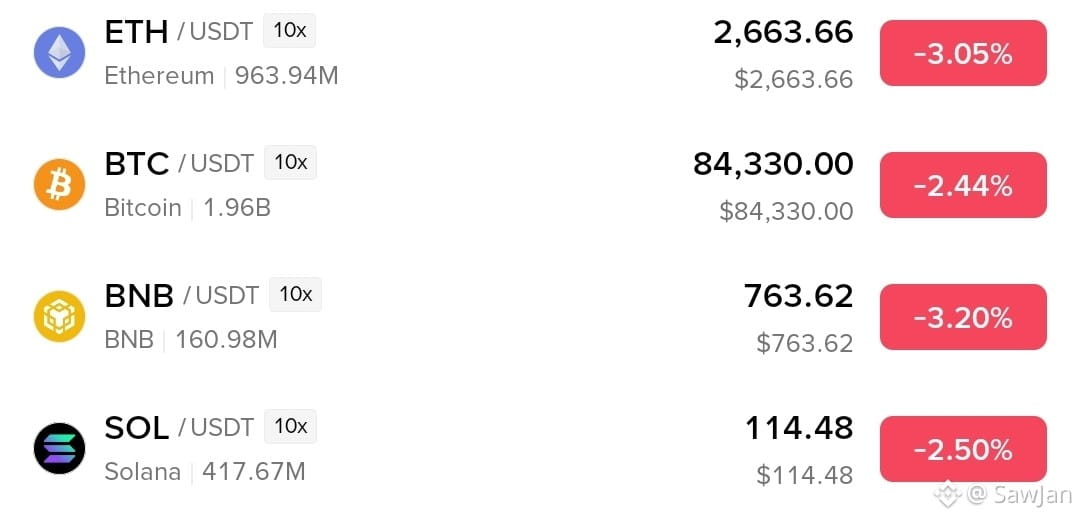
ETH -3.05% | BTC -2.44% | BNB -3.20% | SOL -2.50%
今天所有图表看起来都在闪红 🔴
看来多头在小休一下 🐂
现在该保持耐心,等待下一步 👀
让我们看看市场接下来会走向哪里 📉
今天不是绿色,全部都是红色 😬
ETH -3.05% | BTC -2.44% | BNB -3.20% | SOL -2.50%
今天所有图表看起来都在闪红 🔴
看来多头在小休一下 🐂
现在该保持耐心,等待下一步 👀
让我们看看市场接下来会走向哪里 📉
ETH -3.05% | BTC -2.44% | BNB -3.20% | SOL -2.50%
今天所有图表看起来都在闪红 🔴
看来多头在小休一下 🐂
现在该保持耐心,等待下一步 👀
让我们看看市场接下来会走向哪里 📉
116
·
--
查看翻译
DeFi needs more than hype—it needs better tools for managing capital.
@termmax is building fixed-rate lending and borrowing markets that bring more predictability to on-chain finance. With multi-chain support and clearer capital allocation, users can approach lending strategies with greater confidence.
The ability to lock in rates can be especially useful when markets become volatile and variable borrowing costs move quickly.
As DeFi continues evolving, predictable liquidity and efficient capital management will matter more than ever.
That’s why #termmax is a project worth watching as the next generation of on-chain financial infrastructure takes shape.
#termmax @termmax
DeFi needs more than hype—it needs better tools for managing capital.
@TermMax is building fixed-rate lending and borrowing markets that bring more predictability to on-chain finance. With multi-chain support and clearer capital allocation, users can approach lending strategies with greater confidence.
The ability to lock in rates can be especially useful when markets become volatile and variable borrowing costs move quickly.
As DeFi continues evolving, predictable liquidity and efficient capital management will matter more than ever.
That’s why #termmax is a project worth watching as the next generation of on-chain financial infrastructure takes shape.
#termmax @TermMax
66
·
--
#TermMax @termmax
DeFi 里有很多借贷协议,但可预测的利率仍然被低估。
这就是为什么 TermMax 引起了我的注意。
固定利率的借贷让资金规划变得轻松得多。你可以提前了解成本,而不是一直在应对不断变化的市场环境。
我也喜欢它的多链方向。随着时间推移,更多市场与不同生态之间的流动性,可能会让固定利率产品变得更有用。
更大的图景很简单:DeFi 需要帮助用户更有信心地管理资金的基础设施。
TermMax 正在朝这个方向建设,我也很期待这个生态系统能够成长到多远。DeFi 产品和基础设施之间有区别:前者往往追逐关注度,后者则解决真实问题。
@termmax 之所以有意思,是因为它关注的是更务实的东西:可预测的借款与出借。
固定利率可以让用户在资金配置上获得更多控制权,尤其是在市场变得波动时。
用户不必不断追问下一步利率可能如何变动,而是可以围绕更清晰的成本与预期来搭建仓位。
多链方式又增加了一层可能性:或许能打开通往更多流动性与市场的通道。
对我来说,这才是值得关注的 DeFi 基础设施。
更少的噪音。更多的实用价值。
#TermMaxDeFi 仍然需要的是更好的可预测性。
这就是 @termmax 这个案例有趣之处。
固定利率的借贷可以让链上资金更容易进行规划。无论你是为了策略而借款,还是分配流动性,提前知道利率都能消除大量不确定性。
我也认为,多链愿景很重要。
流动性不应该永远被困在彼此隔离的生态系统之中。
如果 TermMax 能继续在各条链上构建可靠的固定利率市场,它可能会成为面向更广泛 DeFi 用户的有用基础设施。
叙事很简单:
可预测的利率。
更好的资金规划。
更高效的 DeFi。
#termmax @termmax
#TermMax @termmax
DeFi 里有很多借贷协议,但可预测的利率仍然被低估。
这就是为什么 TermMax 引起了我的注意。
固定利率的借贷让资金规划变得轻松得多。你可以提前了解成本,而不是一直在应对不断变化的市场环境。
我也喜欢它的多链方向。随着时间推移,更多市场与不同生态之间的流动性,可能会让固定利率产品变得更有用。
更大的图景很简单:DeFi 需要帮助用户更有信心地管理资金的基础设施。
TermMax 正在朝这个方向建设,我也很期待这个生态系统能够成长到多远。DeFi 产品和基础设施之间有区别:前者往往追逐关注度,后者则解决真实问题。
@TermMax 之所以有意思,是因为它关注的是更务实的东西:可预测的借款与出借。
固定利率可以让用户在资金配置上获得更多控制权,尤其是在市场变得波动时。
用户不必不断追问下一步利率可能如何变动,而是可以围绕更清晰的成本与预期来搭建仓位。
多链方式又增加了一层可能性:或许能打开通往更多流动性与市场的通道。
对我来说,这才是值得关注的 DeFi 基础设施。
更少的噪音。更多的实用价值。
#TermMaxDeFi 仍然需要的是更好的可预测性。
这就是 @TermMax 这个案例有趣之处。
固定利率的借贷可以让链上资金更容易进行规划。无论你是为了策略而借款,还是分配流动性,提前知道利率都能消除大量不确定性。
我也认为,多链愿景很重要。
流动性不应该永远被困在彼此隔离的生态系统之中。
如果 TermMax 能继续在各条链上构建可靠的固定利率市场,它可能会成为面向更广泛 DeFi 用户的有用基础设施。
叙事很简单:
可预测的利率。
更好的资金规划。
更高效的 DeFi。
#termmax @TermMax
77
·
--
查看翻译
TermMax is making DeFi feel more predictable by bringing fixed-rate lending, borrowing, and leverage on-chain. Instead of dealing with constantly changing rates, users can lock in borrowing costs or expected yields until maturity. The protocol also supports managed vaults, multi-chain markets, and one-click leverage, making complex strategies easier to access. What stands out to me is the focus on predictable capital allocation rather than simply chasing short-term incentives. As DeFi matures, fixed-rate markets could become an important building block for both users and institutions. TermMax is definitely one protocol worth watching as this category develops. #termmax @termmax #termmax @termmax
TermMax is making DeFi feel more predictable by bringing fixed-rate lending, borrowing, and leverage on-chain. Instead of dealing with constantly changing rates, users can lock in borrowing costs or expected yields until maturity. The protocol also supports managed vaults, multi-chain markets, and one-click leverage, making complex strategies easier to access. What stands out to me is the focus on predictable capital allocation rather than simply chasing short-term incentives. As DeFi matures, fixed-rate markets could become an important building block for both users and institutions. TermMax is definitely one protocol worth watching as this category develops. #termmax @TermMax #termmax @TermMax
68
·
--
查看翻译
TermMax is building a more flexible way to access fixed-term DeFi markets, giving users better control over yield, maturity, and capital efficiency. What stands out to me about @TermMax is the focus on structured, term-based financial products rather than treating every DeFi position as purely variable. As DeFi evolves, predictable maturity and clearer risk-return profiles could become increasingly important for both users and protocols. TermMax is working toward making these markets more accessible while expanding the possibilities of onchain fixed-term finance. I’ll be watching how the ecosystem develops and how users leverage its growing product stack.
#termmax @termmax
TermMax is building a more flexible way to access fixed-term DeFi markets, giving users better control over yield, maturity, and capital efficiency. What stands out to me about @TermMax is the focus on structured, term-based financial products rather than treating every DeFi position as purely variable. As DeFi evolves, predictable maturity and clearer risk-return profiles could become increasingly important for both users and protocols. TermMax is working toward making these markets more accessible while expanding the possibilities of onchain fixed-term finance. I’ll be watching how the ecosystem develops and how users leverage its growing product stack.
#termmax @TermMax
#termmax @TermMax

68
·
--
查看翻译
The future of trading isn't about choosing between earning yield and staying liquid—it's about having both in one seamless experience.
That's what makes GRVT stand out. By combining the speed and efficiency of a centralized exchange with the transparency and security of decentralized infrastructure, it creates a platform where users remain in control of their assets while accessing a smoother trading experience.
Whether you're trading crypto or real-world assets, your eligible balances don't have to sit idle. Instead, your capital can continue working in the background while remaining available for your next opportunity.
Self-custody, fast execution, and on-chain settlement aren't just technical features—they're building blocks for a more efficient financial system. As more users look for platforms that maximize both flexibility and capital efficiency, solutions like GRVT are becoming increasingly relevant.
The next generation of exchanges won't simply focus on lower fees or faster trades. They'll focus on making every asset more productive without compromising ownership or transparency.
GRVT is moving in that direction by bringing trading, earning, and self-custody together in a single unified experience. That's the kind of innovation that has the potential to reshape how we interact with digital and real-world assets.
@grvt_io #grvt
65
·
--
看涨
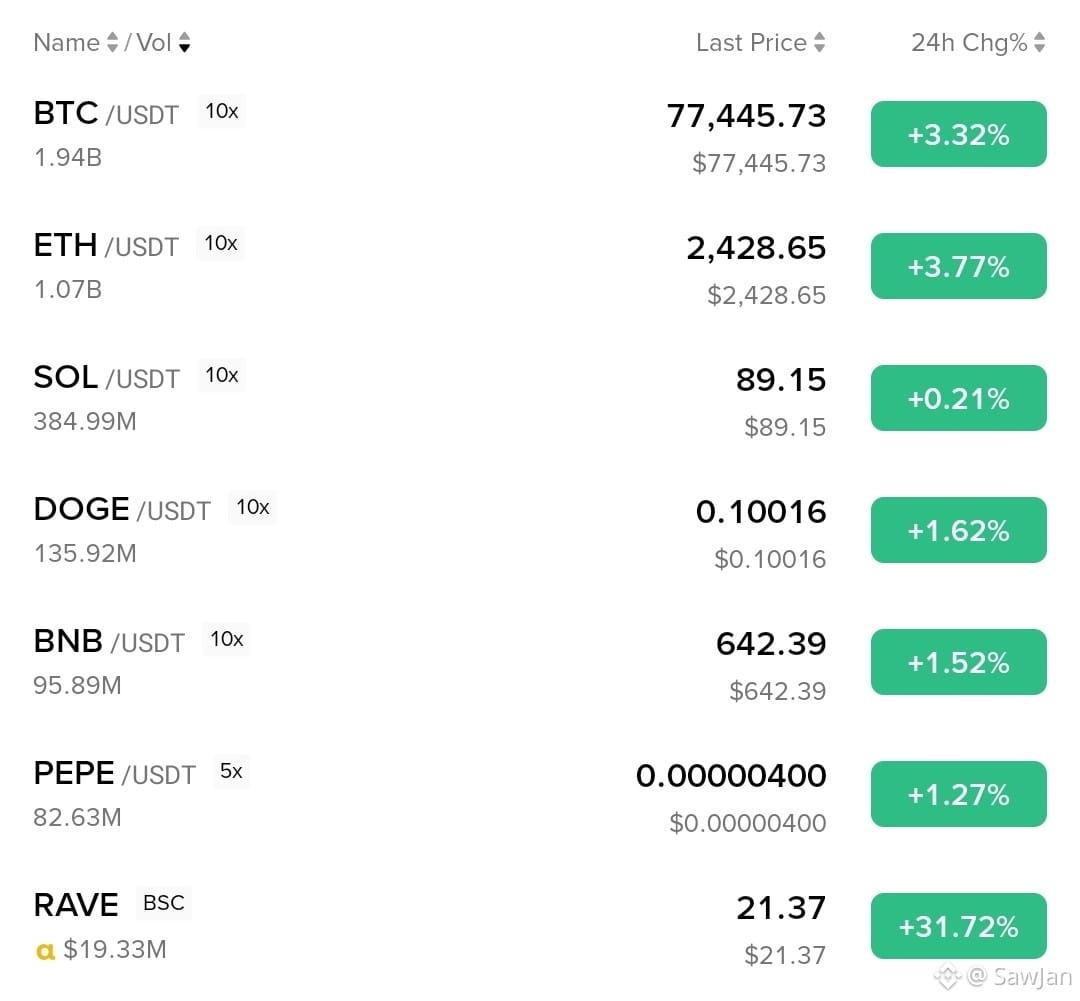
经过长时间,市场将会变得繁荣💚,$BTC ,$ETH ,$SOL 以及其他币种开始上涨,我希望市场一切顺利,每个币种都能回到它们之前的价格。
经过长时间,市场将会变得繁荣💚,$BTC ,$ETH ,$SOL 以及其他币种开始上涨,我希望市场一切顺利,每个币种都能回到它们之前的价格。
65
·
--

文章
查看翻译
pixelThe evolution of @Pixels is becoming one of the most interesting case studies in web3 gaming right now. What started as a simple farming-style game has gradually transformed into a much deeper and more structured ecosystem through its Stacked approach. This shift is not just about adding features, but about creating a sustainable loop where players, creators, and the in-game economy all reinforce each other.
At the center of this system is $PIXEL. Instead of being just another in-game currency, it’s being positioned as the core layer that connects activity, rewards, and long-term participation. As more mechanics are introduced into the Stacked ecosystem, the role of $PIXEL becomes more meaningful, especially as utility expands across different parts of the platform.
One of the most important aspects of this evolution is how @Pixels is aligning incentives. Players are no longer just grinding for short-term rewards; they are contributing to a broader system that benefits from active participation. Creators, on the other hand, are becoming key drivers of growth by bringing attention, education, and narrative to the ecosystem. This combination creates a flywheel effect that is hard to replicate.
Another thing worth noting is the focus on scalability. Many web3 games struggle to maintain user interest over time, but the Stacked ecosystem appears designed to continuously introduce new layers of engagement. This keeps the experience fresh while also strengthening the value proposition of $PIXEL .
If this direction continues, @Pixels could set a strong example for how web3 gaming ecosystems should be built — not around short-term hype, but around long-term value creation. The integration of gameplay, economy, and community is what makes this model stand out.
Overall, the growth of @Pixels and its Stacked ecosystem shows that we are moving toward a more mature phase of web3 gaming. It’s no longer just about playing; it’s about participating in an evolving digital economy. And with $PIXEL at the center of it all, the foundation looks solid for future expansion.
pixel
The evolution of @Pixels is becoming one of the most interesting case studies in web3 gaming right now. What started as a simple farming-style game has gradually transformed into a much deeper and more structured ecosystem through its Stacked approach. This shift is not just about adding features, but about creating a sustainable loop where players, creators, and the in-game economy all reinforce each other.
At the center of this system is $PIXEL . Instead of being just another in-game currency, it’s being positioned as the core layer that connects activity, rewards, and long-term participation. As more mechanics are introduced into the Stacked ecosystem, the role of $PIXEL becomes more meaningful, especially as utility expands across different parts of the platform.
One of the most important aspects of this evolution is how @Pixels is aligning incentives. Players are no longer just grinding for short-term rewards; they are contributing to a broader system that benefits from active participation. Creators, on the other hand, are becoming key drivers of growth by bringing attention, education, and narrative to the ecosystem. This combination creates a flywheel effect that is hard to replicate.
Another thing worth noting is the focus on scalability. Many web3 games struggle to maintain user interest over time, but the Stacked ecosystem appears designed to continuously introduce new layers of engagement. This keeps the experience fresh while also strengthening the value proposition of $PIXEL .
If this direction continues, @Pixels could set a strong example for how web3 gaming ecosystems should be built — not around short-term hype, but around long-term value creation. The integration of gameplay, economy, and community is what makes this model stand out.
Overall, the growth of @Pixels and its Stacked ecosystem shows that we are moving toward a more mature phase of web3 gaming. It’s no longer just about playing; it’s about participating in an evolving digital economy. And with $PIXEL at the center of it all, the foundation looks solid for future expansion.
18
·
--
查看翻译
pixelThe evolution of @Pixels is becoming one of the most interesting case studies in web3 gaming right now. What started as a simple farming-style game has gradually transformed into a much deeper and more structured ecosystem through its Stacked approach. This shift is not just about adding features, but about creating a sustainable loop where players, creators, and the in-game economy all reinforce each other.
At the center of this system is $PIXEL. Instead of being just another in-game currency, it’s being positioned as the core layer that connects activity, rewards, and long-term participation. As more mechanics are introduced into the Stacked ecosystem, the role of $PIXEL becomes more meaningful, especially as utility expands across different parts of the platform.
One of the most important aspects of this evolution is how @Pixels is aligning incentives. Players are no longer just grinding for short-term rewards; they are contributing to a broader system that benefits from active participation. Creators, on the other hand, are becoming key drivers of growth by bringing attention, education, and narrative to the ecosystem. This combination creates a flywheel effect that is hard to replicate.
Another thing worth noting is the focus on scalability. Many web3 games struggle to maintain user interest over time, but the Stacked ecosystem appears designed to continuously introduce new layers of engagement. This keeps the experience fresh while also strengthening the value proposition of $PIXEL.
If this direction continues, @Pixels could set a strong example for how web3 gaming ecosystems should be built — not around short-term hype, but around long-term value creation. The integration of gameplay, economy, and community is what makes this model stand out.
Overall, the growth of @Pixels and its Stacked ecosystem shows that we are moving toward a more mature phase of web3 gaming. It’s no longer just about playing; it’s about participating in an evolving digital economy. And with $PIXEL at the center of it all, the foundation looks solid for future expansion. #pixel
pixel
The evolution of @Pixels is becoming one of the most interesting case studies in web3 gaming right now. What started as a simple farming-style game has gradually transformed into a much deeper and more structured ecosystem through its Stacked approach. This shift is not just about adding features, but about creating a sustainable loop where players, creators, and the in-game economy all reinforce each other.
At the center of this system is $PIXEL. Instead of being just another in-game currency, it’s being positioned as the core layer that connects activity, rewards, and long-term participation. As more mechanics are introduced into the Stacked ecosystem, the role of $PIXEL becomes more meaningful, especially as utility expands across different parts of the platform.
One of the most important aspects of this evolution is how @Pixels is aligning incentives. Players are no longer just grinding for short-term rewards; they are contributing to a broader system that benefits from active participation. Creators, on the other hand, are becoming key drivers of growth by bringing attention, education, and narrative to the ecosystem. This combination creates a flywheel effect that is hard to replicate.
Another thing worth noting is the focus on scalability. Many web3 games struggle to maintain user interest over time, but the Stacked ecosystem appears designed to continuously introduce new layers of engagement. This keeps the experience fresh while also strengthening the value proposition of $PIXEL.
If this direction continues, @Pixels could set a strong example for how web3 gaming ecosystems should be built — not around short-term hype, but around long-term value creation. The integration of gameplay, economy, and community is what makes this model stand out.
Overall, the growth of @Pixels and its Stacked ecosystem shows that we are moving toward a more mature phase of web3 gaming. It’s no longer just about playing; it’s about participating in an evolving digital economy. And with $PIXEL at the center of it all, the foundation looks solid for future expansion. #pixel
18
·
--
查看翻译
Seeing @Pixels grow into a full Stacked ecosystem is honestly impressive. What started as a simple web3 game is now evolving into something much bigger, where $PIXEL plays a key role in connecting gameplay, economy, and creators. The way they are building utility around the token shows long-term thinking rather than short-term hype. More players, more creators, and more use cases mean stronger network effects over time. If this momentum continues, Pixels could become a benchmark for how web3 gaming ecosystems should scale. Definitely worth paying attention to how this develops. #pixel
Seeing @Pixels grow into a full Stacked ecosystem is honestly impressive. What started as a simple web3 game is now evolving into something much bigger, where $PIXEL plays a key role in connecting gameplay, economy, and creators. The way they are building utility around the token shows long-term thinking rather than short-term hype. More players, more creators, and more use cases mean stronger network effects over time. If this momentum continues, Pixels could become a benchmark for how web3 gaming ecosystems should scale. Definitely worth paying attention to how this develops. #pixel
20
·
--
查看翻译
Alpha Trading Competition you just see last day of events close no Trading Volume but you just start tarding then end event time . then see you are the last person never win event and Trading leaderboard is high 😂😂😂😂
Alpha Trading Competition you just see last day of events close no Trading Volume but you just start tarding then end event time . then see you are the last person never win event and Trading leaderboard is high 😂😂😂😂
2
·
--
文章
查看翻译
Most DeFi is still stateless execution.Most DeFi is still stateless execution. @mira_network introduces persistent, context-aware agents that learn, adapt, and coordinate capital over time. By combining verifiable data, memory, and programmable liquidity, Mira enables continuous strategy evolution instead of isolated trades. $MIRA aligns data, execution, and incentives into one feedback loop, creating infrastructure for AI-native markets that compound intelligence and capital together. #Mira
Most DeFi is still stateless execution.
Most DeFi is still stateless execution. @mira_network introduces persistent, context-aware agents that learn, adapt, and coordinate capital over time. By combining verifiable data, memory, and programmable liquidity, Mira enables continuous strategy evolution instead of isolated trades. $MIRA aligns data, execution, and incentives into one feedback loop, creating infrastructure for AI-native markets that compound intelligence and capital together. #Mira
1
·
--
大多数DeFi仍然是无状态执行。@mira_network.大多数DeFi仍然是无状态执行。@mira_network引入了持久的、上下文感知的代理,这些代理能够随着时间的推移学习、适应和协调资本。通过结合可验证的数据、记忆和可编程的流动性,Mira使得策略能够持续演变,而不是孤立的交易。$MIRA将数据、执行和激励整合为一个反馈循环,为AI原生市场创造基础设施,从而复合智能和资本。#mira $MIRA
大多数DeFi仍然是无状态执行。@mira_network.
大多数DeFi仍然是无状态执行。@mira_network引入了持久的、上下文感知的代理,这些代理能够随着时间的推移学习、适应和协调资本。通过结合可验证的数据、记忆和可编程的流动性,Mira使得策略能够持续演变,而不是孤立的交易。$MIRA 将数据、执行和激励整合为一个反馈循环,为AI原生市场创造基础设施,从而复合智能和资本。#mira $MIRA
4
·
--
可组合智能将定义链上市场的下一个阶段,而@mira_network正在为其构建协调层。通过为代理提供持久记忆、可验证的数据访问和可编程执行,Mira将孤立的智能合约调用转变为自适应金融行为。 $MIRA 在数据提供者、战略家和流动性场所之间对齐激励,创造了一个反馈循环,使策略随着时间的推移而改进,而不是在每次交易时重置。这是AI原生DeFi的基础设施——按设计状态保持、上下文感知和资本高效。 #mira $MIRA
可组合智能将定义链上市场的下一个阶段,而@mira_network正在为其构建协调层。通过为代理提供持久记忆、可验证的数据访问和可编程执行,Mira将孤立的智能合约调用转变为自适应金融行为。 $MIRA 在数据提供者、战略家和流动性场所之间对齐激励,创造了一个反馈循环,使策略随着时间的推移而改进,而不是在每次交易时重置。这是AI原生DeFi的基础设施——按设计状态保持、上下文感知和资本高效。 #mira $MIRA
3
·
--
自主代理需要统一的轨道来管理数据、内存和资本,而不发生碎片化。自主代理需要统一的轨道来管理数据、内存和资本,而不发生碎片化。这是@mira_network的核心——可验证基础设施上执行的有状态AI参与者,具有持续的上下文。$MIRA在数据、流动性和执行之间对齐激励,将孤立交易转变为自适应金融行为。这是AI原生DeFi的协调基础设施,在这里,策略可以学习、保持和在链上复合。#Mira
自主代理需要统一的轨道来管理数据、内存和资本,而不发生碎片化。
自主代理需要统一的轨道来管理数据、内存和资本,而不发生碎片化。这是@mira_network的核心——可验证基础设施上执行的有状态AI参与者,具有持续的上下文。$MIRA在数据、流动性和执行之间对齐激励,将孤立交易转变为自适应金融行为。这是AI原生DeFi的协调基础设施,在这里,策略可以学习、保持和在链上复合。#Mira
6
12
·
--
流动性、身份和执行需要在同一层中共存,以便 AI 驱动的金融得以扩展。这就是 @mira_network 背后的愿景——在统一轨道上运作的自主代理,具有可验证的上下文和可编程资本。$MIRA 不仅仅是一个代币,它是下一个机器经济的协调基础设施。
#mira $MIRA
流动性、身份和执行需要在同一层中共存,以便 AI 驱动的金融得以扩展。这就是 @mira_network 背后的愿景——在统一轨道上运作的自主代理,具有可验证的上下文和可编程资本。$MIRA 不仅仅是一个代币,它是下一个机器经济的协调基础设施。
#mira $MIRA
#mira $MIRA
10
22
·
--
查看翻译
#BinanceTurns8 Join us in the #BinanceTurns8 celebration and win a share of up to $888,888 in BNB!
#BinanceTurns8 Join us in the #BinanceTurns8 celebration and win a share of up to $888,888 in BNB!
5
5
登录解锁更多内容
加入币安广场,与全球加密货币用户互动
⚡️ 获取关于加密货币的最新实用信息。
💬 受到全球最大加密货币交易平台的信赖。
👍 发现来自认证创作者的真知灼见。
邮箱/手机号码
热门话题
Strategy未购比特币斥资2.05亿美元回购STRC
1,797 次浏览
68 人讨论中
#strategy市值超越纳斯达克跻身全球前400 微策略不买币了,慌不慌?
兄弟们,盘前扫了一眼MSTR,市值刚超纳斯达克挤进全球前400,按理说塞勒该敲锣打鼓继续扫货才对。结果呢?上周只这周完全没买。
别急着喊“BTC太贵买不起”。
真相在资金流向上:同一周,MSTR掏了1.93亿美金回购自家STRC优先股,买饼才花了2200万。钱没少花,但方向换了。
不是饼贵,是优先股股息快把现金流啃穿了。 STR C那玩意儿年化12%的股息,发得越多,美元利息压得越喘不过气。
塞勒现在干的活,是先把高息债往回买,降低未来的固定支出,而不是继续往饼里砸钱。
再看盘前实况。 BTC今天已经跌破八万,报八万零两百附近,FOMC前避险情绪拉满。MSTR盘前挂在141.6左右,昨天收跌3%出头。
这走势说明市场也在算账:你市值靠饼撑着,饼在跌,你又不加仓,溢价靠什么撑?$MSTR $BTC $ETH #Strategy未购比特币斥资2.05亿美元回购STRC
老腊肉-kevin
·12次点赞
·29.7k 次浏览
BitMine增持10452枚ETH
35,432 次浏览
294 人讨论中
韩国考虑对加密交易所征教育税
32,911 次浏览
292 人讨论中