
Bınance Referal Code - LONG2027
214 Bài đăng
Bınance Referal Code - LONG2027
Báo cáo
Chặn người dùng
Independent guides to Binance referral code 2027, Spot & Futures trading fees, and fee-saving strategies. LONG2027: 20% fee rebates for eligible new users.
5 Đang theo dõi
243 Người theo dõi
454 Đã thích
Bài đăng
Tất cả
Video
PINNED
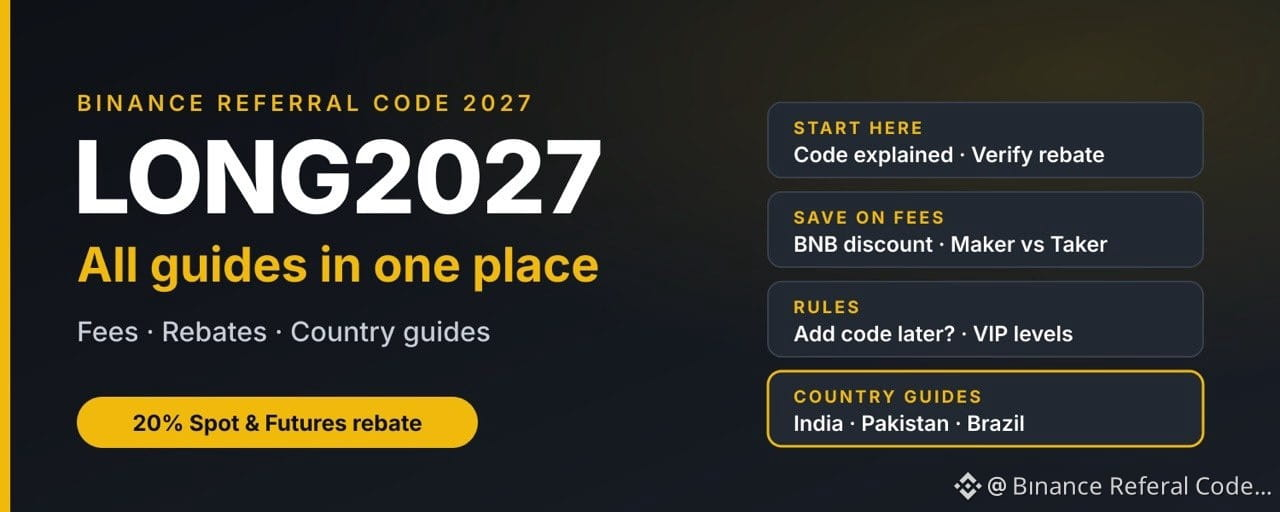
Mã giới thiệu Binance LONG2027: Tất cả hướng dẫn ở một nơi
Đăng ký với LONG2027 để được hoàn 20% phí giao dịch Spot và Futures. Đây là tất cả thông tin bạn cần, trong một danh sách. Lưu bài viết này lại 📌
🟡 BẮT ĐẦU TẠI ĐÂY
Giải thích về LONG2027: khoản hoàn 20% hoạt động như thế nào
[https://www.binance.com/en/square/post/381420313464132](https://www.binance.com/en/square/post/381420313464132)
Cách xác minh bạn đang nhận được khoản hoàn phí
[https://www.binance.com/en/square/post/381417441423510](https://www.binance.com/en/square/post/381417441423510)
💰 TIẾT KIỆM PHÍ NHIỀU HƠN
LONG2027 + BNB: giảm phí Spot đến 40%
[https://www.binance.com/en/square/post/387070005349510](https://www.binance.com/en/square/post/387070005349510)
Maker và Taker: trả phí Futures thấp hơn đến 71%
[https://www.binance.com/en/square/post/387471341496894](https://www.binance.com/en/square/post/387471341496894)
📘 CÁC QUY TẮC CẦN BIẾT
Đã đăng ký rồi? Bạn có thể thêm LONG2027 sau không?
[https://www.binance.com/en/square/post/381737980857470](https://www.binance.com/en/square/post/381737980857470)
Mức hoàn 20% vẫn áp dụng ở VIP 1, 2 hoặc 3 chứ?
[https://www.binance.com/en/square/post/383179103617866](https://www.binance.com/en/square/post/383179103617866)
🌍 HƯỚNG DẪN THEO QUỐC GIA
🇮🇳 Ấn Độ: KYC PAN, nạp INR qua UPI
[https://www.binance.com/en/square/post/387766995636836](https://www.binance.com/en/square/post/387766995636836)
🇵🇰 Pakistan: KYC CNIC, nạp PKR qua P2P
[https://www.binance.com/en/square/post/387473622057251](https://www.binance.com/en/square/post/387473622057251)
🇧🇷 Brazil: CPF, KYC và nạp BRL
[https://www.binance.com/en/square/post/385646010141899](https://www.binance.com/en/square/post/385646010141899)
Bạn muốn hướng dẫn tiếp theo về quốc gia nào? Hãy cho tôi biết trong phần bình luận 👇
Nội dung độc lập, không liên kết với Binance. Giao dịch tiền mã hóa tiềm ẩn rủi ro.
#BinanceReferralCode #LONG2027 #Binance #TradingFees #CryptoGuide
Mã giới thiệu Binance LONG2027: Tất cả hướng dẫn ở một nơi
Đăng ký với LONG2027 để được hoàn 20% phí giao dịch Spot và Futures. Đây là tất cả thông tin bạn cần, trong một danh sách. Lưu bài viết này lại 📌
🟡 BẮT ĐẦU TẠI ĐÂY
Giải thích về LONG2027: khoản hoàn 20% hoạt động như thế nào
https://www.binance.com/en/square/post/381420313464132
Cách xác minh bạn đang nhận được khoản hoàn phí
https://www.binance.com/en/square/post/381417441423510
💰 TIẾT KIỆM PHÍ NHIỀU HƠN
LONG2027 + BNB: giảm phí Spot đến 40%
https://www.binance.com/en/square/post/387070005349510
Maker và Taker: trả phí Futures thấp hơn đến 71%
https://www.binance.com/en/square/post/387471341496894
📘 CÁC QUY TẮC CẦN BIẾT
Đã đăng ký rồi? Bạn có thể thêm LONG2027 sau không?
https://www.binance.com/en/square/post/381737980857470
Mức hoàn 20% vẫn áp dụng ở VIP 1, 2 hoặc 3 chứ?
https://www.binance.com/en/square/post/383179103617866
🌍 HƯỚNG DẪN THEO QUỐC GIA
🇮🇳 Ấn Độ: KYC PAN, nạp INR qua UPI
https://www.binance.com/en/square/post/387766995636836
🇵🇰 Pakistan: KYC CNIC, nạp PKR qua P2P
https://www.binance.com/en/square/post/387473622057251
🇧🇷 Brazil: CPF, KYC và nạp BRL
https://www.binance.com/en/square/post/385646010141899
Bạn muốn hướng dẫn tiếp theo về quốc gia nào? Hãy cho tôi biết trong phần bình luận 👇
Nội dung độc lập, không liên kết với Binance. Giao dịch tiền mã hóa tiềm ẩn rủi ro.
#BinanceReferralCode #LONG2027 #Binance #TradingFees #CryptoGuide
107
Tăng & Giảm: Altcoin yếu, một vài đồng vốn hóa nhỏ tăng
Các đồng giảm trong nhóm vốn hóa lớn (24 giờ):
$XRP khoảng -5,8%
$ETH khoảng -4,6% đến -5,0%, yếu nhất trong top 2
$SOL khoảng -2,7%
Các đồng tăng (24 giờ, vốn hóa nhỏ):
$HOT khoảng +12%. Thị trường liên hệ đà tăng này với việc ra mắt mạng lưới HoloFuel và các đợt chuyển đổi HOT bắt đầu từ ngày 1 tháng 11. Đã chính thức xác nhận đây là động lực tăng giá hôm nay chưa: chưa (chỉ là suy đoán)
$BMT khoảng +5%. Chưa tìm thấy chất xúc tác nào được xác nhận.
Cần theo dõi: liệu đà tăng của các đồng vốn hóa nhỏ có duy trì nếu BTC mất ngưỡng hỗ trợ hay không. Các đợt tăng giá do thanh khoản thấp có thể đảo chiều nhanh chóng.
#Altcoins #TopGainers #CryptoTrading #XRP
236
Mở khóa token tuần này: Dẫn đầu về quy mô so với nguồn cung
Các đợt mở khóa đáng chú ý:
11 tháng 11: $ALLO O, khoảng 160 triệu token (khoảng 23,7 triệu USD), khoảng 65,6% nguồn cung lưu hành
12 tháng 11: mở khóa $RAIN.US (không nêu quy mô)
13 tháng 11: $AZTEC , khoảng 797 triệu token (khoảng 10,3 triệu USD), khoảng 31,8% nguồn cung lưu hành
14 tháng 11: $YZY khoảng 29,2 triệu token (khoảng 8,4 triệu USD), khoảng 4,1% nguồn cung lưu hành
15 tháng 11: mở khóa $STRK và $SIGN
Vì sao điều này quan trọng: các đợt mở khóa có quy mô lớn so với nguồn cung lưu hành có thể làm gia tăng áp lực bán, dù tác động còn tùy thuộc vào người nhận token và các điều khoản phân bổ token theo thời gian.
#TokenUnlock #ALLO #AZTEC #Altcoins
6
768
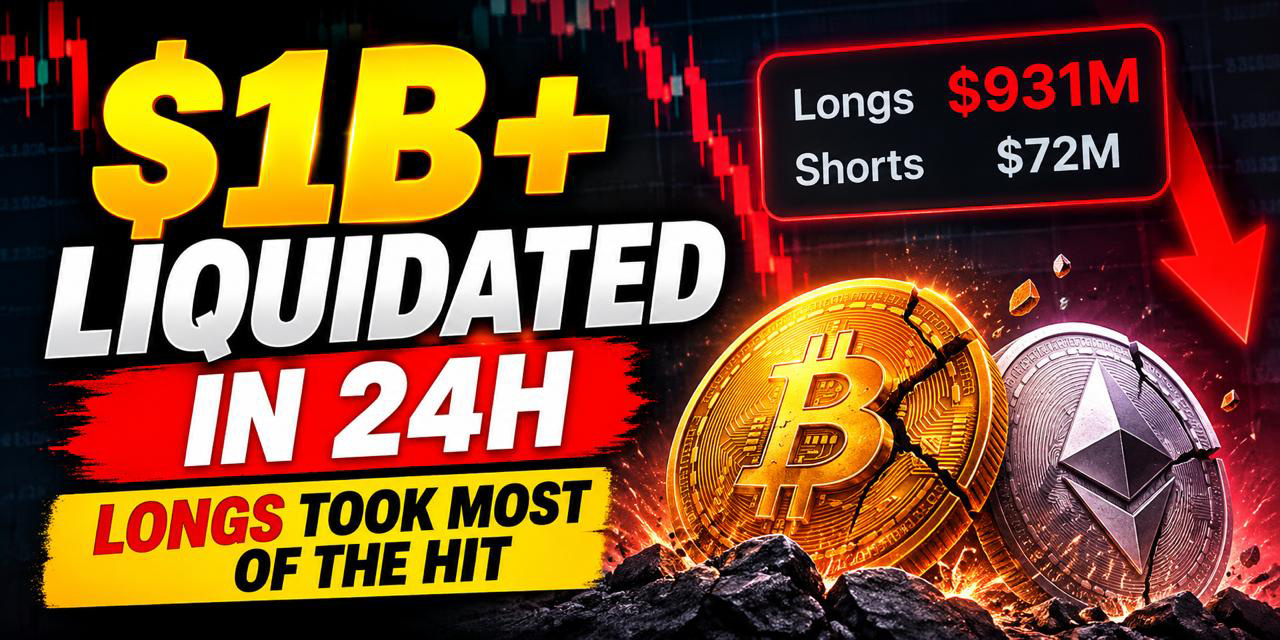
Hơn 1 tỷ USD bị thanh lý trong 24 giờ. Các vị thế mua chịu thiệt hại nặng nhất
Chuyện gì đã xảy ra: hơn 1 tỷ USD vị thế sử dụng đòn bẩy đã bị thanh lý trong 24 giờ, trong đó khoảng 931 triệu USD là các vị thế mua. Khoảng 803 triệu USD bị thanh lý trong một khoảng thời gian 4 giờ khi thị trường lao dốc qua đêm.
Theo tài sản:
$ETH khoảng 455 triệu USD
$BTC khoảng 278 triệu USD
Lệnh thanh lý đơn lẻ lớn nhất: một vị thế ETH trị giá khoảng 48 triệu USD
Vì sao điều này quan trọng: các vị thế mua tập trung đông, cộng với thanh khoản mỏng từ cuối tuần đến thứ Hai, đã khiến biến động theo cả hai chiều mạnh hơn.
Cần theo dõi: tỷ lệ funding và khối lượng hợp đồng mở. Việc đòn bẩy được thiết lập lại thường diễn ra trước khi giá biến động êm hơn, nhưng điều đó không được đảm bảo.
#ThanhLy #Bitcoin #Ethereum #DonBay
2
70
Bài viết
Xem bản dịch
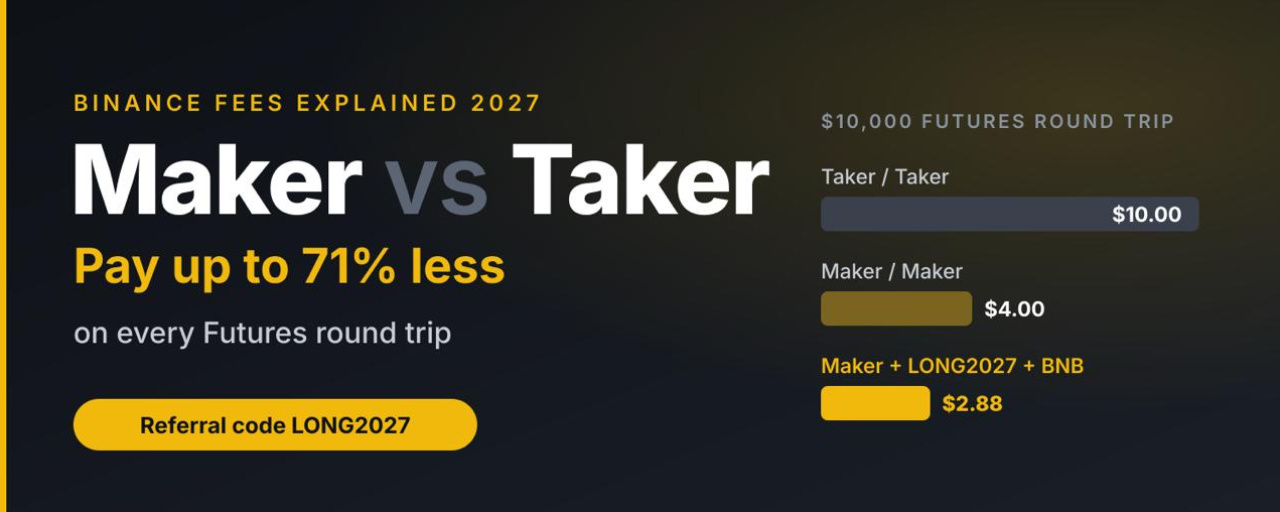
Binance Maker vs Taker Fees Explained (2027): Pay Up to 71% Less on Futures With LONG2027Short answer: On Binance, a "taker" order fills right away against the order book, and a "maker" order waits on the book until someone fills it. On USDⓈ-M Futures, maker fees are much lower than taker fees. Combine maker orders with referral code LONG2027 and BNB fee payment, and a $10,000 Futures round trip costs $2.88 instead of $10.00.
New to LONG2027? Start with the main guide:
[https://www.binance.com/en/square/post/381420313464132](https://www.binance.com/en/square/post/381420313464132)
1. WHAT IS A MAKER AND WHAT IS A TAKER?
🔸 Taker: your order matches an existing order on the book and fills immediately. You "take" liquidity.
Examples: market orders, stop-market orders, and limit orders priced to fill instantly.
🔸 Maker: your order sits on the order book and waits. You "make" liquidity for other traders.
Example: a buy limit order placed below the current price.
A simple way to remember it: if your order fills the moment you click, you are almost always a taker.
2. BINANCE MAKER AND TAKER FEES (REGULAR USER / VIP 0)
🔸 Spot: 0.10% maker, 0.10% taker
🔸 USDⓈ-M Futures: 0.02% maker, 0.05% taker
Spot charges regular users the same rate either way. On Futures, the taker fee is 2.5 times the maker fee. That gap is where the real savings are.
3. WHAT THE DIFFERENCE COSTS ON FUTURES
A round trip means opening and closing one position, so you pay the fee twice.
📊 $10,000 USDⓈ-M position, opened and closed
🔸 Taker in, taker out: $5.00 + $5.00 = $10.00
🔸 Maker in, maker out: $2.00 + $2.00 = $4.00
🔸 Maker + BNB payment (10% off): $3.60
✅ Maker + BNB + LONG2027 (20% rebate): $2.88
That is about 71% less than the taker/taker cost.
💰 Monthly example
A trader who makes 20 round trips of $10,000 per month:
🔸 Always taker, no discounts: $200 per month
✅ Maker orders + BNB + LONG2027: about $57.60 per month
That is roughly $142 saved every month, or more than $1,700 a year.
Full details on how BNB payment and LONG2027 work together:
[https://www.binance.com/en/square/post/387070005349510](https://www.binance.com/en/square/post/387070005349510)
4. HOW TO MAKE SURE YOU PAY THE MAKER FEE
Use "Post Only." A Post Only limit order is never filled immediately. It goes onto the order book as a maker order, so you are only charged the maker fee. If it would fill instantly, Binance cancels it instead of charging you the taker fee.
On Futures:
1. Choose Limit as the order type
2. Tick "Post Only"
3. Place your buy below the best ask, or your sell above the best bid
On Spot:
1. Open the Spot trading page
2. Click the Settings icon at the top right, then the Layout tab
3. Under Order Mode, choose Advanced
4. Tick "Post Only" when placing a limit order
For API traders: Spot uses the LIMIT_MAKER order type, and Futures uses timeInForce = GTX.
5. WHEN PAYING THE TAKER FEE IS STILL WORTH IT
Maker orders are cheaper, but they may never fill. Taker orders still make sense when:
🔸 You need to exit a losing position fast
🔸 The market is moving quickly and missing the entry costs more than the fee
🔸 You are closing a position to avoid liquidation
A stop-loss that triggers as a market order is always a taker order. That is normal. Never remove a stop-loss just to save on fees.
6. COMMON MISTAKES
❌ Thinking every limit order is a maker order
A limit buy priced above the current ask fills instantly and is charged as a taker.
❌ Forgetting to add the referral code at sign-up
A referral code normally has to be entered when the account is created. If you have already signed up:
[https://www.binance.com/en/square/post/381737980857470](https://www.binance.com/en/square/post/381737980857470)
❌ Not checking your actual fees
Check your trade history to see whether each fill was maker or taker, and confirm your rebates here:
[https://www.binance.com/en/square/post/381417441423510](https://www.binance.com/en/square/post/381417441423510)
❌ Ignoring VIP levels
At higher VIP levels, fee rates and referral rules change:
[https://www.binance.com/en/square/post/383179103617866](https://www.binance.com/en/square/post/383179103617866)
FAQ
❓ Is a limit order always a maker order?
No. It is a maker order only if it rests on the order book. Use Post Only to be sure.
❓ Is the maker fee cheaper on Spot?
For regular users, Spot maker and taker fees are both 0.10%. The difference appears on Futures and at higher VIP levels.
❓ Does LONG2027 apply to both maker and taker fees?
Yes. The 20% rebate applies to the trading fees you pay on Spot and Futures.
❓ What happens if my Post Only order would fill immediately?
It is canceled rather than filled as a taker order. Adjust the price and place it again.
🔑 Binance Referral Code: LONG2027
20% Spot and Futures fee rebate
This is independent content and is not affiliated with or endorsed by Binance. Fees and programs can change; the rates shown in your Binance account are the binding ones. Crypto trading carries risk.
#BinanceReferralCode #LONG2027 #MakerTaker #BinanceFutures #TradingFees
Binance Maker vs Taker Fees Explained (2027): Pay Up to 71% Less on Futures With LONG2027
Short answer: On Binance, a "taker" order fills right away against the order book, and a "maker" order waits on the book until someone fills it. On USDⓈ-M Futures, maker fees are much lower than taker fees. Combine maker orders with referral code LONG2027 and BNB fee payment, and a $10,000 Futures round trip costs $2.88 instead of $10.00.
New to LONG2027? Start with the main guide:
https://www.binance.com/en/square/post/381420313464132
1. WHAT IS A MAKER AND WHAT IS A TAKER?
🔸 Taker: your order matches an existing order on the book and fills immediately. You "take" liquidity.
Examples: market orders, stop-market orders, and limit orders priced to fill instantly.
🔸 Maker: your order sits on the order book and waits. You "make" liquidity for other traders.
Example: a buy limit order placed below the current price.
A simple way to remember it: if your order fills the moment you click, you are almost always a taker.
2. BINANCE MAKER AND TAKER FEES (REGULAR USER / VIP 0)
🔸 Spot: 0.10% maker, 0.10% taker
🔸 USDⓈ-M Futures: 0.02% maker, 0.05% taker
Spot charges regular users the same rate either way. On Futures, the taker fee is 2.5 times the maker fee. That gap is where the real savings are.
3. WHAT THE DIFFERENCE COSTS ON FUTURES
A round trip means opening and closing one position, so you pay the fee twice.
📊 $10,000 USDⓈ-M position, opened and closed
🔸 Taker in, taker out: $5.00 + $5.00 = $10.00
🔸 Maker in, maker out: $2.00 + $2.00 = $4.00
🔸 Maker + BNB payment (10% off): $3.60
✅ Maker + BNB + LONG2027 (20% rebate): $2.88
That is about 71% less than the taker/taker cost.
💰 Monthly example
A trader who makes 20 round trips of $10,000 per month:
🔸 Always taker, no discounts: $200 per month
✅ Maker orders + BNB + LONG2027: about $57.60 per month
That is roughly $142 saved every month, or more than $1,700 a year.
Full details on how BNB payment and LONG2027 work together:
https://www.binance.com/en/square/post/387070005349510
4. HOW TO MAKE SURE YOU PAY THE MAKER FEE
Use "Post Only." A Post Only limit order is never filled immediately. It goes onto the order book as a maker order, so you are only charged the maker fee. If it would fill instantly, Binance cancels it instead of charging you the taker fee.
On Futures:
1. Choose Limit as the order type
2. Tick "Post Only"
3. Place your buy below the best ask, or your sell above the best bid
On Spot:
1. Open the Spot trading page
2. Click the Settings icon at the top right, then the Layout tab
3. Under Order Mode, choose Advanced
4. Tick "Post Only" when placing a limit order
For API traders: Spot uses the LIMIT_MAKER order type, and Futures uses timeInForce = GTX.
5. WHEN PAYING THE TAKER FEE IS STILL WORTH IT
Maker orders are cheaper, but they may never fill. Taker orders still make sense when:
🔸 You need to exit a losing position fast
🔸 The market is moving quickly and missing the entry costs more than the fee
🔸 You are closing a position to avoid liquidation
A stop-loss that triggers as a market order is always a taker order. That is normal. Never remove a stop-loss just to save on fees.
6. COMMON MISTAKES
❌ Thinking every limit order is a maker order
A limit buy priced above the current ask fills instantly and is charged as a taker.
❌ Forgetting to add the referral code at sign-up
A referral code normally has to be entered when the account is created. If you have already signed up:
https://www.binance.com/en/square/post/381737980857470
❌ Not checking your actual fees
Check your trade history to see whether each fill was maker or taker, and confirm your rebates here:
https://www.binance.com/en/square/post/381417441423510
❌ Ignoring VIP levels
At higher VIP levels, fee rates and referral rules change:
https://www.binance.com/en/square/post/383179103617866
FAQ
❓ Is a limit order always a maker order?
No. It is a maker order only if it rests on the order book. Use Post Only to be sure.
❓ Is the maker fee cheaper on Spot?
For regular users, Spot maker and taker fees are both 0.10%. The difference appears on Futures and at higher VIP levels.
❓ Does LONG2027 apply to both maker and taker fees?
Yes. The 20% rebate applies to the trading fees you pay on Spot and Futures.
❓ What happens if my Post Only order would fill immediately?
It is canceled rather than filled as a taker order. Adjust the price and place it again.
🔑 Binance Referral Code: LONG2027
20% Spot and Futures fee rebate
This is independent content and is not affiliated with or endorsed by Binance. Fees and programs can change; the rates shown in your Binance account are the binding ones. Crypto trading carries risk.
#BinanceReferralCode #LONG2027 #MakerTaker #BinanceFutures #TradingFees
2
7
Bài viết
Xem bản dịch
Binance Referral Code LONG2027 + BNB Fee Discount (2027): How to Cut Spot Fees by Up to 40%Short answer: Binance gives two separate fee benefits, and you can use both at once.
1. Referral code LONG2027: a 20% rebate on Spot and Futures trading fees, entered at sign-up.
2. Paying fees with BNB: 25% off Spot fees and 10% off USDⓈ-M Futures fees.
Using both together brings a regular user's Spot fee down from 0.10% to roughly 0.06%.
New to the code? Start with the main guide:
[https://www.binance.com/en/square/post/381420313464132](https://www.binance.com/en/square/post/381420313464132)
1. BINANCE'S STANDARD FEES (REGULAR USER / VIP 0)
🔸 Spot: 0.10% maker, 0.10% taker
🔸 USDⓈ-M Futures: 0.02% maker, 0.05% taker
Fees go down as your VIP level rises. VIP levels depend on your 30-day trading volume and your BNB balance.
2. HOW THE BNB FEE DISCOUNT WORKS
🔸 Spot and Margin: 25% discount, so the 0.10% fee becomes 0.075%
🔸 USDⓈ-M Futures: 10% discount, so the 0.05% taker fee becomes 0.045%
🔸 COIN-M Futures: no BNB discount
How to turn it on:
1. Go to Profile > Dashboard > Trading Fees
2. Enable "Using BNB Deduction"
3. For Futures, transfer BNB to your USDⓈ-M Futures wallet. If there is not enough BNB in that wallet, Binance charges the fee in USDT and the 10% discount does not apply.
3. HOW LONG2027 STACKS WITH BNB
The referral rebate and the BNB discount are separate programs. In general, the 20% referral rebate is calculated on the fee you actually pay. So the BNB discount is applied first, and the rebate then comes back on the reduced fee.
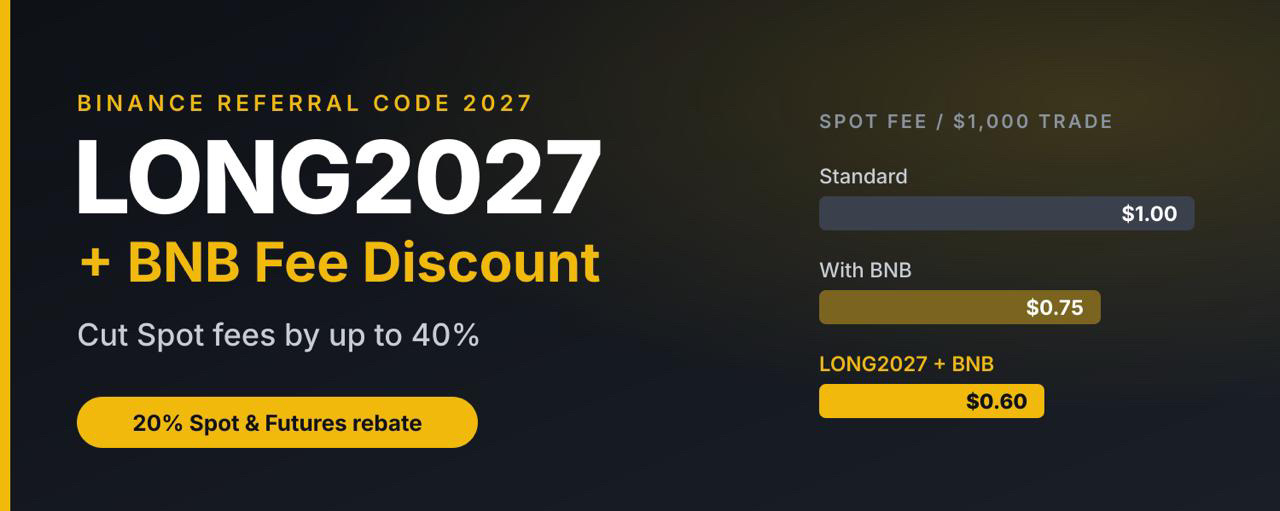
📊 Spot example: buying $1,000 of BTC
🔸 No code, no BNB: $1.00 fee
🔸 BNB only: $0.75 fee (25% saving)
🔸 LONG2027 only: $0.80 fee (20% saving)
✅ LONG2027 + BNB: $0.60 fee (40% saving)
📊 Futures example: a $10,000 USDⓈ-M position (taker)
🔸 No code, no BNB: $5.00 fee
🔸 BNB only: $4.50 fee (10% saving)
✅ LONG2027 + BNB: $3.60 fee (28% saving)
For a maker order of the same size, the fee drops from $2.00 to $1.44.
💰 What it adds up to for an active trader
Someone who trades $20,000 of Spot volume a month pays about $240 a year in fees with no discounts. With LONG2027 and BNB together, that drops to about $144, a saving of roughly $96 a year. The more you trade, the bigger the difference.
You can check the rebates you actually receive in your account. Here is how:
[https://www.binance.com/en/square/post/381417441423510](https://www.binance.com/en/square/post/381417441423510)
4. COMMON MISTAKES
❌ Not using a referral code at sign-up
You can turn on BNB payment at any time, but a referral code normally has to be entered while creating the account. If you have already signed up, read this:
[https://www.binance.com/en/square/post/381737980857470](https://www.binance.com/en/square/post/381737980857470)
❌ Keeping BNB only in the Spot wallet
The Futures discount works only with BNB in the USDⓈ-M Futures wallet.
❌ Running out of BNB
When your balance can't cover a fee, that fee is charged at the standard rate. Keep a small buffer of BNB.
❌ Assuming the rates stay the same as your VIP level rises
At higher VIP levels, referral rules change. Details:
[https://www.binance.com/en/square/post/383179103617866](https://www.binance.com/en/square/post/383179103617866)
5. QUICK SETUP CHECKLIST
✅ Sign up with referral code LONG2027
✅ Complete identity verification (KYC). Country example (Brazil):
[https://www.binance.com/en/square/post/385646010141899](https://www.binance.com/en/square/post/385646010141899)
✅ Buy a small amount of BNB
✅ Enable "Using BNB Deduction"
✅ If you trade Futures, transfer BNB to your USDⓈ-M wallet
✅ Check your rebate records after your first trades
FAQ
❓ Can I use LONG2027 and BNB payment at the same time?
Yes. They are separate programs, and the BNB discount does not cancel the referral rebate.
❓ Does BNB give a discount on Futures too?
Yes, 10% on USDⓈ-M Futures. COIN-M Futures has no BNB discount.
❓ How much BNB do I need?
There is no fixed minimum, but your balance must be enough to cover each trade's fee.
❓ Is the 25% BNB discount permanent?
Binance says it is valid until further notice. Rates can change, so always check your account's fee page.
🔑 Binance Referral Code: LONG2027
20% Spot and Futures fee rebate
This is independent content and is not affiliated with or endorsed by Binance. Fees and programs can change; the rates shown in your Binance account are the binding ones. Crypto trading carries risk.
#BinanceReferralCode #LONG2027 #BNB #BinanceFees #TradingFees
Binance Referral Code LONG2027 + BNB Fee Discount (2027): How to Cut Spot Fees by Up to 40%
Short answer: Binance gives two separate fee benefits, and you can use both at once.
1. Referral code LONG2027: a 20% rebate on Spot and Futures trading fees, entered at sign-up.
2. Paying fees with BNB: 25% off Spot fees and 10% off USDⓈ-M Futures fees.
Using both together brings a regular user's Spot fee down from 0.10% to roughly 0.06%.
New to the code? Start with the main guide:
https://www.binance.com/en/square/post/381420313464132
1. BINANCE'S STANDARD FEES (REGULAR USER / VIP 0)
🔸 Spot: 0.10% maker, 0.10% taker
🔸 USDⓈ-M Futures: 0.02% maker, 0.05% taker
Fees go down as your VIP level rises. VIP levels depend on your 30-day trading volume and your BNB balance.
2. HOW THE BNB FEE DISCOUNT WORKS
🔸 Spot and Margin: 25% discount, so the 0.10% fee becomes 0.075%
🔸 USDⓈ-M Futures: 10% discount, so the 0.05% taker fee becomes 0.045%
🔸 COIN-M Futures: no BNB discount
How to turn it on:
1. Go to Profile > Dashboard > Trading Fees
2. Enable "Using BNB Deduction"
3. For Futures, transfer BNB to your USDⓈ-M Futures wallet. If there is not enough BNB in that wallet, Binance charges the fee in USDT and the 10% discount does not apply.
3. HOW LONG2027 STACKS WITH BNB
The referral rebate and the BNB discount are separate programs. In general, the 20% referral rebate is calculated on the fee you actually pay. So the BNB discount is applied first, and the rebate then comes back on the reduced fee.
📊 Spot example: buying $1,000 of BTC
🔸 No code, no BNB: $1.00 fee
🔸 BNB only: $0.75 fee (25% saving)
🔸 LONG2027 only: $0.80 fee (20% saving)
✅ LONG2027 + BNB: $0.60 fee (40% saving)
📊 Futures example: a $10,000 USDⓈ-M position (taker)
🔸 No code, no BNB: $5.00 fee
🔸 BNB only: $4.50 fee (10% saving)
✅ LONG2027 + BNB: $3.60 fee (28% saving)
For a maker order of the same size, the fee drops from $2.00 to $1.44.
💰 What it adds up to for an active trader
Someone who trades $20,000 of Spot volume a month pays about $240 a year in fees with no discounts. With LONG2027 and BNB together, that drops to about $144, a saving of roughly $96 a year. The more you trade, the bigger the difference.
You can check the rebates you actually receive in your account. Here is how:
https://www.binance.com/en/square/post/381417441423510
4. COMMON MISTAKES
❌ Not using a referral code at sign-up
You can turn on BNB payment at any time, but a referral code normally has to be entered while creating the account. If you have already signed up, read this:
https://www.binance.com/en/square/post/381737980857470
❌ Keeping BNB only in the Spot wallet
The Futures discount works only with BNB in the USDⓈ-M Futures wallet.
❌ Running out of BNB
When your balance can't cover a fee, that fee is charged at the standard rate. Keep a small buffer of BNB.
❌ Assuming the rates stay the same as your VIP level rises
At higher VIP levels, referral rules change. Details:
https://www.binance.com/en/square/post/383179103617866
5. QUICK SETUP CHECKLIST
✅ Sign up with referral code LONG2027
✅ Complete identity verification (KYC). Country example (Brazil):
https://www.binance.com/en/square/post/385646010141899
✅ Buy a small amount of BNB
✅ Enable "Using BNB Deduction"
✅ If you trade Futures, transfer BNB to your USDⓈ-M wallet
✅ Check your rebate records after your first trades
FAQ
❓ Can I use LONG2027 and BNB payment at the same time?
Yes. They are separate programs, and the BNB discount does not cancel the referral rebate.
❓ Does BNB give a discount on Futures too?
Yes, 10% on USDⓈ-M Futures. COIN-M Futures has no BNB discount.
❓ How much BNB do I need?
There is no fixed minimum, but your balance must be enough to cover each trade's fee.
❓ Is the 25% BNB discount permanent?
Binance says it is valid until further notice. Rates can change, so always check your account's fee page.
🔑 Binance Referral Code: LONG2027
20% Spot and Futures fee rebate
This is independent content and is not affiliated with or endorsed by Binance. Fees and programs can change; the rates shown in your Binance account are the binding ones. Crypto trading carries risk.
#BinanceReferralCode #LONG2027 #BNB #BinanceFees #TradingFees
4
5
Bài viết
Xem bản dịch
How to Register on Binance in India (2027): PAN Card, KYC, INR Deposits, UPI and Referral Code LONG2Creating a Binance account in India involves more than entering an email address and setting a password. New users must complete identity verification, provide the information required under India's compliance framework, and check which INR payment methods are available to their accounts.
For Indian residents, one of the most important KYC details is the Permanent Account Number (PAN). Binance has specifically stated that PAN information is required as part of its identity-verification process for users in India.
This guide explains how to register on Binance in India in 2027, complete KYC, understand INR funding options, use P2P carefully, and check a referral code before finishing registration.
The guide is based on Binance's India-specific support information available in November 2026. Payment methods, product access, and referral eligibility can change, so always follow the options and instructions displayed in your own account.
1. Visit the Official Binance Website
Start by visiting the official Binance website or downloading the official Binance application.
For the India-specific experience, you can use:
https://www.binance.com/en-IN
Select the option to create a new account.
Before proceeding, make sure you are using the genuine Binance website or application. Avoid sponsored search results, unofficial Telegram groups, and links sent by unknown accounts.
If you are registering as an individual, choose a personal account. If you are registering on behalf of a company, review the entity-account process instead.
Binance's registration guide warns that the account type should be selected carefully because it cannot simply be changed after registration.
2. Create Your Binance Account
Binance supports several registration methods, including:
- Email address
- Mobile phone number
- Apple account
- Google account
- Telegram, where available
For email or phone registration, follow these steps:
1. Enter your email address or mobile number.
2. Read and accept the Terms of Service and Privacy Policy.
3. Request the verification code.
4. Enter the six-digit code sent to your email or phone.
5. Create a secure password.
6. Complete the initial account registration.
Binance's published registration instructions specify that a password must contain at least eight characters, including at least one uppercase letter and one number.
Use contact details that you control. Your email address and phone number may be needed for security checks, account recovery, and important account notifications.
3. Enter Your Referral Code Before Completing Registration
If you plan to register using a referral code, check the referral section before completing the account setup.
If you open an eligible referral registration link, Binance may automatically populate the referral field.
For the LONG2027 code, follow this process:
1. Open the applicable registration link.
2. Continue to the account creation screen.
3. Locate the referral code field.
4. Check whether LONG2027 is displayed.
5. Confirm that Binance shows the code as successfully linked.
6. Review any referral benefit displayed for your account and region.
Binance's registration guide explains that a successfully linked referral code appears with a green confirmation indicator and the word "Linked".
Do not assume that the code has been attached simply because you opened a referral link.
There is also an important distinction between Referral Lite and Referral Pro. Binance states that a new user can register through only one referral mode. If an account is created through Referral Lite, the user cannot later register again through Referral Pro.
The actual benefits depend on the referral mode, eligibility, regional restrictions, and terms displayed during registration. Do not assume that a benefit advertised for another country automatically applies to an Indian account.
4. Complete Identity Verification (KYC)
After creating your account, open the identity-verification section.
On the Binance website, the usual route is:
Account → Identification → Get Verified
On the mobile application, open your profile and select the verification option.
The general process is:
1. Select India as your country of residence if you live in India.
2. Select the issuing country of your identity document.
3. Choose an accepted document type.
4. Enter the requested personal information.
5. Upload the required document or follow the available verification method.
6. Complete facial or liveness verification if requested.
7. Submit the application and wait for the result.
The available documents and verification steps depend on the account's country and the options shown in the Binance interface.
Make sure your legal name, date of birth, and other details match your official records.
Do not use another person's identity document or submit altered photographs.
5. Why PAN Is Important for Binance Users in India
PAN stands for Permanent Account Number. It is a ten-character alphanumeric identifier issued by India's Income Tax Department.
Binance specifically addressed PAN requirements in its April 18, 2025 identity-verification announcement.
The exchange stated that users in India, including new and existing users, must undergo KYC re-verification and provide PAN details as part of the process required under India's anti-money-laundering framework.
This means Indian users should have their own valid PAN information available when completing verification.
Important points:
- Enter the PAN belonging to the person who owns the Binance account.
- Make sure the name and personal details are consistent with your official records.
- Follow the exact PAN submission instructions shown by Binance.
- Do not use a family member's or another person's PAN.
- If your PAN information is rejected, review the details and contact Binance Support through the official application.
For information about PAN issuance and applications, India's Income Tax Department provides an official resource:
https://www.incometaxindia.gov.in/en/pan
PAN verification is a compliance requirement. It should not be confused with a promise that every product or payment method will automatically become available after KYC.
6. Does Binance Require Aadhaar?
Do not assume that Aadhaar is the only accepted identity document or that every Indian user must complete the same document flow.
Binance's India-specific announcement explicitly identifies PAN as part of its KYC requirements. The exact identity documents and additional checks are determined by the verification options displayed in the account.
If Binance requests Aadhaar or another document during your verification, follow the official instructions shown in the application.
Never send identity documents to an unofficial support account or an individual claiming to be a Binance representative.
7. Understand INR Funding Options
After completing the required verification, the next step is to check how you can fund your Binance account with Indian rupees.
The available options may vary depending on the account, payment channel, and current regional support.
Depending on what Binance displays, users may see options such as:
- P2P trading with INR
- Supported third-party payment channels
- Other available fiat or crypto purchase methods
Do not assume that every Indian bank account supports direct INR deposits to Binance or that UPI is always available as a direct exchange deposit method.
The distinction between a direct fiat deposit and a P2P transaction is important.
A direct deposit is a payment flow provided through an available funding channel.
P2P is a transaction between users, where the buyer and seller agree on a price and payment method. Binance provides an escrow mechanism for the cryptocurrency involved in an eligible P2P order.
Always check the current Buy Crypto, Add Funds, and P2P sections in your own Binance account before sending money.
8. How to Buy Crypto With INR Through Binance P2P
If INR P2P offers are available to your account, you can review them through the Binance P2P section.
A typical buying process is:
1. Log in to Binance.
2. Open Trade or Buy Crypto.
3. Select P2P.
4. Choose Buy.
5. Select the cryptocurrency you want to purchase.
6. Select INR as the fiat currency.
7. Enter the amount you want to spend.
8. Review the available advertisements.
9. Compare the seller's completion rate, number of completed orders, price, and payment methods.
10. Open an eligible order and read the instructions.
11. Make payment using the payment method and account details specified in the order.
12. Mark the payment as completed only after you have actually sent it.
13. Wait for the seller to release the cryptocurrency through the platform.
The exact payment methods displayed can change. UPI or a bank transfer should only be used if it is explicitly offered in the order and permitted by the relevant payment and account rules.
Never complete a P2P transaction outside the Binance order process.
9. Important P2P Safety Rules for Indian Users
P2P trading requires particular attention because the fiat payment occurs between the buyer and seller.
Follow these precautions:
- Use payment accounts registered in your own name.
- Check the seller's completion rate and transaction history.
- Keep communication within the Binance P2P order chat.
- Never trust a payment screenshot as proof that money has arrived.
- Check your actual bank or payment application balance.
- Never release cryptocurrency before confirming receipt of the full payment when you are the seller.
- Do not accept requests to cancel an order after receiving payment without following the official appeal process.
- Do not agree to an offline transaction or a payment to an unrelated third party.
Binance specifically warns about fake proof-of-payment scams. Fraudsters may send edited bank screenshots and pressure sellers to release cryptocurrency before the funds have arrived.
If you are selling crypto, verify the actual credit in your bank account before releasing the assets.
If something appears suspicious, use the order's appeal function and contact Binance Support.
10. Understand India's Travel Rule Requirements
Indian users should also understand that crypto transfers can involve additional information requirements.
Binance's India Travel Rule documentation explains that certain crypto transfers require information about the sender and recipient.
Depending on the transaction, users may be asked to provide details such as:
- Sender or recipient name
- Wallet address
- Country of residence
- Counterparty information
- Other details requested by the platform
When making a crypto withdrawal, follow the information prompts shown by Binance.
When receiving a crypto deposit, check whether the transaction requires additional information or confirmation in the Binance interface.
Do not enter inaccurate information simply to make a transfer proceed faster.
These checks are part of compliance procedures and may affect the processing of certain deposits and withdrawals.
11. Secure Your Binance Account
Before depositing funds or trading, improve your account security.
Recommended steps include:
- Enable two-factor authentication (2FA).
- Use a unique password.
- Activate an authenticator or passkey option where supported.
- Enable anti-phishing protection if available.
- Review active devices and login history.
- Never share verification codes.
- Avoid logging in through links sent by unknown people.
Binance recommends enabling at least one 2FA method during registration.
If you receive an unexpected verification request, do not approve it automatically. Check whether you initiated the action.
12. Can Indian Users Access Binance Spot and Futures?
Product access depends on the current Binance service terms and applicable regional requirements.
Binance's India website lists Spot, Futures, P2P, and other product categories, but the availability of an individual product can depend on account verification, eligibility, and the current regional rules.
Do not assume that every product shown in a global Binance article is available to every Indian user.
Before opening a trade, check:
- Whether the product is visible in your Indian account.
- Whether your identity verification is complete.
- Whether additional eligibility conditions apply.
- Whether the product's terms permit access from your location.
Futures trading involves leverage and can result in rapid losses. Availability should never be interpreted as a recommendation to use leverage.
13. How Does the LONG2027 Referral Code Work?
The LONG2027 referral code belongs to the referral content series associated with this guide.
The important point for Indian users is to verify the actual referral relationship and benefit shown during registration.
Binance's referral documentation describes two referral modes:
Referral Lite:
This mode can include campaign-based rewards or trading-fee rebate vouchers, subject to specific eligibility conditions and campaign deadlines.
Referral Pro:
This mode is structured around eligible trading activity and referral commissions. The applicable rates and conditions depend on the inviter's status, product, and regional eligibility.
A new user can only register through one referral mode. This makes the registration stage important.
If LONG2027 is accepted in the Indian registration flow, confirm that it appears as linked before finishing the process.
Do not rely only on a percentage shown in an external article. The benefit displayed by Binance for the specific account is the relevant confirmation.
For more information about the referral structure, read:
Binance Referral Code 2027: How to Verify Your 20% Spot & Futures Rebate With LONG2027
[https://www.binance.com/en/square/post/381417441423510](https://www.binance.com/en/square/post/381417441423510)
Binance Referral Code 2027: LONG2027 20% Spot and Futures Trading Fee Discount Explained
[https://www.binance.com/en/square/post/381420313464132](https://www.binance.com/en/square/post/381420313464132)
14. Can You Add a Referral Code After Creating Your Account?
You should not assume that a referral code can be added after registration.
Binance's registration instructions state that once a referral code has been linked to an account, it cannot be modified.
The safest approach is to check the referral field before completing account creation.
If you already have an account without a referral code, review Binance's official rules and contact support if necessary. Do not create duplicate accounts or submit false identity information to try to obtain a referral benefit.
Read the detailed guide:
Binance Referral Code After Sign-Up (2027): Can You Add LONG2027 Later?
[https://www.binance.com/en/square/post/381737980857470](https://www.binance.com/en/square/post/381737980857470)
15. Common Mistakes Indian Users Should Avoid
Before completing your Binance registration, avoid these mistakes:
1. Selecting the wrong country of residence.
2. Entering incorrect personal information.
3. Providing a PAN that does not belong to you.
4. Assuming Aadhaar is the only accepted identity document.
5. Ignoring a requested KYC re-verification.
6. Assuming UPI is always available as a direct Binance deposit method.
7. Paying a P2P seller outside the Binance order process.
8. Releasing crypto based on a payment screenshot.
9. Completing registration without checking the referral code.
10. Assuming every global Binance product is available in India.
11. Sharing passwords or verification codes with someone claiming to be support.
12. Ignoring additional information requests for crypto transfers.
16. Frequently Asked Questions
How do I register on Binance in India?
Visit the official Binance website or application, create a personal account, verify your email or phone number, complete identity verification, and provide the PAN information requested during the Indian KYC process.
Is PAN mandatory for Binance KYC in India?
Binance's April 2025 announcement states that PAN details are required as part of its KYC process for users in India under the applicable Indian AML framework.
Can I register on Binance without Aadhaar?
The exact identity documents accepted depend on the verification options shown by Binance. Its India-specific announcement explicitly identifies PAN as a KYC requirement; it does not establish that Aadhaar is the only accepted document.
Can I deposit INR directly into Binance?
Available funding methods depend on the options currently enabled for your account. Check Add Funds or Buy Crypto in the Binance application. Do not assume that a payment method available to another user is also available to you.
Can I use UPI to buy crypto on Binance?
UPI may appear as a payment method in an eligible payment or P2P flow, but it should not be assumed to be a universal direct Binance deposit method. Use it only when the official interface explicitly offers it for your transaction.
Is Binance P2P available in India?
Binance provides an India-specific website and P2P support resources. The available INR advertisements and payment methods should be checked directly in the P2P marketplace.
Can I use LONG2027 when registering in India?
Use the code only if the Indian registration flow accepts it and shows that it is linked. Confirm the applicable benefit and referral mode before completing registration.
Can I change my referral code later?
Binance states that a referral code linked to an account cannot be modified. Verify the code before completing registration.
Why does Binance ask for information about a crypto transfer?
Binance may request sender, recipient, wallet, or counterparty information to comply with applicable Travel Rule and anti-money-laundering requirements.
How long does Binance KYC take?
Review times can vary depending on document quality, verification volume, and whether additional information is requested. Follow the status shown in your account rather than relying on a fixed processing-time estimate.
17. Final Checklist: Registering on Binance in India
Before using your account, confirm the following:
- You accessed the official Binance website or application.
- You selected India as your actual country of residence.
- You chose the correct account type.
- Your email address or phone number is verified.
- Your identity verification is complete.
- You submitted your own PAN information when requested.
- You completed any additional KYC or re-verification request.
- You enabled two-factor authentication.
- You checked the available INR funding methods.
- You understand the difference between direct funding and P2P.
- You verified the referral code before completing registration.
- You reviewed the applicable referral mode and displayed benefits.
- You understand that product availability depends on regional eligibility.
- You know how to respond to additional information requests for crypto transfers.
Final Thoughts
Registering on Binance in India requires attention to identity verification and local compliance requirements.
The most important steps are to use accurate personal information, provide the PAN details requested by Binance, complete KYC, and verify the available INR funding methods before transferring money.
For users interested in LONG2027, the referral code should be checked during registration. A code is not proof of a discount unless Binance confirms that it is linked and displays the applicable benefit for the account.
The safest approach is to complete registration through the official platform, secure the account, understand the available payment methods, and review the product terms that apply to Indian residents.
A properly verified account is the starting point. Understanding the rules governing deposits, withdrawals, referrals, and trading is what helps users avoid preventable problems later.
Further Reading: Binance Referral and Country Registration Guides
How to Register on Binance in Brazil (2027): CPF, KYC, BRL Deposits and Referral Code LONG2027
[https://www.binance.com/en/square/post/385646010141899](https://www.binance.com/en/square/post/385646010141899)
Binance Referral Code 2027: How to Verify Your 20% Spot & Futures Rebate With LONG2027
[https://www.binance.com/en/square/post/381417441423510](https://www.binance.com/en/square/post/381417441423510)
Binance Referral Code 2027: LONG2027 20% Spot and Futures Trading Fee Discount Explained
[https://www.binance.com/en/square/post/381420313464132](https://www.binance.com/en/square/post/381420313464132)
Binance Referral Code After Sign-Up (2027): Can You Add LONG2027 Later?
[https://www.binance.com/en/square/post/381737980857470](https://www.binance.com/en/square/post/381737980857470)
Binance Referral Code 2027 and VIP Levels: Does LONG2027 Still Give 20% at VIP 1, VIP 2 or VIP 3?
[https://www.binance.com/en/square/post/383179103617866](https://www.binance.com/en/square/post/383179103617866)
Official Binance and Government References
How to Register on the Binance Website
[https://www.binance.com/en-IN/support/faq/detail/08f314ad219e45fc9b7a27b67801a5c4](https://www.binance.com/en-IN/support/faq/detail/08f314ad219e45fc9b7a27b67801a5c4)
Important Update About Identity Verification for Binance Users in India
[https://www.binance.com/en-IN/support/announcement/detail/0a217f4677f94092a7f6c94694b89baf](https://www.binance.com/en-IN/support/announcement/detail/0a217f4677f94092a7f6c94694b89baf)
How to Complete Identity Verification for a Personal Account
[https://www.binance.com/en/support/faq/detail/360027287111](https://www.binance.com/en/support/faq/detail/360027287111)
Introduction to the Binance Referral Program
[https://www.binance.com/en-IN/support/faq/detail/d10f95a5ac8847bdb6f422a26921745d](https://www.binance.com/en-IN/support/faq/detail/d10f95a5ac8847bdb6f422a26921745d)
What Is the Travel Rule in India?
[https://www.binance.com/en-IN/support/faq/detail/4ac7970e77a3485d80cd9926958defea](https://www.binance.com/en-IN/support/faq/detail/4ac7970e77a3485d80cd9926958defea)
How to Avoid Proof of Payment Scams on P2P Trading
[https://www.binance.com/en-IN/support/faq/detail/5e9f3b787b164524815a27e0d830d7f8](https://www.binance.com/en-IN/support/faq/detail/5e9f3b787b164524815a27e0d830d7f8)
India Income Tax Department: PAN
https://www.incometaxindia.gov.in/en/pan
Educational Disclaimer: This article is for informational purposes only and does not constitute financial, legal, or tax advice. Digital asset trading involves substantial risk. Binance products, KYC requirements, payment methods, referral campaigns, and regional eligibility may change. Always review the latest terms and instructions displayed in your own Binance account before registering, depositing, or trading.
How to Register on Binance in India (2027): PAN Card, KYC, INR Deposits, UPI and Referral Code LONG2
Creating a Binance account in India involves more than entering an email address and setting a password. New users must complete identity verification, provide the information required under India's compliance framework, and check which INR payment methods are available to their accounts.
For Indian residents, one of the most important KYC details is the Permanent Account Number (PAN). Binance has specifically stated that PAN information is required as part of its identity-verification process for users in India.
This guide explains how to register on Binance in India in 2027, complete KYC, understand INR funding options, use P2P carefully, and check a referral code before finishing registration.
The guide is based on Binance's India-specific support information available in November 2026. Payment methods, product access, and referral eligibility can change, so always follow the options and instructions displayed in your own account.
1. Visit the Official Binance Website
Start by visiting the official Binance website or downloading the official Binance application.
For the India-specific experience, you can use:
https://www.binance.com/en-IN
Select the option to create a new account.
Before proceeding, make sure you are using the genuine Binance website or application. Avoid sponsored search results, unofficial Telegram groups, and links sent by unknown accounts.
If you are registering as an individual, choose a personal account. If you are registering on behalf of a company, review the entity-account process instead.
Binance's registration guide warns that the account type should be selected carefully because it cannot simply be changed after registration.
2. Create Your Binance Account
Binance supports several registration methods, including:
- Email address
- Mobile phone number
- Apple account
- Google account
- Telegram, where available
For email or phone registration, follow these steps:
1. Enter your email address or mobile number.
2. Read and accept the Terms of Service and Privacy Policy.
3. Request the verification code.
4. Enter the six-digit code sent to your email or phone.
5. Create a secure password.
6. Complete the initial account registration.
Binance's published registration instructions specify that a password must contain at least eight characters, including at least one uppercase letter and one number.
Use contact details that you control. Your email address and phone number may be needed for security checks, account recovery, and important account notifications.
3. Enter Your Referral Code Before Completing Registration
If you plan to register using a referral code, check the referral section before completing the account setup.
If you open an eligible referral registration link, Binance may automatically populate the referral field.
For the LONG2027 code, follow this process:
1. Open the applicable registration link.
2. Continue to the account creation screen.
3. Locate the referral code field.
4. Check whether LONG2027 is displayed.
5. Confirm that Binance shows the code as successfully linked.
6. Review any referral benefit displayed for your account and region.
Binance's registration guide explains that a successfully linked referral code appears with a green confirmation indicator and the word "Linked".
Do not assume that the code has been attached simply because you opened a referral link.
There is also an important distinction between Referral Lite and Referral Pro. Binance states that a new user can register through only one referral mode. If an account is created through Referral Lite, the user cannot later register again through Referral Pro.
The actual benefits depend on the referral mode, eligibility, regional restrictions, and terms displayed during registration. Do not assume that a benefit advertised for another country automatically applies to an Indian account.
4. Complete Identity Verification (KYC)
After creating your account, open the identity-verification section.
On the Binance website, the usual route is:
Account → Identification → Get Verified
On the mobile application, open your profile and select the verification option.
The general process is:
1. Select India as your country of residence if you live in India.
2. Select the issuing country of your identity document.
3. Choose an accepted document type.
4. Enter the requested personal information.
5. Upload the required document or follow the available verification method.
6. Complete facial or liveness verification if requested.
7. Submit the application and wait for the result.
The available documents and verification steps depend on the account's country and the options shown in the Binance interface.
Make sure your legal name, date of birth, and other details match your official records.
Do not use another person's identity document or submit altered photographs.
5. Why PAN Is Important for Binance Users in India
PAN stands for Permanent Account Number. It is a ten-character alphanumeric identifier issued by India's Income Tax Department.
Binance specifically addressed PAN requirements in its April 18, 2025 identity-verification announcement.
The exchange stated that users in India, including new and existing users, must undergo KYC re-verification and provide PAN details as part of the process required under India's anti-money-laundering framework.
This means Indian users should have their own valid PAN information available when completing verification.
Important points:
- Enter the PAN belonging to the person who owns the Binance account.
- Make sure the name and personal details are consistent with your official records.
- Follow the exact PAN submission instructions shown by Binance.
- Do not use a family member's or another person's PAN.
- If your PAN information is rejected, review the details and contact Binance Support through the official application.
For information about PAN issuance and applications, India's Income Tax Department provides an official resource:
https://www.incometaxindia.gov.in/en/pan
PAN verification is a compliance requirement. It should not be confused with a promise that every product or payment method will automatically become available after KYC.
6. Does Binance Require Aadhaar?
Do not assume that Aadhaar is the only accepted identity document or that every Indian user must complete the same document flow.
Binance's India-specific announcement explicitly identifies PAN as part of its KYC requirements. The exact identity documents and additional checks are determined by the verification options displayed in the account.
If Binance requests Aadhaar or another document during your verification, follow the official instructions shown in the application.
Never send identity documents to an unofficial support account or an individual claiming to be a Binance representative.
7. Understand INR Funding Options
After completing the required verification, the next step is to check how you can fund your Binance account with Indian rupees.
The available options may vary depending on the account, payment channel, and current regional support.
Depending on what Binance displays, users may see options such as:
- P2P trading with INR
- Supported third-party payment channels
- Other available fiat or crypto purchase methods
Do not assume that every Indian bank account supports direct INR deposits to Binance or that UPI is always available as a direct exchange deposit method.
The distinction between a direct fiat deposit and a P2P transaction is important.
A direct deposit is a payment flow provided through an available funding channel.
P2P is a transaction between users, where the buyer and seller agree on a price and payment method. Binance provides an escrow mechanism for the cryptocurrency involved in an eligible P2P order.
Always check the current Buy Crypto, Add Funds, and P2P sections in your own Binance account before sending money.
8. How to Buy Crypto With INR Through Binance P2P
If INR P2P offers are available to your account, you can review them through the Binance P2P section.
A typical buying process is:
1. Log in to Binance.
2. Open Trade or Buy Crypto.
3. Select P2P.
4. Choose Buy.
5. Select the cryptocurrency you want to purchase.
6. Select INR as the fiat currency.
7. Enter the amount you want to spend.
8. Review the available advertisements.
9. Compare the seller's completion rate, number of completed orders, price, and payment methods.
10. Open an eligible order and read the instructions.
11. Make payment using the payment method and account details specified in the order.
12. Mark the payment as completed only after you have actually sent it.
13. Wait for the seller to release the cryptocurrency through the platform.
The exact payment methods displayed can change. UPI or a bank transfer should only be used if it is explicitly offered in the order and permitted by the relevant payment and account rules.
Never complete a P2P transaction outside the Binance order process.
9. Important P2P Safety Rules for Indian Users
P2P trading requires particular attention because the fiat payment occurs between the buyer and seller.
Follow these precautions:
- Use payment accounts registered in your own name.
- Check the seller's completion rate and transaction history.
- Keep communication within the Binance P2P order chat.
- Never trust a payment screenshot as proof that money has arrived.
- Check your actual bank or payment application balance.
- Never release cryptocurrency before confirming receipt of the full payment when you are the seller.
- Do not accept requests to cancel an order after receiving payment without following the official appeal process.
- Do not agree to an offline transaction or a payment to an unrelated third party.
Binance specifically warns about fake proof-of-payment scams. Fraudsters may send edited bank screenshots and pressure sellers to release cryptocurrency before the funds have arrived.
If you are selling crypto, verify the actual credit in your bank account before releasing the assets.
If something appears suspicious, use the order's appeal function and contact Binance Support.
10. Understand India's Travel Rule Requirements
Indian users should also understand that crypto transfers can involve additional information requirements.
Binance's India Travel Rule documentation explains that certain crypto transfers require information about the sender and recipient.
Depending on the transaction, users may be asked to provide details such as:
- Sender or recipient name
- Wallet address
- Country of residence
- Counterparty information
- Other details requested by the platform
When making a crypto withdrawal, follow the information prompts shown by Binance.
When receiving a crypto deposit, check whether the transaction requires additional information or confirmation in the Binance interface.
Do not enter inaccurate information simply to make a transfer proceed faster.
These checks are part of compliance procedures and may affect the processing of certain deposits and withdrawals.
11. Secure Your Binance Account
Before depositing funds or trading, improve your account security.
Recommended steps include:
- Enable two-factor authentication (2FA).
- Use a unique password.
- Activate an authenticator or passkey option where supported.
- Enable anti-phishing protection if available.
- Review active devices and login history.
- Never share verification codes.
- Avoid logging in through links sent by unknown people.
Binance recommends enabling at least one 2FA method during registration.
If you receive an unexpected verification request, do not approve it automatically. Check whether you initiated the action.
12. Can Indian Users Access Binance Spot and Futures?
Product access depends on the current Binance service terms and applicable regional requirements.
Binance's India website lists Spot, Futures, P2P, and other product categories, but the availability of an individual product can depend on account verification, eligibility, and the current regional rules.
Do not assume that every product shown in a global Binance article is available to every Indian user.
Before opening a trade, check:
- Whether the product is visible in your Indian account.
- Whether your identity verification is complete.
- Whether additional eligibility conditions apply.
- Whether the product's terms permit access from your location.
Futures trading involves leverage and can result in rapid losses. Availability should never be interpreted as a recommendation to use leverage.
13. How Does the LONG2027 Referral Code Work?
The LONG2027 referral code belongs to the referral content series associated with this guide.
The important point for Indian users is to verify the actual referral relationship and benefit shown during registration.
Binance's referral documentation describes two referral modes:
Referral Lite:
This mode can include campaign-based rewards or trading-fee rebate vouchers, subject to specific eligibility conditions and campaign deadlines.
Referral Pro:
This mode is structured around eligible trading activity and referral commissions. The applicable rates and conditions depend on the inviter's status, product, and regional eligibility.
A new user can only register through one referral mode. This makes the registration stage important.
If LONG2027 is accepted in the Indian registration flow, confirm that it appears as linked before finishing the process.
Do not rely only on a percentage shown in an external article. The benefit displayed by Binance for the specific account is the relevant confirmation.
For more information about the referral structure, read:
Binance Referral Code 2027: How to Verify Your 20% Spot & Futures Rebate With LONG2027
https://www.binance.com/en/square/post/381417441423510
Binance Referral Code 2027: LONG2027 20% Spot and Futures Trading Fee Discount Explained
https://www.binance.com/en/square/post/381420313464132
14. Can You Add a Referral Code After Creating Your Account?
You should not assume that a referral code can be added after registration.
Binance's registration instructions state that once a referral code has been linked to an account, it cannot be modified.
The safest approach is to check the referral field before completing account creation.
If you already have an account without a referral code, review Binance's official rules and contact support if necessary. Do not create duplicate accounts or submit false identity information to try to obtain a referral benefit.
Read the detailed guide:
Binance Referral Code After Sign-Up (2027): Can You Add LONG2027 Later?
https://www.binance.com/en/square/post/381737980857470
15. Common Mistakes Indian Users Should Avoid
Before completing your Binance registration, avoid these mistakes:
1. Selecting the wrong country of residence.
2. Entering incorrect personal information.
3. Providing a PAN that does not belong to you.
4. Assuming Aadhaar is the only accepted identity document.
5. Ignoring a requested KYC re-verification.
6. Assuming UPI is always available as a direct Binance deposit method.
7. Paying a P2P seller outside the Binance order process.
8. Releasing crypto based on a payment screenshot.
9. Completing registration without checking the referral code.
10. Assuming every global Binance product is available in India.
11. Sharing passwords or verification codes with someone claiming to be support.
12. Ignoring additional information requests for crypto transfers.
16. Frequently Asked Questions
How do I register on Binance in India?
Visit the official Binance website or application, create a personal account, verify your email or phone number, complete identity verification, and provide the PAN information requested during the Indian KYC process.
Is PAN mandatory for Binance KYC in India?
Binance's April 2025 announcement states that PAN details are required as part of its KYC process for users in India under the applicable Indian AML framework.
Can I register on Binance without Aadhaar?
The exact identity documents accepted depend on the verification options shown by Binance. Its India-specific announcement explicitly identifies PAN as a KYC requirement; it does not establish that Aadhaar is the only accepted document.
Can I deposit INR directly into Binance?
Available funding methods depend on the options currently enabled for your account. Check Add Funds or Buy Crypto in the Binance application. Do not assume that a payment method available to another user is also available to you.
Can I use UPI to buy crypto on Binance?
UPI may appear as a payment method in an eligible payment or P2P flow, but it should not be assumed to be a universal direct Binance deposit method. Use it only when the official interface explicitly offers it for your transaction.
Is Binance P2P available in India?
Binance provides an India-specific website and P2P support resources. The available INR advertisements and payment methods should be checked directly in the P2P marketplace.
Can I use LONG2027 when registering in India?
Use the code only if the Indian registration flow accepts it and shows that it is linked. Confirm the applicable benefit and referral mode before completing registration.
Can I change my referral code later?
Binance states that a referral code linked to an account cannot be modified. Verify the code before completing registration.
Why does Binance ask for information about a crypto transfer?
Binance may request sender, recipient, wallet, or counterparty information to comply with applicable Travel Rule and anti-money-laundering requirements.
How long does Binance KYC take?
Review times can vary depending on document quality, verification volume, and whether additional information is requested. Follow the status shown in your account rather than relying on a fixed processing-time estimate.
17. Final Checklist: Registering on Binance in India
Before using your account, confirm the following:
- You accessed the official Binance website or application.
- You selected India as your actual country of residence.
- You chose the correct account type.
- Your email address or phone number is verified.
- Your identity verification is complete.
- You submitted your own PAN information when requested.
- You completed any additional KYC or re-verification request.
- You enabled two-factor authentication.
- You checked the available INR funding methods.
- You understand the difference between direct funding and P2P.
- You verified the referral code before completing registration.
- You reviewed the applicable referral mode and displayed benefits.
- You understand that product availability depends on regional eligibility.
- You know how to respond to additional information requests for crypto transfers.
Final Thoughts
Registering on Binance in India requires attention to identity verification and local compliance requirements.
The most important steps are to use accurate personal information, provide the PAN details requested by Binance, complete KYC, and verify the available INR funding methods before transferring money.
For users interested in LONG2027, the referral code should be checked during registration. A code is not proof of a discount unless Binance confirms that it is linked and displays the applicable benefit for the account.
The safest approach is to complete registration through the official platform, secure the account, understand the available payment methods, and review the product terms that apply to Indian residents.
A properly verified account is the starting point. Understanding the rules governing deposits, withdrawals, referrals, and trading is what helps users avoid preventable problems later.
Further Reading: Binance Referral and Country Registration Guides
How to Register on Binance in Brazil (2027): CPF, KYC, BRL Deposits and Referral Code LONG2027
https://www.binance.com/en/square/post/385646010141899
Binance Referral Code 2027: How to Verify Your 20% Spot & Futures Rebate With LONG2027
https://www.binance.com/en/square/post/381417441423510
Binance Referral Code 2027: LONG2027 20% Spot and Futures Trading Fee Discount Explained
https://www.binance.com/en/square/post/381420313464132
Binance Referral Code After Sign-Up (2027): Can You Add LONG2027 Later?
https://www.binance.com/en/square/post/381737980857470
Binance Referral Code 2027 and VIP Levels: Does LONG2027 Still Give 20% at VIP 1, VIP 2 or VIP 3?
https://www.binance.com/en/square/post/383179103617866
Official Binance and Government References
How to Register on the Binance Website
https://www.binance.com/en-IN/support/faq/detail/08f314ad219e45fc9b7a27b67801a5c4
Important Update About Identity Verification for Binance Users in India
https://www.binance.com/en-IN/support/announcement/detail/0a217f4677f94092a7f6c94694b89baf
How to Complete Identity Verification for a Personal Account
https://www.binance.com/en/support/faq/detail/360027287111
Introduction to the Binance Referral Program
https://www.binance.com/en-IN/support/faq/detail/d10f95a5ac8847bdb6f422a26921745d
What Is the Travel Rule in India?
https://www.binance.com/en-IN/support/faq/detail/4ac7970e77a3485d80cd9926958defea
How to Avoid Proof of Payment Scams on P2P Trading
https://www.binance.com/en-IN/support/faq/detail/5e9f3b787b164524815a27e0d830d7f8
India Income Tax Department: PAN
https://www.incometaxindia.gov.in/en/pan
Educational Disclaimer: This article is for informational purposes only and does not constitute financial, legal, or tax advice. Digital asset trading involves substantial risk. Binance products, KYC requirements, payment methods, referral campaigns, and regional eligibility may change. Always review the latest terms and instructions displayed in your own Binance account before registering, depositing, or trading.
3
4
Bài viết
Xem bản dịch
How to Register on Binance in Brazil (2027): CPF, KYC, BRL Deposits and Referral Code LONG2027If you are planning to create a Binance account in Brazil, the registration process involves more than entering an email address and choosing a password.
Brazilian users must complete identity verification, provide accurate residence information, and answer a risk-profile questionnaire during onboarding. They should also understand how BRL deposits work under Binance's updated Brazilian operating structure.
This guide explains how to register on Binance in Brazil in 2027, how to complete KYC, what to check before using a referral code, and how to fund an account with Brazilian reais.
The instructions reflect Binance's Brazil-specific notices and support documentation available as of November 2026. Payment options and product availability can change, so always check the current options displayed in your own account.
1. Open the Official Binance Registration Page
Start by accessing Binance through its official website or the official Binance mobile application.
Choose the option to create a new account.
For a personal account, Binance generally allows registration using:
- An email address
- A mobile phone number
- An eligible Apple or Google account
- Other login methods displayed in the registration interface
Select a personal account if you are registering as an individual. If you need a corporate account, review the corporate registration process before proceeding. Binance warns that the account type cannot simply be changed after registration.
Use your real country of residence. If you live in Brazil, select Brazil when the platform asks for your residential country. Do not select another country simply to access different products or payment methods.
2. Create Your Binance Account
If you register using an email address or phone number, follow the instructions displayed on the screen.
The standard process is:
1. Enter your email address or mobile number.
2. Read and accept the applicable terms and privacy policy.
3. Request the verification code.
4. Enter the six-digit code sent to your email or phone.
5. Create a secure password.
6. Complete the account creation process.
Binance's published registration guide specifies a password of at least eight characters, including an uppercase letter and a number.
Use an email address and phone number that you control. Keep access to both because they may be needed for account security and recovery.
3. Enter and Verify Your Referral Code Before Completing Registration
If you intend to register with a referral code, check this part carefully.
A referral code may be automatically populated when you open an eligible referral registration link. Binance's registration guide explains that a successfully linked referral code can display a green “Linked” indicator.
If you are using the LONG2027 referral code, enter it only if the Brazil registration flow provides a referral-code field and accepts the code.
Before continuing, check:
- Is the referral code visible?
- Does the registration page show that it is linked?
- Does the page identify the referral mode?
- Are the applicable benefits displayed for your Brazilian account?
Do not assume that a referral code has been attached just because you opened a link. Confirm the status on the registration screen.
There is another important distinction: Binance has Referral Lite and Referral Pro modes. Its referral documentation states that a new user can register through only one referral mode. If an account is created through Referral Lite, it cannot later be registered again through Referral Pro.
Therefore, if you specifically intend to use a Referral Pro invitation, verify that the registration route is the correct one before completing the account setup.
The exact benefit associated with LONG2027 must be confirmed in the Brazil-specific registration flow and the applicable account terms. Do not assume that a benefit advertised for another country or platform entity automatically applies in Brazil.
4. Complete Identity Verification (KYC)
Creating an account does not mean that all Binance services are immediately available.
New users must complete identity verification before accessing relevant deposit and trading services.
To start KYC:
1. Log in to Binance.
2. Open your account or profile menu.
3. Select Identification or Verify.
4. Choose Brazil as your country of residence if you live there.
5. Select the issuing country and document type.
6. Follow the instructions to submit your identity document.
7. Complete the facial or liveness verification if requested.
8. Review your personal details and submit the application.
The available identity documents depend on the country and the options displayed in the verification flow. Binance generally supports eligible identity documents such as passports, national identity documents, and driving licences, depending on the jurisdiction.
Make sure that:
- Your legal name matches your identity document.
- Your date of birth is accurate.
- Your country of residence is correct.
- Your document is valid and readable.
- Your photographs show the complete document.
- Your face is clearly visible during liveness verification.
Do not use edited photographs, another person's documents, or inaccurate personal information.
5. Prepare Your CPF and Proof of Address
Brazilian users should keep their personal information consistent across Binance and their local banking arrangements.
Your CPF may be relevant to Brazilian identity and payment checks. When Binance requests CPF information, enter the correct number belonging to the account holder.
Do not enter someone else's CPF or use another person's bank account to fund your Binance account.
Binance may also request proof of residential address as part of an enhanced verification process.
Its address-verification guidance lists examples of documents that may be accepted, including:
- Electricity or water bills
- Eligible internet or telecommunications bills
- Bank statements
- Credit card statements from eligible financial institutions
- Government-issued correspondence
- Other accepted documents showing your full name and residential address
The document must match the information submitted to Binance.
Binance's published proof-of-address guidance specifies a three-month validity period for Brazil. Check the current requirements shown in your verification screen before uploading a document.
A document that is readable but too old, issued in another person's name, or inconsistent with your registered address may be rejected.
6. Complete the Brazilian Risk-Profile Questionnaire
One important difference for people registering in Brazil is the risk-profile assessment.
Binance announced that, from October 30, 2026, users in Brazil would be asked to complete a short suitability questionnaire under the Brazilian regulatory framework.
New users are asked to complete the assessment during account opening.
According to Binance, the questionnaire contains four questions and takes approximately one minute.
It assesses areas such as:
- Your reaction to a significant market decline.
- Your investment experience.
- Your previous exposure to financial assets and crypto.
- Your intended investment time horizon.
Based on the answers, Binance assigns one of three risk profiles:
- Conservative
- Moderate
- Aggressive
If you choose to access a product classified at a higher risk level than your assigned profile, Binance may require you to confirm a specific risk-awareness statement before proceeding.
Answer the questions honestly. The questionnaire is not an investment recommendation and should not be treated as a way to unlock products by selecting answers that do not reflect your actual experience or risk tolerance.
7. Secure Your Binance Account
Before depositing money, strengthen your account security.
Recommended steps include:
- Enable two-factor authentication (2FA).
- Use an authenticator app or another supported security method.
- Set up anti-phishing protection if available.
- Use a unique password that you do not use on other websites.
- Review your account's device and login activity.
- Never share verification codes with anyone.
Be careful with websites and social media accounts pretending to be Binance support.
Only enter your password, verification codes, CPF, and identity documents through official Binance channels.
8. How to Deposit Brazilian Reais (BRL) on Binance
After completing the required verification, you can check which BRL funding methods are available to your account.
Binance's BRL deposit documentation has described methods such as:
- PIX bank transfer
- TED bank transfer
However, Brazil's payment infrastructure on Binance has recently changed.
In its notice updated on November 5, 2026, Binance explained that Brazilian users would have an individual payment account through Binance Brasil Corretora de Câmbio e Valores Mobiliários S.A. for their BRL operations.
The same notice states that direct deposits and withdrawals are currently permitted only between accounts with the same ownership. A broader Pix Area experience was described as a future feature.
For this reason, do not rely exclusively on older PIX or TED screenshots. Open the current Binance app and check which BRL deposit methods are actually available to you.
If a BRL bank transfer or PIX option is displayed:
1. Open Add Funds or Deposit.
2. Select BRL.
3. Choose an available payment method.
4. Enter the amount.
5. Read the payment instructions carefully.
6. Use a bank account belonging to the same account holder.
7. Confirm the payment using the details generated by Binance.
8. Check the deposit status in your transaction history.
Never send money to bank details found in an unofficial message or social media post.
9. Important: Binance Futures Availability for Brazilian Residents
This is one of the most important country-specific details in this guide.
Binance's Brazil support notice states that the company does not offer crypto derivatives, including Futures, to residents in Brazil through its Brazilian services.
The notice also explains that a separate international account under Binance's Abu Dhabi Global Market (ADGM) entity is distinct from the Brazilian account. Such international derivatives services are not regulated by Brazil's CVM or Central Bank, and Binance does not actively offer them to Brazilian customers.
This distinction matters when reading referral-code promotions.
A Spot benefit, a Futures benefit, and a global referral offer are not automatically interchangeable.
For Brazilian residents, do not assume that a referral code provides access to Futures or a Futures fee discount through the local Binance Brazil account.
Always check the legal entity, product availability, and terms displayed for your actual country of residence.
10. Which Binance Products Are Available in Brazil?
Binance's Brazil-specific service notice also announced restrictions affecting several products from October 27, 2026.
The listed products include:
- Loans
- Binance Pool
- Cloud Mining
- Margin
- Launchpool
- Megadrop
- HODLer Airdrops
- Alpha 2.0
The availability of other products may also depend on the user's account, risk profile, and applicable regional rules.
Spot trading and other permitted services should be checked directly in the Brazilian account interface.
Do not assume that a tutorial written for users in another country describes the products available to Brazilian residents.
11. How Does the Binance Referral Program Work in Brazil?
Binance's referral documentation describes two main modes:
Referral Lite:
This mode provides access to eligible one-time referral campaigns and voucher-based rewards. Campaign conditions, qualifying purchases, trading requirements, and deadlines apply.
Referral Pro:
This mode is designed around referral commissions from eligible trading activity. The actual commission structure depends on the referral program, account eligibility, product, and applicable regional terms.
Binance's Brazil-specific referral documentation describes Referral Lite and Referral Pro separately. It also explains that a new user can only register through one referral mode.
This is why the registration step matters.
If you want to use LONG2027, check that the referral code is accepted and linked before finishing registration. Then review the exact Spot benefit, if any, shown for your account.
Do not rely on a percentage advertised for another region without checking whether the same offer is available to Brazilian residents.
12. Can You Add a Binance Referral Code After Registration?
You should not assume that you can add a referral code after creating your account.
Binance's registration instructions explain that once a referral code is linked to an account, it cannot be modified.
The safest approach is to verify the referral information before completing registration.
If you have already created an account without a referral code, review Binance's official rules rather than creating duplicate accounts or relying on unofficial methods.
For a more detailed explanation of this issue, read:
Binance Referral Code After Sign-Up (2027): Can You Add LONG2027 Later?
[https://www.binance.com/en/square/post/381737980857470](https://www.binance.com/en/square/post/381737980857470)
13. Common Registration Mistakes to Avoid
Before finishing your Binance registration in Brazil, avoid these mistakes:
1. Selecting the wrong country of residence.
2. Using an incorrect or outdated address.
3. Uploading an expired or unreadable identity document.
4. Entering a CPF that does not belong to you.
5. Using another person's bank account for BRL deposits.
6. Completing registration without checking the referral-code status.
7. Choosing Referral Lite when you specifically intended to register through Referral Pro.
8. Assuming that global Futures promotions apply to Brazilian residents.
9. Ignoring the required risk-profile questionnaire.
10. Trusting unofficial registration links or support messages.
A few minutes spent checking these details can prevent avoidable account and referral problems later.
14. Frequently Asked Questions
How do I create a Binance account in Brazil?
Visit the official Binance website or app, choose personal registration, verify your email or phone, create a password, complete identity verification, and follow the Brazilian onboarding requirements, including the risk-profile questionnaire.
Do I need a CPF to register on Binance Brazil?
You should have your correct CPF information available because it may be requested for Brazilian identity or payment checks. Follow the exact information requested in the official registration and verification flow.
Can foreigners living in Brazil register on Binance?
Eligibility depends on the documents, residence information, and verification options accepted by Binance. Select your actual country of residence and submit valid documents. Do not claim Brazilian residence if you live elsewhere.
Can I deposit BRL using PIX?
Binance's BRL documentation has described PIX deposits, but its Brazil-specific payment arrangements were updated in October 2026. Check the current BRL deposit options in your account and follow the same-ownership requirements stated by Binance.
Can I use LONG2027 when registering from Brazil?
Use LONG2027 only if the current Brazil registration flow accepts it and displays the referral as linked. Confirm the applicable benefit on the registration page or in your account. Regional restrictions and referral-mode rules may affect eligibility.
Does LONG2027 provide a Futures discount in Brazil?
Do not assume that it does. Binance states that it does not offer crypto derivatives, including Futures, to residents in Brazil through its Brazilian services. A separate international account is subject to different terms and regulatory treatment.
Can I change my referral code after registration?
Binance's registration guide states that a linked referral code cannot be modified. Confirm the code before completing registration.
Is the Brazilian risk questionnaire mandatory?
Binance announced that new Brazilian users must complete the risk-profile assessment during account opening. It contains four questions and takes approximately one minute.
How long does Binance KYC take?
Binance states that identity documents are generally reviewed within 48 hours, although some cases may take longer. Check your account for the current verification status.
15. Final Checklist: Registering on Binance in Brazil
Before you start using your account, confirm the following:
- You used the official Binance website or application.
- Your country of residence is correctly set to Brazil.
- You selected the correct personal or corporate account type.
- Your email or phone number is verified.
- Your identity verification is complete.
- Your CPF and address details are accurate where requested.
- You completed the Brazilian risk-profile questionnaire.
- You enabled account security features.
- Your referral code is visibly linked, if the Brazil signup flow accepts it.
- You checked the current BRL deposit methods and same-ownership rules.
- You understand that Futures and other products may not be available through the Brazilian service.
Final Thoughts
Registering on Binance in Brazil is straightforward when you follow the correct steps, but the country-specific details matter.
Identity verification, CPF information, proof of address, the risk-profile questionnaire, BRL payment rules, and referral eligibility all play a role in the onboarding process.
The most important step for anyone using a referral code is to verify the code before completing registration. A referral code should never be treated as a guaranteed discount unless the applicable offer is clearly displayed and confirmed for the account.
For Brazilian residents, it is equally important to distinguish the local Binance service from separate international products. Product availability and regulatory treatment can differ significantly.
A successful registration is not simply an account that has been created. It is an account opened with accurate information, verified correctly, secured properly, and used with a clear understanding of the services available in Brazil.
Further Reading: Binance Referral Code and Registration Guides
Binance Referral Code 2027: How to Verify Your 20% Spot & Futures Rebate With LONG2027
[https://www.binance.com/en/square/post/381417441423510](https://www.binance.com/en/square/post/381417441423510)
Binance Referral Code 2027: LONG2027 20% Spot and Futures Trading Fee Discount Explained
[https://www.binance.com/en/square/post/381420313464132](https://www.binance.com/en/square/post/381420313464132)
Binance Referral Code After Sign-Up (2027): Can You Add LONG2027 Later?
[https://www.binance.com/en/square/post/381737980857470](https://www.binance.com/en/square/post/381737980857470)
Binance Referral Code 2027 and VIP Levels: Does LONG2027 Still Give 20% at VIP 1, VIP 2 or VIP 3?
h[ttps://www.binance.com/en/square/post/383179103617866](https://www.binance.com/en/square/post/383179103617866)
Official Binance References
How to Register on the Binance Website
[https://www.binance.com/pt-BR/support/faq/detail/08f314ad219e45fc9b7a27b67801a5c4](https://www.binance.com/pt-BR/support/faq/detail/08f314ad219e45fc9b7a27b67801a5c4)
How to Complete Identity Verification for a Personal Account
[https://www.binance.com/pt-BR/support/faq/detail/360027287111](https://www.binance.com/pt-BR/support/faq/detail/360027287111)
Binance Brazil: Understand the Changes to Our Services
[https://www.binance.com/pt-BR/support/faq/detail/d79576b30c8240118a043129e0c21398](https://www.binance.com/pt-BR/support/faq/detail/d79576b30c8240118a043129e0c21398)
Risk Profile Assessment for Virtual Assets in Brazil
[https://www.binance.com/pt-BR/support/faq/detail/c8193685622a43278e0e26a3d7b6201f](https://www.binance.com/pt-BR/support/faq/detail/c8193685622a43278e0e26a3d7b6201f)
Introduction to the Binance Referral Program
[https://www.binance.com/pt-BR/support/faq/detail/d10f95a5ac8847bdb6f422a26921745d](https://www.binance.com/pt-BR/support/faq/detail/d10f95a5ac8847bdb6f422a26921745d)
How to Deposit BRL on Binance
[https://www.binance.com/en/support/faq/detail/53636607eebc42dbb513863b49bba98f](https://www.binance.com/en/support/faq/detail/53636607eebc42dbb513863b49bba98f)
Educational Disclaimer: This article is for informational purposes only and does not constitute financial, legal, or tax advice. Binance products, payment methods, referral campaigns, and regional eligibility can change. Always review the latest terms displayed in your own account before registering, depositing funds, or trading.
How to Register on Binance in Brazil (2027): CPF, KYC, BRL Deposits and Referral Code LONG2027
If you are planning to create a Binance account in Brazil, the registration process involves more than entering an email address and choosing a password.
Brazilian users must complete identity verification, provide accurate residence information, and answer a risk-profile questionnaire during onboarding. They should also understand how BRL deposits work under Binance's updated Brazilian operating structure.
This guide explains how to register on Binance in Brazil in 2027, how to complete KYC, what to check before using a referral code, and how to fund an account with Brazilian reais.
The instructions reflect Binance's Brazil-specific notices and support documentation available as of November 2026. Payment options and product availability can change, so always check the current options displayed in your own account.
1. Open the Official Binance Registration Page
Start by accessing Binance through its official website or the official Binance mobile application.
Choose the option to create a new account.
For a personal account, Binance generally allows registration using:
- An email address
- A mobile phone number
- An eligible Apple or Google account
- Other login methods displayed in the registration interface
Select a personal account if you are registering as an individual. If you need a corporate account, review the corporate registration process before proceeding. Binance warns that the account type cannot simply be changed after registration.
Use your real country of residence. If you live in Brazil, select Brazil when the platform asks for your residential country. Do not select another country simply to access different products or payment methods.
2. Create Your Binance Account
If you register using an email address or phone number, follow the instructions displayed on the screen.
The standard process is:
1. Enter your email address or mobile number.
2. Read and accept the applicable terms and privacy policy.
3. Request the verification code.
4. Enter the six-digit code sent to your email or phone.
5. Create a secure password.
6. Complete the account creation process.
Binance's published registration guide specifies a password of at least eight characters, including an uppercase letter and a number.
Use an email address and phone number that you control. Keep access to both because they may be needed for account security and recovery.
3. Enter and Verify Your Referral Code Before Completing Registration
If you intend to register with a referral code, check this part carefully.
A referral code may be automatically populated when you open an eligible referral registration link. Binance's registration guide explains that a successfully linked referral code can display a green “Linked” indicator.
If you are using the LONG2027 referral code, enter it only if the Brazil registration flow provides a referral-code field and accepts the code.
Before continuing, check:
- Is the referral code visible?
- Does the registration page show that it is linked?
- Does the page identify the referral mode?
- Are the applicable benefits displayed for your Brazilian account?
Do not assume that a referral code has been attached just because you opened a link. Confirm the status on the registration screen.
There is another important distinction: Binance has Referral Lite and Referral Pro modes. Its referral documentation states that a new user can register through only one referral mode. If an account is created through Referral Lite, it cannot later be registered again through Referral Pro.
Therefore, if you specifically intend to use a Referral Pro invitation, verify that the registration route is the correct one before completing the account setup.
The exact benefit associated with LONG2027 must be confirmed in the Brazil-specific registration flow and the applicable account terms. Do not assume that a benefit advertised for another country or platform entity automatically applies in Brazil.
4. Complete Identity Verification (KYC)
Creating an account does not mean that all Binance services are immediately available.
New users must complete identity verification before accessing relevant deposit and trading services.
To start KYC:
1. Log in to Binance.
2. Open your account or profile menu.
3. Select Identification or Verify.
4. Choose Brazil as your country of residence if you live there.
5. Select the issuing country and document type.
6. Follow the instructions to submit your identity document.
7. Complete the facial or liveness verification if requested.
8. Review your personal details and submit the application.
The available identity documents depend on the country and the options displayed in the verification flow. Binance generally supports eligible identity documents such as passports, national identity documents, and driving licences, depending on the jurisdiction.
Make sure that:
- Your legal name matches your identity document.
- Your date of birth is accurate.
- Your country of residence is correct.
- Your document is valid and readable.
- Your photographs show the complete document.
- Your face is clearly visible during liveness verification.
Do not use edited photographs, another person's documents, or inaccurate personal information.
5. Prepare Your CPF and Proof of Address
Brazilian users should keep their personal information consistent across Binance and their local banking arrangements.
Your CPF may be relevant to Brazilian identity and payment checks. When Binance requests CPF information, enter the correct number belonging to the account holder.
Do not enter someone else's CPF or use another person's bank account to fund your Binance account.
Binance may also request proof of residential address as part of an enhanced verification process.
Its address-verification guidance lists examples of documents that may be accepted, including:
- Electricity or water bills
- Eligible internet or telecommunications bills
- Bank statements
- Credit card statements from eligible financial institutions
- Government-issued correspondence
- Other accepted documents showing your full name and residential address
The document must match the information submitted to Binance.
Binance's published proof-of-address guidance specifies a three-month validity period for Brazil. Check the current requirements shown in your verification screen before uploading a document.
A document that is readable but too old, issued in another person's name, or inconsistent with your registered address may be rejected.
6. Complete the Brazilian Risk-Profile Questionnaire
One important difference for people registering in Brazil is the risk-profile assessment.
Binance announced that, from October 30, 2026, users in Brazil would be asked to complete a short suitability questionnaire under the Brazilian regulatory framework.
New users are asked to complete the assessment during account opening.
According to Binance, the questionnaire contains four questions and takes approximately one minute.
It assesses areas such as:
- Your reaction to a significant market decline.
- Your investment experience.
- Your previous exposure to financial assets and crypto.
- Your intended investment time horizon.
Based on the answers, Binance assigns one of three risk profiles:
- Conservative
- Moderate
- Aggressive
If you choose to access a product classified at a higher risk level than your assigned profile, Binance may require you to confirm a specific risk-awareness statement before proceeding.
Answer the questions honestly. The questionnaire is not an investment recommendation and should not be treated as a way to unlock products by selecting answers that do not reflect your actual experience or risk tolerance.
7. Secure Your Binance Account
Before depositing money, strengthen your account security.
Recommended steps include:
- Enable two-factor authentication (2FA).
- Use an authenticator app or another supported security method.
- Set up anti-phishing protection if available.
- Use a unique password that you do not use on other websites.
- Review your account's device and login activity.
- Never share verification codes with anyone.
Be careful with websites and social media accounts pretending to be Binance support.
Only enter your password, verification codes, CPF, and identity documents through official Binance channels.
8. How to Deposit Brazilian Reais (BRL) on Binance
After completing the required verification, you can check which BRL funding methods are available to your account.
Binance's BRL deposit documentation has described methods such as:
- PIX bank transfer
- TED bank transfer
However, Brazil's payment infrastructure on Binance has recently changed.
In its notice updated on November 5, 2026, Binance explained that Brazilian users would have an individual payment account through Binance Brasil Corretora de Câmbio e Valores Mobiliários S.A. for their BRL operations.
The same notice states that direct deposits and withdrawals are currently permitted only between accounts with the same ownership. A broader Pix Area experience was described as a future feature.
For this reason, do not rely exclusively on older PIX or TED screenshots. Open the current Binance app and check which BRL deposit methods are actually available to you.
If a BRL bank transfer or PIX option is displayed:
1. Open Add Funds or Deposit.
2. Select BRL.
3. Choose an available payment method.
4. Enter the amount.
5. Read the payment instructions carefully.
6. Use a bank account belonging to the same account holder.
7. Confirm the payment using the details generated by Binance.
8. Check the deposit status in your transaction history.
Never send money to bank details found in an unofficial message or social media post.
9. Important: Binance Futures Availability for Brazilian Residents
This is one of the most important country-specific details in this guide.
Binance's Brazil support notice states that the company does not offer crypto derivatives, including Futures, to residents in Brazil through its Brazilian services.
The notice also explains that a separate international account under Binance's Abu Dhabi Global Market (ADGM) entity is distinct from the Brazilian account. Such international derivatives services are not regulated by Brazil's CVM or Central Bank, and Binance does not actively offer them to Brazilian customers.
This distinction matters when reading referral-code promotions.
A Spot benefit, a Futures benefit, and a global referral offer are not automatically interchangeable.
For Brazilian residents, do not assume that a referral code provides access to Futures or a Futures fee discount through the local Binance Brazil account.
Always check the legal entity, product availability, and terms displayed for your actual country of residence.
10. Which Binance Products Are Available in Brazil?
Binance's Brazil-specific service notice also announced restrictions affecting several products from October 27, 2026.
The listed products include:
- Loans
- Binance Pool
- Cloud Mining
- Margin
- Launchpool
- Megadrop
- HODLer Airdrops
- Alpha 2.0
The availability of other products may also depend on the user's account, risk profile, and applicable regional rules.
Spot trading and other permitted services should be checked directly in the Brazilian account interface.
Do not assume that a tutorial written for users in another country describes the products available to Brazilian residents.
11. How Does the Binance Referral Program Work in Brazil?
Binance's referral documentation describes two main modes:
Referral Lite:
This mode provides access to eligible one-time referral campaigns and voucher-based rewards. Campaign conditions, qualifying purchases, trading requirements, and deadlines apply.
Referral Pro:
This mode is designed around referral commissions from eligible trading activity. The actual commission structure depends on the referral program, account eligibility, product, and applicable regional terms.
Binance's Brazil-specific referral documentation describes Referral Lite and Referral Pro separately. It also explains that a new user can only register through one referral mode.
This is why the registration step matters.
If you want to use LONG2027, check that the referral code is accepted and linked before finishing registration. Then review the exact Spot benefit, if any, shown for your account.
Do not rely on a percentage advertised for another region without checking whether the same offer is available to Brazilian residents.
12. Can You Add a Binance Referral Code After Registration?
You should not assume that you can add a referral code after creating your account.
Binance's registration instructions explain that once a referral code is linked to an account, it cannot be modified.
The safest approach is to verify the referral information before completing registration.
If you have already created an account without a referral code, review Binance's official rules rather than creating duplicate accounts or relying on unofficial methods.
For a more detailed explanation of this issue, read:
Binance Referral Code After Sign-Up (2027): Can You Add LONG2027 Later?
https://www.binance.com/en/square/post/381737980857470
13. Common Registration Mistakes to Avoid
Before finishing your Binance registration in Brazil, avoid these mistakes:
1. Selecting the wrong country of residence.
2. Using an incorrect or outdated address.
3. Uploading an expired or unreadable identity document.
4. Entering a CPF that does not belong to you.
5. Using another person's bank account for BRL deposits.
6. Completing registration without checking the referral-code status.
7. Choosing Referral Lite when you specifically intended to register through Referral Pro.
8. Assuming that global Futures promotions apply to Brazilian residents.
9. Ignoring the required risk-profile questionnaire.
10. Trusting unofficial registration links or support messages.
A few minutes spent checking these details can prevent avoidable account and referral problems later.
14. Frequently Asked Questions
How do I create a Binance account in Brazil?
Visit the official Binance website or app, choose personal registration, verify your email or phone, create a password, complete identity verification, and follow the Brazilian onboarding requirements, including the risk-profile questionnaire.
Do I need a CPF to register on Binance Brazil?
You should have your correct CPF information available because it may be requested for Brazilian identity or payment checks. Follow the exact information requested in the official registration and verification flow.
Can foreigners living in Brazil register on Binance?
Eligibility depends on the documents, residence information, and verification options accepted by Binance. Select your actual country of residence and submit valid documents. Do not claim Brazilian residence if you live elsewhere.
Can I deposit BRL using PIX?
Binance's BRL documentation has described PIX deposits, but its Brazil-specific payment arrangements were updated in October 2026. Check the current BRL deposit options in your account and follow the same-ownership requirements stated by Binance.
Can I use LONG2027 when registering from Brazil?
Use LONG2027 only if the current Brazil registration flow accepts it and displays the referral as linked. Confirm the applicable benefit on the registration page or in your account. Regional restrictions and referral-mode rules may affect eligibility.
Does LONG2027 provide a Futures discount in Brazil?
Do not assume that it does. Binance states that it does not offer crypto derivatives, including Futures, to residents in Brazil through its Brazilian services. A separate international account is subject to different terms and regulatory treatment.
Can I change my referral code after registration?
Binance's registration guide states that a linked referral code cannot be modified. Confirm the code before completing registration.
Is the Brazilian risk questionnaire mandatory?
Binance announced that new Brazilian users must complete the risk-profile assessment during account opening. It contains four questions and takes approximately one minute.
How long does Binance KYC take?
Binance states that identity documents are generally reviewed within 48 hours, although some cases may take longer. Check your account for the current verification status.
15. Final Checklist: Registering on Binance in Brazil
Before you start using your account, confirm the following:
- You used the official Binance website or application.
- Your country of residence is correctly set to Brazil.
- You selected the correct personal or corporate account type.
- Your email or phone number is verified.
- Your identity verification is complete.
- Your CPF and address details are accurate where requested.
- You completed the Brazilian risk-profile questionnaire.
- You enabled account security features.
- Your referral code is visibly linked, if the Brazil signup flow accepts it.
- You checked the current BRL deposit methods and same-ownership rules.
- You understand that Futures and other products may not be available through the Brazilian service.
Final Thoughts
Registering on Binance in Brazil is straightforward when you follow the correct steps, but the country-specific details matter.
Identity verification, CPF information, proof of address, the risk-profile questionnaire, BRL payment rules, and referral eligibility all play a role in the onboarding process.
The most important step for anyone using a referral code is to verify the code before completing registration. A referral code should never be treated as a guaranteed discount unless the applicable offer is clearly displayed and confirmed for the account.
For Brazilian residents, it is equally important to distinguish the local Binance service from separate international products. Product availability and regulatory treatment can differ significantly.
A successful registration is not simply an account that has been created. It is an account opened with accurate information, verified correctly, secured properly, and used with a clear understanding of the services available in Brazil.
Further Reading: Binance Referral Code and Registration Guides
Binance Referral Code 2027: How to Verify Your 20% Spot & Futures Rebate With LONG2027
https://www.binance.com/en/square/post/381417441423510
Binance Referral Code 2027: LONG2027 20% Spot and Futures Trading Fee Discount Explained
https://www.binance.com/en/square/post/381420313464132
Binance Referral Code After Sign-Up (2027): Can You Add LONG2027 Later?
https://www.binance.com/en/square/post/381737980857470
Binance Referral Code 2027 and VIP Levels: Does LONG2027 Still Give 20% at VIP 1, VIP 2 or VIP 3?
https://www.binance.com/en/square/post/383179103617866
Official Binance References
How to Register on the Binance Website
https://www.binance.com/pt-BR/support/faq/detail/08f314ad219e45fc9b7a27b67801a5c4
How to Complete Identity Verification for a Personal Account
https://www.binance.com/pt-BR/support/faq/detail/360027287111
Binance Brazil: Understand the Changes to Our Services
https://www.binance.com/pt-BR/support/faq/detail/d79576b30c8240118a043129e0c21398
Risk Profile Assessment for Virtual Assets in Brazil
https://www.binance.com/pt-BR/support/faq/detail/c8193685622a43278e0e26a3d7b6201f
Introduction to the Binance Referral Program
https://www.binance.com/pt-BR/support/faq/detail/d10f95a5ac8847bdb6f422a26921745d
How to Deposit BRL on Binance
https://www.binance.com/en/support/faq/detail/53636607eebc42dbb513863b49bba98f
Educational Disclaimer: This article is for informational purposes only and does not constitute financial, legal, or tax advice. Binance products, payment methods, referral campaigns, and regional eligibility can change. Always review the latest terms displayed in your own account before registering, depositing funds, or trading.
2
11
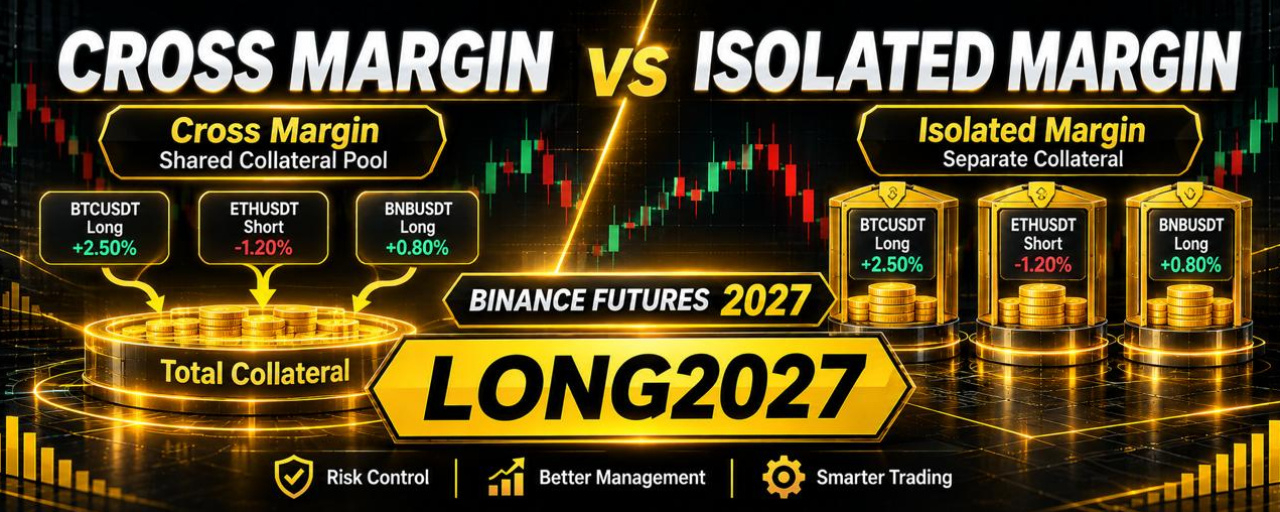
Bài viết
Xem bản dịch
Binance Futures Cross Margin vs Isolated Margin in 2027: How Collateral Sharing Changes LiquidationIn Binance Futures, choosing Cross Margin or Isolated Margin is not just a preference in the trading interface. It determines how collateral is allocated, how losses affect available margin, and how much of your Futures balance may be exposed when a position moves against you.
The distinction becomes especially important when several positions are open at the same time.
Cross Margin allows eligible positions to share a margin balance. Isolated Margin assigns a separate margin balance to an individual position. Neither mode removes liquidation risk. The difference is where the risk is concentrated and how much collateral can be used to support the position.
Understanding this distinction is essential before opening multiple BTC, ETH, or altcoin Futures positions in 2027.
1. What Is Cross Margin on Binance Futures?
Cross Margin is a margin mode in which eligible open positions share available margin from the same asset balance.
For example, if you trade multiple USDT-margined contracts in USDⓈ-M Futures, the available USDT balance can support positions using Cross Margin. In COIN-M Futures, collateral sharing is based on the relevant asset, such as BTC for BTC-based contracts.
This means the margin supporting one position is not necessarily limited to an amount manually assigned to that specific trade.
The main advantage is flexibility. If one position has an unrealized loss while another has an unrealized profit, the shared margin balance can reflect the combined effect of those positions.
However, this flexibility creates a risk that traders sometimes underestimate.
A losing position can consume part of the shared collateral buffer that might otherwise support other open positions.
Cross Margin should therefore be understood as shared collateral exposure, not as a safety mechanism.
2. What Is Isolated Margin on Binance Futures?
Isolated Margin assigns a dedicated margin balance to a specific position.
Instead of relying on a shared collateral pool, the position has its own allocated margin. Other positions do not automatically use that isolated margin balance to support their exposure.
For example, imagine a trader has 1,000 USDT available in the Futures wallet and opens two positions:
- BTCUSDT position with 100 USDT of allocated isolated margin.
- ETHUSDT position with 150 USDT of allocated isolated margin.
The remaining balance is not automatically added to either isolated position.
If the BTC position deteriorates, its allocated margin is the collateral pool associated with that position. The ETH position has a separate margin allocation.
This separation can make position-level risk easier to understand and control.
However, Isolated Margin does not mean that a trade cannot lose its allocated collateral. If the position reaches its liquidation conditions, the allocated margin can be depleted through the liquidation process.
Traders can also manually add or remove margin from an eligible isolated position. Adding margin increases the collateral supporting that position, while removing margin can reduce its liquidation buffer.
3. The Main Difference: Shared Collateral vs Dedicated Collateral
The distinction can be summarized in one question:
Can the collateral supporting one position also be used to support another position?
In Cross Margin, eligible positions sharing the same asset margin balance can draw on that shared pool.
In Isolated Margin, each position has its own allocated margin balance.
Consider a simplified example.
A trader has 1,000 USDT in a USDⓈ-M Futures account and opens two positions.
Position A: BTCUSDT
Position B: ETHUSDT
Under Cross Margin:
Both eligible Cross positions use the shared USDT margin balance. If BTC generates a substantial unrealized loss, the account's available margin can decrease, potentially reducing the buffer available to support ETH as well.
Under Isolated Margin:
The trader allocates 100 USDT to BTC and 150 USDT to ETH. The BTC position's margin is separated from ETH's margin. A loss affecting the BTC position does not automatically consume ETH's isolated margin allocation.
These figures are only an illustration of collateral allocation. They are not liquidation-price calculations. Actual liquidation depends on position size, entry price, Mark Price, maintenance margin, leverage, fees, and other applicable risk parameters.
4. Why Cross Margin Can Create Portfolio-Level Risk
Cross Margin can be useful when a trader intentionally manages several positions as one portfolio.
But it can also create a hidden connection between trades that appear unrelated.
Imagine holding:
- A BTCUSDT long position.
- An ETHUSDT long position.
- A SOLUSDT short position.
Each position may have a separate trading thesis. One may be based on a breakout, another on a hedge, and another on a short-term reversal.
Yet, when eligible positions share Cross Margin collateral, their risk is not completely independent.
If BTC moves sharply against the account, the resulting unrealized loss can reduce the shared margin balance. That reduction may leave less collateral available to absorb volatility in ETH or SOL.
This creates a portfolio-level question:
How much of the account's shared collateral is exposed to the combined movement of all open positions?
A trader who evaluates each position independently may underestimate the total risk.
The correct approach is to monitor account-level margin health, not just the liquidation price of the trade currently receiving attention.
5. Why Isolated Margin Does Not Automatically Mean Lower Trading Risk
Isolated Margin can help limit collateral exposure at the individual-position level, but it does not automatically make a trading strategy safer.
There are several reasons.
First, the trader can still open an oversized position. Separating collateral does not correct poor position sizing.
Second, a position can still be liquidated if its allocated margin becomes insufficient.
Third, traders may repeatedly add margin to losing positions. This can turn an initially limited-risk trade into a larger capital commitment.
Fourth, isolated positions can still incur trading fees, funding payments, slippage, and liquidation-related costs.
The important distinction is between controlling where collateral is exposed and controlling how much market risk is taken.
Isolated Margin helps with the first. Position sizing, leverage discipline, and exit planning are still required for the second.
6. How Leverage Interacts With Cross and Isolated Margin
Leverage and margin mode are related, but they are not the same setting.
Leverage determines the initial margin requirement for a given position size. Margin mode determines how collateral is allocated and shared.
For example, two traders can open positions with similar notional exposure and use the same leverage while choosing different margin modes.
Their collateral arrangements can still be different.
A common mistake is assuming that selecting 10x leverage means the maximum loss is automatically limited to one-tenth of the position value.
That is not a complete description of Futures risk.
The actual outcome depends on the position's price movement, maintenance margin requirements, fees, funding, liquidation mechanics, and the selected margin mode.
A useful way to separate the concepts is:
- Position size determines market exposure.
- Leverage affects the initial margin requirement.
- Margin mode determines how eligible collateral supports positions.
- Maintenance margin and account equity influence liquidation risk.
For a deeper explanation of the costs that can accumulate around a Futures position, read:
Binance Futures Trading Costs Explained: Trading Fees, Funding Rates and Liquidation Costs in 2027
[https://www.binance.com/en/square/post/383591210067971](https://www.binance.com/en/square/post/383591210067971)
7. How Liquidation Works Differently in Cross and Isolated Margin
Liquidation is not triggered simply because the Last Price touches a number displayed on the chart.
Binance Futures uses Mark Price for liquidation calculations. A position becomes subject to liquidation when the available collateral is no longer sufficient to meet the applicable maintenance margin requirement.
The margin mode changes how the available collateral is assessed.
In Cross Margin, the shared margin balance can support eligible positions. This means the liquidation risk of one position can be affected by the broader account's available margin and unrealized PnL.
In Isolated Margin, the position's own allocated margin is central to its liquidation calculation.
There is also an important detail in Hedge Mode.
Binance's Futures liquidation documentation explains that long and short positions of the same symbol share the same liquidation price when they are in Cross Margin Mode. If both positions are in Isolated Margin Mode, they can have different liquidation prices depending on the margin allocated to each position.
This is one reason why margin mode and position mode should not be treated as interchangeable settings.
For a detailed explanation of Mark Price and Last Price, including why liquidation can occur even when the chart's last traded price appears not to have reached the displayed liquidation level, see:
Binance Futures Mark Price vs Last Price: Why Your Stop-Loss May Not Prevent Liquidation in 2027
[https://www.binance.com/en/square/post/383895795195979](https://www.binance.com/en/square/post/383895795195979)
8. Can You Add More Margin to an Isolated Position?
Yes. Binance provides an option to adjust the margin balance allocated to an eligible Isolated position.
A trader can add margin to increase the collateral supporting the position. This can move the liquidation price farther from the current market price, depending on the position and applicable risk parameters.
However, adding margin should not be confused with reducing the underlying market exposure.
If a trader adds 100 USDT to a losing position without changing its size, the position remains the same size. The trader has simply committed more collateral to support it.
Removing margin works in the opposite direction. It reduces the collateral allocated to the position and may bring liquidation closer.
The amount that can be added or removed is subject to Binance's margin calculations and account conditions. It is not always possible to withdraw the full displayed isolated margin balance.
A practical rule is to decide in advance how much capital a position is allowed to consume. Otherwise, repeated margin additions can weaken the original risk limit.
9. Can You Switch Between Cross and Isolated While a Position Is Open?
Binance's published instructions state that margin mode changes apply to the selected contract, rather than automatically changing every contract in the account.
The same instructions state that users cannot switch the margin mode while there are open orders or positions for that contract.
This is important when preparing a trade.
Before opening a position, check the selected contract and confirm whether Cross or Isolated is active. Do not assume that changing the setting for one symbol changes the margin mode for every other symbol.
Also remember that Cross Margin sharing is restricted by asset type. It should not be interpreted as every asset in every Futures wallet automatically becoming one universal collateral pool.
10. Cross Margin, Isolated Margin and Multi-Assets Mode
Another setting that can cause confusion is Multi-Assets Mode.
Margin Mode and Asset Mode are different concepts.
Cross or Isolated determines how margin is allocated to positions.
Single-Asset or Multi-Assets determines how eligible assets are used within USDⓈ-M Futures.
Binance's documentation states that Multi-Assets Mode supports Cross Margin Mode only. If open positions are in Isolated Mode, they must be switched to Cross before Multi-Assets Mode can be enabled.
This matters because traders may see several settings in the Futures interface and assume they all control the same risk mechanism.
They do not.
A trader should understand the difference between:
- Margin Mode: Cross or Isolated.
- Asset Mode: Single-Asset or Multi-Assets.
- Position Mode: One-Way or Hedge.
- Leverage: the leverage configured for the contract.
Each setting changes a different part of the trading system.
11. A Practical Checklist Before Choosing a Margin Mode
Before opening a Futures position, consider the following questions:
1. Am I trading one position or managing several positions together?
2. Do I want eligible positions to share collateral?
3. Would a large unrealized loss in one position affect the margin buffer available to my other positions?
4. How much collateral am I willing to allocate to this specific trade?
5. Have I checked the Mark Price and liquidation price?
6. Do I understand the maintenance margin requirements for the position size?
7. Am I using Single-Asset or Multi-Assets Mode?
8. Have I checked whether the selected contract is actually set to Cross or Isolated?
These questions are more useful than choosing a margin mode simply because one option appears more popular.
12. Frequently Asked Questions
Is Cross Margin safer than Isolated Margin?
Neither is universally safer. Cross Margin can provide a larger shared collateral buffer, but losses in one eligible position can reduce the margin available to support others. Isolated Margin separates collateral by position, but the allocated margin can still be lost through liquidation.
Does Isolated Margin protect my entire Futures balance?
It separates the collateral allocated to an isolated position from other positions. It does not eliminate trading risk, fees, funding costs, or the possibility of losing the margin assigned to that position.
Can Cross Margin prevent liquidation?
No. Shared collateral may provide more room before liquidation, but a sufficiently large loss across the account can still cause liquidation.
Does Cross Margin use every asset in my Binance account?
No. Cross Margin sharing is subject to the relevant Futures account and asset rules. For example, Binance documents sharing between positions using the same type of asset. Multi-Assets Mode is a separate USDⓈ-M setting with its own requirements.
Can I add margin to an Isolated position after opening it?
Binance provides an adjustment function for eligible isolated positions. The amount that can be added or removed depends on the account's available margin and applicable calculations.
Does changing leverage automatically change Cross to Isolated?
No. Leverage and margin mode are separate settings. Changing one does not automatically change the other.
Can two Hedge Mode positions have different liquidation prices?
They can have different liquidation prices when both are in Isolated Margin Mode, depending on the margin allocated to each. In Cross Margin Mode, Binance documents that long and short positions of the same symbol share the same liquidation price.
13. Final Perspective: Margin Mode Is a Collateral Decision
Cross Margin and Isolated Margin are not simply two different ways to display leverage.
They represent two different approaches to collateral management.
Cross Margin connects eligible positions through a shared margin balance. This can make portfolio-level capital use more flexible, but it also means that losses can affect the collateral buffer supporting other positions.
Isolated Margin separates collateral by position. This can make individual trade risk easier to define, but it does not prevent liquidation or compensate for excessive exposure.
The important question is not which setting is always better.
It is whether the collateral structure matches the way the trader actually manages risk.
A trader managing several positions as one portfolio needs to understand the combined effect of unrealized PnL and shared margin. A trader who wants a defined collateral allocation for each position needs to understand how isolated margin can be adjusted and how liquidation affects that allocation.
In Futures trading, the position is only one part of the risk. The collateral supporting it is the other.
Further Reading: Binance Futures Risk Management Series
Binance Futures Trading Costs Explained: Trading Fees, Funding Rates and Liquidation Costs in 2027
[https://www.binance.com/en/square/post/383591210067971](https://www.binance.com/en/square/post/383591210067971)
Binance Futures Mark Price vs Last Price: Why Your Stop-Loss May Not Prevent Liquidation in 2027
[https://www.binance.com/en/square/post/383895795195979](https://www.binance.com/en/square/post/383895795195979)
Binance Futures Stop-Loss Guide 2027: Stop-Market vs Stop-Limit, Trigger Prices and Execution Risk
[https://www.binance.com/en/square/post/384255698781984](https://www.binance.com/en/square/post/384255698781984)
Binance Futures Referral Code 2027: LONG2027 for USDT-M and COIN-M Trading Fees
[https://www.binance.com/en/square/post/382080858570766](https://www.binance.com/en/square/post/382080858570766)
Official Binance References
How to Switch Between the Cross Margin and Isolated Margin Modes
[https://www.binance.com/en/support/faq/detail/360038075852](https://www.binance.com/en/support/faq/detail/360038075852)
How to Adjust Margin Balance in Cross/Isolated Margin Mode
[https://www.binance.com/en/support/faq/detail/360038447311](https://www.binance.com/en/support/faq/detail/360038447311)
Binance Futures Liquidation Protocols
[https://www.binance.com/en/support/faq/detail/360033525271](https://www.binance.com/en/support/faq/detail/360033525271)
How to Switch between Single-Asset and Multi-Assets Modes
[https://www.binance.com/en/support/faq/detail/de2681ac63714c7d84a685967f7c1a53](https://www.binance.com/en/support/faq/detail/de2681ac63714c7d84a685967f7c1a53)
Educational Disclaimer: This article is for informational purposes only and does not constitute financial or investment advice. Futures trading involves substantial risk and may result in the loss of your allocated collateral. Binance product rules, supported features, and regional availability may change. Always review the current trading interface and applicable Binance documentation before placing an order.
Binance Futures Cross Margin vs Isolated Margin in 2027: How Collateral Sharing Changes Liquidation
In Binance Futures, choosing Cross Margin or Isolated Margin is not just a preference in the trading interface. It determines how collateral is allocated, how losses affect available margin, and how much of your Futures balance may be exposed when a position moves against you.
The distinction becomes especially important when several positions are open at the same time.
Cross Margin allows eligible positions to share a margin balance. Isolated Margin assigns a separate margin balance to an individual position. Neither mode removes liquidation risk. The difference is where the risk is concentrated and how much collateral can be used to support the position.
Understanding this distinction is essential before opening multiple BTC, ETH, or altcoin Futures positions in 2027.
1. What Is Cross Margin on Binance Futures?
Cross Margin is a margin mode in which eligible open positions share available margin from the same asset balance.
For example, if you trade multiple USDT-margined contracts in USDⓈ-M Futures, the available USDT balance can support positions using Cross Margin. In COIN-M Futures, collateral sharing is based on the relevant asset, such as BTC for BTC-based contracts.
This means the margin supporting one position is not necessarily limited to an amount manually assigned to that specific trade.
The main advantage is flexibility. If one position has an unrealized loss while another has an unrealized profit, the shared margin balance can reflect the combined effect of those positions.
However, this flexibility creates a risk that traders sometimes underestimate.
A losing position can consume part of the shared collateral buffer that might otherwise support other open positions.
Cross Margin should therefore be understood as shared collateral exposure, not as a safety mechanism.
2. What Is Isolated Margin on Binance Futures?
Isolated Margin assigns a dedicated margin balance to a specific position.
Instead of relying on a shared collateral pool, the position has its own allocated margin. Other positions do not automatically use that isolated margin balance to support their exposure.
For example, imagine a trader has 1,000 USDT available in the Futures wallet and opens two positions:
- BTCUSDT position with 100 USDT of allocated isolated margin.
- ETHUSDT position with 150 USDT of allocated isolated margin.
The remaining balance is not automatically added to either isolated position.
If the BTC position deteriorates, its allocated margin is the collateral pool associated with that position. The ETH position has a separate margin allocation.
This separation can make position-level risk easier to understand and control.
However, Isolated Margin does not mean that a trade cannot lose its allocated collateral. If the position reaches its liquidation conditions, the allocated margin can be depleted through the liquidation process.
Traders can also manually add or remove margin from an eligible isolated position. Adding margin increases the collateral supporting that position, while removing margin can reduce its liquidation buffer.
3. The Main Difference: Shared Collateral vs Dedicated Collateral
The distinction can be summarized in one question:
Can the collateral supporting one position also be used to support another position?
In Cross Margin, eligible positions sharing the same asset margin balance can draw on that shared pool.
In Isolated Margin, each position has its own allocated margin balance.
Consider a simplified example.
A trader has 1,000 USDT in a USDⓈ-M Futures account and opens two positions.
Position A: BTCUSDT
Position B: ETHUSDT
Under Cross Margin:
Both eligible Cross positions use the shared USDT margin balance. If BTC generates a substantial unrealized loss, the account's available margin can decrease, potentially reducing the buffer available to support ETH as well.
Under Isolated Margin:
The trader allocates 100 USDT to BTC and 150 USDT to ETH. The BTC position's margin is separated from ETH's margin. A loss affecting the BTC position does not automatically consume ETH's isolated margin allocation.
These figures are only an illustration of collateral allocation. They are not liquidation-price calculations. Actual liquidation depends on position size, entry price, Mark Price, maintenance margin, leverage, fees, and other applicable risk parameters.
4. Why Cross Margin Can Create Portfolio-Level Risk
Cross Margin can be useful when a trader intentionally manages several positions as one portfolio.
But it can also create a hidden connection between trades that appear unrelated.
Imagine holding:
- A BTCUSDT long position.
- An ETHUSDT long position.
- A SOLUSDT short position.
Each position may have a separate trading thesis. One may be based on a breakout, another on a hedge, and another on a short-term reversal.
Yet, when eligible positions share Cross Margin collateral, their risk is not completely independent.
If BTC moves sharply against the account, the resulting unrealized loss can reduce the shared margin balance. That reduction may leave less collateral available to absorb volatility in ETH or SOL.
This creates a portfolio-level question:
How much of the account's shared collateral is exposed to the combined movement of all open positions?
A trader who evaluates each position independently may underestimate the total risk.
The correct approach is to monitor account-level margin health, not just the liquidation price of the trade currently receiving attention.
5. Why Isolated Margin Does Not Automatically Mean Lower Trading Risk
Isolated Margin can help limit collateral exposure at the individual-position level, but it does not automatically make a trading strategy safer.
There are several reasons.
First, the trader can still open an oversized position. Separating collateral does not correct poor position sizing.
Second, a position can still be liquidated if its allocated margin becomes insufficient.
Third, traders may repeatedly add margin to losing positions. This can turn an initially limited-risk trade into a larger capital commitment.
Fourth, isolated positions can still incur trading fees, funding payments, slippage, and liquidation-related costs.
The important distinction is between controlling where collateral is exposed and controlling how much market risk is taken.
Isolated Margin helps with the first. Position sizing, leverage discipline, and exit planning are still required for the second.
6. How Leverage Interacts With Cross and Isolated Margin
Leverage and margin mode are related, but they are not the same setting.
Leverage determines the initial margin requirement for a given position size. Margin mode determines how collateral is allocated and shared.
For example, two traders can open positions with similar notional exposure and use the same leverage while choosing different margin modes.
Their collateral arrangements can still be different.
A common mistake is assuming that selecting 10x leverage means the maximum loss is automatically limited to one-tenth of the position value.
That is not a complete description of Futures risk.
The actual outcome depends on the position's price movement, maintenance margin requirements, fees, funding, liquidation mechanics, and the selected margin mode.
A useful way to separate the concepts is:
- Position size determines market exposure.
- Leverage affects the initial margin requirement.
- Margin mode determines how eligible collateral supports positions.
- Maintenance margin and account equity influence liquidation risk.
For a deeper explanation of the costs that can accumulate around a Futures position, read:
Binance Futures Trading Costs Explained: Trading Fees, Funding Rates and Liquidation Costs in 2027
https://www.binance.com/en/square/post/383591210067971
7. How Liquidation Works Differently in Cross and Isolated Margin
Liquidation is not triggered simply because the Last Price touches a number displayed on the chart.
Binance Futures uses Mark Price for liquidation calculations. A position becomes subject to liquidation when the available collateral is no longer sufficient to meet the applicable maintenance margin requirement.
The margin mode changes how the available collateral is assessed.
In Cross Margin, the shared margin balance can support eligible positions. This means the liquidation risk of one position can be affected by the broader account's available margin and unrealized PnL.
In Isolated Margin, the position's own allocated margin is central to its liquidation calculation.
There is also an important detail in Hedge Mode.
Binance's Futures liquidation documentation explains that long and short positions of the same symbol share the same liquidation price when they are in Cross Margin Mode. If both positions are in Isolated Margin Mode, they can have different liquidation prices depending on the margin allocated to each position.
This is one reason why margin mode and position mode should not be treated as interchangeable settings.
For a detailed explanation of Mark Price and Last Price, including why liquidation can occur even when the chart's last traded price appears not to have reached the displayed liquidation level, see:
Binance Futures Mark Price vs Last Price: Why Your Stop-Loss May Not Prevent Liquidation in 2027
https://www.binance.com/en/square/post/383895795195979
8. Can You Add More Margin to an Isolated Position?
Yes. Binance provides an option to adjust the margin balance allocated to an eligible Isolated position.
A trader can add margin to increase the collateral supporting the position. This can move the liquidation price farther from the current market price, depending on the position and applicable risk parameters.
However, adding margin should not be confused with reducing the underlying market exposure.
If a trader adds 100 USDT to a losing position without changing its size, the position remains the same size. The trader has simply committed more collateral to support it.
Removing margin works in the opposite direction. It reduces the collateral allocated to the position and may bring liquidation closer.
The amount that can be added or removed is subject to Binance's margin calculations and account conditions. It is not always possible to withdraw the full displayed isolated margin balance.
A practical rule is to decide in advance how much capital a position is allowed to consume. Otherwise, repeated margin additions can weaken the original risk limit.
9. Can You Switch Between Cross and Isolated While a Position Is Open?
Binance's published instructions state that margin mode changes apply to the selected contract, rather than automatically changing every contract in the account.
The same instructions state that users cannot switch the margin mode while there are open orders or positions for that contract.
This is important when preparing a trade.
Before opening a position, check the selected contract and confirm whether Cross or Isolated is active. Do not assume that changing the setting for one symbol changes the margin mode for every other symbol.
Also remember that Cross Margin sharing is restricted by asset type. It should not be interpreted as every asset in every Futures wallet automatically becoming one universal collateral pool.
10. Cross Margin, Isolated Margin and Multi-Assets Mode
Another setting that can cause confusion is Multi-Assets Mode.
Margin Mode and Asset Mode are different concepts.
Cross or Isolated determines how margin is allocated to positions.
Single-Asset or Multi-Assets determines how eligible assets are used within USDⓈ-M Futures.
Binance's documentation states that Multi-Assets Mode supports Cross Margin Mode only. If open positions are in Isolated Mode, they must be switched to Cross before Multi-Assets Mode can be enabled.
This matters because traders may see several settings in the Futures interface and assume they all control the same risk mechanism.
They do not.
A trader should understand the difference between:
- Margin Mode: Cross or Isolated.
- Asset Mode: Single-Asset or Multi-Assets.
- Position Mode: One-Way or Hedge.
- Leverage: the leverage configured for the contract.
Each setting changes a different part of the trading system.
11. A Practical Checklist Before Choosing a Margin Mode
Before opening a Futures position, consider the following questions:
1. Am I trading one position or managing several positions together?
2. Do I want eligible positions to share collateral?
3. Would a large unrealized loss in one position affect the margin buffer available to my other positions?
4. How much collateral am I willing to allocate to this specific trade?
5. Have I checked the Mark Price and liquidation price?
6. Do I understand the maintenance margin requirements for the position size?
7. Am I using Single-Asset or Multi-Assets Mode?
8. Have I checked whether the selected contract is actually set to Cross or Isolated?
These questions are more useful than choosing a margin mode simply because one option appears more popular.
12. Frequently Asked Questions
Is Cross Margin safer than Isolated Margin?
Neither is universally safer. Cross Margin can provide a larger shared collateral buffer, but losses in one eligible position can reduce the margin available to support others. Isolated Margin separates collateral by position, but the allocated margin can still be lost through liquidation.
Does Isolated Margin protect my entire Futures balance?
It separates the collateral allocated to an isolated position from other positions. It does not eliminate trading risk, fees, funding costs, or the possibility of losing the margin assigned to that position.
Can Cross Margin prevent liquidation?
No. Shared collateral may provide more room before liquidation, but a sufficiently large loss across the account can still cause liquidation.
Does Cross Margin use every asset in my Binance account?
No. Cross Margin sharing is subject to the relevant Futures account and asset rules. For example, Binance documents sharing between positions using the same type of asset. Multi-Assets Mode is a separate USDⓈ-M setting with its own requirements.
Can I add margin to an Isolated position after opening it?
Binance provides an adjustment function for eligible isolated positions. The amount that can be added or removed depends on the account's available margin and applicable calculations.
Does changing leverage automatically change Cross to Isolated?
No. Leverage and margin mode are separate settings. Changing one does not automatically change the other.
Can two Hedge Mode positions have different liquidation prices?
They can have different liquidation prices when both are in Isolated Margin Mode, depending on the margin allocated to each. In Cross Margin Mode, Binance documents that long and short positions of the same symbol share the same liquidation price.
13. Final Perspective: Margin Mode Is a Collateral Decision
Cross Margin and Isolated Margin are not simply two different ways to display leverage.
They represent two different approaches to collateral management.
Cross Margin connects eligible positions through a shared margin balance. This can make portfolio-level capital use more flexible, but it also means that losses can affect the collateral buffer supporting other positions.
Isolated Margin separates collateral by position. This can make individual trade risk easier to define, but it does not prevent liquidation or compensate for excessive exposure.
The important question is not which setting is always better.
It is whether the collateral structure matches the way the trader actually manages risk.
A trader managing several positions as one portfolio needs to understand the combined effect of unrealized PnL and shared margin. A trader who wants a defined collateral allocation for each position needs to understand how isolated margin can be adjusted and how liquidation affects that allocation.
In Futures trading, the position is only one part of the risk. The collateral supporting it is the other.
Further Reading: Binance Futures Risk Management Series
Binance Futures Trading Costs Explained: Trading Fees, Funding Rates and Liquidation Costs in 2027
https://www.binance.com/en/square/post/383591210067971
Binance Futures Mark Price vs Last Price: Why Your Stop-Loss May Not Prevent Liquidation in 2027
https://www.binance.com/en/square/post/383895795195979
Binance Futures Stop-Loss Guide 2027: Stop-Market vs Stop-Limit, Trigger Prices and Execution Risk
https://www.binance.com/en/square/post/384255698781984
Binance Futures Referral Code 2027: LONG2027 for USDT-M and COIN-M Trading Fees
https://www.binance.com/en/square/post/382080858570766
Official Binance References
How to Switch Between the Cross Margin and Isolated Margin Modes
https://www.binance.com/en/support/faq/detail/360038075852
How to Adjust Margin Balance in Cross/Isolated Margin Mode
https://www.binance.com/en/support/faq/detail/360038447311
Binance Futures Liquidation Protocols
https://www.binance.com/en/support/faq/detail/360033525271
How to Switch between Single-Asset and Multi-Assets Modes
https://www.binance.com/en/support/faq/detail/de2681ac63714c7d84a685967f7c1a53
Educational Disclaimer: This article is for informational purposes only and does not constitute financial or investment advice. Futures trading involves substantial risk and may result in the loss of your allocated collateral. Binance product rules, supported features, and regional availability may change. Always review the current trading interface and applicable Binance documentation before placing an order.
2
6
Bài viết
Giải thích ADL trên Binance Futures năm 2027: Quỹ bảo hiểm, xếp hạng hàng đợi và giảm vị thế bắt buộcMột vị thế Binance Futures đang có lãi có thể tự động bị giảm quy mô ngay cả khi nhà giao dịch chưa đặt lệnh đóng và giá của vị thế chưa chạm mức thanh lý. Cơ chế này được gọi là Tự động giảm đòn bẩy (ADL).
ADL là một trong những cơ chế ít được hiểu rõ nhất trong giao dịch ký quỹ. Cơ chế này không giống thanh lý thông thường và cũng không có nghĩa là sàn giao dịch tùy tiện đóng các lệnh đang có lãi. Đây là cơ chế quản lý rủi ro được sử dụng như giải pháp cuối cùng để xử lý các vị thế phá sản khi Quỹ bảo hiểm Futures không thể bù đắp khoản lỗ còn lại.
Giải thích ADL trên Binance Futures năm 2027: Quỹ bảo hiểm, xếp hạng hàng đợi và giảm vị thế bắt buộc
Một vị thế Binance Futures đang có lãi có thể tự động bị giảm quy mô ngay cả khi nhà giao dịch chưa đặt lệnh đóng và giá của vị thế chưa chạm mức thanh lý. Cơ chế này được gọi là Tự động giảm đòn bẩy (ADL).
ADL là một trong những cơ chế ít được hiểu rõ nhất trong giao dịch ký quỹ. Cơ chế này không giống thanh lý thông thường và cũng không có nghĩa là sàn giao dịch tùy tiện đóng các lệnh đang có lãi. Đây là cơ chế quản lý rủi ro được sử dụng như giải pháp cuối cùng để xử lý các vị thế phá sản khi Quỹ bảo hiểm Futures không thể bù đắp khoản lỗ còn lại.
ADL là một trong những cơ chế ít được hiểu rõ nhất trong giao dịch ký quỹ. Cơ chế này không giống thanh lý thông thường và cũng không có nghĩa là sàn giao dịch tùy tiện đóng các lệnh đang có lãi. Đây là cơ chế quản lý rủi ro được sử dụng như giải pháp cuối cùng để xử lý các vị thế phá sản khi Quỹ bảo hiểm Futures không thể bù đắp khoản lỗ còn lại.
2
67
Xem bản dịch
Binance Futures One-Way vs Hedge Mode in 2027: Reduce-Only, Close Position and Common Trading MistakManaging a Binance Futures position involves more than choosing Long or Short. Your Position Mode determines how opposing orders interact with existing exposure, while settings such as Reduce-Only and Close Position help control how orders affect an open position.
A simple Sell order can close a Long position, reduce its size, or potentially create Short exposure. The result depends on your position mode, order settings and the quantity submitted.
This guide explains the difference between One-Way Mode and Hedge Mode, how Reduce-Only works, when Close Position is useful, and which mistakes traders should avoid when managing Binance Futures positions.
1. What Is One-Way Mode?
One-Way Mode allows you to hold only one net position direction for a particular Futures contract.
You can be Long or Short, but you cannot maintain separate Long and Short positions in the same contract at the same time.
For example, imagine you hold:
BTCUSDT Long: 0.50 BTC
If you submit a Sell order for 0.20 BTC, it reduces your Long position to 0.30 BTC.
If you submit a Sell order for 0.50 BTC, it can close the Long position completely.
But what happens if you submit a Sell order for 0.70 BTC?
Without an appropriate Reduce-Only restriction, the order may close the 0.50 BTC Long position and leave you with 0.20 BTC of Short exposure, subject to the applicable order and account rules.
This is one reason why traders should understand Reduce-Only before placing closing orders.
One-Way Mode is useful for traders who prefer to manage a single net directional position rather than separate Long and Short positions.
1. What Is Hedge Mode?
Hedge Mode allows you to hold both a Long and a Short position on the same Futures contract simultaneously.
For example, your BTCUSDT positions could look like this:
Long position: 0.50 BTC
Short position: 0.20 BTC
Both positions can exist at the same time and are managed separately.
This can be useful when a trader wants to maintain a longer-term directional position while opening a shorter-term position in the opposite direction.
Consider a simple example:
You hold a 0.50 BTC Long position because your broader market outlook is bullish.
You expect a short-term correction, so you open a 0.20 BTC Short position.
In Hedge Mode, these positions remain separate. Closing the Short position does not automatically close the Long position.
However, holding opposing positions does not eliminate risk. Each position has its own exposure, margin requirements and potential trading costs. Funding payments and unrealized PnL also need to be considered.
1. One-Way Mode vs Hedge Mode: Key Differences
One-Way Mode:
• Only one net direction can be held per contract.
• Opposing orders reduce or reverse the existing net position, depending on order quantity and restrictions.
• Reduce-Only can be used to prevent an order from increasing or reversing the position.
• Position management is based on one net position.
Hedge Mode:
• Long and Short positions can exist simultaneously for the same contract.
• Each direction is managed separately.
• Orders must identify the relevant position side, such as LONG or SHORT.
• The standard Reduce-Only parameter is not supported in Hedge Mode in the USDⓈ-M Futures order interface and API.
The most important practical difference is that an order’s direction alone does not tell you which position it will affect. In Hedge Mode, the position side matters.
1. What Does Reduce-Only Mean?
Reduce-Only is an order restriction designed to ensure that an order can only decrease an existing position rather than increase it or reverse its direction.
Consider this example:
Current position: BTCUSDT Long 0.50 BTC
You submit a Sell order for 0.70 BTC with Reduce-Only enabled.
The order is restricted to reducing your existing Long exposure. It cannot use the excess quantity to create a new Short position.
Depending on the remaining position and order execution, the order may be adjusted, rejected or have an unfilled portion canceled under the applicable rules.
Without Reduce-Only, an oversized opposing order in One-Way Mode could potentially reverse your exposure.
When is Reduce-Only useful?
It is particularly useful when:
• You are placing a closing limit order.
• You have several orders that could affect the same position.
• You want to prevent an exit order from creating reverse exposure.
• You are managing a position manually while other conditional orders remain active.
One important limitation: Reduce-Only does not guarantee execution. A limit order can still remain unfilled if the market does not reach its price.
1. Close Position: How Is It Different From Reduce-Only?
Close Position is a separate order instruction used by supported conditional market orders to close the relevant position in full when the trigger condition is met.
For example, imagine you hold a BTCUSDT Long position and want a conditional order to close the entire position when a specified trigger is reached.
A supported Stop-Market order with Close Position enabled can be configured to close the current Long position when triggered.
The important distinction is:
Reduce-Only restricts an order so it can only reduce an existing position.
Close Position instructs a supported conditional market order to close the entire relevant position.
There are also technical restrictions. For example, the Close Position option cannot be combined with a separately specified quantity or the Reduce-Only parameter in the relevant USDⓈ-M Futures order implementation.
In Hedge Mode, the correct position side and order direction must also be selected. Not every combination is valid.
Always check the order preview and active order details before relying on a conditional closing order.
1. How Position Mode Changes Your Order Management
Position Mode is not simply a visual preference. It changes how orders are interpreted.
In One-Way Mode, a position is represented as one net exposure. A Sell order generally reduces an existing Long position, while a Buy order generally reduces an existing Short position. If the order exceeds the existing position, it may create exposure in the opposite direction unless restricted.
In Hedge Mode, the system maintains separate Long and Short sides.
For example:
To reduce a Long position, the relevant order is a Sell order associated with the LONG position side.
To reduce a Short position, the relevant order is a Buy order associated with the SHORT position side.
Selecting the wrong position side can produce an unexpected result or an order rejection.
Binance’s position-mode documentation also explains that you cannot switch between One-Way Mode and Hedge Mode while you have open positions or open orders.
This means you should decide which mode you need before opening positions and check your existing orders before attempting to change it.
1. A Practical Example: Avoiding an Accidental Position Reversal
Imagine you are trading BTCUSDT in One-Way Mode.
Your current position:
Direction: Long
Position size: 0.40 BTC
You decide to close the position using a limit Sell order.
You accidentally enter:
Sell quantity: 0.60 BTC
Without a suitable Reduce-Only restriction, the order could close the existing 0.40 BTC Long position and leave 0.20 BTC of Short exposure if the full order executes.
You intended to exit the market, but your account could end up holding a position in the opposite direction.
A safer order-review process is:
1. Confirm the current position direction.
2. Check the exact open position quantity.
3. Select the correct closing order direction.
4. Enable Reduce-Only when appropriate and supported.
5. Review the order quantity and execution settings.
6. Confirm that the resulting position matches your intention.
This simple check can prevent an exit order from becoming an unintended new trade.
1. How to Choose the Right Position Mode
One-Way Mode may be more appropriate when:
• You trade one directional position at a time.
• You prefer straightforward net exposure.
• You do not need separate Long and Short positions.
• You want to manage entries and exits through one position.
Hedge Mode may be more appropriate when:
• You actively manage separate Long and Short strategies.
• You want to keep a longer-term position while trading short-term moves in the opposite direction.
• You need separate position tracking for each direction.
• You understand the additional complexity of managing two exposures.
Neither mode automatically reduces trading risk. Hedge Mode can create the impression that opposing positions cancel each other out, but differences in size, entry price, funding payments, fees and margin can still create substantial risk.
1. Position Management Checklist
Before submitting an order on Binance Futures, review the following:
• Which Position Mode is currently active?
• Am I managing a Long position, a Short position or both?
• Is the order intended to open, increase, reduce or close exposure?
• Is the order quantity consistent with my existing position?
• Is Reduce-Only available and appropriate for this order?
• If I use Hedge Mode, have I selected the correct position side?
• If I use Close Position, does the conditional order apply to the intended position?
• Have I checked the order status after submission?
For conditional exits, also review your trigger reference and execution type. A correctly configured closing order can still be affected by liquidity, slippage and market conditions.
Our related guides explain these execution details:
Binance Futures Stop-Loss Guide 2027: Stop-Market vs Stop-Limit, Trigger Prices and Execution Risk
[https://www.binance.com/en/square/post/384255698781984](https://www.binance.com/en/square/post/384255698781984)
Binance Futures Mark Price vs Last Price: Why Your Stop-Loss May Not Prevent Liquidation in 2027
[https://www.binance.com/en/square/post/383895795195979](https://www.binance.com/en/square/post/383895795195979)
Binance Futures Referral Code 2027: LONG2027 for USDT-M and COIN-M Trading Fees
[https://www.binance.com/en/square/post/382080858570766](https://www.binance.com/en/square/post/382080858570766)
Frequently Asked Questions
Can I hold Long and Short positions at the same time on Binance Futures?
Yes. Hedge Mode allows you to maintain separate Long and Short positions on the same Futures contract. One-Way Mode supports only one net direction.
Does Reduce-Only close my entire position?
Not necessarily. Reduce-Only restricts an order to reducing existing exposure. The quantity determines how much of the position the order attempts to close.
Can Reduce-Only open a reverse position?
No. Its purpose is to prevent the order from increasing or reversing the existing position. However, execution and order acceptance still depend on the applicable exchange rules.
Can I use Reduce-Only in Hedge Mode?
The standard Reduce-Only parameter is not supported in Hedge Mode for USDⓈ-M Futures orders. Hedge Mode uses the position-side designation and supported closing-order mechanisms instead.
Can I switch from Hedge Mode to One-Way Mode while holding an open position?
No. Binance’s position-mode instructions state that you must first have no open positions or open orders before changing the mode.
Does Hedge Mode eliminate losses?
No. Holding Long and Short positions can change your directional exposure, but it does not remove trading fees, funding costs, margin requirements or liquidation risk.
Final Thoughts
One-Way Mode and Hedge Mode determine how Binance Futures handles opposing positions. Reduce-Only and Close Position provide additional ways to control how exit orders affect existing exposure.
The key lesson is to distinguish between an order that reduces a position and an order that can create new exposure. Before submitting any Futures order, verify the position mode, order direction, quantity and closing restrictions.
A few seconds spent reviewing these settings can prevent an accidental reversal or an order that affects the wrong position.
Educational content only. This article is not financial or investment advice.
Futures trading involves substantial risk and can result in the loss of your entire margin.
Binance Futures One-Way vs Hedge Mode in 2027: Reduce-Only, Close Position and Common Trading Mistak
Managing a Binance Futures position involves more than choosing Long or Short. Your Position Mode determines how opposing orders interact with existing exposure, while settings such as Reduce-Only and Close Position help control how orders affect an open position.
A simple Sell order can close a Long position, reduce its size, or potentially create Short exposure. The result depends on your position mode, order settings and the quantity submitted.
This guide explains the difference between One-Way Mode and Hedge Mode, how Reduce-Only works, when Close Position is useful, and which mistakes traders should avoid when managing Binance Futures positions.
1. What Is One-Way Mode?
One-Way Mode allows you to hold only one net position direction for a particular Futures contract.
You can be Long or Short, but you cannot maintain separate Long and Short positions in the same contract at the same time.
For example, imagine you hold:
BTCUSDT Long: 0.50 BTC
If you submit a Sell order for 0.20 BTC, it reduces your Long position to 0.30 BTC.
If you submit a Sell order for 0.50 BTC, it can close the Long position completely.
But what happens if you submit a Sell order for 0.70 BTC?
Without an appropriate Reduce-Only restriction, the order may close the 0.50 BTC Long position and leave you with 0.20 BTC of Short exposure, subject to the applicable order and account rules.
This is one reason why traders should understand Reduce-Only before placing closing orders.
One-Way Mode is useful for traders who prefer to manage a single net directional position rather than separate Long and Short positions.
1. What Is Hedge Mode?
Hedge Mode allows you to hold both a Long and a Short position on the same Futures contract simultaneously.
For example, your BTCUSDT positions could look like this:
Long position: 0.50 BTC
Short position: 0.20 BTC
Both positions can exist at the same time and are managed separately.
This can be useful when a trader wants to maintain a longer-term directional position while opening a shorter-term position in the opposite direction.
Consider a simple example:
You hold a 0.50 BTC Long position because your broader market outlook is bullish.
You expect a short-term correction, so you open a 0.20 BTC Short position.
In Hedge Mode, these positions remain separate. Closing the Short position does not automatically close the Long position.
However, holding opposing positions does not eliminate risk. Each position has its own exposure, margin requirements and potential trading costs. Funding payments and unrealized PnL also need to be considered.
1. One-Way Mode vs Hedge Mode: Key Differences
One-Way Mode:
• Only one net direction can be held per contract.
• Opposing orders reduce or reverse the existing net position, depending on order quantity and restrictions.
• Reduce-Only can be used to prevent an order from increasing or reversing the position.
• Position management is based on one net position.
Hedge Mode:
• Long and Short positions can exist simultaneously for the same contract.
• Each direction is managed separately.
• Orders must identify the relevant position side, such as LONG or SHORT.
• The standard Reduce-Only parameter is not supported in Hedge Mode in the USDⓈ-M Futures order interface and API.
The most important practical difference is that an order’s direction alone does not tell you which position it will affect. In Hedge Mode, the position side matters.
1. What Does Reduce-Only Mean?
Reduce-Only is an order restriction designed to ensure that an order can only decrease an existing position rather than increase it or reverse its direction.
Consider this example:
Current position: BTCUSDT Long 0.50 BTC
You submit a Sell order for 0.70 BTC with Reduce-Only enabled.
The order is restricted to reducing your existing Long exposure. It cannot use the excess quantity to create a new Short position.
Depending on the remaining position and order execution, the order may be adjusted, rejected or have an unfilled portion canceled under the applicable rules.
Without Reduce-Only, an oversized opposing order in One-Way Mode could potentially reverse your exposure.
When is Reduce-Only useful?
It is particularly useful when:
• You are placing a closing limit order.
• You have several orders that could affect the same position.
• You want to prevent an exit order from creating reverse exposure.
• You are managing a position manually while other conditional orders remain active.
One important limitation: Reduce-Only does not guarantee execution. A limit order can still remain unfilled if the market does not reach its price.
1. Close Position: How Is It Different From Reduce-Only?
Close Position is a separate order instruction used by supported conditional market orders to close the relevant position in full when the trigger condition is met.
For example, imagine you hold a BTCUSDT Long position and want a conditional order to close the entire position when a specified trigger is reached.
A supported Stop-Market order with Close Position enabled can be configured to close the current Long position when triggered.
The important distinction is:
Reduce-Only restricts an order so it can only reduce an existing position.
Close Position instructs a supported conditional market order to close the entire relevant position.
There are also technical restrictions. For example, the Close Position option cannot be combined with a separately specified quantity or the Reduce-Only parameter in the relevant USDⓈ-M Futures order implementation.
In Hedge Mode, the correct position side and order direction must also be selected. Not every combination is valid.
Always check the order preview and active order details before relying on a conditional closing order.
1. How Position Mode Changes Your Order Management
Position Mode is not simply a visual preference. It changes how orders are interpreted.
In One-Way Mode, a position is represented as one net exposure. A Sell order generally reduces an existing Long position, while a Buy order generally reduces an existing Short position. If the order exceeds the existing position, it may create exposure in the opposite direction unless restricted.
In Hedge Mode, the system maintains separate Long and Short sides.
For example:
To reduce a Long position, the relevant order is a Sell order associated with the LONG position side.
To reduce a Short position, the relevant order is a Buy order associated with the SHORT position side.
Selecting the wrong position side can produce an unexpected result or an order rejection.
Binance’s position-mode documentation also explains that you cannot switch between One-Way Mode and Hedge Mode while you have open positions or open orders.
This means you should decide which mode you need before opening positions and check your existing orders before attempting to change it.
1. A Practical Example: Avoiding an Accidental Position Reversal
Imagine you are trading BTCUSDT in One-Way Mode.
Your current position:
Direction: Long
Position size: 0.40 BTC
You decide to close the position using a limit Sell order.
You accidentally enter:
Sell quantity: 0.60 BTC
Without a suitable Reduce-Only restriction, the order could close the existing 0.40 BTC Long position and leave 0.20 BTC of Short exposure if the full order executes.
You intended to exit the market, but your account could end up holding a position in the opposite direction.
A safer order-review process is:
1. Confirm the current position direction.
2. Check the exact open position quantity.
3. Select the correct closing order direction.
4. Enable Reduce-Only when appropriate and supported.
5. Review the order quantity and execution settings.
6. Confirm that the resulting position matches your intention.
This simple check can prevent an exit order from becoming an unintended new trade.
1. How to Choose the Right Position Mode
One-Way Mode may be more appropriate when:
• You trade one directional position at a time.
• You prefer straightforward net exposure.
• You do not need separate Long and Short positions.
• You want to manage entries and exits through one position.
Hedge Mode may be more appropriate when:
• You actively manage separate Long and Short strategies.
• You want to keep a longer-term position while trading short-term moves in the opposite direction.
• You need separate position tracking for each direction.
• You understand the additional complexity of managing two exposures.
Neither mode automatically reduces trading risk. Hedge Mode can create the impression that opposing positions cancel each other out, but differences in size, entry price, funding payments, fees and margin can still create substantial risk.
1. Position Management Checklist
Before submitting an order on Binance Futures, review the following:
• Which Position Mode is currently active?
• Am I managing a Long position, a Short position or both?
• Is the order intended to open, increase, reduce or close exposure?
• Is the order quantity consistent with my existing position?
• Is Reduce-Only available and appropriate for this order?
• If I use Hedge Mode, have I selected the correct position side?
• If I use Close Position, does the conditional order apply to the intended position?
• Have I checked the order status after submission?
For conditional exits, also review your trigger reference and execution type. A correctly configured closing order can still be affected by liquidity, slippage and market conditions.
Our related guides explain these execution details:
Binance Futures Stop-Loss Guide 2027: Stop-Market vs Stop-Limit, Trigger Prices and Execution Risk
https://www.binance.com/en/square/post/384255698781984
Binance Futures Mark Price vs Last Price: Why Your Stop-Loss May Not Prevent Liquidation in 2027
https://www.binance.com/en/square/post/383895795195979
Binance Futures Referral Code 2027: LONG2027 for USDT-M and COIN-M Trading Fees
https://www.binance.com/en/square/post/382080858570766
Frequently Asked Questions
Can I hold Long and Short positions at the same time on Binance Futures?
Yes. Hedge Mode allows you to maintain separate Long and Short positions on the same Futures contract. One-Way Mode supports only one net direction.
Does Reduce-Only close my entire position?
Not necessarily. Reduce-Only restricts an order to reducing existing exposure. The quantity determines how much of the position the order attempts to close.
Can Reduce-Only open a reverse position?
No. Its purpose is to prevent the order from increasing or reversing the existing position. However, execution and order acceptance still depend on the applicable exchange rules.
Can I use Reduce-Only in Hedge Mode?
The standard Reduce-Only parameter is not supported in Hedge Mode for USDⓈ-M Futures orders. Hedge Mode uses the position-side designation and supported closing-order mechanisms instead.
Can I switch from Hedge Mode to One-Way Mode while holding an open position?
No. Binance’s position-mode instructions state that you must first have no open positions or open orders before changing the mode.
Does Hedge Mode eliminate losses?
No. Holding Long and Short positions can change your directional exposure, but it does not remove trading fees, funding costs, margin requirements or liquidation risk.
Final Thoughts
One-Way Mode and Hedge Mode determine how Binance Futures handles opposing positions. Reduce-Only and Close Position provide additional ways to control how exit orders affect existing exposure.
The key lesson is to distinguish between an order that reduces a position and an order that can create new exposure. Before submitting any Futures order, verify the position mode, order direction, quantity and closing restrictions.
A few seconds spent reviewing these settings can prevent an accidental reversal or an order that affects the wrong position.
Educational content only. This article is not financial or investment advice.
Futures trading involves substantial risk and can result in the loss of your entire margin.
1
6
Bài viết
Hướng dẫn về lệnh dừng lỗ trên Binance Futures năm 2027: Stop-Market và Stop-Limit, giá kích hoạt và rủi ro khớp lệnhLệnh dừng lỗ là một trong những công cụ quản lý rủi ro quan trọng nhất trên Binance Futures, nhưng việc đặt giá kích hoạt không đảm bảo vị thế của bạn sẽ đóng đúng tại mức giá đó.
Loại lệnh bạn chọn rất quan trọng. Lệnh Stop-Market ưu tiên khớp lệnh sau khi đạt đến giá kích hoạt, trong khi lệnh Stop-Limit giúp bạn kiểm soát giá khớp tốt hơn nhưng có thể không được khớp khi thị trường biến động nhanh.
Hướng dẫn này giải thích cách hoạt động của lệnh dừng lỗ trên Binance Futures, cách chọn giữa Giá tham chiếu và Giá khớp cuối cùng, cũng như cách tránh những lỗi khớp lệnh thường gặp.
Hướng dẫn về lệnh dừng lỗ trên Binance Futures năm 2027: Stop-Market và Stop-Limit, giá kích hoạt và rủi ro khớp lệnh
Lệnh dừng lỗ là một trong những công cụ quản lý rủi ro quan trọng nhất trên Binance Futures, nhưng việc đặt giá kích hoạt không đảm bảo vị thế của bạn sẽ đóng đúng tại mức giá đó.
Loại lệnh bạn chọn rất quan trọng. Lệnh Stop-Market ưu tiên khớp lệnh sau khi đạt đến giá kích hoạt, trong khi lệnh Stop-Limit giúp bạn kiểm soát giá khớp tốt hơn nhưng có thể không được khớp khi thị trường biến động nhanh.
Hướng dẫn này giải thích cách hoạt động của lệnh dừng lỗ trên Binance Futures, cách chọn giữa Giá tham chiếu và Giá khớp cuối cùng, cũng như cách tránh những lỗi khớp lệnh thường gặp.
1
85
Bài viết
Giá đánh dấu và Giá khớp lệnh cuối cùng trên Binance Futures: Vì sao lệnh cắt lỗ có thể không ngăn bạn bị thanh lý vào năm 2027Lệnh cắt lỗ không đảm bảo vị thế Binance Futures sẽ được đóng trước khi bị thanh lý. Một lý do quan trọng là Binance sử dụng Giá đánh dấu để kích hoạt thanh lý, trong khi nhà giao dịch có thể chọn Giá đánh dấu hoặc Giá khớp lệnh cuối cùng làm giá kích hoạt cho các lệnh cắt lỗ được hỗ trợ.
Nếu hai mức giá tham chiếu này biến động khác nhau, lệnh cắt lỗ có thể không được kích hoạt vào thời điểm nhà giao dịch dự đoán. Loại lệnh, thanh khoản thị trường, đòn bẩy và khoảng cách đến giá thanh lý cũng có thể ảnh hưởng đến kết quả.
Hiểu rõ sự khác biệt này là điều thiết yếu đối với bất kỳ ai giao dịch hợp đồng Futures có đòn bẩy.
Giá đánh dấu và Giá khớp lệnh cuối cùng trên Binance Futures: Vì sao lệnh cắt lỗ có thể không ngăn bạn bị thanh lý vào năm 2027
Lệnh cắt lỗ không đảm bảo vị thế Binance Futures sẽ được đóng trước khi bị thanh lý. Một lý do quan trọng là Binance sử dụng Giá đánh dấu để kích hoạt thanh lý, trong khi nhà giao dịch có thể chọn Giá đánh dấu hoặc Giá khớp lệnh cuối cùng làm giá kích hoạt cho các lệnh cắt lỗ được hỗ trợ.
Nếu hai mức giá tham chiếu này biến động khác nhau, lệnh cắt lỗ có thể không được kích hoạt vào thời điểm nhà giao dịch dự đoán. Loại lệnh, thanh khoản thị trường, đòn bẩy và khoảng cách đến giá thanh lý cũng có thể ảnh hưởng đến kết quả.
Hiểu rõ sự khác biệt này là điều thiết yếu đối với bất kỳ ai giao dịch hợp đồng Futures có đòn bẩy.
1
90
Bài viết
Giải thích chi phí giao dịch Binance Futures: Phí giao dịch, tỷ lệ funding và chi phí thanh lý năm 2027Để hiểu chi phí thực tế của một vị thế Binance Futures, chỉ kiểm tra tỷ lệ phí giao dịch là chưa đủ. Trước khi mở vị thế, nhà giao dịch cần tính đến phí khớp lệnh, khoản thanh toán funding và các chi phí có thể phát sinh liên quan đến thanh lý.
Một giao dịch Futures vẫn có thể sinh lời nhờ biến động giá nhưng lợi nhuận ròng lại thấp hơn dự kiến do các chi phí bổ sung này.
Hướng dẫn này giải thích ba nhóm chi phí chính trên Binance Futures, cách tính từng khoản và những điều nhà giao dịch nên kiểm tra trước khi đặt lệnh.
Giải thích chi phí giao dịch Binance Futures: Phí giao dịch, tỷ lệ funding và chi phí thanh lý năm 2027
Để hiểu chi phí thực tế của một vị thế Binance Futures, chỉ kiểm tra tỷ lệ phí giao dịch là chưa đủ. Trước khi mở vị thế, nhà giao dịch cần tính đến phí khớp lệnh, khoản thanh toán funding và các chi phí có thể phát sinh liên quan đến thanh lý.
Một giao dịch Futures vẫn có thể sinh lời nhờ biến động giá nhưng lợi nhuận ròng lại thấp hơn dự kiến do các chi phí bổ sung này.
Hướng dẫn này giải thích ba nhóm chi phí chính trên Binance Futures, cách tính từng khoản và những điều nhà giao dịch nên kiểm tra trước khi đặt lệnh.
Một giao dịch Futures vẫn có thể sinh lời nhờ biến động giá nhưng lợi nhuận ròng lại thấp hơn dự kiến do các chi phí bổ sung này.
Hướng dẫn này giải thích ba nhóm chi phí chính trên Binance Futures, cách tính từng khoản và những điều nhà giao dịch nên kiểm tra trước khi đặt lệnh.
1
80
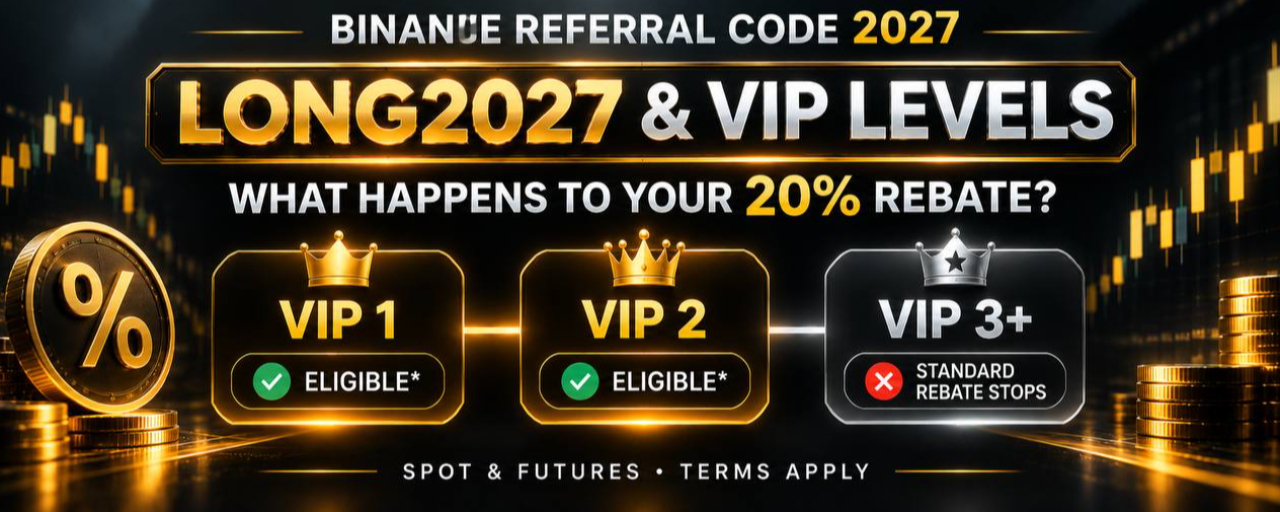
Bài viết
Mã giới thiệu Binance 2027 và các cấp VIP: LONG2027 có còn giảm 20% ở VIP 1, VIP 2 hoặc VIP 3 không?Cập nhật ngày 31 tháng 10 năm 2026 | Hướng dẫn mã giới thiệu Binance 2027
Mức giảm phí giới thiệu Binance của bạn có tiếp tục được áp dụng khi tài khoản đạt cấp VIP cao hơn không?
Đây là câu hỏi quan trọng đối với bất kỳ ai dự định sử dụng mã giới thiệu Binance vào năm 2027, đặc biệt là các nhà giao dịch kỳ vọng khối lượng giao dịch hoặc số dư tài sản trong tài khoản sẽ tăng theo thời gian.
LONG2027 được quảng bá là cung cấp cho người dùng Binance mới đủ điều kiện mức hoàn phí giao dịch Spot 20% và mức hoàn phí giao dịch Futures 20%.
Tuy nhiên, có một giới hạn quan trọng mà nhiều bài so sánh mã giới thiệu thường bỏ qua.
Mã giới thiệu Binance 2027 và các cấp VIP: LONG2027 có còn giảm 20% ở VIP 1, VIP 2 hoặc VIP 3 không?
Cập nhật ngày 31 tháng 10 năm 2026 | Hướng dẫn mã giới thiệu Binance 2027
Mức giảm phí giới thiệu Binance của bạn có tiếp tục được áp dụng khi tài khoản đạt cấp VIP cao hơn không?
Đây là câu hỏi quan trọng đối với bất kỳ ai dự định sử dụng mã giới thiệu Binance vào năm 2027, đặc biệt là các nhà giao dịch kỳ vọng khối lượng giao dịch hoặc số dư tài sản trong tài khoản sẽ tăng theo thời gian.
LONG2027 được quảng bá là cung cấp cho người dùng Binance mới đủ điều kiện mức hoàn phí giao dịch Spot 20% và mức hoàn phí giao dịch Futures 20%.
Tuy nhiên, có một giới hạn quan trọng mà nhiều bài so sánh mã giới thiệu thường bỏ qua.
3
83
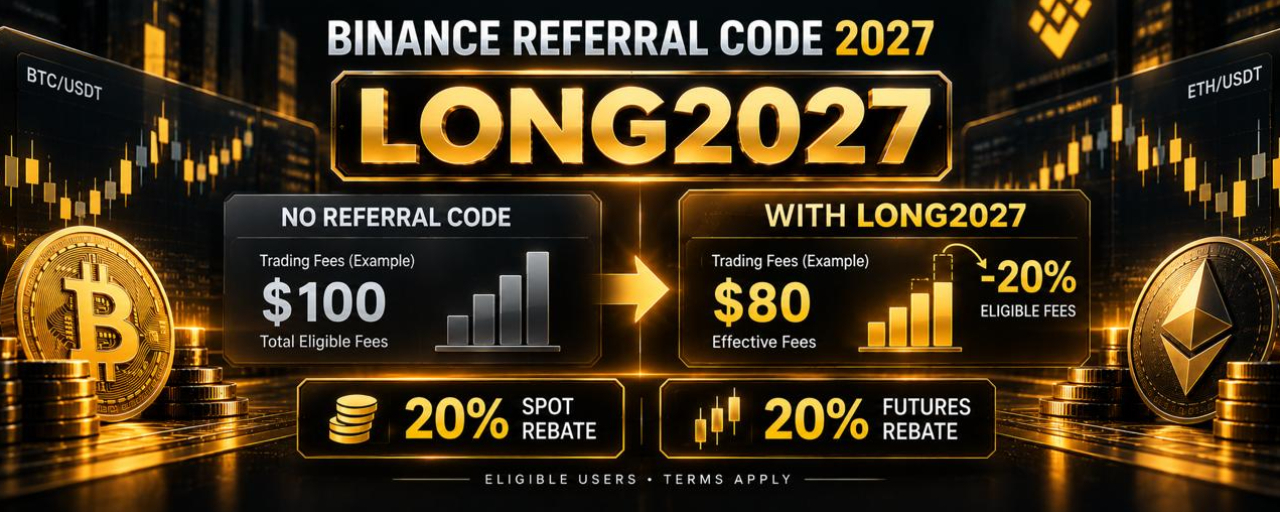
Bài viết
Xem bản dịch
Binance Referral Code 2027 vs No Referral Code: How Much Can LONG2027 Actually Save?Updated October 29, 2026 | Binance Referral Code 2027 Guide
Is it better to register on Binance with a referral code or without one?
If you are planning to open a Binance account in 2027, this question deserves more attention than it usually receives.
Most new users focus on the trading interface, supported cryptocurrencies, and deposit methods. However, the referral decision made during registration can also influence the trading commissions an eligible account ultimately pays.
LONG2027 is a Binance referral code promoted as offering eligible new users a 20% Spot trading fee rebate and a 20% Futures trading fee rebate.
But does using LONG2027 actually save money compared with registering without a referral code?
How much could a beginner save on Bitcoin purchases? What about an active Futures trader? And does a referral code matter if you only trade occasionally?
This guide compares Binance trading fees with and without a qualifying referral rebate, using transparent examples rather than exaggerated savings claims.
Quick Answer: Is a Binance Referral Code Worth Using in 2027?
A qualifying Binance referral code can reduce effective trading commissions when the account receives a referral rebate.
For example, suppose two users generate exactly $100 in eligible trading fees under identical conditions.
User A registers without a referral rebate and pays $100.
User B registers with LONG2027 and receives an eligible 20% commission rebate.
User B's potential rebate is $20, reducing the effective commission cost to $80.
The difference is $20.
However, the result depends on whether the account is eligible, the rebate remains active, and the transactions qualify.
A referral code does not guarantee additional savings on zero-fee transactions, and its benefits do not automatically cover every Binance product.
LONG2027 Referral Details
Referral Code: LONG2027
Promoted Spot Fee Rebate: 20%
Promoted Futures Fee Rebate: 20%
Registration Link: [https://www.binance.com/join?ref=LONG2027](https://www.binance.com/join?ref=LONG2027)
Always verify the displayed rebate rates and applicable terms before completing registration.
1. What Happens If You Register on Binance Without a Referral Code?
Binance allows eligible users to create an account without entering a referral code.
A referral code is not generally required to complete standard registration.
You can still access supported Binance services, subject to account verification, regional restrictions, and product eligibility.
You may also qualify for standard VIP fee rates, applicable BNB fee-payment discounts, or trading pair promotions.
The key distinction concerns the referral relationship.
If you register without an applicable commission-sharing referral arrangement, you should not assume that your account will receive a Referral Pro rebate.
This does not mean that every user without a referral code pays the same trading fees.
Two users can have different commission rates because of VIP status, selected products, maker or taker execution, and special promotions.
Therefore, a meaningful comparison must hold those other factors constant.
To measure the potential value of LONG2027, compare two otherwise identical accounts.
One receives no referral rebate.
The other receives an active 20% rebate on qualifying fees.
This isolates the effect of the referral benefit.
2. Binance With LONG2027 vs Without a Code: The Main Difference
Consider two traders opening accounts under identical conditions.
Trader A completes registration without a commission-sharing referral code.
Trader B registers through an eligible LONG2027 referral link and confirms that the advertised 20% Spot and 20% Futures rebates apply.
Both traders use the same trading pair.
Both place the same type of orders.
Both have the same underlying fee rate.
Both generate identical qualifying commissions.
Under these assumptions, the difference in effective commission cost comes from Trader B's referral rebate.
If Trader A pays $25 in qualifying trading fees, there is no referral rebate in this comparison.
If Trader B generates the same $25 in qualifying fees and receives an eligible 20% rebate, the potential rebate is $5.
Trader B's effective commission cost becomes $20.
The savings represent 20% of the eligible trading fee base, not 20% of the trade's value.
This distinction is essential when interpreting promotional claims.
3. Example: Buying Bitcoin With and Without LONG2027
Imagine two new Binance users who each purchase $1,000 worth of Bitcoin on Spot.
For this example, assume both have an illustrative trading fee rate of 0.10%.
The example excludes separate BNB fee discounts, VIP adjustments, and special zero-fee promotions.
User A: No Referral Rebate
Bitcoin purchase value: $1,000
Illustrative trading fee rate: 0.10%
Trading commission value: $1
Referral rebate: $0
Effective commission value: $1
User B: LONG2027 With an Eligible 20% Spot Rebate
Bitcoin purchase value: $1,000
Illustrative trading fee rate: 0.10%
Trading commission value: $1
Potential referral rebate: $0.20
Effective commission value: $0.80
Potential savings: $0.20
The dollar amount may look small because the trade itself is relatively small.
However, the percentage reduction in the eligible commission is still 20%.
The actual execution fee may be denominated in the cryptocurrency received rather than USDT.
The calculations above express the commission in approximate dollar-equivalent terms for easier comparison.
Bitcoin's market price can change independently of the rebate.
A $0.20 commission saving does not protect the trader from a decline in the value of Bitcoin.
4. What Happens When You Buy and Sell Bitcoin?
A complete Spot trading cycle often involves both a purchase and a later sale.
Each executed transaction can generate its own trading fee.
Suppose a trader purchases $5,000 worth of BTC and later sells the same dollar-equivalent notional amount.
For simplicity, assume an illustrative 0.10% fee rate applies to both transactions.
Buying commission: $5
Selling commission: $5
Total trading commissions: $10
Without a referral rebate, the effective trading commission cost in this example is $10.
With an eligible 20% LONG2027 rebate, the potential total rebate is $2.
The effective commission cost becomes $8.
Potential savings: $2 per completed buy-and-sell cycle.
This example assumes both executions have the same notional value for calculation purposes.
In real trading, the selling value may be higher or lower because cryptocurrency prices change.
Spread and slippage may also affect the final execution result.
A referral rebate only addresses eligible commissions.
It does not guarantee that buying and selling an asset will produce a profitable outcome.
5. How Much Could a Monthly Bitcoin Investor Save?
Not every Binance user is an active trader.
Some people purchase Bitcoin occasionally or follow a recurring investment strategy.
For a long-term investor, the absolute value of a referral rebate may be relatively modest.
Consider an investor who buys $300 worth of Bitcoin every week using qualifying Spot transactions.
Assume four purchases per month and an illustrative 0.10% trading fee.
Total monthly purchase value: $1,200
Illustrative monthly trading fees: $1.20
Potential LONG2027 rebate at 20%: $0.24
Effective monthly trading fee cost: $0.96
Under the same assumptions, 12 months of activity would generate $14.40 in original commissions.
A consistent 20% rebate would represent $2.88 in potential annual savings.
The benefit is real within the hypothetical calculation, but it is not a large financial incentive.
The investor's asset selection, execution price, and long-term investment risk may have a much greater impact on the final result.
Also, recurring purchases made through other Binance services may use different pricing structures and may not qualify for the same Spot referral rebate.
The correct comparison depends on the actual product used.
6. How Much Could an Active Spot Trader Save?
The financial impact becomes more noticeable when a trader generates higher qualifying commission expenditure.
Imagine an active Spot trader who generates $100 in eligible trading commissions each month.
Without a referral rebate:
Monthly commission cost: $100
Annual commission cost, assuming unchanged activity: $1,200
With an eligible 20% LONG2027 Spot rebate:
Potential monthly rebate: $20
Effective monthly commission cost: $80
Potential annual rebate: $240
Effective annual commission cost: $960
Under these assumptions, the difference is $240 over a year.
However, it would be misleading to suggest that every active trader will save exactly this amount.
Monthly transaction volume, VIP levels, trading pairs, account eligibility, and referral conditions can change.
The example also assumes the eligible rebate remains valid throughout the comparison period.
The advantage of a referral rebate should be evaluated against the commission costs a trader would have incurred anyway.
Increasing trading frequency solely to generate cashback generally defeats the purpose of reducing costs.
7. Binance Futures With and Without LONG2027
Futures trading introduces a different commission structure.
Unlike direct Spot transactions, Futures trading involves derivative contracts.
Trading fees are generally calculated from the executed contract value and the applicable maker or taker commission rate.
This matters because leverage can create a position value substantially larger than the initial margin.
Consider a hypothetical trader who opens and later closes a $10,000 Futures position.
Assume both executions have the same $10,000 notional value and an illustrative taker rate of 0.05%.
Opening commission: $5
Closing commission: $5
Total execution commissions: $10
Without a qualifying referral rebate, the effective commission cost would be $10.
With an eligible LONG2027 Futures rebate of 20%, the potential rebate would be $2.
The effective commission cost would become $8.
Potential saving: $2.
This is a simplified commission example. It does not include funding payments, price movements, spread, slippage, or liquidation-related expenses.
It also assumes the Futures referral arrangement is active and both executions qualify.
A referral rebate reduces eligible transaction fees. It does not reduce the leverage or market exposure of the position.
8. Monthly Futures Comparison: Where the Difference Becomes Significant
Imagine a Futures trader who generates $250 in qualifying execution commissions over one month.
Without an eligible referral rebate:
Monthly Futures commissions: $250
Referral rebate: $0
Effective commission cost: $250
With an eligible 20% LONG2027 Futures rebate:
Monthly qualifying commissions: $250
Potential referral rebate: $50
Effective commission cost: $200
Potential monthly savings: $50.
If the same rebate conditions and trading activity remained unchanged for 12 months, the mathematical savings would equal $600.
However, this is a scenario calculation, not a promise of 12 months of rebates.
Binance's Futures referral framework includes commission validity rules.
Certain Futures referral arrangements can be subject to a one-year period, while qualifying higher-tier inviters may receive an exemption from that limitation.
The actual validity period depends on the applicable inviter relationship and program terms.
For this reason, traders should verify both the rebate percentage and the duration of their Futures referral benefit.
For a more detailed explanation of USDT-M, COIN-M, and Futures fee conditions, read:
Binance Futures Referral Code 2027: LONG2027 for USDT-M and COIN-M Trading Fees
[https://www.binance.com/en/square/post/382080858570766](https://www.binance.com/en/square/post/382080858570766)
9. Combined Spot and Futures Savings: A Realistic Comparison
Some Binance users participate in both Spot and Futures markets.
For these traders, a referral code offering eligible benefits on both products may be relevant.
Suppose a hypothetical trader incurs the following monthly commissions.
Eligible Spot trading commissions: $60
Eligible Futures trading commissions: $140
Total eligible trading commissions: $200
Scenario A: No Referral Rebate
Spot commissions paid: $60
Futures commissions paid: $140
Total effective commission cost: $200
Scenario B: LONG2027 With Active 20% Rebates on Both Markets
Potential Spot rebate: $12
Potential Futures rebate: $28
Total potential rebate: $40
Effective commission cost: $160
The mathematical difference is $40 per month.
If the same fees and rebate conditions remained in effect for an entire year, the hypothetical savings would equal $480.
Notice that the discount is not 40%.
The trader receives a 20% reduction in the qualifying Spot commission base and a separate 20% reduction in the qualifying Futures commission base.
Both markets are treated independently.
To explore this distinction further, see:
Binance Referral Code 2027: LONG2027 20% Spot and Futures Trading Fee Discount Explained
[https://www.binance.com/en/square/post/381420313464132](https://www.binance.com/en/square/post/381420313464132)
10. Does a 20% Referral Rebate Apply to the Entire Trade?
No.
This is one of the most important misconceptions to avoid.
If you place a $10,000 trade, a 20% trading fee rebate does not mean Binance returns $2,000.
The rebate relates to the qualifying trading commission.
For example, suppose a $10,000 transaction generates a $10 eligible commission.
A 20% rebate on that $10 fee is $2.
The effective commission cost becomes $8.
The trader does not receive a 20% reduction in the purchase price of the cryptocurrency or the notional value of a Futures contract.
The same principle applies across different trading volumes.
The percentage describes the portion of eligible commission returned, not a percentage of the investment.
11. Does Registering Without a Referral Code Mean You Lose Every Fee Discount?
No.
A referral rebate is only one component of Binance's overall fee structure.
Depending on eligibility, users may also benefit from VIP fee schedules, BNB fee-payment discounts, special trading pair promotions, or other account-level arrangements.
For example, Binance provides eligible users with a BNB-based fee discount on qualifying Spot transactions.
Certain Futures products also have applicable BNB fee-payment discounts.
These arrangements are separate from the referral relationship.
That means a user without a referral code may still pay less than the standard headline commission.
It also means a referred user should not automatically add a 20% rebate to every other advertised discount percentage.
The correct comparison is based on the trading fee that actually qualifies for the referral rebate.
For example, if another discount has already reduced the eligible commission base, the value of a percentage rebate may be lower in absolute terms.
Comparisons should use identical conditions wherever possible.
12. What If the Trading Pair Has Zero Fees?
A zero-fee trading pair changes the calculation.
Suppose an eligible user executes a trade that generates no commission under a special promotion.
Trading commission: $0
Potential 20% referral rebate on that fee: $0
Effective commission: $0
There is no additional commission saving from applying a percentage rebate to a zero commission.
Some Binance promotions also explicitly exclude referral commission or rebate benefits.
For example, selected trading pairs have historically received zero maker fees while retaining standard taker commissions.
The actual benefit depends on whether the order executes as maker or taker and the current promotion terms.
This matters for traders choosing between BTC/USDT, ETH/USDT, and selected alternative quote-currency pairs.
A referral code cannot make a zero commission negative.
For additional details about Bitcoin and Ethereum trading pairs and fee promotions, read:
Binance Referral Code 2027 for Bitcoin & Ethereum: How LONG2027 Reduces BTC and ETH Trading Fees
[https://www.binance.com/en/square/post/381841721228543](https://www.binance.com/en/square/post/381841721228543)
13. The 2026 Net-Fee Rule: Why the Actual Rebate May Be Different
An accurate Binance referral comparison in 2027 must account for the updated commission calculation framework.
Binance announced changes to its referral commission calculations in April 2026.
The changes began taking effect for Spot on April 29, 2026, and for Futures on July 15, 2026.
Under the updated arrangement, referral commissions are calculated using net fees.
Binance defines the relevant net-fee calculation as transaction income after deducting any applicable market-maker rebates.
In simplified terms, the applicable referral commission base may differ from the headline trading fee displayed in an ordinary fee comparison.
This means users should avoid assuming that every transaction produces a rebate equal to exactly 20% of the initially displayed gross commission.
For example, the difference between gross fees and the eligible net-fee base can affect the amount available for commission sharing.
The actual rebate is determined by the relevant account conditions, applicable fee base, and referral commission arrangements.
This is why transaction records and referral distributions are more reliable than an estimated calculator alone.
14. Does Binance Referral Pro Pay Rebates Automatically?
Binance's Referral Pro program allows eligible inviters to share part of their referral commissions with invited users.
The referral commission and the rebate received by the invited user are different portions of the referral arrangement.
Under Binance's published Referral Pro framework, the standard distribution asset for commissions and shared rebates has been USDC since February 2025.
Binance describes periodic conversion and distribution processes for eligible rebates.
Therefore, an executed transaction fee and its associated referral rebate may appear as separate accounting entries.
A user could initially see the trading fee in Trade History and later see a separate referral distribution.
This does not necessarily indicate that the advertised rebate failed.
However, users should never assume a delayed rebate will arrive without confirming that their account and transaction are eligible.
Check the available referral relationship details and distribution history.
For a step-by-step explanation, read:
Binance Referral Code 2027: How to Verify Your 20% Spot & Futures Rebate With LONG2027
[https://www.binance.com/en/square/post/381417441423510](https://www.binance.com/en/square/post/381417441423510)
15. Referral Code vs No Code: What About Referral Lite?
Not every Binance referral offer uses the same reward model.
Binance distinguishes between Referral Lite and Referral Pro.
Referral Lite is associated with task-based rewards, such as qualifying vouchers that may become available after specific deposit or trading activities.
Referral Pro focuses on trading-fee-based commission sharing.
The difference matters when comparing registration offers.
A one-time voucher and a continuing eligible commission rebate are not interchangeable.
For a beginner who trades infrequently, the economic value of a task-based promotion may differ from the value of an ongoing percentage rebate.
For an active trader, qualifying commission sharing may become more relevant as eligible trading fees accumulate.
However, users must check the particular offer rather than assume that one model is always better.
Binance's referral documentation states that new users can participate through only one initial referral mode.
The selected mode can therefore influence the available referral benefits.
Before registering with LONG2027, confirm the displayed referral mode and whether it provides the advertised Spot and Futures rebates.
16. Can You Add LONG2027 After Registering Without a Code?
This is another important consideration.
Some Binance users complete registration without entering a referral code and later attempt to add one.
Binance provides specific post-registration referral binding mechanisms for certain eligible accounts.
However, these are not universal options.
Eligibility can depend on account age, referral history, previous deposits, trading activity, and regional requirements.
Certain recently created accounts may qualify for a limited post-registration binding process.
Other existing users may qualify for separate Affiliate Recall or Affiliate Rebind procedures.
An established referral relationship generally cannot simply be replaced with another referrer.
That is why confirming the intended code before registration is preferable to relying on a later correction.
For complete details, read:
Binance Referral Code After Sign-Up (2027): Can You Add LONG2027 Later?
[https://www.binance.com/en/square/post/381737980857470](https://www.binance.com/en/square/post/381737980857470)
17. How to Register With LONG2027 in 2027
Eligible new users can follow these steps.
Step 1: Open the Binance registration link.
https://www.binance.com/join?ref=LONG2027
Step 2: Check the referral ID field.
The intended referral code is LONG2027.
Step 3: Review the advertised rebate information.
Promoted Spot rebate: 20%
Promoted Futures rebate: 20%
Step 4: Confirm the available referral mode and applicable terms.
Step 5: Check whether Binance Spot and Futures products are available in your country or region.
Step 6: Complete registration and any required identity verification.
Step 7: Review the actual account-level referral conditions before depositing or trading.
Step 8: If you trade, check the relevant fee and rebate records to confirm the effective cost.
A referral code appearing in an article does not guarantee that the benefit is available to every user.
Always rely on the terms displayed by Binance for your account.
18. How to Decide Whether a Referral Code Is Worth Using
The simplest way to evaluate a referral code is to estimate qualifying commissions you would already expect to pay.
Begin with your actual intended trading strategy.
Then identify the products and trading pairs you expect to use.
Check the appropriate maker and taker commission rates.
Review whether any zero-fee or special promotional arrangements apply.
Estimate the potential eligible fee expenditure.
Finally, compare that amount with the account's verified referral rebate percentage.
For a user who generates $5 in monthly eligible commissions, a 20% rebate represents only $1.
For a user who generates $100, it represents $20.
For a user who generates $500, it represents $100.
These are mathematical illustrations assuming all included fees qualify.
The appropriate objective is not to generate the largest possible rebate.
It is to minimize unnecessary costs while maintaining a responsible trading strategy.
19. Frequently Asked Questions
Is it better to join Binance with or without a referral code?
A referral code can offer additional benefits when it provides a qualifying commission rebate. However, actual eligibility, underlying trading fees, promotional restrictions, and the referral mode must be compared before deciding.
What is the Binance referral code for 2027?
LONG2027 is promoted as offering eligible users 20% Spot and 20% Futures trading fee rebates. The displayed benefits must be verified through Binance during registration.
Does LONG2027 offer a 20% discount on all Binance trading fees?
No. The advertised 20% rebates apply to qualifying trading commissions, subject to account eligibility and program conditions. Other costs such as funding payments and slippage are separate.
How much can I save by using LONG2027?
If an account receives an active 20% rebate and generates $100 in qualifying trading commissions, the mathematical rebate is $20. Actual results depend on the eligible fee base and account conditions.
Does a referral code reduce Bitcoin purchase fees?
A qualifying Spot referral rebate can reduce eligible trading commissions on supported Bitcoin transactions. It does not guarantee savings on every purchase method or trading pair.
Can I receive a referral rebate when selling crypto?
Qualifying Spot sell transactions may generate eligible commissions. The rebate depends on the account's referral arrangement and the transaction's actual fee.
Does LONG2027 reduce Futures trading commissions?
LONG2027 is promoted as offering eligible users a 20% Futures fee rebate. Its actual application and validity period must be confirmed through Binance.
Do Spot and Futures rebates combine into 40%?
No. The two advertised 20% rebates apply separately to qualifying commissions in different markets. They do not create a 40% reduction on a single transaction.
Does using a Binance referral code change trading prices?
A referral fee rebate does not automatically change the cryptocurrency market price or order execution price. Spread and slippage remain important.
Can I combine LONG2027 with a BNB fee discount?
Some qualifying commissions may benefit from separate BNB fee-payment arrangements. The combined outcome depends on Binance's calculation rules and should not be estimated by simply adding percentages.
Does a Binance referral rebate last forever?
Not necessarily. Futures referral commission arrangements can be subject to validity periods. Verify the actual duration and terms associated with your account.
Can existing users activate LONG2027?
Certain existing accounts without an established referrer may qualify for specific binding programs. Eligibility depends on Binance's current requirements.
Does a zero-fee trade generate a 20% rebate?
If no eligible trading commission is generated, there is ordinarily no commission amount available for a percentage rebate.
Does Binance pay referral rebates in USDC?
Binance's published Referral Pro framework uses USDC as the standard distribution asset for eligible commissions and shared rebates. Verify the actual distribution details in your account.
Where can I register with LONG2027?
https://www.binance.com/join?ref=LONG2027
20. Final Verdict: LONG2027 vs No Binance Referral Code in 2027
The difference between registering with and without a Binance referral code depends on the benefits actually attached to the account.
Without a qualifying referral relationship, a user may not receive an ongoing Referral Pro commission rebate.
With an eligible LONG2027 referral relationship, the advertised benefit is a 20% rebate on qualifying Spot trading commissions and a separate 20% rebate on qualifying Futures trading commissions.
For two otherwise identical users, the rebate can reduce the effective cost of eligible transactions.
The absolute savings depend on how much qualifying commission is generated.
A long-term investor making small occasional purchases may save only a modest amount.
A more active trader may see a larger reduction in accumulated eligible fees.
However, higher trading volume does not automatically mean better trading performance.
It is equally important to understand zero-fee promotions, VIP fee tiers, BNB discounts, net-fee calculations, and the applicable duration of Futures referral benefits.
A referral code should be evaluated as a trading cost feature, not a guarantee of profit.
LONG2027 Referral Summary
Referral Code: LONG2027
Promoted Spot Trading Fee Rebate: 20%
Promoted Futures Trading Fee Rebate: 20%
Official Registration Link: https://www.binance.com/join?ref=LONG2027
The best approach is to verify the offered benefits before registration, review your actual commission records, and compare total trading costs rather than promotional percentages alone.
Smarter fee management starts with understanding what you actually pay.
Independent educational content. Last reviewed October 29, 2026. Not affiliated with or endorsed by Binance. LONG2027 rebate rates are promotional claims subject to verification, eligibility, product availability, and Binance's current terms. Spot and leveraged Futures trading involve substantial financial risk. This article is not financial advice.
Binance Referral Code 2027 vs No Referral Code: How Much Can LONG2027 Actually Save?
Updated October 29, 2026 | Binance Referral Code 2027 Guide
Is it better to register on Binance with a referral code or without one?
If you are planning to open a Binance account in 2027, this question deserves more attention than it usually receives.
Most new users focus on the trading interface, supported cryptocurrencies, and deposit methods. However, the referral decision made during registration can also influence the trading commissions an eligible account ultimately pays.
LONG2027 is a Binance referral code promoted as offering eligible new users a 20% Spot trading fee rebate and a 20% Futures trading fee rebate.
But does using LONG2027 actually save money compared with registering without a referral code?
How much could a beginner save on Bitcoin purchases? What about an active Futures trader? And does a referral code matter if you only trade occasionally?
This guide compares Binance trading fees with and without a qualifying referral rebate, using transparent examples rather than exaggerated savings claims.
Quick Answer: Is a Binance Referral Code Worth Using in 2027?
A qualifying Binance referral code can reduce effective trading commissions when the account receives a referral rebate.
For example, suppose two users generate exactly $100 in eligible trading fees under identical conditions.
User A registers without a referral rebate and pays $100.
User B registers with LONG2027 and receives an eligible 20% commission rebate.
User B's potential rebate is $20, reducing the effective commission cost to $80.
The difference is $20.
However, the result depends on whether the account is eligible, the rebate remains active, and the transactions qualify.
A referral code does not guarantee additional savings on zero-fee transactions, and its benefits do not automatically cover every Binance product.
LONG2027 Referral Details
Referral Code: LONG2027
Promoted Spot Fee Rebate: 20%
Promoted Futures Fee Rebate: 20%
Registration Link: https://www.binance.com/join?ref=LONG2027
Always verify the displayed rebate rates and applicable terms before completing registration.
1. What Happens If You Register on Binance Without a Referral Code?
Binance allows eligible users to create an account without entering a referral code.
A referral code is not generally required to complete standard registration.
You can still access supported Binance services, subject to account verification, regional restrictions, and product eligibility.
You may also qualify for standard VIP fee rates, applicable BNB fee-payment discounts, or trading pair promotions.
The key distinction concerns the referral relationship.
If you register without an applicable commission-sharing referral arrangement, you should not assume that your account will receive a Referral Pro rebate.
This does not mean that every user without a referral code pays the same trading fees.
Two users can have different commission rates because of VIP status, selected products, maker or taker execution, and special promotions.
Therefore, a meaningful comparison must hold those other factors constant.
To measure the potential value of LONG2027, compare two otherwise identical accounts.
One receives no referral rebate.
The other receives an active 20% rebate on qualifying fees.
This isolates the effect of the referral benefit.
2. Binance With LONG2027 vs Without a Code: The Main Difference
Consider two traders opening accounts under identical conditions.
Trader A completes registration without a commission-sharing referral code.
Trader B registers through an eligible LONG2027 referral link and confirms that the advertised 20% Spot and 20% Futures rebates apply.
Both traders use the same trading pair.
Both place the same type of orders.
Both have the same underlying fee rate.
Both generate identical qualifying commissions.
Under these assumptions, the difference in effective commission cost comes from Trader B's referral rebate.
If Trader A pays $25 in qualifying trading fees, there is no referral rebate in this comparison.
If Trader B generates the same $25 in qualifying fees and receives an eligible 20% rebate, the potential rebate is $5.
Trader B's effective commission cost becomes $20.
The savings represent 20% of the eligible trading fee base, not 20% of the trade's value.
This distinction is essential when interpreting promotional claims.
3. Example: Buying Bitcoin With and Without LONG2027
Imagine two new Binance users who each purchase $1,000 worth of Bitcoin on Spot.
For this example, assume both have an illustrative trading fee rate of 0.10%.
The example excludes separate BNB fee discounts, VIP adjustments, and special zero-fee promotions.
User A: No Referral Rebate
Bitcoin purchase value: $1,000
Illustrative trading fee rate: 0.10%
Trading commission value: $1
Referral rebate: $0
Effective commission value: $1
User B: LONG2027 With an Eligible 20% Spot Rebate
Bitcoin purchase value: $1,000
Illustrative trading fee rate: 0.10%
Trading commission value: $1
Potential referral rebate: $0.20
Effective commission value: $0.80
Potential savings: $0.20
The dollar amount may look small because the trade itself is relatively small.
However, the percentage reduction in the eligible commission is still 20%.
The actual execution fee may be denominated in the cryptocurrency received rather than USDT.
The calculations above express the commission in approximate dollar-equivalent terms for easier comparison.
Bitcoin's market price can change independently of the rebate.
A $0.20 commission saving does not protect the trader from a decline in the value of Bitcoin.
4. What Happens When You Buy and Sell Bitcoin?
A complete Spot trading cycle often involves both a purchase and a later sale.
Each executed transaction can generate its own trading fee.
Suppose a trader purchases $5,000 worth of BTC and later sells the same dollar-equivalent notional amount.
For simplicity, assume an illustrative 0.10% fee rate applies to both transactions.
Buying commission: $5
Selling commission: $5
Total trading commissions: $10
Without a referral rebate, the effective trading commission cost in this example is $10.
With an eligible 20% LONG2027 rebate, the potential total rebate is $2.
The effective commission cost becomes $8.
Potential savings: $2 per completed buy-and-sell cycle.
This example assumes both executions have the same notional value for calculation purposes.
In real trading, the selling value may be higher or lower because cryptocurrency prices change.
Spread and slippage may also affect the final execution result.
A referral rebate only addresses eligible commissions.
It does not guarantee that buying and selling an asset will produce a profitable outcome.
5. How Much Could a Monthly Bitcoin Investor Save?
Not every Binance user is an active trader.
Some people purchase Bitcoin occasionally or follow a recurring investment strategy.
For a long-term investor, the absolute value of a referral rebate may be relatively modest.
Consider an investor who buys $300 worth of Bitcoin every week using qualifying Spot transactions.
Assume four purchases per month and an illustrative 0.10% trading fee.
Total monthly purchase value: $1,200
Illustrative monthly trading fees: $1.20
Potential LONG2027 rebate at 20%: $0.24
Effective monthly trading fee cost: $0.96
Under the same assumptions, 12 months of activity would generate $14.40 in original commissions.
A consistent 20% rebate would represent $2.88 in potential annual savings.
The benefit is real within the hypothetical calculation, but it is not a large financial incentive.
The investor's asset selection, execution price, and long-term investment risk may have a much greater impact on the final result.
Also, recurring purchases made through other Binance services may use different pricing structures and may not qualify for the same Spot referral rebate.
The correct comparison depends on the actual product used.
6. How Much Could an Active Spot Trader Save?
The financial impact becomes more noticeable when a trader generates higher qualifying commission expenditure.
Imagine an active Spot trader who generates $100 in eligible trading commissions each month.
Without a referral rebate:
Monthly commission cost: $100
Annual commission cost, assuming unchanged activity: $1,200
With an eligible 20% LONG2027 Spot rebate:
Potential monthly rebate: $20
Effective monthly commission cost: $80
Potential annual rebate: $240
Effective annual commission cost: $960
Under these assumptions, the difference is $240 over a year.
However, it would be misleading to suggest that every active trader will save exactly this amount.
Monthly transaction volume, VIP levels, trading pairs, account eligibility, and referral conditions can change.
The example also assumes the eligible rebate remains valid throughout the comparison period.
The advantage of a referral rebate should be evaluated against the commission costs a trader would have incurred anyway.
Increasing trading frequency solely to generate cashback generally defeats the purpose of reducing costs.
7. Binance Futures With and Without LONG2027
Futures trading introduces a different commission structure.
Unlike direct Spot transactions, Futures trading involves derivative contracts.
Trading fees are generally calculated from the executed contract value and the applicable maker or taker commission rate.
This matters because leverage can create a position value substantially larger than the initial margin.
Consider a hypothetical trader who opens and later closes a $10,000 Futures position.
Assume both executions have the same $10,000 notional value and an illustrative taker rate of 0.05%.
Opening commission: $5
Closing commission: $5
Total execution commissions: $10
Without a qualifying referral rebate, the effective commission cost would be $10.
With an eligible LONG2027 Futures rebate of 20%, the potential rebate would be $2.
The effective commission cost would become $8.
Potential saving: $2.
This is a simplified commission example. It does not include funding payments, price movements, spread, slippage, or liquidation-related expenses.
It also assumes the Futures referral arrangement is active and both executions qualify.
A referral rebate reduces eligible transaction fees. It does not reduce the leverage or market exposure of the position.
8. Monthly Futures Comparison: Where the Difference Becomes Significant
Imagine a Futures trader who generates $250 in qualifying execution commissions over one month.
Without an eligible referral rebate:
Monthly Futures commissions: $250
Referral rebate: $0
Effective commission cost: $250
With an eligible 20% LONG2027 Futures rebate:
Monthly qualifying commissions: $250
Potential referral rebate: $50
Effective commission cost: $200
Potential monthly savings: $50.
If the same rebate conditions and trading activity remained unchanged for 12 months, the mathematical savings would equal $600.
However, this is a scenario calculation, not a promise of 12 months of rebates.
Binance's Futures referral framework includes commission validity rules.
Certain Futures referral arrangements can be subject to a one-year period, while qualifying higher-tier inviters may receive an exemption from that limitation.
The actual validity period depends on the applicable inviter relationship and program terms.
For this reason, traders should verify both the rebate percentage and the duration of their Futures referral benefit.
For a more detailed explanation of USDT-M, COIN-M, and Futures fee conditions, read:
Binance Futures Referral Code 2027: LONG2027 for USDT-M and COIN-M Trading Fees
https://www.binance.com/en/square/post/382080858570766
9. Combined Spot and Futures Savings: A Realistic Comparison
Some Binance users participate in both Spot and Futures markets.
For these traders, a referral code offering eligible benefits on both products may be relevant.
Suppose a hypothetical trader incurs the following monthly commissions.
Eligible Spot trading commissions: $60
Eligible Futures trading commissions: $140
Total eligible trading commissions: $200
Scenario A: No Referral Rebate
Spot commissions paid: $60
Futures commissions paid: $140
Total effective commission cost: $200
Scenario B: LONG2027 With Active 20% Rebates on Both Markets
Potential Spot rebate: $12
Potential Futures rebate: $28
Total potential rebate: $40
Effective commission cost: $160
The mathematical difference is $40 per month.
If the same fees and rebate conditions remained in effect for an entire year, the hypothetical savings would equal $480.
Notice that the discount is not 40%.
The trader receives a 20% reduction in the qualifying Spot commission base and a separate 20% reduction in the qualifying Futures commission base.
Both markets are treated independently.
To explore this distinction further, see:
Binance Referral Code 2027: LONG2027 20% Spot and Futures Trading Fee Discount Explained
https://www.binance.com/en/square/post/381420313464132
10. Does a 20% Referral Rebate Apply to the Entire Trade?
No.
This is one of the most important misconceptions to avoid.
If you place a $10,000 trade, a 20% trading fee rebate does not mean Binance returns $2,000.
The rebate relates to the qualifying trading commission.
For example, suppose a $10,000 transaction generates a $10 eligible commission.
A 20% rebate on that $10 fee is $2.
The effective commission cost becomes $8.
The trader does not receive a 20% reduction in the purchase price of the cryptocurrency or the notional value of a Futures contract.
The same principle applies across different trading volumes.
The percentage describes the portion of eligible commission returned, not a percentage of the investment.
11. Does Registering Without a Referral Code Mean You Lose Every Fee Discount?
No.
A referral rebate is only one component of Binance's overall fee structure.
Depending on eligibility, users may also benefit from VIP fee schedules, BNB fee-payment discounts, special trading pair promotions, or other account-level arrangements.
For example, Binance provides eligible users with a BNB-based fee discount on qualifying Spot transactions.
Certain Futures products also have applicable BNB fee-payment discounts.
These arrangements are separate from the referral relationship.
That means a user without a referral code may still pay less than the standard headline commission.
It also means a referred user should not automatically add a 20% rebate to every other advertised discount percentage.
The correct comparison is based on the trading fee that actually qualifies for the referral rebate.
For example, if another discount has already reduced the eligible commission base, the value of a percentage rebate may be lower in absolute terms.
Comparisons should use identical conditions wherever possible.
12. What If the Trading Pair Has Zero Fees?
A zero-fee trading pair changes the calculation.
Suppose an eligible user executes a trade that generates no commission under a special promotion.
Trading commission: $0
Potential 20% referral rebate on that fee: $0
Effective commission: $0
There is no additional commission saving from applying a percentage rebate to a zero commission.
Some Binance promotions also explicitly exclude referral commission or rebate benefits.
For example, selected trading pairs have historically received zero maker fees while retaining standard taker commissions.
The actual benefit depends on whether the order executes as maker or taker and the current promotion terms.
This matters for traders choosing between BTC/USDT, ETH/USDT, and selected alternative quote-currency pairs.
A referral code cannot make a zero commission negative.
For additional details about Bitcoin and Ethereum trading pairs and fee promotions, read:
Binance Referral Code 2027 for Bitcoin & Ethereum: How LONG2027 Reduces BTC and ETH Trading Fees
https://www.binance.com/en/square/post/381841721228543
13. The 2026 Net-Fee Rule: Why the Actual Rebate May Be Different
An accurate Binance referral comparison in 2027 must account for the updated commission calculation framework.
Binance announced changes to its referral commission calculations in April 2026.
The changes began taking effect for Spot on April 29, 2026, and for Futures on July 15, 2026.
Under the updated arrangement, referral commissions are calculated using net fees.
Binance defines the relevant net-fee calculation as transaction income after deducting any applicable market-maker rebates.
In simplified terms, the applicable referral commission base may differ from the headline trading fee displayed in an ordinary fee comparison.
This means users should avoid assuming that every transaction produces a rebate equal to exactly 20% of the initially displayed gross commission.
For example, the difference between gross fees and the eligible net-fee base can affect the amount available for commission sharing.
The actual rebate is determined by the relevant account conditions, applicable fee base, and referral commission arrangements.
This is why transaction records and referral distributions are more reliable than an estimated calculator alone.
14. Does Binance Referral Pro Pay Rebates Automatically?
Binance's Referral Pro program allows eligible inviters to share part of their referral commissions with invited users.
The referral commission and the rebate received by the invited user are different portions of the referral arrangement.
Under Binance's published Referral Pro framework, the standard distribution asset for commissions and shared rebates has been USDC since February 2025.
Binance describes periodic conversion and distribution processes for eligible rebates.
Therefore, an executed transaction fee and its associated referral rebate may appear as separate accounting entries.
A user could initially see the trading fee in Trade History and later see a separate referral distribution.
This does not necessarily indicate that the advertised rebate failed.
However, users should never assume a delayed rebate will arrive without confirming that their account and transaction are eligible.
Check the available referral relationship details and distribution history.
For a step-by-step explanation, read:
Binance Referral Code 2027: How to Verify Your 20% Spot & Futures Rebate With LONG2027
https://www.binance.com/en/square/post/381417441423510
15. Referral Code vs No Code: What About Referral Lite?
Not every Binance referral offer uses the same reward model.
Binance distinguishes between Referral Lite and Referral Pro.
Referral Lite is associated with task-based rewards, such as qualifying vouchers that may become available after specific deposit or trading activities.
Referral Pro focuses on trading-fee-based commission sharing.
The difference matters when comparing registration offers.
A one-time voucher and a continuing eligible commission rebate are not interchangeable.
For a beginner who trades infrequently, the economic value of a task-based promotion may differ from the value of an ongoing percentage rebate.
For an active trader, qualifying commission sharing may become more relevant as eligible trading fees accumulate.
However, users must check the particular offer rather than assume that one model is always better.
Binance's referral documentation states that new users can participate through only one initial referral mode.
The selected mode can therefore influence the available referral benefits.
Before registering with LONG2027, confirm the displayed referral mode and whether it provides the advertised Spot and Futures rebates.
16. Can You Add LONG2027 After Registering Without a Code?
This is another important consideration.
Some Binance users complete registration without entering a referral code and later attempt to add one.
Binance provides specific post-registration referral binding mechanisms for certain eligible accounts.
However, these are not universal options.
Eligibility can depend on account age, referral history, previous deposits, trading activity, and regional requirements.
Certain recently created accounts may qualify for a limited post-registration binding process.
Other existing users may qualify for separate Affiliate Recall or Affiliate Rebind procedures.
An established referral relationship generally cannot simply be replaced with another referrer.
That is why confirming the intended code before registration is preferable to relying on a later correction.
For complete details, read:
Binance Referral Code After Sign-Up (2027): Can You Add LONG2027 Later?
https://www.binance.com/en/square/post/381737980857470
17. How to Register With LONG2027 in 2027
Eligible new users can follow these steps.
Step 1: Open the Binance registration link.
https://www.binance.com/join?ref=LONG2027
Step 2: Check the referral ID field.
The intended referral code is LONG2027.
Step 3: Review the advertised rebate information.
Promoted Spot rebate: 20%
Promoted Futures rebate: 20%
Step 4: Confirm the available referral mode and applicable terms.
Step 5: Check whether Binance Spot and Futures products are available in your country or region.
Step 6: Complete registration and any required identity verification.
Step 7: Review the actual account-level referral conditions before depositing or trading.
Step 8: If you trade, check the relevant fee and rebate records to confirm the effective cost.
A referral code appearing in an article does not guarantee that the benefit is available to every user.
Always rely on the terms displayed by Binance for your account.
18. How to Decide Whether a Referral Code Is Worth Using
The simplest way to evaluate a referral code is to estimate qualifying commissions you would already expect to pay.
Begin with your actual intended trading strategy.
Then identify the products and trading pairs you expect to use.
Check the appropriate maker and taker commission rates.
Review whether any zero-fee or special promotional arrangements apply.
Estimate the potential eligible fee expenditure.
Finally, compare that amount with the account's verified referral rebate percentage.
For a user who generates $5 in monthly eligible commissions, a 20% rebate represents only $1.
For a user who generates $100, it represents $20.
For a user who generates $500, it represents $100.
These are mathematical illustrations assuming all included fees qualify.
The appropriate objective is not to generate the largest possible rebate.
It is to minimize unnecessary costs while maintaining a responsible trading strategy.
19. Frequently Asked Questions
Is it better to join Binance with or without a referral code?
A referral code can offer additional benefits when it provides a qualifying commission rebate. However, actual eligibility, underlying trading fees, promotional restrictions, and the referral mode must be compared before deciding.
What is the Binance referral code for 2027?
LONG2027 is promoted as offering eligible users 20% Spot and 20% Futures trading fee rebates. The displayed benefits must be verified through Binance during registration.
Does LONG2027 offer a 20% discount on all Binance trading fees?
No. The advertised 20% rebates apply to qualifying trading commissions, subject to account eligibility and program conditions. Other costs such as funding payments and slippage are separate.
How much can I save by using LONG2027?
If an account receives an active 20% rebate and generates $100 in qualifying trading commissions, the mathematical rebate is $20. Actual results depend on the eligible fee base and account conditions.
Does a referral code reduce Bitcoin purchase fees?
A qualifying Spot referral rebate can reduce eligible trading commissions on supported Bitcoin transactions. It does not guarantee savings on every purchase method or trading pair.
Can I receive a referral rebate when selling crypto?
Qualifying Spot sell transactions may generate eligible commissions. The rebate depends on the account's referral arrangement and the transaction's actual fee.
Does LONG2027 reduce Futures trading commissions?
LONG2027 is promoted as offering eligible users a 20% Futures fee rebate. Its actual application and validity period must be confirmed through Binance.
Do Spot and Futures rebates combine into 40%?
No. The two advertised 20% rebates apply separately to qualifying commissions in different markets. They do not create a 40% reduction on a single transaction.
Does using a Binance referral code change trading prices?
A referral fee rebate does not automatically change the cryptocurrency market price or order execution price. Spread and slippage remain important.
Can I combine LONG2027 with a BNB fee discount?
Some qualifying commissions may benefit from separate BNB fee-payment arrangements. The combined outcome depends on Binance's calculation rules and should not be estimated by simply adding percentages.
Does a Binance referral rebate last forever?
Not necessarily. Futures referral commission arrangements can be subject to validity periods. Verify the actual duration and terms associated with your account.
Can existing users activate LONG2027?
Certain existing accounts without an established referrer may qualify for specific binding programs. Eligibility depends on Binance's current requirements.
Does a zero-fee trade generate a 20% rebate?
If no eligible trading commission is generated, there is ordinarily no commission amount available for a percentage rebate.
Does Binance pay referral rebates in USDC?
Binance's published Referral Pro framework uses USDC as the standard distribution asset for eligible commissions and shared rebates. Verify the actual distribution details in your account.
Where can I register with LONG2027?
https://www.binance.com/join?ref=LONG2027
20. Final Verdict: LONG2027 vs No Binance Referral Code in 2027
The difference between registering with and without a Binance referral code depends on the benefits actually attached to the account.
Without a qualifying referral relationship, a user may not receive an ongoing Referral Pro commission rebate.
With an eligible LONG2027 referral relationship, the advertised benefit is a 20% rebate on qualifying Spot trading commissions and a separate 20% rebate on qualifying Futures trading commissions.
For two otherwise identical users, the rebate can reduce the effective cost of eligible transactions.
The absolute savings depend on how much qualifying commission is generated.
A long-term investor making small occasional purchases may save only a modest amount.
A more active trader may see a larger reduction in accumulated eligible fees.
However, higher trading volume does not automatically mean better trading performance.
It is equally important to understand zero-fee promotions, VIP fee tiers, BNB discounts, net-fee calculations, and the applicable duration of Futures referral benefits.
A referral code should be evaluated as a trading cost feature, not a guarantee of profit.
LONG2027 Referral Summary
Referral Code: LONG2027
Promoted Spot Trading Fee Rebate: 20%
Promoted Futures Trading Fee Rebate: 20%
Official Registration Link: https://www.binance.com/join?ref=LONG2027
The best approach is to verify the offered benefits before registration, review your actual commission records, and compare total trading costs rather than promotional percentages alone.
Smarter fee management starts with understanding what you actually pay.
Independent educational content. Last reviewed October 29, 2026. Not affiliated with or endorsed by Binance. LONG2027 rebate rates are promotional claims subject to verification, eligibility, product availability, and Binance's current terms. Spot and leveraged Futures trading involve substantial financial risk. This article is not financial advice.
3
85
Bài viết
Xem bản dịch
Binance Futures Referral Code 2027: LONG2027 for USDT-M and COIN-M Trading FeesUpdated October 28, 2026 | Binance Futures Referral Guide for 2027
Looking for a Binance Futures referral code in 2027 that can help reduce trading commissions?
LONG2027 is a Binance referral code promoted as offering eligible new users a 20% trading fee rebate on Spot and a 20% rebate on Futures.
But before choosing a Futures referral code, there is an important distinction to understand.
Binance operates different types of cryptocurrency Futures contracts, including USDⓈ-M Futures and COIN-M Futures.
These products can have different margin currencies, settlement mechanisms, contract specifications, and fee calculations.
Does the LONG2027 referral code work with both types of Futures? How are rebates calculated? And how can traders verify whether a 20% commission benefit applies to their particular contracts?
This guide explains the differences between USDT-M and COIN-M Futures, how the Binance referral program works, and what traders should verify before opening a Futures account.
Quick Answer: What Is the Binance Futures Referral Code for 2027?
LONG2027 is promoted as a Binance referral code offering eligible users a 20% Futures trading fee rebate alongside a 20% Spot trading fee rebate.
Referral Code: LONG2027
Spot Trading Fee Rebate: 20%
Futures Trading Fee Rebate: 20%
Registration Link: [https://www.binance.com/join?ref=LONG2027](https://www.binance.com/join?ref=LONG2027)
Binance’s referral documentation supports commission-sharing arrangements involving both USDⓈ-M and COIN-M Futures.
However, not every referral offer necessarily provides identical benefits across every contract.
The exact rebate rate, eligible products, referral validity period, and regional restrictions must be confirmed through the user’s Binance account.
1. How Does a Binance Futures Referral Code Work?
A Binance Futures referral code connects an eligible user to a referral relationship when registering with Binance.
Under qualifying commission-sharing arrangements, the inviter may receive part of the trading commissions generated by the invited user.
The inviter can also share a portion of the eligible referral commission with the invited user as a fee rebate.
This mechanism differs from an ordinary promotional voucher.
A one-time trading fee voucher may cover qualifying fees until its value or validity expires.
A referral rebate, by contrast, is associated with qualifying trading activity and the applicable commission-sharing terms.
For LONG2027, the promoted benefit is a 20% rebate on eligible Futures trading fees.
The rebate percentage refers to qualifying commissions, not a 20% discount on the entire position value.
It also does not reduce trading losses, funding payments, or liquidation exposure by 20%.
1. What Are USDⓈ-M Futures on Binance?
USDⓈ-M Futures are contracts that use supported stablecoin-denominated margin and settlement arrangements.
Common examples include USDT-margined Futures and USDC-margined Futures.
For a typical BTCUSDT perpetual contract, trading commissions and profit or loss are calculated using the applicable USDT-denominated contract rules.
For a supported ETHUSDC contract, the corresponding stablecoin is USDC.
USDⓈ-M Futures are often useful to understand because their trading fees can be expressed directly in stablecoin terms.
Consider an illustrative BTCUSDT Futures position.
Executed position value: $10,000
Illustrative taker commission rate: 0.05%
Original trading commission: $5
Potential 20% referral rebate: $1
Effective commission after rebate: $4
This is a simplified example based on an assumed qualifying transaction.
Actual commission rates depend on the user’s fee tier, order execution, selected contract, and applicable promotions.
The example does not establish that every LONG2027 user will receive the rebate or that the same rate applies to all Futures products.
1. What Are COIN-M Futures on Binance?
COIN-M Futures are cryptocurrency-margined contracts.
Unlike typical USDT-margined Futures, COIN-M contracts can use the underlying cryptocurrency for margin, settlement, and the calculation of relevant account balances.
Examples include Bitcoin-margined and Ethereum-margined Futures contracts.
A BTCUSD COIN-M contract may use Bitcoin as its settlement asset.
An ETHUSD COIN-M contract may use Ethereum.
This creates an important difference in how trading costs are displayed.
Instead of paying a trading commission in USDT, an eligible COIN-M transaction may generate a fee denominated in the underlying cryptocurrency.
For example, a Bitcoin-margined Futures transaction could generate a commission expressed in BTC.
The USD-equivalent value of that commission changes with the market price of Bitcoin.
Understanding this distinction helps traders evaluate the actual economic value of any referral rebate.
1. Does the Binance Referral Program Include COIN-M Futures?
Yes, Binance has historically included COIN-M Futures in its Futures referral program.
Binance announced the addition of COIN-M Futures referral commissions in July 2020, including supported perpetual and quarterly contracts.
This established referral commission coverage beyond USDT-margined perpetual Futures.
However, historical inclusion in a referral program should not be confused with confirmation that every modern referral offer provides the same rebate percentage across all contract types.
For LONG2027, the promoted Futures rebate is 20% on qualifying commissions.
Eligible users should review the displayed referral conditions and verify whether their particular COIN-M contracts participate.
The appropriate distinction is between the platform’s general referral capabilities and the specific benefits attached to an individual referral relationship.
A promotional claim should always be checked against the actual account conditions.
1. USDT-M vs COIN-M Futures: What Changes for Trading Fees?
Both types of Futures can generate maker and taker commissions.
However, the contract structure affects how the fees are calculated and denominated.
With a typical USDT-margined Futures contract, the commission is associated with the executed notional value and the applicable fee rate.
For a COIN-M contract, the contract size, execution price, and coin-denominated notional value influence the commission calculation.
The underlying rebate concept is similar.
If a transaction generates a qualifying commission and the account has an applicable 20% referral rebate, the mathematical rebate is 20% of the eligible fee base.
The original commission and the effective commission after rebate are not necessarily displayed in the same location.
Referral distributions may be credited separately from execution fees.
It is therefore important to examine transaction records and rebate history rather than looking only at the initial commission field.
1. Example: Calculating a 20% Rebate on COIN-M Futures
Consider a hypothetical Bitcoin-margined Futures trade.
Assume an eligible transaction generates a trading commission of 0.00010000 BTC.
Original Futures commission: 0.00010000 BTC
Potential referral rebate at 20%: 0.00002000 BTC equivalent
Effective commission value after rebate: 0.00008000 BTC equivalent
The rebate calculation is straightforward when the qualifying fee is already known.
However, the settlement currency of an actual referral distribution may differ from the currency used to pay the original trading fee.
For example, Binance’s Referral Pro documentation describes USDC-based distribution arrangements for referral commissions and shared rebates.
Therefore, a BTC-denominated execution commission does not necessarily mean that the referral rebate will be distributed directly in BTC.
Conversion rules, settlement timing, and account conditions can affect how the rebate appears.
This distinction is particularly important for COIN-M traders who track portfolio balances in cryptocurrency units.
1. Maker and Taker Fees: Why Order Execution Matters
Binance Futures generally follows a maker-taker trading fee model.
A maker order adds liquidity to the order book.
A taker order removes available liquidity.
Market orders are normally classified as taker executions because they match against existing orders.
Limit orders can be maker or taker orders depending on whether they rest on the order book or execute immediately.
Maker and taker commission rates can differ.
For example, suppose a Futures account has an illustrative maker rate of 0.02% and a taker rate of 0.05%.
On a $20,000 transaction, the maker commission would be $4.
The taker commission would be $10.
A qualifying 20% referral rebate would represent $0.80 on the maker commission or $2 on the taker commission.
The rebate reduces the qualifying commission according to the applicable rules.
It does not change whether the order was executed as maker or taker.
A larger rebate amount on a more expensive transaction should not be mistaken for a better trading outcome.
Execution quality and total transaction cost matter more than the nominal cashback amount.
1. Can LONG2027 Be Combined With the BNB Futures Fee Discount?
Binance offers a BNB fee-payment discount for qualifying USDⓈ-M Futures transactions.
The published guidance describes a 10% discount on applicable standard USDⓈ-M trading commissions when the required BNB payment conditions are met.
This should not automatically be assumed to apply identically to COIN-M Futures.
It is also important to distinguish the BNB fee-payment discount from a referral rebate.
The BNB arrangement may affect the fee charged when the transaction is executed.
A referral rebate is determined by the applicable commission-sharing program.
A 10% BNB fee discount combined with a 20% referral rebate does not necessarily produce a simple 30% reduction in the original fee.
Depending on the rules and calculation sequence, the effective reduction may be different.
Check the final fee records and referral distributions instead of adding promotional percentages together.
1. How Does Leverage Affect Binance Futures Trading Fees?
Leverage is one of the most important considerations in Futures trading.
A trader may control a position whose notional value is much larger than the margin initially committed.
For example, a trader using $1,000 as margin might open a $10,000 position with 10x leverage, subject to applicable product limits.
Trading fees are generally calculated using the executed position value, not simply the initial margin.
Suppose the $10,000 transaction generates a commission of $5.
A qualifying 20% referral rebate would represent $1.
However, the trader’s market exposure remains $10,000.
The rebate does not reduce that exposure.
If the market moves against the position, losses can accumulate quickly relative to the margin committed.
Futures positions may be liquidated when margin requirements are no longer satisfied.
A referral rebate is a commission benefit, not a risk-management mechanism.
Using higher leverage solely to increase trading volume or referral rebates is not a rational fee-saving strategy.
1. Does LONG2027 Reduce Futures Funding Payments?
No trading commission rebate should automatically be interpreted as a reduction in perpetual Futures funding payments.
Funding mechanisms are used to help align perpetual Futures contract prices with their underlying reference markets.
Depending on the funding rate and position direction, traders may pay or receive funding at specified intervals.
These payments are separate from ordinary maker and taker execution commissions.
For example, a trader might save $2 through an eligible referral rebate but pay a larger amount in funding while maintaining a position.
The total economic cost of the trade could therefore exceed the commission savings.
COIN-M and USDⓈ-M perpetual contracts can both have funding arrangements, subject to the specific contract rules.
Quarterly delivery contracts operate differently from perpetual contracts and have their own settlement characteristics.
Always consider the entire cost structure before opening a position.
1. Does a 20% Futures Referral Rebate Last Forever?
Not necessarily.
This is an important distinction for anyone searching for a Binance Futures referral code in 2027.
Binance introduced changes to its Futures referral commission program in 2025.
Under the updated rules, certain referral relationships have a one-year Futures commission validity period.
Binance also provides a mechanism through which eligible inviters who achieve the required higher commission tier can have that time limitation waived.
The rebate shared with an invited user can depend on the inviter’s commission validity.
Therefore, a 20% Futures rebate should not automatically be described as lifetime cashback without confirming the specific referral relationship and its current terms.
The percentage and the duration are separate conditions.
A user may have an eligible 20% rate but still be subject to a time limitation.
LONG2027 users should verify both the displayed Futures rebate rate and any applicable expiration conditions.
1. Why Might Your Futures Referral Rebate Be Missing?
Several factors can explain why a trader does not see an expected Futures referral rebate.
First, the account may not have an eligible Referral Pro relationship.
Second, the selected contract or transaction may not qualify for the expected rebate.
Third, the underlying transaction may have generated no eligible trading commission.
Fourth, the account may have become subject to a restriction associated with VIP status, regional eligibility, or another program condition.
Fifth, the relevant Futures referral validity period may have expired.
Finally, rebate distributions may appear separately from the original transaction fee.
Binance updated its referral commission calculations in 2026 to use net fees after applicable market-maker rebates.
This means the eligible commission base may not always equal the original headline fee that a trader expects.
If your actual rebate appears different from the advertised percentage, examine the relevant transaction details and distribution history.
For a complete account-level verification guide, read:
Binance Referral Code 2027: How to Verify Your 20% Spot & Futures Rebate With LONG2027
[https://www.binance.com/en/square/post/381417441423510](https://www.binance.com/en/square/post/381417441423510)
1. Can You Use LONG2027 for BTCUSDT and ETHUSDT Perpetual Futures?
LONG2027 is promoted as offering eligible users a 20% Futures trading fee rebate.
BTCUSDT and ETHUSDT perpetual contracts are examples of commonly recognized USDⓈ-M Futures products.
If a user’s account has an active qualifying Futures rebate arrangement and the relevant transaction generates an eligible commission, the rebate may reduce the effective trading fee.
However, eligibility is determined by actual program conditions.
The referral code alone does not guarantee that every BTCUSDT or ETHUSDT execution generates a rebate.
Special fee promotions, account tier restrictions, and other exclusions may affect the result.
Traders should verify the specific contract and commission arrangement before relying on the advertised benefit.
For a detailed comparison of Bitcoin and Ethereum transaction costs across Spot and Futures, see:
Binance Referral Code 2027 for Bitcoin & Ethereum: How LONG2027 Reduces BTC and ETH Trading Fees
[https://www.binance.com/en/square/post/381841721228543](https://www.binance.com/en/square/post/381841721228543)
1. How to Register With Binance Futures Referral Code LONG2027
Eligible new users who want to evaluate LONG2027 can follow a straightforward registration process.
Step 1: Open the official Binance registration link.
https://www.binance.com/join?ref=LONG2027
Step 2: Confirm that the referral ID displays LONG2027.
Step 3: Review the advertised 20% Spot and 20% Futures rebate conditions.
Step 4: Check whether Binance Futures products are available in your country or region.
Step 5: Complete account registration and any required identity verification.
Step 6: Before opening a Futures account, review the referral relationship and applicable commission validity period.
Step 7: Compare the actual USDⓈ-M and COIN-M fee schedules for the contracts you intend to trade.
Step 8: After an eligible transaction, review the trading commission and any available rebate distribution records.
If the expected benefit is not displayed, do not assume that it has been applied.
Use Binance’s official account information or Support channels to clarify the available terms.
1. Can Existing Binance Users Add LONG2027?
Some existing Binance accounts without an established referral relationship may qualify for specific post-registration binding programs.
However, this is not equivalent to freely changing a referral code on an established account.
Binance has introduced separate options for eligible recently registered users and certain existing users.
These programs have different requirements involving account age, referral status, trading activity, and other conditions.
An account that already has an established referrer generally cannot simply replace that relationship.
For a full explanation of existing-user options, including post-registration binding, Affiliate Recall, and Affiliate Rebind, read:
Binance Referral Code After Sign-Up (2027): Can You Add LONG2027 Later?
[https://www.binance.com/en/square/post/381737980857470](https://www.binance.com/en/square/post/381737980857470)
1. How Much Can Active Futures Traders Save?
The value of a referral rebate depends on the total qualifying trading commissions generated.
Consider a hypothetical trader who uses both USDⓈ-M and COIN-M Futures.
Monthly qualifying USDⓈ-M commissions: $120
Monthly qualifying COIN-M commissions, expressed in USD equivalent: $80
Total qualifying commissions: $200
Potential 20% referral rebate: $40
Effective commission cost after rebate: $160
This calculation assumes that the same 20% rate applies to both categories and all included commissions qualify.
It is an illustration, not a guarantee.
Actual rebates may vary because of contract eligibility, commission calculations, account restrictions, and the referral program’s validity period.
In addition, a trader’s total profitability depends on market results, spreads, slippage, and funding payments.
Trading more frequently simply to earn a larger rebate can increase both costs and risk.
1. Frequently Asked Questions About Binance Futures Referral Codes in 2027
What is the Binance Futures referral code for 2027?
LONG2027 is promoted as offering eligible new users a 20% rebate on qualifying Futures trading fees and a separate 20% Spot fee rebate. Actual benefits must be verified through Binance.
Does LONG2027 work for USDT-M Futures?
The code is intended to provide eligible Futures fee benefits. Users should confirm the rebate on their accounts and check whether their selected USDT-margined contracts qualify.
Does LONG2027 work for COIN-M Futures?
Binance has included COIN-M trading in its Futures referral program. Whether the advertised LONG2027 rebate applies to a particular COIN-M transaction depends on the actual referral conditions and contract eligibility.
Can I use LONG2027 for Bitcoin Futures?
Eligible BTC Futures trading fees may qualify under an applicable referral arrangement. Check the selected contract’s fee schedule and your account’s referral benefits.
Does LONG2027 work for Ethereum Futures?
The advertised Futures benefit may apply to eligible Ethereum Futures commissions, subject to the specific contract and account conditions.
Does a 20% Futures rebate mean 20% more profit?
No. A referral rebate reduces qualifying trading commissions. It does not increase trading profits by a fixed percentage or protect against losses.
Are Futures referral rebates paid in USDT or USDC?
Binance’s Referral Pro documentation describes USDC-based commission and shared-rebate distributions. Check your actual rebate records for the applicable settlement asset and conversion details.
Does the rebate apply to opening and closing positions?
Opening and closing executions may each generate trading commissions. Eligible commissions may qualify for rebates under the account’s actual terms.
Are funding fees included in the 20% rebate?
No. Funding payments are separate from normal trade execution commissions and are not automatically covered by a commission rebate.
Is the LONG2027 Futures fee rebate valid for life?
Not necessarily. Binance’s Futures referral framework includes commission validity rules. The actual rebate duration depends on the referral relationship and applicable eligibility conditions.
Can I combine LONG2027 with the BNB discount?
Certain USDⓈ-M Futures transactions may qualify for BNB fee-payment discounts. The combined effect depends on the applicable calculation rules and should not be assumed to equal the sum of both advertised percentages.
Is LONG2027 available worldwide?
No referral offer should be assumed to apply worldwide. Binance Futures products and referral benefits can be restricted by country, user status, and local regulations.
Where can I register with LONG2027?
https://www.binance.com/join?ref=LONG2027
1. Final Verdict: Choosing a Binance Futures Referral Code in 2027
Selecting a Binance Futures referral code requires more than comparing cashback percentages.
A trader should understand whether they are using USDⓈ-M or COIN-M Futures, how commissions are calculated, and whether the selected transactions qualify for referral benefits.
LONG2027 is promoted as offering eligible users a 20% Futures trading fee rebate alongside a separate 20% Spot trading fee rebate.
These benefits are subject to actual account eligibility, contract rules, and referral program conditions.
USDⓈ-M and COIN-M contracts differ in margin assets, settlement mechanisms, and commission denomination.
Both may generate qualifying referral commissions under applicable arrangements, but the exact benefit should be verified rather than assumed.
The duration of a Futures referral rebate also matters. A rebate percentage is not automatically a promise of lifetime eligibility.
Most importantly, lower commissions do not remove the financial risks of leveraged trading.
Referral Code: LONG2027
Promoted Spot Fee Rebate: 20%
Promoted Futures Fee Rebate: 20%
Registration Link: https://www.binance.com/join?ref=LONG2027
Verify your referral terms, compare Futures contract costs, and prioritize disciplined risk management.
Independent educational content. Last reviewed October 28, 2026. Not affiliated with or endorsed by Binance. The LONG2027 benefits are promotional claims that must be verified during registration. Actual rebates, eligible products, and validity periods depend on Binance’s current terms. Futures and leveraged cryptocurrency trading involve substantial risk of financial loss.
Binance Futures Referral Code 2027: LONG2027 for USDT-M and COIN-M Trading Fees
Updated October 28, 2026 | Binance Futures Referral Guide for 2027
Looking for a Binance Futures referral code in 2027 that can help reduce trading commissions?
LONG2027 is a Binance referral code promoted as offering eligible new users a 20% trading fee rebate on Spot and a 20% rebate on Futures.
But before choosing a Futures referral code, there is an important distinction to understand.
Binance operates different types of cryptocurrency Futures contracts, including USDⓈ-M Futures and COIN-M Futures.
These products can have different margin currencies, settlement mechanisms, contract specifications, and fee calculations.
Does the LONG2027 referral code work with both types of Futures? How are rebates calculated? And how can traders verify whether a 20% commission benefit applies to their particular contracts?
This guide explains the differences between USDT-M and COIN-M Futures, how the Binance referral program works, and what traders should verify before opening a Futures account.
Quick Answer: What Is the Binance Futures Referral Code for 2027?
LONG2027 is promoted as a Binance referral code offering eligible users a 20% Futures trading fee rebate alongside a 20% Spot trading fee rebate.
Referral Code: LONG2027
Spot Trading Fee Rebate: 20%
Futures Trading Fee Rebate: 20%
Registration Link: https://www.binance.com/join?ref=LONG2027
Binance’s referral documentation supports commission-sharing arrangements involving both USDⓈ-M and COIN-M Futures.
However, not every referral offer necessarily provides identical benefits across every contract.
The exact rebate rate, eligible products, referral validity period, and regional restrictions must be confirmed through the user’s Binance account.
1. How Does a Binance Futures Referral Code Work?
A Binance Futures referral code connects an eligible user to a referral relationship when registering with Binance.
Under qualifying commission-sharing arrangements, the inviter may receive part of the trading commissions generated by the invited user.
The inviter can also share a portion of the eligible referral commission with the invited user as a fee rebate.
This mechanism differs from an ordinary promotional voucher.
A one-time trading fee voucher may cover qualifying fees until its value or validity expires.
A referral rebate, by contrast, is associated with qualifying trading activity and the applicable commission-sharing terms.
For LONG2027, the promoted benefit is a 20% rebate on eligible Futures trading fees.
The rebate percentage refers to qualifying commissions, not a 20% discount on the entire position value.
It also does not reduce trading losses, funding payments, or liquidation exposure by 20%.
1. What Are USDⓈ-M Futures on Binance?
USDⓈ-M Futures are contracts that use supported stablecoin-denominated margin and settlement arrangements.
Common examples include USDT-margined Futures and USDC-margined Futures.
For a typical BTCUSDT perpetual contract, trading commissions and profit or loss are calculated using the applicable USDT-denominated contract rules.
For a supported ETHUSDC contract, the corresponding stablecoin is USDC.
USDⓈ-M Futures are often useful to understand because their trading fees can be expressed directly in stablecoin terms.
Consider an illustrative BTCUSDT Futures position.
Executed position value: $10,000
Illustrative taker commission rate: 0.05%
Original trading commission: $5
Potential 20% referral rebate: $1
Effective commission after rebate: $4
This is a simplified example based on an assumed qualifying transaction.
Actual commission rates depend on the user’s fee tier, order execution, selected contract, and applicable promotions.
The example does not establish that every LONG2027 user will receive the rebate or that the same rate applies to all Futures products.
1. What Are COIN-M Futures on Binance?
COIN-M Futures are cryptocurrency-margined contracts.
Unlike typical USDT-margined Futures, COIN-M contracts can use the underlying cryptocurrency for margin, settlement, and the calculation of relevant account balances.
Examples include Bitcoin-margined and Ethereum-margined Futures contracts.
A BTCUSD COIN-M contract may use Bitcoin as its settlement asset.
An ETHUSD COIN-M contract may use Ethereum.
This creates an important difference in how trading costs are displayed.
Instead of paying a trading commission in USDT, an eligible COIN-M transaction may generate a fee denominated in the underlying cryptocurrency.
For example, a Bitcoin-margined Futures transaction could generate a commission expressed in BTC.
The USD-equivalent value of that commission changes with the market price of Bitcoin.
Understanding this distinction helps traders evaluate the actual economic value of any referral rebate.
1. Does the Binance Referral Program Include COIN-M Futures?
Yes, Binance has historically included COIN-M Futures in its Futures referral program.
Binance announced the addition of COIN-M Futures referral commissions in July 2020, including supported perpetual and quarterly contracts.
This established referral commission coverage beyond USDT-margined perpetual Futures.
However, historical inclusion in a referral program should not be confused with confirmation that every modern referral offer provides the same rebate percentage across all contract types.
For LONG2027, the promoted Futures rebate is 20% on qualifying commissions.
Eligible users should review the displayed referral conditions and verify whether their particular COIN-M contracts participate.
The appropriate distinction is between the platform’s general referral capabilities and the specific benefits attached to an individual referral relationship.
A promotional claim should always be checked against the actual account conditions.
1. USDT-M vs COIN-M Futures: What Changes for Trading Fees?
Both types of Futures can generate maker and taker commissions.
However, the contract structure affects how the fees are calculated and denominated.
With a typical USDT-margined Futures contract, the commission is associated with the executed notional value and the applicable fee rate.
For a COIN-M contract, the contract size, execution price, and coin-denominated notional value influence the commission calculation.
The underlying rebate concept is similar.
If a transaction generates a qualifying commission and the account has an applicable 20% referral rebate, the mathematical rebate is 20% of the eligible fee base.
The original commission and the effective commission after rebate are not necessarily displayed in the same location.
Referral distributions may be credited separately from execution fees.
It is therefore important to examine transaction records and rebate history rather than looking only at the initial commission field.
1. Example: Calculating a 20% Rebate on COIN-M Futures
Consider a hypothetical Bitcoin-margined Futures trade.
Assume an eligible transaction generates a trading commission of 0.00010000 BTC.
Original Futures commission: 0.00010000 BTC
Potential referral rebate at 20%: 0.00002000 BTC equivalent
Effective commission value after rebate: 0.00008000 BTC equivalent
The rebate calculation is straightforward when the qualifying fee is already known.
However, the settlement currency of an actual referral distribution may differ from the currency used to pay the original trading fee.
For example, Binance’s Referral Pro documentation describes USDC-based distribution arrangements for referral commissions and shared rebates.
Therefore, a BTC-denominated execution commission does not necessarily mean that the referral rebate will be distributed directly in BTC.
Conversion rules, settlement timing, and account conditions can affect how the rebate appears.
This distinction is particularly important for COIN-M traders who track portfolio balances in cryptocurrency units.
1. Maker and Taker Fees: Why Order Execution Matters
Binance Futures generally follows a maker-taker trading fee model.
A maker order adds liquidity to the order book.
A taker order removes available liquidity.
Market orders are normally classified as taker executions because they match against existing orders.
Limit orders can be maker or taker orders depending on whether they rest on the order book or execute immediately.
Maker and taker commission rates can differ.
For example, suppose a Futures account has an illustrative maker rate of 0.02% and a taker rate of 0.05%.
On a $20,000 transaction, the maker commission would be $4.
The taker commission would be $10.
A qualifying 20% referral rebate would represent $0.80 on the maker commission or $2 on the taker commission.
The rebate reduces the qualifying commission according to the applicable rules.
It does not change whether the order was executed as maker or taker.
A larger rebate amount on a more expensive transaction should not be mistaken for a better trading outcome.
Execution quality and total transaction cost matter more than the nominal cashback amount.
1. Can LONG2027 Be Combined With the BNB Futures Fee Discount?
Binance offers a BNB fee-payment discount for qualifying USDⓈ-M Futures transactions.
The published guidance describes a 10% discount on applicable standard USDⓈ-M trading commissions when the required BNB payment conditions are met.
This should not automatically be assumed to apply identically to COIN-M Futures.
It is also important to distinguish the BNB fee-payment discount from a referral rebate.
The BNB arrangement may affect the fee charged when the transaction is executed.
A referral rebate is determined by the applicable commission-sharing program.
A 10% BNB fee discount combined with a 20% referral rebate does not necessarily produce a simple 30% reduction in the original fee.
Depending on the rules and calculation sequence, the effective reduction may be different.
Check the final fee records and referral distributions instead of adding promotional percentages together.
1. How Does Leverage Affect Binance Futures Trading Fees?
Leverage is one of the most important considerations in Futures trading.
A trader may control a position whose notional value is much larger than the margin initially committed.
For example, a trader using $1,000 as margin might open a $10,000 position with 10x leverage, subject to applicable product limits.
Trading fees are generally calculated using the executed position value, not simply the initial margin.
Suppose the $10,000 transaction generates a commission of $5.
A qualifying 20% referral rebate would represent $1.
However, the trader’s market exposure remains $10,000.
The rebate does not reduce that exposure.
If the market moves against the position, losses can accumulate quickly relative to the margin committed.
Futures positions may be liquidated when margin requirements are no longer satisfied.
A referral rebate is a commission benefit, not a risk-management mechanism.
Using higher leverage solely to increase trading volume or referral rebates is not a rational fee-saving strategy.
1. Does LONG2027 Reduce Futures Funding Payments?
No trading commission rebate should automatically be interpreted as a reduction in perpetual Futures funding payments.
Funding mechanisms are used to help align perpetual Futures contract prices with their underlying reference markets.
Depending on the funding rate and position direction, traders may pay or receive funding at specified intervals.
These payments are separate from ordinary maker and taker execution commissions.
For example, a trader might save $2 through an eligible referral rebate but pay a larger amount in funding while maintaining a position.
The total economic cost of the trade could therefore exceed the commission savings.
COIN-M and USDⓈ-M perpetual contracts can both have funding arrangements, subject to the specific contract rules.
Quarterly delivery contracts operate differently from perpetual contracts and have their own settlement characteristics.
Always consider the entire cost structure before opening a position.
1. Does a 20% Futures Referral Rebate Last Forever?
Not necessarily.
This is an important distinction for anyone searching for a Binance Futures referral code in 2027.
Binance introduced changes to its Futures referral commission program in 2025.
Under the updated rules, certain referral relationships have a one-year Futures commission validity period.
Binance also provides a mechanism through which eligible inviters who achieve the required higher commission tier can have that time limitation waived.
The rebate shared with an invited user can depend on the inviter’s commission validity.
Therefore, a 20% Futures rebate should not automatically be described as lifetime cashback without confirming the specific referral relationship and its current terms.
The percentage and the duration are separate conditions.
A user may have an eligible 20% rate but still be subject to a time limitation.
LONG2027 users should verify both the displayed Futures rebate rate and any applicable expiration conditions.
1. Why Might Your Futures Referral Rebate Be Missing?
Several factors can explain why a trader does not see an expected Futures referral rebate.
First, the account may not have an eligible Referral Pro relationship.
Second, the selected contract or transaction may not qualify for the expected rebate.
Third, the underlying transaction may have generated no eligible trading commission.
Fourth, the account may have become subject to a restriction associated with VIP status, regional eligibility, or another program condition.
Fifth, the relevant Futures referral validity period may have expired.
Finally, rebate distributions may appear separately from the original transaction fee.
Binance updated its referral commission calculations in 2026 to use net fees after applicable market-maker rebates.
This means the eligible commission base may not always equal the original headline fee that a trader expects.
If your actual rebate appears different from the advertised percentage, examine the relevant transaction details and distribution history.
For a complete account-level verification guide, read:
Binance Referral Code 2027: How to Verify Your 20% Spot & Futures Rebate With LONG2027
https://www.binance.com/en/square/post/381417441423510
1. Can You Use LONG2027 for BTCUSDT and ETHUSDT Perpetual Futures?
LONG2027 is promoted as offering eligible users a 20% Futures trading fee rebate.
BTCUSDT and ETHUSDT perpetual contracts are examples of commonly recognized USDⓈ-M Futures products.
If a user’s account has an active qualifying Futures rebate arrangement and the relevant transaction generates an eligible commission, the rebate may reduce the effective trading fee.
However, eligibility is determined by actual program conditions.
The referral code alone does not guarantee that every BTCUSDT or ETHUSDT execution generates a rebate.
Special fee promotions, account tier restrictions, and other exclusions may affect the result.
Traders should verify the specific contract and commission arrangement before relying on the advertised benefit.
For a detailed comparison of Bitcoin and Ethereum transaction costs across Spot and Futures, see:
Binance Referral Code 2027 for Bitcoin & Ethereum: How LONG2027 Reduces BTC and ETH Trading Fees
https://www.binance.com/en/square/post/381841721228543
1. How to Register With Binance Futures Referral Code LONG2027
Eligible new users who want to evaluate LONG2027 can follow a straightforward registration process.
Step 1: Open the official Binance registration link.
https://www.binance.com/join?ref=LONG2027
Step 2: Confirm that the referral ID displays LONG2027.
Step 3: Review the advertised 20% Spot and 20% Futures rebate conditions.
Step 4: Check whether Binance Futures products are available in your country or region.
Step 5: Complete account registration and any required identity verification.
Step 6: Before opening a Futures account, review the referral relationship and applicable commission validity period.
Step 7: Compare the actual USDⓈ-M and COIN-M fee schedules for the contracts you intend to trade.
Step 8: After an eligible transaction, review the trading commission and any available rebate distribution records.
If the expected benefit is not displayed, do not assume that it has been applied.
Use Binance’s official account information or Support channels to clarify the available terms.
1. Can Existing Binance Users Add LONG2027?
Some existing Binance accounts without an established referral relationship may qualify for specific post-registration binding programs.
However, this is not equivalent to freely changing a referral code on an established account.
Binance has introduced separate options for eligible recently registered users and certain existing users.
These programs have different requirements involving account age, referral status, trading activity, and other conditions.
An account that already has an established referrer generally cannot simply replace that relationship.
For a full explanation of existing-user options, including post-registration binding, Affiliate Recall, and Affiliate Rebind, read:
Binance Referral Code After Sign-Up (2027): Can You Add LONG2027 Later?
https://www.binance.com/en/square/post/381737980857470
1. How Much Can Active Futures Traders Save?
The value of a referral rebate depends on the total qualifying trading commissions generated.
Consider a hypothetical trader who uses both USDⓈ-M and COIN-M Futures.
Monthly qualifying USDⓈ-M commissions: $120
Monthly qualifying COIN-M commissions, expressed in USD equivalent: $80
Total qualifying commissions: $200
Potential 20% referral rebate: $40
Effective commission cost after rebate: $160
This calculation assumes that the same 20% rate applies to both categories and all included commissions qualify.
It is an illustration, not a guarantee.
Actual rebates may vary because of contract eligibility, commission calculations, account restrictions, and the referral program’s validity period.
In addition, a trader’s total profitability depends on market results, spreads, slippage, and funding payments.
Trading more frequently simply to earn a larger rebate can increase both costs and risk.
1. Frequently Asked Questions About Binance Futures Referral Codes in 2027
What is the Binance Futures referral code for 2027?
LONG2027 is promoted as offering eligible new users a 20% rebate on qualifying Futures trading fees and a separate 20% Spot fee rebate. Actual benefits must be verified through Binance.
Does LONG2027 work for USDT-M Futures?
The code is intended to provide eligible Futures fee benefits. Users should confirm the rebate on their accounts and check whether their selected USDT-margined contracts qualify.
Does LONG2027 work for COIN-M Futures?
Binance has included COIN-M trading in its Futures referral program. Whether the advertised LONG2027 rebate applies to a particular COIN-M transaction depends on the actual referral conditions and contract eligibility.
Can I use LONG2027 for Bitcoin Futures?
Eligible BTC Futures trading fees may qualify under an applicable referral arrangement. Check the selected contract’s fee schedule and your account’s referral benefits.
Does LONG2027 work for Ethereum Futures?
The advertised Futures benefit may apply to eligible Ethereum Futures commissions, subject to the specific contract and account conditions.
Does a 20% Futures rebate mean 20% more profit?
No. A referral rebate reduces qualifying trading commissions. It does not increase trading profits by a fixed percentage or protect against losses.
Are Futures referral rebates paid in USDT or USDC?
Binance’s Referral Pro documentation describes USDC-based commission and shared-rebate distributions. Check your actual rebate records for the applicable settlement asset and conversion details.
Does the rebate apply to opening and closing positions?
Opening and closing executions may each generate trading commissions. Eligible commissions may qualify for rebates under the account’s actual terms.
Are funding fees included in the 20% rebate?
No. Funding payments are separate from normal trade execution commissions and are not automatically covered by a commission rebate.
Is the LONG2027 Futures fee rebate valid for life?
Not necessarily. Binance’s Futures referral framework includes commission validity rules. The actual rebate duration depends on the referral relationship and applicable eligibility conditions.
Can I combine LONG2027 with the BNB discount?
Certain USDⓈ-M Futures transactions may qualify for BNB fee-payment discounts. The combined effect depends on the applicable calculation rules and should not be assumed to equal the sum of both advertised percentages.
Is LONG2027 available worldwide?
No referral offer should be assumed to apply worldwide. Binance Futures products and referral benefits can be restricted by country, user status, and local regulations.
Where can I register with LONG2027?
https://www.binance.com/join?ref=LONG2027
1. Final Verdict: Choosing a Binance Futures Referral Code in 2027
Selecting a Binance Futures referral code requires more than comparing cashback percentages.
A trader should understand whether they are using USDⓈ-M or COIN-M Futures, how commissions are calculated, and whether the selected transactions qualify for referral benefits.
LONG2027 is promoted as offering eligible users a 20% Futures trading fee rebate alongside a separate 20% Spot trading fee rebate.
These benefits are subject to actual account eligibility, contract rules, and referral program conditions.
USDⓈ-M and COIN-M contracts differ in margin assets, settlement mechanisms, and commission denomination.
Both may generate qualifying referral commissions under applicable arrangements, but the exact benefit should be verified rather than assumed.
The duration of a Futures referral rebate also matters. A rebate percentage is not automatically a promise of lifetime eligibility.
Most importantly, lower commissions do not remove the financial risks of leveraged trading.
Referral Code: LONG2027
Promoted Spot Fee Rebate: 20%
Promoted Futures Fee Rebate: 20%
Registration Link: https://www.binance.com/join?ref=LONG2027
Verify your referral terms, compare Futures contract costs, and prioritize disciplined risk management.
Independent educational content. Last reviewed October 28, 2026. Not affiliated with or endorsed by Binance. The LONG2027 benefits are promotional claims that must be verified during registration. Actual rebates, eligible products, and validity periods depend on Binance’s current terms. Futures and leveraged cryptocurrency trading involve substantial risk of financial loss.
3
81
Bài viết
Xem bản dịch
Binance Referral Code 2027 for Bitcoin & Ethereum: How LONG2027 Reduces BTC and ETH Trading FeesLooking for a Binance referral code in 2027 that can help reduce Bitcoin and Ethereum trading fees?
LONG2027 is a Binance referral code promoted as offering eligible new users a 20% Spot trading fee rebate and a 20% Futures trading fee rebate.
But there is an important detail many traders overlook.
Trading Bitcoin or Ethereum on Binance does not always involve the same commission structure.
BTC/USDT, ETH/USDT, BTC/FDUSD, and ETH/FDUSD may have different trading fee conditions. Bitcoin and Ethereum Futures contracts also use a separate fee schedule.
Understanding these differences is essential before evaluating any referral discount.
This guide explains how LONG2027 works for eligible BTC and ETH transactions, when a 20% rebate can reduce trading costs, and why certain zero-fee promotions may produce no additional referral savings.
1. What Is the Binance Referral Code LONG2027?
LONG2027 is a referral code intended for eligible new Binance users seeking commission benefits across Spot and Futures markets.
Referral Code: LONG2027
Spot Trading Fee Rebate: 20%
Futures Trading Fee Rebate: 20%
Registration Link: [https://www.binance.com/join?ref=LONG2027](https://www.binance.com/join?ref=LONG2027)
The advertised benefits apply separately to eligible Spot and Futures trading commissions.
For example, a trader buying Bitcoin through Binance Spot may qualify for a Spot referral rebate.
A different transaction involving BTCUSDT perpetual Futures may qualify for a Futures referral rebate.
These benefits are not combined into a single 40% discount.
Furthermore, the advertised 20% rates must be confirmed through the registration interface and applicable account terms.
Product availability and referral eligibility vary by jurisdiction.
2. Does LONG2027 Work for Bitcoin Trading?
Bitcoin is one of the primary assets traded across Binance's supported Spot and derivatives markets.
Users may access Bitcoin through trading pairs such as BTC/USDT and BTC/FDUSD, subject to regional availability.
Eligible users who register with LONG2027 may receive a 20% rebate on qualifying Bitcoin Spot trading commissions.
However, the rebate applies to eligible fees rather than the amount of Bitcoin purchased.
Consider a simplified example.
You purchase $2,000 worth of BTC through an eligible Spot transaction.
Suppose the applicable trading fee is 0.10%.
The original trading commission would have a value equivalent to $2.
With a qualifying 20% referral rebate, the potential rebate value would be $0.40.
The effective commission cost after the rebate would be equivalent to $1.60.
The final fee or rebate may be recorded in cryptocurrency rather than USDT.
This example assumes a normal qualifying commission and excludes other discounts or promotional conditions.
Actual results depend on the transaction and account fee schedule.
3. Does LONG2027 Work for Ethereum Trading?
Ethereum traders can also incur Spot trading commissions when buying or selling ETH.
Common examples include ETH/USDT and ETH/FDUSD.
The same fundamental referral principle applies.
If an eligible Ethereum transaction generates a qualifying trading commission, a 20% referral rebate can reduce the effective fee by one-fifth.
For instance, suppose a trader purchases $5,000 worth of ETH and the applicable fee is 0.10%.
The original commission would have a value equivalent to $5.
A qualifying 20% rebate would represent $1 in savings.
The effective commission cost would be equivalent to $4.
Importantly, this is not a separate Ethereum-specific bonus.
The LONG2027 referral benefit is associated with the qualifying trading commission rather than the specific cryptocurrency's market performance.
Bitcoin and Ethereum prices may fluctuate independently of any fee rebate.
Reducing transaction fees does not reduce the market risk of holding BTC or ETH.
4. BTC/USDT vs BTC/FDUSD: Why Your Trading Pair Matters
Not every Bitcoin trading pair necessarily has the same commission structure.
BTC/USDT is a widely used Spot pair, but Binance has also introduced promotional fee arrangements for selected alternative quote currencies.
One important example involves BTC/FDUSD.
In an announcement effective January 29, 2026, Binance stated that zero maker fees would continue for selected FDUSD Spot pairs, including BTC/FDUSD.
Standard taker fees would apply to those selected pairs.
This distinction matters when evaluating a referral rebate.
If an eligible BTC/FDUSD order executes with a zero maker fee, there is no maker trading commission on that execution to reduce by another 20%.
A 20% rebate on a zero commission is still zero.
If a different qualifying transaction incurs a taker fee, referral benefits may apply according to the account's actual terms.
The lesson is straightforward.
A referral code does not guarantee an additional rebate on every transaction when an existing fee promotion has already reduced the applicable commission to zero.
Trading pair promotions can change, so always check the current Binance fee schedule before placing an order.
5. ETH/USDT vs ETH/FDUSD: The Same Principle Applies
Ethereum traders face a similar distinction.
Binance's January 2026 announcement included ETH/FDUSD among selected trading pairs retaining zero maker fees.
Meanwhile, standard taker fees applied to those pairs under the updated promotion.
Suppose you place a limit order to purchase Ethereum using ETH/FDUSD.
If the order qualifies as a maker transaction and the zero-maker promotion remains applicable, the execution may incur no maker commission.
In that situation, a referral rebate cannot reduce the execution fee below zero.
However, an order that immediately matches against available liquidity may be classified as a taker transaction.
Taker fees can differ from maker fees.
Therefore, simply selecting a trading pair with a zero-maker promotion does not automatically make every order commission-free.
The actual order execution determines whether a maker or taker fee applies.
This is why understanding order types is just as important as selecting a Binance referral code.
6. Market Orders vs Limit Orders for BTC and ETH
Binance generally uses a maker-taker commission model.
A maker order adds liquidity to the order book.
A taker order removes liquidity by matching with an existing order.
Market orders normally execute against available liquidity and are classified as taker transactions.
Limit orders can operate differently.
A limit order that rests on the order book before being matched can generate maker executions.
However, a marketable limit order that executes immediately can generate taker executions.
Consequently, using a limit order does not guarantee maker fees.
An order may also receive different classifications across separate executions if it is partially filled under different conditions.
For BTC and ETH traders seeking predictable execution costs, the most useful approach is to review the applicable maker and taker rates before submitting an order.
A LONG2027 referral rebate may reduce qualifying commissions, but it does not change how an order is classified.
The amount of a rebate also depends on the fee actually charged.
7. Can LONG2027 Reduce Bitcoin Futures Fees?
Binance offers eligible users access to Bitcoin Futures contracts, including BTCUSDT perpetual contracts.
Unlike Spot trading, Futures trading involves derivative positions rather than direct ownership of Bitcoin.
Futures trading commissions depend on the applicable contract fee structure, execution value, maker or taker status, and account conditions.
LONG2027 is promoted as providing a 20% rebate on qualifying Futures trading fees.
Consider a hypothetical BTCUSDT Futures transaction with a $10,000 executed position value.
If the applicable taker fee is 0.05%, the trading commission would be $5.
A qualifying 20% referral rebate would represent $1.
The effective commission cost after the rebate would be $4.This example is intended to explain the rebate calculation, not to represent a guaranteed commission schedule.
One important difference from Spot trading is leverage.
A trader can control a larger Futures position using a smaller amount of margin.
Trading fees are generally determined by the executed contract value rather than the margin deposited.
This means a trader using leverage can generate substantial commissions relative to the initial margin.
A referral fee rebate does not eliminate liquidation risk or protect against losses.
8. Does LONG2027 Also Apply to Ethereum Futures?
Ethereum Futures trading follows the same general principle.
Eligible users trading supported ETH perpetual Futures contracts may qualify for the advertised LONG2027 Futures commission rebate.
For example, imagine an ETHUSDT perpetual transaction generating an eligible $3 trading commission.
A qualifying 20% rebate would represent $0.60.
The effective trading commission would be $2.40.
However, the full cost of holding a perpetual Futures position involves more than execution commissions.
Perpetual Futures contracts may generate periodic funding payments.
Depending on the funding rate and position direction, traders may pay or receive funding.
Funding payments are separate from ordinary maker-taker execution fees.
A referral rebate on eligible trading commissions should not be interpreted as a 20% reduction in every funding payment.
Other risks, including unfavorable price movements, slippage, and liquidation, remain.
9. Does a Binance Referral Rebate Apply to Zero-Fee BTC and ETH Trades?
Not necessarily.
This is one of the most frequently misunderstood aspects of trading fee promotions.
Some Binance trading pairs may offer zero maker fees, temporary zero maker-and-taker fees, or special VIP fee arrangements.
When the applicable commission is zero, there is ordinarily no commission amount from which to calculate a percentage rebate.
For example, Binance previously introduced a temporary zero-fee promotion for BTC/U that ran from April 17 to July 16, 2026.
The announcement expressly excluded referral rebates and additional fee adjustments during the specified promotion.
That historical example illustrates why traders must check the exact pair, campaign dates, and exclusions.
It would be incorrect to assume that every Bitcoin pair receives a 20% referral rebate regardless of its underlying commission.
A more accurate approach is to ask three questions.
Does this transaction generate a trading fee?
Is the fee eligible for a referral rebate?
Does the account have an active referral rebate arrangement for that product?
Only after checking these details can a trader estimate the effective commission.
10. Can You Combine LONG2027 With the BNB Trading Fee Discount?
Binance provides separate BNB-based fee discounts for eligible users who pay qualifying commissions with BNB.
Binance's published guidance describes a 25% BNB fee-payment discount for qualifying Spot transactions and a 10% discount for qualifying Futures transactions, subject to the applicable rules.
This creates an important distinction between fee discounts and referral rebates.
The BNB discount may reduce the commission charged through the platform's fee-payment mechanism.
A referral rebate may then be calculated under separate program conditions.
These percentages should not simply be added together.
For example, a 25% BNB discount and a 20% referral rebate do not automatically mean a 45% reduction in the original Spot commission.
The actual effective fee depends on how the applicable discounts and rebates are calculated.
Check your account's transaction history and rebate distribution records to confirm the result.
11. Is LONG2027 Better for Long-Term BTC and ETH Investors or Active Traders?
The value of a commission rebate depends on the user's trading behavior.
A long-term Bitcoin investor may purchase BTC occasionally and hold the position for an extended period.
Such an investor may generate relatively little trading commission.
An active trader may enter and exit BTC or ETH positions more frequently, resulting in greater cumulative fees.
A qualifying 20% rebate can become more noticeable as eligible commission expenditure increases.
However, trading frequency should be determined by a rational strategy rather than the availability of a referral rebate.
More transactions can introduce additional spread costs, slippage, execution risk, and potential losses.
For long-term investors, recurring purchase plans may also involve different fee arrangements depending on the product used.
Do not assume that every Binance purchase feature qualifies for the same referral commission rebate.
For both investors and active traders, the goal should be to understand the total cost of execution rather than maximize rebate activity.
12. How to Register With Binance Referral Code LONG2027 in 2027
If you are creating a new eligible Binance account, the registration process is straightforward.
Step 1: Open the Binance registration page.
https://www.binance.com/join?ref=LONG2027
Step 2: Confirm the referral ID.
Referral Code: LONG2027
Step 3: Review the displayed referral benefits before completing registration.
Expected promotional benefits:
20% Spot Trading Fee Rebate
20% Futures Trading Fee Rebate
Step 4: Check product availability and regional eligibility.
Step 5: Complete registration and any required identity verification.
Step 6: Review your Spot and Futures fee schedules.
Step 7: Verify the referral relationship and applicable rebate conditions before trading.
Not all users will have access to the same products, promotions, or commission arrangements.
For users who have already registered without entering a referral code, Binance has separate post-registration referral binding procedures with eligibility restrictions.
Read our detailed explanation here:
Binance Referral Code After Sign-Up (2027): Can You Add LONG2027 Later?
[https://www.binance.com/en/square/post/381737980857470](https://www.binance.com/en/square/post/381737980857470)
13. How to Verify LONG2027 Rebates on BTC and ETH Transactions
After completing a qualifying BTC or ETH trade, you can review your actual fee information.
For Spot transactions, open the relevant Trade History section and inspect the executed transaction.
Check the commission asset, charged amount, and applicable trading pair.
Then examine any available referral rebate or distribution records.
For Futures transactions, review the applicable transaction history and commission records.
Do not assume that a rebate must appear as an immediate reduction in the original transaction fee.
Referral benefits may be displayed or distributed separately.
For a more detailed account verification walkthrough, read:
Binance Referral Code 2027: How to Verify Your 20% Spot & Futures Rebate With LONG2027
[https://www.binance.com/en/square/post/381417441423510](https://www.binance.com/en/square/post/381417441423510)
If you want additional trading fee calculation examples across Spot and Futures, see:
Binance Referral Code 2027: LONG2027 20% Spot and Futures Trading Fee Discount Explained
[https://www.binance.com/en/square/post/381420313464132](https://www.binance.com/en/square/post/381420313464132)
These guides explain how to evaluate eligible rebates and distinguish trading commissions from other expenses.
14. Frequently Asked Questions About LONG2027 and BTC/ETH Fees
What is the Binance referral code for Bitcoin trading in 2027?
LONG2027 is promoted as offering eligible new Binance users a 20% rebate on qualifying Spot trading commissions, including eligible Bitcoin transactions. The actual benefit must be confirmed during registration.
Does LONG2027 offer 20% off Ethereum trading fees?
The advertised LONG2027 Spot rebate is 20% on eligible trading commissions. This may include qualifying Ethereum transactions, depending on account terms, pair-specific promotions, and product eligibility.
Can I use LONG2027 for BTC/USDT and ETH/USDT?
The code is intended to provide account-level benefits for eligible Spot trading. Whether a particular BTC or ETH transaction generates a rebate depends on its actual fee and applicable program conditions.
Does LONG2027 work on BTCUSDT perpetual Futures?
LONG2027 is promoted as including a 20% Futures fee rebate for eligible users. Check that your account has the applicable Futures benefit and that the transaction qualifies.
Can I receive a referral rebate on a zero-fee Bitcoin trade?
A zero-fee execution ordinarily has no commission available for a percentage rebate. Some special promotions also expressly exclude referral rebates.
Are BTC/FDUSD and ETH/FDUSD always commission-free?
No. Binance's January 2026 announcement distinguished zero maker fees from standard taker fees on selected FDUSD pairs. Promotion conditions can change, so always review the latest fee schedule.
Does a limit order guarantee zero maker fees?
No. A limit order can execute immediately as a taker order. The execution determines the applicable fee classification.
Does a 20% rebate reduce Bitcoin Futures funding payments?
No. A trading commission rebate does not automatically reduce perpetual Futures funding payments.
Can existing Binance users activate LONG2027?
Some existing users without an established referral relationship may qualify for specific referral binding programs. Eligibility depends on Binance's applicable rules.
Where is the LONG2027 registration link?
https://www.binance.com/join?ref=LONG2027
15. Final Verdict: Choosing a Binance Referral Code for BTC and ETH in 2027
Bitcoin and Ethereum trading fees are not determined solely by the cryptocurrency being traded.
The selected pair, maker or taker execution, account VIP status, payment method, promotional fee schedule, and referral eligibility all influence the final cost.
A Binance referral code can be useful, but traders should understand exactly where the rebate applies.
LONG2027 is promoted as providing eligible users with a 20% Spot trading fee rebate and a 20% Futures trading fee rebate.
The advantages are separate and apply to qualifying commissions.
Zero-fee promotions may remove the underlying commission altogether, leaving no additional rebate to calculate.
Futures traders must also consider funding payments, leverage, and liquidation risks.
The most effective approach is to evaluate total trading costs, verify referral benefits, and avoid unnecessary transactions.
Referral Code: LONG2027
Spot Trading Fee Rebate: 20%
Futures Trading Fee Rebate: 20%
Binance Registration: https://www.binance.com/join?ref=LONG2027
Understand Bitcoin and Ethereum execution costs before trading. Verify your referral benefits and prioritize disciplined risk management.
Independent educational content. Last reviewed October 27, 2026. Not affiliated with or endorsed by Binance. The 20% LONG2027 benefits are promotional claims subject to account verification, eligibility, regional restrictions, and Binance's current terms. Cryptocurrency and leveraged derivatives trading involve substantial financial risk.
Binance Referral Code 2027 for Bitcoin & Ethereum: How LONG2027 Reduces BTC and ETH Trading Fees
Looking for a Binance referral code in 2027 that can help reduce Bitcoin and Ethereum trading fees?
LONG2027 is a Binance referral code promoted as offering eligible new users a 20% Spot trading fee rebate and a 20% Futures trading fee rebate.
But there is an important detail many traders overlook.
Trading Bitcoin or Ethereum on Binance does not always involve the same commission structure.
BTC/USDT, ETH/USDT, BTC/FDUSD, and ETH/FDUSD may have different trading fee conditions. Bitcoin and Ethereum Futures contracts also use a separate fee schedule.
Understanding these differences is essential before evaluating any referral discount.
This guide explains how LONG2027 works for eligible BTC and ETH transactions, when a 20% rebate can reduce trading costs, and why certain zero-fee promotions may produce no additional referral savings.
1. What Is the Binance Referral Code LONG2027?
LONG2027 is a referral code intended for eligible new Binance users seeking commission benefits across Spot and Futures markets.
Referral Code: LONG2027
Spot Trading Fee Rebate: 20%
Futures Trading Fee Rebate: 20%
Registration Link: https://www.binance.com/join?ref=LONG2027
The advertised benefits apply separately to eligible Spot and Futures trading commissions.
For example, a trader buying Bitcoin through Binance Spot may qualify for a Spot referral rebate.
A different transaction involving BTCUSDT perpetual Futures may qualify for a Futures referral rebate.
These benefits are not combined into a single 40% discount.
Furthermore, the advertised 20% rates must be confirmed through the registration interface and applicable account terms.
Product availability and referral eligibility vary by jurisdiction.
2. Does LONG2027 Work for Bitcoin Trading?
Bitcoin is one of the primary assets traded across Binance's supported Spot and derivatives markets.
Users may access Bitcoin through trading pairs such as BTC/USDT and BTC/FDUSD, subject to regional availability.
Eligible users who register with LONG2027 may receive a 20% rebate on qualifying Bitcoin Spot trading commissions.
However, the rebate applies to eligible fees rather than the amount of Bitcoin purchased.
Consider a simplified example.
You purchase $2,000 worth of BTC through an eligible Spot transaction.
Suppose the applicable trading fee is 0.10%.
The original trading commission would have a value equivalent to $2.
With a qualifying 20% referral rebate, the potential rebate value would be $0.40.
The effective commission cost after the rebate would be equivalent to $1.60.
The final fee or rebate may be recorded in cryptocurrency rather than USDT.
This example assumes a normal qualifying commission and excludes other discounts or promotional conditions.
Actual results depend on the transaction and account fee schedule.
3. Does LONG2027 Work for Ethereum Trading?
Ethereum traders can also incur Spot trading commissions when buying or selling ETH.
Common examples include ETH/USDT and ETH/FDUSD.
The same fundamental referral principle applies.
If an eligible Ethereum transaction generates a qualifying trading commission, a 20% referral rebate can reduce the effective fee by one-fifth.
For instance, suppose a trader purchases $5,000 worth of ETH and the applicable fee is 0.10%.
The original commission would have a value equivalent to $5.
A qualifying 20% rebate would represent $1 in savings.
The effective commission cost would be equivalent to $4.
Importantly, this is not a separate Ethereum-specific bonus.
The LONG2027 referral benefit is associated with the qualifying trading commission rather than the specific cryptocurrency's market performance.
Bitcoin and Ethereum prices may fluctuate independently of any fee rebate.
Reducing transaction fees does not reduce the market risk of holding BTC or ETH.
4. BTC/USDT vs BTC/FDUSD: Why Your Trading Pair Matters
Not every Bitcoin trading pair necessarily has the same commission structure.
BTC/USDT is a widely used Spot pair, but Binance has also introduced promotional fee arrangements for selected alternative quote currencies.
One important example involves BTC/FDUSD.
In an announcement effective January 29, 2026, Binance stated that zero maker fees would continue for selected FDUSD Spot pairs, including BTC/FDUSD.
Standard taker fees would apply to those selected pairs.
This distinction matters when evaluating a referral rebate.
If an eligible BTC/FDUSD order executes with a zero maker fee, there is no maker trading commission on that execution to reduce by another 20%.
A 20% rebate on a zero commission is still zero.
If a different qualifying transaction incurs a taker fee, referral benefits may apply according to the account's actual terms.
The lesson is straightforward.
A referral code does not guarantee an additional rebate on every transaction when an existing fee promotion has already reduced the applicable commission to zero.
Trading pair promotions can change, so always check the current Binance fee schedule before placing an order.
5. ETH/USDT vs ETH/FDUSD: The Same Principle Applies
Ethereum traders face a similar distinction.
Binance's January 2026 announcement included ETH/FDUSD among selected trading pairs retaining zero maker fees.
Meanwhile, standard taker fees applied to those pairs under the updated promotion.
Suppose you place a limit order to purchase Ethereum using ETH/FDUSD.
If the order qualifies as a maker transaction and the zero-maker promotion remains applicable, the execution may incur no maker commission.
In that situation, a referral rebate cannot reduce the execution fee below zero.
However, an order that immediately matches against available liquidity may be classified as a taker transaction.
Taker fees can differ from maker fees.
Therefore, simply selecting a trading pair with a zero-maker promotion does not automatically make every order commission-free.
The actual order execution determines whether a maker or taker fee applies.
This is why understanding order types is just as important as selecting a Binance referral code.
6. Market Orders vs Limit Orders for BTC and ETH
Binance generally uses a maker-taker commission model.
A maker order adds liquidity to the order book.
A taker order removes liquidity by matching with an existing order.
Market orders normally execute against available liquidity and are classified as taker transactions.
Limit orders can operate differently.
A limit order that rests on the order book before being matched can generate maker executions.
However, a marketable limit order that executes immediately can generate taker executions.
Consequently, using a limit order does not guarantee maker fees.
An order may also receive different classifications across separate executions if it is partially filled under different conditions.
For BTC and ETH traders seeking predictable execution costs, the most useful approach is to review the applicable maker and taker rates before submitting an order.
A LONG2027 referral rebate may reduce qualifying commissions, but it does not change how an order is classified.
The amount of a rebate also depends on the fee actually charged.
7. Can LONG2027 Reduce Bitcoin Futures Fees?
Binance offers eligible users access to Bitcoin Futures contracts, including BTCUSDT perpetual contracts.
Unlike Spot trading, Futures trading involves derivative positions rather than direct ownership of Bitcoin.
Futures trading commissions depend on the applicable contract fee structure, execution value, maker or taker status, and account conditions.
LONG2027 is promoted as providing a 20% rebate on qualifying Futures trading fees.
Consider a hypothetical BTCUSDT Futures transaction with a $10,000 executed position value.
If the applicable taker fee is 0.05%, the trading commission would be $5.
A qualifying 20% referral rebate would represent $1.
The effective commission cost after the rebate would be $4.This example is intended to explain the rebate calculation, not to represent a guaranteed commission schedule.
One important difference from Spot trading is leverage.
A trader can control a larger Futures position using a smaller amount of margin.
Trading fees are generally determined by the executed contract value rather than the margin deposited.
This means a trader using leverage can generate substantial commissions relative to the initial margin.
A referral fee rebate does not eliminate liquidation risk or protect against losses.
8. Does LONG2027 Also Apply to Ethereum Futures?
Ethereum Futures trading follows the same general principle.
Eligible users trading supported ETH perpetual Futures contracts may qualify for the advertised LONG2027 Futures commission rebate.
For example, imagine an ETHUSDT perpetual transaction generating an eligible $3 trading commission.
A qualifying 20% rebate would represent $0.60.
The effective trading commission would be $2.40.
However, the full cost of holding a perpetual Futures position involves more than execution commissions.
Perpetual Futures contracts may generate periodic funding payments.
Depending on the funding rate and position direction, traders may pay or receive funding.
Funding payments are separate from ordinary maker-taker execution fees.
A referral rebate on eligible trading commissions should not be interpreted as a 20% reduction in every funding payment.
Other risks, including unfavorable price movements, slippage, and liquidation, remain.
9. Does a Binance Referral Rebate Apply to Zero-Fee BTC and ETH Trades?
Not necessarily.
This is one of the most frequently misunderstood aspects of trading fee promotions.
Some Binance trading pairs may offer zero maker fees, temporary zero maker-and-taker fees, or special VIP fee arrangements.
When the applicable commission is zero, there is ordinarily no commission amount from which to calculate a percentage rebate.
For example, Binance previously introduced a temporary zero-fee promotion for BTC/U that ran from April 17 to July 16, 2026.
The announcement expressly excluded referral rebates and additional fee adjustments during the specified promotion.
That historical example illustrates why traders must check the exact pair, campaign dates, and exclusions.
It would be incorrect to assume that every Bitcoin pair receives a 20% referral rebate regardless of its underlying commission.
A more accurate approach is to ask three questions.
Does this transaction generate a trading fee?
Is the fee eligible for a referral rebate?
Does the account have an active referral rebate arrangement for that product?
Only after checking these details can a trader estimate the effective commission.
10. Can You Combine LONG2027 With the BNB Trading Fee Discount?
Binance provides separate BNB-based fee discounts for eligible users who pay qualifying commissions with BNB.
Binance's published guidance describes a 25% BNB fee-payment discount for qualifying Spot transactions and a 10% discount for qualifying Futures transactions, subject to the applicable rules.
This creates an important distinction between fee discounts and referral rebates.
The BNB discount may reduce the commission charged through the platform's fee-payment mechanism.
A referral rebate may then be calculated under separate program conditions.
These percentages should not simply be added together.
For example, a 25% BNB discount and a 20% referral rebate do not automatically mean a 45% reduction in the original Spot commission.
The actual effective fee depends on how the applicable discounts and rebates are calculated.
Check your account's transaction history and rebate distribution records to confirm the result.
11. Is LONG2027 Better for Long-Term BTC and ETH Investors or Active Traders?
The value of a commission rebate depends on the user's trading behavior.
A long-term Bitcoin investor may purchase BTC occasionally and hold the position for an extended period.
Such an investor may generate relatively little trading commission.
An active trader may enter and exit BTC or ETH positions more frequently, resulting in greater cumulative fees.
A qualifying 20% rebate can become more noticeable as eligible commission expenditure increases.
However, trading frequency should be determined by a rational strategy rather than the availability of a referral rebate.
More transactions can introduce additional spread costs, slippage, execution risk, and potential losses.
For long-term investors, recurring purchase plans may also involve different fee arrangements depending on the product used.
Do not assume that every Binance purchase feature qualifies for the same referral commission rebate.
For both investors and active traders, the goal should be to understand the total cost of execution rather than maximize rebate activity.
12. How to Register With Binance Referral Code LONG2027 in 2027
If you are creating a new eligible Binance account, the registration process is straightforward.
Step 1: Open the Binance registration page.
https://www.binance.com/join?ref=LONG2027
Step 2: Confirm the referral ID.
Referral Code: LONG2027
Step 3: Review the displayed referral benefits before completing registration.
Expected promotional benefits:
20% Spot Trading Fee Rebate
20% Futures Trading Fee Rebate
Step 4: Check product availability and regional eligibility.
Step 5: Complete registration and any required identity verification.
Step 6: Review your Spot and Futures fee schedules.
Step 7: Verify the referral relationship and applicable rebate conditions before trading.
Not all users will have access to the same products, promotions, or commission arrangements.
For users who have already registered without entering a referral code, Binance has separate post-registration referral binding procedures with eligibility restrictions.
Read our detailed explanation here:
Binance Referral Code After Sign-Up (2027): Can You Add LONG2027 Later?
https://www.binance.com/en/square/post/381737980857470
13. How to Verify LONG2027 Rebates on BTC and ETH Transactions
After completing a qualifying BTC or ETH trade, you can review your actual fee information.
For Spot transactions, open the relevant Trade History section and inspect the executed transaction.
Check the commission asset, charged amount, and applicable trading pair.
Then examine any available referral rebate or distribution records.
For Futures transactions, review the applicable transaction history and commission records.
Do not assume that a rebate must appear as an immediate reduction in the original transaction fee.
Referral benefits may be displayed or distributed separately.
For a more detailed account verification walkthrough, read:
Binance Referral Code 2027: How to Verify Your 20% Spot & Futures Rebate With LONG2027
https://www.binance.com/en/square/post/381417441423510
If you want additional trading fee calculation examples across Spot and Futures, see:
Binance Referral Code 2027: LONG2027 20% Spot and Futures Trading Fee Discount Explained
https://www.binance.com/en/square/post/381420313464132
These guides explain how to evaluate eligible rebates and distinguish trading commissions from other expenses.
14. Frequently Asked Questions About LONG2027 and BTC/ETH Fees
What is the Binance referral code for Bitcoin trading in 2027?
LONG2027 is promoted as offering eligible new Binance users a 20% rebate on qualifying Spot trading commissions, including eligible Bitcoin transactions. The actual benefit must be confirmed during registration.
Does LONG2027 offer 20% off Ethereum trading fees?
The advertised LONG2027 Spot rebate is 20% on eligible trading commissions. This may include qualifying Ethereum transactions, depending on account terms, pair-specific promotions, and product eligibility.
Can I use LONG2027 for BTC/USDT and ETH/USDT?
The code is intended to provide account-level benefits for eligible Spot trading. Whether a particular BTC or ETH transaction generates a rebate depends on its actual fee and applicable program conditions.
Does LONG2027 work on BTCUSDT perpetual Futures?
LONG2027 is promoted as including a 20% Futures fee rebate for eligible users. Check that your account has the applicable Futures benefit and that the transaction qualifies.
Can I receive a referral rebate on a zero-fee Bitcoin trade?
A zero-fee execution ordinarily has no commission available for a percentage rebate. Some special promotions also expressly exclude referral rebates.
Are BTC/FDUSD and ETH/FDUSD always commission-free?
No. Binance's January 2026 announcement distinguished zero maker fees from standard taker fees on selected FDUSD pairs. Promotion conditions can change, so always review the latest fee schedule.
Does a limit order guarantee zero maker fees?
No. A limit order can execute immediately as a taker order. The execution determines the applicable fee classification.
Does a 20% rebate reduce Bitcoin Futures funding payments?
No. A trading commission rebate does not automatically reduce perpetual Futures funding payments.
Can existing Binance users activate LONG2027?
Some existing users without an established referral relationship may qualify for specific referral binding programs. Eligibility depends on Binance's applicable rules.
Where is the LONG2027 registration link?
https://www.binance.com/join?ref=LONG2027
15. Final Verdict: Choosing a Binance Referral Code for BTC and ETH in 2027
Bitcoin and Ethereum trading fees are not determined solely by the cryptocurrency being traded.
The selected pair, maker or taker execution, account VIP status, payment method, promotional fee schedule, and referral eligibility all influence the final cost.
A Binance referral code can be useful, but traders should understand exactly where the rebate applies.
LONG2027 is promoted as providing eligible users with a 20% Spot trading fee rebate and a 20% Futures trading fee rebate.
The advantages are separate and apply to qualifying commissions.
Zero-fee promotions may remove the underlying commission altogether, leaving no additional rebate to calculate.
Futures traders must also consider funding payments, leverage, and liquidation risks.
The most effective approach is to evaluate total trading costs, verify referral benefits, and avoid unnecessary transactions.
Referral Code: LONG2027
Spot Trading Fee Rebate: 20%
Futures Trading Fee Rebate: 20%
Binance Registration: https://www.binance.com/join?ref=LONG2027
Understand Bitcoin and Ethereum execution costs before trading. Verify your referral benefits and prioritize disciplined risk management.
Independent educational content. Last reviewed October 27, 2026. Not affiliated with or endorsed by Binance. The 20% LONG2027 benefits are promotional claims subject to account verification, eligibility, regional restrictions, and Binance's current terms. Cryptocurrency and leveraged derivatives trading involve substantial financial risk.
2
76
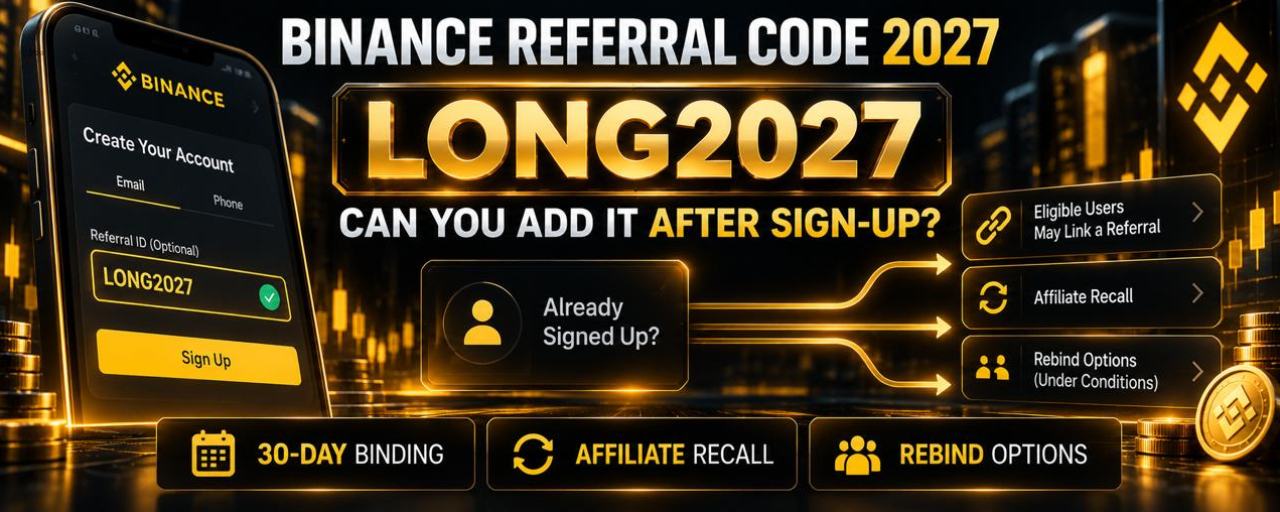
Bài viết
Mã giới thiệu Binance sau khi đăng ký (2027): Bạn có thể thêm LONG2027 sau đó không?Bạn có thể thêm mã giới thiệu Binance sau khi tạo tài khoản vào năm 2027 không?
Câu trả lời là có trong một số trường hợp đủ điều kiện, nhưng không thể thực hiện thông qua quy trình đăng ký thông thường. Binance cung cấp một số tùy chọn liên kết mã giới thiệu sau khi đăng ký, nhưng khả năng sử dụng tùy thuộc vào thời gian tài khoản đã hoạt động, mức độ hoạt động, mối quan hệ giới thiệu hiện có và các hạn chế theo khu vực.
Nếu bạn đang tìm mã giới thiệu Binance vào năm 2027, LONG2027 được quảng bá là mang đến cho người dùng mới đủ điều kiện mức hoàn phí giao dịch Spot 20% và mức hoàn phí giao dịch Futures 20%.
Mã giới thiệu Binance sau khi đăng ký (2027): Bạn có thể thêm LONG2027 sau đó không?
Bạn có thể thêm mã giới thiệu Binance sau khi tạo tài khoản vào năm 2027 không?
Câu trả lời là có trong một số trường hợp đủ điều kiện, nhưng không thể thực hiện thông qua quy trình đăng ký thông thường. Binance cung cấp một số tùy chọn liên kết mã giới thiệu sau khi đăng ký, nhưng khả năng sử dụng tùy thuộc vào thời gian tài khoản đã hoạt động, mức độ hoạt động, mối quan hệ giới thiệu hiện có và các hạn chế theo khu vực.
Nếu bạn đang tìm mã giới thiệu Binance vào năm 2027, LONG2027 được quảng bá là mang đến cho người dùng mới đủ điều kiện mức hoàn phí giao dịch Spot 20% và mức hoàn phí giao dịch Futures 20%.
2
83
Bài viết
Mã giới thiệu Binance 2027: Giải thích giảm phí giao dịch Spot và Futures 20% với LONG2027Bạn đang tìm mã giới thiệu Binance tốt nhất năm 2027 để giảm phí giao dịch trên cả Spot và Futures?
LONG2027 là một mã giới thiệu Binance được quảng bá là mang đến cho người dùng mới đủ điều kiện mức hoàn tiền 20% phí giao dịch Spot và 20% phí giao dịch Futures.
Nhưng bạn thực sự có thể tiết kiệm được bao nhiêu? Mức hoàn tiền 20% Spot cộng với mức hoàn tiền 20% Futures có nghĩa là giảm 40% không? Và những khoản tiết kiệm này ảnh hưởng thế nào đến chi phí giao dịch của bạn?
Hướng dẫn này giải thích cách hoạt động của mã giới thiệu Binance LONG2027, cách tính hoàn tiền phí giao dịch, và những điều nhà giao dịch nên hiểu trước khi mở tài khoản.
Mã giới thiệu Binance 2027: Giải thích giảm phí giao dịch Spot và Futures 20% với LONG2027
Bạn đang tìm mã giới thiệu Binance tốt nhất năm 2027 để giảm phí giao dịch trên cả Spot và Futures?
LONG2027 là một mã giới thiệu Binance được quảng bá là mang đến cho người dùng mới đủ điều kiện mức hoàn tiền 20% phí giao dịch Spot và 20% phí giao dịch Futures.
Nhưng bạn thực sự có thể tiết kiệm được bao nhiêu? Mức hoàn tiền 20% Spot cộng với mức hoàn tiền 20% Futures có nghĩa là giảm 40% không? Và những khoản tiết kiệm này ảnh hưởng thế nào đến chi phí giao dịch của bạn?
Hướng dẫn này giải thích cách hoạt động của mã giới thiệu Binance LONG2027, cách tính hoàn tiền phí giao dịch, và những điều nhà giao dịch nên hiểu trước khi mở tài khoản.
3
78
Đăng nhập để khám phá thêm nội dung
Tham gia cùng người dùng tiền mã hóa toàn cầu trên Binance Square
⚡️ Nhận thông tin mới nhất và hữu ích về tiền mã hóa.
💬 Được tin cậy bởi sàn giao dịch tiền mã hóa lớn nhất thế giới.
👍 Khám phá những thông tin chuyên sâu thực tế từ những nhà sáng tạo đã xác minh.
Email / Số điện thoại