

Wade King
20 Bài đăng

Wade King
Báo cáo
Chặn người dùng
📚 Crypto made simple || 📊 Market insights & trading basics ||💡 Learn. Analyze. Trade smarter.
8 Đang theo dõi
1 Người theo dõi
6 Đã thích
Bài đăng
·
--
Xem bản dịch
Should You Put All Your Money Into One Crypto? 🧐
One concept every crypto investor should understand is **diversification**.
Diversification means spreading your investments across different assets instead of putting everything into one cryptocurrency.
For example, instead of putting your entire portfolio into $BTC , someone might hold a combination of BTC, ETH, and other assets based on their own risk tolerance and strategy.
Why do people diversify?
🔹 It can reduce dependence on a single asset
🔹 Different assets can behave differently in changing market conditions
🔹 It can help manage concentration risk
But diversification doesn't mean buying dozens of random coins.
Holding more assets doesn't automatically make a portfolio safer. Different cryptocurrencies can also move in the same direction during major market moves.
That's why it's important to understand what you're holding, why you're holding it, and how much risk you're taking.
A simple way to remember:
Diversification = spreading exposure
Not:
Diversification = buying everything
Before building a crypto portfolio, consider factors such as risk, liquidity, market conditions, and your investment goals.
How many different cryptocurrencies do you currently follow closely?
#Crypto #BTC #Investing #Diversification
Should You Put All Your Money Into One Crypto? 🧐
One concept every crypto investor should understand is **diversification**.
Diversification means spreading your investments across different assets instead of putting everything into one cryptocurrency.
For example, instead of putting your entire portfolio into $BTC , someone might hold a combination of BTC, ETH, and other assets based on their own risk tolerance and strategy.
Why do people diversify?
🔹 It can reduce dependence on a single asset
🔹 Different assets can behave differently in changing market conditions
🔹 It can help manage concentration risk
But diversification doesn't mean buying dozens of random coins.
Holding more assets doesn't automatically make a portfolio safer. Different cryptocurrencies can also move in the same direction during major market moves.
That's why it's important to understand what you're holding, why you're holding it, and how much risk you're taking.
A simple way to remember:
Diversification = spreading exposure
Not:
Diversification = buying everything
Before building a crypto portfolio, consider factors such as risk, liquidity, market conditions, and your investment goals.
How many different cryptocurrencies do you currently follow closely?
#Crypto #BTC #Investing #Diversification
One concept every crypto investor should understand is **diversification**.
Diversification means spreading your investments across different assets instead of putting everything into one cryptocurrency.
For example, instead of putting your entire portfolio into $BTC , someone might hold a combination of BTC, ETH, and other assets based on their own risk tolerance and strategy.
Why do people diversify?
🔹 It can reduce dependence on a single asset
🔹 Different assets can behave differently in changing market conditions
🔹 It can help manage concentration risk
But diversification doesn't mean buying dozens of random coins.
Holding more assets doesn't automatically make a portfolio safer. Different cryptocurrencies can also move in the same direction during major market moves.
That's why it's important to understand what you're holding, why you're holding it, and how much risk you're taking.
A simple way to remember:
Diversification = spreading exposure
Not:
Diversification = buying everything
Before building a crypto portfolio, consider factors such as risk, liquidity, market conditions, and your investment goals.
How many different cryptocurrencies do you currently follow closely?
#Crypto #BTC #Investing #Diversification
86
·
--
DCA (bình quân giá theo thời gian) trong Crypto là gì? 🧐
Bạn không phải lúc nào cũng cần đầu tư một khoản lớn ngay lập tức.
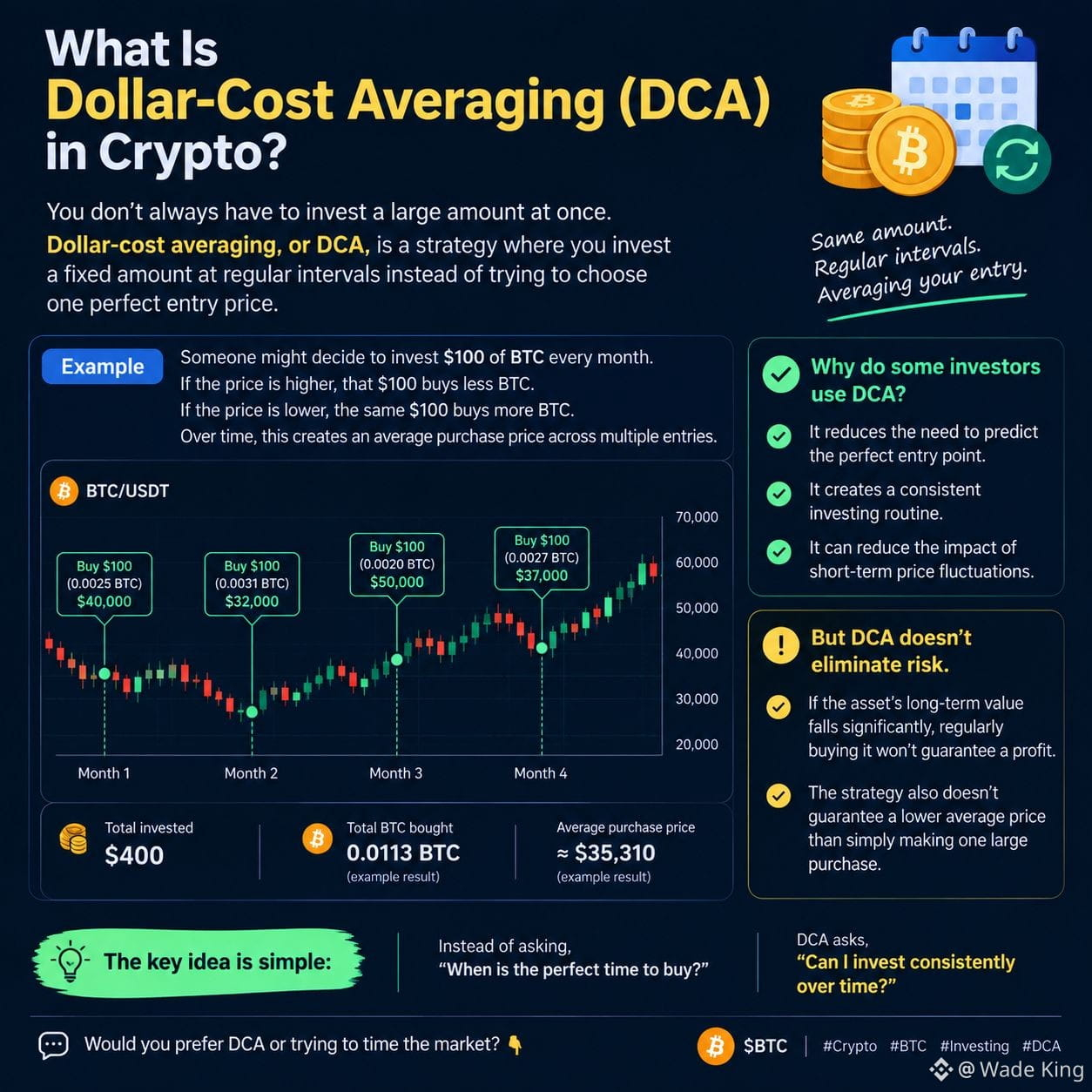
Bình quân giá theo thời gian, hay **DCA**, là một chiến lược trong đó ai đó đầu tư một khoản tiền cố định theo các khoảng thời gian đều đặn thay vì cố gắng chọn một mức giá vào lệnh “hoàn hảo”.
Ví dụ, một người có thể quyết định đầu tư 100 đô la của $BTC mỗi tháng.
Nếu giá cao hơn, 100 đô la đó sẽ mua được ít BTC hơn.
Nếu giá thấp hơn, cùng 100 đô la đó sẽ mua được nhiều BTC hơn.
Theo thời gian, điều này tạo ra một mức giá mua trung bình qua nhiều lần vào lệnh.
Vì sao một số nhà đầu tư sử dụng DCA?
🔹 Giảm nhu cầu phải dự đoán điểm vào lệnh hoàn hảo
🔹 Tạo một thói quen đầu tư ổn định
🔹 Có thể giảm tác động của biến động giá ngắn hạn
Nhưng DCA không loại bỏ rủi ro.
Nếu giá trị dài hạn của tài sản giảm đáng kể, việc mua đều đặn sẽ không đảm bảo có lãi. Chiến lược này cũng không đảm bảo mức giá mua trung bình thấp hơn so với việc chỉ thực hiện một lần mua lớn.
Ý tưởng cốt lõi rất đơn giản:
Thay vì hỏi, “Khi nào là thời điểm hoàn hảo để mua?”
DCA hỏi, “Mình có thể đầu tư một cách đều đặn theo thời gian không?”
Bạn thích DCA hay thử canh thời điểm thị trường?
{spot}(BTCUSDT)
#Crypto #BTC #Investing #DCA
DCA (bình quân giá theo thời gian) trong Crypto là gì? 🧐
Bạn không phải lúc nào cũng cần đầu tư một khoản lớn ngay lập tức.
Bình quân giá theo thời gian, hay **DCA**, là một chiến lược trong đó ai đó đầu tư một khoản tiền cố định theo các khoảng thời gian đều đặn thay vì cố gắng chọn một mức giá vào lệnh “hoàn hảo”.
Ví dụ, một người có thể quyết định đầu tư 100 đô la của $BTC mỗi tháng.
Nếu giá cao hơn, 100 đô la đó sẽ mua được ít BTC hơn.
Nếu giá thấp hơn, cùng 100 đô la đó sẽ mua được nhiều BTC hơn.
Theo thời gian, điều này tạo ra một mức giá mua trung bình qua nhiều lần vào lệnh.
Vì sao một số nhà đầu tư sử dụng DCA?
🔹 Giảm nhu cầu phải dự đoán điểm vào lệnh hoàn hảo
🔹 Tạo một thói quen đầu tư ổn định
🔹 Có thể giảm tác động của biến động giá ngắn hạn
Nhưng DCA không loại bỏ rủi ro.
Nếu giá trị dài hạn của tài sản giảm đáng kể, việc mua đều đặn sẽ không đảm bảo có lãi. Chiến lược này cũng không đảm bảo mức giá mua trung bình thấp hơn so với việc chỉ thực hiện một lần mua lớn.
Ý tưởng cốt lõi rất đơn giản:
Thay vì hỏi, “Khi nào là thời điểm hoàn hảo để mua?”
DCA hỏi, “Mình có thể đầu tư một cách đều đặn theo thời gian không?”
Bạn thích DCA hay thử canh thời điểm thị trường?
#Crypto #BTC #Investing #DCA
Bạn không phải lúc nào cũng cần đầu tư một khoản lớn ngay lập tức.
Bình quân giá theo thời gian, hay **DCA**, là một chiến lược trong đó ai đó đầu tư một khoản tiền cố định theo các khoảng thời gian đều đặn thay vì cố gắng chọn một mức giá vào lệnh “hoàn hảo”.
Ví dụ, một người có thể quyết định đầu tư 100 đô la của $BTC mỗi tháng.
Nếu giá cao hơn, 100 đô la đó sẽ mua được ít BTC hơn.
Nếu giá thấp hơn, cùng 100 đô la đó sẽ mua được nhiều BTC hơn.
Theo thời gian, điều này tạo ra một mức giá mua trung bình qua nhiều lần vào lệnh.
Vì sao một số nhà đầu tư sử dụng DCA?
🔹 Giảm nhu cầu phải dự đoán điểm vào lệnh hoàn hảo
🔹 Tạo một thói quen đầu tư ổn định
🔹 Có thể giảm tác động của biến động giá ngắn hạn
Nhưng DCA không loại bỏ rủi ro.
Nếu giá trị dài hạn của tài sản giảm đáng kể, việc mua đều đặn sẽ không đảm bảo có lãi. Chiến lược này cũng không đảm bảo mức giá mua trung bình thấp hơn so với việc chỉ thực hiện một lần mua lớn.
Ý tưởng cốt lõi rất đơn giản:
Thay vì hỏi, “Khi nào là thời điểm hoàn hảo để mua?”
DCA hỏi, “Mình có thể đầu tư một cách đều đặn theo thời gian không?”
Bạn thích DCA hay thử canh thời điểm thị trường?
#Crypto #BTC #Investing #DCA
74
·
--
Xem bản dịch
What Is Risk-Reward Ratio in Trading? 🧐
Before entering a trade, one useful question is:
"How much am I willing to risk compared with my potential target?"
That's where the **risk-reward ratio** comes in.
📉 Risk = the amount you could lose if the trade moves against you.
📈 Reward = the potential gain if the trade reaches your target.
For example, suppose $BTC is trading at $100,000.
A trader could set:
Entry: $100,000
Stop-loss: $98,000
Target: $104,000
That means the potential risk is $2,000 while the potential reward is $4,000.
The risk-reward ratio would be **1:2**.
In simple terms:
1 part potential risk
2 parts potential reward
But a higher risk-reward ratio doesn't automatically make a trade better. The probability of reaching the target, market conditions, position size, and overall strategy also matter.
Risk-reward is simply a tool that helps traders think about potential downside before entering a position.
Do you calculate risk-reward before taking a trade?
{spot}(BTCUSDT)
#crypto #BTC #Trading #RiskManagem
What Is Risk-Reward Ratio in Trading? 🧐
Before entering a trade, one useful question is:
"How much am I willing to risk compared with my potential target?"
That's where the **risk-reward ratio** comes in.
📉 Risk = the amount you could lose if the trade moves against you.
📈 Reward = the potential gain if the trade reaches your target.
For example, suppose $BTC is trading at $100,000.
A trader could set:
Entry: $100,000
Stop-loss: $98,000
Target: $104,000
That means the potential risk is $2,000 while the potential reward is $4,000.
The risk-reward ratio would be **1:2**.
In simple terms:
1 part potential risk
2 parts potential reward
But a higher risk-reward ratio doesn't automatically make a trade better. The probability of reaching the target, market conditions, position size, and overall strategy also matter.
Risk-reward is simply a tool that helps traders think about potential downside before entering a position.
Do you calculate risk-reward before taking a trade?
#crypto #BTC #Trading #RiskManagem
Before entering a trade, one useful question is:
"How much am I willing to risk compared with my potential target?"
That's where the **risk-reward ratio** comes in.
📉 Risk = the amount you could lose if the trade moves against you.
📈 Reward = the potential gain if the trade reaches your target.
For example, suppose $BTC is trading at $100,000.
A trader could set:
Entry: $100,000
Stop-loss: $98,000
Target: $104,000
That means the potential risk is $2,000 while the potential reward is $4,000.
The risk-reward ratio would be **1:2**.
In simple terms:
1 part potential risk
2 parts potential reward
But a higher risk-reward ratio doesn't automatically make a trade better. The probability of reaching the target, market conditions, position size, and overall strategy also matter.
Risk-reward is simply a tool that helps traders think about potential downside before entering a position.
Do you calculate risk-reward before taking a trade?
#crypto #BTC #Trading #RiskManagem
81
·
--
Xem bản dịch
What Is RSI in Crypto Trading? 📊
If you've ever looked at a crypto chart and seen "RSI," you may have wondered what it means.
RSI stands for **Relative Strength Index**. It is a technical indicator commonly used to measure the strength and speed of recent price movements.
RSI ranges from 0 to 100.
📈 A higher RSI can indicate that an asset has experienced strong recent buying momentum.
📉 A lower RSI can indicate stronger recent selling momentum.
Traders often pay attention to levels such as:
🔹 Above 70 — traditionally considered an overbought zone
🔹 Below 30 — traditionally considered an oversold zone
But there's an important point:
An RSI above 70 doesn't automatically mean the price must fall, and an RSI below 30 doesn't automatically mean the price must rise.
During strong trends, an asset can remain in these zones for a long time.
RSI is therefore better treated as one piece of information rather than a guaranteed buy or sell signal.
Do you use RSI when analyzing crypto? 👇
#Crypto #BTC #Trading #RSI
What Is RSI in Crypto Trading? 📊
If you've ever looked at a crypto chart and seen "RSI," you may have wondered what it means.
RSI stands for **Relative Strength Index**. It is a technical indicator commonly used to measure the strength and speed of recent price movements.
RSI ranges from 0 to 100.
📈 A higher RSI can indicate that an asset has experienced strong recent buying momentum.
📉 A lower RSI can indicate stronger recent selling momentum.
Traders often pay attention to levels such as:
🔹 Above 70 — traditionally considered an overbought zone
🔹 Below 30 — traditionally considered an oversold zone
But there's an important point:
An RSI above 70 doesn't automatically mean the price must fall, and an RSI below 30 doesn't automatically mean the price must rise.
During strong trends, an asset can remain in these zones for a long time.
RSI is therefore better treated as one piece of information rather than a guaranteed buy or sell signal.
Do you use RSI when analyzing crypto? 👇
#Crypto #BTC #Trading #RSI
If you've ever looked at a crypto chart and seen "RSI," you may have wondered what it means.
RSI stands for **Relative Strength Index**. It is a technical indicator commonly used to measure the strength and speed of recent price movements.
RSI ranges from 0 to 100.
📈 A higher RSI can indicate that an asset has experienced strong recent buying momentum.
📉 A lower RSI can indicate stronger recent selling momentum.
Traders often pay attention to levels such as:
🔹 Above 70 — traditionally considered an overbought zone
🔹 Below 30 — traditionally considered an oversold zone
But there's an important point:
An RSI above 70 doesn't automatically mean the price must fall, and an RSI below 30 doesn't automatically mean the price must rise.
During strong trends, an asset can remain in these zones for a long time.
RSI is therefore better treated as one piece of information rather than a guaranteed buy or sell signal.
Do you use RSI when analyzing crypto? 👇
#Crypto #BTC #Trading #RSI
73
·
--
Xem bản dịch
What Is a Candlestick in Crypto Trading? 🕯️
If you've ever opened a crypto chart, you've probably seen red and green candles everywhere.
But what do they actually tell you?
A candlestick shows how an asset's price moved during a specific period.
Each candle contains four important pieces of information:
🟢 Open — the price at the beginning of the period
🔴 Close — the price at the end of the period
⬆️ High — the highest price reached
⬇️ Low — the lowest price reached
The candle's body shows the difference between the opening and closing prices, while the thin lines (called wicks) show the high and low.
For example, a green candle generally means the closing price was higher than the opening price.
A red candle generally means the closing price was lower than the opening price.
The timeframe also matters. A 5-minute candle represents very different price activity from a daily candle.
Candlesticks don't predict the future by themselves, but they help traders understand price movement and market behavior.
Do you usually trade using 5-minute, 1-hour, or daily charts? 👇
#Crypto #BTC #Trading #Candlestick
What Is a Candlestick in Crypto Trading? 🕯️
If you've ever opened a crypto chart, you've probably seen red and green candles everywhere.
But what do they actually tell you?
A candlestick shows how an asset's price moved during a specific period.
Each candle contains four important pieces of information:
🟢 Open — the price at the beginning of the period
🔴 Close — the price at the end of the period
⬆️ High — the highest price reached
⬇️ Low — the lowest price reached
The candle's body shows the difference between the opening and closing prices, while the thin lines (called wicks) show the high and low.
For example, a green candle generally means the closing price was higher than the opening price.
A red candle generally means the closing price was lower than the opening price.
The timeframe also matters. A 5-minute candle represents very different price activity from a daily candle.
Candlesticks don't predict the future by themselves, but they help traders understand price movement and market behavior.
Do you usually trade using 5-minute, 1-hour, or daily charts? 👇
#Crypto #BTC #Trading #Candlestick
If you've ever opened a crypto chart, you've probably seen red and green candles everywhere.
But what do they actually tell you?
A candlestick shows how an asset's price moved during a specific period.
Each candle contains four important pieces of information:
🟢 Open — the price at the beginning of the period
🔴 Close — the price at the end of the period
⬆️ High — the highest price reached
⬇️ Low — the lowest price reached
The candle's body shows the difference between the opening and closing prices, while the thin lines (called wicks) show the high and low.
For example, a green candle generally means the closing price was higher than the opening price.
A red candle generally means the closing price was lower than the opening price.
The timeframe also matters. A 5-minute candle represents very different price activity from a daily candle.
Candlesticks don't predict the future by themselves, but they help traders understand price movement and market behavior.
Do you usually trade using 5-minute, 1-hour, or daily charts? 👇
#Crypto #BTC #Trading #Candlestick
72
·
--
Xem bản dịch
What Is an Order Book in Crypto Trading? 🧐
If you've ever looked at a trading screen and wondered what all those buy and sell orders mean, you're looking at the order book.
An order book is a live list of buy and sell orders for an asset.
🟢 Bids = prices buyers are willing to pay
🔴 Asks = prices sellers are willing to accept
For example, imagine $BTC has buyers willing to buy at $99,900 and sellers willing to sell at $100,000.
The difference between the highest bid and lowest ask is called the spread.
Why does the order book matter?
📊 It shows available buying and selling interest
💧 It can provide clues about market liquidity
⚡ Large orders can sometimes affect short-term price movement
🔎 It helps traders understand the market around the current price
However, an order book is not a guaranteed prediction of where price will go. Orders can be added, cancelled, or changed at any time.
A simple way to remember:
Bids = buyers
Asks = sellers
Spread = difference between the best bid and best ask
Do you check the order book before making a trade? 👇
{spot}(BTCUSDT)
#Crypto #BTC #Trading #OrderBook
What Is an Order Book in Crypto Trading? 🧐
If you've ever looked at a trading screen and wondered what all those buy and sell orders mean, you're looking at the order book.
An order book is a live list of buy and sell orders for an asset.
🟢 Bids = prices buyers are willing to pay
🔴 Asks = prices sellers are willing to accept
For example, imagine $BTC has buyers willing to buy at $99,900 and sellers willing to sell at $100,000.
The difference between the highest bid and lowest ask is called the spread.
Why does the order book matter?
📊 It shows available buying and selling interest
💧 It can provide clues about market liquidity
⚡ Large orders can sometimes affect short-term price movement
🔎 It helps traders understand the market around the current price
However, an order book is not a guaranteed prediction of where price will go. Orders can be added, cancelled, or changed at any time.
A simple way to remember:
Bids = buyers
Asks = sellers
Spread = difference between the best bid and best ask
Do you check the order book before making a trade? 👇
#Crypto #BTC #Trading #OrderBook
If you've ever looked at a trading screen and wondered what all those buy and sell orders mean, you're looking at the order book.
An order book is a live list of buy and sell orders for an asset.
🟢 Bids = prices buyers are willing to pay
🔴 Asks = prices sellers are willing to accept
For example, imagine $BTC has buyers willing to buy at $99,900 and sellers willing to sell at $100,000.
The difference between the highest bid and lowest ask is called the spread.
Why does the order book matter?
📊 It shows available buying and selling interest
💧 It can provide clues about market liquidity
⚡ Large orders can sometimes affect short-term price movement
🔎 It helps traders understand the market around the current price
However, an order book is not a guaranteed prediction of where price will go. Orders can be added, cancelled, or changed at any time.
A simple way to remember:
Bids = buyers
Asks = sellers
Spread = difference between the best bid and best ask
Do you check the order book before making a trade? 👇
#Crypto #BTC #Trading #OrderBook
86
·
--
Xem bản dịch
What Is Liquidation in Crypto Trading? ⚠️
If you've ever heard the phrase "my position got liquidated," you may wonder what it actually means.
Liquidation can happen when a leveraged trading position loses enough value that the available margin is no longer sufficient to keep the position open.
For example, imagine a trader opens a leveraged $BTC position.
📈 If BTC moves in the expected direction, the position may generate a profit.
📉 But if BTC moves strongly against the position, losses can increase quickly.
If the position reaches the exchange's liquidation conditions, it may be automatically closed.
That's why leverage and liquidation are closely connected.
A simple way to remember:
Leverage = increases your market exposure
Liquidation = forced closure when the position can no longer meet the required margin conditions
Liquidation isn't simply the same as "losing money." A trader can close a losing position manually without being liquidated.
Before using leverage, it's important to understand position size, margin, liquidation price, and the risks involved.
Have you ever had a crypto position liquidated? 👇
$BTC
{spot}(BTCUSDT)
#Crypto #BTC #Trading #Futures #Liquidation
What Is Liquidation in Crypto Trading? ⚠️
If you've ever heard the phrase "my position got liquidated," you may wonder what it actually means.
Liquidation can happen when a leveraged trading position loses enough value that the available margin is no longer sufficient to keep the position open.
For example, imagine a trader opens a leveraged $BTC position.
📈 If BTC moves in the expected direction, the position may generate a profit.
📉 But if BTC moves strongly against the position, losses can increase quickly.
If the position reaches the exchange's liquidation conditions, it may be automatically closed.
That's why leverage and liquidation are closely connected.
A simple way to remember:
Leverage = increases your market exposure
Liquidation = forced closure when the position can no longer meet the required margin conditions
Liquidation isn't simply the same as "losing money." A trader can close a losing position manually without being liquidated.
Before using leverage, it's important to understand position size, margin, liquidation price, and the risks involved.
Have you ever had a crypto position liquidated? 👇
$BTC
#Crypto #BTC #Trading #Futures #Liquidation
If you've ever heard the phrase "my position got liquidated," you may wonder what it actually means.
Liquidation can happen when a leveraged trading position loses enough value that the available margin is no longer sufficient to keep the position open.
For example, imagine a trader opens a leveraged $BTC position.
📈 If BTC moves in the expected direction, the position may generate a profit.
📉 But if BTC moves strongly against the position, losses can increase quickly.
If the position reaches the exchange's liquidation conditions, it may be automatically closed.
That's why leverage and liquidation are closely connected.
A simple way to remember:
Leverage = increases your market exposure
Liquidation = forced closure when the position can no longer meet the required margin conditions
Liquidation isn't simply the same as "losing money." A trader can close a losing position manually without being liquidated.
Before using leverage, it's important to understand position size, margin, liquidation price, and the risks involved.
Have you ever had a crypto position liquidated? 👇
$BTC
#Crypto #BTC #Trading #Futures #Liquidation
85
·
--
Đòn bẩy (Leverage) trong giao dịch Crypto là gì? 🧐
Nếu bạn đã từng tìm hiểu crypto futures, chắc hẳn bạn đã thấy thuật ngữ “leverage”.
Nhưng thực ra nó có nghĩa là gì?
⚡ Đòn bẩy cho phép nhà giao dịch kiểm soát một vị thế lớn hơn bằng một lượng vốn nhỏ hơn.
Ví dụ, với đòn bẩy 10×, 100 đô la ký quỹ (margin) có thể tạo ra khả năng tiếp xúc với một vị thế trị giá 1.000 đô la, tùy theo các quy định và yêu cầu của nền tảng.
Nghe có vẻ hữu ích đúng không? Nhưng có một điểm quan trọng.
📈 Nếu thị trường đi đúng hướng, đòn bẩy có thể làm tăng lợi nhuận trên phần ký quỹ của bạn.
📉 Nếu thị trường đi ngược lại, thua lỗ cũng có thể tăng nhanh hơn rất nhiều.
Vì vậy, đòn bẩy có thể khiến giao dịch futures trở nên rủi ro hơn đáng kể so với việc chỉ đơn giản là mua tài sản trên thị trường spot.
Một khái niệm quan trọng khác là thanh lý (liquidation). Nếu thua lỗ làm giảm phần ký quỹ đủ mức, vị thế có thể bị đóng tự động theo các quy tắc thanh lý của sàn giao dịch.
Một cách nhớ đơn giản:
Đòn bẩy không loại bỏ rủi ro — nó khuếch đại phạm vi tiếp xúc.
Trước khi sử dụng đòn bẩy, hãy hiểu margin, giá thanh lý, phí funding và kích thước vị thế.
Bạn giao dịch với đòn bẩy hay bạn thích giao dịch Spot hơn? 👇
$BTC
#Crypto #BTC #Trading #Leverage
Đòn bẩy (Leverage) trong giao dịch Crypto là gì? 🧐
Nếu bạn đã từng tìm hiểu crypto futures, chắc hẳn bạn đã thấy thuật ngữ “leverage”.
Nhưng thực ra nó có nghĩa là gì?
⚡ Đòn bẩy cho phép nhà giao dịch kiểm soát một vị thế lớn hơn bằng một lượng vốn nhỏ hơn.
Ví dụ, với đòn bẩy 10×, 100 đô la ký quỹ (margin) có thể tạo ra khả năng tiếp xúc với một vị thế trị giá 1.000 đô la, tùy theo các quy định và yêu cầu của nền tảng.
Nghe có vẻ hữu ích đúng không? Nhưng có một điểm quan trọng.
📈 Nếu thị trường đi đúng hướng, đòn bẩy có thể làm tăng lợi nhuận trên phần ký quỹ của bạn.
📉 Nếu thị trường đi ngược lại, thua lỗ cũng có thể tăng nhanh hơn rất nhiều.
Vì vậy, đòn bẩy có thể khiến giao dịch futures trở nên rủi ro hơn đáng kể so với việc chỉ đơn giản là mua tài sản trên thị trường spot.
Một khái niệm quan trọng khác là thanh lý (liquidation). Nếu thua lỗ làm giảm phần ký quỹ đủ mức, vị thế có thể bị đóng tự động theo các quy tắc thanh lý của sàn giao dịch.
Một cách nhớ đơn giản:
Đòn bẩy không loại bỏ rủi ro — nó khuếch đại phạm vi tiếp xúc.
Trước khi sử dụng đòn bẩy, hãy hiểu margin, giá thanh lý, phí funding và kích thước vị thế.
Bạn giao dịch với đòn bẩy hay bạn thích giao dịch Spot hơn? 👇
$BTC
#Crypto #BTC #Trading #Leverage
Nếu bạn đã từng tìm hiểu crypto futures, chắc hẳn bạn đã thấy thuật ngữ “leverage”.
Nhưng thực ra nó có nghĩa là gì?
⚡ Đòn bẩy cho phép nhà giao dịch kiểm soát một vị thế lớn hơn bằng một lượng vốn nhỏ hơn.
Ví dụ, với đòn bẩy 10×, 100 đô la ký quỹ (margin) có thể tạo ra khả năng tiếp xúc với một vị thế trị giá 1.000 đô la, tùy theo các quy định và yêu cầu của nền tảng.
Nghe có vẻ hữu ích đúng không? Nhưng có một điểm quan trọng.
📈 Nếu thị trường đi đúng hướng, đòn bẩy có thể làm tăng lợi nhuận trên phần ký quỹ của bạn.
📉 Nếu thị trường đi ngược lại, thua lỗ cũng có thể tăng nhanh hơn rất nhiều.
Vì vậy, đòn bẩy có thể khiến giao dịch futures trở nên rủi ro hơn đáng kể so với việc chỉ đơn giản là mua tài sản trên thị trường spot.
Một khái niệm quan trọng khác là thanh lý (liquidation). Nếu thua lỗ làm giảm phần ký quỹ đủ mức, vị thế có thể bị đóng tự động theo các quy tắc thanh lý của sàn giao dịch.
Một cách nhớ đơn giản:
Đòn bẩy không loại bỏ rủi ro — nó khuếch đại phạm vi tiếp xúc.
Trước khi sử dụng đòn bẩy, hãy hiểu margin, giá thanh lý, phí funding và kích thước vị thế.
Bạn giao dịch với đòn bẩy hay bạn thích giao dịch Spot hơn? 👇
$BTC
#Crypto #BTC #Trading #Leverage
61
·
--
Xem bản dịch
What Are Stop-Loss and Take-Profit Orders? 🧐
Two important tools traders should understand are Stop-Loss and Take-Profit orders.
🛑 Stop-Loss
A stop-loss is designed to help limit potential losses by triggering an order when the market reaches a specified price.
🎯 Take-Profit
A take-profit order is designed to lock in potential gains when the market reaches a specified target.
For example, imagine $BTC is trading at $100,000.
A trader might set a stop-loss below their entry price and a take-profit above it.
The idea is simple:
Stop-Loss = predefined exit to manage downside
Take-Profit = predefined exit to manage a target
However, neither guarantees an exact execution price. Fast-moving markets, liquidity, and order type can affect how an order is executed.
Risk management is an important part of trading, so understanding your order settings before using them matters.
Do you use stop-loss and take-profit when trading? 👇
$BTC
#Crypto #BTC #Trading #RiskManagement
What Are Stop-Loss and Take-Profit Orders? 🧐
Two important tools traders should understand are Stop-Loss and Take-Profit orders.
🛑 Stop-Loss
A stop-loss is designed to help limit potential losses by triggering an order when the market reaches a specified price.
🎯 Take-Profit
A take-profit order is designed to lock in potential gains when the market reaches a specified target.
For example, imagine $BTC is trading at $100,000.
A trader might set a stop-loss below their entry price and a take-profit above it.
The idea is simple:
Stop-Loss = predefined exit to manage downside
Take-Profit = predefined exit to manage a target
However, neither guarantees an exact execution price. Fast-moving markets, liquidity, and order type can affect how an order is executed.
Risk management is an important part of trading, so understanding your order settings before using them matters.
Do you use stop-loss and take-profit when trading? 👇
$BTC
#Crypto #BTC #Trading #RiskManagement
Two important tools traders should understand are Stop-Loss and Take-Profit orders.
🛑 Stop-Loss
A stop-loss is designed to help limit potential losses by triggering an order when the market reaches a specified price.
🎯 Take-Profit
A take-profit order is designed to lock in potential gains when the market reaches a specified target.
For example, imagine $BTC is trading at $100,000.
A trader might set a stop-loss below their entry price and a take-profit above it.
The idea is simple:
Stop-Loss = predefined exit to manage downside
Take-Profit = predefined exit to manage a target
However, neither guarantees an exact execution price. Fast-moving markets, liquidity, and order type can affect how an order is executed.
Risk management is an important part of trading, so understanding your order settings before using them matters.
Do you use stop-loss and take-profit when trading? 👇
$BTC
#Crypto #BTC #Trading #RiskManagement
75
·
--
Xem bản dịch
Why is liquidity important in crypto? 🧐
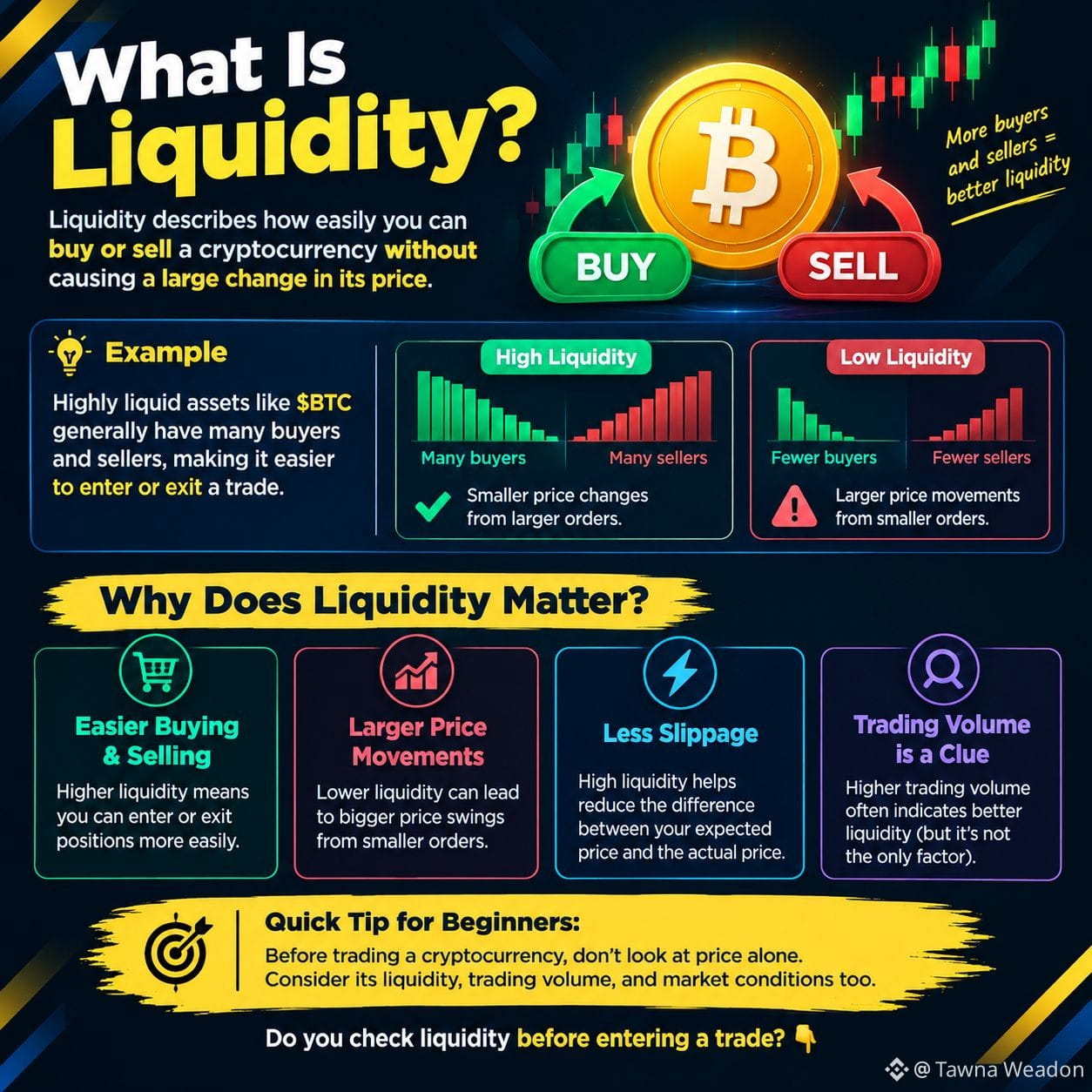
Liquidity describes how easily you can buy or sell a cryptocurrency without causing a large change in its price.
For example, highly liquid assets like $BTC generally have many buyers and sellers, making it easier to enter or exit a trade.
Why does liquidity matter?
💧 Higher liquidity can mean easier buying and selling
📉 Lower liquidity can lead to larger price movements from smaller orders
⚡ High liquidity can help reduce slippage
🔎 Trading volume is one useful indicator when evaluating market activity
A simple rule for beginners:
Before trading a cryptocurrency, don't look at price alone. Consider its liquidity, trading volume, and market conditions too.
Do you check liquidity before entering a trade? 👇
{spot}(BTCUSDT)
#Crypto #BTC #Trading #Liquidity
Why is liquidity important in crypto? 🧐
Liquidity describes how easily you can buy or sell a cryptocurrency without causing a large change in its price.
For example, highly liquid assets like $BTC generally have many buyers and sellers, making it easier to enter or exit a trade.
Why does liquidity matter?
💧 Higher liquidity can mean easier buying and selling
📉 Lower liquidity can lead to larger price movements from smaller orders
⚡ High liquidity can help reduce slippage
🔎 Trading volume is one useful indicator when evaluating market activity
A simple rule for beginners:
Before trading a cryptocurrency, don't look at price alone. Consider its liquidity, trading volume, and market conditions too.
Do you check liquidity before entering a trade? 👇
#Crypto #BTC #Trading #Liquidity
Liquidity describes how easily you can buy or sell a cryptocurrency without causing a large change in its price.
For example, highly liquid assets like $BTC generally have many buyers and sellers, making it easier to enter or exit a trade.
Why does liquidity matter?
💧 Higher liquidity can mean easier buying and selling
📉 Lower liquidity can lead to larger price movements from smaller orders
⚡ High liquidity can help reduce slippage
🔎 Trading volume is one useful indicator when evaluating market activity
A simple rule for beginners:
Before trading a cryptocurrency, don't look at price alone. Consider its liquidity, trading volume, and market conditions too.
Do you check liquidity before entering a trade? 👇
#Crypto #BTC #Trading #Liquidity
64
·
--
Xem bản dịch
How do you research a crypto project before investing? 🧐
Before putting money into a project, don't rely only on its price or social media hype.
Here are 6 things worth checking:
1️⃣ Project Purpose
What problem does it solve? Does it have a real use case?
2️⃣ Team & Community
Research the team, development activity, and whether the community is genuine.
3️⃣ Tokenomics
Check total supply, circulating supply, token distribution, and vesting schedules.
4️⃣ Market & Competition
Look at competitors, demand, market size, price history and trading volume.
5️⃣ Latest Updates
Check official announcements, development progress, partnerships and security issues.
6️⃣ Reliable Sources
Verify information using official documentation and multiple trusted sources.
Remember: No research = higher risk. Good research = better decisions.
What do you check first when researching a new crypto project? 👇
#Crypto #DYOR #Trading #Investing
How do you research a crypto project before investing? 🧐
Before putting money into a project, don't rely only on its price or social media hype.
Here are 6 things worth checking:
1️⃣ Project Purpose
What problem does it solve? Does it have a real use case?
2️⃣ Team & Community
Research the team, development activity, and whether the community is genuine.
3️⃣ Tokenomics
Check total supply, circulating supply, token distribution, and vesting schedules.
4️⃣ Market & Competition
Look at competitors, demand, market size, price history and trading volume.
5️⃣ Latest Updates
Check official announcements, development progress, partnerships and security issues.
6️⃣ Reliable Sources
Verify information using official documentation and multiple trusted sources.
Remember: No research = higher risk. Good research = better decisions.
What do you check first when researching a new crypto project? 👇
#Crypto #DYOR #Trading #Investing
Before putting money into a project, don't rely only on its price or social media hype.
Here are 6 things worth checking:
1️⃣ Project Purpose
What problem does it solve? Does it have a real use case?
2️⃣ Team & Community
Research the team, development activity, and whether the community is genuine.
3️⃣ Tokenomics
Check total supply, circulating supply, token distribution, and vesting schedules.
4️⃣ Market & Competition
Look at competitors, demand, market size, price history and trading volume.
5️⃣ Latest Updates
Check official announcements, development progress, partnerships and security issues.
6️⃣ Reliable Sources
Verify information using official documentation and multiple trusted sources.
Remember: No research = higher risk. Good research = better decisions.
What do you check first when researching a new crypto project? 👇
#Crypto #DYOR #Trading #Investing

61
·
--
Xem bản dịch
Spot vs Futures: What's the Difference? 🧐
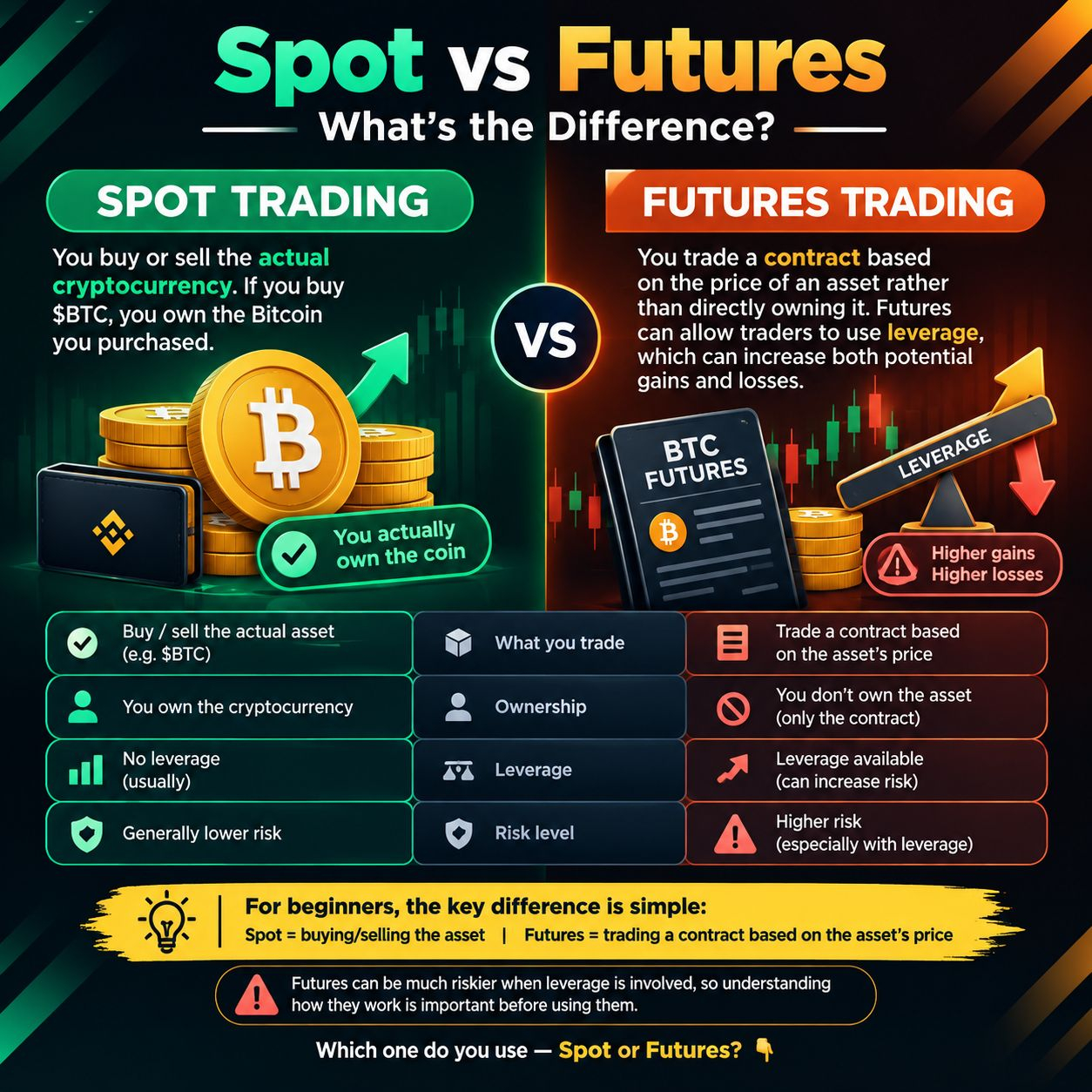
If you're new to crypto trading, you may have heard about Spot and Futures. But what's the difference?
🟢 Spot Trading
You buy or sell the actual cryptocurrency. If you buy $BTC , you own the Bitcoin you purchased.
🔴 Futures Trading
You trade a contract based on the price of an asset rather than directly owning it. Futures can allow traders to use leverage, which can increase both potential gains and losses.
For beginners, the key difference is simple:
Spot = buying/selling the asset
Futures = trading a contract based on the asset's price
Futures can be much riskier when leverage is involved, so understanding how they work is important before using them.
Which one do you use — Spot or Futures? 👇
{spot}(BTCUSDT)
#Crypto #BTC #Trading #Futures #BinanceSquare
Spot vs Futures: What's the Difference? 🧐
If you're new to crypto trading, you may have heard about Spot and Futures. But what's the difference?
🟢 Spot Trading
You buy or sell the actual cryptocurrency. If you buy $BTC , you own the Bitcoin you purchased.
🔴 Futures Trading
You trade a contract based on the price of an asset rather than directly owning it. Futures can allow traders to use leverage, which can increase both potential gains and losses.
For beginners, the key difference is simple:
Spot = buying/selling the asset
Futures = trading a contract based on the asset's price
Futures can be much riskier when leverage is involved, so understanding how they work is important before using them.
Which one do you use — Spot or Futures? 👇
#Crypto #BTC #Trading #Futures #BinanceSquare
If you're new to crypto trading, you may have heard about Spot and Futures. But what's the difference?
🟢 Spot Trading
You buy or sell the actual cryptocurrency. If you buy $BTC , you own the Bitcoin you purchased.
🔴 Futures Trading
You trade a contract based on the price of an asset rather than directly owning it. Futures can allow traders to use leverage, which can increase both potential gains and losses.
For beginners, the key difference is simple:
Spot = buying/selling the asset
Futures = trading a contract based on the asset's price
Futures can be much riskier when leverage is involved, so understanding how they work is important before using them.
Which one do you use — Spot or Futures? 👇
#Crypto #BTC #Trading #Futures #BinanceSquare
63
·
--
Xem bản dịch
What are Support and Resistance in crypto? 🧐
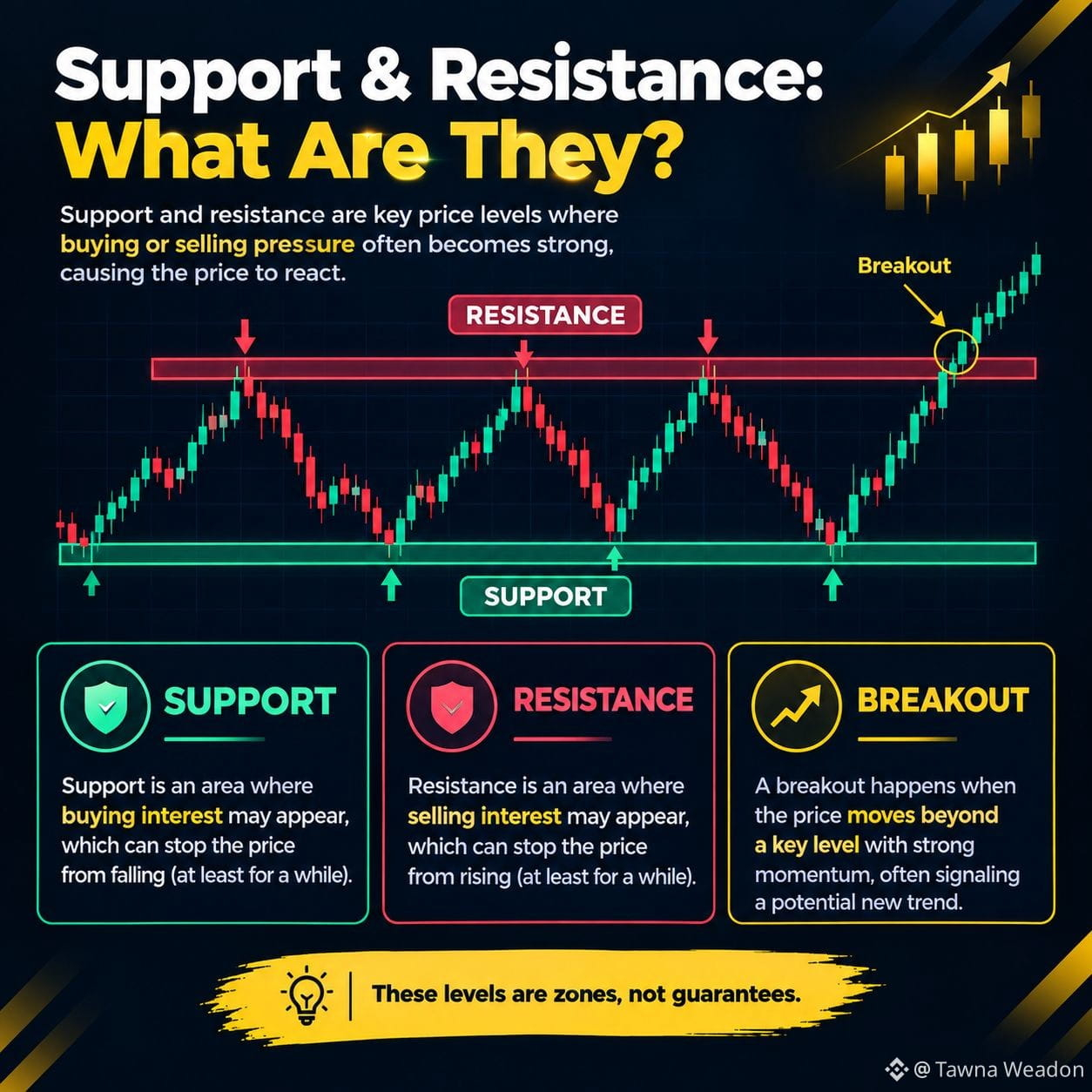
Support and resistance are two important concepts when reading a price chart.
🟢 Support = an area where buying interest may appear and help prevent the price from falling further.
🔴 Resistance = an area where selling interest may appear and make it harder for the price to rise.
For example, if $BTC repeatedly reacts around a similar price level, traders may watch that area as potential support or resistance.
But remember: these are zones, not guaranteed price levels. A strong move can break through either one.
Do you use support and resistance when analyzing a crypto chart? 👇
{spot}(BTCUSDT)
#Crypto #BTC #Trading #BinanceSquare
What are Support and Resistance in crypto? 🧐
Support and resistance are two important concepts when reading a price chart.
🟢 Support = an area where buying interest may appear and help prevent the price from falling further.
🔴 Resistance = an area where selling interest may appear and make it harder for the price to rise.
For example, if $BTC repeatedly reacts around a similar price level, traders may watch that area as potential support or resistance.
But remember: these are zones, not guaranteed price levels. A strong move can break through either one.
Do you use support and resistance when analyzing a crypto chart? 👇
#Crypto #BTC #Trading #BinanceSquare
Support and resistance are two important concepts when reading a price chart.
🟢 Support = an area where buying interest may appear and help prevent the price from falling further.
🔴 Resistance = an area where selling interest may appear and make it harder for the price to rise.
For example, if $BTC repeatedly reacts around a similar price level, traders may watch that area as potential support or resistance.
But remember: these are zones, not guaranteed price levels. A strong move can break through either one.
Do you use support and resistance when analyzing a crypto chart? 👇
#Crypto #BTC #Trading #BinanceSquare
90
·
--
Xem bản dịch
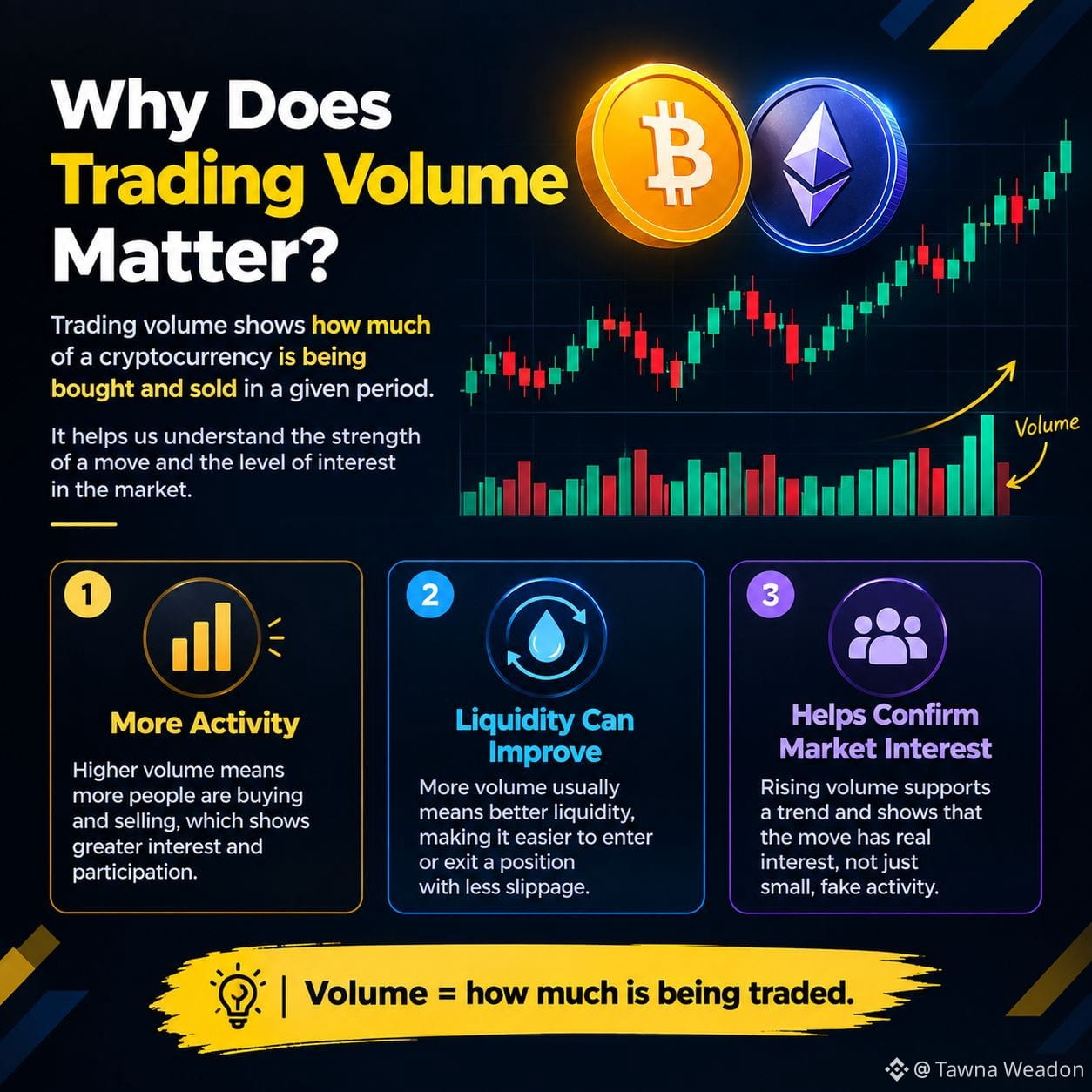
Why does trading volume matter in crypto? 🧐
Trading volume shows how much of a cryptocurrency is being bought and sold during a given period.
For example, when you see high trading activity around $BTC , it means a large amount of Bitcoin is changing hands.
Why should beginners care about volume?
📊 Higher volume = more market activity
💧 More activity can mean better liquidity
🔎 Volume can help you understand whether a price move has strong market participation
But remember: high volume doesn't automatically mean the price will go up or down.
When you look at a crypto chart, do you check volume? 👇
#Crypto #Bitcoin #Trading #BinanceSquare
{spot}(BTCUSDT)
Why does trading volume matter in crypto? 🧐
Trading volume shows how much of a cryptocurrency is being bought and sold during a given period.
For example, when you see high trading activity around $BTC , it means a large amount of Bitcoin is changing hands.
Why should beginners care about volume?
📊 Higher volume = more market activity
💧 More activity can mean better liquidity
🔎 Volume can help you understand whether a price move has strong market participation
But remember: high volume doesn't automatically mean the price will go up or down.
When you look at a crypto chart, do you check volume? 👇
#Crypto #Bitcoin #Trading #BinanceSquare
Trading volume shows how much of a cryptocurrency is being bought and sold during a given period.
For example, when you see high trading activity around $BTC , it means a large amount of Bitcoin is changing hands.
Why should beginners care about volume?
📊 Higher volume = more market activity
💧 More activity can mean better liquidity
🔎 Volume can help you understand whether a price move has strong market participation
But remember: high volume doesn't automatically mean the price will go up or down.
When you look at a crypto chart, do you check volume? 👇
#Crypto #Bitcoin #Trading #BinanceSquare
75
·
--
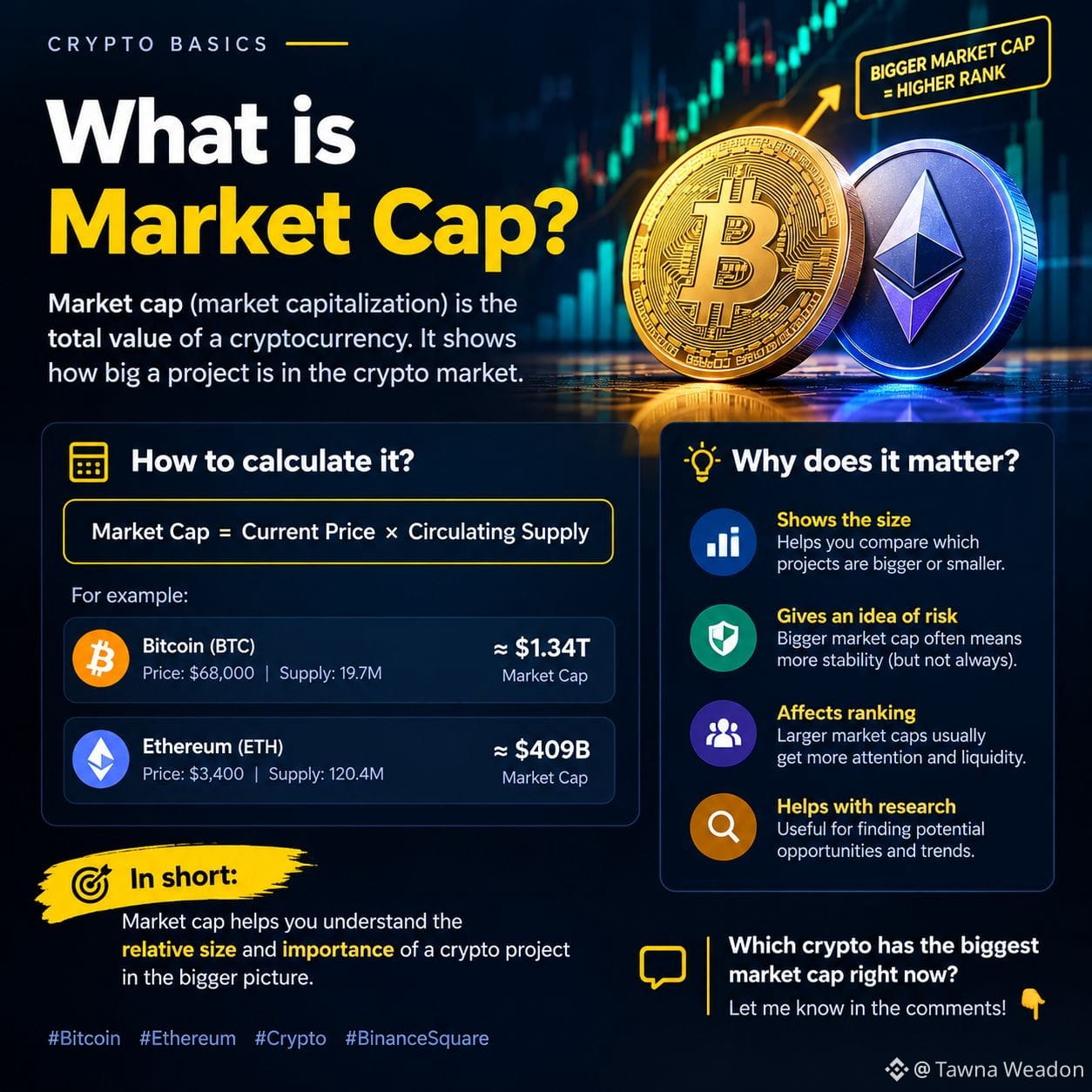
Bạn đã từng thắc mắc vốn hóa thị trường crypto thực sự có nghĩa là gì chưa? 🧐
$BTC và $ETH có thể có mức giá rất khác nhau, nhưng chỉ riêng giá không nói lên được rằng một loại tiền mã hóa thực sự lớn cỡ nào.
Vốn hóa thị trường (Market Cap) = Giá hiện tại × Lượng cung lưu hành
Vì vậy, một đồng có giá 1 đô la không tự động rẻ hơn hay bị định giá thấp hơn một đồng có giá 1.000 đô la.
Đối với người mới bắt đầu, vốn hóa thị trường là một trong những con số hữu ích nhất để kiểm tra khi tìm hiểu một dự án crypto. Nó giúp bạn hiểu quy mô tương đối của dự án và so sánh với các dự án khác.
Khi nghiên cứu một crypto, bạn kiểm tra điều gì trước — giá hay vốn hóa thị trường? 👇
{spot}(BTCUSDT)
{spot}(ETHUSDT)
#Crypto #Bitcoin #Ethereum #BinanceSquare
Bạn đã từng thắc mắc vốn hóa thị trường crypto thực sự có nghĩa là gì chưa? 🧐
$BTC và $ETH có thể có mức giá rất khác nhau, nhưng chỉ riêng giá không nói lên được rằng một loại tiền mã hóa thực sự lớn cỡ nào.
Vốn hóa thị trường (Market Cap) = Giá hiện tại × Lượng cung lưu hành
Vì vậy, một đồng có giá 1 đô la không tự động rẻ hơn hay bị định giá thấp hơn một đồng có giá 1.000 đô la.
Đối với người mới bắt đầu, vốn hóa thị trường là một trong những con số hữu ích nhất để kiểm tra khi tìm hiểu một dự án crypto. Nó giúp bạn hiểu quy mô tương đối của dự án và so sánh với các dự án khác.
Khi nghiên cứu một crypto, bạn kiểm tra điều gì trước — giá hay vốn hóa thị trường? 👇
#Crypto #Bitcoin #Ethereum #BinanceSquare
$BTC và $ETH có thể có mức giá rất khác nhau, nhưng chỉ riêng giá không nói lên được rằng một loại tiền mã hóa thực sự lớn cỡ nào.
Vốn hóa thị trường (Market Cap) = Giá hiện tại × Lượng cung lưu hành
Vì vậy, một đồng có giá 1 đô la không tự động rẻ hơn hay bị định giá thấp hơn một đồng có giá 1.000 đô la.
Đối với người mới bắt đầu, vốn hóa thị trường là một trong những con số hữu ích nhất để kiểm tra khi tìm hiểu một dự án crypto. Nó giúp bạn hiểu quy mô tương đối của dự án và so sánh với các dự án khác.
Khi nghiên cứu một crypto, bạn kiểm tra điều gì trước — giá hay vốn hóa thị trường? 👇
#Crypto #Bitcoin #Ethereum #BinanceSquare
2
1
2
667
·
--
Xem bản dịch
Why is Ethereum so important to crypto? 🧐
$ETH is more than just another cryptocurrency. Ethereum is one of the most widely used blockchain networks, supporting smart contracts, DeFi, NFTs, and many other applications.
One interesting thing about $ETH is that its value isn't only about price. The Ethereum network itself is used by thousands of projects and users.
For beginners, here's a simple way to think about it:
Bitcoin is often viewed as digital money, while Ethereum is more like a platform for building things on blockchain.
But which one has the stronger long-term potential — $BTC or $ETH? 👇
{spot}(ETHUSDT)
#Ethereum #ETH #Crypto #BinanceSquare
Why is Ethereum so important to crypto? 🧐
$ETH is more than just another cryptocurrency. Ethereum is one of the most widely used blockchain networks, supporting smart contracts, DeFi, NFTs, and many other applications.
One interesting thing about $ETH is that its value isn't only about price. The Ethereum network itself is used by thousands of projects and users.
For beginners, here's a simple way to think about it:
Bitcoin is often viewed as digital money, while Ethereum is more like a platform for building things on blockchain.
But which one has the stronger long-term potential — $BTC or $ETH ? 👇
#Ethereum #ETH #Crypto #BinanceSquare
$ETH is more than just another cryptocurrency. Ethereum is one of the most widely used blockchain networks, supporting smart contracts, DeFi, NFTs, and many other applications.
One interesting thing about $ETH is that its value isn't only about price. The Ethereum network itself is used by thousands of projects and users.
For beginners, here's a simple way to think about it:
Bitcoin is often viewed as digital money, while Ethereum is more like a platform for building things on blockchain.
But which one has the stronger long-term potential — $BTC or $ETH ? 👇
#Ethereum #ETH #Crypto #BinanceSquare

81
·
--
Xem bản dịch
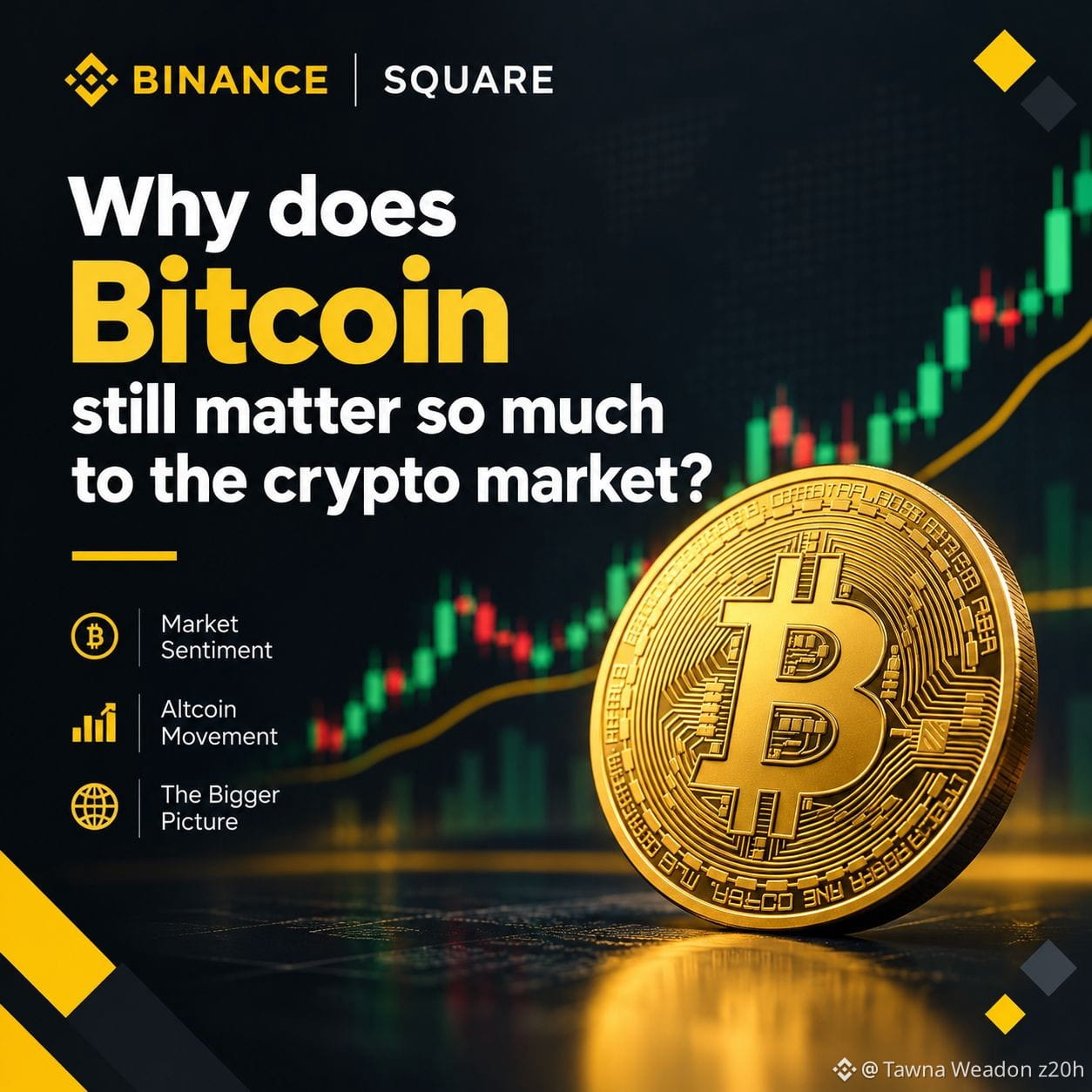
Why does Bitcoin still matter so much to the crypto market? 🧐
$BTC is more than just the largest cryptocurrency by market capitalization. Bitcoin often plays an important role in overall crypto market sentiment.
When $BTC moves strongly, traders frequently pay attention to how altcoins react as well. That's why understanding Bitcoin's price action can be useful even if you mainly trade other cryptocurrencies.
For beginners, one simple rule is worth remembering: don't look at an altcoin in isolation—always keep an eye on the broader market, especially $BTC.
What do you think—will Bitcoin remain the main market leader for the next few years? 👇
#Bitcoin #BTC #Crypto #BinanceSquare
{spot}(BTCUSDT)
Why does Bitcoin still matter so much to the crypto market? 🧐
$BTC is more than just the largest cryptocurrency by market capitalization. Bitcoin often plays an important role in overall crypto market sentiment.
When $BTC moves strongly, traders frequently pay attention to how altcoins react as well. That's why understanding Bitcoin's price action can be useful even if you mainly trade other cryptocurrencies.
For beginners, one simple rule is worth remembering: don't look at an altcoin in isolation—always keep an eye on the broader market, especially $BTC .
What do you think—will Bitcoin remain the main market leader for the next few years? 👇
#Bitcoin #BTC #Crypto #BinanceSquare
$BTC is more than just the largest cryptocurrency by market capitalization. Bitcoin often plays an important role in overall crypto market sentiment.
When $BTC moves strongly, traders frequently pay attention to how altcoins react as well. That's why understanding Bitcoin's price action can be useful even if you mainly trade other cryptocurrencies.
For beginners, one simple rule is worth remembering: don't look at an altcoin in isolation—always keep an eye on the broader market, especially $BTC .
What do you think—will Bitcoin remain the main market leader for the next few years? 👇
#Bitcoin #BTC #Crypto #BinanceSquare
83
Đăng nhập để khám phá thêm nội dung
Tham gia cùng người dùng tiền mã hóa toàn cầu trên Binance Square
⚡️ Nhận thông tin mới nhất và hữu ích về tiền mã hóa.
💬 Được tin cậy bởi sàn giao dịch tiền mã hóa lớn nhất thế giới.
👍 Khám phá những thông tin chuyên sâu thực tế từ những nhà sáng tạo đã xác minh.
Email / Số điện thoại
Chủ đề thịnh hành
TheoDõiFOMC
118,209 lượt xem
668 đang thảo luận
#TheoDõiFOMC
🔥 FOMC lại bắt đầu trở thành tâm điểm của crypto
Bitcoin vừa bước vào tháng 10, nhưng câu chuyện lớn phía sau thị trường lúc này không chỉ là giá.
Các trader đang bắt đầu hướng sự chú ý về cuộc họp FOMC ngày 27–28/10. Sau một loạt phát biểu mới từ quan chức Fed, kỳ vọng về việc tăng lãi suất ngay trong tháng 10 đã giảm đáng kể.
Điều thú vị là trước đó thị trường từng đặt cược khá cao vào một đợt tăng tiếp theo.
Giờ thì mọi thứ lại quay sang chờ dữ liệu kinh tế và những phát biểu tiếp theo của Fed.
Với crypto, chỉ cần kỳ vọng lãi suất thay đổi mạnh là $BTC có thể lập tức biến động, rồi kéo theo cả thị trường altcoin.
Tháng 10 mới bắt đầu mà macro đã có chuyện để hóng rồi 👀
#Bitcoin #Crypto #Macro #Fed #BinanceSquare
X LEI
·0 lượt thích
·154 lượt xem
TinFed
102,042 lượt xem
466 đang thảo luận
ZcashETFPostsFirstWeeklyOutflow$93.6M
35,557 lượt xem
101 đang thảo luận