

When choosing a cryptocurrency exchange, security should be one of the most important considerations. Two of the industry's most recognized platforms, Binance and Coinbase, have invested heavily in protecting customer assets, strengthening account security, and improving transparency.
But is Binance safer than Coinbase?
There is no universal answer. Both platforms offer multiple layers of security, but their approaches differ.
Binance stands out for its user-verifiable Proof of Reserves (PoR), which combines Merkle Trees and zk-SNARKs, as well as its Secure Asset Fund for Users (SAFU). Coinbase, meanwhile, offers public-company financial disclosures, crime-insurance coverage for a portion of custodial digital assets, and additional account protection arrangements for eligible users.
Let's compare the two platforms across five important areas to understand what these differences mean for everyday cryptocurrency users.
1. Proof of Reserves: How Can Users Verify Their Funds?
One of Binance's distinctive security and transparency features is its Proof of Reserves system.
Binance maintains a 1:1 reserve commitment, meaning it aims to hold sufficient assets to cover eligible customer balances. More importantly, users can independently verify whether their balances are included in the published reserves snapshot.
Binance uses two complementary technologies:
Merkle Trees
A Merkle Tree is a cryptographic structure that organizes account information into a single verifiable data structure.
Each user's account information is represented by a leaf in the tree. Users receive a unique verification record that allows them to check whether their balances were included in the published snapshot.
zk-SNARKs (Zero-Knowledge Proofs)
Binance also uses zk-SNARK technology to verify that the reserve calculations satisfy specific mathematical conditions without exposing individual users' private account information.
Together, these technologies allow users to verify their inclusion in the reserves report while maintaining account privacy.
How does Coinbase approach transparency?
Coinbase takes a different approach.
As a publicly listed company on Nasdaq, Coinbase Global publishes financial statements and regulatory disclosures, including annual reports filed with the U.S. Securities and Exchange Commission (SEC).
These disclosures provide information about the company's financial position, operations, risks, and business performance.
However, corporate financial reporting and Proof of Reserves are not equivalent. A company's financial statements do not automatically provide the same account-by-account cryptographic verification that Binance's PoR system offers.
The key difference: Binance emphasizes cryptographic verification of customer asset backing, while Coinbase offers public-company financial reporting and disclosures.
Sources:
Coinbase SEC Filings:
2. SAFU vs. Coinbase Insurance: What Happens When Something Goes Wrong?
Another important difference between the platforms is how they approach financial protection during security incidents.
Binance SAFU – Secure Asset Fund for Users
SAFU is an emergency protection fund established by Binance to provide an additional layer of protection in certain extreme situations, including qualifying security incidents.
It is designed to provide financial resources that can help address unexpected losses affecting users.
Following the October 2026 security incident, Binance used a combination of SAFU resources, its Futures insurance fund, and corporate treasury funds to cover the affected assets.
In its November 19 announcement, Binance confirmed that it had completed coverage of the affected assets and committed to replenishing SAFU to approximately US$1 billion.
This demonstrates how the fund can form part of Binance's broader incident-response strategy.
Coinbase Insurance
Coinbase maintains crime-insurance coverage that protects a portion of digital assets held across its storage systems against certain losses resulting from theft, including cybersecurity breaches.
However, there are important limitations.
The policy does not cover losses resulting from unauthorized access to an individual's account due to compromised or lost login credentials. Cryptocurrency holdings are also not automatically protected by FDIC or SIPC insurance.
Coinbase also offers Account Protection to eligible Coinbase One subscribers who meet specific security requirements. This is a separate protection arrangement with its own coverage limits, exclusions, and eligibility conditions.
Understanding the difference
SAFU is an exchange-managed emergency reserve, while Coinbase's crime insurance is an insurance arrangement subject to policy terms.
Neither should be interpreted as unlimited protection or a guarantee against every type of loss.
Sources:
Binance SAFU and recovery announcement: https://www.binance.com/en/support/announcement/detail/0729ad59cde74700b4eaa96c33441e71
3. Account Security: Which Platform Gives Users More Control?
Exchange-level security is important, but protecting an account also depends on the tools available to individual users.
Both Binance and Coinbase provide multiple security features designed to reduce unauthorized access and suspicious activity.
Here is how Binance's security tools stand out:
Two-Factor Authentication (2FA)
Binance supports multiple authentication methods, including authenticator applications, security keys, and passkeys.
These additional verification requirements make it more difficult for someone to access an account using only a stolen password.
Passkeys and Biometric Authentication
Users can configure passkeys using supported devices and authentication methods, including biometrics and device security credentials.
This provides an alternative to traditional password-based authentication.
Anti-Phishing Code
Binance allows users to establish a personalized anti-phishing code.
The code appears in genuine Binance notification emails, helping users distinguish legitimate communications from fraudulent messages.
Withdrawal Address Whitelisting
Users can restrict withdrawals to previously approved wallet addresses.
This adds another layer of protection if account credentials are compromised.
Device and Account Activity Monitoring
Users can review authorized devices and recent account activity to identify unfamiliar login attempts or suspicious access.
Coinbase also offers strong account security, including two-step verification, passkeys, security keys, and device management. Eligible users can additionally access its Account Protection program.
Practical takeaway: Both platforms provide meaningful account-security controls. Binance offers a particularly useful combination of anti-phishing codes, withdrawal address whitelisting, passkeys, and account activity monitoring.
Regardless of the exchange, users should activate the strongest authentication options available and regularly review their account security settings.
4. Security Incident Response: What Can Users Learn from Binance's Recent Actions?
Security is not only about preventing attacks. It is also about how an exchange responds when something goes wrong.
A platform's response should be evaluated through several factors:
How quickly it identifies and contains an incident.
Whether it communicates clearly with affected users.
Whether it takes responsibility for addressing financial losses.
Whether it introduces additional security measures.
Whether it provides verifiable information about recovery.
Binance's October 2026 security incident provides a recent example.
Following the incident, Binance initiated containment measures, worked with industry partners to trace and freeze affected assets, and committed company resources to cover the financial impact.
In its November 19 update, Binance confirmed that coverage of the affected assets had been completed.
It also published a new Proof of Reserves snapshot covering 198 tokens, with the zero-knowledge proof generated on November 14, allowing users to independently verify that their eligible assets were backed at a minimum of 1:1.
The company also announced plans to replenish SAFU to approximately US$1 billion.
Importantly, withdrawal services were still being restored in phases at the time of the announcement.
This example highlights two separate aspects of security:
Prevention: Building stronger infrastructure, improving transaction controls, and identifying suspicious activity.
Response: Containing incidents, communicating with users, addressing financial impact, and providing evidence of recovery.
No exchange can guarantee that security incidents will never happen. What matters is whether the platform has effective controls and a transparent, accountable response process.
Official announcement:
https://www.binance.com/en/support/announcement/detail/0729ad59cde74700b4eaa96c33441e71
5. How Can I Verify My Own Binance Balance Is Backed?
One of Binance's most useful transparency features is that users can independently check whether their eligible account balances are included in its Proof of Reserves report.
You do not have to rely solely on a published statement from the exchange.
Here is how to perform your own verification.
Step 1: Visit the official Proof of Reserves page
Go to:
https://www.binance.com/en/proof-of-reserves
Step 2: Access your verification information
Log in to your Binance account and navigate to:
Wallet → Verification
Here, you can access your Merkle Leaf and Record ID for the available verification snapshots.
Step 3: Select your verification date
Choose the relevant Proof of Reserves snapshot.
You can review the verification type, Record ID, covered assets, and the balances recorded for your account at the snapshot time.
Step 4: Download the verification tool
Download the official verifier tool and the corresponding verification files from Binance's published resources.
Always use the official Binance website and its linked verification repository.
Step 5: Run the verification
Follow the official instructions to run the verification on your own computer.
The process allows you to check whether your account information is included in the Merkle Tree and whether the corresponding zero-knowledge proof validates the reserve calculations.
For the complete instructions, visit:
https://www.binance.com/en/support/faq/detail/815b25f0cb054bdd9d35eccc408fe981
Why does this matter?
Because transparency is more meaningful when users can independently verify information rather than simply accepting an exchange's statements.
6. Binance vs. Coinbase: Quick Security Comparison
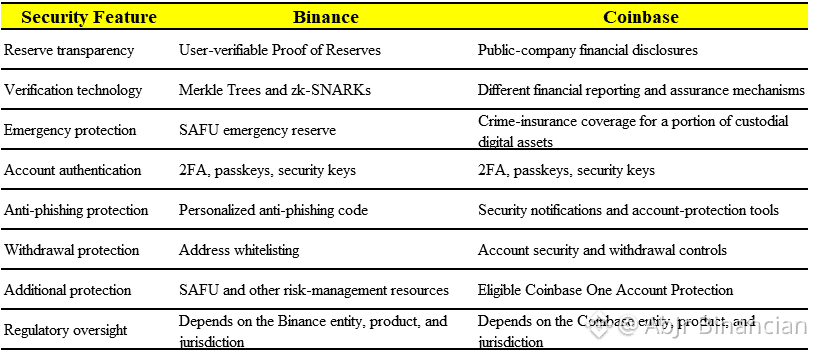
Neither platform offers identical protection mechanisms, and availability varies depending on the user's country and account eligibility.
Conclusion: Is Binance Safer Than Coinbase?
Binance and Coinbase both offer substantial security infrastructure, but they approach transparency and user protection differently.
Binance stands out for its independently verifiable Proof of Reserves, combining Merkle Trees and zk-SNARKs to allow users to check whether their eligible balances are included in published reserve snapshots.
Its SAFU emergency fund also provides an additional financial protection mechanism for certain extreme incidents.
Coinbase offers a different set of strengths, particularly its public-company financial disclosures, crime-insurance arrangements, and additional account-protection options for eligible customers.
Ultimately, neither exchange can be declared universally safer for every user.
The right choice depends on the protections you value, the regulatory arrangements applicable to your location, the services you use, and how actively you manage your account security.
The most important lesson is simple: Don't just trust an exchange. Understand its protections, verify what you can, and take responsibility for securing your own account.