

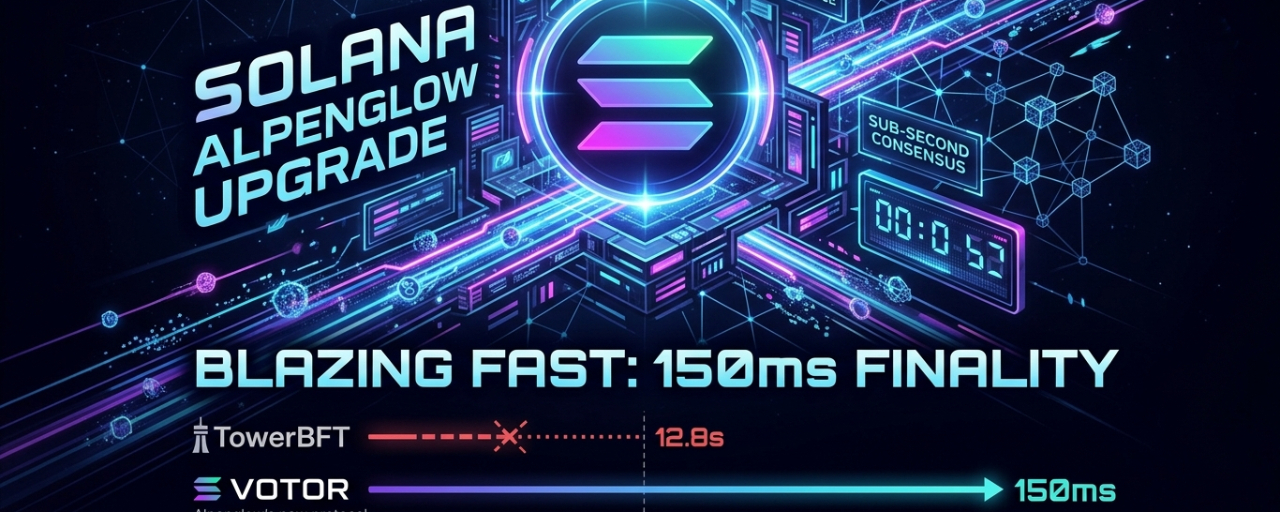

#solanaalpenglowupgradetoactivateonoct21
The blockchain landscape is entering a new era of performance, and Solana is leading the charge with one of the most significant architectural overhauls in its history. Scheduled to activate on October 21, 2026 (at approximately 15:00 UTC during epoch 1064), the Alpenglow upgrade is set to fundamentally reshape how transactions achieve consensus and finality on the network.
For developers, traders, and everyday users, Alpenglow represents a massive leap forward. But what exactly is changing under the hood, and how will it impact the broader Solana ecosystem? Let’s explore the details behind Solana’s upcoming milestone.
1. The Core Innovation: What is Alpenglow?
At its heart, Alpenglow is a consensus-layer upgrade designed to eradicate latency bottlenecks. Since its inception, Solana has relied on TowerBFT—a custom implementation of Practical Byzantine Fault Tolerance (PBFT) optimized for high-throughput blockchains. While TowerBFT served the network well, scaling demands and the growing need for institutional-grade reliability pushed core contributors to rethink validator communication.
Alpenglow replaces TowerBFT with Votor, a novel voting protocol engineered to dramatically accelerate block finalization.
From Seconds to Milliseconds: Under the current design, transaction finality hovers around 12.8 seconds. Alpenglow targets an astonishing 150 milliseconds of transaction finality. This translates to roughly an 85x improvement in speed, reducing finality latency by about 98.8%.
Streamlined Voting Architecture: Instead of forcing validator votes through heavy on-chain transactions, Votor shifts to direct validator-to-validator communication and certificate aggregation.
Flexible Finalization Paths: Votor introduces intelligent validation paths, allowing blocks to finalize in a single voting round under fast-path conditions, or seamlessly proceed through a second round when necessary.
Crucially, Alpenglow is focused strictly on the consensus layer. The Solana Virtual Machine (SVM), smart contract execution, and user transaction fee mechanics remain entirely unchanged. Users do not need to take any action or migrate funds; the network will execute a seamless, one-slot handoff after a brief 5,000-slot countdown.
2. Dispelling Common Misconceptions: Latency vs. TPS
When news of a 150 ms finality target spreads, a common pitfall in crypto communities is assuming that Transactions Per Second (TPS) will instantly multiply by the same factor. Ecosystem analysts emphasize that latency and execution throughput are not a one-to-one relationship.
Finality vs. Execution: Finality measures how quickly a block becomes economically irreversible. Execution capacity, on the other hand, depends on hardware limitations, block compute limits, demand, and state access.
A Shift in How TPS is Counted: Because Alpenglow removes the old model of including validator vote transactions directly in blocks, headline TPS metrics may look different post-activation. A temporary shift or apparent drop in headline numbers does not signal lower user activity; rather, it reflects a cleaner, more accurate accounting of actual user transactions rather than internal network housekeeping.
3. What Alpenglow Means for the Ecosystem
The jump to sub-second finality is more than just a flashy technical metric—it unlocks entirely new classes of decentralized applications (dApps) that demand real-time settlement assurance.
For DeFi and High-Frequency Trading
In decentralized finance, milliseconds matter. Slower finality windows expose liquidity providers and market makers to toxic arbitrage and front-running risks during periods of extreme volatility. With sub-second finality, Solana’s trading infrastructure begins to rival—and in some cases surpass—traditional Web2 financial rails, minimizing slippage and making order-book exchanges hyper-efficient.
For Payments and Consumer Apps
Retail crypto adoption has historically been stalled by the friction of waiting for confirmations at the checkout counter. When a transaction achieves economic finality in 150 ms, crypto-native point-of-sale systems, stablecoin payments, and consumer gaming apps can operate with the fluid immediacy users expect from modern digital banking.
For Validators and Infrastructure
While regular token holders won't notice any disruption, infrastructure operators face a more hands-on transition. Validators must successfully run the updated consensus software, and indexers or block-stream providers need to adapt to the new data model—including handling new fields like bank_id.
4. Market Sentiment and SOL Price Outlook
As the October 21 countdown approaches, discussion forums across Binance Square and other platforms are buzzing. SOL has shown strong underlying resilience, trading comfortably as market participants weigh the technological breakthrough against broader macroeconomic conditions.
The "Sell-the-News" Debate: Traders are actively debating whether Alpenglow is already "priced in" or if a successful, glitch-free rollout will trigger renewed bullish momentum.
Long-Term Fundamentals: Seasoned analysts point out that structural upgrades laying the groundwork for institutional adoption and institutional-grade dApps carry far more weight than short-term price volatility. Rather than trying to time local bottoms, many community members advocate for disciplined, long-term accumulation strategies (like DCA) while keeping a close eye on validator readiness.
Conclusion: A New Baseline for High-Performance Blockchains
Solana’s Alpenglow upgrade is a masterclass in protocol engineering—upgrading the engine of a high-speed train while it is moving at full throttle. By cutting finality down to 150 milliseconds without compromising developer experience or execution logic, Solana is setting a rigorous new standard for layer-1 performance.
As epoch 1064 begins on October 21, all eyes will be on the validator network to ensure a smooth transition. If successful, Alpenglow will cement Solana’s reputation as the premier home for high-frequency, latency-sensitive Web3 applications.
Disclaimer: This article is for informational and educational purposes only and does not constitute financial or investment advice. Always perform your own research (DYOR) before making trading or investment decisions in the crypto market.