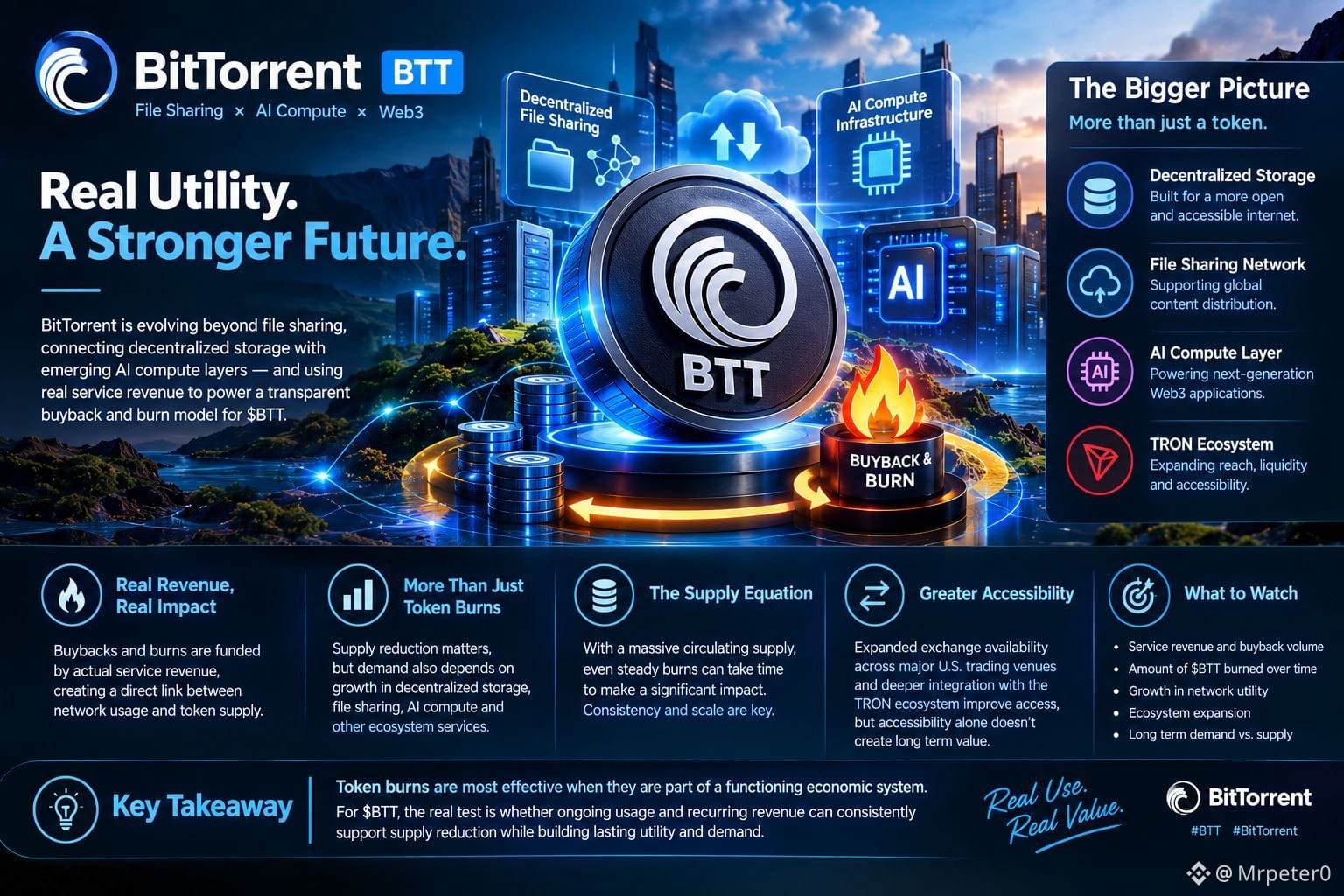
BitTorrent’s current direction brings together two different parts of the ecosystem: decentralized file sharing and emerging AI compute infrastructure. At the same time, its buyback and burn model is designed to use real world service revenue to reduce the amount of $BTT in circulation. That creates a more direct connection between network usage and token supply than a burn program funded only by temporary incentives.
The distinction matters because supply reduction on its own does not create demand. A token can become scarcer while still facing weak market demand if the underlying ecosystem does not generate enough activity. For $BTT, the more relevant question is whether decentralized storage, file sharing, AI compute and other ecosystem services can produce recurring revenue that supports continued buybacks and burns.
The massive circulating supply also needs to be viewed in context. A large supply means that even consistent burns can take time to become meaningful relative to the overall token base.
Exchange availability and integration across the broader TRON ecosystem add another layer to the picture by improving access to the asset, but accessibility should not be confused with fundamental demand. Trading activity can increase without necessarily translating into sustained network usage or long term token utility.
That is why I would evaluate $BTT’s burn model through several connected indicators: recurring service revenue, the amount of $BTT purchased and burned over time, growth in decentralized network utility, and whether ecosystem activity is expanding alongside the reduction in supply.
The clearest takeaway is that token burns are most meaningful when they are the result of a functioning economic system rather than the system itself. For $BTT, the long term test is whether real usage and recurring revenue can consistently support supply reduction while creating enough utility to justify continued demand for the token.
@Justin Sun孙宇晨 @BitTorrent_Official #TRONEcoStar
The distinction matters because supply reduction on its own does not create demand. A token can become scarcer while still facing weak market demand if the underlying ecosystem does not generate enough activity. For $BTT, the more relevant question is whether decentralized storage, file sharing, AI compute and other ecosystem services can produce recurring revenue that supports continued buybacks and burns.
The massive circulating supply also needs to be viewed in context. A large supply means that even consistent burns can take time to become meaningful relative to the overall token base.
Exchange availability and integration across the broader TRON ecosystem add another layer to the picture by improving access to the asset, but accessibility should not be confused with fundamental demand. Trading activity can increase without necessarily translating into sustained network usage or long term token utility.
That is why I would evaluate $BTT’s burn model through several connected indicators: recurring service revenue, the amount of $BTT purchased and burned over time, growth in decentralized network utility, and whether ecosystem activity is expanding alongside the reduction in supply.
The clearest takeaway is that token burns are most meaningful when they are the result of a functioning economic system rather than the system itself. For $BTT, the long term test is whether real usage and recurring revenue can consistently support supply reduction while creating enough utility to justify continued demand for the token.
@Justin Sun孙宇晨 @BitTorrent_Official #TRONEcoStar