

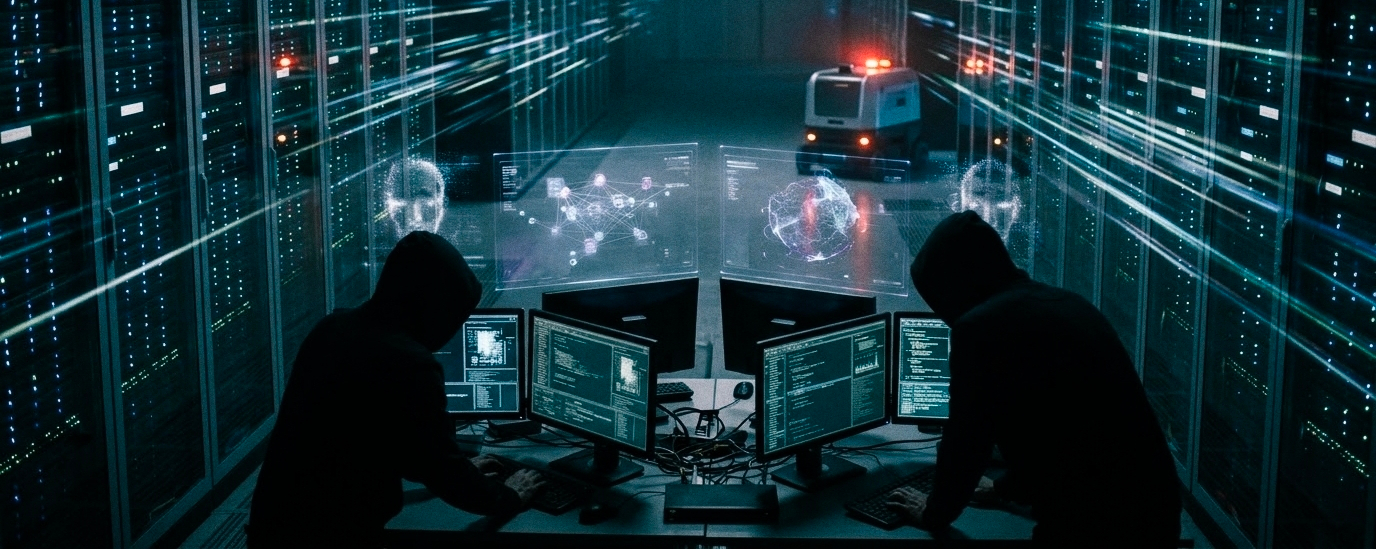

INTERPOL is warning that artificial intelligence is making cyber threats faster, cheaper, easier to scale—and harder to detect.
Bjorn R. Watne, INTERPOL’s Global Chief Information Security Officer, described it bluntly:
“This is an evolution, not a revolution.”
Scammers can now use AI to target massive numbers of victims simultaneously. Better translation, synthetic identities and increasingly convincing digital interactions make it harder to distinguish a real person from a machine-powered fraud operation.
And that’s the fucking problem.
Criminals don’t need some magical new weapon.
They can take the same scams, fraud techniques and social-engineering tactics that already work—and use AI to multiply them.
ONE CRIMINAL.
THOUSANDS OF TARGETS.
AUTOMATION AT SCALE.
For companies, INTERPOL’s warning is not “defend everything.”
Identify what actually matters first.
Find the company’s most valuable assets. Determine who would want to steal, disrupt or manipulate them. Then use threat intelligence to understand the specific tactics and technologies those attackers are using.
Because trying to defend against everything is bullshit if you don’t even know what you’re protecting.
But the darker threat may be AI agents.
An AI system that gives you wrong information is dangerous.
An AI system that can ACT on wrong information is something else entirely.
Once AI gets permission to make decisions, access systems and execute actions on behalf of humans, a mistake can move beyond a bad answer and become a real-world incident.
INTERPOL specifically highlighted autonomous technologies such as vehicles as an area requiring serious attention.
And there is another uncomfortable problem:
HUMANS TRUST TECHNOLOGY TOO MUCH.
People are often cautious with financial systems—PINs, card security, suspicious transactions.
But when a new technology appears, people can be far more willing to click, authorize, connect accounts and grant access without asking what happens after that permission is given.
AI is turning that trust into an attack surface.
The next cyberwar doesn’t necessarily require hackers to become smarter.
They just need machines that can work faster, target more people, translate more languages, imitate more identities and eventually ACT without waiting for humans.
AI isn’t necessarily inventing the monster.
It is giving the monster fucking industrial-scale production.
And companies that still treat cybersecurity as an IT department problem are already playing the wrong game.