
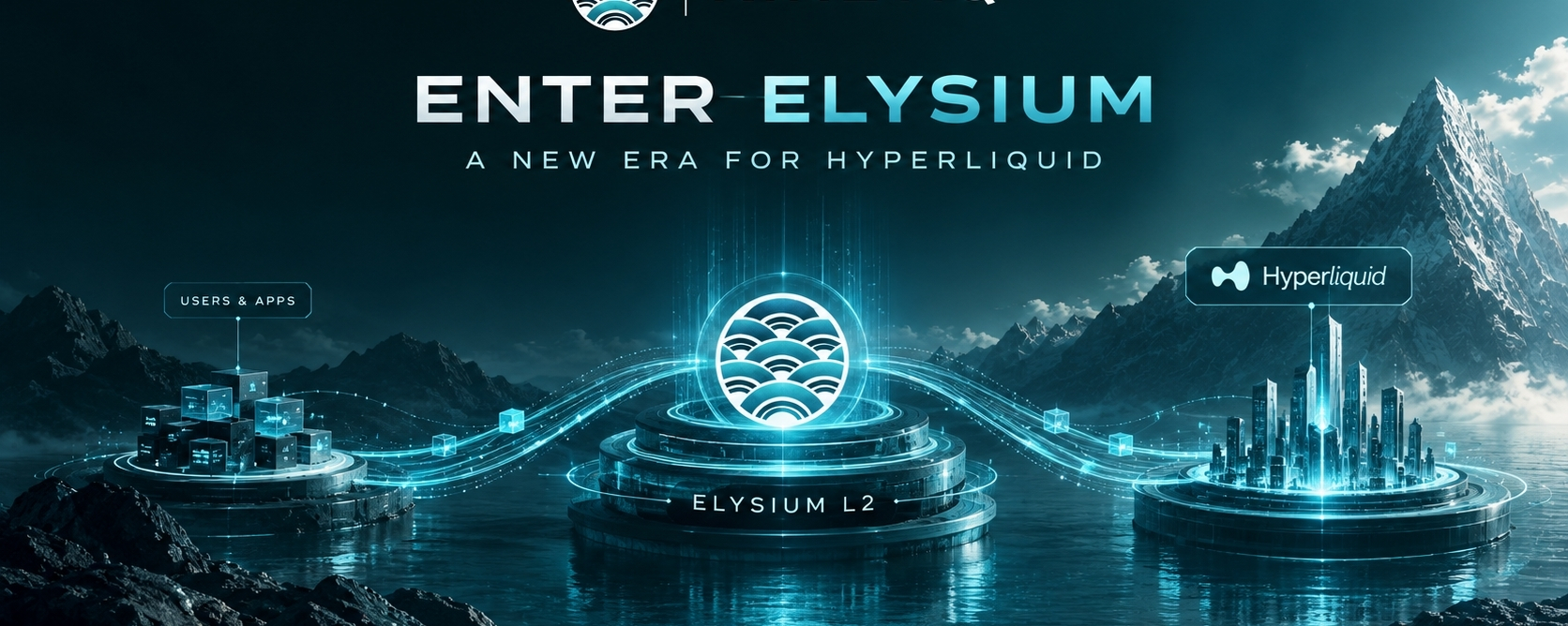

Hyperliquid has already established itself as one of the most important on-chain venues for perpetuals. HyperCore is at the center of that system, while $HYPE provides the underlying asset and economic foundation.
But as activity expands beyond perps, another question becomes harder to ignore: can the execution environment around HyperCore support the kind of high-frequency DeFi activity that builders and traders actually want?
This is the problem Kinetiq is trying to address with Elysium.
Why Hyperliquid needs another execution layer
HyperEVM was designed with an important constraint: maintaining close composability with HyperCore.
Its dual-block architecture uses frequent smaller blocks alongside larger blocks at longer intervals. That design has advantages for coordination with HyperCore, but it also creates limitations for applications that need consistently high throughput and low transaction costs.
For high-frequency DeFi, those limitations matter.
A simple swap can become expensive during periods of congestion, while applications such as professional spot markets and automated market makers need an environment where transactions can be executed quickly and repeatedly without unpredictable costs.
Elysium approaches this from a different direction.
Rather than trying to replace HyperCore, it is designed as a Layer 2 around Hyperliquid, using the Arbitrum Orbit stack and settling to HyperEVM while remaining closely connected to HyperCore.
The network is still pre-mainnet, so its published performance figures should be treated as targets rather than established production results. The stated goal, however, is significant: much faster block times and substantially greater execution capacity for the workloads HyperEVM is not optimized to handle.
One ecosystem, one gas asset. One of the simplest but most important decisions is the use of $HYPE as Elysium's native gas asset.
There is no need to introduce another gas token or create a separate economic system for users moving between Hyperliquid and Elysium.
That keeps the user experience connected to the existing Hyperliquid economy. More importantly, it gives $HYPE another practical role within the ecosystem. Instead of activity happening on a separate L2 with a completely different fee asset, Elysium is designed around the same underlying economic environment.
Built for spot markets and PropAMMs. The most interesting part of Elysium, in my view, is its focus on spot trading.
High-frequency market-making requires more than simply having an EVM environment with lower fees. Market makers need rapid quote updates, efficient execution and a straightforward way to hedge positions against deeper liquidity.
This is where PropAMMs become important. Elysium is designed to support these workloads while maintaining connectivity with HyperCore's existing liquidity infrastructure. Its L1Read precompile is also intended to make Hyperliquid data directly accessible to applications on Elysium, allowing builders to use native Hyperliquid information rather than relying entirely on external oracle infrastructure.
That could make the relationship between the L2 and HyperCore much tighter than the typical "L2 settles back to L1" model.
A clearer path from token launch to HyperCore
Elysium also introduces a more connected token lifecycle:
AMM → PropAMM → HyperCore Spot → HIP-3 Perps
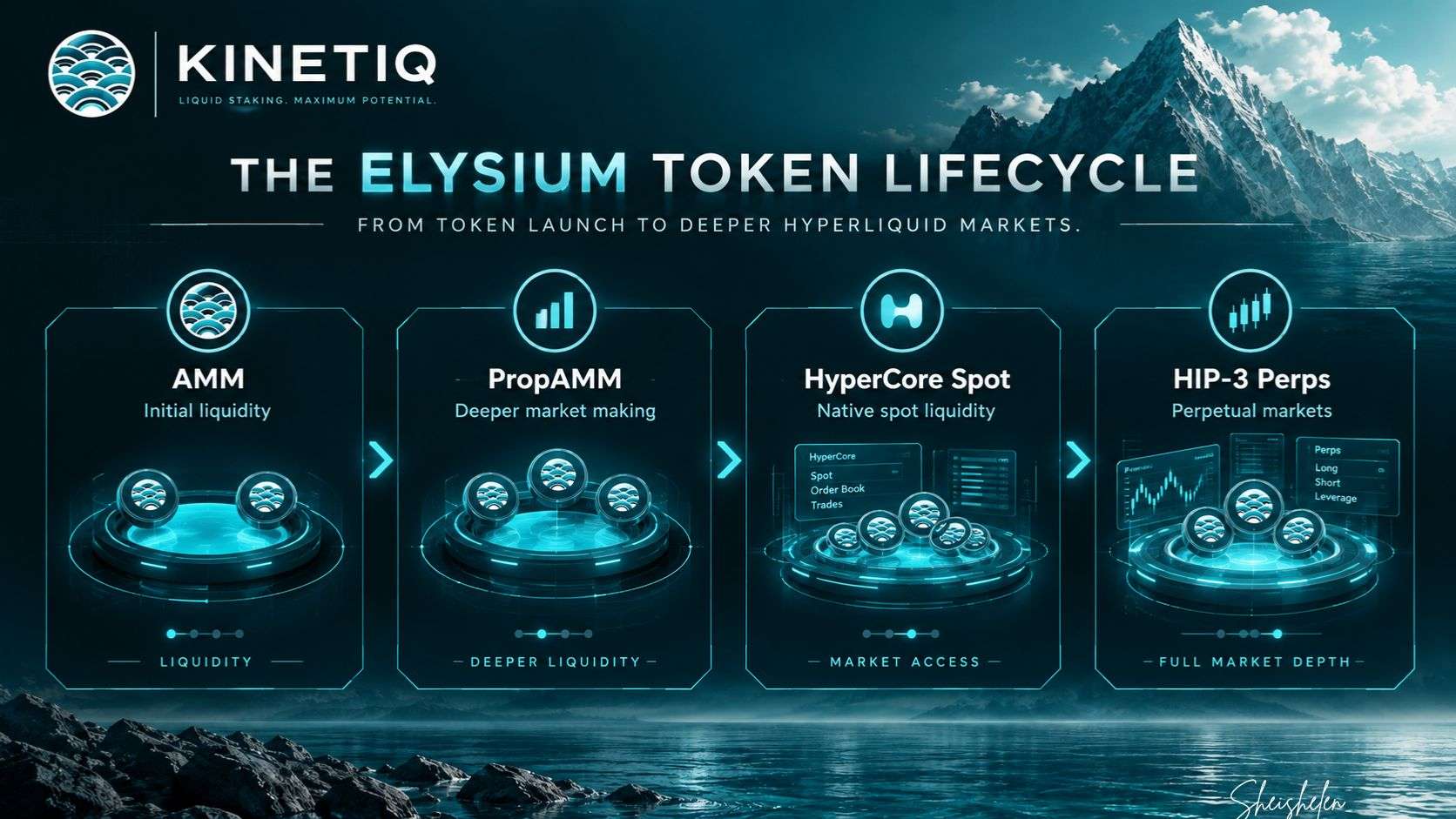
The significance is less about the individual stages and more about the progression between them.
A new asset can begin with liquidity on Elysium, develop through a more sophisticated market-making environment, and potentially move toward HyperCore spot markets and eventually HIP-3 perpetual markets.
If this works as designed, token launches become less fragmented because different stages of market development can happen within the same broader ecosystem.
The part that changes the L2 economics. The biggest difference between Elysium and many traditional L2 models is what happens to sequencer revenue.
The proposed Elysium sequencer fee distribution is:
25% → Builders
25% → Kinetiq Treasury
50% → KNTQ open-market buybacks and burn
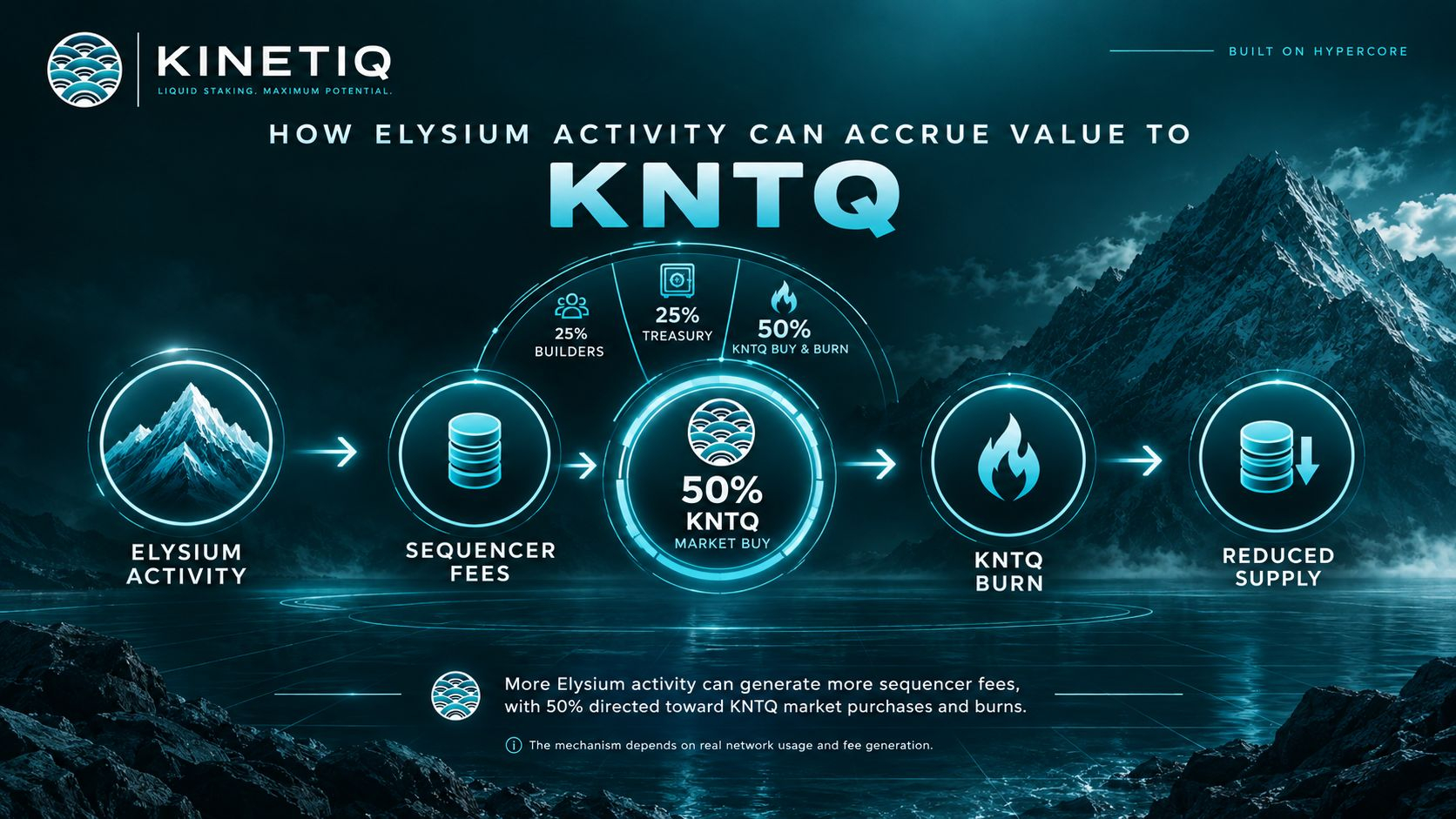
That final 50% is the mechanism behind Elysium's value-accretive thesis.
When users generate activity on Elysium, the sequencer earns fees. Half of the designated sequencer fees are used to purchase KNTQ on the open market, with the purchased tokens then sent for burning.
This creates a direct relationship between network usage and KNTQ supply reduction.
But there is an important distinction here: the mechanism itself does not guarantee value accrual. It only creates the mechanism for it.
For the model to matter at scale, Elysium needs actual transaction activity, meaningful trading volume and sustained demand from builders and users. A burn mechanism attached to low activity would have limited economic impact.
That is why I think the more interesting question is not simply how much KNTQ can be burned, but whether Elysium can generate enough real economic activity for the mechanism to become meaningful.
Why this model is different
Traditional L2s can create a situation where significant activity moves away from the underlying L1 while the L2 captures the economics of that activity through sequencing and fees.
Elysium is being designed around a different relationship.
Its stated architecture attempts to send value and activity in several directions at once:
- $HYPE remains the gas asset.
- HyperCore remains an important source of liquidity and market infrastructure.
- Builders receive 25% of sequencer fees.
- Kinetiq's treasury receives 25%.
- 50% of sequencer fees are directed toward KNTQ purchases and burns.
In other words, the thesis is not simply "move activity to an L2."
It is to create an execution environment where more activity can happen while strengthening the economic connection between Elysium, Hyperliquid and KNTQ.
That is what makes the value-accretive argument worth watching. The part that still needs to be proven
There is a lot to like about the architecture, but the distinction between an interesting design and a successful network will ultimately come down to execution.
Elysium is still pre-mainnet. Published throughput figures are targets, not long-term production results. PropAMM liquidity has to materialize. Builders have to choose the environment. Traders have to use it. And tokens need to successfully move through the proposed lifecycle into deeper HyperCore markets.
There are also broader economic assumptions around additional native USDC liquidity and its potential impact on Hyperliquid's ecosystem. Those scenarios depend on genuinely new liquidity and actual adoption rather than simply moving existing capital around.
So I would not describe Elysium as a proven success yet. I would describe it as a technically interesting attempt to solve a specific problem: how do you expand Hyperliquid's execution capacity without disconnecting that activity from the economic engine that already exists?
If Elysium delivers on that design, its significance goes beyond being another EVM-compatible L2.
It could become an execution layer that makes Hyperliquid more useful for builders and traders while giving network activity a direct economic relationship with KNTQ.
That is the part worth watching.
#Web3 #Hyperliquid #Kinetiq #Elysium #DeFi #Layer2