


Updated: August 31, 2026
The crypto market is full of tokens with big promises, but only a small number are connected to an actual consumer product. Seeker (SKR) is one of the more interesting examples because it sits at the intersection of cryptocurrency, smartphones, decentralized applications and the Solana ecosystem.
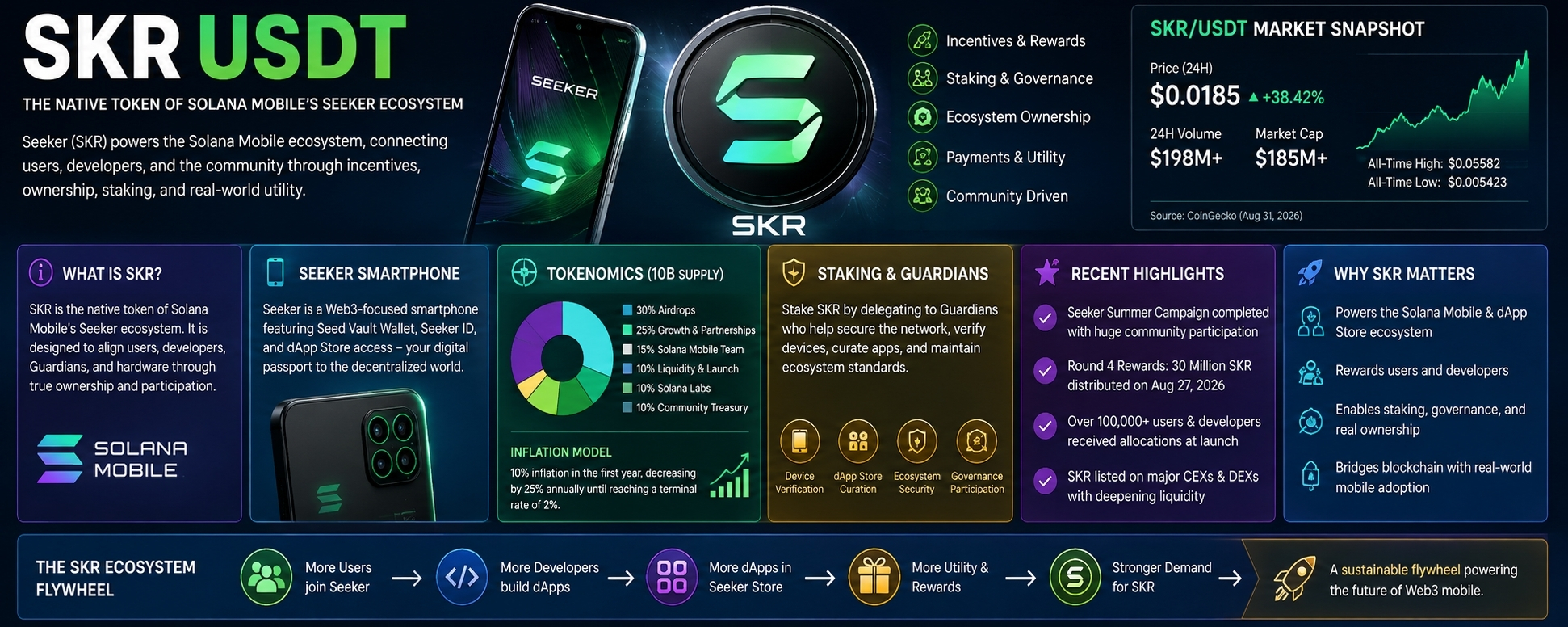
SKR is the native token of Solana Mobile's Seeker ecosystem. It is designed to give users, developers and other participants an economic stake in the mobile platform rather than leaving control entirely with a traditional centralized app-store model.
That is also why the SKR/USDT trading pair has attracted so much attention. The token has experienced enormous price swings since launching in January 2026, and the latest move in August has put SKR back on traders' radar.
But there is more to SKR than a price chart.
The bigger story is whether Solana Mobile can turn Seeker into a genuinely useful crypto-native smartphone ecosystem — and whether SKR can become an important part of that economy.
What Is SKR?
SKR stands for Seeker, the native cryptocurrency of the Solana Mobile ecosystem.
Unlike SOL, which is the native cryptocurrency of the Solana blockchain itself, SKR was created specifically for the Solana Mobile economy.
Solana Mobile describes SKR as a coordination layer for the ecosystem, connecting users, developers and manufacturers. Its intended roles include incentives, ownership, governance and staking.
In simple terms, Solana Mobile wants SKR to help create an economic relationship between the people who use Seeker, the developers who build applications for it and the broader network that supports the platform.
That makes SKR more than just a payment token.
It is part of Solana Mobile's attempt to build a different model for mobile technology.
What Does SKR/USDT Mean?
SKR/USDT is simply the market where Seeker is traded against Tether (USDT).
If SKR/USDT is trading at $0.02, for example, one SKR costs approximately 0.02 USDT.
The pair is popular because USDT is widely used across crypto exchanges and gives traders a relatively stable unit in which to measure SKR's value.
For someone trading the pair, the important things to watch are not just the price but also volume, liquidity, market depth, open interest and funding rates.
Those factors become particularly important with SKR because the token can move very quickly.
SKR's Latest Price Action
SKR has recently entered another period of extreme volatility.
CoinGecko's latest market data shows SKR trading around the $0.017–$0.022 area, with the token posting a dramatic move over the last 24 hours and a much larger gain over the previous week. CoinMarketCap is also showing a sharp recent increase, although exact figures can differ between data providers because cryptocurrency markets move continuously.
That difference between data feeds is worth remembering.
Crypto prices can change dramatically within minutes, especially when a relatively small-cap token experiences a sudden surge in trading activity.
SKR's recent move has been particularly notable because it followed the latest Seeker Summer reward activity. CoinGecko currently identifies the Seeker Summer campaign and its Round 4 rewards as major recent developments associated with the token's price movement.
The Recent 30 Million SKR Reward Distribution
One of the newest developments is the fourth round of Seeker Summer rewards.
On August 27, eligible participants were able to check their Seed Vault Wallet allocations and claim part of a 30 million SKR distribution.
This matters for two reasons.
First, reward campaigns encourage people to actually use the Seeker ecosystem and interact with applications.
Second, newly distributed tokens can also create selling pressure if recipients decide to take profits.
That makes reward distributions a double-edged sword for the market.
They can increase engagement while simultaneously increasing the amount of SKR potentially available for sale.
Seeker Summer and the Push for Real Usage
The Seeker Summer campaign was designed to encourage users to explore applications within the Solana Mobile ecosystem.
The campaign ran through multiple rounds, with users completing quests and interacting with selected applications to earn rewards and badges. Recent reporting indicates that the structured campaign concluded around August 30.
This is important because Solana Mobile needs more than people simply holding SKR.
The long-term goal is to get users actually doing things with the ecosystem.
A healthy mobile platform needs users.
Users need applications.
Developers need users.
And developers need economic incentives.
SKR is intended to sit in the middle of that relationship.
The Seeker Smartphone Is the Bigger Story
To understand SKR properly, it helps to stop looking at the token for a moment.
The real product is Seeker, Solana Mobile's Web3-focused smartphone.
The phone includes features such as the Seed Vault Wallet, Seeker ID and a native experience designed around Solana applications. Solana Mobile describes Seeker as a digital passport into its ecosystem, while its hardware-backed wallet is designed to make crypto transactions more convenient and secure.
This gives SKR something that many crypto tokens do not have: a connection to physical hardware.
That does not guarantee success, of course.
But it creates the possibility of a much larger ecosystem if Seeker adoption continues.
Why the dApp Store Matters
One of the biggest challenges for any new smartphone platform is applications.
A phone can have impressive hardware, but without useful apps, consumers have little reason to switch.
Solana Mobile has been building its own ecosystem around the Solana dApp Store.
According to Solana Mobile, developers can reach more than 150,000 users, while the platform promotes a model with 0% platform fees and developer grants.
That is a meaningful part of the SKR story.
If developers find the platform economically attractive, more applications could appear.
If more applications appear, the phone becomes more useful.
If the phone becomes more useful, user activity can increase.
And if SKR becomes increasingly integrated into that activity, the token could gain stronger fundamental demand.
SKR's Original Launch
SKR officially launched in January 2026.
The launch included a major distribution to Seeker users and developers.
Reports around the launch indicated that more than 100,000 users and developers were eligible for nearly 2 billion SKR through the initial distribution.
This was a deliberate choice by Solana Mobile.
Instead of launching SKR as a token owned mainly by venture investors or early traders, a substantial amount was directed toward people already participating in the ecosystem.
The idea was simple: give the community an economic stake in the platform it was helping build.
SKR Tokenomics
SKR has an initial total supply of 10 billion tokens.
The allocation is divided among several major categories.
AllocationShareAirdrops30%Growth & Partnerships25%Solana Mobile Team15%Liquidity & Launch10%Solana Labs10%Community Treasury10%
The 30% airdrop allocation is especially significant because it shows how strongly the project emphasizes community participation.
The 25% allocation for growth and partnerships is also important because Solana Mobile will need continued investment in developers, users and ecosystem expansion.
The Supply Question Investors Should Not Ignore
There is an important detail hidden behind the headline figure of 10 billion SKR.
SKR uses an inflation model.
Solana Mobile's official tokenomics information describes 10% inflation in the first year, followed by a 25% annual decay in the inflation rate until reaching a terminal rate of 2%.
This matters because token price does not exist in isolation.
Suppose demand for SKR stays flat while the number of tokens available increases.
In that situation, the market needs additional buyers just to absorb the extra supply.
For SKR to perform strongly over the long term, growth in ecosystem demand needs to keep pace with — or ideally exceed — supply expansion.
That is one of the most important fundamental questions surrounding the token.
How SKR Staking Works
Staking is another important part of the ecosystem.
SKR holders can delegate their tokens to Guardians.
Guardians play a role in areas such as device verification, application review and ecosystem security.
For token holders, staking provides a way to participate in the network while potentially earning rewards.
The staking model also gives SKR a purpose beyond trading.
A token that can be staked, used for governance and integrated into applications has a different long-term proposition from a token whose main purpose is speculation.
Of course, staking rewards are not free money.
Rewards can increase the token supply, and stakers may also sell their rewards.
The real question is whether staking creates enough long-term participation to offset that additional supply.
Who Are the Guardians?
Guardians are an important part of Solana Mobile's attempt to decentralize parts of the ecosystem.
They can be involved in:
Device verification
dApp Store curation
Ecosystem standards
Security
Network participation
SKR holders can delegate their tokens to Guardians.
That creates a direct connection between token ownership and participation in the ecosystem.
It is one of the mechanisms through which Solana Mobile wants to move away from a purely centralized mobile-platform model.
TEEPIN: The Technology Behind the Vision
Another term that appears frequently in the Solana Mobile ecosystem is TEEPIN.
The idea is to combine trusted hardware, device identity and blockchain-based coordination.
This is important because Solana Mobile is trying to solve a problem that goes beyond cryptocurrency.
The company wants devices themselves to become part of a decentralized ecosystem.
If that vision works, a Seeker is not simply a smartphone with a crypto wallet.
It becomes an access point to a network where the device, applications, users and tokens are connected.
That is a much bigger ambition.
Why SKR Has Attracted Traders
There are several reasons traders are paying attention to SKR.
The first is volatility.
SKR has already demonstrated that it can make extremely large moves in short periods.
CoinGecko records an all-time high around $0.05582 and an all-time low around $0.005423, showing just how wide its historical trading range has been.
The second reason is the Solana connection.
Solana is already one of the largest blockchain ecosystems, and anything capable of extending Solana into consumer hardware naturally attracts attention.
The third reason is the narrative.
SKR combines several popular crypto themes:
Solana + smartphones + Web3 + payments + decentralized applications + staking + consumer adoption.
When several narratives converge around one asset, traders can become extremely aggressive.
But Volatility Works Both Ways
The same volatility that attracts traders can hurt them.
A token that can rise 100% quickly can also fall dramatically.
That is especially relevant when traders use leverage.
SKR perpetual futures can magnify gains, but they can also turn a relatively small market movement into a liquidation.
For that reason, the SKR/USDT spot market and the SKR/USDT futures market should not be treated as the same thing.
Spot investors are primarily exposed to the token's price.
Leveraged traders are exposed to price, leverage, funding, liquidation and market positioning.
What Is Driving the Current Interest?
The latest move appears to be connected to several factors rather than a single event.
The Seeker Summer campaign has generated additional activity.
The latest 30 million SKR reward round has brought new tokens to users.
The broader Seeker ecosystem continues to develop.
And the token itself has attracted substantial trading volume.
CoinGecko currently reports daily SKR trading volume in the nine-figure-dollar range, while its market data shows a very large recent percentage move.
That combination of increased activity and limited market capitalization can create rapid price discovery.
SKR's Bullish Argument
The bullish case for SKR is relatively easy to understand.
If Solana Mobile succeeds in building a meaningful Web3 mobile platform, SKR could become the economic layer connecting users, developers and hardware.
Imagine a future where:
A user owns a Seeker.
The user discovers applications through the Solana dApp Store.
Those applications use SKR or integrate with the SKR economy.
The user earns rewards.
The user stakes some SKR.
Developers earn from their applications.
More developers arrive because the economics are attractive.
More users arrive because there are more useful applications.
That creates a flywheel.
And that flywheel is arguably the biggest reason to watch SKR.
SKR's Bearish Argument
The bearish case is just as important.
The first concern is token supply.
SKR is inflationary, which means the ecosystem needs continuing demand.
The second concern is adoption.
Selling smartphones to crypto enthusiasts is one thing.
Building a mobile platform used regularly by a much broader audience is considerably harder.
The third issue is competition.
Solana Mobile is effectively trying to create an alternative ecosystem alongside dominant mobile platforms.
Apple and Google have enormous developer networks, established payment systems, mature operating systems and hundreds of millions of users.
Taking meaningful market share from established platforms will not be easy.
Another Risk: Airdrop and Reward Selling
Large token distributions can create short-term selling pressure.
The initial SKR launch included a major distribution to users and developers.
Later campaigns have continued distributing SKR.
For long-term investors, the important question is what recipients do after receiving tokens.
If most people immediately sell their rewards, the market may struggle with supply.
If a significant portion of users stake their tokens or use them inside the ecosystem, the effect could be very different.
That is why the behavior of token recipients matters almost as much as the size of the distribution.
The Difference Between Price and Adoption
This is where SKR becomes particularly interesting.
A token can rise 100% without the underlying product becoming 100% more useful.
Likewise, a project can increase its user base while its token price temporarily falls.
Those two things do not always move together.
For long-term SKR investors, it is therefore better to watch both.
Price tells you what the market thinks today.
Adoption tells you whether the underlying thesis is actually developing.
What to Watch Next
There are several indicators worth monitoring over the coming months.
Seeker User Growth
More active devices would strengthen the ecosystem thesis.
dApp Store Growth
The number and quality of applications matter more than raw app counts.
SKR Staking
Increasing staking can indicate stronger community participation.
Circulating Supply
Investors should keep track of new tokens entering circulation.
Developer Activity
Developers ultimately determine whether the platform has a sustainable application ecosystem.
Payment Integrations
If SKR becomes useful for real-world purchases, its utility could expand considerably.
Exchange Liquidity
More liquidity generally makes the market healthier and can reduce the impact of individual orders.
Futures Open Interest
A sudden increase in leveraged positions can make SKR more vulnerable to violent moves in either direction.
What Could Send SKR Higher?
Several potential catalysts could support the token.
A larger Seeker user base would be positive.
Major new applications could increase activity.
More payment integrations could give SKR practical utility.
Additional hardware products could expand the ecosystem.
More exchange listings could improve liquidity and accessibility.
A strong Solana market could also provide a favorable environment.
And perhaps most importantly, successful conversion of Seeker users into long-term SKR participants could strengthen the project's economics.
What Could Send SKR Lower?
The opposite scenarios are equally important.
A broader crypto market correction could hit SKR heavily.
A decline in Seeker activity would weaken the fundamental story.
Large token distributions could create additional selling pressure.
Rapid inflation without matching demand could hurt the token.
High leverage could produce cascading liquidations.
And if developers fail to build applications that people actually use, the ecosystem could struggle to justify its valuation.
SKR and the Solana Ecosystem
It would be difficult to analyze SKR without considering Solana itself.
Solana Mobile benefits from the broader Solana developer and user ecosystem.
At the same time, Solana Mobile gives Solana another route into consumer technology.
That relationship could become increasingly important if blockchain-based applications move beyond wallets and exchanges and into everyday mobile experiences.
The smartphone is one of the most personal pieces of technology people own.
If crypto becomes a native part of that device, the potential market is much larger than the current crypto trading community.
Why Seeker Could Be Important for Web3
The biggest problem with many Web3 applications is friction.
Users often have to:
Download wallets.
Manage seed phrases.
Switch networks.
Approve transactions.
Understand gas fees.
Connect applications manually.
A purpose-built device can simplify some of these steps.
Seeker's Seed Vault and native Solana integrations are designed around exactly that idea.
If Solana Mobile can make blockchain applications feel as natural as ordinary smartphone apps, it could remove one of the biggest barriers to consumer adoption.
That would be much more important than another exchange listing.
SKR's Long-Term Question
The long-term question is not whether SKR can pump.
It already has.
The real question is whether the token can develop sustainable demand.
That requires people to want SKR for reasons other than selling it to someone else at a higher price.
Staking is one reason.
Governance is another.
Rewards are another.
Payments and applications could become even more important.
The stronger these use cases become, the less dependent SKR would be on pure speculation.
Can SKR Reach $0.10?
This is one of the questions traders naturally ask after seeing a major rally.
The answer depends on market capitalization, not simply the number on the chart.
With a large token supply, reaching $0.10 would require a substantially higher valuation than SKR has today.
That does not make the target impossible.
But it means investors should not look at the price alone.
A move from $0.02 to $0.10 represents a 5x increase.
For that to be sustainable, the market would need to support a much larger valuation, and the ecosystem would ideally need to demonstrate meaningful growth.
Price targets should therefore be treated as scenarios rather than guarantees.
SKR Price Predictions Should Be Treated Carefully
There are already numerous websites publishing SKR forecasts for 2026 and beyond.
Some use simple percentage-growth models, while others use technical indicators or broader market assumptions.
These forecasts can be interesting, but they should not be treated as facts.
For example, Kraken's published calculator provides projections based on a user-selected annual growth assumption rather than a guaranteed prediction.
That distinction matters.
Nobody knows the exact SKR price six months or five years from now.
A better approach is to build scenarios.
Bearish Scenario
Seeker adoption slows, token supply grows faster than demand, and the broader crypto market weakens.
In this environment, SKR could revisit much lower levels.
Neutral Scenario
The ecosystem continues growing, but adoption remains gradual.
SKR could remain volatile and trade through broad ranges while the market waits for stronger fundamentals.
Bullish Scenario
Seeker adoption accelerates, developers build successful applications, SKR utility expands and the wider Solana ecosystem remains strong.
Under that scenario, the token could potentially challenge previous highs.
These are scenarios, not predictions.
The Most Important Thing to Understand About SKR
There is a temptation to look at SKR as just another small-cap cryptocurrency.
That misses the bigger picture.
SKR is effectively a bet on whether a crypto-native mobile ecosystem can become meaningful.
If Solana Mobile succeeds, SKR could benefit from the growth of that economy.
If Seeker remains a niche product, the token's long-term potential could be much more limited.
That is why the phone, the applications, the users and the token should all be analyzed together.
Final Thoughts
SKR/USDT has become one of the more interesting crypto pairs to watch in 2026.
The token has already experienced extraordinary volatility, and the latest Seeker Summer activity has once again pushed it into the spotlight. Recent market data shows SKR making a very large short-term move, while the ecosystem continues to distribute rewards and encourage users to interact with Seeker applications.
But the real story is still being written.
Solana Mobile has created a smartphone, a Web3 application ecosystem, a native wallet experience, a token, a staking system and a model designed to give users and developers a greater economic role.
The next challenge is much harder: turning that infrastructure into something people use consistently.
If Seeker becomes a genuine gateway to everyday Web3 applications, SKR could have a strong fundamental story behind it.
If adoption remains limited, the token may continue to depend heavily on speculation, incentives and broader crypto-market sentiment.
For anyone following SKR/USDT, the smartest approach is therefore to watch more than the candle chart.
Watch the users.
Watch the developers.
Watch the dApp Store.
Watch staking.
Watch circulating supply.
Watch real-world utility.
And above all, watch whether the Solana Mobile ecosystem is actually becoming more valuable over time.
That will ultimately tell us far more about SKR's future than any short-term price prediction.
This article is for informational and educational purposes only and should not be considered financial advice. Cryptocurrency prices can move rapidly, and losses can be substantial.
Frequently Asked Questions
What is SKR?
SKR is the native token of Solana Mobile's Seeker ecosystem. It is designed for incentives, ownership, staking and coordination across the mobile ecosystem.
What is SKR/USDT?
SKR/USDT is the trading pair that allows users to buy or sell Seeker using USDT.
What is the total supply of SKR?
SKR launched with an initial total supply of 10 billion tokens. The token also has an inflation schedule, so investors should distinguish between total supply and circulating supply.
What is Seeker?
Seeker is Solana Mobile's Web3-focused smartphone. It includes features such as Seed Vault Wallet and Seeker ID and is designed to provide direct access to the Solana Mobile ecosystem.
Is SKR the same as every other cryptocurrency using the ticker SKR?
No. Different projects can use the same ticker. Always verify that you are looking at Solana Mobile's Seeker token and confirm the official contract address before transferring or purchasing tokens.
Why is SKR moving so much?
SKR has a relatively small market capitalization compared with major cryptocurrencies, and recent Seeker Summer rewards, ecosystem activity and trading interest have contributed to significant volatility.
Is SKR a good investment?
There is no guaranteed answer. Its long-term potential depends heavily on Seeker adoption, developer activity, SKR utility, token supply growth and the overall Solana ecosystem.
What is the biggest thing to watch?
The most important metric may ultimately be real ecosystem adoption. If more people use Seeker and more developers build useful applications around it, the fundamental case for SKR becomes stronger.