
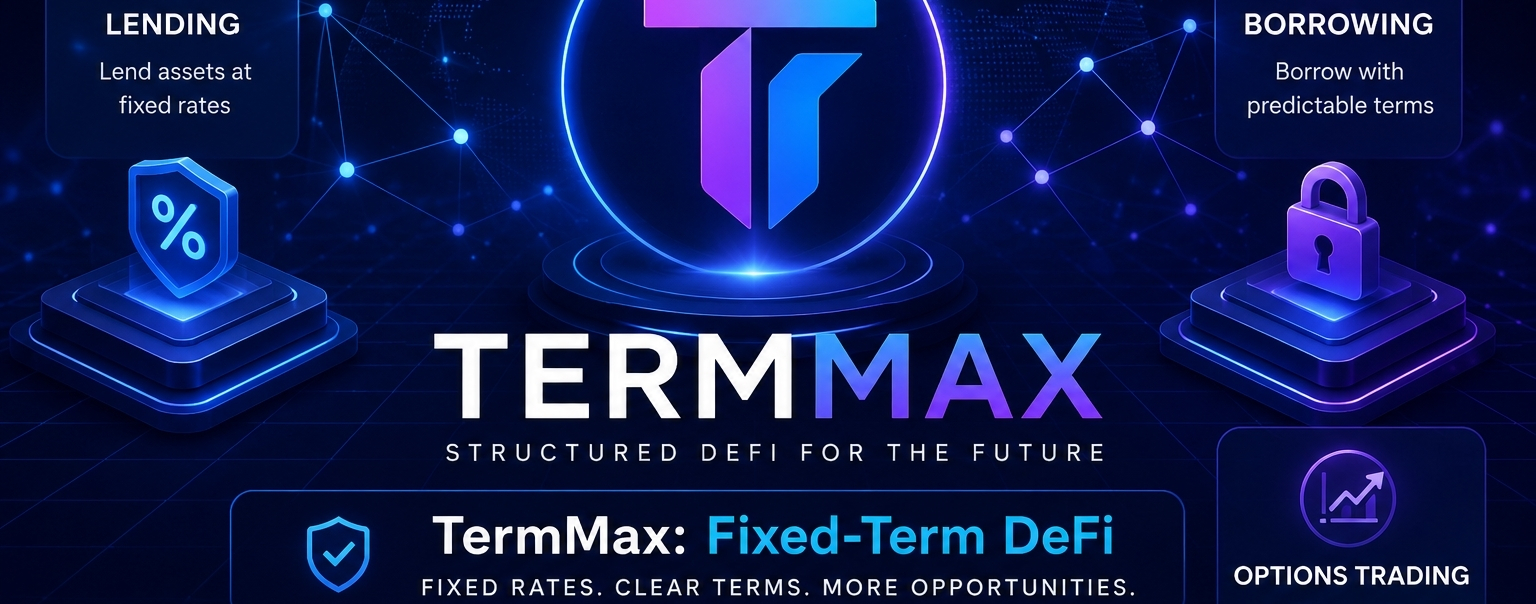
DeFi has made lending and borrowing more accessible, but one challenge remains: uncertainty around interest rates. Rates can change as market conditions, liquidity and demand change. This makes it harder for users to plan a position over a specific period.
This is where I find @TermMax interesting.
TermMax is taking a different approach by focusing on fixed-rate and fixed-term lending and borrowing. Instead of thinking only about the current market rate, users can look at a defined borrowing or lending period and understand the terms of that position more clearly.
What interests me most is not simply the “fixed-rate” concept itself, but what it could mean for DeFi risk management. If the cost of borrowing is known for a specific term, users can potentially make more structured decisions instead of constantly reacting to changing rates.
Another interesting part of the TermMax ecosystem is its focus beyond basic lending. The protocol is designed around fixed-term financial products, while $TMX has a role within the ecosystem through governance, staking and incentives. The long-term value of any such ecosystem, however, should ultimately depend on real usage, liquidity, sustainable incentives and whether users actually find the products useful.
For me, the biggest thing to watch is adoption. A strong concept needs more than an interesting mechanism—it needs sufficient liquidity, active users and a healthy ecosystem to become meaningful in practice.
That makes TermMax an interesting project to follow during its development. I’m particularly curious to see how its fixed-term model evolves and whether it can establish a useful niche within the broader DeFi market.
This is only my personal observation, not financial advice.