
On August 11, 2026, Binance once again dropped a bombshell on the crypto community. The exchange announced it would extend its notorious Monitoring Tag to five more tokens: Moonbeam (GLMR), ICON (ICX), Moonriver (MOVR), SuperRare (RARE), and Sophon (SOPH).
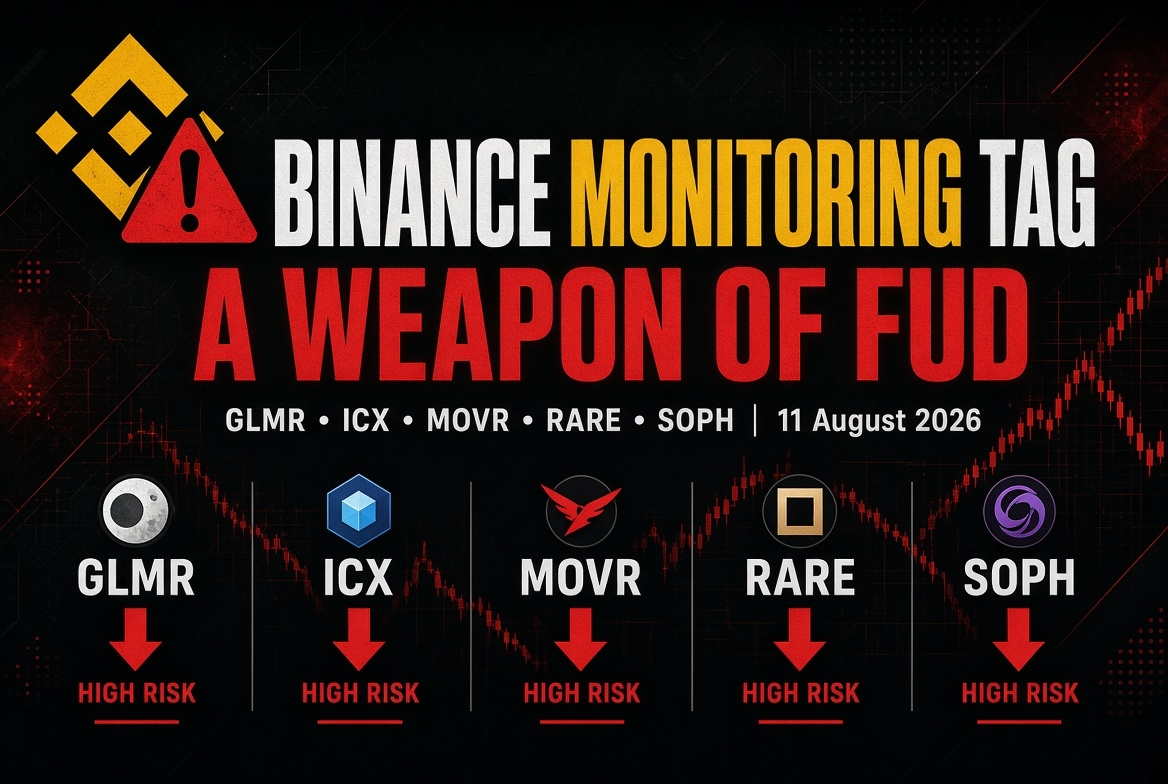
According to Binance, these tokens now “exhibit notably higher volatility and risks.” They will be “closely monitored,” and holders are warned that the projects risk being delisted if they fail to meet the exchange’s listing criteria.
This is not transparency. This is a thinly veiled threat dressed up as risk management and it needs to be called out.
Why the Monitoring Tag Is Deeply Problematic
1. It creates instant, artificial panic selling
Every time Binance adds the Monitoring Tag, prices of the affected tokens usually crash within hours. Retail investors who have held these projects for months or years suddenly see double-digit losses not because the fundamentals collapsed overnight, but because Binance waved a red flag. This is pure FUD engineered by the largest exchange in the world.
2. The criteria are vague and one-sided
Binance lists factors such as “team commitment,” “development activity,” “trading volume and liquidity,” “network stability,” and “contribution to a healthy ecosystem.” These sound reasonable on paper. In practice, they are highly subjective. Projects rarely receive clear, public explanations for why they were tagged. There is no transparent scoring system, no appeal process, and no fixed timeline for removal. Binance holds all the power.
3. It forces unnecessary friction on users
Anyone who wants to trade a Monitoring Tag token must pass a quiz every 90 days and re-accept the terms of use. This is not investor protection it is bureaucratic harassment. Legitimate long-term holders are treated as if they are gambling on meme coins.
4. It disproportionately hurts established projects
ICON has been around since 2017. Moonbeam and Moonriver are key infrastructure projects in the Polkadot ecosystem. SuperRare was one of the early NFT marketplaces. These are not random low-cap experiments. Labeling them as high-risk after years of continuous development sends a damaging signal that even mature projects are never safe on Binance.
5. The delisting threat hangs like a sword
Binance openly states that Monitoring Tag tokens are at risk of being delisted. History shows that a significant percentage of tagged tokens eventually disappear from the exchange. Once delisted, liquidity evaporates, and remaining holders are left stranded with limited options. The tag therefore functions less as a warning and more as a slow-motion death sentence.
6. It concentrates excessive power in one exchange
When the world’s largest crypto exchange can single-handedly destroy market confidence in a project with a single announcement, the entire industry becomes hostage to Binance’s internal reviews. This is unhealthy centralization of influence.
A Better Path Exists
If Binance truly cares about user protection, it should:
Publish clear, quantifiable metrics for the Monitoring Tag
Give projects a public warning period and a clear roadmap to exit the tag
Stop applying the tag to projects that have years of proven development and community
Separate genuine risk warnings from tools that primarily serve to control listings and generate FUD
Until then, the Monitoring Tag remains what it has always been: a convenient mechanism for Binance to pressure projects, scare retail investors, and maintain absolute control over which tokens live or die on its platform.
Retail traders and project teams deserve better than this.
