

Some media outlets and crypto-focused social accounts recycled an earlier Strategy announcement on August 1, presenting it as a new decision to sell as much as $5 billion in Bitcoin following the company’s second-quarter losses.
The framing suggested that Strategy—formerly MicroStrategy—had suddenly changed its long-term Bitcoin policy and was preparing for a large, immediate liquidation.
However, the underlying capital-management framework had already been approved and publicly disclosed on June 29, more than a month earlier.
Michael Saylor directly rejected the viral framing, describing it as “old news presented as new” and clarifying that no new $5 billion Bitcoin sale authorization had been issued in August.
Yet while the corporate decision was not new, the fear generated by the recycled headlines appears to have produced a measurable response among short-term Bitcoin holders.
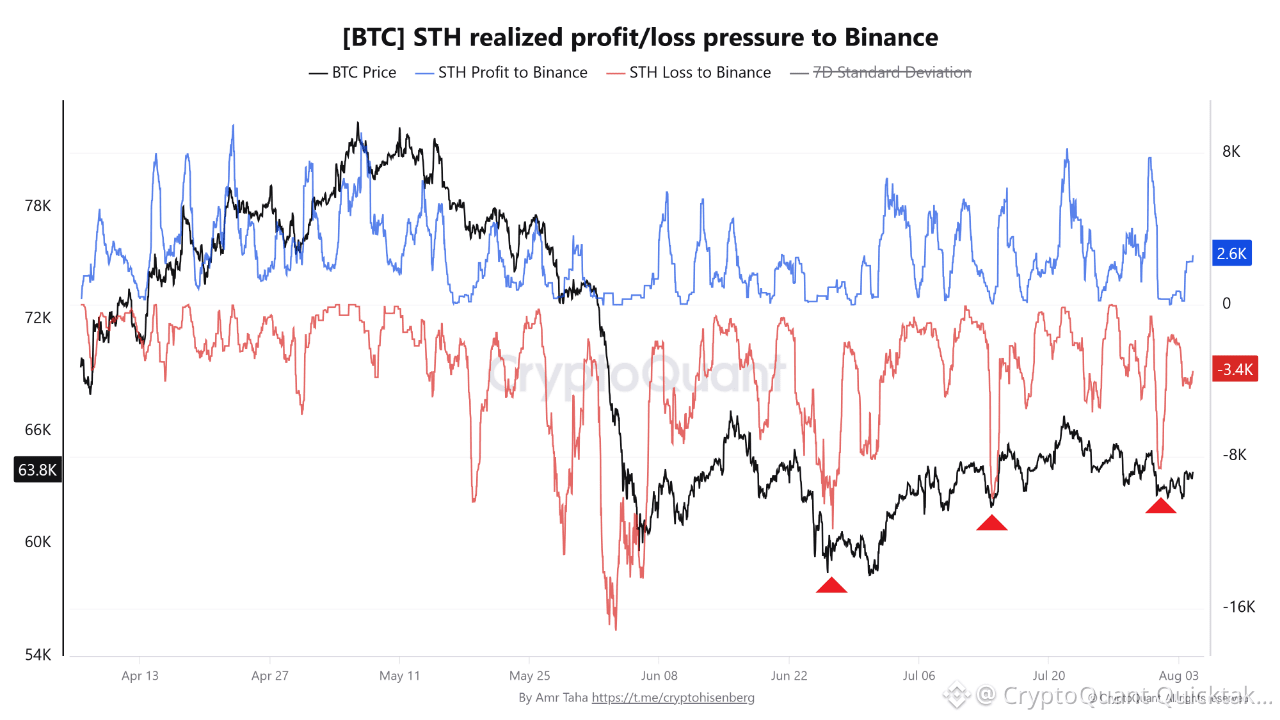
The data shows that STH transferred approximately 8,550 BTC to Binance at a realized loss on August 1, coinciding with the rapid spread of the Strategy story.
Deposits to an exchange do not prove that the entire amount was sold, but they indicate increased potential sell-side pressure or preparation to sell.
This was the third major short-term-holder loss-pressure event on Binance since late June:
June 26: 11,800 BTC
July 13: 10,230 BTC
August 1: 8,550 BTC
This episode illustrates how incomplete or recycled headlines can create new market anxiety without any equivalent change in the underlying facts.
Less-experienced traders may respond by moving assets to exchanges while already holding unrealized losses, increasing the risk of selling near local lows after previously buying at higher prices.
Such fear-driven periods can also shift liquidity from reactive market participants toward better-capitalized and more patient investors—including professional funds capable of accumulating risk assets during periods of forced or emotional selling.
Written by Amr Taha