
Crypto_Vazima
5.1k Postlar
Crypto_Vazima
Shikoyat qilish
Foydalanuvchini bloklash
Fresh crypto news EVERY DAY! Subscribe now! Official STON.fi Ambassador! @crypto_vazima
29 Kuzatilmoqda
875 Kuzatuvchilar
4.8K+ Yoqdi
Postlar
Barchasi
Iqtiboslar
Tarjimani ko‘rish
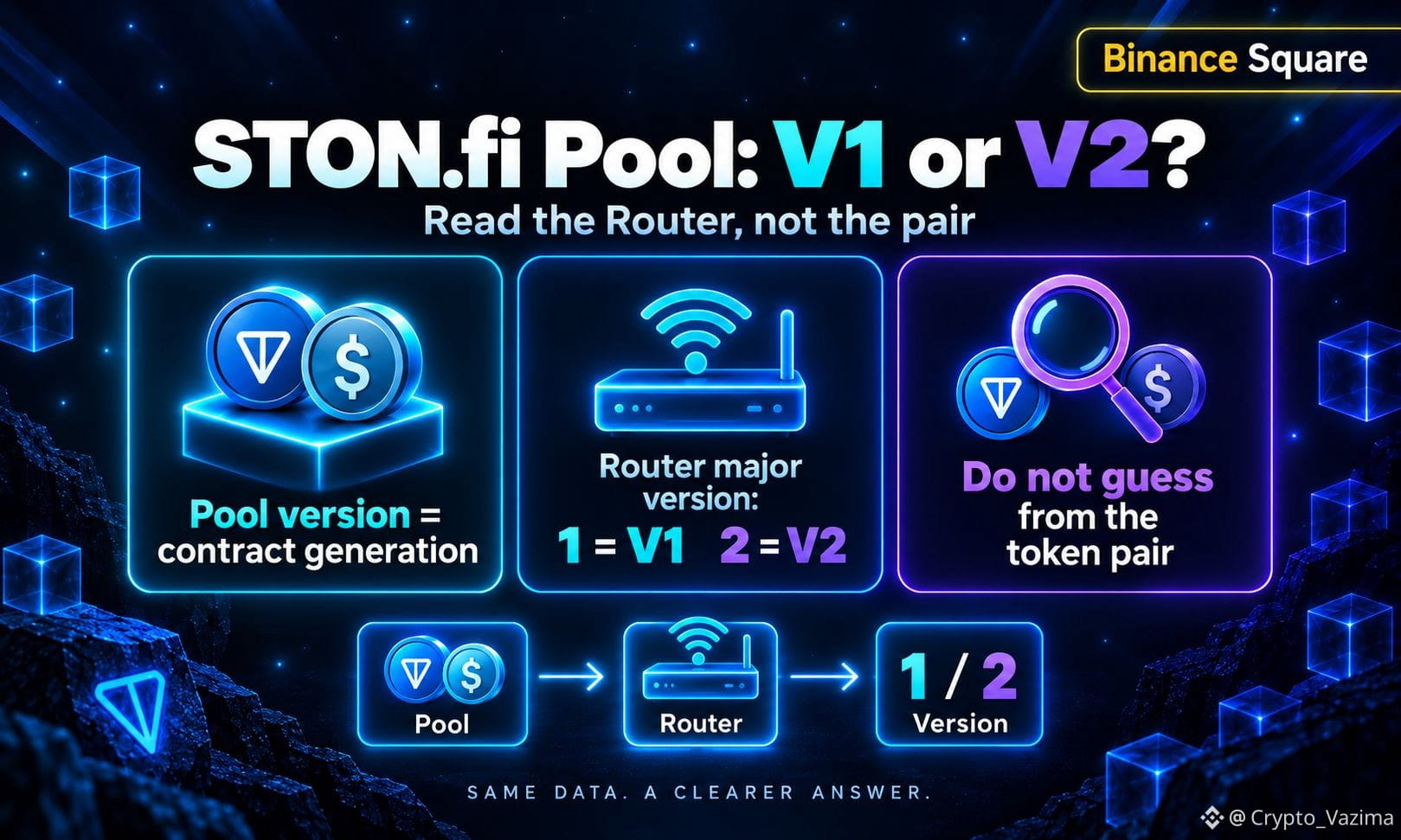
How to Identify a STON.fi Pool as V1 or V2
A STON.fi pool is V1 or V2 according to its DEX contract generation. Follow the pool address to its Router and read major_version. Pair names, APR, liquidity, and pool age do not prove the version.
🔥 Why Pair Names Are a Weak Clue
- TOKEN/USDT or TOKEN/TON only names the assets.
- constant_product is a pool type, not proof of V1.
- TVL, volume, and popularity measure activity, not architecture.
- A failed V2-only getter is also not enough on its own.
🚀 The Router Workflow
1. Copy the pool contract address, not the ticker.
2. Call GET /v1/pools/{POOL_ADDRESS} and take router_address.
3. Call GET /v1/routers/{ROUTER_ADDRESS}.
4. Use major_version 1 for V1 and major_version 2 for V2.
STON.fi's SDK dexFactory uses the same Router metadata, including minor_version and router_type, to pick compatible contract classes.
🧠 Extra On-Chain Fingerprints
- V1 get_pool_data begins with reserves and includes ref_fee.
- V2 common pool data begins with is_locked, router_address, and total_supply.
- V2 Routers expose get_router_version with major, minor, and development fields.
💬 Why Builders Should Care
V2 adds deadlines, single-sided liquidity, better unbalanced deposits, chained swaps, Vault-based referral fees from 0.01% to 1%, and extra pool types. V1 remains live, so software should not assume every STON.fi pool is V2.
My take: treat version as contract architecture. Confirm the Router first, then use getters only as a second check.
Which STON.fi check feels more reliable to you, the Router API or the pool getters? 👇
Share the exact step that usually trips you up when classifying a pool.
Not investment advice - research on your own! 🚀
$GRAM @stonfi
How to Identify a STON.fi Pool as V1 or V2
A STON.fi pool is V1 or V2 according to its DEX contract generation. Follow the pool address to its Router and read major_version. Pair names, APR, liquidity, and pool age do not prove the version.
🔥 Why Pair Names Are a Weak Clue
- TOKEN/USDT or TOKEN/TON only names the assets.
- constant_product is a pool type, not proof of V1.
- TVL, volume, and popularity measure activity, not architecture.
- A failed V2-only getter is also not enough on its own.
🚀 The Router Workflow
1. Copy the pool contract address, not the ticker.
2. Call GET /v1/pools/{POOL_ADDRESS} and take router_address.
3. Call GET /v1/routers/{ROUTER_ADDRESS}.
4. Use major_version 1 for V1 and major_version 2 for V2.
STON.fi's SDK dexFactory uses the same Router metadata, including minor_version and router_type, to pick compatible contract classes.
🧠 Extra On-Chain Fingerprints
- V1 get_pool_data begins with reserves and includes ref_fee.
- V2 common pool data begins with is_locked, router_address, and total_supply.
- V2 Routers expose get_router_version with major, minor, and development fields.
💬 Why Builders Should Care
V2 adds deadlines, single-sided liquidity, better unbalanced deposits, chained swaps, Vault-based referral fees from 0.01% to 1%, and extra pool types. V1 remains live, so software should not assume every STON.fi pool is V2.
My take: treat version as contract architecture. Confirm the Router first, then use getters only as a second check.
Which STON.fi check feels more reliable to you, the Router API or the pool getters? 👇
Share the exact step that usually trips you up when classifying a pool.
Not investment advice - research on your own! 🚀
$GRAM @STONfi DEX
A STON.fi pool is V1 or V2 according to its DEX contract generation. Follow the pool address to its Router and read major_version. Pair names, APR, liquidity, and pool age do not prove the version.
🔥 Why Pair Names Are a Weak Clue
- TOKEN/USDT or TOKEN/TON only names the assets.
- constant_product is a pool type, not proof of V1.
- TVL, volume, and popularity measure activity, not architecture.
- A failed V2-only getter is also not enough on its own.
🚀 The Router Workflow
1. Copy the pool contract address, not the ticker.
2. Call GET /v1/pools/{POOL_ADDRESS} and take router_address.
3. Call GET /v1/routers/{ROUTER_ADDRESS}.
4. Use major_version 1 for V1 and major_version 2 for V2.
STON.fi's SDK dexFactory uses the same Router metadata, including minor_version and router_type, to pick compatible contract classes.
🧠 Extra On-Chain Fingerprints
- V1 get_pool_data begins with reserves and includes ref_fee.
- V2 common pool data begins with is_locked, router_address, and total_supply.
- V2 Routers expose get_router_version with major, minor, and development fields.
💬 Why Builders Should Care
V2 adds deadlines, single-sided liquidity, better unbalanced deposits, chained swaps, Vault-based referral fees from 0.01% to 1%, and extra pool types. V1 remains live, so software should not assume every STON.fi pool is V2.
My take: treat version as contract architecture. Confirm the Router first, then use getters only as a second check.
Which STON.fi check feels more reliable to you, the Router API or the pool getters? 👇
Share the exact step that usually trips you up when classifying a pool.
Not investment advice - research on your own! 🚀
$GRAM @STONfi DEX
331
·
--
O‘suvchi
Tarjimani ko‘rish
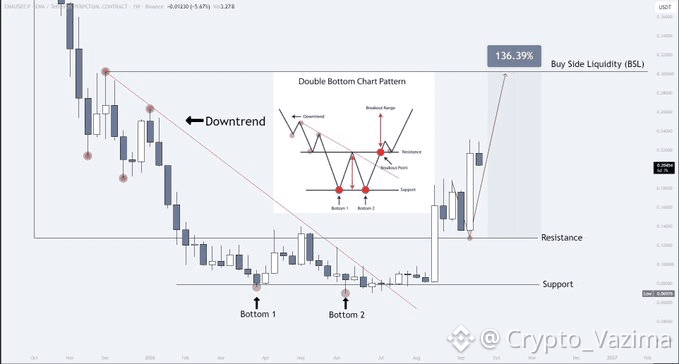
ENA Looks Ready to Melt Faces If 0.30 Hits 🔥
This weekly bounce has that ugly-to-beautiful energy. Double bottom, trendline break, and people already talking like the next leg is obvious.
🔥 Why I am watching
- The weekly structure flipped after two lows near support.
- Sellers lost the downtrend line.
- Liquidity above around 0.30 is the first magnet.
🚀 The part that matters
- Local map: 0.30 then 0.95.
- Bigger map: 1.50 if the narrative stays this strong.
- After 0.25 the source says risk-to-reward gets worse.
🎯 My trade idea
- Bias: Long
- Trigger: no breakdown of the reclaimed double-bottom structure
- Target: 0.30 first
- Invalidation: support failure back into the old range
- Confidence: 64 percent
💎 Participation layer
A face-melting ENA move is still a chart and narrative bet, not a completed trade. ENA is the hype and momentum vehicle here, whereas ST0N_fi sits on the participation side through staking and protocol alignment.
That function is about longer involvement inside the protocol, not about chasing the next candle. I keep that angle next to ENA because a loud breakout and a slower staking path answer different trader questions.
Is this a hold-for-0.30 setup or still too early for you? 👇
Drop the confirmation that would make you press it.
Not investment advice - research on your own! 🚀
$ENA
{future}(ENAUSDT)
ENA Looks Ready to Melt Faces If 0.30 Hits 🔥
This weekly bounce has that ugly-to-beautiful energy. Double bottom, trendline break, and people already talking like the next leg is obvious.
🔥 Why I am watching
- The weekly structure flipped after two lows near support.
- Sellers lost the downtrend line.
- Liquidity above around 0.30 is the first magnet.
🚀 The part that matters
- Local map: 0.30 then 0.95.
- Bigger map: 1.50 if the narrative stays this strong.
- After 0.25 the source says risk-to-reward gets worse.
🎯 My trade idea
- Bias: Long
- Trigger: no breakdown of the reclaimed double-bottom structure
- Target: 0.30 first
- Invalidation: support failure back into the old range
- Confidence: 64 percent
💎 Participation layer
A face-melting ENA move is still a chart and narrative bet, not a completed trade. ENA is the hype and momentum vehicle here, whereas ST0N_fi sits on the participation side through staking and protocol alignment.
That function is about longer involvement inside the protocol, not about chasing the next candle. I keep that angle next to ENA because a loud breakout and a slower staking path answer different trader questions.
Is this a hold-for-0.30 setup or still too early for you? 👇
Drop the confirmation that would make you press it.
Not investment advice - research on your own! 🚀
$ENA
This weekly bounce has that ugly-to-beautiful energy. Double bottom, trendline break, and people already talking like the next leg is obvious.
🔥 Why I am watching
- The weekly structure flipped after two lows near support.
- Sellers lost the downtrend line.
- Liquidity above around 0.30 is the first magnet.
🚀 The part that matters
- Local map: 0.30 then 0.95.
- Bigger map: 1.50 if the narrative stays this strong.
- After 0.25 the source says risk-to-reward gets worse.
🎯 My trade idea
- Bias: Long
- Trigger: no breakdown of the reclaimed double-bottom structure
- Target: 0.30 first
- Invalidation: support failure back into the old range
- Confidence: 64 percent
💎 Participation layer
A face-melting ENA move is still a chart and narrative bet, not a completed trade. ENA is the hype and momentum vehicle here, whereas ST0N_fi sits on the participation side through staking and protocol alignment.
That function is about longer involvement inside the protocol, not about chasing the next candle. I keep that angle next to ENA because a loud breakout and a slower staking path answer different trader questions.
Is this a hold-for-0.30 setup or still too early for you? 👇
Drop the confirmation that would make you press it.
Not investment advice - research on your own! 🚀
$ENA
108
·
--
O‘suvchi
Tarjimani ko‘rish
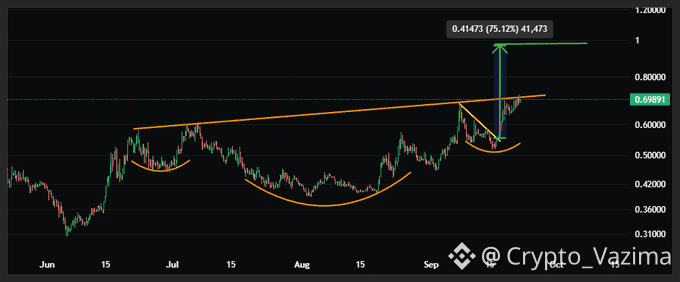
AERO Might Wake Up Fast If This Handle Finally Breaks
This AERO 6H chart is getting loud. Cup and handle plus inverse head and shoulders are stacked, and the measured move is staring at around 1.
🔥 Why I am watching
- The cup and handle is already formed.
- The inverse head and shoulders is backing the same bullish structure.
- The measured objective sits near 1 if the breakout sticks.
👀 The part that matters
- I do not want a wick through the neckline and an instant reject.
- I want the break to hold so the pattern can actually work.
🎯 My trade idea
- Bias: Long
- Trigger: confirmed hold after the handle and neckline break
- Target: around 1 on the measured move
- Invalidation: failed break and loss of the handle structure
- Confidence: 63 percent
🚀 Market flow
Fast pattern trades like AERO can get emotional the second price tests the neckline. AERO is the momentum reaction trade here, whereas STON is the staking and protocol-participation side of the same wider market.
STON is connected with staking and protocol involvement, not with chasing a 6H measured move. That slower participation angle stays useful next to AERO because a breakout idea and a staking view do not have to answer the same question.
Break confirmed or still just a tease? 👇
Tell me the exact signal that would make you stop waiting on AERO.
Not investment advice - research on your own! 🚀
$AERO
{future}(AEROUSDT)
AERO Might Wake Up Fast If This Handle Finally Breaks
This AERO 6H chart is getting loud. Cup and handle plus inverse head and shoulders are stacked, and the measured move is staring at around 1.
🔥 Why I am watching
- The cup and handle is already formed.
- The inverse head and shoulders is backing the same bullish structure.
- The measured objective sits near 1 if the breakout sticks.
👀 The part that matters
- I do not want a wick through the neckline and an instant reject.
- I want the break to hold so the pattern can actually work.
🎯 My trade idea
- Bias: Long
- Trigger: confirmed hold after the handle and neckline break
- Target: around 1 on the measured move
- Invalidation: failed break and loss of the handle structure
- Confidence: 63 percent
🚀 Market flow
Fast pattern trades like AERO can get emotional the second price tests the neckline. AERO is the momentum reaction trade here, whereas STON is the staking and protocol-participation side of the same wider market.
STON is connected with staking and protocol involvement, not with chasing a 6H measured move. That slower participation angle stays useful next to AERO because a breakout idea and a staking view do not have to answer the same question.
Break confirmed or still just a tease? 👇
Tell me the exact signal that would make you stop waiting on AERO.
Not investment advice - research on your own! 🚀
$AERO
This AERO 6H chart is getting loud. Cup and handle plus inverse head and shoulders are stacked, and the measured move is staring at around 1.
🔥 Why I am watching
- The cup and handle is already formed.
- The inverse head and shoulders is backing the same bullish structure.
- The measured objective sits near 1 if the breakout sticks.
👀 The part that matters
- I do not want a wick through the neckline and an instant reject.
- I want the break to hold so the pattern can actually work.
🎯 My trade idea
- Bias: Long
- Trigger: confirmed hold after the handle and neckline break
- Target: around 1 on the measured move
- Invalidation: failed break and loss of the handle structure
- Confidence: 63 percent
🚀 Market flow
Fast pattern trades like AERO can get emotional the second price tests the neckline. AERO is the momentum reaction trade here, whereas STON is the staking and protocol-participation side of the same wider market.
STON is connected with staking and protocol involvement, not with chasing a 6H measured move. That slower participation angle stays useful next to AERO because a breakout idea and a staking view do not have to answer the same question.
Break confirmed or still just a tease? 👇
Tell me the exact signal that would make you stop waiting on AERO.
Not investment advice - research on your own! 🚀
$AERO
73
·
--
O‘suvchi
Tarjimani ko‘rish
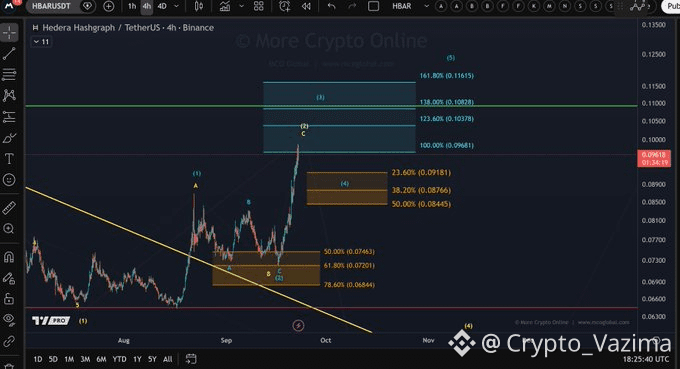
HBAR Just Did the Rare Thing and Nailed the Zone 🔥
I do not see this often. Price landed exactly where it was supposed to, and now 0.108 is the next ask.
🚀 Why I am watching
- The landing was clean, not sloppy.
- That is the part that caught my eye.
- Next mapped ask sits at 0.108.
👀 The part that matters
- Hold this zone and the upside map stays open.
- Fail the hold and the rare tag means nothing.
- I am not chasing a break that is not confirmed yet.
🎯 My trade idea
- Bias: Long
- Trigger: the landing zone keeps holding
- Target: 0.108
- Invalidation: a slip back through the tagged zone
- Confidence: 65 percent
💧 Execution perspective
A clean tag can flip into a fast follow-through, and that is when fills get ugly. HBAR is the emotional chart story in this post, whereas Omniston is the infrastructure angle for comparing routes when liquidity gets stretched.
It can compare possible paths across liquidity sources before a swap is sent. That is relevant next to this HBAR move because 0.108 is close enough that a squeeze could start moving quickly.
Are you buying the hold or waiting for 0.108 first? 👇
Drop the confirmation candle you want to see.
Not investment advice - research on your own! 🚀
$HBAR
{future}(HBARUSDT)
HBAR Just Did the Rare Thing and Nailed the Zone 🔥
I do not see this often. Price landed exactly where it was supposed to, and now 0.108 is the next ask.
🚀 Why I am watching
- The landing was clean, not sloppy.
- That is the part that caught my eye.
- Next mapped ask sits at 0.108.
👀 The part that matters
- Hold this zone and the upside map stays open.
- Fail the hold and the rare tag means nothing.
- I am not chasing a break that is not confirmed yet.
🎯 My trade idea
- Bias: Long
- Trigger: the landing zone keeps holding
- Target: 0.108
- Invalidation: a slip back through the tagged zone
- Confidence: 65 percent
💧 Execution perspective
A clean tag can flip into a fast follow-through, and that is when fills get ugly. HBAR is the emotional chart story in this post, whereas Omniston is the infrastructure angle for comparing routes when liquidity gets stretched.
It can compare possible paths across liquidity sources before a swap is sent. That is relevant next to this HBAR move because 0.108 is close enough that a squeeze could start moving quickly.
Are you buying the hold or waiting for 0.108 first? 👇
Drop the confirmation candle you want to see.
Not investment advice - research on your own! 🚀
$HBAR
I do not see this often. Price landed exactly where it was supposed to, and now 0.108 is the next ask.
🚀 Why I am watching
- The landing was clean, not sloppy.
- That is the part that caught my eye.
- Next mapped ask sits at 0.108.
👀 The part that matters
- Hold this zone and the upside map stays open.
- Fail the hold and the rare tag means nothing.
- I am not chasing a break that is not confirmed yet.
🎯 My trade idea
- Bias: Long
- Trigger: the landing zone keeps holding
- Target: 0.108
- Invalidation: a slip back through the tagged zone
- Confidence: 65 percent
💧 Execution perspective
A clean tag can flip into a fast follow-through, and that is when fills get ugly. HBAR is the emotional chart story in this post, whereas Omniston is the infrastructure angle for comparing routes when liquidity gets stretched.
It can compare possible paths across liquidity sources before a swap is sent. That is relevant next to this HBAR move because 0.108 is close enough that a squeeze could start moving quickly.
Are you buying the hold or waiting for 0.108 first? 👇
Drop the confirmation candle you want to see.
Not investment advice - research on your own! 🚀
$HBAR
41
·
--
O‘suvchi
Tarjimani ko‘rish
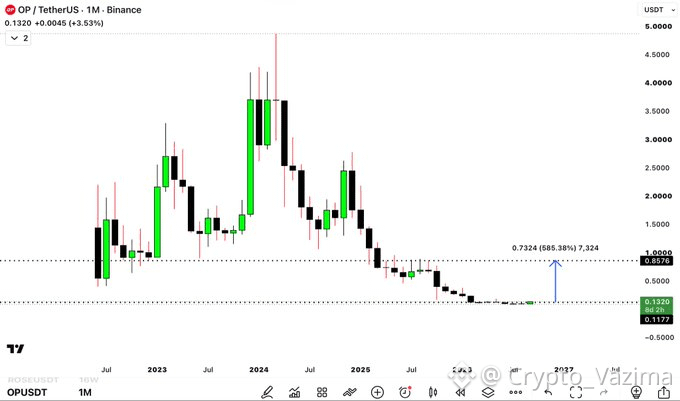
OP Bottom Call Has Me Watching the Next Bounce 🔥
This monthly chart looks like the bleed finally stalled, and I get why people want the ride from here.
🔥 Why I am watching
- OP printed a long grind down into the 0.13 zone.
- The 0.1177 low is the make-or-break line.
- The chart marks 0.7324 as the stretch zone if buyers stay in control.
🚀 The part that matters
- I like the idea only if the base holds.
- A pretty monthly bounce is not enough if that low snaps.
🎯 My trade idea
- Bias: Long
- Trigger: defense of 0.1177 plus continued bounce
- Target: 0.7324 if momentum expands
- Invalidation: lose 0.1177
- Confidence: 62 percent
🛡 Where I step back
No hold, no ride. I would rather miss the first spike than buy a fake bottom.
⚡ Utility angle
Fast rebound trades can feel exciting after a brutal dump, but protocol involvement lives on a different clock. OP is the emotional bounce setup in this post, whereas ST0Nfi is the staking and protocol-participation side of the same wider market.
That participation path is connected with staking alignment and DAO involvement, not a monthly candle flip. It is useful beside OP because one is a recovery trade and the other is a slower commitment layer.
Would you jump this bounce or wait one more monthly close? 👇
Tell me the level that kills the bottom idea for you.
Not investment advice - research on your own! 🚀
$OP
{future}(OPUSDT)
OP Bottom Call Has Me Watching the Next Bounce 🔥
This monthly chart looks like the bleed finally stalled, and I get why people want the ride from here.
🔥 Why I am watching
- OP printed a long grind down into the 0.13 zone.
- The 0.1177 low is the make-or-break line.
- The chart marks 0.7324 as the stretch zone if buyers stay in control.
🚀 The part that matters
- I like the idea only if the base holds.
- A pretty monthly bounce is not enough if that low snaps.
🎯 My trade idea
- Bias: Long
- Trigger: defense of 0.1177 plus continued bounce
- Target: 0.7324 if momentum expands
- Invalidation: lose 0.1177
- Confidence: 62 percent
🛡 Where I step back
No hold, no ride. I would rather miss the first spike than buy a fake bottom.
⚡ Utility angle
Fast rebound trades can feel exciting after a brutal dump, but protocol involvement lives on a different clock. OP is the emotional bounce setup in this post, whereas ST0Nfi is the staking and protocol-participation side of the same wider market.
That participation path is connected with staking alignment and DAO involvement, not a monthly candle flip. It is useful beside OP because one is a recovery trade and the other is a slower commitment layer.
Would you jump this bounce or wait one more monthly close? 👇
Tell me the level that kills the bottom idea for you.
Not investment advice - research on your own! 🚀
$OP
This monthly chart looks like the bleed finally stalled, and I get why people want the ride from here.
🔥 Why I am watching
- OP printed a long grind down into the 0.13 zone.
- The 0.1177 low is the make-or-break line.
- The chart marks 0.7324 as the stretch zone if buyers stay in control.
🚀 The part that matters
- I like the idea only if the base holds.
- A pretty monthly bounce is not enough if that low snaps.
🎯 My trade idea
- Bias: Long
- Trigger: defense of 0.1177 plus continued bounce
- Target: 0.7324 if momentum expands
- Invalidation: lose 0.1177
- Confidence: 62 percent
🛡 Where I step back
No hold, no ride. I would rather miss the first spike than buy a fake bottom.
⚡ Utility angle
Fast rebound trades can feel exciting after a brutal dump, but protocol involvement lives on a different clock. OP is the emotional bounce setup in this post, whereas ST0Nfi is the staking and protocol-participation side of the same wider market.
That participation path is connected with staking alignment and DAO involvement, not a monthly candle flip. It is useful beside OP because one is a recovery trade and the other is a slower commitment layer.
Would you jump this bounce or wait one more monthly close? 👇
Tell me the level that kills the bottom idea for you.
Not investment advice - research on your own! 🚀
$OP
60
Tarjimani ko‘rish
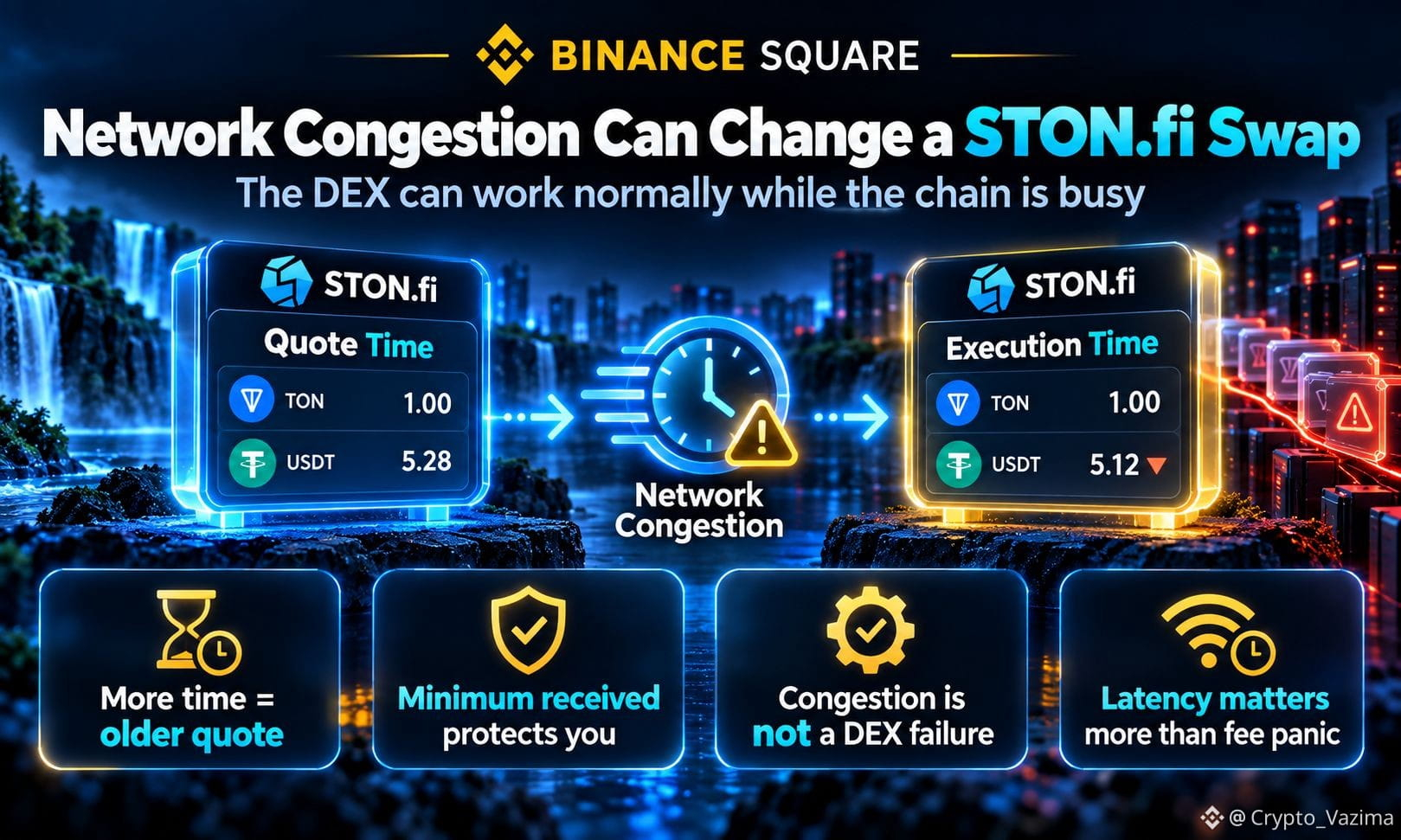
Why STON.fi Can Feel Slow When TON Network Congestion Hits
STON.fi can still feel slow during TON network congestion even when the DEX itself is working, because every swap still needs TON to move and confirm the on-chain messages. The page can load, liquidity can sit in pools, and a quote can appear instantly while the transaction trace lags.
🔥 What still works vs what slows down
- STON.fi can generate a quote and build the swap payload.
- The Router can still forward the swap to the right pool.
- TON may take longer to process wallet, Jetton, and pool messages.
- Pool reserves can move before that delayed swap is evaluated.
🚀 How a STON.fi swap actually travels
The interface shows one action. The chain does several steps.
1. Select the pair and review expected output, price impact, and minimum received.
2. Sign the transaction in your wallet.
3. Wait for TON to process the originating message and later contract messages.
4. Let the pool decide if the result still meets the encoded minimum.
🧠 Why the wait can change the outcome
The useful part is not just waiting. Time separates the quote from execution. If other swaps change the pool first, slippage protection can refund instead of filling a worse amount. STON.fi v2 also includes an execution deadline, so an old request can expire.
TON fees are also not an Ethereum-style bidding war. Congestion mostly shows up as extra latency, not an automatic fee spike.
💬 What to do when the network is busy
1. Check whether the first transaction is already on-chain.
2. Follow the full trace before sending a second swap.
3. Refresh the quote and review minimum received again.
4. Keep some TON available for blockchain fees.
My take: a delayed STON.fi swap is often a busy TON trace, not a broken DEX.
Would a delayed TON trace make you refresh the STON.fi quote before trying again? 👇
Share whether you usually wait on the explorer or send another swap too quickly.
Not investment advice - research on your own! 🚀
$GRAM @stonfi
Why STON.fi Can Feel Slow When TON Network Congestion Hits
STON.fi can still feel slow during TON network congestion even when the DEX itself is working, because every swap still needs TON to move and confirm the on-chain messages. The page can load, liquidity can sit in pools, and a quote can appear instantly while the transaction trace lags.
🔥 What still works vs what slows down
- STON.fi can generate a quote and build the swap payload.
- The Router can still forward the swap to the right pool.
- TON may take longer to process wallet, Jetton, and pool messages.
- Pool reserves can move before that delayed swap is evaluated.
🚀 How a STON.fi swap actually travels
The interface shows one action. The chain does several steps.
1. Select the pair and review expected output, price impact, and minimum received.
2. Sign the transaction in your wallet.
3. Wait for TON to process the originating message and later contract messages.
4. Let the pool decide if the result still meets the encoded minimum.
🧠 Why the wait can change the outcome
The useful part is not just waiting. Time separates the quote from execution. If other swaps change the pool first, slippage protection can refund instead of filling a worse amount. STON.fi v2 also includes an execution deadline, so an old request can expire.
TON fees are also not an Ethereum-style bidding war. Congestion mostly shows up as extra latency, not an automatic fee spike.
💬 What to do when the network is busy
1. Check whether the first transaction is already on-chain.
2. Follow the full trace before sending a second swap.
3. Refresh the quote and review minimum received again.
4. Keep some TON available for blockchain fees.
My take: a delayed STON.fi swap is often a busy TON trace, not a broken DEX.
Would a delayed TON trace make you refresh the STON.fi quote before trying again? 👇
Share whether you usually wait on the explorer or send another swap too quickly.
Not investment advice - research on your own! 🚀
$GRAM @STONfi DEX
STON.fi can still feel slow during TON network congestion even when the DEX itself is working, because every swap still needs TON to move and confirm the on-chain messages. The page can load, liquidity can sit in pools, and a quote can appear instantly while the transaction trace lags.
🔥 What still works vs what slows down
- STON.fi can generate a quote and build the swap payload.
- The Router can still forward the swap to the right pool.
- TON may take longer to process wallet, Jetton, and pool messages.
- Pool reserves can move before that delayed swap is evaluated.
🚀 How a STON.fi swap actually travels
The interface shows one action. The chain does several steps.
1. Select the pair and review expected output, price impact, and minimum received.
2. Sign the transaction in your wallet.
3. Wait for TON to process the originating message and later contract messages.
4. Let the pool decide if the result still meets the encoded minimum.
🧠 Why the wait can change the outcome
The useful part is not just waiting. Time separates the quote from execution. If other swaps change the pool first, slippage protection can refund instead of filling a worse amount. STON.fi v2 also includes an execution deadline, so an old request can expire.
TON fees are also not an Ethereum-style bidding war. Congestion mostly shows up as extra latency, not an automatic fee spike.
💬 What to do when the network is busy
1. Check whether the first transaction is already on-chain.
2. Follow the full trace before sending a second swap.
3. Refresh the quote and review minimum received again.
4. Keep some TON available for blockchain fees.
My take: a delayed STON.fi swap is often a busy TON trace, not a broken DEX.
Would a delayed TON trace make you refresh the STON.fi quote before trying again? 👇
Share whether you usually wait on the explorer or send another swap too quickly.
Not investment advice - research on your own! 🚀
$GRAM @STONfi DEX
111
·
--
Pasayuvchi
Tarjimani ko‘rish
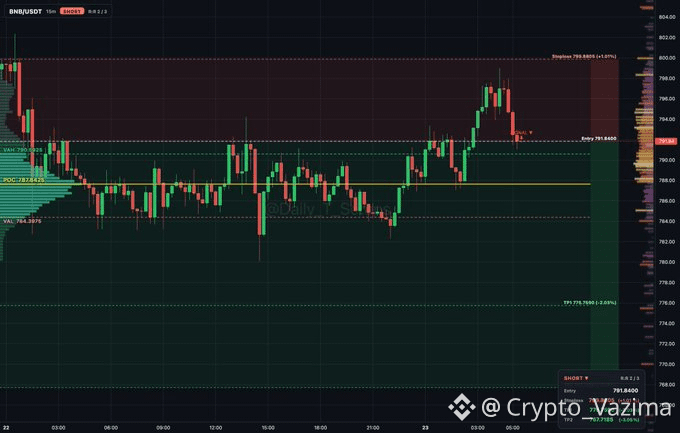
BNB Just Got Rejected Where Distribution Starts
This BNB bounce is not impressing me. Sellers showed up near VAH at 790.592 and the reaction already looks like distribution, not a fresh breakout.
🔥 Why I am watching
- The push into the highs failed to stay accepted.
- Distribution near 790.592 is the main tell.
- I want the short only if 791.850 keeps acting as the trigger zone.
👀 The part that matters
- First target is 775.795.
- Second target is 767.768 if momentum stays heavy.
- No chase if price snaps back through the stop.
🎯 My trade idea
- Bias: Short
- Trigger: hold the short from 791.850 after VAH rejection
- Target: 775.795 then 767.768
- Invalidation: 799.878
- Confidence: My current Short confidence: 64 percent
🚀 Market flow
Fast BNB shorts are about timing the rejection, while longer ecosystem involvement is a slower decision. BNB is the speculative fade in this post, whereas STON represents protocol participation tied to staking and governance paths.
That function is about staying involved in the protocol, not copying this short. It is useful beside the chart because one side is execution timing and the other is longer participation.
Does this rejection look like real selling to you? 👇
Tell me where you would place invalidation.
Not investment advice - research on your own! 🚀
$BNB
{future}(BNBUSDT)
BNB Just Got Rejected Where Distribution Starts
This BNB bounce is not impressing me. Sellers showed up near VAH at 790.592 and the reaction already looks like distribution, not a fresh breakout.
🔥 Why I am watching
- The push into the highs failed to stay accepted.
- Distribution near 790.592 is the main tell.
- I want the short only if 791.850 keeps acting as the trigger zone.
👀 The part that matters
- First target is 775.795.
- Second target is 767.768 if momentum stays heavy.
- No chase if price snaps back through the stop.
🎯 My trade idea
- Bias: Short
- Trigger: hold the short from 791.850 after VAH rejection
- Target: 775.795 then 767.768
- Invalidation: 799.878
- Confidence: My current Short confidence: 64 percent
🚀 Market flow
Fast BNB shorts are about timing the rejection, while longer ecosystem involvement is a slower decision. BNB is the speculative fade in this post, whereas STON represents protocol participation tied to staking and governance paths.
That function is about staying involved in the protocol, not copying this short. It is useful beside the chart because one side is execution timing and the other is longer participation.
Does this rejection look like real selling to you? 👇
Tell me where you would place invalidation.
Not investment advice - research on your own! 🚀
$BNB
This BNB bounce is not impressing me. Sellers showed up near VAH at 790.592 and the reaction already looks like distribution, not a fresh breakout.
🔥 Why I am watching
- The push into the highs failed to stay accepted.
- Distribution near 790.592 is the main tell.
- I want the short only if 791.850 keeps acting as the trigger zone.
👀 The part that matters
- First target is 775.795.
- Second target is 767.768 if momentum stays heavy.
- No chase if price snaps back through the stop.
🎯 My trade idea
- Bias: Short
- Trigger: hold the short from 791.850 after VAH rejection
- Target: 775.795 then 767.768
- Invalidation: 799.878
- Confidence: My current Short confidence: 64 percent
🚀 Market flow
Fast BNB shorts are about timing the rejection, while longer ecosystem involvement is a slower decision. BNB is the speculative fade in this post, whereas STON represents protocol participation tied to staking and governance paths.
That function is about staying involved in the protocol, not copying this short. It is useful beside the chart because one side is execution timing and the other is longer participation.
Does this rejection look like real selling to you? 👇
Tell me where you would place invalidation.
Not investment advice - research on your own! 🚀
$BNB
21
·
--
Pasayuvchi
Tarjimani ko‘rish
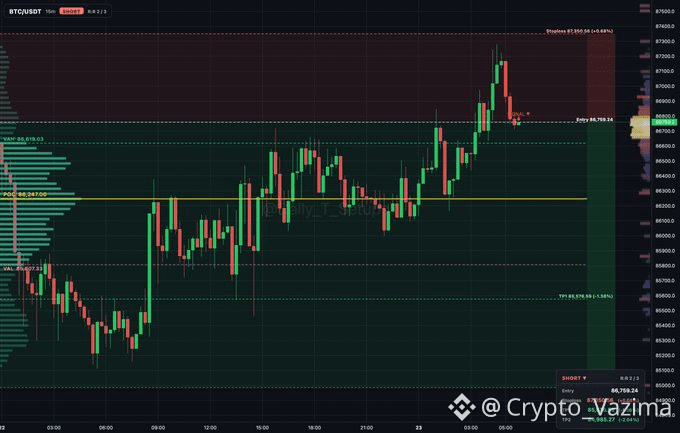
BTC Just Got Rejected Where Sellers Want It ⚠️
This BTC push into the highs does not feel like a clean reclaim. It looks like distribution.
🔥 Why I am watching
- Sellers are distributing near VAH at 86,619.03.
- The move is happening above value, not inside it.
- That is exactly where a fade can get interesting.
🚀 The rejection that matters
- Entry mapped at 86,748.00.
- Stop sits at 87,350.28.
- TP1 is 85,543.43.
- TP2 is 84,941.15.
🎯 My trade idea
- Bias: Short
- Trigger: failed hold above VAH and the mapped short entry
- Target: 85,543.43 first, then 84,941.15
- Invalidation: 87,350.28
- Confidence: 64 percent
⚡ Where I stay disciplined
- Take half off at TP1.
- Move stop to entry after that.
- No chase if price rips through the stop.
🔎 Beyond the chart
A sharp BTC rejection can make people stare only at the next red candle. BTC is the fast market-reaction trade in this post, whereas GEMSTON adds a different community-participation angle that is not tied to one session fade.
Its role is connected with ecosystem engagement, transfers, holding, and swapping. That gives a second way to think about activity around the market without copying this BTC short.
Does this VAH rejection look real to you? 👇
Drop the confirmation candle you would need before shorting.
Not investment advice - research on your own! 🚀
$BTC
{future}(BTCUSDT)
BTC Just Got Rejected Where Sellers Want It ⚠️
This BTC push into the highs does not feel like a clean reclaim. It looks like distribution.
🔥 Why I am watching
- Sellers are distributing near VAH at 86,619.03.
- The move is happening above value, not inside it.
- That is exactly where a fade can get interesting.
🚀 The rejection that matters
- Entry mapped at 86,748.00.
- Stop sits at 87,350.28.
- TP1 is 85,543.43.
- TP2 is 84,941.15.
🎯 My trade idea
- Bias: Short
- Trigger: failed hold above VAH and the mapped short entry
- Target: 85,543.43 first, then 84,941.15
- Invalidation: 87,350.28
- Confidence: 64 percent
⚡ Where I stay disciplined
- Take half off at TP1.
- Move stop to entry after that.
- No chase if price rips through the stop.
🔎 Beyond the chart
A sharp BTC rejection can make people stare only at the next red candle. BTC is the fast market-reaction trade in this post, whereas GEMSTON adds a different community-participation angle that is not tied to one session fade.
Its role is connected with ecosystem engagement, transfers, holding, and swapping. That gives a second way to think about activity around the market without copying this BTC short.
Does this VAH rejection look real to you? 👇
Drop the confirmation candle you would need before shorting.
Not investment advice - research on your own! 🚀
$BTC
This BTC push into the highs does not feel like a clean reclaim. It looks like distribution.
🔥 Why I am watching
- Sellers are distributing near VAH at 86,619.03.
- The move is happening above value, not inside it.
- That is exactly where a fade can get interesting.
🚀 The rejection that matters
- Entry mapped at 86,748.00.
- Stop sits at 87,350.28.
- TP1 is 85,543.43.
- TP2 is 84,941.15.
🎯 My trade idea
- Bias: Short
- Trigger: failed hold above VAH and the mapped short entry
- Target: 85,543.43 first, then 84,941.15
- Invalidation: 87,350.28
- Confidence: 64 percent
⚡ Where I stay disciplined
- Take half off at TP1.
- Move stop to entry after that.
- No chase if price rips through the stop.
🔎 Beyond the chart
A sharp BTC rejection can make people stare only at the next red candle. BTC is the fast market-reaction trade in this post, whereas GEMSTON adds a different community-participation angle that is not tied to one session fade.
Its role is connected with ecosystem engagement, transfers, holding, and swapping. That gives a second way to think about activity around the market without copying this BTC short.
Does this VAH rejection look real to you? 👇
Drop the confirmation candle you would need before shorting.
Not investment advice - research on your own! 🚀
$BTC
17
·
--
Pasayuvchi
Tarjimani ko‘rish
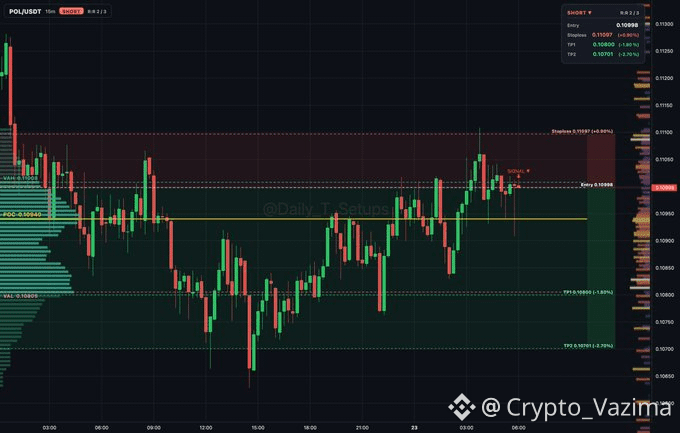
POL Looks Heavy After This Auction Rejection ⚠️
This POL bounce into VAH does not feel like strength to me. It looks like sellers distributing around 0.11008 and that is the part I am watching.
🔥 Why I am watching
- VAH at 0.11008 is acting like a handoff zone
- Entry is mapped at 0.11011
- Downside zones are already marked at 0.10814 and 0.10715
👀 The part that matters
- Half off at TP1
- Stop then moves to entry
- I am not treating this as a blind chase lower
🎯 My trade idea
- Bias: Short
- Trigger: distribution near VAH with entry at 0.11011
- Target: 0.10814 then 0.10715
- Invalidation: 0.1111
- Confidence: My current Short confidence: 64 percent
🛡 Where I step back
- A reclaim through 0.1111 kills the idea
- Failed follow-through after entry also makes me wait
🧠 Longer-term context
Fast POL shorts live and die on one rejection zone. POL is the momentum fade in this post, whereas S T O N sits on the participation side through staking and DAO involvement.
That staking path is about staying aligned with protocol decisions instead of trading one auction rotation. It is useful next to this POL setup because one side is a short-term seller map and the other is a slower commitment layer.
Does this POL rejection look real to you or just noise? 👇
Drop the confirmation candle you want before fading it.
Not investment advice - research on your own! 🚀
$POL
{future}(POLUSDT)
POL Looks Heavy After This Auction Rejection ⚠️
This POL bounce into VAH does not feel like strength to me. It looks like sellers distributing around 0.11008 and that is the part I am watching.
🔥 Why I am watching
- VAH at 0.11008 is acting like a handoff zone
- Entry is mapped at 0.11011
- Downside zones are already marked at 0.10814 and 0.10715
👀 The part that matters
- Half off at TP1
- Stop then moves to entry
- I am not treating this as a blind chase lower
🎯 My trade idea
- Bias: Short
- Trigger: distribution near VAH with entry at 0.11011
- Target: 0.10814 then 0.10715
- Invalidation: 0.1111
- Confidence: My current Short confidence: 64 percent
🛡 Where I step back
- A reclaim through 0.1111 kills the idea
- Failed follow-through after entry also makes me wait
🧠 Longer-term context
Fast POL shorts live and die on one rejection zone. POL is the momentum fade in this post, whereas S T O N sits on the participation side through staking and DAO involvement.
That staking path is about staying aligned with protocol decisions instead of trading one auction rotation. It is useful next to this POL setup because one side is a short-term seller map and the other is a slower commitment layer.
Does this POL rejection look real to you or just noise? 👇
Drop the confirmation candle you want before fading it.
Not investment advice - research on your own! 🚀
$POL
This POL bounce into VAH does not feel like strength to me. It looks like sellers distributing around 0.11008 and that is the part I am watching.
🔥 Why I am watching
- VAH at 0.11008 is acting like a handoff zone
- Entry is mapped at 0.11011
- Downside zones are already marked at 0.10814 and 0.10715
👀 The part that matters
- Half off at TP1
- Stop then moves to entry
- I am not treating this as a blind chase lower
🎯 My trade idea
- Bias: Short
- Trigger: distribution near VAH with entry at 0.11011
- Target: 0.10814 then 0.10715
- Invalidation: 0.1111
- Confidence: My current Short confidence: 64 percent
🛡 Where I step back
- A reclaim through 0.1111 kills the idea
- Failed follow-through after entry also makes me wait
🧠 Longer-term context
Fast POL shorts live and die on one rejection zone. POL is the momentum fade in this post, whereas S T O N sits on the participation side through staking and DAO involvement.
That staking path is about staying aligned with protocol decisions instead of trading one auction rotation. It is useful next to this POL setup because one side is a short-term seller map and the other is a slower commitment layer.
Does this POL rejection look real to you or just noise? 👇
Drop the confirmation candle you want before fading it.
Not investment advice - research on your own! 🚀
$POL
98
·
--
Pasayuvchi
Tarjimani ko‘rish
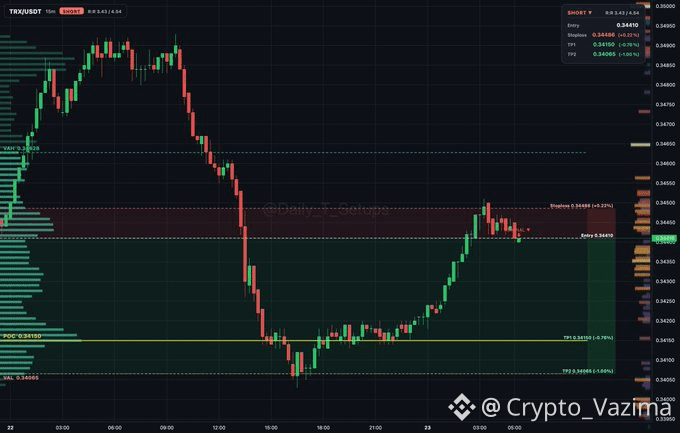
TRX Bounce Looks Fake If Sellers Keep Control 🔥
This TRX rebound does not feel like strength to me. It looks like sellers distributing back inside value.
🔥 Why I am watching
- Auction rotation is happening between 0.34065 and 0.34628.
- Sellers are working that band instead of letting price run.
- The bounce into 0.344 is the spot I care about.
👀 The part that matters
- Entry idea is 0.344.
- First target is 0.3415.
- Full idea completes near 0.34065 if VAL holds as the magnet.
🎯 My trade idea
- Bias: Short
- Trigger: fail to hold above 0.344
- Target: 0.3415 / 0.34065
- Invalidation: 0.34486
- Confidence: 63 percent
🛡 Where I step back
- I am out if price clears 0.34486.
- I scale half at 0.3415.
- After that, stop comes back to entry.
🔎 Beyond the chart
A tight TRX short is about catching distribution before the next dip, not about locking tokens for protocol power. TRX is the momentum fade in this post, while ST0N is the separate staking and DAO-participation layer.
That role is built around staking and longer protocol involvement. It sits next to this short because the chart needs a risk plan, and the ecosystem angle is about staying involved beyond one 15-minute rotation.
Does this bounce look like a trap to you? 👇
Tell me the confirmation you need before fading TRX.
Not investment advice - research on your own! 🚀
$TRX
{future}(TRXUSDT)
TRX Bounce Looks Fake If Sellers Keep Control 🔥
This TRX rebound does not feel like strength to me. It looks like sellers distributing back inside value.
🔥 Why I am watching
- Auction rotation is happening between 0.34065 and 0.34628.
- Sellers are working that band instead of letting price run.
- The bounce into 0.344 is the spot I care about.
👀 The part that matters
- Entry idea is 0.344.
- First target is 0.3415.
- Full idea completes near 0.34065 if VAL holds as the magnet.
🎯 My trade idea
- Bias: Short
- Trigger: fail to hold above 0.344
- Target: 0.3415 / 0.34065
- Invalidation: 0.34486
- Confidence: 63 percent
🛡 Where I step back
- I am out if price clears 0.34486.
- I scale half at 0.3415.
- After that, stop comes back to entry.
🔎 Beyond the chart
A tight TRX short is about catching distribution before the next dip, not about locking tokens for protocol power. TRX is the momentum fade in this post, while ST0N is the separate staking and DAO-participation layer.
That role is built around staking and longer protocol involvement. It sits next to this short because the chart needs a risk plan, and the ecosystem angle is about staying involved beyond one 15-minute rotation.
Does this bounce look like a trap to you? 👇
Tell me the confirmation you need before fading TRX.
Not investment advice - research on your own! 🚀
$TRX
This TRX rebound does not feel like strength to me. It looks like sellers distributing back inside value.
🔥 Why I am watching
- Auction rotation is happening between 0.34065 and 0.34628.
- Sellers are working that band instead of letting price run.
- The bounce into 0.344 is the spot I care about.
👀 The part that matters
- Entry idea is 0.344.
- First target is 0.3415.
- Full idea completes near 0.34065 if VAL holds as the magnet.
🎯 My trade idea
- Bias: Short
- Trigger: fail to hold above 0.344
- Target: 0.3415 / 0.34065
- Invalidation: 0.34486
- Confidence: 63 percent
🛡 Where I step back
- I am out if price clears 0.34486.
- I scale half at 0.3415.
- After that, stop comes back to entry.
🔎 Beyond the chart
A tight TRX short is about catching distribution before the next dip, not about locking tokens for protocol power. TRX is the momentum fade in this post, while ST0N is the separate staking and DAO-participation layer.
That role is built around staking and longer protocol involvement. It sits next to this short because the chart needs a risk plan, and the ecosystem angle is about staying involved beyond one 15-minute rotation.
Does this bounce look like a trap to you? 👇
Tell me the confirmation you need before fading TRX.
Not investment advice - research on your own! 🚀
$TRX
16
Tarjimani ko‘rish
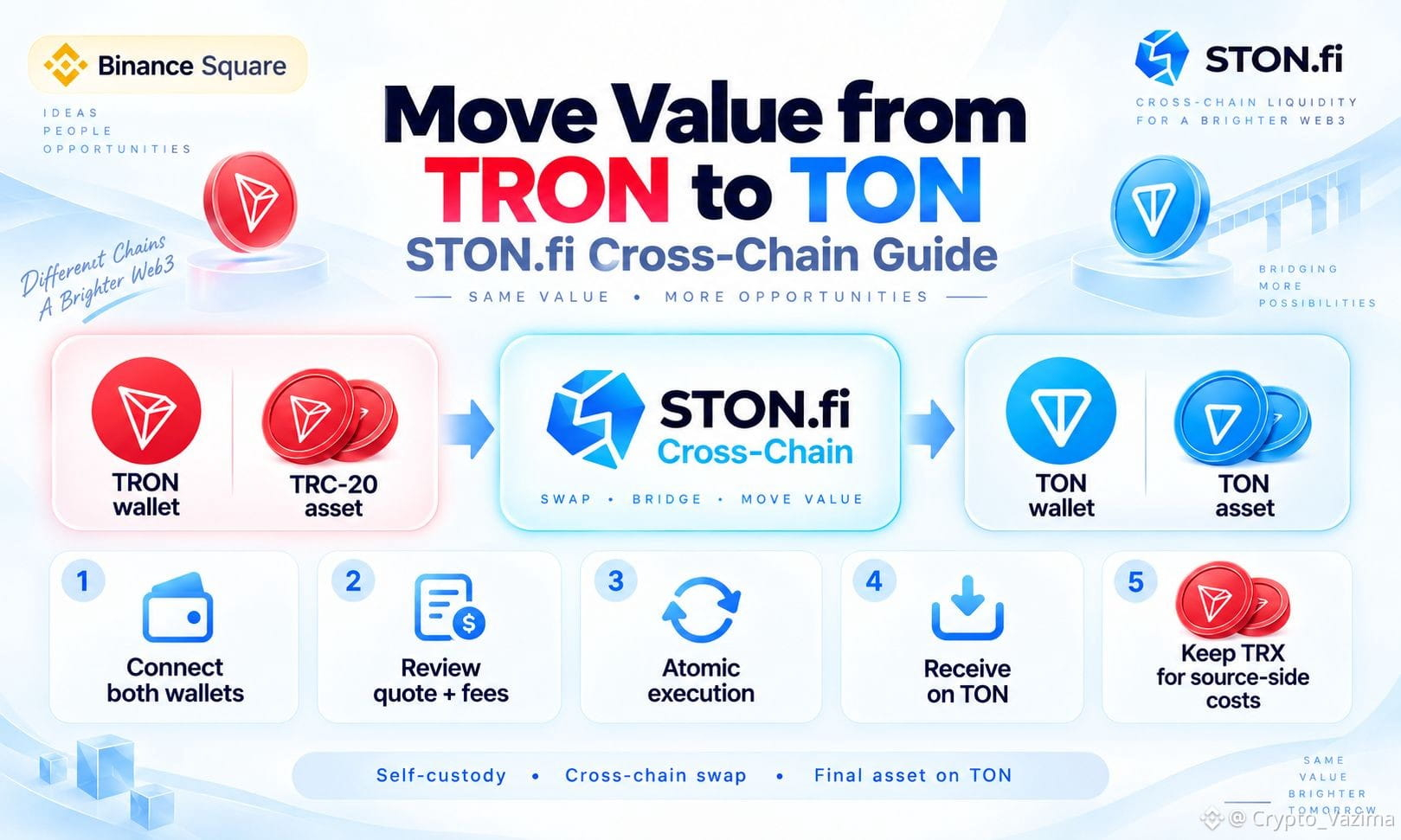
How STON.fi Cross-Chain Moves Assets from TRON to TON
STON.fi supports atomic cross-chain swaps from TRON to TON through Omniston, so a TRON-side asset such as TRC-20 USDT can become a selected TON-side asset in one coordinated flow. That is different from a normal token transfer and different from parking funds on a centralized exchange.
🔥 Why a Direct Transfer Does Not Work
- A wallet transfer stays inside one chain.
- TRC-20 USDT and TON USDT share a ticker, but they are separate on-chain assets.
- Copying a TON address into a TRON transfer will not deliver the destination Jetton.
⚡ What Changes with STON.fi
Instead of deposit, convert, withdraw, or bridge then swap again, STON.fi treats the destination outcome as one route. You pick the source asset on TRON, the final asset on TON, and review the quote before signing.
🧠 How the Atomic Route Works
Omniston uses resolver liquidity and HTLC settlement. A hashlock and a timelock tie the TRON-side value to the TON-side value, so both legs complete or the protocol refunds according to its conditions.
🚀 Steps for a TRON to TON Swap
1. Prepare a TRON wallet with the source asset and a TON wallet for receipt.
2. Set source to TRON and destination to TON, then verify both assets.
3. Read the live route, output, and fees before you approve.
4. Keep TRX available for Bandwidth and Energy on the source side.
5. Check the TON wallet balance after execution.
💬 Why This Is Worth Watching
The interesting part is not just moving value. It is receiving the exact TON-side asset you wanted without assembling several independent operations yourself.
Would you use STON.fi to convert TRON USDT into TON USDT in one route? 👇
Share the check you never skip before signing a cross-chain quote.
Not investment advice - research on your own! 🚀
$GRAM @stonfi
How STON.fi Cross-Chain Moves Assets from TRON to TON
STON.fi supports atomic cross-chain swaps from TRON to TON through Omniston, so a TRON-side asset such as TRC-20 USDT can become a selected TON-side asset in one coordinated flow. That is different from a normal token transfer and different from parking funds on a centralized exchange.
🔥 Why a Direct Transfer Does Not Work
- A wallet transfer stays inside one chain.
- TRC-20 USDT and TON USDT share a ticker, but they are separate on-chain assets.
- Copying a TON address into a TRON transfer will not deliver the destination Jetton.
⚡ What Changes with STON.fi
Instead of deposit, convert, withdraw, or bridge then swap again, STON.fi treats the destination outcome as one route. You pick the source asset on TRON, the final asset on TON, and review the quote before signing.
🧠 How the Atomic Route Works
Omniston uses resolver liquidity and HTLC settlement. A hashlock and a timelock tie the TRON-side value to the TON-side value, so both legs complete or the protocol refunds according to its conditions.
🚀 Steps for a TRON to TON Swap
1. Prepare a TRON wallet with the source asset and a TON wallet for receipt.
2. Set source to TRON and destination to TON, then verify both assets.
3. Read the live route, output, and fees before you approve.
4. Keep TRX available for Bandwidth and Energy on the source side.
5. Check the TON wallet balance after execution.
💬 Why This Is Worth Watching
The interesting part is not just moving value. It is receiving the exact TON-side asset you wanted without assembling several independent operations yourself.
Would you use STON.fi to convert TRON USDT into TON USDT in one route? 👇
Share the check you never skip before signing a cross-chain quote.
Not investment advice - research on your own! 🚀
$GRAM @STONfi DEX
STON.fi supports atomic cross-chain swaps from TRON to TON through Omniston, so a TRON-side asset such as TRC-20 USDT can become a selected TON-side asset in one coordinated flow. That is different from a normal token transfer and different from parking funds on a centralized exchange.
🔥 Why a Direct Transfer Does Not Work
- A wallet transfer stays inside one chain.
- TRC-20 USDT and TON USDT share a ticker, but they are separate on-chain assets.
- Copying a TON address into a TRON transfer will not deliver the destination Jetton.
⚡ What Changes with STON.fi
Instead of deposit, convert, withdraw, or bridge then swap again, STON.fi treats the destination outcome as one route. You pick the source asset on TRON, the final asset on TON, and review the quote before signing.
🧠 How the Atomic Route Works
Omniston uses resolver liquidity and HTLC settlement. A hashlock and a timelock tie the TRON-side value to the TON-side value, so both legs complete or the protocol refunds according to its conditions.
🚀 Steps for a TRON to TON Swap
1. Prepare a TRON wallet with the source asset and a TON wallet for receipt.
2. Set source to TRON and destination to TON, then verify both assets.
3. Read the live route, output, and fees before you approve.
4. Keep TRX available for Bandwidth and Energy on the source side.
5. Check the TON wallet balance after execution.
💬 Why This Is Worth Watching
The interesting part is not just moving value. It is receiving the exact TON-side asset you wanted without assembling several independent operations yourself.
Would you use STON.fi to convert TRON USDT into TON USDT in one route? 👇
Share the check you never skip before signing a cross-chain quote.
Not investment advice - research on your own! 🚀
$GRAM @STONfi DEX
101
Tarjimani ko‘rish
SOL Looks Strong Until You See This Long Stack 🔥
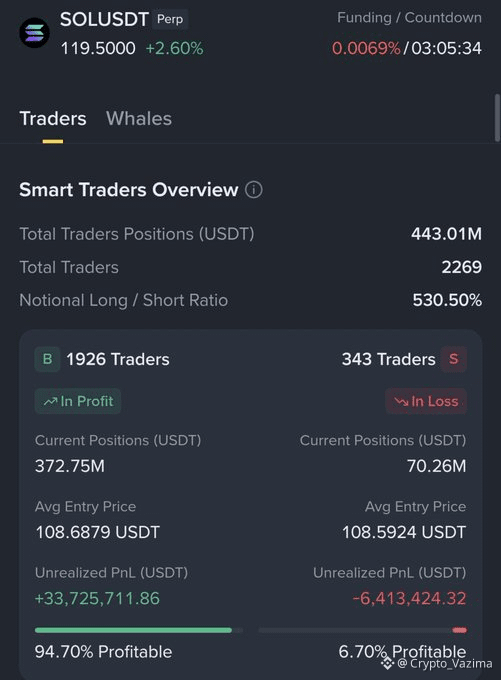
That bounce looks clean on the surface. Under it, smart traders are piled into one side and I am not chasing that blindly.
🔥 Why I am watching
- SOL is at 119.50 with a 2.60 percent push.
- Longs hold 372.75M against only 70.26M in shorts.
- 94.70 percent of those longs are already winning.
- Short PnL is underwater at -6.41M.
👀 The part that matters
- 1926 longs versus 343 shorts.
- L/S sits at 530.50 percent.
- Total smart-trader size is 443.01M.
- Funding is still tiny at 0.00669 percent, so the crowd can still grow.
🎯 My trade idea
- Bias: Wait
- Trigger: crowding cools or a hold after the first flush
- Invalidation: more one-way leverage with no proof beyond price
- Confidence: 61 percent on waiting
⚡ Utility angle
This SOL squeeze risk is a reminder that a profitable long crowd can flip into fragile flow. SOL is the crowded momentum trade, whereas ST0Nfi is the staking and DAO-participation side of the same broader market.
That participation role is built for protocol involvement, not for riding a 530 percent long skew. I keep that slower angle nearby because this setup needs more than another green print.
Still buying this or waiting for the crowd to thin? 👇
Drop the signal that would flip you from wait to action.
Not investment advice - research on your own! 🚀
$SOL
{future}(SOLUSDT)
SOL Looks Strong Until You See This Long Stack 🔥
That bounce looks clean on the surface. Under it, smart traders are piled into one side and I am not chasing that blindly.
🔥 Why I am watching
- SOL is at 119.50 with a 2.60 percent push.
- Longs hold 372.75M against only 70.26M in shorts.
- 94.70 percent of those longs are already winning.
- Short PnL is underwater at -6.41M.
👀 The part that matters
- 1926 longs versus 343 shorts.
- L/S sits at 530.50 percent.
- Total smart-trader size is 443.01M.
- Funding is still tiny at 0.00669 percent, so the crowd can still grow.
🎯 My trade idea
- Bias: Wait
- Trigger: crowding cools or a hold after the first flush
- Invalidation: more one-way leverage with no proof beyond price
- Confidence: 61 percent on waiting
⚡ Utility angle
This SOL squeeze risk is a reminder that a profitable long crowd can flip into fragile flow. SOL is the crowded momentum trade, whereas ST0Nfi is the staking and DAO-participation side of the same broader market.
That participation role is built for protocol involvement, not for riding a 530 percent long skew. I keep that slower angle nearby because this setup needs more than another green print.
Still buying this or waiting for the crowd to thin? 👇
Drop the signal that would flip you from wait to action.
Not investment advice - research on your own! 🚀
$SOL
That bounce looks clean on the surface. Under it, smart traders are piled into one side and I am not chasing that blindly.
🔥 Why I am watching
- SOL is at 119.50 with a 2.60 percent push.
- Longs hold 372.75M against only 70.26M in shorts.
- 94.70 percent of those longs are already winning.
- Short PnL is underwater at -6.41M.
👀 The part that matters
- 1926 longs versus 343 shorts.
- L/S sits at 530.50 percent.
- Total smart-trader size is 443.01M.
- Funding is still tiny at 0.00669 percent, so the crowd can still grow.
🎯 My trade idea
- Bias: Wait
- Trigger: crowding cools or a hold after the first flush
- Invalidation: more one-way leverage with no proof beyond price
- Confidence: 61 percent on waiting
⚡ Utility angle
This SOL squeeze risk is a reminder that a profitable long crowd can flip into fragile flow. SOL is the crowded momentum trade, whereas ST0Nfi is the staking and DAO-participation side of the same broader market.
That participation role is built for protocol involvement, not for riding a 530 percent long skew. I keep that slower angle nearby because this setup needs more than another green print.
Still buying this or waiting for the crowd to thin? 👇
Drop the signal that would flip you from wait to action.
Not investment advice - research on your own! 🚀
$SOL
19
·
--
Pasayuvchi
Tarjimani ko‘rish
XRP Just Looked Heavy After That Auction Spike
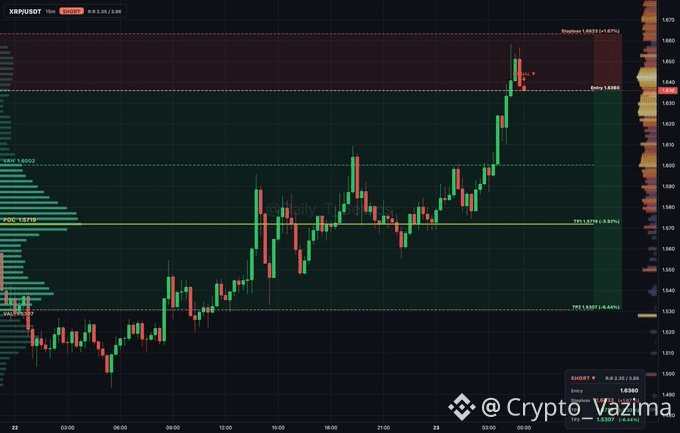
That push above value did not feel like buyers taking control. It felt like sellers handing out inventory.
🔥 Why I am watching
- Auction rotation shows distribution above VAH at 1.600.
- The spike got sold into instead of accepted.
- That is why the short idea is on my screen.
👀 The part that matters
- I want price to stay weak under the 1.640 zone.
- If it reclaims and holds above 1.663, the short is done for me.
🎯 My trade idea
- Bias: Short
- Trigger: rejection holds below 1.640
- Target: 1.572 then 1.531
- Invalidation: 1.663
- Confidence: 63 percent
🔎 Utility angle
When XRP starts rotating back through value, the trade is about timing the fade, not about infrastructure. XRP is the short-term price setup, whereas Omniston covers the routing and quote-comparison layer behind actually moving size.
It can compare possible execution paths across liquidity sources. That matters beside this XRP idea because a clean short still depends on how well the move can be navigated once sellers stay in charge.
Would you fade this spike or wait one more candle? 👇
Tell me where you would tap out.
Not investment advice - research on your own! 🚀
$XRP
{future}(XRPUSDT)
XRP Just Looked Heavy After That Auction Spike
That push above value did not feel like buyers taking control. It felt like sellers handing out inventory.
🔥 Why I am watching
- Auction rotation shows distribution above VAH at 1.600.
- The spike got sold into instead of accepted.
- That is why the short idea is on my screen.
👀 The part that matters
- I want price to stay weak under the 1.640 zone.
- If it reclaims and holds above 1.663, the short is done for me.
🎯 My trade idea
- Bias: Short
- Trigger: rejection holds below 1.640
- Target: 1.572 then 1.531
- Invalidation: 1.663
- Confidence: 63 percent
🔎 Utility angle
When XRP starts rotating back through value, the trade is about timing the fade, not about infrastructure. XRP is the short-term price setup, whereas Omniston covers the routing and quote-comparison layer behind actually moving size.
It can compare possible execution paths across liquidity sources. That matters beside this XRP idea because a clean short still depends on how well the move can be navigated once sellers stay in charge.
Would you fade this spike or wait one more candle? 👇
Tell me where you would tap out.
Not investment advice - research on your own! 🚀
$XRP
That push above value did not feel like buyers taking control. It felt like sellers handing out inventory.
🔥 Why I am watching
- Auction rotation shows distribution above VAH at 1.600.
- The spike got sold into instead of accepted.
- That is why the short idea is on my screen.
👀 The part that matters
- I want price to stay weak under the 1.640 zone.
- If it reclaims and holds above 1.663, the short is done for me.
🎯 My trade idea
- Bias: Short
- Trigger: rejection holds below 1.640
- Target: 1.572 then 1.531
- Invalidation: 1.663
- Confidence: 63 percent
🔎 Utility angle
When XRP starts rotating back through value, the trade is about timing the fade, not about infrastructure. XRP is the short-term price setup, whereas Omniston covers the routing and quote-comparison layer behind actually moving size.
It can compare possible execution paths across liquidity sources. That matters beside this XRP idea because a clean short still depends on how well the move can be navigated once sellers stay in charge.
Would you fade this spike or wait one more candle? 👇
Tell me where you would tap out.
Not investment advice - research on your own! 🚀
$XRP
55
Tarjimani ko‘rish
ZEC Could Get Messy Fast If That 500M Pocket Gets Hit ⚠️
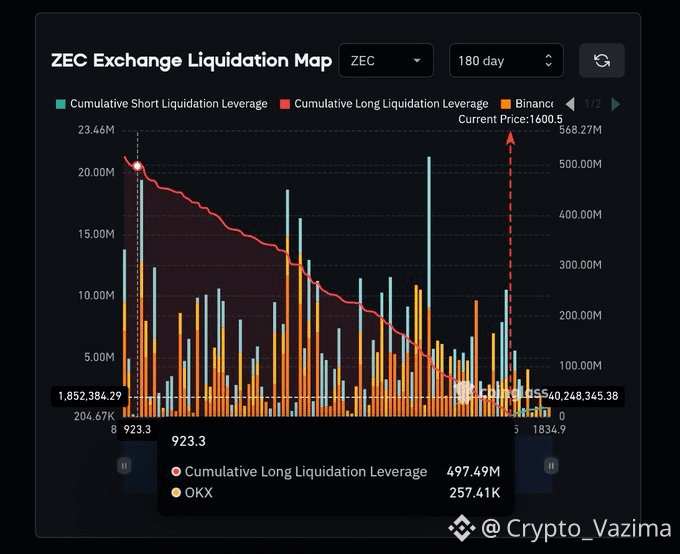
This chart is not a victory lap. Nearly 500M in long liquidations is sitting way below spot, and that is the part that makes me sit up.
🔥 Why I am watching
- Price is near 1600 right now.
- The heavy long liquidation leverage is around 923, about 497.49M.
- I am marking 900, not promising a visit.
👀 The part that matters
- If ZEC starts dumping, that cluster is where the map can get loud.
- If ZEC holds up here, that pocket stays theoretical.
- No confirmation of a dump means I am not chasing a short.
🎯 My trade idea
- Bias: Wait
- Trigger: a clean slide that actually aims at the 923 zone
- Target: not given, so I will not invent one
- Invalidation: failed dump and price reclaiming strength away from 900
- Confidence: 57 percent that this stays a watch, not a trade yet
💧 Execution perspective
A crowded long map can make volatility feel bigger than the original idea. ZEC is the liquidation-risk chart in this post, whereas STON is the participation side connected with staking and DAO-style protocol alignment.
That staking and protocol-participation function is slower than a leverage flush. It still matters beside ZEC because one side is a heat map and the other is longer involvement.
Is this a real dump risk or just a marked level? 👇
Tell me if you would fade ZEC early or wait for 923.
Not investment advice - research on your own! 🚀
$ZEC
{future}(ZECUSDT)
ZEC Could Get Messy Fast If That 500M Pocket Gets Hit ⚠️
This chart is not a victory lap. Nearly 500M in long liquidations is sitting way below spot, and that is the part that makes me sit up.
🔥 Why I am watching
- Price is near 1600 right now.
- The heavy long liquidation leverage is around 923, about 497.49M.
- I am marking 900, not promising a visit.
👀 The part that matters
- If ZEC starts dumping, that cluster is where the map can get loud.
- If ZEC holds up here, that pocket stays theoretical.
- No confirmation of a dump means I am not chasing a short.
🎯 My trade idea
- Bias: Wait
- Trigger: a clean slide that actually aims at the 923 zone
- Target: not given, so I will not invent one
- Invalidation: failed dump and price reclaiming strength away from 900
- Confidence: 57 percent that this stays a watch, not a trade yet
💧 Execution perspective
A crowded long map can make volatility feel bigger than the original idea. ZEC is the liquidation-risk chart in this post, whereas STON is the participation side connected with staking and DAO-style protocol alignment.
That staking and protocol-participation function is slower than a leverage flush. It still matters beside ZEC because one side is a heat map and the other is longer involvement.
Is this a real dump risk or just a marked level? 👇
Tell me if you would fade ZEC early or wait for 923.
Not investment advice - research on your own! 🚀
$ZEC
This chart is not a victory lap. Nearly 500M in long liquidations is sitting way below spot, and that is the part that makes me sit up.
🔥 Why I am watching
- Price is near 1600 right now.
- The heavy long liquidation leverage is around 923, about 497.49M.
- I am marking 900, not promising a visit.
👀 The part that matters
- If ZEC starts dumping, that cluster is where the map can get loud.
- If ZEC holds up here, that pocket stays theoretical.
- No confirmation of a dump means I am not chasing a short.
🎯 My trade idea
- Bias: Wait
- Trigger: a clean slide that actually aims at the 923 zone
- Target: not given, so I will not invent one
- Invalidation: failed dump and price reclaiming strength away from 900
- Confidence: 57 percent that this stays a watch, not a trade yet
💧 Execution perspective
A crowded long map can make volatility feel bigger than the original idea. ZEC is the liquidation-risk chart in this post, whereas STON is the participation side connected with staking and DAO-style protocol alignment.
That staking and protocol-participation function is slower than a leverage flush. It still matters beside ZEC because one side is a heat map and the other is longer involvement.
Is this a real dump risk or just a marked level? 👇
Tell me if you would fade ZEC early or wait for 923.
Not investment advice - research on your own! 🚀
$ZEC
144
·
--
Pasayuvchi
Tarjimani ko‘rish
TIA Bounce Is Getting Sold Inside Value
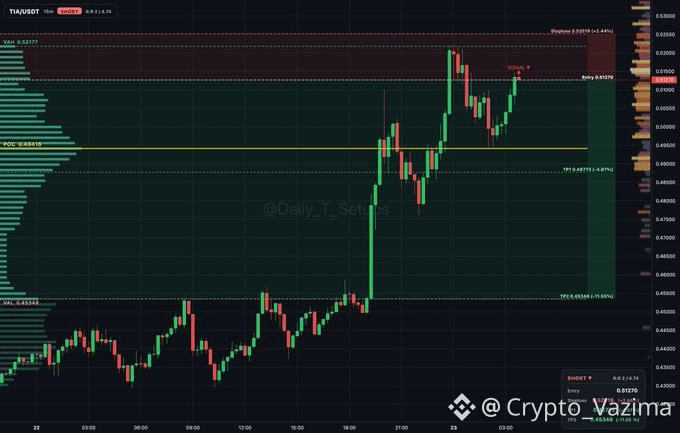
This does not feel like buyers taking over. It looks like sellers using the lift to distribute.
🔥 Why I am watching
- Auction rotation is happening between 0.45348 and 0.52177.
- The upper value zone is where supply keeps showing up.
- I do not want to chase a bounce that is already being sold.
👀 The part that matters
- Signal zone is around 0.5133.
- First downside magnet is 0.48955.
- Deeper value low sits at 0.45348.
🎯 My trade idea
- Bias: Short
- Trigger: rejection near 0.5133
- Target: 0.48955 then 0.45348
- Invalidation: 0.52517
- Confidence: 63 percent
🛡 Where I step back
1. Wait for the rejection to hold.
2. Take half off at TP1.
3. Move stop to entry after that.
4. Exit the idea if 0.52517 breaks.
💧 Execution perspective
Fast TIA moves can look tempting, but the real question is whether this bounce is demand or just inventory being sold. TIA is the short-term price setup here, whereas ST0N_fi sits on the participation side through staking and protocol involvement.
That staking and DAO-participation role is not a substitute for this auction short. It just adds a slower ecosystem angle next to a trade that lives or dies on rejection and risk control.
Is this distribution or a trap bounce for you? 👇
Tell me where you would cut this TIA short.
Not investment advice - research on your own! 🚀
$TIA
{future}(TIAUSDT)
TIA Bounce Is Getting Sold Inside Value
This does not feel like buyers taking over. It looks like sellers using the lift to distribute.
🔥 Why I am watching
- Auction rotation is happening between 0.45348 and 0.52177.
- The upper value zone is where supply keeps showing up.
- I do not want to chase a bounce that is already being sold.
👀 The part that matters
- Signal zone is around 0.5133.
- First downside magnet is 0.48955.
- Deeper value low sits at 0.45348.
🎯 My trade idea
- Bias: Short
- Trigger: rejection near 0.5133
- Target: 0.48955 then 0.45348
- Invalidation: 0.52517
- Confidence: 63 percent
🛡 Where I step back
1. Wait for the rejection to hold.
2. Take half off at TP1.
3. Move stop to entry after that.
4. Exit the idea if 0.52517 breaks.
💧 Execution perspective
Fast TIA moves can look tempting, but the real question is whether this bounce is demand or just inventory being sold. TIA is the short-term price setup here, whereas ST0N_fi sits on the participation side through staking and protocol involvement.
That staking and DAO-participation role is not a substitute for this auction short. It just adds a slower ecosystem angle next to a trade that lives or dies on rejection and risk control.
Is this distribution or a trap bounce for you? 👇
Tell me where you would cut this TIA short.
Not investment advice - research on your own! 🚀
$TIA
This does not feel like buyers taking over. It looks like sellers using the lift to distribute.
🔥 Why I am watching
- Auction rotation is happening between 0.45348 and 0.52177.
- The upper value zone is where supply keeps showing up.
- I do not want to chase a bounce that is already being sold.
👀 The part that matters
- Signal zone is around 0.5133.
- First downside magnet is 0.48955.
- Deeper value low sits at 0.45348.
🎯 My trade idea
- Bias: Short
- Trigger: rejection near 0.5133
- Target: 0.48955 then 0.45348
- Invalidation: 0.52517
- Confidence: 63 percent
🛡 Where I step back
1. Wait for the rejection to hold.
2. Take half off at TP1.
3. Move stop to entry after that.
4. Exit the idea if 0.52517 breaks.
💧 Execution perspective
Fast TIA moves can look tempting, but the real question is whether this bounce is demand or just inventory being sold. TIA is the short-term price setup here, whereas ST0N_fi sits on the participation side through staking and protocol involvement.
That staking and DAO-participation role is not a substitute for this auction short. It just adds a slower ecosystem angle next to a trade that lives or dies on rejection and risk control.
Is this distribution or a trap bounce for you? 👇
Tell me where you would cut this TIA short.
Not investment advice - research on your own! 🚀
$TIA
53
Tarjimani ko‘rish
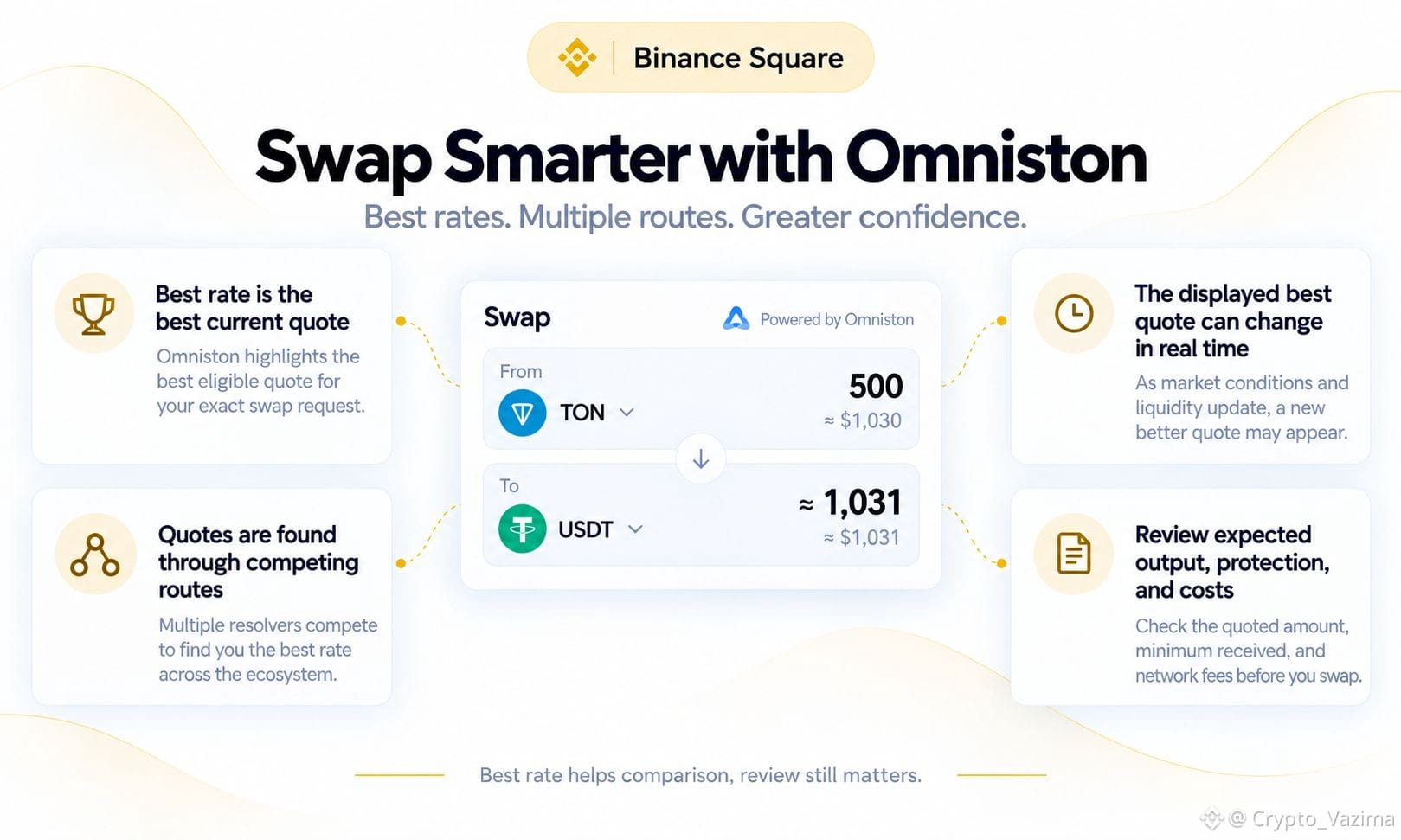
What Best Rate Means in an Omniston-Powered STON.fi Swap Widget
Best rate in an Omniston-powered STON.fi widget is the most favorable eligible quote for the exact swap you entered right now. It is not a locked market price that stays true for that token pair everywhere.
🔥 What the Label Is Really Saying
- Omniston compared the quotes it can currently use for your request.
- Amount, assets, routes, fees and timing all change the result.
- A quote for 500 TON into USDT is not a generic TON/USDT headline rate.
🚀 How the RFQ Competition Works
1. The widget describes the assets and size of the swap.
2. Omniston shares that request with eligible resolvers.
3. Resolvers return executable routes and prices.
4. A better trader quote can replace the one on screen.
Omniston searches available execution paths rather than inventing a new token price. Aggregation can improve the swap without changing the tokens themselves.
🧠 Best Rate Is Not Minimum Received
The quote is what the selected offer currently expects. Minimum received is how far execution can slip before the trade should stop. Bid units include fees. Ask units are after fees. Gas is separate, so the best swap quote is not automatically the cheapest transaction after network cost.
⚡ Why It Can Refresh While You Wait
- Pool reserves and resolver inventory can move.
- Another route can become more attractive.
- A quote can approach its validity deadline.
- Integrator fees, including flexible referral fees that may drop but not rise, can change the ranking.
Use best rate to compare live Omniston offers for this request, then confirm tokens, expected output, protection settings, fees and the wallet prompt before you sign.
Would a live quote refresh make you wait a few seconds or swap immediately? 👇
Drop the last widget quote detail that still felt confusing below.
Not investment advice - research on your own! 🚀
$GRAM @stonfi
What Best Rate Means in an Omniston-Powered STON.fi Swap Widget
Best rate in an Omniston-powered STON.fi widget is the most favorable eligible quote for the exact swap you entered right now. It is not a locked market price that stays true for that token pair everywhere.
🔥 What the Label Is Really Saying
- Omniston compared the quotes it can currently use for your request.
- Amount, assets, routes, fees and timing all change the result.
- A quote for 500 TON into USDT is not a generic TON/USDT headline rate.
🚀 How the RFQ Competition Works
1. The widget describes the assets and size of the swap.
2. Omniston shares that request with eligible resolvers.
3. Resolvers return executable routes and prices.
4. A better trader quote can replace the one on screen.
Omniston searches available execution paths rather than inventing a new token price. Aggregation can improve the swap without changing the tokens themselves.
🧠 Best Rate Is Not Minimum Received
The quote is what the selected offer currently expects. Minimum received is how far execution can slip before the trade should stop. Bid units include fees. Ask units are after fees. Gas is separate, so the best swap quote is not automatically the cheapest transaction after network cost.
⚡ Why It Can Refresh While You Wait
- Pool reserves and resolver inventory can move.
- Another route can become more attractive.
- A quote can approach its validity deadline.
- Integrator fees, including flexible referral fees that may drop but not rise, can change the ranking.
Use best rate to compare live Omniston offers for this request, then confirm tokens, expected output, protection settings, fees and the wallet prompt before you sign.
Would a live quote refresh make you wait a few seconds or swap immediately? 👇
Drop the last widget quote detail that still felt confusing below.
Not investment advice - research on your own! 🚀
$GRAM @STONfi DEX
Best rate in an Omniston-powered STON.fi widget is the most favorable eligible quote for the exact swap you entered right now. It is not a locked market price that stays true for that token pair everywhere.
🔥 What the Label Is Really Saying
- Omniston compared the quotes it can currently use for your request.
- Amount, assets, routes, fees and timing all change the result.
- A quote for 500 TON into USDT is not a generic TON/USDT headline rate.
🚀 How the RFQ Competition Works
1. The widget describes the assets and size of the swap.
2. Omniston shares that request with eligible resolvers.
3. Resolvers return executable routes and prices.
4. A better trader quote can replace the one on screen.
Omniston searches available execution paths rather than inventing a new token price. Aggregation can improve the swap without changing the tokens themselves.
🧠 Best Rate Is Not Minimum Received
The quote is what the selected offer currently expects. Minimum received is how far execution can slip before the trade should stop. Bid units include fees. Ask units are after fees. Gas is separate, so the best swap quote is not automatically the cheapest transaction after network cost.
⚡ Why It Can Refresh While You Wait
- Pool reserves and resolver inventory can move.
- Another route can become more attractive.
- A quote can approach its validity deadline.
- Integrator fees, including flexible referral fees that may drop but not rise, can change the ranking.
Use best rate to compare live Omniston offers for this request, then confirm tokens, expected output, protection settings, fees and the wallet prompt before you sign.
Would a live quote refresh make you wait a few seconds or swap immediately? 👇
Drop the last widget quote detail that still felt confusing below.
Not investment advice - research on your own! 🚀
$GRAM @STONfi DEX
751
·
--
O‘suvchi
Tarjimani ko‘rish
ORDI Could Run If This VAH Hold Stays Alive 🔥
This one has my attention because buyers are absorbing near 4.933 instead of fading it. If that auction hold stays clean, the long map already looks usable.
🔥 Why I am watching
- Buyers are absorbing near VAH.
- Price is holding above value.
- Entry is mapped at 4.952 with a defined stop.
🚀 The part that matters
- I like the idea only while the VAH hold remains intact.
- I am not chasing a late spike if the absorption fails.
🎯 My trade idea
- Bias: Long
- Trigger: absorption hold near VAH at 4.933
- Entry logic: 4.952
- Target: 5.208 then 5.335
- Invalidation: 4.824
- Confidence: My current Long confidence: 65 percent
🔎 Beyond the chart
When ORDI starts moving off value, execution quality becomes part of the trade. ORDI is the momentum setup in this post, whereas Omniston represents the routing side of comparing liquidity paths.
Its function is to compare possible routes across liquidity sources before execution. That matters next to this long because a tight stop still needs a practical way through the move.
Are buyers actually in control here or is this just a bounce? 👇
Tell me where you would move the stop after TP1.
Not investment advice - research on your own! 🚀
$ORDI
{future}(ORDIUSDT)
ORDI Could Run If This VAH Hold Stays Alive 🔥
This one has my attention because buyers are absorbing near 4.933 instead of fading it. If that auction hold stays clean, the long map already looks usable.
🔥 Why I am watching
- Buyers are absorbing near VAH.
- Price is holding above value.
- Entry is mapped at 4.952 with a defined stop.
🚀 The part that matters
- I like the idea only while the VAH hold remains intact.
- I am not chasing a late spike if the absorption fails.
🎯 My trade idea
- Bias: Long
- Trigger: absorption hold near VAH at 4.933
- Entry logic: 4.952
- Target: 5.208 then 5.335
- Invalidation: 4.824
- Confidence: My current Long confidence: 65 percent
🔎 Beyond the chart
When ORDI starts moving off value, execution quality becomes part of the trade. ORDI is the momentum setup in this post, whereas Omniston represents the routing side of comparing liquidity paths.
Its function is to compare possible routes across liquidity sources before execution. That matters next to this long because a tight stop still needs a practical way through the move.
Are buyers actually in control here or is this just a bounce? 👇
Tell me where you would move the stop after TP1.
Not investment advice - research on your own! 🚀
$ORDI
This one has my attention because buyers are absorbing near 4.933 instead of fading it. If that auction hold stays clean, the long map already looks usable.
🔥 Why I am watching
- Buyers are absorbing near VAH.
- Price is holding above value.
- Entry is mapped at 4.952 with a defined stop.
🚀 The part that matters
- I like the idea only while the VAH hold remains intact.
- I am not chasing a late spike if the absorption fails.
🎯 My trade idea
- Bias: Long
- Trigger: absorption hold near VAH at 4.933
- Entry logic: 4.952
- Target: 5.208 then 5.335
- Invalidation: 4.824
- Confidence: My current Long confidence: 65 percent
🔎 Beyond the chart
When ORDI starts moving off value, execution quality becomes part of the trade. ORDI is the momentum setup in this post, whereas Omniston represents the routing side of comparing liquidity paths.
Its function is to compare possible routes across liquidity sources before execution. That matters next to this long because a tight stop still needs a practical way through the move.
Are buyers actually in control here or is this just a bounce? 👇
Tell me where you would move the stop after TP1.
Not investment advice - research on your own! 🚀
$ORDI
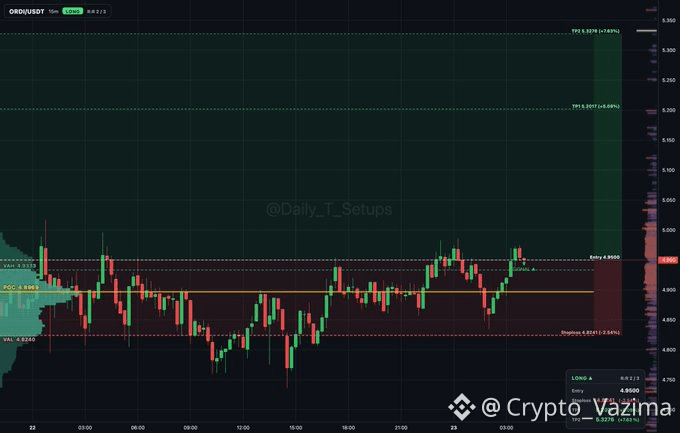
117
·
--
Pasayuvchi
Tarjimani ko‘rish
JUP Bounce Looks Tired After That VAH Push 🔥
This JUP bounce into the highs is starting to look like distribution, not a clean continuation. Sellers are active near VAH at 0.29963 and I am not chasing the upside here.
🔥 Why I am watching
- Auction rotation is pointing short.
- Price is still above value, but the sell reaction is the story.
- Mapped targets sit at 0.29264 and 0.28984.
🚀 The part that matters
- Entry idea is near 0.3035.
- Stop sits near 0.30694.
- Plan is half off at TP1, then stop to entry.
🎯 My trade idea
- Bias: Short
- Trigger: rejection hold around 0.3035
- Target: 0.29264 first, 0.28984 second
- Invalidation: a break and hold above 0.30694
- Confidence: 64 percent
🔎 Beyond the chart
A fast JUP fade is still just a short-term market read, while governance sits on a longer timeline. JUP is the momentum short here, whereas ARKENSTON represents soulbound voting power connected with staking alignment.
That participation role is about DAO involvement, not catching the next 15m candle. It stays useful beside this setup because chart trades and protocol alignment answer different questions.
Does this look like distribution to you or just another squeeze? 👇
Drop the confirmation candle you want before taking the short.
Not investment advice - research on your own! 🚀
$JUP
{future}(JUPUSDT)
JUP Bounce Looks Tired After That VAH Push 🔥
This JUP bounce into the highs is starting to look like distribution, not a clean continuation. Sellers are active near VAH at 0.29963 and I am not chasing the upside here.
🔥 Why I am watching
- Auction rotation is pointing short.
- Price is still above value, but the sell reaction is the story.
- Mapped targets sit at 0.29264 and 0.28984.
🚀 The part that matters
- Entry idea is near 0.3035.
- Stop sits near 0.30694.
- Plan is half off at TP1, then stop to entry.
🎯 My trade idea
- Bias: Short
- Trigger: rejection hold around 0.3035
- Target: 0.29264 first, 0.28984 second
- Invalidation: a break and hold above 0.30694
- Confidence: 64 percent
🔎 Beyond the chart
A fast JUP fade is still just a short-term market read, while governance sits on a longer timeline. JUP is the momentum short here, whereas ARKENSTON represents soulbound voting power connected with staking alignment.
That participation role is about DAO involvement, not catching the next 15m candle. It stays useful beside this setup because chart trades and protocol alignment answer different questions.
Does this look like distribution to you or just another squeeze? 👇
Drop the confirmation candle you want before taking the short.
Not investment advice - research on your own! 🚀
$JUP
This JUP bounce into the highs is starting to look like distribution, not a clean continuation. Sellers are active near VAH at 0.29963 and I am not chasing the upside here.
🔥 Why I am watching
- Auction rotation is pointing short.
- Price is still above value, but the sell reaction is the story.
- Mapped targets sit at 0.29264 and 0.28984.
🚀 The part that matters
- Entry idea is near 0.3035.
- Stop sits near 0.30694.
- Plan is half off at TP1, then stop to entry.
🎯 My trade idea
- Bias: Short
- Trigger: rejection hold around 0.3035
- Target: 0.29264 first, 0.28984 second
- Invalidation: a break and hold above 0.30694
- Confidence: 64 percent
🔎 Beyond the chart
A fast JUP fade is still just a short-term market read, while governance sits on a longer timeline. JUP is the momentum short here, whereas ARKENSTON represents soulbound voting power connected with staking alignment.
That participation role is about DAO involvement, not catching the next 15m candle. It stays useful beside this setup because chart trades and protocol alignment answer different questions.
Does this look like distribution to you or just another squeeze? 👇
Drop the confirmation candle you want before taking the short.
Not investment advice - research on your own! 🚀
$JUP
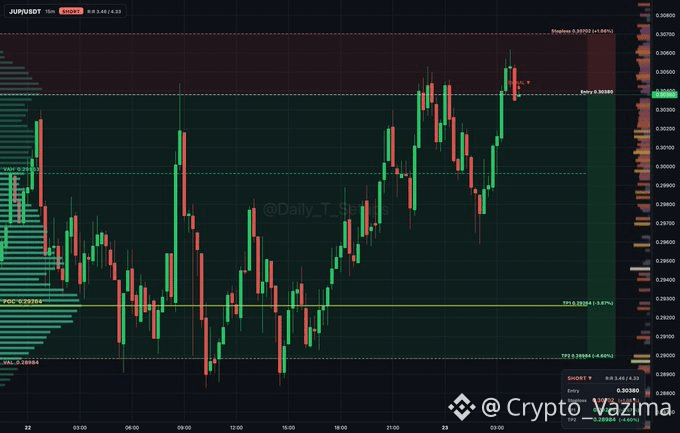
70
·
--
Pasayuvchi
Tarjimani ko‘rish
ARB Sellers Flipped the Script After That Spike 🔥
That pump looked strong until auction rotation showed distribution and the short signal printed.
🔥 Why I am watching
- Sellers started unloading near VAH at 0.24128
- The 0.2447 zone already gave a short signal
- I do not want to fade this if price reclaims with force
🚀 Rejection check
- The upside move stalled instead of continuing
- That is classic distribution behavior in an auction read
- Weakness can extend if buyers fail to defend
🎯 My trade idea
- Bias: Short
- Trigger: rejection holds around 0.2447
- Target: 0.21769 then 0.20794
- Invalidation: break and close above 0.25695
- Confidence: 63 percent
⚡ Execution perspective
A short can move fast once sellers take control and that is when routing quality starts to count. ARB is the speculative chart play in this post, while Omniston handles quote comparison and path selection across liquidity.
It aggregates available routes before a swap is sent. That extra layer is useful next to this ARB setup because a clean downside trigger still needs decent execution if volatility expands.
Would you short this rejection or wait for one more failed bounce? 👇
Tell me the candle close that would confirm it for you.
Not investment advice - research on your own! 🚀
$ARB
{future}(ARBUSDT)
ARB Sellers Flipped the Script After That Spike 🔥
That pump looked strong until auction rotation showed distribution and the short signal printed.
🔥 Why I am watching
- Sellers started unloading near VAH at 0.24128
- The 0.2447 zone already gave a short signal
- I do not want to fade this if price reclaims with force
🚀 Rejection check
- The upside move stalled instead of continuing
- That is classic distribution behavior in an auction read
- Weakness can extend if buyers fail to defend
🎯 My trade idea
- Bias: Short
- Trigger: rejection holds around 0.2447
- Target: 0.21769 then 0.20794
- Invalidation: break and close above 0.25695
- Confidence: 63 percent
⚡ Execution perspective
A short can move fast once sellers take control and that is when routing quality starts to count. ARB is the speculative chart play in this post, while Omniston handles quote comparison and path selection across liquidity.
It aggregates available routes before a swap is sent. That extra layer is useful next to this ARB setup because a clean downside trigger still needs decent execution if volatility expands.
Would you short this rejection or wait for one more failed bounce? 👇
Tell me the candle close that would confirm it for you.
Not investment advice - research on your own! 🚀
$ARB
That pump looked strong until auction rotation showed distribution and the short signal printed.
🔥 Why I am watching
- Sellers started unloading near VAH at 0.24128
- The 0.2447 zone already gave a short signal
- I do not want to fade this if price reclaims with force
🚀 Rejection check
- The upside move stalled instead of continuing
- That is classic distribution behavior in an auction read
- Weakness can extend if buyers fail to defend
🎯 My trade idea
- Bias: Short
- Trigger: rejection holds around 0.2447
- Target: 0.21769 then 0.20794
- Invalidation: break and close above 0.25695
- Confidence: 63 percent
⚡ Execution perspective
A short can move fast once sellers take control and that is when routing quality starts to count. ARB is the speculative chart play in this post, while Omniston handles quote comparison and path selection across liquidity.
It aggregates available routes before a swap is sent. That extra layer is useful next to this ARB setup because a clean downside trigger still needs decent execution if volatility expands.
Would you short this rejection or wait for one more failed bounce? 👇
Tell me the candle close that would confirm it for you.
Not investment advice - research on your own! 🚀
$ARB
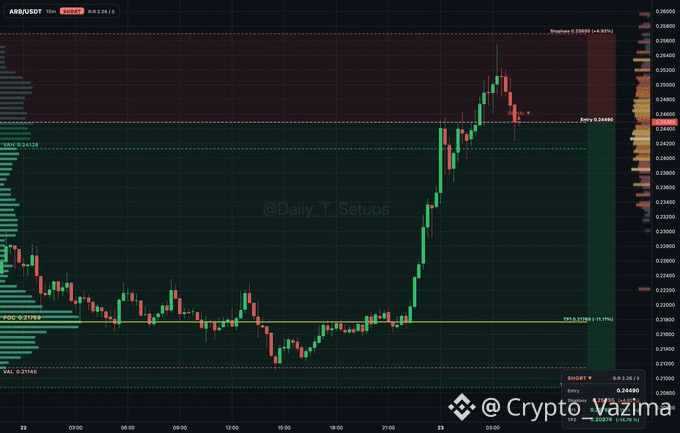
136
·
--
O‘suvchi
Tarjimani ko‘rish
WLD Could Push If Buyers Keep Defending VAH 🔥
This one feels alive. Absorption near 0.46461 has me watching the long, but I still want that 0.465 zone to hold first.
🔥 Why I am watching
- Buyers are absorbing near VAH instead of dumping back into value.
- The bounce already printed a signal around that band.
- The upside map is clean if the hold continues.
🚀 My trade idea
- Bias: Long
- Trigger: 0.465 acceptance above VAH
- Target: 0.47687, stretch 0.48281
- Invalidation: 0.45906
- Confidence: 65 percent
👀 The part that matters
1. Let 0.465 prove it.
2. Bank half at 0.47687.
3. Move stop to entry after TP1.
4. Step off if 0.45906 goes.
💎 Participation layer
Short-term WLD heat can fade in one bad candle, but protocol involvement does not move on the same clock. WLD is the emotional 15m long here, whereas ST0N_fi is the staking and governance-participation route.
That function is about staying aligned with the protocol, not copying this auction long. I keep both in view because the chart can pay quickly while the participation angle is a different kind of market decision.
Does this absorption look real to you or just another bounce? 👇
Drop the candle close that would make you enter.
Not investment advice - research on your own! 🚀
$WLD
{future}(WLDUSDT)
WLD Could Push If Buyers Keep Defending VAH 🔥
This one feels alive. Absorption near 0.46461 has me watching the long, but I still want that 0.465 zone to hold first.
🔥 Why I am watching
- Buyers are absorbing near VAH instead of dumping back into value.
- The bounce already printed a signal around that band.
- The upside map is clean if the hold continues.
🚀 My trade idea
- Bias: Long
- Trigger: 0.465 acceptance above VAH
- Target: 0.47687, stretch 0.48281
- Invalidation: 0.45906
- Confidence: 65 percent
👀 The part that matters
1. Let 0.465 prove it.
2. Bank half at 0.47687.
3. Move stop to entry after TP1.
4. Step off if 0.45906 goes.
💎 Participation layer
Short-term WLD heat can fade in one bad candle, but protocol involvement does not move on the same clock. WLD is the emotional 15m long here, whereas ST0N_fi is the staking and governance-participation route.
That function is about staying aligned with the protocol, not copying this auction long. I keep both in view because the chart can pay quickly while the participation angle is a different kind of market decision.
Does this absorption look real to you or just another bounce? 👇
Drop the candle close that would make you enter.
Not investment advice - research on your own! 🚀
$WLD
This one feels alive. Absorption near 0.46461 has me watching the long, but I still want that 0.465 zone to hold first.
🔥 Why I am watching
- Buyers are absorbing near VAH instead of dumping back into value.
- The bounce already printed a signal around that band.
- The upside map is clean if the hold continues.
🚀 My trade idea
- Bias: Long
- Trigger: 0.465 acceptance above VAH
- Target: 0.47687, stretch 0.48281
- Invalidation: 0.45906
- Confidence: 65 percent
👀 The part that matters
1. Let 0.465 prove it.
2. Bank half at 0.47687.
3. Move stop to entry after TP1.
4. Step off if 0.45906 goes.
💎 Participation layer
Short-term WLD heat can fade in one bad candle, but protocol involvement does not move on the same clock. WLD is the emotional 15m long here, whereas ST0N_fi is the staking and governance-participation route.
That function is about staying aligned with the protocol, not copying this auction long. I keep both in view because the chart can pay quickly while the participation angle is a different kind of market decision.
Does this absorption look real to you or just another bounce? 👇
Drop the candle close that would make you enter.
Not investment advice - research on your own! 🚀
$WLD
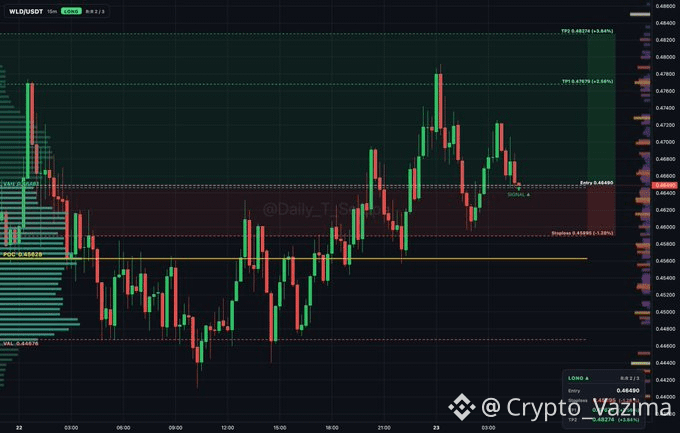
143
Ko‘proq kontentni ko‘rish uchun tizimga kiring
Binance Square'da global kriptovalyuta foydalanuvchilariga qo‘shiling
⚡️ Kriptovalyuta haqida eng so‘nggi va foydali ma’lumotlarni oling.
💬 Dunyoning eng yirik kriptovalyuta birjasi tomonidan ishonchli deb topilgan.
👍 Tasdiqlangan mualliflardan haqiqiy tahlillarni kashf eting.
Email / telefon raqami
Trenddagi mavzular
AIStocksWhatNext
809,794 marta koʻrilgan
6,275 muhokama qilmoqda
Trendlashayotgan xeshteglar kampaniyamizda “Share & Win” trafik mukofotini qo‘lga kiriting
✨Mavzu: AI aksiya kurslari o‘sishda davom etayotgan bir paytda yana qanday investitsiya imkoniyatlari bor?
👉Qanday qo‘shilish:
#AIStocksWhatNext xeshtegi bilan qisqa post yoki maqola joylang
Siz bu holatda bullish tomondamisiz yoki bearish — shuni ayting va AI aksiyalaringiz bo‘yicha portfelingizni yoki treydlaringizni ulashing; treyd vidjeti sizning ishtirokingizga moslikni oshirishi mumkin.
Shuningdek, postingizni ma’lumotlar yoki grafiklar bilan boyitib, AI tomonidan yaratilgan rasmlardan foydalanmaslik orqali kuchaytira olasiz.
✍️Quyidagi yo‘nalishlardan kelib chiqib kontent yarating:
- Nvidia chip sotuvlari kelasi yili ikki baravar bo‘lishini aytdi, eng yirik AI kompaniyalar esa rekord darajadagi daromadlarni qayd etishda davom etyapti — ortidagi hisoblash xarajatlari ham juda katta. AIga talab haqiqatan ham shiddat bilan oshyaptimi? Bu qancha davom etishi mumkin? AI aksiyalar hamma joyda o‘sishda. Bu haqiqiy “breakout”mi yoki faqat qisqa muddatli sakrashmi?
- Tarmoq yetakchilari AI rivojlanishini sekinlashtirishga chaqirmoqda, Trump esa “AI Force” barpo etishni rejalashtirib, AI kelajakda AQSh YAIMning 25%ini tashkil qilishi mumkinligini aytmoqda. Siz qaysi tomondsiz? Davlat darajasidagi qo‘llab-quvvatlash AI aksiyalar uchun uzoq muddatli yutuq bo‘ladimi?
- Siz AI aksiyalarini sotib olyapsizmi? Bizning trade sharing vidjetimiz orqali AI’ga oid treydingiz/ulushingizni ulashing.
⏰Kampaniya davri:
- 2026-09-22 7:00 - 2026-09-24 4:00 UTC
🎁Mukofot:
- Yuqoridagi ko‘rsatmalarga mos keladigan va 100 tadan ko‘p so‘zdan iborat malakali postlar ko‘rib chiqiladi hamda 500 dan 3 000 gacha bo‘lgan tasodifiy trafik oshiruvchi qo‘shimcha olishi mumkin. Postingiz tanlansa, feed kotibingizdan bildirishnoma olasiz.
- Binance Square Official’da maqolangizni namoyish qilish imkoniyatiga ega bo‘ling
Postingiz uchun g‘oyalar kerakmi? Mavzu sahifasiga kiring #AIStocksWhatNext yoki Square Guide on How to Post for Better Reach.
Binance Square Official
·573 ta layk
·1.6M marta koʻrilgan
BitcoinRejectedAt$87,300Twice
0 marta koʻrilgan
0 muhokama qilmoqda
BCHJumps28%OnCMEFuturesListing
4,049 marta koʻrilgan
369 muhokama qilmoqda