
Sattar Chaqer
7.7k Postlar

Sattar Chaqer
 Square Verified+
Shikoyat qilish
Foydalanuvchini bloklash
I’m back x - @SattarChaqer

Traders League Badge Expert
109 Kuzatilmoqda
48.5K+ Kuzatuvchilar
90.8K+ Yoqdi
1 Nishonlar
Postlar
Barchasi
Iqtiboslar
Videolar
QADAB QO‘YILGAN
Sondan 48500 taga ko‘p kuzatuvchilar — bu mening Binance oilam.
Mening yo‘limning bir qismi bo‘lganlarning barchasiga katta rahmat. Bu yerda boshidan bo‘lganmisiz yoki yaqinda qo‘shilgan bo‘lsangiz ham — sizning qo‘llab-quvvatlashingiz menga juda muhim.
Men qaytdim va barchangiz bilan birga bo‘lganimdan xursandman. Keling, birga o‘sishni davom ettiramiz.
Binance oilamga katta mehr. ❤️
maxsus rahmat <@MrStar @btc_fahmi @Rasul_Likhy @GM_CRYPTOInfluencer @ridhi_sharma0318 @AlizehAli_Angel02 @CoinKing007 @Its_Sara @Bull-BnB @Flicky123Nohawn @Nadeem_Bisharat @Square-Creator-46eb16893 @Square-Creator-Lodhi @monkist @maidah_aw @DrSaleG @BINANSERS @kokim4758 @Napol @Amina_khan @RevengeisSweet >
Sondan 48500 taga ko‘p kuzatuvchilar — bu mening Binance oilam.
Mening yo‘limning bir qismi bo‘lganlarning barchasiga katta rahmat. Bu yerda boshidan bo‘lganmisiz yoki yaqinda qo‘shilgan bo‘lsangiz ham — sizning qo‘llab-quvvatlashingiz menga juda muhim.
Men qaytdim va barchangiz bilan birga bo‘lganimdan xursandman. Keling, birga o‘sishni davom ettiramiz.
Binance oilamga katta mehr. ❤️
maxsus rahmat <@MrStar @BTC_Fahmi @Aesthetic_Meow @GM_Crypto01 @Ridhi Sharma @Alizeh Ali _Angel @Coin--King @Hazel Rose @J U N I A @Dr Nohawn @Nadyisom @Mohsin_Trader_King @RUBYISHAH_LODHI2001 @Poxy_ @Crypto_Alchemy @DrSaleG @BINANSERS @KOKIM 4758 @NAPOL @AmnaJen @virtual hug >
Mening yo‘limning bir qismi bo‘lganlarning barchasiga katta rahmat. Bu yerda boshidan bo‘lganmisiz yoki yaqinda qo‘shilgan bo‘lsangiz ham — sizning qo‘llab-quvvatlashingiz menga juda muhim.
Men qaytdim va barchangiz bilan birga bo‘lganimdan xursandman. Keling, birga o‘sishni davom ettiramiz.
Binance oilamga katta mehr. ❤️
maxsus rahmat <@MrStar @BTC_Fahmi @Aesthetic_Meow @GM_Crypto01 @Ridhi Sharma @Alizeh Ali _Angel @Coin--King @Hazel Rose @J U N I A @Dr Nohawn @Nadyisom @Mohsin_Trader_King @RUBYISHAH_LODHI2001 @Poxy_ @Crypto_Alchemy @DrSaleG @BINANSERS @KOKIM 4758 @NAPOL @AmnaJen @virtual hug >

17
1
19
1.2k
Tarjimani ko‘rish
ALL TP HITS
ALL TP HITS
Sattar Chaqer
·
--
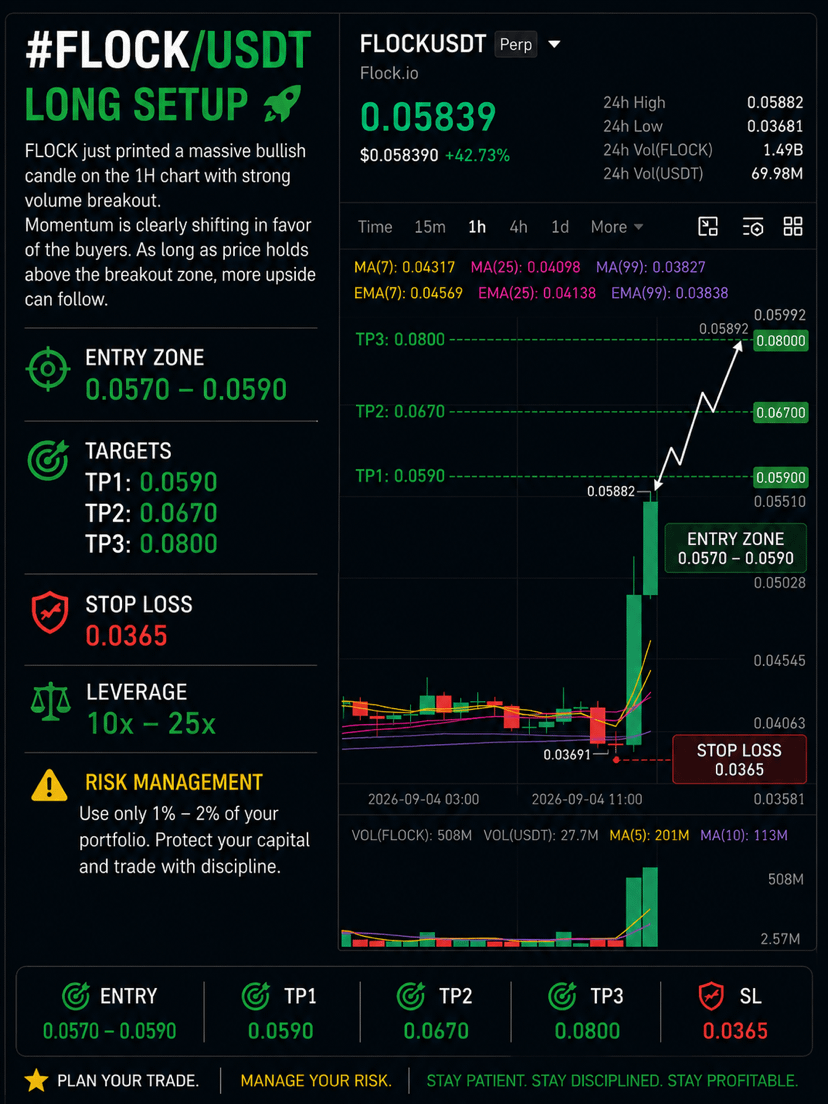
🟢 $FLOCK /USDT — LONG | 10–25x
FLOCK just broke out hard on the 1H chart, with a strong volume spike behind the move. Price is sitting near the recent high, so I’d rather wait for a pullback into the entry zone than chase the candle.
📌 ENTRY: 0.0570 → 0.0590
🎯 TP1: 0.0615
🎯 TP2: 0.0690
🎯 TP3: 0.0820
🛑 SL: 0.0500
⚡ LEVERAGE: 10–25x
⚠️ RISK: Use only 1–2% of your portfolio.
The breakout has momentum, but after a move this fast, the entry matters. If price loses the zone, I’d skip the setup.
FLOCK just broke out hard on the 1H chart, with a strong volume spike behind the move. Price is sitting near the recent high, so I’d rather wait for a pullback into the entry zone than chase the candle.
📌 ENTRY: 0.0570 → 0.0590
🎯 TP1: 0.0615
🎯 TP2: 0.0690
🎯 TP3: 0.0820
🛑 SL: 0.0500
⚡ LEVERAGE: 10–25x
⚠️ RISK: Use only 1–2% of your portfolio.
The breakout has momentum, but after a move this fast, the entry matters. If price loses the zone, I’d skip the setup.
1
110
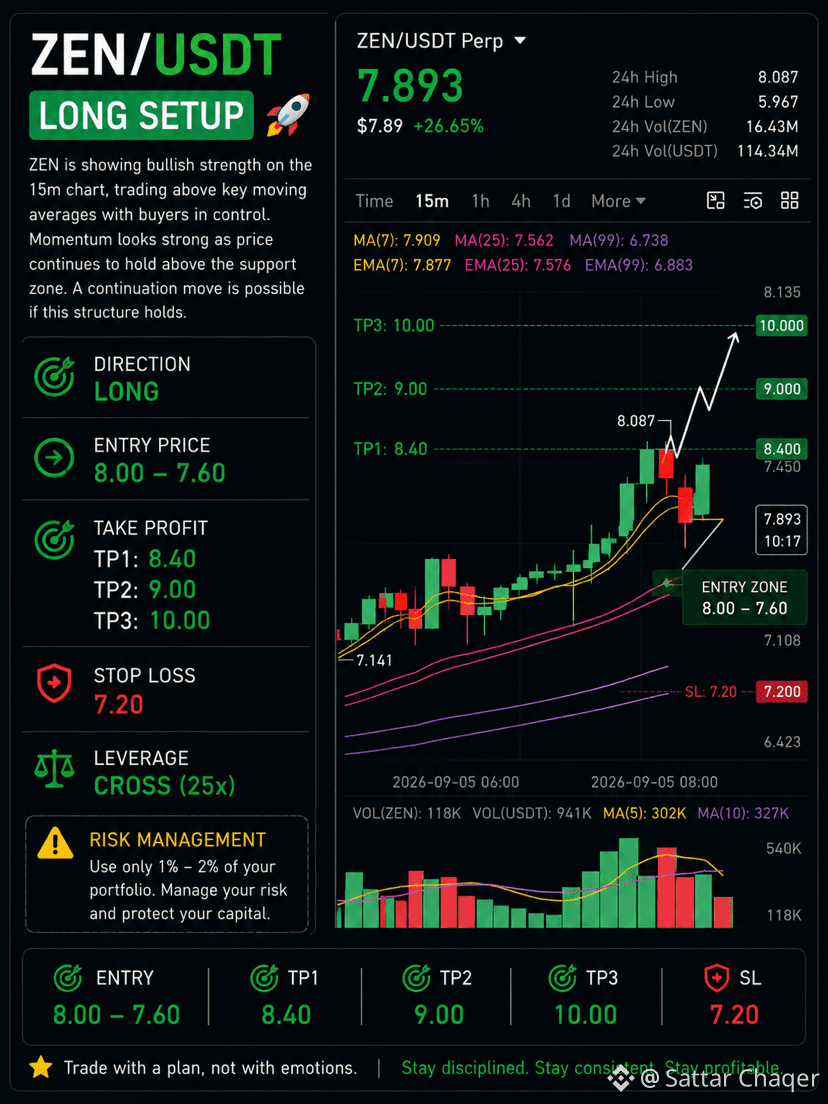
🟢 $ZEN /USDT — LONG | 25x CROSS
ZEN 15 daqiqalik grafikda qisqa muddatli harakatlanuvchi o‘rtachalar ustida ushlab turibdi, narx $8.087 ga yetgandan keyin $7.90 atrofida konsolidatsiyalanmoqda.
Davom etish setupi uchun $8.00–$7.60 oralig‘ini kuzatyapman.
📌 KIRISH: $8.00 → $7.60
🚀 TP1: $8.55
🚀 TP2: $9.25
🚀 TP3: $10.20
🛑 SL: $7.20
⚡ LEVERAJ: Cross 25x
⚠️ XAVF: Portfelingizning faqat 1–2% ini ishlating.
Agar ZEN kuchli sotuv bosimi bilan $7.60 ni yo‘qotsa, men longni majburlagandan ko‘ra kutishni afzal ko‘raman.
{future}(ZENUSDT)
🟢 $ZEN /USDT — LONG | 25x CROSS
ZEN 15 daqiqalik grafikda qisqa muddatli harakatlanuvchi o‘rtachalar ustida ushlab turibdi, narx $8.087 ga yetgandan keyin $7.90 atrofida konsolidatsiyalanmoqda.
Davom etish setupi uchun $8.00–$7.60 oralig‘ini kuzatyapman.
📌 KIRISH: $8.00 → $7.60
🚀 TP1: $8.55
🚀 TP2: $9.25
🚀 TP3: $10.20
🛑 SL: $7.20
⚡ LEVERAJ: Cross 25x
⚠️ XAVF: Portfelingizning faqat 1–2% ini ishlating.
Agar ZEN kuchli sotuv bosimi bilan $7.60 ni yo‘qotsa, men longni majburlagandan ko‘ra kutishni afzal ko‘raman.
ZEN 15 daqiqalik grafikda qisqa muddatli harakatlanuvchi o‘rtachalar ustida ushlab turibdi, narx $8.087 ga yetgandan keyin $7.90 atrofida konsolidatsiyalanmoqda.
Davom etish setupi uchun $8.00–$7.60 oralig‘ini kuzatyapman.
📌 KIRISH: $8.00 → $7.60
🚀 TP1: $8.55
🚀 TP2: $9.25
🚀 TP3: $10.20
🛑 SL: $7.20
⚡ LEVERAJ: Cross 25x
⚠️ XAVF: Portfelingizning faqat 1–2% ini ishlating.
Agar ZEN kuchli sotuv bosimi bilan $7.60 ni yo‘qotsa, men longni majburlagandan ko‘ra kutishni afzal ko‘raman.
1
295
Tarjimani ko‘rish
Tp 1 and tp 2 hits $EDU
{future}(EDUUSDT)
Tp 1 and tp 2 hits $EDU
Sattar Chaqer
·
--
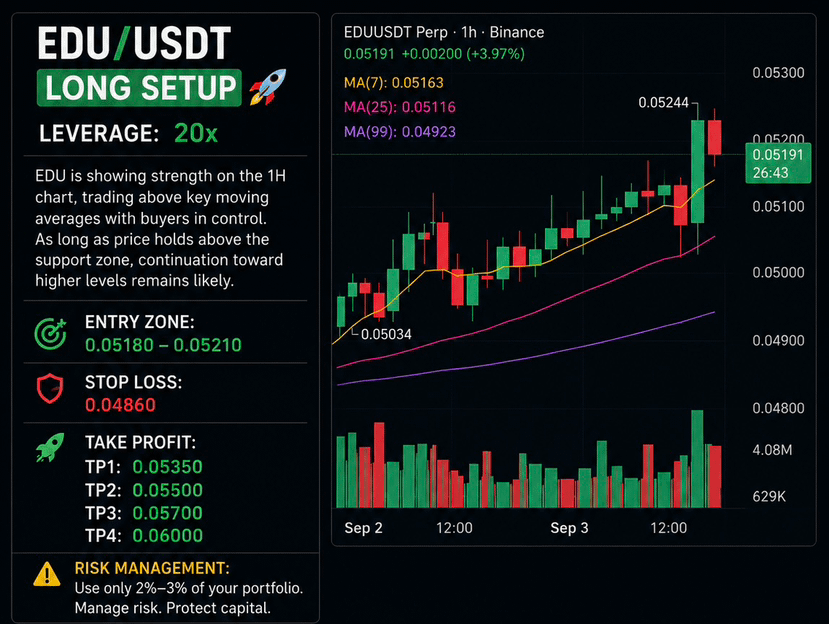
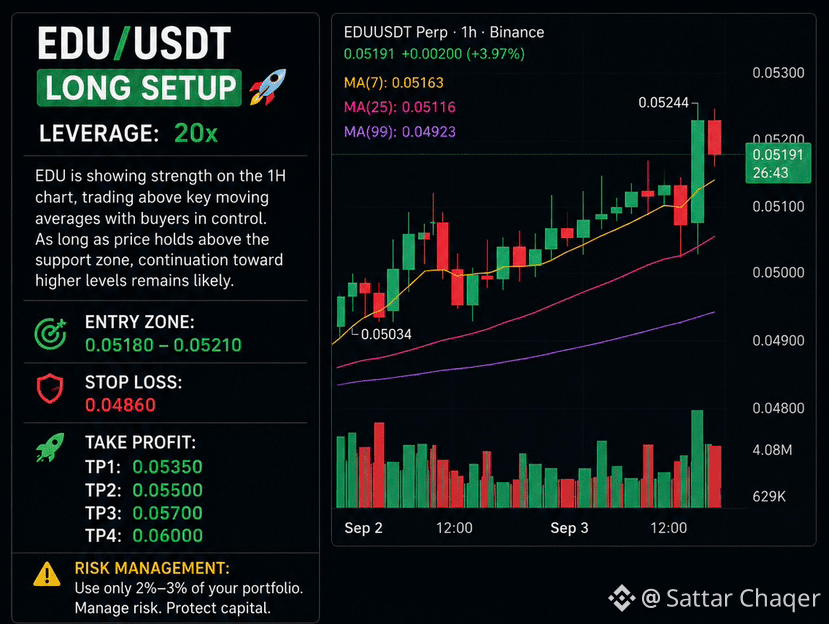
🚀 $EDU /USDT LONG | 20x
EDU 1H jadvalida qisqa muddatli o‘rtacha ko‘rsatkichlar (moving averages) ustida ushlab turibdi, narx esa yaqinda bo‘lgan 0.05244 maksimumiga hali ham yaqin.
Men long uchun 0.05180–0.05210 zonasini kuzatyapman. Agar shu zona ushlansa, men ko‘rayotgan keyingi darajalar:
🎯 Kirish: 0.05180 – 0.05210
🔥 TP1: 0.05350
🔥 TP2: 0.05500
🔥 TP3: 0.05700
🔥 TP4: 0.06000
🛑 SL: 0.04860
⚡ Leverage: 20x
Pozitsiya hajmini nazoratda saqlang. 20x leverage tez harakat qiladi, shuning uchun riskni boshqarish entry quvishdan muhimroq.
Moliyaviy maslahat emas. Reja bilan savdo qiling.
EDU 1H jadvalida qisqa muddatli o‘rtacha ko‘rsatkichlar (moving averages) ustida ushlab turibdi, narx esa yaqinda bo‘lgan 0.05244 maksimumiga hali ham yaqin.
Men long uchun 0.05180–0.05210 zonasini kuzatyapman. Agar shu zona ushlansa, men ko‘rayotgan keyingi darajalar:
🎯 Kirish: 0.05180 – 0.05210
🔥 TP1: 0.05350
🔥 TP2: 0.05500
🔥 TP3: 0.05700
🔥 TP4: 0.06000
🛑 SL: 0.04860
⚡ Leverage: 20x
Pozitsiya hajmini nazoratda saqlang. 20x leverage tez harakat qiladi, shuning uchun riskni boshqarish entry quvishdan muhimroq.
Moliyaviy maslahat emas. Reja bilan savdo qiling.
1
404
Tarjimani ko‘rish
$FLOCK first TP1 HIT
{future}(FLOCKUSDT)
$FLOCK first TP1 HIT
Sattar Chaqer
·
--
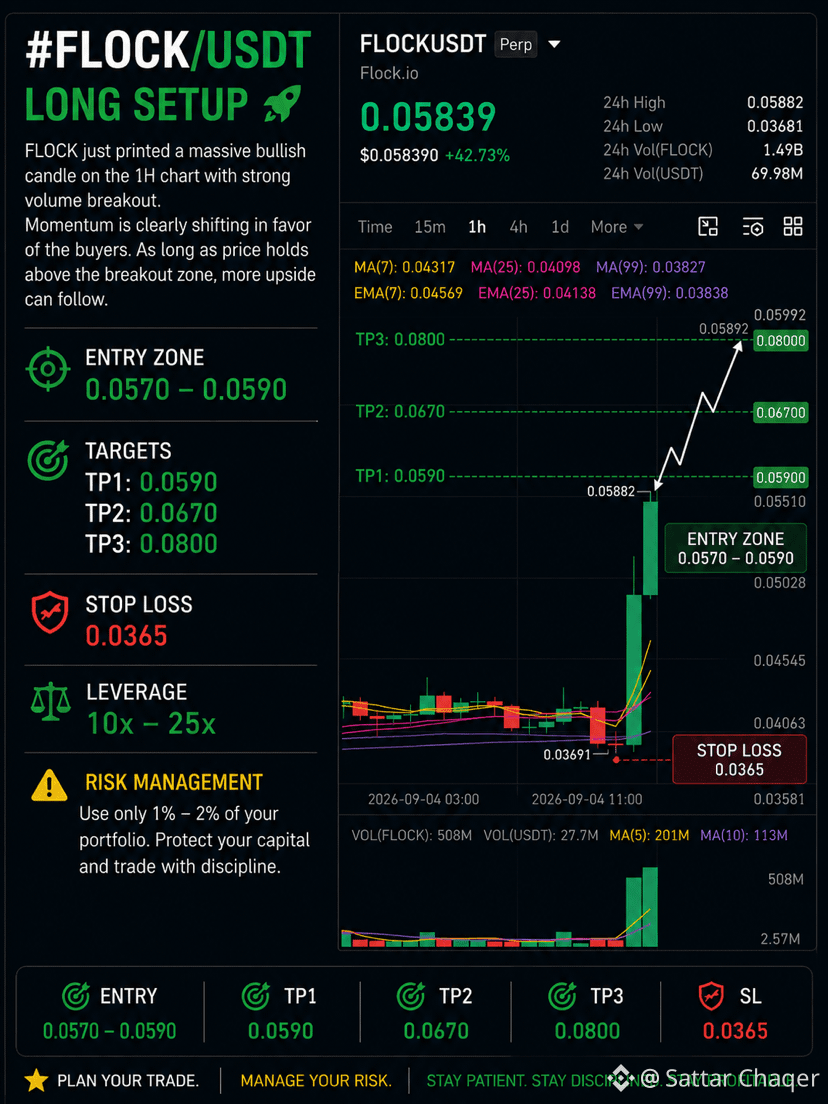
🟢 $FLOCK /USDT — LONG | 10–25x
FLOCK just broke out hard on the 1H chart, with a strong volume spike behind the move. Price is sitting near the recent high, so I’d rather wait for a pullback into the entry zone than chase the candle.
📌 ENTRY: 0.0570 → 0.0590
🎯 TP1: 0.0615
🎯 TP2: 0.0690
🎯 TP3: 0.0820
🛑 SL: 0.0500
⚡ LEVERAGE: 10–25x
⚠️ RISK: Use only 1–2% of your portfolio.
The breakout has momentum, but after a move this fast, the entry matters. If price loses the zone, I’d skip the setup.
FLOCK just broke out hard on the 1H chart, with a strong volume spike behind the move. Price is sitting near the recent high, so I’d rather wait for a pullback into the entry zone than chase the candle.
📌 ENTRY: 0.0570 → 0.0590
🎯 TP1: 0.0615
🎯 TP2: 0.0690
🎯 TP3: 0.0820
🛑 SL: 0.0500
⚡ LEVERAGE: 10–25x
⚠️ RISK: Use only 1–2% of your portfolio.
The breakout has momentum, but after a move this fast, the entry matters. If price loses the zone, I’d skip the setup.
300
Tarjimani ko‘rish
🟢 $FLOCK /USDT — LONG | 10–25x
FLOCK just broke out hard on the 1H chart, with a strong volume spike behind the move. Price is sitting near the recent high, so I’d rather wait for a pullback into the entry zone than chase the candle.
📌 ENTRY: 0.0570 → 0.0590
🎯 TP1: 0.0615
🎯 TP2: 0.0690
🎯 TP3: 0.0820
🛑 SL: 0.0500
⚡ LEVERAGE: 10–25x
⚠️ RISK: Use only 1–2% of your portfolio.
The breakout has momentum, but after a move this fast, the entry matters. If price loses the zone, I’d skip the setup.
{future}(FLOCKUSDT)
🟢 $FLOCK /USDT — LONG | 10–25x
FLOCK just broke out hard on the 1H chart, with a strong volume spike behind the move. Price is sitting near the recent high, so I’d rather wait for a pullback into the entry zone than chase the candle.
📌 ENTRY: 0.0570 → 0.0590
🎯 TP1: 0.0615
🎯 TP2: 0.0690
🎯 TP3: 0.0820
🛑 SL: 0.0500
⚡ LEVERAGE: 10–25x
⚠️ RISK: Use only 1–2% of your portfolio.
The breakout has momentum, but after a move this fast, the entry matters. If price loses the zone, I’d skip the setup.
FLOCK just broke out hard on the 1H chart, with a strong volume spike behind the move. Price is sitting near the recent high, so I’d rather wait for a pullback into the entry zone than chase the candle.
📌 ENTRY: 0.0570 → 0.0590
🎯 TP1: 0.0615
🎯 TP2: 0.0690
🎯 TP3: 0.0820
🛑 SL: 0.0500
⚡ LEVERAGE: 10–25x
⚠️ RISK: Use only 1–2% of your portfolio.
The breakout has momentum, but after a move this fast, the entry matters. If price loses the zone, I’d skip the setup.
2
4
563
Tarjimani ko‘rish
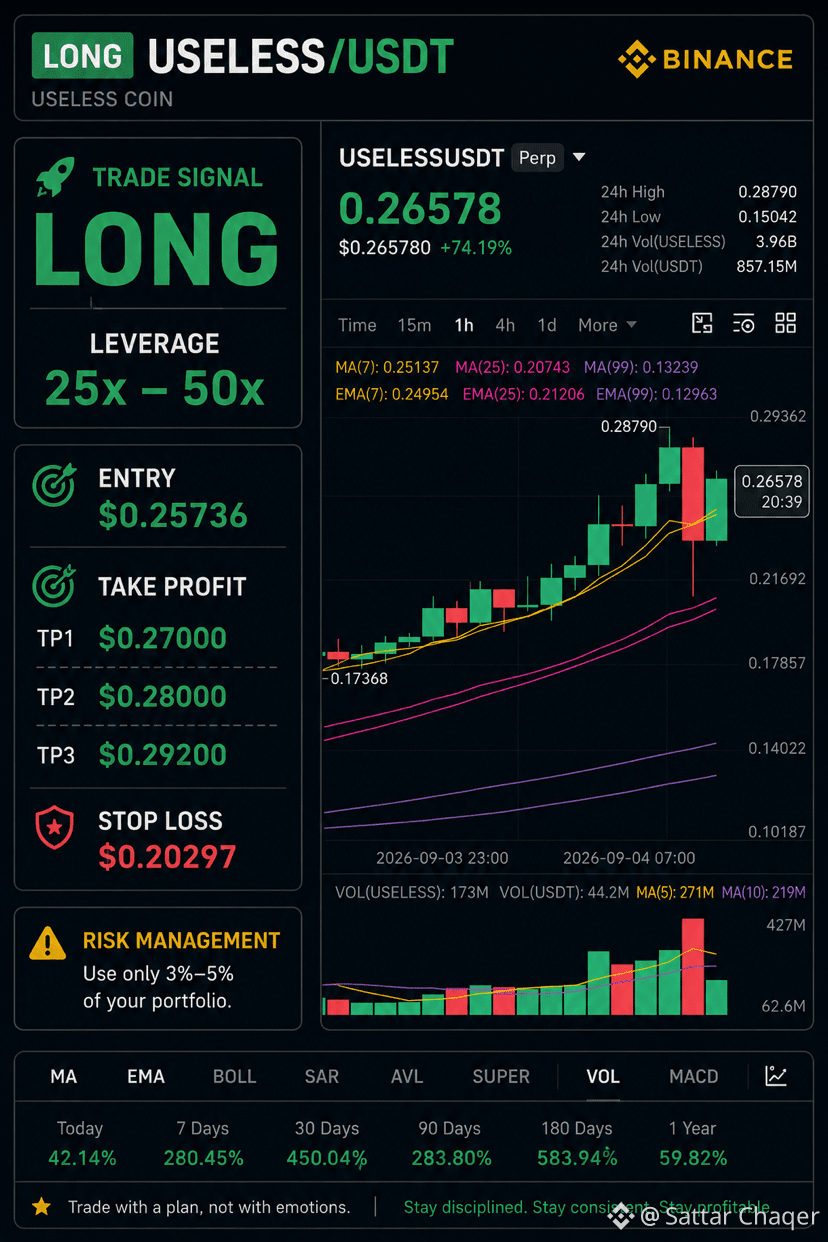
🟢 $USELESS /USDT — LONG | 25–50x
USELESS is holding above the short-term moving averages on the 1H chart after a strong move. Price is currently around $0.2658, with the recent high near $0.2879.
📌 ENTRY: $0.25736
🎯 TP1: $0.27000
🎯 TP2: $0.28000
🎯 TP3: $0.29200
🛑 SL: $0.20297
⚠️ RISK MANAGEMENT: Use only 3–5% of your portfolio.
Price has already moved hard, so I’d avoid chasing a breakout. The entry zone matters here.
{future}(USELESSUSDT)
🟢 $USELESS /USDT — LONG | 25–50x
USELESS is holding above the short-term moving averages on the 1H chart after a strong move. Price is currently around $0.2658, with the recent high near $0.2879.
📌 ENTRY: $0.25736
🎯 TP1: $0.27000
🎯 TP2: $0.28000
🎯 TP3: $0.29200
🛑 SL: $0.20297
⚠️ RISK MANAGEMENT: Use only 3–5% of your portfolio.
Price has already moved hard, so I’d avoid chasing a breakout. The entry zone matters here.
USELESS is holding above the short-term moving averages on the 1H chart after a strong move. Price is currently around $0.2658, with the recent high near $0.2879.
📌 ENTRY: $0.25736
🎯 TP1: $0.27000
🎯 TP2: $0.28000
🎯 TP3: $0.29200
🛑 SL: $0.20297
⚠️ RISK MANAGEMENT: Use only 3–5% of your portfolio.
Price has already moved hard, so I’d avoid chasing a breakout. The entry zone matters here.
1
391
Tarjimani ko‘rish
TP 1 HITS
TP 1 HITS
Sattar Chaqer
·
--
🚀 $EDU /USDT LONG | 20x
EDU 1H jadvalida qisqa muddatli o‘rtacha ko‘rsatkichlar (moving averages) ustida ushlab turibdi, narx esa yaqinda bo‘lgan 0.05244 maksimumiga hali ham yaqin.
Men long uchun 0.05180–0.05210 zonasini kuzatyapman. Agar shu zona ushlansa, men ko‘rayotgan keyingi darajalar:
🎯 Kirish: 0.05180 – 0.05210
🔥 TP1: 0.05350
🔥 TP2: 0.05500
🔥 TP3: 0.05700
🔥 TP4: 0.06000
🛑 SL: 0.04860
⚡ Leverage: 20x
Pozitsiya hajmini nazoratda saqlang. 20x leverage tez harakat qiladi, shuning uchun riskni boshqarish entry quvishdan muhimroq.
Moliyaviy maslahat emas. Reja bilan savdo qiling.
EDU 1H jadvalida qisqa muddatli o‘rtacha ko‘rsatkichlar (moving averages) ustida ushlab turibdi, narx esa yaqinda bo‘lgan 0.05244 maksimumiga hali ham yaqin.
Men long uchun 0.05180–0.05210 zonasini kuzatyapman. Agar shu zona ushlansa, men ko‘rayotgan keyingi darajalar:
🎯 Kirish: 0.05180 – 0.05210
🔥 TP1: 0.05350
🔥 TP2: 0.05500
🔥 TP3: 0.05700
🔥 TP4: 0.06000
🛑 SL: 0.04860
⚡ Leverage: 20x
Pozitsiya hajmini nazoratda saqlang. 20x leverage tez harakat qiladi, shuning uchun riskni boshqarish entry quvishdan muhimroq.
Moliyaviy maslahat emas. Reja bilan savdo qiling.
1
219
Tarjimani ko‘rish
All TP HITS
All TP HITS
Sattar Chaqer
·
--
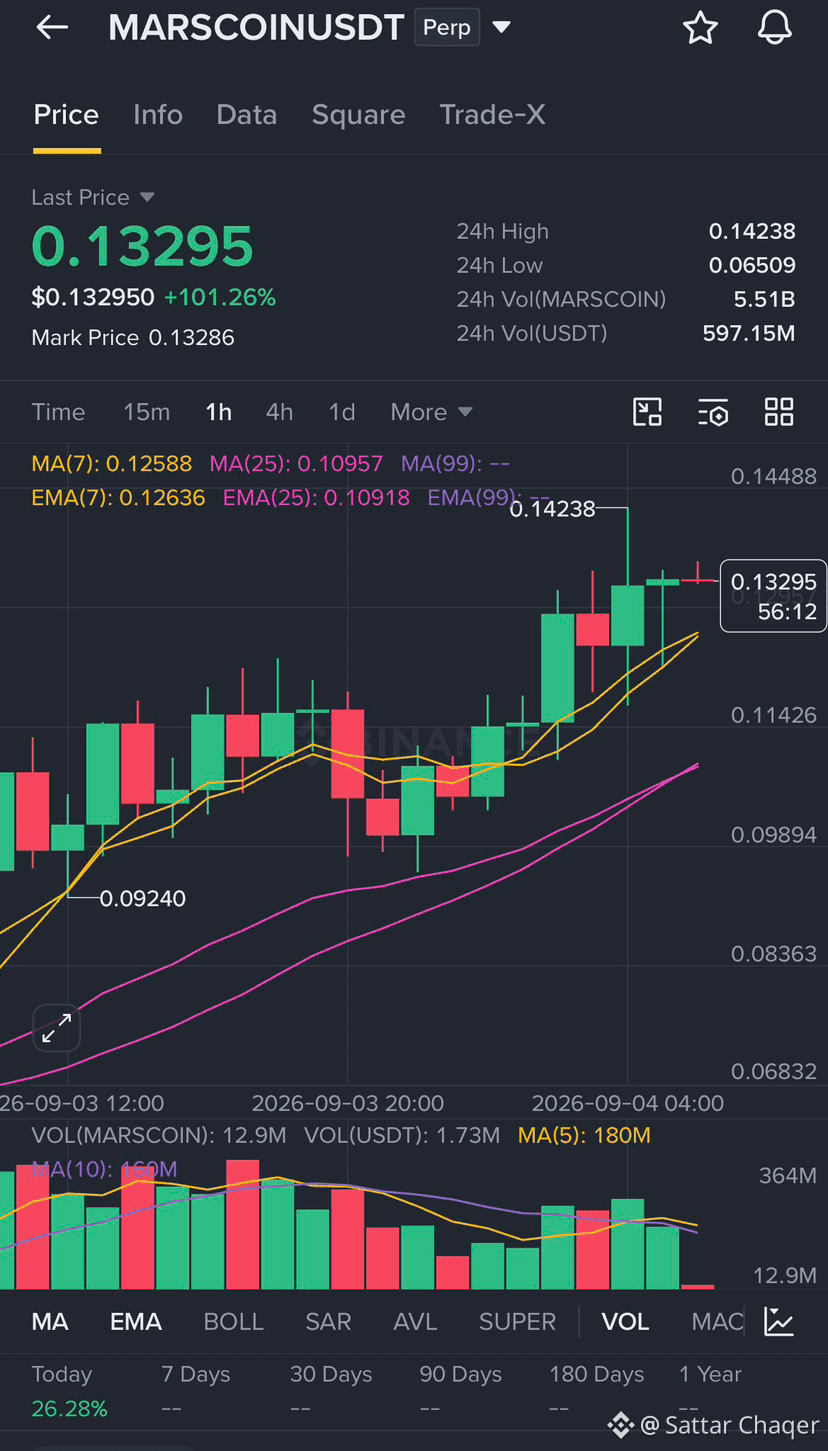
🚀 $MARSCOIN /USDT LONG | 25x
MARSCOIN is holding above the short-term moving averages on the 1H chart after a strong push higher. Price is now consolidating below the recent 0.12181 high.
I’m watching the 0.1100–0.1135 area for a long continuation setup.
🎯 ENTRY: 0.1100 → 0.1135
🚀 TP1: 0.1190
🚀 TP2: 0.1235
🚀 TP3: 0.1290
🛑 SL: 0.1035
⚡ LEVERAGE: 25x
⚠️ RISK MANAGEMENT: Use only 1% of your portfolio.
If price loses the entry zone with strong selling pressure, I’d avoid forcing the trade.
MARSCOIN is holding above the short-term moving averages on the 1H chart after a strong push higher. Price is now consolidating below the recent 0.12181 high.
I’m watching the 0.1100–0.1135 area for a long continuation setup.
🎯 ENTRY: 0.1100 → 0.1135
🚀 TP1: 0.1190
🚀 TP2: 0.1235
🚀 TP3: 0.1290
🛑 SL: 0.1035
⚡ LEVERAGE: 25x
⚠️ RISK MANAGEMENT: Use only 1% of your portfolio.
If price loses the entry zone with strong selling pressure, I’d avoid forcing the trade.
1
310
Tarjimani ko‘rish
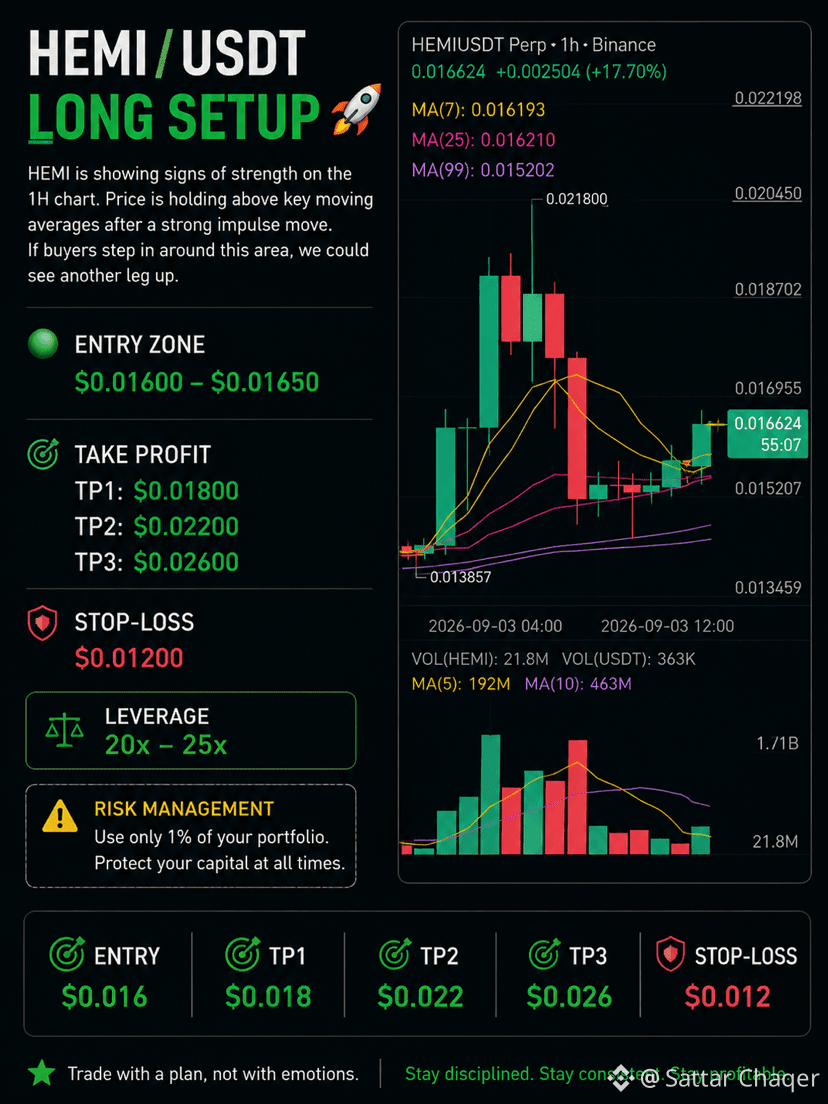
🟢 $HEMI /USDT — LONG
HEMI is holding around the $0.0160 area after the strong move earlier. On the 1H chart, price is still sitting around the short-term moving averages, so I’m watching this zone for another push higher.
📌 ENTRY: $0.01600 → $0.01650
🎯 TP1: $0.01800
🎯 TP2: $0.02200
🎯 TP3: $0.02600
🛑 SL: $0.01200
⚡ LEVERAGE: 20x–25x
⚠️ RISK MANAGEMENT: Use only 1% of your portfolio.
If HEMI loses the entry zone and selling volume picks up, I’d stay out instead of forcing the setup.
{future}(HEMIUSDT)
🟢 $HEMI /USDT — LONG
HEMI is holding around the $0.0160 area after the strong move earlier. On the 1H chart, price is still sitting around the short-term moving averages, so I’m watching this zone for another push higher.
📌 ENTRY: $0.01600 → $0.01650
🎯 TP1: $0.01800
🎯 TP2: $0.02200
🎯 TP3: $0.02600
🛑 SL: $0.01200
⚡ LEVERAGE: 20x–25x
⚠️ RISK MANAGEMENT: Use only 1% of your portfolio.
If HEMI loses the entry zone and selling volume picks up, I’d stay out instead of forcing the setup.
HEMI is holding around the $0.0160 area after the strong move earlier. On the 1H chart, price is still sitting around the short-term moving averages, so I’m watching this zone for another push higher.
📌 ENTRY: $0.01600 → $0.01650
🎯 TP1: $0.01800
🎯 TP2: $0.02200
🎯 TP3: $0.02600
🛑 SL: $0.01200
⚡ LEVERAGE: 20x–25x
⚠️ RISK MANAGEMENT: Use only 1% of your portfolio.
If HEMI loses the entry zone and selling volume picks up, I’d stay out instead of forcing the setup.
5
1.9k
Tarjimani ko‘rish
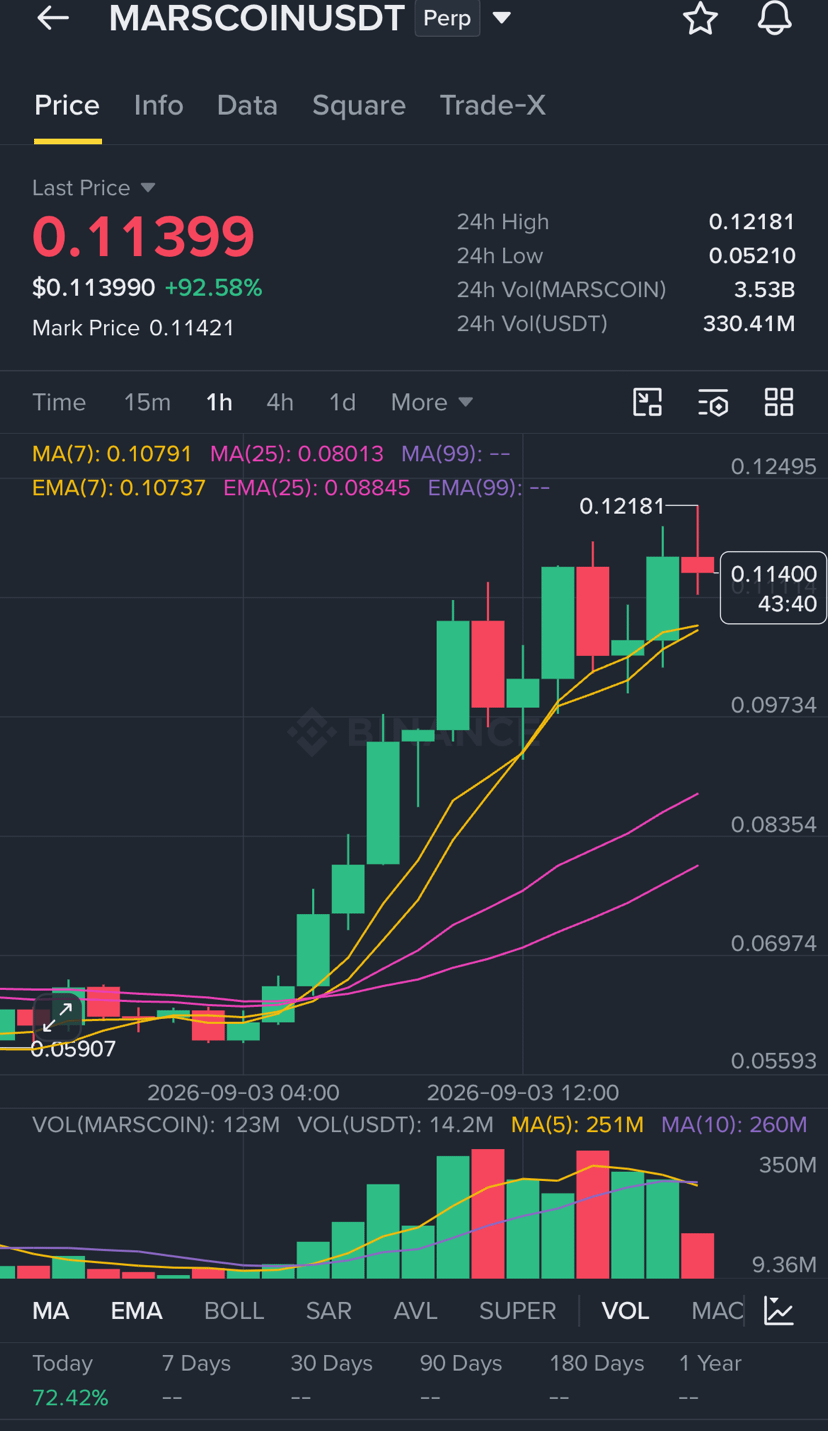
🚀 $MARSCOIN /USDT LONG | 25x
MARSCOIN is holding above the short-term moving averages on the 1H chart after a strong push higher. Price is now consolidating below the recent 0.12181 high.
I’m watching the 0.1100–0.1135 area for a long continuation setup.
🎯 ENTRY: 0.1100 → 0.1135
🚀 TP1: 0.1190
🚀 TP2: 0.1235
🚀 TP3: 0.1290
🛑 SL: 0.1035
⚡ LEVERAGE: 25x
⚠️ RISK MANAGEMENT: Use only 1% of your portfolio.
If price loses the entry zone with strong selling pressure, I’d avoid forcing the trade.
{future}(MARSCOINUSDT)
🚀 $MARSCOIN /USDT LONG | 25x
MARSCOIN is holding above the short-term moving averages on the 1H chart after a strong push higher. Price is now consolidating below the recent 0.12181 high.
I’m watching the 0.1100–0.1135 area for a long continuation setup.
🎯 ENTRY: 0.1100 → 0.1135
🚀 TP1: 0.1190
🚀 TP2: 0.1235
🚀 TP3: 0.1290
🛑 SL: 0.1035
⚡ LEVERAGE: 25x
⚠️ RISK MANAGEMENT: Use only 1% of your portfolio.
If price loses the entry zone with strong selling pressure, I’d avoid forcing the trade.
MARSCOIN is holding above the short-term moving averages on the 1H chart after a strong push higher. Price is now consolidating below the recent 0.12181 high.
I’m watching the 0.1100–0.1135 area for a long continuation setup.
🎯 ENTRY: 0.1100 → 0.1135
🚀 TP1: 0.1190
🚀 TP2: 0.1235
🚀 TP3: 0.1290
🛑 SL: 0.1035
⚡ LEVERAGE: 25x
⚠️ RISK MANAGEMENT: Use only 1% of your portfolio.
If price loses the entry zone with strong selling pressure, I’d avoid forcing the trade.
1
3
1.6k
🚀 $EDU /USDT LONG | 20x
EDU 1H jadvalida qisqa muddatli o‘rtacha ko‘rsatkichlar (moving averages) ustida ushlab turibdi, narx esa yaqinda bo‘lgan 0.05244 maksimumiga hali ham yaqin.
Men long uchun 0.05180–0.05210 zonasini kuzatyapman. Agar shu zona ushlansa, men ko‘rayotgan keyingi darajalar:
🎯 Kirish: 0.05180 – 0.05210
🔥 TP1: 0.05350
🔥 TP2: 0.05500
🔥 TP3: 0.05700
🔥 TP4: 0.06000
🛑 SL: 0.04860
⚡ Leverage: 20x
Pozitsiya hajmini nazoratda saqlang. 20x leverage tez harakat qiladi, shuning uchun riskni boshqarish entry quvishdan muhimroq.
Moliyaviy maslahat emas. Reja bilan savdo qiling.
{future}(EDUUSDT)
🚀 $EDU /USDT LONG | 20x
EDU 1H jadvalida qisqa muddatli o‘rtacha ko‘rsatkichlar (moving averages) ustida ushlab turibdi, narx esa yaqinda bo‘lgan 0.05244 maksimumiga hali ham yaqin.
Men long uchun 0.05180–0.05210 zonasini kuzatyapman. Agar shu zona ushlansa, men ko‘rayotgan keyingi darajalar:
🎯 Kirish: 0.05180 – 0.05210
🔥 TP1: 0.05350
🔥 TP2: 0.05500
🔥 TP3: 0.05700
🔥 TP4: 0.06000
🛑 SL: 0.04860
⚡ Leverage: 20x
Pozitsiya hajmini nazoratda saqlang. 20x leverage tez harakat qiladi, shuning uchun riskni boshqarish entry quvishdan muhimroq.
Moliyaviy maslahat emas. Reja bilan savdo qiling.
EDU 1H jadvalida qisqa muddatli o‘rtacha ko‘rsatkichlar (moving averages) ustida ushlab turibdi, narx esa yaqinda bo‘lgan 0.05244 maksimumiga hali ham yaqin.
Men long uchun 0.05180–0.05210 zonasini kuzatyapman. Agar shu zona ushlansa, men ko‘rayotgan keyingi darajalar:
🎯 Kirish: 0.05180 – 0.05210
🔥 TP1: 0.05350
🔥 TP2: 0.05500
🔥 TP3: 0.05700
🔥 TP4: 0.06000
🛑 SL: 0.04860
⚡ Leverage: 20x
Pozitsiya hajmini nazoratda saqlang. 20x leverage tez harakat qiladi, shuning uchun riskni boshqarish entry quvishdan muhimroq.
Moliyaviy maslahat emas. Reja bilan savdo qiling.
1
2
1
318
Tasdiqlangan
Tarjimani ko‘rish
I used to think consensus was mostly about choosing the next block.
Dusk made me look at it differently.
With Succinct Attestation, a candidate block has to move through multiple stages before it becomes the new tip.
First comes Proposal, where a randomly selected provisioner generates and broadcasts a candidate block.
Then Validation. A committee checks the candidate against the current chain and votes on whether it is valid.
But Dusk doesn’t stop there.
A separate committee handles Ratification, voting on the result of the validation stage.
That separation is what caught my attention.
The network isn’t simply asking, “Do we have a block?”
It is asking whether the block is valid, whether that validation reached quorum, and whether another committee agrees with that outcome.
Only after successful ratification is the candidate accepted as the new tip.
That’s a very different way to think about consensus.
@Dusk_Foundation $DUSK #dusk
I used to think consensus was mostly about choosing the next block.
Dusk made me look at it differently.
With Succinct Attestation, a candidate block has to move through multiple stages before it becomes the new tip.
First comes Proposal, where a randomly selected provisioner generates and broadcasts a candidate block.
Then Validation. A committee checks the candidate against the current chain and votes on whether it is valid.
But Dusk doesn’t stop there.
A separate committee handles Ratification, voting on the result of the validation stage.
That separation is what caught my attention.
The network isn’t simply asking, “Do we have a block?”
It is asking whether the block is valid, whether that validation reached quorum, and whether another committee agrees with that outcome.
Only after successful ratification is the candidate accepted as the new tip.
That’s a very different way to think about consensus.
@Dusk $DUSK #dusk
Dusk made me look at it differently.
With Succinct Attestation, a candidate block has to move through multiple stages before it becomes the new tip.
First comes Proposal, where a randomly selected provisioner generates and broadcasts a candidate block.
Then Validation. A committee checks the candidate against the current chain and votes on whether it is valid.
But Dusk doesn’t stop there.
A separate committee handles Ratification, voting on the result of the validation stage.
That separation is what caught my attention.
The network isn’t simply asking, “Do we have a block?”
It is asking whether the block is valid, whether that validation reached quorum, and whether another committee agrees with that outcome.
Only after successful ratification is the candidate accepted as the new tip.
That’s a very different way to think about consensus.
@Dusk $DUSK #dusk
1
5
156
·
--
O‘suvchi
Tasdiqlangan
Staking shartnomasi amalda qanday mukofot taqsimlash qoidalarini o‘rnatishi mumkin
Kunning ikkinchi yarmida Dusk’dagi staking shartnomasi aslida nimani sozlashga ruxsat berilishini kuzatib chiqdim va men ancha tor variantlar to‘plamini kutgandim. Ammo u tor emas.
Dusk’ning Stake Abstraction haqidagi o‘z hujjatlari shuni tasdiqlaydiki, shartnomalar mukofotlarning bir qismini tavsiya qiluvchilar, hamkorlar yoki operatorlarga yo‘naltirish uchun ixtiyoriy mukofot taqsimlash qoidalarini, butunlay shartnomaning o‘z ixtiyoriga ko‘ra, amalga oshirishi mumkin. Bu qat’iy protokol darajasidagi foiz emas. Bu haqiqatan ham ochiq sozlash maydoni.$BTR
Aynan shu qismi esimda qoldi.
Protokol majburan soddalikni bir chetga surib, shartnomani joylashtirayotgan kim bo‘lsa, mukofotlar undan foydalanuvchi odamlar o‘rtasida aslida qanday taqsimlanishini o‘zi belgilashiga imkon berish evaziga. Yuqoridan hech qanday standart taqsimot yuklanmaydi.$TAC
Lekin biroz to‘xtang, men bu yerda aslida nimani bilishim haqida aniq bo‘lishni istayman. Dusk amalda ushbu modelning namunasi sifatida Sozu’ni, ya’ni avtomatlashtirilgan staking hovuzini tilga oladi. Ammo men hech qayerda hujjatlashtirilgan Sozu’ning joriy joylashtirilish holatini topmadim: mainnet’da ishlayaptimi, faqat testnet’dami yoki shular orasidagi nimadir. Bu borada taxmin qilmayman.@Dusk_Foundation
Sozu’ning aniq holatidan qat’i nazar, bu amalda nimani ta’minlashiga qayta-qayta murojaat qildim: tavsiyaga asoslangan staking xizmatlari, operator to‘lovi modellari, affiliate dasturlari — bularning barchasi texnik jihatdan mumkin, buning uchun Dusk’ning o‘zi ularning hech birini qurishi shart emas.#dusk
Demak, ochiq mukofot taqsimoti haqiqatan foydali staking mahsulotlarini yaratadimi yoki shunchaki ishonch savolini “Dusk’ning protokoli menga adolatli munosabat qiladimi?” degan savoldan “ushbu aniq shartnoma operatori menga adolatli munosabat qiladimi?” degan savolga o‘zgartiradimi?$DUSK
Staking shartnomasi amalda qanday mukofot taqsimlash qoidalarini o‘rnatishi mumkin
Kunning ikkinchi yarmida Dusk’dagi staking shartnomasi aslida nimani sozlashga ruxsat berilishini kuzatib chiqdim va men ancha tor variantlar to‘plamini kutgandim. Ammo u tor emas.
Dusk’ning Stake Abstraction haqidagi o‘z hujjatlari shuni tasdiqlaydiki, shartnomalar mukofotlarning bir qismini tavsiya qiluvchilar, hamkorlar yoki operatorlarga yo‘naltirish uchun ixtiyoriy mukofot taqsimlash qoidalarini, butunlay shartnomaning o‘z ixtiyoriga ko‘ra, amalga oshirishi mumkin. Bu qat’iy protokol darajasidagi foiz emas. Bu haqiqatan ham ochiq sozlash maydoni.$BTR
Aynan shu qismi esimda qoldi.
Protokol majburan soddalikni bir chetga surib, shartnomani joylashtirayotgan kim bo‘lsa, mukofotlar undan foydalanuvchi odamlar o‘rtasida aslida qanday taqsimlanishini o‘zi belgilashiga imkon berish evaziga. Yuqoridan hech qanday standart taqsimot yuklanmaydi.$TAC
Lekin biroz to‘xtang, men bu yerda aslida nimani bilishim haqida aniq bo‘lishni istayman. Dusk amalda ushbu modelning namunasi sifatida Sozu’ni, ya’ni avtomatlashtirilgan staking hovuzini tilga oladi. Ammo men hech qayerda hujjatlashtirilgan Sozu’ning joriy joylashtirilish holatini topmadim: mainnet’da ishlayaptimi, faqat testnet’dami yoki shular orasidagi nimadir. Bu borada taxmin qilmayman.@Dusk
Sozu’ning aniq holatidan qat’i nazar, bu amalda nimani ta’minlashiga qayta-qayta murojaat qildim: tavsiyaga asoslangan staking xizmatlari, operator to‘lovi modellari, affiliate dasturlari — bularning barchasi texnik jihatdan mumkin, buning uchun Dusk’ning o‘zi ularning hech birini qurishi shart emas.#dusk
Demak, ochiq mukofot taqsimoti haqiqatan foydali staking mahsulotlarini yaratadimi yoki shunchaki ishonch savolini “Dusk’ning protokoli menga adolatli munosabat qiladimi?” degan savoldan “ushbu aniq shartnoma operatori menga adolatli munosabat qiladimi?” degan savolga o‘zgartiradimi?$DUSK
Kunning ikkinchi yarmida Dusk’dagi staking shartnomasi aslida nimani sozlashga ruxsat berilishini kuzatib chiqdim va men ancha tor variantlar to‘plamini kutgandim. Ammo u tor emas.
Dusk’ning Stake Abstraction haqidagi o‘z hujjatlari shuni tasdiqlaydiki, shartnomalar mukofotlarning bir qismini tavsiya qiluvchilar, hamkorlar yoki operatorlarga yo‘naltirish uchun ixtiyoriy mukofot taqsimlash qoidalarini, butunlay shartnomaning o‘z ixtiyoriga ko‘ra, amalga oshirishi mumkin. Bu qat’iy protokol darajasidagi foiz emas. Bu haqiqatan ham ochiq sozlash maydoni.$BTR
Aynan shu qismi esimda qoldi.
Protokol majburan soddalikni bir chetga surib, shartnomani joylashtirayotgan kim bo‘lsa, mukofotlar undan foydalanuvchi odamlar o‘rtasida aslida qanday taqsimlanishini o‘zi belgilashiga imkon berish evaziga. Yuqoridan hech qanday standart taqsimot yuklanmaydi.$TAC
Lekin biroz to‘xtang, men bu yerda aslida nimani bilishim haqida aniq bo‘lishni istayman. Dusk amalda ushbu modelning namunasi sifatida Sozu’ni, ya’ni avtomatlashtirilgan staking hovuzini tilga oladi. Ammo men hech qayerda hujjatlashtirilgan Sozu’ning joriy joylashtirilish holatini topmadim: mainnet’da ishlayaptimi, faqat testnet’dami yoki shular orasidagi nimadir. Bu borada taxmin qilmayman.@Dusk
Sozu’ning aniq holatidan qat’i nazar, bu amalda nimani ta’minlashiga qayta-qayta murojaat qildim: tavsiyaga asoslangan staking xizmatlari, operator to‘lovi modellari, affiliate dasturlari — bularning barchasi texnik jihatdan mumkin, buning uchun Dusk’ning o‘zi ularning hech birini qurishi shart emas.#dusk
Demak, ochiq mukofot taqsimoti haqiqatan foydali staking mahsulotlarini yaratadimi yoki shunchaki ishonch savolini “Dusk’ning protokoli menga adolatli munosabat qiladimi?” degan savoldan “ushbu aniq shartnoma operatori menga adolatli munosabat qiladimi?” degan savolga o‘zgartiradimi?$DUSK
Useful flexibility
100%
New trust question
0%
1 Ovozlar • Ovoz berish yopildi
1
5
522
·
--
Pasayuvchi
Tasdiqlangan
Maxfiylik faqat miqdorni yashirish haqida emas.
Feniksda menga qiziq tuyulgani shundaki, u tranzaksiyalarni bir-biriga bog‘lab bo‘lmasligini ham maqsad qiladi.
Feniks Merkle daraxtida saqlanadigan eslatmalardan (notes) foydalanadi. Har bir eslatmaning o‘ziga xos eslatma uchun ochiq kaliti (note public key) bo‘ladi.
Bir xil ochiq kalitni yana-yaniga ishlatish o‘rniga, Feniks har bir eslatma uchun bir martalik eslatma ochiq kalitini yaratadi.
Bu menga ayniqsa ta’sir qildi, chunki bir xil identifikatorni qayta ishlatish turli tranzaksiyalarni aynan bitta foydalanuvchiga bog‘lashni osonlashtirishi mumkin.$GRASS
Oq qog‘ozda aytilishicha, bu bir martalik kalit tranzaksiyalar o‘rtasida bog‘lab bo‘lmaslik (unlinkability)ni ta’minlash uchun mo‘ljallangan.$UAI
Yana bir qismi menga qiziq bo‘ldi.
Qabul qiluvchi eslatmaga tegishli ekanini tekshirish uchun view key (ko‘rish kaliti)dan foydalanishi mumkin, ammo o‘sha eslatmani sarflash uchun kerak bo‘ladigan maxfiy kalit faqat u o‘zining to‘liq maxfiy kalitiga asoslanib hosil qilinadi.
Demak, bu yerda maxfiylik g‘oyasi shunchaki hammasini yashirish emas.
Bu — omma oldida nimani bog‘lash mumkinligini nazorat qilish haqida.
Shundan keyin men Feniksga boshqacha qaray boshladim.
Xususiy tranzaksiya degan narsa bir narsa.
Kimdir bir nechta tranzaksiyani ko‘rib, ularni bir-biriga bog‘lashi qiyinroq bo‘lishi esa boshqa narsa.
Rostini aytsam, ikkinchi qismi ehtimol shunchalik muhim.
@Dusk_Foundation $DUSK #dusk
Maxfiylik uchun eng muhimi nima?
Maxfiylik faqat miqdorni yashirish haqida emas.
Feniksda menga qiziq tuyulgani shundaki, u tranzaksiyalarni bir-biriga bog‘lab bo‘lmasligini ham maqsad qiladi.
Feniks Merkle daraxtida saqlanadigan eslatmalardan (notes) foydalanadi. Har bir eslatmaning o‘ziga xos eslatma uchun ochiq kaliti (note public key) bo‘ladi.
Bir xil ochiq kalitni yana-yaniga ishlatish o‘rniga, Feniks har bir eslatma uchun bir martalik eslatma ochiq kalitini yaratadi.
Bu menga ayniqsa ta’sir qildi, chunki bir xil identifikatorni qayta ishlatish turli tranzaksiyalarni aynan bitta foydalanuvchiga bog‘lashni osonlashtirishi mumkin.$GRASS
Oq qog‘ozda aytilishicha, bu bir martalik kalit tranzaksiyalar o‘rtasida bog‘lab bo‘lmaslik (unlinkability)ni ta’minlash uchun mo‘ljallangan.$UAI
Yana bir qismi menga qiziq bo‘ldi.
Qabul qiluvchi eslatmaga tegishli ekanini tekshirish uchun view key (ko‘rish kaliti)dan foydalanishi mumkin, ammo o‘sha eslatmani sarflash uchun kerak bo‘ladigan maxfiy kalit faqat u o‘zining to‘liq maxfiy kalitiga asoslanib hosil qilinadi.
Demak, bu yerda maxfiylik g‘oyasi shunchaki hammasini yashirish emas.
Bu — omma oldida nimani bog‘lash mumkinligini nazorat qilish haqida.
Shundan keyin men Feniksga boshqacha qaray boshladim.
Xususiy tranzaksiya degan narsa bir narsa.
Kimdir bir nechta tranzaksiyani ko‘rib, ularni bir-biriga bog‘lashi qiyinroq bo‘lishi esa boshqa narsa.
Rostini aytsam, ikkinchi qismi ehtimol shunchalik muhim.
@Dusk $DUSK #dusk
Maxfiylik uchun eng muhimi nima?
Feniksda menga qiziq tuyulgani shundaki, u tranzaksiyalarni bir-biriga bog‘lab bo‘lmasligini ham maqsad qiladi.
Feniks Merkle daraxtida saqlanadigan eslatmalardan (notes) foydalanadi. Har bir eslatmaning o‘ziga xos eslatma uchun ochiq kaliti (note public key) bo‘ladi.
Bir xil ochiq kalitni yana-yaniga ishlatish o‘rniga, Feniks har bir eslatma uchun bir martalik eslatma ochiq kalitini yaratadi.
Bu menga ayniqsa ta’sir qildi, chunki bir xil identifikatorni qayta ishlatish turli tranzaksiyalarni aynan bitta foydalanuvchiga bog‘lashni osonlashtirishi mumkin.$GRASS
Oq qog‘ozda aytilishicha, bu bir martalik kalit tranzaksiyalar o‘rtasida bog‘lab bo‘lmaslik (unlinkability)ni ta’minlash uchun mo‘ljallangan.$UAI
Yana bir qismi menga qiziq bo‘ldi.
Qabul qiluvchi eslatmaga tegishli ekanini tekshirish uchun view key (ko‘rish kaliti)dan foydalanishi mumkin, ammo o‘sha eslatmani sarflash uchun kerak bo‘ladigan maxfiy kalit faqat u o‘zining to‘liq maxfiy kalitiga asoslanib hosil qilinadi.
Demak, bu yerda maxfiylik g‘oyasi shunchaki hammasini yashirish emas.
Bu — omma oldida nimani bog‘lash mumkinligini nazorat qilish haqida.
Shundan keyin men Feniksga boshqacha qaray boshladim.
Xususiy tranzaksiya degan narsa bir narsa.
Kimdir bir nechta tranzaksiyani ko‘rib, ularni bir-biriga bog‘lashi qiyinroq bo‘lishi esa boshqa narsa.
Rostini aytsam, ikkinchi qismi ehtimol shunchalik muhim.
@Dusk $DUSK #dusk
Maxfiylik uchun eng muhimi nima?
🕵️ Unlinkable transactions
100%
👁️ Hidden amounts
0%
2 Ovozlar • Ovoz berish yopildi
3
3
1.5k
Tasdiqlangan
Tarjimani ko‘rish
Sending every blockchain message to everyone sounds safe. It also sounds incredibly wasteful.
That’s what made Kadcast interesting when I went through Dusk’s whitepaper.
Dusk uses Kadcast to broadcast blocks transactions and consensus votes. Instead of simply flooding every neighboring node with the same message Kadcast organizes nodes using ideas from Kademlia.
Each node keeps routing information grouped into buckets based on the XOR distance between node IDs.
Then the propagation gets more selective.
A node forwards a message to selected peers at increasing XOR distances. Those peers continue the process creating a structured cascade across the network.
Kadcast also uses multicast trees. A message starts with nearby peers which then pass it toward nodes farther away in the network. This lets the network cover its nodes with fewer relays instead of repeatedly sending the same information through unnecessary paths.$TUT
That distinction caught my attention because blockchain networking can become expensive when every node keeps forwarding everything to every neighbor.
The point isn’t just making messages move quickly.
It is reducing redundant transmissions while maintaining reliable and timely propagation.
I like this because it shows that blockchain performance isn’t only about consensus or block production.$PUMP
The network has to move information efficiently too.
Sometimes the smarter design isn’t sending more messages.
It’s knowing which nodes actually need to receive them.
@Dusk_Foundation $DUSK #dusk
What makes Kadcast efficient?
Sending every blockchain message to everyone sounds safe. It also sounds incredibly wasteful.
That’s what made Kadcast interesting when I went through Dusk’s whitepaper.
Dusk uses Kadcast to broadcast blocks transactions and consensus votes. Instead of simply flooding every neighboring node with the same message Kadcast organizes nodes using ideas from Kademlia.
Each node keeps routing information grouped into buckets based on the XOR distance between node IDs.
Then the propagation gets more selective.
A node forwards a message to selected peers at increasing XOR distances. Those peers continue the process creating a structured cascade across the network.
Kadcast also uses multicast trees. A message starts with nearby peers which then pass it toward nodes farther away in the network. This lets the network cover its nodes with fewer relays instead of repeatedly sending the same information through unnecessary paths.$TUT
That distinction caught my attention because blockchain networking can become expensive when every node keeps forwarding everything to every neighbor.
The point isn’t just making messages move quickly.
It is reducing redundant transmissions while maintaining reliable and timely propagation.
I like this because it shows that blockchain performance isn’t only about consensus or block production.$PUMP
The network has to move information efficiently too.
Sometimes the smarter design isn’t sending more messages.
It’s knowing which nodes actually need to receive them.
@Dusk $DUSK #dusk
What makes Kadcast efficient?
That’s what made Kadcast interesting when I went through Dusk’s whitepaper.
Dusk uses Kadcast to broadcast blocks transactions and consensus votes. Instead of simply flooding every neighboring node with the same message Kadcast organizes nodes using ideas from Kademlia.
Each node keeps routing information grouped into buckets based on the XOR distance between node IDs.
Then the propagation gets more selective.
A node forwards a message to selected peers at increasing XOR distances. Those peers continue the process creating a structured cascade across the network.
Kadcast also uses multicast trees. A message starts with nearby peers which then pass it toward nodes farther away in the network. This lets the network cover its nodes with fewer relays instead of repeatedly sending the same information through unnecessary paths.$TUT
That distinction caught my attention because blockchain networking can become expensive when every node keeps forwarding everything to every neighbor.
The point isn’t just making messages move quickly.
It is reducing redundant transmissions while maintaining reliable and timely propagation.
I like this because it shows that blockchain performance isn’t only about consensus or block production.$PUMP
The network has to move information efficiently too.
Sometimes the smarter design isn’t sending more messages.
It’s knowing which nodes actually need to receive them.
@Dusk $DUSK #dusk
What makes Kadcast efficient?
🌐 Selective propagation
0%
🔁 More message flooding
100%
1 Ovozlar • Ovoz berish yopildi
2
8
578
Tarjimani ko‘rish
The market is bringing some interesting names again. $TRUMP $BEAT Both are getting plenty of attention on the chart. At this point I’m just trying to figure out how everyone finds these moves before I do.
I used to think a failed smart contract call was basically just an error.
But the more I looked at DuskVM the more interesting the failure path became.
Before execution gets underway Dusk checks things like the sender’s balance signature and nonce. If those basic conditions fail the transaction doesn’t get to execute normally.
But what happens when something goes wrong during execution?
That’s the part I find more important.
A smart contract can make state changes while running but a failed call doesn’t simply leave those changes sitting there. The state changes from that failed execution are not committed.
So you don’t end up with a contract stuck halfway between its old state and an incomplete new one.
Gas matters here too. Contract execution consumes gas which means failure isn’t just about whether the final result was successful. There are still execution resources involved along the way.
That made me rethink what safe execution actually means.
It isn’t only about making successful transactions work.
It’s also about having predictable behavior when execution fails.
For financial applications that distinction matters. A system handling valuable assets needs to know what happens when the expected path breaks.
Sometimes the most important part of a smart contract isn’t what happens when everything goes right.
It’s what the network does when it doesn’t.
@Dusk_Foundation $DUSK #dusk
What matters most when calls fail?
The market is bringing some interesting names again. $TRUMP $BEAT Both are getting plenty of attention on the chart. At this point I’m just trying to figure out how everyone finds these moves before I do.
I used to think a failed smart contract call was basically just an error.
But the more I looked at DuskVM the more interesting the failure path became.
Before execution gets underway Dusk checks things like the sender’s balance signature and nonce. If those basic conditions fail the transaction doesn’t get to execute normally.
But what happens when something goes wrong during execution?
That’s the part I find more important.
A smart contract can make state changes while running but a failed call doesn’t simply leave those changes sitting there. The state changes from that failed execution are not committed.
So you don’t end up with a contract stuck halfway between its old state and an incomplete new one.
Gas matters here too. Contract execution consumes gas which means failure isn’t just about whether the final result was successful. There are still execution resources involved along the way.
That made me rethink what safe execution actually means.
It isn’t only about making successful transactions work.
It’s also about having predictable behavior when execution fails.
For financial applications that distinction matters. A system handling valuable assets needs to know what happens when the expected path breaks.
Sometimes the most important part of a smart contract isn’t what happens when everything goes right.
It’s what the network does when it doesn’t.
@Dusk $DUSK #dusk
What matters most when calls fail?
I used to think a failed smart contract call was basically just an error.
But the more I looked at DuskVM the more interesting the failure path became.
Before execution gets underway Dusk checks things like the sender’s balance signature and nonce. If those basic conditions fail the transaction doesn’t get to execute normally.
But what happens when something goes wrong during execution?
That’s the part I find more important.
A smart contract can make state changes while running but a failed call doesn’t simply leave those changes sitting there. The state changes from that failed execution are not committed.
So you don’t end up with a contract stuck halfway between its old state and an incomplete new one.
Gas matters here too. Contract execution consumes gas which means failure isn’t just about whether the final result was successful. There are still execution resources involved along the way.
That made me rethink what safe execution actually means.
It isn’t only about making successful transactions work.
It’s also about having predictable behavior when execution fails.
For financial applications that distinction matters. A system handling valuable assets needs to know what happens when the expected path breaks.
Sometimes the most important part of a smart contract isn’t what happens when everything goes right.
It’s what the network does when it doesn’t.
@Dusk $DUSK #dusk
What matters most when calls fail?
🔄 State rollback
67%
⛽ Gas handling
33%
9 Ovozlar • Ovoz berish yopildi
5
9
1.8k
Tarjimani ko‘rish
The charts are getting harder to ignore.$HEMI $ONG $ENA
Three names making some serious noise.
And somehow I’m still sitting here thinking Maybe I should’ve been watching these earlier.
One thing that stands out about TermMax Alpha is how clearly it defines the downside before a position begins.
In Alpha a Long position means buying a call while a Short position means buying a put.
In both cases you pay the premium upfront.
And that premium is what TermMax calls Max Cost the upfront amount paid and the maximum possible loss of the position.
That creates an interesting way to think about options.
You can be wrong about the market direction. The position can lose value. But you already know the maximum amount you can lose before entering the trade.
There’s no need to guess how large the downside could become.
The risk is defined from the beginning.
That doesn’t remove market risk of course. It simply makes the downside easier to understand.
And that’s the part I find interesting about Alpha.
The product isn’t only giving users exposure to a potential price move.
It also gives them a clearly defined cost for taking that exposure.
For me that changes the question from How much could I lose? to Am I comfortable with the maximum cost before I enter?
That distinction makes options much easier to evaluate.
@termmax #TermMax
What makes Alpha interesting?
The charts are getting harder to ignore.$HEMI $ONG $ENA
Three names making some serious noise.
And somehow I’m still sitting here thinking Maybe I should’ve been watching these earlier.
One thing that stands out about TermMax Alpha is how clearly it defines the downside before a position begins.
In Alpha a Long position means buying a call while a Short position means buying a put.
In both cases you pay the premium upfront.
And that premium is what TermMax calls Max Cost the upfront amount paid and the maximum possible loss of the position.
That creates an interesting way to think about options.
You can be wrong about the market direction. The position can lose value. But you already know the maximum amount you can lose before entering the trade.
There’s no need to guess how large the downside could become.
The risk is defined from the beginning.
That doesn’t remove market risk of course. It simply makes the downside easier to understand.
And that’s the part I find interesting about Alpha.
The product isn’t only giving users exposure to a potential price move.
It also gives them a clearly defined cost for taking that exposure.
For me that changes the question from How much could I lose? to Am I comfortable with the maximum cost before I enter?
That distinction makes options much easier to evaluate.
@TermMax #TermMax
What makes Alpha interesting?
Three names making some serious noise.
And somehow I’m still sitting here thinking Maybe I should’ve been watching these earlier.
One thing that stands out about TermMax Alpha is how clearly it defines the downside before a position begins.
In Alpha a Long position means buying a call while a Short position means buying a put.
In both cases you pay the premium upfront.
And that premium is what TermMax calls Max Cost the upfront amount paid and the maximum possible loss of the position.
That creates an interesting way to think about options.
You can be wrong about the market direction. The position can lose value. But you already know the maximum amount you can lose before entering the trade.
There’s no need to guess how large the downside could become.
The risk is defined from the beginning.
That doesn’t remove market risk of course. It simply makes the downside easier to understand.
And that’s the part I find interesting about Alpha.
The product isn’t only giving users exposure to a potential price move.
It also gives them a clearly defined cost for taking that exposure.
For me that changes the question from How much could I lose? to Am I comfortable with the maximum cost before I enter?
That distinction makes options much easier to evaluate.
@TermMax #TermMax
What makes Alpha interesting?
🔒 Defined downside
57%
📈 Market exposure
43%
7 Ovozlar • Ovoz berish yopildi
1
4
2.1k
Tasdiqlangan
Bozor sizni ikki marta qarashga majbur qilishni juda yaxshi biladi. $PEOPLE $ENA
Diagrammada ham jiddiy kuch ko‘rsatayotganini ko‘ryapsiz.
Men endi real mahorat «harakat qilayotganlarni» topishda emas, balki ular harakatlana boshlashidan oldin ularni topishda ekan, deb o‘ylayapman.
Ilgari blokcheynning o‘ziga xos muhitiga to‘g‘ridan-to‘g‘ri qurish avtomatik ravishda eng yaxshi variant deb o‘ylardim.
Keyin DuskVM’ni batafsilroq ko‘rdim.
DuskVM ishlab chiquvchilarga Dusk’ning 1-darajali (Layer 1) muhitiga bevosita kirish imkonini beradi. Smart-kontaktlar Dusk’ga xos prmitivlardan foydalana oladi va tarmoqning tabiiy imkoniyatlari bilan juda yaqin ishlaydi.
Bu avzallikdek tuyuladi — boshqa tomonni ko‘rmaguningizcha.
Dusk’da to‘g‘ridan-to‘g‘ri qurish, shuningdek, aynan DuskVM uchun ishlab chiqilgan vositalar bilan ishlashni anglatadi. Rivojlangan ekotizimlardan kelgan ishlab chiquvchilar, ehtimol, tanish bo‘lgan tillar, freymvorklar va ishlab chiqish ish jarayonlariga ko‘nikkan bo‘lishi mumkin.
Demak, bu yerda real murosa bor.
Siz L1’ga yaqinroq kirishasiz, lekin siz o‘zingiz allaqachon biladigan vositalardan yanada uzoqlashasiz.
Bu meni DuskVM’ni boshqacha o‘ylashga majbur qildi.
Savol shunchaki Dusk’ning o‘ziga xos ijro muhiti qanchalik kuchli ekanida emas.
Dusk’ning o‘z prmitivlariga ega bo‘lish ishlab chiquvchilarga yanada ixtisoslashgan ishlab chiqish tajribasini qabul qilish uchun yetarlicha qimmatli ekanidami — shunda gap.
Dusk’ning arxitekturasi bilan juda bog‘liq imkoniyatlar kerak bo‘lgan ilovalar uchun bu murosa mantiqiy bo‘lishi mumkin.
Lekin asosan tanish vositalar va ish jarayonlarini xohlaydigan ishlab chiquvchilar uchun o‘rganish egri chizig‘i texnologiyaning o‘zidek muhim bo‘lishi ham mumkin.
Infrastruktura faqat ishlab chiquvchilar nimalar qurishi mumkinligigina bog‘liq emas.
Bu, shuningdek, uni qurish uchun ular nimalarni o‘rganishga tayyor ekanligi haqida.
@Dusk_Foundation $DUSK #dusk
Ishlab chiquvchilar uchun qaysi jihat ko‘proq muhim?
Bozor sizni ikki marta qarashga majbur qilishni juda yaxshi biladi. $PEOPLE $ENA
Diagrammada ham jiddiy kuch ko‘rsatayotganini ko‘ryapsiz.
Men endi real mahorat «harakat qilayotganlarni» topishda emas, balki ular harakatlana boshlashidan oldin ularni topishda ekan, deb o‘ylayapman.
Ilgari blokcheynning o‘ziga xos muhitiga to‘g‘ridan-to‘g‘ri qurish avtomatik ravishda eng yaxshi variant deb o‘ylardim.
Keyin DuskVM’ni batafsilroq ko‘rdim.
DuskVM ishlab chiquvchilarga Dusk’ning 1-darajali (Layer 1) muhitiga bevosita kirish imkonini beradi. Smart-kontaktlar Dusk’ga xos prmitivlardan foydalana oladi va tarmoqning tabiiy imkoniyatlari bilan juda yaqin ishlaydi.
Bu avzallikdek tuyuladi — boshqa tomonni ko‘rmaguningizcha.
Dusk’da to‘g‘ridan-to‘g‘ri qurish, shuningdek, aynan DuskVM uchun ishlab chiqilgan vositalar bilan ishlashni anglatadi. Rivojlangan ekotizimlardan kelgan ishlab chiquvchilar, ehtimol, tanish bo‘lgan tillar, freymvorklar va ishlab chiqish ish jarayonlariga ko‘nikkan bo‘lishi mumkin.
Demak, bu yerda real murosa bor.
Siz L1’ga yaqinroq kirishasiz, lekin siz o‘zingiz allaqachon biladigan vositalardan yanada uzoqlashasiz.
Bu meni DuskVM’ni boshqacha o‘ylashga majbur qildi.
Savol shunchaki Dusk’ning o‘ziga xos ijro muhiti qanchalik kuchli ekanida emas.
Dusk’ning o‘z prmitivlariga ega bo‘lish ishlab chiquvchilarga yanada ixtisoslashgan ishlab chiqish tajribasini qabul qilish uchun yetarlicha qimmatli ekanidami — shunda gap.
Dusk’ning arxitekturasi bilan juda bog‘liq imkoniyatlar kerak bo‘lgan ilovalar uchun bu murosa mantiqiy bo‘lishi mumkin.
Lekin asosan tanish vositalar va ish jarayonlarini xohlaydigan ishlab chiquvchilar uchun o‘rganish egri chizig‘i texnologiyaning o‘zidek muhim bo‘lishi ham mumkin.
Infrastruktura faqat ishlab chiquvchilar nimalar qurishi mumkinligigina bog‘liq emas.
Bu, shuningdek, uni qurish uchun ular nimalarni o‘rganishga tayyor ekanligi haqida.
@Dusk $DUSK #dusk
Ishlab chiquvchilar uchun qaysi jihat ko‘proq muhim?
Diagrammada ham jiddiy kuch ko‘rsatayotganini ko‘ryapsiz.
Men endi real mahorat «harakat qilayotganlarni» topishda emas, balki ular harakatlana boshlashidan oldin ularni topishda ekan, deb o‘ylayapman.
Ilgari blokcheynning o‘ziga xos muhitiga to‘g‘ridan-to‘g‘ri qurish avtomatik ravishda eng yaxshi variant deb o‘ylardim.
Keyin DuskVM’ni batafsilroq ko‘rdim.
DuskVM ishlab chiquvchilarga Dusk’ning 1-darajali (Layer 1) muhitiga bevosita kirish imkonini beradi. Smart-kontaktlar Dusk’ga xos prmitivlardan foydalana oladi va tarmoqning tabiiy imkoniyatlari bilan juda yaqin ishlaydi.
Bu avzallikdek tuyuladi — boshqa tomonni ko‘rmaguningizcha.
Dusk’da to‘g‘ridan-to‘g‘ri qurish, shuningdek, aynan DuskVM uchun ishlab chiqilgan vositalar bilan ishlashni anglatadi. Rivojlangan ekotizimlardan kelgan ishlab chiquvchilar, ehtimol, tanish bo‘lgan tillar, freymvorklar va ishlab chiqish ish jarayonlariga ko‘nikkan bo‘lishi mumkin.
Demak, bu yerda real murosa bor.
Siz L1’ga yaqinroq kirishasiz, lekin siz o‘zingiz allaqachon biladigan vositalardan yanada uzoqlashasiz.
Bu meni DuskVM’ni boshqacha o‘ylashga majbur qildi.
Savol shunchaki Dusk’ning o‘ziga xos ijro muhiti qanchalik kuchli ekanida emas.
Dusk’ning o‘z prmitivlariga ega bo‘lish ishlab chiquvchilarga yanada ixtisoslashgan ishlab chiqish tajribasini qabul qilish uchun yetarlicha qimmatli ekanidami — shunda gap.
Dusk’ning arxitekturasi bilan juda bog‘liq imkoniyatlar kerak bo‘lgan ilovalar uchun bu murosa mantiqiy bo‘lishi mumkin.
Lekin asosan tanish vositalar va ish jarayonlarini xohlaydigan ishlab chiquvchilar uchun o‘rganish egri chizig‘i texnologiyaning o‘zidek muhim bo‘lishi ham mumkin.
Infrastruktura faqat ishlab chiquvchilar nimalar qurishi mumkinligigina bog‘liq emas.
Bu, shuningdek, uni qurish uchun ular nimalarni o‘rganishga tayyor ekanligi haqida.
@Dusk $DUSK #dusk
Ishlab chiquvchilar uchun qaysi jihat ko‘proq muhim?
⚡ Native L1 access
100%
🧰 Familiar tooling
0%
3 Ovozlar • Ovoz berish yopildi
7
7
927
Tarjimani ko‘rish
I think this might be my favorite kind of trade.$DOGE Long 75x leverage $0.61 margin +$4.58 unrealized PNL
Risking just $0.61 margin and watching the position show $4+ profit is wild.
This is exactly why leverage trading can get your heart beating fast.
The deeper I go into TermMax the more interesting its pricing mechanism becomes.
A fixed rate market might sound like it should have one rate.
But TermMax approaches pricing differently through Range Orders.
A Range Order is a continuous order used to configure the AMM’s pricing curve. Instead of forcing all available liquidity through one rate, a market can contain multiple Range Orders with each covering a different part of the curve.
That means the rate can change depending on where liquidity sits.
Think of it less like one fixed price and more like a path with different pricing levels along the way.
A user entering the market at one point on the curve can encounter a different rate from someone entering at another.
That gives liquidity providers more control over how their capital is offered while market takers can interact with different rates depending on where they enter the curve.
What stands out to me is this.
Fixed rate doesn’t mean every part of the market has one identical rate.
Range Orders let TermMax build a pricing curve where different portions of liquidity can carry different rates.
That changes how I look at the TMX ecosystem.
@termmax #TermMax $BOME
How do Range Orders work?
I think this might be my favorite kind of trade.$DOGE Long 75x leverage $0.61 margin +$4.58 unrealized PNL
Risking just $0.61 margin and watching the position show $4+ profit is wild.
This is exactly why leverage trading can get your heart beating fast.
The deeper I go into TermMax the more interesting its pricing mechanism becomes.
A fixed rate market might sound like it should have one rate.
But TermMax approaches pricing differently through Range Orders.
A Range Order is a continuous order used to configure the AMM’s pricing curve. Instead of forcing all available liquidity through one rate, a market can contain multiple Range Orders with each covering a different part of the curve.
That means the rate can change depending on where liquidity sits.
Think of it less like one fixed price and more like a path with different pricing levels along the way.
A user entering the market at one point on the curve can encounter a different rate from someone entering at another.
That gives liquidity providers more control over how their capital is offered while market takers can interact with different rates depending on where they enter the curve.
What stands out to me is this.
Fixed rate doesn’t mean every part of the market has one identical rate.
Range Orders let TermMax build a pricing curve where different portions of liquidity can carry different rates.
That changes how I look at the TMX ecosystem.
@TermMax #TermMax $BOME
How do Range Orders work?
Risking just $0.61 margin and watching the position show $4+ profit is wild.
This is exactly why leverage trading can get your heart beating fast.
The deeper I go into TermMax the more interesting its pricing mechanism becomes.
A fixed rate market might sound like it should have one rate.
But TermMax approaches pricing differently through Range Orders.
A Range Order is a continuous order used to configure the AMM’s pricing curve. Instead of forcing all available liquidity through one rate, a market can contain multiple Range Orders with each covering a different part of the curve.
That means the rate can change depending on where liquidity sits.
Think of it less like one fixed price and more like a path with different pricing levels along the way.
A user entering the market at one point on the curve can encounter a different rate from someone entering at another.
That gives liquidity providers more control over how their capital is offered while market takers can interact with different rates depending on where they enter the curve.
What stands out to me is this.
Fixed rate doesn’t mean every part of the market has one identical rate.
Range Orders let TermMax build a pricing curve where different portions of liquidity can carry different rates.
That changes how I look at the TMX ecosystem.
@TermMax #TermMax $BOME
How do Range Orders work?
🎯 Different rates
71%
📊 One fixed rate
29%
7 Ovozlar • Ovoz berish yopildi
8
16
942
Ko‘proq kontentni ko‘rish uchun tizimga kiring
Binance Square'da global kriptovalyuta foydalanuvchilariga qo‘shiling
⚡️ Kriptovalyuta haqida eng so‘nggi va foydali ma’lumotlarni oling.
💬 Dunyoning eng yirik kriptovalyuta birjasi tomonidan ishonchli deb topilgan.
👍 Tasdiqlangan mualliflardan haqiqiy tahlillarni kashf eting.
Email / telefon raqami
Trenddagi mavzular
SaylorHintsStrategyBitcoinBuy
2.3M marta koʻrilgan
12,327 muhokama qilmoqda
#saylorhintsstrategybitcoinbuy
🚨 SAYLOR YAKSHANBA $BTC ISHORASINI TASHLADI 👀
Maykl Saylor yana o‘zining odatiy Bitcoin grafigini qayta joyladi.
Agar tarix takrorlansa, u sariq nuqtalar boshqa Strategy BTC xarid kelayotganidan darak berishi mumkin. 🟠
Saylor sotib olganida esa bozor buni kuzatadi.
🐋 Katta miqdordagi BTC zaxiralari
💰 Akkumulyatsiya qilish bo‘yicha davomiy strategiya
📈 Qisqa muddatli kayfiyatga potensial ijobiy ta’sir
Lekin eng muhim joyi shunda:
Qayta joylash — xarid bo‘yicha tasdiq EMAS.
Haqiqiy signal Strategy rasmiy ravishda tranzaksiyani e’lon qilganda keladi.
🔥 Agar yana bir yirik BTC xarid e’lon qilinsa, bu safar bozor qanday reaksiya qiladi?
Yoki Saylor’ning to‘plashi shu qadar odatiy bo‘lib qoladiki, treyderlar endi deyarli sezmay qo‘yishadimi?
👀 E’longa qarang.
$MSTRB
#BTC #strategy #crypto #BitcoinNews
sdatta
·5 ta layk
·5.8k marta koʻrilgan
BOJRaisesRatesTo31YearHigh
243,594 marta koʻrilgan
3,220 muhokama qilmoqda
BuffettStepsDownAsBerkshireChairman
117,592 marta koʻrilgan
1,720 muhokama qilmoqda