
#offthebot
offthebot
82 переглядів
8 обговорюють
Популярні
Найсвіжіші

Звіт по боту #[2](https://www.binance.com/en/square/post/385841762668124) через п’ять днів. $BTC впав із 75,954 до 71,596, −5,7%. Ті самі дві сітки, що й у тому дописі:
– Зворотна сітка, виплати в BTC: +5,03% → на +9,6% більше BTC. Під час падіння вона викуповує монети.
– Нескінченна сітка, виплати в USDT: +1,05% → −2,39%. Вона утримує BTC, тож упала разом із ним.
У доларах пара змінилася з +2,6% приблизно до нуля. Звичайний BTC, куплений того ж дня: −6,5%. Це не хедж, а подушка безпеки: падіння обійшлося вдвічі дешевше.
Як це падіння позначилося на ваших позиціях?
#bitcoin #GridTrading #OffTheBot
Звіт по боту #2 через п’ять днів. $BTC впав із 75,954 до 71,596, −5,7%. Ті самі дві сітки, що й у тому дописі:
– Зворотна сітка, виплати в BTC: +5,03% → на +9,6% більше BTC. Під час падіння вона викуповує монети.
– Нескінченна сітка, виплати в USDT: +1,05% → −2,39%. Вона утримує BTC, тож упала разом із ним.
У доларах пара змінилася з +2,6% приблизно до нуля. Звичайний BTC, куплений того ж дня: −6,5%. Це не хедж, а подушка безпеки: падіння обійшлося вдвічі дешевше.
Як це падіння позначилося на ваших позиціях?
#bitcoin #GridTrading #OffTheBot
Up or flat
Down less than 5%
Down more than 5%
In cash, now buying
16 год залишилося
538
Стаття
Переглянути переклад
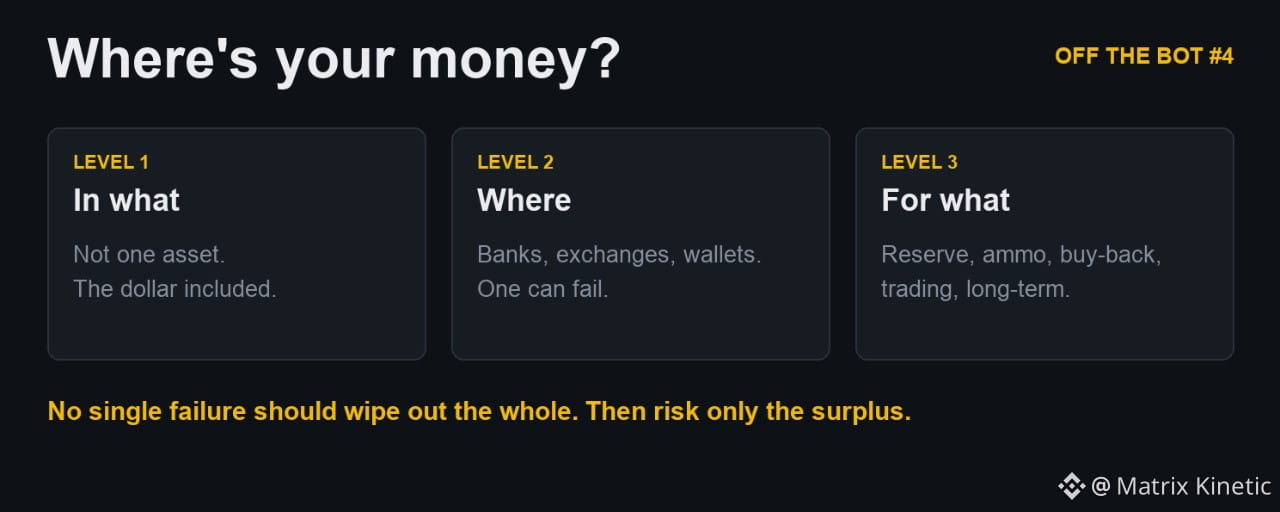
Where's your money?Off the bot # [4](https://www.binance.com/en/square/post/384308244291606). Everyone asks what to buy. Almost nobody asks why, or with what money.
Until you know where your capital sits, what it's made of, and how much of it you can spend or lose, nothing else matters. You're not trading. You're playing a casino with the whole stack, and against yourself.
My rule fits in one line: no single failure should wipe out all my capital, or even a big part of it. Not a bank, not an exchange, not a wallet, not a position, not a price move. So I split it three ways.
Level 1: in what
Not one asset. That includes the dollar. I count my portfolio in $BTC , but I live on fiat, so my cash sits in several currencies: the ones I earn in and the ones I pay my bills in. My crypto isn't one coin either.
Level 2: where
Not one place. Banks, exchanges, wallets. Any of them can freeze, fail or lock you out, and 2022 reminded everyone. If one goes, I lose a part, not everything.
Level 3: for what
The level most people skip, and the one that matters most. Every part of the capital has a job:
– Reserve: months of expenses. Untouchable.
– Ammo: cash above the reserve, waiting for its moment.
– For buy-back: money from what I sold, waiting to become coins again.
– Trading: spot and futures. Losses here are part of the plan, and they can't reach beyond this slice.
– Long-term: investments. I count them in BTC: if my BTC balance grows, I'm doing it right. You can count in dollars or anything else.
A daily recurring buy isn't another job. It's a pipe from ammo into trading.
And every part splits further. My capital is a molecule: it's made of atoms, the atoms split too, and each piece has its own job. Trading alone holds spot, grids, futures margin and a small experimental cell for my bots.
How it plays out
On Oct 29 my futures bot was liquidated in $TIA : −$49. That bot lives in the experimental cell, a small part of the trading part. The loss hit that cell and nothing else.
A year ago, for the first time in my life, I sold all my alts and the BTC from the last rally, on a monthly close below the 12-month average, roughly the 365-day one. My old BTC stayed where it was. Today 89% of that portfolio is cash, not counting futures and old BTC. That's not running from the market. Every dollar has a job.
I'm coming back in drops, not in one move. In 2022 $BTC spent months below its 200-week EMA, so near that line I switched on a daily recurring buy instead of going all in at once. It buys double on fear, so I size it by that: what it spends if it buys double every single day.
Right now BTC is about 6% above that line, and CoinMarketCap's Fear & Greed index reads 26, fear. My recurring buy is buying double.
The panel
This is my capital allocator. The numbers on it are placeholders, not mine. What matters is what it does. I enter my cash, my coins and the job of each part, plus income and expenses. One screen then shows where I am and with what:
– the BTC cycle: last month against the 12-month average, and the distance to the 200-week EMA;
– every bucket in dollars and as a share, the reserve in months of expenses;
– trading against the target share for this phase of the cycle;
– what different daily buying paces leave me in 12 months, after living costs, and in a stress case where income drops;
– what's left to buy back from what I sold, and where I break even.
I built it to make these calls right on the chart. Mine has my numbers, and every day they answer one question: what job does each dollar have?
The blue stripes are the months BTC spent below its 200-week EMA this year. That's why I come back in drops.
Why drops? Because I don't know whether price will dip under the 200-week EMA once more or turn up from here. The last cycle ran from 16K at the low to 126K at the high. Sold at 126K, an average of 16K, 20K or 30K means ×7.9, ×6.3 or ×4.2. All three win. Only the first one needed you to guess the bottom. My own BTC from that cycle averages about 28K. Not the bottom, and it didn't need to be. I don't catch tops either. I build in drops and exit through a grid, for the same reason: I don't know where the low or the high is, and chasing either one is greed.
So why don't I hold TIA?
I see no reason to keep it in my investment portfolio. Why do I trade it? Because it's volatile. Same coin, different cell.
Why did you buy it?
Bought FIL or TIA? Then answer one question first: why. To hold, or to trade? The answer picks the cell, the size and the exit.
And leave emotions out of it. Regret a 10% take when the coin then ran 100%? That's greed for the top, the same as hunting the bottom. Next time set a trailing take that starts at +10% and go to sleep. Automate everything you can.
First the budget: your expenses and what covers them. Then a job for each cell. Then risk, but only the surplus, and with a reason, not with hope.
So, where's your money? Don't answer with the total. Answer for each part: where it sits and what job it has.
#money #RiskManagement #InvestSmartly #OffTheBot
Where's your money?
Off the bot # 4. Everyone asks what to buy. Almost nobody asks why, or with what money.
Until you know where your capital sits, what it's made of, and how much of it you can spend or lose, nothing else matters. You're not trading. You're playing a casino with the whole stack, and against yourself.
My rule fits in one line: no single failure should wipe out all my capital, or even a big part of it. Not a bank, not an exchange, not a wallet, not a position, not a price move. So I split it three ways.
Level 1: in what
Not one asset. That includes the dollar. I count my portfolio in $BTC , but I live on fiat, so my cash sits in several currencies: the ones I earn in and the ones I pay my bills in. My crypto isn't one coin either.
Level 2: where
Not one place. Banks, exchanges, wallets. Any of them can freeze, fail or lock you out, and 2022 reminded everyone. If one goes, I lose a part, not everything.
Level 3: for what
The level most people skip, and the one that matters most. Every part of the capital has a job:
– Reserve: months of expenses. Untouchable.
– Ammo: cash above the reserve, waiting for its moment.
– For buy-back: money from what I sold, waiting to become coins again.
– Trading: spot and futures. Losses here are part of the plan, and they can't reach beyond this slice.
– Long-term: investments. I count them in BTC: if my BTC balance grows, I'm doing it right. You can count in dollars or anything else.
A daily recurring buy isn't another job. It's a pipe from ammo into trading.
And every part splits further. My capital is a molecule: it's made of atoms, the atoms split too, and each piece has its own job. Trading alone holds spot, grids, futures margin and a small experimental cell for my bots.
How it plays out
On Oct 29 my futures bot was liquidated in $TIA : −$49. That bot lives in the experimental cell, a small part of the trading part. The loss hit that cell and nothing else.
A year ago, for the first time in my life, I sold all my alts and the BTC from the last rally, on a monthly close below the 12-month average, roughly the 365-day one. My old BTC stayed where it was. Today 89% of that portfolio is cash, not counting futures and old BTC. That's not running from the market. Every dollar has a job.
I'm coming back in drops, not in one move. In 2022 $BTC spent months below its 200-week EMA, so near that line I switched on a daily recurring buy instead of going all in at once. It buys double on fear, so I size it by that: what it spends if it buys double every single day.
Right now BTC is about 6% above that line, and CoinMarketCap's Fear & Greed index reads 26, fear. My recurring buy is buying double.
The panel
This is my capital allocator. The numbers on it are placeholders, not mine. What matters is what it does. I enter my cash, my coins and the job of each part, plus income and expenses. One screen then shows where I am and with what:
– the BTC cycle: last month against the 12-month average, and the distance to the 200-week EMA;
– every bucket in dollars and as a share, the reserve in months of expenses;
– trading against the target share for this phase of the cycle;
– what different daily buying paces leave me in 12 months, after living costs, and in a stress case where income drops;
– what's left to buy back from what I sold, and where I break even.
I built it to make these calls right on the chart. Mine has my numbers, and every day they answer one question: what job does each dollar have?
The blue stripes are the months BTC spent below its 200-week EMA this year. That's why I come back in drops.
Why drops? Because I don't know whether price will dip under the 200-week EMA once more or turn up from here. The last cycle ran from 16K at the low to 126K at the high. Sold at 126K, an average of 16K, 20K or 30K means ×7.9, ×6.3 or ×4.2. All three win. Only the first one needed you to guess the bottom. My own BTC from that cycle averages about 28K. Not the bottom, and it didn't need to be. I don't catch tops either. I build in drops and exit through a grid, for the same reason: I don't know where the low or the high is, and chasing either one is greed.
So why don't I hold TIA?
I see no reason to keep it in my investment portfolio. Why do I trade it? Because it's volatile. Same coin, different cell.
Why did you buy it?
Bought FIL or TIA? Then answer one question first: why. To hold, or to trade? The answer picks the cell, the size and the exit.
And leave emotions out of it. Regret a 10% take when the coin then ran 100%? That's greed for the top, the same as hunting the bottom. Next time set a trailing take that starts at +10% and go to sleep. Automate everything you can.
First the budget: your expenses and what covers them. Then a job for each cell. Then risk, but only the surplus, and with a reason, not with hope.
So, where's your money? Don't answer with the total. Answer for each part: where it sits and what job it has.
#money #RiskManagement #InvestSmartly #OffTheBot
214
Переглянути переклад
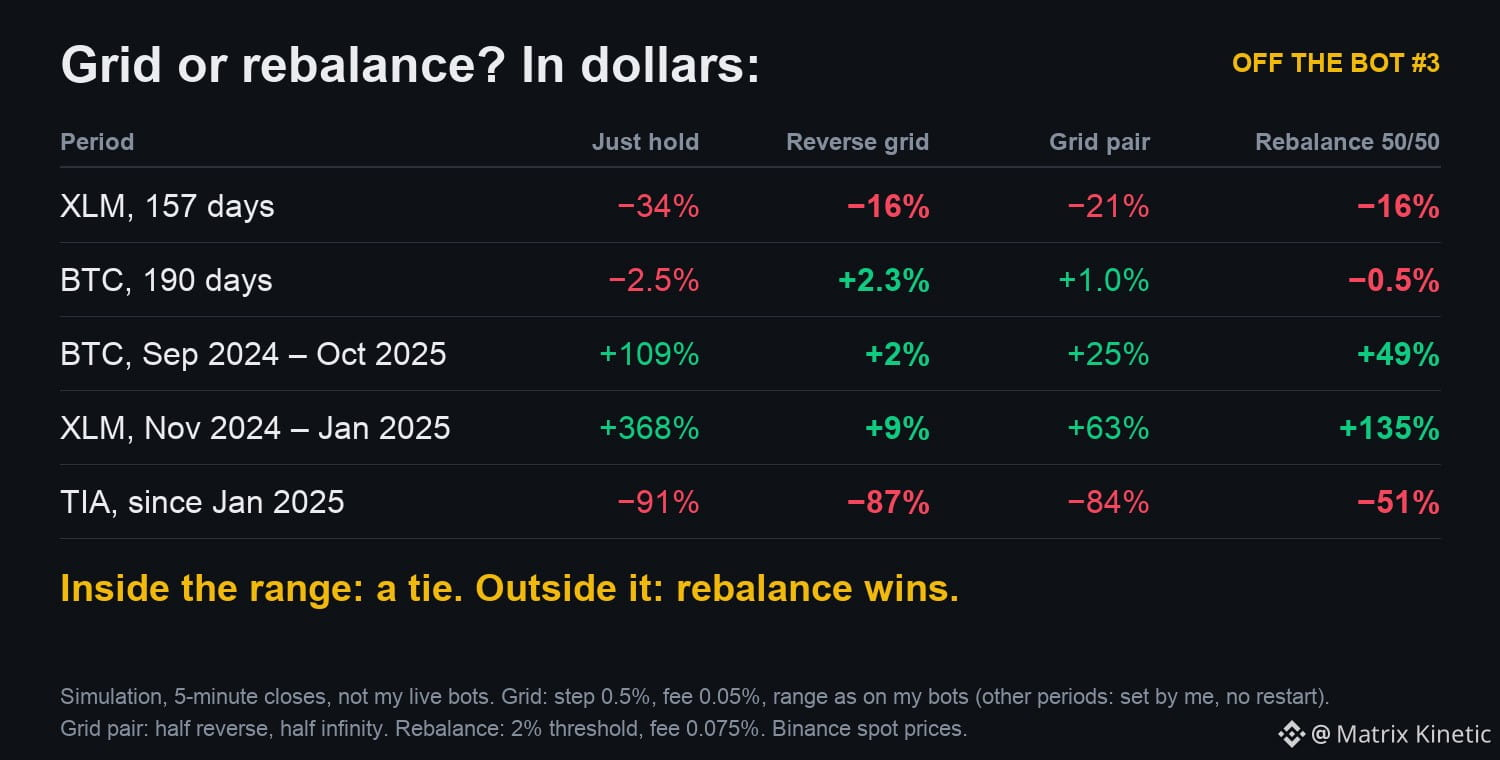
Off the bot # [3](https://www.binance.com/ru-UA/square/post/385841762668124). Grid or rebalance? On BTC +109%: +2% vs +49%.
Last time I swapped staking for a reverse grid. There's a simpler tool: a 50/50 rebalancing bot. Coin and stablecoin, back to equal halves whenever one drifts. Binance has one built in (minimum 200 USDC).
No floor, no ceiling.
It's really a grid without borders: the threshold sets the step, and trade size shrinks with the portfolio, so the cash never runs out.
I simulated both on 5-minute prices. In coins the model lands within a point of my live BTC and TRX grids, and 5 below on XLM.
Inside the range it's a tie. $XLM −34%: grid −16%, rebalance −16%.
Outside it, the range decides. $BTC +109%: the reverse grid sold everything near its ceiling and sat in cash, +2%. Rebalance +49%. $TIA −91%: grid −87%, rebalance −51%. Still −51%.
Two things I expected to matter didn't. Threshold: from 0.25% to 10% the result barely moved on my coins. Fees: 0.05% or 0.075%, same. And a finer grid step was worse: 0.1% lost to 1% every time.
So why do I keep grids? I count in BTC. Over 190 days the reverse grid added +4.9% in coins, the rebalance +2.0%. A rebalance splits its harvest across both sides, and you only see both grow if price comes back.
But a rebalance is easier to live with. Set BTC/BNB/TRX/USDT at 25% each and forget it. Some bots let you add funds, withdraw or change settings without stopping them. I run one too.
Not advice. What would you run instead of staking?
#trading #RiskManagement #bitcoin #Binance #OffTheBot
Off the bot # 3. Grid or rebalance? On BTC +109%: +2% vs +49%.
Last time I swapped staking for a reverse grid. There's a simpler tool: a 50/50 rebalancing bot. Coin and stablecoin, back to equal halves whenever one drifts. Binance has one built in (minimum 200 USDC).
No floor, no ceiling.
It's really a grid without borders: the threshold sets the step, and trade size shrinks with the portfolio, so the cash never runs out.
I simulated both on 5-minute prices. In coins the model lands within a point of my live BTC and TRX grids, and 5 below on XLM.
Inside the range it's a tie. $XLM −34%: grid −16%, rebalance −16%.
Outside it, the range decides. $BTC +109%: the reverse grid sold everything near its ceiling and sat in cash, +2%. Rebalance +49%. $TIA −91%: grid −87%, rebalance −51%. Still −51%.
Two things I expected to matter didn't. Threshold: from 0.25% to 10% the result barely moved on my coins. Fees: 0.05% or 0.075%, same. And a finer grid step was worse: 0.1% lost to 1% every time.
So why do I keep grids? I count in BTC. Over 190 days the reverse grid added +4.9% in coins, the rebalance +2.0%. A rebalance splits its harvest across both sides, and you only see both grow if price comes back.
But a rebalance is easier to live with. Set BTC/BNB/TRX/USDT at 25% each and forget it. Some bots let you add funds, withdraw or change settings without stopping them. I run one too.
Not advice. What would you run instead of staking?
#trading #RiskManagement #bitcoin #Binance #OffTheBot
1
258
Швидке запитання. Якщо завтра ваша основна біржа заморозить виведення коштів, яка частина ваших грошей застрягне?
Це рівень 2 мого правила: жоден окремий збій не повинен знищити все. Як я розподіляю свої кошти: поза ботом №[4](https://www.binance.com/en/square/post/387085931998648).
#money #RiskManagement #OffTheBot
Швидке запитання. Якщо завтра ваша основна біржа заморозить виведення коштів, яка частина ваших грошей застрягне?
Це рівень 2 мого правила: жоден окремий збій не повинен знищити все. Як я розподіляю свої кошти: поза ботом №4.
#money #RiskManagement #OffTheBot
Це рівень 2 мого правила: жоден окремий збій не повинен знищити все. Як я розподіляю свої кошти: поза ботом №4.
#money #RiskManagement #OffTheBot
Almost all of it
About half
A small part
Nothing, I spread it out
16 год залишилося
150
Страшно? $BTC — падає вже шостий тиждень поспіль. Індекс страху та жадібності: 21.
Учора ввечері, коли BTC коштував 71,5 тис., я вклав частину своїх BTC у лонгову ф’ючерсну сітку: нижній ордер — на 57,8 тис., на рівні мінімуму цього циклу, верхній — на 75 тис., із трейлінгом угору. На папері — 10x, але більша частина маржі залишається в резерві, тож ліквідація настане на рівні 51 956.
Через одинадцять годин: −6,69%. Страшно? Це на 0,7% нижче за мою середню ціну, помножені на 10. Сітка вже викупила падіння й знизила середню ціну до 69,7 тис. На рівні 60 тис. подвою позицію.
Чому я не продаю: домінування BTC падає, а не зростає, і значна частина топ-100 у плюсі. Справжня капітуляція має інакший вигляд. Я можу помилятися — бот покаже це в реальному часі.
Що ви робите зараз?
#fearandgreed #WhatWillDriveCryptoandStocks’NextRebound? #OffTheBot
Selling
Holding
Buying
Sitting in cash
16 год залишилося
1
648
Переглянути переклад
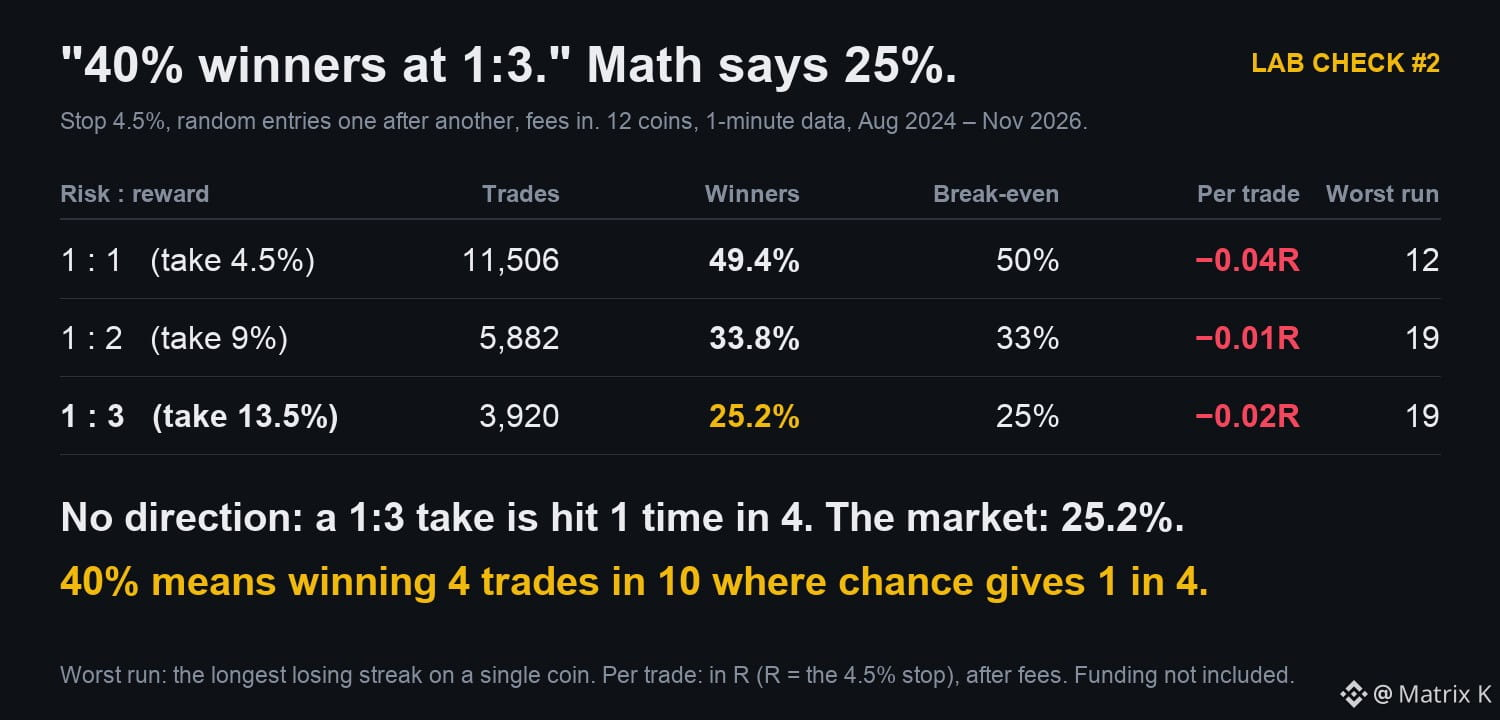
Lab check #2. "40% winners at 1:3": everyone quotes it. Math answers it before any backtest.
The risk rule in this post is sound: isolated margin, $10 at risk on $1,000. The 40% is the problem.
If price has no direction, a stop 1 step away is mathematically hit 3 times more often than a take 3 steps away. At 1:3 that's 25% winners, at 1:1 it's 50%. R:R doesn't create an edge: it only sets the break-even win rate. 40% is a wish, not a result.
I checked it anyway: 12 coins, including $ADA $ENA $AVAX , 1-minute data, Aug 2024 to Nov 2026. Stop 4.5%, take 13.5%, random entries, fees in. 3,920 trades, 25.2% winners. 1:1 gave 49.4%, 1:2 gave 33.8%. The market agrees with the math, and fees push it below zero.
So 40% at 1:3 isn't a rule. It means winning 4 trades in 10 where chance gives 1 in 4. The best entry I've measured, with an ATR stop, won about 3 in 10.
And the losing runs: up to 19 in a row on one coin.
Where does your win rate come from?
#RiskManagement #trading #OffTheBot

Maxim S
·
--
Як торгувати великими обсягами, ризикуючи копійками? 🧠
Поясню простими словами, як правильно торгувати з бюджетом у $1000 (наприклад)! 👇
Більшість новачків думають, що кредитне плече — це інструмент для швидкого розгону депозиту. У результаті вони беруть плече 20x, заходять на весь депозит і отримують ліквідацію після першого ж ринкового коливання.
Кредитне плече потрібно використовувати не для підвищення ризику, а для вивільнення вашого капіталу.
1
582
Переглянути переклад
Off the bot #1. A deaf frog can climb. But the climb is not the goal.
A reader staked 30,000 $TIA in [Keplr](https://www.binance.com/en/square/post/383914064424624?sqb=1) and sent me a Chinese fable: "Only a deaf frog can climb to the top of a tall tower."
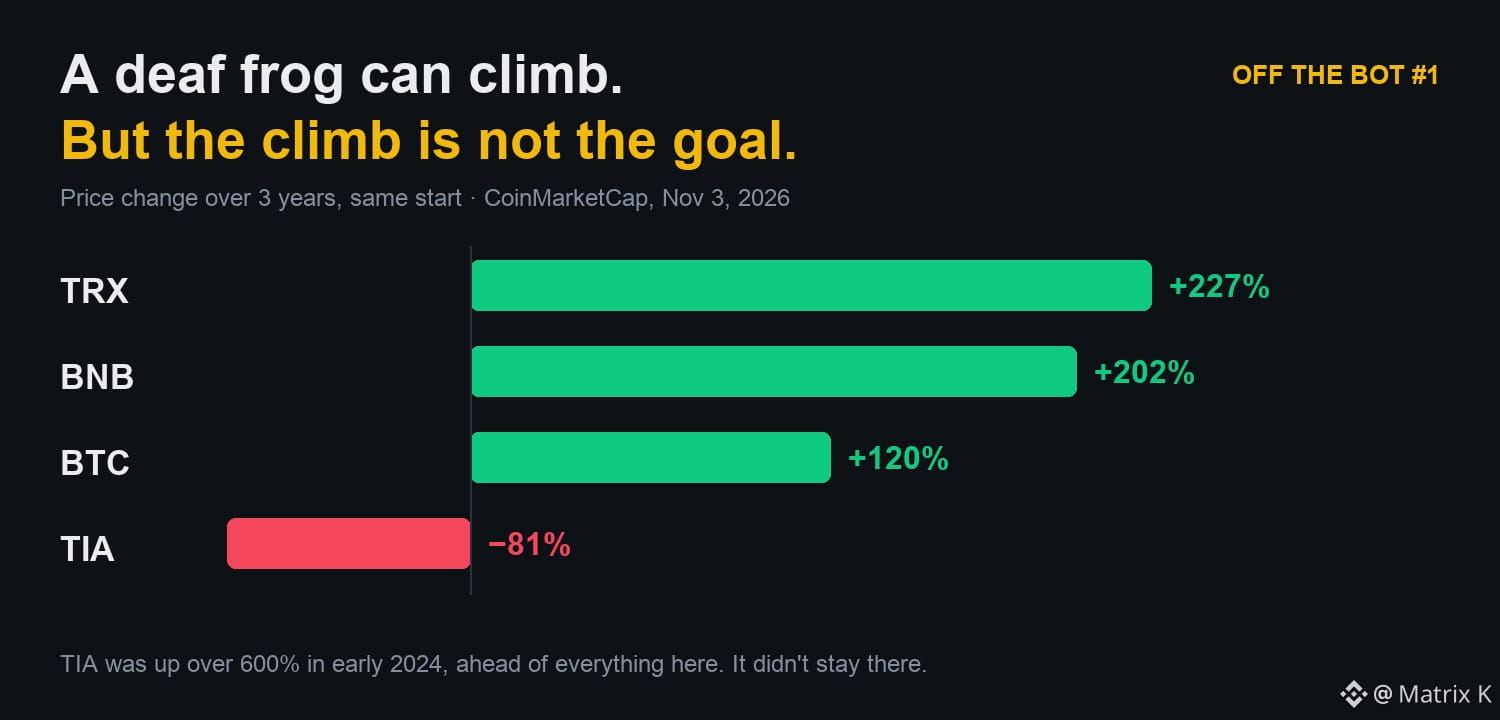
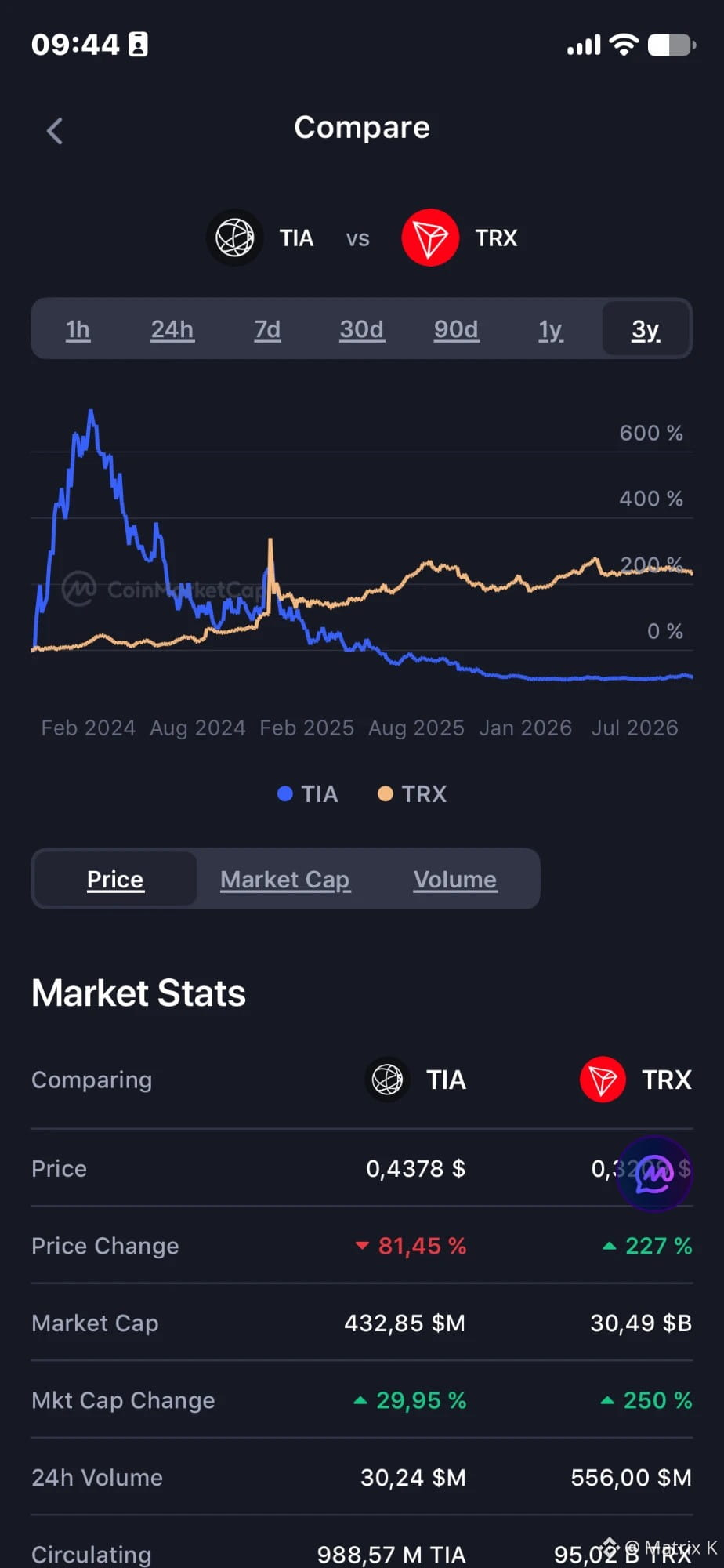
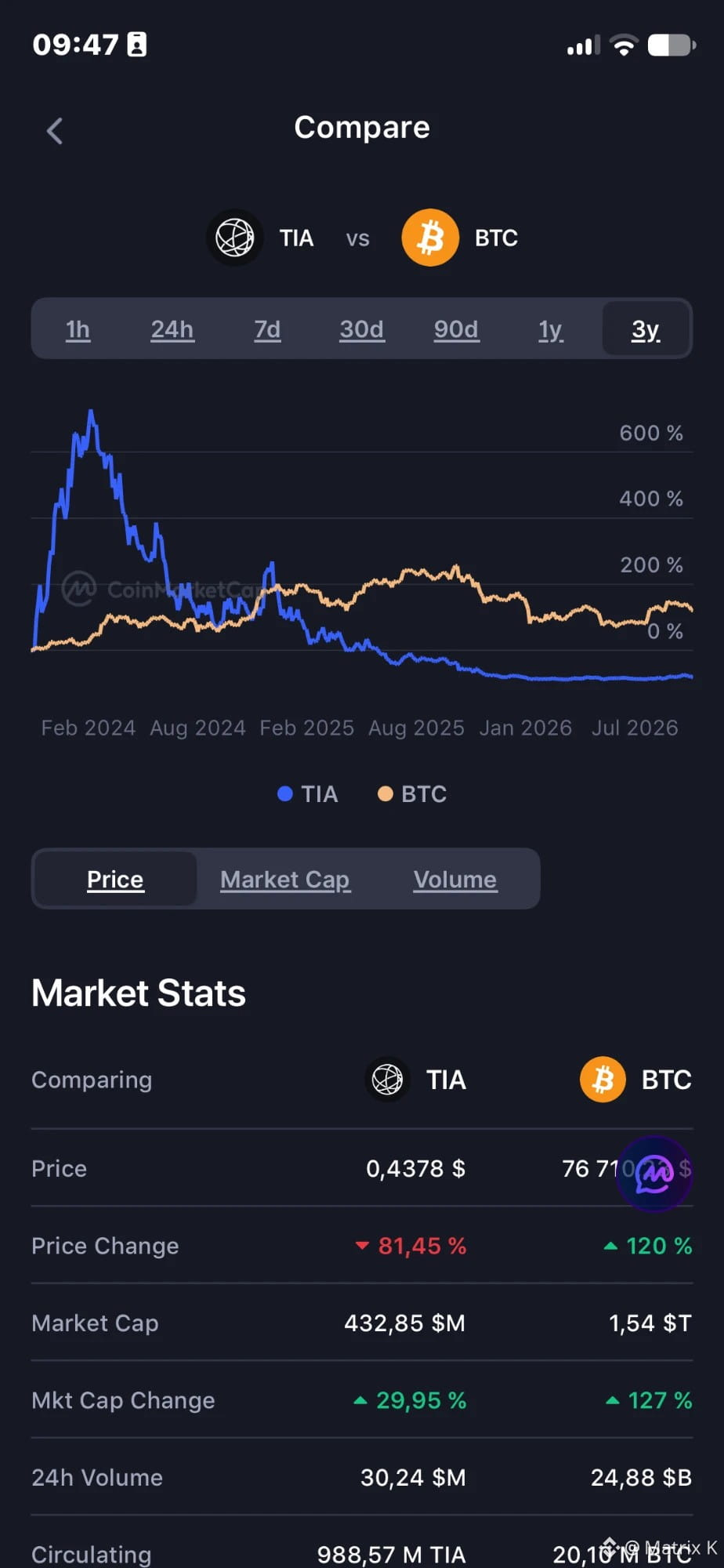
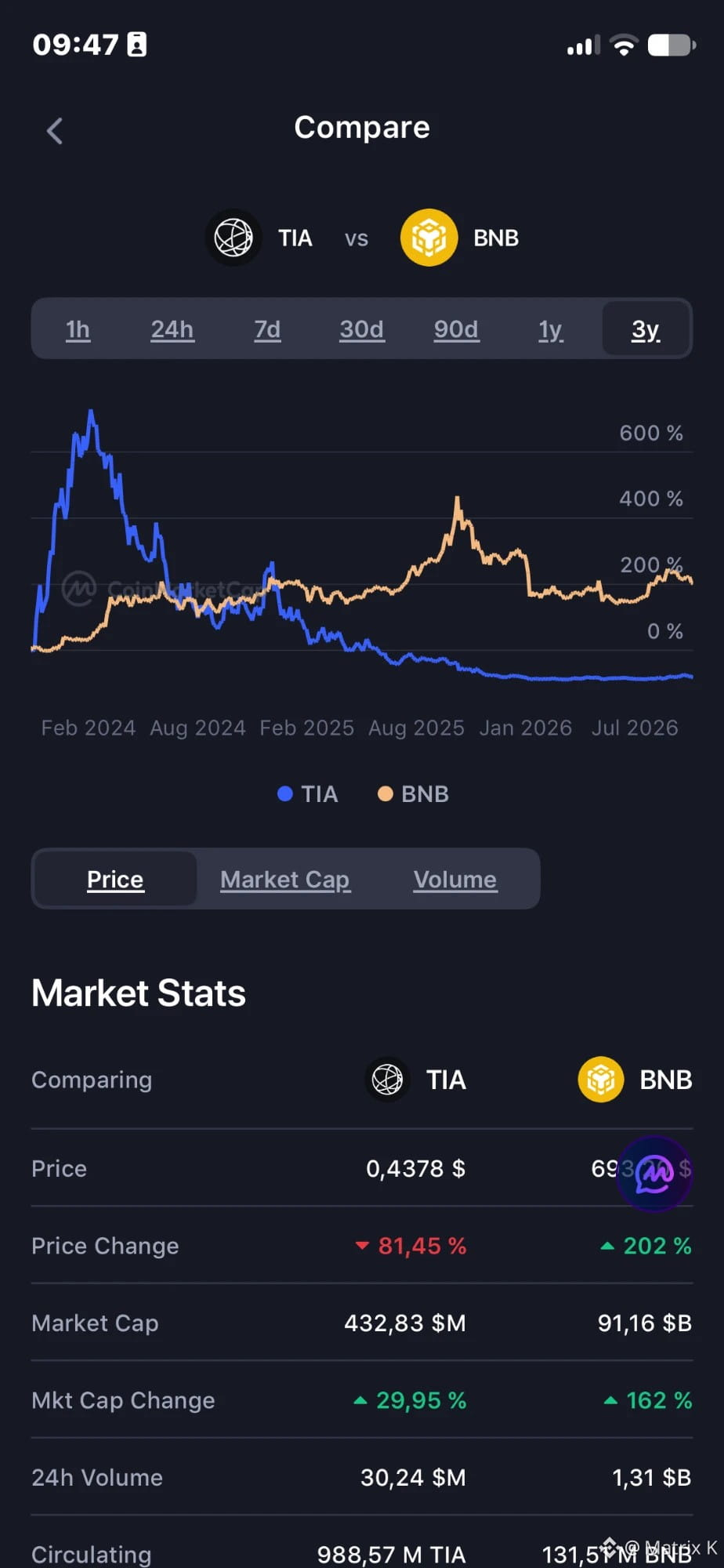
I respect his choice. Let's just open the charts. Three years, same start, price change on CoinMarketCap:
$TRX +227% $BNB +202% $BTC +120% TIA −81%
TIA did climb: in early 2024 it was up over 600%, ahead of everything on this list. I don't know when my reader bought his 30,000, near the top or at some local bottom. But an alt sitting on a bottom is not a reason to buy it. Some towers are Babel: a staircase up that leads down.
I know that tower. TIA and ATOM sat in my Keplr too. A year ago I sold everything except BTC from the previous cycle (average around 28K). The trigger: BTC closed a month below its 12-month average. For me, that's where a bull market ends. Not a feeling, a rule.
The same rule is bringing me back. BTC closed a month above that average again, and I'm returning to speculative positions in alts. Not at the bottom of 57.7K, but later and higher. The right price isn't the lowest one. It's the confirmed one.
Exceptions to this rule? There are. But that's another story.
Long-term buying is a separate track. When BTC fell below its 200-week EMA, the cycle bottom for me, I switched on regular buys of my favorites. What I buy doesn't sit as dead weight: it goes to spot grid bots and keeps working.
A deaf frog can climb. But the climb is a path, not a goal. I know my goals. Does the frog know its own? I can't tell. If the goal is to catch a few X's by buying some bottom, that's not a goal. That's hope. And hope and a goal are different things.
What's the goal behind the coin you hold?
#RiskManagement #InvestSmart #bitcoin #OffTheBot
P.S. The market is sleepy and my bot has nothing new to report. A good excuse to talk about everything around it. Hence the #1.
Off the bot #1. A deaf frog can climb. But the climb is not the goal.
A reader staked 30,000 $TIA in Keplr and sent me a Chinese fable: "Only a deaf frog can climb to the top of a tall tower."
I respect his choice. Let's just open the charts. Three years, same start, price change on CoinMarketCap:
$TRX +227% $BNB +202% $BTC +120% TIA −81%
TIA did climb: in early 2024 it was up over 600%, ahead of everything on this list. I don't know when my reader bought his 30,000, near the top or at some local bottom. But an alt sitting on a bottom is not a reason to buy it. Some towers are Babel: a staircase up that leads down.
I know that tower. TIA and ATOM sat in my Keplr too. A year ago I sold everything except BTC from the previous cycle (average around 28K). The trigger: BTC closed a month below its 12-month average. For me, that's where a bull market ends. Not a feeling, a rule.
The same rule is bringing me back. BTC closed a month above that average again, and I'm returning to speculative positions in alts. Not at the bottom of 57.7K, but later and higher. The right price isn't the lowest one. It's the confirmed one.
Exceptions to this rule? There are. But that's another story.
Long-term buying is a separate track. When BTC fell below its 200-week EMA, the cycle bottom for me, I switched on regular buys of my favorites. What I buy doesn't sit as dead weight: it goes to spot grid bots and keeps working.
A deaf frog can climb. But the climb is a path, not a goal. I know my goals. Does the frog know its own? I can't tell. If the goal is to catch a few X's by buying some bottom, that's not a goal. That's hope. And hope and a goal are different things.
What's the goal behind the coin you hold?
#RiskManagement #InvestSmart #bitcoin #OffTheBot
P.S. The market is sleepy and my bot has nothing new to report. A good excuse to talk about everything around it. Hence the #1.
1
408
Увійдіть, щоб переглянути інший контент
Приєднуйтесь до користувачів криптовалют по всьому світу на Binance Square
⚡️ Отримуйте актуальну та корисну інформацію про криптовалюти.
💬 Приєднуйтесь до найбільшої у світі криптобіржі.
👍 Відкрийте справжні ідеї від перевірених авторів.
Електронна пошта / номер телефону
Трендові теми
1
#fomcвідстеження
118,459 переглядів
534 обговорюють
2
#USPPIMissMayEaseBTCPressure
18,407 переглядів
478 обговорюють
3
#BitcoinCoreDisclosesTorTrafficVulnerability
5,225 переглядів
208 обговорюють
4
#WhatWillDriveCryptoandStocks’NextRebound?
116,971 переглядів
1,398 обговорюють
5
#BitcoinBreaksBelow200WeekMovingAverage
30,399 переглядів
380 обговорюють
6
#SpaceXTeslaMergerTalksWouldCombine30220BTC
10,369 переглядів
195 обговорюють
7
#Anthropic’s6xIPODemandSignalsPotentialRecordRaise
38,641 переглядів
639 обговорюють
8
#USCryptoETFsLose$1.48BInFiveDays
1,869 переглядів
39 обговорюють
9
#KoreaDigitalAssetBasicActFinalDraftExpectedEarlyJanuary
3,396 переглядів
19 обговорюють
10
#RippleRLUSDMarketCapSurpassesPayPalPYUSD
5,956 переглядів
112 обговорюють