


The Uniswap Foundation voted to approve a massive $165.5 million investment plan, why? Because the performance of Uniswap v4 and Unichain after their release has fallen far short of market expectations. In a month’s time:
The total locked value (TVL) of Uni v4 is only $85 million
The TVL of Unichain is only $8.2 million
To promote growth, the Uniswap Foundation proposes allocating $165.5 million in funding to the following areas:
$95.4 million for funding (developer programs, core contributors, validators);
$25.1 million for operations (team expansion, governance tool development);
$45 million for liquidity incentives.
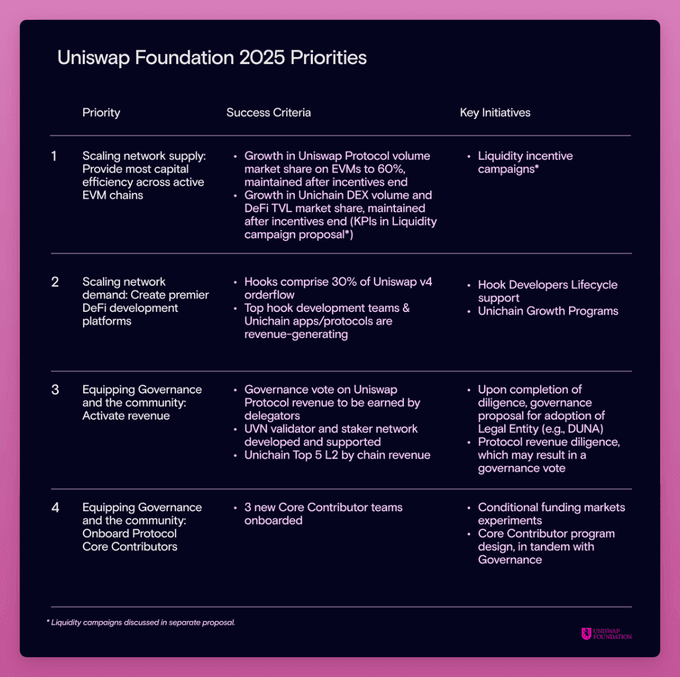 Image source: PANews
As you can see, Uni v4 is not just a DEX but a liquidity platform, and Hooks are applications built on top of it. Hooks should drive the ecological growth of Uni v4, so it is necessary to accelerate this process through funding programs.
Detailed distribution explanation of the funding budget:
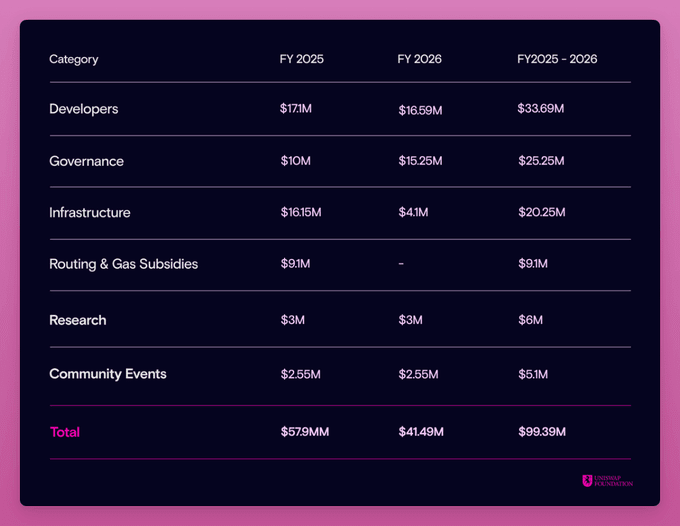 Image source: PANews
$45 million in liquidity provider (LP) incentives will be used for the following aspects:
$24 million (distributed over 6 months): for incentivizing liquidity to migrate from other platforms to Uni v4;
$21 million (distributed over 3 months): to drive the total locked value (TVL) of Unichain from the current $8.2 million to $750 million.
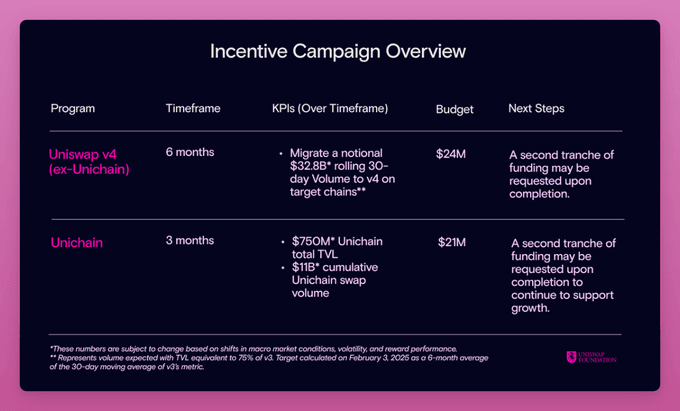 Image source: PANews
In contrast, Aerodrome mints approximately $40 million to $50 million worth of AERO tokens each month for liquidity provider (LP) incentives.
The proposal has passed the temperature check stage but still faces some criticisms: at a time when the industry landscape is changing, Aave proposed to buy back $1 million worth of $AAVE tokens weekly, Maker plans to buy back $30 million monthly, yet $UNI holders seem to be the 'cows' being milked for value, with their token value never being captured.
$UNI token does not activate a fee-sharing mechanism, while Uniswap Labs has earned $171 million through front-end fees over two years.
The key to the entire system lies in the organizational structure design of Uniswap:
Uniswap Labs: Focused on protocol technology development;
Uniswap Foundation: Promotes ecological growth, governance, and funding plans (such as grants and liquidity incentives).
What a savvy legal team.
Aave and Maker have established a closer interest alignment with token holders, I don't understand why Uniswap's front-end fees cannot be shared with $UNI holders.
In summary, other criticisms mainly focus on the high salaries of the core team, Gauntlet being responsible for liquidity incentive execution, and the establishment of a new type of centralized DAO legal framework (DUNA).
As a small governance representative of Uniswap, I voted in favor of this proposal, but I still have significant concerns about the future of $UNI holders: the incentive mechanism fails to align with the interests of the holders.
However, I am a loyal fan of Uniswap and highly recognize its role in driving the DeFi industry. Currently, the growth trend of Uni v4 and Unichain is very bleak, and they need to introduce incentive measures to promote development.
The next Uni DAO vote should focus on the value capture mechanism of the $UNI token.
This article is authorized for reprint from: (PANews)
Original author: Ignas
‘Uniswap V4 did not meet expectations! The official launched a $160 million investment plan, why is it treating the symptoms rather than the root cause?’ This article was first published in ‘Crypto City’