


In recent months, the Solana blockchain, once praised for its high processing speed and ultra-low fees, has been facing a difficult scenario.
According to recent data, its transfer volume has plummeted from around $2 billion in November 2024 to a mere $26 million in mid-February 2025, representing a drop of approximately 95%. Decentralized finance (DeFi) activity on the network is also recording much lower numbers, reflecting significant volume losses across protocols and applications.
At first, the decline may come as a shock to those who have followed Solana’s meteoric rise as a potential “Ethereum killer,” as the blockchain has already reached peaks of thousands of transactions per second (TPS). Despite this, the explanation for this decline appears to involve multiple factors, from technical issues (such as transaction failures) to the saturation of the hype surrounding meme coins. Although analysts see serious risks to the project’s reputation, there are those who believe that the decline may just be a passing cycle, given the strength of the developer community and the ecosystem’s ability to recover.
The Significant Drop in Volume (and Price)
Total transaction volume on the Solana network has fallen from $2 billion to $26 million in about three months, while trading volume on DeFi protocols like decentralized exchanges and lending apps has fallen from nearly $38.58 billion to $8.41 billion in the span of 30 days. For any blockchain, that’s a significant drop.
At the same time, another fact that caught attention was the numerous transaction failures. Analysis mentioned an alarming rate of 131 million failed attempts, against only 8 million operations effectively confirmed in a seven-day period.
This failure rate suggests instability in the infrastructure, whether due to overload, bugs or lack of optimization. In practice, users complain about congestion and bottlenecks, making the experience that should be “fast and economical” unfeasible.
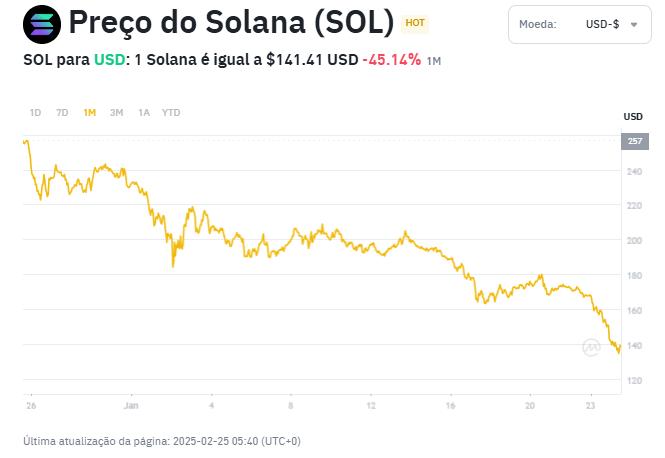
This quickly reflected on the token price.SUN, native to the network. In the space of 1 month, the value of SOL fell by almost half, as shown in the graph below:
Meme Coins, Scams and Passing Euphoria
The Solana blockchain has gained traction in recent bull cycles in part thanks to meme coins, tokens that emerge from jokes or internet trends. Although they attract many investors looking for a quick profit, these coins do not always have solid utility, which can lead to misfortunes such as sycophancy (rug pulling). As the market cooled and certain scams came to light, the excitement around these tokens fizzled out.
Furthermore, the proliferation of meme coins that have been subject to scams – or that have lost value due to lack of liquidity – has worsened the image that the Solana network was full of speculative activity, without any real backing. As a result, many traders have migrated to more established platforms, seeking networks with greater robustness or lower volatility.
Market Dynamics and General Reduction in Interest
The beginning of 2025 was marked by a cooling of the cryptocurrency market worldwide. After some highs at the end of 2024, investors began to face macroeconomic problems, rising interest rates in some countries and fears of increasingly strict regulation. In this scenario, projects like Solana, highly dependent on intensive trading in DeFi and NFTs, are vulnerable.
Some of the audience that was frantically trading tokens or speculating on games and DeFi protocols on Solana may have moved away, either because they are looking for more mature blockchains or simply out of caution regarding further collapses in the crypto space. Thus, the decrease in volume does not only reflect technical failures of the network, but also a feeling of reduced risk appetite.
Competition with Ethereum and Layer-2
Another important component is the strong competition that has emerged from established blockchains and layer-2 solutions on Ethereum. Networks like Arbitrum and Optimism offer relatively low fees and directly benefit from the large Ethereum community, combining security and scalability. In times of liquidity shortages, many users turn to these ecosystems, where there is greater diversity of protocols and, theoretically, less risk of critical failures.
Solana, which once stood out for its penny transactions, has lost some of its appeal. If it fails to resolve its instabilities and ensure reliability, the developer community will tend to migrate, or at least simultaneously test solutions on other networks.
Security Concerns and Network Failures
The transaction failure rate, as reported by users, is perhaps the most sensitive issue, as it calls into question Solana’s fundamental proposition: high-level scalability. If the network claims to process thousands of TPS but a huge percentage fails, this could frustrate projects and dApps that rely on near-instant execution.
It’s clear that Solana needs to step up its code audits and review its consensus or block verification mechanisms. If part of the problem is due to attacks or spam attempts, strategies like priority fees or anti-congestion systems may be needed to stabilize the network.
Market Cycle or Temporary Adjustment?
It’s not all bad news, though. Solana supporters point out that emerging blockchains have also gone through periods of low activity in the past and regained momentum when they introduced innovative solutions or sealed strategic partnerships. Solana still has a solid developer base, some well-known NFT projects, and has been making protocol upgrades to increase resilience.
Some interpret the 95% drop in volume as a natural correction after a period of inflation, possibly caused by bots or momentary meme coin activity. With the slowdown, there may be a much-needed “fine-tooth comb” for the network, allowing more committed users and serious development teams to remain, strengthening the quality of applications.
Solana was hailed as the “Ethereum Killer”: what now?
Solana’s 95% drop in transaction volume serves as a warning: even highly rated blockchains with plenty of investors can face crises if the technology fails to deliver the expected robustness and if the macro scenario does not help. On the other hand, the strength of an ecosystem of engaged developers and the willingness to solve technical problems can help the network recover.
Therefore, the current level does not need to be definitive: there are those who believe that Solana is going through a period of correction after the hype around memecoins and some operational failures. The important thing is to observe the next protocol updates and the network's positioning in relation to the competition.
Solana may have lost some of its shine, but it is not out of the question that, by adapting to the new times and reinforcing security, it will regain some of the volume and prestige it achieved when it emerged as one of the most promising blockchains on the market.
Image created with AI tool