


In February 2025, a heated debate broke out in the blockchain industry over technological originality and open source ethics. Aptos research director Alexander Spiegelman publicly accused Monad of plagiarizing its core technology, especially the BlockSTM dynamic parallel execution architecture, and believed that Monad did not fully acknowledge Aptos' open source contributions during the development process. He pointed out that Aptos's technology (such as pipeline design and decoupled execution architecture) has been made public through multiple peer-reviewed papers, and Monad's BlockSTM "is highly similar to AptosBFT", and even suggested that Monad "spends a lot of time reverse engineering rather than original development."
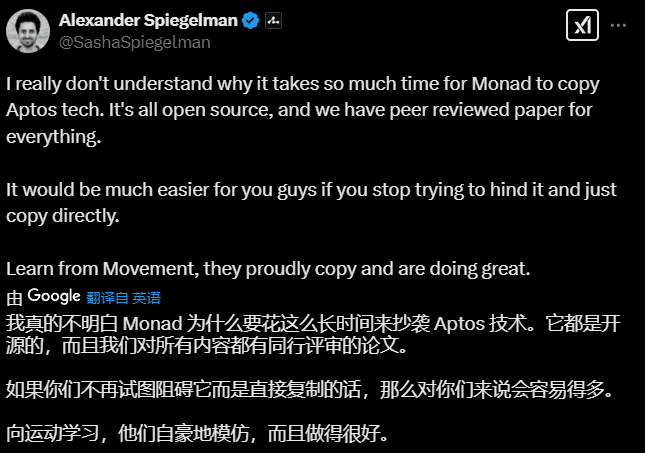 Image source: Mars Finance
In response to this, James Hunsaker, co-founder of Monad, responded strongly, saying that the underlying logic of BlockSTM originated from software transactional memory (STM) and the optimistic concurrency control (OCC) theory proposed in 1979. He also emphasized that he had studied related technologies in the Haskell environment and had never referred to the Aptos code. “If Aptos hadn’t started the fight, I wouldn’t have even thought of this project,” he quipped.
Technology Comparison: BlockSTM vs. AptosBFT
The core differences between BlockSTM and AptosBFT can be analyzed from three aspects: design philosophy, technology traceability, and performance indicators:
Design philosophy - AptosBFT is based on the optimization of the HotStuff consensus algorithm, emphasizing dynamic parallel execution and state synchronization efficiency, and improving throughput through pipeline processing. BlockSTM adopts an optimistic parallel execution strategy, performs concurrent processing before transaction verification, relies on superscalar pipeline technology to reduce hardware device dependence, and aims to achieve single-slot finality.
Technology Origin - Aptos claims that its technology originates from the deep transformation of the Move language and Byzantine Fault Tolerance (BFT) mechanism; while Monad emphasizes that BlockSTM is an extended function of the traditional STM theory on the EVM-compatible chain and has no direct connection with Aptos.
Performance indicators - Aptos currently has a TPS of about 15,000, and Monad claims to be able to reach 100,000, but neither has fully disclosed stress test data, and the actual performance still needs to be verified.
Community response: division and rationality intertwined
The controversy has polarized the blockchain community. Those who support Aptos believe that there is a "design coincidence" between Monad's EVM compatibility solution and Aptos' Move virtual machine, and call for the establishment of stricter open source reference specifications. At the same time, Monad supporters pointed out through test network data that Monad's asynchronous I/O and state database optimization are clearly different from Aptos, questioning the originality of Aptos technology. Neutral researcher Elena Stark wrote that the similarities between BlockSTM and AptosBFT reflect the convergence of industry technology, and called for the open source ecosystem to focus more on collaboration rather than confrontation.
Monad Project Progress: Ambition and Challenges Coexist
Despite the ongoing controversy, Monad's technical route and ecological construction are still progressing steadily. In the fourth quarter of 2024, Monad launched MonadDB, a custom database based on Patricia Trie, which increased the state storage compression efficiency by 40%. In addition, Monad achieved single-second block confirmation on the test network, and the hardware equipment threshold for verification nodes was lowered to 16-core CPU + 64GB memory, attracting the participation of small and medium-sized mining pools.
In terms of ecological expansion, the Monad Foundation's ecological fund has reached US$200 million, focusing on supporting DeFi and gaming applications. In January 2025, derivative financial product protocol NovaX and blockchain game MetaCivic announced their migration to Monad. At the same time, the download volume of Monad's developer tool chain Monad SDK exceeded 500,000. It is compatible with Hardhat and Truffle architectures, reducing the migration cost for Ethereum developers.
Industry impact: Paradigm reflection on the open source ecosystem
This controversy exposed three deep-seated problems in the blockchain industry:
Intellectual property definition of open source agreements: Does the disclosure of program code mean that technical ideas can be freely copied? Spiegelman's accusation is essentially a dispute over "attribution of technological influence", while Hunsaker's rebuttal highlights the blurred boundary between academic theory and engineering practice.
Sustainability of the performance competition: Both Aptos and Monad use high TPS as a selling point, but the market is more concerned about the maturity of the ecosystem rather than simple performance indicators. This is reflected in Aptos’ 96% developer growth rate in 2024, while Monad’s ecosystem has less than 100 applications.
Transparency of community governance: The power of the Monad Foundation is concentrated in the founding team, raising questions about "decentralization"; and although Aptos adopts DAO governance, key decisions are still led by core developers.
Future Outlook: Competition or Symbiosis?
In the short term, the controversy could exacerbate the Aptos-Monad divide. Aptos may consolidate its barriers by patenting some technologies, but this may affect its open source image; while Monad needs to accelerate ecosystem construction to prove its innovation capabilities. If the performance promises are not met, Monad may face a similar dilemma as Core DAO.
In the long run, Aptos and Monad may develop in a differentiated way. Aptos will delve deeper into the Move ecosystem and expand financial and compliance scenarios (such as cross-border settlement cooperation with Visa); while Monad will attract Ethereum developers with EVM compatibility and focus on high-performance industries such as high-frequency trading and gaming.
This controversy will eventually become a footnote to the evolution of blockchain technology, but the discussion it has triggered about open source ethics will drive the industry to form clearer technology traceability standards and collaborative architectures. As Hunsaker said, “You can copy code, but you can’t copy the ecosystem.”
This article is reproduced with permission from: (MarsBit)
Original author: Luke, Mars Finance
Aptos accuses Monad of plagiarizing technology! The community is polarized, where is the boundary between open source and rights? 』This article was first published in "Crypto City"