

#tremmax
tremmax
206 views
22 Discussing
Hot
Latest


·
--
#termmax
TermMax is one of the DeFi projects I’m keeping a close eye on because of its approach to capital efficiency and structured on-chain strategies. #tremMax aims to give users more flexibility across lending, borrowing, fixed-rate products, and leveraged opportunities, creating a broader toolkit for managing digital assets. I especially like the idea of having different strategies within one ecosystem instead of relying on multiple disconnected platforms. For me, strong DeFi products are about real utility, transparent mechanisms, and sustainable growth—not just short-term attention. TermMax is definitely a project worth following as its ecosystem continues to develop. #TermMax
#termmax
TermMax is one of the DeFi projects I’m keeping a close eye on because of its approach to capital efficiency and structured on-chain strategies. #tremMax aims to give users more flexibility across lending, borrowing, fixed-rate products, and leveraged opportunities, creating a broader toolkit for managing digital assets. I especially like the idea of having different strategies within one ecosystem instead of relying on multiple disconnected platforms. For me, strong DeFi products are about real utility, transparent mechanisms, and sustainable growth—not just short-term attention. TermMax is definitely a project worth following as its ecosystem continues to develop. #TermMax
TermMax is one of the DeFi projects I’m keeping a close eye on because of its approach to capital efficiency and structured on-chain strategies. #tremMax aims to give users more flexibility across lending, borrowing, fixed-rate products, and leveraged opportunities, creating a broader toolkit for managing digital assets. I especially like the idea of having different strategies within one ecosystem instead of relying on multiple disconnected platforms. For me, strong DeFi products are about real utility, transparent mechanisms, and sustainable growth—not just short-term attention. TermMax is definitely a project worth following as its ecosystem continues to develop. #TermMax
49

The @termmax roadmap is more than just a list of milestones—it represents a long-term vision for a growing DeFi ecosystem. With continuous product development, ecosystem expansion, and community growth ahead, TermMax seems focused on building meaningful utility. 🚀 I’m looking forward to seeing each roadmap phase come to life and discovering what the team delivers next. The future of TermMax looks interesting. #TremMax
The @TermMax roadmap is more than just a list of milestones—it represents a long-term vision for a growing DeFi ecosystem. With continuous product development, ecosystem expansion, and community growth ahead, TermMax seems focused on building meaningful utility. 🚀 I’m looking forward to seeing each roadmap phase come to life and discovering what the team delivers next. The future of TermMax looks interesting. #TremMax
1
1
2
58

I initially thought @termmax was just building a better order book.
Then I realized the more interesting idea is programmable credit.
Traditional order books ask: how much, and at what price?
Credit is more nuanced.
If I’m lending $50K, I might accept one rate. At $500K, I may want another because more capital is concentrated and less flexible.
That’s where Range Orders become interesting. They can encode how my acceptable rate changes as more capital gets deployed.
But flexibility has a cost: complexity.
Fixed rates give certainty. Floating rates give flexibility. Programmable credit tries to give users more control over the relationship between size, rate, and liquidity.
I’m not convinced that automatically makes it better.
The real test is whether the added precision creates enough value to justify the added complexity.
If it does, TermMax isn’t just improving order books.
It’s making credit itself more programmable.
#tremmax @TermMax
I initially thought @TermMax was just building a better order book.
Then I realized the more interesting idea is programmable credit.
Traditional order books ask: how much, and at what price?
Credit is more nuanced.
If I’m lending $50K, I might accept one rate. At $500K, I may want another because more capital is concentrated and less flexible.
That’s where Range Orders become interesting. They can encode how my acceptable rate changes as more capital gets deployed.
But flexibility has a cost: complexity.
Fixed rates give certainty. Floating rates give flexibility. Programmable credit tries to give users more control over the relationship between size, rate, and liquidity.
I’m not convinced that automatically makes it better.
The real test is whether the added precision creates enough value to justify the added complexity.
If it does, TermMax isn’t just improving order books.
It’s making credit itself more programmable.
#tremmax @TermMax
Then I realized the more interesting idea is programmable credit.
Traditional order books ask: how much, and at what price?
Credit is more nuanced.
If I’m lending $50K, I might accept one rate. At $500K, I may want another because more capital is concentrated and less flexible.
That’s where Range Orders become interesting. They can encode how my acceptable rate changes as more capital gets deployed.
But flexibility has a cost: complexity.
Fixed rates give certainty. Floating rates give flexibility. Programmable credit tries to give users more control over the relationship between size, rate, and liquidity.
I’m not convinced that automatically makes it better.
The real test is whether the added precision creates enough value to justify the added complexity.
If it does, TermMax isn’t just improving order books.
It’s making credit itself more programmable.
#tremmax @TermMax
22
15
207

·
--
Many people talk about RWA, and the first reaction is still: “move stocks and bonds onto the blockchain for trading.”
But lately, after seeing @termmax integrate tokenized stocks, I’ve started to think that what’s truly worth looking at might not be “whether you can buy them,” but whether, once these assets are on-chain, they can continue to be used for financing just like traditional financial assets.
These two things are very different.
Tokenizing a stock only solves the issues of asset representation and transfer. If, after you buy it, it can only sit in a wallet, then it’s still disconnected from other on-chain DeFi.
However, suppose you hold a basket of tokenized stocks, don’t want to sell them, and need a stablecoin liquidity stream—then things get much more interesting.
TermMax previously integrated related assets from Ondo Global Markets, aiming to bring tokenized stocks into fixed-term lending markets. In other words, the stock isn’t just “moved onto the chain”—it starts to have capabilities for collateral, financing, and capital management.
I think this is what could be the next step for real RWA to truly enter DeFi.
In traditional finance, assets are never isolated. Stocks can be used for collateral financing, bonds can be used as collateral, and institutions repeatedly deploy and manage funds around their balance sheets.
If on-chain RWA eventually goes down this path, then future competition may not only be about who issues more tokenized assets, but about who can build a complete credit and capital market around these assets.
TermMax’s entry point here is somewhat special: it’s not just helping you borrow—it also fixes the loan term and the funding cost in advance.
For ordinary retail users, this may just be a feature, but for people who need to plan their capital, “how much I’ll have to repay three months from now” is itself part of the financial infrastructure.
Of course, this path is still early.
The growth of tokenized stock size doesn’t automatically mean everyone will soon use them to support large-scale collateralized borrowing. Asset liquidity, collateral haircuts, liquidation depth, and regulatory issues across different regions will determine how big this market can ultimately become.
So when I look at $TMX now, I don’t just focus on the tag of “fixed-rate protocol.”
What’s even more worth watching is this: if real-world assets are indeed tokenized at large scale, can TermMax become one of the financing layers behind these assets? #tremmax
Many people talk about RWA, and the first reaction is still: “move stocks and bonds onto the blockchain for trading.”
But lately, after seeing @TermMax integrate tokenized stocks, I’ve started to think that what’s truly worth looking at might not be “whether you can buy them,” but whether, once these assets are on-chain, they can continue to be used for financing just like traditional financial assets.
These two things are very different.
Tokenizing a stock only solves the issues of asset representation and transfer. If, after you buy it, it can only sit in a wallet, then it’s still disconnected from other on-chain DeFi.
However, suppose you hold a basket of tokenized stocks, don’t want to sell them, and need a stablecoin liquidity stream—then things get much more interesting.
TermMax previously integrated related assets from Ondo Global Markets, aiming to bring tokenized stocks into fixed-term lending markets. In other words, the stock isn’t just “moved onto the chain”—it starts to have capabilities for collateral, financing, and capital management.
I think this is what could be the next step for real RWA to truly enter DeFi.
In traditional finance, assets are never isolated. Stocks can be used for collateral financing, bonds can be used as collateral, and institutions repeatedly deploy and manage funds around their balance sheets.
If on-chain RWA eventually goes down this path, then future competition may not only be about who issues more tokenized assets, but about who can build a complete credit and capital market around these assets.
TermMax’s entry point here is somewhat special: it’s not just helping you borrow—it also fixes the loan term and the funding cost in advance.
For ordinary retail users, this may just be a feature, but for people who need to plan their capital, “how much I’ll have to repay three months from now” is itself part of the financial infrastructure.
Of course, this path is still early.
The growth of tokenized stock size doesn’t automatically mean everyone will soon use them to support large-scale collateralized borrowing. Asset liquidity, collateral haircuts, liquidation depth, and regulatory issues across different regions will determine how big this market can ultimately become.
So when I look at $TMX now, I don’t just focus on the tag of “fixed-rate protocol.”
What’s even more worth watching is this: if real-world assets are indeed tokenized at large scale, can TermMax become one of the financing layers behind these assets? #tremmax
But lately, after seeing @TermMax integrate tokenized stocks, I’ve started to think that what’s truly worth looking at might not be “whether you can buy them,” but whether, once these assets are on-chain, they can continue to be used for financing just like traditional financial assets.
These two things are very different.
Tokenizing a stock only solves the issues of asset representation and transfer. If, after you buy it, it can only sit in a wallet, then it’s still disconnected from other on-chain DeFi.
However, suppose you hold a basket of tokenized stocks, don’t want to sell them, and need a stablecoin liquidity stream—then things get much more interesting.
TermMax previously integrated related assets from Ondo Global Markets, aiming to bring tokenized stocks into fixed-term lending markets. In other words, the stock isn’t just “moved onto the chain”—it starts to have capabilities for collateral, financing, and capital management.
I think this is what could be the next step for real RWA to truly enter DeFi.
In traditional finance, assets are never isolated. Stocks can be used for collateral financing, bonds can be used as collateral, and institutions repeatedly deploy and manage funds around their balance sheets.
If on-chain RWA eventually goes down this path, then future competition may not only be about who issues more tokenized assets, but about who can build a complete credit and capital market around these assets.
TermMax’s entry point here is somewhat special: it’s not just helping you borrow—it also fixes the loan term and the funding cost in advance.
For ordinary retail users, this may just be a feature, but for people who need to plan their capital, “how much I’ll have to repay three months from now” is itself part of the financial infrastructure.
Of course, this path is still early.
The growth of tokenized stock size doesn’t automatically mean everyone will soon use them to support large-scale collateralized borrowing. Asset liquidity, collateral haircuts, liquidation depth, and regulatory issues across different regions will determine how big this market can ultimately become.
So when I look at $TMX now, I don’t just focus on the tag of “fixed-rate protocol.”
What’s even more worth watching is this: if real-world assets are indeed tokenized at large scale, can TermMax become one of the financing layers behind these assets? #tremmax
1
85



·
--
@termmax
Binance Wallet launches the Booster campaign
On 8.25, there’s a draw with a cap of 80,000 participants and a prize pool of 1.7 million TMX. The task requirements are not high—follow X, retweet the announcement, answer a question, join Discord, and connect the wallet. Once you complete all five, you’re eligible to enter the draw pool. The cap is 80,000 spots, and each person receives 21.25 TMX.
For the 300,000 portion, you need to complete the Square tasks. Among the top 1,000, those who make the leaderboard can each receive around 300 TMX, which is more than a dozen times the single-person reward from the draw portion.
However, you must publish content with id #tremmax during the window period from August 17 to August 21, and then during the verification window on August 24, you must return and manually click Verify to confirm. Only if you do both counts.
You also need to mention the participation threshold: you must hold a Binance Keyless wallet and have at least 2 Binance Alpha points. When registering, 2 points will be deducted first. It’s recommended to confirm that your points are sufficient before you start.
#termmax
@TermMax
Binance Wallet launches the Booster campaign
On 8.25, there’s a draw with a cap of 80,000 participants and a prize pool of 1.7 million TMX. The task requirements are not high—follow X, retweet the announcement, answer a question, join Discord, and connect the wallet. Once you complete all five, you’re eligible to enter the draw pool. The cap is 80,000 spots, and each person receives 21.25 TMX.
For the 300,000 portion, you need to complete the Square tasks. Among the top 1,000, those who make the leaderboard can each receive around 300 TMX, which is more than a dozen times the single-person reward from the draw portion.
However, you must publish content with id #tremmax during the window period from August 17 to August 21, and then during the verification window on August 24, you must return and manually click Verify to confirm. Only if you do both counts.
You also need to mention the participation threshold: you must hold a Binance Keyless wallet and have at least 2 Binance Alpha points. When registering, 2 points will be deducted first. It’s recommended to confirm that your points are sufficient before you start.
#termmax
Binance Wallet launches the Booster campaign
On 8.25, there’s a draw with a cap of 80,000 participants and a prize pool of 1.7 million TMX. The task requirements are not high—follow X, retweet the announcement, answer a question, join Discord, and connect the wallet. Once you complete all five, you’re eligible to enter the draw pool. The cap is 80,000 spots, and each person receives 21.25 TMX.
For the 300,000 portion, you need to complete the Square tasks. Among the top 1,000, those who make the leaderboard can each receive around 300 TMX, which is more than a dozen times the single-person reward from the draw portion.
However, you must publish content with id #tremmax during the window period from August 17 to August 21, and then during the verification window on August 24, you must return and manually click Verify to confirm. Only if you do both counts.
You also need to mention the participation threshold: you must hold a Binance Keyless wallet and have at least 2 Binance Alpha points. When registering, 2 points will be deducted first. It’s recommended to confirm that your points are sufficient before you start.
#termmax
95

·
--
#tremmax best project accept
#tremmax best project accept

Sakib 2037
·
--
#termmax @TermMax I’m keeping an eye on TermMax because the project is building attention around a fresh approach to the crypto trading experience. What interests me most is the focus on creating a platform and ecosystem that can become more useful for traders as the market evolves. In crypto, strong products need more than hype; they need consistent development, real community engagement, and a clear reason for users to stay involved. That is why I’m watching TermMax and following its updates closely. I’m especially interested in how the project develops its features, grows its community, and responds to changing market conditions. As always, everyone should do their own research before making any investment decision, because crypto assets are highly volatile and risky. For me, TermMax is a project worth following and learning more about as the ecosystem continues to develop today. #TermMax

#termmax @termmax TermMax is building a more flexible approach to on-chain finance by focusing on structured products, efficient capital use, and transparent DeFi infrastructure. I’m watching how @termmax TermMax continues to develop its ecosystem and bring new opportunities to users. #tremmax $TERM
#termmax @TermMax TermMax is building a more flexible approach to on-chain finance by focusing on structured products, efficient capital use, and transparent DeFi infrastructure. I’m watching how @TermMax TermMax continues to develop its ecosystem and bring new opportunities to users. #tremmax $TERM
73
·
--
#termmax @termmax Will this code be able to make borrowing in decentralized finance (DeFi) uncomfortable? The lack of knowing what your financing costs will look like next month.
@#TermMax# tries a different approach by introducing borrowing and lending at a fixed interest rate, along with options, within the DeFi world.....
On the surface, the fixed rate seems simple. The borrower gets more certainty about the cost, while the lender gets clearer expectations about yield and maturity.
But the risks don’t disappear.
Collateral value keeps falling. Liquidity can dry up. The loan may mature at an inconvenient time, making refinancing harder. And options add their own market and execution risks.
So I think the most interesting question is not whether fixed rates are useful. They can be, clearly.
Rather, the question is whether there is actually enough real demand for these markets to remain liquid without relying heavily on incentives.
And when the market is under pressure, will borrowers be able to refinance and will lenders still be able to exit?
Here, I’d like to see the real test of the design.
#tremmax
#termmax @TermMax Will this code be able to make borrowing in decentralized finance (DeFi) uncomfortable? The lack of knowing what your financing costs will look like next month.
@#TermMax# tries a different approach by introducing borrowing and lending at a fixed interest rate, along with options, within the DeFi world.....
On the surface, the fixed rate seems simple. The borrower gets more certainty about the cost, while the lender gets clearer expectations about yield and maturity.
But the risks don’t disappear.
Collateral value keeps falling. Liquidity can dry up. The loan may mature at an inconvenient time, making refinancing harder. And options add their own market and execution risks.
So I think the most interesting question is not whether fixed rates are useful. They can be, clearly.
Rather, the question is whether there is actually enough real demand for these markets to remain liquid without relying heavily on incentives.
And when the market is under pressure, will borrowers be able to refinance and will lenders still be able to exit?
Here, I’d like to see the real test of the design.
#tremmax
@#TermMax# tries a different approach by introducing borrowing and lending at a fixed interest rate, along with options, within the DeFi world.....
On the surface, the fixed rate seems simple. The borrower gets more certainty about the cost, while the lender gets clearer expectations about yield and maturity.
But the risks don’t disappear.
Collateral value keeps falling. Liquidity can dry up. The loan may mature at an inconvenient time, making refinancing harder. And options add their own market and execution risks.
So I think the most interesting question is not whether fixed rates are useful. They can be, clearly.
Rather, the question is whether there is actually enough real demand for these markets to remain liquid without relying heavily on incentives.
And when the market is under pressure, will borrowers be able to refinance and will lenders still be able to exit?
Here, I’d like to see the real test of the design.
#tremmax
79

·
--
#termmax @termmax The Term max project is shaping up very well by building its own ecosystem based on sound technology and community participation. I am keeping an eye on it.
@termmax TermMax, I view this very seriously, because promotion alone isn't enough for a strong product; it requires genuine utility, active users, and continuous development. The community aspect is also important and plays a significant role
#tremmax is creating more opportunities for people to learn about and follow this project. I will keep an eye on its upcoming updates, new developments, and how the ecosystem evolves over time, and I look forward to enjoying it all with everyone.
DYOR and always manage your risk before making any investment decision. 🚀🔥 #TermMax❤️❤️ x best of luck#CryptoRally #Binance
#termmax @TermMax The Term max project is shaping up very well by building its own ecosystem based on sound technology and community participation. I am keeping an eye on it.
@TermMax TermMax, I view this very seriously, because promotion alone isn't enough for a strong product; it requires genuine utility, active users, and continuous development. The community aspect is also important and plays a significant role
#tremmax is creating more opportunities for people to learn about and follow this project. I will keep an eye on its upcoming updates, new developments, and how the ecosystem evolves over time, and I look forward to enjoying it all with everyone.
DYOR and always manage your risk before making any investment decision. 🚀🔥 #TermMax❤️❤️ x best of luck#CryptoRally #Binance
@TermMax TermMax, I view this very seriously, because promotion alone isn't enough for a strong product; it requires genuine utility, active users, and continuous development. The community aspect is also important and plays a significant role
#tremmax is creating more opportunities for people to learn about and follow this project. I will keep an eye on its upcoming updates, new developments, and how the ecosystem evolves over time, and I look forward to enjoying it all with everyone.
DYOR and always manage your risk before making any investment decision. 🚀🔥 #TermMax❤️❤️ x best of luck#CryptoRally #Binance
13
2
10
70

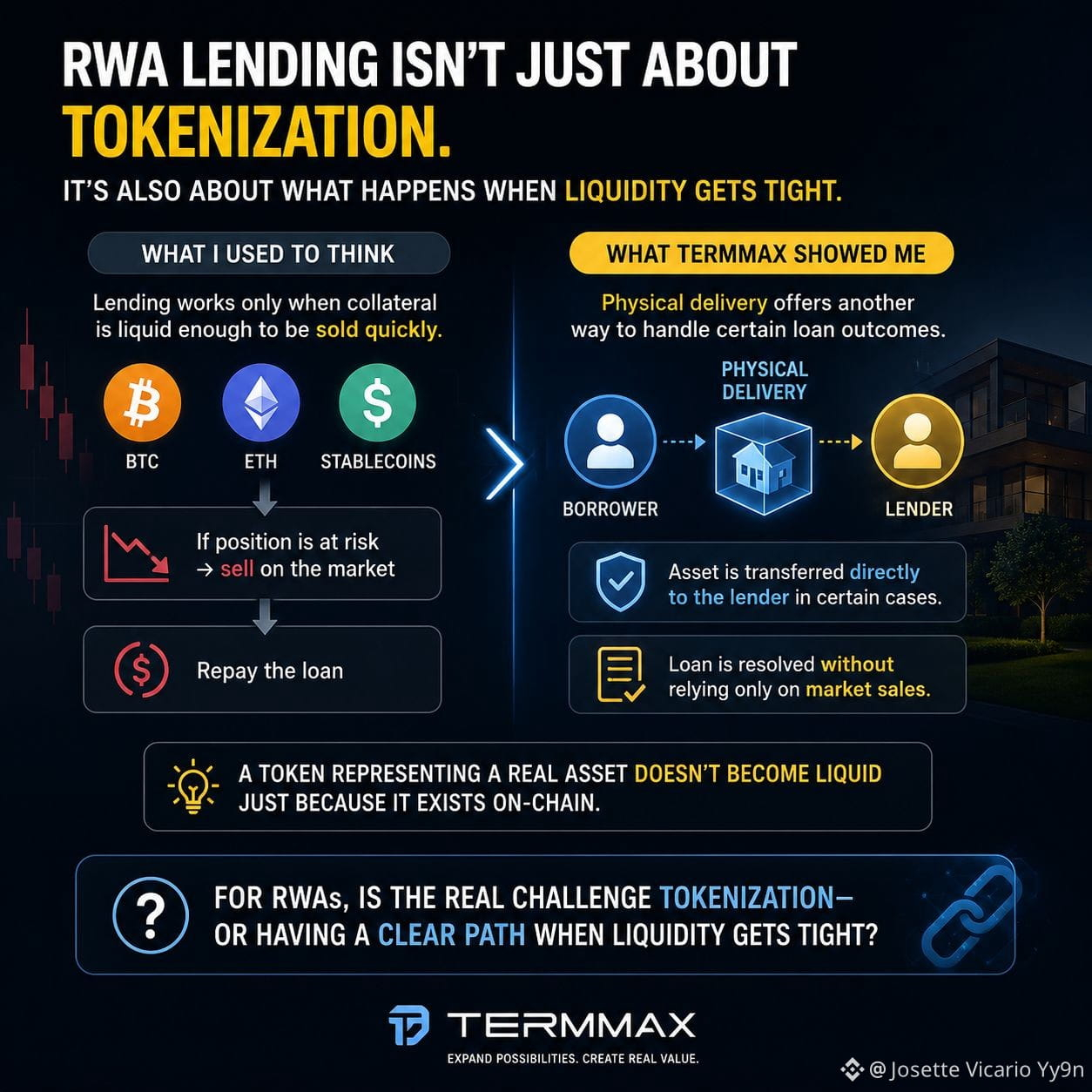
#termmax @termmax I used to think RWA lending was mainly a liquidity problem.
TermMax made me look at it differently: if collateral is less liquid, physical delivery can provide another way to handle certain loan outcomes instead of relying only on immediate market sales.
That raises a bigger question: for RWAs, is the real challenge tokenization—or having a clear path when liquidity gets tight?
#tremmax @termmax
#termmax @TermMax I used to think RWA lending was mainly a liquidity problem.
TermMax made me look at it differently: if collateral is less liquid, physical delivery can provide another way to handle certain loan outcomes instead of relying only on immediate market sales.
That raises a bigger question: for RWAs, is the real challenge tokenization—or having a clear path when liquidity gets tight?
#tremmax @TermMax
TermMax made me look at it differently: if collateral is less liquid, physical delivery can provide another way to handle certain loan outcomes instead of relying only on immediate market sales.
That raises a bigger question: for RWAs, is the real challenge tokenization—or having a clear path when liquidity gets tight?
#tremmax @TermMax
4
3
4
79

·
--


TermMax
·
--
TermMax × @Binance Wallet Booster Program
Complete five tasks or post on Binance Square to share 2,000,000 $TMX.
Binance Keyless Wallet + 2 Alpha Points to join.
Rewards unlock at TGE.
📲 https://www.binance.com/en/web3-campaign/airdrop/5179500589338386433
🖥️ https://web3.binance.com/en/booster/227/5179500589338386433?chain=bsc
🐬
Complete five tasks or post on Binance Square to share 2,000,000 $TMX.
Binance Keyless Wallet + 2 Alpha Points to join.
Rewards unlock at TGE.
📲 https://www.binance.com/en/web3-campaign/airdrop/5179500589338386433
🖥️ https://web3.binance.com/en/booster/227/5179500589338386433?chain=bsc
🐬
3

·
--
#termmax @termmax The growth of Web3 ecosystem project @termmax is truly impressive! Driven by strong fundamentals and real utility, $TOKEN is positioning itself as a strong player in the market. Really excited to see where the roadmap leads next.#TermMax 🚀
Building in crypto requires innovation, consistency, and a dedicated community. @ProjectName demonstrates all three as $TOKEN continues to expand its ecosystem. Excited to support this journey and watch the network grow! #tremmax
With decentralized tech moving forward fast, @termmax is delivering high-value solutions to the Web3 space. The utility behind $TOKEN makes it a key asset to keep on your radar. Looking forward to upcoming milestones! #tremmax #Binance 📊
#termmax @TermMax The growth of Web3 ecosystem project @TermMax is truly impressive! Driven by strong fundamentals and real utility, $TOKEN is positioning itself as a strong player in the market. Really excited to see where the roadmap leads next.#TermMax 🚀
Building in crypto requires innovation, consistency, and a dedicated community. @ProjectName demonstrates all three as $TOKEN continues to expand its ecosystem. Excited to support this journey and watch the network grow! #tremmax
With decentralized tech moving forward fast, @TermMax is delivering high-value solutions to the Web3 space. The utility behind $TOKEN makes it a key asset to keep on your radar. Looking forward to upcoming milestones! #tremmax #Binance 📊
Building in crypto requires innovation, consistency, and a dedicated community. @ProjectName demonstrates all three as $TOKEN continues to expand its ecosystem. Excited to support this journey and watch the network grow! #tremmax
With decentralized tech moving forward fast, @TermMax is delivering high-value solutions to the Web3 space. The utility behind $TOKEN makes it a key asset to keep on your radar. Looking forward to upcoming milestones! #tremmax #Binance 📊
74
Log in to explore more content
Join global crypto users on Binance Square
⚡️ Get latest and useful information about crypto.
💬 Trusted by the world’s largest crypto exchange.
👍 Discover real insights from verified creators.
Email / Phone number
Trending Topics
1
#SECProposesCryptoCustodyRules
901 views
60 Discussing
2
#SECApproves3xLongCryptoCommodityETPs
1,805 views
101 Discussing
3
#G7PlansToReleaseUpTo100MBarrelsOilDiesel
3,441 views
149 Discussing
4
#ICBASuesOCCOverCryptoBankCharters
2,245 views
95 Discussing
5
#USStocksCloseHigherOnWeakJobsData
1,865 views
80 Discussing
6
#AnchorageReportedlyCuts17%Workforce
54 views
26 Discussing
7
#NFPWatch
11M views
19,551 Discussing
8
#NEARIntentsRecovers$3.8MAfterAttack
0 views
0 Discussing
9
#BlastToGraduallyShutDownItsL2Network
438 views
35 Discussing
10
#BitcoinFundingRateTriplesTo10%
215,413 views
1,368 Discussing