

#termma
termma
108 views
25 Discussing
Hot
Latest

·
--
Verified
The other day, while reading the TermMax whitepaper, I kept wondering: what is so special about its Range Order?
Many people focus only on the APR number shown on the page when it comes to fixed-rate lending, and few dig into how the interest rate is actually formed. In conventional DeFi lending, interest rates generally fluctuate according to a pre-set formula, which makes it difficult for liquidity providers to independently control the deployment range.
TermMax’s approach clearly draws on Uniswap V3’s concentrated liquidity logic—only it swaps the object from price to interest rate. We can split funds and allocate them to different APR ranges—for example, put part in the 10%–15% range, and set up another portion in a higher range.
Each time a new loan is successfully matched, the interest rate moves along the preset pricing curve rather than being locked to a single number. This means the “depth” of the funds is directly tied to interest-rate fluctuations.
Its FT split design is also quite interesting. The certificate generated from borrowing is divided into two parts: principal and interest, and then recombined into a debt token—embedding fixed-rate functionality directly into the entire matching mechanism, not just a marketing slogan.
With the TGE on August 25 getting closer, attention continues to rise. But compared with the lively discussion, what I care about more is whether this arbitrage-rate-range mechanism can consistently attract real market-making capital, instead of only miners farming for short-term events.
The fixed-rate lending track has long lacked a mature solution. Can this innovation work end-to-end? The on-chain data from the coming weeks is definitely worth close monitoring.
#termma @termmax
The other day, while reading the TermMax whitepaper, I kept wondering: what is so special about its Range Order?
Many people focus only on the APR number shown on the page when it comes to fixed-rate lending, and few dig into how the interest rate is actually formed. In conventional DeFi lending, interest rates generally fluctuate according to a pre-set formula, which makes it difficult for liquidity providers to independently control the deployment range.
TermMax’s approach clearly draws on Uniswap V3’s concentrated liquidity logic—only it swaps the object from price to interest rate. We can split funds and allocate them to different APR ranges—for example, put part in the 10%–15% range, and set up another portion in a higher range.
Each time a new loan is successfully matched, the interest rate moves along the preset pricing curve rather than being locked to a single number. This means the “depth” of the funds is directly tied to interest-rate fluctuations.
Its FT split design is also quite interesting. The certificate generated from borrowing is divided into two parts: principal and interest, and then recombined into a debt token—embedding fixed-rate functionality directly into the entire matching mechanism, not just a marketing slogan.
With the TGE on August 25 getting closer, attention continues to rise. But compared with the lively discussion, what I care about more is whether this arbitrage-rate-range mechanism can consistently attract real market-making capital, instead of only miners farming for short-term events.
The fixed-rate lending track has long lacked a mature solution. Can this innovation work end-to-end? The on-chain data from the coming weeks is definitely worth close monitoring.
#termma @TermMax
Many people focus only on the APR number shown on the page when it comes to fixed-rate lending, and few dig into how the interest rate is actually formed. In conventional DeFi lending, interest rates generally fluctuate according to a pre-set formula, which makes it difficult for liquidity providers to independently control the deployment range.
TermMax’s approach clearly draws on Uniswap V3’s concentrated liquidity logic—only it swaps the object from price to interest rate. We can split funds and allocate them to different APR ranges—for example, put part in the 10%–15% range, and set up another portion in a higher range.
Each time a new loan is successfully matched, the interest rate moves along the preset pricing curve rather than being locked to a single number. This means the “depth” of the funds is directly tied to interest-rate fluctuations.
Its FT split design is also quite interesting. The certificate generated from borrowing is divided into two parts: principal and interest, and then recombined into a debt token—embedding fixed-rate functionality directly into the entire matching mechanism, not just a marketing slogan.
With the TGE on August 25 getting closer, attention continues to rise. But compared with the lively discussion, what I care about more is whether this arbitrage-rate-range mechanism can consistently attract real market-making capital, instead of only miners farming for short-term events.
The fixed-rate lending track has long lacked a mature solution. Can this innovation work end-to-end? The on-chain data from the coming weeks is definitely worth close monitoring.
#termma @TermMax
1
77


A useful clarification from @TermMaxtoday : 👀
The Booster campaign is not “first come, first served”. If you complete the five eligible tasks, you’re entered into the draw.
So joining on the first day doesn’t give you better chances than joining later.
The same requirements. The same chances in the draw.
This is an important distinction if you’re trying to determine whether there’s any advantage to rushing to finish the campaign.
#termma x
A useful clarification from @TermMaxtoday : 👀
The Booster campaign is not “first come, first served”. If you complete the five eligible tasks, you’re entered into the draw.
So joining on the first day doesn’t give you better chances than joining later.
The same requirements. The same chances in the draw.
This is an important distinction if you’re trying to determine whether there’s any advantage to rushing to finish the campaign.
#termma x
The Booster campaign is not “first come, first served”. If you complete the five eligible tasks, you’re entered into the draw.
So joining on the first day doesn’t give you better chances than joining later.
The same requirements. The same chances in the draw.
This is an important distinction if you’re trying to determine whether there’s any advantage to rushing to finish the campaign.
#termma x
91


·
--
In the DeFi lending and borrowing sector, interest rate fluctuations caused by variable rates have always been a pain point for many users. The new-generation fixed-rate lending/borrowing AMM protocol built by @termmax (https://www.binance.com/zh-CN/square/profile/termmax) precisely addresses this industry challenge. Unlike most mainstream variable-rate lending products, TermMax allows borrowers to lock in their borrowing costs in advance, and lenders can also know their yield at maturity—so they no longer need to worry about interest rates swinging dramatically due to market changes. At the same time, the platform includes a one-click leverage feature, simplifying what used to be complex multi-protocol loop operations into a single step, greatly lowering the operational barrier for ordinary users to participate in leverage strategies. The contract has undergone security audits and has already been deployed on multiple major chains, including BNB Chain, Arbitrum, and Ethereum. The product continues to be iterated on, steadily expanding real-world asset collateral lending scenarios. Whether you’re a typical DeFi participant or institutional capital, you can find a fixed-income solution that fits here—definitely worth keeping a close eye on the project’s ongoing ecosystem progress. #TermMa @TermMax
In the DeFi lending and borrowing sector, interest rate fluctuations caused by variable rates have always been a pain point for many users. The new-generation fixed-rate lending/borrowing AMM protocol built by @TermMax (https://www.binance.com/zh-CN/square/profile/termmax) precisely addresses this industry challenge. Unlike most mainstream variable-rate lending products, TermMax allows borrowers to lock in their borrowing costs in advance, and lenders can also know their yield at maturity—so they no longer need to worry about interest rates swinging dramatically due to market changes. At the same time, the platform includes a one-click leverage feature, simplifying what used to be complex multi-protocol loop operations into a single step, greatly lowering the operational barrier for ordinary users to participate in leverage strategies. The contract has undergone security audits and has already been deployed on multiple major chains, including BNB Chain, Arbitrum, and Ethereum. The product continues to be iterated on, steadily expanding real-world asset collateral lending scenarios. Whether you’re a typical DeFi participant or institutional capital, you can find a fixed-income solution that fits here—definitely worth keeping a close eye on the project’s ongoing ecosystem progress. #TermMa @TermMax
1
63

·
--
TermMax vs Variable-Rate Lending: What Actually Changes for the User?
Most DeFi lending markets use floating rates.
That means the rate you see when you enter a position may not be the rate you keep paying or earning. If demand for borrowing rises, costs can move quickly. If liquidity floods the market, lender yields can drop.
@termmax changes that setup by giving users fixed rates tied to a specific maturity.
For a borrower, the main difference is simple: the financing cost is known from the start.
If you are building a strategy that lasts several weeks or months, that matters. You can calculate your expected borrowing cost before committing capital instead of constantly watching a changing APY.
For lenders, fixed rates create a clearer return profile. Rather than depending entirely on future utilization levels, users can choose a rate and maturity that fits their own time horizon.
Variable-rate lending still has a place. It can work well for users who want flexibility or expect rates to move in their favor.
Fixed-rate lending serves a different need: predictability.
That distinction becomes more meaningful as DeFi attracts traders, treasuries, funds, and users who care about planning capital over a defined period.
The real value of #TermMax is not that fixed rates are automatically better than floating rates.
It is that users finally get another choice.
@termmax #termma
TermMax vs Variable-Rate Lending: What Actually Changes for the User?
Most DeFi lending markets use floating rates.
That means the rate you see when you enter a position may not be the rate you keep paying or earning. If demand for borrowing rises, costs can move quickly. If liquidity floods the market, lender yields can drop.
@TermMax changes that setup by giving users fixed rates tied to a specific maturity.
For a borrower, the main difference is simple: the financing cost is known from the start.
If you are building a strategy that lasts several weeks or months, that matters. You can calculate your expected borrowing cost before committing capital instead of constantly watching a changing APY.
For lenders, fixed rates create a clearer return profile. Rather than depending entirely on future utilization levels, users can choose a rate and maturity that fits their own time horizon.
Variable-rate lending still has a place. It can work well for users who want flexibility or expect rates to move in their favor.
Fixed-rate lending serves a different need: predictability.
That distinction becomes more meaningful as DeFi attracts traders, treasuries, funds, and users who care about planning capital over a defined period.
The real value of #TermMax is not that fixed rates are automatically better than floating rates.
It is that users finally get another choice.
@TermMax #termma
Most DeFi lending markets use floating rates.
That means the rate you see when you enter a position may not be the rate you keep paying or earning. If demand for borrowing rises, costs can move quickly. If liquidity floods the market, lender yields can drop.
@TermMax changes that setup by giving users fixed rates tied to a specific maturity.
For a borrower, the main difference is simple: the financing cost is known from the start.
If you are building a strategy that lasts several weeks or months, that matters. You can calculate your expected borrowing cost before committing capital instead of constantly watching a changing APY.
For lenders, fixed rates create a clearer return profile. Rather than depending entirely on future utilization levels, users can choose a rate and maturity that fits their own time horizon.
Variable-rate lending still has a place. It can work well for users who want flexibility or expect rates to move in their favor.
Fixed-rate lending serves a different need: predictability.
That distinction becomes more meaningful as DeFi attracts traders, treasuries, funds, and users who care about planning capital over a defined period.
The real value of #TermMax is not that fixed rates are automatically better than floating rates.
It is that users finally get another choice.
@TermMax #termma
1
62

#termmax in a fast-changing crypto industry, many people are used to chasing trends, but they often overlook what truly matters: ongoing participation, continuous learning, and steady accumulation.
What TermMax drew my attention to is exactly this kind of “long-termism.” Instead of simply waiting for market conditions, community quests and interactive activities allow users to understand a project more deeply. From the product and ecosystem to community culture, there are opportunities to build a more intuitive understanding through actual involvement.
I believe a truly vibrant project shouldn’t rely only on short-term hype. It should give community members a sense of participation. Every original post, every community interaction, and every thought about the project is an accumulation of both personal insight and the community ecosystem.
Especially when market sentiment changes rapidly, it’s even more important to maintain independent thinking. Don’t be blindly optimistic just because prices are rising in the short term, and don’t lose patience because things are temporarily sluggish. What’s truly worth paying attention to is whether the project continues to build, whether the community remains active, and whether users can gain long-term value through participation.
One important takeaway TermMax gave me is this: participation itself is a kind of value.
Rather than just watch from the sidelines, it’s better to actively learn; rather than chasing short-term hot spots, it’s better to observe the project’s development seriously; rather than repeating what others have already said, it’s better to form your own perspective.
For community members, original content isn’t just a task—it’s a chance to express viewpoints and record personal growth. I hope to continue following TermMax’s progress in the future, and I look forward to seeing more valuable products, events, and community building.
In an industry full of opportunities and changes, the ones who can truly go further are often not the earliest to appear, but those who are willing to keep learning, keep participating, and keep building.
#TermMa @TermMax
#termmax in a fast-changing crypto industry, many people are used to chasing trends, but they often overlook what truly matters: ongoing participation, continuous learning, and steady accumulation.
What TermMax drew my attention to is exactly this kind of “long-termism.” Instead of simply waiting for market conditions, community quests and interactive activities allow users to understand a project more deeply. From the product and ecosystem to community culture, there are opportunities to build a more intuitive understanding through actual involvement.
I believe a truly vibrant project shouldn’t rely only on short-term hype. It should give community members a sense of participation. Every original post, every community interaction, and every thought about the project is an accumulation of both personal insight and the community ecosystem.
Especially when market sentiment changes rapidly, it’s even more important to maintain independent thinking. Don’t be blindly optimistic just because prices are rising in the short term, and don’t lose patience because things are temporarily sluggish. What’s truly worth paying attention to is whether the project continues to build, whether the community remains active, and whether users can gain long-term value through participation.
One important takeaway TermMax gave me is this: participation itself is a kind of value.
Rather than just watch from the sidelines, it’s better to actively learn; rather than chasing short-term hot spots, it’s better to observe the project’s development seriously; rather than repeating what others have already said, it’s better to form your own perspective.
For community members, original content isn’t just a task—it’s a chance to express viewpoints and record personal growth. I hope to continue following TermMax’s progress in the future, and I look forward to seeing more valuable products, events, and community building.
In an industry full of opportunities and changes, the ones who can truly go further are often not the earliest to appear, but those who are willing to keep learning, keep participating, and keep building.
#TermMa @TermMax
What TermMax drew my attention to is exactly this kind of “long-termism.” Instead of simply waiting for market conditions, community quests and interactive activities allow users to understand a project more deeply. From the product and ecosystem to community culture, there are opportunities to build a more intuitive understanding through actual involvement.
I believe a truly vibrant project shouldn’t rely only on short-term hype. It should give community members a sense of participation. Every original post, every community interaction, and every thought about the project is an accumulation of both personal insight and the community ecosystem.
Especially when market sentiment changes rapidly, it’s even more important to maintain independent thinking. Don’t be blindly optimistic just because prices are rising in the short term, and don’t lose patience because things are temporarily sluggish. What’s truly worth paying attention to is whether the project continues to build, whether the community remains active, and whether users can gain long-term value through participation.
One important takeaway TermMax gave me is this: participation itself is a kind of value.
Rather than just watch from the sidelines, it’s better to actively learn; rather than chasing short-term hot spots, it’s better to observe the project’s development seriously; rather than repeating what others have already said, it’s better to form your own perspective.
For community members, original content isn’t just a task—it’s a chance to express viewpoints and record personal growth. I hope to continue following TermMax’s progress in the future, and I look forward to seeing more valuable products, events, and community building.
In an industry full of opportunities and changes, the ones who can truly go further are often not the earliest to appear, but those who are willing to keep learning, keep participating, and keep building.
#TermMa @TermMax
69

·
--
https://www.binance.com/zh-CN/square/profile/termmax可预见性才是 DeFi 真正的差异化所在。通过 @TermMax,用户可以锁定固定利Focus on project potential and market observation (recommended)
I've been paying close attention to the development of the on-chain trading track lately and found @TermMax’s plans in this area quite interesting. The market environment is changing rapidly now, and users’ requirements for the smoothness and security of trading tools are getting higher. TermMax seems to have pinpointed these pain points. I saw that their updates on Binance Square are very frequent, which makes it feel like the team is doing solid work. Especially for friends who want to go deep into Web3, a project that prioritizes user experience is worth keeping track of. What do you all think about TermMax’s next development roadmap? I hope more real-world application scenarios will emerge so we can witness its growth together! <t-11/>#TermMa x
https://www.binance.com/zh-CN/square/profile/termmax可预见性才是 DeFi 真正的差异化所在。通过 @TermMax,用户可以锁定固定利
Focus on project potential and market observation (recommended)
I've been paying close attention to the development of the on-chain trading track lately and found @TermMax’s plans in this area quite interesting. The market environment is changing rapidly now, and users’ requirements for the smoothness and security of trading tools are getting higher. TermMax seems to have pinpointed these pain points. I saw that their updates on Binance Square are very frequent, which makes it feel like the team is doing solid work. Especially for friends who want to go deep into Web3, a project that prioritizes user experience is worth keeping track of. What do you all think about TermMax’s next development roadmap? I hope more real-world application scenarios will emerge so we can witness its growth together! <t-11/>#TermMa x
I've been paying close attention to the development of the on-chain trading track lately and found @TermMax’s plans in this area quite interesting. The market environment is changing rapidly now, and users’ requirements for the smoothness and security of trading tools are getting higher. TermMax seems to have pinpointed these pain points. I saw that their updates on Binance Square are very frequent, which makes it feel like the team is doing solid work. Especially for friends who want to go deep into Web3, a project that prioritizes user experience is worth keeping track of. What do you all think about TermMax’s next development roadmap? I hope more real-world application scenarios will emerge so we can witness its growth together! <t-11/>#TermMa x
6

·
--
Bullish
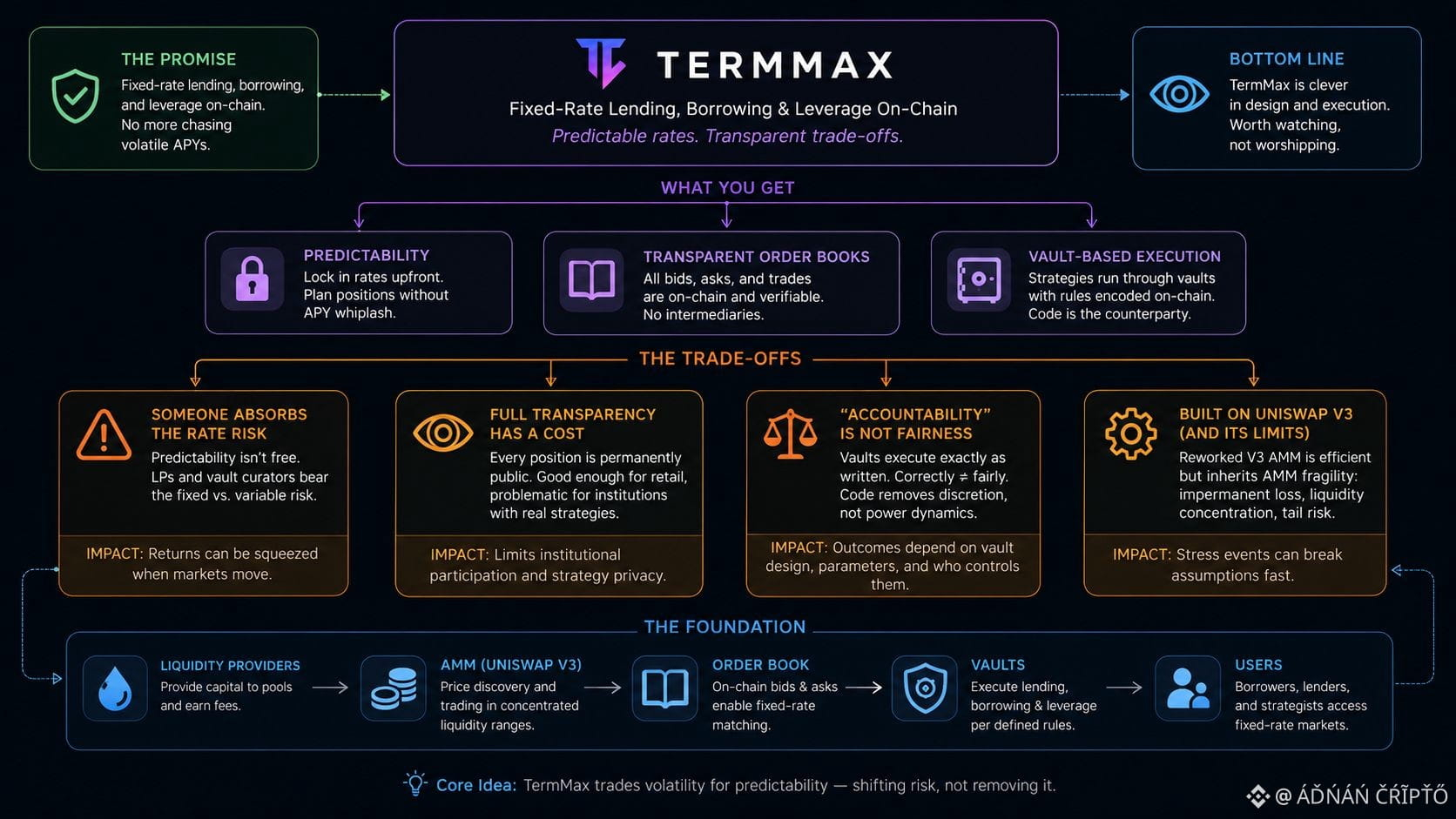
@termmax TermMax promises fixed-rate lending, borrowing, and leverage on-chain — no more chasing volatile APYs. But predictability isn't free. Someone still absorbs the rate risk that variable markets normally price in real time: usually liquidity providers and vault curators.#termma
Its transparent order books are trustless, sure — but every position is permanently public, which is fine for retail, less fine for institutions running real strategies. And its vault model offers "accountability" only in the sense that code executes exactly as written — correctly, not necessarily fairly.
Built on a reworked Uniswap V3 AMM, it's clever — but inherits AMM fragility too. Worth watching, not worshipping.
#termmax @termmax
@TermMax TermMax promises fixed-rate lending, borrowing, and leverage on-chain — no more chasing volatile APYs. But predictability isn't free. Someone still absorbs the rate risk that variable markets normally price in real time: usually liquidity providers and vault curators.#termma
Its transparent order books are trustless, sure — but every position is permanently public, which is fine for retail, less fine for institutions running real strategies. And its vault model offers "accountability" only in the sense that code executes exactly as written — correctly, not necessarily fairly.
Built on a reworked Uniswap V3 AMM, it's clever — but inherits AMM fragility too. Worth watching, not worshipping.
#termmax @TermMax
Its transparent order books are trustless, sure — but every position is permanently public, which is fine for retail, less fine for institutions running real strategies. And its vault model offers "accountability" only in the sense that code executes exactly as written — correctly, not necessarily fairly.
Built on a reworked Uniswap V3 AMM, it's clever — but inherits AMM fragility too. Worth watching, not worshipping.
#termmax @TermMax
1
78

·
--
#termmax @termmax
Understand TermMax's “Unchangeable”: In a DeFi world full of noise, set a floor for the value of time
The latest hot topics in the community feel like a revolving door—meme coins, AI agents, and more. But in this fast-paced market, I’ve found myself increasingly drawn to a seemingly “non-mainstream” track that gets straight to the financial essence: fixed-rate lending and borrowing. And when it comes to this space, you can’t avoid the protagonist I’m talking about today: @TermMax [#TermMax]
Many people may still think of TermMax as “just another lending protocol.” But if you truly experience its V2 version, you’ll see that its ambition goes far beyond that. It isn’t competing with Aave or Compound to build the largest liquidity pools—it’s about reshaping the pricing power and capital efficiency of the lending market.
The core logic that made me dig in is that it solves a long-ignored pain point in DeFi: uncertainty.
In traditional variable-rate lending, both borrowers and lenders are essentially “betting” on future interest rate movements. For entities or individuals who need stable cash-flow planning, it’s almost a nightmare. TermMax, through an order-book-style fixed-rate posting mechanism, turns interest rates themselves into a tradable and predictable commodity. When you deposit funds, you’re not passively accepting the fluctuating interest offered by the protocol—you can, like a market maker, place limit orders at the interest rate you believe in, exercising the power to “price” the value of time. This isn’t just an upgrade in the experience; it’s a leap in identity—from simply being a capital provider to becoming an interest-rate definer.
What also impresses me is the project team’s honesty and restraint when it comes to “risk boundaries.”
In an industry that prizes attractive TVL numbers and seems determined to include all assets as collateral, TermMax can set strict borrowing caps for certain RWA assets (for example, a 400K USDC limit against ynRWAx). This may look “less aggressive” on the surface, but it’s actually the greatest responsibility toward users’ assets. It clearly tells the market: we only do the business that our risk-control models can ensure will have hard redemption; we don’t chase big promises, and we don’t create “liquidity illusions.” This kind of financial discipline—“how much you have, how much you cook”—is especially valuable in today’s restless environment.
#termma x #DeFi #FixedInterestRate #TMX #BinanceSquare
#termmax @TermMax
Understand TermMax's “Unchangeable”: In a DeFi world full of noise, set a floor for the value of time
The latest hot topics in the community feel like a revolving door—meme coins, AI agents, and more. But in this fast-paced market, I’ve found myself increasingly drawn to a seemingly “non-mainstream” track that gets straight to the financial essence: fixed-rate lending and borrowing. And when it comes to this space, you can’t avoid the protagonist I’m talking about today: @TermMax [#TermMax]
Many people may still think of TermMax as “just another lending protocol.” But if you truly experience its V2 version, you’ll see that its ambition goes far beyond that. It isn’t competing with Aave or Compound to build the largest liquidity pools—it’s about reshaping the pricing power and capital efficiency of the lending market.
The core logic that made me dig in is that it solves a long-ignored pain point in DeFi: uncertainty.
In traditional variable-rate lending, both borrowers and lenders are essentially “betting” on future interest rate movements. For entities or individuals who need stable cash-flow planning, it’s almost a nightmare. TermMax, through an order-book-style fixed-rate posting mechanism, turns interest rates themselves into a tradable and predictable commodity. When you deposit funds, you’re not passively accepting the fluctuating interest offered by the protocol—you can, like a market maker, place limit orders at the interest rate you believe in, exercising the power to “price” the value of time. This isn’t just an upgrade in the experience; it’s a leap in identity—from simply being a capital provider to becoming an interest-rate definer.
What also impresses me is the project team’s honesty and restraint when it comes to “risk boundaries.”
In an industry that prizes attractive TVL numbers and seems determined to include all assets as collateral, TermMax can set strict borrowing caps for certain RWA assets (for example, a 400K USDC limit against ynRWAx). This may look “less aggressive” on the surface, but it’s actually the greatest responsibility toward users’ assets. It clearly tells the market: we only do the business that our risk-control models can ensure will have hard redemption; we don’t chase big promises, and we don’t create “liquidity illusions.” This kind of financial discipline—“how much you have, how much you cook”—is especially valuable in today’s restless environment.
#termma x #DeFi #FixedInterestRate #TMX #BinanceSquare
Understand TermMax's “Unchangeable”: In a DeFi world full of noise, set a floor for the value of time
The latest hot topics in the community feel like a revolving door—meme coins, AI agents, and more. But in this fast-paced market, I’ve found myself increasingly drawn to a seemingly “non-mainstream” track that gets straight to the financial essence: fixed-rate lending and borrowing. And when it comes to this space, you can’t avoid the protagonist I’m talking about today: @TermMax [#TermMax]
Many people may still think of TermMax as “just another lending protocol.” But if you truly experience its V2 version, you’ll see that its ambition goes far beyond that. It isn’t competing with Aave or Compound to build the largest liquidity pools—it’s about reshaping the pricing power and capital efficiency of the lending market.
The core logic that made me dig in is that it solves a long-ignored pain point in DeFi: uncertainty.
In traditional variable-rate lending, both borrowers and lenders are essentially “betting” on future interest rate movements. For entities or individuals who need stable cash-flow planning, it’s almost a nightmare. TermMax, through an order-book-style fixed-rate posting mechanism, turns interest rates themselves into a tradable and predictable commodity. When you deposit funds, you’re not passively accepting the fluctuating interest offered by the protocol—you can, like a market maker, place limit orders at the interest rate you believe in, exercising the power to “price” the value of time. This isn’t just an upgrade in the experience; it’s a leap in identity—from simply being a capital provider to becoming an interest-rate definer.
What also impresses me is the project team’s honesty and restraint when it comes to “risk boundaries.”
In an industry that prizes attractive TVL numbers and seems determined to include all assets as collateral, TermMax can set strict borrowing caps for certain RWA assets (for example, a 400K USDC limit against ynRWAx). This may look “less aggressive” on the surface, but it’s actually the greatest responsibility toward users’ assets. It clearly tells the market: we only do the business that our risk-control models can ensure will have hard redemption; we don’t chase big promises, and we don’t create “liquidity illusions.” This kind of financial discipline—“how much you have, how much you cook”—is especially valuable in today’s restless environment.
#termma x #DeFi #FixedInterestRate #TMX #BinanceSquare
57

·
--
Bullish
DeFi is evolving, and TermMax is aiming to be part of that next wave with innovative on-chain financial solutions. I’m excited to follow the ecosystem, technology, and future opportunities being built by @Square-Creator-0f84001b3db77 . #termma x $TMX
DeFi is evolving, and TermMax is aiming to be part of that next wave with innovative on-chain financial solutions. I’m excited to follow the ecosystem, technology, and future opportunities being built by @TermMaxxx . #termma x $TMX
63

For leverage products that just say “zero liquidation risk,” I usually first look for where the wallet is going to get cut. I used to think it was only a convenient marketing phrase, but when I flipped to the TermMax Alpha terminology page, I changed my mind: Long and Short are buy options, and Max Cost is the option premium you pay upfront when opening the position—which is also the most you can lose on that trade. That line about “the most you can lose,” in fact, should be checked before “zero liquidation.”
The risk hasn’t disappeared; it’s written in advance before you place the order. If the price moves against you, the buyer doesn’t have to wait for a notification to top up margin—because the loss is already capped by the option premium. For people afraid of getting liquidated, this certainty is very real; but it can also make people relax their guard, because “won’t be liquidated” sounds more comfortable than “every time you make a mistake, you have to pay first.”
The picture that comes to mind is simple: someone watches a coin that’s just gained some heat, opens several small positions to bet on direction. Their account isn’t liquidated, but their wallet gets gradually thinned out by one option premium payment after another. At that point, the product isn’t malfunctioning—it’s just that they mistook controllable losses for low-cost trial and error. The most dangerous thing isn’t losing everything in one go; it’s thinking every time, “Anyway, it won’t force-liquidate,” and treating the budget as chips you can endlessly re-buy.
@termmax What users really should be focused on is how much capital Max Cost ties up before clicking—not just the leverage multiple. If $TMX’s Alpha can explain this clearly, “zero liquidation” will truly be a boundary of risk, rather than a sentence that helps people lower their guard.#termma
For leverage products that just say “zero liquidation risk,” I usually first look for where the wallet is going to get cut. I used to think it was only a convenient marketing phrase, but when I flipped to the TermMax Alpha terminology page, I changed my mind: Long and Short are buy options, and Max Cost is the option premium you pay upfront when opening the position—which is also the most you can lose on that trade. That line about “the most you can lose,” in fact, should be checked before “zero liquidation.”
The risk hasn’t disappeared; it’s written in advance before you place the order. If the price moves against you, the buyer doesn’t have to wait for a notification to top up margin—because the loss is already capped by the option premium. For people afraid of getting liquidated, this certainty is very real; but it can also make people relax their guard, because “won’t be liquidated” sounds more comfortable than “every time you make a mistake, you have to pay first.”
The picture that comes to mind is simple: someone watches a coin that’s just gained some heat, opens several small positions to bet on direction. Their account isn’t liquidated, but their wallet gets gradually thinned out by one option premium payment after another. At that point, the product isn’t malfunctioning—it’s just that they mistook controllable losses for low-cost trial and error. The most dangerous thing isn’t losing everything in one go; it’s thinking every time, “Anyway, it won’t force-liquidate,” and treating the budget as chips you can endlessly re-buy.
@TermMax What users really should be focused on is how much capital Max Cost ties up before clicking—not just the leverage multiple. If $TMX’s Alpha can explain this clearly, “zero liquidation” will truly be a boundary of risk, rather than a sentence that helps people lower their guard.#termma
The risk hasn’t disappeared; it’s written in advance before you place the order. If the price moves against you, the buyer doesn’t have to wait for a notification to top up margin—because the loss is already capped by the option premium. For people afraid of getting liquidated, this certainty is very real; but it can also make people relax their guard, because “won’t be liquidated” sounds more comfortable than “every time you make a mistake, you have to pay first.”
The picture that comes to mind is simple: someone watches a coin that’s just gained some heat, opens several small positions to bet on direction. Their account isn’t liquidated, but their wallet gets gradually thinned out by one option premium payment after another. At that point, the product isn’t malfunctioning—it’s just that they mistook controllable losses for low-cost trial and error. The most dangerous thing isn’t losing everything in one go; it’s thinking every time, “Anyway, it won’t force-liquidate,” and treating the budget as chips you can endlessly re-buy.
@TermMax What users really should be focused on is how much capital Max Cost ties up before clicking—not just the leverage multiple. If $TMX’s Alpha can explain this clearly, “zero liquidation” will truly be a boundary of risk, rather than a sentence that helps people lower their guard.#termma


2
1
87


#termmax @termmax Loan AMMs are still stuck choosing between fixed and variable rates, but @termmax ax skips that tradeoff entirely. Its one-click looping and customizable pricing curves let borrowers set predictable costs while lenders still capture flexible yield. Add TermMax Alpha on BNB Chain — leveraged exposure to new Alpha listings with a fixed premium and zero liquidation risk — and you get a lending stack built for how DeFi actually trades today. Worth watching how the range orders evolve as more Alpha tokens onboard. #termma x
#termmax @TermMax Loan AMMs are still stuck choosing between fixed and variable rates, but @TermMax ax skips that tradeoff entirely. Its one-click looping and customizable pricing curves let borrowers set predictable costs while lenders still capture flexible yield. Add TermMax Alpha on BNB Chain — leveraged exposure to new Alpha listings with a fixed premium and zero liquidation risk — and you get a lending stack built for how DeFi actually trades today. Worth watching how the range orders evolve as more Alpha tokens onboard. #termma x
83
Log in to explore more content
Join global crypto users on Binance Square
⚡️ Get latest and useful information about crypto.
💬 Trusted by the world’s largest crypto exchange.
👍 Discover real insights from verified creators.
Email / Phone number
Trending Topics
1
#BitcoinSpotETFsDraw$6.34BInflowsInQ3
94 views
12 Discussing
2
#EthereumValidatorExitQueueJumps392%
6,429 views
131 Discussing
3
#IMFApprovesElSalvador$138MWithBitcoinWaiver
535 views
12 Discussing
4
#SECHaltsCryptoETFReviewsAmidFundingLapse
138,275 views
1,090 Discussing
5
#ZcashETFPostsFirstWeeklyOutflow$93.6M
73,743 views
230 Discussing
6
#GreekPoliceBustCryptoScamRingArrest17
273,213 views
1,823 Discussing
7
#BitcoinRejectedAt$87K
182,515 views
288 Discussing
8
#FedOctoberRateHikeOddsFallTo17%
278,835 views
1,964 Discussing
9
#NvidiaHitsRecordHighUp2.4%
187,708 views
1,348 Discussing
10
#CanaryFilesAmendedS1ForPEPEETF
61,244 views
884 Discussing