

#opcat
opcat
4,174 views
15 Discussing
Hot
Latest


·
--
Bullish
AI Agents are everywhere now, and the most discussed things are what they can do and how much money they can make.
But when it actually comes to letting them manage money, what happens if they make a mistake—who will be there to oversee it? It’s not hard to have machine chat and make payments. The hard part is that once the money lands in hand, there have to be boundaries: you can’t just spend whenever you want.
A2A and x402 solve how Agents communicate and how payments work between them. But paying isn’t the same as managing money. The system also needs to know when it’s allowed to move funds, what conditions must be met before it can move them, and whether it can stop immediately if something goes wrong. Those rules are exactly what Bitcoin is best at. Its security foundation is naturally suited for setting constraints.
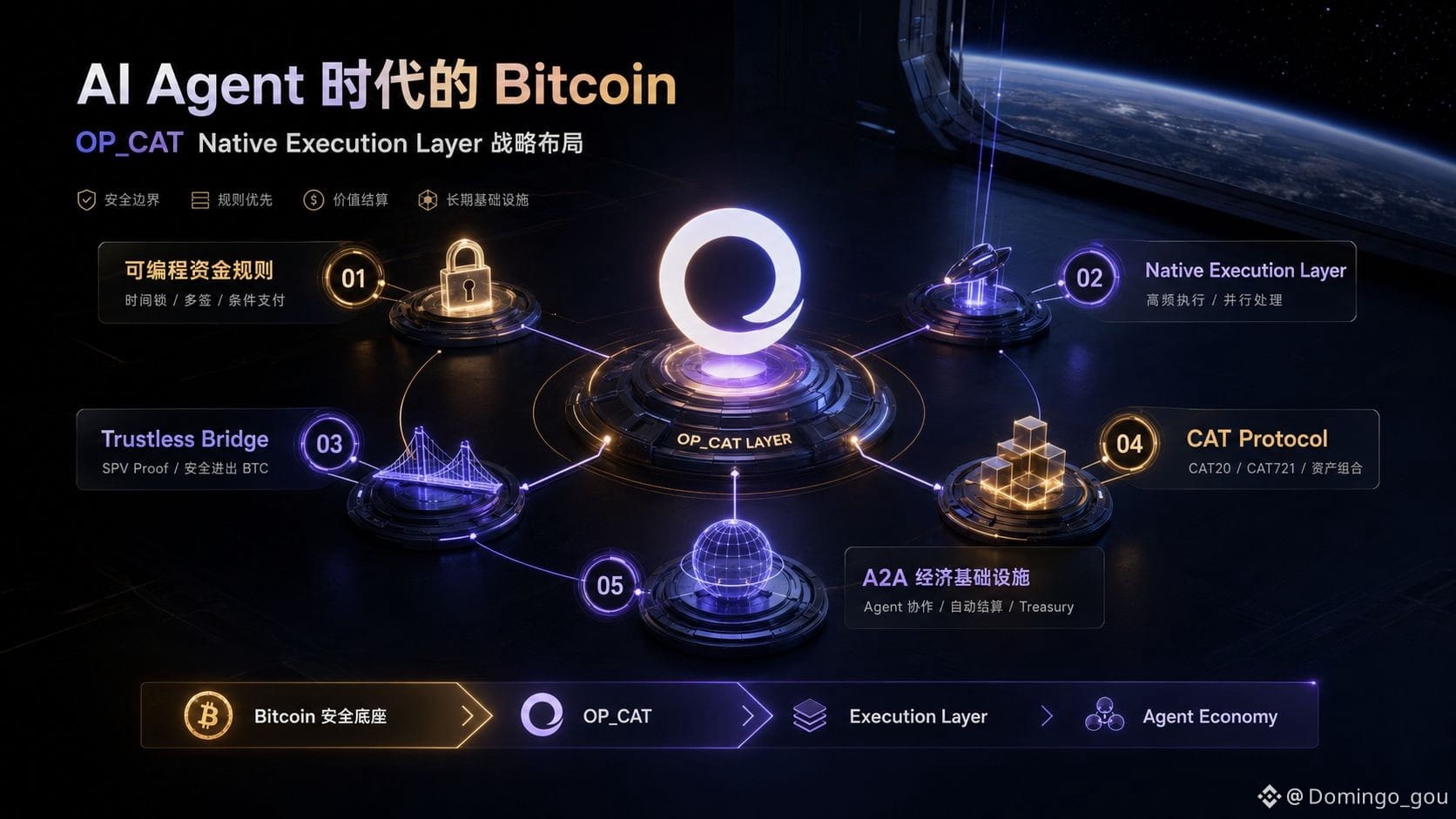
Bitcoin Script has always been fairly conservative. It’s not as flexible for developers, but it has delivered years of steady reliability. The value of OP_CAT lies in supplementing this conservatism with Covenant—so that a single BTC can “lock in” future spending rules in advance, such as time locks, multisig approvals, and condition-triggered spending. This helps prevent Agents from withdrawing all funds at once just by making a move.
What @op_catlayer is doing isn’t recreating a whole new chain. Instead, it keeps Bitcoin in charge of security and settlement, by hooking up a high-frequency Execution Layer using OP_CAT’s Native Execution Layer, along with native assets and complex applications—directly connecting the spending rules and execution capabilities that Agents need.
This road is still early. OP_CAT hasn’t been formally activated on Bitcoin L1 yet, and the safety of the execution-layer bridging and the scale of the ecosystem still need further verification. But it tackles the most urgent question: once Agents have wallets, who will restrict them so they don’t乱 spend?
The market loves to hype how smart Agents are and how much they can earn. But when they truly start managing people’s assets, the most valuable thing may not be the “brains”—it may be the set of rules they can never get around. Do you check how much they can make first, or do you confirm they can’t touch the money they shouldn’t?
@OPCATLayerCN @clawchatglobal #OPCAT #A2A
AI Agents are everywhere now, and the most discussed things are what they can do and how much money they can make.
But when it actually comes to letting them manage money, what happens if they make a mistake—who will be there to oversee it? It’s not hard to have machine chat and make payments. The hard part is that once the money lands in hand, there have to be boundaries: you can’t just spend whenever you want.
A2A and x402 solve how Agents communicate and how payments work between them. But paying isn’t the same as managing money. The system also needs to know when it’s allowed to move funds, what conditions must be met before it can move them, and whether it can stop immediately if something goes wrong. Those rules are exactly what Bitcoin is best at. Its security foundation is naturally suited for setting constraints.
Bitcoin Script has always been fairly conservative. It’s not as flexible for developers, but it has delivered years of steady reliability. The value of OP_CAT lies in supplementing this conservatism with Covenant—so that a single BTC can “lock in” future spending rules in advance, such as time locks, multisig approvals, and condition-triggered spending. This helps prevent Agents from withdrawing all funds at once just by making a move.
What @op_catlayer is doing isn’t recreating a whole new chain. Instead, it keeps Bitcoin in charge of security and settlement, by hooking up a high-frequency Execution Layer using OP_CAT’s Native Execution Layer, along with native assets and complex applications—directly connecting the spending rules and execution capabilities that Agents need.
This road is still early. OP_CAT hasn’t been formally activated on Bitcoin L1 yet, and the safety of the execution-layer bridging and the scale of the ecosystem still need further verification. But it tackles the most urgent question: once Agents have wallets, who will restrict them so they don’t乱 spend?
The market loves to hype how smart Agents are and how much they can earn. But when they truly start managing people’s assets, the most valuable thing may not be the “brains”—it may be the set of rules they can never get around. Do you check how much they can make first, or do you confirm they can’t touch the money they shouldn’t?
@OPCATLayerCN @clawchatglobal #OPCAT #A2A
But when it actually comes to letting them manage money, what happens if they make a mistake—who will be there to oversee it? It’s not hard to have machine chat and make payments. The hard part is that once the money lands in hand, there have to be boundaries: you can’t just spend whenever you want.
A2A and x402 solve how Agents communicate and how payments work between them. But paying isn’t the same as managing money. The system also needs to know when it’s allowed to move funds, what conditions must be met before it can move them, and whether it can stop immediately if something goes wrong. Those rules are exactly what Bitcoin is best at. Its security foundation is naturally suited for setting constraints.
Bitcoin Script has always been fairly conservative. It’s not as flexible for developers, but it has delivered years of steady reliability. The value of OP_CAT lies in supplementing this conservatism with Covenant—so that a single BTC can “lock in” future spending rules in advance, such as time locks, multisig approvals, and condition-triggered spending. This helps prevent Agents from withdrawing all funds at once just by making a move.
What @op_catlayer is doing isn’t recreating a whole new chain. Instead, it keeps Bitcoin in charge of security and settlement, by hooking up a high-frequency Execution Layer using OP_CAT’s Native Execution Layer, along with native assets and complex applications—directly connecting the spending rules and execution capabilities that Agents need.
This road is still early. OP_CAT hasn’t been formally activated on Bitcoin L1 yet, and the safety of the execution-layer bridging and the scale of the ecosystem still need further verification. But it tackles the most urgent question: once Agents have wallets, who will restrict them so they don’t乱 spend?
The market loves to hype how smart Agents are and how much they can earn. But when they truly start managing people’s assets, the most valuable thing may not be the “brains”—it may be the set of rules they can never get around. Do you check how much they can make first, or do you confirm they can’t touch the money they shouldn’t?
@OPCATLayerCN @clawchatglobal #OPCAT #A2A
318
·
--
I previously saw a new protocol launch, and my first reaction was always to look at the technical details.
Now, I’m more likely to ask: after it’s built, who will actually use it? Who is willing to trade? And is there a market afterward that will be able to take it up and support it?
This Catmint update is the reason I’m taking it seriously as well.
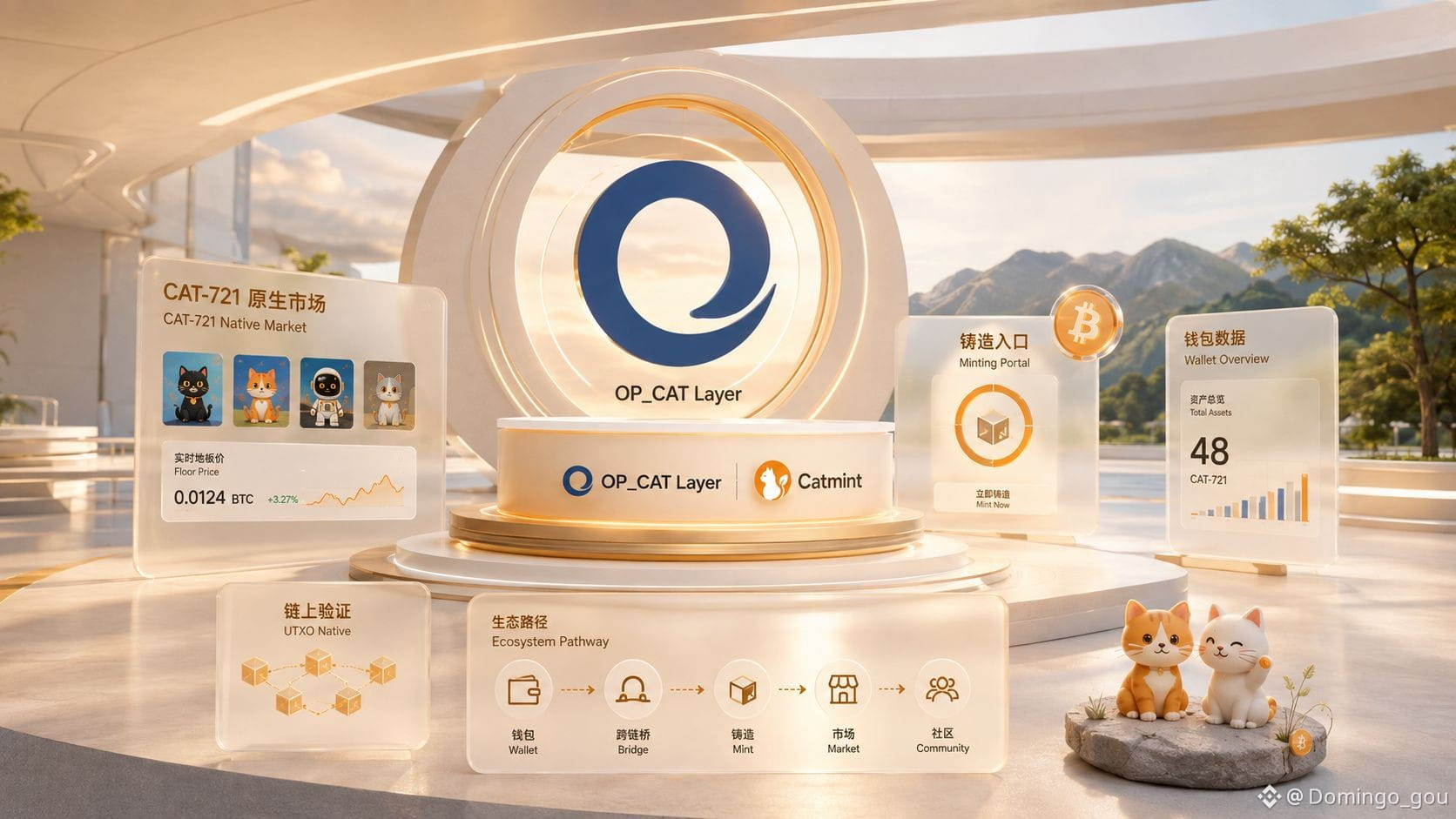
The native market for CAT-721 is already live. Real-time floor prices, minting entry points, wallet data—these trading-side things that should exist are also starting to be filled in. The protocol is no longer just a design in a document. Ordinary users can already go in directly to view, mint, and trade. This step is actually quite important.
CAT-721’s approach is also very clear. The asset follows the UTXO model, and the data and metadata are stored on-chain. The series origin can be traced all the way back to the genesis transaction, and it also supports parallel minting. Since it’s being discussed as “Bitcoin Native,” it makes the most sense that the way the asset exists and how it’s verified should follow Bitcoin’s own logic as much as possible—only then does it feel truly aligned.
What I care about more right now is whether Catmint can bring this set of standards into the market for real. No matter how beautiful the technical writing is, if nobody trades it and there’s no liquidity, over time it’s easy for it to end up being just developers discussing it among themselves. At least for now, CAT-721 has a dedicated trading entry point. The distance between the protocol and users is starting to shrink.
Looking back at @op_catlayer, my overall feeling these days is also quite different from before. Catena Wallet, Bridge, SatSwap, CatGo, Catmint—then ClawChat. What used to be like several separate puzzle pieces is slowly beginning to connect. Wallets are coming in, assets can move across, there are places to issue and places to trade, and there’s also social and content alongside it. The ecosystem is starting to take shape.
After going through a few cycles, I rarely get excited for too long just because another protocol launches. These days, I’d rather wait and see whether anyone uses the product, whether the market actually sees成交 (trades), and whether users will stick around. Catmint made me look a bit closer this time, because it has started to answer these very practical questions.
Next, I’ll continue to watch for trading activity, the number of assets, and whether real users are truly keeping up. Whether the standard can go far—that ultimately still depends on whether the market gives an answer.
@OPCATLayerCN @clawchatglobal #OPCAT #Bitcoin #CAT721
I previously saw a new protocol launch, and my first reaction was always to look at the technical details.
Now, I’m more likely to ask: after it’s built, who will actually use it? Who is willing to trade? And is there a market afterward that will be able to take it up and support it?
This Catmint update is the reason I’m taking it seriously as well.
The native market for CAT-721 is already live. Real-time floor prices, minting entry points, wallet data—these trading-side things that should exist are also starting to be filled in. The protocol is no longer just a design in a document. Ordinary users can already go in directly to view, mint, and trade. This step is actually quite important.
CAT-721’s approach is also very clear. The asset follows the UTXO model, and the data and metadata are stored on-chain. The series origin can be traced all the way back to the genesis transaction, and it also supports parallel minting. Since it’s being discussed as “Bitcoin Native,” it makes the most sense that the way the asset exists and how it’s verified should follow Bitcoin’s own logic as much as possible—only then does it feel truly aligned.
What I care about more right now is whether Catmint can bring this set of standards into the market for real. No matter how beautiful the technical writing is, if nobody trades it and there’s no liquidity, over time it’s easy for it to end up being just developers discussing it among themselves. At least for now, CAT-721 has a dedicated trading entry point. The distance between the protocol and users is starting to shrink.
Looking back at @op_catlayer, my overall feeling these days is also quite different from before. Catena Wallet, Bridge, SatSwap, CatGo, Catmint—then ClawChat. What used to be like several separate puzzle pieces is slowly beginning to connect. Wallets are coming in, assets can move across, there are places to issue and places to trade, and there’s also social and content alongside it. The ecosystem is starting to take shape.
After going through a few cycles, I rarely get excited for too long just because another protocol launches. These days, I’d rather wait and see whether anyone uses the product, whether the market actually sees成交 (trades), and whether users will stick around. Catmint made me look a bit closer this time, because it has started to answer these very practical questions.
Next, I’ll continue to watch for trading activity, the number of assets, and whether real users are truly keeping up. Whether the standard can go far—that ultimately still depends on whether the market gives an answer.
@OPCATLayerCN @clawchatglobal #OPCAT #Bitcoin #CAT721
Now, I’m more likely to ask: after it’s built, who will actually use it? Who is willing to trade? And is there a market afterward that will be able to take it up and support it?
This Catmint update is the reason I’m taking it seriously as well.
The native market for CAT-721 is already live. Real-time floor prices, minting entry points, wallet data—these trading-side things that should exist are also starting to be filled in. The protocol is no longer just a design in a document. Ordinary users can already go in directly to view, mint, and trade. This step is actually quite important.
CAT-721’s approach is also very clear. The asset follows the UTXO model, and the data and metadata are stored on-chain. The series origin can be traced all the way back to the genesis transaction, and it also supports parallel minting. Since it’s being discussed as “Bitcoin Native,” it makes the most sense that the way the asset exists and how it’s verified should follow Bitcoin’s own logic as much as possible—only then does it feel truly aligned.
What I care about more right now is whether Catmint can bring this set of standards into the market for real. No matter how beautiful the technical writing is, if nobody trades it and there’s no liquidity, over time it’s easy for it to end up being just developers discussing it among themselves. At least for now, CAT-721 has a dedicated trading entry point. The distance between the protocol and users is starting to shrink.
Looking back at @op_catlayer, my overall feeling these days is also quite different from before. Catena Wallet, Bridge, SatSwap, CatGo, Catmint—then ClawChat. What used to be like several separate puzzle pieces is slowly beginning to connect. Wallets are coming in, assets can move across, there are places to issue and places to trade, and there’s also social and content alongside it. The ecosystem is starting to take shape.
After going through a few cycles, I rarely get excited for too long just because another protocol launches. These days, I’d rather wait and see whether anyone uses the product, whether the market actually sees成交 (trades), and whether users will stick around. Catmint made me look a bit closer this time, because it has started to answer these very practical questions.
Next, I’ll continue to watch for trading activity, the number of assets, and whether real users are truly keeping up. Whether the standard can go far—that ultimately still depends on whether the market gives an answer.
@OPCATLayerCN @clawchatglobal #OPCAT #Bitcoin #CAT721
150
·
--
AI agents have been a topic of ongoing discussion.AI agents have been a topic of ongoing discussion.
For example, recently discussed are encrypted processing transactions and payments.
If they really are going to manage money, the thing to fear isn’t that Bitcoin scripts are weak, but that the rules are too free.
I used to think that if Bitcoin were to support more applications, it should be more flexible. But after thinking it through, I’ve become wary of systems that can do anything—there’s an extra layer of caution.
A human can make mistakes, such as clicking the wrong transaction line. But if an agent manages a vault of funds, automates payments, and handles coordination, then errors happen faster and the impact gets amplified.
So if an agent manages the funds, the first requirement isn’t imagination, but boundaries: how much it can spend, when it can spend, under what conditions it can spend, and whether—when something goes wrong—it can delay approval or stop.
AI agents have been a topic of ongoing discussion.
AI agents have been a topic of ongoing discussion.
For example, recently discussed are encrypted processing transactions and payments.
If they really are going to manage money, the thing to fear isn’t that Bitcoin scripts are weak, but that the rules are too free.
I used to think that if Bitcoin were to support more applications, it should be more flexible. But after thinking it through, I’ve become wary of systems that can do anything—there’s an extra layer of caution.
A human can make mistakes, such as clicking the wrong transaction line. But if an agent manages a vault of funds, automates payments, and handles coordination, then errors happen faster and the impact gets amplified.
So if an agent manages the funds, the first requirement isn’t imagination, but boundaries: how much it can spend, when it can spend, under what conditions it can spend, and whether—when something goes wrong—it can delay approval or stop.
For example, recently discussed are encrypted processing transactions and payments.
If they really are going to manage money, the thing to fear isn’t that Bitcoin scripts are weak, but that the rules are too free.
I used to think that if Bitcoin were to support more applications, it should be more flexible. But after thinking it through, I’ve become wary of systems that can do anything—there’s an extra layer of caution.
A human can make mistakes, such as clicking the wrong transaction line. But if an agent manages a vault of funds, automates payments, and handles coordination, then errors happen faster and the impact gets amplified.
So if an agent manages the funds, the first requirement isn’t imagination, but boundaries: how much it can spend, when it can spend, under what conditions it can spend, and whether—when something goes wrong—it can delay approval or stop.
157
·
--
Bullish
BTC’s price rebounded to over 60,000 these past two days—let’s talk about BTCFi together.
At this stage, the market isn’t short of new coins. The real question is: after the token is issued, how do we keep liquidity and ensure the incentives keep running smoothly—rather than relying on the project team to manually “resuscitate” it again and again.
This collaboration between SatSwap and CatGo is very tangible.
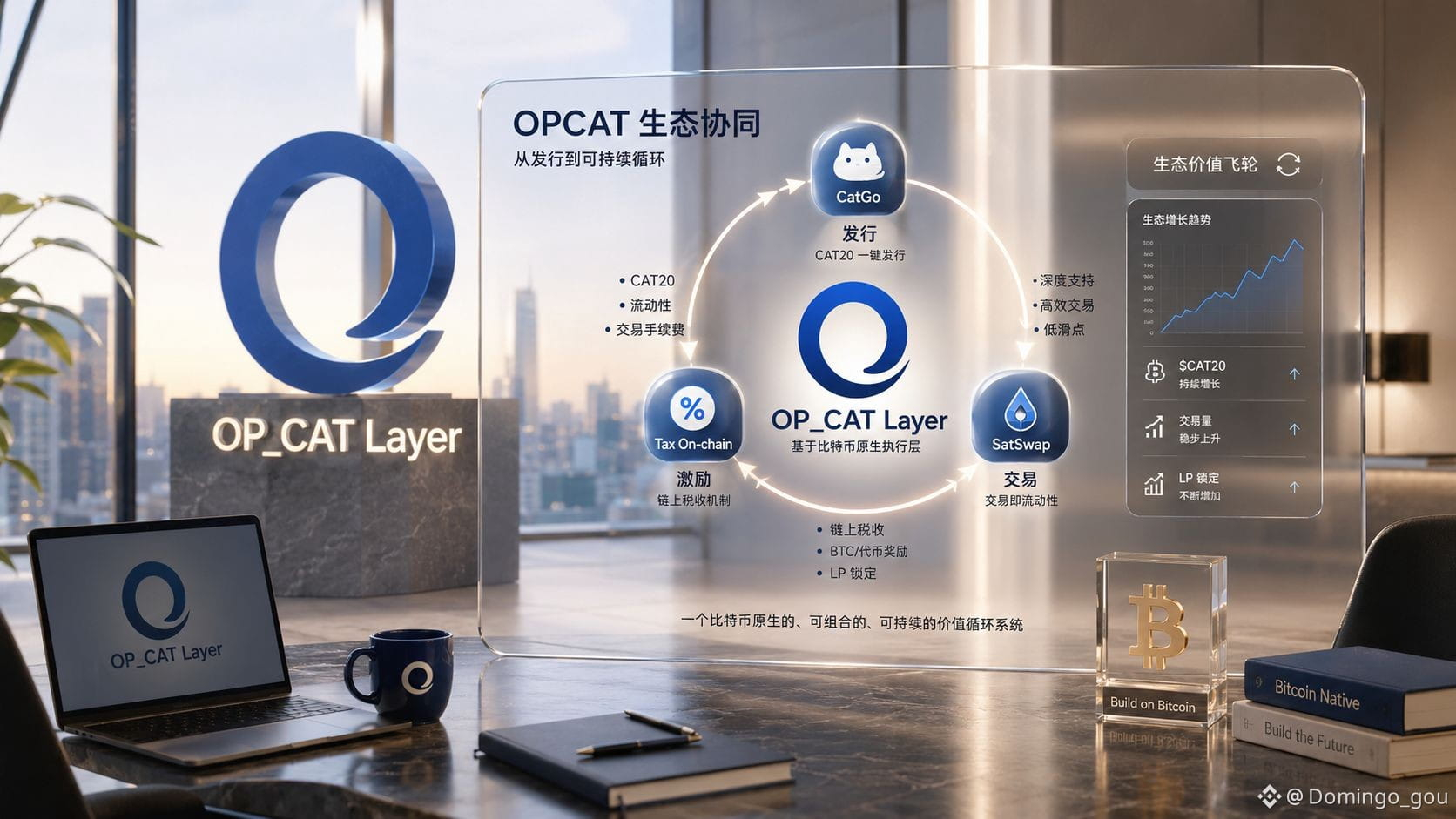
On June 23, @op_catlayer said on the official X post that SatSwap’s Tax feature has already been integrated into CatGo. CatGo handles one-click project token issuance, the bonding curve, and instant trading. SatSwap then takes over afterward, using an AMM to process trades between BTC and CAT20, along with fees and incentives.
With it all connected like this, CAT20 assets aren’t just “issued and done.” From issuance to trading to incentives, they form a closed loop in a Bitcoin-native environment. The Tax mechanism also links on-chain things like how tax revenue is allocated, settlement of BTC and token rewards, and LP-lock incentive alignment.
This is a good signal for the OPCAT ecosystem.
Previously, everyone looked at whether a single application had a product. Now we have to see whether applications can create value for each other and supply liquidity to each other. For BTCFi to keep going long-term, just issuing tokens won’t be enough—these foundational infrastructures need to feed each other.
Of course, it’s still early. The exact tax rate, reward ratios, LP lock-up duration, and other details all need to be confirmed by the official documentation and product pages. As an emerging execution layer, OPCAT still needs time to prove its security and real-world adoption.
But at least this integration shows that OPCAT is moving from mainnet launch toward a composable ecosystem. The focus of BTCFi will gradually shift too—from who can issue tokens first, to who can keep running the longest.
What do you think should be improved next most urgently: liquidity mechanisms, the distribution method, or more transparent on-chain incentive rules?
@OPCATLayerCN @clawchatglobal #SatSwap #CatGo #OPCAT
BTC’s price rebounded to over 60,000 these past two days—let’s talk about BTCFi together.
At this stage, the market isn’t short of new coins. The real question is: after the token is issued, how do we keep liquidity and ensure the incentives keep running smoothly—rather than relying on the project team to manually “resuscitate” it again and again.
This collaboration between SatSwap and CatGo is very tangible.
On June 23, @op_catlayer said on the official X post that SatSwap’s Tax feature has already been integrated into CatGo. CatGo handles one-click project token issuance, the bonding curve, and instant trading. SatSwap then takes over afterward, using an AMM to process trades between BTC and CAT20, along with fees and incentives.
With it all connected like this, CAT20 assets aren’t just “issued and done.” From issuance to trading to incentives, they form a closed loop in a Bitcoin-native environment. The Tax mechanism also links on-chain things like how tax revenue is allocated, settlement of BTC and token rewards, and LP-lock incentive alignment.
This is a good signal for the OPCAT ecosystem.
Previously, everyone looked at whether a single application had a product. Now we have to see whether applications can create value for each other and supply liquidity to each other. For BTCFi to keep going long-term, just issuing tokens won’t be enough—these foundational infrastructures need to feed each other.
Of course, it’s still early. The exact tax rate, reward ratios, LP lock-up duration, and other details all need to be confirmed by the official documentation and product pages. As an emerging execution layer, OPCAT still needs time to prove its security and real-world adoption.
But at least this integration shows that OPCAT is moving from mainnet launch toward a composable ecosystem. The focus of BTCFi will gradually shift too—from who can issue tokens first, to who can keep running the longest.
What do you think should be improved next most urgently: liquidity mechanisms, the distribution method, or more transparent on-chain incentive rules?
@OPCATLayerCN @clawchatglobal #SatSwap #CatGo #OPCAT
At this stage, the market isn’t short of new coins. The real question is: after the token is issued, how do we keep liquidity and ensure the incentives keep running smoothly—rather than relying on the project team to manually “resuscitate” it again and again.
This collaboration between SatSwap and CatGo is very tangible.
On June 23, @op_catlayer said on the official X post that SatSwap’s Tax feature has already been integrated into CatGo. CatGo handles one-click project token issuance, the bonding curve, and instant trading. SatSwap then takes over afterward, using an AMM to process trades between BTC and CAT20, along with fees and incentives.
With it all connected like this, CAT20 assets aren’t just “issued and done.” From issuance to trading to incentives, they form a closed loop in a Bitcoin-native environment. The Tax mechanism also links on-chain things like how tax revenue is allocated, settlement of BTC and token rewards, and LP-lock incentive alignment.
This is a good signal for the OPCAT ecosystem.
Previously, everyone looked at whether a single application had a product. Now we have to see whether applications can create value for each other and supply liquidity to each other. For BTCFi to keep going long-term, just issuing tokens won’t be enough—these foundational infrastructures need to feed each other.
Of course, it’s still early. The exact tax rate, reward ratios, LP lock-up duration, and other details all need to be confirmed by the official documentation and product pages. As an emerging execution layer, OPCAT still needs time to prove its security and real-world adoption.
But at least this integration shows that OPCAT is moving from mainnet launch toward a composable ecosystem. The focus of BTCFi will gradually shift too—from who can issue tokens first, to who can keep running the longest.
What do you think should be improved next most urgently: liquidity mechanisms, the distribution method, or more transparent on-chain incentive rules?
@OPCATLayerCN @clawchatglobal #SatSwap #CatGo #OPCAT
273
·
--

Article
Back when I used to post a piece of content, I would repeatedly check the view count.After going through several platforms and making it through a few cycles, what I care about now is whether this expression makes people stop and actually want to chat with me a few times—starting with a piece of content, and gradually getting to know each other.
Of course follower count matters, but it isn’t the weight of an opinion.
Even an account with no verification and very few followers—if its judgment is independent enough to make me rethink something, I’m still willing to follow it. To cater to changes in the recommendation system, the final data may look better, but what I write ends up feeling farther and farther from myself.
Back when I used to post a piece of content, I would repeatedly check the view count.
After going through several platforms and making it through a few cycles, what I care about now is whether this expression makes people stop and actually want to chat with me a few times—starting with a piece of content, and gradually getting to know each other.
Of course follower count matters, but it isn’t the weight of an opinion.
Even an account with no verification and very few followers—if its judgment is independent enough to make me rethink something, I’m still willing to follow it. To cater to changes in the recommendation system, the final data may look better, but what I write ends up feeling farther and farther from myself.
Of course follower count matters, but it isn’t the weight of an opinion.
Even an account with no verification and very few followers—if its judgment is independent enough to make me rethink something, I’m still willing to follow it. To cater to changes in the recommendation system, the final data may look better, but what I write ends up feeling farther and farther from myself.
1
234
Log in to explore more content
Join global crypto users on Binance Square
⚡️ Get latest and useful information about crypto.
💬 Trusted by the world’s largest crypto exchange.
👍 Discover real insights from verified creators.
Email / Phone number
Trending Topics
1
#FedOctoberRateHikeOddsFallTo17%
0 views
7 Discussing
2
#NvidiaHitsRecordHighUp2.4%
0 views
8 Discussing
3
#CanaryFilesAmendedS1ForPEPEETF
0 views
5 Discussing
4
#USRussiaUkraineTalksReportedlyIncludeLukoilOilDeal
911 views
96 Discussing
5
#BitcoinParesGainsAfterRallyTo$86.5K
30,611 views
118 Discussing
6
#CerebrasSinksNearly20%OnReportNvidiaToPowerOpenAI
59,815 views
675 Discussing
7
#SECProposesCryptoCustodyRules
84,784 views
846 Discussing
8
#SECApproves3xLongCryptoCommodityETPs
59,035 views
616 Discussing
9
#MASKHitsRecordMarketCapAbove$35M
3,810 views
33 Discussing
10
#G7PlansToReleaseUpTo100MBarrelsOilDiesel
45,501 views
544 Discussing