

#nexora
nexora
1,061 views
16 Discussing
Hot
Latest

🚀 P2P Efficiency Guide: How to Structure Your Operations Without Burning Out
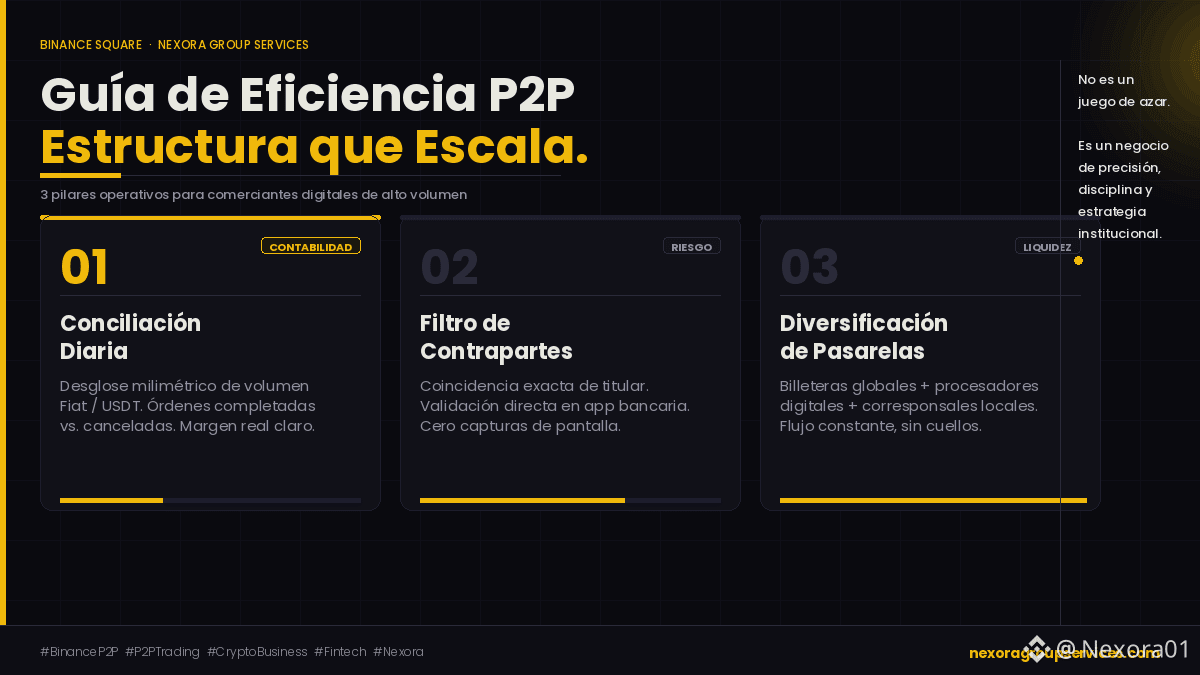
"Behind every order completed in the P2P market, there’s an infrastructure that separates occasional operators from professional merchants. If your goal is to scale your volume and keep healthy cash flow, speed isn’t everything; structure is.
Today we’re sharing the 3 operational pillars we apply every day at Nexora Group Services to optimize each liquidity cycle:
🔹 1. Rigorous Daily Reconciliation Management
You can’t improve what you don’t measure. Each day must close with a precise breakdown: total volume in Fiat (USD), total volume in Assets (USDT), and a strict separation between completed and cancelled orders. This not only protects your real profit margin against rate fluctuations, but also keeps your accounting spotless for tax filings under general regimes.
🔹 2. Risk Mitigation and Counterparty Filtering
The real benefit isn’t in chasing the highest 'spread' if it means operating with profiles of questionable origin. Setting strict filters (such as exact match of account holders and direct manual validation in your banking app, ignoring screenshots) is what ensures your capital survives in the long run.
🔹 3. Diversification of Gateways and Channels
Relying on a single payment method is a bottleneck. Efficient operators map liquidity cycles across global wallets, digital processors, and local correspondents to move value consistently—taking advantage of demand spikes at different times of the day.
Digital asset trading isn’t a game of chance; it’s a business of precision, discipline, and institutional strategy.
What’s the biggest challenge you’ve faced when organizing the accounting or security of your P2P operations? Let’s open the discussion in the comments! 👇
#BinanceP2P #P2PTrading #CryptoBusiness #Fintech #Nexora
🚀 P2P Efficiency Guide: How to Structure Your Operations Without Burning Out
"Behind every order completed in the P2P market, there’s an infrastructure that separates occasional operators from professional merchants. If your goal is to scale your volume and keep healthy cash flow, speed isn’t everything; structure is.
Today we’re sharing the 3 operational pillars we apply every day at Nexora Group Services to optimize each liquidity cycle:
🔹 1. Rigorous Daily Reconciliation Management
You can’t improve what you don’t measure. Each day must close with a precise breakdown: total volume in Fiat (USD), total volume in Assets (USDT), and a strict separation between completed and cancelled orders. This not only protects your real profit margin against rate fluctuations, but also keeps your accounting spotless for tax filings under general regimes.
🔹 2. Risk Mitigation and Counterparty Filtering
The real benefit isn’t in chasing the highest 'spread' if it means operating with profiles of questionable origin. Setting strict filters (such as exact match of account holders and direct manual validation in your banking app, ignoring screenshots) is what ensures your capital survives in the long run.
🔹 3. Diversification of Gateways and Channels
Relying on a single payment method is a bottleneck. Efficient operators map liquidity cycles across global wallets, digital processors, and local correspondents to move value consistently—taking advantage of demand spikes at different times of the day.
Digital asset trading isn’t a game of chance; it’s a business of precision, discipline, and institutional strategy.
What’s the biggest challenge you’ve faced when organizing the accounting or security of your P2P operations? Let’s open the discussion in the comments! 👇
#BinanceP2P #P2PTrading #CryptoBusiness #Fintech #Nexora
"Behind every order completed in the P2P market, there’s an infrastructure that separates occasional operators from professional merchants. If your goal is to scale your volume and keep healthy cash flow, speed isn’t everything; structure is.
Today we’re sharing the 3 operational pillars we apply every day at Nexora Group Services to optimize each liquidity cycle:
🔹 1. Rigorous Daily Reconciliation Management
You can’t improve what you don’t measure. Each day must close with a precise breakdown: total volume in Fiat (USD), total volume in Assets (USDT), and a strict separation between completed and cancelled orders. This not only protects your real profit margin against rate fluctuations, but also keeps your accounting spotless for tax filings under general regimes.
🔹 2. Risk Mitigation and Counterparty Filtering
The real benefit isn’t in chasing the highest 'spread' if it means operating with profiles of questionable origin. Setting strict filters (such as exact match of account holders and direct manual validation in your banking app, ignoring screenshots) is what ensures your capital survives in the long run.
🔹 3. Diversification of Gateways and Channels
Relying on a single payment method is a bottleneck. Efficient operators map liquidity cycles across global wallets, digital processors, and local correspondents to move value consistently—taking advantage of demand spikes at different times of the day.
Digital asset trading isn’t a game of chance; it’s a business of precision, discipline, and institutional strategy.
What’s the biggest challenge you’ve faced when organizing the accounting or security of your P2P operations? Let’s open the discussion in the comments! 👇
#BinanceP2P #P2PTrading #CryptoBusiness #Fintech #Nexora
1
117

·
--
Partly True
$NEX BiFinance Listing Countdown 💜
It's just a little longer.
$NEX trading will be launched on June 29, 2026 at 09:00 UTC, while the exchange will officially be added to the BiFinance platform in a few hours.
It's another big development in Nexora's evolution towards wider adoption and a more prominent international presence.
What am I still confident of with the project:
🔹 Max Supply of 100M Tokens
🔹 97% liquidity locked until 2027
🔹 Audited smart contract
🔹 Priority on real use and sustainable growth
A tight knit community and a staff that always does its duty to give their best.A close knit community and staff that always does its job well.
Instead of following the latest trends, Nexora is steadily developing to serve a purpose. Each addition adds to access and gets the ecosystem closer to its future goals.
We're excited to see the Purple Wave spreading to even more 💜
@NexoraCoin26112 💜
#Nexora #NEX #BiFinance
$NEX BiFinance Listing Countdown 💜
It's just a little longer.
$NEX trading will be launched on June 29, 2026 at 09:00 UTC, while the exchange will officially be added to the BiFinance platform in a few hours.
It's another big development in Nexora's evolution towards wider adoption and a more prominent international presence.
What am I still confident of with the project:
🔹 Max Supply of 100M Tokens
🔹 97% liquidity locked until 2027
🔹 Audited smart contract
🔹 Priority on real use and sustainable growth
A tight knit community and a staff that always does its duty to give their best.A close knit community and staff that always does its job well.
Instead of following the latest trends, Nexora is steadily developing to serve a purpose. Each addition adds to access and gets the ecosystem closer to its future goals.
We're excited to see the Purple Wave spreading to even more 💜
@NexoraCoin26112 💜
#Nexora #NEX #BiFinance
It's just a little longer.
$NEX trading will be launched on June 29, 2026 at 09:00 UTC, while the exchange will officially be added to the BiFinance platform in a few hours.
It's another big development in Nexora's evolution towards wider adoption and a more prominent international presence.
What am I still confident of with the project:
🔹 Max Supply of 100M Tokens
🔹 97% liquidity locked until 2027
🔹 Audited smart contract
🔹 Priority on real use and sustainable growth
A tight knit community and a staff that always does its duty to give their best.A close knit community and staff that always does its job well.
Instead of following the latest trends, Nexora is steadily developing to serve a purpose. Each addition adds to access and gets the ecosystem closer to its future goals.
We're excited to see the Purple Wave spreading to even more 💜
@NexoraCoin26112 💜
#Nexora #NEX #BiFinance

5
1k

·
--
📊 Gold (XAUUSD) Quick Update
Gold is holding above key support! As long as buyers defend this zone, the bullish structure stays valid.
? Are you Bullish or Bearish on Gold today?
$XAU #XAUUSD #BinanceSquare #Nexora
{future}(XAUUSDT)
{spot}(BTCUSDT)
📊 Gold (XAUUSD) Quick Update
Gold is holding above key support! As long as buyers defend this zone, the bullish structure stays valid.
? Are you Bullish or Bearish on Gold today?
$XAU #XAUUSD #BinanceSquare #Nexora
Gold is holding above key support! As long as buyers defend this zone, the bullish structure stays valid.
? Are you Bullish or Bearish on Gold today?
$XAU #XAUUSD #BinanceSquare #Nexora
1
69
·
--
🧠 3 Rules to Survive in Trading:
1️⃣ No Plan = No Trade (Never enter on FOMO)
2️⃣ Protect Capital First (Profits come second)
3️⃣ Accept Losses (Stop-loss is just a business
cost)
🎯 Strategy gets you in, discipline keeps you alive!
Which rule is hardest for you?👇🏻
#BTCETH #TradingPsychology #RiskManagement
#BinanceSquare #Nexora
🧠 3 Rules to Survive in Trading:
1️⃣ No Plan = No Trade (Never enter on FOMO)
2️⃣ Protect Capital First (Profits come second)
3️⃣ Accept Losses (Stop-loss is just a business
cost)
🎯 Strategy gets you in, discipline keeps you alive!
Which rule is hardest for you?👇🏻
#BTCETH #TradingPsychology #RiskManagement
#BinanceSquare #Nexora
1️⃣ No Plan = No Trade (Never enter on FOMO)
2️⃣ Protect Capital First (Profits come second)
3️⃣ Accept Losses (Stop-loss is just a business
cost)
🎯 Strategy gets you in, discipline keeps you alive!
Which rule is hardest for you?👇🏻
#BTCETH #TradingPsychology #RiskManagement
#BinanceSquare #Nexora

1
94
Article
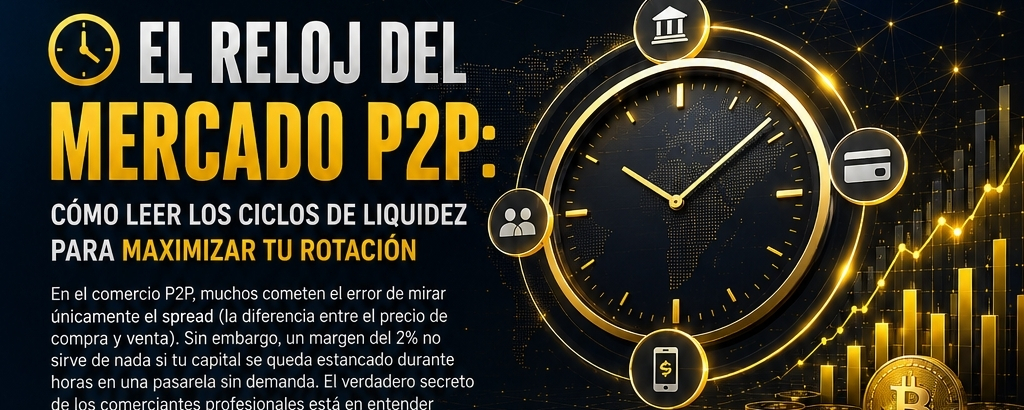
⏱️ The P2P Market Clock: How to Read Liquidity Cycles to Maximize Your TurnoverIn P2P trading, many make the mistake of looking only at the spread (the difference between the buy and sell prices). However, a 2% margin is useless if your capital gets stuck for hours on a bridge with no demand. The real secret of professional traders is understanding liquidity cycles.
Today we share how we structure the flow map at Nexora Group Services to keep money in constant motion:
🔹 1. Map the "Peak Hours" by Bridge
⏱️ The P2P Market Clock: How to Read Liquidity Cycles to Maximize Your Turnover
In P2P trading, many make the mistake of looking only at the spread (the difference between the buy and sell prices). However, a 2% margin is useless if your capital gets stuck for hours on a bridge with no demand. The real secret of professional traders is understanding liquidity cycles.
Today we share how we structure the flow map at Nexora Group Services to keep money in constant motion:
🔹 1. Map the "Peak Hours" by Bridge
Today we share how we structure the flow map at Nexora Group Services to keep money in constant motion:
🔹 1. Map the "Peak Hours" by Bridge
2
147
·
--
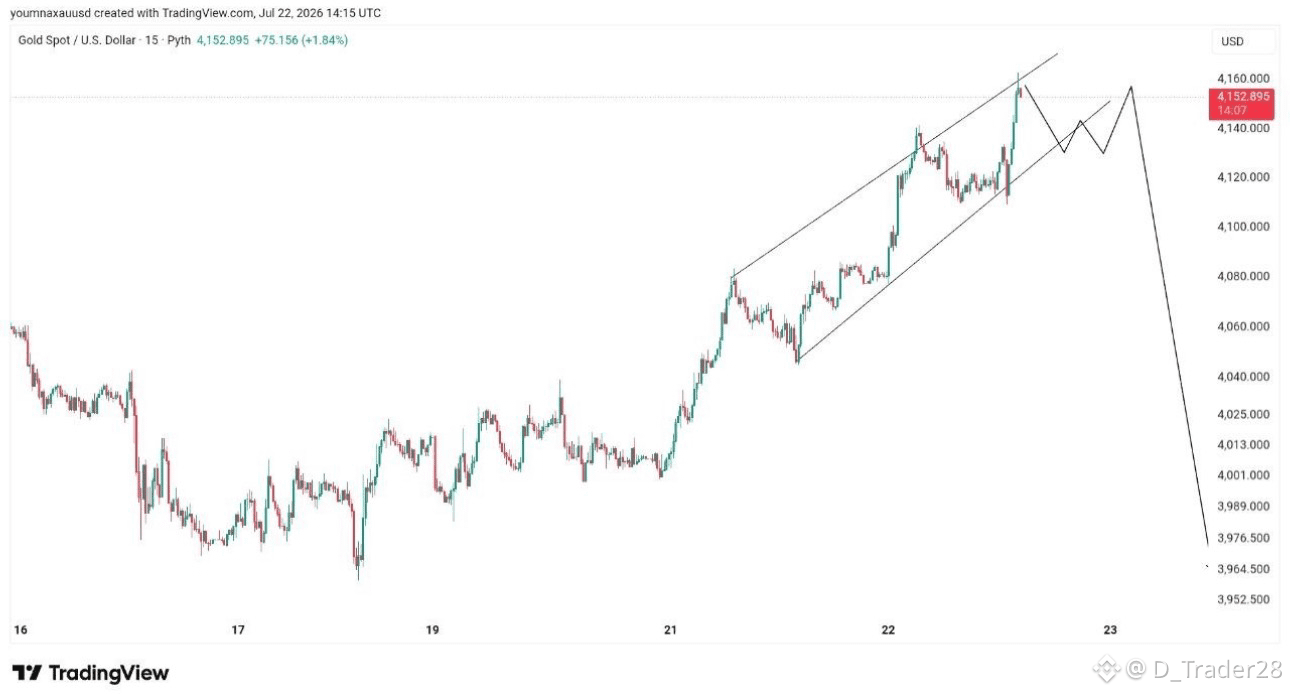
🔴 XAUUSD SELL SETUP📍 🔴
📉 Entry: 4152-4155
🛑 SL: 4165
🎯 TP1: 4120
🎯 TP2: 4100
🎯 TP3: 4050
🎯 TP4: 4000
🎯 TP5: 3975 (Final Target) 🎯
#XAUUSD #GoldTrading #Nexora
🔴 XAUUSD SELL SETUP📍 🔴
📉 Entry: 4152-4155
🛑 SL: 4165
🎯 TP1: 4120
🎯 TP2: 4100
🎯 TP3: 4050
🎯 TP4: 4000
🎯 TP5: 3975 (Final Target) 🎯
#XAUUSD #GoldTrading #Nexora
📉 Entry: 4152-4155
🛑 SL: 4165
🎯 TP1: 4120
🎯 TP2: 4100
🎯 TP3: 4050
🎯 TP4: 4000
🎯 TP5: 3975 (Final Target) 🎯
#XAUUSD #GoldTrading #Nexora
3
1
85
·
--
🚀 GOLD ($XAUUSD) Pushing Higher!
Gold just touched the 4,160 zone on the 1H chart!
Strong buyers momentum in play.
❓ Are we heading straight to 4,180, or is a quick pullback coming?
Drop your bias below👇🏻
$XAU #XAUUSD #GoldTrading
#BinanceSquare #Nexora
{future}(XAUUSDT)
🚀 GOLD ($XAUUSD) Pushing Higher!
Gold just touched the 4,160 zone on the 1H chart!
Strong buyers momentum in play.
❓ Are we heading straight to 4,180, or is a quick pullback coming?
Drop your bias below👇🏻
$XAU #XAUUSD #GoldTrading
#BinanceSquare #Nexora
Gold just touched the 4,160 zone on the 1H chart!
Strong buyers momentum in play.
❓ Are we heading straight to 4,180, or is a quick pullback coming?
Drop your bias below👇🏻
$XAU #XAUUSD #GoldTrading
#BinanceSquare #Nexora
1
104
·
--
🧠 Bitcoin: The Silent Accumulation Phase?
$BTC is oscillating between key liquidity zones.
While retail traders are waiting for a clear direction, smart money is watching the macro structure!
Bearish Scenario: A breakdown below local
support could sweep liquidity down to lower demand zones before any real reversal.
Bullish Scenario: Reclaiming key resistance
with strong volume validates the bullish continuation toward new highs.
Trading Rule: Never trade the bias — trade the
reaction at critical levels!
?
What is your current exposure -
Accumulating, Holding, or Waiting in Cash? Drop your strategy below!
$BTC #Bitcoin #CryptoAnalysis #TradingStrategy #BinanceSquare #Nexora
{spot}(BTCUSDT)
🧠 Bitcoin: The Silent Accumulation Phase?
$BTC is oscillating between key liquidity zones.
While retail traders are waiting for a clear direction, smart money is watching the macro structure!
Bearish Scenario: A breakdown below local
support could sweep liquidity down to lower demand zones before any real reversal.
Bullish Scenario: Reclaiming key resistance
with strong volume validates the bullish continuation toward new highs.
Trading Rule: Never trade the bias — trade the
reaction at critical levels!
?
What is your current exposure -
Accumulating, Holding, or Waiting in Cash? Drop your strategy below!
$BTC #Bitcoin #CryptoAnalysis #TradingStrategy #BinanceSquare #Nexora
$BTC is oscillating between key liquidity zones.
While retail traders are waiting for a clear direction, smart money is watching the macro structure!
Bearish Scenario: A breakdown below local
support could sweep liquidity down to lower demand zones before any real reversal.
Bullish Scenario: Reclaiming key resistance
with strong volume validates the bullish continuation toward new highs.
Trading Rule: Never trade the bias — trade the
reaction at critical levels!
?
What is your current exposure -
Accumulating, Holding, or Waiting in Cash? Drop your strategy below!
$BTC #Bitcoin #CryptoAnalysis #TradingStrategy #BinanceSquare #Nexora
1
32
·
--
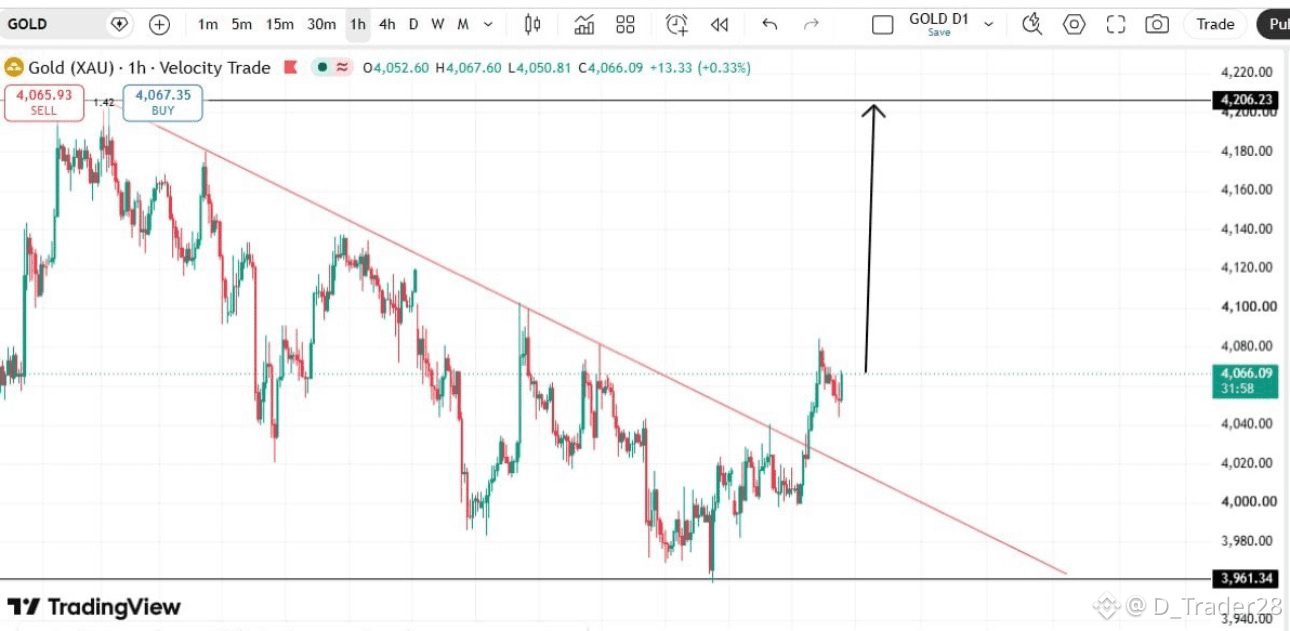
GOLD (XAUUSD) Trendline Breakout! (1H
Chart)
Gold has broken out of the descending trendline on the 1H timeframe!
Key Highlights:
• Clean breakout above dynamic resistance.
• Buyers showing momentum, pushing price higher after a solid retest.
• Next major target zone to watch: 4,206 level.
Do you think Gold will hit the target or retest
lower first? Share your view below!
$XAU #XAUUSD #GoldTrading #ForexAnalysis
#BinanceSquare #Nexora
{future}(XAUUSDT)
GOLD (XAUUSD) Trendline Breakout! (1H
Chart)
Gold has broken out of the descending trendline on the 1H timeframe!
Key Highlights:
• Clean breakout above dynamic resistance.
• Buyers showing momentum, pushing price higher after a solid retest.
• Next major target zone to watch: 4,206 level.
Do you think Gold will hit the target or retest
lower first? Share your view below!
$XAU #XAUUSD #GoldTrading #ForexAnalysis
#BinanceSquare #Nexora
Chart)
Gold has broken out of the descending trendline on the 1H timeframe!
Key Highlights:
• Clean breakout above dynamic resistance.
• Buyers showing momentum, pushing price higher after a solid retest.
• Next major target zone to watch: 4,206 level.
Do you think Gold will hit the target or retest
lower first? Share your view below!
$XAU #XAUUSD #GoldTrading #ForexAnalysis
#BinanceSquare #Nexora
1
80
·
--
Gold (XAUUSD) Daily Market Update
Gold is trading above 4140, maintaining a strong bullish trend on the H1 chart! A temporary consolidation is occurring.
Is it time to buy the dip or wait for confirmation?
#XAUUSD #Forex #Trading #BinanceSquare
#Nexora
$XAU
{future}(XAUUSDT)
Gold (XAUUSD) Daily Market Update
Gold is trading above 4140, maintaining a strong bullish trend on the H1 chart! A temporary consolidation is occurring.
Is it time to buy the dip or wait for confirmation?
#XAUUSD #Forex #Trading #BinanceSquare
#Nexora
$XAU
Gold is trading above 4140, maintaining a strong bullish trend on the H1 chart! A temporary consolidation is occurring.
Is it time to buy the dip or wait for confirmation?
#XAUUSD #Forex #Trading #BinanceSquare
#Nexora
$XAU
1
87
Log in to explore more content
Join global crypto users on Binance Square
⚡️ Get latest and useful information about crypto.
💬 Trusted by the world’s largest crypto exchange.
👍 Discover real insights from verified creators.
Email / Phone number
Trending Topics
1
#BNBSurpasses$790
8,905 views
73 Discussing
2
#ZamaRises15.99%ToIntradayHigh$0.09
2,901 views
64 Discussing
3
#BitcoinSpotETFsDraw$6.34BInflowsInQ3
3,128 views
52 Discussing
4
#EthereumValidatorExitQueueJumps392%
47,637 views
604 Discussing
5
#IMFApprovesElSalvador$138MWithBitcoinWaiver
6,265 views
38 Discussing
6
#SECHaltsCryptoETFReviewsAmidFundingLapse
195,271 views
1,510 Discussing
7
#ZcashETFPostsFirstWeeklyOutflow$93.6M
86,291 views
241 Discussing
8
#GreekPoliceBustCryptoScamRingArrest17
325,996 views
2,182 Discussing
9
#BitcoinRejectedAt$87K
201,867 views
300 Discussing
10
#FedOctoberRateHikeOddsFallTo17%
324,493 views
2,316 Discussing