

#nearintentsrecovers
nearintentsrecovers
174 views
7 Discussing
Hot
Latest

·
--
Everyone thinks automated cross-chain intent protocols solve all liquidity friction instantly, but actually, treating intent execution as risk-free magic is how traders get caught off guard during sudden volatility.
Most traders rush into complex cross-chain routing during market greed phases, only to watch slippage drain their balance or find their transactions stuck when settlement solvers encounter reorgs.
Think of chain abstraction like ordering a rideshare across three different cities. You just set the destination and let specialized drivers figure out the route behind the scenes. When $NEAR architecture handles intent execution, it bundles those messy settlement layers into one smooth signature. But just like a traffic gridlock on a busy highway, when market volume surges alongside assets like $BTC or $USDT, solver networks can face temporary liquidity bottlenecks.
The recent recovery in solver settlement mechanisms proves that cross-chain infra is maturing, yet execution risk never truly drops to zero. If you rely on intent-based swaps without checking network solver health during high-congestion periods, you end up paying hidden latency costs.
Have you noticed any execution lag while using cross-chain intent bridges recently?
#NEARIntentsRecovers #SECProposesCryptoCustodyRules
Everyone thinks automated cross-chain intent protocols solve all liquidity friction instantly, but actually, treating intent execution as risk-free magic is how traders get caught off guard during sudden volatility.
Most traders rush into complex cross-chain routing during market greed phases, only to watch slippage drain their balance or find their transactions stuck when settlement solvers encounter reorgs.
Think of chain abstraction like ordering a rideshare across three different cities. You just set the destination and let specialized drivers figure out the route behind the scenes. When $NEAR architecture handles intent execution, it bundles those messy settlement layers into one smooth signature. But just like a traffic gridlock on a busy highway, when market volume surges alongside assets like $BTC or $USDT, solver networks can face temporary liquidity bottlenecks.
The recent recovery in solver settlement mechanisms proves that cross-chain infra is maturing, yet execution risk never truly drops to zero. If you rely on intent-based swaps without checking network solver health during high-congestion periods, you end up paying hidden latency costs.
Have you noticed any execution lag while using cross-chain intent bridges recently?
#NEARIntentsRecovers #SECProposesCryptoCustodyRules
Most traders rush into complex cross-chain routing during market greed phases, only to watch slippage drain their balance or find their transactions stuck when settlement solvers encounter reorgs.
Think of chain abstraction like ordering a rideshare across three different cities. You just set the destination and let specialized drivers figure out the route behind the scenes. When $NEAR architecture handles intent execution, it bundles those messy settlement layers into one smooth signature. But just like a traffic gridlock on a busy highway, when market volume surges alongside assets like $BTC or $USDT, solver networks can face temporary liquidity bottlenecks.
The recent recovery in solver settlement mechanisms proves that cross-chain infra is maturing, yet execution risk never truly drops to zero. If you rely on intent-based swaps without checking network solver health during high-congestion periods, you end up paying hidden latency costs.
Have you noticed any execution lag while using cross-chain intent bridges recently?
#NEARIntentsRecovers #SECProposesCryptoCustodyRules
37

The last time infrastructure this important recovered, most of us were still calling it a science project.
You have watched another L1 narrative melt your bag after you FOMO'd the top, then sat there wondering why the real money always seems to hide in the boring parts of the stack.
I have been around long enough to remember when people thought Cosmos IBC was too complicated and Ethereum rollups would never scale. They were wrong both times. $NEAR Intents is the same pattern playing out again.
Instead of forcing users to become part-time engineers, you simply declare what you want done. You can swap $BTC for an asset sitting on a completely different chain or move value without ever touching a bridge yourself. Solvers compete to execute it. That is not marketing. That is how crypto should have felt five years ago.
We are sitting in greed at 67 on the index, which is exactly when people start chasing $ICP headlines and forget the plumbing. Intents recovering right now is not a coincidence. It is the market quietly rotating toward the things that actually reduce friction, the same way it eventually did with L2s after years of denial.
Where do you think this goes once the next wave of users actually tries it?
#NEARIntentsRecovers #NFPWatch #USStocksCloseHigherOnWeakJobsData
The last time infrastructure this important recovered, most of us were still calling it a science project.
You have watched another L1 narrative melt your bag after you FOMO'd the top, then sat there wondering why the real money always seems to hide in the boring parts of the stack.
I have been around long enough to remember when people thought Cosmos IBC was too complicated and Ethereum rollups would never scale. They were wrong both times. $NEAR Intents is the same pattern playing out again.
Instead of forcing users to become part-time engineers, you simply declare what you want done. You can swap $BTC for an asset sitting on a completely different chain or move value without ever touching a bridge yourself. Solvers compete to execute it. That is not marketing. That is how crypto should have felt five years ago.
We are sitting in greed at 67 on the index, which is exactly when people start chasing $ICP headlines and forget the plumbing. Intents recovering right now is not a coincidence. It is the market quietly rotating toward the things that actually reduce friction, the same way it eventually did with L2s after years of denial.
Where do you think this goes once the next wave of users actually tries it?
#NEARIntentsRecovers #NFPWatch #USStocksCloseHigherOnWeakJobsData
You have watched another L1 narrative melt your bag after you FOMO'd the top, then sat there wondering why the real money always seems to hide in the boring parts of the stack.
I have been around long enough to remember when people thought Cosmos IBC was too complicated and Ethereum rollups would never scale. They were wrong both times. $NEAR Intents is the same pattern playing out again.
Instead of forcing users to become part-time engineers, you simply declare what you want done. You can swap $BTC for an asset sitting on a completely different chain or move value without ever touching a bridge yourself. Solvers compete to execute it. That is not marketing. That is how crypto should have felt five years ago.
We are sitting in greed at 67 on the index, which is exactly when people start chasing $ICP headlines and forget the plumbing. Intents recovering right now is not a coincidence. It is the market quietly rotating toward the things that actually reduce friction, the same way it eventually did with L2s after years of denial.
Where do you think this goes once the next wave of users actually tries it?
#NEARIntentsRecovers #NFPWatch #USStocksCloseHigherOnWeakJobsData
179

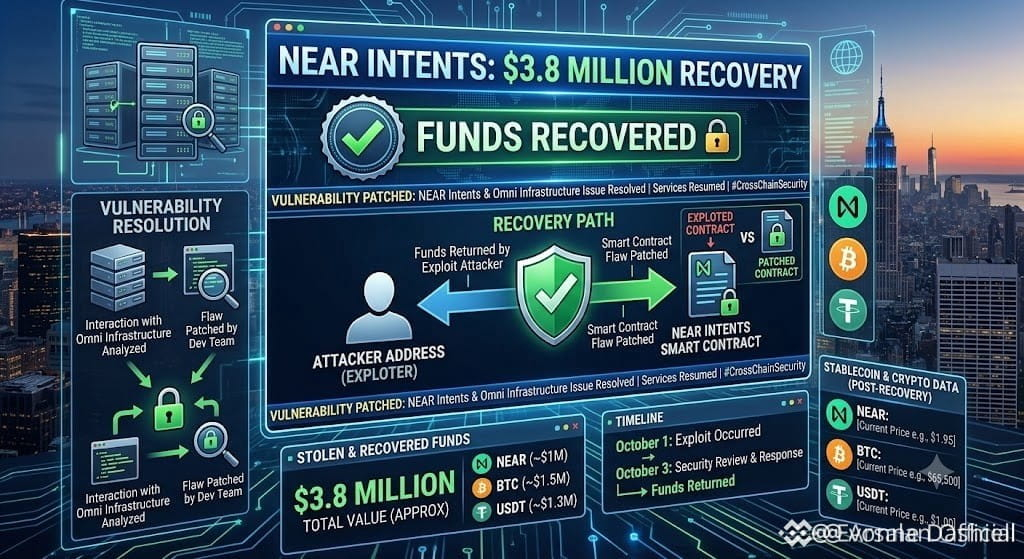
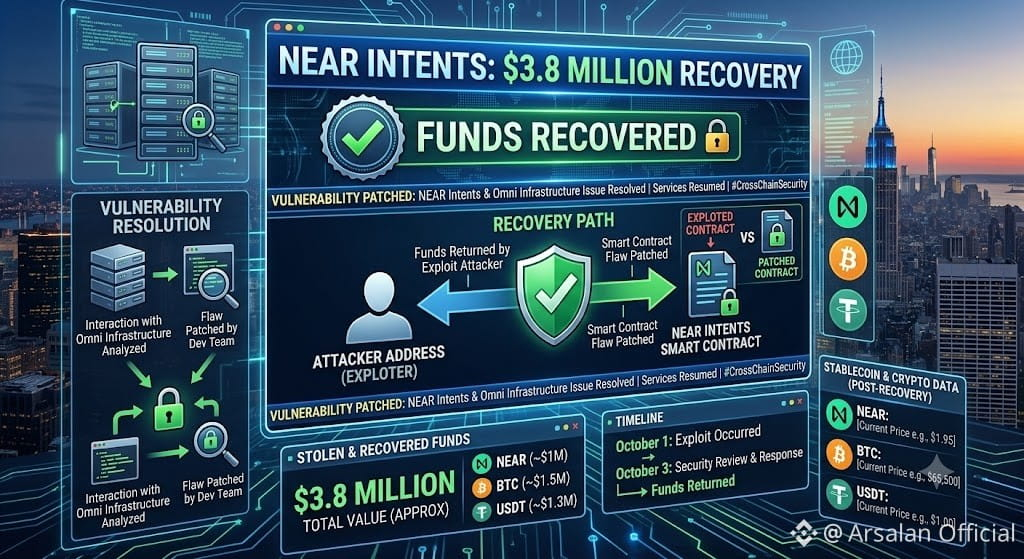
#NEARIntentsRecovers $3.8MAfterAttackNEAR Intents has recovered the approximately $3.8 million stolen in the October 1 exploit after the attacker returned the funds. The incident involved a vulnerability in the interaction between Omni’s infrastructure and a NEAR Intents smart contract; the contract flaw was patched and services resumed. 🔐⛓️
#NEARIntentsRecovery #CryptoSecurityUpdate #BlockchainExploitRecovery #CrossChainSecurity
l $NEAR
{spot}(NEARUSDT)
| $BTC
{spot}(BTCUSDT)
| $USDT
#NEARIntentsRecovers $3.8MAfterAttackNEAR Intents has recovered the approximately $3.8 million stolen in the October 1 exploit after the attacker returned the funds. The incident involved a vulnerability in the interaction between Omni’s infrastructure and a NEAR Intents smart contract; the contract flaw was patched and services resumed. 🔐⛓️
#NEARIntentsRecovery #CryptoSecurityUpdate #BlockchainExploitRecovery #CrossChainSecurity
l $NEAR
| $BTC
| $USDT
#NEARIntentsRecovery #CryptoSecurityUpdate #BlockchainExploitRecovery #CrossChainSecurity
l $NEAR
| $BTC
| $USDT
1
127
Log in to explore more content
Join global crypto users on Binance Square
⚡️ Get latest and useful information about crypto.
💬 Trusted by the world’s largest crypto exchange.
👍 Discover real insights from verified creators.
Email / Phone number
Trending Topics
1
#ZcashETFPostsFirstWeeklyOutflow$93.6M
48,340 views
143 Discussing
2
#GreekPoliceBustCryptoScamRingArrest17
130,360 views
921 Discussing
3
#BitcoinRejectedAt$87K
145,225 views
200 Discussing
4
#FedOctoberRateHikeOddsFallTo17%
159,089 views
1,145 Discussing
5
#NvidiaHitsRecordHighUp2.4%
116,337 views
817 Discussing
6
#CanaryFilesAmendedS1ForPEPEETF
29,258 views
570 Discussing
7
#BitcoinParesGainsAfterRallyTo$86.5K
52,919 views
169 Discussing
8
#CerebrasSinksNearly20%OnReportNvidiaToPowerOpenAI
135,872 views
1,190 Discussing
9
#SECProposesCryptoCustodyRules
186,518 views
1,461 Discussing
10
#SECApproves3xLongCryptoCommodityETPs
86,067 views
716 Discussing