

#minereconomics
minereconomics
72 views
5 Discussing
Hot
Latest

·
--
Bitcoin miners are the most underanalyzed participants in crypto markets and their economics reveal a lot about where the cycle is heading.
Every halving cuts block rewards in half. Miners who operated profitably before it must suddenly generate the same revenue with 50% less BTC per block. The ones who survive are the ones with the lowest cost per coin: cheapest energy, newest hardware, most efficient operations.
This dynamic creates a natural supply filter. Inefficient miners capitulate, hash rate temporarily drops, difficulty adjusts downward, and surviving miners get a brief margin reprieve. It is one of the most elegant self-correcting mechanisms in any asset class.
But here is the part most people miss: miner selling behavior is a real-time liquidity signal. When miner BTC balances on exchanges spike, that is forced selling, usually correlating with local price stress. When balances drain to cold storage, miners are holding, implying confidence in forward price.
Post-halving, the next pressure point is the transaction fee market. As block subsidies diminish over future cycles, Bitcoin long-term security depends increasingly on fee revenue. That means layer 2 activity, Ordinals, and inscription demand are no longer just cultural debates. They are protocol security debates.
Miner economics do not predict price directly. But they map the stress fractures in the network before they show up in charts.
$BTC $ETH $BNB
#Bitcoin #MinerEconomics #Halving #CryptoMarkets #BinanceSquare
57

·
--
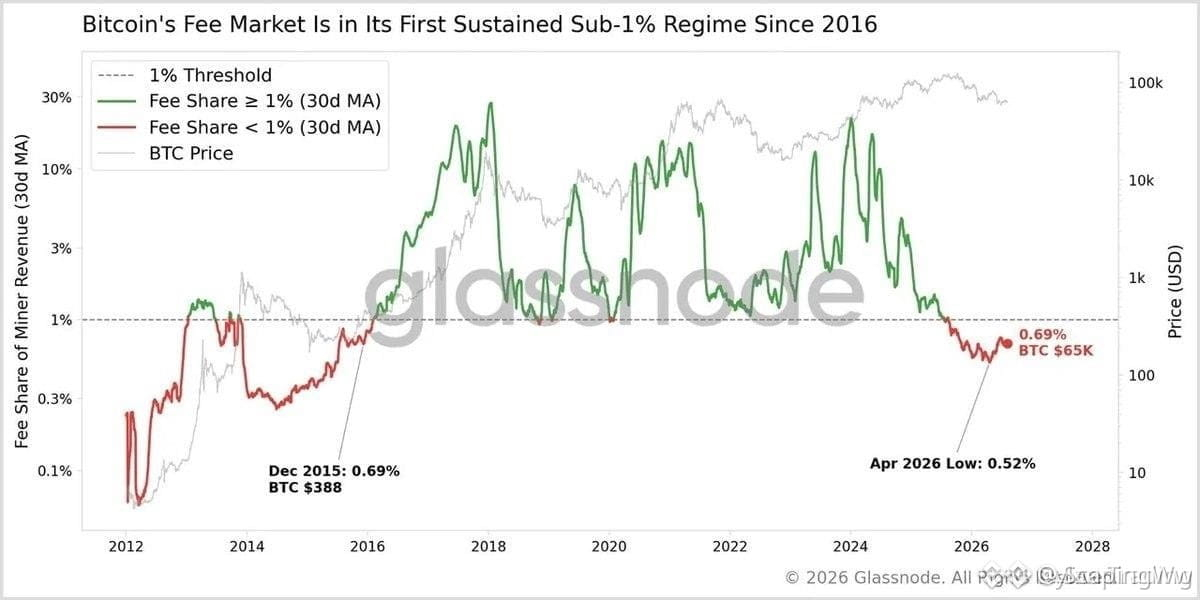
💥 $BTC FEES HIT 10-YEAR LOW — MINER REVENUE STRUCTURE JUST CRACKED! 📉
📉 Bitcoin's transaction fees just collapsed to 0.69% of miner revenue — a decade-low watermark that changes the profit math for every miner on the network. Fee income is no longer a meaningful cushion; block rewards are now carrying almost the entire load.
🔍 Here's the angle nobody's talking about: when the fee stream dries up, the weakest miners start operating on razor-thin margins. That's when capitulation waves ripple through hash rate and wallet flows spike. 📊 Watch miner outflows like a hawk over the coming weeks — the market's next move could be written in their balance sheets before it prints on the chart.
💬 Is this fee collapse a quiet adoption win for Bitcoin, or a slow-burn pressure cooker for miner sell pressure? 👇
⚠️ Not financial advice. Always manage your risk. 🛡️
🏷️ #BTC #MinerEconomics #Bitcoin #OnChainData #Crypto
🦈 🔍
20

$BTC HASHRATE EXIT COULD REWRITE THE MINER SUPPLY MAP 📊
🦈 The Q2 data shows at least 35 EH/s leaving listed miners, nearly 4.7% of the 750 EH/s network, and CoinShares sees no easy return even if $BTC rallies. AI infrastructure is paying about $1.5M per megawatt versus $500K from mining, while listed miners' average Q2 cash cost sits near $75,500 per BTC.
💡 That changes the supply-side math: hashrate is no longer just a price lever, it is competing with contracted AI margins. If $BTC revisits production cost, the market may see fewer reflexive miner capitulations and a more durable structural floor. 💬 Does this pivot make $BTC less supply-sensitive or just shift the next squeeze to energy contracts?
⚠️ Not financial advice. Always manage your risk. 🛡️
🏷️ #BTC #Hashrate #AIInfrastructure #MinerEconomics #Crypto
🎯
14
Log in to explore more content
Join global crypto users on Binance Square
⚡️ Get latest and useful information about crypto.
💬 Trusted by the world’s largest crypto exchange.
👍 Discover real insights from verified creators.
Email / Phone number
Trending Topics
1
#BinancePick
2.6M views
140,919 Discussing
2
#EarningsSeason
5M views
24,292 Discussing
3
#FranklinTempletonFilesForTwoDividendToBitcoinETFs
1,001 views
61 Discussing
4
#StrategyMSTRSurpassesNasdaqInMarketCap
1,268 views
69 Discussing
5
#CanadaProposesStablecoinRedemptionWithin3BusinessDays
81 views
10 Discussing
6
#ElectrumWalletBugLetRogueServersStealFunds
7,707 views
219 Discussing
7
#ArgentineCourtDismissesLIBRACaseAgainstMilei
17,306 views
301 Discussing
8
#SKHynixReportedlyPlansSpecialDividendFromKioxiaStakeSale
3,060 views
48 Discussing
9
#KeystoneWebsiteBreachExposesBuyersShippingAddresses
1,641 views
40 Discussing
10
#USQ3GDPAndSeptemberPCEDueNextWeek
94,234 views
1,118 Discussing