
#memecoinsdown
memecoinsdown
541 views
4 Discussing
Hot
Latest

Article
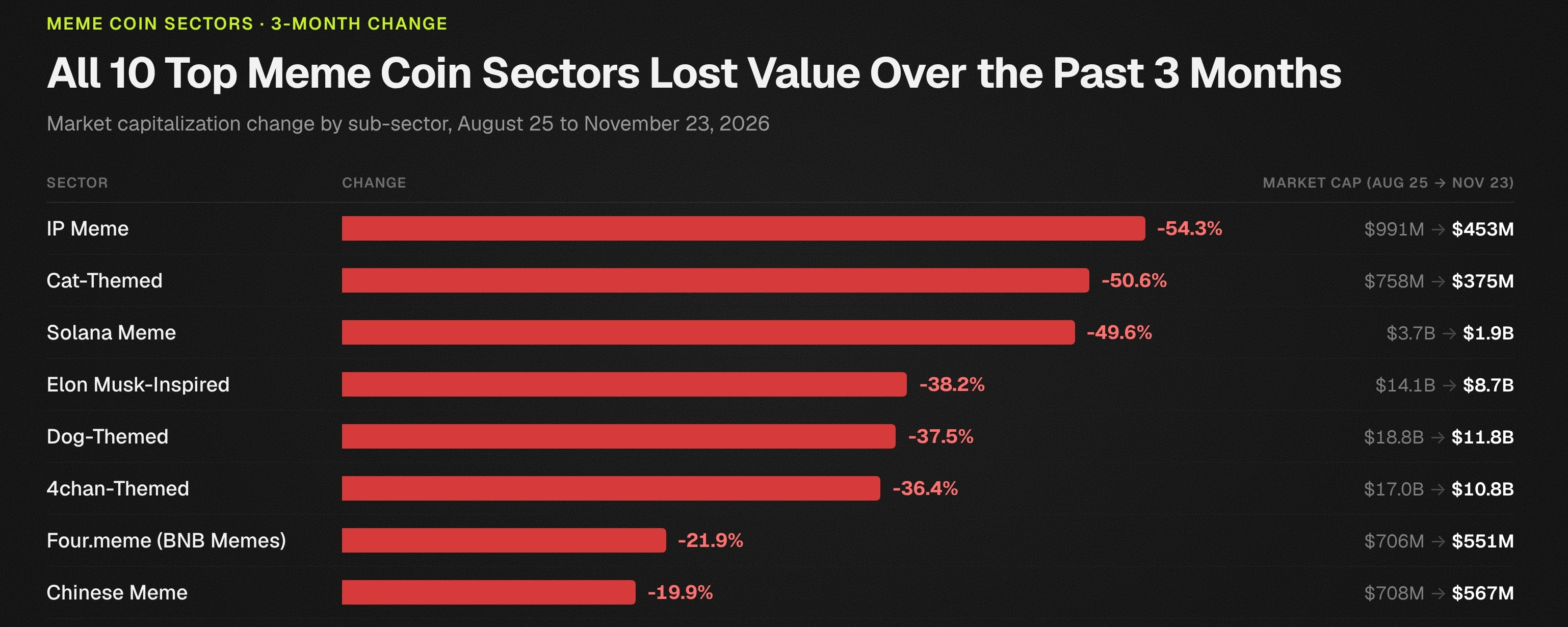
Meme Coin Dominance Hits a Record Low: Why Are Traders Rotating Out?Just two years ago, meme coins were the undisputed center of gravity in the cryptocurrency market. Driven by viral internet culture, low entry barriers, and explosive retail speculation, meme tokens routinely outperformed major Layer-1 networks and dominated daily trading volumes. Today, however, the landscape looks dramatically different: meme coin dominance has fallen to its lowest share of the altcoin market on record.
This sharp contraction marks a notable shift in how both retail and institutional participants are deploying capital across digital assets.
Speculative Fatigue and Liquidity Fragmentation
One of the primary drivers behind the decline is sheer market saturation. The ease of launching new tokens—fueled by automated launchpads and low-fee blockchains—led to millions of competing meme coins flooding the market. Instead of concentrating liquidity into a few flagship community tokens, capital became fractured across countless short-lived projects. As lifespans shrank from months to hours, retail traders grew exhausted by PvP (player-versus-player) trading dynamics, rug pulls, and rapid-fire dilution.
A Shift Toward Fundamentals and Revenue
As the broader crypto market matures, capital is increasingly favoring sectors with measurable utility, sustainable tokenomics, and clear revenue models. During periods of tighter liquidity and heightened macroeconomic caution, investors tend to rotate out of purely narrative-driven assets and into protocols generating real on-chain fees—such as decentralized exchanges, Real-World Assets (RWAs), stablecoin infrastructure, and AI-integrated networks.
Changing Market Structure
The composition of market participants has also evolved. With spot ETFs, institutional custody, and regulated financial products playing a larger role in driving crypto liquidity, inflows are disproportionately targeting Bitcoin and established large-cap assets rather than speculative micro-caps. Without the massive waves of new retail liquidity that characterized earlier cycles, meme coins have struggled to maintain their previous market share.
Is the Meme Coin Era Over?
A record low in dominance does not necessarily mean meme coins are disappearing permanently. Historically, internet-native assets have proven resilient during periods of peak euphoria, often acting as high-beta vehicles when excess liquidity returns to the market.
However, the current downturn suggests that simply launching a viral ticker is no longer enough—only the most established, deeply liquid communities are likely to survive the current rotation.
#MemeCoinsdown #Altcoins #USAddsMegaspeedToEntityList #meme2026
Meme Coin Dominance Hits a Record Low: Why Are Traders Rotating Out?
Just two years ago, meme coins were the undisputed center of gravity in the cryptocurrency market. Driven by viral internet culture, low entry barriers, and explosive retail speculation, meme tokens routinely outperformed major Layer-1 networks and dominated daily trading volumes. Today, however, the landscape looks dramatically different: meme coin dominance has fallen to its lowest share of the altcoin market on record.
This sharp contraction marks a notable shift in how both retail and institutional participants are deploying capital across digital assets.
Speculative Fatigue and Liquidity Fragmentation
One of the primary drivers behind the decline is sheer market saturation. The ease of launching new tokens—fueled by automated launchpads and low-fee blockchains—led to millions of competing meme coins flooding the market. Instead of concentrating liquidity into a few flagship community tokens, capital became fractured across countless short-lived projects. As lifespans shrank from months to hours, retail traders grew exhausted by PvP (player-versus-player) trading dynamics, rug pulls, and rapid-fire dilution.
A Shift Toward Fundamentals and Revenue
As the broader crypto market matures, capital is increasingly favoring sectors with measurable utility, sustainable tokenomics, and clear revenue models. During periods of tighter liquidity and heightened macroeconomic caution, investors tend to rotate out of purely narrative-driven assets and into protocols generating real on-chain fees—such as decentralized exchanges, Real-World Assets (RWAs), stablecoin infrastructure, and AI-integrated networks.
Changing Market Structure
The composition of market participants has also evolved. With spot ETFs, institutional custody, and regulated financial products playing a larger role in driving crypto liquidity, inflows are disproportionately targeting Bitcoin and established large-cap assets rather than speculative micro-caps. Without the massive waves of new retail liquidity that characterized earlier cycles, meme coins have struggled to maintain their previous market share.
Is the Meme Coin Era Over?
A record low in dominance does not necessarily mean meme coins are disappearing permanently. Historically, internet-native assets have proven resilient during periods of peak euphoria, often acting as high-beta vehicles when excess liquidity returns to the market.
However, the current downturn suggests that simply launching a viral ticker is no longer enough—only the most established, deeply liquid communities are likely to survive the current rotation.
#MemeCoinsdown #Altcoins #USAddsMegaspeedToEntityList #meme2026
202
Log in to explore more content
Join global crypto users on Binance Square
⚡️ Get latest and useful information about crypto.
💬 Trusted by the world’s largest crypto exchange.
👍 Discover real insights from verified creators.
Email / Phone number
Trending Topics
1
#AnthropicFallsBelow$83IPOPricePremarket
72 views
5 Discussing
2
#NVDASoarsOnJensenReturn
22,465 views
316 Discussing
3
#Bitcoin'sReboundFadesBelow$60K
23,411 views
189 Discussing
4
#NVIDIAReinstatesJensenHuangasCEO
334,417 views
2,007 Discussing
5
#WillMarketsStageAThanksgivingReliefRally?
386,524 views
2,683 Discussing
6
#EthereumFoundationPlansShiftToHashBasedSignaturesBy2028
0 views
3 Discussing
7
#WillOctCorePCEShiftFedHikeExpectations?
146,062 views
1,372 Discussing
8
#EvolveAtBinanceBlockchainWeek
275,441 views
1,704 Discussing
9
#BlackRockLaunchesAsiaPacificFirstTokenizedMoneyMarketFund
1,732 views
9 Discussing
10
#SouthKoreaBeginsCryptoProviderShareholderReviews
9,688 views
160 Discussing