

#leverager
leverager
1,217 views
3 Discussing
Hot
Latest

·
--
Bullish
#termmax @termmax
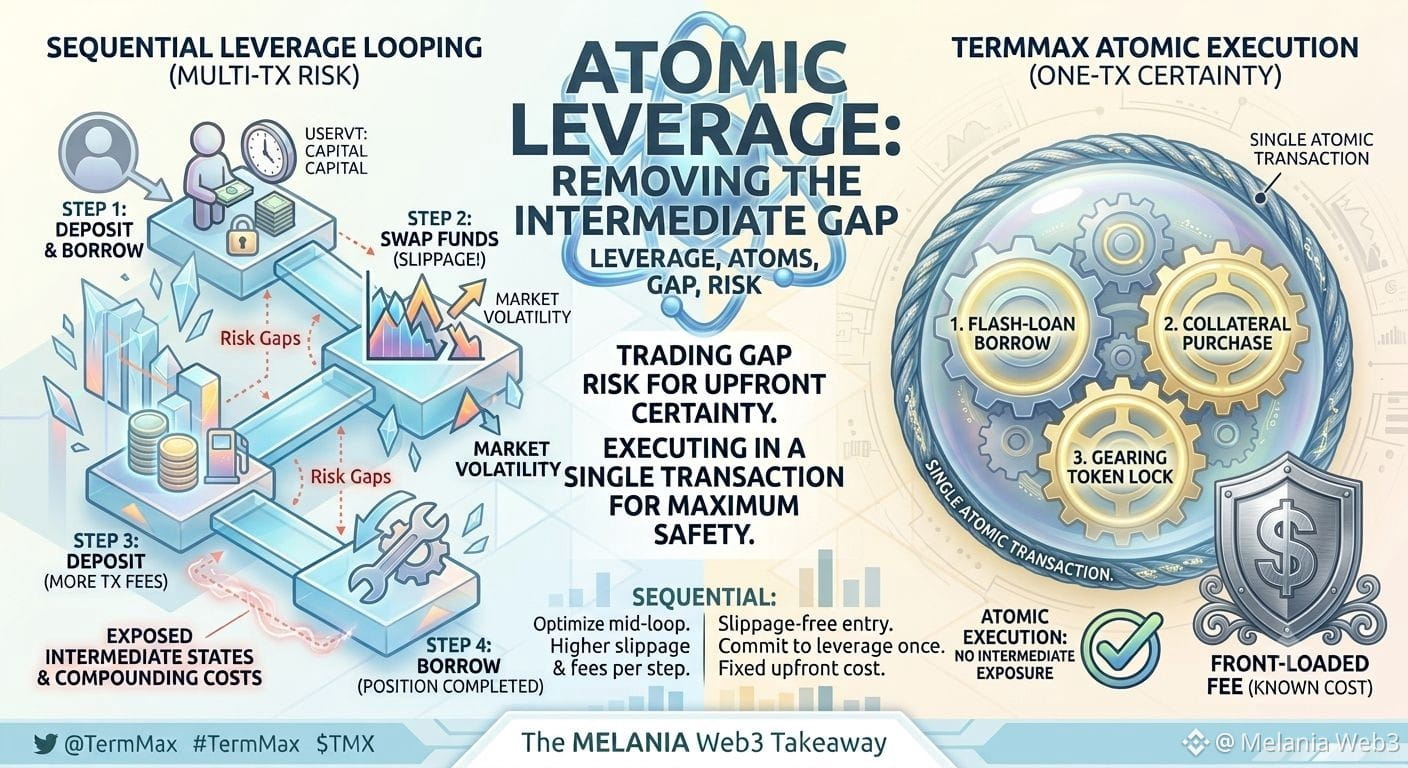
Always assumed on-chain leverage meant the same thing everywhere: borrow, swap, deposit, borrow again — each step its own transaction, each one a moment where the position sits half-built.
TermMax's #Leverager doesn't work that way. The borrow, the collateral purchase, and the Gearing Token lock all happen inside one atomic, flash-loan-backed transaction. No intermediate state where you're holding borrowed funds but haven't deployed them yet.
What I hadn't clocked until I checked the fee mechanics: cost isn't distributed across loop iterations like a manual strategy. It's front-loaded — calculated once, on the full borrowed amount, at entry. A stepwise loop lets cost land differently depending on how each iteration prices; atomic execution prices the whole position in one shot, upfront.
That's a real trade, not just a UX upgrade. Removing the gap between steps also removes the ability to average into a position as conditions shift mid-build — you commit to the leverage ratio once, against whatever the market looks like in that single transaction.
I don't think that makes atomic execution worse. No exposed intermediate state between separate transactions is worth something concrete on its own. I'm just not sure it's worth the same amount to everyone — someone actively managing a loop, adjusting each iteration, is optimizing for something the atomic version doesn't offer at all.
Still working through whether the front-loaded fee nets out cheaper than a manual loop's accumulated slippage in volatile conditions, or just moves the same cost to a different point in time.
So: for a position you'd normally build iteratively, is one atomic entry actually cheaper end to end — or does it just make the cost visible earlier instead of smaller overall?
@termmax $COLLECT
{alpha}(560x4b3d30992f003c8167699735f5ab2831b2a087d3)
$PEOPLE
{spot}(PEOPLEUSDT)
$BTW
{alpha}(560x444045b0ee1ee319a660a5e3d604ca0ffa35acaa)
#termmax @TermMax
Always assumed on-chain leverage meant the same thing everywhere: borrow, swap, deposit, borrow again — each step its own transaction, each one a moment where the position sits half-built.
TermMax's #Leverager doesn't work that way. The borrow, the collateral purchase, and the Gearing Token lock all happen inside one atomic, flash-loan-backed transaction. No intermediate state where you're holding borrowed funds but haven't deployed them yet.
What I hadn't clocked until I checked the fee mechanics: cost isn't distributed across loop iterations like a manual strategy. It's front-loaded — calculated once, on the full borrowed amount, at entry. A stepwise loop lets cost land differently depending on how each iteration prices; atomic execution prices the whole position in one shot, upfront.
That's a real trade, not just a UX upgrade. Removing the gap between steps also removes the ability to average into a position as conditions shift mid-build — you commit to the leverage ratio once, against whatever the market looks like in that single transaction.
I don't think that makes atomic execution worse. No exposed intermediate state between separate transactions is worth something concrete on its own. I'm just not sure it's worth the same amount to everyone — someone actively managing a loop, adjusting each iteration, is optimizing for something the atomic version doesn't offer at all.
Still working through whether the front-loaded fee nets out cheaper than a manual loop's accumulated slippage in volatile conditions, or just moves the same cost to a different point in time.
So: for a position you'd normally build iteratively, is one atomic entry actually cheaper end to end — or does it just make the cost visible earlier instead of smaller overall?
@TermMax $COLLECT
$PEOPLE
$BTW
Always assumed on-chain leverage meant the same thing everywhere: borrow, swap, deposit, borrow again — each step its own transaction, each one a moment where the position sits half-built.
TermMax's #Leverager doesn't work that way. The borrow, the collateral purchase, and the Gearing Token lock all happen inside one atomic, flash-loan-backed transaction. No intermediate state where you're holding borrowed funds but haven't deployed them yet.
What I hadn't clocked until I checked the fee mechanics: cost isn't distributed across loop iterations like a manual strategy. It's front-loaded — calculated once, on the full borrowed amount, at entry. A stepwise loop lets cost land differently depending on how each iteration prices; atomic execution prices the whole position in one shot, upfront.
That's a real trade, not just a UX upgrade. Removing the gap between steps also removes the ability to average into a position as conditions shift mid-build — you commit to the leverage ratio once, against whatever the market looks like in that single transaction.
I don't think that makes atomic execution worse. No exposed intermediate state between separate transactions is worth something concrete on its own. I'm just not sure it's worth the same amount to everyone — someone actively managing a loop, adjusting each iteration, is optimizing for something the atomic version doesn't offer at all.
Still working through whether the front-loaded fee nets out cheaper than a manual loop's accumulated slippage in volatile conditions, or just moves the same cost to a different point in time.
So: for a position you'd normally build iteratively, is one atomic entry actually cheaper end to end — or does it just make the cost visible earlier instead of smaller overall?
@TermMax $COLLECT
$PEOPLE
$BTW
30
4
17
2.4k
Log in to explore more content
Join global crypto users on Binance Square
⚡️ Get latest and useful information about crypto.
💬 Trusted by the world’s largest crypto exchange.
👍 Discover real insights from verified creators.
Email / Phone number
Trending Topics
1
#BinanceLaunchesBinanceIntelligence
0 views
0 Discussing
2
#EvernorthXRPTreasuryCompletesSPACMerger
324 views
24 Discussing
3
#ADAGains10%Above$0.27
16,195 views
182 Discussing
4
#ETHUp70%InQ3ButLiquidityFalls
181,401 views
1,112 Discussing
5
#EthStakingExitQueueHits2026High
61,849 views
793 Discussing
6
#FedOctoberHoldOdds82.3%
64,704 views
752 Discussing
7
#Nikkei225Jumps2.5%ToThreeMonthHigh
84,747 views
1,115 Discussing
8
#CircleMints$2.75BUSDCOnSolanaIn7Days
2,334 views
52 Discussing
9
#DriftHackVictimsBeginClaims
181,850 views
1,764 Discussing
10
#SolanaTokenizedStockVolumeTops$4.4BInSeptember
13,940 views
133 Discussing