

pareeshayy
19 Posts

pareeshayy
Report
Block User
I am pareeshay 🎀🎀 New in Binance square... Content creator...
6 Following
0 Followers
2 Liked
Posts
·
--
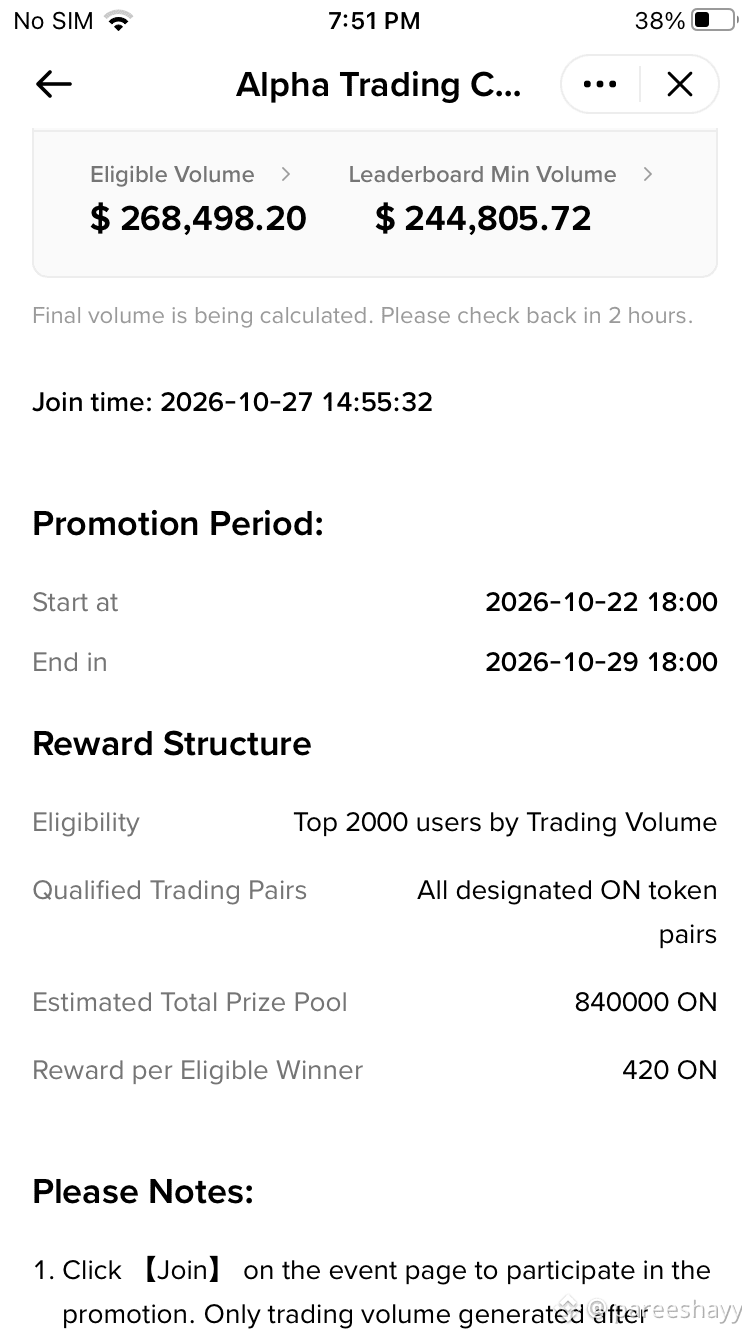
$ON when final leaderboard update my final rank 267k i am eligible anyone please tell me 😭
$ON when final leaderboard update my final rank 267k i am eligible anyone please tell me 😭
3
1
381
·
--
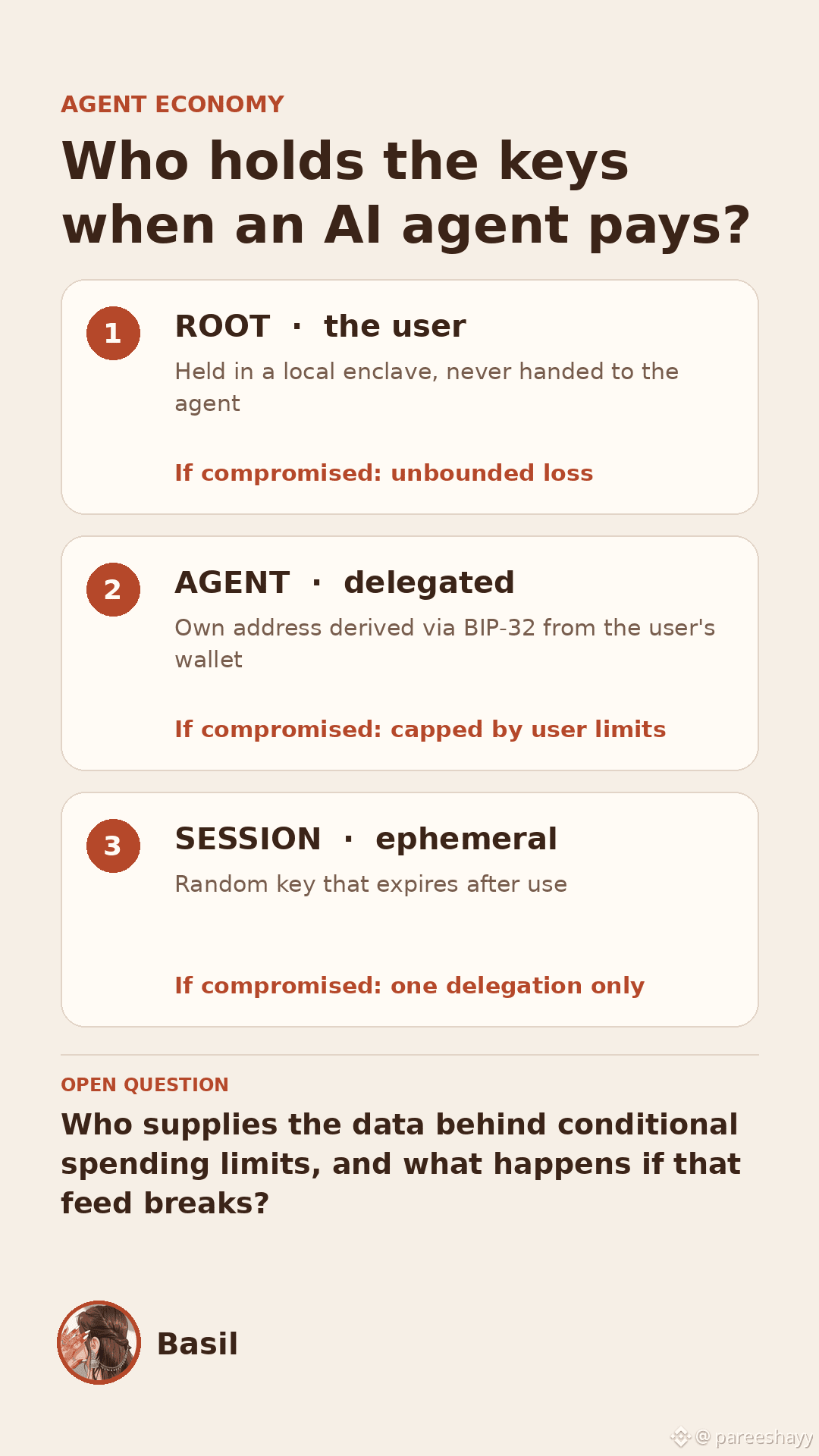
Today I read Kite’s developer docs end to end, and the part that stayed with me wasn’t speed or fees. It was how authority is split into three layers. The user holds root authority, each agent gets its own address derived from the user’s wallet via BIP-32, and every session runs on a random key that expires after use. Compromise a session and you lose one delegation. Compromise an agent and the damage stays inside the limits the user set. Only the root key carries unbounded loss, which is why the docs keep it in a local enclave.
The payment design follows the same logic. Instead of settling every request on-chain, two parties open a channel, exchange thousands of signed updates off-chain, and close it with a second transaction.
The docs cite sub-100ms latency at roughly $1 per million requests.
Here is where I’d push back on my own enthusiasm. The docs also describe conditional rules, like cutting an agent’s limit when volatility spikes. A rule like that needs an outside data input, and I couldn’t find who supplies it or what happens if that feed is wrong. Also, the large testnet figures (hundreds of millions of transactions) came from a testing environment, so they say little about recurring demand on mainnet, which launched April 30, 2026.
What I’m tracking from here: the number of active Agent Passports on KiteScan, the share of agent transactions that are real service payments rather than test traffic, and whether the docs name the data source behind conditional spending limits.
An agent economy only works if a person can hand over a wallet and still sleep. That depends less on how fast agents pay and more on what the rules do when their inputs break.
#KiteBBW $KITE @GoKiteAI #KiteBBW
Today I read Kite’s developer docs end to end, and the part that stayed with me wasn’t speed or fees. It was how authority is split into three layers. The user holds root authority, each agent gets its own address derived from the user’s wallet via BIP-32, and every session runs on a random key that expires after use. Compromise a session and you lose one delegation. Compromise an agent and the damage stays inside the limits the user set. Only the root key carries unbounded loss, which is why the docs keep it in a local enclave.
The payment design follows the same logic. Instead of settling every request on-chain, two parties open a channel, exchange thousands of signed updates off-chain, and close it with a second transaction.
The docs cite sub-100ms latency at roughly $1 per million requests.
Here is where I’d push back on my own enthusiasm. The docs also describe conditional rules, like cutting an agent’s limit when volatility spikes. A rule like that needs an outside data input, and I couldn’t find who supplies it or what happens if that feed is wrong. Also, the large testnet figures (hundreds of millions of transactions) came from a testing environment, so they say little about recurring demand on mainnet, which launched April 30, 2026.
What I’m tracking from here: the number of active Agent Passports on KiteScan, the share of agent transactions that are real service payments rather than test traffic, and whether the docs name the data source behind conditional spending limits.
An agent economy only works if a person can hand over a wallet and still sleep. That depends less on how fast agents pay and more on what the rules do when their inputs break.
#KiteBBW $KITE @KITE AI 中文 #KiteBBW
78
·
--
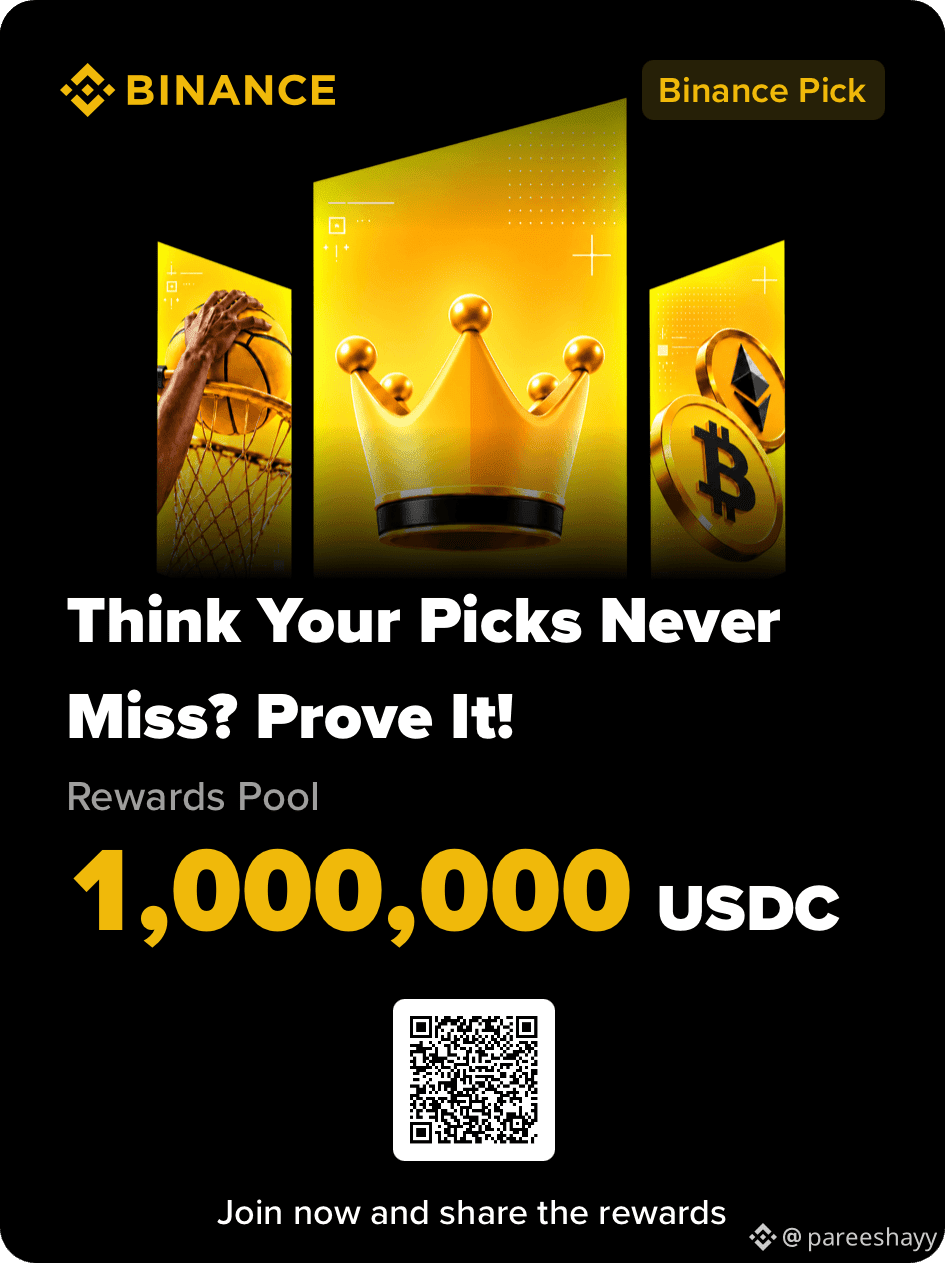
#BinancePick i am done my today task everyone can join this hottested camapign
#BinancePick i am done my today task everyone can join this hottested camapign
·
--
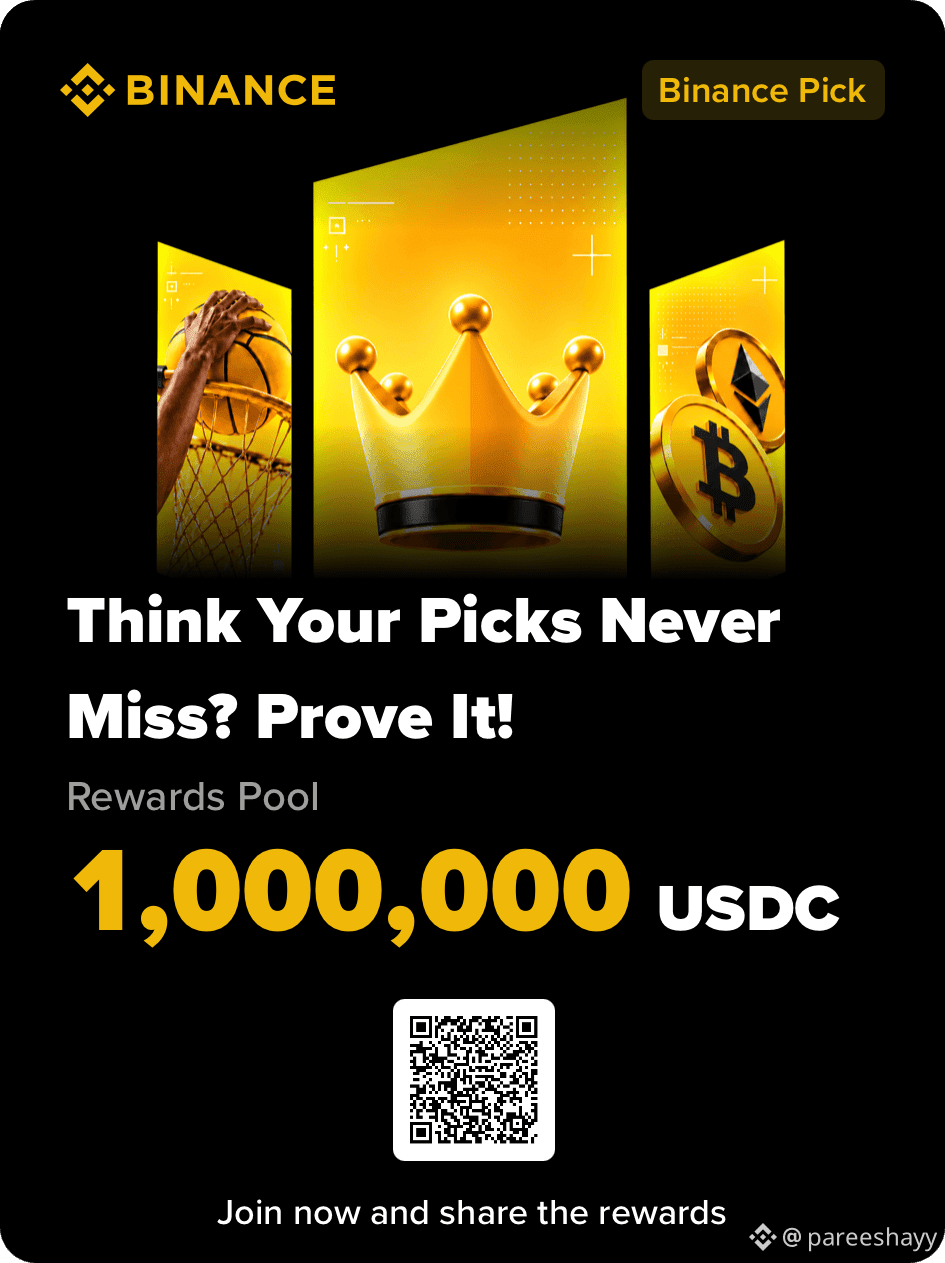
#BinancePick everyone join this campaign befire late
#BinancePick everyone join this campaign befire late
·
--
#BinancePick when week 1 reward will be distribution?
#BinancePick when week 1 reward will be distribution?
51
·
--
$ON compitation is afaired to participate .. i am leaving early 😅
$ON compitation is afaired to participate .. i am leaving early 😅
396
·
--
#BinancePick anyone recived first week payment 🥲
#BinancePick anyone recived first week payment 🥲
62
·
--
#BinancePick somethig new intresting camapign live lets try.. everyone join
#BinancePick somethig new intresting camapign live lets try.. everyone join
·
--
#dusk $DUSK @Dusk_Foundation Many people who look at Dusk's consensus layer ask one question first - how fast is it? I kept thinking that speed is the wrong place to start. The more interesting question is what the design is actually protecting against.
Succinct Attestation runs every block through three steps - Proposal, Validation, Ratification. A provisioner creates a candidate block. A randomly selected committee checks its validity. A second, separately selected committee confirms the validation outcome and finalizes it. Two independent committees, same block, same round.
What slowed me down reading this was the word "independently." Most PoS systems use one committee to propose and approve. Dusk uses two separate committees for validation and ratification, meaning a block needs agreement from two groups who were selected randomly and separately before it is ever considered final. A single compromised committee cannot push through an invalid block alone.
The randomness matters more than it first appears. Provisioners are selected through sortition - weighted by stake, but non-deterministic. Nobody knows in advance which specific nodes will form the next validation or ratification committee. That uncertainty is the security mechanism. An attacker cannot bribe or target a committee that does not yet exist.
The minimum stake to participate is 1,000 DUSK. That number is not arbitrary - it sets the economic floor for what it costs to become a provisioner and potentially influence committee selection. The higher the total staked, the more expensive it becomes to accumulate enough weight to matter.
What I find genuinely unresolved is the relationship between stake concentration and sortition outcomes over time. If a small number of large provisioners dominate the stake weight, the "random" selection starts producing predictable patterns. The cryptography holds, but the economic assumptions underneath it require watching.
#dusk $DUSK @Dusk Many people who look at Dusk's consensus layer ask one question first - how fast is it? I kept thinking that speed is the wrong place to start. The more interesting question is what the design is actually protecting against.
Succinct Attestation runs every block through three steps - Proposal, Validation, Ratification. A provisioner creates a candidate block. A randomly selected committee checks its validity. A second, separately selected committee confirms the validation outcome and finalizes it. Two independent committees, same block, same round.
What slowed me down reading this was the word "independently." Most PoS systems use one committee to propose and approve. Dusk uses two separate committees for validation and ratification, meaning a block needs agreement from two groups who were selected randomly and separately before it is ever considered final. A single compromised committee cannot push through an invalid block alone.
The randomness matters more than it first appears. Provisioners are selected through sortition - weighted by stake, but non-deterministic. Nobody knows in advance which specific nodes will form the next validation or ratification committee. That uncertainty is the security mechanism. An attacker cannot bribe or target a committee that does not yet exist.
The minimum stake to participate is 1,000 DUSK. That number is not arbitrary - it sets the economic floor for what it costs to become a provisioner and potentially influence committee selection. The higher the total staked, the more expensive it becomes to accumulate enough weight to matter.
What I find genuinely unresolved is the relationship between stake concentration and sortition outcomes over time. If a small number of large provisioners dominate the stake weight, the "random" selection starts producing predictable patterns. The cryptography holds, but the economic assumptions underneath it require watching.
80
·
--
#dusk $DUSK @Dusk_Foundation Many people who look at Dusk for the first time reduce Phoenix and Moonlight to a simple toggle - private mode and public mode. I kept thinking that framing misses what is actually interesting about how these two models sit inside the same protocol.
Phoenix is not just "private." It is a completely different transaction architecture. Funds do not live in balances - they live as encrypted notes. When you spend, you consume existing notes and create new ones, proving with zero-knowledge proofs that no double spend happened and that the amounts add up, without revealing who sent what to whom or how much moved. The receiver sees the note. Nobody else does, unless you share a viewing key.
Moonlight works the opposite way - account-based, fully transparent, sender and recipient and amount all visible on-chain. The kind of model most people already understand from Ethereum.
What caught my attention is that both models settle through the same Transfer Contract on DuskDS. They are not separate chains or separate ledgers. A Phoenix transaction and a Moonlight transaction can both exist inside the same block, finalized by the same consensus round, without either model needing to know about the other's internal logic.
The part worth sitting with is what this means for regulated assets. A securities transaction might need full transparency for the regulator and full privacy from the counterparty. Phoenix viewing keys make selective disclosure possible - you reveal exactly what you must, to exactly who requires it, nothing more. Moonlight handles flows where transparency is the requirement by default.
What I find harder to answer is whether regulators will accept viewing-key-based disclosure as equivalent to traditional audit trails. The cryptography works. Whether the legal frameworks catch up is a different question entirely.
#dusk $DUSK @Dusk Many people who look at Dusk for the first time reduce Phoenix and Moonlight to a simple toggle - private mode and public mode. I kept thinking that framing misses what is actually interesting about how these two models sit inside the same protocol.
Phoenix is not just "private." It is a completely different transaction architecture. Funds do not live in balances - they live as encrypted notes. When you spend, you consume existing notes and create new ones, proving with zero-knowledge proofs that no double spend happened and that the amounts add up, without revealing who sent what to whom or how much moved. The receiver sees the note. Nobody else does, unless you share a viewing key.
Moonlight works the opposite way - account-based, fully transparent, sender and recipient and amount all visible on-chain. The kind of model most people already understand from Ethereum.
What caught my attention is that both models settle through the same Transfer Contract on DuskDS. They are not separate chains or separate ledgers. A Phoenix transaction and a Moonlight transaction can both exist inside the same block, finalized by the same consensus round, without either model needing to know about the other's internal logic.
The part worth sitting with is what this means for regulated assets. A securities transaction might need full transparency for the regulator and full privacy from the counterparty. Phoenix viewing keys make selective disclosure possible - you reveal exactly what you must, to exactly who requires it, nothing more. Moonlight handles flows where transparency is the requirement by default.
What I find harder to answer is whether regulators will accept viewing-key-based disclosure as equivalent to traditional audit trails. The cryptography works. Whether the legal frameworks catch up is a different question entirely.
81
Log in to explore more content
Join global crypto users on Binance Square
⚡️ Get latest and useful information about crypto.
💬 Trusted by the world’s largest crypto exchange.
👍 Discover real insights from verified creators.
Email / Phone number