
#kimi3
kimi3
797 views
5 Discussing
Hot
Latest

·
--
China's Kimi K3 ranks first in the front-end code competition arena, surpassing Claude Fable 5. Although its overall capabilities are not as strong as GPT 5.6 Sol and Fable 5.
It’s expected that competition will intensify → the entire AI ecosystem will expand (the most core logic): improved model capabilities + lower prices will lead more enterprises and developers to actually deploy and use them (from big companies to mid-sized businesses and individual developers).
Front-end code generation is a high-frequency, must-have scenario. Once cost-effectiveness becomes sufficient, it will massively replace/assist human development, causing token consumption to skyrocket. So even if a single model is cheaper, total compute demand still increases (more people use it, use it more frequently, and employ more complex agent workflows).
No matter how strong or cheap the model is, running it still requires GPUs/HBM/servers/optical modules/power/data centers. In the US stock market’s AI sector, pure model/software companies (whose high valuations depend on a model moat) may face long-term pressure.
Minor negative: If the market interprets it as the US model moat being weakened, it could create short-term pressure on some high-valuation AI software/application stocks.
Let me estimate the deployment cost for K3. Previously, a 1T model would require about 4 Mac Studio clusters; to use it smoothly, it would need roughly 6–8. Now it’s 2.8T, handling more context and memory. It would likely require at least 21–32 units.
It should reach a scale of 64+ GPUs: total hardware cost $2 million–$10 million+ (and GPUs alone could be several million USD).
#KIMI3
China's Kimi K3 ranks first in the front-end code competition arena, surpassing Claude Fable 5. Although its overall capabilities are not as strong as GPT 5.6 Sol and Fable 5.
It’s expected that competition will intensify → the entire AI ecosystem will expand (the most core logic): improved model capabilities + lower prices will lead more enterprises and developers to actually deploy and use them (from big companies to mid-sized businesses and individual developers).
Front-end code generation is a high-frequency, must-have scenario. Once cost-effectiveness becomes sufficient, it will massively replace/assist human development, causing token consumption to skyrocket. So even if a single model is cheaper, total compute demand still increases (more people use it, use it more frequently, and employ more complex agent workflows).
No matter how strong or cheap the model is, running it still requires GPUs/HBM/servers/optical modules/power/data centers. In the US stock market’s AI sector, pure model/software companies (whose high valuations depend on a model moat) may face long-term pressure.
Minor negative: If the market interprets it as the US model moat being weakened, it could create short-term pressure on some high-valuation AI software/application stocks.
Let me estimate the deployment cost for K3. Previously, a 1T model would require about 4 Mac Studio clusters; to use it smoothly, it would need roughly 6–8. Now it’s 2.8T, handling more context and memory. It would likely require at least 21–32 units.
It should reach a scale of 64+ GPUs: total hardware cost $2 million–$10 million+ (and GPUs alone could be several million USD).
#KIMI3
It’s expected that competition will intensify → the entire AI ecosystem will expand (the most core logic): improved model capabilities + lower prices will lead more enterprises and developers to actually deploy and use them (from big companies to mid-sized businesses and individual developers).
Front-end code generation is a high-frequency, must-have scenario. Once cost-effectiveness becomes sufficient, it will massively replace/assist human development, causing token consumption to skyrocket. So even if a single model is cheaper, total compute demand still increases (more people use it, use it more frequently, and employ more complex agent workflows).
No matter how strong or cheap the model is, running it still requires GPUs/HBM/servers/optical modules/power/data centers. In the US stock market’s AI sector, pure model/software companies (whose high valuations depend on a model moat) may face long-term pressure.
Minor negative: If the market interprets it as the US model moat being weakened, it could create short-term pressure on some high-valuation AI software/application stocks.
Let me estimate the deployment cost for K3. Previously, a 1T model would require about 4 Mac Studio clusters; to use it smoothly, it would need roughly 6–8. Now it’s 2.8T, handling more context and memory. It would likely require at least 21–32 units.
It should reach a scale of 64+ GPUs: total hardware cost $2 million–$10 million+ (and GPUs alone could be several million USD).
#KIMI3
374

·
--
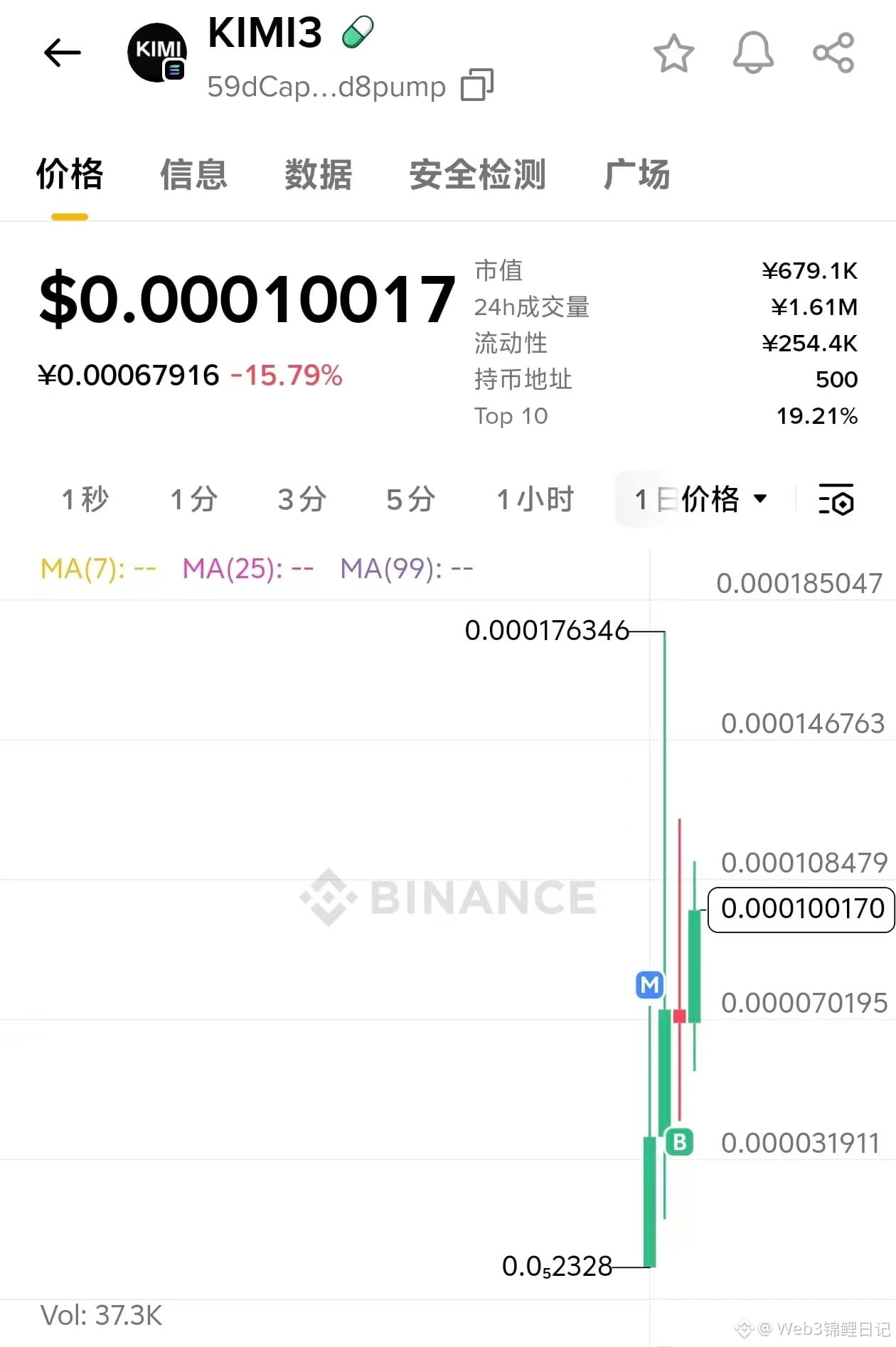
#KIMI3 60,000 market cap—I bought a bit, not bad (personal record only, don’t follow)
Reasons for buying
1. The concept is interesting. In the AI concept, China’s Kimi K3 ranks #1 in the frontend code competition arena, surpassing Claude Fable 5, and Musk even interacted with it twice.
2. Lower market cap. It launched on July 16, topping out at 74,000. On July 17, it hit a new high with a 176,000 market cap. It then dropped to a low of 42,000, climbed back up to 60,000, and I promptly bought a little. The chips are concentrated: the top 100 account for 69%. The average entry price is around 67,000 market cap. There are a few key holders/influencers at the front, like Dongji, MANA, etc.
3. The community is decent—500+ holders, 300+ in the community, mainly text-based promotions.
#跟着锦鲤学打百倍金狗 $币安人生
Follow Web3 Lucky Carp Diary—if you buy the coin, it can multiply tenfold.
59dCaphi38eZHiuZjJ2n26BuEcktu9ohdH8eAQd8pump
{web3_wallet_create}(CT_50159dCaphi38eZHiuZjJ2n26BuEcktu9ohdH8eAQd8pump)
#KIMI3 60,000 market cap—I bought a bit, not bad (personal record only, don’t follow)
Reasons for buying
1. The concept is interesting. In the AI concept, China’s Kimi K3 ranks #1 in the frontend code competition arena, surpassing Claude Fable 5, and Musk even interacted with it twice.
2. Lower market cap. It launched on July 16, topping out at 74,000. On July 17, it hit a new high with a 176,000 market cap. It then dropped to a low of 42,000, climbed back up to 60,000, and I promptly bought a little. The chips are concentrated: the top 100 account for 69%. The average entry price is around 67,000 market cap. There are a few key holders/influencers at the front, like Dongji, MANA, etc.
3. The community is decent—500+ holders, 300+ in the community, mainly text-based promotions.
#跟着锦鲤学打百倍金狗 $币安人生
Follow Web3 Lucky Carp Diary—if you buy the coin, it can multiply tenfold.
59dCaphi38eZHiuZjJ2n26BuEcktu9ohdH8eAQd8pump
Reasons for buying
1. The concept is interesting. In the AI concept, China’s Kimi K3 ranks #1 in the frontend code competition arena, surpassing Claude Fable 5, and Musk even interacted with it twice.
2. Lower market cap. It launched on July 16, topping out at 74,000. On July 17, it hit a new high with a 176,000 market cap. It then dropped to a low of 42,000, climbed back up to 60,000, and I promptly bought a little. The chips are concentrated: the top 100 account for 69%. The average entry price is around 67,000 market cap. There are a few key holders/influencers at the front, like Dongji, MANA, etc.
3. The community is decent—500+ holders, 300+ in the community, mainly text-based promotions.
#跟着锦鲤学打百倍金狗 $币安人生
Follow Web3 Lucky Carp Diary—if you buy the coin, it can multiply tenfold.
59dCaphi38eZHiuZjJ2n26BuEcktu9ohdH8eAQd8pump


1
1.2k
Imagine logging into MiliQBits not as a dashboard, but as the boss of your own crypto family. Every agent checks in. The quantum layer maps hidden ties across chains. The swarm doesn’t just react—it plans. When a whale fakes a breakout, the risk cleaner already has a countermove. When liquidity gets thin, the scout pulls the crew back. It’s not gambling. It’s coordination.
The story matters because trading is emotional. So MiliQBits gives you a narrative you can trust: a live heist where the machines do the heavy lifting and you stay in control. You can watch the agents work, tune the crew’s aggression, and learn their language. No black box. More like a war room with real money on the line.
This is the future-realistic edge—quantum-inspired signal blending, swarm consensus, autonomous execution, and a UI that feels like a film but runs like infrastructure. MiliQBits isn’t just another bot. It’s a next-gen Crypto Mafia Agent system with a soul, a story, and a strict risk code. 🤖🤖
miliqbits.com/ai-hub
$NVDA.US $NVDAB $GOOGL.US #OpenAI #Claude #Deepseek #QWEN #KIMI3
Imagine logging into MiliQBits not as a dashboard, but as the boss of your own crypto family. Every agent checks in. The quantum layer maps hidden ties across chains. The swarm doesn’t just react—it plans. When a whale fakes a breakout, the risk cleaner already has a countermove. When liquidity gets thin, the scout pulls the crew back. It’s not gambling. It’s coordination.
The story matters because trading is emotional. So MiliQBits gives you a narrative you can trust: a live heist where the machines do the heavy lifting and you stay in control. You can watch the agents work, tune the crew’s aggression, and learn their language. No black box. More like a war room with real money on the line.
This is the future-realistic edge—quantum-inspired signal blending, swarm consensus, autonomous execution, and a UI that feels like a film but runs like infrastructure. MiliQBits isn’t just another bot. It’s a next-gen Crypto Mafia Agent system with a soul, a story, and a strict risk code. 🤖🤖
miliqbits.com/ai-hub
$NVDA.US $NVDAB $GOOGL.US #OpenAI #Claude #Deepseek #QWEN #KIMI3
The story matters because trading is emotional. So MiliQBits gives you a narrative you can trust: a live heist where the machines do the heavy lifting and you stay in control. You can watch the agents work, tune the crew’s aggression, and learn their language. No black box. More like a war room with real money on the line.
This is the future-realistic edge—quantum-inspired signal blending, swarm consensus, autonomous execution, and a UI that feels like a film but runs like infrastructure. MiliQBits isn’t just another bot. It’s a next-gen Crypto Mafia Agent system with a soul, a story, and a strict risk code. 🤖🤖
miliqbits.com/ai-hub
$NVDA.US $NVDAB $GOOGL.US #OpenAI #Claude #Deepseek #QWEN #KIMI3
2
21
Log in to explore more content
Join global crypto users on Binance Square
⚡️ Get latest and useful information about crypto.
💬 Trusted by the world’s largest crypto exchange.
👍 Discover real insights from verified creators.
Email / Phone number
Trending Topics
1
#AIStocksWhatNext
874,300 views
6,580 Discussing
2
#BitcoinRejectedAt$87,300Twice
0 views
0 Discussing
3
#BCHJumps28%OnCMEFuturesListing
10,061 views
489 Discussing
4
#WallStreetEarningsRevisionsTurnBearish
7,287 views
364 Discussing
5
#DollarIndexReclaims101
5,889 views
303 Discussing
6
#21SharesLaunchesEuropesFirstZcashETP
40,400 views
1,096 Discussing
7
#CardanoJoinsX402PaymentStandard
25,635 views
786 Discussing
8
#BitcoinTops$87KAtEightMonthHigh
12,398 views
133 Discussing
9
#ZECBreaksAbove$1600AtRecordHigh
8,765 views
107 Discussing
10
#BitwiseNEARStakingETPAssetsTop$100M
40,916 views
108 Discussing