
#grm
grm
786 views
8 Discussing
Hot
Latest
$GRM DUMPS 8% AS APPLE YANKS TELEGRAM FROM THE APP STORE 🔴
📉 The App Store blackout lasted only hours, but $GRM holders felt the full weight of the panic. Apple pulled Telegram citing CSAM violations, and the token surrendered ~8% before the app quietly crawled back. Classic liquidity scare — but the market moved first.
🔍 This is the second time since 2018 that Apple has swung the hammer on Telegram. The precedent? The protocol cleaned house, tightened moderation, and survived. The token recovers, but the stain on sentiment lingers.
💡 The real question isn't whether Telegram returns — it's whether this regulatory shadow keeps capping $GRM 's upside. 💬 Are you treating this dip as a discount or a red flag?
⚠️ Not financial advice. Always manage your risk. 🛡️
🏷️ #GRM #Telegram #Crypto #Bearish #AppStore
🩸 📉
$GRM DUMPS 8% AS APPLE YANKS TELEGRAM FROM THE APP STORE 🔴
📉 The App Store blackout lasted only hours, but $GRM holders felt the full weight of the panic. Apple pulled Telegram citing CSAM violations, and the token surrendered ~8% before the app quietly crawled back. Classic liquidity scare — but the market moved first.
🔍 This is the second time since 2018 that Apple has swung the hammer on Telegram. The precedent? The protocol cleaned house, tightened moderation, and survived. The token recovers, but the stain on sentiment lingers.
💡 The real question isn't whether Telegram returns — it's whether this regulatory shadow keeps capping $GRM 's upside. 💬 Are you treating this dip as a discount or a red flag?
⚠️ Not financial advice. Always manage your risk. 🛡️
🏷️ #GRM #Telegram #Crypto #Bearish #AppStore
🩸 📉
📉 The App Store blackout lasted only hours, but $GRM holders felt the full weight of the panic. Apple pulled Telegram citing CSAM violations, and the token surrendered ~8% before the app quietly crawled back. Classic liquidity scare — but the market moved first.
🔍 This is the second time since 2018 that Apple has swung the hammer on Telegram. The precedent? The protocol cleaned house, tightened moderation, and survived. The token recovers, but the stain on sentiment lingers.
💡 The real question isn't whether Telegram returns — it's whether this regulatory shadow keeps capping $GRM 's upside. 💬 Are you treating this dip as a discount or a red flag?
⚠️ Not financial advice. Always manage your risk. 🛡️
🏷️ #GRM #Telegram #Crypto #Bearish #AppStore
🩸 📉
6
·
--
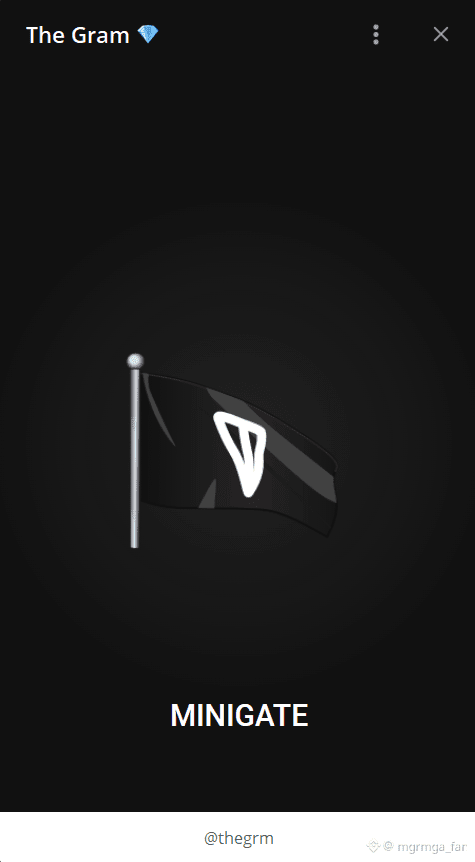
While everyone is focused on the situation between the App Store and #Telegram , I'd like to talk about the @thegrm bot on Telegram instead. Here are three interesting things I found.😵😵😵
1. I'm pretty sure this bot is being updated quietly behind the scenes. It used to work, had auctions, and even included a Gram (GRM) wallet. Now, when you launch it, MINIGATE appears at the bottom of the screen, followed by "Loading failed."
(Unfortunately, I can't remember if the MINIGATE label was there before, but as far as I remember, it wasn't.)
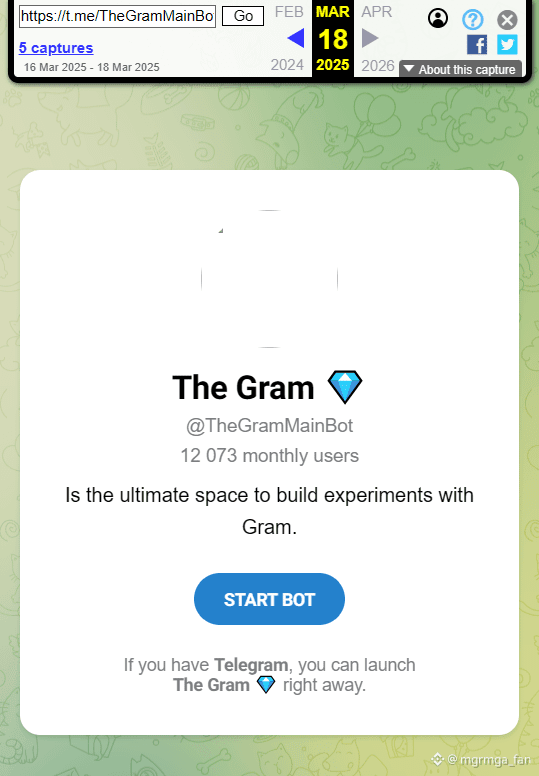
2. The bot's username has been changed. (I've attached a screenshot from the Wayback Machine.)
Old: t.me/TheGramMainBot
New: t.me/thegrm
3. The bot was created by Oleg Oskolsky (also known as Gorilla🙊).
You can monitor this bot yourselves, but as soon as something changes, I'll do my best to let you know first.
MINIGATE... what do you think it could mean? As far as I remember, this word had never appeared before in app.
#GRM #Bot $GRAM
While everyone is focused on the situation between the App Store and #Telegram , I'd like to talk about the @thegrm bot on Telegram instead. Here are three interesting things I found.😵😵😵
1. I'm pretty sure this bot is being updated quietly behind the scenes. It used to work, had auctions, and even included a Gram (GRM) wallet. Now, when you launch it, MINIGATE appears at the bottom of the screen, followed by "Loading failed."
(Unfortunately, I can't remember if the MINIGATE label was there before, but as far as I remember, it wasn't.)
2. The bot's username has been changed. (I've attached a screenshot from the Wayback Machine.)
Old: t.me/TheGramMainBot
New: t.me/thegrm
3. The bot was created by Oleg Oskolsky (also known as Gorilla🙊).
You can monitor this bot yourselves, but as soon as something changes, I'll do my best to let you know first.
MINIGATE... what do you think it could mean? As far as I remember, this word had never appeared before in app.
#GRM #Bot $GRAM
1. I'm pretty sure this bot is being updated quietly behind the scenes. It used to work, had auctions, and even included a Gram (GRM) wallet. Now, when you launch it, MINIGATE appears at the bottom of the screen, followed by "Loading failed."
(Unfortunately, I can't remember if the MINIGATE label was there before, but as far as I remember, it wasn't.)
2. The bot's username has been changed. (I've attached a screenshot from the Wayback Machine.)
Old: t.me/TheGramMainBot
New: t.me/thegrm
3. The bot was created by Oleg Oskolsky (also known as Gorilla🙊).
You can monitor this bot yourselves, but as soon as something changes, I'll do my best to let you know first.
MINIGATE... what do you think it could mean? As far as I remember, this word had never appeared before in app.
#GRM #Bot $GRAM
2
219
·
--
By the way, I’ve picked up several domains myself. One of them is mgrmgafan.gram / mgrmgafan.grm.
Why did I write both .gram and .grm? The answer is in Fact #2 below.
Fact #2
If you missed Fact #1, you can find it here: [Fact 1 — Gram DNS](https://www.binance.com/en/square/post/354898494113249)
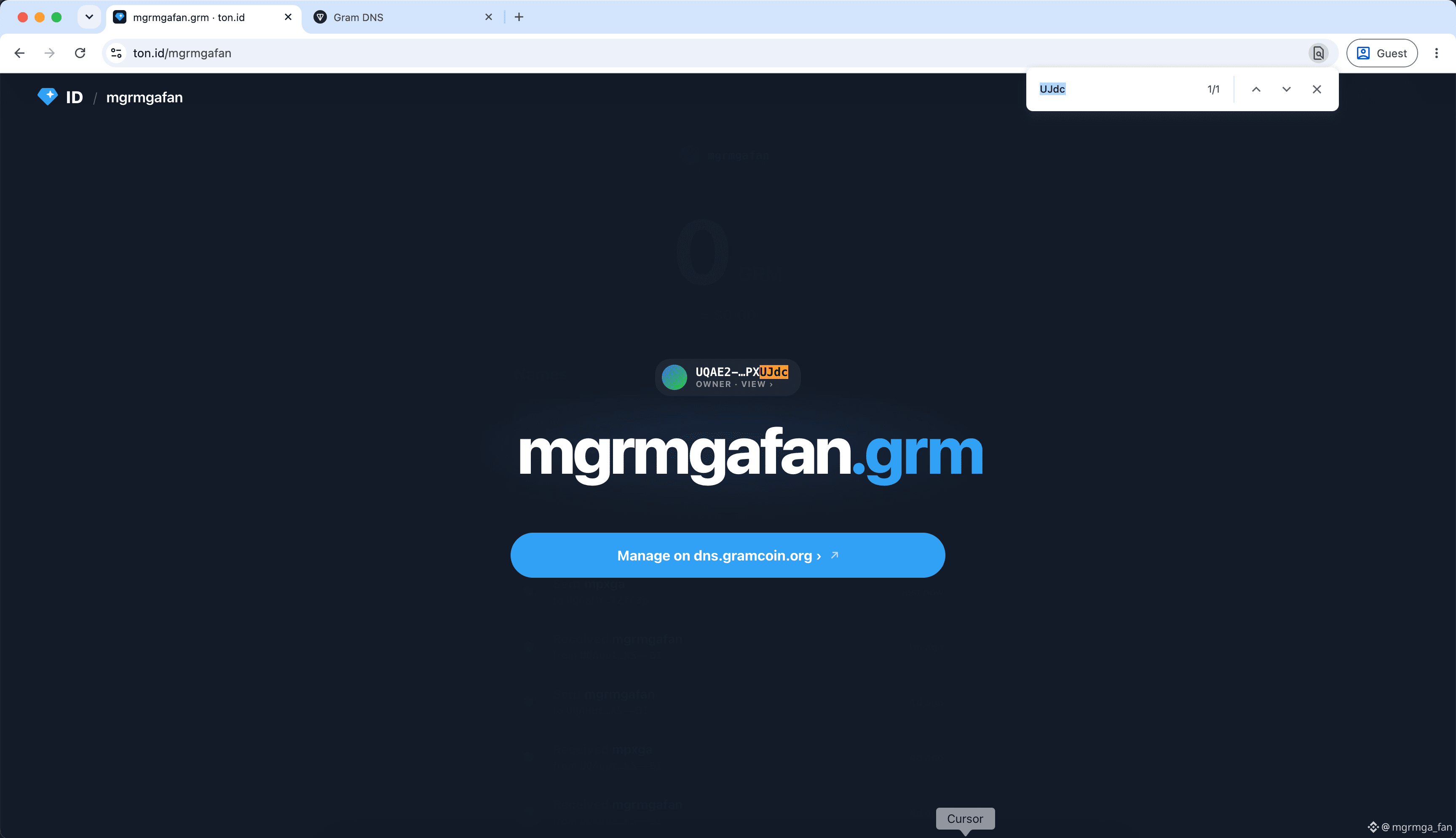
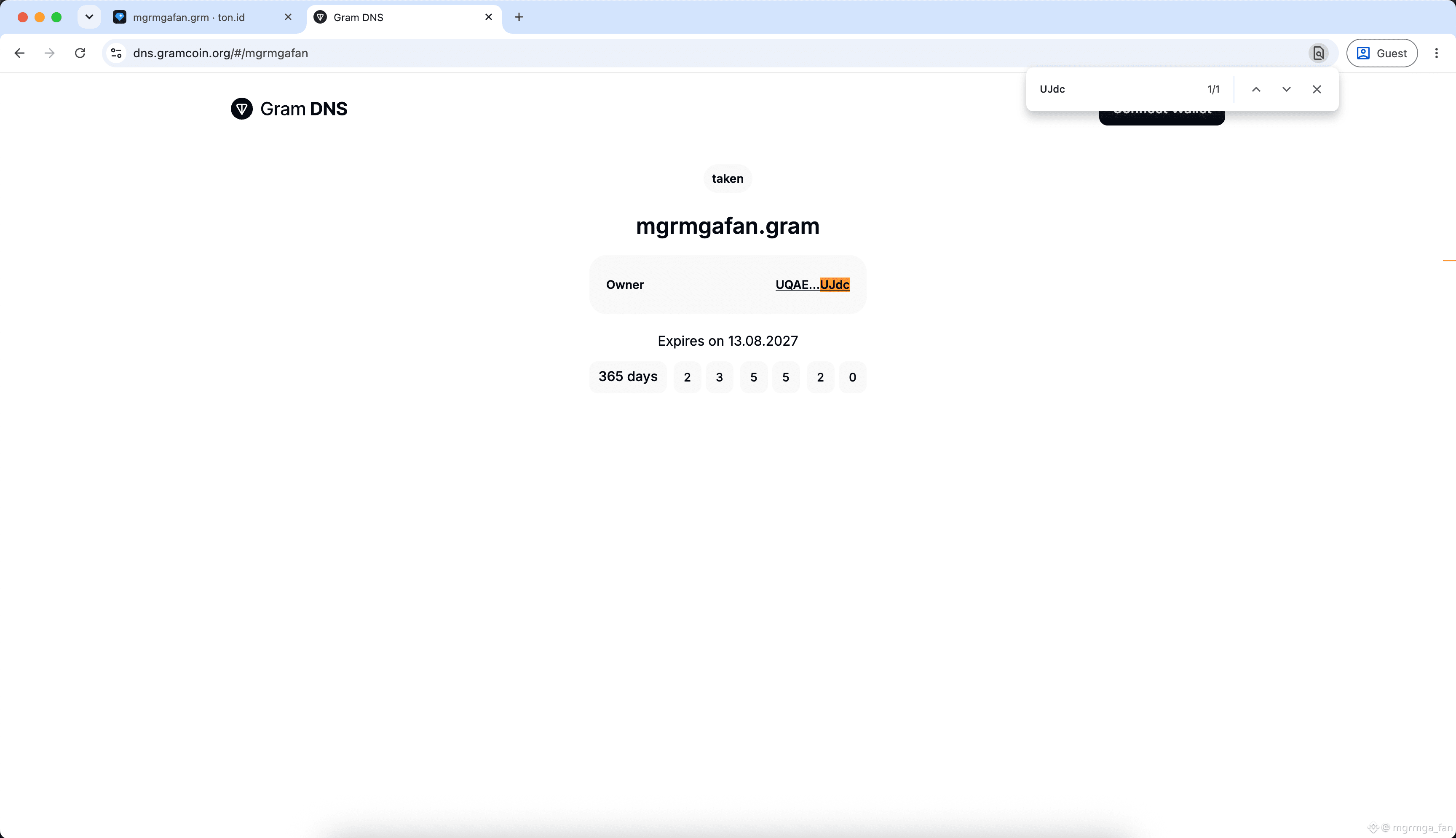
I bought domains on dns.gramcoin.org with the .gram TLD. After that, I could find my domain on ton.id, but there it appeared as .grm.
Moreover, I had been following ton.id since before its first changes. Previously, I could see people owning domains ending in .gram, but after an update, .gram was changed to .grm.
Even now, when I look up my domain on dns.gramcoin.org, I see mgrmgafan.gram, while on ton.id it appears as mgrmgafan.grm.
#GRAM #GRM #MGRMGA #Telegram
By the way, I’ve picked up several domains myself. One of them is mgrmgafan.gram / mgrmgafan.grm.
Why did I write both .gram and .grm? The answer is in Fact #2 below.
Fact #2
If you missed Fact #1, you can find it here: Fact 1 — Gram DNS
I bought domains on dns.gramcoin.org with the .gram TLD. After that, I could find my domain on ton.id, but there it appeared as .grm.
Moreover, I had been following ton.id since before its first changes. Previously, I could see people owning domains ending in .gram, but after an update, .gram was changed to .grm.
Even now, when I look up my domain on dns.gramcoin.org, I see mgrmgafan.gram, while on ton.id it appears as mgrmgafan.grm.
#GRAM #GRM #MGRMGA #Telegram
Why did I write both .gram and .grm? The answer is in Fact #2 below.
Fact #2
If you missed Fact #1, you can find it here: Fact 1 — Gram DNS
I bought domains on dns.gramcoin.org with the .gram TLD. After that, I could find my domain on ton.id, but there it appeared as .grm.
Moreover, I had been following ton.id since before its first changes. Previously, I could see people owning domains ending in .gram, but after an update, .gram was changed to .grm.
Even now, when I look up my domain on dns.gramcoin.org, I see mgrmgafan.gram, while on ton.id it appears as mgrmgafan.grm.
#GRAM #GRM #MGRMGA #Telegram
1
111

·
--
Article
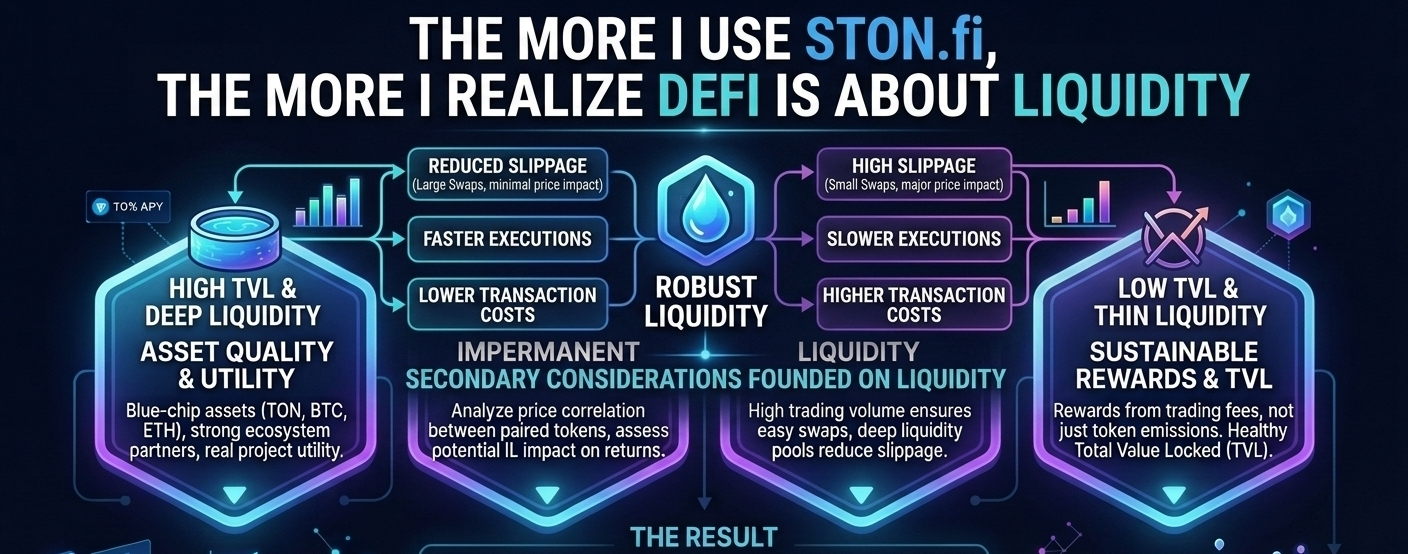
The More I Use STON.fi, the More I Realize DeFi Is About LiquidityThe More I Use STON.fi, the More I Realize DeFi Is About Liquidity
When I first started exploring STON.fi, I was mostly interested in one thing: earning from my crypto.
I would look at the farming page, check the APRs, compare the pools, and naturally gravitate toward whichever number looked the most attractive.
But the longer I spend around STON.fi, the more my perspective has changed.
I now understand that liquidity farming isn't simply about finding a high APR and depositing funds. There is a bigger story happening behind every swap, every liquidity pool, and every reward earned by an LP.
And honestly, that's what has made DeFi more interesting to me.
I Used to See Pools as Just a Place to Earn
At the beginning, I looked at a liquidity pool from a very simple perspective:
"I put my tokens here, and I receive rewards."
That's true, but it's only part of the picture.
When I provide liquidity, those assets are helping other users trade. The pool needs liquidity so people can swap one token for another without relying on a traditional order book.
STON.fi describes liquidity provision and farming as separate steps: providing liquidity gives you LP tokens representing your position, while farming involves staking those LP tokens to earn additional rewards. �
STON.fi Blog +1
Once I understood that, I started looking at my role differently.
I'm not simply depositing money into a farm.
I'm contributing liquidity to a market.
That's When APR Became Less Important to Me
I still check APR. I probably always will.
It's useful for comparing current opportunities.
But I don't let APR make the entire decision anymore.
I've seen how quickly farming numbers can change. A pool that looks extremely attractive today may have a completely different APR later.
So now, when I see a pool with a big number, I become curious rather than excited.
I ask myself:
What is driving this APR?
Is there strong trading activity?
Are there additional farming incentives?
How volatile are the tokens?
Would I still be comfortable holding these assets if the market moved against me?
Those questions are much more useful than simply chasing the biggest percentage.
Liquidity Is the Part of DeFi I Appreciate More Now
One thing I've come to appreciate is how important liquidity actually is.
As a user, it's easy to think about swaps from the perspective of the person clicking "Swap."
You choose a token, enter an amount, confirm the transaction, and you're done.
But behind that simple experience is liquidity.
Someone has supplied those assets.
Someone is taking on the risks associated with providing liquidity.
And that liquidity helps make trading possible.
That's why STON.fi's farming model interests me. Farming isn't completely disconnected from the activity happening on the DEX. Liquidity providers are contributing to the infrastructure that other users depend on.
STON.fi itself describes liquidity as one of the core ways users can contribute to TON DeFi, alongside governance through staking. �
STON.fi Blog
I Also Had to Learn About Impermanent Loss
This was one of the concepts I struggled with when I started.
At first, I thought:
"If I provide liquidity and earn rewards, why wouldn't I simply make more than holding the tokens?"
Then I learned about impermanent loss.
When the relative prices of the two assets in a liquidity pool change, the value of the position can differ from simply holding the two assets separately. That's one of the fundamental risks liquidity providers need to understand. �
STON.fi Blog
Learning this didn't make me stop using liquidity pools.
Instead, it made me more careful.
I stopped looking at farming as "free money" and started treating it as what it really is: a strategy with potential rewards and real risks.
That change in mindset was important for me.
Now I Look at the Whole Picture
These days, when I'm checking STON.fi, I don't look at just one number.
I look at the APR.
I look at the tokens.
I think about volatility.
I consider impermanent loss.
I pay attention to liquidity and trading activity.
And I ask myself whether the opportunity actually makes sense for me.
That doesn't mean I always get it right. DeFi moves too quickly for anyone to predict everything.
But I feel much better making a decision after understanding what I'm getting into rather than simply following the crowd.
Why This Journey Has Been Valuable for Me
The biggest thing STON.fi has given me isn't a particular farm or a particular APR.
It's experience.
Every week, when I check the pools and see how the numbers have changed, I'm learning something about markets, liquidity, incentives and risk.
One week, a particular pool might dominate the farming numbers.
Another week, a different opportunity might attract attention.
And that's actually the interesting part.
DeFi isn't static.
The ecosystem keeps moving, and as a liquidity provider, you have to keep learning with it.
My Biggest Lesson So Far
If there's one thing I'd tell someone just starting out, it's this:
Don't enter DeFi just because you saw a high APR.
Take some time to understand what you're actually doing.
Learn what a liquidity pool is.
Understand where your rewards come from.
Learn about impermanent loss.
Look at the tokens you're providing.
And most importantly, never assume that a high return comes without additional risk.
STON.fi's own educational material makes the same broader point: liquidity provision and farming can create opportunities, but rates fluctuate and risks such as impermanent loss and smart-contract vulnerabilities need to be considered. �
STON.fi Blog +1
Final Thoughts
My view of STON.fi has changed quite a lot since I first started exploring it.
At the beginning, I saw farming as a way to potentially earn more from my crypto.
Now, I see something bigger.
I see liquidity providers helping markets function. I see farmers participating in the TON DeFi economy. I see an ecosystem where the numbers change constantly and where learning is just as important as earning.
And that's probably the biggest lesson I've taken from my experience so far:
In DeFi, the goal shouldn't only be to find the highest yield. The goal should be to understand what you're participating in.
The more I learn about STON.fi, the more I realise that liquidity isn't just a number on a dashboard.
It's the foundation that keeps the whole trading experience moving. 🗿
This is a personal perspective on using and following STON.fi and is not financial advice. Liquidity provision and DeFi involve risk, and APRs can change over time.
#GRM $GRAM
{spot}(GRAMUSDT)
The More I Use STON.fi, the More I Realize DeFi Is About Liquidity
The More I Use STON.fi, the More I Realize DeFi Is About Liquidity
When I first started exploring STON.fi, I was mostly interested in one thing: earning from my crypto.
I would look at the farming page, check the APRs, compare the pools, and naturally gravitate toward whichever number looked the most attractive.
But the longer I spend around STON.fi, the more my perspective has changed.
I now understand that liquidity farming isn't simply about finding a high APR and depositing funds. There is a bigger story happening behind every swap, every liquidity pool, and every reward earned by an LP.
And honestly, that's what has made DeFi more interesting to me.
I Used to See Pools as Just a Place to Earn
At the beginning, I looked at a liquidity pool from a very simple perspective:
"I put my tokens here, and I receive rewards."
That's true, but it's only part of the picture.
When I provide liquidity, those assets are helping other users trade. The pool needs liquidity so people can swap one token for another without relying on a traditional order book.
STON.fi describes liquidity provision and farming as separate steps: providing liquidity gives you LP tokens representing your position, while farming involves staking those LP tokens to earn additional rewards. �
STON.fi Blog +1
Once I understood that, I started looking at my role differently.
I'm not simply depositing money into a farm.
I'm contributing liquidity to a market.
That's When APR Became Less Important to Me
I still check APR. I probably always will.
It's useful for comparing current opportunities.
But I don't let APR make the entire decision anymore.
I've seen how quickly farming numbers can change. A pool that looks extremely attractive today may have a completely different APR later.
So now, when I see a pool with a big number, I become curious rather than excited.
I ask myself:
What is driving this APR?
Is there strong trading activity?
Are there additional farming incentives?
How volatile are the tokens?
Would I still be comfortable holding these assets if the market moved against me?
Those questions are much more useful than simply chasing the biggest percentage.
Liquidity Is the Part of DeFi I Appreciate More Now
One thing I've come to appreciate is how important liquidity actually is.
As a user, it's easy to think about swaps from the perspective of the person clicking "Swap."
You choose a token, enter an amount, confirm the transaction, and you're done.
But behind that simple experience is liquidity.
Someone has supplied those assets.
Someone is taking on the risks associated with providing liquidity.
And that liquidity helps make trading possible.
That's why STON.fi's farming model interests me. Farming isn't completely disconnected from the activity happening on the DEX. Liquidity providers are contributing to the infrastructure that other users depend on.
STON.fi itself describes liquidity as one of the core ways users can contribute to TON DeFi, alongside governance through staking. �
STON.fi Blog
I Also Had to Learn About Impermanent Loss
This was one of the concepts I struggled with when I started.
At first, I thought:
"If I provide liquidity and earn rewards, why wouldn't I simply make more than holding the tokens?"
Then I learned about impermanent loss.
When the relative prices of the two assets in a liquidity pool change, the value of the position can differ from simply holding the two assets separately. That's one of the fundamental risks liquidity providers need to understand. �
STON.fi Blog
Learning this didn't make me stop using liquidity pools.
Instead, it made me more careful.
I stopped looking at farming as "free money" and started treating it as what it really is: a strategy with potential rewards and real risks.
That change in mindset was important for me.
Now I Look at the Whole Picture
These days, when I'm checking STON.fi, I don't look at just one number.
I look at the APR.
I look at the tokens.
I think about volatility.
I consider impermanent loss.
I pay attention to liquidity and trading activity.
And I ask myself whether the opportunity actually makes sense for me.
That doesn't mean I always get it right. DeFi moves too quickly for anyone to predict everything.
But I feel much better making a decision after understanding what I'm getting into rather than simply following the crowd.
Why This Journey Has Been Valuable for Me
The biggest thing STON.fi has given me isn't a particular farm or a particular APR.
It's experience.
Every week, when I check the pools and see how the numbers have changed, I'm learning something about markets, liquidity, incentives and risk.
One week, a particular pool might dominate the farming numbers.
Another week, a different opportunity might attract attention.
And that's actually the interesting part.
DeFi isn't static.
The ecosystem keeps moving, and as a liquidity provider, you have to keep learning with it.
My Biggest Lesson So Far
If there's one thing I'd tell someone just starting out, it's this:
Don't enter DeFi just because you saw a high APR.
Take some time to understand what you're actually doing.
Learn what a liquidity pool is.
Understand where your rewards come from.
Learn about impermanent loss.
Look at the tokens you're providing.
And most importantly, never assume that a high return comes without additional risk.
STON.fi's own educational material makes the same broader point: liquidity provision and farming can create opportunities, but rates fluctuate and risks such as impermanent loss and smart-contract vulnerabilities need to be considered. �
STON.fi Blog +1
Final Thoughts
My view of STON.fi has changed quite a lot since I first started exploring it.
At the beginning, I saw farming as a way to potentially earn more from my crypto.
Now, I see something bigger.
I see liquidity providers helping markets function. I see farmers participating in the TON DeFi economy. I see an ecosystem where the numbers change constantly and where learning is just as important as earning.
And that's probably the biggest lesson I've taken from my experience so far:
In DeFi, the goal shouldn't only be to find the highest yield. The goal should be to understand what you're participating in.
The more I learn about STON.fi, the more I realise that liquidity isn't just a number on a dashboard.
It's the foundation that keeps the whole trading experience moving. 🗿
This is a personal perspective on using and following STON.fi and is not financial advice. Liquidity provision and DeFi involve risk, and APRs can change over time.
#GRM $GRAM
When I first started exploring STON.fi, I was mostly interested in one thing: earning from my crypto.
I would look at the farming page, check the APRs, compare the pools, and naturally gravitate toward whichever number looked the most attractive.
But the longer I spend around STON.fi, the more my perspective has changed.
I now understand that liquidity farming isn't simply about finding a high APR and depositing funds. There is a bigger story happening behind every swap, every liquidity pool, and every reward earned by an LP.
And honestly, that's what has made DeFi more interesting to me.
I Used to See Pools as Just a Place to Earn
At the beginning, I looked at a liquidity pool from a very simple perspective:
"I put my tokens here, and I receive rewards."
That's true, but it's only part of the picture.
When I provide liquidity, those assets are helping other users trade. The pool needs liquidity so people can swap one token for another without relying on a traditional order book.
STON.fi describes liquidity provision and farming as separate steps: providing liquidity gives you LP tokens representing your position, while farming involves staking those LP tokens to earn additional rewards. �
STON.fi Blog +1
Once I understood that, I started looking at my role differently.
I'm not simply depositing money into a farm.
I'm contributing liquidity to a market.
That's When APR Became Less Important to Me
I still check APR. I probably always will.
It's useful for comparing current opportunities.
But I don't let APR make the entire decision anymore.
I've seen how quickly farming numbers can change. A pool that looks extremely attractive today may have a completely different APR later.
So now, when I see a pool with a big number, I become curious rather than excited.
I ask myself:
What is driving this APR?
Is there strong trading activity?
Are there additional farming incentives?
How volatile are the tokens?
Would I still be comfortable holding these assets if the market moved against me?
Those questions are much more useful than simply chasing the biggest percentage.
Liquidity Is the Part of DeFi I Appreciate More Now
One thing I've come to appreciate is how important liquidity actually is.
As a user, it's easy to think about swaps from the perspective of the person clicking "Swap."
You choose a token, enter an amount, confirm the transaction, and you're done.
But behind that simple experience is liquidity.
Someone has supplied those assets.
Someone is taking on the risks associated with providing liquidity.
And that liquidity helps make trading possible.
That's why STON.fi's farming model interests me. Farming isn't completely disconnected from the activity happening on the DEX. Liquidity providers are contributing to the infrastructure that other users depend on.
STON.fi itself describes liquidity as one of the core ways users can contribute to TON DeFi, alongside governance through staking. �
STON.fi Blog
I Also Had to Learn About Impermanent Loss
This was one of the concepts I struggled with when I started.
At first, I thought:
"If I provide liquidity and earn rewards, why wouldn't I simply make more than holding the tokens?"
Then I learned about impermanent loss.
When the relative prices of the two assets in a liquidity pool change, the value of the position can differ from simply holding the two assets separately. That's one of the fundamental risks liquidity providers need to understand. �
STON.fi Blog
Learning this didn't make me stop using liquidity pools.
Instead, it made me more careful.
I stopped looking at farming as "free money" and started treating it as what it really is: a strategy with potential rewards and real risks.
That change in mindset was important for me.
Now I Look at the Whole Picture
These days, when I'm checking STON.fi, I don't look at just one number.
I look at the APR.
I look at the tokens.
I think about volatility.
I consider impermanent loss.
I pay attention to liquidity and trading activity.
And I ask myself whether the opportunity actually makes sense for me.
That doesn't mean I always get it right. DeFi moves too quickly for anyone to predict everything.
But I feel much better making a decision after understanding what I'm getting into rather than simply following the crowd.
Why This Journey Has Been Valuable for Me
The biggest thing STON.fi has given me isn't a particular farm or a particular APR.
It's experience.
Every week, when I check the pools and see how the numbers have changed, I'm learning something about markets, liquidity, incentives and risk.
One week, a particular pool might dominate the farming numbers.
Another week, a different opportunity might attract attention.
And that's actually the interesting part.
DeFi isn't static.
The ecosystem keeps moving, and as a liquidity provider, you have to keep learning with it.
My Biggest Lesson So Far
If there's one thing I'd tell someone just starting out, it's this:
Don't enter DeFi just because you saw a high APR.
Take some time to understand what you're actually doing.
Learn what a liquidity pool is.
Understand where your rewards come from.
Learn about impermanent loss.
Look at the tokens you're providing.
And most importantly, never assume that a high return comes without additional risk.
STON.fi's own educational material makes the same broader point: liquidity provision and farming can create opportunities, but rates fluctuate and risks such as impermanent loss and smart-contract vulnerabilities need to be considered. �
STON.fi Blog +1
Final Thoughts
My view of STON.fi has changed quite a lot since I first started exploring it.
At the beginning, I saw farming as a way to potentially earn more from my crypto.
Now, I see something bigger.
I see liquidity providers helping markets function. I see farmers participating in the TON DeFi economy. I see an ecosystem where the numbers change constantly and where learning is just as important as earning.
And that's probably the biggest lesson I've taken from my experience so far:
In DeFi, the goal shouldn't only be to find the highest yield. The goal should be to understand what you're participating in.
The more I learn about STON.fi, the more I realise that liquidity isn't just a number on a dashboard.
It's the foundation that keeps the whole trading experience moving. 🗿
This is a personal perspective on using and following STON.fi and is not financial advice. Liquidity provision and DeFi involve risk, and APRs can change over time.
#GRM $GRAM
1
164
·
--
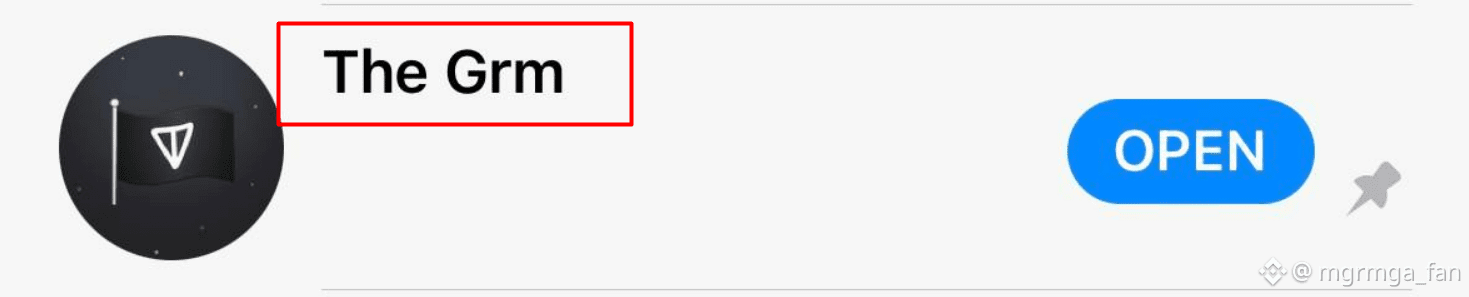
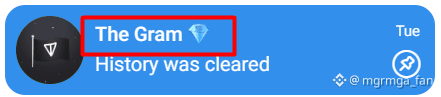
I want to continue discussing the @thegrm bot on #Telegram . I noticed a strange bug—or maybe it's a feature, I'm not sure. For some reason, in the Windows app (2nd screenshot), the name sometimes changes to "The Grm" and then switches back to the old one, "The Gram 🐳".
The exact same thing happens in the web version as well (1st and last screenshots).
Does it happen to you as well?
This is very strange.
🐳: The whale emoji is actually supposed to be a crystal, but Binance doesn't have that emoji yet. We should probably let them know—maybe they'll add it in the future.
#MGRMGA #GRM #GRAM #HODL
I want to continue discussing the @thegrm bot on #Telegram . I noticed a strange bug—or maybe it's a feature, I'm not sure. For some reason, in the Windows app (2nd screenshot), the name sometimes changes to "The Grm" and then switches back to the old one, "The Gram 🐳".
The exact same thing happens in the web version as well (1st and last screenshots).
Does it happen to you as well?
This is very strange.
🐳: The whale emoji is actually supposed to be a crystal, but Binance doesn't have that emoji yet. We should probably let them know—maybe they'll add it in the future.
#MGRMGA #GRM #GRAM #HODL
The exact same thing happens in the web version as well (1st and last screenshots).
Does it happen to you as well?
This is very strange.
🐳: The whale emoji is actually supposed to be a crystal, but Binance doesn't have that emoji yet. We should probably let them know—maybe they'll add it in the future.
#MGRMGA #GRM #GRAM #HODL


1
2
1.3k
·
--
The answer to the riddle: member of the #MGRMGA gang. More crazy gorillas. More community!
🙉🙈🙊🙉🙈🙊🙉🙈🙊
MAKE #OLEH GREAT AGAIN!
MAKE #GRAM GREAT AGAIN!
MAKE #COMMUNITY GREAT AGAIN!
MAKE #GRM GREAT AGAIN!
The answer to the riddle: member of the #MGRMGA gang. More crazy gorillas. More community!
🙉🙈🙊🙉🙈🙊🙉🙈🙊
MAKE #OLEH GREAT AGAIN!
MAKE #GRAM GREAT AGAIN!
MAKE #COMMUNITY GREAT AGAIN!
MAKE #GRM GREAT AGAIN!
🙉🙈🙊🙉🙈🙊🙉🙈🙊
MAKE #OLEH GREAT AGAIN!
MAKE #GRAM GREAT AGAIN!
MAKE #COMMUNITY GREAT AGAIN!
MAKE #GRM GREAT AGAIN!
MGRMGAFAN
·
--
🙊(gorilla) + 🐳(diamond) = ?
#REBUS #GRM #GRAM #TON #MGRMGA
#REBUS #GRM #GRAM #TON #MGRMGA
2
303
Log in to explore more content
Join global crypto users on Binance Square
⚡️ Get latest and useful information about crypto.
💬 Trusted by the world’s largest crypto exchange.
👍 Discover real insights from verified creators.
Email / Phone number
Trending Topics
1
#FedRateWatch
211,525 views
1,442 Discussing
2
#BitcoinSlidesTo$76000
980 views
40 Discussing
3
#BitcoinReboundsTo$79K
46,036 views
345 Discussing
4
#StrategyMarketCapPassesFord
3,880 views
244 Discussing
5
#ClarityActOddsHalveOnPolymarket
2,985 views
200 Discussing
6
#US30YTreasuryYieldTops5.40%
6,047 views
176 Discussing
7
#BessentEndorsesFinalClarityActDraft
21,736 views
475 Discussing
8
#ZamaOpens16ConfidentialMorphoVaults
8,410 views
227 Discussing
9
#USDCOnChainVolumeTops$100Trillion
1,294 views
34 Discussing
10
#BitcoinSpotETFsNetInflow$160M
2,157 views
87 Discussing