

#cryptonews
cryptonews
112M views
289,997 Discussing
Hot
Latest

·
--
🚨 SEC Approves 3x Leveraged Bitcoin & Ether ETPs!
U.S. SEC just cleared the path for 3x BTC and 3x ETH products (plus gold, silver, oil).
These track 3x the daily move of futures benchmarks.
Trading still needs final registration, but this is a major step for leveraged products in the U.S.
More tools coming for traders 👀
#Bitcoin #Ethereum m #SEC #Leverage #CryptoNews $NVDA.US
🚨 SEC Approves 3x Leveraged Bitcoin & Ether ETPs!
U.S. SEC just cleared the path for 3x BTC and 3x ETH products (plus gold, silver, oil).
These track 3x the daily move of futures benchmarks.
Trading still needs final registration, but this is a major step for leveraged products in the U.S.
More tools coming for traders 👀
#Bitcoin #Ethereum m #SEC #Leverage #CryptoNews $NVDA.US
U.S. SEC just cleared the path for 3x BTC and 3x ETH products (plus gold, silver, oil).
These track 3x the daily move of futures benchmarks.
Trading still needs final registration, but this is a major step for leveraged products in the U.S.
More tools coming for traders 👀
#Bitcoin #Ethereum m #SEC #Leverage #CryptoNews $NVDA.US
152

🚨 Chainlink ETFs Grab 2.2% of Supply in Four Days
📊 Alpha Breakdown:
The five spot Chainlink ETFs now hold 2.2% of the total LINK supply. Net inflows have continued for four consecutive days. These products generated $13.02M in gains during September. This accumulation reflects strong institutional confidence in the oracle protocol. The market cap expansion is significant for cryptocurrency holders....
🔗 Full Breakdown on YourWeb3Guy:
https://www.yourweb3guy.com/news/chainlink-etfs-grab-2-2-of-supply-in-four-days
#cryptonews #cryptocurrency #cryptoprices
🚨 Chainlink ETFs Grab 2.2% of Supply in Four Days
📊 Alpha Breakdown:
The five spot Chainlink ETFs now hold 2.2% of the total LINK supply. Net inflows have continued for four consecutive days. These products generated $13.02M in gains during September. This accumulation reflects strong institutional confidence in the oracle protocol. The market cap expansion is significant for cryptocurrency holders....
🔗 Full Breakdown on YourWeb3Guy:
https://www.yourweb3guy.com/news/chainlink-etfs-grab-2-2-of-supply-in-four-days
#cryptonews #cryptocurrency #cryptoprices
📊 Alpha Breakdown:
The five spot Chainlink ETFs now hold 2.2% of the total LINK supply. Net inflows have continued for four consecutive days. These products generated $13.02M in gains during September. This accumulation reflects strong institutional confidence in the oracle protocol. The market cap expansion is significant for cryptocurrency holders....
🔗 Full Breakdown on YourWeb3Guy:
https://www.yourweb3guy.com/news/chainlink-etfs-grab-2-2-of-supply-in-four-days
#cryptonews #cryptocurrency #cryptoprices
8

·
--
🚨 $ONDO JUST DROPPED 3 NEW SINGLE-TOKEN PORTFOLIOS
Built around strategies designed by BlackRock, while ONDO issues and manages the tokens.
🌍 Available to non-U.S. investors only.
#BlackRock #CryptoNews #ONDO $GLMR $AIN
🚨 $ONDO JUST DROPPED 3 NEW SINGLE-TOKEN PORTFOLIOS
Built around strategies designed by BlackRock, while ONDO issues and manages the tokens.
🌍 Available to non-U.S. investors only.
#BlackRock #CryptoNews #ONDO $GLMR $AIN
Built around strategies designed by BlackRock, while ONDO issues and manages the tokens.
🌍 Available to non-U.S. investors only.
#BlackRock #CryptoNews #ONDO $GLMR $AIN


Mafia Alpha:
I buy ondo
3
2
348

🚨 BREAKING NEWS: Crypto's Sisyphean struggle
Sisyphus was condemned by the gods to push a boulder uphill, only to watch it roll back down again and again. After years of pushing for regulatory clarity, crypto appears doomed to a similar fate. The latest attempt—all635 pagesof it—has rolled down the hill once more.
The Senate recentlyfailed to advancethe Digital Asset Market Clarity Act, also known as the Clarity Act, and with the midterms around the corner, there is no realistic path to reviving it before the end of the year.
The Clarity Act, as its name suggests, sought to establish a framework for market structure: the rulebook that sorts crypto tokens into legal categories, licenses the firms trading them, and determines how supervisory authority should be divided between the Securities and Exchange Commission and the Commodity Futures Trading Commission.
Ryan Chan-Wei is a research fellow at the Cato Institute's Center for Monetary and Financial Alternatives.
🔗 [Đọc toàn bộ bài viết tại bản gốc](https://www.coindesk.com/opinion/2026/10/03/crypto-s-sisyphean-struggle)
📰 Nguồn: 🪙 CoinDesk
$BTC $ETH #BinanceSquare #CryptoNews
🚨 BREAKING NEWS: Crypto's Sisyphean struggle
Sisyphus was condemned by the gods to push a boulder uphill, only to watch it roll back down again and again. After years of pushing for regulatory clarity, crypto appears doomed to a similar fate. The latest attempt—all635 pagesof it—has rolled down the hill once more.
The Senate recentlyfailed to advancethe Digital Asset Market Clarity Act, also known as the Clarity Act, and with the midterms around the corner, there is no realistic path to reviving it before the end of the year.
The Clarity Act, as its name suggests, sought to establish a framework for market structure: the rulebook that sorts crypto tokens into legal categories, licenses the firms trading them, and determines how supervisory authority should be divided between the Securities and Exchange Commission and the Commodity Futures Trading Commission.
Ryan Chan-Wei is a research fellow at the Cato Institute's Center for Monetary and Financial Alternatives.
🔗 [Đọc toàn bộ bài viết tại bản gốc](https://www.coindesk.com/opinion/2026/10/03/crypto-s-sisyphean-struggle)
📰 Nguồn: 🪙 CoinDesk
$BTC $ETH #BinanceSquare #CryptoNews
Sisyphus was condemned by the gods to push a boulder uphill, only to watch it roll back down again and again. After years of pushing for regulatory clarity, crypto appears doomed to a similar fate. The latest attempt—all635 pagesof it—has rolled down the hill once more.
The Senate recentlyfailed to advancethe Digital Asset Market Clarity Act, also known as the Clarity Act, and with the midterms around the corner, there is no realistic path to reviving it before the end of the year.
The Clarity Act, as its name suggests, sought to establish a framework for market structure: the rulebook that sorts crypto tokens into legal categories, licenses the firms trading them, and determines how supervisory authority should be divided between the Securities and Exchange Commission and the Commodity Futures Trading Commission.
Ryan Chan-Wei is a research fellow at the Cato Institute's Center for Monetary and Financial Alternatives.
🔗 [Đọc toàn bộ bài viết tại bản gốc](https://www.coindesk.com/opinion/2026/10/03/crypto-s-sisyphean-struggle)
📰 Nguồn: 🪙 CoinDesk
$BTC $ETH #BinanceSquare #CryptoNews

50

·
--
🚨WEAK JOBS DATA WAS BULLISH… SO WHY DID BITCOIN REJECT $87K AGAIN?
U.S. jobs data came in much weaker than expected. Just 29K jobs added vs 90K expected.
That pushed expectations for further Fed tightening lower, stocks rallied, and Nvidia even hit a new record high.
And $BTC?
It initially jumped toward $87K… Then got rejected. Again. 😶
BTC is now back around $84.6K, making this the third rejection around the $87K area.
So what’s holding Bitcoin back?
#liquidity
Binance’s latest crypto report highlights that the stablecoin market cap is still around $14B below its May peak, with only about $4B recovered. That matters because a Bitcoin breakout needs more than a bullish headline. It needs fresh capital actually entering the market. And this is the part I’m watching closely:
If BTC keeps testing $87K without enough new liquidity coming in, another rejection wouldn’t surprise me. But if stablecoin liquidity starts expanding while BTC reclaims and holds $87K, that would be a very different signal. There’s also a bigger structural argument here.
CryptoQuant CEO Ki Young Ju expects this cycle to be less extreme than previous Bitcoin cycles, with institutional participation helping reduce both upside and downside extremes.
So maybe the game is changing.
Less crazy parabolic moves.
Less brutal crashes.
More capital.
More institutions.
But for now, $87K is still the level I’m watching.
BTC above $87K and holding = different story.
Another rejection = liquidity becomes even more important.
#SECProposesCryptoCustodyRules #FedOctoberRateHikeOddsFallTo17% #CryptoNews $PEPE $NVDAB $ICP
What happens next?
🚨WEAK JOBS DATA WAS BULLISH… SO WHY DID BITCOIN REJECT $87K AGAIN?
U.S. jobs data came in much weaker than expected. Just 29K jobs added vs 90K expected.
That pushed expectations for further Fed tightening lower, stocks rallied, and Nvidia even hit a new record high.
And $BTC?
It initially jumped toward $87K… Then got rejected. Again. 😶
BTC is now back around $84.6K, making this the third rejection around the $87K area.
So what’s holding Bitcoin back?
#liquidity
Binance’s latest crypto report highlights that the stablecoin market cap is still around $14B below its May peak, with only about $4B recovered. That matters because a Bitcoin breakout needs more than a bullish headline. It needs fresh capital actually entering the market. And this is the part I’m watching closely:
If BTC keeps testing $87K without enough new liquidity coming in, another rejection wouldn’t surprise me. But if stablecoin liquidity starts expanding while BTC reclaims and holds $87K, that would be a very different signal. There’s also a bigger structural argument here.
CryptoQuant CEO Ki Young Ju expects this cycle to be less extreme than previous Bitcoin cycles, with institutional participation helping reduce both upside and downside extremes.
So maybe the game is changing.
Less crazy parabolic moves.
Less brutal crashes.
More capital.
More institutions.
But for now, $87K is still the level I’m watching.
BTC above $87K and holding = different story.
Another rejection = liquidity becomes even more important.
#SECProposesCryptoCustodyRules #FedOctoberRateHikeOddsFallTo17% #CryptoNews $PEPE $NVDAB $ICP
What happens next?
U.S. jobs data came in much weaker than expected. Just 29K jobs added vs 90K expected.
That pushed expectations for further Fed tightening lower, stocks rallied, and Nvidia even hit a new record high.
And $BTC?
It initially jumped toward $87K… Then got rejected. Again. 😶
BTC is now back around $84.6K, making this the third rejection around the $87K area.
So what’s holding Bitcoin back?
#liquidity
Binance’s latest crypto report highlights that the stablecoin market cap is still around $14B below its May peak, with only about $4B recovered. That matters because a Bitcoin breakout needs more than a bullish headline. It needs fresh capital actually entering the market. And this is the part I’m watching closely:
If BTC keeps testing $87K without enough new liquidity coming in, another rejection wouldn’t surprise me. But if stablecoin liquidity starts expanding while BTC reclaims and holds $87K, that would be a very different signal. There’s also a bigger structural argument here.
CryptoQuant CEO Ki Young Ju expects this cycle to be less extreme than previous Bitcoin cycles, with institutional participation helping reduce both upside and downside extremes.
So maybe the game is changing.
Less crazy parabolic moves.
Less brutal crashes.
More capital.
More institutions.
But for now, $87K is still the level I’m watching.
BTC above $87K and holding = different story.
Another rejection = liquidity becomes even more important.
#SECProposesCryptoCustodyRules #FedOctoberRateHikeOddsFallTo17% #CryptoNews $PEPE $NVDAB $ICP
What happens next?
$87K finally breaks
Another rejection
BTC drops $82K–$83K first
Sideways until liqdty improves
19 hr(s) left
80

·
--
Institutional adoption is no longer a distant promise; it is the current reality. Ripple’s President has officially highlighted the next major growth phase for the XRP Ledger, driven by a massive surge in tokenized real-world assets (RWA). With projections indicating the RWA market on the ledger could reach $30 billion, this development marks a pivotal shift from speculative trading to utility-driven institutional volume. For traders, this signals a fundamental re-rating of the network’s value proposition as it becomes a primary settlement layer for global finance.
• **$30B Target:** The XRP Ledger aims to host $30 billion in tokenized real-world assets, signaling massive institutional inflows.
• **Utility Shift:** The focus is moving from pure speculation to high-frequency, low-cost settlement for banks and enterprises.
• **Leadership Clarity:** Ripple’s President has explicitly framed this as the 'next big growth phase,' aligning corporate strategy with on-chain metrics.
As the broader market consolidates—with BTC currently trading at 84,870.04 (-1.96% in 24h)—narratives around institutional utility are becoming the primary drivers for altcoin strength. The integration of RWAs provides a tangible use case that can sustain volume even during periods of macro uncertainty. If the $30 billion projection materializes, the liquidity implications for the XRP ecosystem could be transformative, potentially decoupling its price action from pure Bitcoin beta and establishing it as a standalone financial infrastructure play.
Do you believe the $30B RWA target is achievable by 2027, or is it just another hype cycle? Drop your thoughts below! 👇
XRP BTC
#BinanceSquare #CryptoNews #Bitcoin
Institutional adoption is no longer a distant promise; it is the current reality. Ripple’s President has officially highlighted the next major growth phase for the XRP Ledger, driven by a massive surge in tokenized real-world assets (RWA). With projections indicating the RWA market on the ledger could reach $30 billion, this development marks a pivotal shift from speculative trading to utility-driven institutional volume. For traders, this signals a fundamental re-rating of the network’s value proposition as it becomes a primary settlement layer for global finance.
• **$30B Target:** The XRP Ledger aims to host $30 billion in tokenized real-world assets, signaling massive institutional inflows.
• **Utility Shift:** The focus is moving from pure speculation to high-frequency, low-cost settlement for banks and enterprises.
• **Leadership Clarity:** Ripple’s President has explicitly framed this as the 'next big growth phase,' aligning corporate strategy with on-chain metrics.
As the broader market consolidates—with BTC currently trading at 84,870.04 (-1.96% in 24h)—narratives around institutional utility are becoming the primary drivers for altcoin strength. The integration of RWAs provides a tangible use case that can sustain volume even during periods of macro uncertainty. If the $30 billion projection materializes, the liquidity implications for the XRP ecosystem could be transformative, potentially decoupling its price action from pure Bitcoin beta and establishing it as a standalone financial infrastructure play.
Do you believe the $30B RWA target is achievable by 2027, or is it just another hype cycle? Drop your thoughts below! 👇
XRP BTC
#BinanceSquare #CryptoNews #Bitcoin
• **$30B Target:** The XRP Ledger aims to host $30 billion in tokenized real-world assets, signaling massive institutional inflows.
• **Utility Shift:** The focus is moving from pure speculation to high-frequency, low-cost settlement for banks and enterprises.
• **Leadership Clarity:** Ripple’s President has explicitly framed this as the 'next big growth phase,' aligning corporate strategy with on-chain metrics.
As the broader market consolidates—with BTC currently trading at 84,870.04 (-1.96% in 24h)—narratives around institutional utility are becoming the primary drivers for altcoin strength. The integration of RWAs provides a tangible use case that can sustain volume even during periods of macro uncertainty. If the $30 billion projection materializes, the liquidity implications for the XRP ecosystem could be transformative, potentially decoupling its price action from pure Bitcoin beta and establishing it as a standalone financial infrastructure play.
Do you believe the $30B RWA target is achievable by 2027, or is it just another hype cycle? Drop your thoughts below! 👇
XRP BTC
#BinanceSquare #CryptoNews #Bitcoin

55

·
--
🔥 BITCOIN MAXI vs. ALTCOIN DEGEN: Which Trader Are You? 🚨
Bitcoin Dominance is flirting with 58.6%, but liquidity is quietly leaking into high-beta altcoins. Every trader in October 2026 is caught between two completely different market playbooks.
Option 1: The "Risk-Managed" Bitcoin Maxi 🛡️
The Goal: Capital preservation & steady institutional growth.
The Thesis: $BTC consolidation near $85K with ETF inflows absorbing massive sell pressure.
Strategy: HODL blue-chip assets ($BTC,$ETH ) and stake for yields while letting macro sentiment play out.
Option 2: The "Parabolic" Altseason Degen 🚀
The Goal: 10x to 100x wealth accumulation before the cycle matures.
The Thesis: $SOL breaking out, RENDER riding the AI super-cycle, and low-cap Layer-1s likeSUI pumping on ecosystem upgrades.
Strategy: Rotating profits out of $BTC into high-beta alts the moment BTC dominance tops out.
⚠️ The Big Question:
Are you playing it safe with blue chips, or rotation-hunting alts for life-changing gains?
👇 COMMENT YOUR PLAYBOOK BELOW:
Are you #TeamMaxi or #TeamAltseason?
#Altseason2026 #CryptoStrategy #CryptoNews
🔥 BITCOIN MAXI vs. ALTCOIN DEGEN: Which Trader Are You? 🚨
Bitcoin Dominance is flirting with 58.6%, but liquidity is quietly leaking into high-beta altcoins. Every trader in October 2026 is caught between two completely different market playbooks.
Option 1: The "Risk-Managed" Bitcoin Maxi 🛡️
The Goal: Capital preservation & steady institutional growth.
The Thesis: $BTC consolidation near $85K with ETF inflows absorbing massive sell pressure.
Strategy: HODL blue-chip assets ($BTC ,$ETH ) and stake for yields while letting macro sentiment play out.
Option 2: The "Parabolic" Altseason Degen 🚀
The Goal: 10x to 100x wealth accumulation before the cycle matures.
The Thesis: $SOL breaking out, RENDER riding the AI super-cycle, and low-cap Layer-1s likeSUI pumping on ecosystem upgrades.
Strategy: Rotating profits out of $BTC into high-beta alts the moment BTC dominance tops out.
⚠️ The Big Question:
Are you playing it safe with blue chips, or rotation-hunting alts for life-changing gains?
👇 COMMENT YOUR PLAYBOOK BELOW:
Are you #TeamMaxi or #TeamAltseason?
#Altseason2026 #CryptoStrategy #CryptoNews
Bitcoin Dominance is flirting with 58.6%, but liquidity is quietly leaking into high-beta altcoins. Every trader in October 2026 is caught between two completely different market playbooks.
Option 1: The "Risk-Managed" Bitcoin Maxi 🛡️
The Goal: Capital preservation & steady institutional growth.
The Thesis: $BTC consolidation near $85K with ETF inflows absorbing massive sell pressure.
Strategy: HODL blue-chip assets ($BTC ,$ETH ) and stake for yields while letting macro sentiment play out.
Option 2: The "Parabolic" Altseason Degen 🚀
The Goal: 10x to 100x wealth accumulation before the cycle matures.
The Thesis: $SOL breaking out, RENDER riding the AI super-cycle, and low-cap Layer-1s likeSUI pumping on ecosystem upgrades.
Strategy: Rotating profits out of $BTC into high-beta alts the moment BTC dominance tops out.
⚠️ The Big Question:
Are you playing it safe with blue chips, or rotation-hunting alts for life-changing gains?
👇 COMMENT YOUR PLAYBOOK BELOW:
Are you #TeamMaxi or #TeamAltseason?
#Altseason2026 #CryptoStrategy #CryptoNews

1
1
191
🚨 Ethereum Still Owns 55% of TVL While Price Lags in 2026
📊 Alpha Breakdown:
Ethereum maintains 55% of industry TVL and hosts nearly 50% of all stablecoins. This dominance persists despite poor ETH price performance in 2026. Competing chains are currently fragmenting the remaining market share rather than challenging Ethereum's position. The data suggests fundamental strength regardless of short-term price action. Investors should focus on on-chain metrics over price charts for long-term positioning....
🔗 Full Breakdown on YourWeb3Guy:
https://www.yourweb3guy.com/news/ethereum-still-owns-55-of-tvl-while-price-lags-in-2026
#cryptonews #cryptocurrency #cryptoprices
🚨 Ethereum Still Owns 55% of TVL While Price Lags in 2026
📊 Alpha Breakdown:
Ethereum maintains 55% of industry TVL and hosts nearly 50% of all stablecoins. This dominance persists despite poor ETH price performance in 2026. Competing chains are currently fragmenting the remaining market share rather than challenging Ethereum's position. The data suggests fundamental strength regardless of short-term price action. Investors should focus on on-chain metrics over price charts for long-term positioning....
🔗 Full Breakdown on YourWeb3Guy:
https://www.yourweb3guy.com/news/ethereum-still-owns-55-of-tvl-while-price-lags-in-2026
#cryptonews #cryptocurrency #cryptoprices
📊 Alpha Breakdown:
Ethereum maintains 55% of industry TVL and hosts nearly 50% of all stablecoins. This dominance persists despite poor ETH price performance in 2026. Competing chains are currently fragmenting the remaining market share rather than challenging Ethereum's position. The data suggests fundamental strength regardless of short-term price action. Investors should focus on on-chain metrics over price charts for long-term positioning....
🔗 Full Breakdown on YourWeb3Guy:
https://www.yourweb3guy.com/news/ethereum-still-owns-55-of-tvl-while-price-lags-in-2026
#cryptonews #cryptocurrency #cryptoprices
6
🚨 Vitalik Claims Ethereum Is the Economic Layer for AI Agents
📊 Alpha Breakdown:
Vitalik Buterin stated in an OKX interview that Ethereum serves as the foundational economic layer for AI. He argues that permissionless settlement allows autonomous agents to transact across organizations without relying on centralized platforms, creating a trustless infrastructure for future machine economies....
🔗 Full Breakdown on YourWeb3Guy:
https://www.yourweb3guy.com/news/vitalik-claims-ethereum-is-the-economic-layer-for-ai-agents
#cryptonews #cryptocurrency #ethereumnews
🚨 Vitalik Claims Ethereum Is the Economic Layer for AI Agents
📊 Alpha Breakdown:
Vitalik Buterin stated in an OKX interview that Ethereum serves as the foundational economic layer for AI. He argues that permissionless settlement allows autonomous agents to transact across organizations without relying on centralized platforms, creating a trustless infrastructure for future machine economies....
🔗 Full Breakdown on YourWeb3Guy:
https://www.yourweb3guy.com/news/vitalik-claims-ethereum-is-the-economic-layer-for-ai-agents
#cryptonews #cryptocurrency #ethereumnews
📊 Alpha Breakdown:
Vitalik Buterin stated in an OKX interview that Ethereum serves as the foundational economic layer for AI. He argues that permissionless settlement allows autonomous agents to transact across organizations without relying on centralized platforms, creating a trustless infrastructure for future machine economies....
🔗 Full Breakdown on YourWeb3Guy:
https://www.yourweb3guy.com/news/vitalik-claims-ethereum-is-the-economic-layer-for-ai-agents
#cryptonews #cryptocurrency #ethereumnews
5

·
--

Article
🇺🇸 THE NEXT U.S. CRYPTO WAR MAY NOT BE ABOUT BITCOIN — IT’S ABOUT WHO CONTROLS THE RAILS 👀For years, the crypto battle in America looked pretty simple:
Crypto vs regulators.
But something different is happening now.
And I think traders focusing only on Bitcoin candles may be missing the bigger story.
On October 1, the U.S. SEC proposed a new framework addressing how registered investment advisers and regulated funds can custody crypto assets.
This isn’t a final rule yet. It still has to go through the regulatory process.
But the direction is interesting.
The conversation is increasingly moving away from:
“Should traditional finance touch crypto?”
toward:
“How should traditional finance hold and use crypto?”
That’s a very different conversation.
Then, one day later, the banks entered the picture.
On October 2, the Independent Community Bankers of America sued the Office of the Comptroller of the Currency over its approach to national trust-bank charters being used by crypto companies.
The banking group argues that the OCC has gone beyond its legal authority and that these firms shouldn’t receive access to the federal banking system without comparable regulatory requirements.
Those are allegations in an ongoing legal challenge—not a court finding.
But forget the legal argument for a second.
Look at what the fight itself tells us.
Crypto companies aren’t just building exchanges anymore.
They’re moving toward:
Custody.
Payments.
Stablecoins.
Settlement.
Institutional infrastructure.
In other words…
the rails.
And this is where the Trump story gets more interesting. 🇺🇸
The Trump administration has explicitly pushed toward making the United States a major global center for digital assets and integrating crypto more deeply into the existing financial system.
That sounds bullish when reduced to a headline.
But actually rebuilding financial infrastructure around digital assets is much more complicated.
Because once crypto companies start operating in areas traditionally occupied by banks and other regulated financial institutions, the question changes.
It’s no longer simply:
“Will America allow crypto?”
It becomes:
“Who gets to control the infrastructure?”
Banks?
Crypto-native companies?
Asset managers?
Fintechs?
Or some combination of all four?
And that could become one of the most important U.S. crypto stories to watch.
This isn’t necessarily a Bitcoin-pumps-tomorrow story.
That’s important.
A regulatory proposal doesn’t guarantee institutional money suddenly enters crypto.
A lawsuit doesn’t automatically hurt crypto.
And political support doesn’t remove regulatory, legal or market risk.
I’m looking at something longer term.
If digital assets genuinely become part of America’s mainstream financial system, enormous businesses could eventually compete over:
who holds the assets,
who issues the stablecoins,
who processes the payments,
who settles the transactions,
and who owns the relationship with the customer.
That’s much bigger than another green candle.
For years everyone asked:
“Will Wall Street enter crypto?”
Maybe we’re approaching a more interesting question:
What happens when crypto starts entering Wall Street’s territory? 👀
Because the next major U.S. crypto battle might not be about the price of Bitcoin.
It might be about something much more valuable:
Who controls the rails.
— Master CX
#CryptoNews
#CryptoRegulation #USCrypto
🇺🇸 THE NEXT U.S. CRYPTO WAR MAY NOT BE ABOUT BITCOIN — IT’S ABOUT WHO CONTROLS THE RAILS 👀
For years, the crypto battle in America looked pretty simple:
Crypto vs regulators.
But something different is happening now.
And I think traders focusing only on Bitcoin candles may be missing the bigger story.
On October 1, the U.S. SEC proposed a new framework addressing how registered investment advisers and regulated funds can custody crypto assets.
This isn’t a final rule yet. It still has to go through the regulatory process.
But the direction is interesting.
The conversation is increasingly moving away from:
“Should traditional finance touch crypto?”
toward:
“How should traditional finance hold and use crypto?”
That’s a very different conversation.
Then, one day later, the banks entered the picture.
On October 2, the Independent Community Bankers of America sued the Office of the Comptroller of the Currency over its approach to national trust-bank charters being used by crypto companies.
The banking group argues that the OCC has gone beyond its legal authority and that these firms shouldn’t receive access to the federal banking system without comparable regulatory requirements.
Those are allegations in an ongoing legal challenge—not a court finding.
But forget the legal argument for a second.
Look at what the fight itself tells us.
Crypto companies aren’t just building exchanges anymore.
They’re moving toward:
Custody.
Payments.
Stablecoins.
Settlement.
Institutional infrastructure.
In other words…
the rails.
And this is where the Trump story gets more interesting. 🇺🇸
The Trump administration has explicitly pushed toward making the United States a major global center for digital assets and integrating crypto more deeply into the existing financial system.
That sounds bullish when reduced to a headline.
But actually rebuilding financial infrastructure around digital assets is much more complicated.
Because once crypto companies start operating in areas traditionally occupied by banks and other regulated financial institutions, the question changes.
It’s no longer simply:
“Will America allow crypto?”
It becomes:
“Who gets to control the infrastructure?”
Banks?
Crypto-native companies?
Asset managers?
Fintechs?
Or some combination of all four?
And that could become one of the most important U.S. crypto stories to watch.
This isn’t necessarily a Bitcoin-pumps-tomorrow story.
That’s important.
A regulatory proposal doesn’t guarantee institutional money suddenly enters crypto.
A lawsuit doesn’t automatically hurt crypto.
And political support doesn’t remove regulatory, legal or market risk.
I’m looking at something longer term.
If digital assets genuinely become part of America’s mainstream financial system, enormous businesses could eventually compete over:
who holds the assets,
who issues the stablecoins,
who processes the payments,
who settles the transactions,
and who owns the relationship with the customer.
That’s much bigger than another green candle.
For years everyone asked:
“Will Wall Street enter crypto?”
Maybe we’re approaching a more interesting question:
What happens when crypto starts entering Wall Street’s territory? 👀
Because the next major U.S. crypto battle might not be about the price of Bitcoin.
It might be about something much more valuable:
Who controls the rails.
— Master CX
#CryptoNews
#CryptoRegulation #USCrypto
Crypto vs regulators.
But something different is happening now.
And I think traders focusing only on Bitcoin candles may be missing the bigger story.
On October 1, the U.S. SEC proposed a new framework addressing how registered investment advisers and regulated funds can custody crypto assets.
This isn’t a final rule yet. It still has to go through the regulatory process.
But the direction is interesting.
The conversation is increasingly moving away from:
“Should traditional finance touch crypto?”
toward:
“How should traditional finance hold and use crypto?”
That’s a very different conversation.
Then, one day later, the banks entered the picture.
On October 2, the Independent Community Bankers of America sued the Office of the Comptroller of the Currency over its approach to national trust-bank charters being used by crypto companies.
The banking group argues that the OCC has gone beyond its legal authority and that these firms shouldn’t receive access to the federal banking system without comparable regulatory requirements.
Those are allegations in an ongoing legal challenge—not a court finding.
But forget the legal argument for a second.
Look at what the fight itself tells us.
Crypto companies aren’t just building exchanges anymore.
They’re moving toward:
Custody.
Payments.
Stablecoins.
Settlement.
Institutional infrastructure.
In other words…
the rails.
And this is where the Trump story gets more interesting. 🇺🇸
The Trump administration has explicitly pushed toward making the United States a major global center for digital assets and integrating crypto more deeply into the existing financial system.
That sounds bullish when reduced to a headline.
But actually rebuilding financial infrastructure around digital assets is much more complicated.
Because once crypto companies start operating in areas traditionally occupied by banks and other regulated financial institutions, the question changes.
It’s no longer simply:
“Will America allow crypto?”
It becomes:
“Who gets to control the infrastructure?”
Banks?
Crypto-native companies?
Asset managers?
Fintechs?
Or some combination of all four?
And that could become one of the most important U.S. crypto stories to watch.
This isn’t necessarily a Bitcoin-pumps-tomorrow story.
That’s important.
A regulatory proposal doesn’t guarantee institutional money suddenly enters crypto.
A lawsuit doesn’t automatically hurt crypto.
And political support doesn’t remove regulatory, legal or market risk.
I’m looking at something longer term.
If digital assets genuinely become part of America’s mainstream financial system, enormous businesses could eventually compete over:
who holds the assets,
who issues the stablecoins,
who processes the payments,
who settles the transactions,
and who owns the relationship with the customer.
That’s much bigger than another green candle.
For years everyone asked:
“Will Wall Street enter crypto?”
Maybe we’re approaching a more interesting question:
What happens when crypto starts entering Wall Street’s territory? 👀
Because the next major U.S. crypto battle might not be about the price of Bitcoin.
It might be about something much more valuable:
Who controls the rails.
— Master CX
#CryptoNews
#CryptoRegulation #USCrypto
7
🚨 Trump's Meme Coin Gala: $635M Royalties and Senate Stalemate
📊 Alpha Breakdown:
The TRUMP meme coin project will host its top 185 registered holders at Trump National Golf Club on November 22. The event occurs shortly after the Clarity Act failed a procedural vote in the Senate due to disputes over presidential crypto holdings. Financial disclosures show Trump earned over $635 million from the token in 2025 primarily through licensing royalties. No private meetings with the President are included in the package....
🔗 Full Breakdown on YourWeb3Guy:
https://www.yourweb3guy.com/news/trump-s-meme-coin-gala-635m-royalties-and-senate-stalemate
#cryptonews #cryptocurrency #bitcoinnews
🚨 Trump's Meme Coin Gala: $635M Royalties and Senate Stalemate
📊 Alpha Breakdown:
The TRUMP meme coin project will host its top 185 registered holders at Trump National Golf Club on November 22. The event occurs shortly after the Clarity Act failed a procedural vote in the Senate due to disputes over presidential crypto holdings. Financial disclosures show Trump earned over $635 million from the token in 2025 primarily through licensing royalties. No private meetings with the President are included in the package....
🔗 Full Breakdown on YourWeb3Guy:
https://www.yourweb3guy.com/news/trump-s-meme-coin-gala-635m-royalties-and-senate-stalemate
#cryptonews #cryptocurrency #bitcoinnews
📊 Alpha Breakdown:
The TRUMP meme coin project will host its top 185 registered holders at Trump National Golf Club on November 22. The event occurs shortly after the Clarity Act failed a procedural vote in the Senate due to disputes over presidential crypto holdings. Financial disclosures show Trump earned over $635 million from the token in 2025 primarily through licensing royalties. No private meetings with the President are included in the package....
🔗 Full Breakdown on YourWeb3Guy:
https://www.yourweb3guy.com/news/trump-s-meme-coin-gala-635m-royalties-and-senate-stalemate
#cryptonews #cryptocurrency #bitcoinnews
63
🚨 Ethereum Surges Past $1,900, Outshining Bitcoin—Why It Matters
📊 Alpha Breakdown:
Ethereum surged past $1,900 as CPI data cooled expectations, prompting $1.2 billion in Binance taker buys. Analysts argue ETH's stablecoin adoption, real‑world asset tokenization, and better ETF inflows give it a medium‑term edge over BTC. SuperTrend signals show historic 72% and 177% gains. Investors may consider adding ETH while watching BTC flows and monitor future price actions as market volatility evolves daily....
🔗 Full Breakdown on YourWeb3Guy:
https://www.yourweb3guy.com/news/ethereum-surges-past-1-900-outshining-bitcoin-why-it-matters
#cryptonews #cryptocurrency #bitcoinnewstoday
🚨 Ethereum Surges Past $1,900, Outshining Bitcoin—Why It Matters
📊 Alpha Breakdown:
Ethereum surged past $1,900 as CPI data cooled expectations, prompting $1.2 billion in Binance taker buys. Analysts argue ETH's stablecoin adoption, real‑world asset tokenization, and better ETF inflows give it a medium‑term edge over BTC. SuperTrend signals show historic 72% and 177% gains. Investors may consider adding ETH while watching BTC flows and monitor future price actions as market volatility evolves daily....
🔗 Full Breakdown on YourWeb3Guy:
https://www.yourweb3guy.com/news/ethereum-surges-past-1-900-outshining-bitcoin-why-it-matters
#cryptonews #cryptocurrency #bitcoinnewstoday
📊 Alpha Breakdown:
Ethereum surged past $1,900 as CPI data cooled expectations, prompting $1.2 billion in Binance taker buys. Analysts argue ETH's stablecoin adoption, real‑world asset tokenization, and better ETF inflows give it a medium‑term edge over BTC. SuperTrend signals show historic 72% and 177% gains. Investors may consider adding ETH while watching BTC flows and monitor future price actions as market volatility evolves daily....
🔗 Full Breakdown on YourWeb3Guy:
https://www.yourweb3guy.com/news/ethereum-surges-past-1-900-outshining-bitcoin-why-it-matters
#cryptonews #cryptocurrency #bitcoinnewstoday
27

·
--
🚨 CRYPTO MARKET WATCH — OCT 4
Bitcoin is entering Sunday near *$84K*, after being rejected around the *$87K* area. The key question for traders tomorrow: can BTC reclaim $86K–$87K, or will sellers push it back toward support?
📊 The interesting part: U.S. spot Bitcoin ETFs recorded about *$2.65B in net inflows during September*, while October started with another *$102.7M inflow* on Oct. 1.
⚠️ But ETF flows are currently mixed. Recent data showed Bitcoin ETFs gaining while Ethereum ETFs saw significant outflows, so BTC vs. ETH flows are worth watching.
👀 Tomorrow’s watchlist:-
• BTC — $84K support / $87K resistance
• ETH — around $2.7K
• BNB — around $770
• ETF inflows & trading volume
No guaranteed breakout—watch the levels, volume and ETF flows before making decisions.
#Bitcoin #Ethereum #BNB #Crypto #CryptoNews
🚨 CRYPTO MARKET WATCH — OCT 4
Bitcoin is entering Sunday near *$84K*, after being rejected around the *$87K* area. The key question for traders tomorrow: can BTC reclaim $86K–$87K, or will sellers push it back toward support?
📊 The interesting part: U.S. spot Bitcoin ETFs recorded about *$2.65B in net inflows during September*, while October started with another *$102.7M inflow* on Oct. 1.
⚠️ But ETF flows are currently mixed. Recent data showed Bitcoin ETFs gaining while Ethereum ETFs saw significant outflows, so BTC vs. ETH flows are worth watching.
👀 Tomorrow’s watchlist:-
• BTC — $84K support / $87K resistance
• ETH — around $2.7K
• BNB — around $770
• ETF inflows & trading volume
No guaranteed breakout—watch the levels, volume and ETF flows before making decisions.
#Bitcoin #Ethereum #BNB #Crypto #CryptoNews
Bitcoin is entering Sunday near *$84K*, after being rejected around the *$87K* area. The key question for traders tomorrow: can BTC reclaim $86K–$87K, or will sellers push it back toward support?
📊 The interesting part: U.S. spot Bitcoin ETFs recorded about *$2.65B in net inflows during September*, while October started with another *$102.7M inflow* on Oct. 1.
⚠️ But ETF flows are currently mixed. Recent data showed Bitcoin ETFs gaining while Ethereum ETFs saw significant outflows, so BTC vs. ETH flows are worth watching.
👀 Tomorrow’s watchlist:-
• BTC — $84K support / $87K resistance
• ETH — around $2.7K
• BNB — around $770
• ETF inflows & trading volume
No guaranteed breakout—watch the levels, volume and ETF flows before making decisions.
#Bitcoin #Ethereum #BNB #Crypto #CryptoNews

40

·
--
⚡ CRYPTO MARKET PULSE
📌 Trump Is Hosting Yet Another Meme Coin Dinner: Here Are the Details
• The TRUMP meme coin project is inviting its top 185 holders to a Nov.
• 22 gala dinner with President Trump two weeks after ethics disputes over his crypto interests helped stall the Clarity Act in the Senate.
💡 Follow for continuous real-time market updates.
$BTC $BNB
#BinanceSquare #CryptoNews #Crypto #CryptoAI #Ethereum
⚡ CRYPTO MARKET PULSE
📌 Trump Is Hosting Yet Another Meme Coin Dinner: Here Are the Details
• The TRUMP meme coin project is inviting its top 185 holders to a Nov.
• 22 gala dinner with President Trump two weeks after ethics disputes over his crypto interests helped stall the Clarity Act in the Senate.
💡 Follow for continuous real-time market updates.
$BTC $BNB
#BinanceSquare #CryptoNews #Crypto #CryptoAI #Ethereum
📌 Trump Is Hosting Yet Another Meme Coin Dinner: Here Are the Details
• The TRUMP meme coin project is inviting its top 185 holders to a Nov.
• 22 gala dinner with President Trump two weeks after ethics disputes over his crypto interests helped stall the Clarity Act in the Senate.
💡 Follow for continuous real-time market updates.
$BTC $BNB
#BinanceSquare #CryptoNews #Crypto #CryptoAI #Ethereum
7

·
--
Payments firm OpenPayd targets year-end Nasdaq listing to fund U.S. expansion and acquisitions
📰 Key Takeaways:
• OpenPayd plans a Nasdaq listing by year‑end to raise capital for U.S. expansion, targeting a launch by April 2027.
• The firm is pursuing strategic acquisitions and licensing deals to bolster its regulatory compliance and technology stack in the U.S. market.
• The IPO and expansion efforts signal a broader trend of European fintechs seeking U.S. market entry and increased cross‑border integration.
💡 Market Impact:
The anticipated listing is likely to inject liquidity into the fintech sector, boosting investor confidence in cross‑border payment platforms. Market sentiment may shift positively as OpenPayd positions itself as a competitive alternative to established U.S. payment processors.
🔥 24H Top Futures Gainers:
• $AIN (+96.5%) — Price: 0.0467
• $PUMPBTC (+22.8%) — Price: 0.0102
• $VELVET (+22.6%) — Price: 0.0838
#CryptoNews #BinanceFutures #MarketMovers
Payments firm OpenPayd targets year-end Nasdaq listing to fund U.S. expansion and acquisitions
📰 Key Takeaways:
• OpenPayd plans a Nasdaq listing by year‑end to raise capital for U.S. expansion, targeting a launch by April 2027.
• The firm is pursuing strategic acquisitions and licensing deals to bolster its regulatory compliance and technology stack in the U.S. market.
• The IPO and expansion efforts signal a broader trend of European fintechs seeking U.S. market entry and increased cross‑border integration.
💡 Market Impact:
The anticipated listing is likely to inject liquidity into the fintech sector, boosting investor confidence in cross‑border payment platforms. Market sentiment may shift positively as OpenPayd positions itself as a competitive alternative to established U.S. payment processors.
🔥 24H Top Futures Gainers:
• $AIN (+96.5%) — Price: 0.0467
• $PUMPBTC (+22.8%) — Price: 0.0102
• $VELVET (+22.6%) — Price: 0.0838
#CryptoNews #BinanceFutures #MarketMovers
📰 Key Takeaways:
• OpenPayd plans a Nasdaq listing by year‑end to raise capital for U.S. expansion, targeting a launch by April 2027.
• The firm is pursuing strategic acquisitions and licensing deals to bolster its regulatory compliance and technology stack in the U.S. market.
• The IPO and expansion efforts signal a broader trend of European fintechs seeking U.S. market entry and increased cross‑border integration.
💡 Market Impact:
The anticipated listing is likely to inject liquidity into the fintech sector, boosting investor confidence in cross‑border payment platforms. Market sentiment may shift positively as OpenPayd positions itself as a competitive alternative to established U.S. payment processors.
🔥 24H Top Futures Gainers:
• $AIN (+96.5%) — Price: 0.0467
• $PUMPBTC (+22.8%) — Price: 0.0102
• $VELVET (+22.6%) — Price: 0.0838
#CryptoNews #BinanceFutures #MarketMovers
20

🔥 CRYPTO HOURLY — BREAKING UPDATES 🔥
━━━━━━━━━━━━━━━━━━━━
🟢 Bullish - OpenPayd eyes Nasdaq IPO to fuel US growth and M&A
• OpenPayd aims for year-end Nasdaq listing to fund U.S. expansion and acquisitions, boosting crypto payment rails.
⚪ Neutral - Crypto job postings triple to over 1,200 in September, but applications fall
• Job listings surged threefold while applicant interest dropped, signaling a potential talent gap in the sector.
🔴 Bearish - ESMA Proposes Cutting Off EU Custody Services for Non-Compliant Stablecoins
• ESMA's proposal would revoke licensed custody and transfer access from non-compliant stablecoins if enacted, with exit rules still unresolved.
⚪ Neutral - PewDiePie Banned Twice by OpenAI While Building Uncensored AI Model "Ajax"
• PewDiePie says OpenAI suspended his account twice while he trained a small, uncensored AI model designed to run locally on personal computers.
━━━━━━━━━━━━━━━━━━━━
📈 Market Sentiment: 67 (Greed)
📊 Stay ahead. Think smart. Trade safe.
#cryptonews #NewListing
Disclaimer: Includes third-party opinions. No advice.
BTC: -0.40% (H: 85339.4 L: 83888) | ETH: -0.51% (H: 2699.86 L: 2650.88) | SOL: -0.33% (H: 120.44 L: 117.11)
🔥 CRYPTO HOURLY — BREAKING UPDATES 🔥
━━━━━━━━━━━━━━━━━━━━
🟢 Bullish - OpenPayd eyes Nasdaq IPO to fuel US growth and M&A
• OpenPayd aims for year-end Nasdaq listing to fund U.S. expansion and acquisitions, boosting crypto payment rails.
⚪ Neutral - Crypto job postings triple to over 1,200 in September, but applications fall
• Job listings surged threefold while applicant interest dropped, signaling a potential talent gap in the sector.
🔴 Bearish - ESMA Proposes Cutting Off EU Custody Services for Non-Compliant Stablecoins
• ESMA's proposal would revoke licensed custody and transfer access from non-compliant stablecoins if enacted, with exit rules still unresolved.
⚪ Neutral - PewDiePie Banned Twice by OpenAI While Building Uncensored AI Model "Ajax"
• PewDiePie says OpenAI suspended his account twice while he trained a small, uncensored AI model designed to run locally on personal computers.
━━━━━━━━━━━━━━━━━━━━
📈 Market Sentiment: 67 (Greed)
📊 Stay ahead. Think smart. Trade safe.
#cryptonews #NewListing
Disclaimer: Includes third-party opinions. No advice.
BTC: -0.40% (H: 85339.4 L: 83888) | ETH: -0.51% (H: 2699.86 L: 2650.88) | SOL: -0.33% (H: 120.44 L: 117.11)
━━━━━━━━━━━━━━━━━━━━
🟢 Bullish - OpenPayd eyes Nasdaq IPO to fuel US growth and M&A
• OpenPayd aims for year-end Nasdaq listing to fund U.S. expansion and acquisitions, boosting crypto payment rails.
⚪ Neutral - Crypto job postings triple to over 1,200 in September, but applications fall
• Job listings surged threefold while applicant interest dropped, signaling a potential talent gap in the sector.
🔴 Bearish - ESMA Proposes Cutting Off EU Custody Services for Non-Compliant Stablecoins
• ESMA's proposal would revoke licensed custody and transfer access from non-compliant stablecoins if enacted, with exit rules still unresolved.
⚪ Neutral - PewDiePie Banned Twice by OpenAI While Building Uncensored AI Model "Ajax"
• PewDiePie says OpenAI suspended his account twice while he trained a small, uncensored AI model designed to run locally on personal computers.
━━━━━━━━━━━━━━━━━━━━
📈 Market Sentiment: 67 (Greed)
📊 Stay ahead. Think smart. Trade safe.
#cryptonews #NewListing
Disclaimer: Includes third-party opinions. No advice.
BTC: -0.40% (H: 85339.4 L: 83888) | ETH: -0.51% (H: 2699.86 L: 2650.88) | SOL: -0.33% (H: 120.44 L: 117.11)
1
🔥 CRYPTO HOURLY — BREAKING UPDATES 🔥
━━━━━━━━━━━━━━━━━━━━
⚪ Neutral - Cathie Wood Urges Investors to Track AI Agent Spending
• Cathie Wood advises investors to monitor AI agents' spending patterns as a new investment indicator.
⚪ Neutral - Trump Meme Coin Gala Invites Top 185 Holders
• TRUMP meme coin hosts top 185 holders for a Nov. 22 dinner with Trump, amid ethics disputes that stalled the Clarity Act.
━━━━━━━━━━━━━━━━━━━━
📈 Market Sentiment: 67 (Greed)
📊 Stay ahead. Think smart. Trade safe.
#cryptonews
Disclaimer: Includes third-party opinions. No advice.
BTC: -0.76% (H: 85688 L: 83888) | ETH: -0.84% (H: 2708.6 L: 2650.88) | SOL: -0.38% (H: 120.44 L: 117.11)
🔥 CRYPTO HOURLY — BREAKING UPDATES 🔥
━━━━━━━━━━━━━━━━━━━━
⚪ Neutral - Cathie Wood Urges Investors to Track AI Agent Spending
• Cathie Wood advises investors to monitor AI agents' spending patterns as a new investment indicator.
⚪ Neutral - Trump Meme Coin Gala Invites Top 185 Holders
• TRUMP meme coin hosts top 185 holders for a Nov. 22 dinner with Trump, amid ethics disputes that stalled the Clarity Act.
━━━━━━━━━━━━━━━━━━━━
📈 Market Sentiment: 67 (Greed)
📊 Stay ahead. Think smart. Trade safe.
#cryptonews
Disclaimer: Includes third-party opinions. No advice.
BTC: -0.76% (H: 85688 L: 83888) | ETH: -0.84% (H: 2708.6 L: 2650.88) | SOL: -0.38% (H: 120.44 L: 117.11)
━━━━━━━━━━━━━━━━━━━━
⚪ Neutral - Cathie Wood Urges Investors to Track AI Agent Spending
• Cathie Wood advises investors to monitor AI agents' spending patterns as a new investment indicator.
⚪ Neutral - Trump Meme Coin Gala Invites Top 185 Holders
• TRUMP meme coin hosts top 185 holders for a Nov. 22 dinner with Trump, amid ethics disputes that stalled the Clarity Act.
━━━━━━━━━━━━━━━━━━━━
📈 Market Sentiment: 67 (Greed)
📊 Stay ahead. Think smart. Trade safe.
#cryptonews
Disclaimer: Includes third-party opinions. No advice.
BTC: -0.76% (H: 85688 L: 83888) | ETH: -0.84% (H: 2708.6 L: 2650.88) | SOL: -0.38% (H: 120.44 L: 117.11)
100

$BTC SEC JUST PROPOSED NEW CRYPTO CUSTODY RULESAnother important regulatory move in the U.S. crypto market. 🇺🇸
The SEC has proposed a new custody framework for registered investment advisers and regulated funds holding digital assets.
The interesting part? 👀
🔐 Self-custody could be allowed in certain situations when an eligible custodian isn't available.
🏦 State-chartered trust companies could also provide custody services if they meet the proposed requirements.
🛡️ The framework focuses on asset protection, segregation, private-key security, theft, loss and misuse.
For $BTC , $ETH and $SOL, clearer institutional custody rules could matter because custody has been one of the biggest hurdles for traditional financial firms entering digital assets.
But don't confuse a proposal with a final rule.
The SEC is opening a 60-day public-comment period, and the framework can still change before adoption.
For me, the important part is what comes next:
Custody clarity → institutional access → potential broader digital-asset participation.
Watching the rulemaking, not just the headline.
$SOL
#SECCrypto #CryptoRegulation #Crypto #Bitcoin #Ethereum #Solana #BTC #ETH #SOL #DigitalAssets #CryptoNews
{spot}(SOLUSDT)
{spot}(ETHUSDT)
{spot}(BTCUSDT)
$BTC SEC JUST PROPOSED NEW CRYPTO CUSTODY RULES
Another important regulatory move in the U.S. crypto market. 🇺🇸
The SEC has proposed a new custody framework for registered investment advisers and regulated funds holding digital assets.
The interesting part? 👀
🔐 Self-custody could be allowed in certain situations when an eligible custodian isn't available.
🏦 State-chartered trust companies could also provide custody services if they meet the proposed requirements.
🛡️ The framework focuses on asset protection, segregation, private-key security, theft, loss and misuse.
For $BTC , $ETH and $SOL , clearer institutional custody rules could matter because custody has been one of the biggest hurdles for traditional financial firms entering digital assets.
But don't confuse a proposal with a final rule.
The SEC is opening a 60-day public-comment period, and the framework can still change before adoption.
For me, the important part is what comes next:
Custody clarity → institutional access → potential broader digital-asset participation.
Watching the rulemaking, not just the headline.
$SOL
#SECCrypto #CryptoRegulation #Crypto #Bitcoin #Ethereum #Solana #BTC #ETH #SOL #DigitalAssets #CryptoNews
The SEC has proposed a new custody framework for registered investment advisers and regulated funds holding digital assets.
The interesting part? 👀
🔐 Self-custody could be allowed in certain situations when an eligible custodian isn't available.
🏦 State-chartered trust companies could also provide custody services if they meet the proposed requirements.
🛡️ The framework focuses on asset protection, segregation, private-key security, theft, loss and misuse.
For $BTC , $ETH and $SOL , clearer institutional custody rules could matter because custody has been one of the biggest hurdles for traditional financial firms entering digital assets.
But don't confuse a proposal with a final rule.
The SEC is opening a 60-day public-comment period, and the framework can still change before adoption.
For me, the important part is what comes next:
Custody clarity → institutional access → potential broader digital-asset participation.
Watching the rulemaking, not just the headline.
$SOL
#SECCrypto #CryptoRegulation #Crypto #Bitcoin #Ethereum #Solana #BTC #ETH #SOL #DigitalAssets #CryptoNews
1
53

·
--
#ZcashETFPostsFirstWeeklyOutflow$93.6M
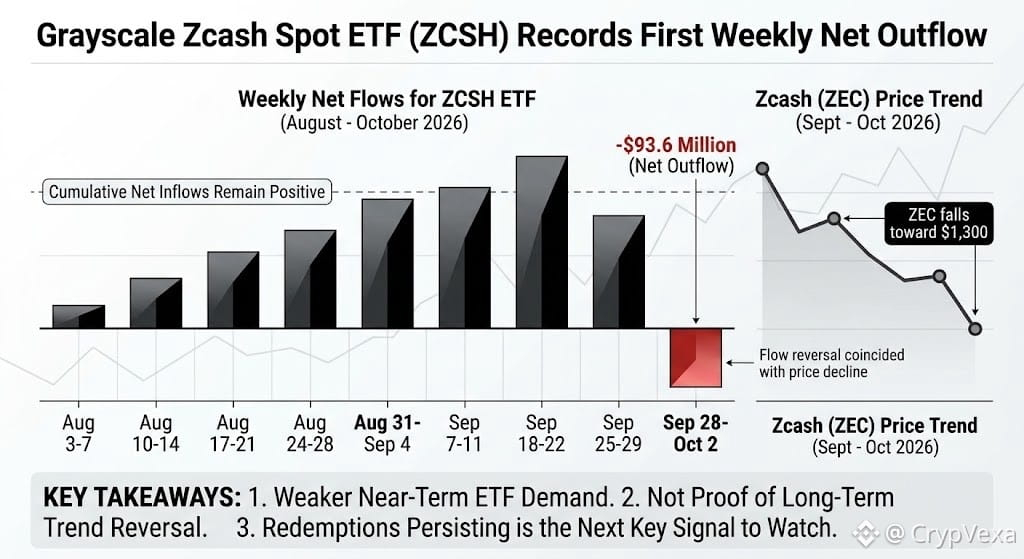
📉 Grayscale’s Zcash ETF Sees First Weekly Outflow
🟣 Grayscale’s ZCSH recorded its first weekly net outflow since launching in August 2026, with about $93.6M in outflows for the week ending Oct. 2.
📊 The reversal came as ZEC fell toward $1,300, pointing to weaker near-term ETF demand.
⚠️ One week of outflows does not confirm a long-term trend reversal. ZCSH reportedly remains positive on cumulative net flows since launch.
👀 Will ZCSH see continued redemptions, or can ETF demand recover?
#Zcash #ZEC #CryptoETF #CryptoNews
#ZcashETFPostsFirstWeeklyOutflow$93.6M
📉 Grayscale’s Zcash ETF Sees First Weekly Outflow
🟣 Grayscale’s ZCSH recorded its first weekly net outflow since launching in August 2026, with about $93.6M in outflows for the week ending Oct. 2.
📊 The reversal came as ZEC fell toward $1,300, pointing to weaker near-term ETF demand.
⚠️ One week of outflows does not confirm a long-term trend reversal. ZCSH reportedly remains positive on cumulative net flows since launch.
👀 Will ZCSH see continued redemptions, or can ETF demand recover?
#Zcash #ZEC #CryptoETF #CryptoNews
📉 Grayscale’s Zcash ETF Sees First Weekly Outflow
🟣 Grayscale’s ZCSH recorded its first weekly net outflow since launching in August 2026, with about $93.6M in outflows for the week ending Oct. 2.
📊 The reversal came as ZEC fell toward $1,300, pointing to weaker near-term ETF demand.
⚠️ One week of outflows does not confirm a long-term trend reversal. ZCSH reportedly remains positive on cumulative net flows since launch.
👀 Will ZCSH see continued redemptions, or can ETF demand recover?
#Zcash #ZEC #CryptoETF #CryptoNews
1
4
·
--
The institutional tide is not just turning; it is crashing. In a massive signal of conviction, BlackRock has poured over $1.5 billion into Bitcoin purchases in the last 30 days, significantly expanding its holdings while cementing its undisputed dominance in the ETF market. This isn't just accumulation; it's a strategic fortification of the largest asset manager in the world.
🔑 Key Takeaways:
• BlackRock added >$1.5B in $BTC exposure in just one month.
• The firm retains its top spot in the Bitcoin ETF market share.
• Institutional demand continues to outpace retail volatility, creating a strong price floor.
With $BTC currently trading at $84,856.02 (down 1.01% in 24h), this influx of capital serves as a critical buffer against short-term dips. The sheer scale of BlackRock's buying pressure suggests that institutional investors view the current price range as a prime accumulation zone rather than a peak. As macro liquidity improves, this level of institutional backing could be the catalyst needed to push the market toward new all-time highs.
Do you believe this level of institutional buying will sustain the current price range, or are we seeing a top? Drop your analysis below! 👇
#BinanceSquare #CryptoNews #Bitcoin
The institutional tide is not just turning; it is crashing. In a massive signal of conviction, BlackRock has poured over $1.5 billion into Bitcoin purchases in the last 30 days, significantly expanding its holdings while cementing its undisputed dominance in the ETF market. This isn't just accumulation; it's a strategic fortification of the largest asset manager in the world.
🔑 Key Takeaways:
• BlackRock added >$1.5B in $BTC exposure in just one month.
• The firm retains its top spot in the Bitcoin ETF market share.
• Institutional demand continues to outpace retail volatility, creating a strong price floor.
With $BTC currently trading at $84,856.02 (down 1.01% in 24h), this influx of capital serves as a critical buffer against short-term dips. The sheer scale of BlackRock's buying pressure suggests that institutional investors view the current price range as a prime accumulation zone rather than a peak. As macro liquidity improves, this level of institutional backing could be the catalyst needed to push the market toward new all-time highs.
Do you believe this level of institutional buying will sustain the current price range, or are we seeing a top? Drop your analysis below! 👇
#BinanceSquare #CryptoNews #Bitcoin
🔑 Key Takeaways:
• BlackRock added >$1.5B in $BTC exposure in just one month.
• The firm retains its top spot in the Bitcoin ETF market share.
• Institutional demand continues to outpace retail volatility, creating a strong price floor.
With $BTC currently trading at $84,856.02 (down 1.01% in 24h), this influx of capital serves as a critical buffer against short-term dips. The sheer scale of BlackRock's buying pressure suggests that institutional investors view the current price range as a prime accumulation zone rather than a peak. As macro liquidity improves, this level of institutional backing could be the catalyst needed to push the market toward new all-time highs.
Do you believe this level of institutional buying will sustain the current price range, or are we seeing a top? Drop your analysis below! 👇
#BinanceSquare #CryptoNews #Bitcoin

8
Log in to explore more content
Join global crypto users on Binance Square
⚡️ Get latest and useful information about crypto.
💬 Trusted by the world’s largest crypto exchange.
👍 Discover real insights from verified creators.
Email / Phone number
Trending Topics
1
#ZcashETFPostsFirstWeeklyOutflow$93.6M
8,591 views
39 Discussing
2
#GreekPoliceBustCryptoScamRingArrest17
11,841 views
199 Discussing
3
#BitcoinRejectedAt$87K
73,881 views
106 Discussing
4
#FedOctoberRateHikeOddsFallTo17%
43,195 views
595 Discussing
5
#NvidiaHitsRecordHighUp2.4%
23,535 views
412 Discussing
6
#CanaryFilesAmendedS1ForPEPEETF
9,640 views
273 Discussing
7
#USRussiaUkraineTalksReportedlyIncludeLukoilOilDeal
18,081 views
323 Discussing
8
#BitcoinParesGainsAfterRallyTo$86.5K
41,574 views
155 Discussing
9
#CerebrasSinksNearly20%OnReportNvidiaToPowerOpenAI
94,981 views
918 Discussing
10
#SECProposesCryptoCustodyRules
122,397 views
1,133 Discussing