

#bstockscis
bstockscis
329,720 views
9,274 Discussing
Hot
Latest

·
--
bStocks are tokenized shares of real companies, right on the blockchain.
Now you can trade shares of Apple, Tesla, Amazon, and others on Binance 24/7, without the restrictions of traditional exchanges.
bStocks brings the real economy and the crypto world closer together.
Who has tried trading bStocks? What did you think?
@BinanceCIS $AAPLB $AMZNB $
#bStocksCIS
bStocks are tokenized shares of real companies, right on the blockchain.
Now you can trade shares of Apple, Tesla, Amazon, and others on Binance 24/7, without the restrictions of traditional exchanges.
bStocks brings the real economy and the crypto world closer together.
Who has tried trading bStocks? What did you think?
@BinanceCIS $AAPLB $AMZNB $
#bStocksCIS
Now you can trade shares of Apple, Tesla, Amazon, and others on Binance 24/7, without the restrictions of traditional exchanges.
bStocks brings the real economy and the crypto world closer together.
Who has tried trading bStocks? What did you think?
@BinanceCIS $AAPLB $AMZNB $
#bStocksCIS
92

$SPCXB 168.40 -1.89% · Appears in this activity because the topic is tokenized U.S. stocks
The topic of this activity is tokenized U.S. stocks / bStocks, so the post should focus on how $SPCXB works, rather than just tacking a token name onto the end to make it seem relevant.
Do you think “relevance” should be reflected in the mechanism or in the tags?
Follow $SPCXB
@BinanceCIS #bStocksCIS $SPCXB
$SPCXB 168.40 -1.89% · Appears in this activity because the topic is tokenized U.S. stocks
The topic of this activity is tokenized U.S. stocks / bStocks, so the post should focus on how $SPCXB works, rather than just tacking a token name onto the end to make it seem relevant.
Do you think “relevance” should be reflected in the mechanism or in the tags?
Follow $SPCXB
@BinanceCIS #bStocksCIS $SPCXB
The topic of this activity is tokenized U.S. stocks / bStocks, so the post should focus on how $SPCXB works, rather than just tacking a token name onto the end to make it seem relevant.
Do you think “relevance” should be reflected in the mechanism or in the tags?
Follow $SPCXB
@BinanceCIS #bStocksCIS $SPCXB
126
$SPCXB 160.27 +0.91% · The tokenized US stocks and the spot markets aren’t on the same clock
Tokenized US stocks and spot orders aren’t on the same schedule. Among time-zone differences, liquidity, and the timing of information disclosure, which is most likely to turn “looks like it’s going up” into a misinterpretation? Use BinanceCIS · bStocks CreatorPad to form your judgment basis (learning-focused).
Which do you think is more likely to cause a misreading: time-zone differences or liquidity?
Discussion only; not investment advice.
Follow $SPCXB
@BinanceCIS #bStocksCIS $SPCXB
$SPCXB 160.27 +0.91% · The tokenized US stocks and the spot markets aren’t on the same clock
Tokenized US stocks and spot orders aren’t on the same schedule. Among time-zone differences, liquidity, and the timing of information disclosure, which is most likely to turn “looks like it’s going up” into a misinterpretation? Use BinanceCIS · bStocks CreatorPad to form your judgment basis (learning-focused).
Which do you think is more likely to cause a misreading: time-zone differences or liquidity?
Discussion only; not investment advice.
Follow $SPCXB
@BinanceCIS #bStocksCIS $SPCXB
Tokenized US stocks and spot orders aren’t on the same schedule. Among time-zone differences, liquidity, and the timing of information disclosure, which is most likely to turn “looks like it’s going up” into a misinterpretation? Use BinanceCIS · bStocks CreatorPad to form your judgment basis (learning-focused).
Which do you think is more likely to cause a misreading: time-zone differences or liquidity?
Discussion only; not investment advice.
Follow $SPCXB
@BinanceCIS #bStocksCIS $SPCXB
175

The development of traditional financial instruments in the crypto sphere opens excellent prospects for traders. Binance’s bStocks product allows tokenizing stocks and making trading even more flexible and accessible right from the platform! Integrating familiar assets makes the market more transparent and convenient for analysis. What do you think about the prospects of bStocks in the region?
@BinanceCIS #bStocksCIS
The development of traditional financial instruments in the crypto sphere opens excellent prospects for traders. Binance’s bStocks product allows tokenizing stocks and making trading even more flexible and accessible right from the platform! Integrating familiar assets makes the market more transparent and convenient for analysis. What do you think about the prospects of bStocks in the region?
@BinanceCIS #bStocksCIS
@BinanceCIS #bStocksCIS
220
$SPCXB 158.83 +6.58% · Is a tradable, compliant wrapper, not a get-rich-overnight target
We’ll only dig into one thing: $SPCXB is discussing a “tradable, compliant wrapper,” not a one-night wealth story. Topic: tokenized US stocks / bStocks.
What matters to you more—the compliance pathway or the trading experience?
Follow $SPCXB
@BinanceCIS #bStocksCIS $SPCXB
$SPCXB 158.83 +6.58% · Is a tradable, compliant wrapper, not a get-rich-overnight target
We’ll only dig into one thing: $SPCXB is discussing a “tradable, compliant wrapper,” not a one-night wealth story. Topic: tokenized US stocks / bStocks.
What matters to you more—the compliance pathway or the trading experience?
Follow $SPCXB
@BinanceCIS #bStocksCIS $SPCXB
We’ll only dig into one thing: $SPCXB is discussing a “tradable, compliant wrapper,” not a one-night wealth story. Topic: tokenized US stocks / bStocks.
What matters to you more—the compliance pathway or the trading experience?
Follow $SPCXB
@BinanceCIS #bStocksCIS $SPCXB
161

🌎 I like the very idea of a global portfolio
The global market is much broader than the companies and assets we see every day.
Technology, finance, the consumer sector, energy — each area has its own dynamics and risks.
That’s why I wouldn’t want all my results to depend on the economy of only one country or just one sector.
Stocks can be one of the options to gain exposure to global companies in digital form.
But diversification for me isn’t about “buying everything at random”—it’s about consciously spreading risk across different areas.
@BinanceCIS #bStocksCIS
🌎 I like the very idea of a global portfolio
The global market is much broader than the companies and assets we see every day.
Technology, finance, the consumer sector, energy — each area has its own dynamics and risks.
That’s why I wouldn’t want all my results to depend on the economy of only one country or just one sector.
Stocks can be one of the options to gain exposure to global companies in digital form.
But diversification for me isn’t about “buying everything at random”—it’s about consciously spreading risk across different areas.
@BinanceCIS #bStocksCIS
The global market is much broader than the companies and assets we see every day.
Technology, finance, the consumer sector, energy — each area has its own dynamics and risks.
That’s why I wouldn’t want all my results to depend on the economy of only one country or just one sector.
Stocks can be one of the options to gain exposure to global companies in digital form.
But diversification for me isn’t about “buying everything at random”—it’s about consciously spreading risk across different areas.
@BinanceCIS #bStocksCIS
87

🌐Traditional finance is gradually changing form
I’m interested in watching how the boundary between traditional finance and digital infrastructure is being erased.
In the past, the stock market and the crypto market were seen as almost two separate worlds.
Now, products are emerging that try to combine traditional assets with blockchain infrastructure.
Stocks is one example of this approach.
For me, the key point here is not even the fact that a new format has appeared, but the ability to choose: an investor can consider different instruments depending on their strategy, time horizon, and attitude to risk.
It will be interesting to see where this trend will take the financial market next.
#bStocksCIS @BinanceCIS
🌐Traditional finance is gradually changing form
I’m interested in watching how the boundary between traditional finance and digital infrastructure is being erased.
In the past, the stock market and the crypto market were seen as almost two separate worlds.
Now, products are emerging that try to combine traditional assets with blockchain infrastructure.
Stocks is one example of this approach.
For me, the key point here is not even the fact that a new format has appeared, but the ability to choose: an investor can consider different instruments depending on their strategy, time horizon, and attitude to risk.
It will be interesting to see where this trend will take the financial market next.
#bStocksCIS @BinanceCIS
I’m interested in watching how the boundary between traditional finance and digital infrastructure is being erased.
In the past, the stock market and the crypto market were seen as almost two separate worlds.
Now, products are emerging that try to combine traditional assets with blockchain infrastructure.
Stocks is one example of this approach.
For me, the key point here is not even the fact that a new format has appeared, but the ability to choose: an investor can consider different instruments depending on their strategy, time horizon, and attitude to risk.
It will be interesting to see where this trend will take the financial market next.
#bStocksCIS @BinanceCIS
103
📈 And what matters more: the entry point or the time horizon?
Of course, the entry price matters.
But sometimes an investor becomes so focused on finding the “perfect point” that they forget the main thing—why the asset is bought in the first place.
If the horizon is short, there’s one logic. If we’re talking about years, it’s completely different.
That’s why when considering bStocks, I would first define the goal and the horizon, and only then evaluate a specific asset.
For me, a good portfolio isn’t an attempt to guess every move of the chart, but a structure that can be explained even without an open trading terminal.
#bStocksCIS @BinanceCIS $AMDB
{spot}(AMDBUSDT)
📈 And what matters more: the entry point or the time horizon?
Of course, the entry price matters.
But sometimes an investor becomes so focused on finding the “perfect point” that they forget the main thing—why the asset is bought in the first place.
If the horizon is short, there’s one logic. If we’re talking about years, it’s completely different.
That’s why when considering bStocks, I would first define the goal and the horizon, and only then evaluate a specific asset.
For me, a good portfolio isn’t an attempt to guess every move of the chart, but a structure that can be explained even without an open trading terminal.
#bStocksCIS @BinanceCIS $AMDB
Of course, the entry price matters.
But sometimes an investor becomes so focused on finding the “perfect point” that they forget the main thing—why the asset is bought in the first place.
If the horizon is short, there’s one logic. If we’re talking about years, it’s completely different.
That’s why when considering bStocks, I would first define the goal and the horizon, and only then evaluate a specific asset.
For me, a good portfolio isn’t an attempt to guess every move of the chart, but a structure that can be explained even without an open trading terminal.
#bStocksCIS @BinanceCIS $AMDB
KiSerVik:
цікава інформація. підписуюсь на тебе. подивись, у мене також є цікаві публікації
1
1
166
·
--
🚀 The financial market is becoming more and more digital
Tokenization, blockchain, and traditional financial assets are gradually intersecting in one space.
And I’m interested in not only specific products, but also the direction of development itself.
Stocks shows one possible version of how this could come together—access to global companies through a tokenized format.
Will tokenization become a standard part of financial infrastructure in the future—time will tell.
But even now, this direction is interesting enough to keep a close eye on. 🌍📈
#bStocksCIS $AMZNB $TSMB
{spot}(TSMBUSDT)
🚀 The financial market is becoming more and more digital
Tokenization, blockchain, and traditional financial assets are gradually intersecting in one space.
And I’m interested in not only specific products, but also the direction of development itself.
Stocks shows one possible version of how this could come together—access to global companies through a tokenized format.
Will tokenization become a standard part of financial infrastructure in the future—time will tell.
But even now, this direction is interesting enough to keep a close eye on. 🌍📈
#bStocksCIS $AMZNB $TSMB
Tokenization, blockchain, and traditional financial assets are gradually intersecting in one space.
And I’m interested in not only specific products, but also the direction of development itself.
Stocks shows one possible version of how this could come together—access to global companies through a tokenized format.
Will tokenization become a standard part of financial infrastructure in the future—time will tell.
But even now, this direction is interesting enough to keep a close eye on. 🌍📈
#bStocksCIS $AMZNB $TSMB
86
$SPCXB 149.28 +2.36% · Appears in this event because the topic is tokenized U.S. stocks
The topic of this event is tokenized U.S. stocks / bStocks, so the main text is written around the mechanism of $SPCXB , not just by pasting a coin name at the end to make it feel “relevant.”
Do you think “relevant” should be written in the mechanism, or in the tags?
Watch $SPCXB
@BinanceCIS #bStocksCIS $SPCXB
$SPCXB 149.28 +2.36% · Appears in this event because the topic is tokenized U.S. stocks
The topic of this event is tokenized U.S. stocks / bStocks, so the main text is written around the mechanism of $SPCXB , not just by pasting a coin name at the end to make it feel “relevant.”
Do you think “relevant” should be written in the mechanism, or in the tags?
Watch $SPCXB
@BinanceCIS #bStocksCIS $SPCXB
The topic of this event is tokenized U.S. stocks / bStocks, so the main text is written around the mechanism of $SPCXB , not just by pasting a coin name at the end to make it feel “relevant.”
Do you think “relevant” should be written in the mechanism, or in the tags?
Watch $SPCXB
@BinanceCIS #bStocksCIS $SPCXB
101
·
--
🌎 Why am I interested in looking beyond a single market?
Because the economy of one country does not reflect the entire world economy.
Somewhere consumption is growing.
Somewhere the tech sector is developing.
Somewhere new production capacities are being launched.
And somewhere, on the contrary, a certain industry is facing difficulties.
That’s why global companies can show a completely different picture than a local market.
This is where I see an interesting role for Binance BStock in a portfolio strategy.
Not as a single direction.
But as an opportunity to look more broadly at companies and the economies of different regions.
🌐 For me, a global portfolio is primarily an attempt not to tie all expectations to one market.
And the specific allocation should depend on your goals, time horizon, and acceptable risk.
#bStocksCIS $AAPLB
{spot}(AAPLBUSDT)
@BinanceCIS
🌎 Why am I interested in looking beyond a single market?
Because the economy of one country does not reflect the entire world economy.
Somewhere consumption is growing.
Somewhere the tech sector is developing.
Somewhere new production capacities are being launched.
And somewhere, on the contrary, a certain industry is facing difficulties.
That’s why global companies can show a completely different picture than a local market.
This is where I see an interesting role for Binance BStock in a portfolio strategy.
Not as a single direction.
But as an opportunity to look more broadly at companies and the economies of different regions.
🌐 For me, a global portfolio is primarily an attempt not to tie all expectations to one market.
And the specific allocation should depend on your goals, time horizon, and acceptable risk.
#bStocksCIS $AAPLB
@BinanceCIS
Because the economy of one country does not reflect the entire world economy.
Somewhere consumption is growing.
Somewhere the tech sector is developing.
Somewhere new production capacities are being launched.
And somewhere, on the contrary, a certain industry is facing difficulties.
That’s why global companies can show a completely different picture than a local market.
This is where I see an interesting role for Binance BStock in a portfolio strategy.
Not as a single direction.
But as an opportunity to look more broadly at companies and the economies of different regions.
🌐 For me, a global portfolio is primarily an attempt not to tie all expectations to one market.
And the specific allocation should depend on your goals, time horizon, and acceptable risk.
#bStocksCIS $AAPLB
@BinanceCIS
176

bStocks are getting closer to regular trading
Previously, I viewed bStocks simply as a way to get exposure to TradFi.
But now, the functionality is genuinely expanding.
Binance already allows using bStocks as collateral for Cross Margin and Portfolio Margin. In other words, the asset doesn’t just sit on your balance—it can be used in Binance’s margin infrastructure.
And for me, that’s more interesting than just another list of new tickers.
Basically, the logic becomes like this:
buy bStocks → hold the position → you can use it as collateral → you keep working with other assets.
But here, I would definitely not rush.
Binance is directly introducing additional risk controls and suitability assessments for users who use bStocks as collateral.
So the question is no longer only “what to buy?”, but also “how should you properly use this asset in your portfolio?”
How do you feel about bStocks as collateral?
🟢 Interesting opportunity
🟡 Need more practice
🔴 Don’t want to use leverage
@BinanceCIS
#bStocksCIS #Binance #TradFi #BinanceEarn
bStocks are getting closer to regular trading
Previously, I viewed bStocks simply as a way to get exposure to TradFi.
But now, the functionality is genuinely expanding.
Binance already allows using bStocks as collateral for Cross Margin and Portfolio Margin. In other words, the asset doesn’t just sit on your balance—it can be used in Binance’s margin infrastructure.
And for me, that’s more interesting than just another list of new tickers.
Basically, the logic becomes like this:
buy bStocks → hold the position → you can use it as collateral → you keep working with other assets.
But here, I would definitely not rush.
Binance is directly introducing additional risk controls and suitability assessments for users who use bStocks as collateral.
So the question is no longer only “what to buy?”, but also “how should you properly use this asset in your portfolio?”
How do you feel about bStocks as collateral?
🟢 Interesting opportunity
🟡 Need more practice
🔴 Don’t want to use leverage
@BinanceCIS
#bStocksCIS #Binance #TradFi #BinanceEarn
Previously, I viewed bStocks simply as a way to get exposure to TradFi.
But now, the functionality is genuinely expanding.
Binance already allows using bStocks as collateral for Cross Margin and Portfolio Margin. In other words, the asset doesn’t just sit on your balance—it can be used in Binance’s margin infrastructure.
And for me, that’s more interesting than just another list of new tickers.
Basically, the logic becomes like this:
buy bStocks → hold the position → you can use it as collateral → you keep working with other assets.
But here, I would definitely not rush.
Binance is directly introducing additional risk controls and suitability assessments for users who use bStocks as collateral.
So the question is no longer only “what to buy?”, but also “how should you properly use this asset in your portfolio?”
How do you feel about bStocks as collateral?
🟢 Interesting opportunity
🟡 Need more practice
🔴 Don’t want to use leverage
@BinanceCIS
#bStocksCIS #Binance #TradFi #BinanceEarn
81

·
--
bStocks — when you want to look at the market more broadly 📈
I’m used to following crypto, but lately I’ve become interested in combining this world with traditional stock market assets. That’s why I took notice of Binance bStocks.
NVIDIA is especially interesting to me — a company at the center of the AI trend and high-performance technologies. I like the idea of having access to different types of assets within the Binance ecosystem and choosing what fits my strategy on my own.
For me, bStocks is another way to look at investments more broadly, rather than focusing only on cryptocurrencies.
@BinanceCIS #bStocksCIS
bStocks — when you want to look at the market more broadly 📈
I’m used to following crypto, but lately I’ve become interested in combining this world with traditional stock market assets. That’s why I took notice of Binance bStocks.
NVIDIA is especially interesting to me — a company at the center of the AI trend and high-performance technologies. I like the idea of having access to different types of assets within the Binance ecosystem and choosing what fits my strategy on my own.
For me, bStocks is another way to look at investments more broadly, rather than focusing only on cryptocurrencies.
@BinanceCIS #bStocksCIS
I’m used to following crypto, but lately I’ve become interested in combining this world with traditional stock market assets. That’s why I took notice of Binance bStocks.
NVIDIA is especially interesting to me — a company at the center of the AI trend and high-performance technologies. I like the idea of having access to different types of assets within the Binance ecosystem and choosing what fits my strategy on my own.
For me, bStocks is another way to look at investments more broadly, rather than focusing only on cryptocurrencies.
@BinanceCIS #bStocksCIS
109

·
--
Bullish
📈 Binance bStocks: what will happen to the market next?
Binance bStocks opens a new way to gain exposure to traditional stocks through the crypto ecosystem.
💡 A good question: what will happen to bStocks if the stock market suddenly drops?
Different scenarios are possible:
• 📉 a decline in the underlying stocks may be reflected in the value of bStocks;
• 📊 high volatility can increase trading activity;
• 🔄 correlation with the traditional stock market may become more noticeable;
• 🌐 investors will be able to compare bStocks’ price action with the crypto market.
❓ What do you think—will bStocks become a bridge between the crypto and stock markets, or will they remain a separate instrument within the Binance ecosystem?
💬 Share your opinion in the comments.
@BinanceCIS #bStocksCIS
📈 Binance bStocks: what will happen to the market next?
Binance bStocks opens a new way to gain exposure to traditional stocks through the crypto ecosystem.
💡 A good question: what will happen to bStocks if the stock market suddenly drops?
Different scenarios are possible:
• 📉 a decline in the underlying stocks may be reflected in the value of bStocks;
• 📊 high volatility can increase trading activity;
• 🔄 correlation with the traditional stock market may become more noticeable;
• 🌐 investors will be able to compare bStocks’ price action with the crypto market.
❓ What do you think—will bStocks become a bridge between the crypto and stock markets, or will they remain a separate instrument within the Binance ecosystem?
💬 Share your opinion in the comments.
@BinanceCIS #bStocksCIS
Binance bStocks opens a new way to gain exposure to traditional stocks through the crypto ecosystem.
💡 A good question: what will happen to bStocks if the stock market suddenly drops?
Different scenarios are possible:
• 📉 a decline in the underlying stocks may be reflected in the value of bStocks;
• 📊 high volatility can increase trading activity;
• 🔄 correlation with the traditional stock market may become more noticeable;
• 🌐 investors will be able to compare bStocks’ price action with the crypto market.
❓ What do you think—will bStocks become a bridge between the crypto and stock markets, or will they remain a separate instrument within the Binance ecosystem?
💬 Share your opinion in the comments.
@BinanceCIS #bStocksCIS
127

·
--
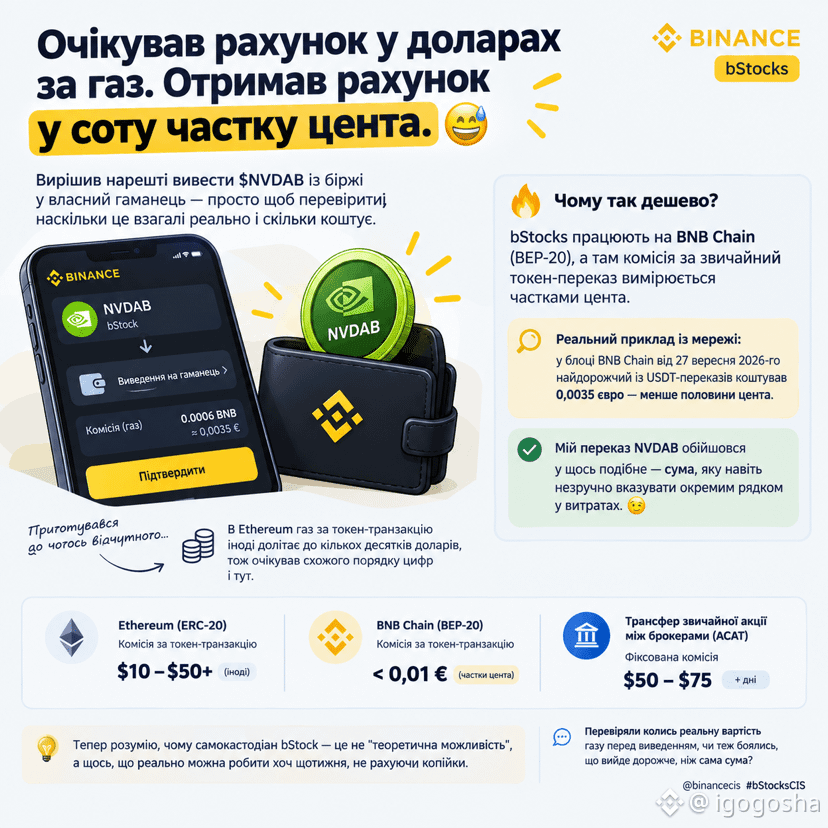
Expected a dollar invoice for gas. Got an invoice for a hundredth of a cent instead. 😅
Finally decided to try withdrawing $NVDAB from the exchange to my own wallet — just to check how realistic it is and how much it costs.
I braced for something significant: on Ethereum, gas for a token transaction sometimes comes in at a few dozen dollars, so I expected a similar order of magnitude here.
Turns out — no. bStocks run on BNB Chain (BEP-20), and there the fee for a regular token transfer is measured in fractions of a cent. I even found a real example: in a network block dated September 27, 2026, the most expensive among USDT transfers cost €0.0035 — less than half a cent.
My NVDAB transfer came out to something similar: the amount that’s even awkward to list as a separate line item in expenses.
For comparison — transferring a regular stock between brokers (ACAT) often costs a fixed commission of $50–75 and takes days. Here — seconds, and essentially free.
Now I understand why bStock self-custody isn’t a “theoretical possibility,” but something you can actually do every week, without counting pennies.
Have you ever checked the real gas cost before withdrawing, or were you also afraid it would end up more expensive than the amount itself?
@BinanceCIS #bStocksCIS
{spot}(NVDABUSDT)
Expected a dollar invoice for gas. Got an invoice for a hundredth of a cent instead. 😅
Finally decided to try withdrawing $NVDAB from the exchange to my own wallet — just to check how realistic it is and how much it costs.
I braced for something significant: on Ethereum, gas for a token transaction sometimes comes in at a few dozen dollars, so I expected a similar order of magnitude here.
Turns out — no. bStocks run on BNB Chain (BEP-20), and there the fee for a regular token transfer is measured in fractions of a cent. I even found a real example: in a network block dated September 27, 2026, the most expensive among USDT transfers cost €0.0035 — less than half a cent.
My NVDAB transfer came out to something similar: the amount that’s even awkward to list as a separate line item in expenses.
For comparison — transferring a regular stock between brokers (ACAT) often costs a fixed commission of $50–75 and takes days. Here — seconds, and essentially free.
Now I understand why bStock self-custody isn’t a “theoretical possibility,” but something you can actually do every week, without counting pennies.
Have you ever checked the real gas cost before withdrawing, or were you also afraid it would end up more expensive than the amount itself?
@BinanceCIS #bStocksCIS
Finally decided to try withdrawing $NVDAB from the exchange to my own wallet — just to check how realistic it is and how much it costs.
I braced for something significant: on Ethereum, gas for a token transaction sometimes comes in at a few dozen dollars, so I expected a similar order of magnitude here.
Turns out — no. bStocks run on BNB Chain (BEP-20), and there the fee for a regular token transfer is measured in fractions of a cent. I even found a real example: in a network block dated September 27, 2026, the most expensive among USDT transfers cost €0.0035 — less than half a cent.
My NVDAB transfer came out to something similar: the amount that’s even awkward to list as a separate line item in expenses.
For comparison — transferring a regular stock between brokers (ACAT) often costs a fixed commission of $50–75 and takes days. Here — seconds, and essentially free.
Now I understand why bStock self-custody isn’t a “theoretical possibility,” but something you can actually do every week, without counting pennies.
Have you ever checked the real gas cost before withdrawing, or were you also afraid it would end up more expensive than the amount itself?
@BinanceCIS #bStocksCIS
147

·
--
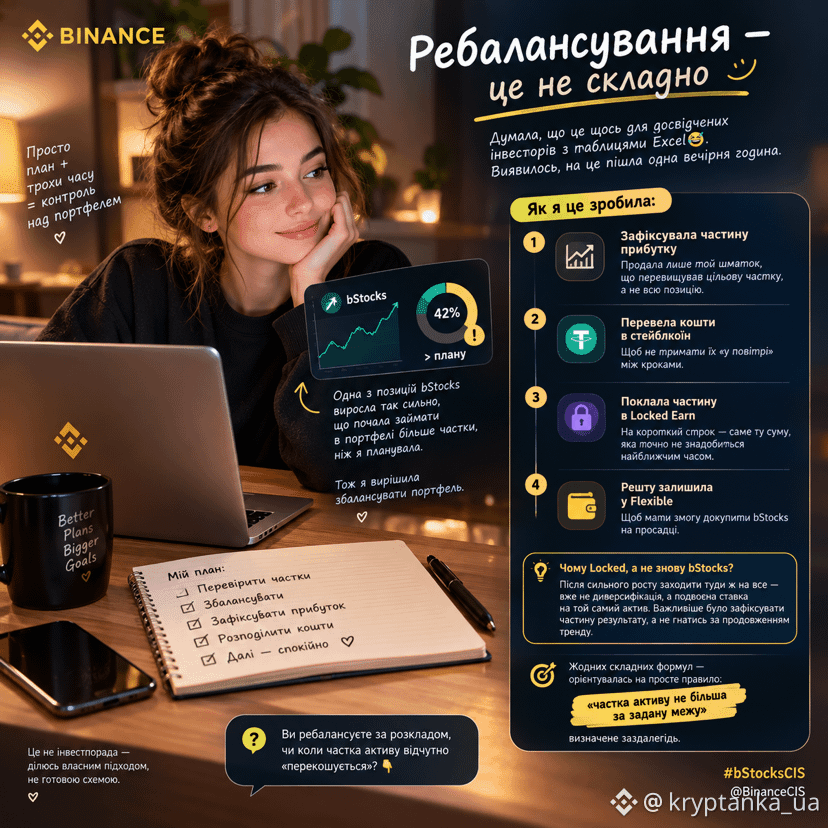
I thought rebalancing was something only experienced investors do with Excel spreadsheets😅. Turns out it took me just one evening.
One of the bStocks positions grew so much that it started taking up a larger share of my portfolio than I initially planned—so it was no longer “a strategy,” but “how it turned out.”
Step by step:
— I locked in part of the profit by selling only the slice that exceeded the target allocation, not the entire position;
— I moved the funds into a stablecoin so they wouldn’t just be “in the air” between steps;
— I put part into Locked Earn for a short period—specifically the amount that definitely won’t be needed in the near future;
— I left the rest in Flexible so I can buy more bStocks if there’s a dip.
Why Locked and not bStocks again: after a strong surge, going back in with everything is no longer diversification—it’s a doubled bet on the same asset. It mattered more to capture some of the gains than to chase the trend continuing.
Honestly: no complex formulas—I followed a simple rule: “the asset’s allocation share must not exceed a predefined limit,” set in advance.
Not investment advice—I’m sharing my own approach, not a ready-made scheme.
Do you rebalance according to a schedule, or when an asset’s share noticeably “gets skewed”?👇
#bStocksCIS #Earnbianance
I thought rebalancing was something only experienced investors do with Excel spreadsheets😅. Turns out it took me just one evening.
One of the bStocks positions grew so much that it started taking up a larger share of my portfolio than I initially planned—so it was no longer “a strategy,” but “how it turned out.”
Step by step:
— I locked in part of the profit by selling only the slice that exceeded the target allocation, not the entire position;
— I moved the funds into a stablecoin so they wouldn’t just be “in the air” between steps;
— I put part into Locked Earn for a short period—specifically the amount that definitely won’t be needed in the near future;
— I left the rest in Flexible so I can buy more bStocks if there’s a dip.
Why Locked and not bStocks again: after a strong surge, going back in with everything is no longer diversification—it’s a doubled bet on the same asset. It mattered more to capture some of the gains than to chase the trend continuing.
Honestly: no complex formulas—I followed a simple rule: “the asset’s allocation share must not exceed a predefined limit,” set in advance.
Not investment advice—I’m sharing my own approach, not a ready-made scheme.
Do you rebalance according to a schedule, or when an asset’s share noticeably “gets skewed”?👇
#bStocksCIS #Earnbianance
One of the bStocks positions grew so much that it started taking up a larger share of my portfolio than I initially planned—so it was no longer “a strategy,” but “how it turned out.”
Step by step:
— I locked in part of the profit by selling only the slice that exceeded the target allocation, not the entire position;
— I moved the funds into a stablecoin so they wouldn’t just be “in the air” between steps;
— I put part into Locked Earn for a short period—specifically the amount that definitely won’t be needed in the near future;
— I left the rest in Flexible so I can buy more bStocks if there’s a dip.
Why Locked and not bStocks again: after a strong surge, going back in with everything is no longer diversification—it’s a doubled bet on the same asset. It mattered more to capture some of the gains than to chase the trend continuing.
Honestly: no complex formulas—I followed a simple rule: “the asset’s allocation share must not exceed a predefined limit,” set in advance.
Not investment advice—I’m sharing my own approach, not a ready-made scheme.
Do you rebalance according to a schedule, or when an asset’s share noticeably “gets skewed”?👇
#bStocksCIS #Earnbianance
1
173
bStocks is now really interesting to test
Binance has just launched a new Trade bStocks 24/7 campaign — until October 14 you can complete tasks and get chances at rewards up to 500 USDT in token vouchers.
But I’m more interested in the product itself.
bStocks can be traded 24/7, like crypto assets, while also giving exposure to US stocks. You can even start with a small amount.
What’s interesting to me here is the combination:
📈 Crypto — volatility
🏦 bStocks — exposure to TradFi
💰 Binance Earn — working with idle assets
However, there’s an important nuance: bStocks are not direct ownership of company shares. They are tokenized securities that represent an interest in the underlying asset.
So before buying, I’d look not only at the ticker and price, but also at what exactly I’m buying and what role this asset plays in my portfolio.
Have you used bStocks yet?
1️⃣ Yes, I trade
2️⃣ I tried, but I’m still watching
3️⃣ Not yet
@BinanceCIS
#bStocksCIS #Binance #TradFi #BinanceEarn
bStocks is now really interesting to test
Binance has just launched a new Trade bStocks 24/7 campaign — until October 14 you can complete tasks and get chances at rewards up to 500 USDT in token vouchers.
But I’m more interested in the product itself.
bStocks can be traded 24/7, like crypto assets, while also giving exposure to US stocks. You can even start with a small amount.
What’s interesting to me here is the combination:
📈 Crypto — volatility
🏦 bStocks — exposure to TradFi
💰 Binance Earn — working with idle assets
However, there’s an important nuance: bStocks are not direct ownership of company shares. They are tokenized securities that represent an interest in the underlying asset.
So before buying, I’d look not only at the ticker and price, but also at what exactly I’m buying and what role this asset plays in my portfolio.
Have you used bStocks yet?
1️⃣ Yes, I trade
2️⃣ I tried, but I’m still watching
3️⃣ Not yet
@BinanceCIS
#bStocksCIS #Binance #TradFi #BinanceEarn
Binance has just launched a new Trade bStocks 24/7 campaign — until October 14 you can complete tasks and get chances at rewards up to 500 USDT in token vouchers.
But I’m more interested in the product itself.
bStocks can be traded 24/7, like crypto assets, while also giving exposure to US stocks. You can even start with a small amount.
What’s interesting to me here is the combination:
📈 Crypto — volatility
🏦 bStocks — exposure to TradFi
💰 Binance Earn — working with idle assets
However, there’s an important nuance: bStocks are not direct ownership of company shares. They are tokenized securities that represent an interest in the underlying asset.
So before buying, I’d look not only at the ticker and price, but also at what exactly I’m buying and what role this asset plays in my portfolio.
Have you used bStocks yet?
1️⃣ Yes, I trade
2️⃣ I tried, but I’m still watching
3️⃣ Not yet
@BinanceCIS
#bStocksCIS #Binance #TradFi #BinanceEarn
90
$SPCXB 149.09 +0.37% · The tokenized US stocks on-chain and the spot market are not in the same “time zone”
Tokenized US stocks and the spot order book are not in the same “time cycle.” Among time differences, liquidity, and the pace of information disclosure—which one is most likely to turn “it looks like it’s going up” into a misinterpretation? Using BinanceCIS · bStocks CreatorPad, share your reasoning (educational content).
Which do you think is more likely to cause a misread—time difference or liquidity?
Discussion only; not investment advice.
Follow $SPCXB
@BinanceCIS #bStocksCIS $SPCXB
$SPCXB 149.09 +0.37% · The tokenized US stocks on-chain and the spot market are not in the same “time zone”
Tokenized US stocks and the spot order book are not in the same “time cycle.” Among time differences, liquidity, and the pace of information disclosure—which one is most likely to turn “it looks like it’s going up” into a misinterpretation? Using BinanceCIS · bStocks CreatorPad, share your reasoning (educational content).
Which do you think is more likely to cause a misread—time difference or liquidity?
Discussion only; not investment advice.
Follow $SPCXB
@BinanceCIS #bStocksCIS $SPCXB
Tokenized US stocks and the spot order book are not in the same “time cycle.” Among time differences, liquidity, and the pace of information disclosure—which one is most likely to turn “it looks like it’s going up” into a misinterpretation? Using BinanceCIS · bStocks CreatorPad, share your reasoning (educational content).
Which do you think is more likely to cause a misread—time difference or liquidity?
Discussion only; not investment advice.
Follow $SPCXB
@BinanceCIS #bStocksCIS $SPCXB
95
·
--
🌐 One of the main advantages of digital finance is access
Global markets have always been interesting, but traditionally gaining access required a certain level of infrastructure.
Tokenization is trying to change this very part of the financial system.
I find bStocks interesting as an example of combining traditional securities assets with blockchain infrastructure on Binance.
At the same time, technological convenience does not eliminate the need to analyze risks.
On the contrary — the simpler access becomes, the more important it is to understand what exactly is behind the Buy button. 👀
#bStocksCIS @BinanceCIS $NVDAB
{spot}(NVDABUSDT)
🌐 One of the main advantages of digital finance is access
Global markets have always been interesting, but traditionally gaining access required a certain level of infrastructure.
Tokenization is trying to change this very part of the financial system.
I find bStocks interesting as an example of combining traditional securities assets with blockchain infrastructure on Binance.
At the same time, technological convenience does not eliminate the need to analyze risks.
On the contrary — the simpler access becomes, the more important it is to understand what exactly is behind the Buy button. 👀
#bStocksCIS @BinanceCIS $NVDAB
Global markets have always been interesting, but traditionally gaining access required a certain level of infrastructure.
Tokenization is trying to change this very part of the financial system.
I find bStocks interesting as an example of combining traditional securities assets with blockchain infrastructure on Binance.
At the same time, technological convenience does not eliminate the need to analyze risks.
On the contrary — the simpler access becomes, the more important it is to understand what exactly is behind the Buy button. 👀
#bStocksCIS @BinanceCIS $NVDAB
86
·
--
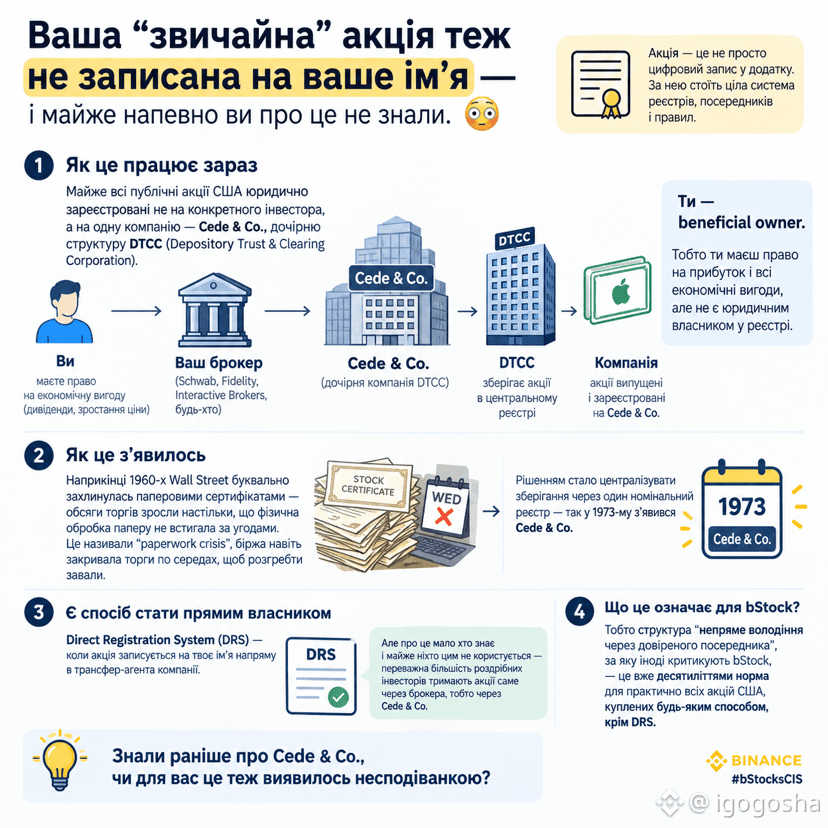
Your “ordinary” stock is also not registered in your name — and you almost certainly didn’t know that. 😳
I wrote earlier that bStock is a certificate, not direct ownership with voting rights, and in the comments I often hear: “If only I could do it directly through a normal broker.” I checked — no, it’s not that.
Almost all US stocks are legally registered not to the investor, but to one company, Cede & Co. (a DTCC subsidiary). You buy through Schwab, Fidelity, or anyone else — you’re not the one listed in the register; it’s Cede & Co. You are only a “beneficial owner” with rights to the benefits, but not the owner on the register.
This isn’t random: in the late 1960s, Wall Street choked on paper stock certificates, and even the exchange temporarily closed trading on Wednesdays to clear the backlog. The solution was to consolidate custody into a single registry — and in 1973 Cede & Co. came into existence.
You can become a direct owner through the Direct Registration System (DRS) — the share is recorded in your name directly with the transfer agent. But not many people know about it: the vast majority hold shares through a broker, meaning through Cede & Co.
So the “indirect ownership through a middleman,” which is what people criticize bStock for, has already been the norm for decades for almost all US stocks—except DRS.
Did you already know about Cede & Co., or was that also a surprise for you?
@Binance_Ukraine #bStocksCIS
Your “ordinary” stock is also not registered in your name — and you almost certainly didn’t know that. 😳
I wrote earlier that bStock is a certificate, not direct ownership with voting rights, and in the comments I often hear: “If only I could do it directly through a normal broker.” I checked — no, it’s not that.
Almost all US stocks are legally registered not to the investor, but to one company, Cede & Co. (a DTCC subsidiary). You buy through Schwab, Fidelity, or anyone else — you’re not the one listed in the register; it’s Cede & Co. You are only a “beneficial owner” with rights to the benefits, but not the owner on the register.
This isn’t random: in the late 1960s, Wall Street choked on paper stock certificates, and even the exchange temporarily closed trading on Wednesdays to clear the backlog. The solution was to consolidate custody into a single registry — and in 1973 Cede & Co. came into existence.
You can become a direct owner through the Direct Registration System (DRS) — the share is recorded in your name directly with the transfer agent. But not many people know about it: the vast majority hold shares through a broker, meaning through Cede & Co.
So the “indirect ownership through a middleman,” which is what people criticize bStock for, has already been the norm for decades for almost all US stocks—except DRS.
Did you already know about Cede & Co., or was that also a surprise for you?
@Binance_Ukraine #bStocksCIS
I wrote earlier that bStock is a certificate, not direct ownership with voting rights, and in the comments I often hear: “If only I could do it directly through a normal broker.” I checked — no, it’s not that.
Almost all US stocks are legally registered not to the investor, but to one company, Cede & Co. (a DTCC subsidiary). You buy through Schwab, Fidelity, or anyone else — you’re not the one listed in the register; it’s Cede & Co. You are only a “beneficial owner” with rights to the benefits, but not the owner on the register.
This isn’t random: in the late 1960s, Wall Street choked on paper stock certificates, and even the exchange temporarily closed trading on Wednesdays to clear the backlog. The solution was to consolidate custody into a single registry — and in 1973 Cede & Co. came into existence.
You can become a direct owner through the Direct Registration System (DRS) — the share is recorded in your name directly with the transfer agent. But not many people know about it: the vast majority hold shares through a broker, meaning through Cede & Co.
So the “indirect ownership through a middleman,” which is what people criticize bStock for, has already been the norm for decades for almost all US stocks—except DRS.
Did you already know about Cede & Co., or was that also a surprise for you?
@Binance_Ukraine #bStocksCIS
1
151
Log in to explore more content
Join global crypto users on Binance Square
⚡️ Get latest and useful information about crypto.
💬 Trusted by the world’s largest crypto exchange.
👍 Discover real insights from verified creators.
Email / Phone number
Trending Topics
1
#BinanceLaunchesBinanceIntelligence
849,250 views
5,251 Discussing
2
#FedMinutesFocusOnOctoberPause
0 views
13 Discussing
3
#RobinhoodAdds$25MInBitcoinToBalanceSheet
36 views
4 Discussing
4
#SP500AndNasdaqHitRecordHighs
371 views
60 Discussing
5
#USMortgageRatesRiseTo7.49%
238 views
51 Discussing
6
#BTCFallsBelow$84K
56,285 views
156 Discussing
7
#DubaiVARAIssuesReserveAssetAuditCircular
22,406 views
660 Discussing
8
#SECApproves3XBitcoinETF
20,200 views
549 Discussing
9
#WinklevossFilesSpotZcashETFApplication
28,710 views
666 Discussing
10
#SouthKoreaAITradeLiftsWorldcoinTo$7.41B
3,279 views
50 Discussing