

#binancesuperapp
binancesuperapp
831 views
14 Discussing
Hot
Latest
Article
Inside Binance - Episode 5 and Last: Where Everything ConnectsIntroduction: When an Exchange Becomes Something More
When most people hear the word Binance, the first thing that comes to mind is buying Bitcoin. It's understandable, millions of users downloaded the app for exactly that reason. Some wanted to purchase their first cryptocurrency, others wanted to trade, while many simply wanted to understand why digital assets had become one of the biggest financial conversations of our generation. But the longer you spend inside Binance, the more you realize something interesting: buying crypto is only the beginning.
Think back to the first time you downloaded any financial application. Most apps were designed to solve one problem. Your banking app lets you manage your bank account. A stock broker allows you to invest in stocks. A payment application lets you send money. A learning platform teaches you. A social media platform helps you connect with people. Every service existed in its own separate world, forcing users to switch between multiple applications just to complete one financial journey.
Binance took a different approach.
Instead of building another exchange, Binance gradually developed an ecosystem where investing, trading, payments, education, communities, research, Web3, and digital ownership all connect under one platform. That's the difference between using an exchange and using a Financial Super App. The goal isn't to make users spend more time inside one application. The goal is to make every part of their financial journey feel connected. Let's explore the side of Binance that many people never discover.
Binance Pay: When Crypto Becomes Everyday Money
One of the biggest misconceptions about cryptocurrency is that it's only useful for buying low and selling high. While investing remains an important part of the ecosystem, digital assets were also created with another vision: transferring value quickly, efficiently, and without unnecessary barriers. This is exactly where Binance Pay comes in. Instead of treating your crypto as something that only lives inside your portfolio, Binance Pay transforms supported digital assets into a practical payment solution. Users can send and receive supported cryptocurrencies with other Binance users, pay participating merchants, and complete transactions through QR codes, all without leaving the ecosystem.
Imagine you're traveling with three friends. The restaurant bill arrives, and one person pays for everyone. Instead of calculating cash, waiting for bank transfers, or worrying about international payment delays, you simply open Binance Pay, scan their QR code, and instantly send your share using supported digital assets. The payment takes seconds, and both of you continue enjoying your evening. That same simplicity extends beyond friends. Binance Pay has continued expanding its merchant ecosystem, allowing eligible users to make payments for goods and services with supported cryptocurrencies wherever the feature is available. The experience feels less like moving money between wallets and more like using digital finance the way it was always imagined, fast, borderless, and integrated.
The beauty of Binance Pay isn't simply that it moves money. It's that it connects naturally with everything else inside Binance. The assets you invested in yesterday could become tomorrow's payment method without needing to leave the ecosystem.
Binance P2P: Connecting People, Not Just Markets
Not every country has the same banking infrastructure. Some users have direct access to crypto purchases through their local banks, while others face restrictions, limited payment options, or unavailable services. Binance recognized that accessibility shouldn't depend entirely on traditional financial systems, which is why Binance P2P became one of the platform's most important products. Unlike traditional exchanges where users only interact with the platform itself, Binance P2P allows buyers and sellers to trade directly with one another while Binance provides an escrow service that helps protect both parties throughout the transaction. The seller's crypto remains securely held until payment is confirmed, creating an additional layer of confidence for both sides. Imagine a university student who wants to purchase $100 worth of USDT using a local payment method that's commonly used in their country but unavailable through international exchanges. Instead of giving up, they open Binance P2P, browse verified offers, choose a seller with a strong transaction history, complete the payment through their preferred method, and receive the crypto once the transaction is confirmed. On the other side of the transaction might be someone looking to sell part of their digital assets while receiving payment through the same local banking system. Binance simply becomes the bridge connecting two people who need opposite things at the same moment. This peer-to-peer model has played an important role in making cryptocurrency more accessible across different regions of the world. Rather than forcing every user into one payment solution, Binance adapts to local markets by supporting numerous payment methods and currencies, allowing more people to participate in the digital economy.
Binance Wallet & Web3: Owning More Than an Account
As the internet continues evolving, one phrase appears more often than almost any other: Web3.
For many beginners, Web3 sounds complicated, filled with unfamiliar terminology and technical concepts. In reality, one of its biggest ideas is surprisingly simple: giving users greater ownership over their digital lives.
Traditional internet platforms store most of your digital activity inside their own systems. Your account, your information, and your digital identity often remain tied to a single company. Web3 introduces a different philosophy where users can interact with decentralized applications, manage digital assets, and explore blockchain ecosystems through their own wallets.
Binance Wallet acts as a gateway into that world. Instead of stopping at buying cryptocurrencies, users can explore decentralized applications, participate in different blockchain ecosystems, manage digital assets, and interact with Web3 experiences, all while remaining connected to the broader Binance ecosystem. Imagine discovering a new decentralized finance application that allows users to interact directly with blockchain protocols. Instead of creating multiple accounts across different services, managing complicated wallet setups, or constantly switching between platforms, Binance Wallet helps simplify that journey by bringing Web3 exploration closer to the familiar Binance experience. The important lesson isn't that everyone should immediately explore every decentralized application available. It's understanding that cryptocurrency is no longer only about coins. It has evolved into entire digital ecosystems where ownership, technology, applications, and communities interact in ways that traditional finance never could.
Gift Cards: Giving Digital Assets a Personal Touch
When people think about giving gifts, they usually imagine physical objects, a watch, a book, a gift voucher, or perhaps cash inside an envelope. Cryptocurrency has introduced another possibility, and Binance Gift Cards make sharing digital assets feel surprisingly familiar.
Instead of transferring crypto through wallet addresses that may intimidate beginners, Binance Gift Cards allow eligible users to send supported digital assets through a more accessible and enjoyable experience. Whether celebrating a birthday, congratulating a graduate, rewarding an employee, or introducing a friend to crypto for the very first time, the process feels much more personal than a standard blockchain transaction.
Imagine your younger brother has spent months learning about Bitcoin but has never actually owned any. Rather than explaining private keys, exchanges, and trading interfaces all at once, you decide to surprise him with his first crypto gift through a Binance Gift Card. In just a few moments, you've transformed what could have been a complicated onboarding process into an exciting memory that introduces him to an entirely new financial world.
Small experiences like these highlight something bigger about Binance. Every product isn't designed only for experienced traders. Many are built to make digital finance feel more approachable, practical, and connected to everyday life.
As the Binance ecosystem continues growing, it becomes increasingly clear that buying and selling cryptocurrencies represents only one chapter of a much larger story. In the next part of this episode, we'll explore how Binance combines education, research, communities, developer tools, institutional services, and industry-leading security to complete the Financial Super App experience, and why two people can both say, "I use Binance," while experiencing completely different worlds inside the very same platform.
Binance Square: Where the Crypto Conversation Never Sleeps
Financial markets never truly stop, and neither do the conversations surrounding them. New technologies emerge, regulations evolve, blockchain projects launch, and market sentiment can shift within minutes. In the past, staying informed often meant jumping between multiple social media platforms, news websites, research blogs, and community forums just to understand what was happening. Binance wanted to simplify that experience by creating a place where information, education, discussion, and community could exist together.
That's exactly what Binance Square was designed to do.
Rather than being just another social media feed, Binance Square has become the voice of the Binance ecosystem. Users can discover official announcements, follow their favorite creators, read educational articles, analyze market opinions, participate in discussions, and interact with millions of people who share the same passion for blockchain technology. Whether you're looking for a beginner-friendly explanation of Bitcoin, a technical analysis on Ethereum, or breaking news about a newly listed project, everything lives inside the same ecosystem.
Imagine waking up one morning to find Bitcoin moving 8% overnight. Instead of opening five different applications trying to understand why the market moved, you simply open Binance Square. Within minutes you're reading official Binance announcements, expert opinions, educational breakdowns, community reactions, and discussions from creators around the world. Suddenly, you're not just seeing the market move, you understand the story behind it.
For creators like myself, Binance Square has also become much more than a publishing platform. It's a place where knowledge is shared, discussions are created, and communities continue growing every single day. Every article, thread, and educational post has the potential to help someone take their first step into crypto or deepen the understanding of someone who's already been in the space for years.
Binance Academy: Because Knowledge Is the Best Investment
One of the biggest mistakes beginners make is believing they need to invest before they learn. In reality, the smartest investment you'll ever make isn't Bitcoin, Ethereum, or any other asset, it's investing in your own knowledge.
That's the philosophy behind Binance Academy.
Binance Academy is one of the largest free educational libraries in the blockchain industry, offering hundreds of articles, guides, glossaries, and lessons covering everything from basic cryptocurrency concepts to advanced blockchain technology. Whether someone has never heard the term "blockchain" before or wants to understand zero-knowledge proofs, tokenomics, decentralized finance, or cryptography, there's always another lesson waiting.
Imagine your father asks you what Bitcoin actually is. You could try explaining blockchain yourself, or you could open Binance Academy and find a professionally written article designed specifically for beginners. Now imagine six months later you're researching smart contracts, proof-of-stake consensus mechanisms, or Layer-2 scaling solutions. You're still using the same Academy, but your educational journey has evolved.
That's one of the things I admire most about Binance. The platform doesn't assume everyone arrives with the same level of knowledge. It grows with you. The more curious you become, the deeper the educational resources become as well.
Binance Research: Looking Beyond the Headlines
In today's world, information is everywhere. Unfortunately, quality information is much harder to find. A project starts trending on social media, influencers begin talking about it, prices start moving, and suddenly thousands of people invest without understanding what they're actually buying. Binance Research encourages a completely different mindset. Instead of following hype, research the fundamentals. Binance Research provides in-depth reports covering blockchain projects, tokenomics, industry sectors, technological innovations, market developments, and macroeconomic trends affecting the digital asset space. Rather than asking, "Is this token pumping?" it encourages users to ask, "Why does this project exist? What problem does it solve? Who built it? How does its economy work?" Imagine discovering a newly launched blockchain project that's suddenly everywhere on social media. Instead of investing because everyone else seems excited, you spend thirty minutes reading a research report explaining the project's vision, technology, competitive advantages, token distribution, roadmap, and potential risks. Whether you decide to invest or not becomes far less important than the fact that your decision was informed rather than emotional. Markets reward knowledge far more consistently than excitement.
Communities & Events: Building More Than Technology
One of the easiest ways to judge a company is by looking at its products. One of the best ways to judge an ecosystem is by looking at its people.
Behind every Binance product exists one of the largest blockchain communities in the world. From local meetups and online workshops to global conferences, university programs, creator initiatives, hackathons, and community campaigns, Binance has built an ecosystem where people don't simply use the platform, they become part of it.
I've experienced this personally through my own journey as a Binance Angel. What started as curiosity about cryptocurrency eventually became an opportunity to educate communities, organize activities, connect with people from different countries, attend global events, and contribute to something much larger than myself. The friendships, conversations, and experiences I've gained remind me that blockchain has never been only about technology. It's always been about people. Imagine attending your first Binance meetup. You walk into the room expecting to hear people talk about Bitcoin prices. Instead, you leave after discussing entrepreneurship, artificial intelligence, blockchain development, financial freedom, digital identity, and the future of technology with people from completely different backgrounds. That's when you realize Binance isn't simply growing a platform. It's growing a global community.
Developer Ecosystem & APIs: Building on Top of Binance
Every great ecosystem eventually reaches a point where people no longer only use it, they start building with it. Behind the familiar Binance interface lies an extensive developer ecosystem that allows businesses, entrepreneurs, analysts, and software developers to create entirely new experiences using Binance infrastructure. Through APIs and developer tools, users can build automated trading bots, portfolio management systems, analytical dashboards, payment integrations, business applications, and countless other solutions. Imagine owning an online business that accepts cryptocurrency payments. Instead of creating your own blockchain infrastructure from scratch, developer tools allow you to integrate existing Binance services into your business, saving time while expanding the payment options available to your customers. The same ecosystem also supports developers creating educational tools, trading applications, market analytics, and financial software that millions of users may eventually benefit from. Innovation doesn't stop at Binance, it grows because thousands of developers continue expanding what's possible.
Institutional Services: Built for More Than Individuals
While millions of individuals use Binance every day, the platform also serves organizations operating on a completely different scale.
Investment firms, corporate treasuries, family offices, asset managers, liquidity providers, and institutional investors all have different needs than everyday retail users. Large transactions require specialized services, deeper liquidity, professional infrastructure, and dedicated support.
Binance Institutional was created to meet those demands, offering solutions designed specifically for professional market participants while maintaining the same commitment to efficiency and innovation found throughout the broader ecosystem.
This reminds us that the Binance ecosystem isn't designed for one type of user. Whether someone is investing their first 100$ or managing millions of dollars professionally, the platform continues expanding to serve different financial journeys.
Security: The Foundation Holding Everything Together
None of these products would matter if users didn't trust the platform protecting them. Security isn't another feature inside Binance. It's the foundation supporting every other feature. From Two-Factor Authentication, passkeys, anti-phishing codes, withdrawal address management, device verification, account monitoring, Proof of Reserves, advanced risk management systems, and continuous security improvements, Binance has invested heavily in building multiple layers of protection designed to help users safeguard their accounts and digital assets. Imagine someone somehow discovers your account password. Years ago, that could have been enough to compromise an account. Today, multiple security layers may require additional verification, recognize unfamiliar devices, identify suspicious activity, and provide users with tools to significantly strengthen account protection before unauthorized access becomes possible. Good security is something users rarely think about. Great security is something users hopefully never have to think about at all.
One App. Millions of Different Journeys.
Imagine two people opening Binance this morning.
The first opens the app to buy 100$ worth of Bitcoin before closing it a few minutes later. Their goal is simple: begin investing. The second starts the morning by reviewing a diversified portfolio of cryptocurrencies and, where available, stock-related products. They subscribe eligible assets to Simple Earn, check the performance of a Launchpool project they recently joined, pay a friend through Binance Pay, scroll through Binance Square to catch up on market news, complete a lesson on Binance Academy, read a Binance Research report before making an investment decision, connect their Binance Wallet to explore a Web3 application, and finish the evening joining an online Binance community event discussing the future of blockchain technology.
At the end of the day, both people say exactly the same sentence:
"I use Binance."
Yet their experiences couldn't be more different. One sees an exchange. The other sees an entire financial ecosystem.
That's what truly defines a Financial Super App. It isn't built around one feature, one market, or one investment product. It's defined by how seamlessly it connects investing, trading, earning, payments, education, research, Web3, communities, developers, institutions, and innovation into one continuously evolving platform. Every product strengthens another, allowing users to create a financial journey that's completely their own.
Throughout this series, we've explored the Binance universe one layer at a time. We started by discovering why Binance is more than an exchange, learned how to build diversified portfolios, explored the depth of its trading ecosystem, uncovered the passive wealth opportunities inside Binance Earn, and finally stepped beyond investing to discover everything else quietly powering the platform behind the scenes.
The universe isn't extraordinary because it contains one planet. It's extraordinary because millions of celestial bodies work together to create something infinitely larger than themselves.
The same can be said about Binance. It isn't one product. It isn't one service. It isn't one market. It's an ecosystem, and that's what makes Binance a true Financial Super App.
#BinanceEcosystem #BinanceSuperApp
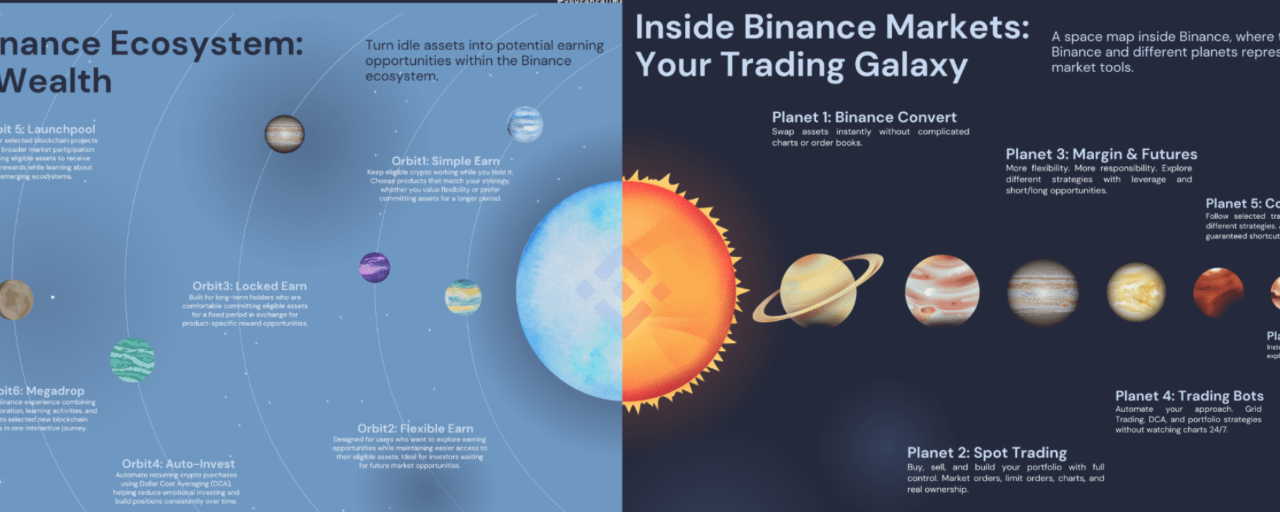
No new planet this time... because this final episode brings the entire Binance universe together. 🌌 Swipe through the posters from the previous episodes and discover how every product, every feature, and every innovation connects to make Binance a true Financial Super App. The journey doesn't end here, it all comes together.
Inside Binance - Episode 5 and Last: Where Everything Connects
Introduction: When an Exchange Becomes Something More
When most people hear the word Binance, the first thing that comes to mind is buying Bitcoin. It's understandable, millions of users downloaded the app for exactly that reason. Some wanted to purchase their first cryptocurrency, others wanted to trade, while many simply wanted to understand why digital assets had become one of the biggest financial conversations of our generation. But the longer you spend inside Binance, the more you realize something interesting: buying crypto is only the beginning.
Think back to the first time you downloaded any financial application. Most apps were designed to solve one problem. Your banking app lets you manage your bank account. A stock broker allows you to invest in stocks. A payment application lets you send money. A learning platform teaches you. A social media platform helps you connect with people. Every service existed in its own separate world, forcing users to switch between multiple applications just to complete one financial journey.
Binance took a different approach.
Instead of building another exchange, Binance gradually developed an ecosystem where investing, trading, payments, education, communities, research, Web3, and digital ownership all connect under one platform. That's the difference between using an exchange and using a Financial Super App. The goal isn't to make users spend more time inside one application. The goal is to make every part of their financial journey feel connected. Let's explore the side of Binance that many people never discover.
Binance Pay: When Crypto Becomes Everyday Money
One of the biggest misconceptions about cryptocurrency is that it's only useful for buying low and selling high. While investing remains an important part of the ecosystem, digital assets were also created with another vision: transferring value quickly, efficiently, and without unnecessary barriers. This is exactly where Binance Pay comes in. Instead of treating your crypto as something that only lives inside your portfolio, Binance Pay transforms supported digital assets into a practical payment solution. Users can send and receive supported cryptocurrencies with other Binance users, pay participating merchants, and complete transactions through QR codes, all without leaving the ecosystem.
Imagine you're traveling with three friends. The restaurant bill arrives, and one person pays for everyone. Instead of calculating cash, waiting for bank transfers, or worrying about international payment delays, you simply open Binance Pay, scan their QR code, and instantly send your share using supported digital assets. The payment takes seconds, and both of you continue enjoying your evening. That same simplicity extends beyond friends. Binance Pay has continued expanding its merchant ecosystem, allowing eligible users to make payments for goods and services with supported cryptocurrencies wherever the feature is available. The experience feels less like moving money between wallets and more like using digital finance the way it was always imagined, fast, borderless, and integrated.
The beauty of Binance Pay isn't simply that it moves money. It's that it connects naturally with everything else inside Binance. The assets you invested in yesterday could become tomorrow's payment method without needing to leave the ecosystem.
Binance P2P: Connecting People, Not Just Markets
Not every country has the same banking infrastructure. Some users have direct access to crypto purchases through their local banks, while others face restrictions, limited payment options, or unavailable services. Binance recognized that accessibility shouldn't depend entirely on traditional financial systems, which is why Binance P2P became one of the platform's most important products. Unlike traditional exchanges where users only interact with the platform itself, Binance P2P allows buyers and sellers to trade directly with one another while Binance provides an escrow service that helps protect both parties throughout the transaction. The seller's crypto remains securely held until payment is confirmed, creating an additional layer of confidence for both sides. Imagine a university student who wants to purchase $100 worth of USDT using a local payment method that's commonly used in their country but unavailable through international exchanges. Instead of giving up, they open Binance P2P, browse verified offers, choose a seller with a strong transaction history, complete the payment through their preferred method, and receive the crypto once the transaction is confirmed. On the other side of the transaction might be someone looking to sell part of their digital assets while receiving payment through the same local banking system. Binance simply becomes the bridge connecting two people who need opposite things at the same moment. This peer-to-peer model has played an important role in making cryptocurrency more accessible across different regions of the world. Rather than forcing every user into one payment solution, Binance adapts to local markets by supporting numerous payment methods and currencies, allowing more people to participate in the digital economy.
Binance Wallet & Web3: Owning More Than an Account
As the internet continues evolving, one phrase appears more often than almost any other: Web3.
For many beginners, Web3 sounds complicated, filled with unfamiliar terminology and technical concepts. In reality, one of its biggest ideas is surprisingly simple: giving users greater ownership over their digital lives.
Traditional internet platforms store most of your digital activity inside their own systems. Your account, your information, and your digital identity often remain tied to a single company. Web3 introduces a different philosophy where users can interact with decentralized applications, manage digital assets, and explore blockchain ecosystems through their own wallets.
Binance Wallet acts as a gateway into that world. Instead of stopping at buying cryptocurrencies, users can explore decentralized applications, participate in different blockchain ecosystems, manage digital assets, and interact with Web3 experiences, all while remaining connected to the broader Binance ecosystem. Imagine discovering a new decentralized finance application that allows users to interact directly with blockchain protocols. Instead of creating multiple accounts across different services, managing complicated wallet setups, or constantly switching between platforms, Binance Wallet helps simplify that journey by bringing Web3 exploration closer to the familiar Binance experience. The important lesson isn't that everyone should immediately explore every decentralized application available. It's understanding that cryptocurrency is no longer only about coins. It has evolved into entire digital ecosystems where ownership, technology, applications, and communities interact in ways that traditional finance never could.
Gift Cards: Giving Digital Assets a Personal Touch
When people think about giving gifts, they usually imagine physical objects, a watch, a book, a gift voucher, or perhaps cash inside an envelope. Cryptocurrency has introduced another possibility, and Binance Gift Cards make sharing digital assets feel surprisingly familiar.
Instead of transferring crypto through wallet addresses that may intimidate beginners, Binance Gift Cards allow eligible users to send supported digital assets through a more accessible and enjoyable experience. Whether celebrating a birthday, congratulating a graduate, rewarding an employee, or introducing a friend to crypto for the very first time, the process feels much more personal than a standard blockchain transaction.
Imagine your younger brother has spent months learning about Bitcoin but has never actually owned any. Rather than explaining private keys, exchanges, and trading interfaces all at once, you decide to surprise him with his first crypto gift through a Binance Gift Card. In just a few moments, you've transformed what could have been a complicated onboarding process into an exciting memory that introduces him to an entirely new financial world.
Small experiences like these highlight something bigger about Binance. Every product isn't designed only for experienced traders. Many are built to make digital finance feel more approachable, practical, and connected to everyday life.
As the Binance ecosystem continues growing, it becomes increasingly clear that buying and selling cryptocurrencies represents only one chapter of a much larger story. In the next part of this episode, we'll explore how Binance combines education, research, communities, developer tools, institutional services, and industry-leading security to complete the Financial Super App experience, and why two people can both say, "I use Binance," while experiencing completely different worlds inside the very same platform.
Binance Square: Where the Crypto Conversation Never Sleeps
Financial markets never truly stop, and neither do the conversations surrounding them. New technologies emerge, regulations evolve, blockchain projects launch, and market sentiment can shift within minutes. In the past, staying informed often meant jumping between multiple social media platforms, news websites, research blogs, and community forums just to understand what was happening. Binance wanted to simplify that experience by creating a place where information, education, discussion, and community could exist together.
That's exactly what Binance Square was designed to do.
Rather than being just another social media feed, Binance Square has become the voice of the Binance ecosystem. Users can discover official announcements, follow their favorite creators, read educational articles, analyze market opinions, participate in discussions, and interact with millions of people who share the same passion for blockchain technology. Whether you're looking for a beginner-friendly explanation of Bitcoin, a technical analysis on Ethereum, or breaking news about a newly listed project, everything lives inside the same ecosystem.
Imagine waking up one morning to find Bitcoin moving 8% overnight. Instead of opening five different applications trying to understand why the market moved, you simply open Binance Square. Within minutes you're reading official Binance announcements, expert opinions, educational breakdowns, community reactions, and discussions from creators around the world. Suddenly, you're not just seeing the market move, you understand the story behind it.
For creators like myself, Binance Square has also become much more than a publishing platform. It's a place where knowledge is shared, discussions are created, and communities continue growing every single day. Every article, thread, and educational post has the potential to help someone take their first step into crypto or deepen the understanding of someone who's already been in the space for years.
Binance Academy: Because Knowledge Is the Best Investment
One of the biggest mistakes beginners make is believing they need to invest before they learn. In reality, the smartest investment you'll ever make isn't Bitcoin, Ethereum, or any other asset, it's investing in your own knowledge.
That's the philosophy behind Binance Academy.
Binance Academy is one of the largest free educational libraries in the blockchain industry, offering hundreds of articles, guides, glossaries, and lessons covering everything from basic cryptocurrency concepts to advanced blockchain technology. Whether someone has never heard the term "blockchain" before or wants to understand zero-knowledge proofs, tokenomics, decentralized finance, or cryptography, there's always another lesson waiting.
Imagine your father asks you what Bitcoin actually is. You could try explaining blockchain yourself, or you could open Binance Academy and find a professionally written article designed specifically for beginners. Now imagine six months later you're researching smart contracts, proof-of-stake consensus mechanisms, or Layer-2 scaling solutions. You're still using the same Academy, but your educational journey has evolved.
That's one of the things I admire most about Binance. The platform doesn't assume everyone arrives with the same level of knowledge. It grows with you. The more curious you become, the deeper the educational resources become as well.
Binance Research: Looking Beyond the Headlines
In today's world, information is everywhere. Unfortunately, quality information is much harder to find. A project starts trending on social media, influencers begin talking about it, prices start moving, and suddenly thousands of people invest without understanding what they're actually buying. Binance Research encourages a completely different mindset. Instead of following hype, research the fundamentals. Binance Research provides in-depth reports covering blockchain projects, tokenomics, industry sectors, technological innovations, market developments, and macroeconomic trends affecting the digital asset space. Rather than asking, "Is this token pumping?" it encourages users to ask, "Why does this project exist? What problem does it solve? Who built it? How does its economy work?" Imagine discovering a newly launched blockchain project that's suddenly everywhere on social media. Instead of investing because everyone else seems excited, you spend thirty minutes reading a research report explaining the project's vision, technology, competitive advantages, token distribution, roadmap, and potential risks. Whether you decide to invest or not becomes far less important than the fact that your decision was informed rather than emotional. Markets reward knowledge far more consistently than excitement.
Communities & Events: Building More Than Technology
One of the easiest ways to judge a company is by looking at its products. One of the best ways to judge an ecosystem is by looking at its people.
Behind every Binance product exists one of the largest blockchain communities in the world. From local meetups and online workshops to global conferences, university programs, creator initiatives, hackathons, and community campaigns, Binance has built an ecosystem where people don't simply use the platform, they become part of it.
I've experienced this personally through my own journey as a Binance Angel. What started as curiosity about cryptocurrency eventually became an opportunity to educate communities, organize activities, connect with people from different countries, attend global events, and contribute to something much larger than myself. The friendships, conversations, and experiences I've gained remind me that blockchain has never been only about technology. It's always been about people. Imagine attending your first Binance meetup. You walk into the room expecting to hear people talk about Bitcoin prices. Instead, you leave after discussing entrepreneurship, artificial intelligence, blockchain development, financial freedom, digital identity, and the future of technology with people from completely different backgrounds. That's when you realize Binance isn't simply growing a platform. It's growing a global community.
Developer Ecosystem & APIs: Building on Top of Binance
Every great ecosystem eventually reaches a point where people no longer only use it, they start building with it. Behind the familiar Binance interface lies an extensive developer ecosystem that allows businesses, entrepreneurs, analysts, and software developers to create entirely new experiences using Binance infrastructure. Through APIs and developer tools, users can build automated trading bots, portfolio management systems, analytical dashboards, payment integrations, business applications, and countless other solutions. Imagine owning an online business that accepts cryptocurrency payments. Instead of creating your own blockchain infrastructure from scratch, developer tools allow you to integrate existing Binance services into your business, saving time while expanding the payment options available to your customers. The same ecosystem also supports developers creating educational tools, trading applications, market analytics, and financial software that millions of users may eventually benefit from. Innovation doesn't stop at Binance, it grows because thousands of developers continue expanding what's possible.
Institutional Services: Built for More Than Individuals
While millions of individuals use Binance every day, the platform also serves organizations operating on a completely different scale.
Investment firms, corporate treasuries, family offices, asset managers, liquidity providers, and institutional investors all have different needs than everyday retail users. Large transactions require specialized services, deeper liquidity, professional infrastructure, and dedicated support.
Binance Institutional was created to meet those demands, offering solutions designed specifically for professional market participants while maintaining the same commitment to efficiency and innovation found throughout the broader ecosystem.
This reminds us that the Binance ecosystem isn't designed for one type of user. Whether someone is investing their first 100$ or managing millions of dollars professionally, the platform continues expanding to serve different financial journeys.
Security: The Foundation Holding Everything Together
None of these products would matter if users didn't trust the platform protecting them. Security isn't another feature inside Binance. It's the foundation supporting every other feature. From Two-Factor Authentication, passkeys, anti-phishing codes, withdrawal address management, device verification, account monitoring, Proof of Reserves, advanced risk management systems, and continuous security improvements, Binance has invested heavily in building multiple layers of protection designed to help users safeguard their accounts and digital assets. Imagine someone somehow discovers your account password. Years ago, that could have been enough to compromise an account. Today, multiple security layers may require additional verification, recognize unfamiliar devices, identify suspicious activity, and provide users with tools to significantly strengthen account protection before unauthorized access becomes possible. Good security is something users rarely think about. Great security is something users hopefully never have to think about at all.
One App. Millions of Different Journeys.
Imagine two people opening Binance this morning.
The first opens the app to buy 100$ worth of Bitcoin before closing it a few minutes later. Their goal is simple: begin investing. The second starts the morning by reviewing a diversified portfolio of cryptocurrencies and, where available, stock-related products. They subscribe eligible assets to Simple Earn, check the performance of a Launchpool project they recently joined, pay a friend through Binance Pay, scroll through Binance Square to catch up on market news, complete a lesson on Binance Academy, read a Binance Research report before making an investment decision, connect their Binance Wallet to explore a Web3 application, and finish the evening joining an online Binance community event discussing the future of blockchain technology.
At the end of the day, both people say exactly the same sentence:
"I use Binance."
Yet their experiences couldn't be more different. One sees an exchange. The other sees an entire financial ecosystem.
That's what truly defines a Financial Super App. It isn't built around one feature, one market, or one investment product. It's defined by how seamlessly it connects investing, trading, earning, payments, education, research, Web3, communities, developers, institutions, and innovation into one continuously evolving platform. Every product strengthens another, allowing users to create a financial journey that's completely their own.
Throughout this series, we've explored the Binance universe one layer at a time. We started by discovering why Binance is more than an exchange, learned how to build diversified portfolios, explored the depth of its trading ecosystem, uncovered the passive wealth opportunities inside Binance Earn, and finally stepped beyond investing to discover everything else quietly powering the platform behind the scenes.
The universe isn't extraordinary because it contains one planet. It's extraordinary because millions of celestial bodies work together to create something infinitely larger than themselves.
The same can be said about Binance. It isn't one product. It isn't one service. It isn't one market. It's an ecosystem, and that's what makes Binance a true Financial Super App.
#BinanceEcosystem #BinanceSuperApp
No new planet this time... because this final episode brings the entire Binance universe together. 🌌 Swipe through the posters from the previous episodes and discover how every product, every feature, and every innovation connects to make Binance a true Financial Super App. The journey doesn't end here, it all comes together.
When most people hear the word Binance, the first thing that comes to mind is buying Bitcoin. It's understandable, millions of users downloaded the app for exactly that reason. Some wanted to purchase their first cryptocurrency, others wanted to trade, while many simply wanted to understand why digital assets had become one of the biggest financial conversations of our generation. But the longer you spend inside Binance, the more you realize something interesting: buying crypto is only the beginning.
Think back to the first time you downloaded any financial application. Most apps were designed to solve one problem. Your banking app lets you manage your bank account. A stock broker allows you to invest in stocks. A payment application lets you send money. A learning platform teaches you. A social media platform helps you connect with people. Every service existed in its own separate world, forcing users to switch between multiple applications just to complete one financial journey.
Binance took a different approach.
Instead of building another exchange, Binance gradually developed an ecosystem where investing, trading, payments, education, communities, research, Web3, and digital ownership all connect under one platform. That's the difference between using an exchange and using a Financial Super App. The goal isn't to make users spend more time inside one application. The goal is to make every part of their financial journey feel connected. Let's explore the side of Binance that many people never discover.
Binance Pay: When Crypto Becomes Everyday Money
One of the biggest misconceptions about cryptocurrency is that it's only useful for buying low and selling high. While investing remains an important part of the ecosystem, digital assets were also created with another vision: transferring value quickly, efficiently, and without unnecessary barriers. This is exactly where Binance Pay comes in. Instead of treating your crypto as something that only lives inside your portfolio, Binance Pay transforms supported digital assets into a practical payment solution. Users can send and receive supported cryptocurrencies with other Binance users, pay participating merchants, and complete transactions through QR codes, all without leaving the ecosystem.
Imagine you're traveling with three friends. The restaurant bill arrives, and one person pays for everyone. Instead of calculating cash, waiting for bank transfers, or worrying about international payment delays, you simply open Binance Pay, scan their QR code, and instantly send your share using supported digital assets. The payment takes seconds, and both of you continue enjoying your evening. That same simplicity extends beyond friends. Binance Pay has continued expanding its merchant ecosystem, allowing eligible users to make payments for goods and services with supported cryptocurrencies wherever the feature is available. The experience feels less like moving money between wallets and more like using digital finance the way it was always imagined, fast, borderless, and integrated.
The beauty of Binance Pay isn't simply that it moves money. It's that it connects naturally with everything else inside Binance. The assets you invested in yesterday could become tomorrow's payment method without needing to leave the ecosystem.
Binance P2P: Connecting People, Not Just Markets
Not every country has the same banking infrastructure. Some users have direct access to crypto purchases through their local banks, while others face restrictions, limited payment options, or unavailable services. Binance recognized that accessibility shouldn't depend entirely on traditional financial systems, which is why Binance P2P became one of the platform's most important products. Unlike traditional exchanges where users only interact with the platform itself, Binance P2P allows buyers and sellers to trade directly with one another while Binance provides an escrow service that helps protect both parties throughout the transaction. The seller's crypto remains securely held until payment is confirmed, creating an additional layer of confidence for both sides. Imagine a university student who wants to purchase $100 worth of USDT using a local payment method that's commonly used in their country but unavailable through international exchanges. Instead of giving up, they open Binance P2P, browse verified offers, choose a seller with a strong transaction history, complete the payment through their preferred method, and receive the crypto once the transaction is confirmed. On the other side of the transaction might be someone looking to sell part of their digital assets while receiving payment through the same local banking system. Binance simply becomes the bridge connecting two people who need opposite things at the same moment. This peer-to-peer model has played an important role in making cryptocurrency more accessible across different regions of the world. Rather than forcing every user into one payment solution, Binance adapts to local markets by supporting numerous payment methods and currencies, allowing more people to participate in the digital economy.
Binance Wallet & Web3: Owning More Than an Account
As the internet continues evolving, one phrase appears more often than almost any other: Web3.
For many beginners, Web3 sounds complicated, filled with unfamiliar terminology and technical concepts. In reality, one of its biggest ideas is surprisingly simple: giving users greater ownership over their digital lives.
Traditional internet platforms store most of your digital activity inside their own systems. Your account, your information, and your digital identity often remain tied to a single company. Web3 introduces a different philosophy where users can interact with decentralized applications, manage digital assets, and explore blockchain ecosystems through their own wallets.
Binance Wallet acts as a gateway into that world. Instead of stopping at buying cryptocurrencies, users can explore decentralized applications, participate in different blockchain ecosystems, manage digital assets, and interact with Web3 experiences, all while remaining connected to the broader Binance ecosystem. Imagine discovering a new decentralized finance application that allows users to interact directly with blockchain protocols. Instead of creating multiple accounts across different services, managing complicated wallet setups, or constantly switching between platforms, Binance Wallet helps simplify that journey by bringing Web3 exploration closer to the familiar Binance experience. The important lesson isn't that everyone should immediately explore every decentralized application available. It's understanding that cryptocurrency is no longer only about coins. It has evolved into entire digital ecosystems where ownership, technology, applications, and communities interact in ways that traditional finance never could.
Gift Cards: Giving Digital Assets a Personal Touch
When people think about giving gifts, they usually imagine physical objects, a watch, a book, a gift voucher, or perhaps cash inside an envelope. Cryptocurrency has introduced another possibility, and Binance Gift Cards make sharing digital assets feel surprisingly familiar.
Instead of transferring crypto through wallet addresses that may intimidate beginners, Binance Gift Cards allow eligible users to send supported digital assets through a more accessible and enjoyable experience. Whether celebrating a birthday, congratulating a graduate, rewarding an employee, or introducing a friend to crypto for the very first time, the process feels much more personal than a standard blockchain transaction.
Imagine your younger brother has spent months learning about Bitcoin but has never actually owned any. Rather than explaining private keys, exchanges, and trading interfaces all at once, you decide to surprise him with his first crypto gift through a Binance Gift Card. In just a few moments, you've transformed what could have been a complicated onboarding process into an exciting memory that introduces him to an entirely new financial world.
Small experiences like these highlight something bigger about Binance. Every product isn't designed only for experienced traders. Many are built to make digital finance feel more approachable, practical, and connected to everyday life.
As the Binance ecosystem continues growing, it becomes increasingly clear that buying and selling cryptocurrencies represents only one chapter of a much larger story. In the next part of this episode, we'll explore how Binance combines education, research, communities, developer tools, institutional services, and industry-leading security to complete the Financial Super App experience, and why two people can both say, "I use Binance," while experiencing completely different worlds inside the very same platform.
Binance Square: Where the Crypto Conversation Never Sleeps
Financial markets never truly stop, and neither do the conversations surrounding them. New technologies emerge, regulations evolve, blockchain projects launch, and market sentiment can shift within minutes. In the past, staying informed often meant jumping between multiple social media platforms, news websites, research blogs, and community forums just to understand what was happening. Binance wanted to simplify that experience by creating a place where information, education, discussion, and community could exist together.
That's exactly what Binance Square was designed to do.
Rather than being just another social media feed, Binance Square has become the voice of the Binance ecosystem. Users can discover official announcements, follow their favorite creators, read educational articles, analyze market opinions, participate in discussions, and interact with millions of people who share the same passion for blockchain technology. Whether you're looking for a beginner-friendly explanation of Bitcoin, a technical analysis on Ethereum, or breaking news about a newly listed project, everything lives inside the same ecosystem.
Imagine waking up one morning to find Bitcoin moving 8% overnight. Instead of opening five different applications trying to understand why the market moved, you simply open Binance Square. Within minutes you're reading official Binance announcements, expert opinions, educational breakdowns, community reactions, and discussions from creators around the world. Suddenly, you're not just seeing the market move, you understand the story behind it.
For creators like myself, Binance Square has also become much more than a publishing platform. It's a place where knowledge is shared, discussions are created, and communities continue growing every single day. Every article, thread, and educational post has the potential to help someone take their first step into crypto or deepen the understanding of someone who's already been in the space for years.
Binance Academy: Because Knowledge Is the Best Investment
One of the biggest mistakes beginners make is believing they need to invest before they learn. In reality, the smartest investment you'll ever make isn't Bitcoin, Ethereum, or any other asset, it's investing in your own knowledge.
That's the philosophy behind Binance Academy.
Binance Academy is one of the largest free educational libraries in the blockchain industry, offering hundreds of articles, guides, glossaries, and lessons covering everything from basic cryptocurrency concepts to advanced blockchain technology. Whether someone has never heard the term "blockchain" before or wants to understand zero-knowledge proofs, tokenomics, decentralized finance, or cryptography, there's always another lesson waiting.
Imagine your father asks you what Bitcoin actually is. You could try explaining blockchain yourself, or you could open Binance Academy and find a professionally written article designed specifically for beginners. Now imagine six months later you're researching smart contracts, proof-of-stake consensus mechanisms, or Layer-2 scaling solutions. You're still using the same Academy, but your educational journey has evolved.
That's one of the things I admire most about Binance. The platform doesn't assume everyone arrives with the same level of knowledge. It grows with you. The more curious you become, the deeper the educational resources become as well.
Binance Research: Looking Beyond the Headlines
In today's world, information is everywhere. Unfortunately, quality information is much harder to find. A project starts trending on social media, influencers begin talking about it, prices start moving, and suddenly thousands of people invest without understanding what they're actually buying. Binance Research encourages a completely different mindset. Instead of following hype, research the fundamentals. Binance Research provides in-depth reports covering blockchain projects, tokenomics, industry sectors, technological innovations, market developments, and macroeconomic trends affecting the digital asset space. Rather than asking, "Is this token pumping?" it encourages users to ask, "Why does this project exist? What problem does it solve? Who built it? How does its economy work?" Imagine discovering a newly launched blockchain project that's suddenly everywhere on social media. Instead of investing because everyone else seems excited, you spend thirty minutes reading a research report explaining the project's vision, technology, competitive advantages, token distribution, roadmap, and potential risks. Whether you decide to invest or not becomes far less important than the fact that your decision was informed rather than emotional. Markets reward knowledge far more consistently than excitement.
Communities & Events: Building More Than Technology
One of the easiest ways to judge a company is by looking at its products. One of the best ways to judge an ecosystem is by looking at its people.
Behind every Binance product exists one of the largest blockchain communities in the world. From local meetups and online workshops to global conferences, university programs, creator initiatives, hackathons, and community campaigns, Binance has built an ecosystem where people don't simply use the platform, they become part of it.
I've experienced this personally through my own journey as a Binance Angel. What started as curiosity about cryptocurrency eventually became an opportunity to educate communities, organize activities, connect with people from different countries, attend global events, and contribute to something much larger than myself. The friendships, conversations, and experiences I've gained remind me that blockchain has never been only about technology. It's always been about people. Imagine attending your first Binance meetup. You walk into the room expecting to hear people talk about Bitcoin prices. Instead, you leave after discussing entrepreneurship, artificial intelligence, blockchain development, financial freedom, digital identity, and the future of technology with people from completely different backgrounds. That's when you realize Binance isn't simply growing a platform. It's growing a global community.
Developer Ecosystem & APIs: Building on Top of Binance
Every great ecosystem eventually reaches a point where people no longer only use it, they start building with it. Behind the familiar Binance interface lies an extensive developer ecosystem that allows businesses, entrepreneurs, analysts, and software developers to create entirely new experiences using Binance infrastructure. Through APIs and developer tools, users can build automated trading bots, portfolio management systems, analytical dashboards, payment integrations, business applications, and countless other solutions. Imagine owning an online business that accepts cryptocurrency payments. Instead of creating your own blockchain infrastructure from scratch, developer tools allow you to integrate existing Binance services into your business, saving time while expanding the payment options available to your customers. The same ecosystem also supports developers creating educational tools, trading applications, market analytics, and financial software that millions of users may eventually benefit from. Innovation doesn't stop at Binance, it grows because thousands of developers continue expanding what's possible.
Institutional Services: Built for More Than Individuals
While millions of individuals use Binance every day, the platform also serves organizations operating on a completely different scale.
Investment firms, corporate treasuries, family offices, asset managers, liquidity providers, and institutional investors all have different needs than everyday retail users. Large transactions require specialized services, deeper liquidity, professional infrastructure, and dedicated support.
Binance Institutional was created to meet those demands, offering solutions designed specifically for professional market participants while maintaining the same commitment to efficiency and innovation found throughout the broader ecosystem.
This reminds us that the Binance ecosystem isn't designed for one type of user. Whether someone is investing their first 100$ or managing millions of dollars professionally, the platform continues expanding to serve different financial journeys.
Security: The Foundation Holding Everything Together
None of these products would matter if users didn't trust the platform protecting them. Security isn't another feature inside Binance. It's the foundation supporting every other feature. From Two-Factor Authentication, passkeys, anti-phishing codes, withdrawal address management, device verification, account monitoring, Proof of Reserves, advanced risk management systems, and continuous security improvements, Binance has invested heavily in building multiple layers of protection designed to help users safeguard their accounts and digital assets. Imagine someone somehow discovers your account password. Years ago, that could have been enough to compromise an account. Today, multiple security layers may require additional verification, recognize unfamiliar devices, identify suspicious activity, and provide users with tools to significantly strengthen account protection before unauthorized access becomes possible. Good security is something users rarely think about. Great security is something users hopefully never have to think about at all.
One App. Millions of Different Journeys.
Imagine two people opening Binance this morning.
The first opens the app to buy 100$ worth of Bitcoin before closing it a few minutes later. Their goal is simple: begin investing. The second starts the morning by reviewing a diversified portfolio of cryptocurrencies and, where available, stock-related products. They subscribe eligible assets to Simple Earn, check the performance of a Launchpool project they recently joined, pay a friend through Binance Pay, scroll through Binance Square to catch up on market news, complete a lesson on Binance Academy, read a Binance Research report before making an investment decision, connect their Binance Wallet to explore a Web3 application, and finish the evening joining an online Binance community event discussing the future of blockchain technology.
At the end of the day, both people say exactly the same sentence:
"I use Binance."
Yet their experiences couldn't be more different. One sees an exchange. The other sees an entire financial ecosystem.
That's what truly defines a Financial Super App. It isn't built around one feature, one market, or one investment product. It's defined by how seamlessly it connects investing, trading, earning, payments, education, research, Web3, communities, developers, institutions, and innovation into one continuously evolving platform. Every product strengthens another, allowing users to create a financial journey that's completely their own.
Throughout this series, we've explored the Binance universe one layer at a time. We started by discovering why Binance is more than an exchange, learned how to build diversified portfolios, explored the depth of its trading ecosystem, uncovered the passive wealth opportunities inside Binance Earn, and finally stepped beyond investing to discover everything else quietly powering the platform behind the scenes.
The universe isn't extraordinary because it contains one planet. It's extraordinary because millions of celestial bodies work together to create something infinitely larger than themselves.
The same can be said about Binance. It isn't one product. It isn't one service. It isn't one market. It's an ecosystem, and that's what makes Binance a true Financial Super App.
#BinanceEcosystem #BinanceSuperApp
No new planet this time... because this final episode brings the entire Binance universe together. 🌌 Swipe through the posters from the previous episodes and discover how every product, every feature, and every innovation connects to make Binance a true Financial Super App. The journey doesn't end here, it all comes together.
1
1.3k

·
--

Article
BINANCE: THE MASTER MOVE TO BECOME THE FINANCIAL SUPERAPP1. THE SIGNAL THAT THE MARKET MISSED
the launch of bStocks isn't just a new product on the shelf. no way.
it's a clear signal. a strategic play that defines where binance is aiming: the center of the global financial universe.
think of it as the next evolution of the platform, not just for crypto, but for everything.
2. THE BREAK OF TRADFI: 24/7 AND BORDERLESS
traditional markets sleep. binance, never.
with the bStocks offering, we're talking about trading tokenized stocks 24/7. while wall street takes its nap, the global market keeps moving.
BINANCE: THE MASTER MOVE TO BECOME THE FINANCIAL SUPERAPP
1. THE SIGNAL THAT THE MARKET MISSED
the launch of bStocks isn't just a new product on the shelf. no way.
it's a clear signal. a strategic play that defines where binance is aiming: the center of the global financial universe.
think of it as the next evolution of the platform, not just for crypto, but for everything.
2. THE BREAK OF TRADFI: 24/7 AND BORDERLESS
traditional markets sleep. binance, never.
with the bStocks offering, we're talking about trading tokenized stocks 24/7. while wall street takes its nap, the global market keeps moving.
the launch of bStocks isn't just a new product on the shelf. no way.
it's a clear signal. a strategic play that defines where binance is aiming: the center of the global financial universe.
think of it as the next evolution of the platform, not just for crypto, but for everything.
2. THE BREAK OF TRADFI: 24/7 AND BORDERLESS
traditional markets sleep. binance, never.
with the bStocks offering, we're talking about trading tokenized stocks 24/7. while wall street takes its nap, the global market keeps moving.
133
🎮 YOU JUST ENTERED THE SUPERAPP GAME
LEVEL 1 — CRYPTO 🚀
You wake up.
Bitcoin is moving.
Ethereum is moving.
Your phone is full of charts, candles and headlines.
You look at the screen:
“Okay… what exactly am I looking at?”
Welcome to Level 1.
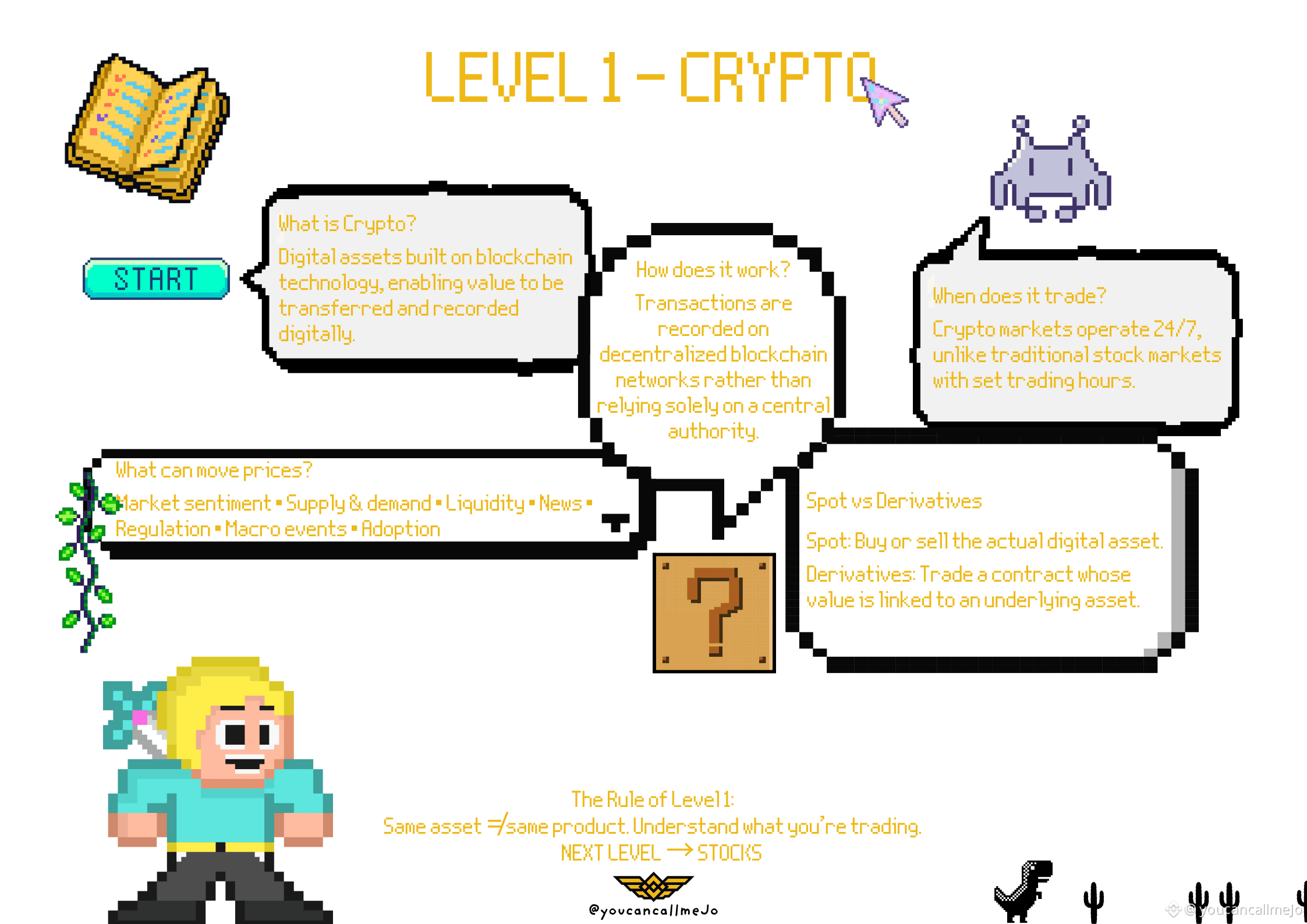
🚀 WHAT IS CRYPTO?
Cryptocurrency is a digital asset built on blockchain technology. Bitcoin was the first major example, but today's crypto ecosystem includes thousands of different assets with different purposes.
Unlike traditional markets, crypto markets operate 24/7.
That means the market doesn't wait for Monday morning to react to breaking news.
🌐 BUT HERE'S THE IMPORTANT PART:
Not every crypto product means the same thing.
Spot generally means buying or selling the actual digital asset.
Derivatives are contracts whose value is linked to an underlying asset.
Same Bitcoin.
Different product.
And that's one of the first rules of the financial game:
Don't just learn the asset. Learn the product.
⚡ WHY DOES CRYPTO MOVE SO MUCH?
Prices can react to sentiment, liquidity, news, regulation, macroeconomic events, adoption and supply-demand dynamics.
And because the market never really closes, information can be reflected in prices at any hour.
🎮 LEVEL 1 COMPLETE
You just learned:
🚀 What crypto is
🌐 Why it trades 24/7
🧩 Spot vs derivatives
⚡ What can move crypto markets
But the game isn't over.
You walk through the next door…
A stock ticker lights up.
📈 LEVEL 2: STOCKS
Loading…
#Binance #BTC #bitcoin #BinanceSuperApp #crypto
🎮 YOU JUST ENTERED THE SUPERAPP GAME
LEVEL 1 — CRYPTO 🚀
You wake up.
Bitcoin is moving.
Ethereum is moving.
Your phone is full of charts, candles and headlines.
You look at the screen:
“Okay… what exactly am I looking at?”
Welcome to Level 1.
🚀 WHAT IS CRYPTO?
Cryptocurrency is a digital asset built on blockchain technology. Bitcoin was the first major example, but today's crypto ecosystem includes thousands of different assets with different purposes.
Unlike traditional markets, crypto markets operate 24/7.
That means the market doesn't wait for Monday morning to react to breaking news.
🌐 BUT HERE'S THE IMPORTANT PART:
Not every crypto product means the same thing.
Spot generally means buying or selling the actual digital asset.
Derivatives are contracts whose value is linked to an underlying asset.
Same Bitcoin.
Different product.
And that's one of the first rules of the financial game:
Don't just learn the asset. Learn the product.
⚡ WHY DOES CRYPTO MOVE SO MUCH?
Prices can react to sentiment, liquidity, news, regulation, macroeconomic events, adoption and supply-demand dynamics.
And because the market never really closes, information can be reflected in prices at any hour.
🎮 LEVEL 1 COMPLETE
You just learned:
🚀 What crypto is
🌐 Why it trades 24/7
🧩 Spot vs derivatives
⚡ What can move crypto markets
But the game isn't over.
You walk through the next door…
A stock ticker lights up.
📈 LEVEL 2: STOCKS
Loading…
#Binance #BTC #bitcoin #BinanceSuperApp #crypto
LEVEL 1 — CRYPTO 🚀
You wake up.
Bitcoin is moving.
Ethereum is moving.
Your phone is full of charts, candles and headlines.
You look at the screen:
“Okay… what exactly am I looking at?”
Welcome to Level 1.
🚀 WHAT IS CRYPTO?
Cryptocurrency is a digital asset built on blockchain technology. Bitcoin was the first major example, but today's crypto ecosystem includes thousands of different assets with different purposes.
Unlike traditional markets, crypto markets operate 24/7.
That means the market doesn't wait for Monday morning to react to breaking news.
🌐 BUT HERE'S THE IMPORTANT PART:
Not every crypto product means the same thing.
Spot generally means buying or selling the actual digital asset.
Derivatives are contracts whose value is linked to an underlying asset.
Same Bitcoin.
Different product.
And that's one of the first rules of the financial game:
Don't just learn the asset. Learn the product.
⚡ WHY DOES CRYPTO MOVE SO MUCH?
Prices can react to sentiment, liquidity, news, regulation, macroeconomic events, adoption and supply-demand dynamics.
And because the market never really closes, information can be reflected in prices at any hour.
🎮 LEVEL 1 COMPLETE
You just learned:
🚀 What crypto is
🌐 Why it trades 24/7
🧩 Spot vs derivatives
⚡ What can move crypto markets
But the game isn't over.
You walk through the next door…
A stock ticker lights up.
📈 LEVEL 2: STOCKS
Loading…
#Binance #BTC #bitcoin #BinanceSuperApp #crypto
3
174
🎮 LEVEL 2 — STOCKS 📈
You cleared Level 1. Now the game changes. Welcome to the world of companies, ownership, shares, and stock markets.
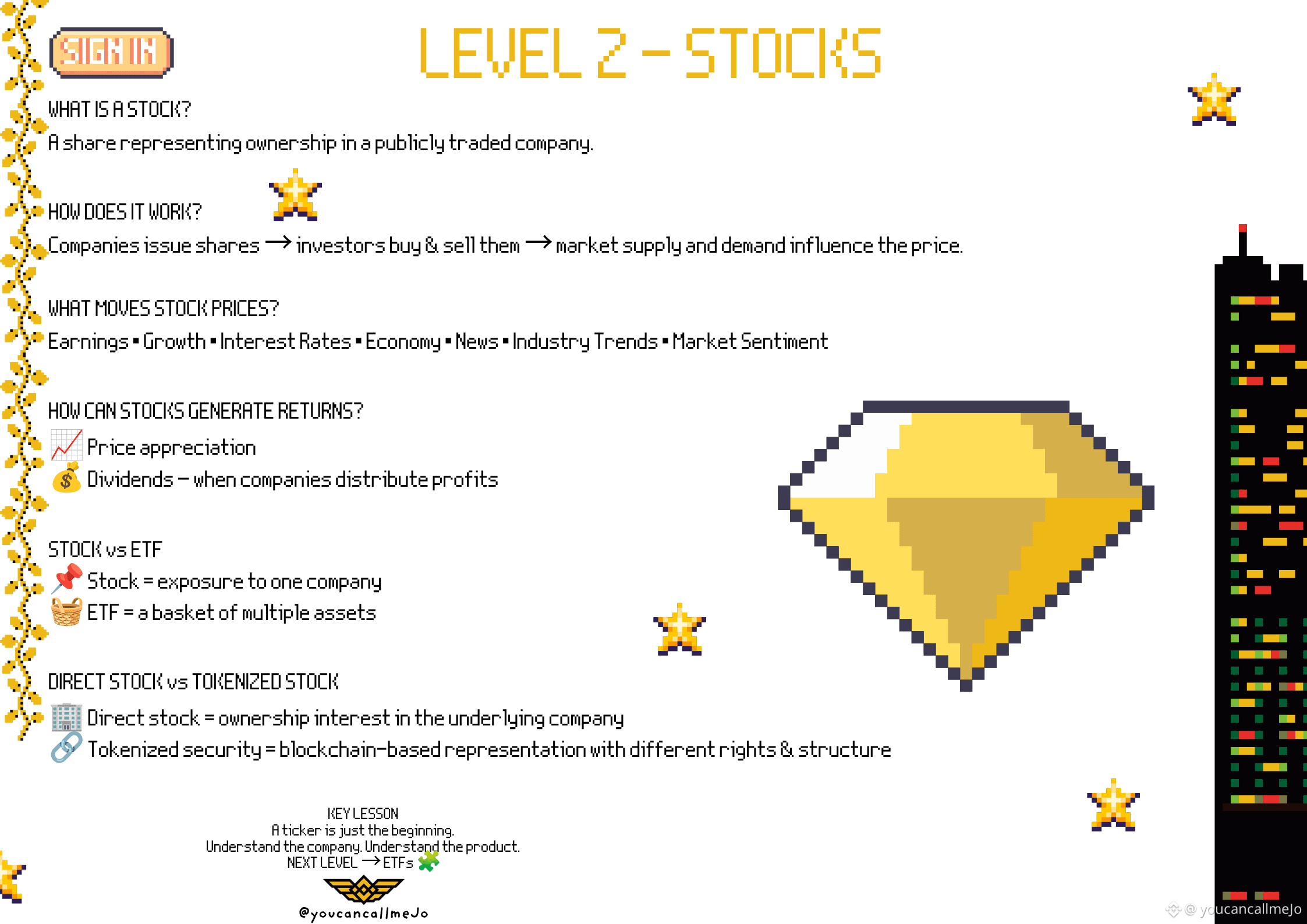
🏢 WHAT IS A STOCK?
A stock represents an ownership interest in a publicly traded company.
When you buy a share, you are gaining exposure to a business — its performance, growth prospects, risks, and future expectations.
📊 WHY DO STOCK PRICES MOVE?
Supply and demand are at the core, but what drives them?
Company earnings • Revenue growth • Future expectations • Interest rates • Economic conditions • Industry trends • Company news • Investor sentiment
A stock can move even when nothing dramatic happened today because markets constantly price in expectations about the future.
💰 HOW CAN STOCKS GENERATE RETURNS?
Two concepts matter:
📈 Price appreciation — the share price increases.
💵 Dividends — some companies distribute part of their profits to shareholders.
Not every company pays dividends. Some reinvest their profits into growing the business.
🧩 STOCK ≠ ETF
A stock gives exposure to a company.
An ETF is a fund that can hold a basket of stocks, bonds, commodities, or other assets.
Think of it like:
🍎 One stock = one apple
🧺 ETF = a basket of apples
🔗 AND THEN COMES TOKENIZATION
Traditional stocks and tokenized stocks are not necessarily the same product.
For example, Binance bStocks are tokenized securities backed 1:1 by corresponding U.S. shares, but they are not direct ownership of the underlying shares. Product availability and eligibility vary by jurisdiction.
🎮 LEVEL 2 LESSON
Don't just learn the ticker.
Understand the company.
Understand the share.
Understand the product you're actually holding.
🔓 NEXT LEVEL → ETFs 🧩
#Binance #Stocks #TradFi #BinanceSuperApp #ETFs
🎮 LEVEL 2 — STOCKS 📈
You cleared Level 1. Now the game changes. Welcome to the world of companies, ownership, shares, and stock markets.
🏢 WHAT IS A STOCK?
A stock represents an ownership interest in a publicly traded company.
When you buy a share, you are gaining exposure to a business — its performance, growth prospects, risks, and future expectations.
📊 WHY DO STOCK PRICES MOVE?
Supply and demand are at the core, but what drives them?
Company earnings • Revenue growth • Future expectations • Interest rates • Economic conditions • Industry trends • Company news • Investor sentiment
A stock can move even when nothing dramatic happened today because markets constantly price in expectations about the future.
💰 HOW CAN STOCKS GENERATE RETURNS?
Two concepts matter:
📈 Price appreciation — the share price increases.
💵 Dividends — some companies distribute part of their profits to shareholders.
Not every company pays dividends. Some reinvest their profits into growing the business.
🧩 STOCK ≠ ETF
A stock gives exposure to a company.
An ETF is a fund that can hold a basket of stocks, bonds, commodities, or other assets.
Think of it like:
🍎 One stock = one apple
🧺 ETF = a basket of apples
🔗 AND THEN COMES TOKENIZATION
Traditional stocks and tokenized stocks are not necessarily the same product.
For example, Binance bStocks are tokenized securities backed 1:1 by corresponding U.S. shares, but they are not direct ownership of the underlying shares. Product availability and eligibility vary by jurisdiction.
🎮 LEVEL 2 LESSON
Don't just learn the ticker.
Understand the company.
Understand the share.
Understand the product you're actually holding.
🔓 NEXT LEVEL → ETFs 🧩
#Binance #Stocks #TradFi #BinanceSuperApp #ETFs
You cleared Level 1. Now the game changes. Welcome to the world of companies, ownership, shares, and stock markets.
🏢 WHAT IS A STOCK?
A stock represents an ownership interest in a publicly traded company.
When you buy a share, you are gaining exposure to a business — its performance, growth prospects, risks, and future expectations.
📊 WHY DO STOCK PRICES MOVE?
Supply and demand are at the core, but what drives them?
Company earnings • Revenue growth • Future expectations • Interest rates • Economic conditions • Industry trends • Company news • Investor sentiment
A stock can move even when nothing dramatic happened today because markets constantly price in expectations about the future.
💰 HOW CAN STOCKS GENERATE RETURNS?
Two concepts matter:
📈 Price appreciation — the share price increases.
💵 Dividends — some companies distribute part of their profits to shareholders.
Not every company pays dividends. Some reinvest their profits into growing the business.
🧩 STOCK ≠ ETF
A stock gives exposure to a company.
An ETF is a fund that can hold a basket of stocks, bonds, commodities, or other assets.
Think of it like:
🍎 One stock = one apple
🧺 ETF = a basket of apples
🔗 AND THEN COMES TOKENIZATION
Traditional stocks and tokenized stocks are not necessarily the same product.
For example, Binance bStocks are tokenized securities backed 1:1 by corresponding U.S. shares, but they are not direct ownership of the underlying shares. Product availability and eligibility vary by jurisdiction.
🎮 LEVEL 2 LESSON
Don't just learn the ticker.
Understand the company.
Understand the share.
Understand the product you're actually holding.
🔓 NEXT LEVEL → ETFs 🧩
#Binance #Stocks #TradFi #BinanceSuperApp #ETFs
4
305




·
--
Article
🚀 Binance Just Announced the TriFi Superapp – Here's What It Means for BNB HoldersBig news dropped yesterday.
Binance is officially building the TriFi Superapp — merging Traditional Finance (TradFi), Centralized Finance (CeFi), and Decentralized Finance (DeFi) into one platform.
Here's why this matters for your portfolio 👇
---
🔷 What Is TriFi?
Currently, these three financial worlds are separate:
Type Example Problem
TradFi Bank accounts, stocks Slow, controlled by intermediaries
CeFi Binance exchange Centralized control, custodial
DeFi Uniswap, Aave Complex, high learning curve
TriFi combines all three in a single app. You'll be able to:
· Hold stocks and crypto in one wallet
· Move seamlessly between centralized and decentralized exchanges
· Use banking rails AND blockchain rails without switching apps
(Source: Binance Square official announcement, April 27, 2026)
---
💎 Why This Is Bullish for $BNB
BNB is the native token of the Binance ecosystem. As the TriFi Superapp scales, BNB could benefit in three ways:
1. Utility expansion – BNB will likely power transactions across all three financial layers
2. Increased adoption – TradFi users entering crypto will need BNB for gas fees
3. Burn mechanism acceleration – More on-chain activity = more BNB burned
---
📊 What Experts Are Saying
"The TriFi Superapp positions Binance to become the 'WeChat of Finance' – a single gateway for all money movements, centralized or decentralized."
Early reactions on Binance Square are positive, with many calling it the most significant Binance product update of 2026.
---
⚠️ Things to Watch
· Launch timeline – No official release date yet (likely Q3 or Q4 2026)
· Regulatory hurdles – TradFi integration means more compliance requirements
· Competition – Other exchanges may follow with similar offerings
---
💡 How to Position Yourself
1. Hold $BNB – If TriFi drives demand, BNB could appreciate
2. Follow official Binance announcements – Be ready when the Superapp launches
3. Learn DeFi basics – The TriFi app will reward users who understand all three layers
---
🎯 Final Takeaway
The TriFi Superapp is not just another exchange update. It's a vision for the future of finance — one where TradFi, CeFi, and DeFi stop competing and start working together.
Will Binance succeed? Drop your opinion below 👇
---
#BNB #TriFi #BinanceSuperApp #cefi #Write2Earn
🚀 Binance Just Announced the TriFi Superapp – Here's What It Means for BNB Holders
Big news dropped yesterday.
Binance is officially building the TriFi Superapp — merging Traditional Finance (TradFi), Centralized Finance (CeFi), and Decentralized Finance (DeFi) into one platform.
Here's why this matters for your portfolio 👇
---
🔷 What Is TriFi?
Currently, these three financial worlds are separate:
Type Example Problem
TradFi Bank accounts, stocks Slow, controlled by intermediaries
CeFi Binance exchange Centralized control, custodial
DeFi Uniswap, Aave Complex, high learning curve
TriFi combines all three in a single app. You'll be able to:
· Hold stocks and crypto in one wallet
· Move seamlessly between centralized and decentralized exchanges
· Use banking rails AND blockchain rails without switching apps
(Source: Binance Square official announcement, April 27, 2026)
---
💎 Why This Is Bullish for $BNB
BNB is the native token of the Binance ecosystem. As the TriFi Superapp scales, BNB could benefit in three ways:
1. Utility expansion – BNB will likely power transactions across all three financial layers
2. Increased adoption – TradFi users entering crypto will need BNB for gas fees
3. Burn mechanism acceleration – More on-chain activity = more BNB burned
---
📊 What Experts Are Saying
"The TriFi Superapp positions Binance to become the 'WeChat of Finance' – a single gateway for all money movements, centralized or decentralized."
Early reactions on Binance Square are positive, with many calling it the most significant Binance product update of 2026.
---
⚠️ Things to Watch
· Launch timeline – No official release date yet (likely Q3 or Q4 2026)
· Regulatory hurdles – TradFi integration means more compliance requirements
· Competition – Other exchanges may follow with similar offerings
---
💡 How to Position Yourself
1. Hold $BNB – If TriFi drives demand, BNB could appreciate
2. Follow official Binance announcements – Be ready when the Superapp launches
3. Learn DeFi basics – The TriFi app will reward users who understand all three layers
---
🎯 Final Takeaway
The TriFi Superapp is not just another exchange update. It's a vision for the future of finance — one where TradFi, CeFi, and DeFi stop competing and start working together.
Will Binance succeed? Drop your opinion below 👇
---
#BNB #TriFi #BinanceSuperApp #cefi #Write2Earn
Binance is officially building the TriFi Superapp — merging Traditional Finance (TradFi), Centralized Finance (CeFi), and Decentralized Finance (DeFi) into one platform.
Here's why this matters for your portfolio 👇
---
🔷 What Is TriFi?
Currently, these three financial worlds are separate:
Type Example Problem
TradFi Bank accounts, stocks Slow, controlled by intermediaries
CeFi Binance exchange Centralized control, custodial
DeFi Uniswap, Aave Complex, high learning curve
TriFi combines all three in a single app. You'll be able to:
· Hold stocks and crypto in one wallet
· Move seamlessly between centralized and decentralized exchanges
· Use banking rails AND blockchain rails without switching apps
(Source: Binance Square official announcement, April 27, 2026)
---
💎 Why This Is Bullish for $BNB
BNB is the native token of the Binance ecosystem. As the TriFi Superapp scales, BNB could benefit in three ways:
1. Utility expansion – BNB will likely power transactions across all three financial layers
2. Increased adoption – TradFi users entering crypto will need BNB for gas fees
3. Burn mechanism acceleration – More on-chain activity = more BNB burned
---
📊 What Experts Are Saying
"The TriFi Superapp positions Binance to become the 'WeChat of Finance' – a single gateway for all money movements, centralized or decentralized."
Early reactions on Binance Square are positive, with many calling it the most significant Binance product update of 2026.
---
⚠️ Things to Watch
· Launch timeline – No official release date yet (likely Q3 or Q4 2026)
· Regulatory hurdles – TradFi integration means more compliance requirements
· Competition – Other exchanges may follow with similar offerings
---
💡 How to Position Yourself
1. Hold $BNB – If TriFi drives demand, BNB could appreciate
2. Follow official Binance announcements – Be ready when the Superapp launches
3. Learn DeFi basics – The TriFi app will reward users who understand all three layers
---
🎯 Final Takeaway
The TriFi Superapp is not just another exchange update. It's a vision for the future of finance — one where TradFi, CeFi, and DeFi stop competing and start working together.
Will Binance succeed? Drop your opinion below 👇
---
#BNB #TriFi #BinanceSuperApp #cefi #Write2Earn
104

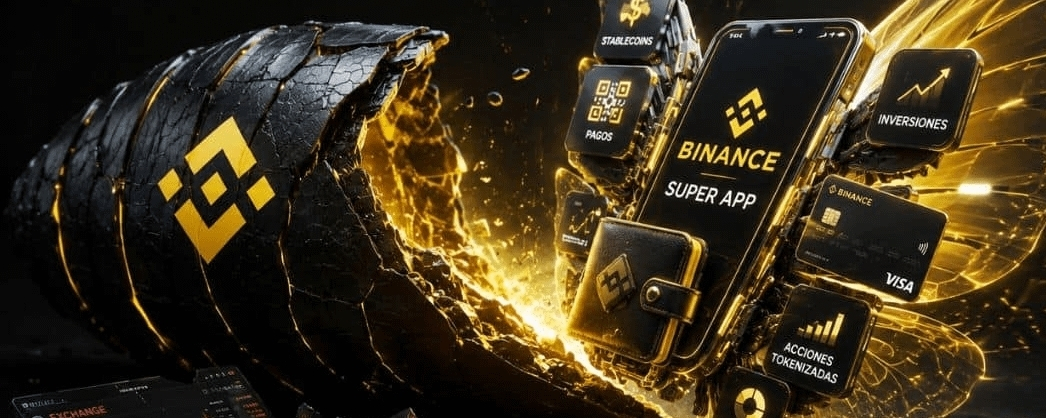
Article
Binance bets on becoming a crypto “super app” while stablecoins drive growth📢 Binance is betting on becoming a crypto “super app” as stablecoins drive a new phase of growth
Stablecoins are redefining how millions of people use digital assets, and Binance wants to position itself at the heart of that transformation. The largest cryptocurrency exchange platform by trading volume is reshaping its strategy to evolve beyond trading and become a financial super app…
Binance bets on becoming a crypto “super app” while stablecoins drive growth
📢 Binance is betting on becoming a crypto “super app” as stablecoins drive a new phase of growth
Stablecoins are redefining how millions of people use digital assets, and Binance wants to position itself at the heart of that transformation. The largest cryptocurrency exchange platform by trading volume is reshaping its strategy to evolve beyond trading and become a financial super app…
Stablecoins are redefining how millions of people use digital assets, and Binance wants to position itself at the heart of that transformation. The largest cryptocurrency exchange platform by trading volume is reshaping its strategy to evolve beyond trading and become a financial super app…
1
3
52

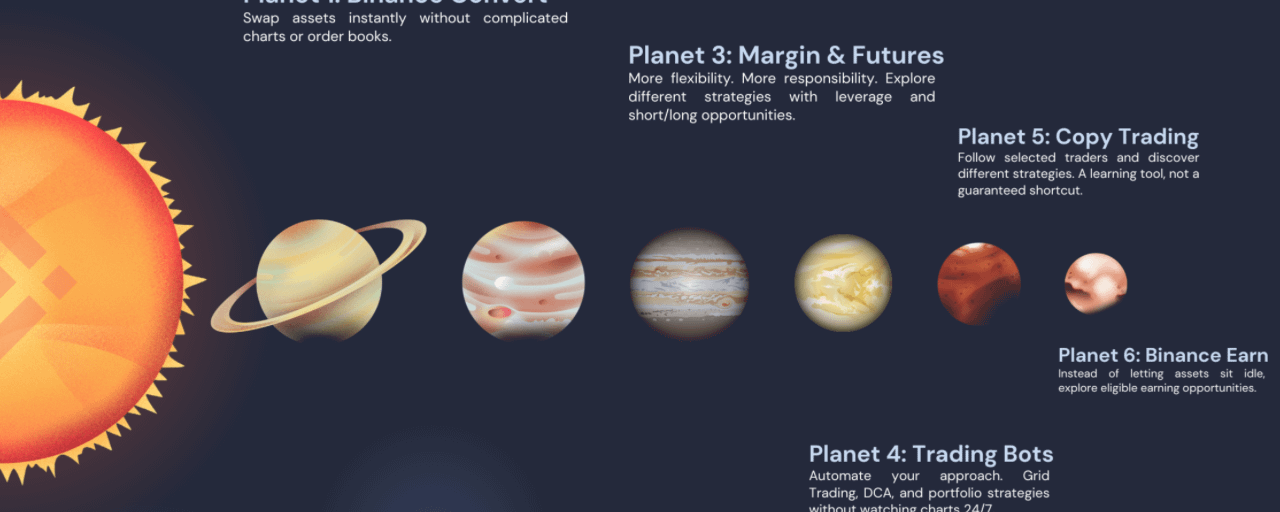
Article
Inside Binance - Episode 3: Inside the MarketsIntroduction: One Button Opens an Entire Trading World
Most people think trading starts with pressing Buy and ends with pressing Sell. Open the Binance app, however, and you'll quickly realize those two buttons are only the beginning. Behind them is an entire ecosystem designed for different goals, different experience levels, and different trading styles. Whether you want to make your first crypto purchase, actively trade the markets, automate your strategy, or simply let your assets work while you wait, Binance connects everything in one place. Let's take a walk through the Markets section and discover what each part of the ecosystem is designed to do.
The Easiest Door: Binance Convert
Imagine you've just deposited 500$ into Binance. You don't know what an order book is, you've never read a candlestick chart, and words like "bid" and "ask" sound like a different language. That's completely normal. Binance Convert was built for moments exactly like this. Instead of navigating a trading interface, you simply choose the asset you already have, the one you want to receive, review the quoted price, and confirm the conversion. Want to swap USDT for Bitcoin? Or Ethereum for BNB? It can all be done in just a few taps. For beginners, it's often the easiest way to enter the market before exploring more advanced trading tools.
Ready for More? Welcome to Spot Trading
Sooner or later, curiosity takes over. You begin asking questions. What if I only want to buy Bitcoin when it drops another 3%? What if I don't want to accept today's price? What do all these buy and sell orders actually mean?
This is where most Binance users naturally graduate from Convert to Spot Trading. Unlike Convert, Spot Trading gives you complete control over how your trades are executed. Instead of accepting a quoted conversion price, you decide exactly how you want to enter or exit the market. You can place a Market Order if speed is your priority, allowing Binance to execute your trade immediately at the best available market price. Or you can place a Limit Order, choosing the exact price you're willing to pay and allowing the market to come to you instead of chasing it. Let's say Bitcoin is trading at 120,000$, but after studying the chart you believe a short-term pullback to 118,000$ is possible. Rather than watching your screen all day, you simply place a Limit Order at your desired price and continue with your day. If the market reaches your target, Binance automatically executes the trade for you. If it doesn't, your order simply waits. Sometimes the smartest trader isn't the fastest one, it's the most patient.
Spot Trading also introduces one of the most important concepts in the Binance ecosystem: ownership. When you buy BTC, ETH, BNB, SOL, or thousands of other supported digital assets through Spot, those assets become yours. They appear in your Spot Wallet, ready for whatever you decide to do next. And this is where Binance begins to reveal why it's called a Financial Super App. The same BNB you purchased through Spot doesn't have to remain idle. You could hold it as a long-term investment because you believe in the growth of the Binance ecosystem. You could actively trade it if market conditions change. If you're waiting for your next opportunity, you could explore eligible Binance Earn products instead of letting it sit unused. You might use it to participate in Launchpool campaigns, explore Binance Alpha opportunities when available, interact with Web3 applications through Binance Wallet, or simply keep it in your portfolio as one of your core long-term holdings.
One purchase. Multiple possibilities. One connected ecosystem. That's the difference between using a traditional exchange and navigating a Financial Super App. On Binance, buying an asset is rarely the end of the journey, it's usually the beginning.
When Spot Isn't Enough: Margin and Futures
For many users, Spot Trading is more than enough. You buy an asset, you own it, and you decide when to sell it. But as traders gain experience, some begin looking for more flexibility, different strategies, and greater market exposure. That's where Margin and Futures Trading come in. While both are designed for more advanced users, they serve very different purposes and introduce an entirely new side of the Binance ecosystem.
Margin Trading allows eligible users to borrow funds to increase their buying power. Instead of trading only with the capital available in your wallet, you can temporarily increase your market exposure by borrowing assets, with the expectation of repaying them later. Imagine you have 500$ and identify an opportunity you strongly believe in. Rather than limiting yourself to a 500$ position, Margin allows you to increase your position size using borrowed funds. Of course, borrowing capital doesn't only increase potential profits, it also increases potential losses. Every additional dollar of exposure comes with additional responsibility, which is why Margin Trading is generally better suited for users who already understand market behavior and risk management.
Futures Trading takes this concept even further. Unlike Spot, you're no longer buying the actual cryptocurrency. Instead, you're trading contracts based on where you believe the price will move next. Think of it as trading the market itself rather than owning the asset. One of the biggest differences is that Futures gives traders the ability to profit in both directions. If you believe Bitcoin will rise, you can open a Long position. If your analysis suggests the market may fall, you can open a Short position instead. Suddenly, opportunities are no longer limited to bull markets.
This is also where concepts like leverage, liquidation, and funding fees enter the picture. Imagine you have 500$ in your Futures Wallet. By using leverage, you can gain exposure to a much larger position than your original capital. That means a relatively small market movement can produce a much larger profit, but it can just as easily produce a much larger loss. If the market moves significantly against your position, liquidation may occur, automatically closing your trade to prevent further losses. It's one of the reasons Futures has become one of Binance's most powerful trading products, while also being one of its riskiest. The higher the potential reward, the greater the need for discipline, preparation, and a well-defined strategy.
One of the things I appreciate most about Binance is that it doesn't force every user into Futures or Margin. They're simply additional tools within the ecosystem. Some traders never leave Spot. Others combine Spot for long-term investing with Futures for short-term opportunities. Binance gives you access to both worlds, allowing you to choose the one that matches your experience, goals, and risk tolerance rather than assuming every trader follows the same path.
What If Binance Could Trade While You're Away?
Not everyone has the time to sit in front of charts for hours every day. Some people have full-time jobs, university classes, businesses to run, or simply don't want to spend every minute watching candles move up and down. That doesn't mean they can't build a trading strategy. It simply means they need smarter tools. This is exactly why Binance introduced Trading Bots. Rather than manually placing every buy and sell order yourself, Trading Bots allow you to automate specific strategies based on rules you define in advance. The bot doesn't predict the future or magically generate profits. It simply follows your strategy consistently, without emotions, hesitation, or fatigue. Imagine Bitcoin has been moving between 115,000$ and 120,000$ for several days. Instead of constantly buying near the lower end of the range and selling near the upper end yourself, a Grid Trading Bot can automatically execute that strategy according to your chosen parameters. Or perhaps you're investing for the long term and want to buy a fixed amount of Bitcoin every week regardless of price. Rather than remembering to place the same order every Monday, a Recurring Buy or DCA strategy can automate the process, helping remove emotion from long-term investing. Users who manage diversified portfolios can also explore Rebalancing Bots, which automatically adjust portfolio allocations back to their target percentages as market prices change.
This is another example of why Binance feels like a Financial Super App rather than just a trading platform. The ecosystem doesn't simply give you markets, it gives you different ways to participate in those markets. You can trade manually, automate part of your strategy, combine bots with Spot Trading, or even move eligible assets into Binance Earn while waiting for your next opportunity. Everything is connected, allowing your strategy to evolve as your experience grows. Of course, it's important to remember that automation doesn't eliminate risk. A Trading Bot is only as good as the strategy behind it. It won't fix poor market analysis or guarantee profits. What it does exceptionally well is remove one of the biggest challenges every trader faces: human emotion. Fear, greed, hesitation, and impulsive decisions often lead to costly mistakes. A well-configured bot simply follows the plan you created, trade after trade, with the same consistency every single time.
Learning from Others: Copy Trading
Every experienced trader was once a beginner. No one wakes up knowing how to read charts, manage risk, or confidently navigate market volatility. Like any other skill, trading is learned through experience, observation, and continuous practice. Think about learning to play football, you watch professional players before stepping onto the field yourself. Learning the piano often starts by listening to experienced musicians. Trading is no different, and that's where Binance Copy Trading comes in.
Binance Copy Trading allows eligible users to automatically replicate the trades of selected Lead Traders, making it easier to observe how experienced traders approach the market in real time. Instead of only reading about trading strategies, beginners can gain insight into how positions are opened and closed, how risk is managed, and how different traders react to changing market conditions. It's an educational bridge between theory and real market experience.
Imagine you're interested in Futures Trading but still don't feel confident placing your own trades. Rather than jumping into the market blindly, you decide to follow a trader whose strategy, risk level, and historical performance align with your own goals. As their positions are executed, you can observe how they manage entries, exits, and risk while continuing to build your own knowledge. Over time, many users begin recognizing patterns, understanding different trading styles, and developing the confidence to make more independent decisions. However, one of the biggest misconceptions about Copy Trading is believing it guarantees profits. It doesn't. Every trader, no matter how experienced, goes through both winning and losing periods. Markets constantly change, and no strategy performs perfectly under every condition. Copy Trading should therefore be viewed as a learning tool rather than a shortcut to success. It gives beginners the opportunity to learn from experienced traders while reminding them that every investment decision still carries risk.
Once again, this highlights what makes Binance a Financial Super App. The platform doesn't simply provide trading tools, it creates different ways for users to learn. You can study for free through Binance Academy, stay informed with Binance Square, practice your own strategies on Spot or Futures, or observe experienced traders through Copy Trading. Every product complements another, allowing users to grow from complete beginners into more confident market participants without ever leaving the Binance ecosystem.
The Language of the Market
At first glance, Binance charts can look overwhelming. Green candles, red candles, indicators, moving averages, volume bars, there's a lot happening on one screen. But every chart tells a story. Candlesticks show how price moved over a specific period of time, while volume reveals how much interest there was behind those movements. Support and resistance highlight areas where buyers and sellers have reacted before. Traders don't read charts because they predict the future. They read them because they help organize probability and make more informed decisions.
Candlesticks: The Story of Price: Every candlestick represents an asset's price movement over a selected timeframe, showing four key values: the Open, High, Low, and Close (OHLC) prices. A green candle means buyers pushed the price higher during that period, while a red candle indicates sellers were in control. Remember, one candle never tells the whole story, it's the sequence of candlesticks that reveals trends, momentum, and possible reversals.
Timeframes: The Same Market, Different Stories The same market can tell completely different stories depending on the timeframe you're viewing. A 5-minute chart helps short-term traders identify quick opportunities, while 4-hour, daily, weekly, or monthly charts provide a broader perspective for swing traders and long-term investors. Always zoom out before making decisions, changing the timeframe often changes the entire picture.
Volume: Price shows what happened, while volume explains how much conviction was behind that move. High trading volume confirms strong participation from buyers and sellers, making a price movement more reliable. Low volume, on the other hand, may indicate weaker momentum and increase the likelihood of false breakouts or temporary price moves.
The Order Book: The Binance Order Book displays all active buy (bids) and sell (asks) orders waiting to be executed. It provides a live snapshot of market supply, demand, and liquidity, helping traders identify where buying or selling pressure may be building. Watching the Order Book can offer valuable insight into how the market is reacting in real time.
Market Orders vs. Limit Orders: A Market Order executes immediately at the best available market price, making it ideal when speed is more important than price. A Limit Order allows you to choose the exact price you're willing to buy or sell at, with Binance executing the trade only if the market reaches that level. One prioritizes speed, while the other prioritizes precision.
Support & Resistance: The Market's Decision Zones: Support and resistance are price areas where buyers and sellers have historically become more active. Support often acts as a floor where buying pressure slows price declines, while resistance acts as a ceiling where selling pressure may limit further gains. These aren't guaranteed turning points, but they are key decision zones watched by traders around the world.
Technical Indicators: Binance offers dozens of technical indicators, including RSI, MACD, Moving Averages, Bollinger Bands, ATR, ADX, and many more, to help traders analyze trends, momentum, volatility, and market strength. Each indicator provides a different perspective, and no single tool can predict the future. The best traders combine multiple indicators with proper risk management rather than relying on one signal alone.
Common Binance Chart Indicators:
Moving Average (MA): A Moving Average smooths out price fluctuations by calculating the average price over a chosen period. It helps traders identify the overall trend and acts as a dynamic support or resistance level.Simple Moving Average (SMA): The SMA gives equal importance to every price within the selected period. It's commonly used to identify long-term trends, although it reacts more slowly to sudden market changes.Exponential Moving Average (EMA): Unlike the SMA, the EMA gives greater weight to recent prices, allowing it to respond more quickly to new market movements. It's widely used by short-term and swing traders.RSI (Relative Strength Index): RSI is a momentum indicator that measures the speed and strength of price movements on a scale from 0 to 100. Readings above 70 may indicate overbought conditions, while readings below 30 may suggest the asset is oversold.MACD (Moving Average Convergence Divergence): MACD measures momentum and trend direction by comparing two moving averages. Traders often watch for crossovers between the MACD and Signal Line to identify potential buying or selling opportunities.Bollinger Bands: Bollinger Bands measure market volatility using three bands around the price. When the bands expand, volatility is increasing; when they contract, the market is becoming quieter and may be preparing for a larger move.VWAP (Volume Weighted Average Price): VWAP calculates the average trading price while considering trading volume. It is commonly used by professional and institutional traders to determine whether an asset is trading above or below its average value for the day.ATR (Average True Range): ATR measures market volatility rather than price direction. A higher ATR indicates larger price swings, helping traders adjust position sizes and place more appropriate stop-loss levels.ADX (Average Directional Index): ADX measures the strength of a trend without indicating whether it's bullish or bearish. Higher values suggest a stronger trend, while lower values indicate a weak or sideways market.Stochastic RSI: Stochastic RSI is a faster version of the traditional RSI that reacts more quickly to price changes. It's mainly used to identify short-term overbought and oversold conditions in fast-moving markets.Ichimoku Cloud: Ichimoku Cloud is an all-in-one indicator that combines trend, momentum, and support and resistance into a single chart. The cloud helps traders quickly determine whether the market is generally bullish or bearish.Fibonacci Retracement: Fibonacci Retracement draws key percentage levels where prices often pause or reverse during a trend. Traders use these levels to identify potential entry points, profit targets, and areas of support or resistance.OBV (On-Balance Volume): OBV combines price movement with trading volume to evaluate buying and selling pressure. Rising OBV generally indicates accumulation, while falling OBV may suggest increasing selling pressure.Parabolic SAR: Parabolic SAR places dots above or below the price to indicate the current trend. It is commonly used to identify possible trend reversals and trailing stop-loss levels.CCI (Commodity Channel Index): CCI measures how far an asset's price has moved from its historical average. Traders use it to identify potential overbought, oversold, or trend-changing conditions.Pivot Points: Pivot Points automatically calculate important support and resistance levels based on previous price data. They are especially popular among intraday traders for planning entries and exits.Supertrend: Supertrend combines price action with market volatility to identify the prevailing trend. It provides clear buy and sell signals while helping traders stay aligned with the market's direction.
Charts Don't Predict the Future-They Improve Your Decisions
Charts aren't crystal balls, they're decision-making tools. They organize historical price action, market psychology, and trading activity to help traders evaluate probabilities instead of certainties. Combined with Binance's professional charting tools, real-time data, and advanced indicators, they allow users to make more informed trading decisions while continuously improving their market analysis skills.
The Most Important Tool Isn't on Your Screen
Many people spend weeks searching for the perfect indicator or secret strategy, yet overlook the most valuable skill in trading: risk management. Imagine two traders each starting with 1,000$. One risks half of their account on every trade, hoping for quick profits. The other risks only a small percentage, accepts that losses are part of the journey, and protects their capital. After a series of trades, the second trader is still in the market, learning and improving. The first may already be looking for another deposit. The goal isn't to win every trade, it's to stay in the game long enough for your strategy to work.
One Ecosystem. Endless Possibilities.
This is what truly makes Binance a Financial Super App. A beginner might start with Binance Convert, later explore Spot Trading, automate part of their strategy with Trading Bots, move long-term holdings into Binance Earn, manage payments through Binance Pay, explore Web3, or continue learning through Binance Academy and Binance Square. None of these products exist in isolation, they're designed to work together.
You don't outgrow Binance as you gain experience. You simply unlock more of what the ecosystem has to offer. Your strategy evolves, your goals change, and the platform evolves with you. That's the difference between using an exchange and navigating a complete financial ecosystem.
#learnwithbinance #BinanceSpotTrading #BinanceFutures #BinanceEcosystem #BinanceSuperApp
Inside Binance - Episode 3: Inside the Markets
Introduction: One Button Opens an Entire Trading World
Most people think trading starts with pressing Buy and ends with pressing Sell. Open the Binance app, however, and you'll quickly realize those two buttons are only the beginning. Behind them is an entire ecosystem designed for different goals, different experience levels, and different trading styles. Whether you want to make your first crypto purchase, actively trade the markets, automate your strategy, or simply let your assets work while you wait, Binance connects everything in one place. Let's take a walk through the Markets section and discover what each part of the ecosystem is designed to do.
The Easiest Door: Binance Convert
Imagine you've just deposited 500$ into Binance. You don't know what an order book is, you've never read a candlestick chart, and words like "bid" and "ask" sound like a different language. That's completely normal. Binance Convert was built for moments exactly like this. Instead of navigating a trading interface, you simply choose the asset you already have, the one you want to receive, review the quoted price, and confirm the conversion. Want to swap USDT for Bitcoin? Or Ethereum for BNB? It can all be done in just a few taps. For beginners, it's often the easiest way to enter the market before exploring more advanced trading tools.
Ready for More? Welcome to Spot Trading
Sooner or later, curiosity takes over. You begin asking questions. What if I only want to buy Bitcoin when it drops another 3%? What if I don't want to accept today's price? What do all these buy and sell orders actually mean?
This is where most Binance users naturally graduate from Convert to Spot Trading. Unlike Convert, Spot Trading gives you complete control over how your trades are executed. Instead of accepting a quoted conversion price, you decide exactly how you want to enter or exit the market. You can place a Market Order if speed is your priority, allowing Binance to execute your trade immediately at the best available market price. Or you can place a Limit Order, choosing the exact price you're willing to pay and allowing the market to come to you instead of chasing it. Let's say Bitcoin is trading at 120,000$, but after studying the chart you believe a short-term pullback to 118,000$ is possible. Rather than watching your screen all day, you simply place a Limit Order at your desired price and continue with your day. If the market reaches your target, Binance automatically executes the trade for you. If it doesn't, your order simply waits. Sometimes the smartest trader isn't the fastest one, it's the most patient.
Spot Trading also introduces one of the most important concepts in the Binance ecosystem: ownership. When you buy BTC, ETH, BNB, SOL, or thousands of other supported digital assets through Spot, those assets become yours. They appear in your Spot Wallet, ready for whatever you decide to do next. And this is where Binance begins to reveal why it's called a Financial Super App. The same BNB you purchased through Spot doesn't have to remain idle. You could hold it as a long-term investment because you believe in the growth of the Binance ecosystem. You could actively trade it if market conditions change. If you're waiting for your next opportunity, you could explore eligible Binance Earn products instead of letting it sit unused. You might use it to participate in Launchpool campaigns, explore Binance Alpha opportunities when available, interact with Web3 applications through Binance Wallet, or simply keep it in your portfolio as one of your core long-term holdings.
One purchase. Multiple possibilities. One connected ecosystem. That's the difference between using a traditional exchange and navigating a Financial Super App. On Binance, buying an asset is rarely the end of the journey, it's usually the beginning.
When Spot Isn't Enough: Margin and Futures
For many users, Spot Trading is more than enough. You buy an asset, you own it, and you decide when to sell it. But as traders gain experience, some begin looking for more flexibility, different strategies, and greater market exposure. That's where Margin and Futures Trading come in. While both are designed for more advanced users, they serve very different purposes and introduce an entirely new side of the Binance ecosystem.
Margin Trading allows eligible users to borrow funds to increase their buying power. Instead of trading only with the capital available in your wallet, you can temporarily increase your market exposure by borrowing assets, with the expectation of repaying them later. Imagine you have 500$ and identify an opportunity you strongly believe in. Rather than limiting yourself to a 500$ position, Margin allows you to increase your position size using borrowed funds. Of course, borrowing capital doesn't only increase potential profits, it also increases potential losses. Every additional dollar of exposure comes with additional responsibility, which is why Margin Trading is generally better suited for users who already understand market behavior and risk management.
Futures Trading takes this concept even further. Unlike Spot, you're no longer buying the actual cryptocurrency. Instead, you're trading contracts based on where you believe the price will move next. Think of it as trading the market itself rather than owning the asset. One of the biggest differences is that Futures gives traders the ability to profit in both directions. If you believe Bitcoin will rise, you can open a Long position. If your analysis suggests the market may fall, you can open a Short position instead. Suddenly, opportunities are no longer limited to bull markets.
This is also where concepts like leverage, liquidation, and funding fees enter the picture. Imagine you have 500$ in your Futures Wallet. By using leverage, you can gain exposure to a much larger position than your original capital. That means a relatively small market movement can produce a much larger profit, but it can just as easily produce a much larger loss. If the market moves significantly against your position, liquidation may occur, automatically closing your trade to prevent further losses. It's one of the reasons Futures has become one of Binance's most powerful trading products, while also being one of its riskiest. The higher the potential reward, the greater the need for discipline, preparation, and a well-defined strategy.
One of the things I appreciate most about Binance is that it doesn't force every user into Futures or Margin. They're simply additional tools within the ecosystem. Some traders never leave Spot. Others combine Spot for long-term investing with Futures for short-term opportunities. Binance gives you access to both worlds, allowing you to choose the one that matches your experience, goals, and risk tolerance rather than assuming every trader follows the same path.
What If Binance Could Trade While You're Away?
Not everyone has the time to sit in front of charts for hours every day. Some people have full-time jobs, university classes, businesses to run, or simply don't want to spend every minute watching candles move up and down. That doesn't mean they can't build a trading strategy. It simply means they need smarter tools. This is exactly why Binance introduced Trading Bots. Rather than manually placing every buy and sell order yourself, Trading Bots allow you to automate specific strategies based on rules you define in advance. The bot doesn't predict the future or magically generate profits. It simply follows your strategy consistently, without emotions, hesitation, or fatigue. Imagine Bitcoin has been moving between 115,000$ and 120,000$ for several days. Instead of constantly buying near the lower end of the range and selling near the upper end yourself, a Grid Trading Bot can automatically execute that strategy according to your chosen parameters. Or perhaps you're investing for the long term and want to buy a fixed amount of Bitcoin every week regardless of price. Rather than remembering to place the same order every Monday, a Recurring Buy or DCA strategy can automate the process, helping remove emotion from long-term investing. Users who manage diversified portfolios can also explore Rebalancing Bots, which automatically adjust portfolio allocations back to their target percentages as market prices change.
This is another example of why Binance feels like a Financial Super App rather than just a trading platform. The ecosystem doesn't simply give you markets, it gives you different ways to participate in those markets. You can trade manually, automate part of your strategy, combine bots with Spot Trading, or even move eligible assets into Binance Earn while waiting for your next opportunity. Everything is connected, allowing your strategy to evolve as your experience grows. Of course, it's important to remember that automation doesn't eliminate risk. A Trading Bot is only as good as the strategy behind it. It won't fix poor market analysis or guarantee profits. What it does exceptionally well is remove one of the biggest challenges every trader faces: human emotion. Fear, greed, hesitation, and impulsive decisions often lead to costly mistakes. A well-configured bot simply follows the plan you created, trade after trade, with the same consistency every single time.
Learning from Others: Copy Trading
Every experienced trader was once a beginner. No one wakes up knowing how to read charts, manage risk, or confidently navigate market volatility. Like any other skill, trading is learned through experience, observation, and continuous practice. Think about learning to play football, you watch professional players before stepping onto the field yourself. Learning the piano often starts by listening to experienced musicians. Trading is no different, and that's where Binance Copy Trading comes in.
Binance Copy Trading allows eligible users to automatically replicate the trades of selected Lead Traders, making it easier to observe how experienced traders approach the market in real time. Instead of only reading about trading strategies, beginners can gain insight into how positions are opened and closed, how risk is managed, and how different traders react to changing market conditions. It's an educational bridge between theory and real market experience.
Imagine you're interested in Futures Trading but still don't feel confident placing your own trades. Rather than jumping into the market blindly, you decide to follow a trader whose strategy, risk level, and historical performance align with your own goals. As their positions are executed, you can observe how they manage entries, exits, and risk while continuing to build your own knowledge. Over time, many users begin recognizing patterns, understanding different trading styles, and developing the confidence to make more independent decisions. However, one of the biggest misconceptions about Copy Trading is believing it guarantees profits. It doesn't. Every trader, no matter how experienced, goes through both winning and losing periods. Markets constantly change, and no strategy performs perfectly under every condition. Copy Trading should therefore be viewed as a learning tool rather than a shortcut to success. It gives beginners the opportunity to learn from experienced traders while reminding them that every investment decision still carries risk.
Once again, this highlights what makes Binance a Financial Super App. The platform doesn't simply provide trading tools, it creates different ways for users to learn. You can study for free through Binance Academy, stay informed with Binance Square, practice your own strategies on Spot or Futures, or observe experienced traders through Copy Trading. Every product complements another, allowing users to grow from complete beginners into more confident market participants without ever leaving the Binance ecosystem.
The Language of the Market
At first glance, Binance charts can look overwhelming. Green candles, red candles, indicators, moving averages, volume bars, there's a lot happening on one screen. But every chart tells a story. Candlesticks show how price moved over a specific period of time, while volume reveals how much interest there was behind those movements. Support and resistance highlight areas where buyers and sellers have reacted before. Traders don't read charts because they predict the future. They read them because they help organize probability and make more informed decisions.
Candlesticks: The Story of Price: Every candlestick represents an asset's price movement over a selected timeframe, showing four key values: the Open, High, Low, and Close (OHLC) prices. A green candle means buyers pushed the price higher during that period, while a red candle indicates sellers were in control. Remember, one candle never tells the whole story, it's the sequence of candlesticks that reveals trends, momentum, and possible reversals.
Timeframes: The Same Market, Different Stories The same market can tell completely different stories depending on the timeframe you're viewing. A 5-minute chart helps short-term traders identify quick opportunities, while 4-hour, daily, weekly, or monthly charts provide a broader perspective for swing traders and long-term investors. Always zoom out before making decisions, changing the timeframe often changes the entire picture.
Volume: Price shows what happened, while volume explains how much conviction was behind that move. High trading volume confirms strong participation from buyers and sellers, making a price movement more reliable. Low volume, on the other hand, may indicate weaker momentum and increase the likelihood of false breakouts or temporary price moves.
The Order Book: The Binance Order Book displays all active buy (bids) and sell (asks) orders waiting to be executed. It provides a live snapshot of market supply, demand, and liquidity, helping traders identify where buying or selling pressure may be building. Watching the Order Book can offer valuable insight into how the market is reacting in real time.
Market Orders vs. Limit Orders: A Market Order executes immediately at the best available market price, making it ideal when speed is more important than price. A Limit Order allows you to choose the exact price you're willing to buy or sell at, with Binance executing the trade only if the market reaches that level. One prioritizes speed, while the other prioritizes precision.
Support & Resistance: The Market's Decision Zones: Support and resistance are price areas where buyers and sellers have historically become more active. Support often acts as a floor where buying pressure slows price declines, while resistance acts as a ceiling where selling pressure may limit further gains. These aren't guaranteed turning points, but they are key decision zones watched by traders around the world.
Technical Indicators: Binance offers dozens of technical indicators, including RSI, MACD, Moving Averages, Bollinger Bands, ATR, ADX, and many more, to help traders analyze trends, momentum, volatility, and market strength. Each indicator provides a different perspective, and no single tool can predict the future. The best traders combine multiple indicators with proper risk management rather than relying on one signal alone.
Common Binance Chart Indicators:
Moving Average (MA): A Moving Average smooths out price fluctuations by calculating the average price over a chosen period. It helps traders identify the overall trend and acts as a dynamic support or resistance level.Simple Moving Average (SMA): The SMA gives equal importance to every price within the selected period. It's commonly used to identify long-term trends, although it reacts more slowly to sudden market changes.Exponential Moving Average (EMA): Unlike the SMA, the EMA gives greater weight to recent prices, allowing it to respond more quickly to new market movements. It's widely used by short-term and swing traders.RSI (Relative Strength Index): RSI is a momentum indicator that measures the speed and strength of price movements on a scale from 0 to 100. Readings above 70 may indicate overbought conditions, while readings below 30 may suggest the asset is oversold.MACD (Moving Average Convergence Divergence): MACD measures momentum and trend direction by comparing two moving averages. Traders often watch for crossovers between the MACD and Signal Line to identify potential buying or selling opportunities.Bollinger Bands: Bollinger Bands measure market volatility using three bands around the price. When the bands expand, volatility is increasing; when they contract, the market is becoming quieter and may be preparing for a larger move.VWAP (Volume Weighted Average Price): VWAP calculates the average trading price while considering trading volume. It is commonly used by professional and institutional traders to determine whether an asset is trading above or below its average value for the day.ATR (Average True Range): ATR measures market volatility rather than price direction. A higher ATR indicates larger price swings, helping traders adjust position sizes and place more appropriate stop-loss levels.ADX (Average Directional Index): ADX measures the strength of a trend without indicating whether it's bullish or bearish. Higher values suggest a stronger trend, while lower values indicate a weak or sideways market.Stochastic RSI: Stochastic RSI is a faster version of the traditional RSI that reacts more quickly to price changes. It's mainly used to identify short-term overbought and oversold conditions in fast-moving markets.Ichimoku Cloud: Ichimoku Cloud is an all-in-one indicator that combines trend, momentum, and support and resistance into a single chart. The cloud helps traders quickly determine whether the market is generally bullish or bearish.Fibonacci Retracement: Fibonacci Retracement draws key percentage levels where prices often pause or reverse during a trend. Traders use these levels to identify potential entry points, profit targets, and areas of support or resistance.OBV (On-Balance Volume): OBV combines price movement with trading volume to evaluate buying and selling pressure. Rising OBV generally indicates accumulation, while falling OBV may suggest increasing selling pressure.Parabolic SAR: Parabolic SAR places dots above or below the price to indicate the current trend. It is commonly used to identify possible trend reversals and trailing stop-loss levels.CCI (Commodity Channel Index): CCI measures how far an asset's price has moved from its historical average. Traders use it to identify potential overbought, oversold, or trend-changing conditions.Pivot Points: Pivot Points automatically calculate important support and resistance levels based on previous price data. They are especially popular among intraday traders for planning entries and exits.Supertrend: Supertrend combines price action with market volatility to identify the prevailing trend. It provides clear buy and sell signals while helping traders stay aligned with the market's direction.
Charts Don't Predict the Future-They Improve Your Decisions
Charts aren't crystal balls, they're decision-making tools. They organize historical price action, market psychology, and trading activity to help traders evaluate probabilities instead of certainties. Combined with Binance's professional charting tools, real-time data, and advanced indicators, they allow users to make more informed trading decisions while continuously improving their market analysis skills.
The Most Important Tool Isn't on Your Screen
Many people spend weeks searching for the perfect indicator or secret strategy, yet overlook the most valuable skill in trading: risk management. Imagine two traders each starting with 1,000$. One risks half of their account on every trade, hoping for quick profits. The other risks only a small percentage, accepts that losses are part of the journey, and protects their capital. After a series of trades, the second trader is still in the market, learning and improving. The first may already be looking for another deposit. The goal isn't to win every trade, it's to stay in the game long enough for your strategy to work.
One Ecosystem. Endless Possibilities.
This is what truly makes Binance a Financial Super App. A beginner might start with Binance Convert, later explore Spot Trading, automate part of their strategy with Trading Bots, move long-term holdings into Binance Earn, manage payments through Binance Pay, explore Web3, or continue learning through Binance Academy and Binance Square. None of these products exist in isolation, they're designed to work together.
You don't outgrow Binance as you gain experience. You simply unlock more of what the ecosystem has to offer. Your strategy evolves, your goals change, and the platform evolves with you. That's the difference between using an exchange and navigating a complete financial ecosystem.
#learnwithbinance #BinanceSpotTrading #BinanceFutures #BinanceEcosystem #BinanceSuperApp
Most people think trading starts with pressing Buy and ends with pressing Sell. Open the Binance app, however, and you'll quickly realize those two buttons are only the beginning. Behind them is an entire ecosystem designed for different goals, different experience levels, and different trading styles. Whether you want to make your first crypto purchase, actively trade the markets, automate your strategy, or simply let your assets work while you wait, Binance connects everything in one place. Let's take a walk through the Markets section and discover what each part of the ecosystem is designed to do.
The Easiest Door: Binance Convert
Imagine you've just deposited 500$ into Binance. You don't know what an order book is, you've never read a candlestick chart, and words like "bid" and "ask" sound like a different language. That's completely normal. Binance Convert was built for moments exactly like this. Instead of navigating a trading interface, you simply choose the asset you already have, the one you want to receive, review the quoted price, and confirm the conversion. Want to swap USDT for Bitcoin? Or Ethereum for BNB? It can all be done in just a few taps. For beginners, it's often the easiest way to enter the market before exploring more advanced trading tools.
Ready for More? Welcome to Spot Trading
Sooner or later, curiosity takes over. You begin asking questions. What if I only want to buy Bitcoin when it drops another 3%? What if I don't want to accept today's price? What do all these buy and sell orders actually mean?
This is where most Binance users naturally graduate from Convert to Spot Trading. Unlike Convert, Spot Trading gives you complete control over how your trades are executed. Instead of accepting a quoted conversion price, you decide exactly how you want to enter or exit the market. You can place a Market Order if speed is your priority, allowing Binance to execute your trade immediately at the best available market price. Or you can place a Limit Order, choosing the exact price you're willing to pay and allowing the market to come to you instead of chasing it. Let's say Bitcoin is trading at 120,000$, but after studying the chart you believe a short-term pullback to 118,000$ is possible. Rather than watching your screen all day, you simply place a Limit Order at your desired price and continue with your day. If the market reaches your target, Binance automatically executes the trade for you. If it doesn't, your order simply waits. Sometimes the smartest trader isn't the fastest one, it's the most patient.
Spot Trading also introduces one of the most important concepts in the Binance ecosystem: ownership. When you buy BTC, ETH, BNB, SOL, or thousands of other supported digital assets through Spot, those assets become yours. They appear in your Spot Wallet, ready for whatever you decide to do next. And this is where Binance begins to reveal why it's called a Financial Super App. The same BNB you purchased through Spot doesn't have to remain idle. You could hold it as a long-term investment because you believe in the growth of the Binance ecosystem. You could actively trade it if market conditions change. If you're waiting for your next opportunity, you could explore eligible Binance Earn products instead of letting it sit unused. You might use it to participate in Launchpool campaigns, explore Binance Alpha opportunities when available, interact with Web3 applications through Binance Wallet, or simply keep it in your portfolio as one of your core long-term holdings.
One purchase. Multiple possibilities. One connected ecosystem. That's the difference between using a traditional exchange and navigating a Financial Super App. On Binance, buying an asset is rarely the end of the journey, it's usually the beginning.
When Spot Isn't Enough: Margin and Futures
For many users, Spot Trading is more than enough. You buy an asset, you own it, and you decide when to sell it. But as traders gain experience, some begin looking for more flexibility, different strategies, and greater market exposure. That's where Margin and Futures Trading come in. While both are designed for more advanced users, they serve very different purposes and introduce an entirely new side of the Binance ecosystem.
Margin Trading allows eligible users to borrow funds to increase their buying power. Instead of trading only with the capital available in your wallet, you can temporarily increase your market exposure by borrowing assets, with the expectation of repaying them later. Imagine you have 500$ and identify an opportunity you strongly believe in. Rather than limiting yourself to a 500$ position, Margin allows you to increase your position size using borrowed funds. Of course, borrowing capital doesn't only increase potential profits, it also increases potential losses. Every additional dollar of exposure comes with additional responsibility, which is why Margin Trading is generally better suited for users who already understand market behavior and risk management.
Futures Trading takes this concept even further. Unlike Spot, you're no longer buying the actual cryptocurrency. Instead, you're trading contracts based on where you believe the price will move next. Think of it as trading the market itself rather than owning the asset. One of the biggest differences is that Futures gives traders the ability to profit in both directions. If you believe Bitcoin will rise, you can open a Long position. If your analysis suggests the market may fall, you can open a Short position instead. Suddenly, opportunities are no longer limited to bull markets.
This is also where concepts like leverage, liquidation, and funding fees enter the picture. Imagine you have 500$ in your Futures Wallet. By using leverage, you can gain exposure to a much larger position than your original capital. That means a relatively small market movement can produce a much larger profit, but it can just as easily produce a much larger loss. If the market moves significantly against your position, liquidation may occur, automatically closing your trade to prevent further losses. It's one of the reasons Futures has become one of Binance's most powerful trading products, while also being one of its riskiest. The higher the potential reward, the greater the need for discipline, preparation, and a well-defined strategy.
One of the things I appreciate most about Binance is that it doesn't force every user into Futures or Margin. They're simply additional tools within the ecosystem. Some traders never leave Spot. Others combine Spot for long-term investing with Futures for short-term opportunities. Binance gives you access to both worlds, allowing you to choose the one that matches your experience, goals, and risk tolerance rather than assuming every trader follows the same path.
What If Binance Could Trade While You're Away?
Not everyone has the time to sit in front of charts for hours every day. Some people have full-time jobs, university classes, businesses to run, or simply don't want to spend every minute watching candles move up and down. That doesn't mean they can't build a trading strategy. It simply means they need smarter tools. This is exactly why Binance introduced Trading Bots. Rather than manually placing every buy and sell order yourself, Trading Bots allow you to automate specific strategies based on rules you define in advance. The bot doesn't predict the future or magically generate profits. It simply follows your strategy consistently, without emotions, hesitation, or fatigue. Imagine Bitcoin has been moving between 115,000$ and 120,000$ for several days. Instead of constantly buying near the lower end of the range and selling near the upper end yourself, a Grid Trading Bot can automatically execute that strategy according to your chosen parameters. Or perhaps you're investing for the long term and want to buy a fixed amount of Bitcoin every week regardless of price. Rather than remembering to place the same order every Monday, a Recurring Buy or DCA strategy can automate the process, helping remove emotion from long-term investing. Users who manage diversified portfolios can also explore Rebalancing Bots, which automatically adjust portfolio allocations back to their target percentages as market prices change.
This is another example of why Binance feels like a Financial Super App rather than just a trading platform. The ecosystem doesn't simply give you markets, it gives you different ways to participate in those markets. You can trade manually, automate part of your strategy, combine bots with Spot Trading, or even move eligible assets into Binance Earn while waiting for your next opportunity. Everything is connected, allowing your strategy to evolve as your experience grows. Of course, it's important to remember that automation doesn't eliminate risk. A Trading Bot is only as good as the strategy behind it. It won't fix poor market analysis or guarantee profits. What it does exceptionally well is remove one of the biggest challenges every trader faces: human emotion. Fear, greed, hesitation, and impulsive decisions often lead to costly mistakes. A well-configured bot simply follows the plan you created, trade after trade, with the same consistency every single time.
Learning from Others: Copy Trading
Every experienced trader was once a beginner. No one wakes up knowing how to read charts, manage risk, or confidently navigate market volatility. Like any other skill, trading is learned through experience, observation, and continuous practice. Think about learning to play football, you watch professional players before stepping onto the field yourself. Learning the piano often starts by listening to experienced musicians. Trading is no different, and that's where Binance Copy Trading comes in.
Binance Copy Trading allows eligible users to automatically replicate the trades of selected Lead Traders, making it easier to observe how experienced traders approach the market in real time. Instead of only reading about trading strategies, beginners can gain insight into how positions are opened and closed, how risk is managed, and how different traders react to changing market conditions. It's an educational bridge between theory and real market experience.
Imagine you're interested in Futures Trading but still don't feel confident placing your own trades. Rather than jumping into the market blindly, you decide to follow a trader whose strategy, risk level, and historical performance align with your own goals. As their positions are executed, you can observe how they manage entries, exits, and risk while continuing to build your own knowledge. Over time, many users begin recognizing patterns, understanding different trading styles, and developing the confidence to make more independent decisions. However, one of the biggest misconceptions about Copy Trading is believing it guarantees profits. It doesn't. Every trader, no matter how experienced, goes through both winning and losing periods. Markets constantly change, and no strategy performs perfectly under every condition. Copy Trading should therefore be viewed as a learning tool rather than a shortcut to success. It gives beginners the opportunity to learn from experienced traders while reminding them that every investment decision still carries risk.
Once again, this highlights what makes Binance a Financial Super App. The platform doesn't simply provide trading tools, it creates different ways for users to learn. You can study for free through Binance Academy, stay informed with Binance Square, practice your own strategies on Spot or Futures, or observe experienced traders through Copy Trading. Every product complements another, allowing users to grow from complete beginners into more confident market participants without ever leaving the Binance ecosystem.
The Language of the Market
At first glance, Binance charts can look overwhelming. Green candles, red candles, indicators, moving averages, volume bars, there's a lot happening on one screen. But every chart tells a story. Candlesticks show how price moved over a specific period of time, while volume reveals how much interest there was behind those movements. Support and resistance highlight areas where buyers and sellers have reacted before. Traders don't read charts because they predict the future. They read them because they help organize probability and make more informed decisions.
Candlesticks: The Story of Price: Every candlestick represents an asset's price movement over a selected timeframe, showing four key values: the Open, High, Low, and Close (OHLC) prices. A green candle means buyers pushed the price higher during that period, while a red candle indicates sellers were in control. Remember, one candle never tells the whole story, it's the sequence of candlesticks that reveals trends, momentum, and possible reversals.
Timeframes: The Same Market, Different Stories The same market can tell completely different stories depending on the timeframe you're viewing. A 5-minute chart helps short-term traders identify quick opportunities, while 4-hour, daily, weekly, or monthly charts provide a broader perspective for swing traders and long-term investors. Always zoom out before making decisions, changing the timeframe often changes the entire picture.
Volume: Price shows what happened, while volume explains how much conviction was behind that move. High trading volume confirms strong participation from buyers and sellers, making a price movement more reliable. Low volume, on the other hand, may indicate weaker momentum and increase the likelihood of false breakouts or temporary price moves.
The Order Book: The Binance Order Book displays all active buy (bids) and sell (asks) orders waiting to be executed. It provides a live snapshot of market supply, demand, and liquidity, helping traders identify where buying or selling pressure may be building. Watching the Order Book can offer valuable insight into how the market is reacting in real time.
Market Orders vs. Limit Orders: A Market Order executes immediately at the best available market price, making it ideal when speed is more important than price. A Limit Order allows you to choose the exact price you're willing to buy or sell at, with Binance executing the trade only if the market reaches that level. One prioritizes speed, while the other prioritizes precision.
Support & Resistance: The Market's Decision Zones: Support and resistance are price areas where buyers and sellers have historically become more active. Support often acts as a floor where buying pressure slows price declines, while resistance acts as a ceiling where selling pressure may limit further gains. These aren't guaranteed turning points, but they are key decision zones watched by traders around the world.
Technical Indicators: Binance offers dozens of technical indicators, including RSI, MACD, Moving Averages, Bollinger Bands, ATR, ADX, and many more, to help traders analyze trends, momentum, volatility, and market strength. Each indicator provides a different perspective, and no single tool can predict the future. The best traders combine multiple indicators with proper risk management rather than relying on one signal alone.
Common Binance Chart Indicators:
Moving Average (MA): A Moving Average smooths out price fluctuations by calculating the average price over a chosen period. It helps traders identify the overall trend and acts as a dynamic support or resistance level.Simple Moving Average (SMA): The SMA gives equal importance to every price within the selected period. It's commonly used to identify long-term trends, although it reacts more slowly to sudden market changes.Exponential Moving Average (EMA): Unlike the SMA, the EMA gives greater weight to recent prices, allowing it to respond more quickly to new market movements. It's widely used by short-term and swing traders.RSI (Relative Strength Index): RSI is a momentum indicator that measures the speed and strength of price movements on a scale from 0 to 100. Readings above 70 may indicate overbought conditions, while readings below 30 may suggest the asset is oversold.MACD (Moving Average Convergence Divergence): MACD measures momentum and trend direction by comparing two moving averages. Traders often watch for crossovers between the MACD and Signal Line to identify potential buying or selling opportunities.Bollinger Bands: Bollinger Bands measure market volatility using three bands around the price. When the bands expand, volatility is increasing; when they contract, the market is becoming quieter and may be preparing for a larger move.VWAP (Volume Weighted Average Price): VWAP calculates the average trading price while considering trading volume. It is commonly used by professional and institutional traders to determine whether an asset is trading above or below its average value for the day.ATR (Average True Range): ATR measures market volatility rather than price direction. A higher ATR indicates larger price swings, helping traders adjust position sizes and place more appropriate stop-loss levels.ADX (Average Directional Index): ADX measures the strength of a trend without indicating whether it's bullish or bearish. Higher values suggest a stronger trend, while lower values indicate a weak or sideways market.Stochastic RSI: Stochastic RSI is a faster version of the traditional RSI that reacts more quickly to price changes. It's mainly used to identify short-term overbought and oversold conditions in fast-moving markets.Ichimoku Cloud: Ichimoku Cloud is an all-in-one indicator that combines trend, momentum, and support and resistance into a single chart. The cloud helps traders quickly determine whether the market is generally bullish or bearish.Fibonacci Retracement: Fibonacci Retracement draws key percentage levels where prices often pause or reverse during a trend. Traders use these levels to identify potential entry points, profit targets, and areas of support or resistance.OBV (On-Balance Volume): OBV combines price movement with trading volume to evaluate buying and selling pressure. Rising OBV generally indicates accumulation, while falling OBV may suggest increasing selling pressure.Parabolic SAR: Parabolic SAR places dots above or below the price to indicate the current trend. It is commonly used to identify possible trend reversals and trailing stop-loss levels.CCI (Commodity Channel Index): CCI measures how far an asset's price has moved from its historical average. Traders use it to identify potential overbought, oversold, or trend-changing conditions.Pivot Points: Pivot Points automatically calculate important support and resistance levels based on previous price data. They are especially popular among intraday traders for planning entries and exits.Supertrend: Supertrend combines price action with market volatility to identify the prevailing trend. It provides clear buy and sell signals while helping traders stay aligned with the market's direction.
Charts Don't Predict the Future-They Improve Your Decisions
Charts aren't crystal balls, they're decision-making tools. They organize historical price action, market psychology, and trading activity to help traders evaluate probabilities instead of certainties. Combined with Binance's professional charting tools, real-time data, and advanced indicators, they allow users to make more informed trading decisions while continuously improving their market analysis skills.
The Most Important Tool Isn't on Your Screen
Many people spend weeks searching for the perfect indicator or secret strategy, yet overlook the most valuable skill in trading: risk management. Imagine two traders each starting with 1,000$. One risks half of their account on every trade, hoping for quick profits. The other risks only a small percentage, accepts that losses are part of the journey, and protects their capital. After a series of trades, the second trader is still in the market, learning and improving. The first may already be looking for another deposit. The goal isn't to win every trade, it's to stay in the game long enough for your strategy to work.
One Ecosystem. Endless Possibilities.
This is what truly makes Binance a Financial Super App. A beginner might start with Binance Convert, later explore Spot Trading, automate part of their strategy with Trading Bots, move long-term holdings into Binance Earn, manage payments through Binance Pay, explore Web3, or continue learning through Binance Academy and Binance Square. None of these products exist in isolation, they're designed to work together.
You don't outgrow Binance as you gain experience. You simply unlock more of what the ecosystem has to offer. Your strategy evolves, your goals change, and the platform evolves with you. That's the difference between using an exchange and navigating a complete financial ecosystem.
#learnwithbinance #BinanceSpotTrading #BinanceFutures #BinanceEcosystem #BinanceSuperApp
2
225
Log in to explore more content
Join global crypto users on Binance Square
⚡️ Get latest and useful information about crypto.
💬 Trusted by the world’s largest crypto exchange.
👍 Discover real insights from verified creators.
Email / Phone number
Trending Topics
1
#ChinaMayLetAlibabaByteDanceBuyNvidiaChips
0 views
0 Discussing
2
#USChinaRelease$30BTariffCutProductLists
0 views
0 Discussing
3
#SKoreaFSCConsidersVirtualAssetMarketMaker
355 views
38 Discussing
4
#ChinaIndustrialProfitGrowthSlowsFourthMonth
1,308 views
75 Discussing
5
#BitwiseFilesFinalNEARSpotETFProspectus
102,129 views
1,551 Discussing
6
#BitgetHackerMoves$83MStolenXRP
36,422 views
171 Discussing
7
#SOLSpotETFWeeklyInflow$188M
23,502 views
137 Discussing
8
#DogecoinETFsPostBiggestWeekSinceLaunch
62,009 views
1,037 Discussing
9
#StrategyStriveAdd2305BitcoinThisWeek
156,306 views
2,262 Discussing
10
#TrumpRejectsIranHormuzReopening
134,617 views
1,716 Discussing