

#aljazeeraenglish
aljazeeraenglish
16,386 views
15 Discussing
Hot
Latest

·
--
Bullish
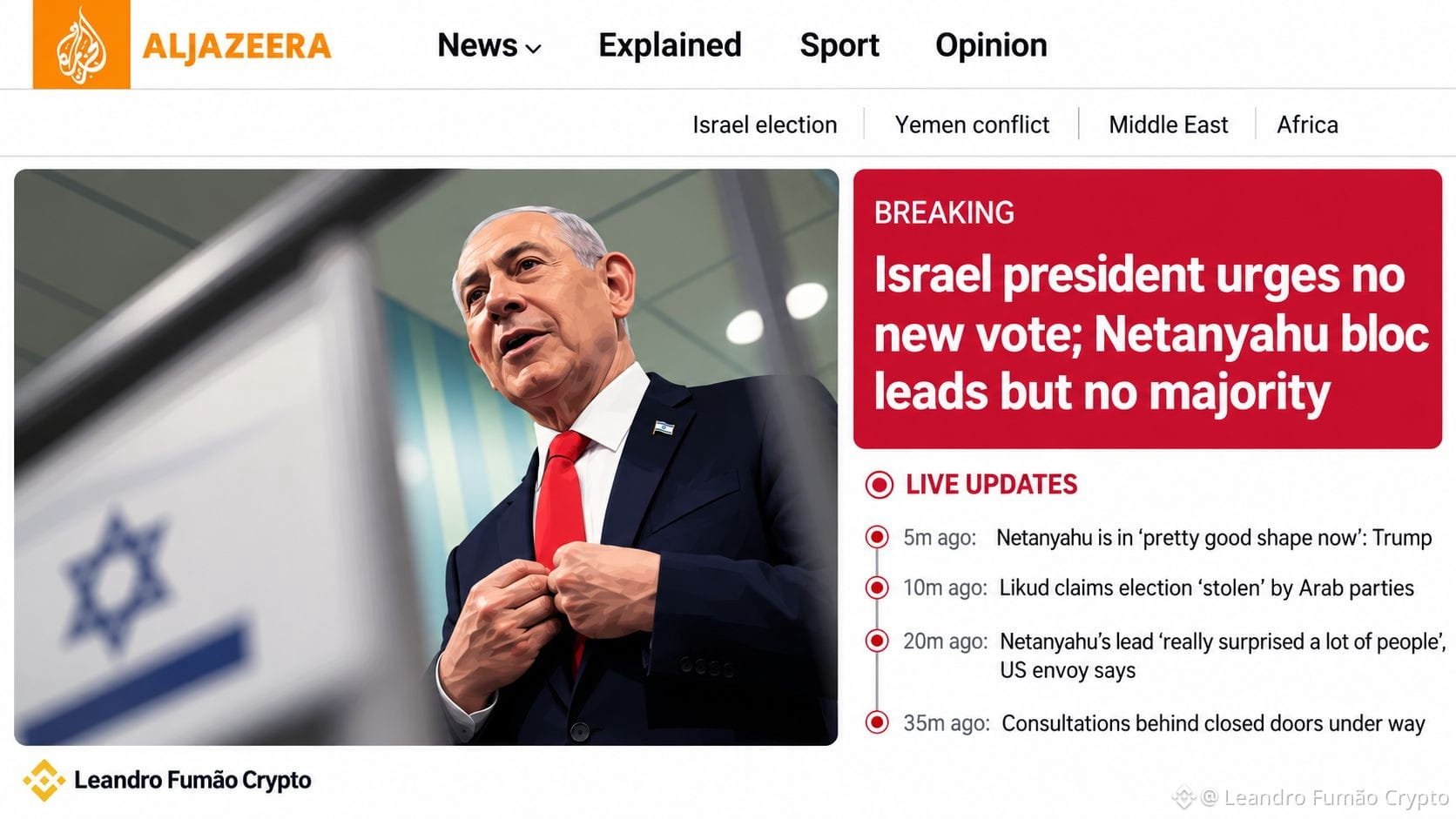
🔥📩 ELECTIONS IN ISRAEL ⋙ NETANYAHU LEADS👉 BUT WITHOUT A MAJORITY ⋙ CLOSE RACE WITH EISENKOT❗ જ⁀➴
Preliminary results from Israel's elections show an extremely close race, with no clear winner and the country facing political uncertainty.
With 85.6% of the votes counted↴
Netanyahu's bloc » 53 seats Eisenkot's bloc (opposition)» 48 seats Arab parties » 19 seats
Neither side has a majority to form a government on its own. Netanyahu said the right had won a “decisive” majority among the Zionist public and called for the formation of a “national right-wing government.” The prime minister ruled out any coalition with Arab parties, calling one “shameful.”
President Isaac Herzog urged Israel to avoid another election and said he would begin consultations on forming a government next week. High turnout among Palestinian citizens of Israel threatens Netanyahu's dominance. Possible scenarios include a national unity government, an attempt by Netanyahu to break up the opposition, or even using tensions with Iran to delay the transition.
.....................................👁️ $TRUMP 👁️.........................................
Israel is experiencing a classic political deadlock: Netanyahu is leading but lacks a majority, and the opposition also cannot form a government without the Arab parties — something most Jewish parties reject. The result underscores the polarization and leaves the country in uncertain territory, with the risk of another election or a fragile government. The situation in Gaza and tensions with Iran remain in the background of the race.
{spot}(DOTUSDT)
💭Does the close result of Israel's elections strengthen Netanyahu or open a real path to a change of government? And does the rejection of coalitions with Arab parties show the limits of Israeli politics?
#Israel #Election2026 #AlJazeeraEnglish
🔥📩 ELECTIONS IN ISRAEL ⋙ NETANYAHU LEADS👉 BUT WITHOUT A MAJORITY ⋙ CLOSE RACE WITH EISENKOT❗ જ⁀➴
Preliminary results from Israel's elections show an extremely close race, with no clear winner and the country facing political uncertainty.
With 85.6% of the votes counted↴
Netanyahu's bloc » 53 seats Eisenkot's bloc (opposition)» 48 seats Arab parties » 19 seats
Neither side has a majority to form a government on its own. Netanyahu said the right had won a “decisive” majority among the Zionist public and called for the formation of a “national right-wing government.” The prime minister ruled out any coalition with Arab parties, calling one “shameful.”
President Isaac Herzog urged Israel to avoid another election and said he would begin consultations on forming a government next week. High turnout among Palestinian citizens of Israel threatens Netanyahu's dominance. Possible scenarios include a national unity government, an attempt by Netanyahu to break up the opposition, or even using tensions with Iran to delay the transition.
.....................................👁️ $TRUMP 👁️.........................................
Israel is experiencing a classic political deadlock: Netanyahu is leading but lacks a majority, and the opposition also cannot form a government without the Arab parties — something most Jewish parties reject. The result underscores the polarization and leaves the country in uncertain territory, with the risk of another election or a fragile government. The situation in Gaza and tensions with Iran remain in the background of the race.
💭Does the close result of Israel's elections strengthen Netanyahu or open a real path to a change of government? And does the rejection of coalitions with Arab parties show the limits of Israeli politics?
#Israel #Election2026 #AlJazeeraEnglish
2
737
·
--
Bullish
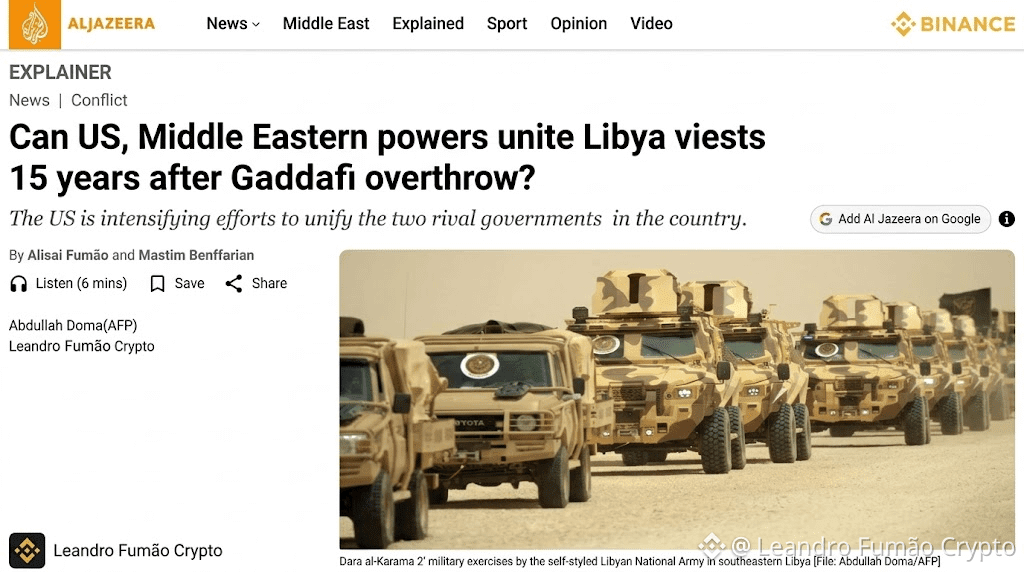
⚔️15 YEARS AFTER GADDAFI'S FALL » THE U.S. AND MIDDLE EAST POWERS TRY TO UNIFY LIBYA❗
Fifteen years after the uprising that toppled Muammar Gaddafi, Libya remains deeply divided. Now, the United States, Egypt, Turkey, and Qatar are stepping up diplomatic efforts to try to reunify the country and put an end to more than a decade of conflict between two rival governments.
Libya Remains Split Between Two Rival Administrations
The Government of National Unity (GNU), recognized by the UN and based in Tripoli, is led by Prime Minister Abdul Hamid Dbeibah. The eastern administration, based in Tobruk and backed by Khalifa Haftar and his Libyan National Army (LNA), controls oil-rich areas.
The United States, led by advisor Massad Boulos (Trump’s adviser on Arab and African affairs), is intensifying mediation. The American proposal offers an economic incentive: if the parties cooperate and form a single government, the U.S. will encourage American investment in Libyan oil fields.
The power-sharing plan provides that Dbeibah will remain prime minister and Saddam Haftar (son of Khalifa Haftar) will take the presidency. Egypt, Turkey, and Qatar are also pursuing a “Single Libya,” with recent high-level meetings. A unified national budget for 2026 has already been approved—the first in more than a decade—but there is still no single functioning government.
Unifying Libya matters to the United States mainly because of oil and control of migration flows to Europe. Regional powers, meanwhile, are trying to balance their influence in the country. After 15 years of division, violence, and economic crisis, the big question remains the same: will diplomacy this time really succeed in bringing Libya together?
{spot}(XRPUSDT)
🤔 Does American mediation and that of the Middle East powers have a real chance of unifying Libya, or will the country continue to be divided for more years?
#Trump's #AlJazeeraEnglish
⚔️15 YEARS AFTER GADDAFI'S FALL » THE U.S. AND MIDDLE EAST POWERS TRY TO UNIFY LIBYA❗
Fifteen years after the uprising that toppled Muammar Gaddafi, Libya remains deeply divided. Now, the United States, Egypt, Turkey, and Qatar are stepping up diplomatic efforts to try to reunify the country and put an end to more than a decade of conflict between two rival governments.
Libya Remains Split Between Two Rival Administrations
The Government of National Unity (GNU), recognized by the UN and based in Tripoli, is led by Prime Minister Abdul Hamid Dbeibah. The eastern administration, based in Tobruk and backed by Khalifa Haftar and his Libyan National Army (LNA), controls oil-rich areas.
The United States, led by advisor Massad Boulos (Trump’s adviser on Arab and African affairs), is intensifying mediation. The American proposal offers an economic incentive: if the parties cooperate and form a single government, the U.S. will encourage American investment in Libyan oil fields.
The power-sharing plan provides that Dbeibah will remain prime minister and Saddam Haftar (son of Khalifa Haftar) will take the presidency. Egypt, Turkey, and Qatar are also pursuing a “Single Libya,” with recent high-level meetings. A unified national budget for 2026 has already been approved—the first in more than a decade—but there is still no single functioning government.
Unifying Libya matters to the United States mainly because of oil and control of migration flows to Europe. Regional powers, meanwhile, are trying to balance their influence in the country. After 15 years of division, violence, and economic crisis, the big question remains the same: will diplomacy this time really succeed in bringing Libya together?
🤔 Does American mediation and that of the Middle East powers have a real chance of unifying Libya, or will the country continue to be divided for more years?
#Trump's #AlJazeeraEnglish
4
1.7k
Log in to explore more content
Join global crypto users on Binance Square
⚡️ Get latest and useful information about crypto.
💬 Trusted by the world’s largest crypto exchange.
👍 Discover real insights from verified creators.
Email / Phone number
Trending Topics
1
#$1.5BInLeveragedCryptoBetsLiquidated
3,741 views
58 Discussing
2
#KOSPIFalls3.53%BackBelow6000
7,020 views
261 Discussing
3
#USMidtermElections
120,564 views
1,530 Discussing
4
#StrategySTRCReaches$99.95ForFirstTimeIn165Days
2,057 views
62 Discussing
5
#BinanceWillListPredictPREDICT
32,555 views
703 Discussing
6
#SwitzerlandFirstSpotBitcoinETFExpectedToTradeInNovember
1,263 views
72 Discussing
7
#StrategyReports$21BQ3OperatingProfit
1,352 views
41 Discussing
8
#TwoAddressesHoldingAbout1.28BUSDTFrozen
16,669 views
406 Discussing
9
#FirstDigitalBlacklistsAttackerAddressHoldingAbout3.4MFDUSD
584 views
17 Discussing
10
#BitcoinDropsBelow$80K
72,393 views
171 Discussing