
#anthropicipo
anthropicipo
14,526 views
133 Discussing
Hot
Latest


Article
Share Your Takes: Can Anthropic Hold a $1 Trillion+ Valuation?After Democrats won both the House and the Senate in the 2026 midterms, U.S. stocks rose and then fell. On Nov 5, the Nasdaq dropped about 5.5% in a single day, with AI stocks among the biggest decliners, as concerns grew over data center regulation and a slowdown in AI infrastructure buildout. Meanwhile, Anthropic's IPO is approaching the roadshow and pricing stage. It could raise up to $100 billion and become the largest IPO in history, but valuation expectations have been revised down from $2 trillion. Is AI still a bubble? Will regulation outweigh fundamentals?
Follow Anthropic's IPO on Square for the latest updates, and share your takes to earn a traffic boost.
Share Your Anthropic IPO Views on Square to Earn Traffic Boost
How to Join:Post with #AnthropicIPO Pick any angle and share your take in the post.Angle 1: Anthropic's expected IPO valuation has dropped from $2 trillion to around $1.5 trillion. Can it hold the $1 trillion mark?Angle 2: SpaceX rose 19% on its first trading day this June. Will Anthropic rise or fall on debut?Angle 3: On Nov 5, Anthropic began beta testing Personal Finance in Claude, with read-only access to connected bank and card accounts. Would you let AI see your account data?
Submission window:2026-11-10 12:00 – 2026-11-13 06:00 (UTC)Quality posts meeting requirements may be selected for random traffic boosts. Posts featuring trade-share cards for $ANTHROPIC trades or positions are more likely to be boosted.
Share Your Takes: Can Anthropic Hold a $1 Trillion+ Valuation?
After Democrats won both the House and the Senate in the 2026 midterms, U.S. stocks rose and then fell. On Nov 5, the Nasdaq dropped about 5.5% in a single day, with AI stocks among the biggest decliners, as concerns grew over data center regulation and a slowdown in AI infrastructure buildout. Meanwhile, Anthropic's IPO is approaching the roadshow and pricing stage. It could raise up to $100 billion and become the largest IPO in history, but valuation expectations have been revised down from $2 trillion. Is AI still a bubble? Will regulation outweigh fundamentals?
Follow Anthropic's IPO on Square for the latest updates, and share your takes to earn a traffic boost.
Share Your Anthropic IPO Views on Square to Earn Traffic Boost
How to Join:Post with #AnthropicIPO Pick any angle and share your take in the post.Angle 1: Anthropic's expected IPO valuation has dropped from $2 trillion to around $1.5 trillion. Can it hold the $1 trillion mark?Angle 2: SpaceX rose 19% on its first trading day this June. Will Anthropic rise or fall on debut?Angle 3: On Nov 5, Anthropic began beta testing Personal Finance in Claude, with read-only access to connected bank and card accounts. Would you let AI see your account data?
Submission window:2026-11-10 12:00 – 2026-11-13 06:00 (UTC)Quality posts meeting requirements may be selected for random traffic boosts. Posts featuring trade-share cards for $ANTHROPIC trades or positions are more likely to be boosted.
Follow Anthropic's IPO on Square for the latest updates, and share your takes to earn a traffic boost.
Share Your Anthropic IPO Views on Square to Earn Traffic Boost
How to Join:Post with #AnthropicIPO Pick any angle and share your take in the post.Angle 1: Anthropic's expected IPO valuation has dropped from $2 trillion to around $1.5 trillion. Can it hold the $1 trillion mark?Angle 2: SpaceX rose 19% on its first trading day this June. Will Anthropic rise or fall on debut?Angle 3: On Nov 5, Anthropic began beta testing Personal Finance in Claude, with read-only access to connected bank and card accounts. Would you let AI see your account data?
Submission window:2026-11-10 12:00 – 2026-11-13 06:00 (UTC)Quality posts meeting requirements may be selected for random traffic boosts. Posts featuring trade-share cards for $ANTHROPIC trades or positions are more likely to be boosted.
Demonmusic7:
thank you for the event
10
28
5.9k

·
--
#AnthropicIPO
The Biggest IPO In History Is Here.
Anthropic, the company behind Claude, just set its IPO price range today.
The Details:
Ticker: $ANT on Nasdaq
Price Range: $70 - $78 per share
Shares: 825 Million
Raise: Up to $64.35B from IPO alone
Valuation: Up to $1.02 Trillion, $1.405 Trillion fully diluted
Listing Date: Expected week of Nov 16 - 19
This is down from the $2 Trillion valuation talked about in October. The AI sell-off forced Anthropic to be more realistic.
Who Is Buying $26B On The Side?
Google: $10B
Nvidia $NVDA: $10B
AMD $AMD: $2.5B
Microsoft $MSFT: $1B
Broadcom $AVGO: $1B
Micron $MU: $1B
TSMC $TSM: $500M
Total fundraising could hit $90.4B. That would make it one of the largest ever, close to SpaceX.
The Numbers:
Revenue 9 months 2026: $33.24B, 12x higher than last year
Q3 Revenue: $16.96B, up 46.7% from Q2
Net Loss 9 months: $104B, mostly due to accounting adjustment
Last private valuation May 2026: $965B
Anthropic is growing insanely fast, but it is still burning massive cash on AI compute. It has $895.4B in committed spending on AI infrastructure.
Why This Matters For Crypto?
If $ANT IPO succeeds, it will bring back confidence in AI. That is bullish for $BTC, $ETH, and AI coins like $TAO, $FET, $RENDER, $NEAR, $UAI.
If it flops, AI bubble fear will get worse.
Are you buying $ANT on listing day, or waiting?
#AnthropicIPO #Anthropic #Claude #BinanceSquare
#AnthropicIPO
#AnthropicIPO
The Biggest IPO In History Is Here.
Anthropic, the company behind Claude, just set its IPO price range today.
The Details:
Ticker: $ANT on Nasdaq
Price Range: $70 - $78 per share
Shares: 825 Million
Raise: Up to $64.35B from IPO alone
Valuation: Up to $1.02 Trillion, $1.405 Trillion fully diluted
Listing Date: Expected week of Nov 16 - 19
This is down from the $2 Trillion valuation talked about in October. The AI sell-off forced Anthropic to be more realistic.
Who Is Buying $26B On The Side?
Google: $10B
Nvidia $NVDA: $10B
AMD $AMD: $2.5B
Microsoft $MSFT: $1B
Broadcom $AVGO: $1B
Micron $MU: $1B
TSMC $TSM: $500M
Total fundraising could hit $90.4B. That would make it one of the largest ever, close to SpaceX.
The Numbers:
Revenue 9 months 2026: $33.24B, 12x higher than last year
Q3 Revenue: $16.96B, up 46.7% from Q2
Net Loss 9 months: $104B, mostly due to accounting adjustment
Last private valuation May 2026: $965B
Anthropic is growing insanely fast, but it is still burning massive cash on AI compute. It has $895.4B in committed spending on AI infrastructure.
Why This Matters For Crypto?
If $ANT IPO succeeds, it will bring back confidence in AI. That is bullish for $BTC, $ETH, and AI coins like $TAO, $FET, $RENDER, $NEAR, $UAI.
If it flops, AI bubble fear will get worse.
Are you buying $ANT on listing day, or waiting?
#AnthropicIPO #Anthropic #Claude #BinanceSquare
#AnthropicIPO
The Biggest IPO In History Is Here.
Anthropic, the company behind Claude, just set its IPO price range today.
The Details:
Ticker: $ANT on Nasdaq
Price Range: $70 - $78 per share
Shares: 825 Million
Raise: Up to $64.35B from IPO alone
Valuation: Up to $1.02 Trillion, $1.405 Trillion fully diluted
Listing Date: Expected week of Nov 16 - 19
This is down from the $2 Trillion valuation talked about in October. The AI sell-off forced Anthropic to be more realistic.
Who Is Buying $26B On The Side?
Google: $10B
Nvidia $NVDA: $10B
AMD $AMD: $2.5B
Microsoft $MSFT: $1B
Broadcom $AVGO: $1B
Micron $MU: $1B
TSMC $TSM: $500M
Total fundraising could hit $90.4B. That would make it one of the largest ever, close to SpaceX.
The Numbers:
Revenue 9 months 2026: $33.24B, 12x higher than last year
Q3 Revenue: $16.96B, up 46.7% from Q2
Net Loss 9 months: $104B, mostly due to accounting adjustment
Last private valuation May 2026: $965B
Anthropic is growing insanely fast, but it is still burning massive cash on AI compute. It has $895.4B in committed spending on AI infrastructure.
Why This Matters For Crypto?
If $ANT IPO succeeds, it will bring back confidence in AI. That is bullish for $BTC, $ETH, and AI coins like $TAO, $FET, $RENDER, $NEAR, $UAI.
If it flops, AI bubble fear will get worse.
Are you buying $ANT on listing day, or waiting?
#AnthropicIPO #Anthropic #Claude #BinanceSquare
#AnthropicIPO
Buying
Waiting
2 day(s) left
1
330

·
--
🚨 AI's Biggest Moment Is Here!
#AnthropicIPO is making headlines as Anthropic takes a major step toward becoming a publicly traded company. This move could attract fresh capital, boost confidence in the AI sector, and increase investor interest across the market.
The IPO is still awaiting regulatory approval, but it's already one of the most closely watched events in the AI industry. Keep this on your radar—this could be a defining moment for the future of artificial intelligence.
What's your take? Bullish on AI? 👇
$ANTHROPIC
{future}(ANTHROPICUSDT)
#Anthropic #IPO #CryptoNews
🚨 AI's Biggest Moment Is Here!
#AnthropicIPO is making headlines as Anthropic takes a major step toward becoming a publicly traded company. This move could attract fresh capital, boost confidence in the AI sector, and increase investor interest across the market.
The IPO is still awaiting regulatory approval, but it's already one of the most closely watched events in the AI industry. Keep this on your radar—this could be a defining moment for the future of artificial intelligence.
What's your take? Bullish on AI? 👇
$ANTHROPIC
#Anthropic #IPO #CryptoNews
#AnthropicIPO is making headlines as Anthropic takes a major step toward becoming a publicly traded company. This move could attract fresh capital, boost confidence in the AI sector, and increase investor interest across the market.
The IPO is still awaiting regulatory approval, but it's already one of the most closely watched events in the AI industry. Keep this on your radar—this could be a defining moment for the future of artificial intelligence.
What's your take? Bullish on AI? 👇
$ANTHROPIC
#Anthropic #IPO #CryptoNews

1
2

·
--
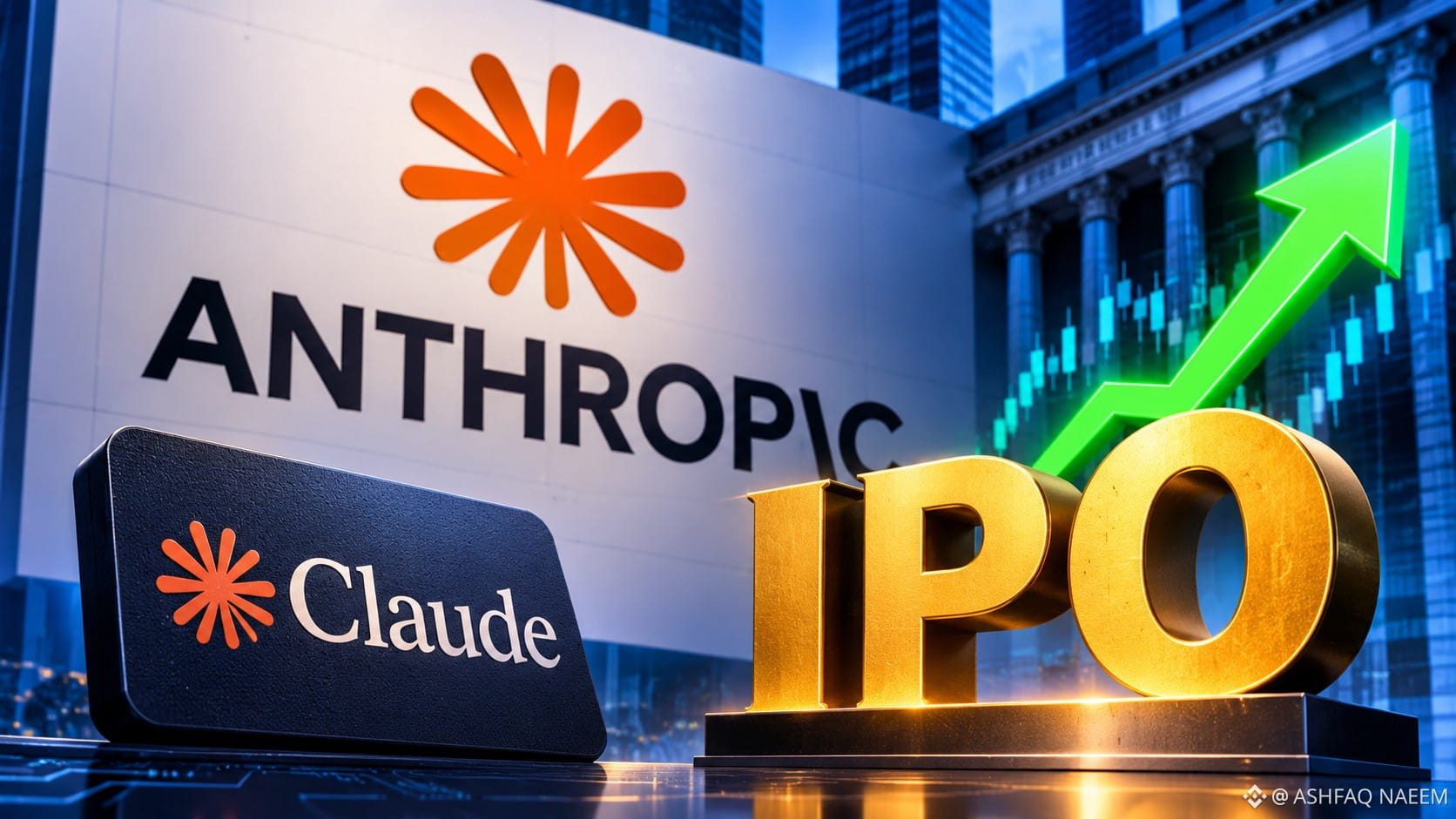
🚨 ANTHROPIC IPO COULD MAKE WALL STREET HISTORY!
The company behind Claude AI is moving toward a potentially record-breaking stock market debut, with its latest SEC filing outlining an IPO price range of $70–$78 per share.
Here are the major numbers:
🔥 Up to $64.4 billion targeted through the IPO
🔥 Another $26 billion planned through a private placement
🔥 Potential combined fundraising of approximately $90.4 billion
🔥 Major strategic investors include Google, Nvidia, Microsoft, AMD and Broadcom
This is more than another tech IPO. It could become a major test of investor confidence in the AI industry.
But there's a bigger question: Can Anthropic justify its enormous valuation while facing massive computing and infrastructure costs?
The AI investment race is entering a new chapter.
Would you invest in Anthropic at its IPO price, or wait for the market to settle?
#anthropicipo $ANTHROPIC
{future}(ANTHROPICUSDT)
🚨 ANTHROPIC IPO COULD MAKE WALL STREET HISTORY!
The company behind Claude AI is moving toward a potentially record-breaking stock market debut, with its latest SEC filing outlining an IPO price range of $70–$78 per share.
Here are the major numbers:
🔥 Up to $64.4 billion targeted through the IPO
🔥 Another $26 billion planned through a private placement
🔥 Potential combined fundraising of approximately $90.4 billion
🔥 Major strategic investors include Google, Nvidia, Microsoft, AMD and Broadcom
This is more than another tech IPO. It could become a major test of investor confidence in the AI industry.
But there's a bigger question: Can Anthropic justify its enormous valuation while facing massive computing and infrastructure costs?
The AI investment race is entering a new chapter.
Would you invest in Anthropic at its IPO price, or wait for the market to settle?
#anthropicipo $ANTHROPIC
The company behind Claude AI is moving toward a potentially record-breaking stock market debut, with its latest SEC filing outlining an IPO price range of $70–$78 per share.
Here are the major numbers:
🔥 Up to $64.4 billion targeted through the IPO
🔥 Another $26 billion planned through a private placement
🔥 Potential combined fundraising of approximately $90.4 billion
🔥 Major strategic investors include Google, Nvidia, Microsoft, AMD and Broadcom
This is more than another tech IPO. It could become a major test of investor confidence in the AI industry.
But there's a bigger question: Can Anthropic justify its enormous valuation while facing massive computing and infrastructure costs?
The AI investment race is entering a new chapter.
Would you invest in Anthropic at its IPO price, or wait for the market to settle?
#anthropicipo $ANTHROPIC
85

·
--
Bullish
#anthropicipo
🚨 Anthropic Targets Trillion+ Valuation in Landmark IPO
Anthropic is moving ahead with one of the biggest AI IPOs ever, targeting a valuation of up to roughly $1.02 trillion. The Claude developer plans to offer 825 million shares at $70–$78, potentially raising up to $64.4 billion.
The bigger story for markets is the investor appetite for AI at extreme valuations. Anthropic’s IPO is arriving as investors have become more cautious about massive AI infrastructure spending, high financing costs, and whether future AI revenue can justify current valuations.
For traders, this is less about Anthropic alone and more about risk sentiment across the broader technology market. A strong IPO could reinforce confidence in the AI investment cycle, while weak demand or disappointing pricing could add pressure to already-sensitive AI-related assets.
Anthropic’s Q3 revenue reached about $16.96 billion, up 47% sequentially, but growth has slowed from the previous quarter. The company also has enormous future computing commitments, making capital requirements an important factor for investors.
Bottom line: Anthropic’s IPO could become an important market test for whether investors are still willing to pay premium valuations for AI growth. Crypto traders should watch the broader AI and risk-asset sentiment rather than treating the IPO as a direct crypto catalyst.
#Anthropic #AI #Crypto #MarketNews
$INIT $ARIA $SOPH
{future}(SOPHUSDT)
{future}(ARIAUSDT)
{future}(INITUSDT)
#anthropicipo
🚨 Anthropic Targets Trillion+ Valuation in Landmark IPO
Anthropic is moving ahead with one of the biggest AI IPOs ever, targeting a valuation of up to roughly $1.02 trillion. The Claude developer plans to offer 825 million shares at $70–$78, potentially raising up to $64.4 billion.
The bigger story for markets is the investor appetite for AI at extreme valuations. Anthropic’s IPO is arriving as investors have become more cautious about massive AI infrastructure spending, high financing costs, and whether future AI revenue can justify current valuations.
For traders, this is less about Anthropic alone and more about risk sentiment across the broader technology market. A strong IPO could reinforce confidence in the AI investment cycle, while weak demand or disappointing pricing could add pressure to already-sensitive AI-related assets.
Anthropic’s Q3 revenue reached about $16.96 billion, up 47% sequentially, but growth has slowed from the previous quarter. The company also has enormous future computing commitments, making capital requirements an important factor for investors.
Bottom line: Anthropic’s IPO could become an important market test for whether investors are still willing to pay premium valuations for AI growth. Crypto traders should watch the broader AI and risk-asset sentiment rather than treating the IPO as a direct crypto catalyst.
#Anthropic #AI #Crypto #MarketNews
$INIT $ARIA $SOPH
🚨 Anthropic Targets Trillion+ Valuation in Landmark IPO
Anthropic is moving ahead with one of the biggest AI IPOs ever, targeting a valuation of up to roughly $1.02 trillion. The Claude developer plans to offer 825 million shares at $70–$78, potentially raising up to $64.4 billion.
The bigger story for markets is the investor appetite for AI at extreme valuations. Anthropic’s IPO is arriving as investors have become more cautious about massive AI infrastructure spending, high financing costs, and whether future AI revenue can justify current valuations.
For traders, this is less about Anthropic alone and more about risk sentiment across the broader technology market. A strong IPO could reinforce confidence in the AI investment cycle, while weak demand or disappointing pricing could add pressure to already-sensitive AI-related assets.
Anthropic’s Q3 revenue reached about $16.96 billion, up 47% sequentially, but growth has slowed from the previous quarter. The company also has enormous future computing commitments, making capital requirements an important factor for investors.
Bottom line: Anthropic’s IPO could become an important market test for whether investors are still willing to pay premium valuations for AI growth. Crypto traders should watch the broader AI and risk-asset sentiment rather than treating the IPO as a direct crypto catalyst.
#Anthropic #AI #Crypto #MarketNews
$INIT $ARIA $SOPH

60


·
--
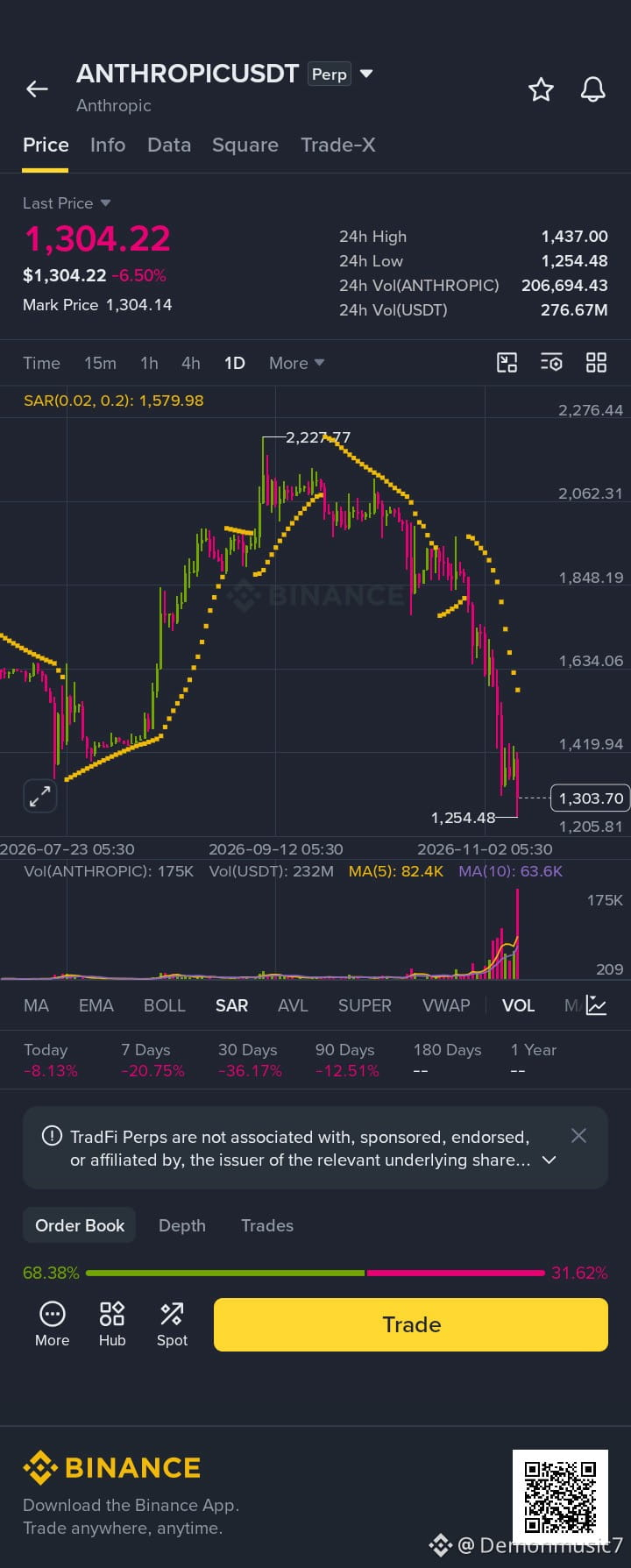
Whether Anthropic will rise or fall on its debut is impossible to predict with certainty, as first day stock movements depend heavily on final pricing, market sentiment, and institutional demand.
1. Scale and Valuation Expectations
The SpaceX Comparison: SpaceX’s massive debut came with a heavy wave of retail and institutional enthusiasm, helping drive its strong first-day pop.
The Anthropic Setup: Anthropic is targeting a historic and massive Nasdaq debut under the ticker ANT, with expected valuations ranging anywhere from $1.5 trillion to $2 trillion (and some recent reports noting investor adjustments toward the lower end of that spectrum amid shifting market backdrops). Because it is attempting to price such a colossal valuation right out of the gate, underwriters have to carefully balance heavy demand against the risk of the stock being priced for perfection.
2. Tailwinds (The Bull Case)
Hyper-Growth: Anthropic’s S 1 filings have highlighted explosive revenue scaling and rapidly narrowing operating losses, driven heavily by enterprise adoption of Claude.
Strategic Backing: Deep pocketed heavyweights like Amazon and Alphabet (Google) provide major structural stability, hardware/compute support, and massive corporate partnership commitments.
3. Headwinds (The Bear Case)
Enormous Capital Commitments: The S 1 also revealed staggering long-term infrastructure and compute commitments, leaving some market watchers questioning how fast operating cash flows can catch up to maturing short term bills.
#AnthropicIPO #AnthropicRejectsIPODelayValuationinQuestion
$ANTHROPIC
{future}(ANTHROPICUSDT)
Whether Anthropic will rise or fall on its debut is impossible to predict with certainty, as first day stock movements depend heavily on final pricing, market sentiment, and institutional demand.
1. Scale and Valuation Expectations
The SpaceX Comparison: SpaceX’s massive debut came with a heavy wave of retail and institutional enthusiasm, helping drive its strong first-day pop.
The Anthropic Setup: Anthropic is targeting a historic and massive Nasdaq debut under the ticker ANT, with expected valuations ranging anywhere from $1.5 trillion to $2 trillion (and some recent reports noting investor adjustments toward the lower end of that spectrum amid shifting market backdrops). Because it is attempting to price such a colossal valuation right out of the gate, underwriters have to carefully balance heavy demand against the risk of the stock being priced for perfection.
2. Tailwinds (The Bull Case)
Hyper-Growth: Anthropic’s S 1 filings have highlighted explosive revenue scaling and rapidly narrowing operating losses, driven heavily by enterprise adoption of Claude.
Strategic Backing: Deep pocketed heavyweights like Amazon and Alphabet (Google) provide major structural stability, hardware/compute support, and massive corporate partnership commitments.
3. Headwinds (The Bear Case)
Enormous Capital Commitments: The S 1 also revealed staggering long-term infrastructure and compute commitments, leaving some market watchers questioning how fast operating cash flows can catch up to maturing short term bills.
#AnthropicIPO #AnthropicRejectsIPODelayValuationinQuestion
$ANTHROPIC
1. Scale and Valuation Expectations
The SpaceX Comparison: SpaceX’s massive debut came with a heavy wave of retail and institutional enthusiasm, helping drive its strong first-day pop.
The Anthropic Setup: Anthropic is targeting a historic and massive Nasdaq debut under the ticker ANT, with expected valuations ranging anywhere from $1.5 trillion to $2 trillion (and some recent reports noting investor adjustments toward the lower end of that spectrum amid shifting market backdrops). Because it is attempting to price such a colossal valuation right out of the gate, underwriters have to carefully balance heavy demand against the risk of the stock being priced for perfection.
2. Tailwinds (The Bull Case)
Hyper-Growth: Anthropic’s S 1 filings have highlighted explosive revenue scaling and rapidly narrowing operating losses, driven heavily by enterprise adoption of Claude.
Strategic Backing: Deep pocketed heavyweights like Amazon and Alphabet (Google) provide major structural stability, hardware/compute support, and massive corporate partnership commitments.
3. Headwinds (The Bear Case)
Enormous Capital Commitments: The S 1 also revealed staggering long-term infrastructure and compute commitments, leaving some market watchers questioning how fast operating cash flows can catch up to maturing short term bills.
#AnthropicIPO #AnthropicRejectsIPODelayValuationinQuestion
$ANTHROPIC
120
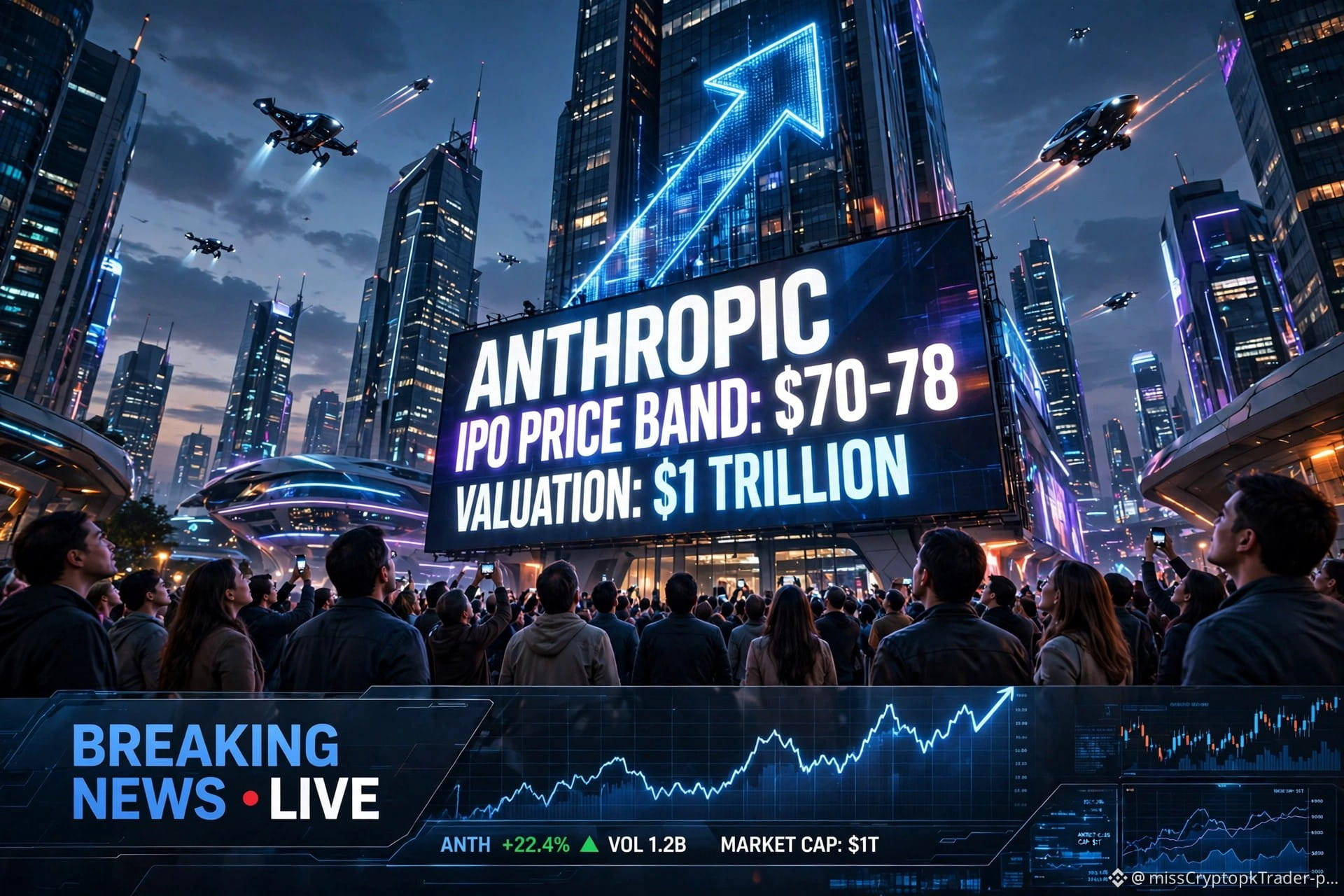
🚨 ANTHROPIC IPO PRICE BAND OUT: $70 - $78 PER SHARE
Valuation: $1 TRILLION+ — The biggest AI IPO ever is here!
According to CNBC Awaaz / Reuters, Anthropic has officially set its IPO price band in its filing today.
Deal Details:
- Price Band: $70 to $78 per share
- Total Shares: 825 Million
- 801.3M new shares being sold by the company
- 23.6M shares being sold by existing investors
- Raise from IPO: Up to $64.4 Billion (at $78)
- Ticker: ANT — Will list on Nasdaq
- Listing: Expected mid-November
What Is The Valuation?
- On outstanding shares: $1.02 Trillion
- Fully Diluted (including options + unvested stock): Up to $1.4 Trillion
- Last Private Round (May): $965 Billion
Earlier there was talk of $1.8 - $2 Trillion. Now the valuation has come down a bit — due to market volatility.
Even Bigger Twist:
Along with the IPO, there is a $26 Billion Private Placement.
Google, Nvidia, AMD, Microsoft, Broadcom, Micron, TSMC — 7 big tech giants are putting in money together.
Total Fundraise: $90.4 Billion — One of the largest tech fundraises in history!
Revenue Is Also also a Monster:
- Revenue Run-Rate: $81 Billion (as of Oct 31)
- Q3 Revenue: ~$17 Billion, up 1,127% YoY
- 9 Months Revenue: $33.24 Billion
But still loss-making — with $900B+ in future infra commitments.
SpaceX raised $75B in June at a $1.75T valuation. Now the Anthropic is challenging that record.
Roadshow starts today — Anthropic will now pitch to investors.
What do you think?
🟢 = Even at $78 it's cheap, I will BUY
🔴 = $1 Trillion is too much, it's a bubble
#AnthropicIPOPriceBand70to78Valuation1Trillion
#AnthropicIPO #AI #Claude #StockMarket
$ANT $NVDA $GOOGL
🚨 ANTHROPIC IPO PRICE BAND OUT: $70 - $78 PER SHARE
Valuation: $1 TRILLION+ — The biggest AI IPO ever is here!
According to CNBC Awaaz / Reuters, Anthropic has officially set its IPO price band in its filing today.
Deal Details:
- Price Band: $70 to $78 per share
- Total Shares: 825 Million
- 801.3M new shares being sold by the company
- 23.6M shares being sold by existing investors
- Raise from IPO: Up to $64.4 Billion (at $78)
- Ticker: ANT — Will list on Nasdaq
- Listing: Expected mid-November
What Is The Valuation?
- On outstanding shares: $1.02 Trillion
- Fully Diluted (including options + unvested stock): Up to $1.4 Trillion
- Last Private Round (May): $965 Billion
Earlier there was talk of $1.8 - $2 Trillion. Now the valuation has come down a bit — due to market volatility.
Even Bigger Twist:
Along with the IPO, there is a $26 Billion Private Placement.
Google, Nvidia, AMD, Microsoft, Broadcom, Micron, TSMC — 7 big tech giants are putting in money together.
Total Fundraise: $90.4 Billion — One of the largest tech fundraises in history!
Revenue Is Also also a Monster:
- Revenue Run-Rate: $81 Billion (as of Oct 31)
- Q3 Revenue: ~$17 Billion, up 1,127% YoY
- 9 Months Revenue: $33.24 Billion
But still loss-making — with $900B+ in future infra commitments.
SpaceX raised $75B in June at a $1.75T valuation. Now the Anthropic is challenging that record.
Roadshow starts today — Anthropic will now pitch to investors.
What do you think?
🟢 = Even at $78 it's cheap, I will BUY
🔴 = $1 Trillion is too much, it's a bubble
#AnthropicIPOPriceBand70to78Valuation1Trillion
#AnthropicIPO #AI #Claude #StockMarket
$ANT $NVDA $GOOGL
Valuation: $1 TRILLION+ — The biggest AI IPO ever is here!
According to CNBC Awaaz / Reuters, Anthropic has officially set its IPO price band in its filing today.
Deal Details:
- Price Band: $70 to $78 per share
- Total Shares: 825 Million
- 801.3M new shares being sold by the company
- 23.6M shares being sold by existing investors
- Raise from IPO: Up to $64.4 Billion (at $78)
- Ticker: ANT — Will list on Nasdaq
- Listing: Expected mid-November
What Is The Valuation?
- On outstanding shares: $1.02 Trillion
- Fully Diluted (including options + unvested stock): Up to $1.4 Trillion
- Last Private Round (May): $965 Billion
Earlier there was talk of $1.8 - $2 Trillion. Now the valuation has come down a bit — due to market volatility.
Even Bigger Twist:
Along with the IPO, there is a $26 Billion Private Placement.
Google, Nvidia, AMD, Microsoft, Broadcom, Micron, TSMC — 7 big tech giants are putting in money together.
Total Fundraise: $90.4 Billion — One of the largest tech fundraises in history!
Revenue Is Also also a Monster:
- Revenue Run-Rate: $81 Billion (as of Oct 31)
- Q3 Revenue: ~$17 Billion, up 1,127% YoY
- 9 Months Revenue: $33.24 Billion
But still loss-making — with $900B+ in future infra commitments.
SpaceX raised $75B in June at a $1.75T valuation. Now the Anthropic is challenging that record.
Roadshow starts today — Anthropic will now pitch to investors.
What do you think?
🟢 = Even at $78 it's cheap, I will BUY
🔴 = $1 Trillion is too much, it's a bubble
#AnthropicIPOPriceBand70to78Valuation1Trillion
#AnthropicIPO #AI #Claude #StockMarket
$ANT $NVDA $GOOGL
172

·
--

Article
Can Anthropic Really Hold a $1 Trillion+ Valuation? The AI Market Is Facing Its Biggest Test YetA company can dominate the AI race and still be overpriced. Anthropic is about to put that theory to the test.
The AI trade is entering a critical phase. Investors who once rushed to buy anything connected to artificial intelligence are now asking a tougher question: Where are the actual returns?
On November 5, the Nasdaq plunged approximately 5.5% in a single session, with AI and semiconductor stocks among the hardest hit. Concerns over data-center regulation, infrastructure spending and the future profitability of AI businesses triggered a fresh wave of selling.
Now, Anthropic's upcoming IPO is adding another layer to the debate.
Could a company command a valuation above $1 trillion, or are investors getting ahead of the fundamentals?
Anthropic's $1 Trillion IPO: Growth or Overvaluation?
Anthropic's valuation expectations have shifted considerably.
Earlier discussions suggested a possible $2 trillion valuation. More recent reports have pointed to approximately $1 trillion in non-diluted market value and up to $1.4 trillion on a fully diluted basis.
The proposed offering could raise tens of billions of dollars, making it one of the largest IPOs ever considered.
The business numbers are impressive. Anthropic reportedly reached approximately $81 billion in annualized revenue as of October 31, 2026, with third-quarter revenue of $16.96 billion.
That's meaningful commercial traction.
But here's where investors need to be careful: strong revenue growth does not automatically justify a trillion-dollar valuation.
The real test is whether Anthropic can turn its growing customer base into sustainable profits.
Is AI Becoming a Bubble?
I don't think the entire AI sector is a bubble. The technology has real demand, and companies are already paying for AI services.
However, some valuations appear to assume years of uninterrupted growth.
There are two possible outcomes:
Bullish scenario: Enterprise adoption continues, Claude gains market share, and recurring AI revenue grows faster than operating costs.
Bearish scenario: Infrastructure expenses remain high, competition pressures pricing, and investors begin questioning when these companies will become consistently profitable.
Infrastructure is particularly important.
Anthropic has made enormous computing commitments involving major technology partners, including Google and Amazon.
That gives the company access to the resources it needs to expand. But it also creates substantial financial and execution risks.
If revenue grows faster than infrastructure costs, the business could become highly profitable.
If costs keep rising faster than revenue, even impressive growth may not protect its valuation.
Three Tickers Investors Should Watch
1. ANTHROPIC — The AI IPO Opportunity
Anthropic's public listing could become a major test of institutional demand for AI companies.
Strong IPO demand followed by sustained buying would suggest investors are comfortable paying premium valuations for AI growth.
But a weak debut or aggressive post-listing selling could signal that the market has reached its valuation limits.
One distinction matters: $ANTHROPIC is a discussion tag, not a confirmed exchange ticker. The reported expected IPO symbol is ANT.
2. SPCX — Another High-Growth Valuation Story
SpaceX offers an interesting comparison.
Investors are increasingly willing to value companies based on future market potential rather than current earnings alone.
But that approach has limits.
If Anthropic fails to deliver on its growth expectations, investors may start questioning the valuation premiums attached to other high-growth companies, including SpaceX.
3. GOOG — A Different Way to Play AI
Google is particularly interesting because its relationship with Anthropic extends beyond a simple financial investment.
Google is both an investor and a major computing infrastructure partner.
That gives Alphabet exposure to AI growth through its cloud infrastructure and broader technology business.
For investors who prefer established companies over uncertain IPO valuations, GOOG deserves attention.
However, Google's capital expenditure, AI competition and infrastructure costs still need to be monitored.
Regulation Could Change the AI Trade
The November 5 sell-off highlighted how sensitive technology stocks have become to political and regulatory developments.
Concerns over data-center construction, electricity consumption, water usage and environmental restrictions are becoming increasingly important.
AI companies need enormous computing capacity. Any delay in building new data centers could affect expansion plans and operating costs.
Stricter regulation could therefore pressure companies that depend heavily on continuous infrastructure expansion.
However, there is another side to this story.
Large companies with stronger balance sheets, established infrastructure and regulatory experience may actually benefit if smaller competitors struggle to keep up.
That's why investors should focus on business quality rather than simply buying the AI narrative.
My Trading Strategy: Don't Chase the AI Hype
I would approach this market with patience.
The first few trading sessions after a major IPO can be extremely volatile. Strong opening prices do not always mean sustainable demand.
I'd monitor three signals:
IPO demand: Watch final pricing, institutional participation and post-listing buying pressure.
Technical structure: Look for higher lows, strong trading volume and successful support retests in AI-related stocks.
Fundamentals: Track revenue growth, operating losses, infrastructure commitments and profitability.
For $GOOG.US and $SPCX , a recovery above important technical resistance levels, supported by strong volume, would improve the bullish outlook.
On the other hand, repeated rejections and lower highs would suggest that sellers remain in control.
My approach would be to avoid chasing sudden rallies, enter gradually and keep position sizes under control.
Protecting capital matters more than catching every AI breakout.
Final Take: Is $1 Trillion Too Much?
I'm cautiously bullish on AI's long-term growth, but I wouldn't blindly accept every valuation attached to the sector.
Anthropic has strong products, growing commercial demand and powerful technology partners. These are real advantages.
But maintaining a valuation above $1 trillion requires more than impressive revenue figures. Profitability, infrastructure efficiency and competitive strength will ultimately determine whether that price makes sense.
Here's the question I want every investor to consider:
Can Anthropic genuinely justify a $1 trillion+ valuation through real earnings and sustainable growth, or is the AI market pricing in a future that may never fully arrive?
Share your bullish or bearish argument below. I'd particularly like to hear whether you would invest in Anthropic's IPO or prefer established AI exposure through GOOG.
{stock_us}(GOOG.US)
{future}(SPCXUSDT)
{future}(ANTHROPICUSDT)
#AnthropicIPO #CryptoAnalysis #Geopolitics #cryptouniverseofficial #Binance
Can Anthropic Really Hold a $1 Trillion+ Valuation? The AI Market Is Facing Its Biggest Test Yet
A company can dominate the AI race and still be overpriced. Anthropic is about to put that theory to the test.
The AI trade is entering a critical phase. Investors who once rushed to buy anything connected to artificial intelligence are now asking a tougher question: Where are the actual returns?
On November 5, the Nasdaq plunged approximately 5.5% in a single session, with AI and semiconductor stocks among the hardest hit. Concerns over data-center regulation, infrastructure spending and the future profitability of AI businesses triggered a fresh wave of selling.
Now, Anthropic's upcoming IPO is adding another layer to the debate.
Could a company command a valuation above $1 trillion, or are investors getting ahead of the fundamentals?
Anthropic's $1 Trillion IPO: Growth or Overvaluation?
Anthropic's valuation expectations have shifted considerably.
Earlier discussions suggested a possible $2 trillion valuation. More recent reports have pointed to approximately $1 trillion in non-diluted market value and up to $1.4 trillion on a fully diluted basis.
The proposed offering could raise tens of billions of dollars, making it one of the largest IPOs ever considered.
The business numbers are impressive. Anthropic reportedly reached approximately $81 billion in annualized revenue as of October 31, 2026, with third-quarter revenue of $16.96 billion.
That's meaningful commercial traction.
But here's where investors need to be careful: strong revenue growth does not automatically justify a trillion-dollar valuation.
The real test is whether Anthropic can turn its growing customer base into sustainable profits.
Is AI Becoming a Bubble?
I don't think the entire AI sector is a bubble. The technology has real demand, and companies are already paying for AI services.
However, some valuations appear to assume years of uninterrupted growth.
There are two possible outcomes:
Bullish scenario: Enterprise adoption continues, Claude gains market share, and recurring AI revenue grows faster than operating costs.
Bearish scenario: Infrastructure expenses remain high, competition pressures pricing, and investors begin questioning when these companies will become consistently profitable.
Infrastructure is particularly important.
Anthropic has made enormous computing commitments involving major technology partners, including Google and Amazon.
That gives the company access to the resources it needs to expand. But it also creates substantial financial and execution risks.
If revenue grows faster than infrastructure costs, the business could become highly profitable.
If costs keep rising faster than revenue, even impressive growth may not protect its valuation.
Three Tickers Investors Should Watch
1. ANTHROPIC — The AI IPO Opportunity
Anthropic's public listing could become a major test of institutional demand for AI companies.
Strong IPO demand followed by sustained buying would suggest investors are comfortable paying premium valuations for AI growth.
But a weak debut or aggressive post-listing selling could signal that the market has reached its valuation limits.
One distinction matters: $ANTHROPIC is a discussion tag, not a confirmed exchange ticker. The reported expected IPO symbol is ANT.
2. SPCX — Another High-Growth Valuation Story
SpaceX offers an interesting comparison.
Investors are increasingly willing to value companies based on future market potential rather than current earnings alone.
But that approach has limits.
If Anthropic fails to deliver on its growth expectations, investors may start questioning the valuation premiums attached to other high-growth companies, including SpaceX.
3. GOOG — A Different Way to Play AI
Google is particularly interesting because its relationship with Anthropic extends beyond a simple financial investment.
Google is both an investor and a major computing infrastructure partner.
That gives Alphabet exposure to AI growth through its cloud infrastructure and broader technology business.
For investors who prefer established companies over uncertain IPO valuations, GOOG deserves attention.
However, Google's capital expenditure, AI competition and infrastructure costs still need to be monitored.
Regulation Could Change the AI Trade
The November 5 sell-off highlighted how sensitive technology stocks have become to political and regulatory developments.
Concerns over data-center construction, electricity consumption, water usage and environmental restrictions are becoming increasingly important.
AI companies need enormous computing capacity. Any delay in building new data centers could affect expansion plans and operating costs.
Stricter regulation could therefore pressure companies that depend heavily on continuous infrastructure expansion.
However, there is another side to this story.
Large companies with stronger balance sheets, established infrastructure and regulatory experience may actually benefit if smaller competitors struggle to keep up.
That's why investors should focus on business quality rather than simply buying the AI narrative.
My Trading Strategy: Don't Chase the AI Hype
I would approach this market with patience.
The first few trading sessions after a major IPO can be extremely volatile. Strong opening prices do not always mean sustainable demand.
I'd monitor three signals:
IPO demand: Watch final pricing, institutional participation and post-listing buying pressure.
Technical structure: Look for higher lows, strong trading volume and successful support retests in AI-related stocks.
Fundamentals: Track revenue growth, operating losses, infrastructure commitments and profitability.
For $GOOG.US and $SPCX , a recovery above important technical resistance levels, supported by strong volume, would improve the bullish outlook.
On the other hand, repeated rejections and lower highs would suggest that sellers remain in control.
My approach would be to avoid chasing sudden rallies, enter gradually and keep position sizes under control.
Protecting capital matters more than catching every AI breakout.
Final Take: Is $1 Trillion Too Much?
I'm cautiously bullish on AI's long-term growth, but I wouldn't blindly accept every valuation attached to the sector.
Anthropic has strong products, growing commercial demand and powerful technology partners. These are real advantages.
But maintaining a valuation above $1 trillion requires more than impressive revenue figures. Profitability, infrastructure efficiency and competitive strength will ultimately determine whether that price makes sense.
Here's the question I want every investor to consider:
Can Anthropic genuinely justify a $1 trillion+ valuation through real earnings and sustainable growth, or is the AI market pricing in a future that may never fully arrive?
Share your bullish or bearish argument below. I'd particularly like to hear whether you would invest in Anthropic's IPO or prefer established AI exposure through GOOG.
#AnthropicIPO #CryptoAnalysis #Geopolitics #cryptouniverseofficial #Binance
The AI trade is entering a critical phase. Investors who once rushed to buy anything connected to artificial intelligence are now asking a tougher question: Where are the actual returns?
On November 5, the Nasdaq plunged approximately 5.5% in a single session, with AI and semiconductor stocks among the hardest hit. Concerns over data-center regulation, infrastructure spending and the future profitability of AI businesses triggered a fresh wave of selling.
Now, Anthropic's upcoming IPO is adding another layer to the debate.
Could a company command a valuation above $1 trillion, or are investors getting ahead of the fundamentals?
Anthropic's $1 Trillion IPO: Growth or Overvaluation?
Anthropic's valuation expectations have shifted considerably.
Earlier discussions suggested a possible $2 trillion valuation. More recent reports have pointed to approximately $1 trillion in non-diluted market value and up to $1.4 trillion on a fully diluted basis.
The proposed offering could raise tens of billions of dollars, making it one of the largest IPOs ever considered.
The business numbers are impressive. Anthropic reportedly reached approximately $81 billion in annualized revenue as of October 31, 2026, with third-quarter revenue of $16.96 billion.
That's meaningful commercial traction.
But here's where investors need to be careful: strong revenue growth does not automatically justify a trillion-dollar valuation.
The real test is whether Anthropic can turn its growing customer base into sustainable profits.
Is AI Becoming a Bubble?
I don't think the entire AI sector is a bubble. The technology has real demand, and companies are already paying for AI services.
However, some valuations appear to assume years of uninterrupted growth.
There are two possible outcomes:
Bullish scenario: Enterprise adoption continues, Claude gains market share, and recurring AI revenue grows faster than operating costs.
Bearish scenario: Infrastructure expenses remain high, competition pressures pricing, and investors begin questioning when these companies will become consistently profitable.
Infrastructure is particularly important.
Anthropic has made enormous computing commitments involving major technology partners, including Google and Amazon.
That gives the company access to the resources it needs to expand. But it also creates substantial financial and execution risks.
If revenue grows faster than infrastructure costs, the business could become highly profitable.
If costs keep rising faster than revenue, even impressive growth may not protect its valuation.
Three Tickers Investors Should Watch
1. ANTHROPIC — The AI IPO Opportunity
Anthropic's public listing could become a major test of institutional demand for AI companies.
Strong IPO demand followed by sustained buying would suggest investors are comfortable paying premium valuations for AI growth.
But a weak debut or aggressive post-listing selling could signal that the market has reached its valuation limits.
One distinction matters: $ANTHROPIC is a discussion tag, not a confirmed exchange ticker. The reported expected IPO symbol is ANT.
2. SPCX — Another High-Growth Valuation Story
SpaceX offers an interesting comparison.
Investors are increasingly willing to value companies based on future market potential rather than current earnings alone.
But that approach has limits.
If Anthropic fails to deliver on its growth expectations, investors may start questioning the valuation premiums attached to other high-growth companies, including SpaceX.
3. GOOG — A Different Way to Play AI
Google is particularly interesting because its relationship with Anthropic extends beyond a simple financial investment.
Google is both an investor and a major computing infrastructure partner.
That gives Alphabet exposure to AI growth through its cloud infrastructure and broader technology business.
For investors who prefer established companies over uncertain IPO valuations, GOOG deserves attention.
However, Google's capital expenditure, AI competition and infrastructure costs still need to be monitored.
Regulation Could Change the AI Trade
The November 5 sell-off highlighted how sensitive technology stocks have become to political and regulatory developments.
Concerns over data-center construction, electricity consumption, water usage and environmental restrictions are becoming increasingly important.
AI companies need enormous computing capacity. Any delay in building new data centers could affect expansion plans and operating costs.
Stricter regulation could therefore pressure companies that depend heavily on continuous infrastructure expansion.
However, there is another side to this story.
Large companies with stronger balance sheets, established infrastructure and regulatory experience may actually benefit if smaller competitors struggle to keep up.
That's why investors should focus on business quality rather than simply buying the AI narrative.
My Trading Strategy: Don't Chase the AI Hype
I would approach this market with patience.
The first few trading sessions after a major IPO can be extremely volatile. Strong opening prices do not always mean sustainable demand.
I'd monitor three signals:
IPO demand: Watch final pricing, institutional participation and post-listing buying pressure.
Technical structure: Look for higher lows, strong trading volume and successful support retests in AI-related stocks.
Fundamentals: Track revenue growth, operating losses, infrastructure commitments and profitability.
For $GOOG.US and $SPCX , a recovery above important technical resistance levels, supported by strong volume, would improve the bullish outlook.
On the other hand, repeated rejections and lower highs would suggest that sellers remain in control.
My approach would be to avoid chasing sudden rallies, enter gradually and keep position sizes under control.
Protecting capital matters more than catching every AI breakout.
Final Take: Is $1 Trillion Too Much?
I'm cautiously bullish on AI's long-term growth, but I wouldn't blindly accept every valuation attached to the sector.
Anthropic has strong products, growing commercial demand and powerful technology partners. These are real advantages.
But maintaining a valuation above $1 trillion requires more than impressive revenue figures. Profitability, infrastructure efficiency and competitive strength will ultimately determine whether that price makes sense.
Here's the question I want every investor to consider:
Can Anthropic genuinely justify a $1 trillion+ valuation through real earnings and sustainable growth, or is the AI market pricing in a future that may never fully arrive?
Share your bullish or bearish argument below. I'd particularly like to hear whether you would invest in Anthropic's IPO or prefer established AI exposure through GOOG.
#AnthropicIPO #CryptoAnalysis #Geopolitics #cryptouniverseofficial #Binance
1
57

#AnthropicIPO
🚨 Anthropic IPO: A Major Test for AI & Risk Sentiment
Anthropic’s planned IPO is drawing significant attention as investors reassess valuations across the AI sector. The company’s public-market debut could become an important indicator of how much appetite remains for high-growth technology companies.
📊 Why it matters:
A strong IPO reception could reinforce confidence in AI and broader growth-oriented assets. On the other hand, weak demand or a cautious valuation could signal that investors are becoming more selective after the rapid repricing seen across parts of the technology market.
🔗 Crypto impact:
While Anthropic is not a crypto company, its IPO could still influence broader risk sentiment. Crypto markets often react to shifts in investor appetite for high-growth and speculative assets, particularly when major technology events attract significant capital attention.
Bottom line: Anthropic’s IPO could provide another useful signal on whether investors are still comfortable paying premium valuations for AI-driven growth.
#AnthropicIPO #AI #Crypto #Markets
$ONE $ARIA $INIT
{future}(INITUSDT)
{future}(ARIAUSDT)
{future}(ONEUSDT)
#AnthropicIPO
🚨 Anthropic IPO: A Major Test for AI & Risk Sentiment
Anthropic’s planned IPO is drawing significant attention as investors reassess valuations across the AI sector. The company’s public-market debut could become an important indicator of how much appetite remains for high-growth technology companies.
📊 Why it matters:
A strong IPO reception could reinforce confidence in AI and broader growth-oriented assets. On the other hand, weak demand or a cautious valuation could signal that investors are becoming more selective after the rapid repricing seen across parts of the technology market.
🔗 Crypto impact:
While Anthropic is not a crypto company, its IPO could still influence broader risk sentiment. Crypto markets often react to shifts in investor appetite for high-growth and speculative assets, particularly when major technology events attract significant capital attention.
Bottom line: Anthropic’s IPO could provide another useful signal on whether investors are still comfortable paying premium valuations for AI-driven growth.
#AnthropicIPO #AI #Crypto #Markets
$ONE $ARIA $INIT
🚨 Anthropic IPO: A Major Test for AI & Risk Sentiment
Anthropic’s planned IPO is drawing significant attention as investors reassess valuations across the AI sector. The company’s public-market debut could become an important indicator of how much appetite remains for high-growth technology companies.
📊 Why it matters:
A strong IPO reception could reinforce confidence in AI and broader growth-oriented assets. On the other hand, weak demand or a cautious valuation could signal that investors are becoming more selective after the rapid repricing seen across parts of the technology market.
🔗 Crypto impact:
While Anthropic is not a crypto company, its IPO could still influence broader risk sentiment. Crypto markets often react to shifts in investor appetite for high-growth and speculative assets, particularly when major technology events attract significant capital attention.
Bottom line: Anthropic’s IPO could provide another useful signal on whether investors are still comfortable paying premium valuations for AI-driven growth.
#AnthropicIPO #AI #Crypto #Markets
$ONE $ARIA $INIT

1
148

·
--
#AnthropicRejectsIPODelayValuationinQuestion
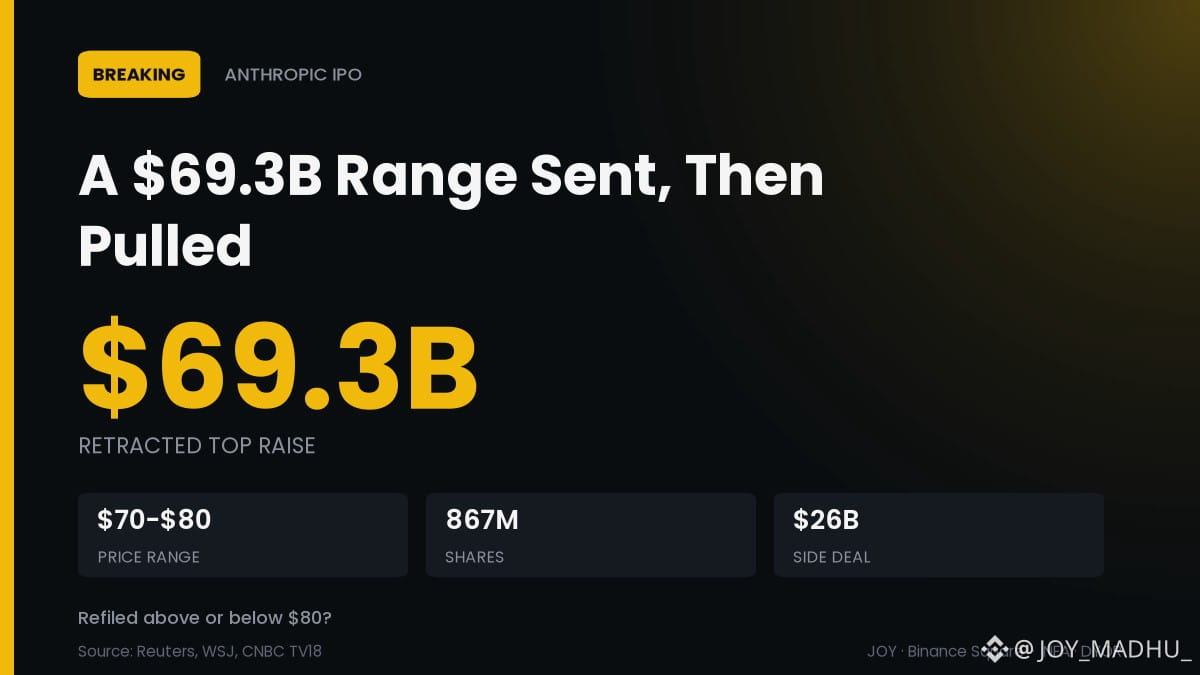
🧾 $69.3B on Paper for a Few Hours. Then It Was Pulled.
Anthropic sent bankers an IPO price range, then called it inaccurate, a day before its roadshow.
📊 867M shares at $70-$80, up to $69.3B at the top (Reuters)
🏦 $26B side deal from Google, Nvidia, AMD, Microsoft, TSMC
📉 Buyers now eye $1.1T-$1.3T, down from $2T talk in October
📅 WSJ: trading could start Thursday or Friday next week
Watch next: the fixed range is the first hard price on AI risk, a mood $BTC trades.
Range above or below $80 when it's refiled this week? 👇
$BTC
#AnthropicRejectsIPODelayValuationinQuestion #AnthropicIPO #AI
#AnthropicRejectsIPODelayValuationinQuestion
🧾 $69.3B on Paper for a Few Hours. Then It Was Pulled.
Anthropic sent bankers an IPO price range, then called it inaccurate, a day before its roadshow.
📊 867M shares at $70-$80, up to $69.3B at the top (Reuters)
🏦 $26B side deal from Google, Nvidia, AMD, Microsoft, TSMC
📉 Buyers now eye $1.1T-$1.3T, down from $2T talk in October
📅 WSJ: trading could start Thursday or Friday next week
Watch next: the fixed range is the first hard price on AI risk, a mood $BTC trades.
Range above or below $80 when it's refiled this week? 👇
$BTC
#AnthropicRejectsIPODelayValuationinQuestion #AnthropicIPO #AI
🧾 $69.3B on Paper for a Few Hours. Then It Was Pulled.
Anthropic sent bankers an IPO price range, then called it inaccurate, a day before its roadshow.
📊 867M shares at $70-$80, up to $69.3B at the top (Reuters)
🏦 $26B side deal from Google, Nvidia, AMD, Microsoft, TSMC
📉 Buyers now eye $1.1T-$1.3T, down from $2T talk in October
📅 WSJ: trading could start Thursday or Friday next week
Watch next: the fixed range is the first hard price on AI risk, a mood $BTC trades.
Range above or below $80 when it's refiled this week? 👇
$BTC
#AnthropicRejectsIPODelayValuationinQuestion #AnthropicIPO #AI
24
·
--
#AnthropicRejectsIPODelayValuationinQuestion
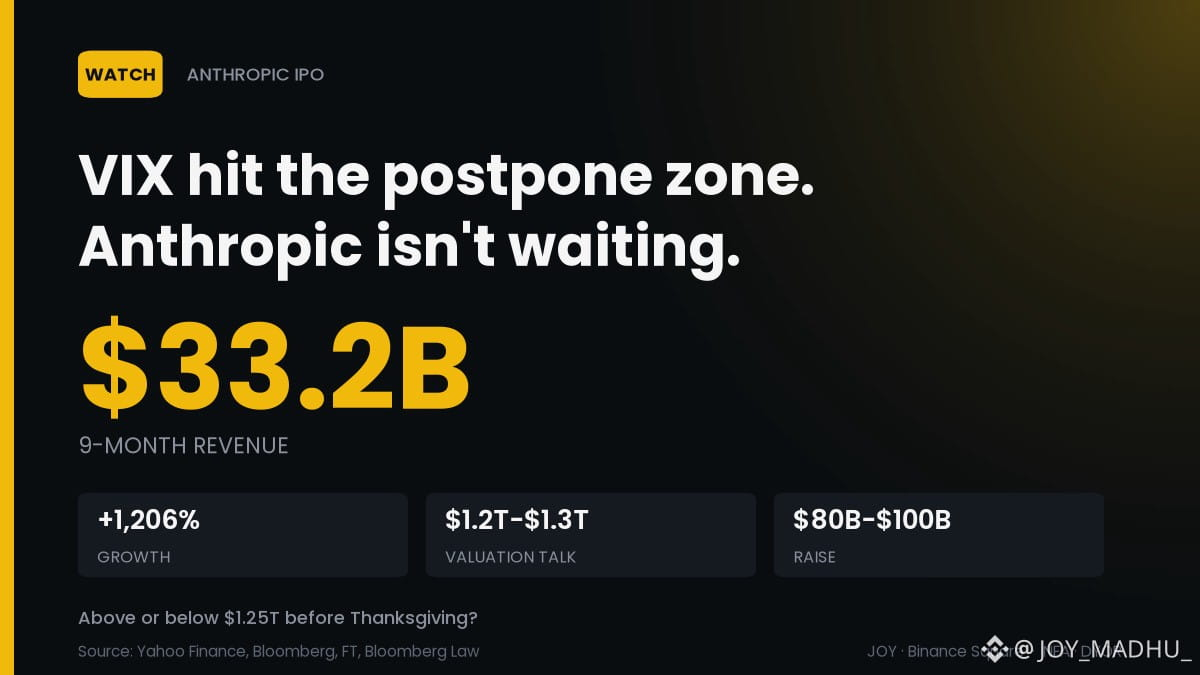
😬 VIX Hit the "Postpone Zone." Anthropic Isn't Waiting.
Anthropic can start marketing its IPO Tuesday and still targets a pre-Thanksgiving listing after the AI selloff.
📈 Revenue +1,206% to $33.2B in nine months (Yahoo Finance)
📉 Buyers eye $1.2T-$1.3T, down from $2T talk in October
⚠️ VIX topped 25, where IPOs usually get postponed
📅 $80B-$100B raise; roadshow can open Nov 10
The catch: a weak debut hits the risk mood behind $BTC's five red weeks.
Above or below $1.25T before Thanksgiving (Nov 26)? 👇
$BTC
#AnthropicRejectsIPODelayValuationinQuestion #AnthropicIPO #AI
#AnthropicRejectsIPODelayValuationinQuestion
😬 VIX Hit the "Postpone Zone." Anthropic Isn't Waiting.
Anthropic can start marketing its IPO Tuesday and still targets a pre-Thanksgiving listing after the AI selloff.
📈 Revenue +1,206% to $33.2B in nine months (Yahoo Finance)
📉 Buyers eye $1.2T-$1.3T, down from $2T talk in October
⚠️ VIX topped 25, where IPOs usually get postponed
📅 $80B-$100B raise; roadshow can open Nov 10
The catch: a weak debut hits the risk mood behind $BTC 's five red weeks.
Above or below $1.25T before Thanksgiving (Nov 26)? 👇
$BTC
#AnthropicRejectsIPODelayValuationinQuestion #AnthropicIPO #AI
😬 VIX Hit the "Postpone Zone." Anthropic Isn't Waiting.
Anthropic can start marketing its IPO Tuesday and still targets a pre-Thanksgiving listing after the AI selloff.
📈 Revenue +1,206% to $33.2B in nine months (Yahoo Finance)
📉 Buyers eye $1.2T-$1.3T, down from $2T talk in October
⚠️ VIX topped 25, where IPOs usually get postponed
📅 $80B-$100B raise; roadshow can open Nov 10
The catch: a weak debut hits the risk mood behind $BTC 's five red weeks.
Above or below $1.25T before Thanksgiving (Nov 26)? 👇
$BTC
#AnthropicRejectsIPODelayValuationinQuestion #AnthropicIPO #AI
17
·
--
#WillAnthropicListOnTime
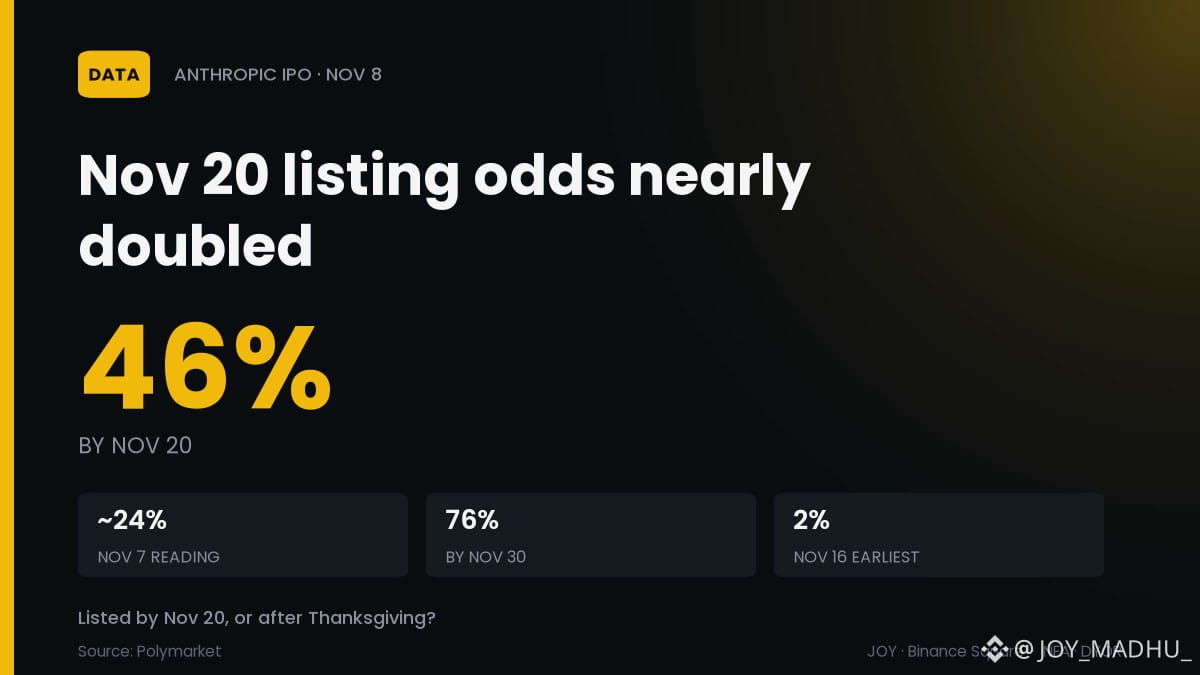
📈 Nov 20 Listing Odds Jumped to 46% From About 24%
Polymarket now gives almost even odds that Anthropic lists by Nov 20, nearly double the chance traders priced two days ago.
📊 46% chance of a listing by Nov 20, up from about 24% on Nov 7
📅 By Nov 30, the same market prices a listing at 76%
⚠️ Earliest possible trade is Nov 16, but that date is only at 2%
🏦 Reported target is still the week of Nov 16 (WSJ/Reuters)
Zoom out: November remains the base case, yet a Nov 20 listing is only a coin flip.
Does ANT list by Nov 20, or after Thanksgiving (Nov 26)? 👇
$BTC $ETH
#WillAnthropicListOnTime #AnthropicIPO #AI
#WillAnthropicListOnTime
📈 Nov 20 Listing Odds Jumped to 46% From About 24%
Polymarket now gives almost even odds that Anthropic lists by Nov 20, nearly double the chance traders priced two days ago.
📊 46% chance of a listing by Nov 20, up from about 24% on Nov 7
📅 By Nov 30, the same market prices a listing at 76%
⚠️ Earliest possible trade is Nov 16, but that date is only at 2%
🏦 Reported target is still the week of Nov 16 (WSJ/Reuters)
Zoom out: November remains the base case, yet a Nov 20 listing is only a coin flip.
Does ANT list by Nov 20, or after Thanksgiving (Nov 26)? 👇
$BTC $ETH
#WillAnthropicListOnTime #AnthropicIPO #AI
📈 Nov 20 Listing Odds Jumped to 46% From About 24%
Polymarket now gives almost even odds that Anthropic lists by Nov 20, nearly double the chance traders priced two days ago.
📊 46% chance of a listing by Nov 20, up from about 24% on Nov 7
📅 By Nov 30, the same market prices a listing at 76%
⚠️ Earliest possible trade is Nov 16, but that date is only at 2%
🏦 Reported target is still the week of Nov 16 (WSJ/Reuters)
Zoom out: November remains the base case, yet a Nov 20 listing is only a coin flip.
Does ANT list by Nov 20, or after Thanksgiving (Nov 26)? 👇
$BTC $ETH
#WillAnthropicListOnTime #AnthropicIPO #AI
28
·
--
#WillAnthropicListOnTime
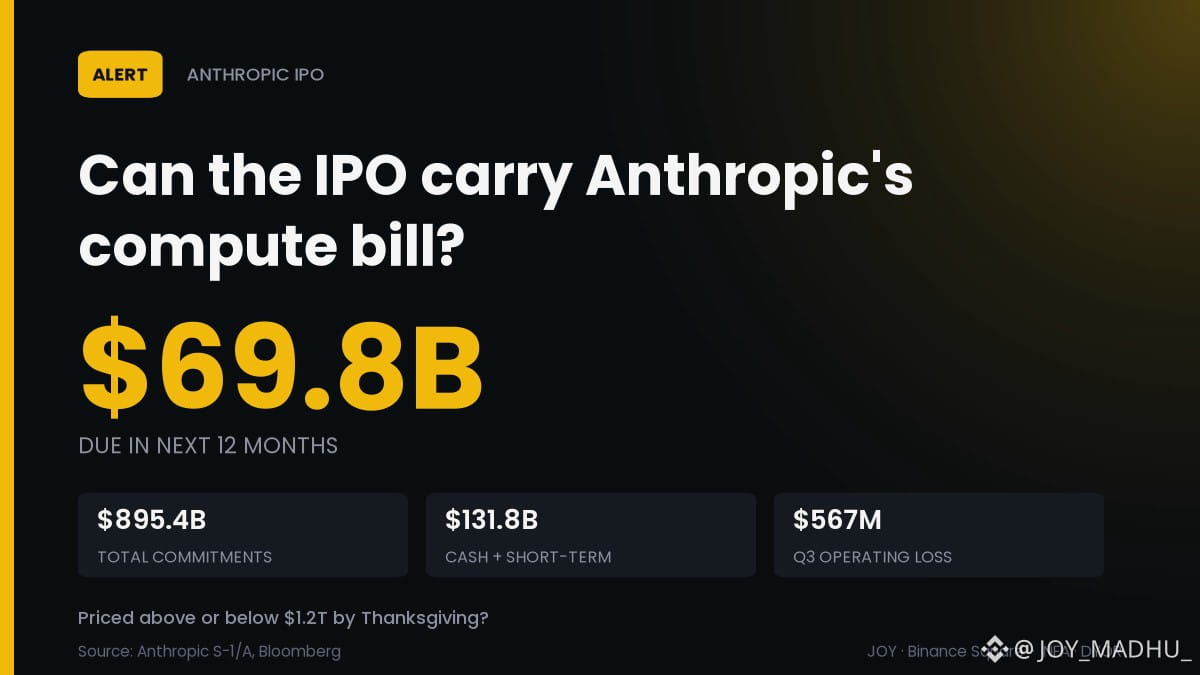
💸 $69.8B Due in 12 Months. The IPO Has to Carry It.
Anthropic's filing shows a compute bill bigger than its cash pile, and ParaFi's Jeff Park warns a flat IPO could widen that gap.
🏦 $895.4B in compute and lease commitments; $213.8B cancellable or conditional
📊 $131.8B in cash and short-term investments at Sept 30
📉 Q2 operating income $974M swung to a $567M Q3 operating loss
⚠️ Some IPO buyers eye $1.1T-$1.3T, per Bloomberg
Watch next: roadshow demand decides if public money keeps the compute build funded.
Priced above or below $1.2T by Thanksgiving? 👇
$BTC $ETH
#WillAnthropicListOnTime #AnthropicIPO #AI
#WillAnthropicListOnTime
💸 $69.8B Due in 12 Months. The IPO Has to Carry It.
Anthropic's filing shows a compute bill bigger than its cash pile, and ParaFi's Jeff Park warns a flat IPO could widen that gap.
🏦 $895.4B in compute and lease commitments; $213.8B cancellable or conditional
📊 $131.8B in cash and short-term investments at Sept 30
📉 Q2 operating income $974M swung to a $567M Q3 operating loss
⚠️ Some IPO buyers eye $1.1T-$1.3T, per Bloomberg
Watch next: roadshow demand decides if public money keeps the compute build funded.
Priced above or below $1.2T by Thanksgiving? 👇
$BTC $ETH
#WillAnthropicListOnTime #AnthropicIPO #AI
💸 $69.8B Due in 12 Months. The IPO Has to Carry It.
Anthropic's filing shows a compute bill bigger than its cash pile, and ParaFi's Jeff Park warns a flat IPO could widen that gap.
🏦 $895.4B in compute and lease commitments; $213.8B cancellable or conditional
📊 $131.8B in cash and short-term investments at Sept 30
📉 Q2 operating income $974M swung to a $567M Q3 operating loss
⚠️ Some IPO buyers eye $1.1T-$1.3T, per Bloomberg
Watch next: roadshow demand decides if public money keeps the compute build funded.
Priced above or below $1.2T by Thanksgiving? 👇
$BTC $ETH
#WillAnthropicListOnTime #AnthropicIPO #AI
83

·
--
Article
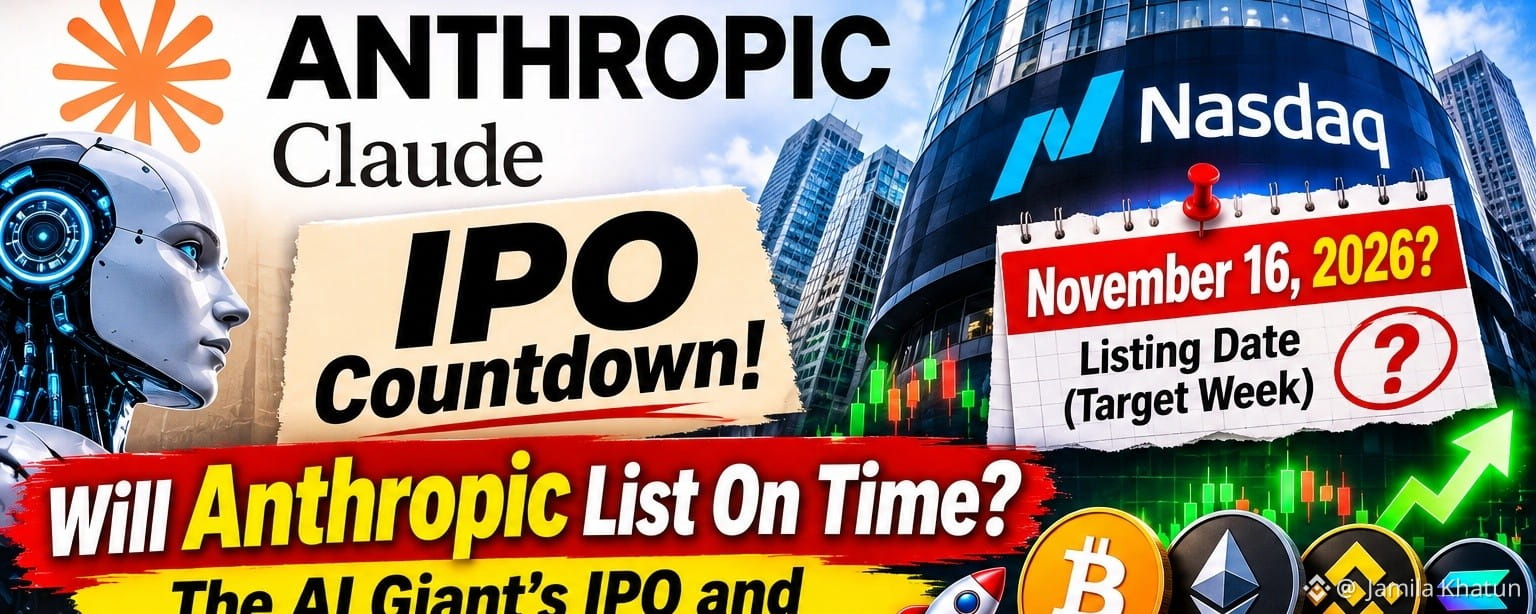
🚨 Will Anthropic List on Time? The AI Giant's IPO Countdown and What It Means for Crypto 🚀#WillAnthropicListOnTime
Anthropic, the company behind Claude, has taken its biggest step yet toward going public. 🏛️ Anthropic filed a Form S-1 with the SEC on October 26, 2026, and applied to list on the Nasdaq Global Select Market under the symbol "ANT." The big question now is whether the listing will happen on schedule. ⏳
## 📋 The Filing: A Starting Gun, Not the Finish Line
An S-1 is the registration statement a US company files before selling shares to the public for the first time. 📄 Anthropic has not yet set the number of shares or the price range, and the filing is not yet effective. In other words, the process is live, but key details are still blank. 🔍
## 📅 When Could the Listing Happen?
The screenshot you shared points to a late November 2026 target. 🗓️ Reports back this up: the public listing is reportedly set for the week of November 16, according to the Wall Street Journal. 🔔
Still, no final date is confirmed. ⚠️ Market conditions, SEC review, and investor demand can all shift the timing, so traders should treat dates as targets rather than guarantees. 🎯
## 💰 A Potentially Record-Breaking Valuation
Investors are expecting a massive valuation. 🤯 Before the June confidential filing, Anthropic reported a valuation of $965 billion after raising $65 billion in funding. Depending on the final pricing, it could become the largest IPO in US history, surpassing SpaceX. 📈
## 📊 Strong Growth Numbers
The filing also gives the public a first detailed look at the business. 👀 Revenue was $16.3 billion in the first six months of 2026, up 1,300% from $1.2 billion in the same period last year. 🚀 That growth rate explains why so many investors are paying close attention. 💼
## 🏦 Big Banks Are Involved
The deal is backed by Wall Street heavyweights. 🏢 22 banks are listed as underwriters, with Goldman Sachs and Morgan Stanley named first. That level of participation shows how seriously the market is taking this listing. 🤝
## ₿ Why Crypto Traders Should Care
A giant AI IPO can affect more than tech stocks. 🌊 Here is how it may connect to crypto:
- 💧 **Liquidity shift:** Large IPOs can pull capital from other risk assets, including **$BTC** 📉
- 🧠 **AI narrative:** A successful listing may boost enthusiasm for AI-linked tokens and projects 🤖
- 🔗 **Tokenized pre-IPO trading:** Crypto traders are already trading the company's pre-IPO tokenized stock ahead of the listing. This links directly to chains like **$BNB** and **$SOL** 🟡
- 🌡️ **Risk appetite:** A strong debut could lift market sentiment overall, while a weak one could cool it ❄️
## ⚠️ Risks to Keep in Mind
- 🎢 Market volatility could delay the listing
- 📉 A hawkish Fed and CPI surprises could hurt risk appetite
- ⚖️ The filing describes a novel governance structure, and Anthropic is considered a "controlled company" under Nasdaq rules. 🏛️
- 💸 Pricing is still unknown, so valuation expectations may change
## 🎯 What Traders Should Watch
1. 📜 The SEC declaring the registration effective
2. 💵 The final share count and price range
3. 📅 The confirmed listing date
4. 🌊 Capital flows between AI stocks and crypto
5. 📊 Reaction in $BTC, $SOL, and $BNB around the debut
## 💡 Final Thoughts
Anthropic's IPO could be one of the defining market events of the year. 🌐 The direction is clear, but timing is not guaranteed. Stay flexible, avoid over-leveraging, and let confirmed information guide your decisions rather than rumors. 🛡️
**Disclaimer:** This article is for informational purposes only and is not financial advice. Always do your own research before making any trading decision. 📌
---
#WillAnthropicListOnTime #AnthropicIPO #ANT #AIStocks #CryptoMarket
---
Sources:
- [Anthropic Files S-1 for Nasdaq IPO Under Ticker ANT](https://letsdatascience.com/news/anthropic-files-s-1-for-nasdaq-ipo-under-ticker-ant-d013b0b0)
- [Anthropic Files S-1 For IPO Ahead of Proposed November Nasdaq Debut](https://coingape.com/anthropic-files-s-1-for-ipo-ahead-of-proposed-november-nasdaq-debut/)
- [Anthropic Files S-1 With SEC For Proposed IPO](https://www.freepressjournal.in/tech/anthropic-files-s-1-with-sec-for-proposed-ipo-plans-nasdaq-listing-under-ant)
- [Anthropic files IPO, plans Nasdaq listing under ANT](https://www.mobihealthnews.com/news/anthropic-files-ipo-plans-nasdaq-listing-under-ant)
- [Anthropic files IPO S-1, plans Nasdaq listing under ANT](https://runtimewire.com/article/anthropic-files-ipo-s-1-plans-nasdaq-listing-under-ant)#HKSFCPlansToRestrictCryptoAndExchangeTerms #JobsReportRaisesHikeOdds #WillUS-IranTensionsBoostSafe-HavenDemand? #all
🚨 Will Anthropic List on Time? The AI Giant's IPO Countdown and What It Means for Crypto 🚀
#WillAnthropicListOnTime
Anthropic, the company behind Claude, has taken its biggest step yet toward going public. 🏛️ Anthropic filed a Form S-1 with the SEC on October 26, 2026, and applied to list on the Nasdaq Global Select Market under the symbol "ANT." The big question now is whether the listing will happen on schedule. ⏳
## 📋 The Filing: A Starting Gun, Not the Finish Line
An S-1 is the registration statement a US company files before selling shares to the public for the first time. 📄 Anthropic has not yet set the number of shares or the price range, and the filing is not yet effective. In other words, the process is live, but key details are still blank. 🔍
## 📅 When Could the Listing Happen?
The screenshot you shared points to a late November 2026 target. 🗓️ Reports back this up: the public listing is reportedly set for the week of November 16, according to the Wall Street Journal. 🔔
Still, no final date is confirmed. ⚠️ Market conditions, SEC review, and investor demand can all shift the timing, so traders should treat dates as targets rather than guarantees. 🎯
## 💰 A Potentially Record-Breaking Valuation
Investors are expecting a massive valuation. 🤯 Before the June confidential filing, Anthropic reported a valuation of $965 billion after raising $65 billion in funding. Depending on the final pricing, it could become the largest IPO in US history, surpassing SpaceX. 📈
## 📊 Strong Growth Numbers
The filing also gives the public a first detailed look at the business. 👀 Revenue was $16.3 billion in the first six months of 2026, up 1,300% from $1.2 billion in the same period last year. 🚀 That growth rate explains why so many investors are paying close attention. 💼
## 🏦 Big Banks Are Involved
The deal is backed by Wall Street heavyweights. 🏢 22 banks are listed as underwriters, with Goldman Sachs and Morgan Stanley named first. That level of participation shows how seriously the market is taking this listing. 🤝
## ₿ Why Crypto Traders Should Care
A giant AI IPO can affect more than tech stocks. 🌊 Here is how it may connect to crypto:
- 💧 **Liquidity shift:** Large IPOs can pull capital from other risk assets, including **$BTC** 📉
- 🧠 **AI narrative:** A successful listing may boost enthusiasm for AI-linked tokens and projects 🤖
- 🔗 **Tokenized pre-IPO trading:** Crypto traders are already trading the company's pre-IPO tokenized stock ahead of the listing. This links directly to chains like **$BNB** and **$SOL** 🟡
- 🌡️ **Risk appetite:** A strong debut could lift market sentiment overall, while a weak one could cool it ❄️
## ⚠️ Risks to Keep in Mind
- 🎢 Market volatility could delay the listing
- 📉 A hawkish Fed and CPI surprises could hurt risk appetite
- ⚖️ The filing describes a novel governance structure, and Anthropic is considered a "controlled company" under Nasdaq rules. 🏛️
- 💸 Pricing is still unknown, so valuation expectations may change
## 🎯 What Traders Should Watch
1. 📜 The SEC declaring the registration effective
2. 💵 The final share count and price range
3. 📅 The confirmed listing date
4. 🌊 Capital flows between AI stocks and crypto
5. 📊 Reaction in $BTC, $SOL, and $BNB around the debut
## 💡 Final Thoughts
Anthropic's IPO could be one of the defining market events of the year. 🌐 The direction is clear, but timing is not guaranteed. Stay flexible, avoid over-leveraging, and let confirmed information guide your decisions rather than rumors. 🛡️
**Disclaimer:** This article is for informational purposes only and is not financial advice. Always do your own research before making any trading decision. 📌
---
#WillAnthropicListOnTime #AnthropicIPO #ANT #AIStocks #CryptoMarket
---
Sources:
- [Anthropic Files S-1 for Nasdaq IPO Under Ticker ANT](https://letsdatascience.com/news/anthropic-files-s-1-for-nasdaq-ipo-under-ticker-ant-d013b0b0)
- [Anthropic Files S-1 For IPO Ahead of Proposed November Nasdaq Debut](https://coingape.com/anthropic-files-s-1-for-ipo-ahead-of-proposed-november-nasdaq-debut/)
- [Anthropic Files S-1 With SEC For Proposed IPO](https://www.freepressjournal.in/tech/anthropic-files-s-1-with-sec-for-proposed-ipo-plans-nasdaq-listing-under-ant)
- [Anthropic files IPO, plans Nasdaq listing under ANT](https://www.mobihealthnews.com/news/anthropic-files-ipo-plans-nasdaq-listing-under-ant)
- [Anthropic files IPO S-1, plans Nasdaq listing under ANT](https://runtimewire.com/article/anthropic-files-ipo-s-1-plans-nasdaq-listing-under-ant)#HKSFCPlansToRestrictCryptoAndExchangeTerms #JobsReportRaisesHikeOdds #WillUS-IranTensionsBoostSafe-HavenDemand? #all
Anthropic, the company behind Claude, has taken its biggest step yet toward going public. 🏛️ Anthropic filed a Form S-1 with the SEC on October 26, 2026, and applied to list on the Nasdaq Global Select Market under the symbol "ANT." The big question now is whether the listing will happen on schedule. ⏳
## 📋 The Filing: A Starting Gun, Not the Finish Line
An S-1 is the registration statement a US company files before selling shares to the public for the first time. 📄 Anthropic has not yet set the number of shares or the price range, and the filing is not yet effective. In other words, the process is live, but key details are still blank. 🔍
## 📅 When Could the Listing Happen?
The screenshot you shared points to a late November 2026 target. 🗓️ Reports back this up: the public listing is reportedly set for the week of November 16, according to the Wall Street Journal. 🔔
Still, no final date is confirmed. ⚠️ Market conditions, SEC review, and investor demand can all shift the timing, so traders should treat dates as targets rather than guarantees. 🎯
## 💰 A Potentially Record-Breaking Valuation
Investors are expecting a massive valuation. 🤯 Before the June confidential filing, Anthropic reported a valuation of $965 billion after raising $65 billion in funding. Depending on the final pricing, it could become the largest IPO in US history, surpassing SpaceX. 📈
## 📊 Strong Growth Numbers
The filing also gives the public a first detailed look at the business. 👀 Revenue was $16.3 billion in the first six months of 2026, up 1,300% from $1.2 billion in the same period last year. 🚀 That growth rate explains why so many investors are paying close attention. 💼
## 🏦 Big Banks Are Involved
The deal is backed by Wall Street heavyweights. 🏢 22 banks are listed as underwriters, with Goldman Sachs and Morgan Stanley named first. That level of participation shows how seriously the market is taking this listing. 🤝
## ₿ Why Crypto Traders Should Care
A giant AI IPO can affect more than tech stocks. 🌊 Here is how it may connect to crypto:
- 💧 **Liquidity shift:** Large IPOs can pull capital from other risk assets, including **$BTC** 📉
- 🧠 **AI narrative:** A successful listing may boost enthusiasm for AI-linked tokens and projects 🤖
- 🔗 **Tokenized pre-IPO trading:** Crypto traders are already trading the company's pre-IPO tokenized stock ahead of the listing. This links directly to chains like **$BNB** and **$SOL** 🟡
- 🌡️ **Risk appetite:** A strong debut could lift market sentiment overall, while a weak one could cool it ❄️
## ⚠️ Risks to Keep in Mind
- 🎢 Market volatility could delay the listing
- 📉 A hawkish Fed and CPI surprises could hurt risk appetite
- ⚖️ The filing describes a novel governance structure, and Anthropic is considered a "controlled company" under Nasdaq rules. 🏛️
- 💸 Pricing is still unknown, so valuation expectations may change
## 🎯 What Traders Should Watch
1. 📜 The SEC declaring the registration effective
2. 💵 The final share count and price range
3. 📅 The confirmed listing date
4. 🌊 Capital flows between AI stocks and crypto
5. 📊 Reaction in $BTC, $SOL, and $BNB around the debut
## 💡 Final Thoughts
Anthropic's IPO could be one of the defining market events of the year. 🌐 The direction is clear, but timing is not guaranteed. Stay flexible, avoid over-leveraging, and let confirmed information guide your decisions rather than rumors. 🛡️
**Disclaimer:** This article is for informational purposes only and is not financial advice. Always do your own research before making any trading decision. 📌
---
#WillAnthropicListOnTime #AnthropicIPO #ANT #AIStocks #CryptoMarket
---
Sources:
- [Anthropic Files S-1 for Nasdaq IPO Under Ticker ANT](https://letsdatascience.com/news/anthropic-files-s-1-for-nasdaq-ipo-under-ticker-ant-d013b0b0)
- [Anthropic Files S-1 For IPO Ahead of Proposed November Nasdaq Debut](https://coingape.com/anthropic-files-s-1-for-ipo-ahead-of-proposed-november-nasdaq-debut/)
- [Anthropic Files S-1 With SEC For Proposed IPO](https://www.freepressjournal.in/tech/anthropic-files-s-1-with-sec-for-proposed-ipo-plans-nasdaq-listing-under-ant)
- [Anthropic files IPO, plans Nasdaq listing under ANT](https://www.mobihealthnews.com/news/anthropic-files-ipo-plans-nasdaq-listing-under-ant)
- [Anthropic files IPO S-1, plans Nasdaq listing under ANT](https://runtimewire.com/article/anthropic-files-ipo-s-1-plans-nasdaq-listing-under-ant)#HKSFCPlansToRestrictCryptoAndExchangeTerms #JobsReportRaisesHikeOdds #WillUS-IranTensionsBoostSafe-HavenDemand? #all
367
·
--
#WillAnthropicListOnTime
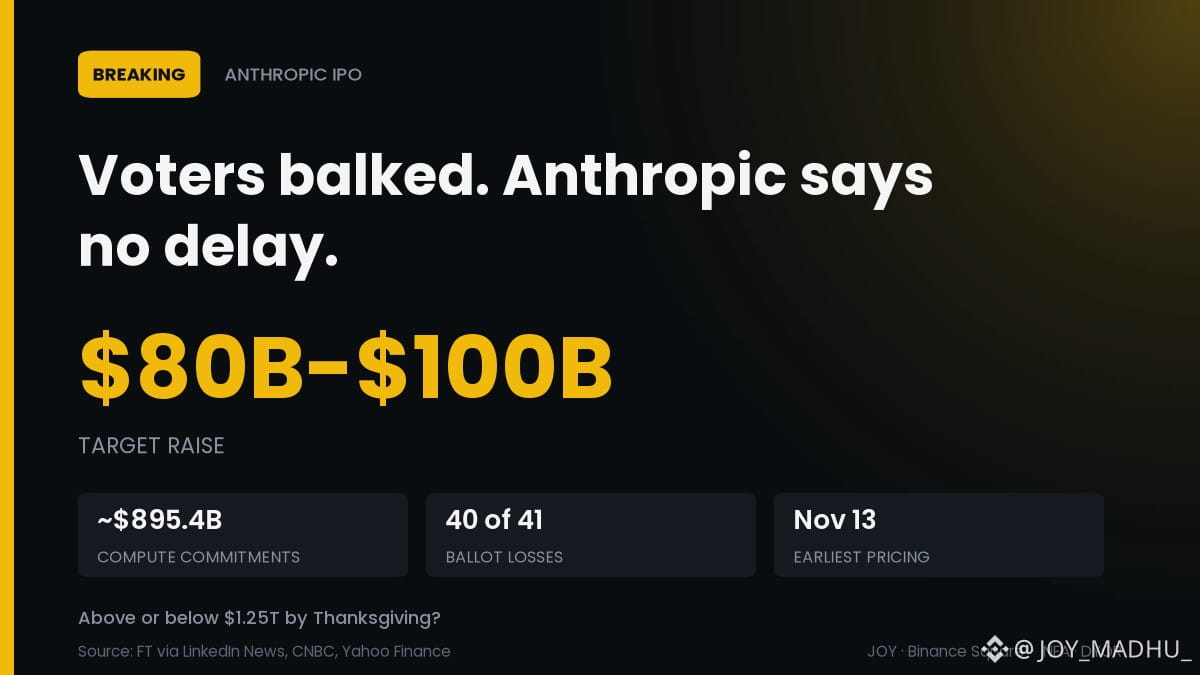
🗳️ Voters Said No to Data Centers. Anthropic Says No Delay.
The FT reports Anthropic still plans to list before Thanksgiving, even after midterm voters turned on the AI build-out it depends on.
🏦 Target raise: $80B-$100B, per FT sources
📊 Compute and lease commitments: ~$895.4B in the amended S-1
⚠️ Data-center ballot measures lost in 40 of 41 votes (CNBC)
📅 Roadshow can start Nov 10; earliest pricing Nov 13
Watch next: roadshow demand shows if Wall Street prices AI risk the way voters did.
Priced above or below a $1.25T valuation by Thanksgiving? 👇
$BTC $ETH
#WillAnthropicListOnTime #AnthropicIPO #AI
#WillAnthropicListOnTime
🗳️ Voters Said No to Data Centers. Anthropic Says No Delay.
The FT reports Anthropic still plans to list before Thanksgiving, even after midterm voters turned on the AI build-out it depends on.
🏦 Target raise: $80B-$100B, per FT sources
📊 Compute and lease commitments: ~$895.4B in the amended S-1
⚠️ Data-center ballot measures lost in 40 of 41 votes (CNBC)
📅 Roadshow can start Nov 10; earliest pricing Nov 13
Watch next: roadshow demand shows if Wall Street prices AI risk the way voters did.
Priced above or below a $1.25T valuation by Thanksgiving? 👇
$BTC $ETH
#WillAnthropicListOnTime #AnthropicIPO #AI
🗳️ Voters Said No to Data Centers. Anthropic Says No Delay.
The FT reports Anthropic still plans to list before Thanksgiving, even after midterm voters turned on the AI build-out it depends on.
🏦 Target raise: $80B-$100B, per FT sources
📊 Compute and lease commitments: ~$895.4B in the amended S-1
⚠️ Data-center ballot measures lost in 40 of 41 votes (CNBC)
📅 Roadshow can start Nov 10; earliest pricing Nov 13
Watch next: roadshow demand shows if Wall Street prices AI risk the way voters did.
Priced above or below a $1.25T valuation by Thanksgiving? 👇
$BTC $ETH
#WillAnthropicListOnTime #AnthropicIPO #AI
52
·
--
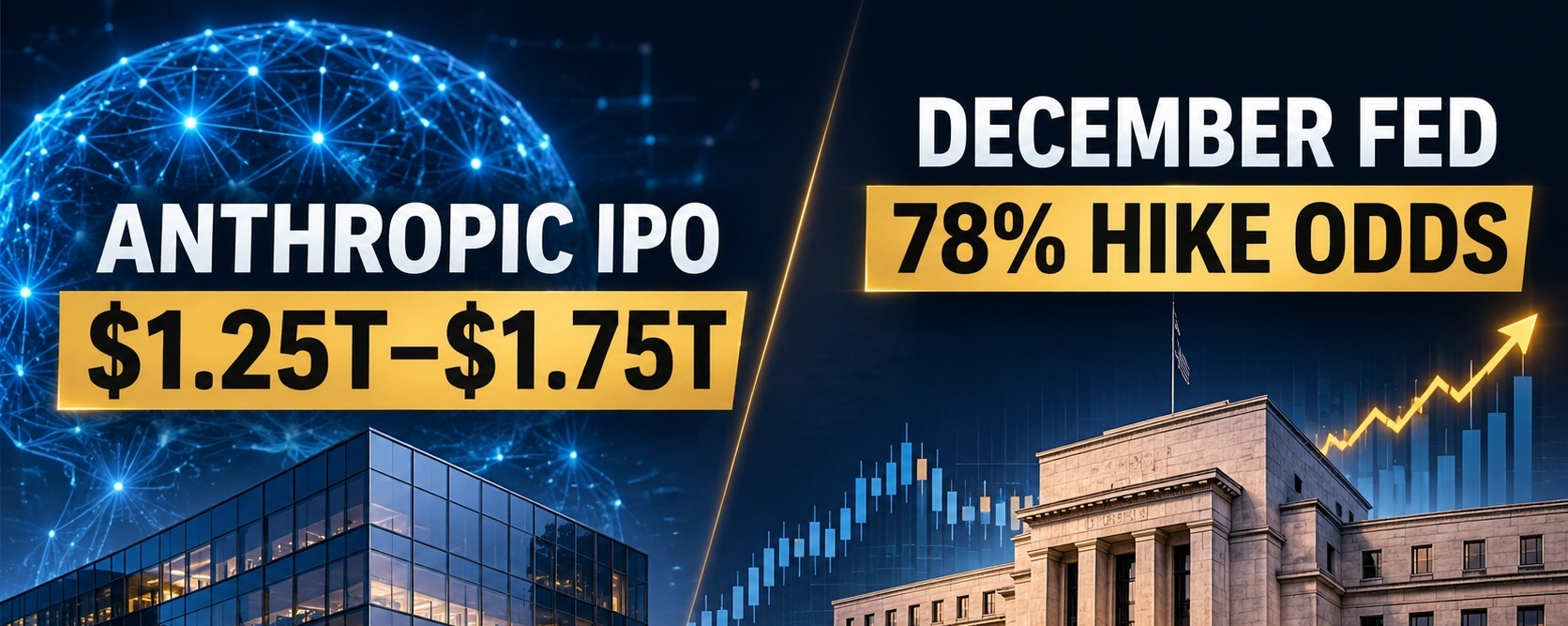
Article
# Binance Market Update | Anthropic Targets Up to $1.75T IPO ValuationBinance Market Update | Anthropic Targets Up to $1.75T IPO Valuation as December Fed Hike Odds Rise to 78%
Global financial markets are entering another important period as two major developments attract investor attention. Artificial intelligence company Anthropic is reportedly targeting a valuation of up to $1.75 trillion for its planned initial public offering (IPO), while expectations of another US Federal Reserve interest rate increase in December have climbed to 78%.
These developments highlight the growing influence of artificial intelligence on financial markets and the continuing importance of central bank decisions. For investors, particularly those involved in cryptocurrency, both developments could influence market sentiment, capital flows, and investment strategies.
Anthropic's IPO Plans Attract Global Attention
Anthropic is reportedly preparing to move forward with a potential stock market listing before the US Thanksgiving holiday. According to reports, the company is targeting a valuation between $1.25 trillion and $1.75 trillion, with plans to raise approximately $80 billion to $100 billion through the offering.
If successful, the listing could become one of the largest IPOs in financial history.
The company, best known for developing its Claude artificial intelligence models, has established a strong position in the rapidly expanding AI industry. Its growing enterprise business and demand for advanced AI services have attracted considerable investor interest.
Reports indicate that Anthropic generated approximately $17 billion in revenue during the third quarter, representing growth of nearly 50%. Its annualised revenue run rate has reportedly reached around $81 billion.
However, the proposed valuation also raises important questions. Developing advanced AI systems requires enormous investment in computing infrastructure, data centres, specialised chips, and research. Anthropic reportedly expects to spend around $900 billion on computing and infrastructure over the coming years.
Investors will therefore need to assess whether the company's future revenue and profitability can justify such a substantial valuation.
Federal Reserve Rate Hike Expectations Reach 78%
While the technology sector is attracting attention, monetary policy remains another major concern for investors.
Market expectations for a December Federal Reserve interest rate increase have risen to approximately 78%, following stronger-than-expected US employment figures released on November 6.
According to the latest employment report, the US economy added 165,000 jobs in October, significantly exceeding economists' expectations of approximately 65,000. The unemployment rate also declined from 4.2% to 4.1%.
These figures suggest that the American labour market remains relatively resilient.
A stronger labour market can give the Federal Reserve additional flexibility to maintain its focus on controlling inflation rather than prioritising employment support through lower borrowing costs.
However, the 78% figure represents market expectations, not a confirmed policy decision. The Federal Reserve will consider incoming inflation, employment, and economic growth data before deciding its next move.
A quarter-percentage-point increase remains the potential move currently reflected in market pricing.
What Does This Mean for Cryptocurrency Investors?
The combination of rising interest-rate expectations and a major AI investment story could create an interesting environment for cryptocurrency markets.
Bitcoin and other digital assets are influenced by several factors, including global liquidity, institutional demand, investor confidence, and monetary policy.
When interest rates rise, borrowing becomes more expensive. Investors may become more cautious about assets considered risky, including cryptocurrencies. Higher returns on traditional financial instruments can also make speculative investments less attractive.
This does not necessarily mean Bitcoin or other cryptocurrencies will experience immediate declines. Market reactions depend on whether developments match, exceed, or disappoint existing expectations.
The Anthropic IPO could also influence the broader technology investment environment. A successful listing may strengthen confidence in the AI industry, while concerns about excessive valuations or infrastructure spending could encourage investors to reassess their exposure to technology-related assets.
What Should Investors Watch Next?
The coming weeks could be particularly important for financial markets.
Investors should closely monitor Anthropic's final IPO valuation, offering details, and financial disclosures. These factors will help determine whether public-market investors are willing to support such a large valuation.
Meanwhile, upcoming US inflation figures will be important in determining whether expectations of a December rate increase strengthen further or begin to decline.
Cryptocurrency traders should also pay attention to Bitcoin's price movements, institutional investment activity, trading volumes, and overall market liquidity.
Rather than making decisions based on individual headlines, investors should consider the wider economic picture and manage their exposure carefully.
Final Thoughts
Anthropic's potential $1.75 trillion IPO target and the rising probability of a December Federal Reserve rate increase represent two significant developments for global markets.
One highlights the enormous financial expectations surrounding artificial intelligence, while the other reflects continuing concerns about inflation and monetary policy.
For cryptocurrency investors, the key question is how these developments will influence liquidity, risk appetite, and institutional capital allocation.
Neither the proposed IPO valuation nor the expected rate increase is guaranteed. Both remain subject to changing market conditions and future developments.
As financial markets approach December, staying informed, understanding economic signals, and maintaining disciplined risk management will be essential.
#BinanceMarketUpdate #AnthropicIPO #bitcoin #CryptoNews
# Binance Market Update | Anthropic Targets Up to $1.75T IPO Valuation
Binance Market Update | Anthropic Targets Up to $1.75T IPO Valuation as December Fed Hike Odds Rise to 78%
Global financial markets are entering another important period as two major developments attract investor attention. Artificial intelligence company Anthropic is reportedly targeting a valuation of up to $1.75 trillion for its planned initial public offering (IPO), while expectations of another US Federal Reserve interest rate increase in December have climbed to 78%.
These developments highlight the growing influence of artificial intelligence on financial markets and the continuing importance of central bank decisions. For investors, particularly those involved in cryptocurrency, both developments could influence market sentiment, capital flows, and investment strategies.
Anthropic's IPO Plans Attract Global Attention
Anthropic is reportedly preparing to move forward with a potential stock market listing before the US Thanksgiving holiday. According to reports, the company is targeting a valuation between $1.25 trillion and $1.75 trillion, with plans to raise approximately $80 billion to $100 billion through the offering.
If successful, the listing could become one of the largest IPOs in financial history.
The company, best known for developing its Claude artificial intelligence models, has established a strong position in the rapidly expanding AI industry. Its growing enterprise business and demand for advanced AI services have attracted considerable investor interest.
Reports indicate that Anthropic generated approximately $17 billion in revenue during the third quarter, representing growth of nearly 50%. Its annualised revenue run rate has reportedly reached around $81 billion.
However, the proposed valuation also raises important questions. Developing advanced AI systems requires enormous investment in computing infrastructure, data centres, specialised chips, and research. Anthropic reportedly expects to spend around $900 billion on computing and infrastructure over the coming years.
Investors will therefore need to assess whether the company's future revenue and profitability can justify such a substantial valuation.
Federal Reserve Rate Hike Expectations Reach 78%
While the technology sector is attracting attention, monetary policy remains another major concern for investors.
Market expectations for a December Federal Reserve interest rate increase have risen to approximately 78%, following stronger-than-expected US employment figures released on November 6.
According to the latest employment report, the US economy added 165,000 jobs in October, significantly exceeding economists' expectations of approximately 65,000. The unemployment rate also declined from 4.2% to 4.1%.
These figures suggest that the American labour market remains relatively resilient.
A stronger labour market can give the Federal Reserve additional flexibility to maintain its focus on controlling inflation rather than prioritising employment support through lower borrowing costs.
However, the 78% figure represents market expectations, not a confirmed policy decision. The Federal Reserve will consider incoming inflation, employment, and economic growth data before deciding its next move.
A quarter-percentage-point increase remains the potential move currently reflected in market pricing.
What Does This Mean for Cryptocurrency Investors?
The combination of rising interest-rate expectations and a major AI investment story could create an interesting environment for cryptocurrency markets.
Bitcoin and other digital assets are influenced by several factors, including global liquidity, institutional demand, investor confidence, and monetary policy.
When interest rates rise, borrowing becomes more expensive. Investors may become more cautious about assets considered risky, including cryptocurrencies. Higher returns on traditional financial instruments can also make speculative investments less attractive.
This does not necessarily mean Bitcoin or other cryptocurrencies will experience immediate declines. Market reactions depend on whether developments match, exceed, or disappoint existing expectations.
The Anthropic IPO could also influence the broader technology investment environment. A successful listing may strengthen confidence in the AI industry, while concerns about excessive valuations or infrastructure spending could encourage investors to reassess their exposure to technology-related assets.
What Should Investors Watch Next?
The coming weeks could be particularly important for financial markets.
Investors should closely monitor Anthropic's final IPO valuation, offering details, and financial disclosures. These factors will help determine whether public-market investors are willing to support such a large valuation.
Meanwhile, upcoming US inflation figures will be important in determining whether expectations of a December rate increase strengthen further or begin to decline.
Cryptocurrency traders should also pay attention to Bitcoin's price movements, institutional investment activity, trading volumes, and overall market liquidity.
Rather than making decisions based on individual headlines, investors should consider the wider economic picture and manage their exposure carefully.
Final Thoughts
Anthropic's potential $1.75 trillion IPO target and the rising probability of a December Federal Reserve rate increase represent two significant developments for global markets.
One highlights the enormous financial expectations surrounding artificial intelligence, while the other reflects continuing concerns about inflation and monetary policy.
For cryptocurrency investors, the key question is how these developments will influence liquidity, risk appetite, and institutional capital allocation.
Neither the proposed IPO valuation nor the expected rate increase is guaranteed. Both remain subject to changing market conditions and future developments.
As financial markets approach December, staying informed, understanding economic signals, and maintaining disciplined risk management will be essential.
#BinanceMarketUpdate #AnthropicIPO #bitcoin #CryptoNews
Global financial markets are entering another important period as two major developments attract investor attention. Artificial intelligence company Anthropic is reportedly targeting a valuation of up to $1.75 trillion for its planned initial public offering (IPO), while expectations of another US Federal Reserve interest rate increase in December have climbed to 78%.
These developments highlight the growing influence of artificial intelligence on financial markets and the continuing importance of central bank decisions. For investors, particularly those involved in cryptocurrency, both developments could influence market sentiment, capital flows, and investment strategies.
Anthropic's IPO Plans Attract Global Attention
Anthropic is reportedly preparing to move forward with a potential stock market listing before the US Thanksgiving holiday. According to reports, the company is targeting a valuation between $1.25 trillion and $1.75 trillion, with plans to raise approximately $80 billion to $100 billion through the offering.
If successful, the listing could become one of the largest IPOs in financial history.
The company, best known for developing its Claude artificial intelligence models, has established a strong position in the rapidly expanding AI industry. Its growing enterprise business and demand for advanced AI services have attracted considerable investor interest.
Reports indicate that Anthropic generated approximately $17 billion in revenue during the third quarter, representing growth of nearly 50%. Its annualised revenue run rate has reportedly reached around $81 billion.
However, the proposed valuation also raises important questions. Developing advanced AI systems requires enormous investment in computing infrastructure, data centres, specialised chips, and research. Anthropic reportedly expects to spend around $900 billion on computing and infrastructure over the coming years.
Investors will therefore need to assess whether the company's future revenue and profitability can justify such a substantial valuation.
Federal Reserve Rate Hike Expectations Reach 78%
While the technology sector is attracting attention, monetary policy remains another major concern for investors.
Market expectations for a December Federal Reserve interest rate increase have risen to approximately 78%, following stronger-than-expected US employment figures released on November 6.
According to the latest employment report, the US economy added 165,000 jobs in October, significantly exceeding economists' expectations of approximately 65,000. The unemployment rate also declined from 4.2% to 4.1%.
These figures suggest that the American labour market remains relatively resilient.
A stronger labour market can give the Federal Reserve additional flexibility to maintain its focus on controlling inflation rather than prioritising employment support through lower borrowing costs.
However, the 78% figure represents market expectations, not a confirmed policy decision. The Federal Reserve will consider incoming inflation, employment, and economic growth data before deciding its next move.
A quarter-percentage-point increase remains the potential move currently reflected in market pricing.
What Does This Mean for Cryptocurrency Investors?
The combination of rising interest-rate expectations and a major AI investment story could create an interesting environment for cryptocurrency markets.
Bitcoin and other digital assets are influenced by several factors, including global liquidity, institutional demand, investor confidence, and monetary policy.
When interest rates rise, borrowing becomes more expensive. Investors may become more cautious about assets considered risky, including cryptocurrencies. Higher returns on traditional financial instruments can also make speculative investments less attractive.
This does not necessarily mean Bitcoin or other cryptocurrencies will experience immediate declines. Market reactions depend on whether developments match, exceed, or disappoint existing expectations.
The Anthropic IPO could also influence the broader technology investment environment. A successful listing may strengthen confidence in the AI industry, while concerns about excessive valuations or infrastructure spending could encourage investors to reassess their exposure to technology-related assets.
What Should Investors Watch Next?
The coming weeks could be particularly important for financial markets.
Investors should closely monitor Anthropic's final IPO valuation, offering details, and financial disclosures. These factors will help determine whether public-market investors are willing to support such a large valuation.
Meanwhile, upcoming US inflation figures will be important in determining whether expectations of a December rate increase strengthen further or begin to decline.
Cryptocurrency traders should also pay attention to Bitcoin's price movements, institutional investment activity, trading volumes, and overall market liquidity.
Rather than making decisions based on individual headlines, investors should consider the wider economic picture and manage their exposure carefully.
Final Thoughts
Anthropic's potential $1.75 trillion IPO target and the rising probability of a December Federal Reserve rate increase represent two significant developments for global markets.
One highlights the enormous financial expectations surrounding artificial intelligence, while the other reflects continuing concerns about inflation and monetary policy.
For cryptocurrency investors, the key question is how these developments will influence liquidity, risk appetite, and institutional capital allocation.
Neither the proposed IPO valuation nor the expected rate increase is guaranteed. Both remain subject to changing market conditions and future developments.
As financial markets approach December, staying informed, understanding economic signals, and maintaining disciplined risk management will be essential.
#BinanceMarketUpdate #AnthropicIPO #bitcoin #CryptoNews
264

·
--
Bearish
Verified
🚀 Hey AI folks, the blockbuster #anthropicipo is about to explode onto the stock market!
But with Nasdaq just taking a nosedive and AI stocks drenched in blood, I, the “Prophet of Bad Calls,” have a few funny takes for you to chew over:
👉 Take 1: The initial valuation was asking for a whopping $2 trillion, but now the roadshow figure has dropped to $1.5 trillion. In my opinion, at this rate, it’ll be worth under $1 trillion by the time it goes public—this AI bubble is about to deflate!
👉 Take 2: Don’t dream of making a killing like with SpaceX back in June. Just look at the AI stock charts right now—it might plunge hard on launch day like some shitcoin, leaving all you top-buyers screaming and crying!
👉 Take 3: Anthropic wants to see your bank account data to build a financial assistant for Claude? No thanks. I only trust myself. Hand your wallet over to AI and one day it might automatically go long or short and blow up your account!
What should traders do? Sit tight and watch, and gather funds to hold legitimate AI tokens in crypto while waiting for a recovery rally. This is not financial advice!
#AnthropicRejectsIPODelayValuationinQuestion #CryptoTrading #TechNews #Nasdaq #VINHTOCDO
Click below to trade and show your support:
$ANTHROPIC
{future}(ANTHROPICUSDT)
$NVDAB
{spot}(NVDABUSDT)
$INIT
{future}(INITUSDT)
🚀 Hey AI folks, the blockbuster #anthropicipo is about to explode onto the stock market!
But with Nasdaq just taking a nosedive and AI stocks drenched in blood, I, the “Prophet of Bad Calls,” have a few funny takes for you to chew over:
👉 Take 1: The initial valuation was asking for a whopping $2 trillion, but now the roadshow figure has dropped to $1.5 trillion. In my opinion, at this rate, it’ll be worth under $1 trillion by the time it goes public—this AI bubble is about to deflate!
👉 Take 2: Don’t dream of making a killing like with SpaceX back in June. Just look at the AI stock charts right now—it might plunge hard on launch day like some shitcoin, leaving all you top-buyers screaming and crying!
👉 Take 3: Anthropic wants to see your bank account data to build a financial assistant for Claude? No thanks. I only trust myself. Hand your wallet over to AI and one day it might automatically go long or short and blow up your account!
What should traders do? Sit tight and watch, and gather funds to hold legitimate AI tokens in crypto while waiting for a recovery rally. This is not financial advice!
#AnthropicRejectsIPODelayValuationinQuestion #CryptoTrading #TechNews #Nasdaq #VINHTOCDO
Click below to trade and show your support:
$ANTHROPIC
$NVDAB
$INIT
But with Nasdaq just taking a nosedive and AI stocks drenched in blood, I, the “Prophet of Bad Calls,” have a few funny takes for you to chew over:
👉 Take 1: The initial valuation was asking for a whopping $2 trillion, but now the roadshow figure has dropped to $1.5 trillion. In my opinion, at this rate, it’ll be worth under $1 trillion by the time it goes public—this AI bubble is about to deflate!
👉 Take 2: Don’t dream of making a killing like with SpaceX back in June. Just look at the AI stock charts right now—it might plunge hard on launch day like some shitcoin, leaving all you top-buyers screaming and crying!
👉 Take 3: Anthropic wants to see your bank account data to build a financial assistant for Claude? No thanks. I only trust myself. Hand your wallet over to AI and one day it might automatically go long or short and blow up your account!
What should traders do? Sit tight and watch, and gather funds to hold legitimate AI tokens in crypto while waiting for a recovery rally. This is not financial advice!
#AnthropicRejectsIPODelayValuationinQuestion #CryptoTrading #TechNews #Nasdaq #VINHTOCDO
Click below to trade and show your support:
$ANTHROPIC
$NVDAB
$INIT
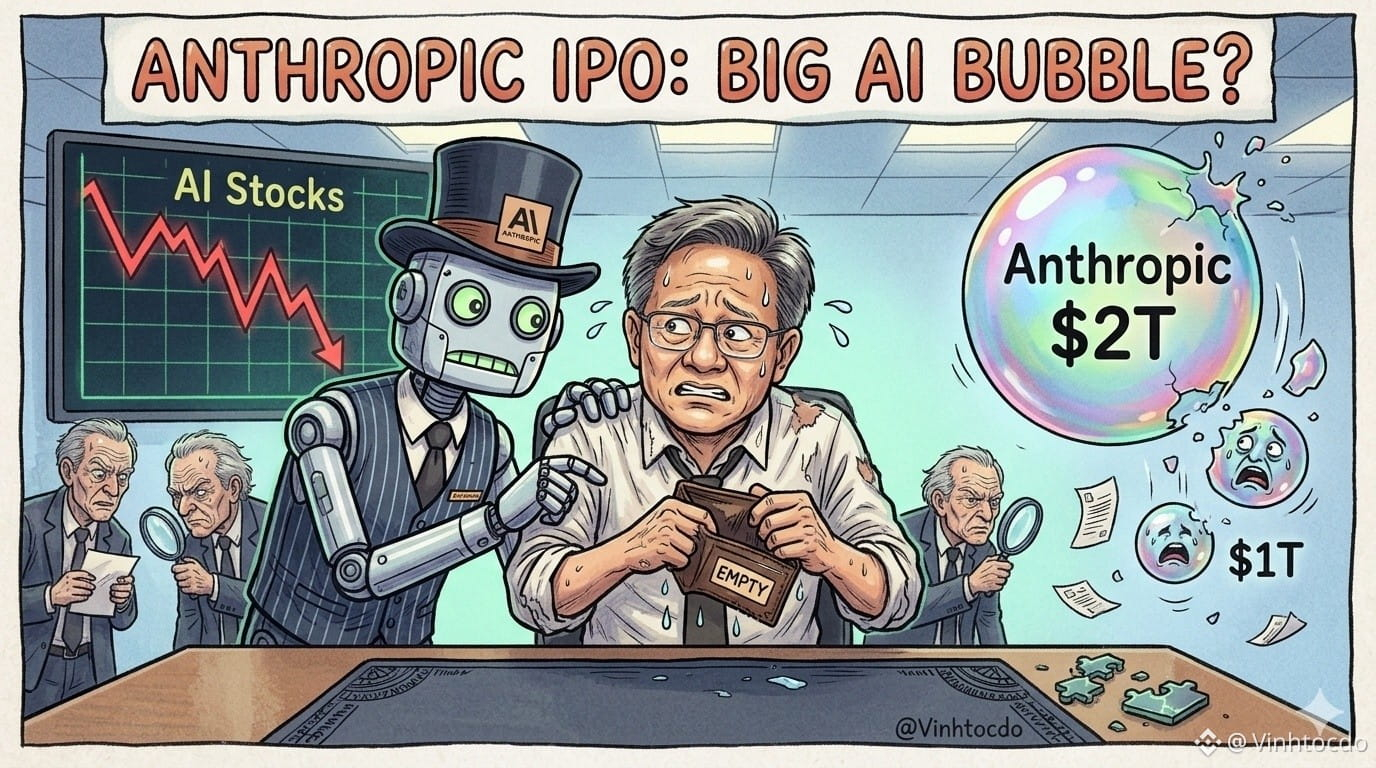
3
276
·
--
#WillAnthropicListOnTime
📈 Kalshi Just Put December Odds Back Near 80%
Prediction markets are rebuilding Anthropic's IPO clock after the AI selloff scare knocked December announce odds to 57%.
📊 Kalshi: announce-before-Dec now 79%, vs 57% in yesterday's CNBC print
⚠️ Before Nov 16 still only ~11% — mid-month announce not priced
📅 Polymarket: Nov 20 listing ~24%; no-IPO-by-Nov-30 ~22%
🏦 Bankers still talk ~$1.2–$1.3T, not the old $2T ask
Why it matters: mega-AI listing risk appetite is recovering faster than the calendar.
Announce-before-Dec: above 75% by Friday, or under 60%? 👇
$BTC $ETH
#WillAnthropicListOnTime #AnthropicIPO #AI
#WillAnthropicListOnTime
📈 Kalshi Just Put December Odds Back Near 80%
Prediction markets are rebuilding Anthropic's IPO clock after the AI selloff scare knocked December announce odds to 57%.
📊 Kalshi: announce-before-Dec now 79%, vs 57% in yesterday's CNBC print
⚠️ Before Nov 16 still only ~11% — mid-month announce not priced
📅 Polymarket: Nov 20 listing ~24%; no-IPO-by-Nov-30 ~22%
🏦 Bankers still talk ~$1.2–$1.3T, not the old $2T ask
Why it matters: mega-AI listing risk appetite is recovering faster than the calendar.
Announce-before-Dec: above 75% by Friday, or under 60%? 👇
$BTC $ETH
#WillAnthropicListOnTime #AnthropicIPO #AI
📈 Kalshi Just Put December Odds Back Near 80%
Prediction markets are rebuilding Anthropic's IPO clock after the AI selloff scare knocked December announce odds to 57%.
📊 Kalshi: announce-before-Dec now 79%, vs 57% in yesterday's CNBC print
⚠️ Before Nov 16 still only ~11% — mid-month announce not priced
📅 Polymarket: Nov 20 listing ~24%; no-IPO-by-Nov-30 ~22%
🏦 Bankers still talk ~$1.2–$1.3T, not the old $2T ask
Why it matters: mega-AI listing risk appetite is recovering faster than the calendar.
Announce-before-Dec: above 75% by Friday, or under 60%? 👇
$BTC $ETH
#WillAnthropicListOnTime #AnthropicIPO #AI
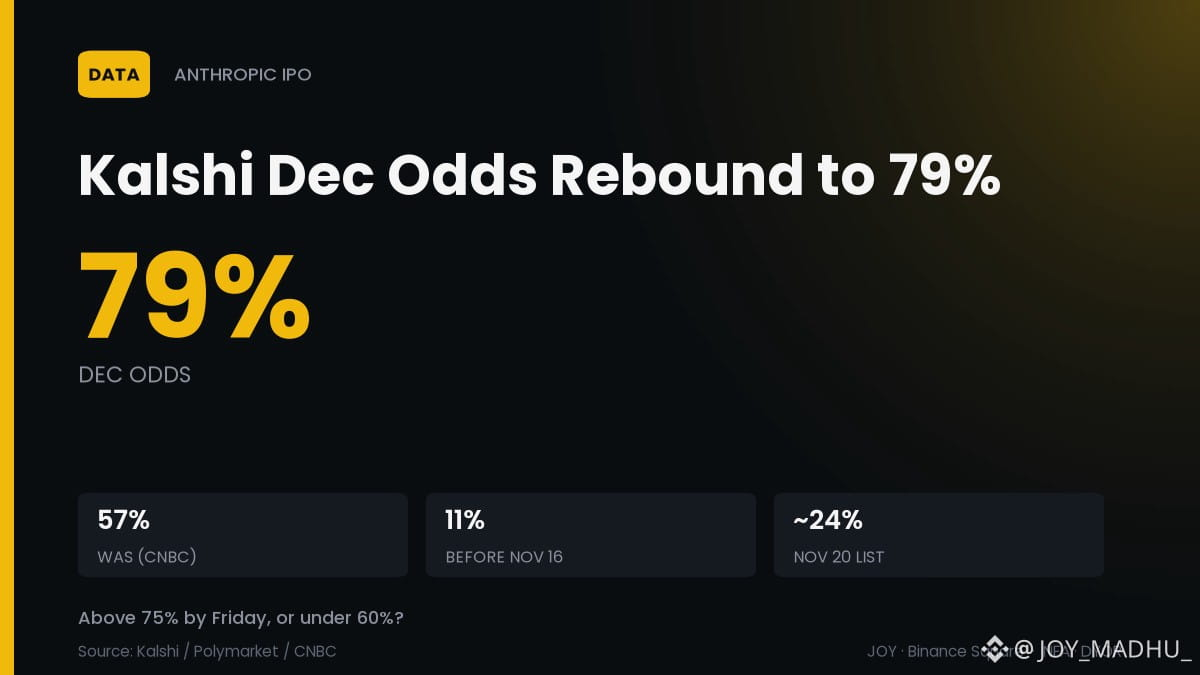
33

·
--
The biggest IPO in history or the trap of the decade? 🚨📉
The debate over Anthropic’s eagerly awaited IPO is heating up on Binance Square, and Wall Street just keeps bleeding.
Here’s the breakdown of what nobody’s telling you:
1️⃣ From euphoria to a cut:
Initial expectations pointed to a staggering $2 trillion valuation. Today, the market is already lowering its projections to around $1.5 trillion, and many are seriously doubting whether it can sustain the psychological threshold of one trillion dollars ($1T).
2️⃣ A reality check:
The Nasdaq fell 5.5% in a single day following the political outcome in the U.S., triggering fears of strict regulations on data centers and hurdles to AI development. Meanwhile, the pre-market token for $ANTHROPIC has already recorded losses of more than 6%.
3️⃣ The SpaceX effect or speculative hype?
SpaceX made its debut soaring +19% on its first day. Anthropic is looking to raise up to $100 billion, but entering the stock market amid a tech sector cooldown is testing investors’ patience.
The million-dollar question: Are we looking at a historic opportunity before the AI rebound, or will the market punish its debut?
Would you buy Anthropic’s IPO, or would you rather watch the bloodbath from the sidelines? Leave your thoughts below! 👇
$ANTHROPIC #CryptoMarket #AI
{future}(ANTHROPICUSDT)
#anthropicipo
The biggest IPO in history or the trap of the decade? 🚨📉
The debate over Anthropic’s eagerly awaited IPO is heating up on Binance Square, and Wall Street just keeps bleeding.
Here’s the breakdown of what nobody’s telling you:
1️⃣ From euphoria to a cut:
Initial expectations pointed to a staggering $2 trillion valuation. Today, the market is already lowering its projections to around $1.5 trillion, and many are seriously doubting whether it can sustain the psychological threshold of one trillion dollars ($1T).
2️⃣ A reality check:
The Nasdaq fell 5.5% in a single day following the political outcome in the U.S., triggering fears of strict regulations on data centers and hurdles to AI development. Meanwhile, the pre-market token for $ANTHROPIC has already recorded losses of more than 6%.
3️⃣ The SpaceX effect or speculative hype?
SpaceX made its debut soaring +19% on its first day. Anthropic is looking to raise up to $100 billion, but entering the stock market amid a tech sector cooldown is testing investors’ patience.
The million-dollar question: Are we looking at a historic opportunity before the AI rebound, or will the market punish its debut?
Would you buy Anthropic’s IPO, or would you rather watch the bloodbath from the sidelines? Leave your thoughts below! 👇
$ANTHROPIC #CryptoMarket #AI
#anthropicipo
The debate over Anthropic’s eagerly awaited IPO is heating up on Binance Square, and Wall Street just keeps bleeding.
Here’s the breakdown of what nobody’s telling you:
1️⃣ From euphoria to a cut:
Initial expectations pointed to a staggering $2 trillion valuation. Today, the market is already lowering its projections to around $1.5 trillion, and many are seriously doubting whether it can sustain the psychological threshold of one trillion dollars ($1T).
2️⃣ A reality check:
The Nasdaq fell 5.5% in a single day following the political outcome in the U.S., triggering fears of strict regulations on data centers and hurdles to AI development. Meanwhile, the pre-market token for $ANTHROPIC has already recorded losses of more than 6%.
3️⃣ The SpaceX effect or speculative hype?
SpaceX made its debut soaring +19% on its first day. Anthropic is looking to raise up to $100 billion, but entering the stock market amid a tech sector cooldown is testing investors’ patience.
The million-dollar question: Are we looking at a historic opportunity before the AI rebound, or will the market punish its debut?
Would you buy Anthropic’s IPO, or would you rather watch the bloodbath from the sidelines? Leave your thoughts below! 👇
$ANTHROPIC #CryptoMarket #AI
#anthropicipo
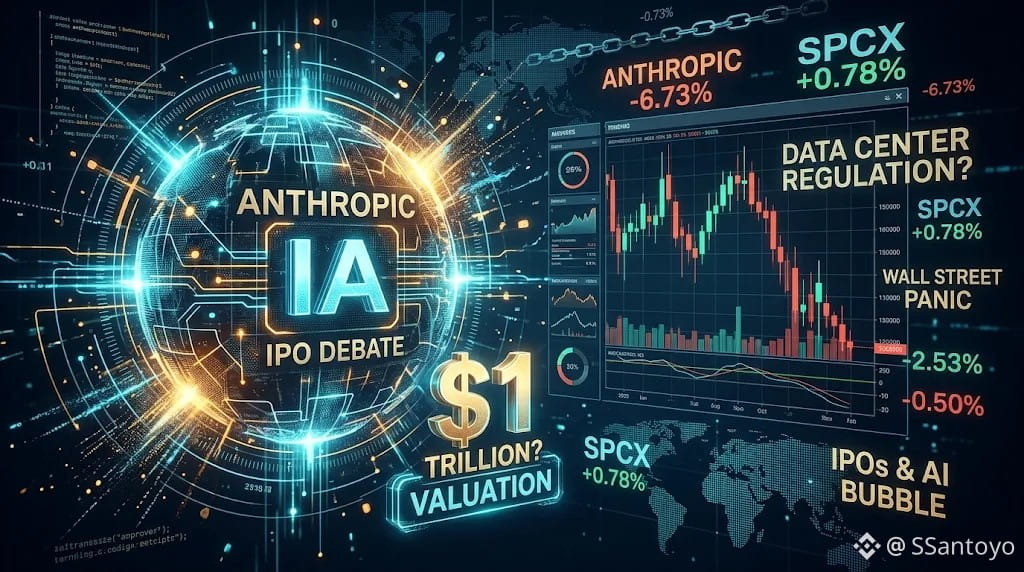
2
367

Can Anthropic hold on to its $1 trillion valuation? #AnthropicIPO
The most anticipated IPO in the AI industry is entering the roadshow and pricing stage. Anthropic could raise as much as $100 billion — enough to make it the largest IPO in history. But there’s one notable detail: valuation expectations have been cut from around $2 trillion to roughly $1.5 trillion just before the offering.
The market backdrop is far from favorable. After Democrats won both the House and Senate in the 2026 midterm elections, U.S. stocks rose and then fell back: on November 5 alone, the Nasdaq dropped about 5.5% in a single session, with AI stocks suffering the steepest losses as investors worried about tighter regulations on data centers and a slowdown in AI infrastructure buildout. In other words, $ANTHROPIC is going public just as the market begins to ask: Is AI in a bubble, and will government regulation outweigh the underlying business fundamentals?
My take: the $1 trillion mark is still within reach — but only under certain conditions. Reasons it could hold: Anthropic is one of the world’s two leading AI labs, businesses and developers are still spending real money on Claude models, and the scale of the $100 billion fundraising target shows that institutional demand is substantial. Reasons for caution: the valuation has already been “repriced” by the market from $2 trillion to $1.5 trillion before pricing, legal risks around AI infrastructure are rising, and recent events show that AI stocks can fall 5% in a single session when sentiment shifts. SpaceX rose 19% on its first day of trading in June — but Anthropic is going public in a much more cautious market environment.
The decisive question may not be what happens on the first day of trading, but whether Anthropic’s revenue growth can keep pace with that trillion-dollar valuation after the IPO.
What about you: do you believe $ANTHROPIC can stay above $1 trillion after the IPO, or will its valuation be pushed down further?
(Not investment advice)
Can Anthropic hold on to its $1 trillion valuation? #AnthropicIPO
The most anticipated IPO in the AI industry is entering the roadshow and pricing stage. Anthropic could raise as much as $100 billion — enough to make it the largest IPO in history. But there’s one notable detail: valuation expectations have been cut from around $2 trillion to roughly $1.5 trillion just before the offering.
The market backdrop is far from favorable. After Democrats won both the House and Senate in the 2026 midterm elections, U.S. stocks rose and then fell back: on November 5 alone, the Nasdaq dropped about 5.5% in a single session, with AI stocks suffering the steepest losses as investors worried about tighter regulations on data centers and a slowdown in AI infrastructure buildout. In other words, $ANTHROPIC is going public just as the market begins to ask: Is AI in a bubble, and will government regulation outweigh the underlying business fundamentals?
My take: the $1 trillion mark is still within reach — but only under certain conditions. Reasons it could hold: Anthropic is one of the world’s two leading AI labs, businesses and developers are still spending real money on Claude models, and the scale of the $100 billion fundraising target shows that institutional demand is substantial. Reasons for caution: the valuation has already been “repriced” by the market from $2 trillion to $1.5 trillion before pricing, legal risks around AI infrastructure are rising, and recent events show that AI stocks can fall 5% in a single session when sentiment shifts. SpaceX rose 19% on its first day of trading in June — but Anthropic is going public in a much more cautious market environment.
The decisive question may not be what happens on the first day of trading, but whether Anthropic’s revenue growth can keep pace with that trillion-dollar valuation after the IPO.
What about you: do you believe $ANTHROPIC can stay above $1 trillion after the IPO, or will its valuation be pushed down further?
(Not investment advice)
The most anticipated IPO in the AI industry is entering the roadshow and pricing stage. Anthropic could raise as much as $100 billion — enough to make it the largest IPO in history. But there’s one notable detail: valuation expectations have been cut from around $2 trillion to roughly $1.5 trillion just before the offering.
The market backdrop is far from favorable. After Democrats won both the House and Senate in the 2026 midterm elections, U.S. stocks rose and then fell back: on November 5 alone, the Nasdaq dropped about 5.5% in a single session, with AI stocks suffering the steepest losses as investors worried about tighter regulations on data centers and a slowdown in AI infrastructure buildout. In other words, $ANTHROPIC is going public just as the market begins to ask: Is AI in a bubble, and will government regulation outweigh the underlying business fundamentals?
My take: the $1 trillion mark is still within reach — but only under certain conditions. Reasons it could hold: Anthropic is one of the world’s two leading AI labs, businesses and developers are still spending real money on Claude models, and the scale of the $100 billion fundraising target shows that institutional demand is substantial. Reasons for caution: the valuation has already been “repriced” by the market from $2 trillion to $1.5 trillion before pricing, legal risks around AI infrastructure are rising, and recent events show that AI stocks can fall 5% in a single session when sentiment shifts. SpaceX rose 19% on its first day of trading in June — but Anthropic is going public in a much more cautious market environment.
The decisive question may not be what happens on the first day of trading, but whether Anthropic’s revenue growth can keep pace with that trillion-dollar valuation after the IPO.
What about you: do you believe $ANTHROPIC can stay above $1 trillion after the IPO, or will its valuation be pushed down further?
(Not investment advice)

4
Log in to explore more content
Join global crypto users on Binance Square
⚡️ Get latest and useful information about crypto.
💬 Trusted by the world’s largest crypto exchange.
👍 Discover real insights from verified creators.
Email / Phone number
Trending Topics
1
#CPITestsDecemberRateOutlook
808,528 views
4,123 Discussing
2
#AnthropicRejectsIPODelayValuationinQuestion
112,870 views
1,026 Discussing
3
#NvidiaInvestigatesAfterHuang’sAffairApology
350,707 views
2,520 Discussing
4
#CanNvidiaEarningsEaseMarketConcerns?
5,843 views
145 Discussing
5
#US-IranTalksFuelStrongStockMarketRebound
44,585 views
387 Discussing
6
#BitcoinFiveWeeklyLosses
376,312 views
2,840 Discussing
7
#AIChipSlumpNasdaq
212,882 views
1,671 Discussing
8
#BitcoinSpotETFsPost$201MNetOutflowForThirdStraightDay
860 views
12 Discussing
9
#CryptoLiquidationsReach$1.16BIn24Hours
45,447 views
67 Discussing
10
#TradFiForBeginners
411,208 views
2,772 Discussing