
#aigensyn
aigensyn
500,696 views
3,569 Discussing
Hot
Latest

$AIGENSYN - Long Setup Ready 🎯
{future}(AIGENSYNUSDT)
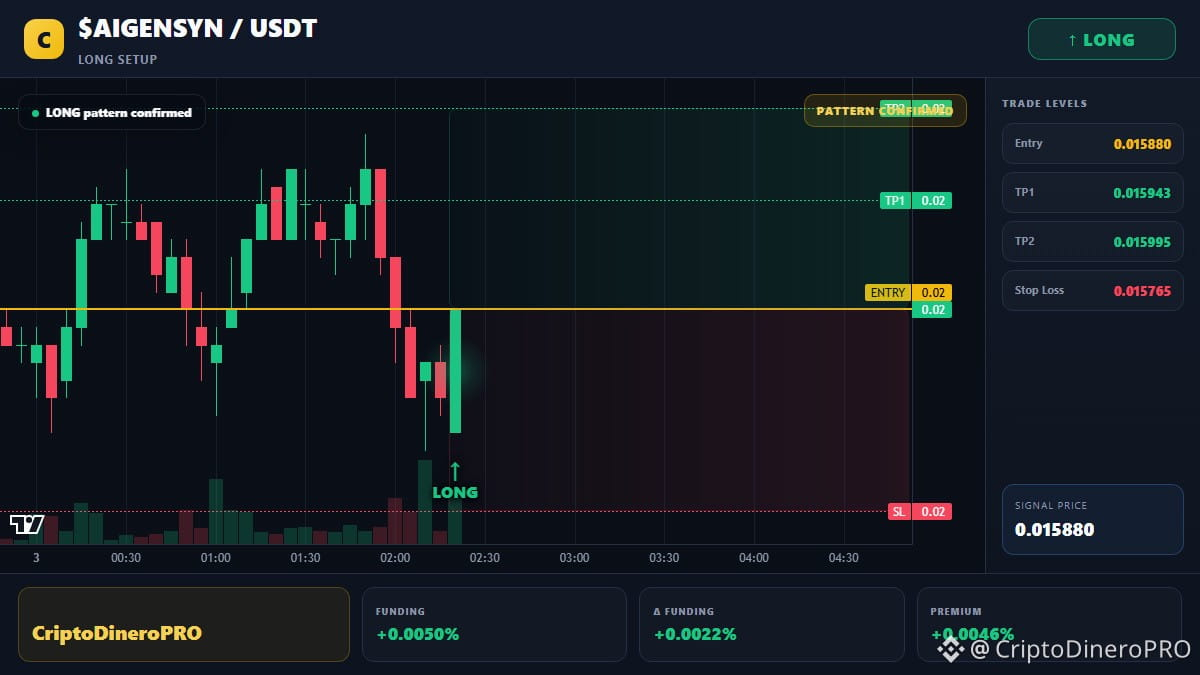
📍 Entry: 0.015880
🛑 Stop Loss: Below 0.015765
🎯 Targets:
• TP1: 0.015943
• TP2: Above 0.015995
DYOR.
#AIGENSYN #AIGENSYNUSDT
$AIGENSYN - Long Setup Ready 🎯
📍 Entry: 0.015880
🛑 Stop Loss: Below 0.015765
🎯 Targets:
• TP1: 0.015943
• TP2: Above 0.015995
DYOR.
#AIGENSYN #AIGENSYNUSDT
📍 Entry: 0.015880
🛑 Stop Loss: Below 0.015765
🎯 Targets:
• TP1: 0.015943
• TP2: Above 0.015995
DYOR.
#AIGENSYN #AIGENSYNUSDT
11

A 300u position opened with 8x leverage lasted 5 months before getting liquidated. But the detail that really matters in this post isn’t the liquidation—it’s that the funding rate never paid longs once during those 5 months. 0.0000%, settled every 4 hours, unchanged for the full 5 months. In a perpetual contract, holding a long position earned not a cent in premium.
First, that 0.0000%. The purpose of funding rates in perpetual contracts is to keep the contract price as close as possible to the spot price. In a bull market, longs are willing to pay costs of tens of percentage points annualized to secure positions, so a positive funding rate is itself a real-time gauge of market sentiment. The AIGENSYN contract stayed at zero from start to finish, which means two things: neither side was willing to pay to express a directional view, and the market didn’t even have the appetite to “express an opinion.” For a long-term long, the implication is even more direct: you bear 5 months of time and liquidation risk, while the only source of return you can count on is price appreciation itself. There’s no carry and no rollover yield. That’s not much different from holding spot, except you’re also taking on a liquidation threshold.
The second contradiction is that the account breakdown doesn’t match the funding rate. Long accounts make up 59.0%—more than half are betting on a rise—yet the funding rate remains a steady 0.0000%. Normally, a majority of long accounts would push the rate positive. The fact that it hasn’t moved up suggests that although there are more long accounts, they don’t have the upper hand in terms of capital. The excess is likely to come from small accounts like those with 300u, while the capital that actually determines the funding rate is on the other side, held by larger shorts or hedgers. In other words: retail traders are long by account count, but the market as a whole isn’t following suit. Reading the percentage of long accounts as “the market is bullish” can easily lead you astray in a thinly traded contract like this.
The third point is the order-book structure. Open interest is 1.29 million USDT and 24-hour trading volume is 1.7 million USDT—volume and open interest are roughly in the same range, which makes this a very thin pool. A thin pool has a simple characteristic: prices can drift without much trading volume. The price fell 5.57% in 24 hours on just 1.7 million in volume. This looks more like sparse buy and sell orders, where trades of just a few hundred u can push the price down a level, rather than concentrated selling. With 8x leverage, the liquidation buffer is only a little over 12%; after fees and maintenance margin, it’s even smaller. That means the 5.57% move over 24 hours has already eaten up nearly half the buffer. Not getting liquidated for 5 months doesn’t mean the position was safe; it just means the volatility in the preceding months happened not to reach that point. High leverage in a thin order book essentially hands control over liquidation to liquidity, not to the market trend.
There’s another side to the risk that needs to be made clear: a funding rate staying precisely at 0.0000% for a long time may not be a natural market outcome; there could be upper and lower limits built into the contract mechanism. If so, even if a directional move does happen later, the funding rate won’t signal it in advance. You can’t use it as a leading indicator of sentiment. Likewise, without positive funding, long positions can’t build up into a crowded trade, so there’s no fuel for a short squeeze. To confirm direction, you have to look at spot trading structure, large transfers, and synchronized changes in OI—you can’t just look at the funding rate.
My view is that this asset currently offers long-term longs no structural compensation, while still exposing them to the liquidation risk of a thin pool. If you want to take a directional position, don’t do it in the least worthwhile way possible—with high leverage and a long holding period. Wait for trading volume and open interest to expand together, and for the funding rate to move decisively away from zero, before considering a position. Leverage costs in crypto are deducted in real terms through funding rates. What doesn’t show up in the funding rate will eventually show up in liquidation records.
#AIGENSYN #Crypto
A 300u position opened with 8x leverage lasted 5 months before getting liquidated. But the detail that really matters in this post isn’t the liquidation—it’s that the funding rate never paid longs once during those 5 months. 0.0000%, settled every 4 hours, unchanged for the full 5 months. In a perpetual contract, holding a long position earned not a cent in premium.
First, that 0.0000%. The purpose of funding rates in perpetual contracts is to keep the contract price as close as possible to the spot price. In a bull market, longs are willing to pay costs of tens of percentage points annualized to secure positions, so a positive funding rate is itself a real-time gauge of market sentiment. The AIGENSYN contract stayed at zero from start to finish, which means two things: neither side was willing to pay to express a directional view, and the market didn’t even have the appetite to “express an opinion.” For a long-term long, the implication is even more direct: you bear 5 months of time and liquidation risk, while the only source of return you can count on is price appreciation itself. There’s no carry and no rollover yield. That’s not much different from holding spot, except you’re also taking on a liquidation threshold.
The second contradiction is that the account breakdown doesn’t match the funding rate. Long accounts make up 59.0%—more than half are betting on a rise—yet the funding rate remains a steady 0.0000%. Normally, a majority of long accounts would push the rate positive. The fact that it hasn’t moved up suggests that although there are more long accounts, they don’t have the upper hand in terms of capital. The excess is likely to come from small accounts like those with 300u, while the capital that actually determines the funding rate is on the other side, held by larger shorts or hedgers. In other words: retail traders are long by account count, but the market as a whole isn’t following suit. Reading the percentage of long accounts as “the market is bullish” can easily lead you astray in a thinly traded contract like this.
The third point is the order-book structure. Open interest is 1.29 million USDT and 24-hour trading volume is 1.7 million USDT—volume and open interest are roughly in the same range, which makes this a very thin pool. A thin pool has a simple characteristic: prices can drift without much trading volume. The price fell 5.57% in 24 hours on just 1.7 million in volume. This looks more like sparse buy and sell orders, where trades of just a few hundred u can push the price down a level, rather than concentrated selling. With 8x leverage, the liquidation buffer is only a little over 12%; after fees and maintenance margin, it’s even smaller. That means the 5.57% move over 24 hours has already eaten up nearly half the buffer. Not getting liquidated for 5 months doesn’t mean the position was safe; it just means the volatility in the preceding months happened not to reach that point. High leverage in a thin order book essentially hands control over liquidation to liquidity, not to the market trend.
There’s another side to the risk that needs to be made clear: a funding rate staying precisely at 0.0000% for a long time may not be a natural market outcome; there could be upper and lower limits built into the contract mechanism. If so, even if a directional move does happen later, the funding rate won’t signal it in advance. You can’t use it as a leading indicator of sentiment. Likewise, without positive funding, long positions can’t build up into a crowded trade, so there’s no fuel for a short squeeze. To confirm direction, you have to look at spot trading structure, large transfers, and synchronized changes in OI—you can’t just look at the funding rate.
My view is that this asset currently offers long-term longs no structural compensation, while still exposing them to the liquidation risk of a thin pool. If you want to take a directional position, don’t do it in the least worthwhile way possible—with high leverage and a long holding period. Wait for trading volume and open interest to expand together, and for the funding rate to move decisively away from zero, before considering a position. Leverage costs in crypto are deducted in real terms through funding rates. What doesn’t show up in the funding rate will eventually show up in liquidation records.
#AIGENSYN #Crypto
First, that 0.0000%. The purpose of funding rates in perpetual contracts is to keep the contract price as close as possible to the spot price. In a bull market, longs are willing to pay costs of tens of percentage points annualized to secure positions, so a positive funding rate is itself a real-time gauge of market sentiment. The AIGENSYN contract stayed at zero from start to finish, which means two things: neither side was willing to pay to express a directional view, and the market didn’t even have the appetite to “express an opinion.” For a long-term long, the implication is even more direct: you bear 5 months of time and liquidation risk, while the only source of return you can count on is price appreciation itself. There’s no carry and no rollover yield. That’s not much different from holding spot, except you’re also taking on a liquidation threshold.
The second contradiction is that the account breakdown doesn’t match the funding rate. Long accounts make up 59.0%—more than half are betting on a rise—yet the funding rate remains a steady 0.0000%. Normally, a majority of long accounts would push the rate positive. The fact that it hasn’t moved up suggests that although there are more long accounts, they don’t have the upper hand in terms of capital. The excess is likely to come from small accounts like those with 300u, while the capital that actually determines the funding rate is on the other side, held by larger shorts or hedgers. In other words: retail traders are long by account count, but the market as a whole isn’t following suit. Reading the percentage of long accounts as “the market is bullish” can easily lead you astray in a thinly traded contract like this.
The third point is the order-book structure. Open interest is 1.29 million USDT and 24-hour trading volume is 1.7 million USDT—volume and open interest are roughly in the same range, which makes this a very thin pool. A thin pool has a simple characteristic: prices can drift without much trading volume. The price fell 5.57% in 24 hours on just 1.7 million in volume. This looks more like sparse buy and sell orders, where trades of just a few hundred u can push the price down a level, rather than concentrated selling. With 8x leverage, the liquidation buffer is only a little over 12%; after fees and maintenance margin, it’s even smaller. That means the 5.57% move over 24 hours has already eaten up nearly half the buffer. Not getting liquidated for 5 months doesn’t mean the position was safe; it just means the volatility in the preceding months happened not to reach that point. High leverage in a thin order book essentially hands control over liquidation to liquidity, not to the market trend.
There’s another side to the risk that needs to be made clear: a funding rate staying precisely at 0.0000% for a long time may not be a natural market outcome; there could be upper and lower limits built into the contract mechanism. If so, even if a directional move does happen later, the funding rate won’t signal it in advance. You can’t use it as a leading indicator of sentiment. Likewise, without positive funding, long positions can’t build up into a crowded trade, so there’s no fuel for a short squeeze. To confirm direction, you have to look at spot trading structure, large transfers, and synchronized changes in OI—you can’t just look at the funding rate.
My view is that this asset currently offers long-term longs no structural compensation, while still exposing them to the liquidation risk of a thin pool. If you want to take a directional position, don’t do it in the least worthwhile way possible—with high leverage and a long holding period. Wait for trading volume and open interest to expand together, and for the funding rate to move decisively away from zero, before considering a position. Leverage costs in crypto are deducted in real terms through funding rates. What doesn’t show up in the funding rate will eventually show up in liquidation records.
#AIGENSYN #Crypto
34

·
--
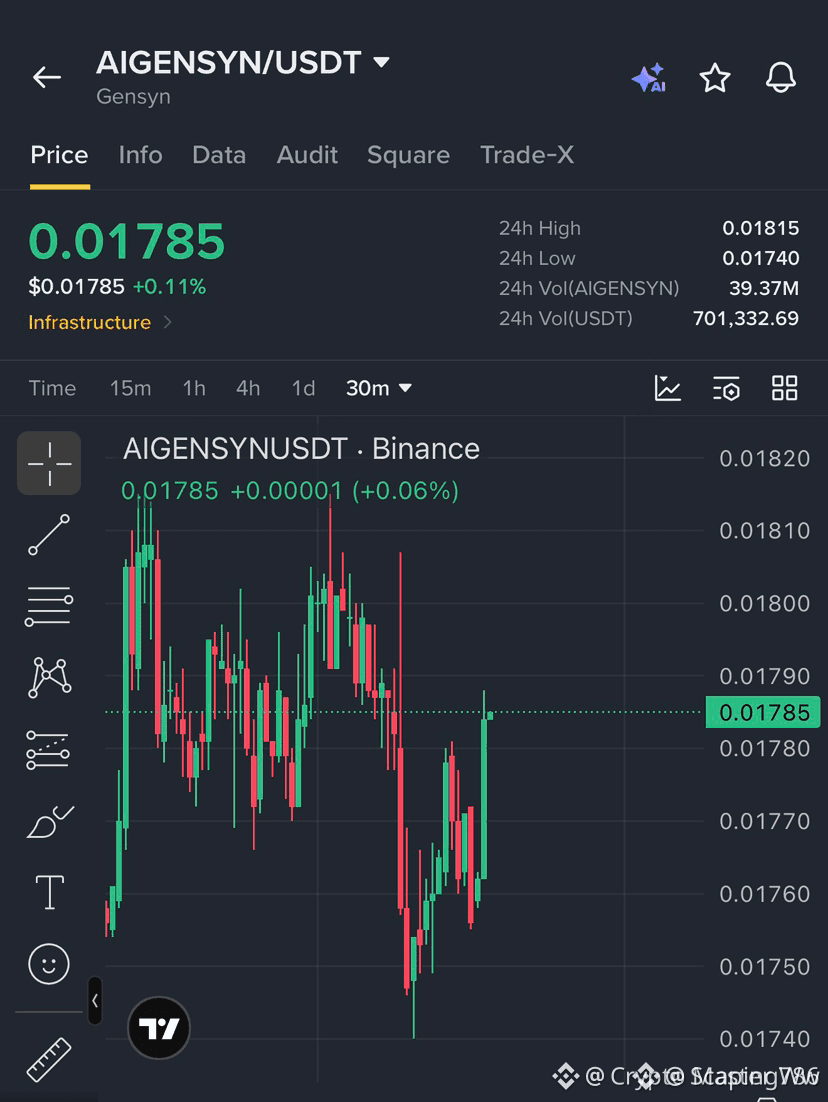
🚀💥 $AIGENSYN RECLAIMS THE FLOOR, READY TO BREAK $0.01790
Entry: 0.01775-0.01785 ⚡
Target: 0.01795/0.01805/0.01815 🚀
Stop Loss: 0.01745 ⚠️
📊 The support zone held tight, swallowing sell pressure like a whale’s maw 🦈. Volume spikes on the 1‑hour chart signal smart money re‑entering, and the RSI is flirting with oversold territory, setting the stage for a clean upside thrust. ⚡ A breach above $0.01790 would flip the order block into fresh demand, opening a runway toward the clustered targets. 📌
💬 Are you lining up your bids for the breakout or waiting for the next liquidity sweep? 👇
⚠️ Not financial advice. Always manage your risk. 🛡️
🏷️ #AIGENSYN #LongSetup #Breakout #Crypto
🔥💎
🚀💥 $AIGENSYN RECLAIMS THE FLOOR, READY TO BREAK $0.01790
Entry: 0.01775-0.01785 ⚡
Target: 0.01795/0.01805/0.01815 🚀
Stop Loss: 0.01745 ⚠️
📊 The support zone held tight, swallowing sell pressure like a whale’s maw 🦈. Volume spikes on the 1‑hour chart signal smart money re‑entering, and the RSI is flirting with oversold territory, setting the stage for a clean upside thrust. ⚡ A breach above $0.01790 would flip the order block into fresh demand, opening a runway toward the clustered targets. 📌
💬 Are you lining up your bids for the breakout or waiting for the next liquidity sweep? 👇
⚠️ Not financial advice. Always manage your risk. 🛡️
🏷️ #AIGENSYN #LongSetup #Breakout #Crypto
🔥💎
Entry: 0.01775-0.01785 ⚡
Target: 0.01795/0.01805/0.01815 🚀
Stop Loss: 0.01745 ⚠️
📊 The support zone held tight, swallowing sell pressure like a whale’s maw 🦈. Volume spikes on the 1‑hour chart signal smart money re‑entering, and the RSI is flirting with oversold territory, setting the stage for a clean upside thrust. ⚡ A breach above $0.01790 would flip the order block into fresh demand, opening a runway toward the clustered targets. 📌
💬 Are you lining up your bids for the breakout or waiting for the next liquidity sweep? 👇
⚠️ Not financial advice. Always manage your risk. 🛡️
🏷️ #AIGENSYN #LongSetup #Breakout #Crypto
🔥💎
56

·
--
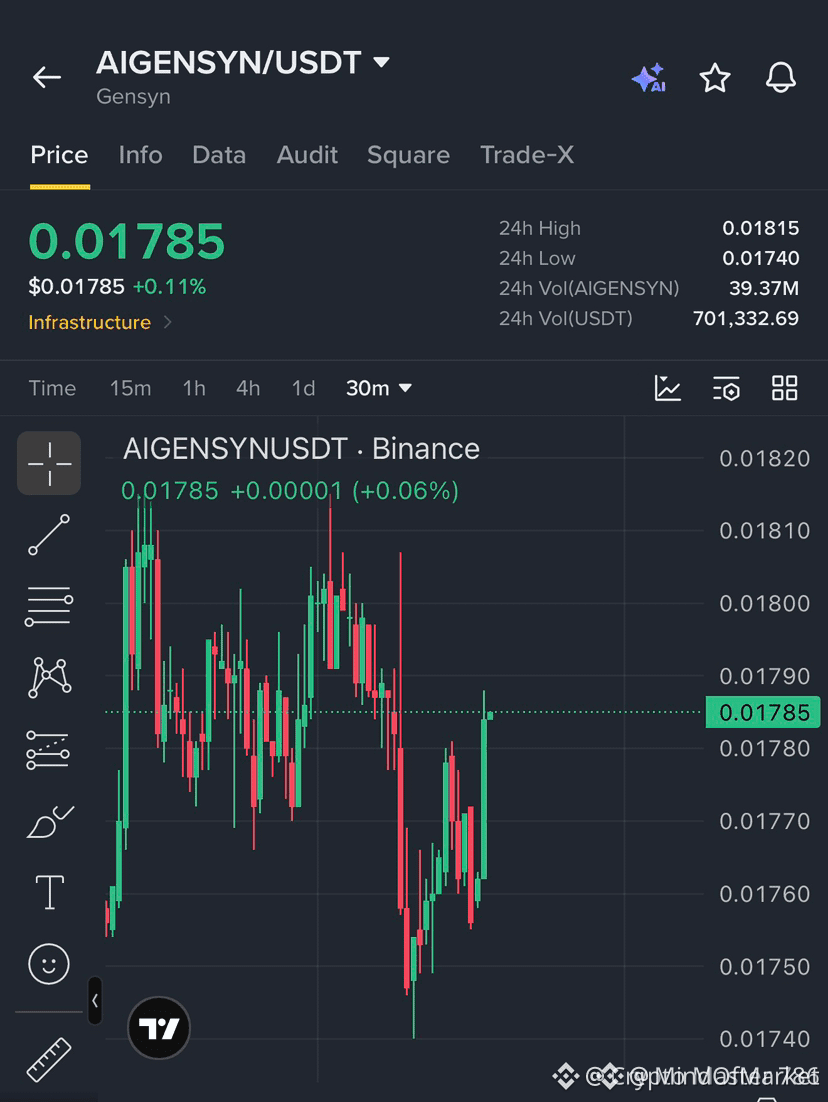
🚀 $AIGENSYN BOUNCES TOWARD BREAKOUT ZONE – WATCH THE LIQUIDITY SWEEP! 📈
Entry: 0.01775-0.01785 ⚡
Target: 0.01795, 0.01805, 0.01815 🚀
Stop Loss: 0.01745 ⚠️
📊 The demand block just above 0.01775 has soaked three rounds of sell pressure, and the order‑block retest is now primed for a smart‑money push. 🌊 Volume on the 4‑hour chart is expanding, indicating institutional liquidity is gathering at the 0.01800 ceiling.
⚡ With a clean 1:3+ risk‑to‑reward, the setup aligns with classic liquidity‑hunt dynamics—buyers ready to flip the market once the barrier breaks. 💬 Do you see the breakout materializing above 0.01790 or a second sweep below support? 👇
⚠️ Not financial advice. Always manage your risk. 🛡️
🏷️ #AIGENSYN #LongSetup #Breakout #Crypto
🦈 🔥
🚀 $AIGENSYN BOUNCES TOWARD BREAKOUT ZONE – WATCH THE LIQUIDITY SWEEP! 📈
Entry: 0.01775-0.01785 ⚡
Target: 0.01795, 0.01805, 0.01815 🚀
Stop Loss: 0.01745 ⚠️
📊 The demand block just above 0.01775 has soaked three rounds of sell pressure, and the order‑block retest is now primed for a smart‑money push. 🌊 Volume on the 4‑hour chart is expanding, indicating institutional liquidity is gathering at the 0.01800 ceiling.
⚡ With a clean 1:3+ risk‑to‑reward, the setup aligns with classic liquidity‑hunt dynamics—buyers ready to flip the market once the barrier breaks. 💬 Do you see the breakout materializing above 0.01790 or a second sweep below support? 👇
⚠️ Not financial advice. Always manage your risk. 🛡️
🏷️ #AIGENSYN #LongSetup #Breakout #Crypto
🦈 🔥
Entry: 0.01775-0.01785 ⚡
Target: 0.01795, 0.01805, 0.01815 🚀
Stop Loss: 0.01745 ⚠️
📊 The demand block just above 0.01775 has soaked three rounds of sell pressure, and the order‑block retest is now primed for a smart‑money push. 🌊 Volume on the 4‑hour chart is expanding, indicating institutional liquidity is gathering at the 0.01800 ceiling.
⚡ With a clean 1:3+ risk‑to‑reward, the setup aligns with classic liquidity‑hunt dynamics—buyers ready to flip the market once the barrier breaks. 💬 Do you see the breakout materializing above 0.01790 or a second sweep below support? 👇
⚠️ Not financial advice. Always manage your risk. 🛡️
🏷️ #AIGENSYN #LongSetup #Breakout #Crypto
🦈 🔥

#AIGENSYN Is a Rebound Taking Shape? 🤖
AIGENSYN trades near $0.01748, with support at $0.01650 and resistance at $0.01820. Spot accumulation offers some support, but bearish futures positioning and a 14.1% monthly decline suggest caution.
{future}(AIGENSYNUSDT)
A confirmed breakout above $0.01820 could open a path toward $0.01950. Watch trading volume and price confirmation for signs of a stronger recovery.
$AIGENSYN #CoinVahini #AI #CryptoTrading #Altcoins
#AIGENSYN Is a Rebound Taking Shape? 🤖
AIGENSYN trades near $0.01748, with support at $0.01650 and resistance at $0.01820. Spot accumulation offers some support, but bearish futures positioning and a 14.1% monthly decline suggest caution.
A confirmed breakout above $0.01820 could open a path toward $0.01950. Watch trading volume and price confirmation for signs of a stronger recovery.
$AIGENSYN #CoinVahini #AI #CryptoTrading #Altcoins
AIGENSYN trades near $0.01748, with support at $0.01650 and resistance at $0.01820. Spot accumulation offers some support, but bearish futures positioning and a 14.1% monthly decline suggest caution.
A confirmed breakout above $0.01820 could open a path toward $0.01950. Watch trading volume and price confirmation for signs of a stronger recovery.
$AIGENSYN #CoinVahini #AI #CryptoTrading #Altcoins
91

·
--
$AIGENSYN or $XRP for the next leg? Only one.
AIGENSYN is at $0.0175, down 3.10% today on $1.49M volume. Price is still below the 20d and 50d MAs. Not pretty.
Volume is just 0.2x its 20d average, while funding sits at 0.005%, meaning longs are paying as momentum stays soft. I’d watch $0.0175 closely, not chase a bounce there. 🥶📉
Pick a side: would you enter here or wait for a retest?
#AIGENSYN #Binance
$AIGENSYN or $XRP for the next leg? Only one.
AIGENSYN is at $0.0175, down 3.10% today on $1.49M volume. Price is still below the 20d and 50d MAs. Not pretty.
Volume is just 0.2x its 20d average, while funding sits at 0.005%, meaning longs are paying as momentum stays soft. I’d watch $0.0175 closely, not chase a bounce there. 🥶📉
Pick a side: would you enter here or wait for a retest?
#AIGENSYN #Binance
AIGENSYN is at $0.0175, down 3.10% today on $1.49M volume. Price is still below the 20d and 50d MAs. Not pretty.
Volume is just 0.2x its 20d average, while funding sits at 0.005%, meaning longs are paying as momentum stays soft. I’d watch $0.0175 closely, not chase a bounce there. 🥶📉
Pick a side: would you enter here or wait for a retest?
#AIGENSYN #Binance
55

·
--
$AIGENSYN +4.00% | $ONDO +3.90% | $STX +3.81%
#AIGENSYN trades at $0.0182, up +4.00% with $3.2M volume.
#ONDO sits at $0.4161, climbing +3.90% on $9.7M traded; its nonprofit foundation roots keep it interesting.
#STX is priced $0.3048, gaining +3.81% with $1.5M volume as it pushes Bitcoin‑based smart contracts.
Watch how the differing volume scales might influence short‑term momentum across the trio.
#Write2Earn #Binance
$AIGENSYN +4.00% | $ONDO +3.90% | $STX +3.81%
#AIGENSYN trades at $0.0182, up +4.00% with $3.2M volume.
#ONDO sits at $0.4161, climbing +3.90% on $9.7M traded; its nonprofit foundation roots keep it interesting.
#STX is priced $0.3048, gaining +3.81% with $1.5M volume as it pushes Bitcoin‑based smart contracts.
Watch how the differing volume scales might influence short‑term momentum across the trio.
#Write2Earn #Binance
#AIGENSYN trades at $0.0182, up +4.00% with $3.2M volume.
#ONDO sits at $0.4161, climbing +3.90% on $9.7M traded; its nonprofit foundation roots keep it interesting.
#STX is priced $0.3048, gaining +3.81% with $1.5M volume as it pushes Bitcoin‑based smart contracts.
Watch how the differing volume scales might influence short‑term momentum across the trio.
#Write2Earn #Binance
14

·
--
AIGENSYN is currently at 0.0181, up 0.28% over 24 hours and 6.73% over 7 days. Its intraday range is 0.0169–0.0208, with an amplitude of 23.1%.
【Market Overview】
Volatility has been through the roof these past few days, giving AIGENSYN a very wide intraday range.
But it’s precisely at times like this that you need to watch out for shakeouts—short-term sentiment can overheat easily.
AIGENSYN’s volatility is low, making it a modest gainer that is moving in line with the broader market.
The 0.0169 area was the starting point of this rally, so a pullback to that level could offer a decent risk-reward entry.
Compared with BTC’s -0.62%, AIGENSYN’s 0.28% gain is a slight outperformance. Its strength is not particularly notable, but it is moving in the same direction.
【Macro】 U.S. stocks fell overnight: Nasdaq -1.88%, S&P 500 -1.11% (close on 2026-10-14). BTC ETFs saw net outflows of around $45.2 billion this month. U.S. CPI came in at 3.7% year over year, above expectations. The probability of a rate hike at the 2026-10-27/28 policy meeting is around 47%.
The short-term outlook leans bullish.
【Bullish Reasons】
AIGENSYN climbed from 0.0169 to 0.0208, and its 0.28% single-day gain has set off a wave of FOMO buying.
It has pushed up from 0.0169 to around 0.0181, with its short-term center of gravity still moving higher.
What’s lacking has never been market action, but patience.
Keep an eye on the broader market: if it turns lower, AIGENSYN’s holders at higher levels could lose conviction at any moment.
$AIGENSYN #AIGENSYN
AIGENSYN is currently at 0.0181, up 0.28% over 24 hours and 6.73% over 7 days. Its intraday range is 0.0169–0.0208, with an amplitude of 23.1%.
【Market Overview】
Volatility has been through the roof these past few days, giving AIGENSYN a very wide intraday range.
But it’s precisely at times like this that you need to watch out for shakeouts—short-term sentiment can overheat easily.
AIGENSYN’s volatility is low, making it a modest gainer that is moving in line with the broader market.
The 0.0169 area was the starting point of this rally, so a pullback to that level could offer a decent risk-reward entry.
Compared with BTC’s -0.62%, AIGENSYN’s 0.28% gain is a slight outperformance. Its strength is not particularly notable, but it is moving in the same direction.
【Macro】 U.S. stocks fell overnight: Nasdaq -1.88%, S&P 500 -1.11% (close on 2026-10-14). BTC ETFs saw net outflows of around $45.2 billion this month. U.S. CPI came in at 3.7% year over year, above expectations. The probability of a rate hike at the 2026-10-27/28 policy meeting is around 47%.
The short-term outlook leans bullish.
【Bullish Reasons】
AIGENSYN climbed from 0.0169 to 0.0208, and its 0.28% single-day gain has set off a wave of FOMO buying.
It has pushed up from 0.0169 to around 0.0181, with its short-term center of gravity still moving higher.
What’s lacking has never been market action, but patience.
Keep an eye on the broader market: if it turns lower, AIGENSYN’s holders at higher levels could lose conviction at any moment.
$AIGENSYN #AIGENSYN
【Market Overview】
Volatility has been through the roof these past few days, giving AIGENSYN a very wide intraday range.
But it’s precisely at times like this that you need to watch out for shakeouts—short-term sentiment can overheat easily.
AIGENSYN’s volatility is low, making it a modest gainer that is moving in line with the broader market.
The 0.0169 area was the starting point of this rally, so a pullback to that level could offer a decent risk-reward entry.
Compared with BTC’s -0.62%, AIGENSYN’s 0.28% gain is a slight outperformance. Its strength is not particularly notable, but it is moving in the same direction.
【Macro】 U.S. stocks fell overnight: Nasdaq -1.88%, S&P 500 -1.11% (close on 2026-10-14). BTC ETFs saw net outflows of around $45.2 billion this month. U.S. CPI came in at 3.7% year over year, above expectations. The probability of a rate hike at the 2026-10-27/28 policy meeting is around 47%.
The short-term outlook leans bullish.
【Bullish Reasons】
AIGENSYN climbed from 0.0169 to 0.0208, and its 0.28% single-day gain has set off a wave of FOMO buying.
It has pushed up from 0.0169 to around 0.0181, with its short-term center of gravity still moving higher.
What’s lacking has never been market action, but patience.
Keep an eye on the broader market: if it turns lower, AIGENSYN’s holders at higher levels could lose conviction at any moment.
$AIGENSYN #AIGENSYN
233

·
--
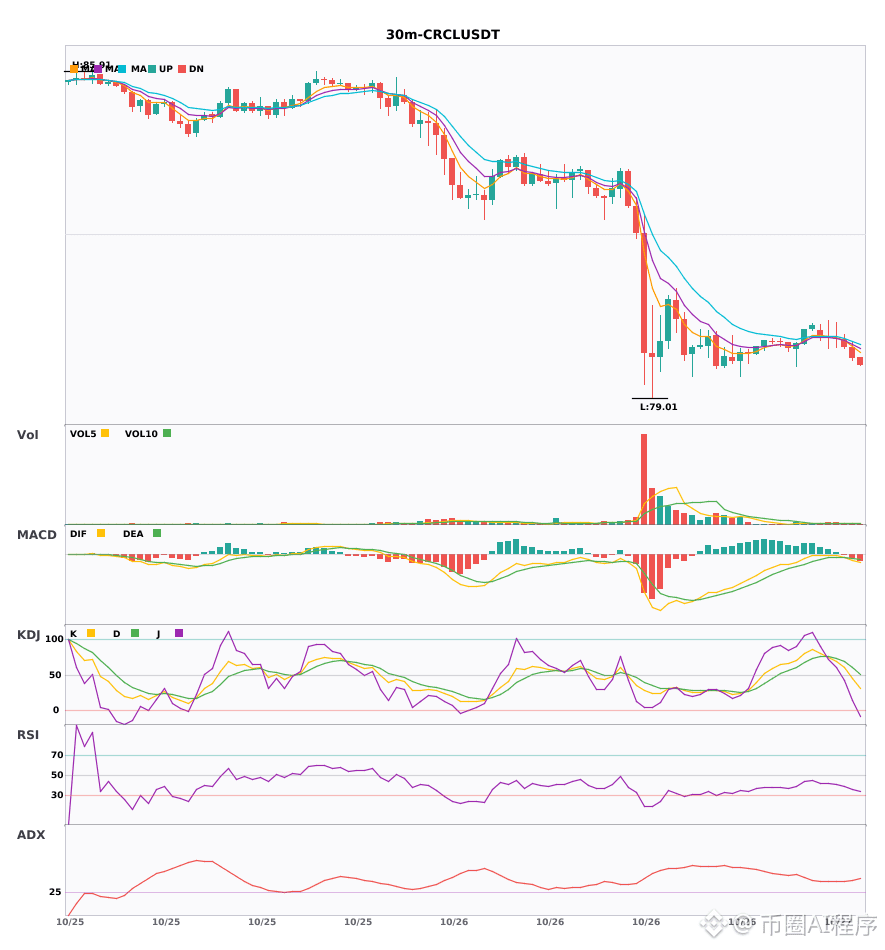
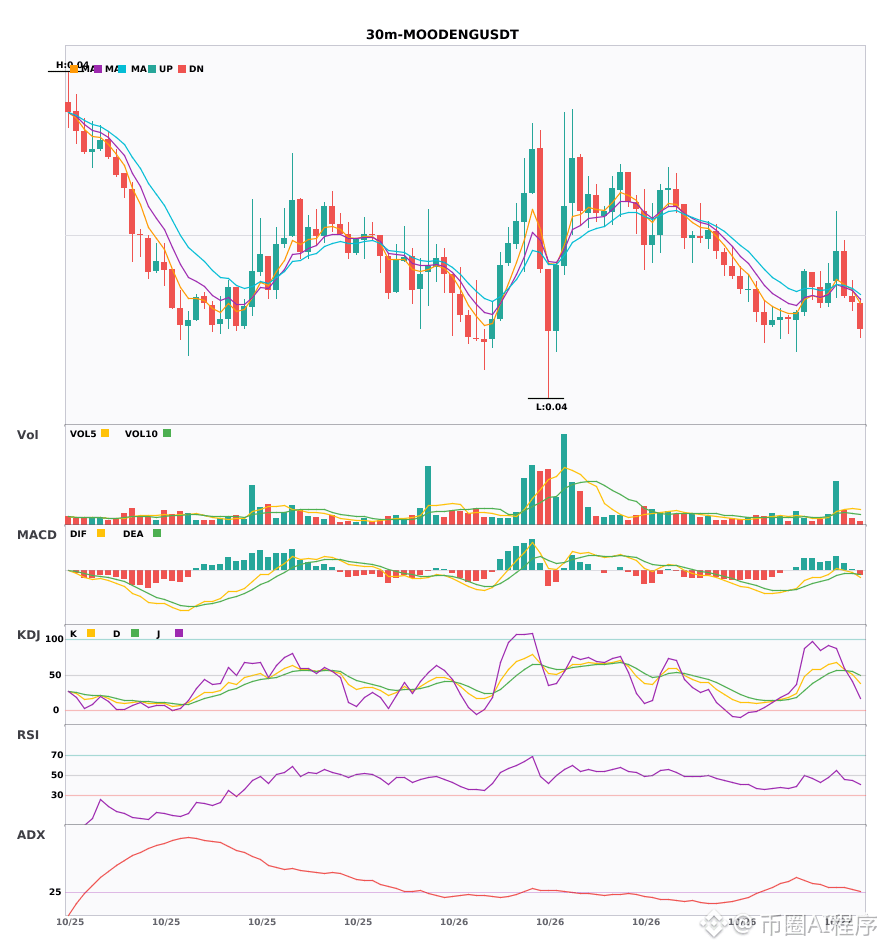
$AIGENSYN / $CRCL / $MOODENG 30-minute bearish signals, 4-hour bearish trend confirmed 🔥
════════════════════
🟢 $AIGENSYN 30-minute bearish signal
⚠️Technical analysis: 4-hour bearish confluence confirmed | 30-minute entry: MACD bearish cross below zero, bearish momentum accelerating | EMA5 < EMA8 < EMA13, bearish alignment | KDJ moving weakly, bears in control (K=33.8, D=42.3) | Volume increased (1.7x)
════════════════════
🟢 $CRCL 30-minute bearish signal
⚠️Technical analysis: 4-hour bearish confluence confirmed | 30-minute entry: MACD bearish cross below zero, bearish momentum accelerating | EMA5 crossed below EMA8, short-term outlook turns bearish | KDJ moving strongly, bulls in control (K=60.1, D=68.8) | Volume increased (1.9x)
════════════════════
🟢 $MOODENG 30-minute bearish signal
⚠️Technical analysis: 4-hour bearish confluence confirmed | 30-minute entry: EMA5 crossed below EMA8, short-term outlook turns bearish | KDJ bearish cross, short-term outlook bearish (K=50.1, D=54.7) | Volume normal (1.2x)
════════════════════
🔔 Follow for first-hand market updates 🔔
#多周期共振 #AIGENSYN #CRCL #MOODENG
📌 When trading, pay attention to whether the candlestick pattern matches
$AIGENSYN / $CRCL / $MOODENG 30-minute bearish signals, 4-hour bearish trend confirmed 🔥
════════════════════
🟢 $AIGENSYN 30-minute bearish signal
⚠️Technical analysis: 4-hour bearish confluence confirmed | 30-minute entry: MACD bearish cross below zero, bearish momentum accelerating | EMA5 < EMA8 < EMA13, bearish alignment | KDJ moving weakly, bears in control (K=33.8, D=42.3) | Volume increased (1.7x)
════════════════════
🟢 $CRCL 30-minute bearish signal
⚠️Technical analysis: 4-hour bearish confluence confirmed | 30-minute entry: MACD bearish cross below zero, bearish momentum accelerating | EMA5 crossed below EMA8, short-term outlook turns bearish | KDJ moving strongly, bulls in control (K=60.1, D=68.8) | Volume increased (1.9x)
════════════════════
🟢 $MOODENG 30-minute bearish signal
⚠️Technical analysis: 4-hour bearish confluence confirmed | 30-minute entry: EMA5 crossed below EMA8, short-term outlook turns bearish | KDJ bearish cross, short-term outlook bearish (K=50.1, D=54.7) | Volume normal (1.2x)
════════════════════
🔔 Follow for first-hand market updates 🔔
#多周期共振 #AIGENSYN #CRCL #MOODENG
📌 When trading, pay attention to whether the candlestick pattern matches
════════════════════
🟢 $AIGENSYN 30-minute bearish signal
⚠️Technical analysis: 4-hour bearish confluence confirmed | 30-minute entry: MACD bearish cross below zero, bearish momentum accelerating | EMA5 < EMA8 < EMA13, bearish alignment | KDJ moving weakly, bears in control (K=33.8, D=42.3) | Volume increased (1.7x)
════════════════════
🟢 $CRCL 30-minute bearish signal
⚠️Technical analysis: 4-hour bearish confluence confirmed | 30-minute entry: MACD bearish cross below zero, bearish momentum accelerating | EMA5 crossed below EMA8, short-term outlook turns bearish | KDJ moving strongly, bulls in control (K=60.1, D=68.8) | Volume increased (1.9x)
════════════════════
🟢 $MOODENG 30-minute bearish signal
⚠️Technical analysis: 4-hour bearish confluence confirmed | 30-minute entry: EMA5 crossed below EMA8, short-term outlook turns bearish | KDJ bearish cross, short-term outlook bearish (K=50.1, D=54.7) | Volume normal (1.2x)
════════════════════
🔔 Follow for first-hand market updates 🔔
#多周期共振 #AIGENSYN #CRCL #MOODENG
📌 When trading, pay attention to whether the candlestick pattern matches
15

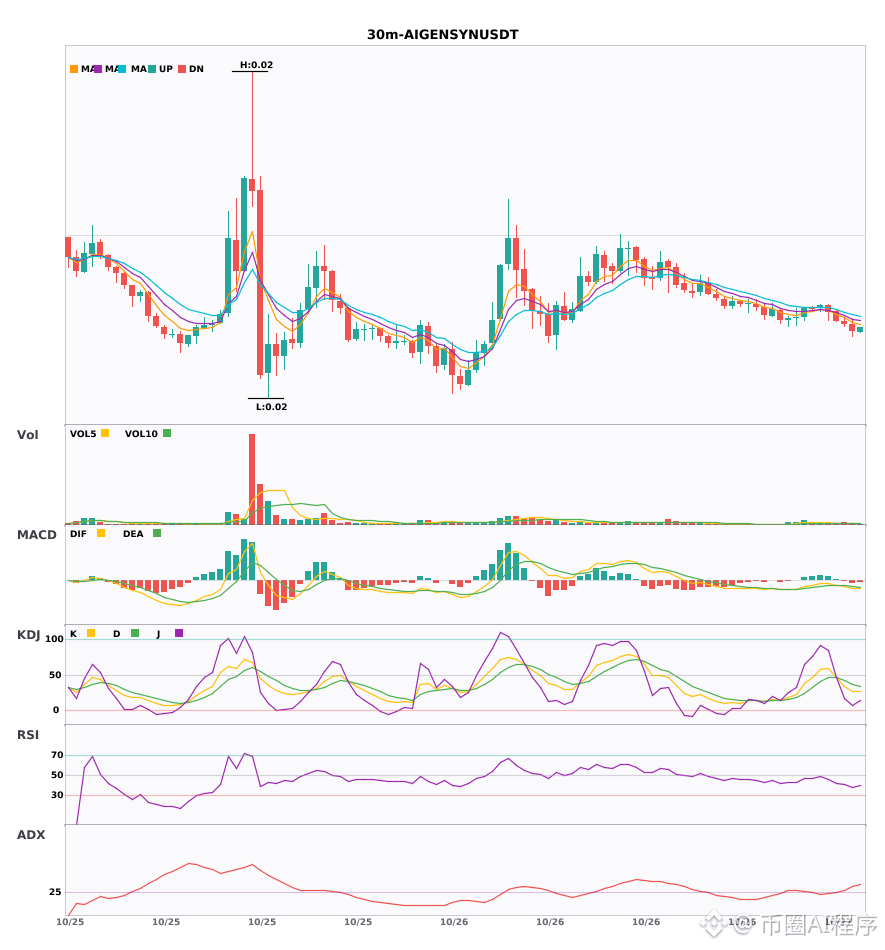
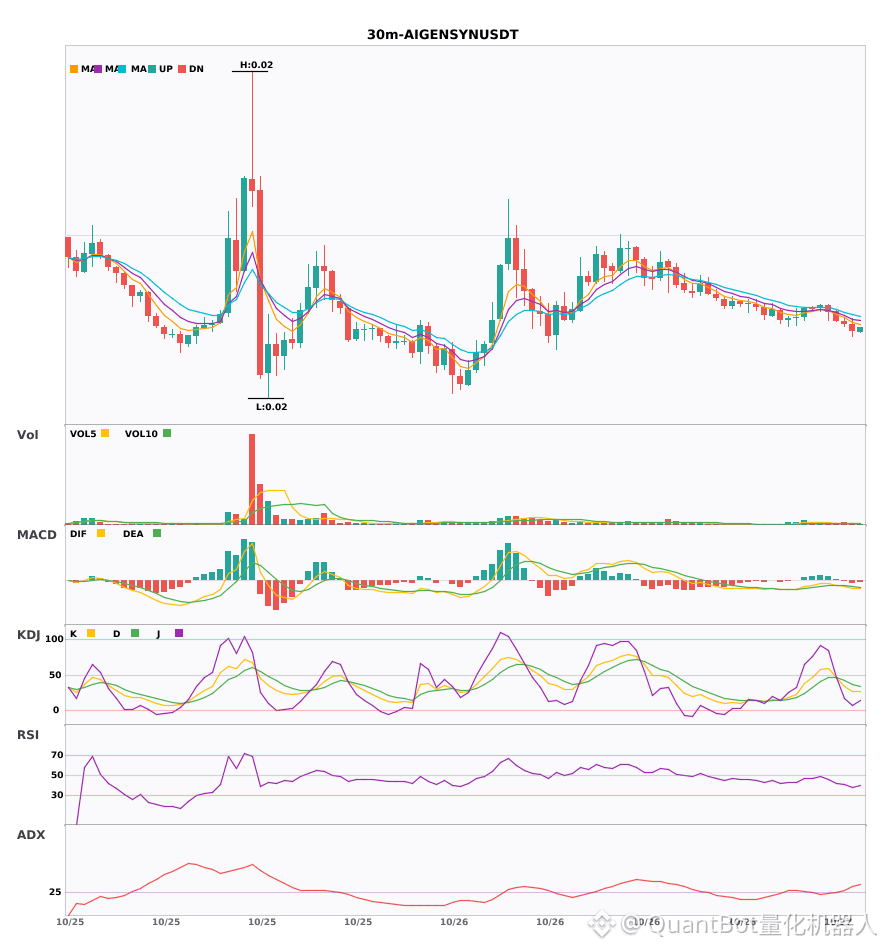
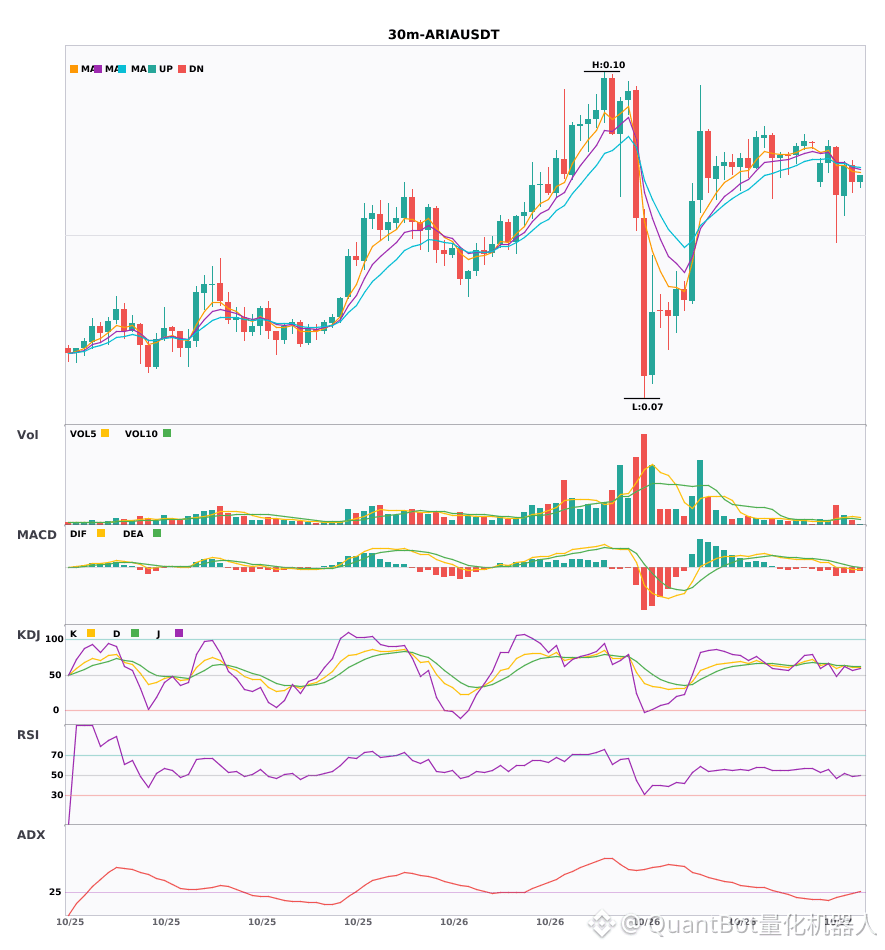
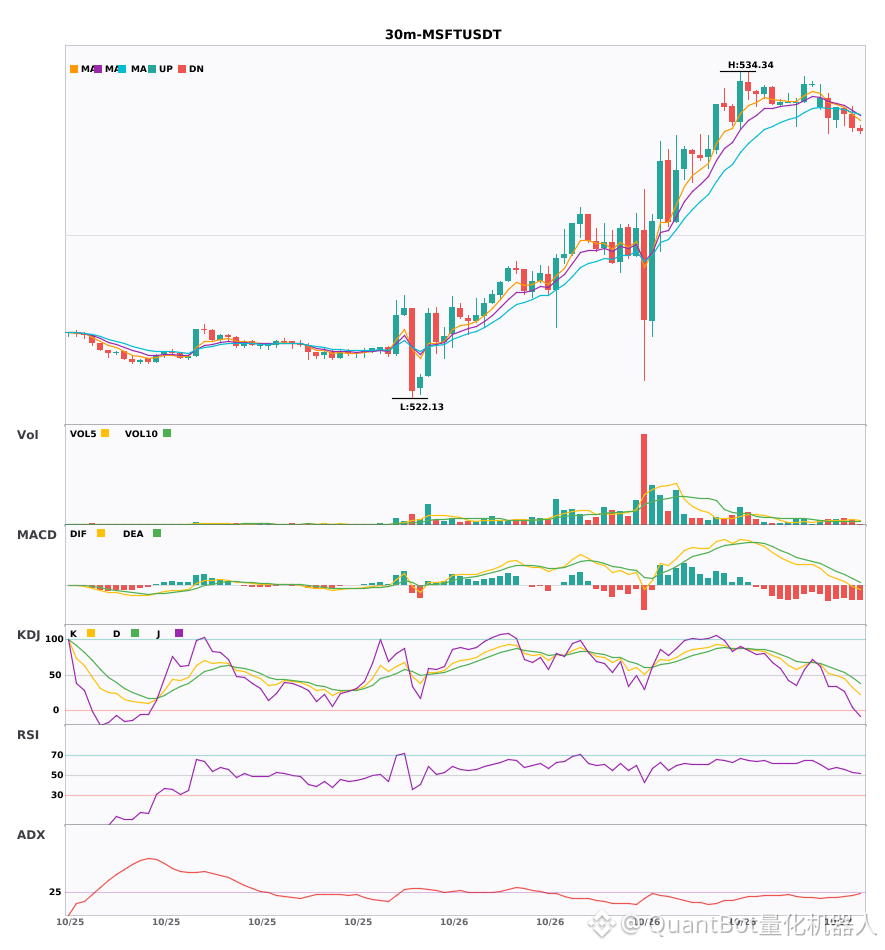
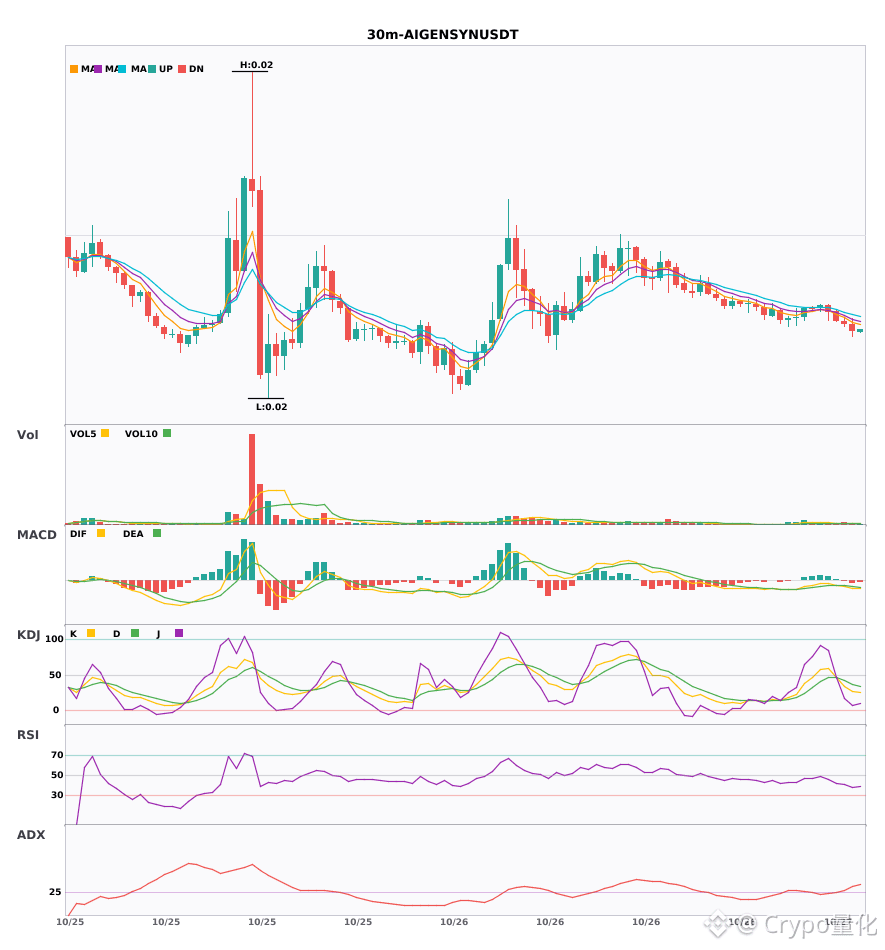
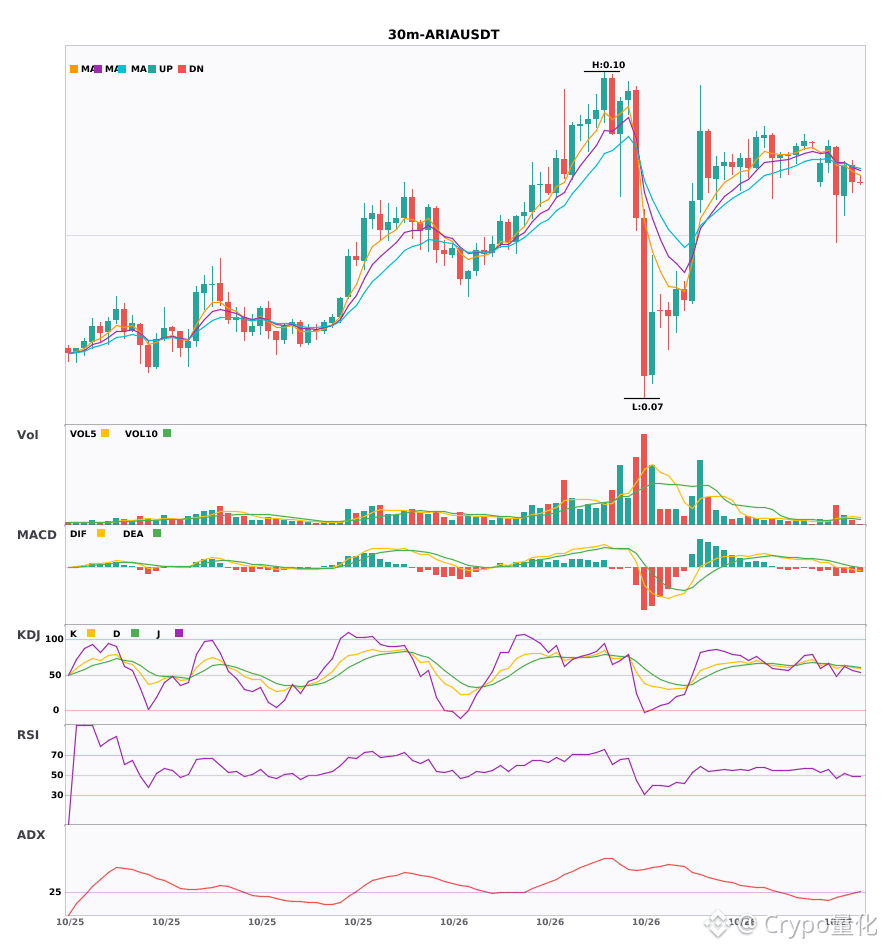
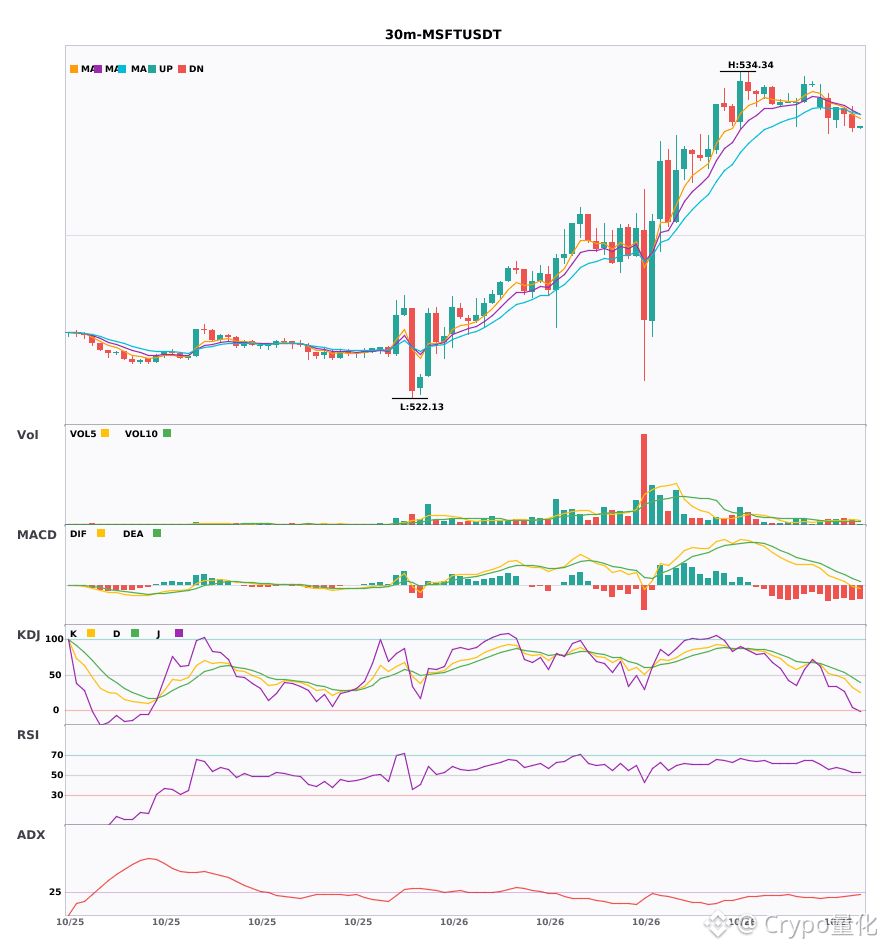
$AIGENSYN / $ARIA / $MSFT 30-minute resonance turns bearish, with bearish signals appearing simultaneously
📉 $AIGENSYN | 30-minute bearish signal
━━━━━━━━━━━━━━━━━━
Technical analysis: ADX(31) Strong trending market | MACD bearish crossover below zero, bearish momentum accelerating | EMA5 < EMA8 < EMA13, bearish alignment | KDJ moving weakly, bears in control (K: 33.8, D: 42.3) | Volume increased (1.7x)
Price change: -0.1700%
📉 $ARIA | 30-minute bearish signal
━━━━━━━━━━━━━━━━━━
Technical analysis: ADX(27) Trend is forming; entry is possible | MACD bearish, trend is weak, momentum strengthening | EMA5 < EMA8 < EMA13, bearish alignment | KDJ moving strongly, bulls in control (K: 60.3, D: 62.4) | Volume increased (1.5x)
Price change: -1.8100%
📉 $MSFT | 30-minute bearish signal
━━━━━━━━━━━━━━━━━━
Technical analysis: ADX(25) Trend is forming; entry is possible | MACD DIF has fallen below the zero line; trend has turned bearish | Moving averages are converging, building momentum; a direction is about to be chosen | KDJ moving weakly, bears in control (K: 32.8, D: 46.6) | Volume increased (1.7x)
Price change: -0.1000%
━━━━━━━━━━━━━━━━━━
#技术分析 #AIGENSYN #ARIA #MSFT
📌 The above content is for reference only and does not constitute investment advice
$AIGENSYN / $ARIA / $MSFT 30-minute resonance turns bearish, with bearish signals appearing simultaneously
📉 $AIGENSYN | 30-minute bearish signal
━━━━━━━━━━━━━━━━━━
Technical analysis: ADX(31) Strong trending market | MACD bearish crossover below zero, bearish momentum accelerating | EMA5 < EMA8 < EMA13, bearish alignment | KDJ moving weakly, bears in control (K: 33.8, D: 42.3) | Volume increased (1.7x)
Price change: -0.1700%
📉 $ARIA | 30-minute bearish signal
━━━━━━━━━━━━━━━━━━
Technical analysis: ADX(27) Trend is forming; entry is possible | MACD bearish, trend is weak, momentum strengthening | EMA5 < EMA8 < EMA13, bearish alignment | KDJ moving strongly, bulls in control (K: 60.3, D: 62.4) | Volume increased (1.5x)
Price change: -1.8100%
📉 $MSFT | 30-minute bearish signal
━━━━━━━━━━━━━━━━━━
Technical analysis: ADX(25) Trend is forming; entry is possible | MACD DIF has fallen below the zero line; trend has turned bearish | Moving averages are converging, building momentum; a direction is about to be chosen | KDJ moving weakly, bears in control (K: 32.8, D: 46.6) | Volume increased (1.7x)
Price change: -0.1000%
━━━━━━━━━━━━━━━━━━
#技术分析 #AIGENSYN #ARIA #MSFT
📌 The above content is for reference only and does not constitute investment advice
📉 $AIGENSYN | 30-minute bearish signal
━━━━━━━━━━━━━━━━━━
Technical analysis: ADX(31) Strong trending market | MACD bearish crossover below zero, bearish momentum accelerating | EMA5 < EMA8 < EMA13, bearish alignment | KDJ moving weakly, bears in control (K: 33.8, D: 42.3) | Volume increased (1.7x)
Price change: -0.1700%
📉 $ARIA | 30-minute bearish signal
━━━━━━━━━━━━━━━━━━
Technical analysis: ADX(27) Trend is forming; entry is possible | MACD bearish, trend is weak, momentum strengthening | EMA5 < EMA8 < EMA13, bearish alignment | KDJ moving strongly, bulls in control (K: 60.3, D: 62.4) | Volume increased (1.5x)
Price change: -1.8100%
📉 $MSFT | 30-minute bearish signal
━━━━━━━━━━━━━━━━━━
Technical analysis: ADX(25) Trend is forming; entry is possible | MACD DIF has fallen below the zero line; trend has turned bearish | Moving averages are converging, building momentum; a direction is about to be chosen | KDJ moving weakly, bears in control (K: 32.8, D: 46.6) | Volume increased (1.7x)
Price change: -0.1000%
━━━━━━━━━━━━━━━━━━
#技术分析 #AIGENSYN #ARIA #MSFT
📌 The above content is for reference only and does not constitute investment advice
8
·
--
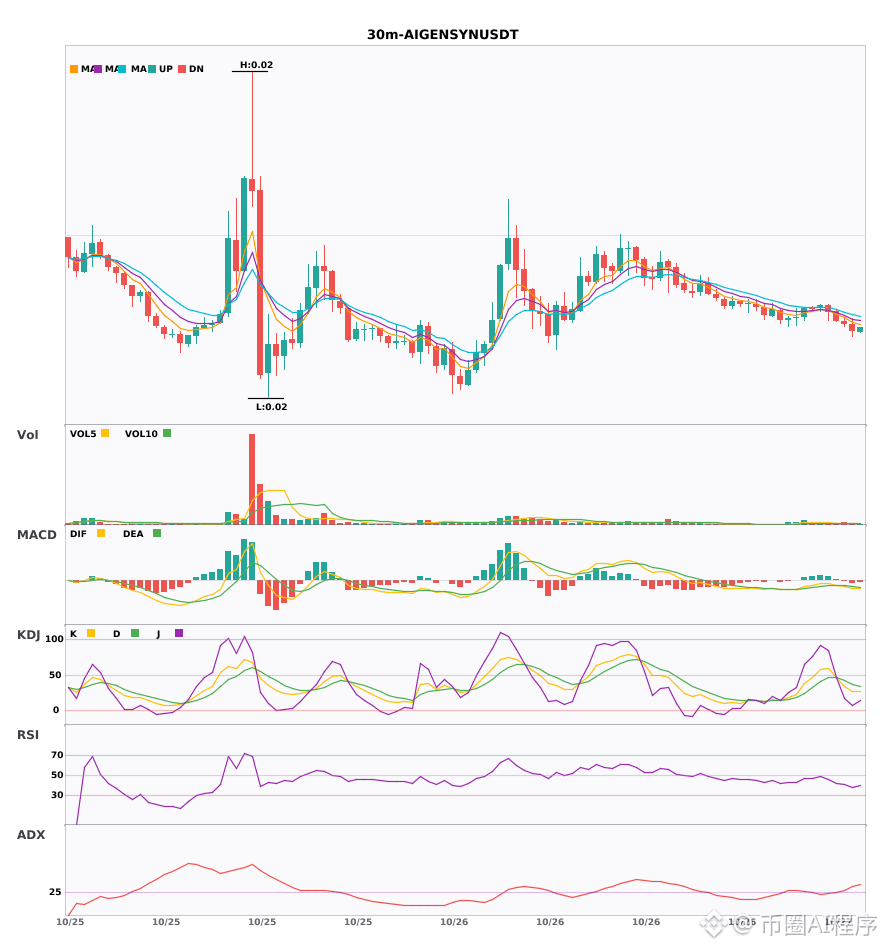
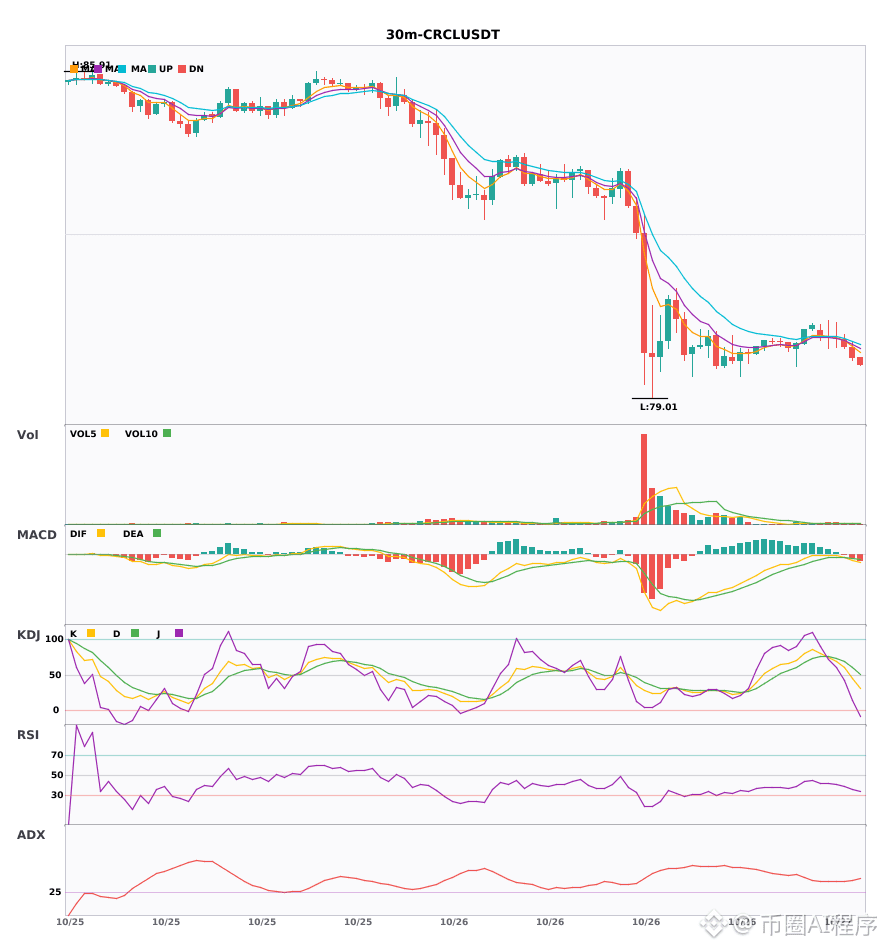
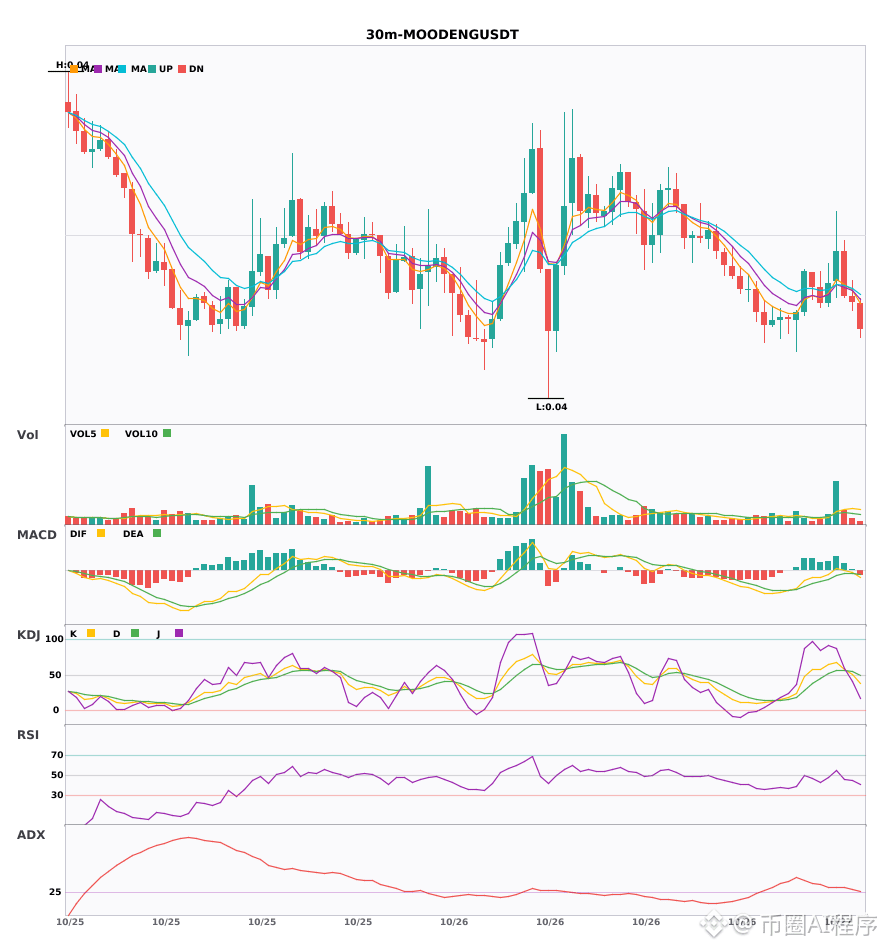
$AIGENSYN / $CRCL / $MOODENG 30-minute bearish signals, 4-hour bearish trend confirmed 🔥
════════════════════
🟢 $AIGENSYN 30-minute bearish signal
⚠️Technical analysis: 4-hour bearish confluence confirmed | 30-minute entry: MACD bearish crossover below zero, bearish momentum accelerating | EMA5 < EMA8 < EMA13, bearish alignment | KDJ moving weakly, bears in control (K: 33.8, D: 42.3) | Volume increased (1.7x)
════════════════════
🟢 $CRCL 30-minute bearish signal
⚠️Technical analysis: 4-hour bearish confluence confirmed | 30-minute entry: MACD bearish crossover below zero, bearish momentum accelerating | EMA5 crossed below EMA8, short-term outlook turning bearish | KDJ moving strongly, bulls in control (K: 60.1, D: 68.8) | Volume increased (1.9x)
════════════════════
🟢 $MOODENG 30-minute bearish signal
⚠️Technical analysis: 4-hour bearish confluence confirmed | 30-minute entry: EMA5 crossed below EMA8, short-term outlook turning bearish | KDJ bearish crossover, short-term outlook bearish (K: 50.1, D: 54.7) | Volume normal (1.2x)
════════════════════
🔔 Follow for first-hand market updates 🔔
#多周期共振 #AIGENSYN #CRCL #MOODENG
📌 When trading, pay attention to whether the candlestick patterns align
$AIGENSYN / $CRCL / $MOODENG 30-minute bearish signals, 4-hour bearish trend confirmed 🔥
════════════════════
🟢 $AIGENSYN 30-minute bearish signal
⚠️Technical analysis: 4-hour bearish confluence confirmed | 30-minute entry: MACD bearish crossover below zero, bearish momentum accelerating | EMA5 < EMA8 < EMA13, bearish alignment | KDJ moving weakly, bears in control (K: 33.8, D: 42.3) | Volume increased (1.7x)
════════════════════
🟢 $CRCL 30-minute bearish signal
⚠️Technical analysis: 4-hour bearish confluence confirmed | 30-minute entry: MACD bearish crossover below zero, bearish momentum accelerating | EMA5 crossed below EMA8, short-term outlook turning bearish | KDJ moving strongly, bulls in control (K: 60.1, D: 68.8) | Volume increased (1.9x)
════════════════════
🟢 $MOODENG 30-minute bearish signal
⚠️Technical analysis: 4-hour bearish confluence confirmed | 30-minute entry: EMA5 crossed below EMA8, short-term outlook turning bearish | KDJ bearish crossover, short-term outlook bearish (K: 50.1, D: 54.7) | Volume normal (1.2x)
════════════════════
🔔 Follow for first-hand market updates 🔔
#多周期共振 #AIGENSYN #CRCL #MOODENG
📌 When trading, pay attention to whether the candlestick patterns align
════════════════════
🟢 $AIGENSYN 30-minute bearish signal
⚠️Technical analysis: 4-hour bearish confluence confirmed | 30-minute entry: MACD bearish crossover below zero, bearish momentum accelerating | EMA5 < EMA8 < EMA13, bearish alignment | KDJ moving weakly, bears in control (K: 33.8, D: 42.3) | Volume increased (1.7x)
════════════════════
🟢 $CRCL 30-minute bearish signal
⚠️Technical analysis: 4-hour bearish confluence confirmed | 30-minute entry: MACD bearish crossover below zero, bearish momentum accelerating | EMA5 crossed below EMA8, short-term outlook turning bearish | KDJ moving strongly, bulls in control (K: 60.1, D: 68.8) | Volume increased (1.9x)
════════════════════
🟢 $MOODENG 30-minute bearish signal
⚠️Technical analysis: 4-hour bearish confluence confirmed | 30-minute entry: EMA5 crossed below EMA8, short-term outlook turning bearish | KDJ bearish crossover, short-term outlook bearish (K: 50.1, D: 54.7) | Volume normal (1.2x)
════════════════════
🔔 Follow for first-hand market updates 🔔
#多周期共振 #AIGENSYN #CRCL #MOODENG
📌 When trading, pay attention to whether the candlestick patterns align
13

·
--
$AIGENSYN / $ARIA / $MSFT 30-minute technical indicators are weakening in sync. Watch out for risk 🔥
════════════════════
🟢 $AIGENSYN 30-minute bearish signal
⚠️Technical analysis: ADX(31): A clear trending market | MACD bearish crossover below zero, bearish momentum accelerating | EMA5 < EMA8 < EMA13: bearish alignment | KDJ trending weakly, bears in control (K: 33.8, D: 42.3) | Volume up (1.7x)
════════════════════
🟢 $ARIA 30-minute bearish signal
⚠️Technical analysis: ADX(27): Trend is forming; entry is possible | MACD is bearish, trend is weak, momentum is strengthening | EMA5 < EMA8 < EMA13: bearish alignment | KDJ trending strongly, bulls in control (K: 60.3, D: 62.4) | Volume up (1.5x)
════════════════════
🟢 $MSFT 30-minute bearish signal
⚠️Technical analysis: ADX(25): Trend is forming; entry is possible | MACD DIF has fallen below the zero line; trend has turned bearish | Moving averages are converging and building momentum; a direction is likely to be chosen soon | KDJ trending weakly, bears in control (K: 32.8, D: 46.6) | Volume up (1.7x)
════════════════════
🔔 Follow for first-hand market movement alerts 🔔
#技术分析 #AIGENSYN #ARIA #MSFT
📌 When trading, watch whether the candlestick pattern confirms the signal
$AIGENSYN / $ARIA / $MSFT 30-minute technical indicators are weakening in sync. Watch out for risk 🔥
════════════════════
🟢 $AIGENSYN 30-minute bearish signal
⚠️Technical analysis: ADX(31): A clear trending market | MACD bearish crossover below zero, bearish momentum accelerating | EMA5 < EMA8 < EMA13: bearish alignment | KDJ trending weakly, bears in control (K: 33.8, D: 42.3) | Volume up (1.7x)
════════════════════
🟢 $ARIA 30-minute bearish signal
⚠️Technical analysis: ADX(27): Trend is forming; entry is possible | MACD is bearish, trend is weak, momentum is strengthening | EMA5 < EMA8 < EMA13: bearish alignment | KDJ trending strongly, bulls in control (K: 60.3, D: 62.4) | Volume up (1.5x)
════════════════════
🟢 $MSFT 30-minute bearish signal
⚠️Technical analysis: ADX(25): Trend is forming; entry is possible | MACD DIF has fallen below the zero line; trend has turned bearish | Moving averages are converging and building momentum; a direction is likely to be chosen soon | KDJ trending weakly, bears in control (K: 32.8, D: 46.6) | Volume up (1.7x)
════════════════════
🔔 Follow for first-hand market movement alerts 🔔
#技术分析 #AIGENSYN #ARIA #MSFT
📌 When trading, watch whether the candlestick pattern confirms the signal
════════════════════
🟢 $AIGENSYN 30-minute bearish signal
⚠️Technical analysis: ADX(31): A clear trending market | MACD bearish crossover below zero, bearish momentum accelerating | EMA5 < EMA8 < EMA13: bearish alignment | KDJ trending weakly, bears in control (K: 33.8, D: 42.3) | Volume up (1.7x)
════════════════════
🟢 $ARIA 30-minute bearish signal
⚠️Technical analysis: ADX(27): Trend is forming; entry is possible | MACD is bearish, trend is weak, momentum is strengthening | EMA5 < EMA8 < EMA13: bearish alignment | KDJ trending strongly, bulls in control (K: 60.3, D: 62.4) | Volume up (1.5x)
════════════════════
🟢 $MSFT 30-minute bearish signal
⚠️Technical analysis: ADX(25): Trend is forming; entry is possible | MACD DIF has fallen below the zero line; trend has turned bearish | Moving averages are converging and building momentum; a direction is likely to be chosen soon | KDJ trending weakly, bears in control (K: 32.8, D: 46.6) | Volume up (1.7x)
════════════════════
🔔 Follow for first-hand market movement alerts 🔔
#技术分析 #AIGENSYN #ARIA #MSFT
📌 When trading, watch whether the candlestick pattern confirms the signal
35

·
--
AIGENSYN: A STRONG STORY, BUT THE MARKET HASN'T PICKED A SIDE.
THE MARKET READ
0.01792 | 24H +1.93%
4H STRUCTURE: RANGE
1H CONFIRMATION: BEARISH
RELATIVE VOLUME: 1.88x
THE NARRATIVE
AIGENSYN's narrative is tied to its own network, product and ecosystem fundamentals; no project metadata was available right now.
MY VIEW — NEUTRAL
Neutral. The narrative may attract attention, but price structure has not yet shown which side is in control.
WHAT WOULD CONFIRM IT
Technical confirmation is weak: wait for cleaner structure and stronger participation before drawing a firm conclusion.
This is narrative analysis, not a trade signal. Verify current market data and project claims before acting.
#AIGENSYN #Crypto #MarketStructure
AIGENSYN: A STRONG STORY, BUT THE MARKET HASN'T PICKED A SIDE.
THE MARKET READ
0.01792 | 24H +1.93%
4H STRUCTURE: RANGE
1H CONFIRMATION: BEARISH
RELATIVE VOLUME: 1.88x
THE NARRATIVE
AIGENSYN's narrative is tied to its own network, product and ecosystem fundamentals; no project metadata was available right now.
MY VIEW — NEUTRAL
Neutral. The narrative may attract attention, but price structure has not yet shown which side is in control.
WHAT WOULD CONFIRM IT
Technical confirmation is weak: wait for cleaner structure and stronger participation before drawing a firm conclusion.
This is narrative analysis, not a trade signal. Verify current market data and project claims before acting.
#AIGENSYN #Crypto #MarketStructure
THE MARKET READ
0.01792 | 24H +1.93%
4H STRUCTURE: RANGE
1H CONFIRMATION: BEARISH
RELATIVE VOLUME: 1.88x
THE NARRATIVE
AIGENSYN's narrative is tied to its own network, product and ecosystem fundamentals; no project metadata was available right now.
MY VIEW — NEUTRAL
Neutral. The narrative may attract attention, but price structure has not yet shown which side is in control.
WHAT WOULD CONFIRM IT
Technical confirmation is weak: wait for cleaner structure and stronger participation before drawing a firm conclusion.
This is narrative analysis, not a trade signal. Verify current market data and project claims before acting.
#AIGENSYN #Crypto #MarketStructure
12


·
--
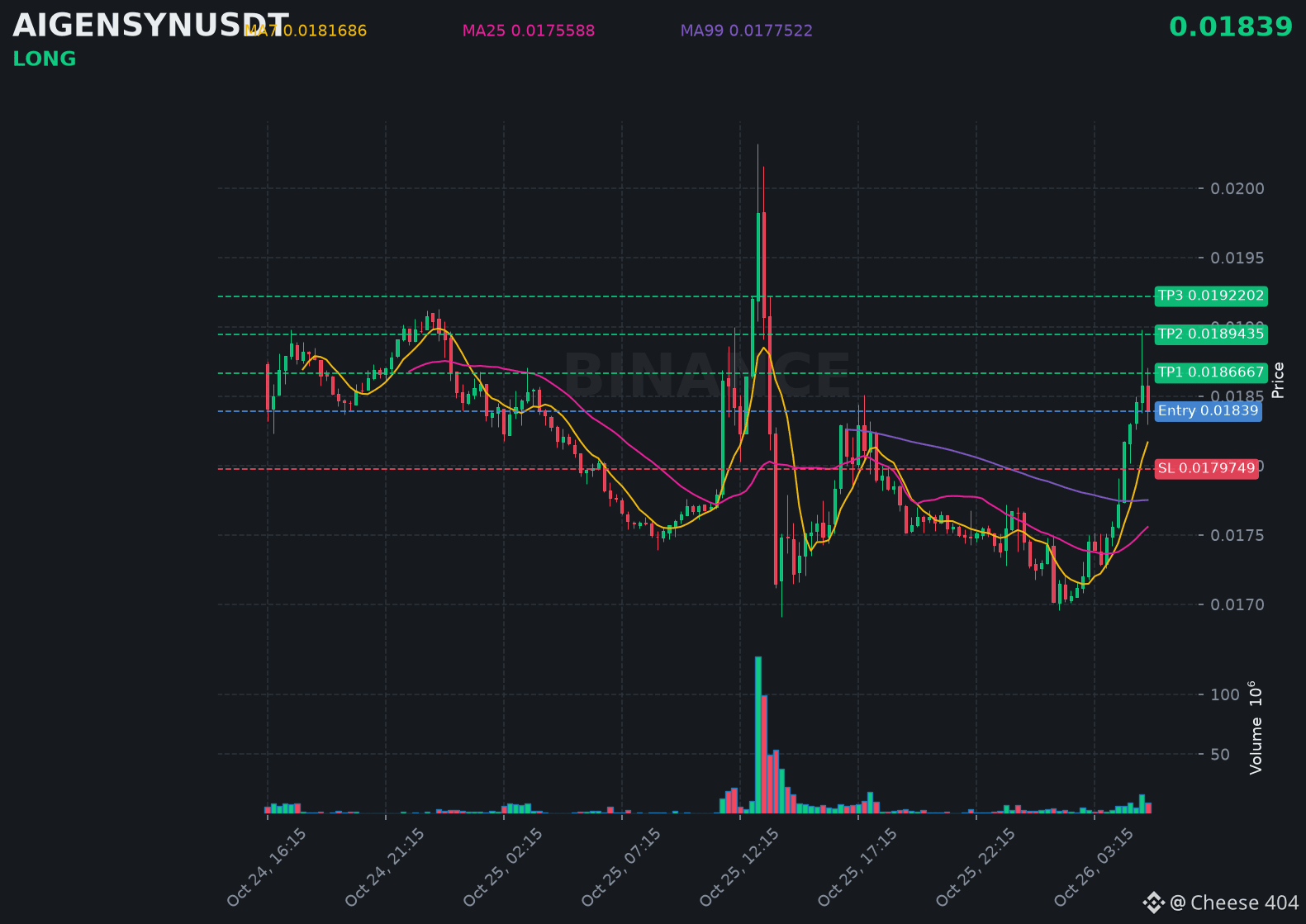
$AIGENSYN is trending up with real conviction, buyers defending every dip along the way.
📍 @ 0.01839 | Volume: 0.17M USD
RSI 68 | EMA20: 0.0177919 USD
📈 Trade Plan:
📈 Entry: 0.018307 – 0.018473
🛑 Stop Loss: 0.0179749
🎯 TP1: 0.0186667
🎯 TP2: 0.0189435
🎯 TP3: 0.0192202
Waiting for a retest, then riding the uptrend.
👉 $AIGENSYN 👈 Catch it
#AIGENSYN
$AIGENSYN is trending up with real conviction, buyers defending every dip along the way.
📍 @ 0.01839 | Volume: 0.17M USD
RSI 68 | EMA20: 0.0177919 USD
📈 Trade Plan:
📈 Entry: 0.018307 – 0.018473
🛑 Stop Loss: 0.0179749
🎯 TP1: 0.0186667
🎯 TP2: 0.0189435
🎯 TP3: 0.0192202
Waiting for a retest, then riding the uptrend.
👉 $AIGENSYN 👈 Catch it
#AIGENSYN
📍 @ 0.01839 | Volume: 0.17M USD
RSI 68 | EMA20: 0.0177919 USD
📈 Trade Plan:
📈 Entry: 0.018307 – 0.018473
🛑 Stop Loss: 0.0179749
🎯 TP1: 0.0186667
🎯 TP2: 0.0189435
🎯 TP3: 0.0192202
Waiting for a retest, then riding the uptrend.
👉 $AIGENSYN 👈 Catch it
#AIGENSYN
58

·
--
Bullish
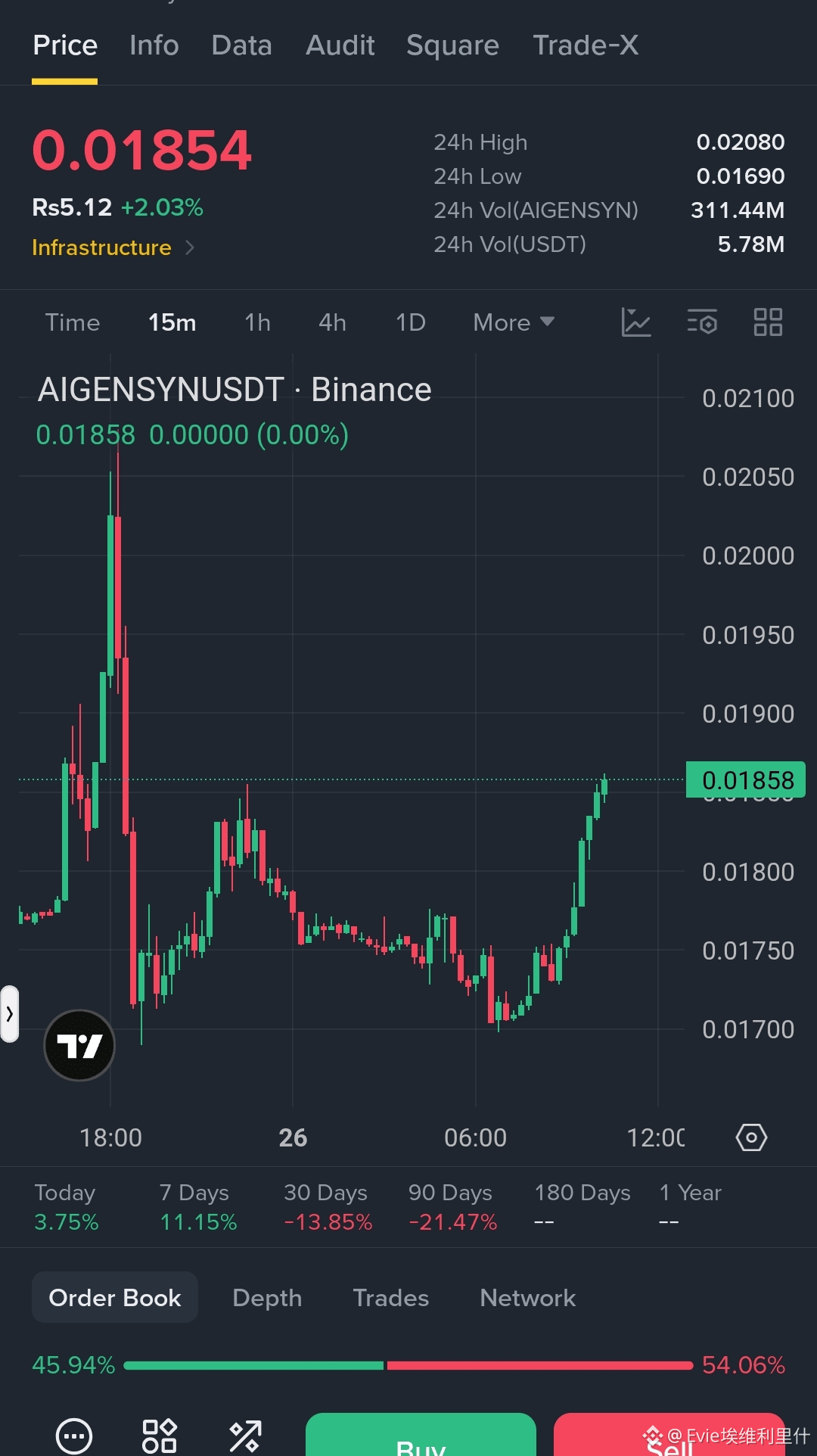
$AIGENSYN BULLISH RECOVERY WATCH!
AIGENSYN BOUNCES FROM $0.01690 — CAN BULLS RECLAIM $0.02080?
💰 Price: $0.01854 (+2.03%)
🎯 Targets: $0.01900 → $0.02000 → $0.02080
🛡️ Support: $0.01800 → $0.01750 → $0.01690
🔥 Recovery is building, but sellers lead at 54.06%. Bulls need stronger buying pressure to confirm continuation.
BREAKOUT OR BULL TRAP? WATCH $0.02080 CLOSELY! 👀
#AIGENSYN
{spot}(AIGENSYNUSDT)
$CAP
{future}(CAPUSDT)
$IRYS
{future}(IRYSUSDT)
$AIGENSYN BULLISH RECOVERY WATCH!
AIGENSYN BOUNCES FROM $0.01690 — CAN BULLS RECLAIM $0.02080?
💰 Price: $0.01854 (+2.03%)
🎯 Targets: $0.01900 → $0.02000 → $0.02080
🛡️ Support: $0.01800 → $0.01750 → $0.01690
🔥 Recovery is building, but sellers lead at 54.06%. Bulls need stronger buying pressure to confirm continuation.
BREAKOUT OR BULL TRAP? WATCH $0.02080 CLOSELY! 👀
#AIGENSYN
$CAP
$IRYS
AIGENSYN BOUNCES FROM $0.01690 — CAN BULLS RECLAIM $0.02080?
💰 Price: $0.01854 (+2.03%)
🎯 Targets: $0.01900 → $0.02000 → $0.02080
🛡️ Support: $0.01800 → $0.01750 → $0.01690
🔥 Recovery is building, but sellers lead at 54.06%. Bulls need stronger buying pressure to confirm continuation.
BREAKOUT OR BULL TRAP? WATCH $0.02080 CLOSELY! 👀
#AIGENSYN
$CAP
$IRYS
58
·
--
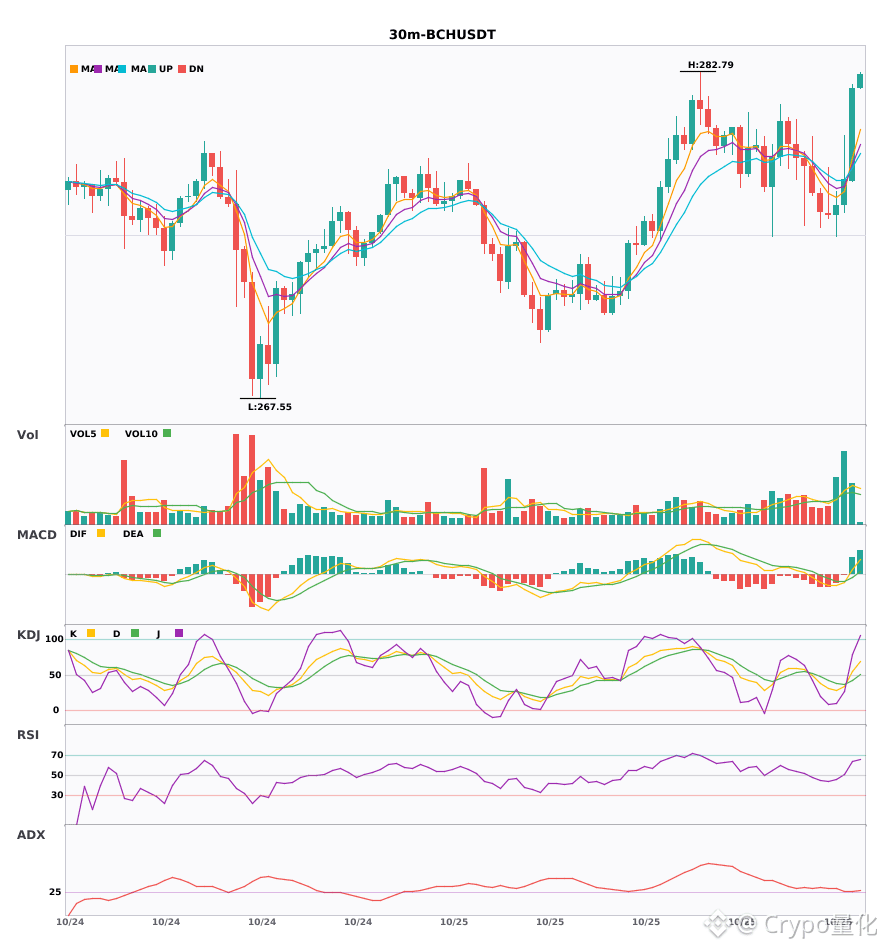
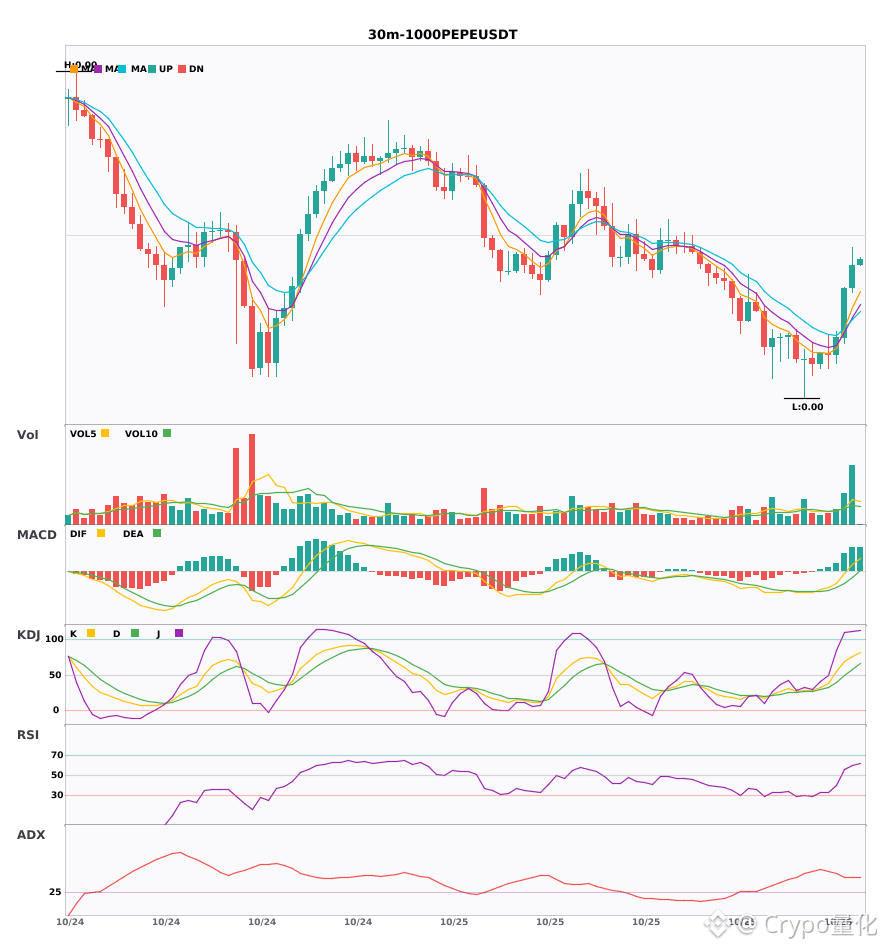
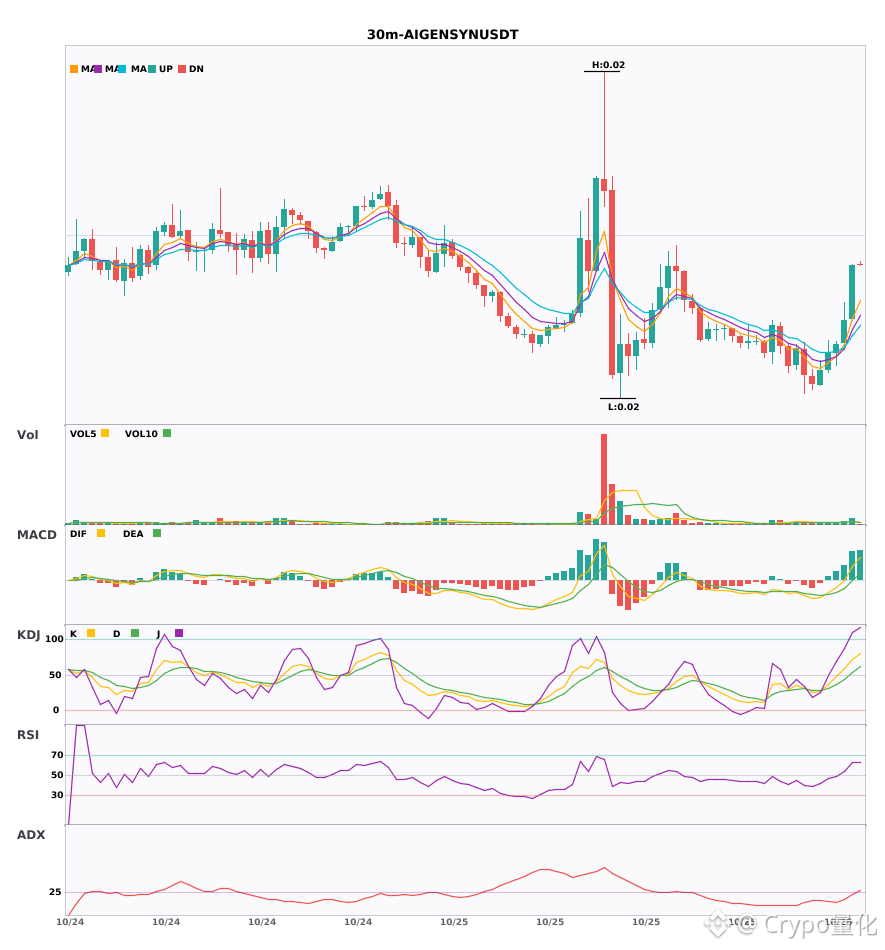
$BCH / $1000PEPE / $AIGENSYN 30-minute bullish setup, a short-term confluence opportunity 🔥
════════════════════
🔴 $BCH 30-minute bullish signal
⚠️ Technical analysis: ADX(28): trend is forming; opportunity to participate | MACD bullish crossover above zero, bullish momentum emerging | EMA5 crosses above EMA8, short-term trend turns bullish | KDJ bullish crossover, short-term outlook is bullish (K: 54.6, D: 42.3) | Volume increased (2.3x)
════════════════════
🔴 $1000PEPE 30-minute bullish signal
⚠️ Technical analysis: ADX(44): clear trending market | MACD DIF breaks above zero, trend turns bullish | EMA5 > EMA8 > EMA13, bullish alignment | KDJ running strong, bulls in control (K: 75.5, D: 58.1) | Volume surge (3.0x)
════════════════════
🔴 $AIGENSYN 30-minute bullish signal
⚠️ Technical analysis: ADX(27): trend is forming; opportunity to participate | MACD is bullish, trend is strong, momentum increasing | EMA5 > EMA8 > EMA13, bullish alignment | KDJ running strong, bulls in control (K: 72.0, D: 53.3) | Volume increased (2.1x)
════════════════════
🔔 Follow for first-hand market movement alerts 🔔
#技术分析 #BCH #1000PEPE #AIGENSYN
📌 When trading, pay attention to whether the candlestick pattern aligns
$BCH / $1000PEPE / $AIGENSYN 30-minute bullish setup, a short-term confluence opportunity 🔥
════════════════════
🔴 $BCH 30-minute bullish signal
⚠️ Technical analysis: ADX(28): trend is forming; opportunity to participate | MACD bullish crossover above zero, bullish momentum emerging | EMA5 crosses above EMA8, short-term trend turns bullish | KDJ bullish crossover, short-term outlook is bullish (K: 54.6, D: 42.3) | Volume increased (2.3x)
════════════════════
🔴 $1000PEPE 30-minute bullish signal
⚠️ Technical analysis: ADX(44): clear trending market | MACD DIF breaks above zero, trend turns bullish | EMA5 > EMA8 > EMA13, bullish alignment | KDJ running strong, bulls in control (K: 75.5, D: 58.1) | Volume surge (3.0x)
════════════════════
🔴 $AIGENSYN 30-minute bullish signal
⚠️ Technical analysis: ADX(27): trend is forming; opportunity to participate | MACD is bullish, trend is strong, momentum increasing | EMA5 > EMA8 > EMA13, bullish alignment | KDJ running strong, bulls in control (K: 72.0, D: 53.3) | Volume increased (2.1x)
════════════════════
🔔 Follow for first-hand market movement alerts 🔔
#技术分析 #BCH #1000PEPE #AIGENSYN
📌 When trading, pay attention to whether the candlestick pattern aligns
════════════════════
🔴 $BCH 30-minute bullish signal
⚠️ Technical analysis: ADX(28): trend is forming; opportunity to participate | MACD bullish crossover above zero, bullish momentum emerging | EMA5 crosses above EMA8, short-term trend turns bullish | KDJ bullish crossover, short-term outlook is bullish (K: 54.6, D: 42.3) | Volume increased (2.3x)
════════════════════
🔴 $1000PEPE 30-minute bullish signal
⚠️ Technical analysis: ADX(44): clear trending market | MACD DIF breaks above zero, trend turns bullish | EMA5 > EMA8 > EMA13, bullish alignment | KDJ running strong, bulls in control (K: 75.5, D: 58.1) | Volume surge (3.0x)
════════════════════
🔴 $AIGENSYN 30-minute bullish signal
⚠️ Technical analysis: ADX(27): trend is forming; opportunity to participate | MACD is bullish, trend is strong, momentum increasing | EMA5 > EMA8 > EMA13, bullish alignment | KDJ running strong, bulls in control (K: 72.0, D: 53.3) | Volume increased (2.1x)
════════════════════
🔔 Follow for first-hand market movement alerts 🔔
#技术分析 #BCH #1000PEPE #AIGENSYN
📌 When trading, pay attention to whether the candlestick pattern aligns
14

·
--
⚠️ Short Setup: $AIGENSYN (FUTURES) Distribution Pattern
Rating: 76/100 [A] • Strategy: MACDTrend
📊 Trade Thesis:
Price action on $AIGENSYN is showing consistent lower highs and lower lows on the 1-hour chart, with multiple rejections at overhead resistance.
🎯 Entry: 0.01739
🛑 Stop-Loss: 0.01835 (-5.52%)
✅ Take-Profit: 0.01579 (+9.20%)
⚖️ Risk/Reward: 1:1.7
🚫 Invalidation Rule: If a 1-hour candle closes above $0.01835 (+5.52%), this bearish thesis is invalidated. Cut position immediately.
💡 Trade Management: Secure 50% profit at Take-Profit target ($0.01579 +9.20%) and move Stop-Loss to Breakeven to eliminate downside risk.
⚖️ Risk Note: Moderate leverage recommended (3x–5x on Futures). Never risk more than 1–2% of total portfolio capital on a single setup.
📈 Binance Market Data:
• Funding: -0.1630% (Bearish crowded (Shorts pay)) • Next: 2h 01m
• Open Interest (OI): $1.71M
• 24h Volume: $11.66M
• 24h Range: 0.01738 — 0.02032 (-6.0%)
📈 Strategy Track Record: WR 47% over 279 trades
#AIGENSYN #PriceAction #TechnicalAnalysis #BinanceSquare
⚠️ Not financial advice. Always manage your risk.
⚠️ Short Setup: $AIGENSYN (FUTURES) Distribution Pattern
Rating: 76/100 [A] • Strategy: MACDTrend
📊 Trade Thesis:
Price action on $AIGENSYN is showing consistent lower highs and lower lows on the 1-hour chart, with multiple rejections at overhead resistance.
🎯 Entry: 0.01739
🛑 Stop-Loss: 0.01835 (-5.52%)
✅ Take-Profit: 0.01579 (+9.20%)
⚖️ Risk/Reward: 1:1.7
🚫 Invalidation Rule: If a 1-hour candle closes above $0.01835 (+5.52%), this bearish thesis is invalidated. Cut position immediately.
💡 Trade Management: Secure 50% profit at Take-Profit target ($0.01579 +9.20%) and move Stop-Loss to Breakeven to eliminate downside risk.
⚖️ Risk Note: Moderate leverage recommended (3x–5x on Futures). Never risk more than 1–2% of total portfolio capital on a single setup.
📈 Binance Market Data:
• Funding: -0.1630% (Bearish crowded (Shorts pay)) • Next: 2h 01m
• Open Interest (OI): $1.71M
• 24h Volume: $11.66M
• 24h Range: 0.01738 — 0.02032 (-6.0%)
📈 Strategy Track Record: WR 47% over 279 trades
#AIGENSYN #PriceAction #TechnicalAnalysis #BinanceSquare
⚠️ Not financial advice. Always manage your risk.
Rating: 76/100 [A] • Strategy: MACDTrend
📊 Trade Thesis:
Price action on $AIGENSYN is showing consistent lower highs and lower lows on the 1-hour chart, with multiple rejections at overhead resistance.
🎯 Entry: 0.01739
🛑 Stop-Loss: 0.01835 (-5.52%)
✅ Take-Profit: 0.01579 (+9.20%)
⚖️ Risk/Reward: 1:1.7
🚫 Invalidation Rule: If a 1-hour candle closes above $0.01835 (+5.52%), this bearish thesis is invalidated. Cut position immediately.
💡 Trade Management: Secure 50% profit at Take-Profit target ($0.01579 +9.20%) and move Stop-Loss to Breakeven to eliminate downside risk.
⚖️ Risk Note: Moderate leverage recommended (3x–5x on Futures). Never risk more than 1–2% of total portfolio capital on a single setup.
📈 Binance Market Data:
• Funding: -0.1630% (Bearish crowded (Shorts pay)) • Next: 2h 01m
• Open Interest (OI): $1.71M
• 24h Volume: $11.66M
• 24h Range: 0.01738 — 0.02032 (-6.0%)
📈 Strategy Track Record: WR 47% over 279 trades
#AIGENSYN #PriceAction #TechnicalAnalysis #BinanceSquare
⚠️ Not financial advice. Always manage your risk.
29

·
--
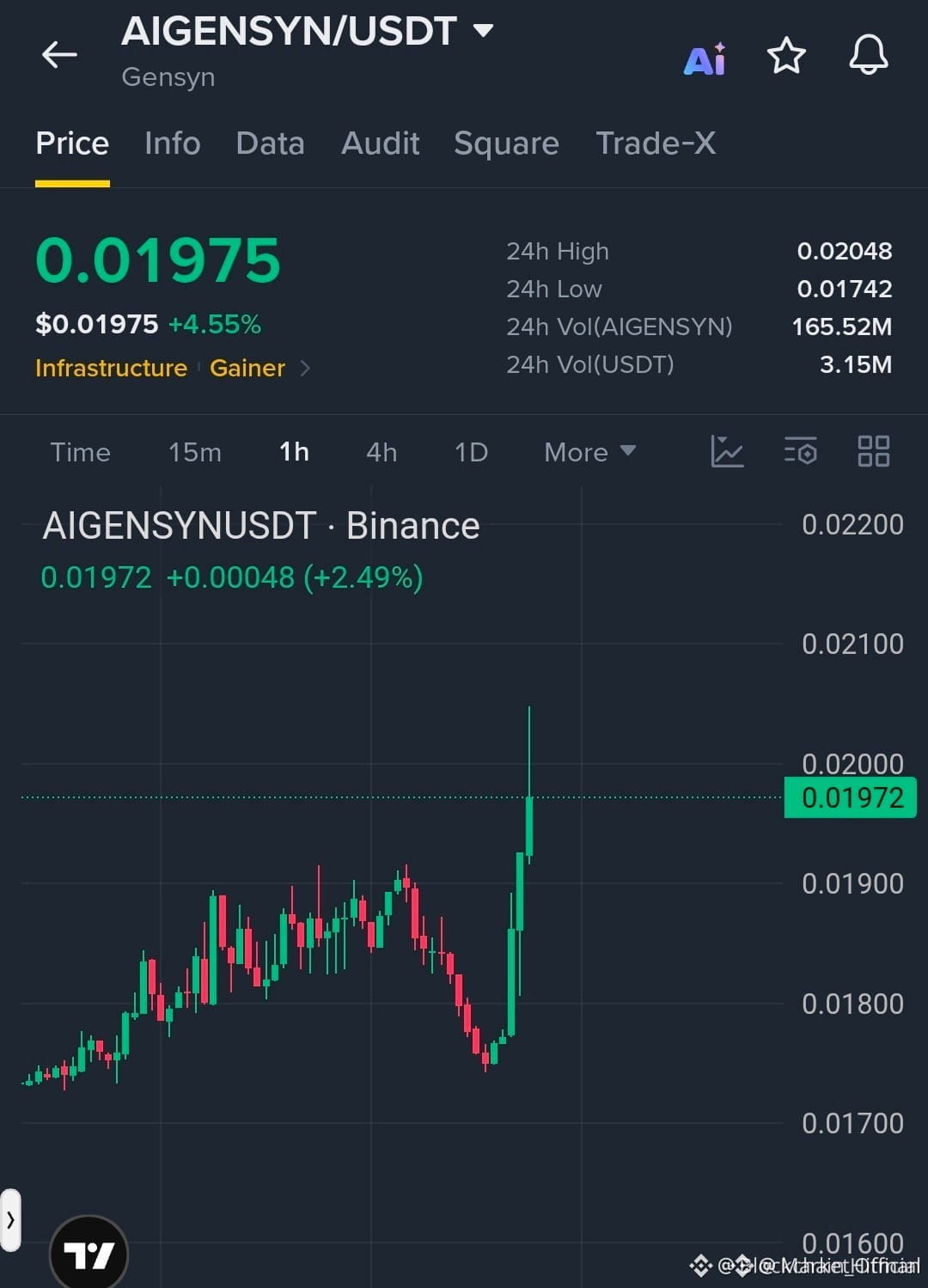
🚀 $AIGENSYN SKYROCKETING TO $0.02100! 🟢
Target: $0.02100 🚀
The order flow has flipped clean, with a wave of buying pressure carving a fresh higher low. 📊 Volume on the 1‑hour chart is spiking, confirming that smart money is loading positions ahead of the next resistance. 🦈
The next key ceiling sits at $0.02100, a tight cluster of previous sell orders that could melt away if the bulls keep the tempo. A break above would unlock a short‑term rally toward the $0.0225 zone. ⚡
💬 Who’s ready to ride this upward surge, and where are you setting your exit? 👇
⚠️ Not financial advice. Always manage your risk. 🛡️
🏷️ #AIGENSYN #Bullish #Momentum #Crypto
🚀 💎
🚀 $AIGENSYN SKYROCKETING TO $0.02100! 🟢
Target: $0.02100 🚀
The order flow has flipped clean, with a wave of buying pressure carving a fresh higher low. 📊 Volume on the 1‑hour chart is spiking, confirming that smart money is loading positions ahead of the next resistance. 🦈
The next key ceiling sits at $0.02100, a tight cluster of previous sell orders that could melt away if the bulls keep the tempo. A break above would unlock a short‑term rally toward the $0.0225 zone. ⚡
💬 Who’s ready to ride this upward surge, and where are you setting your exit? 👇
⚠️ Not financial advice. Always manage your risk. 🛡️
🏷️ #AIGENSYN #Bullish #Momentum #Crypto
🚀 💎
Target: $0.02100 🚀
The order flow has flipped clean, with a wave of buying pressure carving a fresh higher low. 📊 Volume on the 1‑hour chart is spiking, confirming that smart money is loading positions ahead of the next resistance. 🦈
The next key ceiling sits at $0.02100, a tight cluster of previous sell orders that could melt away if the bulls keep the tempo. A break above would unlock a short‑term rally toward the $0.0225 zone. ⚡
💬 Who’s ready to ride this upward surge, and where are you setting your exit? 👇
⚠️ Not financial advice. Always manage your risk. 🛡️
🏷️ #AIGENSYN #Bullish #Momentum #Crypto
🚀 💎
7

·
--
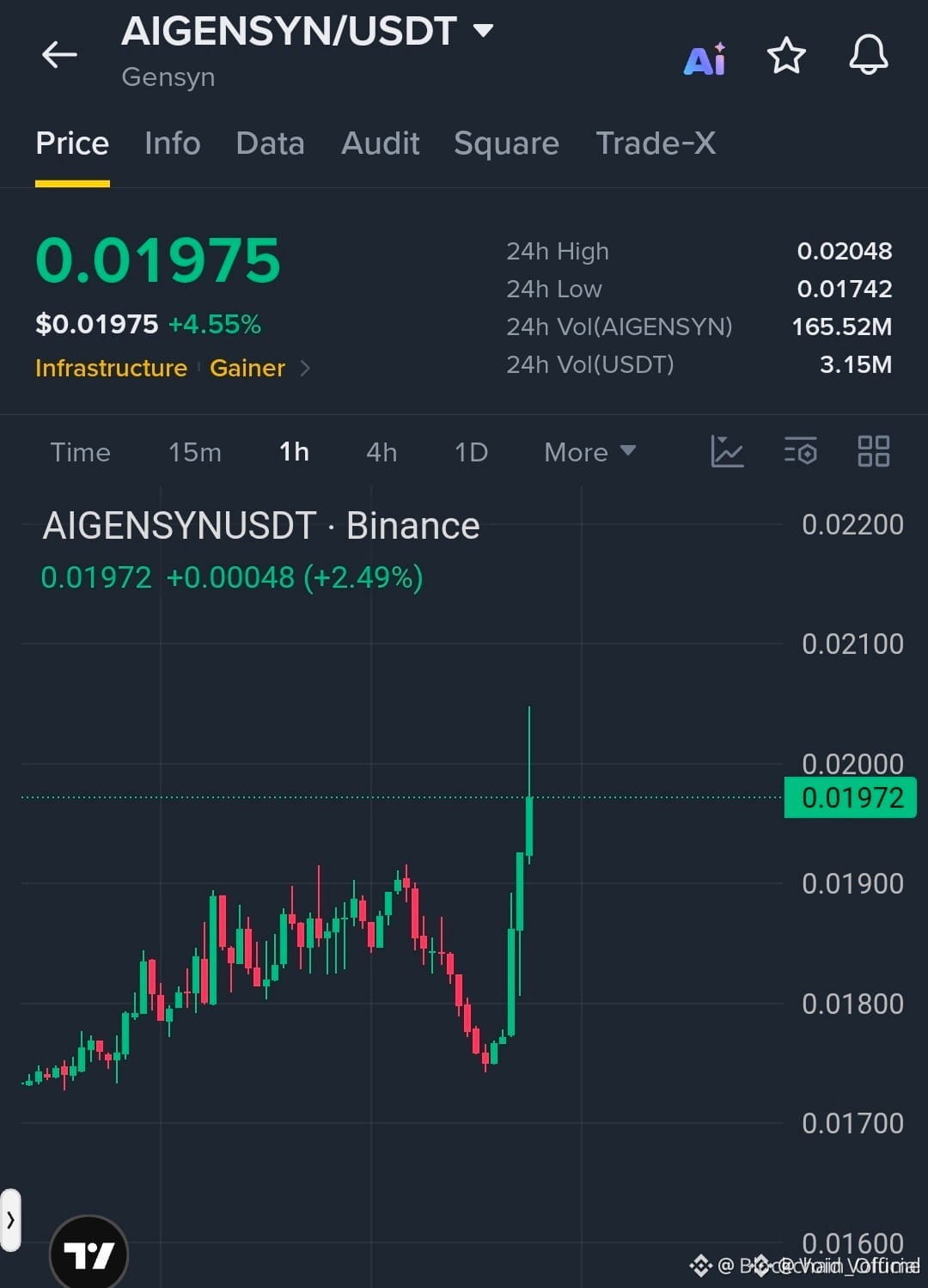
🚀 🟢 $AIGENSYN RACES TOWARD $0.02100 – BULLS IN CONTROL!
Target: 0.02100 🚀
Liquidity hunters have carved a fresh order block around the 0.0195 zone, and the price now respects the bullish bias with each retest. 📊 Volume on the 1H chart surged 45% over the last three candles, confirming smart‑money accumulation. ⚡ The next resistance aligns precisely with the $0.02100 target, a classic fair‑value gap that institutional buyers are eager to fill.
Should the upward thrust hold, the next upside leg could chase the 0.0235 ceiling, but a break below 0.0190 would trigger a rapid liquidity sweep. 💡 Position size prudently and keep the stop just under the recent swing low. 💬 Are you ready to ride the next liquidity wave or waiting for a pullback confirmation? 👇
⚠️ Not financial advice. Always manage your risk. 🛡️
🏷️ #AIGENSYN #LongSetup #BullishMomentum #Crypto
🔥 💎
🚀 🟢 $AIGENSYN RACES TOWARD $0.02100 – BULLS IN CONTROL!
Target: 0.02100 🚀
Liquidity hunters have carved a fresh order block around the 0.0195 zone, and the price now respects the bullish bias with each retest. 📊 Volume on the 1H chart surged 45% over the last three candles, confirming smart‑money accumulation. ⚡ The next resistance aligns precisely with the $0.02100 target, a classic fair‑value gap that institutional buyers are eager to fill.
Should the upward thrust hold, the next upside leg could chase the 0.0235 ceiling, but a break below 0.0190 would trigger a rapid liquidity sweep. 💡 Position size prudently and keep the stop just under the recent swing low. 💬 Are you ready to ride the next liquidity wave or waiting for a pullback confirmation? 👇
⚠️ Not financial advice. Always manage your risk. 🛡️
🏷️ #AIGENSYN #LongSetup #BullishMomentum #Crypto
🔥 💎
Target: 0.02100 🚀
Liquidity hunters have carved a fresh order block around the 0.0195 zone, and the price now respects the bullish bias with each retest. 📊 Volume on the 1H chart surged 45% over the last three candles, confirming smart‑money accumulation. ⚡ The next resistance aligns precisely with the $0.02100 target, a classic fair‑value gap that institutional buyers are eager to fill.
Should the upward thrust hold, the next upside leg could chase the 0.0235 ceiling, but a break below 0.0190 would trigger a rapid liquidity sweep. 💡 Position size prudently and keep the stop just under the recent swing low. 💬 Are you ready to ride the next liquidity wave or waiting for a pullback confirmation? 👇
⚠️ Not financial advice. Always manage your risk. 🛡️
🏷️ #AIGENSYN #LongSetup #BullishMomentum #Crypto
🔥 💎
11

·
--
Bullish
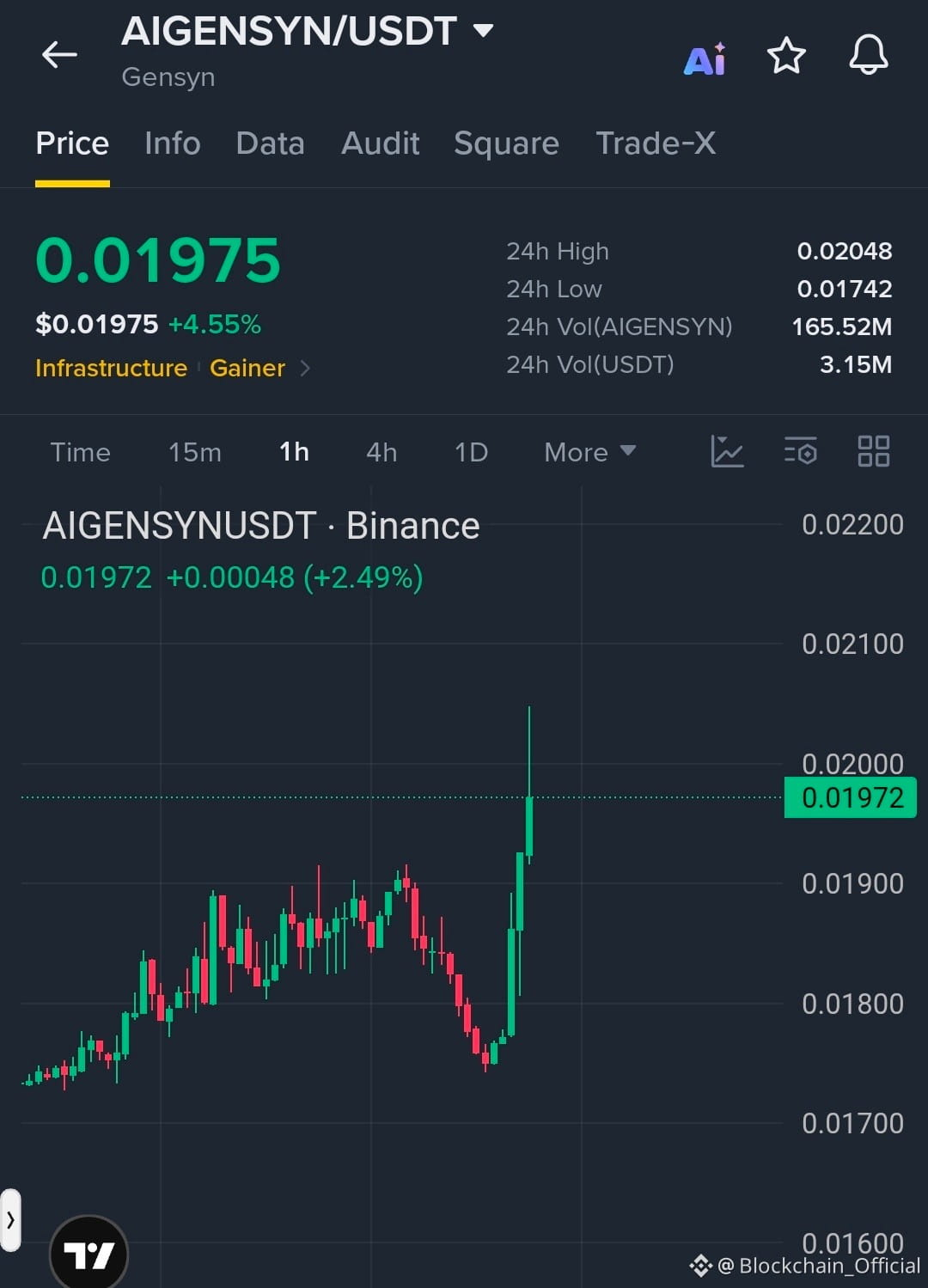
$AIGENSYN Showing Strong Bullish Momentum!
#AIGENSYN is gaining strength with a sharp upward move. Bulls are stepping in, and the next key target is $0.02100.
If momentum continues, we could see another push higher. Watch the price action and manage risk carefully.
{future}(AIGENSYNUSDT)
$AIGENSYN Showing Strong Bullish Momentum!
#AIGENSYN is gaining strength with a sharp upward move. Bulls are stepping in, and the next key target is $0.02100.
If momentum continues, we could see another push higher. Watch the price action and manage risk carefully.
#AIGENSYN is gaining strength with a sharp upward move. Bulls are stepping in, and the next key target is $0.02100.
If momentum continues, we could see another push higher. Watch the price action and manage risk carefully.
1
84
Log in to explore more content
Join global crypto users on Binance Square
⚡️ Get latest and useful information about crypto.
💬 Trusted by the world’s largest crypto exchange.
👍 Discover real insights from verified creators.
Email / Phone number
Trending Topics
1
#BinanceReopensWithdrawalsForMoreAssets
0 views
0 Discussing
2
#AppleReportsMixedResults
530 views
70 Discussing
3
#BinanceWithdrawalScamWarning
68,531 views
871 Discussing
4
#USMidtermElections
647,197 views
3,424 Discussing
5
#USOctoberNFP-AreRateCutsStillPossible
71,858 views
669 Discussing
6
#Verify1to1BinanceReserves
62,156 views
503 Discussing
7
#BinanceRestores28FiatWithdrawals
196,046 views
1,164 Discussing
8
#NasdaqFalls1.07%AsChipStocksPlunge
72 views
16 Discussing
9
#StrategyRepurchases$208MSTRCAdds811Bitcoin
9,021 views
21 Discussing
10
#FATFLaunchesReviewOfCryptoHubsMoneyLaunderingControls
1,173 views
26 Discussing