

#a2zusdt
a2zusdt
208,336 views
559 Discussing
Hot
Latest

·
--
A2ZUSDT has surged to the top of Binance's spot movers list, but the main narrative might still revolve around Trump and the White House's influence on crypto assets. The market will initially trade based on policy expectations and sentiment.
My first reaction is that A2ZUSDT, being high on the movers list, is definitely worth keeping an eye on, but it shouldn't be overly glorified. Its presence on the list indicates that attention is focusing here, but we really need to dissect where this attention is coming from and whether it can be sustained.
The news backdrop points to Trump and the White House's connection to crypto assets, suggesting that the market will trade based on policy expectations and sentiment. Such news tends to stir emotions quickly, but whether it can hold ground in the end will depend on the company's fundamentals, real capital movements, and policy advancements.
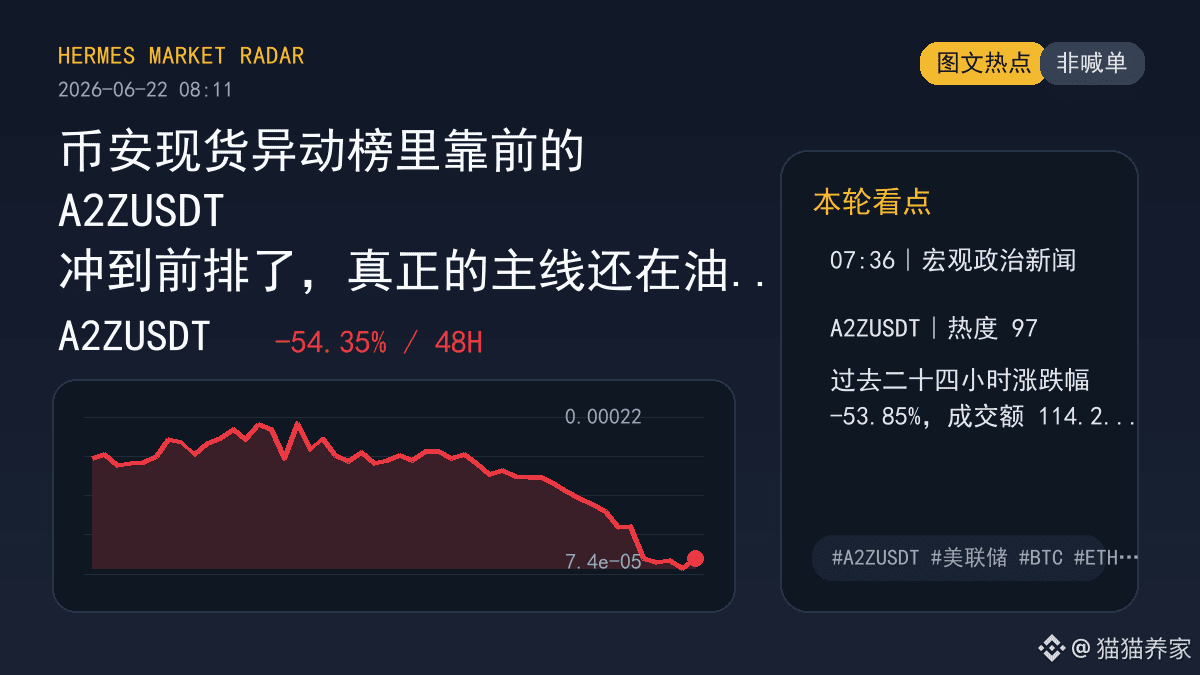
The hot list data shows: a 24-hour price change of -53.85% and a trading volume of 1.142 million stablecoins. My take is that if it's just a search trend, it must be validated by ongoing trading and discussion; if trading volume picks up as well, it could transition from just hype to a main trend.
When examining A2ZUSDT, US politics, and BTC, the focus isn’t on buzzwords, but rather if it can generate real trades and sustained discussions. I'm looking to see if it can maintain its momentum over two consecutive rounds, rather than just focusing on its current ranking.
One more small signal: BONK is also trending high on the overseas search list. It may not change the main narrative, but it indicates that the attention isn’t solely concentrated on one point.
#A2ZUSDT #美国政治 #BTC #ETH #BNB
A2ZUSDT has surged to the top of Binance's spot movers list, but the main narrative might still revolve around Trump and the White House's influence on crypto assets. The market will initially trade based on policy expectations and sentiment.
My first reaction is that A2ZUSDT, being high on the movers list, is definitely worth keeping an eye on, but it shouldn't be overly glorified. Its presence on the list indicates that attention is focusing here, but we really need to dissect where this attention is coming from and whether it can be sustained.
The news backdrop points to Trump and the White House's connection to crypto assets, suggesting that the market will trade based on policy expectations and sentiment. Such news tends to stir emotions quickly, but whether it can hold ground in the end will depend on the company's fundamentals, real capital movements, and policy advancements.
The hot list data shows: a 24-hour price change of -53.85% and a trading volume of 1.142 million stablecoins. My take is that if it's just a search trend, it must be validated by ongoing trading and discussion; if trading volume picks up as well, it could transition from just hype to a main trend.
When examining A2ZUSDT, US politics, and BTC, the focus isn’t on buzzwords, but rather if it can generate real trades and sustained discussions. I'm looking to see if it can maintain its momentum over two consecutive rounds, rather than just focusing on its current ranking.
One more small signal: BONK is also trending high on the overseas search list. It may not change the main narrative, but it indicates that the attention isn’t solely concentrated on one point.
#A2ZUSDT #美国政治 #BTC #ETH #BNB
My first reaction is that A2ZUSDT, being high on the movers list, is definitely worth keeping an eye on, but it shouldn't be overly glorified. Its presence on the list indicates that attention is focusing here, but we really need to dissect where this attention is coming from and whether it can be sustained.
The news backdrop points to Trump and the White House's connection to crypto assets, suggesting that the market will trade based on policy expectations and sentiment. Such news tends to stir emotions quickly, but whether it can hold ground in the end will depend on the company's fundamentals, real capital movements, and policy advancements.
The hot list data shows: a 24-hour price change of -53.85% and a trading volume of 1.142 million stablecoins. My take is that if it's just a search trend, it must be validated by ongoing trading and discussion; if trading volume picks up as well, it could transition from just hype to a main trend.
When examining A2ZUSDT, US politics, and BTC, the focus isn’t on buzzwords, but rather if it can generate real trades and sustained discussions. I'm looking to see if it can maintain its momentum over two consecutive rounds, rather than just focusing on its current ranking.
One more small signal: BONK is also trending high on the overseas search list. It may not change the main narrative, but it indicates that the attention isn’t solely concentrated on one point.
#A2ZUSDT #美国政治 #BTC #ETH #BNB
74
·
--
A2ZUSDT is making waves on Binance's spot movers list, but the real focus is still on oil prices and geopolitical risks.
A2ZUSDT's position on the Binance spot movers list is worth noting, but I won’t hype it up too much. Its ranking indicates that attention is concentrating, but the real question is where this attention is coming from and if it can be sustained.
The news context points to oil prices and geopolitical risks. Geopolitical uncertainty might lead to funds reducing leverage before choosing between safe havens or risk assets. In the short term, don't just look at the news; watch how the dollar, oil prices, and Bitcoin react in sync.
The hot list data shows: a 24-hour price change of -53.85% and a trading volume of 1.142 million stablecoins. If it’s just trending hot, we need to confirm it with ongoing trades and discussions; only if the trading volume follows can we shift from hype to a main narrative.
I would break down this situation as follows: oil prices and geopolitical risks explain why funds might hesitate; A2ZUSDT on the Binance spot movers list shows where attention is being drawn; ultimately, only trading volume can determine if it’s a main narrative.
When looking at topics like A2ZUSDT, the Federal Reserve, and BTC, the key isn't just buzzwords but whether it can generate real trades and continuous discussions. Moving forward, I’m focused on whether it can maintain its heat over two rounds, rather than just this moment's ranking.
If BTC continues to rank high on the overseas search trends, I’ll only see it as evidence of attention diffusion. It doesn’t change the main narrative; it merely helps assess whether the hype is expanding from a single point into a broader trend.
#A2ZUSDT #美联储 #BTC #ETH #BNB
A2ZUSDT is making waves on Binance's spot movers list, but the real focus is still on oil prices and geopolitical risks.
A2ZUSDT's position on the Binance spot movers list is worth noting, but I won’t hype it up too much. Its ranking indicates that attention is concentrating, but the real question is where this attention is coming from and if it can be sustained.
The news context points to oil prices and geopolitical risks. Geopolitical uncertainty might lead to funds reducing leverage before choosing between safe havens or risk assets. In the short term, don't just look at the news; watch how the dollar, oil prices, and Bitcoin react in sync.
The hot list data shows: a 24-hour price change of -53.85% and a trading volume of 1.142 million stablecoins. If it’s just trending hot, we need to confirm it with ongoing trades and discussions; only if the trading volume follows can we shift from hype to a main narrative.
I would break down this situation as follows: oil prices and geopolitical risks explain why funds might hesitate; A2ZUSDT on the Binance spot movers list shows where attention is being drawn; ultimately, only trading volume can determine if it’s a main narrative.
When looking at topics like A2ZUSDT, the Federal Reserve, and BTC, the key isn't just buzzwords but whether it can generate real trades and continuous discussions. Moving forward, I’m focused on whether it can maintain its heat over two rounds, rather than just this moment's ranking.
If BTC continues to rank high on the overseas search trends, I’ll only see it as evidence of attention diffusion. It doesn’t change the main narrative; it merely helps assess whether the hype is expanding from a single point into a broader trend.
#A2ZUSDT #美联储 #BTC #ETH #BNB
A2ZUSDT's position on the Binance spot movers list is worth noting, but I won’t hype it up too much. Its ranking indicates that attention is concentrating, but the real question is where this attention is coming from and if it can be sustained.
The news context points to oil prices and geopolitical risks. Geopolitical uncertainty might lead to funds reducing leverage before choosing between safe havens or risk assets. In the short term, don't just look at the news; watch how the dollar, oil prices, and Bitcoin react in sync.
The hot list data shows: a 24-hour price change of -53.85% and a trading volume of 1.142 million stablecoins. If it’s just trending hot, we need to confirm it with ongoing trades and discussions; only if the trading volume follows can we shift from hype to a main narrative.
I would break down this situation as follows: oil prices and geopolitical risks explain why funds might hesitate; A2ZUSDT on the Binance spot movers list shows where attention is being drawn; ultimately, only trading volume can determine if it’s a main narrative.
When looking at topics like A2ZUSDT, the Federal Reserve, and BTC, the key isn't just buzzwords but whether it can generate real trades and continuous discussions. Moving forward, I’m focused on whether it can maintain its heat over two rounds, rather than just this moment's ranking.
If BTC continues to rank high on the overseas search trends, I’ll only see it as evidence of attention diffusion. It doesn’t change the main narrative; it merely helps assess whether the hype is expanding from a single point into a broader trend.
#A2ZUSDT #美联储 #BTC #ETH #BNB
220
·
--
Trump’s line has been brought back into focus by the market again, unlocking liquidity channels. Trending charts are just the appetizer.
This market’s take on Trump’s line again shouldn’t be read based on the news headline alone. What I care about is whether it will change the path that funds enter or exit the crypto market.
One news item isn’t enough to make a judgment. First, look for a second source to confirm it; then see whether the price action is willing to “buy in.”
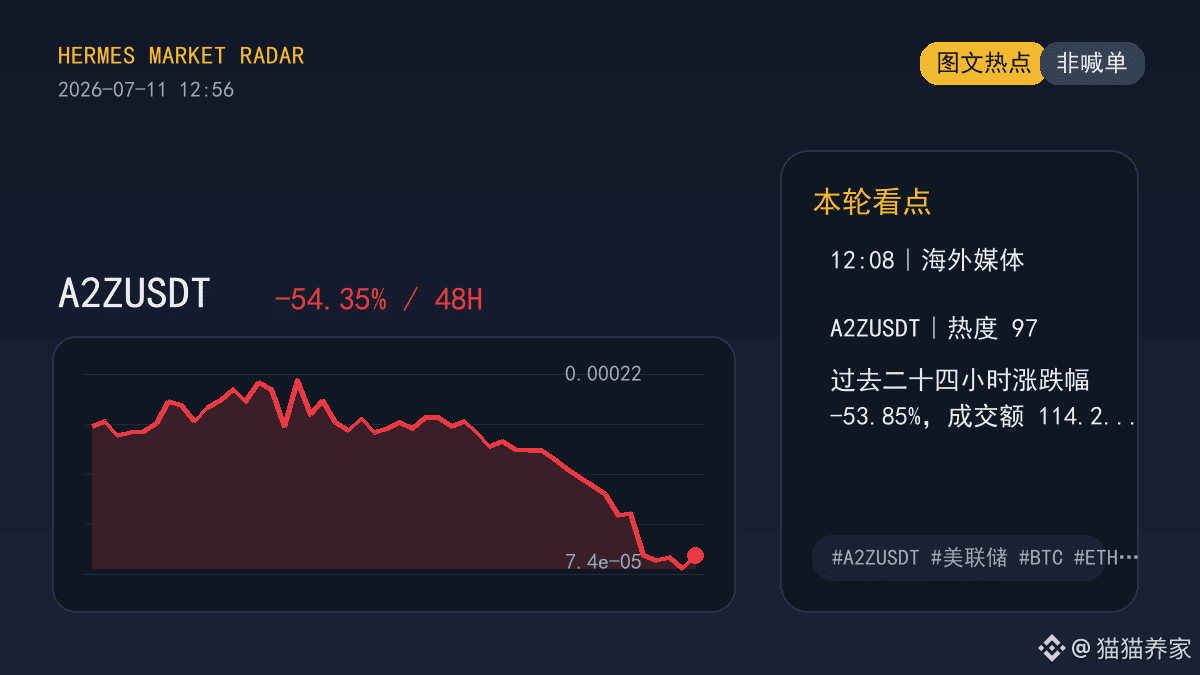
In Binance’s hot list spot movers chart, the top-ranked A2ZUSDT is another faster track. The main storyline explains why the funds moved; the hot-list track explains where attention is being squeezed. Their rhythms are completely different.
I would break down this linkage like this: Trump’s line being picked up by the market again explains why funds hesitate; A2ZUSDT in the Binance spot movers chart being near the top explains where attention is being pushed; and finally, only trading volume can determine whether it is the main storyline.
Looking at topics like A2ZUSDT, the Fed, and BTC, the key isn’t whether it borrows the right keywords—it’s whether it can produce real trades and sustained discussion. Next, I’ll look for clearer follow-up capital moves, instead of turning a single headline directly into a price conclusion.
So the validation order is simple: first, see whether mainstream coin trading is able to hold up; then check whether A2ZUSDT near the top of Binance’s spot movers list can stay in the front row continuously; finally, see whether subsequent news has a second source confirming it.
If ZANO also keeps staying near the top in overseas search hot lists, I’ll treat it only as evidence that attention is spreading. It doesn’t change the main storyline—it only helps judge whether the heat expands from a single point into a line.
#A2ZUSDT #美联储 #BTC #ETH #BNB
Trump’s line has been brought back into focus by the market again, unlocking liquidity channels. Trending charts are just the appetizer.
This market’s take on Trump’s line again shouldn’t be read based on the news headline alone. What I care about is whether it will change the path that funds enter or exit the crypto market.
One news item isn’t enough to make a judgment. First, look for a second source to confirm it; then see whether the price action is willing to “buy in.”
In Binance’s hot list spot movers chart, the top-ranked A2ZUSDT is another faster track. The main storyline explains why the funds moved; the hot-list track explains where attention is being squeezed. Their rhythms are completely different.
I would break down this linkage like this: Trump’s line being picked up by the market again explains why funds hesitate; A2ZUSDT in the Binance spot movers chart being near the top explains where attention is being pushed; and finally, only trading volume can determine whether it is the main storyline.
Looking at topics like A2ZUSDT, the Fed, and BTC, the key isn’t whether it borrows the right keywords—it’s whether it can produce real trades and sustained discussion. Next, I’ll look for clearer follow-up capital moves, instead of turning a single headline directly into a price conclusion.
So the validation order is simple: first, see whether mainstream coin trading is able to hold up; then check whether A2ZUSDT near the top of Binance’s spot movers list can stay in the front row continuously; finally, see whether subsequent news has a second source confirming it.
If ZANO also keeps staying near the top in overseas search hot lists, I’ll treat it only as evidence that attention is spreading. It doesn’t change the main storyline—it only helps judge whether the heat expands from a single point into a line.
#A2ZUSDT #美联储 #BTC #ETH #BNB
This market’s take on Trump’s line again shouldn’t be read based on the news headline alone. What I care about is whether it will change the path that funds enter or exit the crypto market.
One news item isn’t enough to make a judgment. First, look for a second source to confirm it; then see whether the price action is willing to “buy in.”
In Binance’s hot list spot movers chart, the top-ranked A2ZUSDT is another faster track. The main storyline explains why the funds moved; the hot-list track explains where attention is being squeezed. Their rhythms are completely different.
I would break down this linkage like this: Trump’s line being picked up by the market again explains why funds hesitate; A2ZUSDT in the Binance spot movers chart being near the top explains where attention is being pushed; and finally, only trading volume can determine whether it is the main storyline.
Looking at topics like A2ZUSDT, the Fed, and BTC, the key isn’t whether it borrows the right keywords—it’s whether it can produce real trades and sustained discussion. Next, I’ll look for clearer follow-up capital moves, instead of turning a single headline directly into a price conclusion.
So the validation order is simple: first, see whether mainstream coin trading is able to hold up; then check whether A2ZUSDT near the top of Binance’s spot movers list can stay in the front row continuously; finally, see whether subsequent news has a second source confirming it.
If ZANO also keeps staying near the top in overseas search hot lists, I’ll treat it only as evidence that attention is spreading. It doesn’t change the main storyline—it only helps judge whether the heat expands from a single point into a line.
#A2ZUSDT #美联储 #BTC #ETH #BNB
172
·
--
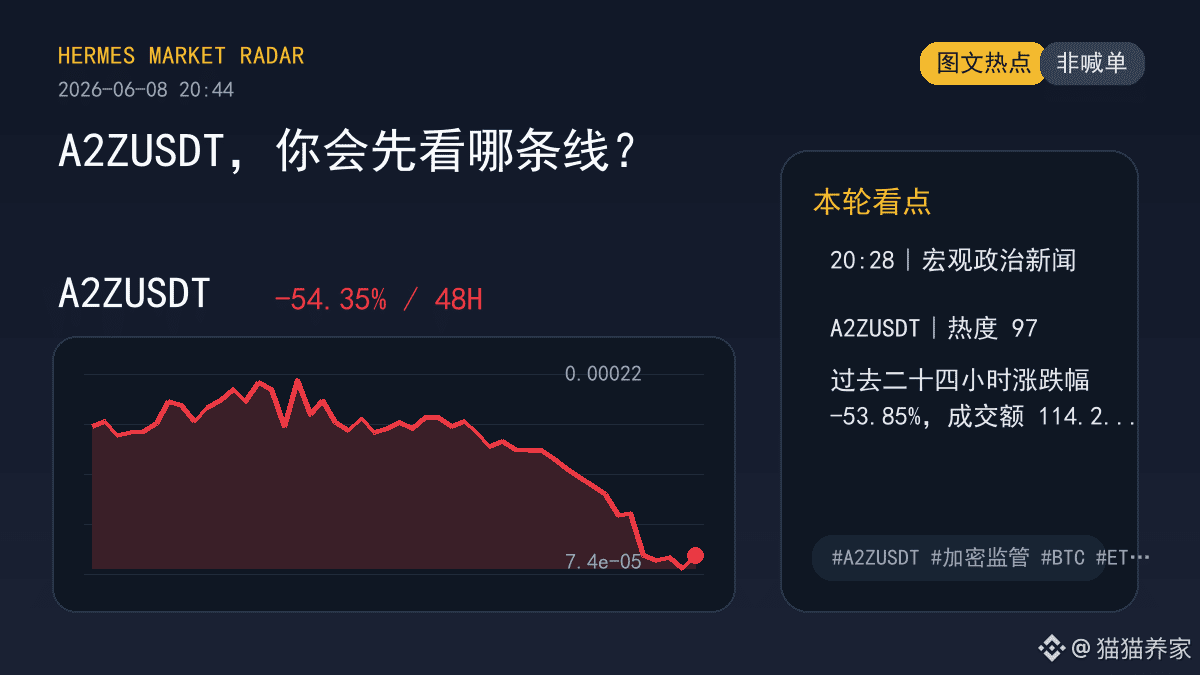
US Senate, news on the regulation and enforcement of the US crypto market structure bill... and in Binance's hot list, A2ZUSDT is making waves, which line are you looking at first?
My first reaction is that there's a clear divergence: the news side is talking about new developments in the US Senate, the regulation and enforcement of the US crypto market structure bill, and whether it will drive funds and sentiment to continue to ferment. Meanwhile, the hot list is pushing A2ZUSDT, one is slow while the other is fast.
What’s really worth watching isn’t whether we can pump it today, but rather it’s addressing a slower yet more critical issue: how compliant funds will come in, how they will stay on-chain, and how to move crypto yield services from the gray area into the open.
My judgment is that the slow line explains why funds are moving, while the fast line tells you where the attention is heading. Looking at A2ZUSDT, crypto regulation, and BTC, the focus isn't just on buzzwords but on whether it can lead to real trades and ongoing discussions.
If I had to pick one, I’d first check if mainstream coin volume has confirmed. Would you prioritize policy and macro or check where hot list funds have already surged?
#A2ZUSDT #加密监管 #BTC #ETH #BNB
US Senate, news on the regulation and enforcement of the US crypto market structure bill... and in Binance's hot list, A2ZUSDT is making waves, which line are you looking at first?
My first reaction is that there's a clear divergence: the news side is talking about new developments in the US Senate, the regulation and enforcement of the US crypto market structure bill, and whether it will drive funds and sentiment to continue to ferment. Meanwhile, the hot list is pushing A2ZUSDT, one is slow while the other is fast.
What’s really worth watching isn’t whether we can pump it today, but rather it’s addressing a slower yet more critical issue: how compliant funds will come in, how they will stay on-chain, and how to move crypto yield services from the gray area into the open.
My judgment is that the slow line explains why funds are moving, while the fast line tells you where the attention is heading. Looking at A2ZUSDT, crypto regulation, and BTC, the focus isn't just on buzzwords but on whether it can lead to real trades and ongoing discussions.
If I had to pick one, I’d first check if mainstream coin volume has confirmed. Would you prioritize policy and macro or check where hot list funds have already surged?
#A2ZUSDT #加密监管 #BTC #ETH #BNB
My first reaction is that there's a clear divergence: the news side is talking about new developments in the US Senate, the regulation and enforcement of the US crypto market structure bill, and whether it will drive funds and sentiment to continue to ferment. Meanwhile, the hot list is pushing A2ZUSDT, one is slow while the other is fast.
What’s really worth watching isn’t whether we can pump it today, but rather it’s addressing a slower yet more critical issue: how compliant funds will come in, how they will stay on-chain, and how to move crypto yield services from the gray area into the open.
My judgment is that the slow line explains why funds are moving, while the fast line tells you where the attention is heading. Looking at A2ZUSDT, crypto regulation, and BTC, the focus isn't just on buzzwords but on whether it can lead to real trades and ongoing discussions.
If I had to pick one, I’d first check if mainstream coin volume has confirmed. Would you prioritize policy and macro or check where hot list funds have already surged?
#A2ZUSDT #加密监管 #BTC #ETH #BNB
134
·
--
A2ZUSDT is making waves on Binance's spot movers list, but the real drivers might be oil prices and geopolitical risks.
My first thought is that A2ZUSDT, being high up on Binance's movers list, is worth keeping an eye on, but it shouldn't be blindly glorified. Its listing indicates that attention is shifting, but the real question is where this attention is coming from and whether it can be sustained.
The news backdrop highlights oil prices and geopolitical risks. Political news can initially sway emotions, but we can't just focus on who’s making statements. We need to look at the legislation, administrative actions, and whether the funding side is genuinely following through.
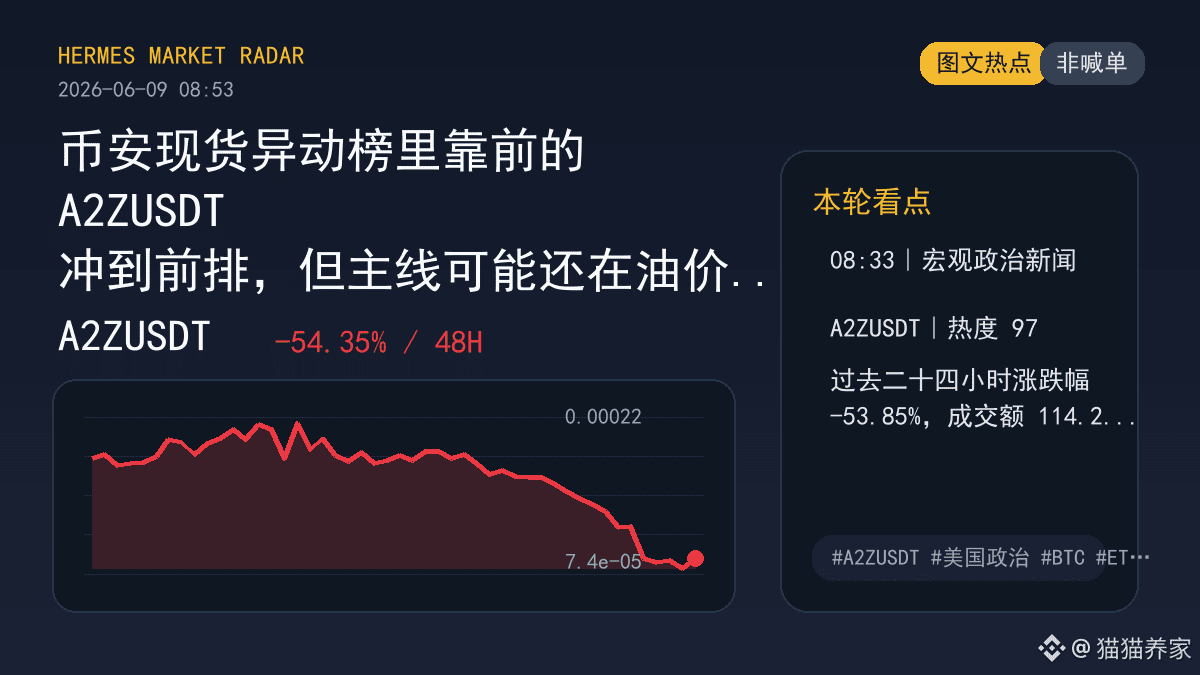
The hot list data shows: a 24-hour price change of -53.85%, with a trading volume of 1.142 million stablecoins. My take is that if it’s just a search trend, we need to confirm it with consistent trades and discussions; if trading picks up as well, it could shift from just a buzz to a mainstay.
When considering A2ZUSDT, U.S. politics, and BTC, the focus isn’t just on riding the hype but rather on whether it can generate real trades and ongoing discussions. I’ll be watching to see if it can maintain its momentum over two rounds, rather than just fixating on its current ranking.
Another small signal: HYPE is also trending high on the international search list. It may not change the main narrative, but it shows that attention isn’t solely concentrated in one area.
#A2ZUSDT #美国政治 #BTC #ETH #BNB
A2ZUSDT is making waves on Binance's spot movers list, but the real drivers might be oil prices and geopolitical risks.
My first thought is that A2ZUSDT, being high up on Binance's movers list, is worth keeping an eye on, but it shouldn't be blindly glorified. Its listing indicates that attention is shifting, but the real question is where this attention is coming from and whether it can be sustained.
The news backdrop highlights oil prices and geopolitical risks. Political news can initially sway emotions, but we can't just focus on who’s making statements. We need to look at the legislation, administrative actions, and whether the funding side is genuinely following through.
The hot list data shows: a 24-hour price change of -53.85%, with a trading volume of 1.142 million stablecoins. My take is that if it’s just a search trend, we need to confirm it with consistent trades and discussions; if trading picks up as well, it could shift from just a buzz to a mainstay.
When considering A2ZUSDT, U.S. politics, and BTC, the focus isn’t just on riding the hype but rather on whether it can generate real trades and ongoing discussions. I’ll be watching to see if it can maintain its momentum over two rounds, rather than just fixating on its current ranking.
Another small signal: HYPE is also trending high on the international search list. It may not change the main narrative, but it shows that attention isn’t solely concentrated in one area.
#A2ZUSDT #美国政治 #BTC #ETH #BNB
My first thought is that A2ZUSDT, being high up on Binance's movers list, is worth keeping an eye on, but it shouldn't be blindly glorified. Its listing indicates that attention is shifting, but the real question is where this attention is coming from and whether it can be sustained.
The news backdrop highlights oil prices and geopolitical risks. Political news can initially sway emotions, but we can't just focus on who’s making statements. We need to look at the legislation, administrative actions, and whether the funding side is genuinely following through.
The hot list data shows: a 24-hour price change of -53.85%, with a trading volume of 1.142 million stablecoins. My take is that if it’s just a search trend, we need to confirm it with consistent trades and discussions; if trading picks up as well, it could shift from just a buzz to a mainstay.
When considering A2ZUSDT, U.S. politics, and BTC, the focus isn’t just on riding the hype but rather on whether it can generate real trades and ongoing discussions. I’ll be watching to see if it can maintain its momentum over two rounds, rather than just fixating on its current ranking.
Another small signal: HYPE is also trending high on the international search list. It may not change the main narrative, but it shows that attention isn’t solely concentrated in one area.
#A2ZUSDT #美国政治 #BTC #ETH #BNB
155
·
--
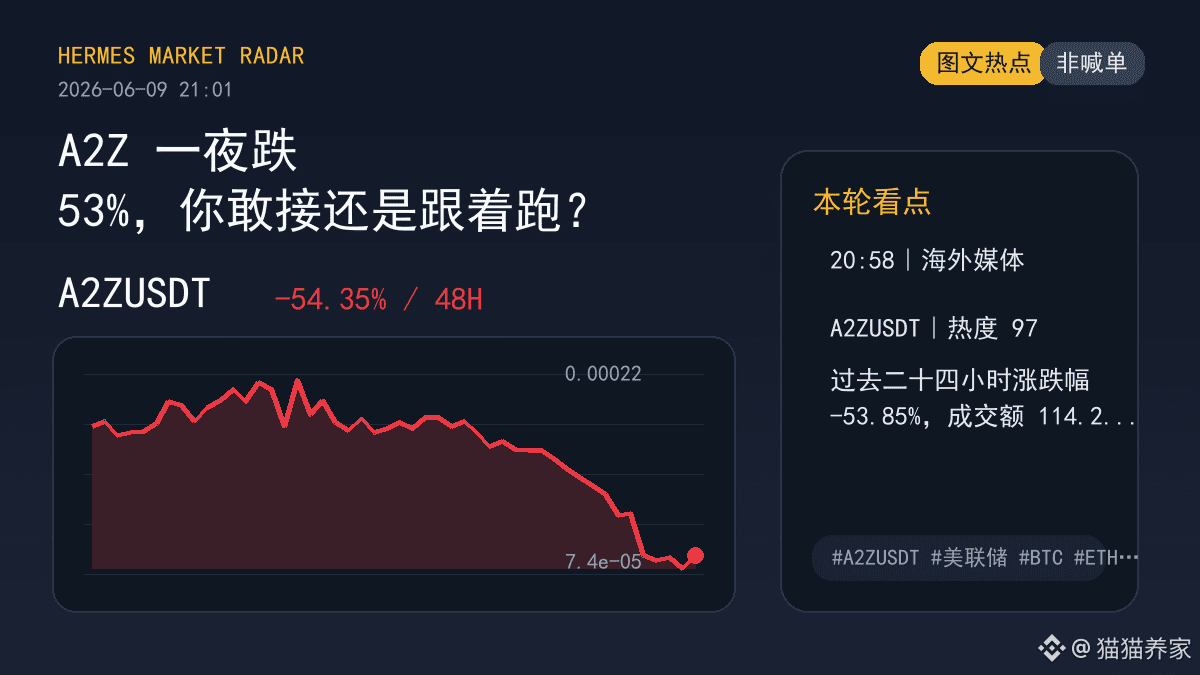
A2Z just tanked 53% overnight, are you picking it up or running away?
When I saw A2ZUSDT on Binance's spot market with a -53% daily drop, my first reaction wasn't panic, but I went to check the volume and depth.
114 million stablecoins in trading volume isn’t much for a coin that’s dropped over half. This suggests that the price collapse is more about a liquidity gap caused by a buy-sell imbalance rather than a large-scale organized sell-off. If someone is looking to rebuild support at this level and the depth can recover, this position could actually be worth adding to the watchlist.
But putting A2Z back into the broader context of today makes it less straightforward.
Bitcoin dropped below and then bounced back to around 62,500, bouncing all day but failing to close with two consecutive bullish candles—this is a clear warning for those looking to recover losses through a rebound: the strength just isn’t there. On the other side, energy prices are starting to raise alarms about inflation pressure; if May's inflation data comes in above expectations, the holding costs for risk assets will change.
My take is: A2Z's crash isn’t an isolated event. It coincides with Bitcoin's weak rebound and the macro narrative returning to inflation; these three signals are happening within the same window, indicating that market funds are currently extremely picky—liquidity is concentrated on a few select assets, while most coins are in a "can be ignored" state. The magnitude of the drop in these volatile coins itself isn’t the conclusion; the conclusion depends on whether external funds come in to catch the falling knife. If the same batch of volatile coins hasn't seen increased trading volume tomorrow, then this round is just pure liquidity flight, not necessarily an opportunity signal.
I've always felt that this kind of window is more worth watching than a one-sided market—not because there’s an opportunity to catch someone’s bottom, but because the market's preferences become most apparent during these times. Where funds are flowing to and where they’re pulling back from, the answers are all written in the volume and depth charts.
Are you willing to look at these volatile coins as a price discovery opportunity for a closer look, or do you think it’s better to let things settle for a bit before making a move?
#A2ZUSDT #美联储 #BTC #ETH #BNB
A2Z just tanked 53% overnight, are you picking it up or running away?
When I saw A2ZUSDT on Binance's spot market with a -53% daily drop, my first reaction wasn't panic, but I went to check the volume and depth.
114 million stablecoins in trading volume isn’t much for a coin that’s dropped over half. This suggests that the price collapse is more about a liquidity gap caused by a buy-sell imbalance rather than a large-scale organized sell-off. If someone is looking to rebuild support at this level and the depth can recover, this position could actually be worth adding to the watchlist.
But putting A2Z back into the broader context of today makes it less straightforward.
Bitcoin dropped below and then bounced back to around 62,500, bouncing all day but failing to close with two consecutive bullish candles—this is a clear warning for those looking to recover losses through a rebound: the strength just isn’t there. On the other side, energy prices are starting to raise alarms about inflation pressure; if May's inflation data comes in above expectations, the holding costs for risk assets will change.
My take is: A2Z's crash isn’t an isolated event. It coincides with Bitcoin's weak rebound and the macro narrative returning to inflation; these three signals are happening within the same window, indicating that market funds are currently extremely picky—liquidity is concentrated on a few select assets, while most coins are in a "can be ignored" state. The magnitude of the drop in these volatile coins itself isn’t the conclusion; the conclusion depends on whether external funds come in to catch the falling knife. If the same batch of volatile coins hasn't seen increased trading volume tomorrow, then this round is just pure liquidity flight, not necessarily an opportunity signal.
I've always felt that this kind of window is more worth watching than a one-sided market—not because there’s an opportunity to catch someone’s bottom, but because the market's preferences become most apparent during these times. Where funds are flowing to and where they’re pulling back from, the answers are all written in the volume and depth charts.
Are you willing to look at these volatile coins as a price discovery opportunity for a closer look, or do you think it’s better to let things settle for a bit before making a move?
#A2ZUSDT #美联储 #BTC #ETH #BNB
When I saw A2ZUSDT on Binance's spot market with a -53% daily drop, my first reaction wasn't panic, but I went to check the volume and depth.
114 million stablecoins in trading volume isn’t much for a coin that’s dropped over half. This suggests that the price collapse is more about a liquidity gap caused by a buy-sell imbalance rather than a large-scale organized sell-off. If someone is looking to rebuild support at this level and the depth can recover, this position could actually be worth adding to the watchlist.
But putting A2Z back into the broader context of today makes it less straightforward.
Bitcoin dropped below and then bounced back to around 62,500, bouncing all day but failing to close with two consecutive bullish candles—this is a clear warning for those looking to recover losses through a rebound: the strength just isn’t there. On the other side, energy prices are starting to raise alarms about inflation pressure; if May's inflation data comes in above expectations, the holding costs for risk assets will change.
My take is: A2Z's crash isn’t an isolated event. It coincides with Bitcoin's weak rebound and the macro narrative returning to inflation; these three signals are happening within the same window, indicating that market funds are currently extremely picky—liquidity is concentrated on a few select assets, while most coins are in a "can be ignored" state. The magnitude of the drop in these volatile coins itself isn’t the conclusion; the conclusion depends on whether external funds come in to catch the falling knife. If the same batch of volatile coins hasn't seen increased trading volume tomorrow, then this round is just pure liquidity flight, not necessarily an opportunity signal.
I've always felt that this kind of window is more worth watching than a one-sided market—not because there’s an opportunity to catch someone’s bottom, but because the market's preferences become most apparent during these times. Where funds are flowing to and where they’re pulling back from, the answers are all written in the volume and depth charts.
Are you willing to look at these volatile coins as a price discovery opportunity for a closer look, or do you think it’s better to let things settle for a bit before making a move?
#A2ZUSDT #美联储 #BTC #ETH #BNB
42
·
--
There are new developments in the security incident—this round isn’t over yet. We need the volume to come out and take a stance.
This section feels more like a stage review than a clear start of a new main storyline. New developments in the security incident can explain part of the sentiment, but it still hasn’t fully lifted the market.
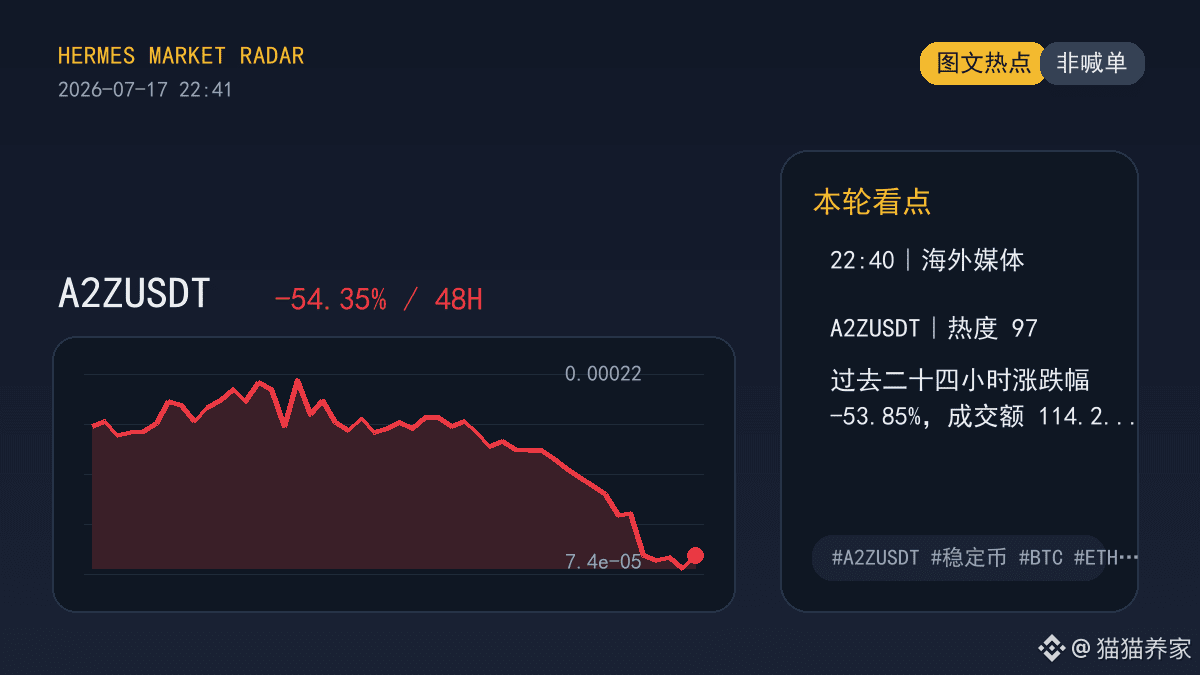
As for the trending chart, Binance’s spot movers list shows A2ZUSDT near the top, which gave a short-term reaction. Since A2ZUSDT at the top of the Binance spot movers list has high volatility, we should first see whether the trading activity can continue—don’t just watch the up/down percentage.
I’d break this chain of logic like this: the new developments in the security incident explain why the capital is hesitating; A2ZUSDT near the top of Binance’s spot movers list explains where the attention is getting squeezed; in the end, only the trading volume can determine whether it’s the main storyline.
Looking at A2ZUSDT, stablecoins, and BTC, the focus isn’t on whether it’s just “riding buzzwords,” but on whether it can actually drive real trading and sustained discussion. If the next wave of heat is still there and mainstream coins’ volume also keeps up, then I’ll continue amplifying this line.
On the other hand, if only a few hot terms are moving and mainstream coins don’t respond, I’ll treat it as an attention rotation rather than a trend confirmation.
If ATAUSDT near the top of Binance’s spot movers list also stays in the lead, I’ll only take it as evidence that attention is spreading. It doesn’t change the main storyline; it just helps judge whether the heat grows from a single point into a continuous line.
#A2ZUSDT #稳定币 #BTC #ETH #BNB
【Promotional link】Arcus perpetual contracts waitlist (their official site says it partners with Robinhood Chain). Not Binance official; no airdrop or profit promise. The link includes promotional tracking; please verify participation and region restrictions yourself: https://waitlist.arcus.xyz/s/0919
There are new developments in the security incident—this round isn’t over yet. We need the volume to come out and take a stance.
This section feels more like a stage review than a clear start of a new main storyline. New developments in the security incident can explain part of the sentiment, but it still hasn’t fully lifted the market.
As for the trending chart, Binance’s spot movers list shows A2ZUSDT near the top, which gave a short-term reaction. Since A2ZUSDT at the top of the Binance spot movers list has high volatility, we should first see whether the trading activity can continue—don’t just watch the up/down percentage.
I’d break this chain of logic like this: the new developments in the security incident explain why the capital is hesitating; A2ZUSDT near the top of Binance’s spot movers list explains where the attention is getting squeezed; in the end, only the trading volume can determine whether it’s the main storyline.
Looking at A2ZUSDT, stablecoins, and BTC, the focus isn’t on whether it’s just “riding buzzwords,” but on whether it can actually drive real trading and sustained discussion. If the next wave of heat is still there and mainstream coins’ volume also keeps up, then I’ll continue amplifying this line.
On the other hand, if only a few hot terms are moving and mainstream coins don’t respond, I’ll treat it as an attention rotation rather than a trend confirmation.
If ATAUSDT near the top of Binance’s spot movers list also stays in the lead, I’ll only take it as evidence that attention is spreading. It doesn’t change the main storyline; it just helps judge whether the heat grows from a single point into a continuous line.
#A2ZUSDT #稳定币 #BTC #ETH #BNB
【Promotional link】Arcus perpetual contracts waitlist (their official site says it partners with Robinhood Chain). Not Binance official; no airdrop or profit promise. The link includes promotional tracking; please verify participation and region restrictions yourself: https://waitlist.arcus.xyz/s/0919
This section feels more like a stage review than a clear start of a new main storyline. New developments in the security incident can explain part of the sentiment, but it still hasn’t fully lifted the market.
As for the trending chart, Binance’s spot movers list shows A2ZUSDT near the top, which gave a short-term reaction. Since A2ZUSDT at the top of the Binance spot movers list has high volatility, we should first see whether the trading activity can continue—don’t just watch the up/down percentage.
I’d break this chain of logic like this: the new developments in the security incident explain why the capital is hesitating; A2ZUSDT near the top of Binance’s spot movers list explains where the attention is getting squeezed; in the end, only the trading volume can determine whether it’s the main storyline.
Looking at A2ZUSDT, stablecoins, and BTC, the focus isn’t on whether it’s just “riding buzzwords,” but on whether it can actually drive real trading and sustained discussion. If the next wave of heat is still there and mainstream coins’ volume also keeps up, then I’ll continue amplifying this line.
On the other hand, if only a few hot terms are moving and mainstream coins don’t respond, I’ll treat it as an attention rotation rather than a trend confirmation.
If ATAUSDT near the top of Binance’s spot movers list also stays in the lead, I’ll only take it as evidence that attention is spreading. It doesn’t change the main storyline; it just helps judge whether the heat grows from a single point into a continuous line.
#A2ZUSDT #稳定币 #BTC #ETH #BNB
【Promotional link】Arcus perpetual contracts waitlist (their official site says it partners with Robinhood Chain). Not Binance official; no airdrop or profit promise. The link includes promotional tracking; please verify participation and region restrictions yourself: https://waitlist.arcus.xyz/s/0919
100
·
--
A new interpretation of political news from the White House is emerging—shifting capital routes; the trending list is just a preview
You shouldn’t read this new claim about White House political news just by the headline. What I care about is whether it will change the path by which funds enter or leave the crypto market.
I’ll put it into my watchlist first and won’t jump to conclusions. The real value will be in the subsequent trades and the synchronized reaction of mainstream assets.
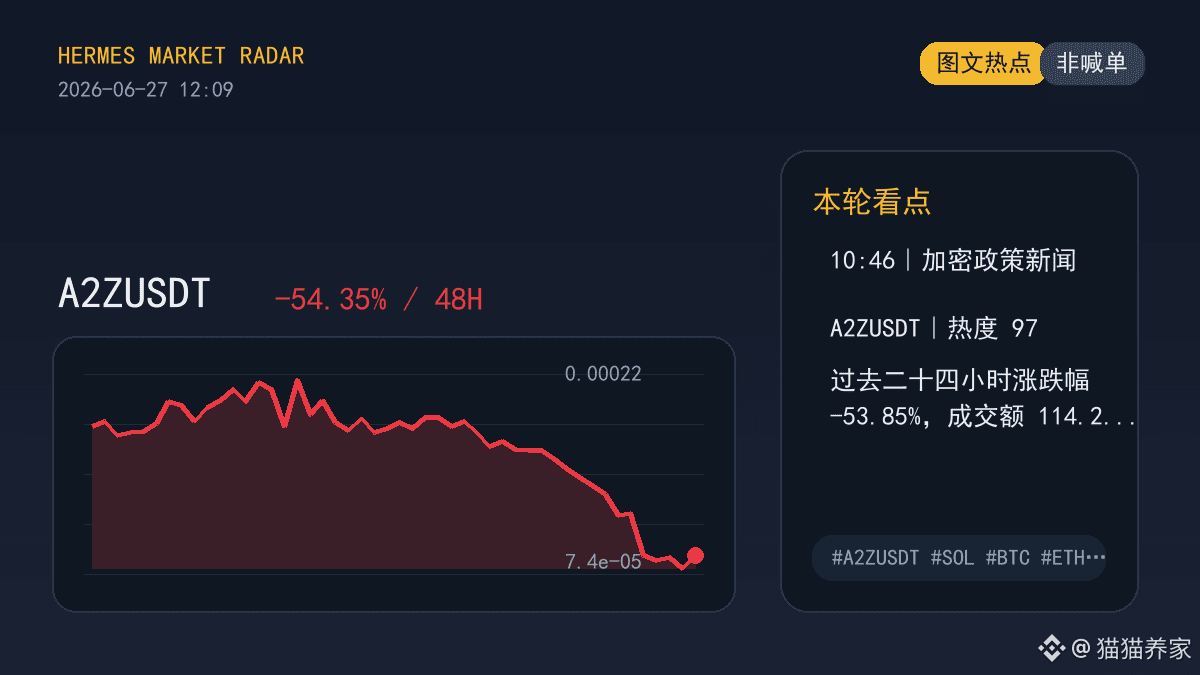
In Binance’s spot “movers” rankings on the trending list, A2ZUSDT near the top is another, faster signal. The main narrative explains why capital moves; the trending-list signal explains where attention is being pushed—their rhythms are completely different.
I’ll break down this chain like this: the White House political news introduces a new interpretation—explaining why capital hesitates; A2ZUSDT near the top of Binance’s spot movers list—explaining where attention gets crowded; and finally, it can only be confirmed as the main thread by trading volume.
Looking at discussions involving A2ZUSDT, SOL, and BTC, the focus isn’t on whether it’s “keyword-chasing,” but on whether it can generate real trades and sustained discussion. Next, I’ll check whether there are clearer follow-up capital moves, instead of turning a single headline directly into a price conclusion.
So the verification order is simple: first, see whether mainstream coins can hold the trade volume; then see whether A2ZUSDT near the top of Binance’s spot movers list can keep staying in the front ranks continuously; and finally, see whether subsequent news has a second source that confirms it.
If, in overseas search trends, the top BTC also keeps staying near the front, I’ll treat it only as evidence of attention spreading. It doesn’t change the main thread—it only helps determine whether the hype expands from a single point into a continuous line.
#A2ZUSDT #SOL #BTC #ETH #BNB
A new interpretation of political news from the White House is emerging—shifting capital routes; the trending list is just a preview
You shouldn’t read this new claim about White House political news just by the headline. What I care about is whether it will change the path by which funds enter or leave the crypto market.
I’ll put it into my watchlist first and won’t jump to conclusions. The real value will be in the subsequent trades and the synchronized reaction of mainstream assets.
In Binance’s spot “movers” rankings on the trending list, A2ZUSDT near the top is another, faster signal. The main narrative explains why capital moves; the trending-list signal explains where attention is being pushed—their rhythms are completely different.
I’ll break down this chain like this: the White House political news introduces a new interpretation—explaining why capital hesitates; A2ZUSDT near the top of Binance’s spot movers list—explaining where attention gets crowded; and finally, it can only be confirmed as the main thread by trading volume.
Looking at discussions involving A2ZUSDT, SOL, and BTC, the focus isn’t on whether it’s “keyword-chasing,” but on whether it can generate real trades and sustained discussion. Next, I’ll check whether there are clearer follow-up capital moves, instead of turning a single headline directly into a price conclusion.
So the verification order is simple: first, see whether mainstream coins can hold the trade volume; then see whether A2ZUSDT near the top of Binance’s spot movers list can keep staying in the front ranks continuously; and finally, see whether subsequent news has a second source that confirms it.
If, in overseas search trends, the top BTC also keeps staying near the front, I’ll treat it only as evidence of attention spreading. It doesn’t change the main thread—it only helps determine whether the hype expands from a single point into a continuous line.
#A2ZUSDT #SOL #BTC #ETH #BNB
You shouldn’t read this new claim about White House political news just by the headline. What I care about is whether it will change the path by which funds enter or leave the crypto market.
I’ll put it into my watchlist first and won’t jump to conclusions. The real value will be in the subsequent trades and the synchronized reaction of mainstream assets.
In Binance’s spot “movers” rankings on the trending list, A2ZUSDT near the top is another, faster signal. The main narrative explains why capital moves; the trending-list signal explains where attention is being pushed—their rhythms are completely different.
I’ll break down this chain like this: the White House political news introduces a new interpretation—explaining why capital hesitates; A2ZUSDT near the top of Binance’s spot movers list—explaining where attention gets crowded; and finally, it can only be confirmed as the main thread by trading volume.
Looking at discussions involving A2ZUSDT, SOL, and BTC, the focus isn’t on whether it’s “keyword-chasing,” but on whether it can generate real trades and sustained discussion. Next, I’ll check whether there are clearer follow-up capital moves, instead of turning a single headline directly into a price conclusion.
So the verification order is simple: first, see whether mainstream coins can hold the trade volume; then see whether A2ZUSDT near the top of Binance’s spot movers list can keep staying in the front ranks continuously; and finally, see whether subsequent news has a second source that confirms it.
If, in overseas search trends, the top BTC also keeps staying near the front, I’ll treat it only as evidence of attention spreading. It doesn’t change the main thread—it only helps determine whether the hype expands from a single point into a continuous line.
#A2ZUSDT #SOL #BTC #ETH #BNB
204
·
--
Funds are currently not lacking news; what's missing is the ability to catch the new developments in Bitcoin trading.
My first reaction is that Bitcoin's new developments aren't the main deal; what's crucial is whether the funds see it as a reason to keep entering the market.
Consider this as a clue for now; more sources are needed for confirmation later. The headline can stir emotions, but whether it translates into market action depends on whether the funds follow suit.
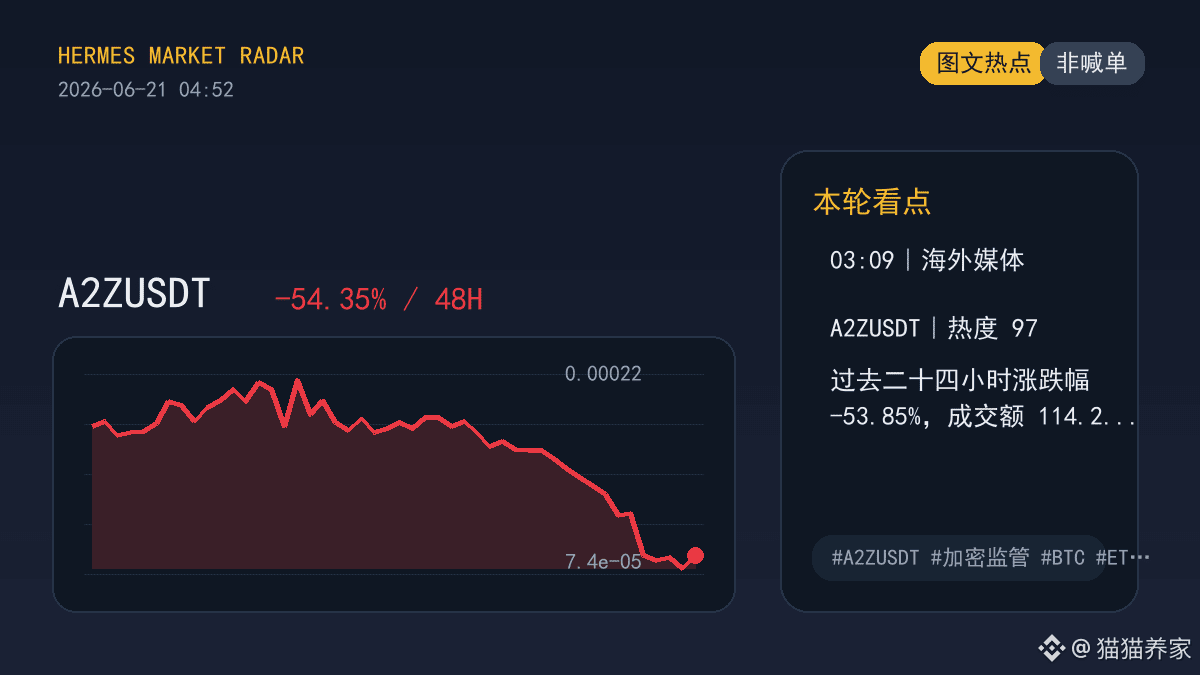
On the trending list, A2ZUSDT is showing significant movement on the Binance spot market, providing another clue. A2ZUSDT's position on the Binance spot movement list looks more like a signal from funds testing the waters; we should first check the depth and continuous trades before discussing if it's a main trend. If in the end there's only search interest and discussion without actual trades and depth to back it up, I would downgrade its significance.
My judgment is that during such windows, we should pay less attention to slogans and more to the actions of the funds. Looking at topics like A2ZUSDT, crypto regulation, and BTC, the focus should not be on buzzwords but rather on whether they can lead to real trades and ongoing discussions.
In the next round, I will first look at mainstream coin trading volumes, whether there have been any changes in exchange-traded funds or stablecoin channels, and then decide if this line is worth amplifying.
One more subtle signal: BICO is also trending high on the overseas search list. It might not alter the main trend, but it indicates that attention isn't solely focused on one point.
#A2ZUSDT #加密监管 #BTC #ETH #BNB
Funds are currently not lacking news; what's missing is the ability to catch the new developments in Bitcoin trading.
My first reaction is that Bitcoin's new developments aren't the main deal; what's crucial is whether the funds see it as a reason to keep entering the market.
Consider this as a clue for now; more sources are needed for confirmation later. The headline can stir emotions, but whether it translates into market action depends on whether the funds follow suit.
On the trending list, A2ZUSDT is showing significant movement on the Binance spot market, providing another clue. A2ZUSDT's position on the Binance spot movement list looks more like a signal from funds testing the waters; we should first check the depth and continuous trades before discussing if it's a main trend. If in the end there's only search interest and discussion without actual trades and depth to back it up, I would downgrade its significance.
My judgment is that during such windows, we should pay less attention to slogans and more to the actions of the funds. Looking at topics like A2ZUSDT, crypto regulation, and BTC, the focus should not be on buzzwords but rather on whether they can lead to real trades and ongoing discussions.
In the next round, I will first look at mainstream coin trading volumes, whether there have been any changes in exchange-traded funds or stablecoin channels, and then decide if this line is worth amplifying.
One more subtle signal: BICO is also trending high on the overseas search list. It might not alter the main trend, but it indicates that attention isn't solely focused on one point.
#A2ZUSDT #加密监管 #BTC #ETH #BNB
My first reaction is that Bitcoin's new developments aren't the main deal; what's crucial is whether the funds see it as a reason to keep entering the market.
Consider this as a clue for now; more sources are needed for confirmation later. The headline can stir emotions, but whether it translates into market action depends on whether the funds follow suit.
On the trending list, A2ZUSDT is showing significant movement on the Binance spot market, providing another clue. A2ZUSDT's position on the Binance spot movement list looks more like a signal from funds testing the waters; we should first check the depth and continuous trades before discussing if it's a main trend. If in the end there's only search interest and discussion without actual trades and depth to back it up, I would downgrade its significance.
My judgment is that during such windows, we should pay less attention to slogans and more to the actions of the funds. Looking at topics like A2ZUSDT, crypto regulation, and BTC, the focus should not be on buzzwords but rather on whether they can lead to real trades and ongoing discussions.
In the next round, I will first look at mainstream coin trading volumes, whether there have been any changes in exchange-traded funds or stablecoin channels, and then decide if this line is worth amplifying.
One more subtle signal: BICO is also trending high on the overseas search list. It might not alter the main trend, but it indicates that attention isn't solely focused on one point.
#A2ZUSDT #加密监管 #BTC #ETH #BNB
181
·
--
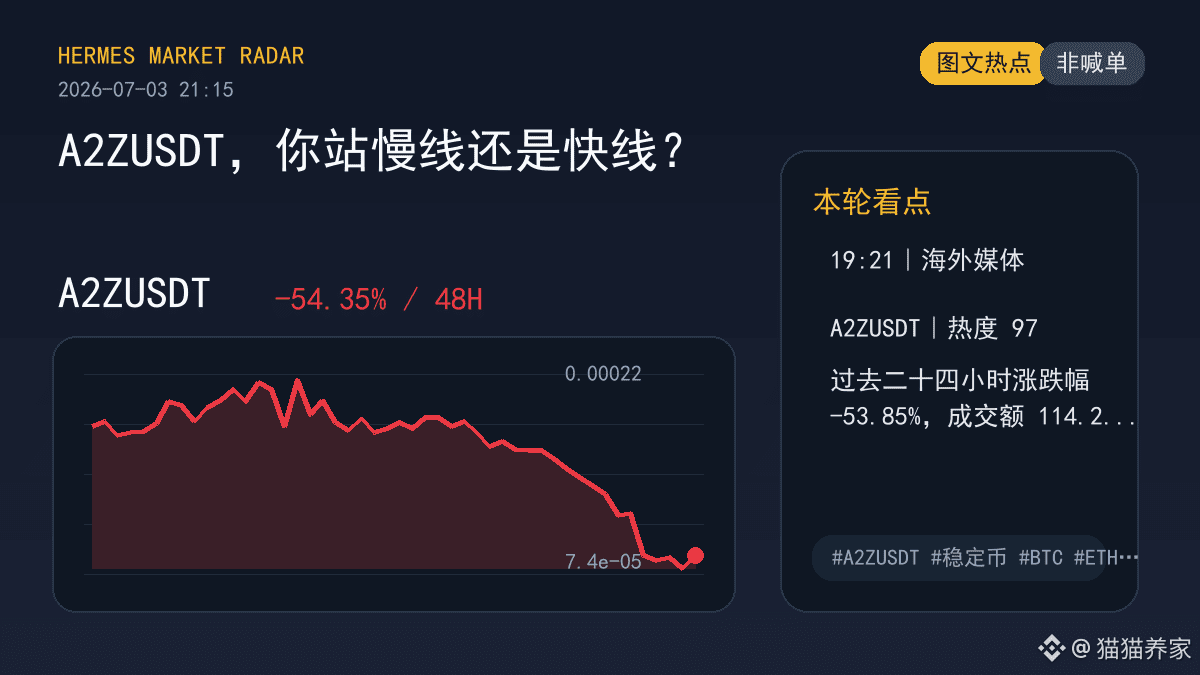
Bitcoin, the Federal Reserve, and interest-rate expectations are starting to affect the crypto market again—what will you do, the slow lane or the fast lane? You’ve run into A2ZUSDT, which is near the top of Binance’s spot unusual movements leaderboard.
This divergence is pretty clear this round: the news side says Bitcoin, the Fed, and interest-rate expectations are again starting to influence the crypto market—watch whether the interest-rate path will change… On the trending side, it’s pushing A2ZUSDT near the top of Binance’s spot unusual movements leaderboard, one is more slow, the other more fast.
Rates and inflation directly affect risk appetite. If the crypto market wants to keep strengthening, it usually needs dollar liquidity and trading in major coins to move in tandem.
The slow lane explains why the capital is moving; the fast lane shows where the attention is running. Put it in the context of A2ZUSDT, stablecoins, and BTC—what matters isn’t just the buzzwords, but whether it can produce real trades and ongoing discussion.
So the verification order is simple: first, see whether major-coin trading can hold up; then, check whether A2ZUSDT near the top of Binance’s spot unusual movements leaderboard can stay in the front ranks continuously; finally, see whether later news has a second source confirmation. If I can only choose one, I’ll first look for confirmation from major-coin trading. Do you prioritize policy and macro first, or do you check where the trending capital has already rushed to?
#A2ZUSDT #稳定币 #BTC #ETH #BNB
Bitcoin, the Federal Reserve, and interest-rate expectations are starting to affect the crypto market again—what will you do, the slow lane or the fast lane? You’ve run into A2ZUSDT, which is near the top of Binance’s spot unusual movements leaderboard.
This divergence is pretty clear this round: the news side says Bitcoin, the Fed, and interest-rate expectations are again starting to influence the crypto market—watch whether the interest-rate path will change… On the trending side, it’s pushing A2ZUSDT near the top of Binance’s spot unusual movements leaderboard, one is more slow, the other more fast.
Rates and inflation directly affect risk appetite. If the crypto market wants to keep strengthening, it usually needs dollar liquidity and trading in major coins to move in tandem.
The slow lane explains why the capital is moving; the fast lane shows where the attention is running. Put it in the context of A2ZUSDT, stablecoins, and BTC—what matters isn’t just the buzzwords, but whether it can produce real trades and ongoing discussion.
So the verification order is simple: first, see whether major-coin trading can hold up; then, check whether A2ZUSDT near the top of Binance’s spot unusual movements leaderboard can stay in the front ranks continuously; finally, see whether later news has a second source confirmation. If I can only choose one, I’ll first look for confirmation from major-coin trading. Do you prioritize policy and macro first, or do you check where the trending capital has already rushed to?
#A2ZUSDT #稳定币 #BTC #ETH #BNB
This divergence is pretty clear this round: the news side says Bitcoin, the Fed, and interest-rate expectations are again starting to influence the crypto market—watch whether the interest-rate path will change… On the trending side, it’s pushing A2ZUSDT near the top of Binance’s spot unusual movements leaderboard, one is more slow, the other more fast.
Rates and inflation directly affect risk appetite. If the crypto market wants to keep strengthening, it usually needs dollar liquidity and trading in major coins to move in tandem.
The slow lane explains why the capital is moving; the fast lane shows where the attention is running. Put it in the context of A2ZUSDT, stablecoins, and BTC—what matters isn’t just the buzzwords, but whether it can produce real trades and ongoing discussion.
So the verification order is simple: first, see whether major-coin trading can hold up; then, check whether A2ZUSDT near the top of Binance’s spot unusual movements leaderboard can stay in the front ranks continuously; finally, see whether later news has a second source confirmation. If I can only choose one, I’ll first look for confirmation from major-coin trading. Do you prioritize policy and macro first, or do you check where the trending capital has already rushed to?
#A2ZUSDT #稳定币 #BTC #ETH #BNB
4
·
--
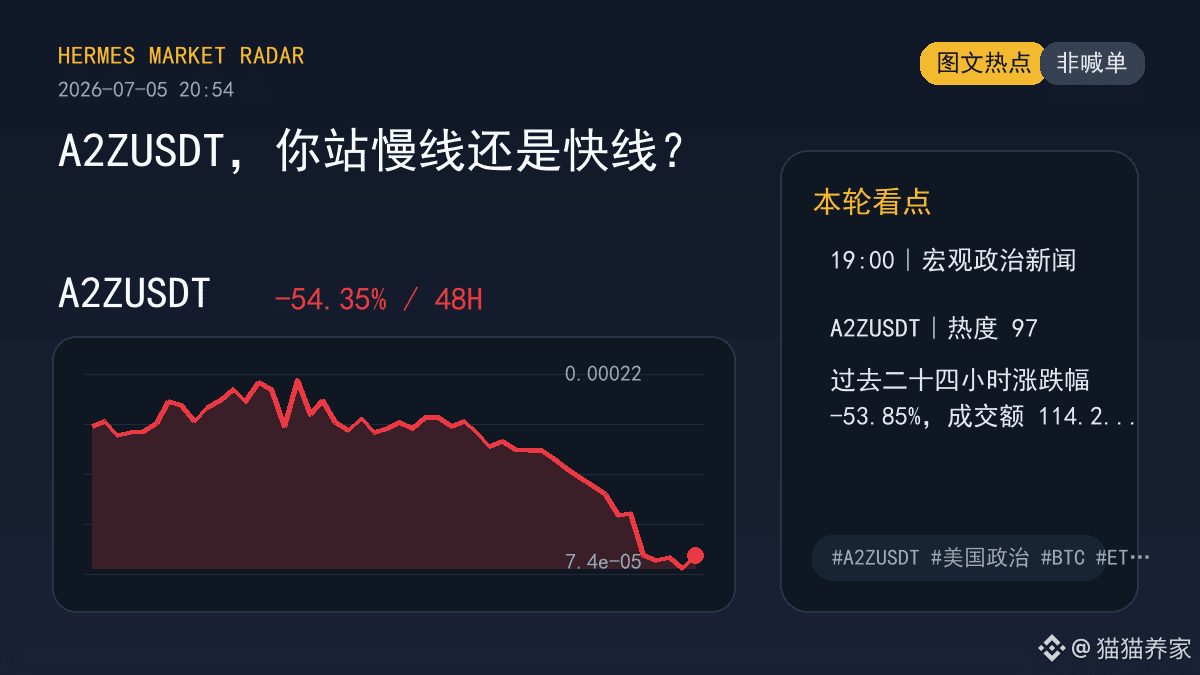
Trump, the U.S. SEC get pulled into crypto assets—will the market trade first based on policy expectations… and then bump into A2ZUSDT, which is near the top of Binance spot’s unusual activity leaderboard? Do you take the slow lane or the fast lane?
This round of disagreement is pretty clear: on the news side, it’s talking about Trump and the U.S. SEC being involved with crypto assets—so the market will trade based on policy expectations and sentiment catalysts. On the trending list side, it’s pushing A2ZUSDT to the top of Binance spot’s unusual activity leaderboard—one is moving slowly, the other is moving fast.
Political news can stir sentiment first, but you can’t just look at who made a statement. Next, you need to see whether the bill, administrative actions, and the capital side have any real follow-through.
The slow lane explains why the money moves; the fast lane warns where attention is running to. Put into the context of A2ZUSDT, U.S. politics, BTC, and the like—the key point isn’t “borrowing keywords,” but whether it can produce real trading volume and continued discussion.
So the validation order is simple: first, check whether major coins’ trading has actually held up; then see whether A2ZUSDT staying near the top of Binance spot’s unusual activity leaderboard can remain there consistently. Finally, check whether subsequent news has a second source confirmation. If you can only choose one, I’d first look for confirmation from major coins’ trading. Would you prioritize policy and macro, or would you first look at how far the hot-list capital has already rushed?
#A2ZUSDT #美国政治 #BTC #ETH #BNB
Trump, the U.S. SEC get pulled into crypto assets—will the market trade first based on policy expectations… and then bump into A2ZUSDT, which is near the top of Binance spot’s unusual activity leaderboard? Do you take the slow lane or the fast lane?
This round of disagreement is pretty clear: on the news side, it’s talking about Trump and the U.S. SEC being involved with crypto assets—so the market will trade based on policy expectations and sentiment catalysts. On the trending list side, it’s pushing A2ZUSDT to the top of Binance spot’s unusual activity leaderboard—one is moving slowly, the other is moving fast.
Political news can stir sentiment first, but you can’t just look at who made a statement. Next, you need to see whether the bill, administrative actions, and the capital side have any real follow-through.
The slow lane explains why the money moves; the fast lane warns where attention is running to. Put into the context of A2ZUSDT, U.S. politics, BTC, and the like—the key point isn’t “borrowing keywords,” but whether it can produce real trading volume and continued discussion.
So the validation order is simple: first, check whether major coins’ trading has actually held up; then see whether A2ZUSDT staying near the top of Binance spot’s unusual activity leaderboard can remain there consistently. Finally, check whether subsequent news has a second source confirmation. If you can only choose one, I’d first look for confirmation from major coins’ trading. Would you prioritize policy and macro, or would you first look at how far the hot-list capital has already rushed?
#A2ZUSDT #美国政治 #BTC #ETH #BNB
This round of disagreement is pretty clear: on the news side, it’s talking about Trump and the U.S. SEC being involved with crypto assets—so the market will trade based on policy expectations and sentiment catalysts. On the trending list side, it’s pushing A2ZUSDT to the top of Binance spot’s unusual activity leaderboard—one is moving slowly, the other is moving fast.
Political news can stir sentiment first, but you can’t just look at who made a statement. Next, you need to see whether the bill, administrative actions, and the capital side have any real follow-through.
The slow lane explains why the money moves; the fast lane warns where attention is running to. Put into the context of A2ZUSDT, U.S. politics, BTC, and the like—the key point isn’t “borrowing keywords,” but whether it can produce real trading volume and continued discussion.
So the validation order is simple: first, check whether major coins’ trading has actually held up; then see whether A2ZUSDT staying near the top of Binance spot’s unusual activity leaderboard can remain there consistently. Finally, check whether subsequent news has a second source confirmation. If you can only choose one, I’d first look for confirmation from major coins’ trading. Would you prioritize policy and macro, or would you first look at how far the hot-list capital has already rushed?
#A2ZUSDT #美国政治 #BTC #ETH #BNB
229
·
--
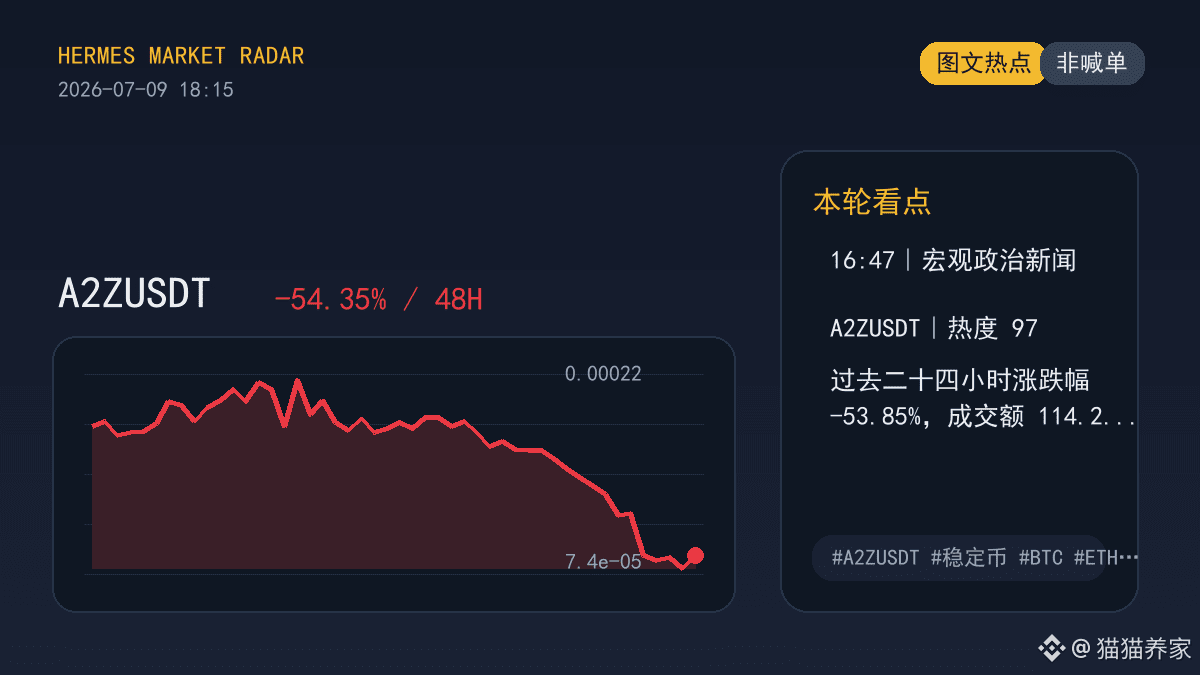
Oil prices and geopolitical risk—don’t get carried away yet. I’m only waiting for three hard signals
First, don’t spread this. Oil prices and geopolitical risk are the leading candidates. In Binance’s spot movers list, the top-ranked A2ZUSDT is an outlet for attention. I’ll look at both sides separately.
First: whether trading volume in major coins is backing it up.
Second: whether the hot-list targets show continuity.
Third: whether Bitcoin, the Fed, and rate-expectation moves are starting to affect the crypto market again—especially whether the rate path will change, and whether there’s a second source to confirm it.
I’ll break this chain of logic down like this: oil prices and geopolitical risk—why funds would hesitate; A2ZUSDT at the top of Binance’s spot movers list—where attention is squeezing toward; and in the end, only volume can determine whether it’s a main narrative.
When placed within topics like A2ZUSDT, stablecoins, and BTC, the key isn’t word-chasing, but whether it can generate real trading activity and continuous discussion. It’s not time to jump to a conclusion yet, but I’ll put it into the next round of observation.
#A2ZUSDT #稳定币 #BTC #ETH #BNB
Oil prices and geopolitical risk—don’t get carried away yet. I’m only waiting for three hard signals
First, don’t spread this. Oil prices and geopolitical risk are the leading candidates. In Binance’s spot movers list, the top-ranked A2ZUSDT is an outlet for attention. I’ll look at both sides separately.
First: whether trading volume in major coins is backing it up.
Second: whether the hot-list targets show continuity.
Third: whether Bitcoin, the Fed, and rate-expectation moves are starting to affect the crypto market again—especially whether the rate path will change, and whether there’s a second source to confirm it.
I’ll break this chain of logic down like this: oil prices and geopolitical risk—why funds would hesitate; A2ZUSDT at the top of Binance’s spot movers list—where attention is squeezing toward; and in the end, only volume can determine whether it’s a main narrative.
When placed within topics like A2ZUSDT, stablecoins, and BTC, the key isn’t word-chasing, but whether it can generate real trading activity and continuous discussion. It’s not time to jump to a conclusion yet, but I’ll put it into the next round of observation.
#A2ZUSDT #稳定币 #BTC #ETH #BNB
First, don’t spread this. Oil prices and geopolitical risk are the leading candidates. In Binance’s spot movers list, the top-ranked A2ZUSDT is an outlet for attention. I’ll look at both sides separately.
First: whether trading volume in major coins is backing it up.
Second: whether the hot-list targets show continuity.
Third: whether Bitcoin, the Fed, and rate-expectation moves are starting to affect the crypto market again—especially whether the rate path will change, and whether there’s a second source to confirm it.
I’ll break this chain of logic down like this: oil prices and geopolitical risk—why funds would hesitate; A2ZUSDT at the top of Binance’s spot movers list—where attention is squeezing toward; and in the end, only volume can determine whether it’s a main narrative.
When placed within topics like A2ZUSDT, stablecoins, and BTC, the key isn’t word-chasing, but whether it can generate real trading activity and continuous discussion. It’s not time to jump to a conclusion yet, but I’ll put it into the next round of observation.
#A2ZUSDT #稳定币 #BTC #ETH #BNB
141
·
--
This round, the key isn't about the amount of news, but whether the funds are willing to catch the Ethereum asset reserve company's pivot to staking yields.
My first reaction is that the Ethereum asset reserve company's shift to staking yields isn't the most crucial factor; what's important is whether the funds see this as a reason to keep entering the market.
I’ll put it on my watchlist for now, not rushing to conclusions. What really matters are the subsequent trades and the synchronized reactions of mainstream assets.
On the hot list side, A2ZUSDT is giving another clue as it’s moving in the Binance spot volatility chart. The movement of A2ZUSDT indicates trading activity and price fluctuations, but we need to clarify whether it’s due to new funds entering or just a spike caused by thin liquidity. If later it’s just searching and discussing without actual trades and deep cooperation, I’ll downgrade its importance.
My judgment is to focus less on slogans and more on actual fund movements during this window. Looking at A2ZUSDT, SOL, BTC, the emphasis isn't on buzzwords but whether they can lead to real trades and ongoing discussions.
Next, I'll keep an eye on mainstream coin trading, whether exchange-traded funds or stablecoin channels continue to change, and then decide if this line is worth amplifying.
There’s also a small signal: BONK is ranking high on the overseas search hotlist. It might not change the main narrative, but it shows that attention isn’t just focused on one point.
#A2ZUSDT #SOL #BTC #ETH #BNB
This round, the key isn't about the amount of news, but whether the funds are willing to catch the Ethereum asset reserve company's pivot to staking yields.
My first reaction is that the Ethereum asset reserve company's shift to staking yields isn't the most crucial factor; what's important is whether the funds see this as a reason to keep entering the market.
I’ll put it on my watchlist for now, not rushing to conclusions. What really matters are the subsequent trades and the synchronized reactions of mainstream assets.
On the hot list side, A2ZUSDT is giving another clue as it’s moving in the Binance spot volatility chart. The movement of A2ZUSDT indicates trading activity and price fluctuations, but we need to clarify whether it’s due to new funds entering or just a spike caused by thin liquidity. If later it’s just searching and discussing without actual trades and deep cooperation, I’ll downgrade its importance.
My judgment is to focus less on slogans and more on actual fund movements during this window. Looking at A2ZUSDT, SOL, BTC, the emphasis isn't on buzzwords but whether they can lead to real trades and ongoing discussions.
Next, I'll keep an eye on mainstream coin trading, whether exchange-traded funds or stablecoin channels continue to change, and then decide if this line is worth amplifying.
There’s also a small signal: BONK is ranking high on the overseas search hotlist. It might not change the main narrative, but it shows that attention isn’t just focused on one point.
#A2ZUSDT #SOL #BTC #ETH #BNB
My first reaction is that the Ethereum asset reserve company's shift to staking yields isn't the most crucial factor; what's important is whether the funds see this as a reason to keep entering the market.
I’ll put it on my watchlist for now, not rushing to conclusions. What really matters are the subsequent trades and the synchronized reactions of mainstream assets.
On the hot list side, A2ZUSDT is giving another clue as it’s moving in the Binance spot volatility chart. The movement of A2ZUSDT indicates trading activity and price fluctuations, but we need to clarify whether it’s due to new funds entering or just a spike caused by thin liquidity. If later it’s just searching and discussing without actual trades and deep cooperation, I’ll downgrade its importance.
My judgment is to focus less on slogans and more on actual fund movements during this window. Looking at A2ZUSDT, SOL, BTC, the emphasis isn't on buzzwords but whether they can lead to real trades and ongoing discussions.
Next, I'll keep an eye on mainstream coin trading, whether exchange-traded funds or stablecoin channels continue to change, and then decide if this line is worth amplifying.
There’s also a small signal: BONK is ranking high on the overseas search hotlist. It might not change the main narrative, but it shows that attention isn’t just focused on one point.
#A2ZUSDT #SOL #BTC #ETH #BNB
200
·
--
Rates stayed the same, but the crypto market dipped first – Walsh's "wait and see" is what we should really be wary of
I don't quite agree with slapping the simple "macro bearish" label on last night's pullback. The Fed did keep rates unchanged, and taken at face value, that shouldn't trigger a mass exodus from risk assets. But Bitcoin dropped, Ethereum dropped, and Ripple followed suit with a drop of over 4% – indicating that funds are not reacting to the decision itself, but are pricing in the path set by the new chair, Walsh, ahead of time.
Walsh is known for his hawkish stance. His first decision after taking office to hold steady has only made the market more anxious: because "holding steady" doesn’t mean "not planning to act". From the multiple macro news pieces that dropped early this morning, it appears that the rate path has replaced ETF inflows and halving narratives as the primary variable that short-term funds are focused on.
My take is: over the next few days, what we should really be monitoring isn’t whether Bitcoin can hold a certain integer level, but two signals. First, is there any sign of improvement in USD liquidity? Second, can mainstream coin trading warm up in sync? Until both turn positive, the macro pressure logic won't just disappear on its own.
Right now, I'm keeping an eye on the stablecoin movements. Yesterday, several U.S. regulatory bodies issued specifics on the GENIUS Act, requiring stablecoin platforms to implement customer identity verification rules similar to banks. This news doesn’t seem immediately stimulative and won’t have a short-term price impact, but if compliance expectations drive up redemption pressure, on-chain funds will tighten further, which isn’t good news for short-term support for Bitcoin and Ethereum.
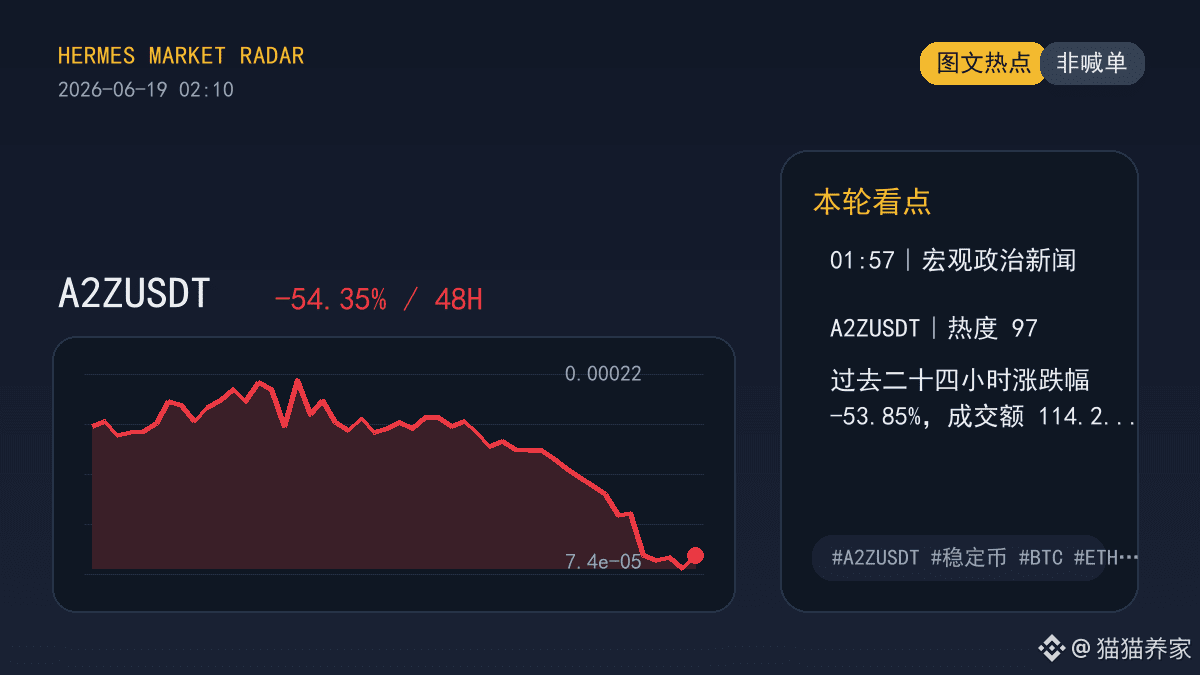
Additionally, tonight on Binance's spot unusual activity list, A2ZUSDT has seen a drop of over 50% in the past 24 hours, with a trading volume of 1.14 million stablecoins. Such a steep drop raises concerns over thin liquidity leading to spike risks – A2Z’s depth isn’t thick to begin with – and we should also see if this is a panic sell-off reaching its end. No rush to buy the dip, let's first clear the risks.
The signal I’m really focused on now: is there a noticeable decline in the total supply of stablecoins? If so, it indicates that funds are pulling back, and I will be even more cautious than I am now.
#A2ZUSDT #稳定币 #BTC #ETH #BNB
Rates stayed the same, but the crypto market dipped first – Walsh's "wait and see" is what we should really be wary of
I don't quite agree with slapping the simple "macro bearish" label on last night's pullback. The Fed did keep rates unchanged, and taken at face value, that shouldn't trigger a mass exodus from risk assets. But Bitcoin dropped, Ethereum dropped, and Ripple followed suit with a drop of over 4% – indicating that funds are not reacting to the decision itself, but are pricing in the path set by the new chair, Walsh, ahead of time.
Walsh is known for his hawkish stance. His first decision after taking office to hold steady has only made the market more anxious: because "holding steady" doesn’t mean "not planning to act". From the multiple macro news pieces that dropped early this morning, it appears that the rate path has replaced ETF inflows and halving narratives as the primary variable that short-term funds are focused on.
My take is: over the next few days, what we should really be monitoring isn’t whether Bitcoin can hold a certain integer level, but two signals. First, is there any sign of improvement in USD liquidity? Second, can mainstream coin trading warm up in sync? Until both turn positive, the macro pressure logic won't just disappear on its own.
Right now, I'm keeping an eye on the stablecoin movements. Yesterday, several U.S. regulatory bodies issued specifics on the GENIUS Act, requiring stablecoin platforms to implement customer identity verification rules similar to banks. This news doesn’t seem immediately stimulative and won’t have a short-term price impact, but if compliance expectations drive up redemption pressure, on-chain funds will tighten further, which isn’t good news for short-term support for Bitcoin and Ethereum.
Additionally, tonight on Binance's spot unusual activity list, A2ZUSDT has seen a drop of over 50% in the past 24 hours, with a trading volume of 1.14 million stablecoins. Such a steep drop raises concerns over thin liquidity leading to spike risks – A2Z’s depth isn’t thick to begin with – and we should also see if this is a panic sell-off reaching its end. No rush to buy the dip, let's first clear the risks.
The signal I’m really focused on now: is there a noticeable decline in the total supply of stablecoins? If so, it indicates that funds are pulling back, and I will be even more cautious than I am now.
#A2ZUSDT #稳定币 #BTC #ETH #BNB
I don't quite agree with slapping the simple "macro bearish" label on last night's pullback. The Fed did keep rates unchanged, and taken at face value, that shouldn't trigger a mass exodus from risk assets. But Bitcoin dropped, Ethereum dropped, and Ripple followed suit with a drop of over 4% – indicating that funds are not reacting to the decision itself, but are pricing in the path set by the new chair, Walsh, ahead of time.
Walsh is known for his hawkish stance. His first decision after taking office to hold steady has only made the market more anxious: because "holding steady" doesn’t mean "not planning to act". From the multiple macro news pieces that dropped early this morning, it appears that the rate path has replaced ETF inflows and halving narratives as the primary variable that short-term funds are focused on.
My take is: over the next few days, what we should really be monitoring isn’t whether Bitcoin can hold a certain integer level, but two signals. First, is there any sign of improvement in USD liquidity? Second, can mainstream coin trading warm up in sync? Until both turn positive, the macro pressure logic won't just disappear on its own.
Right now, I'm keeping an eye on the stablecoin movements. Yesterday, several U.S. regulatory bodies issued specifics on the GENIUS Act, requiring stablecoin platforms to implement customer identity verification rules similar to banks. This news doesn’t seem immediately stimulative and won’t have a short-term price impact, but if compliance expectations drive up redemption pressure, on-chain funds will tighten further, which isn’t good news for short-term support for Bitcoin and Ethereum.
Additionally, tonight on Binance's spot unusual activity list, A2ZUSDT has seen a drop of over 50% in the past 24 hours, with a trading volume of 1.14 million stablecoins. Such a steep drop raises concerns over thin liquidity leading to spike risks – A2Z’s depth isn’t thick to begin with – and we should also see if this is a panic sell-off reaching its end. No rush to buy the dip, let's first clear the risks.
The signal I’m really focused on now: is there a noticeable decline in the total supply of stablecoins? If so, it indicates that funds are pulling back, and I will be even more cautious than I am now.
#A2ZUSDT #稳定币 #BTC #ETH #BNB
445
·
--
Three signals of geopolitical risk flashing at once, how much longer can the crypto market stay immune?
My first reaction is to lower my leverage.
In the past few hours, three geopolitical signals have emerged almost simultaneously: escalating tensions in Iran, rising US Treasury yields, and sanctions imposed by the UK on exchanges related to Sun Yuchen. Each one could be dismissed as "not really related to crypto," but when they're all packed together, the situation changes.
This is an early signal of a shift in the macro risk environment. Bitcoin and Ethereum have yet to show clear pricing for a safe haven, while net inflows into ETFs are still supporting the sentiment. Over in the mining stocks, narratives around AI infrastructure have also sparked some momentum. The news front is cooling down, while the charts are still hot—this divergence is exactly the stage I'm most wary of. Because if capital starts to flow in the same direction later, the adjustment speed will exceed most people's expectations.
My judgment is that if the US dollar index and oil prices continue to rise together, while Bitcoin breaks down with volume below its current range, I won't dismiss geopolitical news as short-term noise anymore. Instead, I'll treat it as a serious risk re-pricing event. Conversely, if oil prices stabilize and the dollar retreats, while Bitcoin consolidates above support with decreasing volume, then this set of news will just be a minor episode.
By the way, A2ZUSDT has dropped over half in the last 24 hours. In a macro risk window, the assets with the thinnest liquidity are the first to reveal vulnerabilities. This isn't an isolated case; it's a structural weakness—when funds tighten, the first thing to disappear is always the depth of buy orders.
Right now, I'm going to watch the changes in Bitcoin's trading volume over the next few hours, while keeping an eye on oil prices and US Treasury yields. News can be ignored, but liquidity doesn’t lie.
#A2ZUSDT #ETF #BTC #ETH #BNB
Three signals of geopolitical risk flashing at once, how much longer can the crypto market stay immune?
My first reaction is to lower my leverage.
In the past few hours, three geopolitical signals have emerged almost simultaneously: escalating tensions in Iran, rising US Treasury yields, and sanctions imposed by the UK on exchanges related to Sun Yuchen. Each one could be dismissed as "not really related to crypto," but when they're all packed together, the situation changes.
This is an early signal of a shift in the macro risk environment. Bitcoin and Ethereum have yet to show clear pricing for a safe haven, while net inflows into ETFs are still supporting the sentiment. Over in the mining stocks, narratives around AI infrastructure have also sparked some momentum. The news front is cooling down, while the charts are still hot—this divergence is exactly the stage I'm most wary of. Because if capital starts to flow in the same direction later, the adjustment speed will exceed most people's expectations.
My judgment is that if the US dollar index and oil prices continue to rise together, while Bitcoin breaks down with volume below its current range, I won't dismiss geopolitical news as short-term noise anymore. Instead, I'll treat it as a serious risk re-pricing event. Conversely, if oil prices stabilize and the dollar retreats, while Bitcoin consolidates above support with decreasing volume, then this set of news will just be a minor episode.
By the way, A2ZUSDT has dropped over half in the last 24 hours. In a macro risk window, the assets with the thinnest liquidity are the first to reveal vulnerabilities. This isn't an isolated case; it's a structural weakness—when funds tighten, the first thing to disappear is always the depth of buy orders.
Right now, I'm going to watch the changes in Bitcoin's trading volume over the next few hours, while keeping an eye on oil prices and US Treasury yields. News can be ignored, but liquidity doesn’t lie.
#A2ZUSDT #ETF #BTC #ETH #BNB
My first reaction is to lower my leverage.
In the past few hours, three geopolitical signals have emerged almost simultaneously: escalating tensions in Iran, rising US Treasury yields, and sanctions imposed by the UK on exchanges related to Sun Yuchen. Each one could be dismissed as "not really related to crypto," but when they're all packed together, the situation changes.
This is an early signal of a shift in the macro risk environment. Bitcoin and Ethereum have yet to show clear pricing for a safe haven, while net inflows into ETFs are still supporting the sentiment. Over in the mining stocks, narratives around AI infrastructure have also sparked some momentum. The news front is cooling down, while the charts are still hot—this divergence is exactly the stage I'm most wary of. Because if capital starts to flow in the same direction later, the adjustment speed will exceed most people's expectations.
My judgment is that if the US dollar index and oil prices continue to rise together, while Bitcoin breaks down with volume below its current range, I won't dismiss geopolitical news as short-term noise anymore. Instead, I'll treat it as a serious risk re-pricing event. Conversely, if oil prices stabilize and the dollar retreats, while Bitcoin consolidates above support with decreasing volume, then this set of news will just be a minor episode.
By the way, A2ZUSDT has dropped over half in the last 24 hours. In a macro risk window, the assets with the thinnest liquidity are the first to reveal vulnerabilities. This isn't an isolated case; it's a structural weakness—when funds tighten, the first thing to disappear is always the depth of buy orders.
Right now, I'm going to watch the changes in Bitcoin's trading volume over the next few hours, while keeping an eye on oil prices and US Treasury yields. News can be ignored, but liquidity doesn’t lie.
#A2ZUSDT #ETF #BTC #ETH #BNB
248
·
--
Stablecoin regulation continues to tighten; what the market should focus on isn't just the trending rankings.
My first reaction is that stablecoin regulation, being a slow-moving piece of news, is more crucial to watch than the trending small caps.
It affects the flow of on-chain capital: who can issue, who can redeem, and who holds the power in payment and compliance.
However, the trending list paints a different picture. The A2ZUSDT is high on Binance's spot movers list, with data showing: a 24-hour price change of -53.85% and a trading volume of 1.142 million stablecoins.
My take is to keep these two matters separate in the short term. When looking at A2ZUSDT, stablecoins, and BTC, the focus shouldn't just be on the buzzwords but rather on whether it can generate real trades and ongoing discussions.
Right now, I'm watching two things: whether the main news has clearer progression; and if the trading volumes of the top trending coins can sustain over two rounds, rather than just spiking once for a rank.
There's also a small signal: BONK, which is high on the overseas search trending list. It may not change the main narrative, but it shows that attention isn't solely fixated on one point.
#A2ZUSDT #稳定币 #BTC #ETH #BNB
Stablecoin regulation continues to tighten; what the market should focus on isn't just the trending rankings.
My first reaction is that stablecoin regulation, being a slow-moving piece of news, is more crucial to watch than the trending small caps.
It affects the flow of on-chain capital: who can issue, who can redeem, and who holds the power in payment and compliance.
However, the trending list paints a different picture. The A2ZUSDT is high on Binance's spot movers list, with data showing: a 24-hour price change of -53.85% and a trading volume of 1.142 million stablecoins.
My take is to keep these two matters separate in the short term. When looking at A2ZUSDT, stablecoins, and BTC, the focus shouldn't just be on the buzzwords but rather on whether it can generate real trades and ongoing discussions.
Right now, I'm watching two things: whether the main news has clearer progression; and if the trading volumes of the top trending coins can sustain over two rounds, rather than just spiking once for a rank.
There's also a small signal: BONK, which is high on the overseas search trending list. It may not change the main narrative, but it shows that attention isn't solely fixated on one point.
#A2ZUSDT #稳定币 #BTC #ETH #BNB
My first reaction is that stablecoin regulation, being a slow-moving piece of news, is more crucial to watch than the trending small caps.
It affects the flow of on-chain capital: who can issue, who can redeem, and who holds the power in payment and compliance.
However, the trending list paints a different picture. The A2ZUSDT is high on Binance's spot movers list, with data showing: a 24-hour price change of -53.85% and a trading volume of 1.142 million stablecoins.
My take is to keep these two matters separate in the short term. When looking at A2ZUSDT, stablecoins, and BTC, the focus shouldn't just be on the buzzwords but rather on whether it can generate real trades and ongoing discussions.
Right now, I'm watching two things: whether the main news has clearer progression; and if the trading volumes of the top trending coins can sustain over two rounds, rather than just spiking once for a rank.
There's also a small signal: BONK, which is high on the overseas search trending list. It may not change the main narrative, but it shows that attention isn't solely fixated on one point.
#A2ZUSDT #稳定币 #BTC #ETH #BNB
74


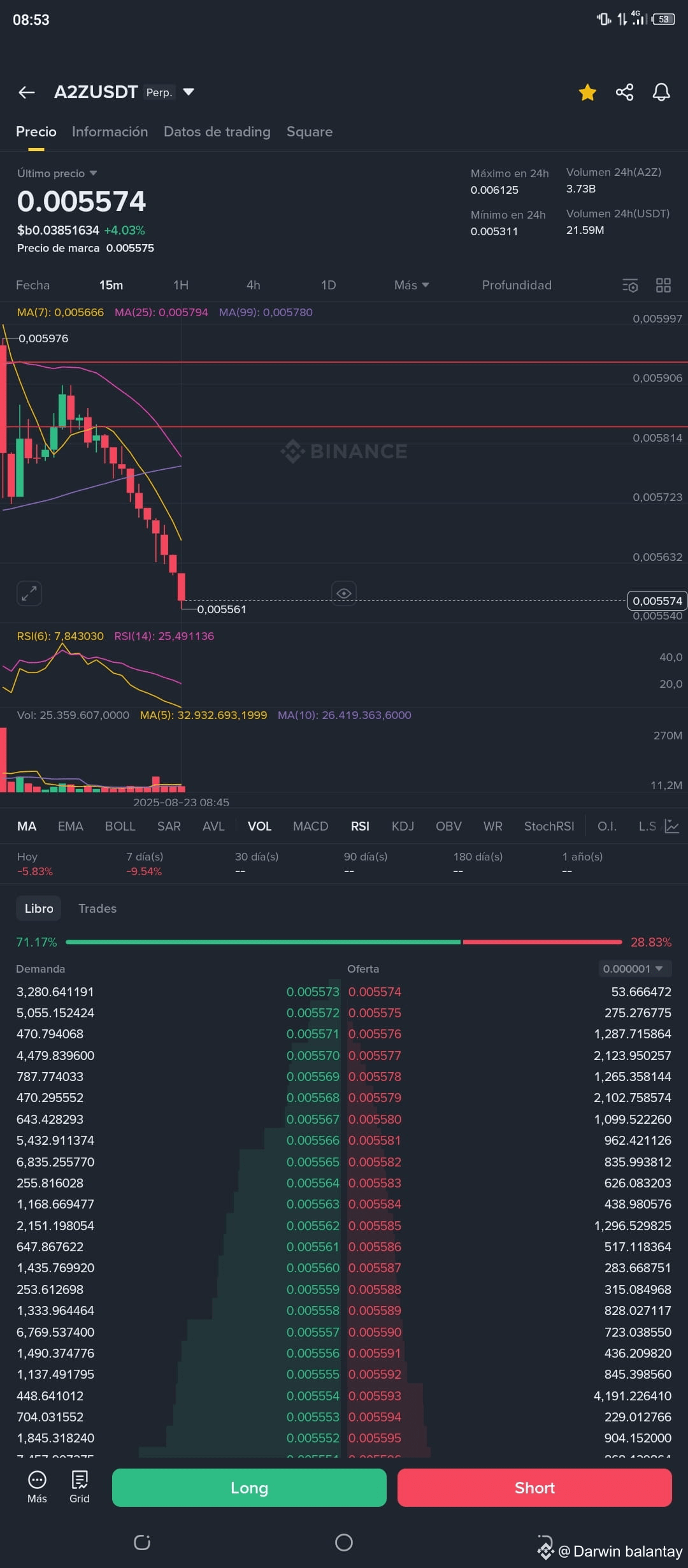

·
--
I've eaten enough, raised it by 90%, leaving 10% to continue rolling, #A2ZUSDT thank you!!!
I've eaten enough, raised it by 90%, leaving 10% to continue rolling, #A2ZUSDT thank you!!!

10
3
35
44.7k

📈 Just closed a PERP trade on $A2Z USDT with a solid +5.10 USDT PNL! 💸
🔹 Entry Price: 0.004848
🔹 Close Price: 0.004981
🔹 Close Time: August 1, 2025 - 16:42 UTC
It’s not always about catching the top — sometimes, it's about securing consistent green trades. 📊
Small gains, big discipline. 💪
#CryptoTrading #BinanceFutures #A2ZUSDT #TradeSmart #WriteToEarn
$XRP $TREE
📈 Just closed a PERP trade on $A2Z USDT with a solid +5.10 USDT PNL! 💸
🔹 Entry Price: 0.004848
🔹 Close Price: 0.004981
🔹 Close Time: August 1, 2025 - 16:42 UTC
It’s not always about catching the top — sometimes, it's about securing consistent green trades. 📊
Small gains, big discipline. 💪
#CryptoTrading #BinanceFutures #A2ZUSDT #TradeSmart #WriteToEarn
$XRP $TREE
🔹 Entry Price: 0.004848
🔹 Close Price: 0.004981
🔹 Close Time: August 1, 2025 - 16:42 UTC
It’s not always about catching the top — sometimes, it's about securing consistent green trades. 📊
Small gains, big discipline. 💪
#CryptoTrading #BinanceFutures #A2ZUSDT #TradeSmart #WriteToEarn
$XRP $TREE
1
668
Log in to explore more content
Join global crypto users on Binance Square
⚡️ Get latest and useful information about crypto.
💬 Trusted by the world’s largest crypto exchange.
👍 Discover real insights from verified creators.
Email / Phone number
Trending Topics
1
#BitwiseFilesFinalNEARSpotETFProspectus
27,714 views
834 Discussing
2
#BitgetHackerMoves$83MStolenXRP
19,042 views
118 Discussing
3
#SOLSpotETFWeeklyInflow$188M
10,182 views
91 Discussing
4
#DogecoinETFsPostBiggestWeekSinceLaunch
24,428 views
689 Discussing
5
#StrategyStriveAdd2305BitcoinThisWeek
87,383 views
1,781 Discussing
6
#TrumpRejectsIranHormuzReopening
82,312 views
1,383 Discussing
7
#CircleTetherFreezeBitgetHackerWallet
83,362 views
1,315 Discussing
8
#SECSaysTokenBuybacksNotAutoSecurities
50,458 views
784 Discussing
9
#ChinaUSAgreeOn$30BTariffCut
4,058 views
42 Discussing
10
#CoinMarketCapCompletesCoinglassAcquisition
59,599 views
895 Discussing