
#11723
11723
12 views
4 Discussing
Hot
Latest

·
--
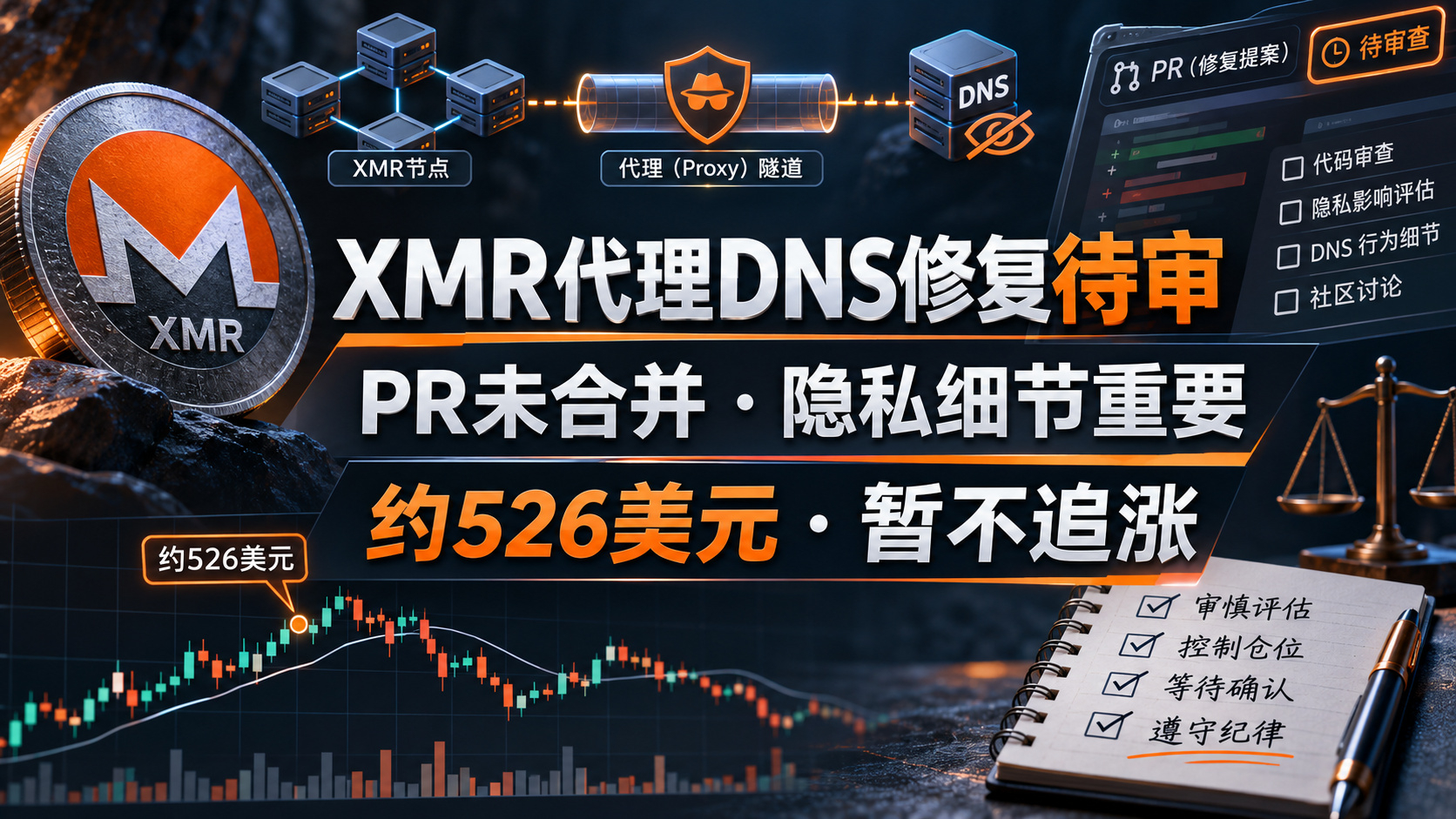
XMR proxy DNS fix still under review|Privacy implementation details matter more than slogans|Don’t chase the rally near $526
My stance is to wait and see. In Monero’s official code repository, maintainer selsta submitted PR #11723, titled “Prevent peer hostname DNS leaks when using a proxy.” I checked the submission page and the changes: in proxy mode, unless DNS leaks are explicitly allowed, the software is set to prevent local resolution of peer hostnames and prompt users to use IP addresses or explicitly enable the relevant option. The page currently still shows Open and pending review. One reviewer has approved it, but that does not mean it has been merged or that an official release has fixed the issue. Nor does this justify claiming that the privacy of all XMR transactions has been compromised; the issue concerns a specific proxy and domain-name resolution path, and its scope will depend on the maintainers’ review and release notes.
The significance of this for the crypto market is mainly about trust and user experience. XMR’s value proposition depends on privacy, but privacy concerns go beyond on-chain transactions: network requests made while running a node may also reveal information about the user’s environment. If the code is ultimately merged and released, it could reduce the risk of leaks under one configuration. At the same time, requiring node operators to check their configurations could bring migration and operational costs. The official repository is still reviewing the change, so I see it as engineering progress, not a price catalyst. This is separate from MEXC’s plan to stop spot trading of XMR today; the delisting should not be directly attributed to this PR.
The market has already had its say: XMR/USD on Kraken is currently around $526, with a 24-hour low of $500 and a high of about $562. The price has rebounded from $500, but remains well below the top of the range, so whether buying pressure will persist remains to be seen. XMR is not directly represented among the current trending topics on Binance Square, and I won’t force an unrelated label onto it. The key levels are the intraday low at $500, the short-term reclaim level near $535, and the range high at $562. If the price breaks below $500 and cannot quickly reclaim it, my view of the rebound is invalidated. If it reclaims $535 and forms a higher low, then there may be conditions for a further move toward $562. Code progress, exchange liquidity, and spot-market structure should be verified separately.
If I were trading this myself: I wouldn’t enter now. I’d only consider a small spot long position, with no high leverage. My entry trigger would be a four-hour close above $535, followed by a retest of $530–$535 that holds. I’d risk no more than 2.5% of my total assets on a trial position. The first target is $550, where I’d sell half; the second is $562, where I’d close the remainder in stages. I’d place a stop below $516 and close the position if triggered, rather than adding to it to conceal a bad call. If $500 gives way first, I’d cancel the long plan. If the PR is not merged, or liquidity suddenly thins around MEXC’s delisting, I’d keep waiting even if the price reaches my trigger level; a trade shouldn’t be made just to beat the clock.
Sources: Monero official GitHub PR #11723 and code changes, MEXC official announcement, Kraken XMR/USD market data. #XMR
The above is solely my personal market observation and does not constitute investment advice.
5
·
--
Monero proxy DNS fix still under review | XMR consolidates around $562 | I’m watching how the privacy commitment is implemented
My stance is to watch cautiously, rather than treat a security-fix proposal as a price catalyst. On November 10, a developer submitted PR #11723 to Monero’s official GitHub repository, titled “Prevent peer hostname DNS leaks when using a proxy.” The page still shows the PR as Open, with the labels pending review and needs backport. One maintainer has approved the code review, but it has not yet been merged, so it would be inaccurate to say the fix is already in an official release. The project’s official download and release pages do not list this PR as a new release. The adjacent PR #11724 concerns wallet RPC filename validation and is a separate issue under review; the two should not be conflated into claims that “Monero has suffered a new attack” or that “all wallet funds are at risk.”
Why is this more worth watching than short-term indicators? Trust in privacy coins comes not only from their on-chain transaction structure, but also from how nodes connect to the network. If a user connects through a proxy but some peer hostnames are still resolved locally, that could create a network-layer metadata exposure risk. “Could” here describes the risk implied by the PR title; the page provides no evidence of a large-scale leak, how many users may be affected, or any loss of funds. Monero’s official guide to connecting to your own node through Tor also reminds users that wallet and node connection paths need to be configured explicitly. Traders should watch for the final merge, which versions receive the backport, the official release notes, and whether users actually upgrade—not infer from unmerged code that the asset has already been attacked.
The market’s current reaction should also be considered separately. At the time of writing, the latest Kraken XMR/USD spot trade was around $562.13, with a 24-hour range of about $540.96 to $586.55 and a daily open of about $562.64. XMR is close to its daily open, and there is no price evidence that this PR is driving a one-way move. XMR is not currently among the rapidly rising topics on Binance Square’s Trending Topics or Most Searched lists, so I’m only using tags for the coin actually being discussed, rather than borrowing macro or other-coin trending topics. The Russian central bank’s earlier list for non-qualified investors included only BTC, ETH, and USDT; XMR was not listed. But that concerns access rules for specific channels in that jurisdiction, not a global ban. This time, the focus is software privacy boundaries, so the two issues should not be mixed together.
I’m watching two things: first, whether the PR is merged and included in an official release; second, whether the price can hold above $550 and move back above $570. If developer discussions reveal that the issue’s scope is broader than the current title suggests, or an official announcement specifies a clear impact, I’ll assign more weight to the risk. If the PR is modified or closed without a release, the claim that “the fix has been deployed” would no longer hold. On the price side, a drop below $540 with no recovery would also invalidate the short-term support thesis.
If I were trading this myself, I would stay out for now and consider only a conditional spot long. I’d use no more than 2% of my total capital to test an entry, and only if XMR moves back above $570, confirms the move with two 15-minute candles, and holds above that level on a retest. The first target would be $580, where I’d sell half; I’d hold the rest for $590. I’d set the initial stop at $558. If the price falls back below $570 after entry and fails to recover within 30 minutes, I’d close the position proactively. If it first breaks below $540, I’d cancel the long setup. I wouldn’t use high leverage, or describe a setup that has not triggered as an executed trade.
#XMR
This is solely my personal market observation and does not constitute investment advice.

6
·
--
Monero proxy DNS patch pending merge | XMR still down nearly 6% | I’m waiting for 565 confirmation
My stance is to respect security progress, but not to treat a code proposal as a signal that the price will rise. Current trending topics on Binance Square focus on CPI, Bitcoin’s weekly chart, and liquidations; XMR is also absent from the six-hour search rankings. I haven’t seen a trending tag that accurately corresponds to this development, so I’ll discuss only firsthand code facts. A new PR, #11723, was opened in the official Monero code repository on November 10. Its title is about preventing DNS leaks of peer hostnames when using a proxy. The page still shows the status as Open, pending review, and marked needs backport. A maintainer has left a positive review, but approval does not mean it has been merged, much less that the official version installed by users has been fixed.
I reviewed the diff: the proposal adds a check in the path where a node resolves peer hostnames. When a proxy is configured and DNS leaks have not been explicitly allowed, it rejects hostnames that require local resolution and prompts users to use an IP address or explicitly enable the option allowing local DNS resolution. It also tightens the settings related to DNS seeds and the blocklist. The goal is to reduce the privacy gap where “network traffic goes through a proxy, but domain name resolution goes out locally.” This concerns a potential exposure path for connection metadata; it does not mean Monero’s on-chain transaction privacy has failed, nor does it justify inferring that a large-scale leak has occurred. The next verifiable steps are the merge record, backports to release branches, and official release notes. The latest official release on the website is still version 0.18.5.4, dated October 16.
The market connection here is long-term trust: the value proposition of privacy coins depends not only on on-chain cryptography, but also on implementation details when wallets and nodes connect. If the patch makes it into an official release, it could reduce operational risk for proxy users; but the PR itself will not change XMR supply or automatically increase trading volume. Macroeconomic inflation and broad risk-off sentiment across the crypto market may have a much greater short-term effect on price than a code change that is still awaiting a merge. Don’t panic-sell just because you see the words “DNS leak,” and don’t chase a long position with a heavy allocation just because you see the word “fix.”
When I checked XMR/USDT on KuCoin, the price was about $559.73, down about 5.91% over 24 hours, with a low of $541.21 and a high of $596.13. The price has pulled back significantly, but is still above the intraday low. I see $565 as the level where buyers need to reassert themselves in the short term, and $541.21 as the risk boundary. If the price breaks above $565 but quickly falls back below $555, the rebound thesis is invalidated. If it drops below $541.21 and continues lower, I’ll treat it as a new leg down. The PR and price movements can be observed side by side, but the decline cannot be attributed solely to this code discussion.
If I were trading this myself, I wouldn’t enter now. The only direction I’d consider is a small spot long, with a position size of 2% of total capital and no leverage. The trigger is a 15-minute candle closing above $565, followed by a successful retest of the $560–$565 range. If that doesn’t happen, I’ll stay out. After entry, the first target is $578, where I’d sell half; the second target is $590, where I’d sell half of the remaining position. I’d close the rest if the price falls back below $565. The initial stop-loss is $548; if it’s hit, I’d exit the entire position. If the price first breaks below $541.21, the original plan is canceled. I wouldn’t hold through losses based on expectations of a “technical fix.” Both the code status and the market price need confirmation from the facts.
#XMR
This is only my personal market observation and does not constitute investment advice.

7
Log in to explore more content
Join global crypto users on Binance Square
⚡️ Get latest and useful information about crypto.
💬 Trusted by the world’s largest crypto exchange.
👍 Discover real insights from verified creators.
Email / Phone number
Trending Topics
1
#USPPIMissMayEaseBTCPressure
6,042 views
260 Discussing
2
#BitcoinCoreDisclosesTorTrafficVulnerability
343 views
58 Discussing
3
#WhatWillDriveCryptoandStocks’NextRebound?
94,659 views
1,256 Discussing
4
#BitcoinBreaksBelow200WeekMovingAverage
15,800 views
277 Discussing
5
#SpaceXTeslaMergerTalksWouldCombine30220BTC
5,869 views
136 Discussing
6
#Anthropic’s6xIPODemandSignalsPotentialRecordRaise
30,959 views
584 Discussing
7
#USCryptoETFsLose$1.48BInFiveDays
1,207 views
32 Discussing
8
#KoreaDigitalAssetBasicActFinalDraftExpectedEarlyJanuary
2,815 views
17 Discussing
9
#RippleRLUSDMarketCapSurpassesPayPalPYUSD
2,723 views
88 Discussing
10
#JaneStreetNearlyOctuplesFidelityBitcoinETFHoldings
10,978 views
189 Discussing