
#11679
11679
11 views
3 Discussing
Hot
Latest

·
--
XMR merchant payment warning proposal still awaiting merge | Bounce near $601 | I’ll wait for confirmation, not chase the price
My stance is cautious observation. PR #4767 in Monero’s official GUI repository proposes labeling incoming transactions suspected of being double spends as “Possible double spend” in the merchant payment interface, with a prominent color warning. The code changes cover the payment tracking list, the transaction history model, and the wallet interface; the developer explicitly notes that this GUI change depends on core repository PR #11679 and a submodule update. Both PRs are still Open. Although the GUI PR is marked “next release,” this is not a new feature that has already been released. Monero’s official blog shows that the latest official versions of the GUI and core wallet are still 0.18.5.4, released on October 16. This is a risk-warning design under review; it should not be interpreted as evidence of a network-wide double spend on Monero or user funds being lost, nor should it be claimed that the current official release already includes this new warning.
The impact of this development on XMR is primarily about payment trust and merchant settlement processes—not setting a price direction based on a code proposal alone. Unconfirmed transactions already carry risks related to replacement, conflicts, and changes in propagation status. If merchants can see anomalies more clearly on the receiving end, they can more easily avoid treating “seen in the mempool” as “finally received.” But the warning itself cannot replace on-chain confirmations; its actual effect will depend on the dependent PR being merged, a GUI release, and user feedback. Privacy coins are also constrained by transaction channels and regulatory liquidity, so technical improvements may not immediately bring in new capital.
Market reactions should also be judged by the data: when I checked XMR/USD on Kraken, the latest trade was around $601.17, the daily open was about $600.02, and the rolling 24-hour low and high were $593.66 and $614.75. The price has rebounded from its low to around $600, but remains below the 24-hour high; there is no evidence that this rebound was caused by the PRs mentioned above. XMR is not currently a directly trending topic in Binance Square’s popular rankings or its six-hour Most Searched list, so I won’t use other coins’ popularity to label it.
If I were trading this myself, I would sit this one out for now, with a 0% position. I would only consider an unleveraged spot long: the price would first need to hold above $602, then stay above around $600 on a pullback. Only then would I open a test position using 0.7% of my total capital. I’d take half off at the first target of $608, then half of the remainder at the second target of $614. I’d stop out immediately if the price fell below $596. If it rises and then falls back below $600, or if either PR’s status changes materially for the worse, I’d close the position even if the stop hasn’t been hit. If the price first falls below $593.66, I’d cancel this long plan and reassess rather than write about the plan as if it had already been executed. What would overturn my cautious view is the price holding decisively above $614.75 while trading activity expands at the same time, along with confirmation that the relevant feature has landed in an official release. Sources: Monero GUI PR #4767, core PR #11679, Monero official blog, Kraken XMR/USD market data. #XMR
The above is only my personal market observation and does not constitute investment advice.

2
·
--
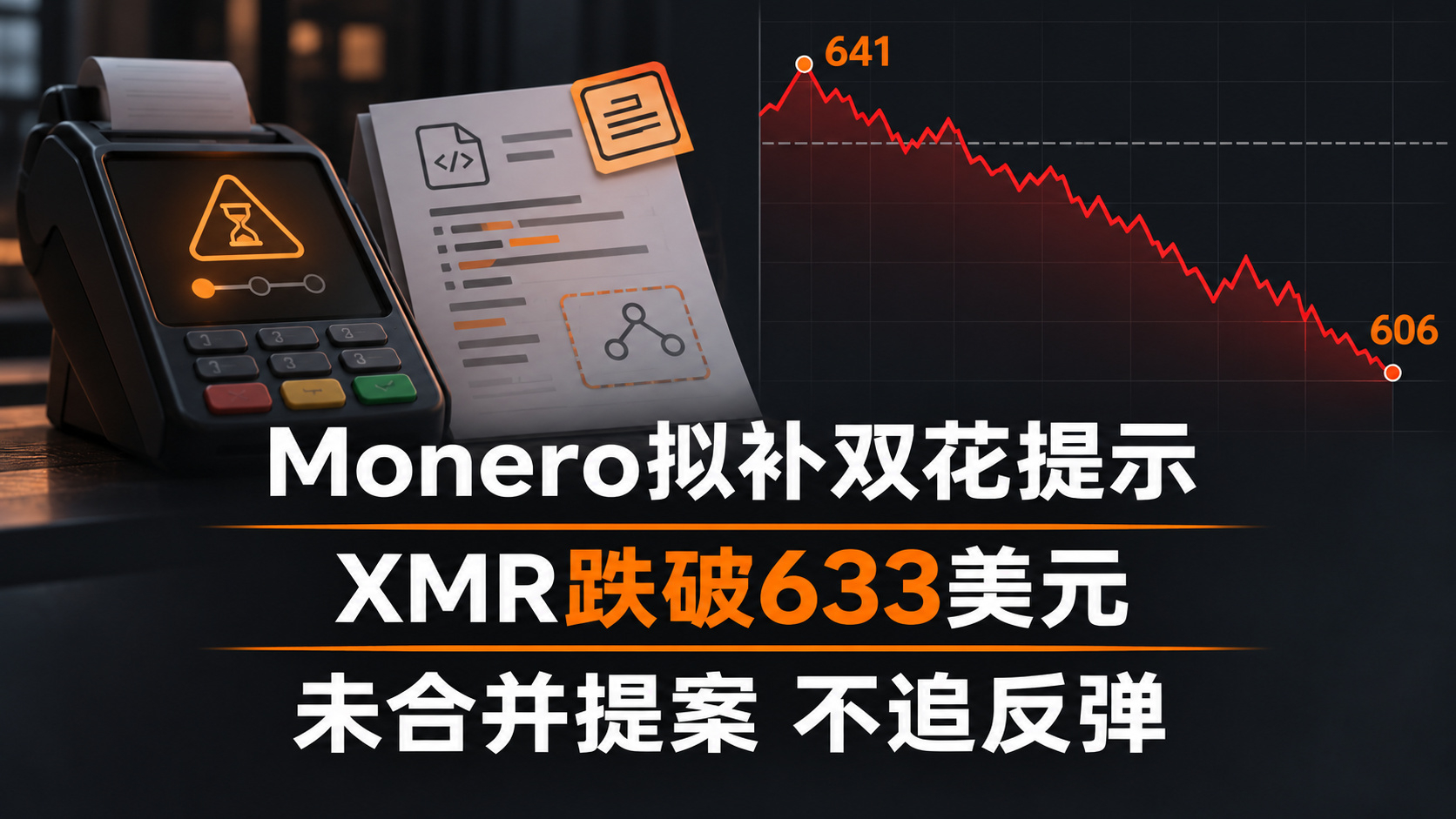
Monero proposes merchant double-spend warnings|XMR falls below prior low|Wait for confirmation before considering an entry
My stance is to take payment security seriously, but not to treat unmerged code as a short-term bullish catalyst. Monero Core PR #11679 proposes allowing the wallet API to expose the possibility that a mempool payment may be double-spent; GUI PR #4767 proposes warning merchants about potential double-spends in the payment screen, relying on the former and a submodule update. Both are open proposals in official repositories: although the Core PR has received review approval, the GUI PR is marked “next release.” It would still be inaccurate to say this is live in all wallets, let alone claim that a large-scale double-spend incident occurred on the network today. Merchants who hand over goods based solely on an unconfirmed payment are taking on real payment risk.
Seeing a payment in the mempool only means that a node has received a transaction that has not yet been included on-chain; it is not the same as final confirmation. If a conflict arises, recipients need a risk warning and their own confirmation rules. Adding information to the API and interface can help merchants identify risks, but cannot eliminate the uncertainty of accepting zero-confirmation payments. The actual experience may change only after the proposals are merged, released, and adopted by users. More reliable payment tools may support adoption, but they will not automatically bring net buying today.
At around 12:40 a.m. Beijing time on November 6, Kraken XMR/USD was about $617, with an opening price of about $641 and a low of about $606. The previous 633 watch level has been breached, and the conditional plan at 645 was not triggered; I cannot describe this as a completed purchase or a profit. Hot topics on Binance Square were mostly about exchange security, Nonfarm Payrolls, and the Zcash upgrade. I did not see a trending topic corresponding to the Monero merchant PR, so I will not attach unrelated tags. A Binance platform recovery announcement also does not imply that there is a problem with the Monero network.
The broader market backdrop still matters. On October 28, the Federal Reserve kept the target range for the federal funds rate at 3.75% to 4%. The U.S. Bureau of Labor Statistics schedule shows that the October employment report will be released at 8:30 a.m. ET on November 6. Reducing exposure to risk assets ahead of the data is one possible explanation, but it has not been proven as the cause of XMR’s decline; the Nonfarm Payrolls results are not yet available. XMR may also be affected by passive deleveraging when liquidity in the crypto market shifts. The privacy-coin narrative does not provide immunity from declines. For now, I see $606–$610, near the intraday low, as the first risk zone; if that level is decisively lost, I will watch $590. To the upside, I will first watch $625, then the breached levels of $633 and $645. My cautious view would be invalidated only if XMR regains and holds above $633 while BTC stops extending its losses. If it merely touches $625 and then retreats, I will remain defensive.
If I were trading this myself: I would not enter at current levels and would stay directionally neutral, with 0% in new positions. Only if XMR’s one-hour candle closes back above $625 and a retest holds, while the status of the relevant wallet PRs is not mistaken for a released feature, would I consider a spot long using no more than 1% of my total capital, with no leverage. The first target is $633; I would take half off near that level. I would consider $645 for the remainder only after XMR holds above $633. After entry, I would stop out if the price falls back below $615; if it breaks below $606, I would close the entire position regardless of how close it is to the target. If the trigger conditions do not occur, I will not trade.
Sources: Monero Core PR #11679, GUI PR #4767, Kraken XMR/USD market data, Federal Reserve statement, and BLS schedule; also checked Binance Square Trending and Most Searched, Binance News/Research/OTC, the SEC, Strategy, exchange security updates, and official project announcements. #XMR
This is solely my personal market observation and does not constitute investment advice.
18
Log in to explore more content
Join global crypto users on Binance Square
⚡️ Get latest and useful information about crypto.
💬 Trusted by the world’s largest crypto exchange.
👍 Discover real insights from verified creators.
Email / Phone number
Trending Topics
1
#BinanceReopensWithdrawalsForHYPE&APT
36,202 views
599 Discussing
2
#SouthKoreaDraftLawTargets15To20%ShareholderCap
40,583 views
413 Discussing
3
#TradFiForBeginners
147,676 views
1,549 Discussing
4
#KeplrAdvisesSocialLoginUsersToTransferAssets
25,892 views
385 Discussing
5
#TetherPlans€28.8MForJuventusCapitalIncrease
14,913 views
296 Discussing
6
#JobsReportRaisesHikeOdds
776,993 views
4,285 Discussing
7
#CPITestsDecemberRateOutlook
299,351 views
1,785 Discussing
8
#US Data Center Rules May Constrain AI Expansion
115,276 views
256 Discussing
9
#ARKPlans14ThematicETFsCoveringAIAndTokenizedMarkets
7,937 views
86 Discussing
10
#WillAnthropicListOnTime
248,894 views
1,834 Discussing