

#11637
11637
5 views
3 Discussing
Hot
Latest

·
--
Monero Multisig Address Protection Still Awaiting Merge | XMR Around $599 | Prioritize the Payment Process Over Chasing Updates
My stance is to watch cautiously and not treat code review as a catalyst for an XMR rally for now. PR #11637 in Monero’s official code repository proposes that wallets should not show users potentially invalid addresses before the multisig process is complete. The submitter explicitly says this is to prevent users from sharing invalid addresses. Based on the files changed, checks for multisig readiness have been added to the command-line wallet’s startup prompt, address display, and some wallet RPC response paths. The page still shows the PR as Open, with labels indicating that it needs review and backporting. Although a reviewer has approved it, we cannot say the code has been merged, the client has been released, or that this is a mainnet upgrade. The latest official wallet version listed on the project’s blog is still 0.18.5.4, released on October 16; a minor-version fix does not mean this proposal has made it into software used by the public.
This change is worth watching because the cost of mistakes in the multisig payment process is mainly operational: if participants copy a temporary address before address generation is complete, subsequent verification, payment, and recovery could all become more complicated. The proposal aims to prevent an address from being displayed until it is clearly “not yet ready,” reducing the chance that users will use an unfinished address to receive funds. It concerns wallet interaction and address validity—not a sudden improvement in XMR’s privacy algorithm—and there is no evidence of large-scale on-chain losses. For ordinary users, the more practical approach is still to wait until all multisig participants have completed the protocol, independently verify the final address, and test it with a small amount first, rather than changing their fund-management practices based on a single PR.
How has the market reacted so far? In the Kraken spot market checked for this update, XMR recently traded at around $598.86, slightly above the daily open of $597.92 but still below the daily high of $615.99. BTC was around $80,332, below its daily open of $81,287. XMR holding near the daily open does not prove that this PR has attracted buyers; a development event and a price move occurring at the same time does not establish causation. I see $597–$600 as the short-term equilibrium zone, with $605 and $616 as upside levels to watch, and $590 to the downside, followed by the intraday low of $582.03. If XMR cannot hold $597 and BTC continues to weaken, the short-term bullish thesis is invalidated. If XMR holds above $605 on increased volume, rather than just printing a brief upper wick, then the daily high becomes worth watching.
If I were trading this myself, I would sit out for now and keep only a conditional plan for a small spot long position. I would consider entering with 1% of total capital, without leverage, only if XMR moves above $605, holds $600 on a retest, and BTC does not make a new low for the day. I would take half off near the first target of $616; after a confirmed breakout, I would then look toward $625, with a trailing stop on the remainder. If the price falls back below $597 after entry, I would stop out and close the position. I would also close proactively if two attempts to break through $616 fail, or if the PR is subsequently closed and the price action weakens. Until these conditions are met, this is only a plan—not a statement that a trade has been executed or has made a profit.
Sources: Monero official GitHub PR #11637, the official version blog, and a Kraken spot price snapshot. #XMR
This is solely my personal market observation and does not constitute investment advice.

14
·
--
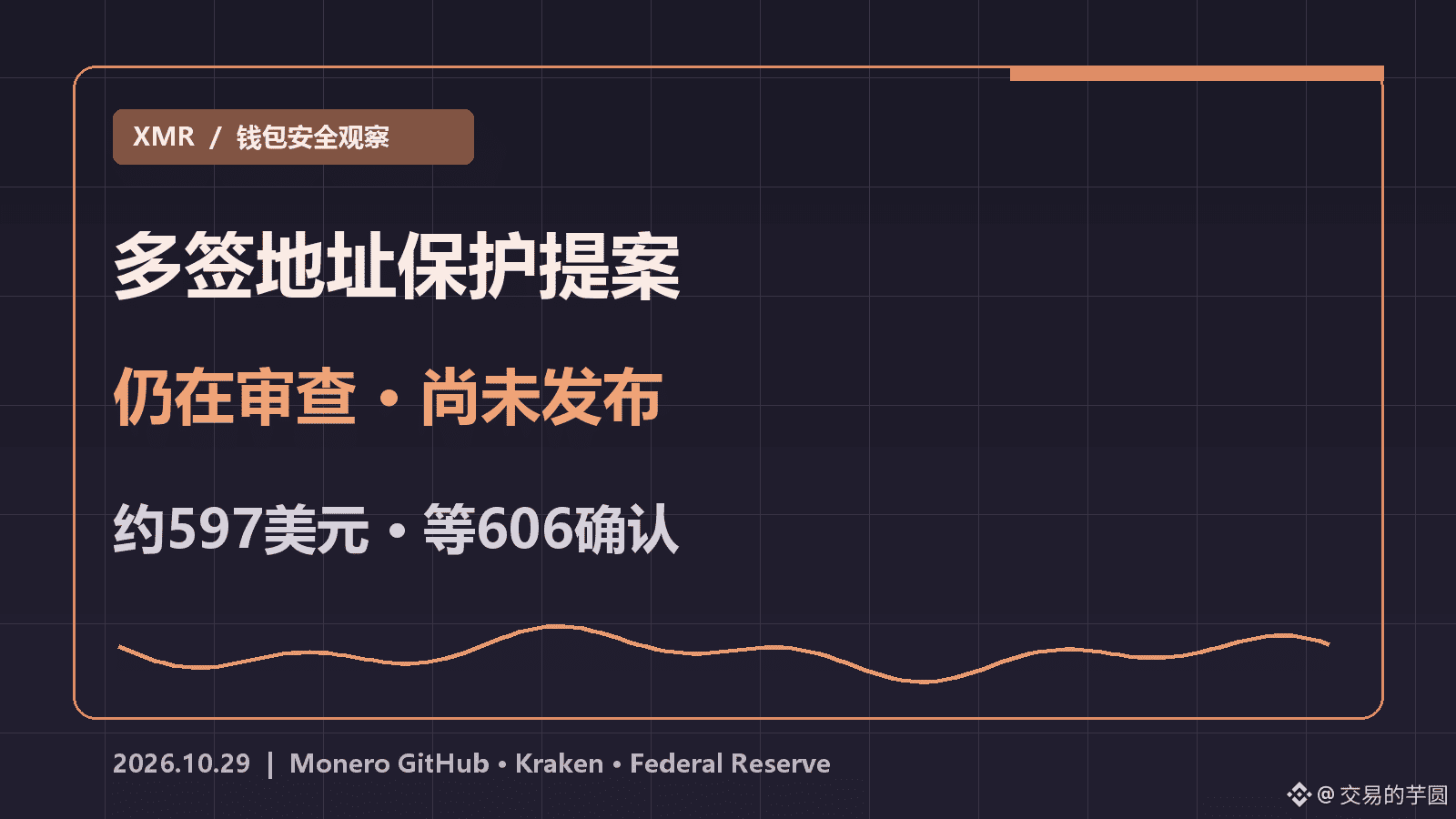
XMR Multisig Address Protection Proposal | Still Under Review, Not Released | Stay Disciplined Near $597
I’m treating this as a wallet-operation risk signal, not a reason to chase a rally based on a code proposal. On October 28, a new pull request, #11637, was added to Monero’s official code repository. Its title is about preventing incomplete multisig addresses from being displayed. The submitter states plainly in the description that users should not be allowed to share invalid addresses. I checked the changed files: the command-line wallet is proposed to hide address output until multisig setup is complete, while wallet RPC endpoints for retrieving and creating addresses are also proposed to add readiness checks. The page still shows Open and pending review. Although a reviewer has expressed support, it has not been merged, so it would be inaccurate to say that all wallets have been upgraded.
The actual mechanism is more nuanced than simply calling it “good news for security.” A multisig wallet requires participants to exchange information through a set process before setup is complete. If an address is given to a payer before that process is finished, the payment could fail or create complications in subsequent handling. The proposal concerns the boundaries of wallet interaction and display; it does not justify claiming that Monero’s mainnet consensus has been compromised, nor does it imply that large-scale losses have occurred. For multisig users, the immediate steps are to verify that wallet setup is truly complete, test with a small incoming payment, and wait for the code to be formally merged, tested, and released. A proposed fix under code review does not mean that existing versions already have this protection.
For the market, wallet usability can affect trust over the long term, but this proposal alone does not prove that new demand for XMR is emerging. This morning, Kraken’s XMR/USD was around $597.25, below the daily open near $606.12, with a 24-hour high and low of about $618.56 and $591. BTC/USD was around $81,260. XMR remains below the $600 level, indicating that the current quote has shown no sign of breaking out directly on this news. Nor can the decline be attributed to the proposal. On October 28, the Federal Reserve held its rate range at 3.75% to 4% by a 10–2 vote, with two dissenters favoring a rate hike. Against this macroeconomic backdrop, smaller-cap coins are more likely to be affected by overall risk appetite.
I’ll treat $600 as the first level to watch, look for a possible recovery of the daily open near $606, and watch around $618 to see whether there is enough trading volume to support the move. On the downside, $591 is the first level to watch. If the price falls below $591 and then fails to recover it on a rebound, my short-term bullish view is invalidated. A brief intraday move above $600 followed by a quick pullback would not count as a genuine strengthening trend either. Price action and wallet code progress must be assessed separately; an unmerged pull request is no substitute for trading evidence.
If I were trading this myself, I would stay out for now. The only direction I’d consider is a leveraged-free spot long, with no more than 2% of total capital allocated to any single trade. The entry trigger would be XMR regaining and holding $606, then retesting $600 without breaking below it, while BTC remains above $81,000. The first target would be $618, where I’d reduce the position by half. I’d hold the remainder toward $630 only if volume remains strong. The hard stop would be $590. If, after entry, the price falls back below $600 and cannot recover it, I’d close the position early. If the trigger conditions don’t appear, I’ll remain in cash and won’t present a watch plan as an executed trade. If the project announces a merge or a new release, I’ll verify that separately.
Sources: Monero’s official GitHub pull request #11637 and file changes; Kraken live market data; the Federal Reserve statement of October 28. #XMR
This is solely my personal market observation and does not constitute investment advice.
1
Log in to explore more content
Join global crypto users on Binance Square
⚡️ Get latest and useful information about crypto.
💬 Trusted by the world’s largest crypto exchange.
👍 Discover real insights from verified creators.
Email / Phone number
Trending Topics
1
#FedWatch
16.3M views
39,401 Discussing
2
#EarningsSeason
6.4M views
32,095 Discussing
3
#USMidtermElections
42,628 views
623 Discussing
4
#BitcoinDropsBelow$80K
28,741 views
119 Discussing
5
#BoEOpensConsultationOnTokenizedCollateralForClearing
618 views
29 Discussing
6
#BrazilCryptoExchangesMustApplyForLicensesByFriday
32,751 views
504 Discussing
7
#ICEPartnersWithTradeXYZToBringPerpetualContractsToUS
706 views
19 Discussing
8
#SolidusLabsReportsSuspected$170MSpoofingOnHyperliquidOilContracts
1,618 views
28 Discussing
9
#StanDruckenmillerBecomesInvestorInTradeXYZ
24,614 views
438 Discussing
10
#RussiaProposedNonCustodialWalletLimitsExcludeIntlSettlements
2,110 views
41 Discussing