
CryptonewsCom
11.5k Posts

CryptonewsCom
 Square Verified+
Report
Block User
Latest cryptocurrency news from cryptonews.com
0 Following
3.7K+ Followers
7.4K+ Liked
Posts
Article
DOGE Whales Quietly Dumped 280M Tokens While ETF Inflows Cooled: Is Rally Losing Its Real Buyers?Whales are quietly stepping back right as retail gets excited again. Dogecoin (DOGE) has bounced 3.02% over the last 24 hours to $0.090, a level analysts have flagged as decisive. Can DOGE price push through, or does this stall into another leg down? The signals beneath the bounce suggest the answer might not be what the bulls want.
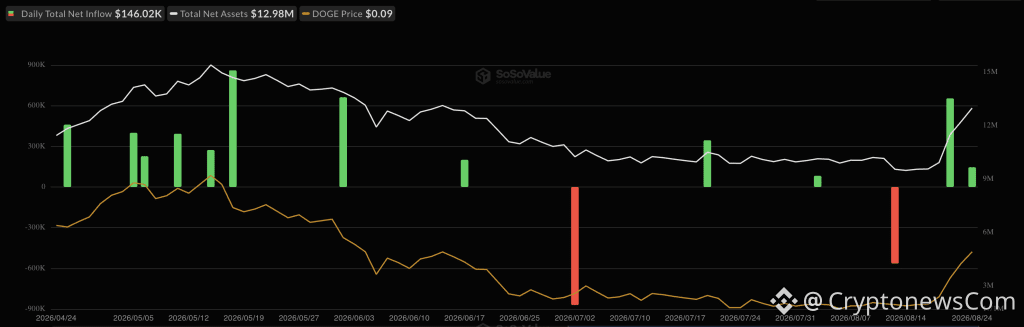
Spot Dogecoin ETFs pulled in a modest $146,020 inflow Monday, down sharply from the prior week’s $653,420. Institutional interest is present but cooling.
Source: SoSoValue
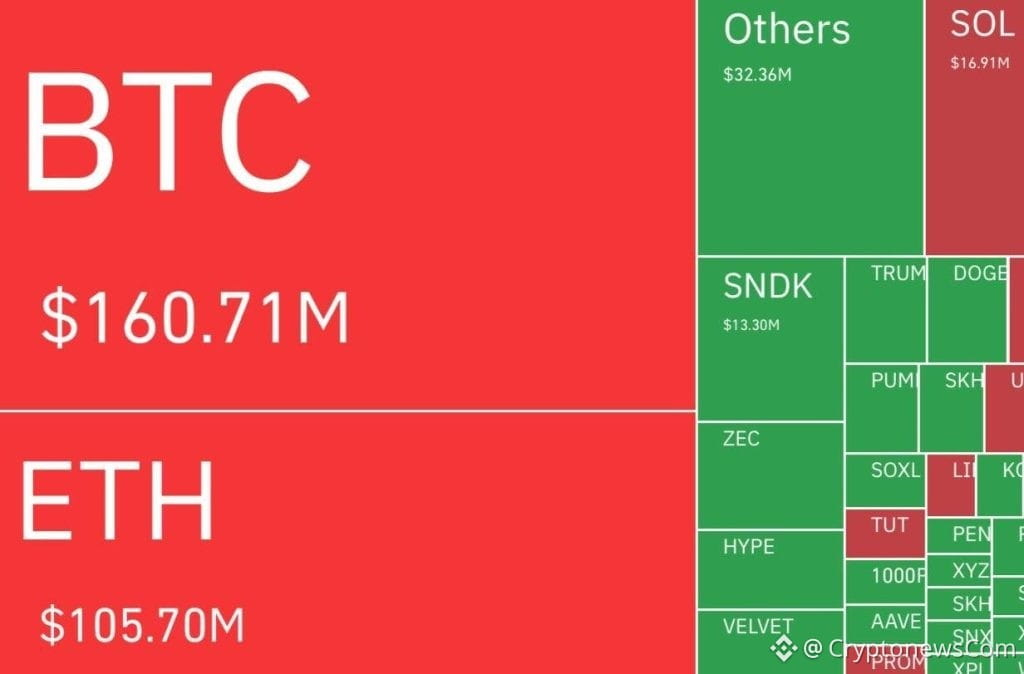
Whale behavior is even less encouraging. Wallets holding between 1 million and 100 million DOGE have shed a combined 280 million tokens since Friday. That is whales quietly de-risking into strength, not a vote of confidence after last week’s 34% rally.
Broader crypto sentiment remains choppy, with Bitcoin’s own price action still setting the tone for beta plays like DOGE. Macro liquidity conditions add another layer that traders should not ignore this week.
Dogecoin (DOGE)
24h7d30d1yAll time
Discover: The Best Crypto to Diversify Your Portfolio
Can Dogecoin Price Hit $0.10 This Week?
The chart says bullish. The positioning data says caution.
DOGE at $0.090 sits above both its 50-day EMA near $0.076 and 100-day EMA near $0.081, a structurally bullish setup on paper. The reclaimed downtrend line near $0.070 now acts as support, with immediate protection sitting at the $0.088 horizontal level.
Momentum tells a different story. RSI reads near 77, deep overbought territory, while the long-to-short ratio sits at 0.93, close to a one-month low. Traders are positioning for a pullback even as the price holds up.
A clean break above $0.094, with sustained ETF inflows, could trigger a run toward $0.10 to $0.104. Consolidation between $0.088 and $0.094, as overbought conditions cool off, is the base case. A break below $0.088 exposes the 100-day EMA near $0.081, then $0.076.
Discover: The Best Token Presales
Maxi Doge Targets Early Mover Upside as Dogecoin Tests Key Levels
DOGE holders riding last week’s 34% rally have reason to feel good, but at a market cap in the billions, a repeat of that move gets harder every time.
Whale distribution and a sub-1 long-short ratio suggest the easy gains here may already be priced in. That’s pushing more traders toward earlier-stage plays where upside isn’t capped by nine-figure liquidity.
Maxi Doge (MAXI) is one of those plays, an Ethereum-based meme token built around gym-bro trading culture and “1000x leverage” energy, literally personified as a 240-lb canine mascot.
The presale has raised $4,848,993.00 so far, with tokens priced at $0.0002835 and dynamic APY staking live for holders. Standout features include holder-only trading competitions with leaderboard rewards and a Maxi Fund treasury earmarked for liquidity and partnerships.
Get Ahead of Next Meme Coin Launch Here
The post DOGE Whales Quietly Dumped 280M Tokens While ETF Inflows Cooled: Is Rally Losing Its Real Buyers? appeared first on Cryptonews.
DOGE Whales Quietly Dumped 280M Tokens While ETF Inflows Cooled: Is Rally Losing Its Real Buyers?
Whales are quietly stepping back right as retail gets excited again. Dogecoin (DOGE) has bounced 3.02% over the last 24 hours to $0.090, a level analysts have flagged as decisive. Can DOGE price push through, or does this stall into another leg down? The signals beneath the bounce suggest the answer might not be what the bulls want.
Spot Dogecoin ETFs pulled in a modest $146,020 inflow Monday, down sharply from the prior week’s $653,420. Institutional interest is present but cooling.
Source: SoSoValue
Whale behavior is even less encouraging. Wallets holding between 1 million and 100 million DOGE have shed a combined 280 million tokens since Friday. That is whales quietly de-risking into strength, not a vote of confidence after last week’s 34% rally.
Broader crypto sentiment remains choppy, with Bitcoin’s own price action still setting the tone for beta plays like DOGE. Macro liquidity conditions add another layer that traders should not ignore this week.
Dogecoin (DOGE)
24h7d30d1yAll time
Discover: The Best Crypto to Diversify Your Portfolio
Can Dogecoin Price Hit $0.10 This Week?
The chart says bullish. The positioning data says caution.
DOGE at $0.090 sits above both its 50-day EMA near $0.076 and 100-day EMA near $0.081, a structurally bullish setup on paper. The reclaimed downtrend line near $0.070 now acts as support, with immediate protection sitting at the $0.088 horizontal level.
Momentum tells a different story. RSI reads near 77, deep overbought territory, while the long-to-short ratio sits at 0.93, close to a one-month low. Traders are positioning for a pullback even as the price holds up.
A clean break above $0.094, with sustained ETF inflows, could trigger a run toward $0.10 to $0.104. Consolidation between $0.088 and $0.094, as overbought conditions cool off, is the base case. A break below $0.088 exposes the 100-day EMA near $0.081, then $0.076.
Discover: The Best Token Presales
Maxi Doge Targets Early Mover Upside as Dogecoin Tests Key Levels
DOGE holders riding last week’s 34% rally have reason to feel good, but at a market cap in the billions, a repeat of that move gets harder every time.
Whale distribution and a sub-1 long-short ratio suggest the easy gains here may already be priced in. That’s pushing more traders toward earlier-stage plays where upside isn’t capped by nine-figure liquidity.
Maxi Doge (MAXI) is one of those plays, an Ethereum-based meme token built around gym-bro trading culture and “1000x leverage” energy, literally personified as a 240-lb canine mascot.
The presale has raised $4,848,993.00 so far, with tokens priced at $0.0002835 and dynamic APY staking live for holders. Standout features include holder-only trading competitions with leaderboard rewards and a Maxi Fund treasury earmarked for liquidity and partnerships.
Get Ahead of Next Meme Coin Launch Here
The post DOGE Whales Quietly Dumped 280M Tokens While ETF Inflows Cooled: Is Rally Losing Its Real Buyers? appeared first on Cryptonews.
Spot Dogecoin ETFs pulled in a modest $146,020 inflow Monday, down sharply from the prior week’s $653,420. Institutional interest is present but cooling.
Source: SoSoValue
Whale behavior is even less encouraging. Wallets holding between 1 million and 100 million DOGE have shed a combined 280 million tokens since Friday. That is whales quietly de-risking into strength, not a vote of confidence after last week’s 34% rally.
Broader crypto sentiment remains choppy, with Bitcoin’s own price action still setting the tone for beta plays like DOGE. Macro liquidity conditions add another layer that traders should not ignore this week.
Dogecoin (DOGE)
24h7d30d1yAll time
Discover: The Best Crypto to Diversify Your Portfolio
Can Dogecoin Price Hit $0.10 This Week?
The chart says bullish. The positioning data says caution.
DOGE at $0.090 sits above both its 50-day EMA near $0.076 and 100-day EMA near $0.081, a structurally bullish setup on paper. The reclaimed downtrend line near $0.070 now acts as support, with immediate protection sitting at the $0.088 horizontal level.
Momentum tells a different story. RSI reads near 77, deep overbought territory, while the long-to-short ratio sits at 0.93, close to a one-month low. Traders are positioning for a pullback even as the price holds up.
A clean break above $0.094, with sustained ETF inflows, could trigger a run toward $0.10 to $0.104. Consolidation between $0.088 and $0.094, as overbought conditions cool off, is the base case. A break below $0.088 exposes the 100-day EMA near $0.081, then $0.076.
Discover: The Best Token Presales
Maxi Doge Targets Early Mover Upside as Dogecoin Tests Key Levels
DOGE holders riding last week’s 34% rally have reason to feel good, but at a market cap in the billions, a repeat of that move gets harder every time.
Whale distribution and a sub-1 long-short ratio suggest the easy gains here may already be priced in. That’s pushing more traders toward earlier-stage plays where upside isn’t capped by nine-figure liquidity.
Maxi Doge (MAXI) is one of those plays, an Ethereum-based meme token built around gym-bro trading culture and “1000x leverage” energy, literally personified as a 240-lb canine mascot.
The presale has raised $4,848,993.00 so far, with tokens priced at $0.0002835 and dynamic APY staking live for holders. Standout features include holder-only trading competitions with leaderboard rewards and a Maxi Fund treasury earmarked for liquidity and partnerships.
Get Ahead of Next Meme Coin Launch Here
The post DOGE Whales Quietly Dumped 280M Tokens While ETF Inflows Cooled: Is Rally Losing Its Real Buyers? appeared first on Cryptonews.
41
Article
Bitcoin Price Prediction: BTC Broke $80,000 for First Time in 15 WeeksBitcoin just punched through $80,000 for the first time in almost 15 weeks. This is very bullish for Bitcoin price prediction, and the mechanics behind the move matter more than the headline number.
This is one of the sharpest 8-day advances Bitcoin has posted since 2021. Price is trading near $80,513, up roughly 2.02% on the day, but the real story is underneath the surface.
The rally has added an estimated $350 billion to Bitcoin’s market cap since late July, driven by renewed spot ETF inflows, a shift in Treasury buyback policy, and a wave of forced short covering.
Source: CT
Liquidation trackers show roughly $335 million in BTC positions wiped out, nearly 84% of them shorts. That is a squeeze, not pure conviction buying.
Bitcoin has now clawed back 38% from its July 1 low near $57,700, erasing the entire May drawdown. But price has walked straight into the same resistance shelf that rejected rallies earlier this year.
What happens at that ceiling determines the next leg, and for anyone tracking early-stage plays, it also reframes where the better risk-adjusted upside might actually sit.
Bitcoin (BTC)
24h7d30d1yAll time
Discover: The Best Crypto to Diversify Your Portfolio
Bitcoin Price Prediction: Can Bitcoin Price Hit $82,000 This Week?
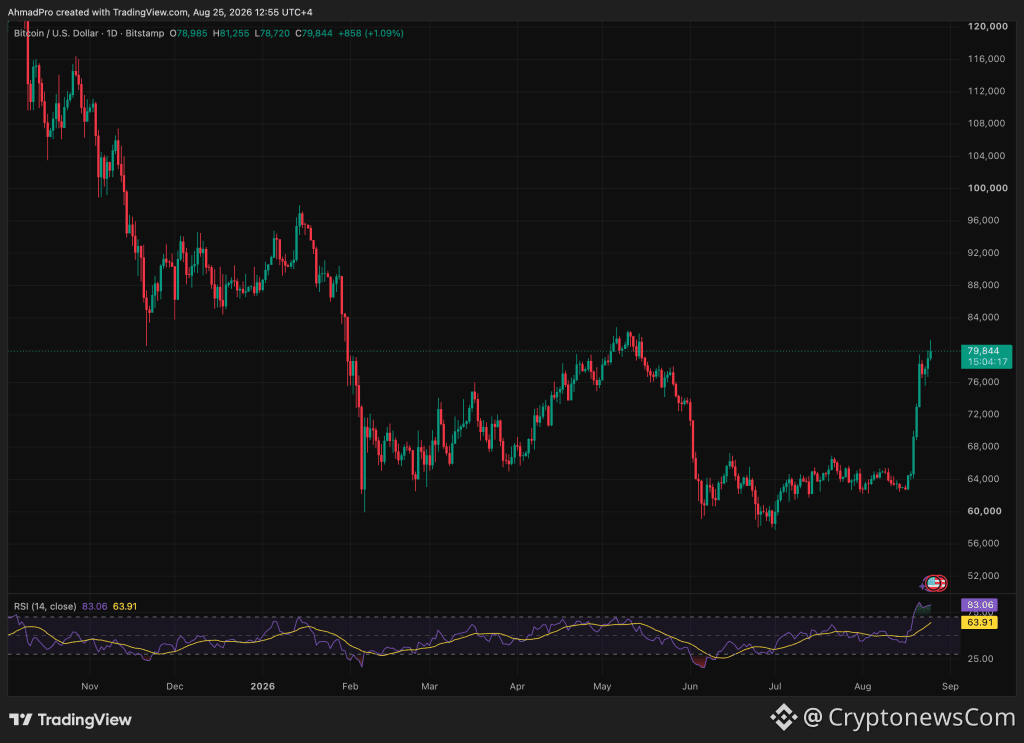
BTC is sitting at $79,786 on the daily chart, and the move that has happened over the past week is the most explosive and convincing recovery attempt since the January peak, with price launching from the $60,000 base and pushing nearly $20,000 higher in a matter of days.
The $80,000 level is the immediate test, being the dotted line on the chart that marks the prior support zone from the February to March period, and a clean daily close above it would be the most significant technical development in months.
What makes this move different from the previous recovery attempts in March and May is the speed and scale of it, those rallies were gradual grinds that faded at lower levels, whereas this one has momentum and is pushing into real resistance zones without showing signs of stalling yet.
The $84,000 to $85,000 range is the next major resistance above, being where the May recovery peaked and rolled over, and that is the level that would need to flip for the conversation to shift from recovery to genuine trend reversal.
On the downside, $72,000 to $74,000 is the first support from the breakout zone, and $65,000 below that is where the base was built throughout July, which needs to hold on any pullback to keep the structure intact.
The risk here is that the move has been very fast and sharp, and a cooling-off period or retest of $74,000 to $76,000 before the next leg would actually be healthy for the setup.
But the direction has changed, and $80,000 is the line that confirms it.
Don’t Miss Out on Our $1,000 USDT Airdrop on ByBitBitcoin Hyper Targets Early Mover Upside as Bitcoin Tests Key Levels
An 8-day, 28% rally that erased months of losses is a strong result, no argument there. But buying Bitcoin at an $80,000+ market cap denominator means outsized percentage moves get structurally harder, the asset has to move mountains to double from here.
That math is exactly why traders rotate a slice of capital toward earlier-stage infrastructure plays while BTC consolidates at resistance, and why Bitcoin Hyper (HYPER) has been picking up presale attention alongside the spot rally.
Bitcoin Hyper bills itself as the first Bitcoin Layer 2 with SVM integration, smart contracts running faster than Solana itself, settled through a decentralized canonical bridge back to BTC.
It’s currently priced at $0.0136852, with $33,080,369.89 raised so far and staking rewards live at launch. The pitch: fast, cheap, programmable Bitcoin without sacrificing base-layer security.
Unlock Access to Bitcoin’s New Layer 2 Here
Discover: The Best Token Presales
The post Bitcoin Price Prediction: BTC Broke $80,000 for First Time in 15 Weeks appeared first on Cryptonews.
Bitcoin Price Prediction: BTC Broke $80,000 for First Time in 15 Weeks
Bitcoin just punched through $80,000 for the first time in almost 15 weeks. This is very bullish for Bitcoin price prediction, and the mechanics behind the move matter more than the headline number.
This is one of the sharpest 8-day advances Bitcoin has posted since 2021. Price is trading near $80,513, up roughly 2.02% on the day, but the real story is underneath the surface.
The rally has added an estimated $350 billion to Bitcoin’s market cap since late July, driven by renewed spot ETF inflows, a shift in Treasury buyback policy, and a wave of forced short covering.
Source: CT
Liquidation trackers show roughly $335 million in BTC positions wiped out, nearly 84% of them shorts. That is a squeeze, not pure conviction buying.
Bitcoin has now clawed back 38% from its July 1 low near $57,700, erasing the entire May drawdown. But price has walked straight into the same resistance shelf that rejected rallies earlier this year.
What happens at that ceiling determines the next leg, and for anyone tracking early-stage plays, it also reframes where the better risk-adjusted upside might actually sit.
Bitcoin (BTC)
24h7d30d1yAll time
Discover: The Best Crypto to Diversify Your Portfolio
Bitcoin Price Prediction: Can Bitcoin Price Hit $82,000 This Week?
BTC is sitting at $79,786 on the daily chart, and the move that has happened over the past week is the most explosive and convincing recovery attempt since the January peak, with price launching from the $60,000 base and pushing nearly $20,000 higher in a matter of days.
The $80,000 level is the immediate test, being the dotted line on the chart that marks the prior support zone from the February to March period, and a clean daily close above it would be the most significant technical development in months.
What makes this move different from the previous recovery attempts in March and May is the speed and scale of it, those rallies were gradual grinds that faded at lower levels, whereas this one has momentum and is pushing into real resistance zones without showing signs of stalling yet.
The $84,000 to $85,000 range is the next major resistance above, being where the May recovery peaked and rolled over, and that is the level that would need to flip for the conversation to shift from recovery to genuine trend reversal.
On the downside, $72,000 to $74,000 is the first support from the breakout zone, and $65,000 below that is where the base was built throughout July, which needs to hold on any pullback to keep the structure intact.
The risk here is that the move has been very fast and sharp, and a cooling-off period or retest of $74,000 to $76,000 before the next leg would actually be healthy for the setup.
But the direction has changed, and $80,000 is the line that confirms it.
Don’t Miss Out on Our $1,000 USDT Airdrop on ByBitBitcoin Hyper Targets Early Mover Upside as Bitcoin Tests Key Levels
An 8-day, 28% rally that erased months of losses is a strong result, no argument there. But buying Bitcoin at an $80,000+ market cap denominator means outsized percentage moves get structurally harder, the asset has to move mountains to double from here.
That math is exactly why traders rotate a slice of capital toward earlier-stage infrastructure plays while BTC consolidates at resistance, and why Bitcoin Hyper (HYPER) has been picking up presale attention alongside the spot rally.
Bitcoin Hyper bills itself as the first Bitcoin Layer 2 with SVM integration, smart contracts running faster than Solana itself, settled through a decentralized canonical bridge back to BTC.
It’s currently priced at $0.0136852, with $33,080,369.89 raised so far and staking rewards live at launch. The pitch: fast, cheap, programmable Bitcoin without sacrificing base-layer security.
Unlock Access to Bitcoin’s New Layer 2 Here
Discover: The Best Token Presales
The post Bitcoin Price Prediction: BTC Broke $80,000 for First Time in 15 Weeks appeared first on Cryptonews.
This is one of the sharpest 8-day advances Bitcoin has posted since 2021. Price is trading near $80,513, up roughly 2.02% on the day, but the real story is underneath the surface.
The rally has added an estimated $350 billion to Bitcoin’s market cap since late July, driven by renewed spot ETF inflows, a shift in Treasury buyback policy, and a wave of forced short covering.
Source: CT
Liquidation trackers show roughly $335 million in BTC positions wiped out, nearly 84% of them shorts. That is a squeeze, not pure conviction buying.
Bitcoin has now clawed back 38% from its July 1 low near $57,700, erasing the entire May drawdown. But price has walked straight into the same resistance shelf that rejected rallies earlier this year.
What happens at that ceiling determines the next leg, and for anyone tracking early-stage plays, it also reframes where the better risk-adjusted upside might actually sit.
Bitcoin (BTC)
24h7d30d1yAll time
Discover: The Best Crypto to Diversify Your Portfolio
Bitcoin Price Prediction: Can Bitcoin Price Hit $82,000 This Week?
BTC is sitting at $79,786 on the daily chart, and the move that has happened over the past week is the most explosive and convincing recovery attempt since the January peak, with price launching from the $60,000 base and pushing nearly $20,000 higher in a matter of days.
The $80,000 level is the immediate test, being the dotted line on the chart that marks the prior support zone from the February to March period, and a clean daily close above it would be the most significant technical development in months.
What makes this move different from the previous recovery attempts in March and May is the speed and scale of it, those rallies were gradual grinds that faded at lower levels, whereas this one has momentum and is pushing into real resistance zones without showing signs of stalling yet.
The $84,000 to $85,000 range is the next major resistance above, being where the May recovery peaked and rolled over, and that is the level that would need to flip for the conversation to shift from recovery to genuine trend reversal.
On the downside, $72,000 to $74,000 is the first support from the breakout zone, and $65,000 below that is where the base was built throughout July, which needs to hold on any pullback to keep the structure intact.
The risk here is that the move has been very fast and sharp, and a cooling-off period or retest of $74,000 to $76,000 before the next leg would actually be healthy for the setup.
But the direction has changed, and $80,000 is the line that confirms it.
Don’t Miss Out on Our $1,000 USDT Airdrop on ByBitBitcoin Hyper Targets Early Mover Upside as Bitcoin Tests Key Levels
An 8-day, 28% rally that erased months of losses is a strong result, no argument there. But buying Bitcoin at an $80,000+ market cap denominator means outsized percentage moves get structurally harder, the asset has to move mountains to double from here.
That math is exactly why traders rotate a slice of capital toward earlier-stage infrastructure plays while BTC consolidates at resistance, and why Bitcoin Hyper (HYPER) has been picking up presale attention alongside the spot rally.
Bitcoin Hyper bills itself as the first Bitcoin Layer 2 with SVM integration, smart contracts running faster than Solana itself, settled through a decentralized canonical bridge back to BTC.
It’s currently priced at $0.0136852, with $33,080,369.89 raised so far and staking rewards live at launch. The pitch: fast, cheap, programmable Bitcoin without sacrificing base-layer security.
Unlock Access to Bitcoin’s New Layer 2 Here
Discover: The Best Token Presales
The post Bitcoin Price Prediction: BTC Broke $80,000 for First Time in 15 Weeks appeared first on Cryptonews.
86
Bitcoin News: ETF Demand and Short Covering Power August RallyBitcoin rose above $80,000 today, reaching more than a three-month high as softer U.S. dollar news revived momentum in the crypto sector. The cryptocurrency was last trading at $80,300 after touching $81,200. It had risen 16% since the prior week.
The move has drawn attention to two forces behind the rally: demand through U.S. spot Bitcoin exchange-traded funds and the unwinding of bearish positions as prices climbed.
Bitcoin (BTC)
24h7d30d1yAll time
This month, the U.S. Treasury doubled its support for longer-dated government bonds, increasing its buyback program from $2 billion to $4 billion. The move does not directly expand the money supply, but it may put downward pressure on long-term yields and can be viewed by markets as having an easing-like effect.
The announcement helped revive discussion of the debasement trade, in which investors seek assets seen as protection against a weaker dollar, persistent deficits, and inflation. Bitcoin’s fixed supply of 21 million coins is part of its appeal to investors who view scarce assets as a hedge against currency weakness.
Dollar weakness accompanied the move. The ICE U.S. Dollar Index fell 0.8% during the week after the Treasury announcement. Gold also moved above its 200-day moving average, which was near $4,518 an ounce, over the same period.
Discover: The Best Token Presales
ETF Flows and Short Covering
U.S. spot Bitcoin ETFs recorded $517 million in net inflows on August 19, their strongest day since May. The funds drew roughly $1 billion in net inflows during the first two weeks of August 2026.
A Bitcoin BTC/USD trading chart illustrating the use of Bollinger Bands for volatility analysis.
Short covering added to the speed of Bitcoin’s advance. Roughly $1.5 billion in Bitcoin short positions were liquidated as prices rose, with about $700 million cleared in a single minute. When traders with short positions exit their positions, the buying needed to close them can add pressure on an upward price move.
The combination of ETF demand and short liquidations helps explain the scale of the rally. The ETF news reflects flows into regulated products that allow investors to gain Bitcoin exposure through brokerage accounts without directly holding the cryptocurrency.
Trade Crypto on Kraken Now!
Bitcoin Pumps, But Bond Yields News Remain in Focus
The Treasury said its larger buyback operations for longer-dated Treasurys would begin September 9 and were intended to provide greater liquidity support. The initial positive reaction in the bond market reversed the following day, however.
The 10-year Treasury yield rose to 4.737%, while the 30-year yield increased to 5.276%, according to Dow Jones Market Data cited by MarketWatch. Those levels brought the rates back to around where they stood before the buyback announcement.
Ian Lyngen, head of U.S. rates strategy at BMO, said concerns over de-dollarization, U.S. creditworthiness, and the need for a higher term premium remained central to the recent bond selloff. His assessment underscored skepticism that the Treasury’s buyback adjustment had changed the underlying drivers of rising yields.
A sustained break could put Bitcoin’s next test in the $95,000 to $100,000 range, but no analyst can reliably determine whether the rally will continue. For now, the August move has highlighted how macroeconomic expectations, ETF flows, and market positioning can converge.
The Treasury action was viewed by some market participants as easing-like, while Bitcoin’s fixed supply kept it in focus alongside gold as investors weighed dollar weakness and inflation concerns.
Discover: The Best Crypto to Diversify Your Portfolio
The post Bitcoin News: ETF Demand and Short Covering Power August Rally appeared first on Cryptonews.
Bitcoin News: ETF Demand and Short Covering Power August Rally
Bitcoin rose above $80,000 today, reaching more than a three-month high as softer U.S. dollar news revived momentum in the crypto sector. The cryptocurrency was last trading at $80,300 after touching $81,200. It had risen 16% since the prior week.
The move has drawn attention to two forces behind the rally: demand through U.S. spot Bitcoin exchange-traded funds and the unwinding of bearish positions as prices climbed.
Bitcoin (BTC)
24h7d30d1yAll time
This month, the U.S. Treasury doubled its support for longer-dated government bonds, increasing its buyback program from $2 billion to $4 billion. The move does not directly expand the money supply, but it may put downward pressure on long-term yields and can be viewed by markets as having an easing-like effect.
The announcement helped revive discussion of the debasement trade, in which investors seek assets seen as protection against a weaker dollar, persistent deficits, and inflation. Bitcoin’s fixed supply of 21 million coins is part of its appeal to investors who view scarce assets as a hedge against currency weakness.
Dollar weakness accompanied the move. The ICE U.S. Dollar Index fell 0.8% during the week after the Treasury announcement. Gold also moved above its 200-day moving average, which was near $4,518 an ounce, over the same period.
Discover: The Best Token Presales
ETF Flows and Short Covering
U.S. spot Bitcoin ETFs recorded $517 million in net inflows on August 19, their strongest day since May. The funds drew roughly $1 billion in net inflows during the first two weeks of August 2026.
A Bitcoin BTC/USD trading chart illustrating the use of Bollinger Bands for volatility analysis.
Short covering added to the speed of Bitcoin’s advance. Roughly $1.5 billion in Bitcoin short positions were liquidated as prices rose, with about $700 million cleared in a single minute. When traders with short positions exit their positions, the buying needed to close them can add pressure on an upward price move.
The combination of ETF demand and short liquidations helps explain the scale of the rally. The ETF news reflects flows into regulated products that allow investors to gain Bitcoin exposure through brokerage accounts without directly holding the cryptocurrency.
Trade Crypto on Kraken Now!
Bitcoin Pumps, But Bond Yields News Remain in Focus
The Treasury said its larger buyback operations for longer-dated Treasurys would begin September 9 and were intended to provide greater liquidity support. The initial positive reaction in the bond market reversed the following day, however.
The 10-year Treasury yield rose to 4.737%, while the 30-year yield increased to 5.276%, according to Dow Jones Market Data cited by MarketWatch. Those levels brought the rates back to around where they stood before the buyback announcement.
Ian Lyngen, head of U.S. rates strategy at BMO, said concerns over de-dollarization, U.S. creditworthiness, and the need for a higher term premium remained central to the recent bond selloff. His assessment underscored skepticism that the Treasury’s buyback adjustment had changed the underlying drivers of rising yields.
A sustained break could put Bitcoin’s next test in the $95,000 to $100,000 range, but no analyst can reliably determine whether the rally will continue. For now, the August move has highlighted how macroeconomic expectations, ETF flows, and market positioning can converge.
The Treasury action was viewed by some market participants as easing-like, while Bitcoin’s fixed supply kept it in focus alongside gold as investors weighed dollar weakness and inflation concerns.
Discover: The Best Crypto to Diversify Your Portfolio
The post Bitcoin News: ETF Demand and Short Covering Power August Rally appeared first on Cryptonews.
The move has drawn attention to two forces behind the rally: demand through U.S. spot Bitcoin exchange-traded funds and the unwinding of bearish positions as prices climbed.
Bitcoin (BTC)
24h7d30d1yAll time
This month, the U.S. Treasury doubled its support for longer-dated government bonds, increasing its buyback program from $2 billion to $4 billion. The move does not directly expand the money supply, but it may put downward pressure on long-term yields and can be viewed by markets as having an easing-like effect.
The announcement helped revive discussion of the debasement trade, in which investors seek assets seen as protection against a weaker dollar, persistent deficits, and inflation. Bitcoin’s fixed supply of 21 million coins is part of its appeal to investors who view scarce assets as a hedge against currency weakness.
Dollar weakness accompanied the move. The ICE U.S. Dollar Index fell 0.8% during the week after the Treasury announcement. Gold also moved above its 200-day moving average, which was near $4,518 an ounce, over the same period.
Discover: The Best Token Presales
ETF Flows and Short Covering
U.S. spot Bitcoin ETFs recorded $517 million in net inflows on August 19, their strongest day since May. The funds drew roughly $1 billion in net inflows during the first two weeks of August 2026.
A Bitcoin BTC/USD trading chart illustrating the use of Bollinger Bands for volatility analysis.
Short covering added to the speed of Bitcoin’s advance. Roughly $1.5 billion in Bitcoin short positions were liquidated as prices rose, with about $700 million cleared in a single minute. When traders with short positions exit their positions, the buying needed to close them can add pressure on an upward price move.
The combination of ETF demand and short liquidations helps explain the scale of the rally. The ETF news reflects flows into regulated products that allow investors to gain Bitcoin exposure through brokerage accounts without directly holding the cryptocurrency.
Trade Crypto on Kraken Now!
Bitcoin Pumps, But Bond Yields News Remain in Focus
The Treasury said its larger buyback operations for longer-dated Treasurys would begin September 9 and were intended to provide greater liquidity support. The initial positive reaction in the bond market reversed the following day, however.
The 10-year Treasury yield rose to 4.737%, while the 30-year yield increased to 5.276%, according to Dow Jones Market Data cited by MarketWatch. Those levels brought the rates back to around where they stood before the buyback announcement.
Ian Lyngen, head of U.S. rates strategy at BMO, said concerns over de-dollarization, U.S. creditworthiness, and the need for a higher term premium remained central to the recent bond selloff. His assessment underscored skepticism that the Treasury’s buyback adjustment had changed the underlying drivers of rising yields.
A sustained break could put Bitcoin’s next test in the $95,000 to $100,000 range, but no analyst can reliably determine whether the rally will continue. For now, the August move has highlighted how macroeconomic expectations, ETF flows, and market positioning can converge.
The Treasury action was viewed by some market participants as easing-like, while Bitcoin’s fixed supply kept it in focus alongside gold as investors weighed dollar weakness and inflation concerns.
Discover: The Best Crypto to Diversify Your Portfolio
The post Bitcoin News: ETF Demand and Short Covering Power August Rally appeared first on Cryptonews.
49

Article
Supply Shock? SOL Voters Are Deciding Whether to Cut Emissions and 14x the Burn RateIn the latest Solana news, 3 governance proposals capable of reshaping the network’s supply dynamics head into their final voting window. Voting closes at the end of epoch 1023 on Thursday, a deadline that has quietly become one of the more consequential dates on Solana’s 2026 calendar.
The vote covers a “Solana Constitution” governance framework, a disinflation proposal targeting an 18.9 million SOL emissions cut over 6 years, and a resource fee mechanism designed to push daily SOL burning from roughly 648 to 9,000 tokens.
That is a burn rate increase of nearly 14x. A bullish supply shock narrative is forming around the vote, suggesting traders are front-running the tightening float before implementation even lands.
The timing matters. Broader crypto sentiment has been choppy, yet SOL has decoupled to the upside, a divergence worth watching as governance-driven scarcity narratives collide with technical resistance overhead.
JUST IN: Voting is now live on 3 major @Solana governance proposals and will remain open until the end of epoch 1023 on Thursday
SGP 1: “Solana Constitution,” a new governance framework
SGP 2: doubles disinflation, cutting ~18.9M $SOL (~$1.7B) emissions over 6 years
… pic.twitter.com/f2ZzZ147Le
— SolanaFloor (@SolanaFloor) August 23, 2026
Gain Access to New Bitcoin Layer 2 Early HereSolana News: Can SOL Price Hit $105 This Week?
SOL’s daily bar for August 25 opened at $98.64, ran to a high of $102.14, and closed near $101.22. The 7-day gain sits at 31.87%, and the 30-day move is near 35.6%. This is not a single-day spike. It is a sustained trend.
Resistance clusters between $100 and $105.18, with a 13-week high sitting around $102.70. Support has layered in beneath at $88.18, with deeper structural support near $82 to $88 where the EMA20/EMA50 clusters previously held.
Source: SOLUSD / Tradingview
A close above $102.70 opens room toward $105 and beyond, especially if the disinflation vote passes cleanly. SOL consolidating between $95 and $102 as traders wait for Thursday’s epoch close before committing further capital is the base case. Rejection at resistance sends price back to retest the $88 to $90 pivot zone and invalidates the current breakout structure.
Traders watching for confirmation should track volume on any push through $102.70. A low-volume breakout would be a red flag.
Gain Access to New Bitcoin Layer 2 Early HereBitcoin Hyper Targets Early Mover Upside as Solana Tests Key Levels
A 31.87% weekly rally validates anyone who bought SOL below $80. But at a market cap already pricing in governance-driven scarcity, the remaining upside to $105 is single-digit percentage territory — not the kind of asymmetric return early-stage capital typically hunts for.
That’s pushed attention toward Bitcoin’s own scaling gap, one Solana effectively exploited years ago with its throughput advantage.
Bitcoin Hyper (HYPER) is positioning itself as the first Bitcoin Layer 2 with native SVM integration, smart contract speed on top of Bitcoin’s security, without the base-layer bottlenecks.
The presale has raised $33,080,369.89 at a current token price of $0.0136852, with staking rewards live at launch (APY not yet disclosed). Its Decentralized Canonical Bridge aims to solve BTC’s programmability gap directly, the same limitation that pushed capital toward Solana and Ethereum in the first place.
Presale allocations carry standard early-stage risk: no live mainnet yet, and returns depend on execution. Full breakdown of the raise and Layer-2 mechanics is covered in this presale assignment report.
Unlock Access to Bitcoin’s New Layer 2 Here
The post Supply Shock? SOL Voters Are Deciding Whether to Cut Emissions and 14x the Burn Rate appeared first on Cryptonews.
Supply Shock? SOL Voters Are Deciding Whether to Cut Emissions and 14x the Burn Rate
In the latest Solana news, 3 governance proposals capable of reshaping the network’s supply dynamics head into their final voting window. Voting closes at the end of epoch 1023 on Thursday, a deadline that has quietly become one of the more consequential dates on Solana’s 2026 calendar.
The vote covers a “Solana Constitution” governance framework, a disinflation proposal targeting an 18.9 million SOL emissions cut over 6 years, and a resource fee mechanism designed to push daily SOL burning from roughly 648 to 9,000 tokens.
That is a burn rate increase of nearly 14x. A bullish supply shock narrative is forming around the vote, suggesting traders are front-running the tightening float before implementation even lands.
The timing matters. Broader crypto sentiment has been choppy, yet SOL has decoupled to the upside, a divergence worth watching as governance-driven scarcity narratives collide with technical resistance overhead.
JUST IN: Voting is now live on 3 major @Solana governance proposals and will remain open until the end of epoch 1023 on Thursday
SGP 1: “Solana Constitution,” a new governance framework
SGP 2: doubles disinflation, cutting ~18.9M $SOL (~$1.7B) emissions over 6 years
… pic.twitter.com/f2ZzZ147Le
— SolanaFloor (@SolanaFloor) August 23, 2026
Gain Access to New Bitcoin Layer 2 Early HereSolana News: Can SOL Price Hit $105 This Week?
SOL’s daily bar for August 25 opened at $98.64, ran to a high of $102.14, and closed near $101.22. The 7-day gain sits at 31.87%, and the 30-day move is near 35.6%. This is not a single-day spike. It is a sustained trend.
Resistance clusters between $100 and $105.18, with a 13-week high sitting around $102.70. Support has layered in beneath at $88.18, with deeper structural support near $82 to $88 where the EMA20/EMA50 clusters previously held.
Source: SOLUSD / Tradingview
A close above $102.70 opens room toward $105 and beyond, especially if the disinflation vote passes cleanly. SOL consolidating between $95 and $102 as traders wait for Thursday’s epoch close before committing further capital is the base case. Rejection at resistance sends price back to retest the $88 to $90 pivot zone and invalidates the current breakout structure.
Traders watching for confirmation should track volume on any push through $102.70. A low-volume breakout would be a red flag.
Gain Access to New Bitcoin Layer 2 Early HereBitcoin Hyper Targets Early Mover Upside as Solana Tests Key Levels
A 31.87% weekly rally validates anyone who bought SOL below $80. But at a market cap already pricing in governance-driven scarcity, the remaining upside to $105 is single-digit percentage territory — not the kind of asymmetric return early-stage capital typically hunts for.
That’s pushed attention toward Bitcoin’s own scaling gap, one Solana effectively exploited years ago with its throughput advantage.
Bitcoin Hyper (HYPER) is positioning itself as the first Bitcoin Layer 2 with native SVM integration, smart contract speed on top of Bitcoin’s security, without the base-layer bottlenecks.
The presale has raised $33,080,369.89 at a current token price of $0.0136852, with staking rewards live at launch (APY not yet disclosed). Its Decentralized Canonical Bridge aims to solve BTC’s programmability gap directly, the same limitation that pushed capital toward Solana and Ethereum in the first place.
Presale allocations carry standard early-stage risk: no live mainnet yet, and returns depend on execution. Full breakdown of the raise and Layer-2 mechanics is covered in this presale assignment report.
Unlock Access to Bitcoin’s New Layer 2 Here
The post Supply Shock? SOL Voters Are Deciding Whether to Cut Emissions and 14x the Burn Rate appeared first on Cryptonews.
The vote covers a “Solana Constitution” governance framework, a disinflation proposal targeting an 18.9 million SOL emissions cut over 6 years, and a resource fee mechanism designed to push daily SOL burning from roughly 648 to 9,000 tokens.
That is a burn rate increase of nearly 14x. A bullish supply shock narrative is forming around the vote, suggesting traders are front-running the tightening float before implementation even lands.
The timing matters. Broader crypto sentiment has been choppy, yet SOL has decoupled to the upside, a divergence worth watching as governance-driven scarcity narratives collide with technical resistance overhead.
JUST IN: Voting is now live on 3 major @Solana governance proposals and will remain open until the end of epoch 1023 on Thursday
SGP 1: “Solana Constitution,” a new governance framework
SGP 2: doubles disinflation, cutting ~18.9M $SOL (~$1.7B) emissions over 6 years
… pic.twitter.com/f2ZzZ147Le
— SolanaFloor (@SolanaFloor) August 23, 2026
Gain Access to New Bitcoin Layer 2 Early HereSolana News: Can SOL Price Hit $105 This Week?
SOL’s daily bar for August 25 opened at $98.64, ran to a high of $102.14, and closed near $101.22. The 7-day gain sits at 31.87%, and the 30-day move is near 35.6%. This is not a single-day spike. It is a sustained trend.
Resistance clusters between $100 and $105.18, with a 13-week high sitting around $102.70. Support has layered in beneath at $88.18, with deeper structural support near $82 to $88 where the EMA20/EMA50 clusters previously held.
Source: SOLUSD / Tradingview
A close above $102.70 opens room toward $105 and beyond, especially if the disinflation vote passes cleanly. SOL consolidating between $95 and $102 as traders wait for Thursday’s epoch close before committing further capital is the base case. Rejection at resistance sends price back to retest the $88 to $90 pivot zone and invalidates the current breakout structure.
Traders watching for confirmation should track volume on any push through $102.70. A low-volume breakout would be a red flag.
Gain Access to New Bitcoin Layer 2 Early HereBitcoin Hyper Targets Early Mover Upside as Solana Tests Key Levels
A 31.87% weekly rally validates anyone who bought SOL below $80. But at a market cap already pricing in governance-driven scarcity, the remaining upside to $105 is single-digit percentage territory — not the kind of asymmetric return early-stage capital typically hunts for.
That’s pushed attention toward Bitcoin’s own scaling gap, one Solana effectively exploited years ago with its throughput advantage.
Bitcoin Hyper (HYPER) is positioning itself as the first Bitcoin Layer 2 with native SVM integration, smart contract speed on top of Bitcoin’s security, without the base-layer bottlenecks.
The presale has raised $33,080,369.89 at a current token price of $0.0136852, with staking rewards live at launch (APY not yet disclosed). Its Decentralized Canonical Bridge aims to solve BTC’s programmability gap directly, the same limitation that pushed capital toward Solana and Ethereum in the first place.
Presale allocations carry standard early-stage risk: no live mainnet yet, and returns depend on execution. Full breakdown of the raise and Layer-2 mechanics is covered in this presale assignment report.
Unlock Access to Bitcoin’s New Layer 2 Here
The post Supply Shock? SOL Voters Are Deciding Whether to Cut Emissions and 14x the Burn Rate appeared first on Cryptonews.
72

Article
Pepperstone Crypto Offers $476K Porsche 911 GTS Prize to Australian TradersPepperstone Crypto is placing a Porsche 911 GTS up for grabs for Australian crypto traders, with a simple competition that involves trading A$500+ and writing 25 words about why the exchange is a gateway to crypto.
The campaign is now underway and runs until December 1, 2026, with the value of the Porsche 911 GTS estimated at A$476,000.
It is an amazing prize for a pretty modest trading threshold. Australians who already have a Pepperstone Crypto account can participate, while newcomers can download the app, open and verify an account, make their first deposit, and start trading.
The A$500 requirement is cumulative, so you do not need to place the entire amount in a single transaction.
Visit Peppestone Crypto
How to Enter Pepperstone Crypto’s Porsche 911 Competition
Pepperstone’s qualifying process is straightforward: entrants must be Australian residents with a Pepperstone Crypto account and complete at least A$500 in trades during the campaign period.
Once the threshold has been reached, participants can submit an original response of no more than 25 words explaining why they believe Pepperstone is the gateway to crypto.
The campaign is a judged competition rather than a random prize draw, and Pepperstone’s Senior Marketing Manager will assess submissions and select five finalists. A five-member commercial and marketing panel will judge entries for relevance, originality and creativity, and clarity and quality of writing.
The submission with the highest aggregate score wins, with Pepperstone’s Australia Head of Sales acting as the tie-breaker if required. Naturally, only one entry can be submitted per person.
The campaign closes at 5pm AEST on December 1, with the winner announced on December 10.
Pepperstone’s full terms specify a MY25 2025 Porsche 911 Carrera GTS Coupe in Vanadium Grey Metallic, carrying an estimated retail value of A$476,000. Initial vehicle registration, compulsory third-party insurance, and stamp duty are included.
The eventual winner will need to collect the car personally from Porsche Centre Newcastle in New South Wales and will become responsible for comprehensive insurance, fuel, future registration, and other running costs after delivery.
You can see the full terms and conditions on the campaign page.
Pepperstone Crypto Brings the Group’s Trading Business Into Spot Crypto
The Porsche campaign arrives as Pepperstone expands its Australian brand beyond the leveraged trading products for which the group has traditionally been known.
Pepperstone Crypto is a spot cryptocurrency exchange operated by Pepperstone Digital Pty Limited and forms part of the wider Melbourne-founded Pepperstone group. The crypto business is registered with AUSTRAC as a virtual asset service provider.
Pepperstone Crypto currently advertises more than 150 supported coins, including Bitcoin, Ethereum, and Solana, alongside AUD deposits and a standard 0.1% trading fee. Prices are drawn from its native order books, allowing users to view the bid, ask, and spread before placing a trade.
The exchange also separates simpler buying from more advanced trading – newer crypto users can use instant buy, sell, and conversion tools from the mobile app, while more active traders can place orders directly on the book.
For the Porsche campaign, Australian users have until December 1 to complete A$500 in cumulative trades and submit their 25-word pitch. The winning words could end up being worth considerably more than the trades needed to qualify.
Visit Peppestone Crypto
The post Pepperstone Crypto Offers $476K Porsche 911 GTS Prize to Australian Traders appeared first on Cryptonews.
Pepperstone Crypto Offers $476K Porsche 911 GTS Prize to Australian Traders
Pepperstone Crypto is placing a Porsche 911 GTS up for grabs for Australian crypto traders, with a simple competition that involves trading A$500+ and writing 25 words about why the exchange is a gateway to crypto.
The campaign is now underway and runs until December 1, 2026, with the value of the Porsche 911 GTS estimated at A$476,000.
It is an amazing prize for a pretty modest trading threshold. Australians who already have a Pepperstone Crypto account can participate, while newcomers can download the app, open and verify an account, make their first deposit, and start trading.
The A$500 requirement is cumulative, so you do not need to place the entire amount in a single transaction.
Visit Peppestone Crypto
How to Enter Pepperstone Crypto’s Porsche 911 Competition
Pepperstone’s qualifying process is straightforward: entrants must be Australian residents with a Pepperstone Crypto account and complete at least A$500 in trades during the campaign period.
Once the threshold has been reached, participants can submit an original response of no more than 25 words explaining why they believe Pepperstone is the gateway to crypto.
The campaign is a judged competition rather than a random prize draw, and Pepperstone’s Senior Marketing Manager will assess submissions and select five finalists. A five-member commercial and marketing panel will judge entries for relevance, originality and creativity, and clarity and quality of writing.
The submission with the highest aggregate score wins, with Pepperstone’s Australia Head of Sales acting as the tie-breaker if required. Naturally, only one entry can be submitted per person.
The campaign closes at 5pm AEST on December 1, with the winner announced on December 10.
Pepperstone’s full terms specify a MY25 2025 Porsche 911 Carrera GTS Coupe in Vanadium Grey Metallic, carrying an estimated retail value of A$476,000. Initial vehicle registration, compulsory third-party insurance, and stamp duty are included.
The eventual winner will need to collect the car personally from Porsche Centre Newcastle in New South Wales and will become responsible for comprehensive insurance, fuel, future registration, and other running costs after delivery.
You can see the full terms and conditions on the campaign page.
Pepperstone Crypto Brings the Group’s Trading Business Into Spot Crypto
The Porsche campaign arrives as Pepperstone expands its Australian brand beyond the leveraged trading products for which the group has traditionally been known.
Pepperstone Crypto is a spot cryptocurrency exchange operated by Pepperstone Digital Pty Limited and forms part of the wider Melbourne-founded Pepperstone group. The crypto business is registered with AUSTRAC as a virtual asset service provider.
Pepperstone Crypto currently advertises more than 150 supported coins, including Bitcoin, Ethereum, and Solana, alongside AUD deposits and a standard 0.1% trading fee. Prices are drawn from its native order books, allowing users to view the bid, ask, and spread before placing a trade.
The exchange also separates simpler buying from more advanced trading – newer crypto users can use instant buy, sell, and conversion tools from the mobile app, while more active traders can place orders directly on the book.
For the Porsche campaign, Australian users have until December 1 to complete A$500 in cumulative trades and submit their 25-word pitch. The winning words could end up being worth considerably more than the trades needed to qualify.
Visit Peppestone Crypto
The post Pepperstone Crypto Offers $476K Porsche 911 GTS Prize to Australian Traders appeared first on Cryptonews.
The campaign is now underway and runs until December 1, 2026, with the value of the Porsche 911 GTS estimated at A$476,000.
It is an amazing prize for a pretty modest trading threshold. Australians who already have a Pepperstone Crypto account can participate, while newcomers can download the app, open and verify an account, make their first deposit, and start trading.
The A$500 requirement is cumulative, so you do not need to place the entire amount in a single transaction.
Visit Peppestone Crypto
How to Enter Pepperstone Crypto’s Porsche 911 Competition
Pepperstone’s qualifying process is straightforward: entrants must be Australian residents with a Pepperstone Crypto account and complete at least A$500 in trades during the campaign period.
Once the threshold has been reached, participants can submit an original response of no more than 25 words explaining why they believe Pepperstone is the gateway to crypto.
The campaign is a judged competition rather than a random prize draw, and Pepperstone’s Senior Marketing Manager will assess submissions and select five finalists. A five-member commercial and marketing panel will judge entries for relevance, originality and creativity, and clarity and quality of writing.
The submission with the highest aggregate score wins, with Pepperstone’s Australia Head of Sales acting as the tie-breaker if required. Naturally, only one entry can be submitted per person.
The campaign closes at 5pm AEST on December 1, with the winner announced on December 10.
Pepperstone’s full terms specify a MY25 2025 Porsche 911 Carrera GTS Coupe in Vanadium Grey Metallic, carrying an estimated retail value of A$476,000. Initial vehicle registration, compulsory third-party insurance, and stamp duty are included.
The eventual winner will need to collect the car personally from Porsche Centre Newcastle in New South Wales and will become responsible for comprehensive insurance, fuel, future registration, and other running costs after delivery.
You can see the full terms and conditions on the campaign page.
Pepperstone Crypto Brings the Group’s Trading Business Into Spot Crypto
The Porsche campaign arrives as Pepperstone expands its Australian brand beyond the leveraged trading products for which the group has traditionally been known.
Pepperstone Crypto is a spot cryptocurrency exchange operated by Pepperstone Digital Pty Limited and forms part of the wider Melbourne-founded Pepperstone group. The crypto business is registered with AUSTRAC as a virtual asset service provider.
Pepperstone Crypto currently advertises more than 150 supported coins, including Bitcoin, Ethereum, and Solana, alongside AUD deposits and a standard 0.1% trading fee. Prices are drawn from its native order books, allowing users to view the bid, ask, and spread before placing a trade.
The exchange also separates simpler buying from more advanced trading – newer crypto users can use instant buy, sell, and conversion tools from the mobile app, while more active traders can place orders directly on the book.
For the Porsche campaign, Australian users have until December 1 to complete A$500 in cumulative trades and submit their 25-word pitch. The winning words could end up being worth considerably more than the trades needed to qualify.
Visit Peppestone Crypto
The post Pepperstone Crypto Offers $476K Porsche 911 GTS Prize to Australian Traders appeared first on Cryptonews.
122

Article
Toobit Expands Hacken Penetration Testing Across Web, API & Mobile AppsCrypto exchange Toobit has completed a new round of penetration testing with Web3 cybersecurity firm Hacken, expanding the tests beyond its mobile applications to cover the exchange’s web platform and API infrastructure.
Hacken carried out three separate assessments covering Toobit’s web and API systems, iOS application, and Android application. No Critical or High-severity vulnerabilities were identified across the tests.
Seven Medium-severity findings were recorded during the assessments, which Toobit subsequently fixed, including issues relating to application data handling and access controls.
The latest work added to the scope of Toobit’s independent security testing after Hacken assessed its mobile applications in 2025. Adding the exchange’s web platform and APIs brings more of the infrastructure traders under the same external testing process.
Visit ToobitHacken Tests Toobit Across Three Core Environments
Penetration testing is designed to actively probe systems for weaknesses that could potentially be exploited rather than relying solely on automated vulnerability scanning.
For Toobit’s 2026 assessments, Hacken tests on three major parts of the exchange, and the absence of Critical and High-severity findings across all assessments provides Toobit with another independent review of the systems used for account access and trading.
Testing was conducted in line with widely used penetration testing standards and guidance, which includes the National Institute of Standards and Technology’s NIST SP 800-115, the Penetration Testing Execution Standard (PTES), and the OWASP Testing Guide.
Hacken draws on these frameworks when conducting vulnerability assessments across both traditional internet infrastructure and Web3 systems. Its work includes testing applications, APIs, blockchain products, and other infrastructure for exploitable weaknesses.
The complete Toobit penetration testing reports are now available on Hacken’s platform.
Toobit Builds Testing Into Wider Security Framework
The Hacken assessments sit alongside several security controls already used by Toobit.
The exchange holds ISO/IEC 27001:2022 certification, the international standard covering information security management systems. ISO 27001 focuses on how an organization identifies, manages, and reduces information security risks rather than certifying a single product or application.
Toobit also operates Bee-Safe, its proprietary multi-layered security framework. The system combines measures including Proof of Reserves, encryption, and continuous threat monitoring.
The Hacken testing brings external security specialists into the process and attempts to identify weaknesses under controlled conditions.
That work has become particularly relevant as attackers increasingly target the infrastructure surrounding crypto platforms rather than relying only on weaknesses in individual smart contracts.
Figures cited by Toobit show that 207 crypto hacks were recorded during the first half of 2026, the largest number reported in any six-month period. Approximately $972 million was stolen.
Infrastructure and operational compromises accounted for only around 15% of recorded incidents but roughly 76% of total losses. In other words, these attacks were less common than some other forms of crypto exploit but considerably more damaging when successful.
That makes exchanges’ web systems, APIs, mobile applications, account permissions, and internal operational controls an important part of the security picture alongside blockchain-specific defenses.
Toobit Extends Independent Security Testing
Toobit is a global cryptocurrency exchange offering spot and derivatives trading across crypto and traditional financial markets. Its platform includes zero-fee spot trading, AI-powered trading tools, and leveraged products.
The 2026 assessments are an extension of Toobit’s previous work with Hacken.
Testing in 2025 focused on Toobit’s mobile applications, and the addition of web and API infrastructure means the assessment now spans more of the exchange’s trading environment.
Regular testing is useful because the exchange infrastructure does not remain static – new features, integrations, application updates, and changes to account architecture can introduce security risks even when earlier versions of a platform have already been reviewed.
With Hacken’s latest assessments complete and all Medium-severity findings remediated, Toobit has now extended external penetration testing across its web platform, APIs, and both major mobile operating systems.
Visit Toobit
The post Toobit Expands Hacken Penetration Testing Across Web, API & Mobile Apps appeared first on Cryptonews.
Toobit Expands Hacken Penetration Testing Across Web, API & Mobile Apps
Crypto exchange Toobit has completed a new round of penetration testing with Web3 cybersecurity firm Hacken, expanding the tests beyond its mobile applications to cover the exchange’s web platform and API infrastructure.
Hacken carried out three separate assessments covering Toobit’s web and API systems, iOS application, and Android application. No Critical or High-severity vulnerabilities were identified across the tests.
Seven Medium-severity findings were recorded during the assessments, which Toobit subsequently fixed, including issues relating to application data handling and access controls.
The latest work added to the scope of Toobit’s independent security testing after Hacken assessed its mobile applications in 2025. Adding the exchange’s web platform and APIs brings more of the infrastructure traders under the same external testing process.
Visit ToobitHacken Tests Toobit Across Three Core Environments
Penetration testing is designed to actively probe systems for weaknesses that could potentially be exploited rather than relying solely on automated vulnerability scanning.
For Toobit’s 2026 assessments, Hacken tests on three major parts of the exchange, and the absence of Critical and High-severity findings across all assessments provides Toobit with another independent review of the systems used for account access and trading.
Testing was conducted in line with widely used penetration testing standards and guidance, which includes the National Institute of Standards and Technology’s NIST SP 800-115, the Penetration Testing Execution Standard (PTES), and the OWASP Testing Guide.
Hacken draws on these frameworks when conducting vulnerability assessments across both traditional internet infrastructure and Web3 systems. Its work includes testing applications, APIs, blockchain products, and other infrastructure for exploitable weaknesses.
The complete Toobit penetration testing reports are now available on Hacken’s platform.
Toobit Builds Testing Into Wider Security Framework
The Hacken assessments sit alongside several security controls already used by Toobit.
The exchange holds ISO/IEC 27001:2022 certification, the international standard covering information security management systems. ISO 27001 focuses on how an organization identifies, manages, and reduces information security risks rather than certifying a single product or application.
Toobit also operates Bee-Safe, its proprietary multi-layered security framework. The system combines measures including Proof of Reserves, encryption, and continuous threat monitoring.
The Hacken testing brings external security specialists into the process and attempts to identify weaknesses under controlled conditions.
That work has become particularly relevant as attackers increasingly target the infrastructure surrounding crypto platforms rather than relying only on weaknesses in individual smart contracts.
Figures cited by Toobit show that 207 crypto hacks were recorded during the first half of 2026, the largest number reported in any six-month period. Approximately $972 million was stolen.
Infrastructure and operational compromises accounted for only around 15% of recorded incidents but roughly 76% of total losses. In other words, these attacks were less common than some other forms of crypto exploit but considerably more damaging when successful.
That makes exchanges’ web systems, APIs, mobile applications, account permissions, and internal operational controls an important part of the security picture alongside blockchain-specific defenses.
Toobit Extends Independent Security Testing
Toobit is a global cryptocurrency exchange offering spot and derivatives trading across crypto and traditional financial markets. Its platform includes zero-fee spot trading, AI-powered trading tools, and leveraged products.
The 2026 assessments are an extension of Toobit’s previous work with Hacken.
Testing in 2025 focused on Toobit’s mobile applications, and the addition of web and API infrastructure means the assessment now spans more of the exchange’s trading environment.
Regular testing is useful because the exchange infrastructure does not remain static – new features, integrations, application updates, and changes to account architecture can introduce security risks even when earlier versions of a platform have already been reviewed.
With Hacken’s latest assessments complete and all Medium-severity findings remediated, Toobit has now extended external penetration testing across its web platform, APIs, and both major mobile operating systems.
Visit Toobit
The post Toobit Expands Hacken Penetration Testing Across Web, API & Mobile Apps appeared first on Cryptonews.
Hacken carried out three separate assessments covering Toobit’s web and API systems, iOS application, and Android application. No Critical or High-severity vulnerabilities were identified across the tests.
Seven Medium-severity findings were recorded during the assessments, which Toobit subsequently fixed, including issues relating to application data handling and access controls.
The latest work added to the scope of Toobit’s independent security testing after Hacken assessed its mobile applications in 2025. Adding the exchange’s web platform and APIs brings more of the infrastructure traders under the same external testing process.
Visit ToobitHacken Tests Toobit Across Three Core Environments
Penetration testing is designed to actively probe systems for weaknesses that could potentially be exploited rather than relying solely on automated vulnerability scanning.
For Toobit’s 2026 assessments, Hacken tests on three major parts of the exchange, and the absence of Critical and High-severity findings across all assessments provides Toobit with another independent review of the systems used for account access and trading.
Testing was conducted in line with widely used penetration testing standards and guidance, which includes the National Institute of Standards and Technology’s NIST SP 800-115, the Penetration Testing Execution Standard (PTES), and the OWASP Testing Guide.
Hacken draws on these frameworks when conducting vulnerability assessments across both traditional internet infrastructure and Web3 systems. Its work includes testing applications, APIs, blockchain products, and other infrastructure for exploitable weaknesses.
The complete Toobit penetration testing reports are now available on Hacken’s platform.
Toobit Builds Testing Into Wider Security Framework
The Hacken assessments sit alongside several security controls already used by Toobit.
The exchange holds ISO/IEC 27001:2022 certification, the international standard covering information security management systems. ISO 27001 focuses on how an organization identifies, manages, and reduces information security risks rather than certifying a single product or application.
Toobit also operates Bee-Safe, its proprietary multi-layered security framework. The system combines measures including Proof of Reserves, encryption, and continuous threat monitoring.
The Hacken testing brings external security specialists into the process and attempts to identify weaknesses under controlled conditions.
That work has become particularly relevant as attackers increasingly target the infrastructure surrounding crypto platforms rather than relying only on weaknesses in individual smart contracts.
Figures cited by Toobit show that 207 crypto hacks were recorded during the first half of 2026, the largest number reported in any six-month period. Approximately $972 million was stolen.
Infrastructure and operational compromises accounted for only around 15% of recorded incidents but roughly 76% of total losses. In other words, these attacks were less common than some other forms of crypto exploit but considerably more damaging when successful.
That makes exchanges’ web systems, APIs, mobile applications, account permissions, and internal operational controls an important part of the security picture alongside blockchain-specific defenses.
Toobit Extends Independent Security Testing
Toobit is a global cryptocurrency exchange offering spot and derivatives trading across crypto and traditional financial markets. Its platform includes zero-fee spot trading, AI-powered trading tools, and leveraged products.
The 2026 assessments are an extension of Toobit’s previous work with Hacken.
Testing in 2025 focused on Toobit’s mobile applications, and the addition of web and API infrastructure means the assessment now spans more of the exchange’s trading environment.
Regular testing is useful because the exchange infrastructure does not remain static – new features, integrations, application updates, and changes to account architecture can introduce security risks even when earlier versions of a platform have already been reviewed.
With Hacken’s latest assessments complete and all Medium-severity findings remediated, Toobit has now extended external penetration testing across its web platform, APIs, and both major mobile operating systems.
Visit Toobit
The post Toobit Expands Hacken Penetration Testing Across Web, API & Mobile Apps appeared first on Cryptonews.
36
Article
BTC Price Hits $80,000 as Bitcoin Miners Dodge Data Center Backlash Crushing AI Stocks And BTC Ju...A political fight over data center construction is quietly reshaping which crypto-adjacent equities win and lose this summer, and Bitcoin miners are ending up on the right side of it.
Governors from New York to Texas have moved to slow or block new data center construction amid rising anti-AI political backlash, hammering stocks like Constellation Energy and NRG in the process.
Bitcoin miners running their own power infrastructure, names like Cipher Digital and Hut 8, are positioned to sidestep the fallout entirely. Vertically integrated energy means miners do not face the same zoning and grid-approval headwinds currently choking AI data center buildout.
Greg Abbott on the AI data center boom in Texas: "they basically dug their own grave for the problem that's been caused for them"
this is the Texas governor on why he just froze every new data center in the state – live on this week, aug 23
"I have pressed pause on any new data… https://t.co/sFmGTLLjfj pic.twitter.com/ImU8q6hv8V
— st1ne (@SolSt1ne) August 24, 2026
That divergence matters. While AI infrastructure absorbs regulatory friction, Bitcoin’s underlying network economics keep tightening underneath the surface.
Price action is already reflecting it. Bitcoin is trading at $80,000, up 3.50% on the day and up over 27% in the past 7 days, grinding against the same $80,000 ceiling it has not cleared since May.
The question now is whether mining economics and spot price can both hold their footing above key resistance.
Discover: The Best Token Presales
Can Bitcoin Price Hit $82K This Week?
Bitcoin is trading at $80,500, up 2.0% over the past 24 hours, with weekly gains north of 22%. Volume has remained elevated throughout the breakout, a sign that this is not a low-liquidity spike.
Price is consolidating in the high $70,000s to low $80,000s band, right at the psychological line that has rejected BTC once already this cycle.
Source: BTCUSD / Tradingview
Short-term resistance sits at $82,193.5, with support cushioning near $70,750. The short-term trend reads bullish. Mid-term is neutral. Long-term structure still carries bearish overhang from prior downtrend levels, a mixed picture despite the strong tape.
A clean break above $82,193.5 opens room toward $87,000. Consolidation between $75,000 and $82,000 while the market digests the rally is the base case. Failure to hold $78,000 support invalidates near-term bullish structure and drags price back toward the $70,000 zone.
Government accumulation trends remain a structural tailwind regardless of short-term chop.
Bitcoin Hyper Targets Early Mover Upside as Bitcoin Tests Key Levels
Holding BTC through this stretch has paid off; a 22% weekly move validates anyone who bought the dip. But at an $80,500 price point and a market cap north of $1.5 trillion, doubling from here requires trillions in fresh capital.
That math gets harder every time BTC sets a new high. Early-stage infrastructure plays built on Bitcoin, rather than just tracking its price, offer a different risk-reward entirely, and that’s exactly the lane Bitcoin Hyper is running in.
Bitcoin Hyper (HYPER) bills itself as the first Bitcoin Layer 2 with full SVM integration, smart contract execution that it claims outpaces Solana, layered on top of Bitcoin’s base-layer security.
The presale has raised $33,080,369.89 at a current token price of $0.0136852, with staking rewards live for early participants. Core features include a decentralized canonical bridge for BTC transfers and low-latency, low-cost transaction execution, addressing Bitcoin’s longstanding programmability gap.
More details on the macro backdrop driving this rotation are in this Bitcoin Hyper presale breakdown. Presale tokens carry no guarantee of exchange listing or price performance; standard early-stage risk applies.
Unlock Access to Bitcoin’s New Layer 2 Here
Discover: The Best Crypto to Diversify Your Portfolio
The post BTC Price Hits $80,000 as Bitcoin Miners Dodge Data Center Backlash Crushing AI Stocks And BTC Just Hit $80,000 appeared first on Cryptonews.
BTC Price Hits $80,000 as Bitcoin Miners Dodge Data Center Backlash Crushing AI Stocks And BTC Ju...
A political fight over data center construction is quietly reshaping which crypto-adjacent equities win and lose this summer, and Bitcoin miners are ending up on the right side of it.
Governors from New York to Texas have moved to slow or block new data center construction amid rising anti-AI political backlash, hammering stocks like Constellation Energy and NRG in the process.
Bitcoin miners running their own power infrastructure, names like Cipher Digital and Hut 8, are positioned to sidestep the fallout entirely. Vertically integrated energy means miners do not face the same zoning and grid-approval headwinds currently choking AI data center buildout.
Greg Abbott on the AI data center boom in Texas: "they basically dug their own grave for the problem that's been caused for them"
this is the Texas governor on why he just froze every new data center in the state – live on this week, aug 23
"I have pressed pause on any new data… https://t.co/sFmGTLLjfj pic.twitter.com/ImU8q6hv8V
— st1ne (@SolSt1ne) August 24, 2026
That divergence matters. While AI infrastructure absorbs regulatory friction, Bitcoin’s underlying network economics keep tightening underneath the surface.
Price action is already reflecting it. Bitcoin is trading at $80,000, up 3.50% on the day and up over 27% in the past 7 days, grinding against the same $80,000 ceiling it has not cleared since May.
The question now is whether mining economics and spot price can both hold their footing above key resistance.
Discover: The Best Token Presales
Can Bitcoin Price Hit $82K This Week?
Bitcoin is trading at $80,500, up 2.0% over the past 24 hours, with weekly gains north of 22%. Volume has remained elevated throughout the breakout, a sign that this is not a low-liquidity spike.
Price is consolidating in the high $70,000s to low $80,000s band, right at the psychological line that has rejected BTC once already this cycle.
Source: BTCUSD / Tradingview
Short-term resistance sits at $82,193.5, with support cushioning near $70,750. The short-term trend reads bullish. Mid-term is neutral. Long-term structure still carries bearish overhang from prior downtrend levels, a mixed picture despite the strong tape.
A clean break above $82,193.5 opens room toward $87,000. Consolidation between $75,000 and $82,000 while the market digests the rally is the base case. Failure to hold $78,000 support invalidates near-term bullish structure and drags price back toward the $70,000 zone.
Government accumulation trends remain a structural tailwind regardless of short-term chop.
Bitcoin Hyper Targets Early Mover Upside as Bitcoin Tests Key Levels
Holding BTC through this stretch has paid off; a 22% weekly move validates anyone who bought the dip. But at an $80,500 price point and a market cap north of $1.5 trillion, doubling from here requires trillions in fresh capital.
That math gets harder every time BTC sets a new high. Early-stage infrastructure plays built on Bitcoin, rather than just tracking its price, offer a different risk-reward entirely, and that’s exactly the lane Bitcoin Hyper is running in.
Bitcoin Hyper (HYPER) bills itself as the first Bitcoin Layer 2 with full SVM integration, smart contract execution that it claims outpaces Solana, layered on top of Bitcoin’s base-layer security.
The presale has raised $33,080,369.89 at a current token price of $0.0136852, with staking rewards live for early participants. Core features include a decentralized canonical bridge for BTC transfers and low-latency, low-cost transaction execution, addressing Bitcoin’s longstanding programmability gap.
More details on the macro backdrop driving this rotation are in this Bitcoin Hyper presale breakdown. Presale tokens carry no guarantee of exchange listing or price performance; standard early-stage risk applies.
Unlock Access to Bitcoin’s New Layer 2 Here
Discover: The Best Crypto to Diversify Your Portfolio
The post BTC Price Hits $80,000 as Bitcoin Miners Dodge Data Center Backlash Crushing AI Stocks And BTC Just Hit $80,000 appeared first on Cryptonews.
Governors from New York to Texas have moved to slow or block new data center construction amid rising anti-AI political backlash, hammering stocks like Constellation Energy and NRG in the process.
Bitcoin miners running their own power infrastructure, names like Cipher Digital and Hut 8, are positioned to sidestep the fallout entirely. Vertically integrated energy means miners do not face the same zoning and grid-approval headwinds currently choking AI data center buildout.
Greg Abbott on the AI data center boom in Texas: "they basically dug their own grave for the problem that's been caused for them"
this is the Texas governor on why he just froze every new data center in the state – live on this week, aug 23
"I have pressed pause on any new data… https://t.co/sFmGTLLjfj pic.twitter.com/ImU8q6hv8V
— st1ne (@SolSt1ne) August 24, 2026
That divergence matters. While AI infrastructure absorbs regulatory friction, Bitcoin’s underlying network economics keep tightening underneath the surface.
Price action is already reflecting it. Bitcoin is trading at $80,000, up 3.50% on the day and up over 27% in the past 7 days, grinding against the same $80,000 ceiling it has not cleared since May.
The question now is whether mining economics and spot price can both hold their footing above key resistance.
Discover: The Best Token Presales
Can Bitcoin Price Hit $82K This Week?
Bitcoin is trading at $80,500, up 2.0% over the past 24 hours, with weekly gains north of 22%. Volume has remained elevated throughout the breakout, a sign that this is not a low-liquidity spike.
Price is consolidating in the high $70,000s to low $80,000s band, right at the psychological line that has rejected BTC once already this cycle.
Source: BTCUSD / Tradingview
Short-term resistance sits at $82,193.5, with support cushioning near $70,750. The short-term trend reads bullish. Mid-term is neutral. Long-term structure still carries bearish overhang from prior downtrend levels, a mixed picture despite the strong tape.
A clean break above $82,193.5 opens room toward $87,000. Consolidation between $75,000 and $82,000 while the market digests the rally is the base case. Failure to hold $78,000 support invalidates near-term bullish structure and drags price back toward the $70,000 zone.
Government accumulation trends remain a structural tailwind regardless of short-term chop.
Bitcoin Hyper Targets Early Mover Upside as Bitcoin Tests Key Levels
Holding BTC through this stretch has paid off; a 22% weekly move validates anyone who bought the dip. But at an $80,500 price point and a market cap north of $1.5 trillion, doubling from here requires trillions in fresh capital.
That math gets harder every time BTC sets a new high. Early-stage infrastructure plays built on Bitcoin, rather than just tracking its price, offer a different risk-reward entirely, and that’s exactly the lane Bitcoin Hyper is running in.
Bitcoin Hyper (HYPER) bills itself as the first Bitcoin Layer 2 with full SVM integration, smart contract execution that it claims outpaces Solana, layered on top of Bitcoin’s base-layer security.
The presale has raised $33,080,369.89 at a current token price of $0.0136852, with staking rewards live for early participants. Core features include a decentralized canonical bridge for BTC transfers and low-latency, low-cost transaction execution, addressing Bitcoin’s longstanding programmability gap.
More details on the macro backdrop driving this rotation are in this Bitcoin Hyper presale breakdown. Presale tokens carry no guarantee of exchange listing or price performance; standard early-stage risk applies.
Unlock Access to Bitcoin’s New Layer 2 Here
Discover: The Best Crypto to Diversify Your Portfolio
The post BTC Price Hits $80,000 as Bitcoin Miners Dodge Data Center Backlash Crushing AI Stocks And BTC Just Hit $80,000 appeared first on Cryptonews.
148

Article
CLARITY Act 60-Vote Hurdle Puts Crypto Rules in Focus Days After White House MeetingThe CLARITY Act cleared a Senate Banking Committee vote and now sits on the chamber’s legislative calendar after a cloture motion was filed on August 8, according to congressional records. That procedural motion is the next real test as the bill needs 60 votes just to proceed to floor debate, a bar it has not yet cleared.
The bill, formally H.R. 3633 or the Digital Asset Market Clarity Act, passed the House 294-134 in July 2025 with meaningful Democratic support. It would split oversight of digital assets between the SEC and CFTC, a jurisdictional question that has shaped enforcement uncertainty across the industry for years.
President Donald Trump hosted crypto executives at the White House on August 19, calling on Congress to pass what he termed a “fair version” of the CLARITY Act. Coinbase CEO Brian Armstrong, Robinhood CEO Vlad Tenev, and Kraken co-CEO Arjun Sethi were among the attendees, alongside CFTC Chair Michael Selig and SEC Chair Paul Atkins.
That optics push doesn’t change the math on the Senate floor. Democrats and some Republicans have withheld support over conflict-of-interest language tied to Trump’s own crypto holdings. Reuters reported he has earned more than $1.4 billion from family crypto ventures since taking office. Not just that, a Reuters/Ipsos poll this week found a majority of Americans believe those holdings have inappropriately shaped policy.
Discover: The Best Token Presales
Why Should We Care
CLARITY’s core function is resolving the securities-versus-commodity question that has driven years of SEC enforcement actions and left token issuers guessing at their own legal status.
CFTC Chairman Selig has signaled the agency could use existing statutory authority to build out a market-structure regime even without new legislation. SEC itself has separately proposed rules exempting certain token offerings from securities treatment.
TODAY: The SEC proposed new rules, “Regulation Crypto Assets,” that would create a clear and fit-for-purpose framework for certain investment contracts involving crypto assets. pic.twitter.com/SAA2sErMXF
— U.S. Securities and Exchange Commission (@SECGov) August 18, 2026
That matters for positioning: a stalled bill pushes the regulatory center of gravity toward agency rulemaking rather than statute, which is inherently more reversible with the next administration or the next commissioner. Market structure clarity via legislation is durable; clarity via agency discretion is not.
Trade Crypto Before The Clarity ACT on Bybit and Get a Chance to Win Our $1,000 USDT Airdrop
What Happens Next for The CLARITY Act?
Reporting has pointed to mid-September, with September 15 discussed as a tentative target for the cloture vote. Though that date is not confirmed in the congressional record and should be treated as a planning window rather than a lock.
BREAKING: U.S. Senate schedules a vote on the CLARITY Act for Tuesday, September 15.
— Polymarket (@Polymarket) August 8, 2026
If cloture fails, the bill’s path forward within the current Congress narrows sharply, given a limited legislative calendar and competing priorities.
If it clears 60 votes, the substitute text reported out of Senate Banking in June, a roughly 600-page revision merging Banking and Agriculture committee work, would move to floor debate. Either outcome resolves a multi-year overhang on token classification, which is why the vote count.
Discover: The Best Crypto to Diversify Your Portfolio
The post CLARITY Act 60-Vote Hurdle Puts Crypto Rules in Focus Days After White House Meeting appeared first on Cryptonews.
CLARITY Act 60-Vote Hurdle Puts Crypto Rules in Focus Days After White House Meeting
The CLARITY Act cleared a Senate Banking Committee vote and now sits on the chamber’s legislative calendar after a cloture motion was filed on August 8, according to congressional records. That procedural motion is the next real test as the bill needs 60 votes just to proceed to floor debate, a bar it has not yet cleared.
The bill, formally H.R. 3633 or the Digital Asset Market Clarity Act, passed the House 294-134 in July 2025 with meaningful Democratic support. It would split oversight of digital assets between the SEC and CFTC, a jurisdictional question that has shaped enforcement uncertainty across the industry for years.
President Donald Trump hosted crypto executives at the White House on August 19, calling on Congress to pass what he termed a “fair version” of the CLARITY Act. Coinbase CEO Brian Armstrong, Robinhood CEO Vlad Tenev, and Kraken co-CEO Arjun Sethi were among the attendees, alongside CFTC Chair Michael Selig and SEC Chair Paul Atkins.
That optics push doesn’t change the math on the Senate floor. Democrats and some Republicans have withheld support over conflict-of-interest language tied to Trump’s own crypto holdings. Reuters reported he has earned more than $1.4 billion from family crypto ventures since taking office. Not just that, a Reuters/Ipsos poll this week found a majority of Americans believe those holdings have inappropriately shaped policy.
Discover: The Best Token Presales
Why Should We Care
CLARITY’s core function is resolving the securities-versus-commodity question that has driven years of SEC enforcement actions and left token issuers guessing at their own legal status.
CFTC Chairman Selig has signaled the agency could use existing statutory authority to build out a market-structure regime even without new legislation. SEC itself has separately proposed rules exempting certain token offerings from securities treatment.
TODAY: The SEC proposed new rules, “Regulation Crypto Assets,” that would create a clear and fit-for-purpose framework for certain investment contracts involving crypto assets. pic.twitter.com/SAA2sErMXF
— U.S. Securities and Exchange Commission (@SECGov) August 18, 2026
That matters for positioning: a stalled bill pushes the regulatory center of gravity toward agency rulemaking rather than statute, which is inherently more reversible with the next administration or the next commissioner. Market structure clarity via legislation is durable; clarity via agency discretion is not.
Trade Crypto Before The Clarity ACT on Bybit and Get a Chance to Win Our $1,000 USDT Airdrop
What Happens Next for The CLARITY Act?
Reporting has pointed to mid-September, with September 15 discussed as a tentative target for the cloture vote. Though that date is not confirmed in the congressional record and should be treated as a planning window rather than a lock.
BREAKING: U.S. Senate schedules a vote on the CLARITY Act for Tuesday, September 15.
— Polymarket (@Polymarket) August 8, 2026
If cloture fails, the bill’s path forward within the current Congress narrows sharply, given a limited legislative calendar and competing priorities.
If it clears 60 votes, the substitute text reported out of Senate Banking in June, a roughly 600-page revision merging Banking and Agriculture committee work, would move to floor debate. Either outcome resolves a multi-year overhang on token classification, which is why the vote count.
Discover: The Best Crypto to Diversify Your Portfolio
The post CLARITY Act 60-Vote Hurdle Puts Crypto Rules in Focus Days After White House Meeting appeared first on Cryptonews.
The bill, formally H.R. 3633 or the Digital Asset Market Clarity Act, passed the House 294-134 in July 2025 with meaningful Democratic support. It would split oversight of digital assets between the SEC and CFTC, a jurisdictional question that has shaped enforcement uncertainty across the industry for years.
President Donald Trump hosted crypto executives at the White House on August 19, calling on Congress to pass what he termed a “fair version” of the CLARITY Act. Coinbase CEO Brian Armstrong, Robinhood CEO Vlad Tenev, and Kraken co-CEO Arjun Sethi were among the attendees, alongside CFTC Chair Michael Selig and SEC Chair Paul Atkins.
That optics push doesn’t change the math on the Senate floor. Democrats and some Republicans have withheld support over conflict-of-interest language tied to Trump’s own crypto holdings. Reuters reported he has earned more than $1.4 billion from family crypto ventures since taking office. Not just that, a Reuters/Ipsos poll this week found a majority of Americans believe those holdings have inappropriately shaped policy.
Discover: The Best Token Presales
Why Should We Care
CLARITY’s core function is resolving the securities-versus-commodity question that has driven years of SEC enforcement actions and left token issuers guessing at their own legal status.
CFTC Chairman Selig has signaled the agency could use existing statutory authority to build out a market-structure regime even without new legislation. SEC itself has separately proposed rules exempting certain token offerings from securities treatment.
TODAY: The SEC proposed new rules, “Regulation Crypto Assets,” that would create a clear and fit-for-purpose framework for certain investment contracts involving crypto assets. pic.twitter.com/SAA2sErMXF
— U.S. Securities and Exchange Commission (@SECGov) August 18, 2026
That matters for positioning: a stalled bill pushes the regulatory center of gravity toward agency rulemaking rather than statute, which is inherently more reversible with the next administration or the next commissioner. Market structure clarity via legislation is durable; clarity via agency discretion is not.
Trade Crypto Before The Clarity ACT on Bybit and Get a Chance to Win Our $1,000 USDT Airdrop
What Happens Next for The CLARITY Act?
Reporting has pointed to mid-September, with September 15 discussed as a tentative target for the cloture vote. Though that date is not confirmed in the congressional record and should be treated as a planning window rather than a lock.
BREAKING: U.S. Senate schedules a vote on the CLARITY Act for Tuesday, September 15.
— Polymarket (@Polymarket) August 8, 2026
If cloture fails, the bill’s path forward within the current Congress narrows sharply, given a limited legislative calendar and competing priorities.
If it clears 60 votes, the substitute text reported out of Senate Banking in June, a roughly 600-page revision merging Banking and Agriculture committee work, would move to floor debate. Either outcome resolves a multi-year overhang on token classification, which is why the vote count.
Discover: The Best Crypto to Diversify Your Portfolio
The post CLARITY Act 60-Vote Hurdle Puts Crypto Rules in Focus Days After White House Meeting appeared first on Cryptonews.
68
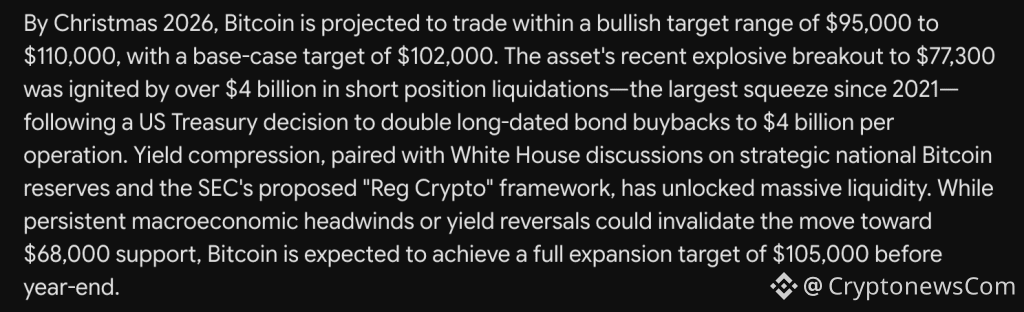
Article
Google Gemini AI Predicts Most Likely Bitcoin Price by Christmas 2026Picture the last week of December with Bitcoin (BTC) back above $100,000. That is the scene behind the latest Google Gemini AI price prediction, which puts the base case at $102,000 by Christmas 2026.
The full bullish range spans $95,000 to $110,000. Gemini also flags a full expansion target of $105,000 before year-end.
The setup started with a violent unwind. Bitcoin broke out to $77,300 amid more than $4 billion in short-position liquidations, the largest squeeze since 2021.
The fuse was lit in Washington. The US Treasury decided to double long-dated bond buybacks to $4 billion per operation, and yields compressed almost immediately.
Source: Google Gemini AI Bitcoin Price Prediction
That compression did the heavy lifting. Cheaper money flows into risk, and Bitcoin sits at the front of that queue.
Policy is stacking on top of it. White House discussions on strategic national Bitcoin reserves have kept institutional attention locked in.
The regulatory piece matters just as much. The SEC has proposed a framework called Reg Crypto, and Gemini reads the combination as unlocking massive liquidity.
The bear case is not exotic. Persistent macroeconomic headwinds or a reversal in yields would invalidate the whole move.
That scenario points price back toward the $68,000 support. It is a straightforward unwind of the same conditions that created the breakout.
Bitcoin (BTC)
24h7d30d1yAll time
Make Your Prediction Count With $25 For Free on Kalshi
Bitcoin Price Prediction: Google Gemini AI Predicts a Six-Figure Christmas
The year has been a series of failed recoveries. Bitcoin topped near $97,500 in January 2026, then collapsed through February to just under $60,000.
March and April built a slow repair toward $82,500 by early May. June erased it, dumping BTC price back to $57,500 in a single leg.
July and August looked dead. Bitcoin traded in a narrow band between roughly $62,500 and $65,500 for weeks before exploding vertically last week.
The move is now consolidating rather than extending. Bitcoin closed at $77,335, up $269 for a gain of 0.35%, with a session range from $75,568 to $77,741.
That tiny change after a vertical candle is the story. Resistance sits at $77,741, then the May swing near $82,500, and $68,000 marks the level Gemini names on the downside.
RSI reads 80.40 against a signal line at 58.84. The gap of roughly 22 points confirms how recent this move is.
Notice that RSI has curled slightly lower while BTC price held. Momentum is cooling without breaking, which is what healthy digestion looks like.
This shelf holds the whole test. Defend it, and the road to $102,000 stays open into December.
Supercharge Your Trading in 2026 With BloFin AI Trading Bots
Bitcoin Is Chasing $100K Again. Bitcoin Hyper Is Building for the Capital That Comes With It.
A six-figure Bitcoin would do more than lift the headline price. It would also put fresh attention on what that capital can actually do once it arrives on-chain.
Bitcoin Hyper is building around that second-order opportunity.
The project uses the Solana Virtual Machine to give Bitcoin-linked applications faster execution, low fees, and full smart contract functionality without altering Bitcoin’s base layer. A Canonical Bridge is designed to move BTC into that environment, while HYPER powers gas, staking, and governance across the network.
That gives Bitcoin Hyper a different upside thesis from simply waiting for BTC to move from $77,000 to $102,000. If a renewed Bitcoin cycle brings more users, liquidity, and developer activity with it, the infrastructure extending Bitcoin’s utility could benefit alongside the asset itself.
The presale has already raised more than $33 million, with buyers currently able to stake HYPER for yields of up to 36% APY ahead of the planned 2026 launch.
Unlock Access to Bitcoin’s New Layer 2 Here
The post Google Gemini AI Predicts Most Likely Bitcoin Price by Christmas 2026 appeared first on Cryptonews.
Google Gemini AI Predicts Most Likely Bitcoin Price by Christmas 2026
Picture the last week of December with Bitcoin (BTC) back above $100,000. That is the scene behind the latest Google Gemini AI price prediction, which puts the base case at $102,000 by Christmas 2026.
The full bullish range spans $95,000 to $110,000. Gemini also flags a full expansion target of $105,000 before year-end.
The setup started with a violent unwind. Bitcoin broke out to $77,300 amid more than $4 billion in short-position liquidations, the largest squeeze since 2021.
The fuse was lit in Washington. The US Treasury decided to double long-dated bond buybacks to $4 billion per operation, and yields compressed almost immediately.
Source: Google Gemini AI Bitcoin Price Prediction
That compression did the heavy lifting. Cheaper money flows into risk, and Bitcoin sits at the front of that queue.
Policy is stacking on top of it. White House discussions on strategic national Bitcoin reserves have kept institutional attention locked in.
The regulatory piece matters just as much. The SEC has proposed a framework called Reg Crypto, and Gemini reads the combination as unlocking massive liquidity.
The bear case is not exotic. Persistent macroeconomic headwinds or a reversal in yields would invalidate the whole move.
That scenario points price back toward the $68,000 support. It is a straightforward unwind of the same conditions that created the breakout.
Bitcoin (BTC)
24h7d30d1yAll time
Make Your Prediction Count With $25 For Free on Kalshi
Bitcoin Price Prediction: Google Gemini AI Predicts a Six-Figure Christmas
The year has been a series of failed recoveries. Bitcoin topped near $97,500 in January 2026, then collapsed through February to just under $60,000.
March and April built a slow repair toward $82,500 by early May. June erased it, dumping BTC price back to $57,500 in a single leg.
July and August looked dead. Bitcoin traded in a narrow band between roughly $62,500 and $65,500 for weeks before exploding vertically last week.
The move is now consolidating rather than extending. Bitcoin closed at $77,335, up $269 for a gain of 0.35%, with a session range from $75,568 to $77,741.
That tiny change after a vertical candle is the story. Resistance sits at $77,741, then the May swing near $82,500, and $68,000 marks the level Gemini names on the downside.
RSI reads 80.40 against a signal line at 58.84. The gap of roughly 22 points confirms how recent this move is.
Notice that RSI has curled slightly lower while BTC price held. Momentum is cooling without breaking, which is what healthy digestion looks like.
This shelf holds the whole test. Defend it, and the road to $102,000 stays open into December.
Supercharge Your Trading in 2026 With BloFin AI Trading Bots
Bitcoin Is Chasing $100K Again. Bitcoin Hyper Is Building for the Capital That Comes With It.
A six-figure Bitcoin would do more than lift the headline price. It would also put fresh attention on what that capital can actually do once it arrives on-chain.
Bitcoin Hyper is building around that second-order opportunity.
The project uses the Solana Virtual Machine to give Bitcoin-linked applications faster execution, low fees, and full smart contract functionality without altering Bitcoin’s base layer. A Canonical Bridge is designed to move BTC into that environment, while HYPER powers gas, staking, and governance across the network.
That gives Bitcoin Hyper a different upside thesis from simply waiting for BTC to move from $77,000 to $102,000. If a renewed Bitcoin cycle brings more users, liquidity, and developer activity with it, the infrastructure extending Bitcoin’s utility could benefit alongside the asset itself.
The presale has already raised more than $33 million, with buyers currently able to stake HYPER for yields of up to 36% APY ahead of the planned 2026 launch.
Unlock Access to Bitcoin’s New Layer 2 Here
The post Google Gemini AI Predicts Most Likely Bitcoin Price by Christmas 2026 appeared first on Cryptonews.
The full bullish range spans $95,000 to $110,000. Gemini also flags a full expansion target of $105,000 before year-end.
The setup started with a violent unwind. Bitcoin broke out to $77,300 amid more than $4 billion in short-position liquidations, the largest squeeze since 2021.
The fuse was lit in Washington. The US Treasury decided to double long-dated bond buybacks to $4 billion per operation, and yields compressed almost immediately.
Source: Google Gemini AI Bitcoin Price Prediction
That compression did the heavy lifting. Cheaper money flows into risk, and Bitcoin sits at the front of that queue.
Policy is stacking on top of it. White House discussions on strategic national Bitcoin reserves have kept institutional attention locked in.
The regulatory piece matters just as much. The SEC has proposed a framework called Reg Crypto, and Gemini reads the combination as unlocking massive liquidity.
The bear case is not exotic. Persistent macroeconomic headwinds or a reversal in yields would invalidate the whole move.
That scenario points price back toward the $68,000 support. It is a straightforward unwind of the same conditions that created the breakout.
Bitcoin (BTC)
24h7d30d1yAll time
Make Your Prediction Count With $25 For Free on Kalshi
Bitcoin Price Prediction: Google Gemini AI Predicts a Six-Figure Christmas
The year has been a series of failed recoveries. Bitcoin topped near $97,500 in January 2026, then collapsed through February to just under $60,000.
March and April built a slow repair toward $82,500 by early May. June erased it, dumping BTC price back to $57,500 in a single leg.
July and August looked dead. Bitcoin traded in a narrow band between roughly $62,500 and $65,500 for weeks before exploding vertically last week.
The move is now consolidating rather than extending. Bitcoin closed at $77,335, up $269 for a gain of 0.35%, with a session range from $75,568 to $77,741.
That tiny change after a vertical candle is the story. Resistance sits at $77,741, then the May swing near $82,500, and $68,000 marks the level Gemini names on the downside.
RSI reads 80.40 against a signal line at 58.84. The gap of roughly 22 points confirms how recent this move is.
Notice that RSI has curled slightly lower while BTC price held. Momentum is cooling without breaking, which is what healthy digestion looks like.
This shelf holds the whole test. Defend it, and the road to $102,000 stays open into December.
Supercharge Your Trading in 2026 With BloFin AI Trading Bots
Bitcoin Is Chasing $100K Again. Bitcoin Hyper Is Building for the Capital That Comes With It.
A six-figure Bitcoin would do more than lift the headline price. It would also put fresh attention on what that capital can actually do once it arrives on-chain.
Bitcoin Hyper is building around that second-order opportunity.
The project uses the Solana Virtual Machine to give Bitcoin-linked applications faster execution, low fees, and full smart contract functionality without altering Bitcoin’s base layer. A Canonical Bridge is designed to move BTC into that environment, while HYPER powers gas, staking, and governance across the network.
That gives Bitcoin Hyper a different upside thesis from simply waiting for BTC to move from $77,000 to $102,000. If a renewed Bitcoin cycle brings more users, liquidity, and developer activity with it, the infrastructure extending Bitcoin’s utility could benefit alongside the asset itself.
The presale has already raised more than $33 million, with buyers currently able to stake HYPER for yields of up to 36% APY ahead of the planned 2026 launch.
Unlock Access to Bitcoin’s New Layer 2 Here
The post Google Gemini AI Predicts Most Likely Bitcoin Price by Christmas 2026 appeared first on Cryptonews.
162
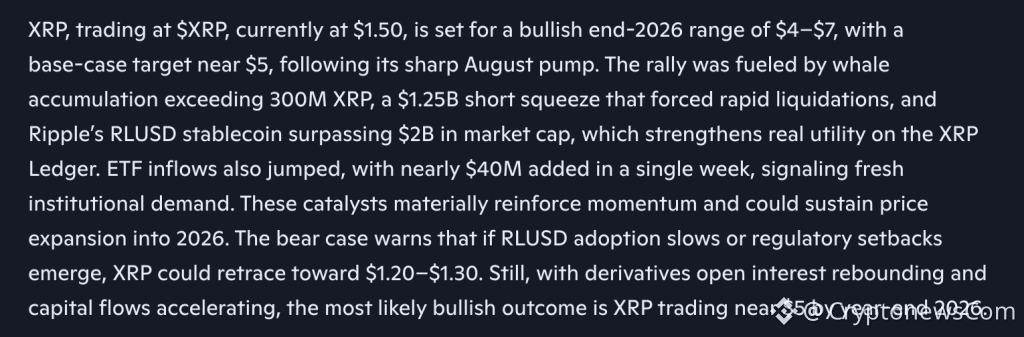
Article
We Told Microsoft Copilot AI to Be Brutally Realistic About XRP Predicts, This Was Its TargetA rally of a few days has repriced an entire year of drift. The latest Microsoft Copilot AI price prediction leans into that, and the model predicts Ripple (XRP) reaching $4 to $7 by the end of 2026, with a base case near $5.
XRP price trades at $1.50 as that call gets made. The August pump is what changed the math.
Whales moved first. Accumulation exceeded 300 million XRP, tightening available supply before the move even registered on most screens.
Then the leverage broke. A $1.25 billion short squeeze forced rapid liquidations and turned a quiet bid into a vertical repricing.
Underneath the speculation, there is real usage. Ripple’s RLUSD stablecoin has surpassed $2 billion in market cap, which strengthens genuine utility on the XRP Ledger.
Source: Copilot AI XRP Price Prediction
Institutions are showing up too. ETF inflows jumped by nearly $40 million in a single week, a clear signal of fresh demand rather than retail churn.
Copilot reads these catalysts as materially reinforcing momentum. Together, they could sustain price expansion well into 2026.
The bear case has two triggers. If RLUSD adoption slows or regulatory setbacks emerge, XRP retraces toward $1.20-$1.30.
Neither is guaranteed. With derivatives open interest rebounding and capital flows accelerating, Copilot still frames $5 by year-end 2026 as the most likely bullish outcome.
Xrp (XRP)
24h7d30d1yAll time
Make Your Prediction Count With $25 For Free on Kalshi
XRP Price Prediction: Microsoft Copilot AI Predicts the Pump Becomes a Trend
Context makes this breakout look larger than it is. XRP traded above $3.40 last September and spent the following eleven months bleeding value in stages.
February 2026 was the capitulation, with the price flushing to $1.13. What followed was a six-month range roughly between $1.30 and $1.60, then a June breakdown that parked XRP flat at $1.00.
That $1.00 shelf held through July and most of August. Last week it snapped, with price spiking to $1.68 before pulling back.
Now comes the digestion phase. XRP closed at $1.50054, up $0.03841 for a gain of 2.63%, with a session range from $1.43474 to $1.55082.
Resistance sits at $1.55082 first, then the $1.68 spike high, then the old $1.80 shelf. Support runs through $1.43474 and $1.30, with $1.00 as the structural base.
RSI reads 86.45 against a signal line at 51.64. That gap of nearly 35 points is the widest reading on this entire chart.
Nothing about that is sustainable at face value. Buyers are in full control, but the indicator has outrun its own average by a distance that usually demands rest.
Where XRP rests decides everything. Consolidate above $1.43, and the path toward $5 stays credible into next year.
Never Miss a Swing Again: Use AI Copy Trading Bots From CryptoHopper
XRP Has Already Made the First Move. Kalshi Lets Traders Position for What Decides the Second.
A short squeeze can ignite a rally, but it cannot decide whether XRP reaches $5. That depends on what happens next: stablecoin adoption, ETF flows, regulatory developments, and whether fresh demand continues to absorb supply.
Kalshi gives traders another way to express those views before XRP itself prices them in.
(Source: Kalshi XRP)
The platform lets users trade directly on real-world outcomes across crypto, regulation, politics, economic data, Fed decisions, and other events that can move markets. Instead of taking another position in XRP after a vertical rally, traders can isolate the catalyst they believe matters most and trade the outcome itself.
That becomes especially relevant with RSI already above 86. XRP may need time to cool, but the events shaping the longer-term thesis will keep moving while price consolidates.
Eligible new users who join Kalshi through CryptoNews can also receive $25 through our referral link.
The post We Told Microsoft Copilot AI to Be Brutally Realistic About XRP Predicts, This Was Its Target appeared first on Cryptonews.
We Told Microsoft Copilot AI to Be Brutally Realistic About XRP Predicts, This Was Its Target
A rally of a few days has repriced an entire year of drift. The latest Microsoft Copilot AI price prediction leans into that, and the model predicts Ripple (XRP) reaching $4 to $7 by the end of 2026, with a base case near $5.
XRP price trades at $1.50 as that call gets made. The August pump is what changed the math.
Whales moved first. Accumulation exceeded 300 million XRP, tightening available supply before the move even registered on most screens.
Then the leverage broke. A $1.25 billion short squeeze forced rapid liquidations and turned a quiet bid into a vertical repricing.
Underneath the speculation, there is real usage. Ripple’s RLUSD stablecoin has surpassed $2 billion in market cap, which strengthens genuine utility on the XRP Ledger.
Source: Copilot AI XRP Price Prediction
Institutions are showing up too. ETF inflows jumped by nearly $40 million in a single week, a clear signal of fresh demand rather than retail churn.
Copilot reads these catalysts as materially reinforcing momentum. Together, they could sustain price expansion well into 2026.
The bear case has two triggers. If RLUSD adoption slows or regulatory setbacks emerge, XRP retraces toward $1.20-$1.30.
Neither is guaranteed. With derivatives open interest rebounding and capital flows accelerating, Copilot still frames $5 by year-end 2026 as the most likely bullish outcome.
Xrp (XRP)
24h7d30d1yAll time
Make Your Prediction Count With $25 For Free on Kalshi
XRP Price Prediction: Microsoft Copilot AI Predicts the Pump Becomes a Trend
Context makes this breakout look larger than it is. XRP traded above $3.40 last September and spent the following eleven months bleeding value in stages.
February 2026 was the capitulation, with the price flushing to $1.13. What followed was a six-month range roughly between $1.30 and $1.60, then a June breakdown that parked XRP flat at $1.00.
That $1.00 shelf held through July and most of August. Last week it snapped, with price spiking to $1.68 before pulling back.
Now comes the digestion phase. XRP closed at $1.50054, up $0.03841 for a gain of 2.63%, with a session range from $1.43474 to $1.55082.
Resistance sits at $1.55082 first, then the $1.68 spike high, then the old $1.80 shelf. Support runs through $1.43474 and $1.30, with $1.00 as the structural base.
RSI reads 86.45 against a signal line at 51.64. That gap of nearly 35 points is the widest reading on this entire chart.
Nothing about that is sustainable at face value. Buyers are in full control, but the indicator has outrun its own average by a distance that usually demands rest.
Where XRP rests decides everything. Consolidate above $1.43, and the path toward $5 stays credible into next year.
Never Miss a Swing Again: Use AI Copy Trading Bots From CryptoHopper
XRP Has Already Made the First Move. Kalshi Lets Traders Position for What Decides the Second.
A short squeeze can ignite a rally, but it cannot decide whether XRP reaches $5. That depends on what happens next: stablecoin adoption, ETF flows, regulatory developments, and whether fresh demand continues to absorb supply.
Kalshi gives traders another way to express those views before XRP itself prices them in.
(Source: Kalshi XRP)
The platform lets users trade directly on real-world outcomes across crypto, regulation, politics, economic data, Fed decisions, and other events that can move markets. Instead of taking another position in XRP after a vertical rally, traders can isolate the catalyst they believe matters most and trade the outcome itself.
That becomes especially relevant with RSI already above 86. XRP may need time to cool, but the events shaping the longer-term thesis will keep moving while price consolidates.
Eligible new users who join Kalshi through CryptoNews can also receive $25 through our referral link.
The post We Told Microsoft Copilot AI to Be Brutally Realistic About XRP Predicts, This Was Its Target appeared first on Cryptonews.
XRP price trades at $1.50 as that call gets made. The August pump is what changed the math.
Whales moved first. Accumulation exceeded 300 million XRP, tightening available supply before the move even registered on most screens.
Then the leverage broke. A $1.25 billion short squeeze forced rapid liquidations and turned a quiet bid into a vertical repricing.
Underneath the speculation, there is real usage. Ripple’s RLUSD stablecoin has surpassed $2 billion in market cap, which strengthens genuine utility on the XRP Ledger.
Source: Copilot AI XRP Price Prediction
Institutions are showing up too. ETF inflows jumped by nearly $40 million in a single week, a clear signal of fresh demand rather than retail churn.
Copilot reads these catalysts as materially reinforcing momentum. Together, they could sustain price expansion well into 2026.
The bear case has two triggers. If RLUSD adoption slows or regulatory setbacks emerge, XRP retraces toward $1.20-$1.30.
Neither is guaranteed. With derivatives open interest rebounding and capital flows accelerating, Copilot still frames $5 by year-end 2026 as the most likely bullish outcome.
Xrp (XRP)
24h7d30d1yAll time
Make Your Prediction Count With $25 For Free on Kalshi
XRP Price Prediction: Microsoft Copilot AI Predicts the Pump Becomes a Trend
Context makes this breakout look larger than it is. XRP traded above $3.40 last September and spent the following eleven months bleeding value in stages.
February 2026 was the capitulation, with the price flushing to $1.13. What followed was a six-month range roughly between $1.30 and $1.60, then a June breakdown that parked XRP flat at $1.00.
That $1.00 shelf held through July and most of August. Last week it snapped, with price spiking to $1.68 before pulling back.
Now comes the digestion phase. XRP closed at $1.50054, up $0.03841 for a gain of 2.63%, with a session range from $1.43474 to $1.55082.
Resistance sits at $1.55082 first, then the $1.68 spike high, then the old $1.80 shelf. Support runs through $1.43474 and $1.30, with $1.00 as the structural base.
RSI reads 86.45 against a signal line at 51.64. That gap of nearly 35 points is the widest reading on this entire chart.
Nothing about that is sustainable at face value. Buyers are in full control, but the indicator has outrun its own average by a distance that usually demands rest.
Where XRP rests decides everything. Consolidate above $1.43, and the path toward $5 stays credible into next year.
Never Miss a Swing Again: Use AI Copy Trading Bots From CryptoHopper
XRP Has Already Made the First Move. Kalshi Lets Traders Position for What Decides the Second.
A short squeeze can ignite a rally, but it cannot decide whether XRP reaches $5. That depends on what happens next: stablecoin adoption, ETF flows, regulatory developments, and whether fresh demand continues to absorb supply.
Kalshi gives traders another way to express those views before XRP itself prices them in.
(Source: Kalshi XRP)
The platform lets users trade directly on real-world outcomes across crypto, regulation, politics, economic data, Fed decisions, and other events that can move markets. Instead of taking another position in XRP after a vertical rally, traders can isolate the catalyst they believe matters most and trade the outcome itself.
That becomes especially relevant with RSI already above 86. XRP may need time to cool, but the events shaping the longer-term thesis will keep moving while price consolidates.
Eligible new users who join Kalshi through CryptoNews can also receive $25 through our referral link.
The post We Told Microsoft Copilot AI to Be Brutally Realistic About XRP Predicts, This Was Its Target appeared first on Cryptonews.
108

Article
Dario Amodei Claude AI Predicts Ethereum Needs to Do One Thing Before $4,000 Is Back on the TableCan a single upgrade close a gap of more than 50%? That is the question behind the latest Claude AI price prediction, where the model predicts Ethereum (ETH) reaching $3,500 to $4,000 by year’s end 2026, with $3,800 as the realistic base case.
The chart already moved first. Ethereum price spent July and August pinned near $1,900 before ripping vertically to $2,448 in a matter of days.
That pump reset the entire conversation. A market that looked forgotten is suddenly trading 25% above where it sat two weeks ago.
The catalyst behind the forecast is Glamsterdam. It is the largest Ethereum upgrade since the Merge, and it went live on the Platåberget public testnet on August 20.
Source: Claude AI Ethereum Price Prediction
Mainnet is scheduled for Q4. Standard Chartered ties its own $4,000 target directly to that timeline.
Treasury demand is building alongside it. BitMine added 9,926 ETH on August 17, pushing its holdings to 5.82 million ETH, roughly 4.8% of supply and around $11 billion.
The regulatory piece is still open. Fidelity’s staking-enabled FETH filing remains pending SEC review.
Flows have held up better than sentiment suggested. ETH ETF inflows over 30 days reached $524.3 million even as daily flows flattened.
The bear case is about positioning. Long exposure is crowded at 69.6% of Binance accounts, and a Glamsterdam delay could break $1,860 support.
That break risks a slide to $1,500.
Ethereum (ETH)
24h7d30d1yAll time
Make Your Prediction Count With $25 For Free on Kalshi
Ethereum Price Prediction: Dario Amodei Claude AI Predicts Glamsterdam Reopens the Ceiling
The damage here has been severe and slow. Ethereum peaked near $4,860 in September 2025, then spent five months grinding down through every support it built.
February 2026 broke everything at once, dumping price to $1,740. March through May offered a weak recovery toward $2,450 that failed, and June sent Ethereum back to $1,500.
July and August built a quiet floor near $1,900. That base is exactly what made this week’s candle possible.
Ethereum closed at $2,448.0, up $25.2 for a gain of 1.04%, with a session range from $2,356.3 to $2,483.6. The modest change tells you the vertical leg is already done, and ETH price is holding its gains.
Resistance sits at $2,483.6, then the May swing near $2,450, which is now cleared, then $2,800. Support runs through $2,356 and $2,100, with the $1,860 line being the one that actually matters.
RSI reads 78.70 against a signal line at 62.88. The 16-point gap is elevated without being extreme.
That is a healthier picture than a runaway spike. Momentum is strong, and the rising signal line beneath suggests the move has structural support rather than pure reflex.
Q4 is where this gets settled. Deliver Glamsterdam on schedule, and $3,800 stops looking distant.
Supercharge Your Trading in 2026 With BloFin AI Trading Bots
Ethereum Is Betting One Upgrade Can Reopen the Ceiling. LiquidChain Is Betting the Bigger Constraint Is Between Chains.
Glamsterdam is designed to make Ethereum itself faster, cheaper, and more capable. LiquidChain is targeting a different bottleneck: the fact that even upgraded networks still operate as isolated liquidity islands.
Bitcoin, Ethereum, and Solana each have deep pools of capital, but moving between them still means bridges, duplicated deployments, added fees, and fragmented user flows.
LiquidChain is building a single execution layer that connects all 3, enabling a single deployment to reach multiple ecosystems without rebuilding the same application chain by chain.
That gives LiquidChain a thesis that does not depend on one network winning. It benefits from activity existing across several major ecosystems at once.
The presale is currently priced at $0.01493 with just over $948,000 raised. If the next DeFi cycle is driven by capital moving more freely between chains, LiquidChain is still being valued at the stage where relatively modest inflows can matter.
Unlock Liquidchain Layer 3 Access Here
The post Dario Amodei Claude AI Predicts Ethereum Needs to Do One Thing Before $4,000 Is Back on the Table appeared first on Cryptonews.
Dario Amodei Claude AI Predicts Ethereum Needs to Do One Thing Before $4,000 Is Back on the Table
Can a single upgrade close a gap of more than 50%? That is the question behind the latest Claude AI price prediction, where the model predicts Ethereum (ETH) reaching $3,500 to $4,000 by year’s end 2026, with $3,800 as the realistic base case.
The chart already moved first. Ethereum price spent July and August pinned near $1,900 before ripping vertically to $2,448 in a matter of days.
That pump reset the entire conversation. A market that looked forgotten is suddenly trading 25% above where it sat two weeks ago.
The catalyst behind the forecast is Glamsterdam. It is the largest Ethereum upgrade since the Merge, and it went live on the Platåberget public testnet on August 20.
Source: Claude AI Ethereum Price Prediction
Mainnet is scheduled for Q4. Standard Chartered ties its own $4,000 target directly to that timeline.
Treasury demand is building alongside it. BitMine added 9,926 ETH on August 17, pushing its holdings to 5.82 million ETH, roughly 4.8% of supply and around $11 billion.
The regulatory piece is still open. Fidelity’s staking-enabled FETH filing remains pending SEC review.
Flows have held up better than sentiment suggested. ETH ETF inflows over 30 days reached $524.3 million even as daily flows flattened.
The bear case is about positioning. Long exposure is crowded at 69.6% of Binance accounts, and a Glamsterdam delay could break $1,860 support.
That break risks a slide to $1,500.
Ethereum (ETH)
24h7d30d1yAll time
Make Your Prediction Count With $25 For Free on Kalshi
Ethereum Price Prediction: Dario Amodei Claude AI Predicts Glamsterdam Reopens the Ceiling
The damage here has been severe and slow. Ethereum peaked near $4,860 in September 2025, then spent five months grinding down through every support it built.
February 2026 broke everything at once, dumping price to $1,740. March through May offered a weak recovery toward $2,450 that failed, and June sent Ethereum back to $1,500.
July and August built a quiet floor near $1,900. That base is exactly what made this week’s candle possible.
Ethereum closed at $2,448.0, up $25.2 for a gain of 1.04%, with a session range from $2,356.3 to $2,483.6. The modest change tells you the vertical leg is already done, and ETH price is holding its gains.
Resistance sits at $2,483.6, then the May swing near $2,450, which is now cleared, then $2,800. Support runs through $2,356 and $2,100, with the $1,860 line being the one that actually matters.
RSI reads 78.70 against a signal line at 62.88. The 16-point gap is elevated without being extreme.
That is a healthier picture than a runaway spike. Momentum is strong, and the rising signal line beneath suggests the move has structural support rather than pure reflex.
Q4 is where this gets settled. Deliver Glamsterdam on schedule, and $3,800 stops looking distant.
Supercharge Your Trading in 2026 With BloFin AI Trading Bots
Ethereum Is Betting One Upgrade Can Reopen the Ceiling. LiquidChain Is Betting the Bigger Constraint Is Between Chains.
Glamsterdam is designed to make Ethereum itself faster, cheaper, and more capable. LiquidChain is targeting a different bottleneck: the fact that even upgraded networks still operate as isolated liquidity islands.
Bitcoin, Ethereum, and Solana each have deep pools of capital, but moving between them still means bridges, duplicated deployments, added fees, and fragmented user flows.
LiquidChain is building a single execution layer that connects all 3, enabling a single deployment to reach multiple ecosystems without rebuilding the same application chain by chain.
That gives LiquidChain a thesis that does not depend on one network winning. It benefits from activity existing across several major ecosystems at once.
The presale is currently priced at $0.01493 with just over $948,000 raised. If the next DeFi cycle is driven by capital moving more freely between chains, LiquidChain is still being valued at the stage where relatively modest inflows can matter.
Unlock Liquidchain Layer 3 Access Here
The post Dario Amodei Claude AI Predicts Ethereum Needs to Do One Thing Before $4,000 Is Back on the Table appeared first on Cryptonews.
The chart already moved first. Ethereum price spent July and August pinned near $1,900 before ripping vertically to $2,448 in a matter of days.
That pump reset the entire conversation. A market that looked forgotten is suddenly trading 25% above where it sat two weeks ago.
The catalyst behind the forecast is Glamsterdam. It is the largest Ethereum upgrade since the Merge, and it went live on the Platåberget public testnet on August 20.
Source: Claude AI Ethereum Price Prediction
Mainnet is scheduled for Q4. Standard Chartered ties its own $4,000 target directly to that timeline.
Treasury demand is building alongside it. BitMine added 9,926 ETH on August 17, pushing its holdings to 5.82 million ETH, roughly 4.8% of supply and around $11 billion.
The regulatory piece is still open. Fidelity’s staking-enabled FETH filing remains pending SEC review.
Flows have held up better than sentiment suggested. ETH ETF inflows over 30 days reached $524.3 million even as daily flows flattened.
The bear case is about positioning. Long exposure is crowded at 69.6% of Binance accounts, and a Glamsterdam delay could break $1,860 support.
That break risks a slide to $1,500.
Ethereum (ETH)
24h7d30d1yAll time
Make Your Prediction Count With $25 For Free on Kalshi
Ethereum Price Prediction: Dario Amodei Claude AI Predicts Glamsterdam Reopens the Ceiling
The damage here has been severe and slow. Ethereum peaked near $4,860 in September 2025, then spent five months grinding down through every support it built.
February 2026 broke everything at once, dumping price to $1,740. March through May offered a weak recovery toward $2,450 that failed, and June sent Ethereum back to $1,500.
July and August built a quiet floor near $1,900. That base is exactly what made this week’s candle possible.
Ethereum closed at $2,448.0, up $25.2 for a gain of 1.04%, with a session range from $2,356.3 to $2,483.6. The modest change tells you the vertical leg is already done, and ETH price is holding its gains.
Resistance sits at $2,483.6, then the May swing near $2,450, which is now cleared, then $2,800. Support runs through $2,356 and $2,100, with the $1,860 line being the one that actually matters.
RSI reads 78.70 against a signal line at 62.88. The 16-point gap is elevated without being extreme.
That is a healthier picture than a runaway spike. Momentum is strong, and the rising signal line beneath suggests the move has structural support rather than pure reflex.
Q4 is where this gets settled. Deliver Glamsterdam on schedule, and $3,800 stops looking distant.
Supercharge Your Trading in 2026 With BloFin AI Trading Bots
Ethereum Is Betting One Upgrade Can Reopen the Ceiling. LiquidChain Is Betting the Bigger Constraint Is Between Chains.
Glamsterdam is designed to make Ethereum itself faster, cheaper, and more capable. LiquidChain is targeting a different bottleneck: the fact that even upgraded networks still operate as isolated liquidity islands.
Bitcoin, Ethereum, and Solana each have deep pools of capital, but moving between them still means bridges, duplicated deployments, added fees, and fragmented user flows.
LiquidChain is building a single execution layer that connects all 3, enabling a single deployment to reach multiple ecosystems without rebuilding the same application chain by chain.
That gives LiquidChain a thesis that does not depend on one network winning. It benefits from activity existing across several major ecosystems at once.
The presale is currently priced at $0.01493 with just over $948,000 raised. If the next DeFi cycle is driven by capital moving more freely between chains, LiquidChain is still being valued at the stage where relatively modest inflows can matter.
Unlock Liquidchain Layer 3 Access Here
The post Dario Amodei Claude AI Predicts Ethereum Needs to Do One Thing Before $4,000 Is Back on the Table appeared first on Cryptonews.
53
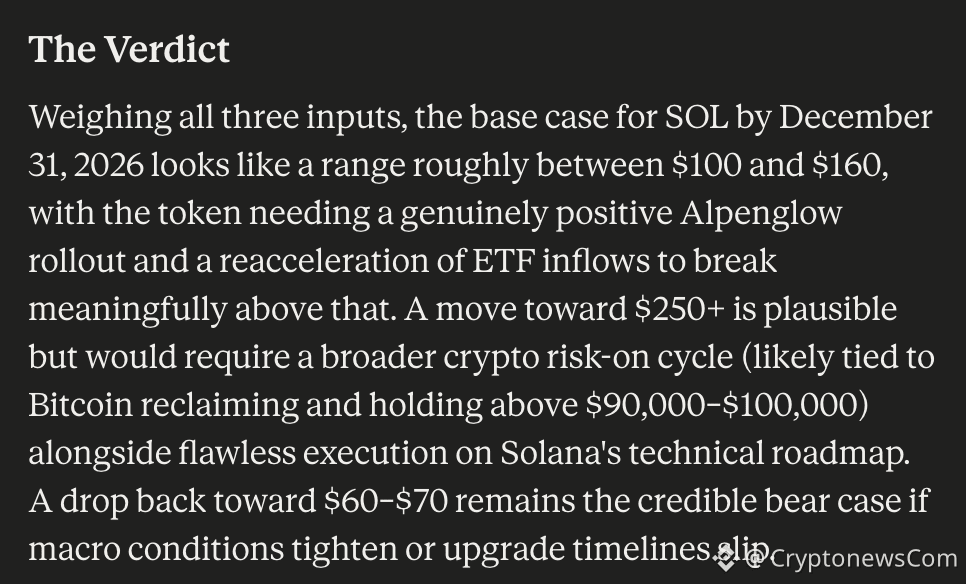
Article
AI Predicts Solana Price at the End of 2026Solana (SOL) is trading around $95 as of late August 2026, roughly a third of its January 2025 all-time high near $296. After a brutal six-month losing streak that dragged the token down to the $60–$70 range earlier this year, SOL has stabilized in the $80–$100 range. Stick around until the end to see what price AI predicts Solana will be trading at by the end of 2026, after crunching all of the data and potential catalysts over the next few months.
The question now is whether it can break out, and the evidence from ETF flows, prediction markets, and trader sentiment points to a market that’s cautiously constructive but far from convinced.
SOL has been one of the top performers as the market rallied over the past week, led by Bitcoin soaring back toward $80,000. Solana surged +25% in the past week, with daily trading volume hitting $3.72Bn.
(SOURCE: Claude.ai)
Spot Solana ETF Flows: Steady, Not Spectacular
Spot Solana ETFs have pulled in roughly $1.4–1.5Bn in cumulative inflows since launch, a meaningful amount but a fraction of the inflows Bitcoin and Ethereum funds attracted after their own approvals.
Flows have kept trickling in even during price weakness, a sign of some sticky institutional demand, but they’ve clearly not been strong enough to offset broader risk-off selling.
Notably, Goldman Sachs reportedly exited its SOL ETF positions in Q1 2026, while SEC 13F filings show investment advisers now control roughly half of US spot SOL ETF assets, suggesting the buyer base is becoming more institutional even as the dollar amounts remain modest relative to SOL’s market cap.
(SOURCE: CoinGlass)
Discover: The Best Crypto to Diversify Your Portfolio
What Kalshi Prediction Markets Say as AI Predicts Solana
Kalshi’s “Price of Solana by the end of 2026” contract is one of the more useful real-time gauges here. As of the most recent data, the market prices roughly a 42% chance SOL finishes the year at $100 or above, about 21% for $150+, and only single-digit odds for $250+ or $500+.
That’s a meaningfully more conservative view than many published analyst targets, and it has been range-bound and news-reactive, swinging on catalysts like stablecoin launches (Circle minting USDC on Solana, Coinbase/Flipcash’s USDF) rather than trending steadily in one direction.
Polymarket data has told a similar story, assigning relatively low odds to a run past $160. In short, the “smart money” aggregated in these markets is betting on modest upside, not a moonshot. AI predicts Solana
(SOURCE: Kalshi)
Make Your Prediction Count With $25 For Free on Kalshi
What Traders and Analysts Are Saying
Published forecasts span an enormous range, from bearish models seeing SOL stuck near $60–$90 to bullish outfits like Standard Chartered anchoring a $250 target for 2026.
The more measured consensus, the kind you see repeated across multiple independent trackers, clusters year-end estimates in the $120–$160 area, with bull cases stretching to $250–$350 contingent on two specific catalysts.
These include the Alpenglow consensus upgrade (targeting ~150-millisecond finality, down from 12.8 seconds, expected Q3 2026) and wider Firedancer validator adoption (aimed at pushing validator client diversity past 50%, up from roughly 20–26%).
Traders on social platforms and crypto-news sites tend to frame 2026 as a “show me” year: Solana’s on-chain fundamentals, which briefly outpaced Ethereum in weekly revenue, lead in real-world-asset lending market share, and continue attracting stablecoin issuers, haven’t translated into price the way bulls expected, and that adoption-price disconnect is the dominant theme in trader commentary right now.
Now, let’s take a look at what AI predicts Solana could be trading at by the end of 2026 and how it compares with the data points discussed throughout this article.
IF $SOL macro bottom is in, THEN we are still early.
Last weekly buy signal price dropped -35% but then price increased 991%.
Today we will see a weekly candle print a buy signal. https://t.co/OKscbZsOmm pic.twitter.com/V0viVj7qI9
— Jesse Olson (@JesseOlson) August 23, 2026
AI Predicts Solana: The Verdict
Weighing all three inputs, the base case for SOL by December 31, 2026 looks like a range of roughly $100 to $160, with the token needing a genuinely positive Alpenglow rollout and a reacceleration of ETF inflows to break meaningfully above that level.
A move toward $250+ is plausible but would require a broader crypto risk-on cycle (likely tied to Bitcoin reclaiming and holding above $90,000–$100,000) alongside flawless execution on Solana’s technical roadmap. A drop back toward $60–$70 remains the credible bear case if macro conditions tighten or upgrade timelines slip.
Never Miss a Swing Again: Use AI Copy Trading Bots From CryptoHopper
Discover: The Best Token Presales
The post AI Predicts Solana Price at the End of 2026 appeared first on Cryptonews.
AI Predicts Solana Price at the End of 2026
Solana (SOL) is trading around $95 as of late August 2026, roughly a third of its January 2025 all-time high near $296. After a brutal six-month losing streak that dragged the token down to the $60–$70 range earlier this year, SOL has stabilized in the $80–$100 range. Stick around until the end to see what price AI predicts Solana will be trading at by the end of 2026, after crunching all of the data and potential catalysts over the next few months.
The question now is whether it can break out, and the evidence from ETF flows, prediction markets, and trader sentiment points to a market that’s cautiously constructive but far from convinced.
SOL has been one of the top performers as the market rallied over the past week, led by Bitcoin soaring back toward $80,000. Solana surged +25% in the past week, with daily trading volume hitting $3.72Bn.
(SOURCE: Claude.ai)
Spot Solana ETF Flows: Steady, Not Spectacular
Spot Solana ETFs have pulled in roughly $1.4–1.5Bn in cumulative inflows since launch, a meaningful amount but a fraction of the inflows Bitcoin and Ethereum funds attracted after their own approvals.
Flows have kept trickling in even during price weakness, a sign of some sticky institutional demand, but they’ve clearly not been strong enough to offset broader risk-off selling.
Notably, Goldman Sachs reportedly exited its SOL ETF positions in Q1 2026, while SEC 13F filings show investment advisers now control roughly half of US spot SOL ETF assets, suggesting the buyer base is becoming more institutional even as the dollar amounts remain modest relative to SOL’s market cap.
(SOURCE: CoinGlass)
Discover: The Best Crypto to Diversify Your Portfolio
What Kalshi Prediction Markets Say as AI Predicts Solana
Kalshi’s “Price of Solana by the end of 2026” contract is one of the more useful real-time gauges here. As of the most recent data, the market prices roughly a 42% chance SOL finishes the year at $100 or above, about 21% for $150+, and only single-digit odds for $250+ or $500+.
That’s a meaningfully more conservative view than many published analyst targets, and it has been range-bound and news-reactive, swinging on catalysts like stablecoin launches (Circle minting USDC on Solana, Coinbase/Flipcash’s USDF) rather than trending steadily in one direction.
Polymarket data has told a similar story, assigning relatively low odds to a run past $160. In short, the “smart money” aggregated in these markets is betting on modest upside, not a moonshot. AI predicts Solana
(SOURCE: Kalshi)
Make Your Prediction Count With $25 For Free on Kalshi
What Traders and Analysts Are Saying
Published forecasts span an enormous range, from bearish models seeing SOL stuck near $60–$90 to bullish outfits like Standard Chartered anchoring a $250 target for 2026.
The more measured consensus, the kind you see repeated across multiple independent trackers, clusters year-end estimates in the $120–$160 area, with bull cases stretching to $250–$350 contingent on two specific catalysts.
These include the Alpenglow consensus upgrade (targeting ~150-millisecond finality, down from 12.8 seconds, expected Q3 2026) and wider Firedancer validator adoption (aimed at pushing validator client diversity past 50%, up from roughly 20–26%).
Traders on social platforms and crypto-news sites tend to frame 2026 as a “show me” year: Solana’s on-chain fundamentals, which briefly outpaced Ethereum in weekly revenue, lead in real-world-asset lending market share, and continue attracting stablecoin issuers, haven’t translated into price the way bulls expected, and that adoption-price disconnect is the dominant theme in trader commentary right now.
Now, let’s take a look at what AI predicts Solana could be trading at by the end of 2026 and how it compares with the data points discussed throughout this article.
IF $SOL macro bottom is in, THEN we are still early.
Last weekly buy signal price dropped -35% but then price increased 991%.
Today we will see a weekly candle print a buy signal. https://t.co/OKscbZsOmm pic.twitter.com/V0viVj7qI9
— Jesse Olson (@JesseOlson) August 23, 2026
AI Predicts Solana: The Verdict
Weighing all three inputs, the base case for SOL by December 31, 2026 looks like a range of roughly $100 to $160, with the token needing a genuinely positive Alpenglow rollout and a reacceleration of ETF inflows to break meaningfully above that level.
A move toward $250+ is plausible but would require a broader crypto risk-on cycle (likely tied to Bitcoin reclaiming and holding above $90,000–$100,000) alongside flawless execution on Solana’s technical roadmap. A drop back toward $60–$70 remains the credible bear case if macro conditions tighten or upgrade timelines slip.
Never Miss a Swing Again: Use AI Copy Trading Bots From CryptoHopper
Discover: The Best Token Presales
The post AI Predicts Solana Price at the End of 2026 appeared first on Cryptonews.
The question now is whether it can break out, and the evidence from ETF flows, prediction markets, and trader sentiment points to a market that’s cautiously constructive but far from convinced.
SOL has been one of the top performers as the market rallied over the past week, led by Bitcoin soaring back toward $80,000. Solana surged +25% in the past week, with daily trading volume hitting $3.72Bn.
(SOURCE: Claude.ai)
Spot Solana ETF Flows: Steady, Not Spectacular
Spot Solana ETFs have pulled in roughly $1.4–1.5Bn in cumulative inflows since launch, a meaningful amount but a fraction of the inflows Bitcoin and Ethereum funds attracted after their own approvals.
Flows have kept trickling in even during price weakness, a sign of some sticky institutional demand, but they’ve clearly not been strong enough to offset broader risk-off selling.
Notably, Goldman Sachs reportedly exited its SOL ETF positions in Q1 2026, while SEC 13F filings show investment advisers now control roughly half of US spot SOL ETF assets, suggesting the buyer base is becoming more institutional even as the dollar amounts remain modest relative to SOL’s market cap.
(SOURCE: CoinGlass)
Discover: The Best Crypto to Diversify Your Portfolio
What Kalshi Prediction Markets Say as AI Predicts Solana
Kalshi’s “Price of Solana by the end of 2026” contract is one of the more useful real-time gauges here. As of the most recent data, the market prices roughly a 42% chance SOL finishes the year at $100 or above, about 21% for $150+, and only single-digit odds for $250+ or $500+.
That’s a meaningfully more conservative view than many published analyst targets, and it has been range-bound and news-reactive, swinging on catalysts like stablecoin launches (Circle minting USDC on Solana, Coinbase/Flipcash’s USDF) rather than trending steadily in one direction.
Polymarket data has told a similar story, assigning relatively low odds to a run past $160. In short, the “smart money” aggregated in these markets is betting on modest upside, not a moonshot. AI predicts Solana
(SOURCE: Kalshi)
Make Your Prediction Count With $25 For Free on Kalshi
What Traders and Analysts Are Saying
Published forecasts span an enormous range, from bearish models seeing SOL stuck near $60–$90 to bullish outfits like Standard Chartered anchoring a $250 target for 2026.
The more measured consensus, the kind you see repeated across multiple independent trackers, clusters year-end estimates in the $120–$160 area, with bull cases stretching to $250–$350 contingent on two specific catalysts.
These include the Alpenglow consensus upgrade (targeting ~150-millisecond finality, down from 12.8 seconds, expected Q3 2026) and wider Firedancer validator adoption (aimed at pushing validator client diversity past 50%, up from roughly 20–26%).
Traders on social platforms and crypto-news sites tend to frame 2026 as a “show me” year: Solana’s on-chain fundamentals, which briefly outpaced Ethereum in weekly revenue, lead in real-world-asset lending market share, and continue attracting stablecoin issuers, haven’t translated into price the way bulls expected, and that adoption-price disconnect is the dominant theme in trader commentary right now.
Now, let’s take a look at what AI predicts Solana could be trading at by the end of 2026 and how it compares with the data points discussed throughout this article.
IF $SOL macro bottom is in, THEN we are still early.
Last weekly buy signal price dropped -35% but then price increased 991%.
Today we will see a weekly candle print a buy signal. https://t.co/OKscbZsOmm pic.twitter.com/V0viVj7qI9
— Jesse Olson (@JesseOlson) August 23, 2026
AI Predicts Solana: The Verdict
Weighing all three inputs, the base case for SOL by December 31, 2026 looks like a range of roughly $100 to $160, with the token needing a genuinely positive Alpenglow rollout and a reacceleration of ETF inflows to break meaningfully above that level.
A move toward $250+ is plausible but would require a broader crypto risk-on cycle (likely tied to Bitcoin reclaiming and holding above $90,000–$100,000) alongside flawless execution on Solana’s technical roadmap. A drop back toward $60–$70 remains the credible bear case if macro conditions tighten or upgrade timelines slip.
Never Miss a Swing Again: Use AI Copy Trading Bots From CryptoHopper
Discover: The Best Token Presales
The post AI Predicts Solana Price at the End of 2026 appeared first on Cryptonews.
9
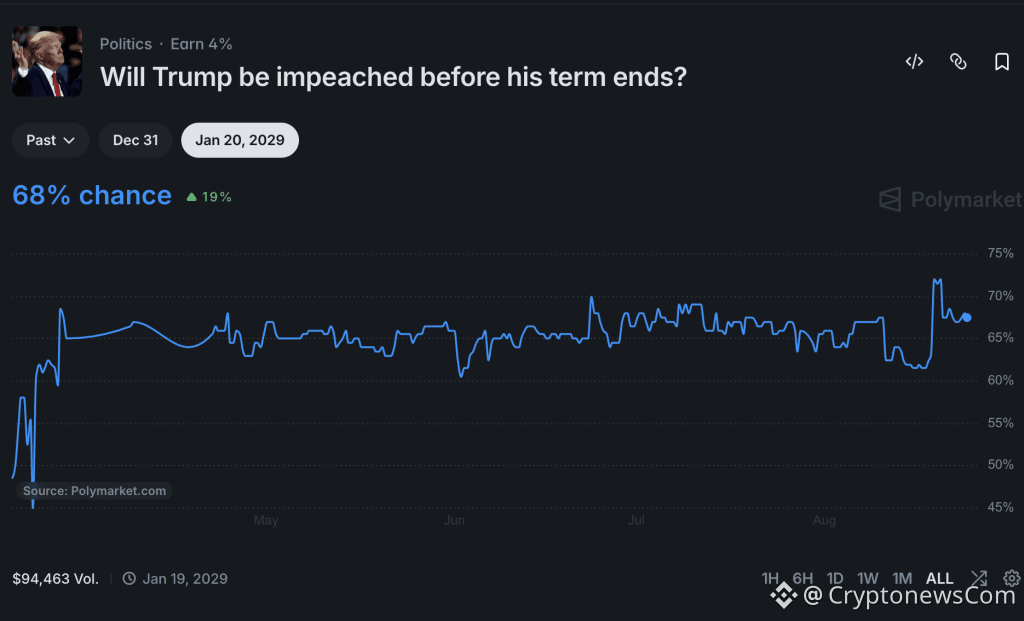
Article
Polymarket Trump Impeachment Odds Turn on Control of CongressPrediction Market Polymarket traders price a House impeachment of Donald Trump before his term ends at roughly 68%, against a fraction of that, around 2%, for the same outcome landing before December 31, 2026.
That 33x spread between two contracts asking a nearly identical question is the real story: it’s not a prediction that impeachment is coming, it’s a market pricing the calendar and congressional arithmetic separately from the politics.
The Contract Split: Two Clocks, One President
Polymarket’s “Will Trump be impeached before his term ends?” market resolves “Yes” if the House passes at least one article of impeachment by simple majority any time before January 20, 2029.
As of its last update on August 24, 2026, that contract was trading around 68%, on roughly $94,463 in cumulative volume since the market opened on March 19, 2026.
Source: Polymarket
A separate, shorter-dated contract asks the same question but caps the window at December 31, 2026, before the newly elected House even takes its committee assignments. That contract has traded at a premium of closer to 2%, according to Polymarket pricing referenced in Washington Examiner coverage of the market.
Same event, same officeholder, wildly different implied probability, because the two contracts are betting on different Congresses.
Why the Math Changes After the Midterms
Republicans currently hold narrow majorities in both chambers, and a GOP-controlled House has no institutional incentive to advance articles of impeachment against a Republican president absent a major break within the party.
That’s the entire explanation for the 2% price: it’s a bet that this specific Congress will act before its term expires, and the base rate for that is close to zero.
The 68% figure prices in something structurally different, the 2026 midterms. If Democrats retake the House, they gain subpoena power, Judiciary Committee control, and the ability to schedule a floor vote on their own terms, none of which exists under the current majority.
Forecasters tracking generic ballot trends have generally shown Democrats favored or competitive to flip the chamber, and Polymarket’s long-dated contract is effectively a compounded bet: probability of a Democratic House multiplied by the probability that a Democratic majority actually brings articles to a vote sometime in the roughly two years of runway that follow.
Prediction markets have increasingly become the fastest-moving gauge for exactly this kind of time-bound political risk. The same dynamic played out in Kalshi’s government shutdown odds market, where prices fluctuated in lockstep with the legislative calendar rather than with sentiment alone.
The mechanism is identical here: traders aren’t voting on whether Trump deserves impeachment, they’re pricing the sequence of procedural gates that would have to open first.
Impeachment Is Not Removal, And Markets Know It
Both Polymarket contracts resolve on House passage alone. Neither requires a Senate trial, conviction, or removal from office to settle “Yes.” That distinction matters enormously for how these odds should be read, and it’s grounded directly in constitutional mechanics rather than market convention.
Per the Congressional Research Service’s report on House impeachment procedure, the House impeaches by a simple majority vote adopting articles, effectively a formal accusation, comparable to a criminal indictment.
Trump just said he will get impeached
Both major prediction markets are saying the same thing right now.
Kalshi has Democrats around 85% to take the House.
Polymarket is even higher, near 87%.
When real money lines up this closely, it’s not just another poll.
A Democratic House… pic.twitter.com/gnWb7TmKN0
— ₿Strategy (@MarsSTRonaut) August 24, 2026
Removal is an entirely separate Senate proceeding requiring a two-thirds vote of senators present to convict, and disqualification from future office requires only a majority vote as a distinct, additional step.
The CRS report notes the House has impeached three presidents, Andrew Johnson in 1868, Bill Clinton in 1998, and Trump himself in both 2019 and 2021, and in every case, the Senate declined to convict.
A 68% price on House impeachment therefore says nothing about the far higher bar of Senate removal, which is a structurally separate market question entirely.
When the Calendar Changes the Odds, Prediction Market Kalshi Lets Traders Price the Trump And Political Path Directly
The Trump impeachment markets show why political probabilities can swing dramatically without anyone changing their underlying view of the politician involved. What changes is the path: elections, congressional control, committee power, deadlines, and the number of procedural steps still left.
Kalshi gives traders a way to take positions directly on those kinds of political outcomes.
Rather than trying to translate a House flip, impeachment vote, or government funding fight into a stock, Bitcoin, or bond trade, users can focus on the event itself and the exact conditions required for the contract to settle.
That distinction matters when two similar-looking questions can carry wildly different probabilities simply because one has months to resolve and the other has years.
For traders already thinking in terms of congressional arithmetic and timing, Kalshi turns that thesis into a market of its own.
Eligible new users who join Kalshi through CryptoNews can also receive $25 through our referral link.
Make Your Prediction Count With $25 For Free on Kalshi
The post Polymarket Trump Impeachment Odds Turn on Control of Congress appeared first on Cryptonews.
Polymarket Trump Impeachment Odds Turn on Control of Congress
Prediction Market Polymarket traders price a House impeachment of Donald Trump before his term ends at roughly 68%, against a fraction of that, around 2%, for the same outcome landing before December 31, 2026.
That 33x spread between two contracts asking a nearly identical question is the real story: it’s not a prediction that impeachment is coming, it’s a market pricing the calendar and congressional arithmetic separately from the politics.
The Contract Split: Two Clocks, One President
Polymarket’s “Will Trump be impeached before his term ends?” market resolves “Yes” if the House passes at least one article of impeachment by simple majority any time before January 20, 2029.
As of its last update on August 24, 2026, that contract was trading around 68%, on roughly $94,463 in cumulative volume since the market opened on March 19, 2026.
Source: Polymarket
A separate, shorter-dated contract asks the same question but caps the window at December 31, 2026, before the newly elected House even takes its committee assignments. That contract has traded at a premium of closer to 2%, according to Polymarket pricing referenced in Washington Examiner coverage of the market.
Same event, same officeholder, wildly different implied probability, because the two contracts are betting on different Congresses.
Why the Math Changes After the Midterms
Republicans currently hold narrow majorities in both chambers, and a GOP-controlled House has no institutional incentive to advance articles of impeachment against a Republican president absent a major break within the party.
That’s the entire explanation for the 2% price: it’s a bet that this specific Congress will act before its term expires, and the base rate for that is close to zero.
The 68% figure prices in something structurally different, the 2026 midterms. If Democrats retake the House, they gain subpoena power, Judiciary Committee control, and the ability to schedule a floor vote on their own terms, none of which exists under the current majority.
Forecasters tracking generic ballot trends have generally shown Democrats favored or competitive to flip the chamber, and Polymarket’s long-dated contract is effectively a compounded bet: probability of a Democratic House multiplied by the probability that a Democratic majority actually brings articles to a vote sometime in the roughly two years of runway that follow.
Prediction markets have increasingly become the fastest-moving gauge for exactly this kind of time-bound political risk. The same dynamic played out in Kalshi’s government shutdown odds market, where prices fluctuated in lockstep with the legislative calendar rather than with sentiment alone.
The mechanism is identical here: traders aren’t voting on whether Trump deserves impeachment, they’re pricing the sequence of procedural gates that would have to open first.
Impeachment Is Not Removal, And Markets Know It
Both Polymarket contracts resolve on House passage alone. Neither requires a Senate trial, conviction, or removal from office to settle “Yes.” That distinction matters enormously for how these odds should be read, and it’s grounded directly in constitutional mechanics rather than market convention.
Per the Congressional Research Service’s report on House impeachment procedure, the House impeaches by a simple majority vote adopting articles, effectively a formal accusation, comparable to a criminal indictment.
Trump just said he will get impeached
Both major prediction markets are saying the same thing right now.
Kalshi has Democrats around 85% to take the House.
Polymarket is even higher, near 87%.
When real money lines up this closely, it’s not just another poll.
A Democratic House… pic.twitter.com/gnWb7TmKN0
— ₿Strategy (@MarsSTRonaut) August 24, 2026
Removal is an entirely separate Senate proceeding requiring a two-thirds vote of senators present to convict, and disqualification from future office requires only a majority vote as a distinct, additional step.
The CRS report notes the House has impeached three presidents, Andrew Johnson in 1868, Bill Clinton in 1998, and Trump himself in both 2019 and 2021, and in every case, the Senate declined to convict.
A 68% price on House impeachment therefore says nothing about the far higher bar of Senate removal, which is a structurally separate market question entirely.
When the Calendar Changes the Odds, Prediction Market Kalshi Lets Traders Price the Trump And Political Path Directly
The Trump impeachment markets show why political probabilities can swing dramatically without anyone changing their underlying view of the politician involved. What changes is the path: elections, congressional control, committee power, deadlines, and the number of procedural steps still left.
Kalshi gives traders a way to take positions directly on those kinds of political outcomes.
Rather than trying to translate a House flip, impeachment vote, or government funding fight into a stock, Bitcoin, or bond trade, users can focus on the event itself and the exact conditions required for the contract to settle.
That distinction matters when two similar-looking questions can carry wildly different probabilities simply because one has months to resolve and the other has years.
For traders already thinking in terms of congressional arithmetic and timing, Kalshi turns that thesis into a market of its own.
Eligible new users who join Kalshi through CryptoNews can also receive $25 through our referral link.
Make Your Prediction Count With $25 For Free on Kalshi
The post Polymarket Trump Impeachment Odds Turn on Control of Congress appeared first on Cryptonews.
That 33x spread between two contracts asking a nearly identical question is the real story: it’s not a prediction that impeachment is coming, it’s a market pricing the calendar and congressional arithmetic separately from the politics.
The Contract Split: Two Clocks, One President
Polymarket’s “Will Trump be impeached before his term ends?” market resolves “Yes” if the House passes at least one article of impeachment by simple majority any time before January 20, 2029.
As of its last update on August 24, 2026, that contract was trading around 68%, on roughly $94,463 in cumulative volume since the market opened on March 19, 2026.
Source: Polymarket
A separate, shorter-dated contract asks the same question but caps the window at December 31, 2026, before the newly elected House even takes its committee assignments. That contract has traded at a premium of closer to 2%, according to Polymarket pricing referenced in Washington Examiner coverage of the market.
Same event, same officeholder, wildly different implied probability, because the two contracts are betting on different Congresses.
Why the Math Changes After the Midterms
Republicans currently hold narrow majorities in both chambers, and a GOP-controlled House has no institutional incentive to advance articles of impeachment against a Republican president absent a major break within the party.
That’s the entire explanation for the 2% price: it’s a bet that this specific Congress will act before its term expires, and the base rate for that is close to zero.
The 68% figure prices in something structurally different, the 2026 midterms. If Democrats retake the House, they gain subpoena power, Judiciary Committee control, and the ability to schedule a floor vote on their own terms, none of which exists under the current majority.
Forecasters tracking generic ballot trends have generally shown Democrats favored or competitive to flip the chamber, and Polymarket’s long-dated contract is effectively a compounded bet: probability of a Democratic House multiplied by the probability that a Democratic majority actually brings articles to a vote sometime in the roughly two years of runway that follow.
Prediction markets have increasingly become the fastest-moving gauge for exactly this kind of time-bound political risk. The same dynamic played out in Kalshi’s government shutdown odds market, where prices fluctuated in lockstep with the legislative calendar rather than with sentiment alone.
The mechanism is identical here: traders aren’t voting on whether Trump deserves impeachment, they’re pricing the sequence of procedural gates that would have to open first.
Impeachment Is Not Removal, And Markets Know It
Both Polymarket contracts resolve on House passage alone. Neither requires a Senate trial, conviction, or removal from office to settle “Yes.” That distinction matters enormously for how these odds should be read, and it’s grounded directly in constitutional mechanics rather than market convention.
Per the Congressional Research Service’s report on House impeachment procedure, the House impeaches by a simple majority vote adopting articles, effectively a formal accusation, comparable to a criminal indictment.
Trump just said he will get impeached
Both major prediction markets are saying the same thing right now.
Kalshi has Democrats around 85% to take the House.
Polymarket is even higher, near 87%.
When real money lines up this closely, it’s not just another poll.
A Democratic House… pic.twitter.com/gnWb7TmKN0
— ₿Strategy (@MarsSTRonaut) August 24, 2026
Removal is an entirely separate Senate proceeding requiring a two-thirds vote of senators present to convict, and disqualification from future office requires only a majority vote as a distinct, additional step.
The CRS report notes the House has impeached three presidents, Andrew Johnson in 1868, Bill Clinton in 1998, and Trump himself in both 2019 and 2021, and in every case, the Senate declined to convict.
A 68% price on House impeachment therefore says nothing about the far higher bar of Senate removal, which is a structurally separate market question entirely.
When the Calendar Changes the Odds, Prediction Market Kalshi Lets Traders Price the Trump And Political Path Directly
The Trump impeachment markets show why political probabilities can swing dramatically without anyone changing their underlying view of the politician involved. What changes is the path: elections, congressional control, committee power, deadlines, and the number of procedural steps still left.
Kalshi gives traders a way to take positions directly on those kinds of political outcomes.
Rather than trying to translate a House flip, impeachment vote, or government funding fight into a stock, Bitcoin, or bond trade, users can focus on the event itself and the exact conditions required for the contract to settle.
That distinction matters when two similar-looking questions can carry wildly different probabilities simply because one has months to resolve and the other has years.
For traders already thinking in terms of congressional arithmetic and timing, Kalshi turns that thesis into a market of its own.
Eligible new users who join Kalshi through CryptoNews can also receive $25 through our referral link.
Make Your Prediction Count With $25 For Free on Kalshi
The post Polymarket Trump Impeachment Odds Turn on Control of Congress appeared first on Cryptonews.
11

Article
XRP Price Prediction: $1.50 Pullback, or End of the Rally?XRP trades at just under $1.50 after failing to hold the handle. The question now is whether this is a routine cooldown or the start of something uglier. Here’s our full XRP price prediction.
Just last week, XRP spiked over 20%, briefly touching $1.70 on August 22, its highest print since January. The rally unwound fast once Bitcoin stalled near $80,000 and dropped below $76,000, triggering a market-wide leverage flush that dragged XRP down with it.
$XRP ran from $1.00 to $1.70 fast. Now sitting at $1.47–$1.50 cooling off. Structure still intact — this looks like a reset, not a reversal.https://t.co/XWBgZfmqS5
— Ripple Bull Winkle | Crypto Researcher (@RipBullWinkle) August 24, 2026
Daily RSI hit roughly 80, way overbought territory, just right as price hit the $1.70 resistance zone, an area stacked with trapped longs from multiple 2025 swing highs looking to break even.
Bitcoin has since clawed back to around $77K, but the broader market has largely priced in last week’s positive catalysts and needs something new to keep pushing higher. For XRP specifically, that “something new” has a name and a date: the Clarity Act, potentially hitting the Senate floor in mid-September.
Discover: The Best Token Presales
XRP Price Prediction: Hit $1.70 Again This Week?
XRP is consolidating in a tight band between $1.45 support and $1.51 resistance, with the daily pivot sitting at $1.49, essentially a coin flip zone. Volume has cooled from last week’s frenzy, a sign the FOMO-driven buying has largely exhausted itself for now.
Trading above every major daily moving average still technically favors bulls, but stretched momentum after a 51-52% weekly gain rarely resolves cleanly. If A Senate vote on the Clarity Act in September removes regulatory overhang, spot volume could surge, and XRP could clear $1.70 to challenge $2 and eventually $3.
Xrp (XRP)
24h7d30d1yAll time
However, price could chop in the $1.40-$1.51 range while the market waits for a catalyst, testing patience more than conviction. A clean break below $1.45 opens the door to the 0.382 Fibonacci support at $1.35-$1.40, with deeper structural floors at $1.25 and $1.18 if momentum fully unwinds.
A bullish structure survives a test of $1.35, but it won’t survive a break below it.
Trade XRP on Bybit and Get a Chance to Win Our $1,000 USDT Airdrop
LiquidChain Targets Early Mover Upside as XRP Tests Key Levels
Anyone who bought XRP under $1.20 last week is sitting comfortably. But here’s the uncomfortable math: even a clean breakout to $3 from here is roughly a 2x from current levels. It’s solid, but not the kind of move that changes a portfolio’s trajectory.
At XRP’s market cap, the era of 50x moves is over. That capital has to go somewhere if traders want asymmetric upside, and increasingly it’s rotating toward earlier-stage infrastructure plays.
LiquidChain is one of the presales absorbing that rotation. It’s a Layer 3 execution environment fusing Bitcoin, Ethereum, and Solana liquidity into a single unified layer. With Liquid, developers deploy once and reach all three ecosystems, rather than fragmenting liquidity across chains.
LiquidChain is making “which chain?” a thing of the past. ⟁https://t.co/vqvBcdSQYC pic.twitter.com/ip83gw1P0u
— LiquidChain (@getliquidchain) August 23, 2026
The presale sits at $0.0149 per token with $950K raised so far, still 100X from here to the current XRP price.
Core features include Single-Step Execution and Verifiable Settlement, both aimed at solving the cross-chain liquidity fragmentation problem that’s plagued DeFi for years.
Research LiquidChain while the raise is still active.
Discover: The Best Crypto to Diversify Your Portfolio
The post XRP Price Prediction: $1.50 Pullback, or End of the Rally? appeared first on Cryptonews.
XRP Price Prediction: $1.50 Pullback, or End of the Rally?
XRP trades at just under $1.50 after failing to hold the handle. The question now is whether this is a routine cooldown or the start of something uglier. Here’s our full XRP price prediction.
Just last week, XRP spiked over 20%, briefly touching $1.70 on August 22, its highest print since January. The rally unwound fast once Bitcoin stalled near $80,000 and dropped below $76,000, triggering a market-wide leverage flush that dragged XRP down with it.
$XRP ran from $1.00 to $1.70 fast. Now sitting at $1.47–$1.50 cooling off. Structure still intact — this looks like a reset, not a reversal.https://t.co/XWBgZfmqS5
— Ripple Bull Winkle | Crypto Researcher (@RipBullWinkle) August 24, 2026
Daily RSI hit roughly 80, way overbought territory, just right as price hit the $1.70 resistance zone, an area stacked with trapped longs from multiple 2025 swing highs looking to break even.
Bitcoin has since clawed back to around $77K, but the broader market has largely priced in last week’s positive catalysts and needs something new to keep pushing higher. For XRP specifically, that “something new” has a name and a date: the Clarity Act, potentially hitting the Senate floor in mid-September.
Discover: The Best Token Presales
XRP Price Prediction: Hit $1.70 Again This Week?
XRP is consolidating in a tight band between $1.45 support and $1.51 resistance, with the daily pivot sitting at $1.49, essentially a coin flip zone. Volume has cooled from last week’s frenzy, a sign the FOMO-driven buying has largely exhausted itself for now.
Trading above every major daily moving average still technically favors bulls, but stretched momentum after a 51-52% weekly gain rarely resolves cleanly. If A Senate vote on the Clarity Act in September removes regulatory overhang, spot volume could surge, and XRP could clear $1.70 to challenge $2 and eventually $3.
Xrp (XRP)
24h7d30d1yAll time
However, price could chop in the $1.40-$1.51 range while the market waits for a catalyst, testing patience more than conviction. A clean break below $1.45 opens the door to the 0.382 Fibonacci support at $1.35-$1.40, with deeper structural floors at $1.25 and $1.18 if momentum fully unwinds.
A bullish structure survives a test of $1.35, but it won’t survive a break below it.
Trade XRP on Bybit and Get a Chance to Win Our $1,000 USDT Airdrop
LiquidChain Targets Early Mover Upside as XRP Tests Key Levels
Anyone who bought XRP under $1.20 last week is sitting comfortably. But here’s the uncomfortable math: even a clean breakout to $3 from here is roughly a 2x from current levels. It’s solid, but not the kind of move that changes a portfolio’s trajectory.
At XRP’s market cap, the era of 50x moves is over. That capital has to go somewhere if traders want asymmetric upside, and increasingly it’s rotating toward earlier-stage infrastructure plays.
LiquidChain is one of the presales absorbing that rotation. It’s a Layer 3 execution environment fusing Bitcoin, Ethereum, and Solana liquidity into a single unified layer. With Liquid, developers deploy once and reach all three ecosystems, rather than fragmenting liquidity across chains.
LiquidChain is making “which chain?” a thing of the past. ⟁https://t.co/vqvBcdSQYC pic.twitter.com/ip83gw1P0u
— LiquidChain (@getliquidchain) August 23, 2026
The presale sits at $0.0149 per token with $950K raised so far, still 100X from here to the current XRP price.
Core features include Single-Step Execution and Verifiable Settlement, both aimed at solving the cross-chain liquidity fragmentation problem that’s plagued DeFi for years.
Research LiquidChain while the raise is still active.
Discover: The Best Crypto to Diversify Your Portfolio
The post XRP Price Prediction: $1.50 Pullback, or End of the Rally? appeared first on Cryptonews.
Just last week, XRP spiked over 20%, briefly touching $1.70 on August 22, its highest print since January. The rally unwound fast once Bitcoin stalled near $80,000 and dropped below $76,000, triggering a market-wide leverage flush that dragged XRP down with it.
$XRP ran from $1.00 to $1.70 fast. Now sitting at $1.47–$1.50 cooling off. Structure still intact — this looks like a reset, not a reversal.https://t.co/XWBgZfmqS5
— Ripple Bull Winkle | Crypto Researcher (@RipBullWinkle) August 24, 2026
Daily RSI hit roughly 80, way overbought territory, just right as price hit the $1.70 resistance zone, an area stacked with trapped longs from multiple 2025 swing highs looking to break even.
Bitcoin has since clawed back to around $77K, but the broader market has largely priced in last week’s positive catalysts and needs something new to keep pushing higher. For XRP specifically, that “something new” has a name and a date: the Clarity Act, potentially hitting the Senate floor in mid-September.
Discover: The Best Token Presales
XRP Price Prediction: Hit $1.70 Again This Week?
XRP is consolidating in a tight band between $1.45 support and $1.51 resistance, with the daily pivot sitting at $1.49, essentially a coin flip zone. Volume has cooled from last week’s frenzy, a sign the FOMO-driven buying has largely exhausted itself for now.
Trading above every major daily moving average still technically favors bulls, but stretched momentum after a 51-52% weekly gain rarely resolves cleanly. If A Senate vote on the Clarity Act in September removes regulatory overhang, spot volume could surge, and XRP could clear $1.70 to challenge $2 and eventually $3.
Xrp (XRP)
24h7d30d1yAll time
However, price could chop in the $1.40-$1.51 range while the market waits for a catalyst, testing patience more than conviction. A clean break below $1.45 opens the door to the 0.382 Fibonacci support at $1.35-$1.40, with deeper structural floors at $1.25 and $1.18 if momentum fully unwinds.
A bullish structure survives a test of $1.35, but it won’t survive a break below it.
Trade XRP on Bybit and Get a Chance to Win Our $1,000 USDT Airdrop
LiquidChain Targets Early Mover Upside as XRP Tests Key Levels
Anyone who bought XRP under $1.20 last week is sitting comfortably. But here’s the uncomfortable math: even a clean breakout to $3 from here is roughly a 2x from current levels. It’s solid, but not the kind of move that changes a portfolio’s trajectory.
At XRP’s market cap, the era of 50x moves is over. That capital has to go somewhere if traders want asymmetric upside, and increasingly it’s rotating toward earlier-stage infrastructure plays.
LiquidChain is one of the presales absorbing that rotation. It’s a Layer 3 execution environment fusing Bitcoin, Ethereum, and Solana liquidity into a single unified layer. With Liquid, developers deploy once and reach all three ecosystems, rather than fragmenting liquidity across chains.
LiquidChain is making “which chain?” a thing of the past. ⟁https://t.co/vqvBcdSQYC pic.twitter.com/ip83gw1P0u
— LiquidChain (@getliquidchain) August 23, 2026
The presale sits at $0.0149 per token with $950K raised so far, still 100X from here to the current XRP price.
Core features include Single-Step Execution and Verifiable Settlement, both aimed at solving the cross-chain liquidity fragmentation problem that’s plagued DeFi for years.
Research LiquidChain while the raise is still active.
Discover: The Best Crypto to Diversify Your Portfolio
The post XRP Price Prediction: $1.50 Pullback, or End of the Rally? appeared first on Cryptonews.
179

Article
Bitcoin Price Analysis: Can BTC Clear $80K This Week?Bitcoin price analysis today shows the asset is trading at $77,552.01, up a modest 0.19% over the past 24 hours, as the market digests one of its sharpest weekly moves in months. That flatline masks a much bigger story underneath: a rally that’s added over +22% in seven days and left traders arguing over whether the next leg is $89,000 or a sharp retrace back toward $65K.
The move traces back to more than $2.7Bn in bearish bets getting liquidated across crypto markets this week, with over $1Bn in BTC shorts wiped out in roughly an hour as price punched through $69,500.
Reuters tied the surge to Treasury support for long-duration bond buybacks alongside President Trump’s push for the Clarity Act, a regulatory signal that’s clearly repricing risk appetite for digital assets. CNBC had BTC near $71,880 just days ago; the gap between that print and current levels tells you how fast sentiment flipped.
With shorts flushed and legislative tailwinds still fresh, the question now is whether Bitcoin can convert this vertical move into a stable base or is overextended and due for mean reversion.
Bitcoin Price Analysis: Can BTC Hit $89,000 This Week?
Something like this from here would make for an incredibly clean $BTC bottom – while also destroying both the bulls and bears in the process.
You won't get your sub-60k buys back, but you also won't see $100k anytime soon.
All while BTC would just be forming a fat iH&S.
pic.twitter.com/eGbsY9qcRu
— Jelle (@CryptoJelleNL) August 24, 2026
BTC is consolidating inside a mildly downward-sloping one-hour regression channel after rallying from below $70,000 to a recent high of $79,500. The structure looks like a textbook bull flag: the prior surge as the flagpole, the current pullback as the flag, though nothing’s confirmed until price acts.
Bitcoin (BTC)
24h7d30d1yAll time
Support sits near $75,000–$76,000, with a deeper floor at $74,000–$74,100 if momentum fades. Resistance clusters at $77,800–$80,000, then $82,000–$85,000. CoinStats data flags $78,000 as the immediate ceiling.
Bull case: a decisive one-hour close above the channel’s upper boundary, backed by real volume, opens the $89,000 target.
Base case: BTC grinds sideways in the high-$70Ks while the market decides.
Bear case: failure to reclaim $79,500 traps price in the channel, with a break lower exposing $74,000 and potentially the $65,000–$67,000 range flagged in forecasts from early August.
Trade Ethereum on Bybit and Get a Chance to Win Our $1,000 USDT Airdrop
Bitcoin Hyper Targets Early Mover Upside as Bitcoin Tests Key Levels
A +24% weekly gain validates anyone who bought the dip below $70K. But buying BTC now, chasing a move that’s already run this far, means underwriting a much smaller reward-to-risk ratio than the traders who got in last week.
At Bitcoin’s current market cap, doubling it from here would require trillions in fresh capital. That math is exactly why attention keeps returning to earlier-stage infrastructure plays built atop Bitcoin’s network.
Bitcoin Hyper (HYPER) is positioning itself as the first Bitcoin Layer 2 with full SVM integration, smart contracts that run faster than Solana, and layered atop Bitcoin’s base security.
The presale has raised $33,069,078.13 at a token price of $0.0136851, with staking rewards available to early holders. Its Decentralized Canonical Bridge aims to solve BTC’s biggest structural gaps: slow settlement, high fees, and zero programmability.
Gain Access to New Bitcoin Layer 2 Early Here
Have Your Say and Claim Your $25 on Kalshi
The post Bitcoin Price Analysis: Can BTC Clear $80K This Week? appeared first on Cryptonews.
Bitcoin Price Analysis: Can BTC Clear $80K This Week?
Bitcoin price analysis today shows the asset is trading at $77,552.01, up a modest 0.19% over the past 24 hours, as the market digests one of its sharpest weekly moves in months. That flatline masks a much bigger story underneath: a rally that’s added over +22% in seven days and left traders arguing over whether the next leg is $89,000 or a sharp retrace back toward $65K.
The move traces back to more than $2.7Bn in bearish bets getting liquidated across crypto markets this week, with over $1Bn in BTC shorts wiped out in roughly an hour as price punched through $69,500.
Reuters tied the surge to Treasury support for long-duration bond buybacks alongside President Trump’s push for the Clarity Act, a regulatory signal that’s clearly repricing risk appetite for digital assets. CNBC had BTC near $71,880 just days ago; the gap between that print and current levels tells you how fast sentiment flipped.
With shorts flushed and legislative tailwinds still fresh, the question now is whether Bitcoin can convert this vertical move into a stable base or is overextended and due for mean reversion.
Bitcoin Price Analysis: Can BTC Hit $89,000 This Week?
Something like this from here would make for an incredibly clean $BTC bottom – while also destroying both the bulls and bears in the process.
You won't get your sub-60k buys back, but you also won't see $100k anytime soon.
All while BTC would just be forming a fat iH&S.
pic.twitter.com/eGbsY9qcRu
— Jelle (@CryptoJelleNL) August 24, 2026
BTC is consolidating inside a mildly downward-sloping one-hour regression channel after rallying from below $70,000 to a recent high of $79,500. The structure looks like a textbook bull flag: the prior surge as the flagpole, the current pullback as the flag, though nothing’s confirmed until price acts.
Bitcoin (BTC)
24h7d30d1yAll time
Support sits near $75,000–$76,000, with a deeper floor at $74,000–$74,100 if momentum fades. Resistance clusters at $77,800–$80,000, then $82,000–$85,000. CoinStats data flags $78,000 as the immediate ceiling.
Bull case: a decisive one-hour close above the channel’s upper boundary, backed by real volume, opens the $89,000 target.
Base case: BTC grinds sideways in the high-$70Ks while the market decides.
Bear case: failure to reclaim $79,500 traps price in the channel, with a break lower exposing $74,000 and potentially the $65,000–$67,000 range flagged in forecasts from early August.
Trade Ethereum on Bybit and Get a Chance to Win Our $1,000 USDT Airdrop
Bitcoin Hyper Targets Early Mover Upside as Bitcoin Tests Key Levels
A +24% weekly gain validates anyone who bought the dip below $70K. But buying BTC now, chasing a move that’s already run this far, means underwriting a much smaller reward-to-risk ratio than the traders who got in last week.
At Bitcoin’s current market cap, doubling it from here would require trillions in fresh capital. That math is exactly why attention keeps returning to earlier-stage infrastructure plays built atop Bitcoin’s network.
Bitcoin Hyper (HYPER) is positioning itself as the first Bitcoin Layer 2 with full SVM integration, smart contracts that run faster than Solana, and layered atop Bitcoin’s base security.
The presale has raised $33,069,078.13 at a token price of $0.0136851, with staking rewards available to early holders. Its Decentralized Canonical Bridge aims to solve BTC’s biggest structural gaps: slow settlement, high fees, and zero programmability.
Gain Access to New Bitcoin Layer 2 Early Here
Have Your Say and Claim Your $25 on Kalshi
The post Bitcoin Price Analysis: Can BTC Clear $80K This Week? appeared first on Cryptonews.
The move traces back to more than $2.7Bn in bearish bets getting liquidated across crypto markets this week, with over $1Bn in BTC shorts wiped out in roughly an hour as price punched through $69,500.
Reuters tied the surge to Treasury support for long-duration bond buybacks alongside President Trump’s push for the Clarity Act, a regulatory signal that’s clearly repricing risk appetite for digital assets. CNBC had BTC near $71,880 just days ago; the gap between that print and current levels tells you how fast sentiment flipped.
With shorts flushed and legislative tailwinds still fresh, the question now is whether Bitcoin can convert this vertical move into a stable base or is overextended and due for mean reversion.
Bitcoin Price Analysis: Can BTC Hit $89,000 This Week?
Something like this from here would make for an incredibly clean $BTC bottom – while also destroying both the bulls and bears in the process.
You won't get your sub-60k buys back, but you also won't see $100k anytime soon.
All while BTC would just be forming a fat iH&S.
pic.twitter.com/eGbsY9qcRu
— Jelle (@CryptoJelleNL) August 24, 2026
BTC is consolidating inside a mildly downward-sloping one-hour regression channel after rallying from below $70,000 to a recent high of $79,500. The structure looks like a textbook bull flag: the prior surge as the flagpole, the current pullback as the flag, though nothing’s confirmed until price acts.
Bitcoin (BTC)
24h7d30d1yAll time
Support sits near $75,000–$76,000, with a deeper floor at $74,000–$74,100 if momentum fades. Resistance clusters at $77,800–$80,000, then $82,000–$85,000. CoinStats data flags $78,000 as the immediate ceiling.
Bull case: a decisive one-hour close above the channel’s upper boundary, backed by real volume, opens the $89,000 target.
Base case: BTC grinds sideways in the high-$70Ks while the market decides.
Bear case: failure to reclaim $79,500 traps price in the channel, with a break lower exposing $74,000 and potentially the $65,000–$67,000 range flagged in forecasts from early August.
Trade Ethereum on Bybit and Get a Chance to Win Our $1,000 USDT Airdrop
Bitcoin Hyper Targets Early Mover Upside as Bitcoin Tests Key Levels
A +24% weekly gain validates anyone who bought the dip below $70K. But buying BTC now, chasing a move that’s already run this far, means underwriting a much smaller reward-to-risk ratio than the traders who got in last week.
At Bitcoin’s current market cap, doubling it from here would require trillions in fresh capital. That math is exactly why attention keeps returning to earlier-stage infrastructure plays built atop Bitcoin’s network.
Bitcoin Hyper (HYPER) is positioning itself as the first Bitcoin Layer 2 with full SVM integration, smart contracts that run faster than Solana, and layered atop Bitcoin’s base security.
The presale has raised $33,069,078.13 at a token price of $0.0136851, with staking rewards available to early holders. Its Decentralized Canonical Bridge aims to solve BTC’s biggest structural gaps: slow settlement, high fees, and zero programmability.
Gain Access to New Bitcoin Layer 2 Early Here
Have Your Say and Claim Your $25 on Kalshi
The post Bitcoin Price Analysis: Can BTC Clear $80K This Week? appeared first on Cryptonews.
236
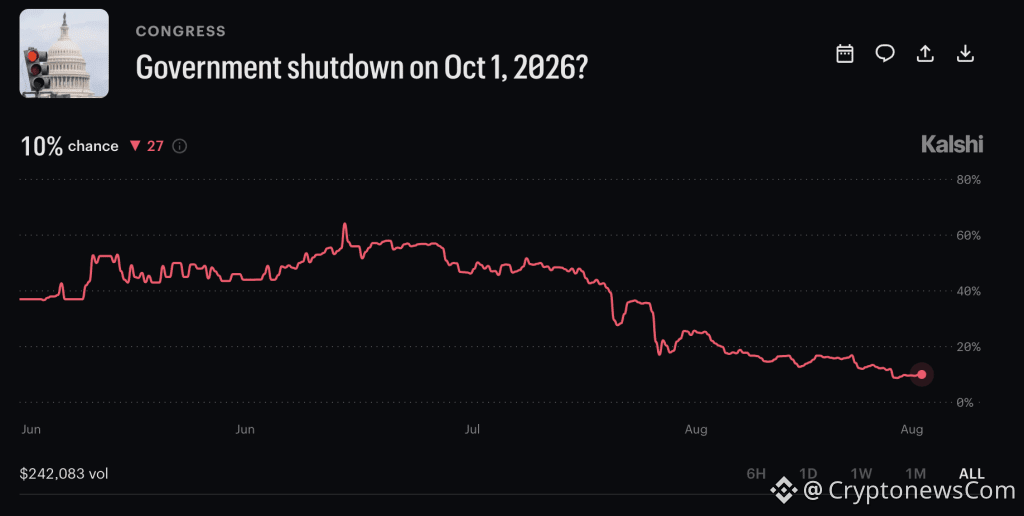
Article
Goverment Shutdown 2026 Odds Fall as Markets Split the October 1 RiskKalshi’s contract on a federal government shutdown on October 1, 2026 priced YES at 15-16 cents, an implied odds near 10% and down sharply from 35% just three weeks earlier.
Polymarket’s parallel market, which resolves on a different trigger and a later cutoff, still showed 16.5 cents as of August 14, per Polymarket Trader’s snapshot. The gap between those two numbers says less about Washington than about how differently the two venues define a shutdown.
The Goverment Shutdown Odds In 2026 Aren’t Pricing the Same Bet
Kalshi’s contract resolves YES only if part of the government is shut down at 10:00 a.m. ET on October 1 specifically. Polymarket runs two separate contracts on the same date: one requiring an actual shutdown, agencies suspending non-excepted operations, typically with furloughs, by 11:59 p.m. ET, and a second, broader “any-duration lapse” contract that pays out even on a brief technical gap with zero operational impact.
On August 14, Polymarket priced the shutdown version at 16.5 cents and the lapse version at 13.5 cents.
Source: Kalshi
A third Polymarket market bundles “another shutdown by January 31, 2027” with the 2026 House winner. Its no-shutdown legs had already settled at zero cents by the August 14 check, while the shutdown-plus-Democratic-House leg traded at 87.3 cents.
That is the market telling traders something specific: a lapse somewhere in the current funding cycle is priced as close to certain, even while an October 1 lapse specifically sits in the mid-teens.
A Five-Week Repricing, Told Through Three Snapshots
Kalshi’s own market commentary put the shutdown contract at 35% on July 31, with Senate negotiators reportedly nearing a stopgap that would fund the government to December 4 while capping a disputed OMB rule on appropriated spending.
By August 3, the cross-venue average had fallen to 28%, with Kalshi at 25% and PredictIt at 31%. Two weeks later, Kalshi had drifted down again to the 12-13% range on roughly $193,000 in contract volume.
Two prediction markets look at the same shutdown deadline and land in different places.
Kalshi prices a 49.4% chance of a shutdown by October 1. Polymarket has it closer to 42%. Same Congress, same deadline, a 7 point gap in how likely traders think Washington fails.
— Predixa (@Predixa_xyz) July 28, 2026
That trajectory, 35%, then 28%, then roughly 12-13%, is a repricing toward “Congress avoids the specific date,” not toward “shutdown risk is gone.”
The combined Polymarket market’s zeroed-out no-shutdown legs for January 31 make that distinction explicit: traders are separating the October 1 deadline from the broader fiscal-year window, and pricing them very differently.
Both books remain thin relative to 2025, when related shutdown contracts on Polymarket cleared roughly $157 million in cumulative volume on the start-date market alone – a reminder that current liquidity of a few thousand to a few hundred thousand dollars leaves these prices more exposed to spread and single-trade repricing than last year’s deeper markets.
The Percentage Is Only Half the Trade. Kalshi Lets You Trade the Exact Question.
The shutdown market shows why prediction trading is more than glancing at a headline probability. A 15% contract can mean something very different from another market showing 16% if the resolution rules, timing, and trigger are not identical.
That precision is part of Kalshi’s appeal.
Users can trade directly on defined real-world outcomes across politics, economic data, Fed decisions, crypto, and other major events, with every contract spelling out exactly what must happen for YES or NO to settle.
For traders following Washington into October, that creates a cleaner way to express a view than trying to guess how stocks, bonds, Bitcoin, or the dollar might react to the same event.
The government may avoid a shutdown at 10:00 a.m. on October 1 and still face another funding crisis weeks later. Kalshi lets traders separate those questions rather than treat them as a single macro bet.
Eligible new users who join through CryptoNews can also receive $25 through our referral link.
Make Your Prediction Count With $25 For Free on Kalshi
The post Goverment Shutdown 2026 Odds Fall as Markets Split the October 1 Risk appeared first on Cryptonews.
Goverment Shutdown 2026 Odds Fall as Markets Split the October 1 Risk
Kalshi’s contract on a federal government shutdown on October 1, 2026 priced YES at 15-16 cents, an implied odds near 10% and down sharply from 35% just three weeks earlier.
Polymarket’s parallel market, which resolves on a different trigger and a later cutoff, still showed 16.5 cents as of August 14, per Polymarket Trader’s snapshot. The gap between those two numbers says less about Washington than about how differently the two venues define a shutdown.
The Goverment Shutdown Odds In 2026 Aren’t Pricing the Same Bet
Kalshi’s contract resolves YES only if part of the government is shut down at 10:00 a.m. ET on October 1 specifically. Polymarket runs two separate contracts on the same date: one requiring an actual shutdown, agencies suspending non-excepted operations, typically with furloughs, by 11:59 p.m. ET, and a second, broader “any-duration lapse” contract that pays out even on a brief technical gap with zero operational impact.
On August 14, Polymarket priced the shutdown version at 16.5 cents and the lapse version at 13.5 cents.
Source: Kalshi
A third Polymarket market bundles “another shutdown by January 31, 2027” with the 2026 House winner. Its no-shutdown legs had already settled at zero cents by the August 14 check, while the shutdown-plus-Democratic-House leg traded at 87.3 cents.
That is the market telling traders something specific: a lapse somewhere in the current funding cycle is priced as close to certain, even while an October 1 lapse specifically sits in the mid-teens.
A Five-Week Repricing, Told Through Three Snapshots
Kalshi’s own market commentary put the shutdown contract at 35% on July 31, with Senate negotiators reportedly nearing a stopgap that would fund the government to December 4 while capping a disputed OMB rule on appropriated spending.
By August 3, the cross-venue average had fallen to 28%, with Kalshi at 25% and PredictIt at 31%. Two weeks later, Kalshi had drifted down again to the 12-13% range on roughly $193,000 in contract volume.
Two prediction markets look at the same shutdown deadline and land in different places.
Kalshi prices a 49.4% chance of a shutdown by October 1. Polymarket has it closer to 42%. Same Congress, same deadline, a 7 point gap in how likely traders think Washington fails.
— Predixa (@Predixa_xyz) July 28, 2026
That trajectory, 35%, then 28%, then roughly 12-13%, is a repricing toward “Congress avoids the specific date,” not toward “shutdown risk is gone.”
The combined Polymarket market’s zeroed-out no-shutdown legs for January 31 make that distinction explicit: traders are separating the October 1 deadline from the broader fiscal-year window, and pricing them very differently.
Both books remain thin relative to 2025, when related shutdown contracts on Polymarket cleared roughly $157 million in cumulative volume on the start-date market alone – a reminder that current liquidity of a few thousand to a few hundred thousand dollars leaves these prices more exposed to spread and single-trade repricing than last year’s deeper markets.
The Percentage Is Only Half the Trade. Kalshi Lets You Trade the Exact Question.
The shutdown market shows why prediction trading is more than glancing at a headline probability. A 15% contract can mean something very different from another market showing 16% if the resolution rules, timing, and trigger are not identical.
That precision is part of Kalshi’s appeal.
Users can trade directly on defined real-world outcomes across politics, economic data, Fed decisions, crypto, and other major events, with every contract spelling out exactly what must happen for YES or NO to settle.
For traders following Washington into October, that creates a cleaner way to express a view than trying to guess how stocks, bonds, Bitcoin, or the dollar might react to the same event.
The government may avoid a shutdown at 10:00 a.m. on October 1 and still face another funding crisis weeks later. Kalshi lets traders separate those questions rather than treat them as a single macro bet.
Eligible new users who join through CryptoNews can also receive $25 through our referral link.
Make Your Prediction Count With $25 For Free on Kalshi
The post Goverment Shutdown 2026 Odds Fall as Markets Split the October 1 Risk appeared first on Cryptonews.
Polymarket’s parallel market, which resolves on a different trigger and a later cutoff, still showed 16.5 cents as of August 14, per Polymarket Trader’s snapshot. The gap between those two numbers says less about Washington than about how differently the two venues define a shutdown.
The Goverment Shutdown Odds In 2026 Aren’t Pricing the Same Bet
Kalshi’s contract resolves YES only if part of the government is shut down at 10:00 a.m. ET on October 1 specifically. Polymarket runs two separate contracts on the same date: one requiring an actual shutdown, agencies suspending non-excepted operations, typically with furloughs, by 11:59 p.m. ET, and a second, broader “any-duration lapse” contract that pays out even on a brief technical gap with zero operational impact.
On August 14, Polymarket priced the shutdown version at 16.5 cents and the lapse version at 13.5 cents.
Source: Kalshi
A third Polymarket market bundles “another shutdown by January 31, 2027” with the 2026 House winner. Its no-shutdown legs had already settled at zero cents by the August 14 check, while the shutdown-plus-Democratic-House leg traded at 87.3 cents.
That is the market telling traders something specific: a lapse somewhere in the current funding cycle is priced as close to certain, even while an October 1 lapse specifically sits in the mid-teens.
A Five-Week Repricing, Told Through Three Snapshots
Kalshi’s own market commentary put the shutdown contract at 35% on July 31, with Senate negotiators reportedly nearing a stopgap that would fund the government to December 4 while capping a disputed OMB rule on appropriated spending.
By August 3, the cross-venue average had fallen to 28%, with Kalshi at 25% and PredictIt at 31%. Two weeks later, Kalshi had drifted down again to the 12-13% range on roughly $193,000 in contract volume.
Two prediction markets look at the same shutdown deadline and land in different places.
Kalshi prices a 49.4% chance of a shutdown by October 1. Polymarket has it closer to 42%. Same Congress, same deadline, a 7 point gap in how likely traders think Washington fails.
— Predixa (@Predixa_xyz) July 28, 2026
That trajectory, 35%, then 28%, then roughly 12-13%, is a repricing toward “Congress avoids the specific date,” not toward “shutdown risk is gone.”
The combined Polymarket market’s zeroed-out no-shutdown legs for January 31 make that distinction explicit: traders are separating the October 1 deadline from the broader fiscal-year window, and pricing them very differently.
Both books remain thin relative to 2025, when related shutdown contracts on Polymarket cleared roughly $157 million in cumulative volume on the start-date market alone – a reminder that current liquidity of a few thousand to a few hundred thousand dollars leaves these prices more exposed to spread and single-trade repricing than last year’s deeper markets.
The Percentage Is Only Half the Trade. Kalshi Lets You Trade the Exact Question.
The shutdown market shows why prediction trading is more than glancing at a headline probability. A 15% contract can mean something very different from another market showing 16% if the resolution rules, timing, and trigger are not identical.
That precision is part of Kalshi’s appeal.
Users can trade directly on defined real-world outcomes across politics, economic data, Fed decisions, crypto, and other major events, with every contract spelling out exactly what must happen for YES or NO to settle.
For traders following Washington into October, that creates a cleaner way to express a view than trying to guess how stocks, bonds, Bitcoin, or the dollar might react to the same event.
The government may avoid a shutdown at 10:00 a.m. on October 1 and still face another funding crisis weeks later. Kalshi lets traders separate those questions rather than treat them as a single macro bet.
Eligible new users who join through CryptoNews can also receive $25 through our referral link.
Make Your Prediction Count With $25 For Free on Kalshi
The post Goverment Shutdown 2026 Odds Fall as Markets Split the October 1 Risk appeared first on Cryptonews.
36

Article
XRP Price Prediction: $1.5B ETF Inflows and Institutional BackingXRP is changing hands at $1.47, down 1.25% over the last 24 hours, a pullback that looks minor against the backdrop of what’s happening in the ETF complex. Cumulative net inflows into U.S. spot XRP ETFs hit roughly $1.51 billion, with total net assets sitting between $940 million.
The Friday’s flow data shows inflows of about $18 million, led by Bitwise, Grayscale, and Franklin, a rebound from a rougher stretch where weekly inflows collapsed roughly 93% to just $1.01 million earlier in August. Markets seem to be pricing that optimism in real time.
XRP ETF Flows, Coinglass
The bigger question: does $1.5 billion in cumulative inflows represent durable institutional conviction, or is it a headline number masking week-to-week fatigue?
Discover: The Best Crypto to Diversify Your Portfolio
XRP Price Prediction: Hit $2 This Week?
At $1.47, XRP has already cleared levels that recent coverage framed as resistance. Our reports from earlier in the month had the token oscillating between $0.98 and $1.01 after briefly losing the psychological $1 handle.
XRP is at a meaningful structural shift. The $1.20 resistance zone that bulls were watching has been taken out entirely, and the token is now trading well above the consolidation range that defined most of August.
Xrp (XRP)
24h7d30d1yAll time
If ETF inflows continue their rebound, regulatory clarity headlines keep landing, and XRP grinds toward new multi-month highs with $1 acting as freshly minted support, XRP could catapult towards its $2 high. If price consolidates in the $1.40–$1.55 band, traders will digest the recent move and wait for the next flow update.
However, a sharp reversal of ETF sentiment or a broader risk-off macro shift, as the $40 trillion federal debt overhang isn’t going away, drags XRP back toward $1.20 support. Watching the next ETF flow print will likely settle which scenario plays out.
Trade XRP on Bybit and Get a Chance to Win Our $1,000 USDT Airdrop
LiquidChain Targets Early Mover Upside as XRP Tests Key Levels
Anyone who bought XRP price near $1 in early August is sitting on a solid move. But here’s the catch: at XRP’s current market cap, a repeat of that percentage gain requires billions more in fresh capital rotation.
Institutional flows help, but they move slowly. Traders chasing the next multiple often look further down the risk curve, toward assets still in price discovery.
LiquidChain is making “which chain?” a thing of the past. ⟁https://t.co/vqvBcdSQYC pic.twitter.com/ip83gw1P0u
— LiquidChain (@getliquidchain) August 23, 2026
That’s the pitch behind LiquidChain ($LIQUID), a Layer 3 infrastructure project fusing Bitcoin, Ethereum, and Solana liquidity into a single execution environment.
The presale token sits at $0.01493, with closer to $950K raised so far. The pitch centers on a deploy-once architecture, so developers build once and access liquidity across all three ecosystems, rather than fragmenting deployments chain by chain.
Verifiable settlement and single-step execution round out the technical case.
Research LiquidChain directly before committing capital.
Discover: The Best Token Presales
The post XRP Price Prediction: $1.5B ETF Inflows and Institutional Backing appeared first on Cryptonews.
XRP Price Prediction: $1.5B ETF Inflows and Institutional Backing
XRP is changing hands at $1.47, down 1.25% over the last 24 hours, a pullback that looks minor against the backdrop of what’s happening in the ETF complex. Cumulative net inflows into U.S. spot XRP ETFs hit roughly $1.51 billion, with total net assets sitting between $940 million.
The Friday’s flow data shows inflows of about $18 million, led by Bitwise, Grayscale, and Franklin, a rebound from a rougher stretch where weekly inflows collapsed roughly 93% to just $1.01 million earlier in August. Markets seem to be pricing that optimism in real time.
XRP ETF Flows, Coinglass
The bigger question: does $1.5 billion in cumulative inflows represent durable institutional conviction, or is it a headline number masking week-to-week fatigue?
Discover: The Best Crypto to Diversify Your Portfolio
XRP Price Prediction: Hit $2 This Week?
At $1.47, XRP has already cleared levels that recent coverage framed as resistance. Our reports from earlier in the month had the token oscillating between $0.98 and $1.01 after briefly losing the psychological $1 handle.
XRP is at a meaningful structural shift. The $1.20 resistance zone that bulls were watching has been taken out entirely, and the token is now trading well above the consolidation range that defined most of August.
Xrp (XRP)
24h7d30d1yAll time
If ETF inflows continue their rebound, regulatory clarity headlines keep landing, and XRP grinds toward new multi-month highs with $1 acting as freshly minted support, XRP could catapult towards its $2 high. If price consolidates in the $1.40–$1.55 band, traders will digest the recent move and wait for the next flow update.
However, a sharp reversal of ETF sentiment or a broader risk-off macro shift, as the $40 trillion federal debt overhang isn’t going away, drags XRP back toward $1.20 support. Watching the next ETF flow print will likely settle which scenario plays out.
Trade XRP on Bybit and Get a Chance to Win Our $1,000 USDT Airdrop
LiquidChain Targets Early Mover Upside as XRP Tests Key Levels
Anyone who bought XRP price near $1 in early August is sitting on a solid move. But here’s the catch: at XRP’s current market cap, a repeat of that percentage gain requires billions more in fresh capital rotation.
Institutional flows help, but they move slowly. Traders chasing the next multiple often look further down the risk curve, toward assets still in price discovery.
LiquidChain is making “which chain?” a thing of the past. ⟁https://t.co/vqvBcdSQYC pic.twitter.com/ip83gw1P0u
— LiquidChain (@getliquidchain) August 23, 2026
That’s the pitch behind LiquidChain ($LIQUID), a Layer 3 infrastructure project fusing Bitcoin, Ethereum, and Solana liquidity into a single execution environment.
The presale token sits at $0.01493, with closer to $950K raised so far. The pitch centers on a deploy-once architecture, so developers build once and access liquidity across all three ecosystems, rather than fragmenting deployments chain by chain.
Verifiable settlement and single-step execution round out the technical case.
Research LiquidChain directly before committing capital.
Discover: The Best Token Presales
The post XRP Price Prediction: $1.5B ETF Inflows and Institutional Backing appeared first on Cryptonews.
The Friday’s flow data shows inflows of about $18 million, led by Bitwise, Grayscale, and Franklin, a rebound from a rougher stretch where weekly inflows collapsed roughly 93% to just $1.01 million earlier in August. Markets seem to be pricing that optimism in real time.
XRP ETF Flows, Coinglass
The bigger question: does $1.5 billion in cumulative inflows represent durable institutional conviction, or is it a headline number masking week-to-week fatigue?
Discover: The Best Crypto to Diversify Your Portfolio
XRP Price Prediction: Hit $2 This Week?
At $1.47, XRP has already cleared levels that recent coverage framed as resistance. Our reports from earlier in the month had the token oscillating between $0.98 and $1.01 after briefly losing the psychological $1 handle.
XRP is at a meaningful structural shift. The $1.20 resistance zone that bulls were watching has been taken out entirely, and the token is now trading well above the consolidation range that defined most of August.
Xrp (XRP)
24h7d30d1yAll time
If ETF inflows continue their rebound, regulatory clarity headlines keep landing, and XRP grinds toward new multi-month highs with $1 acting as freshly minted support, XRP could catapult towards its $2 high. If price consolidates in the $1.40–$1.55 band, traders will digest the recent move and wait for the next flow update.
However, a sharp reversal of ETF sentiment or a broader risk-off macro shift, as the $40 trillion federal debt overhang isn’t going away, drags XRP back toward $1.20 support. Watching the next ETF flow print will likely settle which scenario plays out.
Trade XRP on Bybit and Get a Chance to Win Our $1,000 USDT Airdrop
LiquidChain Targets Early Mover Upside as XRP Tests Key Levels
Anyone who bought XRP price near $1 in early August is sitting on a solid move. But here’s the catch: at XRP’s current market cap, a repeat of that percentage gain requires billions more in fresh capital rotation.
Institutional flows help, but they move slowly. Traders chasing the next multiple often look further down the risk curve, toward assets still in price discovery.
LiquidChain is making “which chain?” a thing of the past. ⟁https://t.co/vqvBcdSQYC pic.twitter.com/ip83gw1P0u
— LiquidChain (@getliquidchain) August 23, 2026
That’s the pitch behind LiquidChain ($LIQUID), a Layer 3 infrastructure project fusing Bitcoin, Ethereum, and Solana liquidity into a single execution environment.
The presale token sits at $0.01493, with closer to $950K raised so far. The pitch centers on a deploy-once architecture, so developers build once and access liquidity across all three ecosystems, rather than fragmenting deployments chain by chain.
Verifiable settlement and single-step execution round out the technical case.
Research LiquidChain directly before committing capital.
Discover: The Best Token Presales
The post XRP Price Prediction: $1.5B ETF Inflows and Institutional Backing appeared first on Cryptonews.
149
Ripple Payment Rails Separated From FedNow Access by VolanteVolante Technologies offers U.S. banks and financial institutions a unified solution for the Federal Reserve’s FedNow Service and The Clearing House’s RTP real-time payments network. Separately, Volante’s cross-border payment materials list Ripple and digital currencies among the services its platform processes.
The available materials describe separate capabilities, while the Federal Reserve’s FedNow participants and service providers page does not mention XRP or Ripple.
Volante says its cloud-native cross-border payments platform processes SWIFT gpi, Ripple, Visa B2B, Mastercard Send, digital currencies, alternative payments, and other services from a single platform. The company also describes connectivity to SWIFT, blockchain networks, major card networks, and alternative payment rails.
This architecture presents multiple payment and messaging options through one provider. Volante’s cross-border materials identify Ripple alongside other rails, while its FedNow announcement describes a separate unified offering for FedNow and TCH RTP.
Discover: The Best Token Presales
Volante’s FedNow Offering Ripple Payment
In an announcement, Volante said it was offering U.S. banks and financial institutions a single unified solution for the FedNow Service and TCH RTP real-time payments. The company said adopters could begin with TCH RTP and add the FedNow Service when the network was ready.
The announcement said Volante had joined the FedNow Pilot Program in early 2021 and was a prospective participant in the Federal Reserve’s FedNow Service Provider Showcase. It described capabilities for real-time and instant payments and said Volante’s FedNow offering would be extensible to wire, ACH, and SWIFT. However, the announcement does not refer to Ripple or XRP.
The Federal Reserve’s FedNow participants and service providers page describes the FedNow Service as instant-payments infrastructure through which participating banks and credit unions can send and receive transactions within seconds on behalf of customers, 24 hours a day, seven days a week.
Infographic explaining the FedNow instant-payment platform from Investopedia.
Trade XRP on Bybit and Get a Chance to Win Our $1,000 USDT Airdrop
Keeping the Distinction Clear
Volante’s materials support two separate points: the company offers a FedNow and TCH RTP solution for U.S. financial institutions, and its cross-border platform processes Ripple among a broader set of payment services. The supplied materials do not describe a shared settlement mechanism between FedNow and Ripple.
Xrp (XRP)
24h7d30d1yAll time
A direct statement from FedNow connecting the service to XRP or Ripple would be needed to establish such a link. Based on the materials reviewed, Volante’s FedNow offering and its Ripple-related cross-border capability should be treated as separate parts of the vendor’s platform.
Discover: The Best Crypto to Diversify Your Portfolio
The post Ripple Payment Rails Separated From FedNow Access by Volante appeared first on Cryptonews.
Ripple Payment Rails Separated From FedNow Access by Volante
Volante Technologies offers U.S. banks and financial institutions a unified solution for the Federal Reserve’s FedNow Service and The Clearing House’s RTP real-time payments network. Separately, Volante’s cross-border payment materials list Ripple and digital currencies among the services its platform processes.
The available materials describe separate capabilities, while the Federal Reserve’s FedNow participants and service providers page does not mention XRP or Ripple.
Volante says its cloud-native cross-border payments platform processes SWIFT gpi, Ripple, Visa B2B, Mastercard Send, digital currencies, alternative payments, and other services from a single platform. The company also describes connectivity to SWIFT, blockchain networks, major card networks, and alternative payment rails.
This architecture presents multiple payment and messaging options through one provider. Volante’s cross-border materials identify Ripple alongside other rails, while its FedNow announcement describes a separate unified offering for FedNow and TCH RTP.
Discover: The Best Token Presales
Volante’s FedNow Offering Ripple Payment
In an announcement, Volante said it was offering U.S. banks and financial institutions a single unified solution for the FedNow Service and TCH RTP real-time payments. The company said adopters could begin with TCH RTP and add the FedNow Service when the network was ready.
The announcement said Volante had joined the FedNow Pilot Program in early 2021 and was a prospective participant in the Federal Reserve’s FedNow Service Provider Showcase. It described capabilities for real-time and instant payments and said Volante’s FedNow offering would be extensible to wire, ACH, and SWIFT. However, the announcement does not refer to Ripple or XRP.
The Federal Reserve’s FedNow participants and service providers page describes the FedNow Service as instant-payments infrastructure through which participating banks and credit unions can send and receive transactions within seconds on behalf of customers, 24 hours a day, seven days a week.
Infographic explaining the FedNow instant-payment platform from Investopedia.
Trade XRP on Bybit and Get a Chance to Win Our $1,000 USDT Airdrop
Keeping the Distinction Clear
Volante’s materials support two separate points: the company offers a FedNow and TCH RTP solution for U.S. financial institutions, and its cross-border platform processes Ripple among a broader set of payment services. The supplied materials do not describe a shared settlement mechanism between FedNow and Ripple.
Xrp (XRP)
24h7d30d1yAll time
A direct statement from FedNow connecting the service to XRP or Ripple would be needed to establish such a link. Based on the materials reviewed, Volante’s FedNow offering and its Ripple-related cross-border capability should be treated as separate parts of the vendor’s platform.
Discover: The Best Crypto to Diversify Your Portfolio
The post Ripple Payment Rails Separated From FedNow Access by Volante appeared first on Cryptonews.
The available materials describe separate capabilities, while the Federal Reserve’s FedNow participants and service providers page does not mention XRP or Ripple.
Volante says its cloud-native cross-border payments platform processes SWIFT gpi, Ripple, Visa B2B, Mastercard Send, digital currencies, alternative payments, and other services from a single platform. The company also describes connectivity to SWIFT, blockchain networks, major card networks, and alternative payment rails.
This architecture presents multiple payment and messaging options through one provider. Volante’s cross-border materials identify Ripple alongside other rails, while its FedNow announcement describes a separate unified offering for FedNow and TCH RTP.
Discover: The Best Token Presales
Volante’s FedNow Offering Ripple Payment
In an announcement, Volante said it was offering U.S. banks and financial institutions a single unified solution for the FedNow Service and TCH RTP real-time payments. The company said adopters could begin with TCH RTP and add the FedNow Service when the network was ready.
The announcement said Volante had joined the FedNow Pilot Program in early 2021 and was a prospective participant in the Federal Reserve’s FedNow Service Provider Showcase. It described capabilities for real-time and instant payments and said Volante’s FedNow offering would be extensible to wire, ACH, and SWIFT. However, the announcement does not refer to Ripple or XRP.
The Federal Reserve’s FedNow participants and service providers page describes the FedNow Service as instant-payments infrastructure through which participating banks and credit unions can send and receive transactions within seconds on behalf of customers, 24 hours a day, seven days a week.
Infographic explaining the FedNow instant-payment platform from Investopedia.
Trade XRP on Bybit and Get a Chance to Win Our $1,000 USDT Airdrop
Keeping the Distinction Clear
Volante’s materials support two separate points: the company offers a FedNow and TCH RTP solution for U.S. financial institutions, and its cross-border platform processes Ripple among a broader set of payment services. The supplied materials do not describe a shared settlement mechanism between FedNow and Ripple.
Xrp (XRP)
24h7d30d1yAll time
A direct statement from FedNow connecting the service to XRP or Ripple would be needed to establish such a link. Based on the materials reviewed, Volante’s FedNow offering and its Ripple-related cross-border capability should be treated as separate parts of the vendor’s platform.
Discover: The Best Crypto to Diversify Your Portfolio
The post Ripple Payment Rails Separated From FedNow Access by Volante appeared first on Cryptonews.
130

Article
Fed Under Pressure: $40Tn Debt Crisis Sparks Bitcoin Surge as Layer-2 Pioneer Bitcoin Hyper Raise...The global financial system is flashing severe warning signs as the US national debt breaches a historic $40 trillion. Against a backdrop of a weakening dollar and aggressive Treasury interventions, investors are bracing for a high-stakes address from Federal Reserve Chair Kevin Warsh at this Friday’s Jackson Hole gathering.
The systemic pressure is palpable. Even as the US Treasury deploys $4 billion in long-bond buyback operations to stabilize the bond market, smart money is aggressively rotating into hard assets. This macro-driven flight to safety has propelled Bitcoin above $77,000, marking a spectacular 22% gain over the past week, one of its most dominant weekly performances against the greenback in over three years.
Market experts suggest this is just the beginning of a broader structural shift. Renowned analyst Michaël van de Poppe expects this bullish momentum to carry through the remainder of the third quarter.
The bull market has barely started at this point for #Bitcoin. https://t.co/mXQlJnF8UI
— Michaël van de Poppe (@CryptoMichNL) August 23, 2026
As capital floods into the world’s premier digital asset, the network’s underlying infrastructure faces a critical test. While Bitcoin’s security remains unmatched, high congestion during market surges can lead to slow processing times and prohibitive transaction fees. This has intensified demand for robust Layer-2 scaling solutions that can transform Bitcoin from a passive hedge into a highly efficient, everyday currency for transacting.
The Macro Catalyst: Why $40T Debt is Forcing Bitcoin to Evolve
To bypass the main network’s bottlenecks, developers are building high-speed companion networks. Leading this infrastructure charge is Bitcoin Hyper (HYPER). The project’s ongoing presale has already captured massive market attention, securing over $33 million from early backers who want to see Bitcoin scale to meet global demand.
By shifting transaction execution off the main chain while preserving its underlying security, Layer-2 protocols ensure that Bitcoin remains viable even under extreme network load. With macroeconomic pressures driving unprecedented adoption, the race to scale Bitcoin has become a primary focus for the industry.
Unlocking Solana-Level Speed on Bitcoin Security
In technical terms, Bitcoin Hyper (HYPER) bridges the gap between Bitcoin’s institutional-grade security and the high-performance execution of the Solana Virtual Machine (SVM). The result is a companion network built for sub-penny transaction costs and near-instant settlement.
Key components of the ecosystem include:
The Bridge: A secure portal designed to seamlessly transfer BTC onto the high-speed Bitcoin Hyper network.
Everyday Usability: Enables frictionless microtransactions, decentralized application (dApp) interactions, and staking without network congestion.
The HYPER Token: The native utility asset powering the ecosystem. Featuring a fixed supply of 21 billion tokens, HYPER is used for gas fees, decentralized governance, and network rewards.
When the forecast says there's a 100% chance of HYPER. https://t.co/VNG0P4GuDo pic.twitter.com/LPrQrLUZ5w
— Bitcoin Hyper (@BTC_Hyper2) August 23, 2026
How to Position Early in the HYPER Presale
For those looking to hedge against macroeconomic instability while backing next-generation L2 tech, the HYPER presale offers an early-entry window. The utility token is currently priced at $0.0136851, with a price increase scheduled to take place later today as the presale advances to its next stage.
Participating in the presale is streamlined. Investors can visit the official Bitcoin Hyper website, connect a compatible Web3 wallet, and purchase tokens using ETH, SOL, BNB, stablecoins, or credit cards.
Alternatively, the presale is integrated directly into the secure Best Wallet app, which can be downloaded via the Apple App Store or Google Play.
Early participants can immediately lock their tokens into the network’s staking protocol to capture a substantial 35% APY, allowing their holdings to compound ahead of the official launch.
To stay informed on development milestones and community initiatives, you can follow the Bitcoin Hyper project on X and join its Telegram channel.
Visit Bitcoin Hyper.
The post Fed Under Pressure: $40Tn Debt Crisis Sparks Bitcoin Surge as Layer-2 Pioneer Bitcoin Hyper Raises $33M appeared first on Cryptonews.
Fed Under Pressure: $40Tn Debt Crisis Sparks Bitcoin Surge as Layer-2 Pioneer Bitcoin Hyper Raise...
The global financial system is flashing severe warning signs as the US national debt breaches a historic $40 trillion. Against a backdrop of a weakening dollar and aggressive Treasury interventions, investors are bracing for a high-stakes address from Federal Reserve Chair Kevin Warsh at this Friday’s Jackson Hole gathering.
The systemic pressure is palpable. Even as the US Treasury deploys $4 billion in long-bond buyback operations to stabilize the bond market, smart money is aggressively rotating into hard assets. This macro-driven flight to safety has propelled Bitcoin above $77,000, marking a spectacular 22% gain over the past week, one of its most dominant weekly performances against the greenback in over three years.
Market experts suggest this is just the beginning of a broader structural shift. Renowned analyst Michaël van de Poppe expects this bullish momentum to carry through the remainder of the third quarter.
The bull market has barely started at this point for #Bitcoin. https://t.co/mXQlJnF8UI
— Michaël van de Poppe (@CryptoMichNL) August 23, 2026
As capital floods into the world’s premier digital asset, the network’s underlying infrastructure faces a critical test. While Bitcoin’s security remains unmatched, high congestion during market surges can lead to slow processing times and prohibitive transaction fees. This has intensified demand for robust Layer-2 scaling solutions that can transform Bitcoin from a passive hedge into a highly efficient, everyday currency for transacting.
The Macro Catalyst: Why $40T Debt is Forcing Bitcoin to Evolve
To bypass the main network’s bottlenecks, developers are building high-speed companion networks. Leading this infrastructure charge is Bitcoin Hyper (HYPER). The project’s ongoing presale has already captured massive market attention, securing over $33 million from early backers who want to see Bitcoin scale to meet global demand.
By shifting transaction execution off the main chain while preserving its underlying security, Layer-2 protocols ensure that Bitcoin remains viable even under extreme network load. With macroeconomic pressures driving unprecedented adoption, the race to scale Bitcoin has become a primary focus for the industry.
Unlocking Solana-Level Speed on Bitcoin Security
In technical terms, Bitcoin Hyper (HYPER) bridges the gap between Bitcoin’s institutional-grade security and the high-performance execution of the Solana Virtual Machine (SVM). The result is a companion network built for sub-penny transaction costs and near-instant settlement.
Key components of the ecosystem include:
The Bridge: A secure portal designed to seamlessly transfer BTC onto the high-speed Bitcoin Hyper network.
Everyday Usability: Enables frictionless microtransactions, decentralized application (dApp) interactions, and staking without network congestion.
The HYPER Token: The native utility asset powering the ecosystem. Featuring a fixed supply of 21 billion tokens, HYPER is used for gas fees, decentralized governance, and network rewards.
When the forecast says there's a 100% chance of HYPER. https://t.co/VNG0P4GuDo pic.twitter.com/LPrQrLUZ5w
— Bitcoin Hyper (@BTC_Hyper2) August 23, 2026
How to Position Early in the HYPER Presale
For those looking to hedge against macroeconomic instability while backing next-generation L2 tech, the HYPER presale offers an early-entry window. The utility token is currently priced at $0.0136851, with a price increase scheduled to take place later today as the presale advances to its next stage.
Participating in the presale is streamlined. Investors can visit the official Bitcoin Hyper website, connect a compatible Web3 wallet, and purchase tokens using ETH, SOL, BNB, stablecoins, or credit cards.
Alternatively, the presale is integrated directly into the secure Best Wallet app, which can be downloaded via the Apple App Store or Google Play.
Early participants can immediately lock their tokens into the network’s staking protocol to capture a substantial 35% APY, allowing their holdings to compound ahead of the official launch.
To stay informed on development milestones and community initiatives, you can follow the Bitcoin Hyper project on X and join its Telegram channel.
Visit Bitcoin Hyper.
The post Fed Under Pressure: $40Tn Debt Crisis Sparks Bitcoin Surge as Layer-2 Pioneer Bitcoin Hyper Raises $33M appeared first on Cryptonews.
The systemic pressure is palpable. Even as the US Treasury deploys $4 billion in long-bond buyback operations to stabilize the bond market, smart money is aggressively rotating into hard assets. This macro-driven flight to safety has propelled Bitcoin above $77,000, marking a spectacular 22% gain over the past week, one of its most dominant weekly performances against the greenback in over three years.
Market experts suggest this is just the beginning of a broader structural shift. Renowned analyst Michaël van de Poppe expects this bullish momentum to carry through the remainder of the third quarter.
The bull market has barely started at this point for #Bitcoin. https://t.co/mXQlJnF8UI
— Michaël van de Poppe (@CryptoMichNL) August 23, 2026
As capital floods into the world’s premier digital asset, the network’s underlying infrastructure faces a critical test. While Bitcoin’s security remains unmatched, high congestion during market surges can lead to slow processing times and prohibitive transaction fees. This has intensified demand for robust Layer-2 scaling solutions that can transform Bitcoin from a passive hedge into a highly efficient, everyday currency for transacting.
The Macro Catalyst: Why $40T Debt is Forcing Bitcoin to Evolve
To bypass the main network’s bottlenecks, developers are building high-speed companion networks. Leading this infrastructure charge is Bitcoin Hyper (HYPER). The project’s ongoing presale has already captured massive market attention, securing over $33 million from early backers who want to see Bitcoin scale to meet global demand.
By shifting transaction execution off the main chain while preserving its underlying security, Layer-2 protocols ensure that Bitcoin remains viable even under extreme network load. With macroeconomic pressures driving unprecedented adoption, the race to scale Bitcoin has become a primary focus for the industry.
Unlocking Solana-Level Speed on Bitcoin Security
In technical terms, Bitcoin Hyper (HYPER) bridges the gap between Bitcoin’s institutional-grade security and the high-performance execution of the Solana Virtual Machine (SVM). The result is a companion network built for sub-penny transaction costs and near-instant settlement.
Key components of the ecosystem include:
The Bridge: A secure portal designed to seamlessly transfer BTC onto the high-speed Bitcoin Hyper network.
Everyday Usability: Enables frictionless microtransactions, decentralized application (dApp) interactions, and staking without network congestion.
The HYPER Token: The native utility asset powering the ecosystem. Featuring a fixed supply of 21 billion tokens, HYPER is used for gas fees, decentralized governance, and network rewards.
When the forecast says there's a 100% chance of HYPER. https://t.co/VNG0P4GuDo pic.twitter.com/LPrQrLUZ5w
— Bitcoin Hyper (@BTC_Hyper2) August 23, 2026
How to Position Early in the HYPER Presale
For those looking to hedge against macroeconomic instability while backing next-generation L2 tech, the HYPER presale offers an early-entry window. The utility token is currently priced at $0.0136851, with a price increase scheduled to take place later today as the presale advances to its next stage.
Participating in the presale is streamlined. Investors can visit the official Bitcoin Hyper website, connect a compatible Web3 wallet, and purchase tokens using ETH, SOL, BNB, stablecoins, or credit cards.
Alternatively, the presale is integrated directly into the secure Best Wallet app, which can be downloaded via the Apple App Store or Google Play.
Early participants can immediately lock their tokens into the network’s staking protocol to capture a substantial 35% APY, allowing their holdings to compound ahead of the official launch.
To stay informed on development milestones and community initiatives, you can follow the Bitcoin Hyper project on X and join its Telegram channel.
Visit Bitcoin Hyper.
The post Fed Under Pressure: $40Tn Debt Crisis Sparks Bitcoin Surge as Layer-2 Pioneer Bitcoin Hyper Raises $33M appeared first on Cryptonews.
490
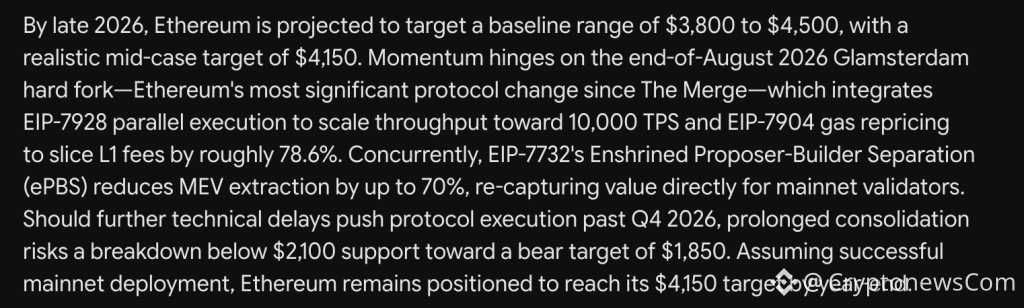
Article
Google Gemini AI Predicts Ethereum Could Become the Trade Retail Misses in 2026The biggest protocol change since The Merge is days away. Google Gemini AI predicts it resets Ethereum’s trajectory, and the price prediction targets a baseline of $3,800 to $4,500 by late 2026, with $4,150 as the realistic mid-case.
Everything hinges on the end-of-August Glamsterdam hard fork. Gemini calls it Ethereum’s most significant protocol change since The Merge.
EIP-7928 brings parallel execution to the network. That scales throughput toward 10,000 TPS, and EIP-7904 handles the cost side through gas repricing. It slices Layer-1 fees by roughly 78.6%.
Source: Gemini AI Ethereum Price Prediction
Cheaper and faster together change what can run on mainnet rather than a rollup. EIP-7732 adds the third component with Enshrined Proposer-Builder Separation.
That reduces MEV extraction by up to 70%. The value gets recaptured directly for mainnet validators instead of leaking to searchers.
The bear case is a timing failure. Further technical delays pushing protocol execution past Q4 2026 would trigger prolonged consolidation. That risks a breakdown below $2,100 support toward a bear target of $1,850. Successful mainnet deployment is what keeps the $4,150 target on the table.
Ethereum (ETH)
24h7d30d1yAll time
Discover: Everyone’s Got a Take. Get Free $25 from Kalshi to Actually Trade Yours
Ethereum Price Prediction: Gemini AI Predicts The Biggest Change Since The Merge Lands This Month
The daily chart has broken out of a long base. ETH peaked near $4,950 last August before a sustained decline. October and November cut the price from $4,700 toward $2,800. February brought the sharpest break, dropping ETH near $1,780.
Spring recovered to $2,450 by May, before June erased it. The low arrived at around $1,480. July and August built a slow base above $1,850. The past two sessions have exploded through it, lifting ETH near $2,400.
The close reads $2,398.9, up 3.13%, and $72.9. The daily range covered $2,324.2 to $2,446.8. Support sits at $2,300, then $2,100, and $1,850. Resistance appears at $2,450, then $2,800, and $3,000.
RSI reads 86.13 with its signal line far below at 59.55. That gap of more than 26 points is extreme and reflects a violent repricing.
The oscillator is deeply overbought. Momentum is powerfully bullish, though readings this high rarely extend without consolidation.
Gemini’s mid-case needs a further 73% move. The fork itself is the event that decides whether this breakout becomes a trend.
Discover: Your Market Calls Are Worth Something. Start with a free $25 on Kalshi
Ethereum Is Rebuilding Its Base Layer: Bitcoin Hyper Is Building the Layer Bitcoin Never Had
Ethereum’s next leg depends on making its network dramatically faster and cheaper without sacrificing the security underneath. Bitcoin Hyper is pursuing the same outcome for Bitcoin from a different starting point.
Rather than changing Bitcoin’s base layer, the project is building an execution environment around it using the Solana Virtual Machine. That brings high-speed transactions, ultra-low fees, and smart contract functionality to an ecosystem historically limited by Bitcoin’s slower, less programmable design.
A Canonical Bridge is designed to move BTC into that environment, while HYPER powers gas fees, staking, and governance across the network.
The opportunity is straightforward: Bitcoin already has enormous capital and security. Bitcoin Hyper is betting that adding a faster execution layer can make far more of that capital usable.
The presale has already raised more than $33 million, with buyers currently able to stake HYPER for yields of up to 36% APY ahead of the planned 2026 launch.
Explore the Bitcoin Hyper Presale
The post Google Gemini AI Predicts Ethereum Could Become the Trade Retail Misses in 2026 appeared first on Cryptonews.
Google Gemini AI Predicts Ethereum Could Become the Trade Retail Misses in 2026
The biggest protocol change since The Merge is days away. Google Gemini AI predicts it resets Ethereum’s trajectory, and the price prediction targets a baseline of $3,800 to $4,500 by late 2026, with $4,150 as the realistic mid-case.
Everything hinges on the end-of-August Glamsterdam hard fork. Gemini calls it Ethereum’s most significant protocol change since The Merge.
EIP-7928 brings parallel execution to the network. That scales throughput toward 10,000 TPS, and EIP-7904 handles the cost side through gas repricing. It slices Layer-1 fees by roughly 78.6%.
Source: Gemini AI Ethereum Price Prediction
Cheaper and faster together change what can run on mainnet rather than a rollup. EIP-7732 adds the third component with Enshrined Proposer-Builder Separation.
That reduces MEV extraction by up to 70%. The value gets recaptured directly for mainnet validators instead of leaking to searchers.
The bear case is a timing failure. Further technical delays pushing protocol execution past Q4 2026 would trigger prolonged consolidation. That risks a breakdown below $2,100 support toward a bear target of $1,850. Successful mainnet deployment is what keeps the $4,150 target on the table.
Ethereum (ETH)
24h7d30d1yAll time
Discover: Everyone’s Got a Take. Get Free $25 from Kalshi to Actually Trade Yours
Ethereum Price Prediction: Gemini AI Predicts The Biggest Change Since The Merge Lands This Month
The daily chart has broken out of a long base. ETH peaked near $4,950 last August before a sustained decline. October and November cut the price from $4,700 toward $2,800. February brought the sharpest break, dropping ETH near $1,780.
Spring recovered to $2,450 by May, before June erased it. The low arrived at around $1,480. July and August built a slow base above $1,850. The past two sessions have exploded through it, lifting ETH near $2,400.
The close reads $2,398.9, up 3.13%, and $72.9. The daily range covered $2,324.2 to $2,446.8. Support sits at $2,300, then $2,100, and $1,850. Resistance appears at $2,450, then $2,800, and $3,000.
RSI reads 86.13 with its signal line far below at 59.55. That gap of more than 26 points is extreme and reflects a violent repricing.
The oscillator is deeply overbought. Momentum is powerfully bullish, though readings this high rarely extend without consolidation.
Gemini’s mid-case needs a further 73% move. The fork itself is the event that decides whether this breakout becomes a trend.
Discover: Your Market Calls Are Worth Something. Start with a free $25 on Kalshi
Ethereum Is Rebuilding Its Base Layer: Bitcoin Hyper Is Building the Layer Bitcoin Never Had
Ethereum’s next leg depends on making its network dramatically faster and cheaper without sacrificing the security underneath. Bitcoin Hyper is pursuing the same outcome for Bitcoin from a different starting point.
Rather than changing Bitcoin’s base layer, the project is building an execution environment around it using the Solana Virtual Machine. That brings high-speed transactions, ultra-low fees, and smart contract functionality to an ecosystem historically limited by Bitcoin’s slower, less programmable design.
A Canonical Bridge is designed to move BTC into that environment, while HYPER powers gas fees, staking, and governance across the network.
The opportunity is straightforward: Bitcoin already has enormous capital and security. Bitcoin Hyper is betting that adding a faster execution layer can make far more of that capital usable.
The presale has already raised more than $33 million, with buyers currently able to stake HYPER for yields of up to 36% APY ahead of the planned 2026 launch.
Explore the Bitcoin Hyper Presale
The post Google Gemini AI Predicts Ethereum Could Become the Trade Retail Misses in 2026 appeared first on Cryptonews.
Everything hinges on the end-of-August Glamsterdam hard fork. Gemini calls it Ethereum’s most significant protocol change since The Merge.
EIP-7928 brings parallel execution to the network. That scales throughput toward 10,000 TPS, and EIP-7904 handles the cost side through gas repricing. It slices Layer-1 fees by roughly 78.6%.
Source: Gemini AI Ethereum Price Prediction
Cheaper and faster together change what can run on mainnet rather than a rollup. EIP-7732 adds the third component with Enshrined Proposer-Builder Separation.
That reduces MEV extraction by up to 70%. The value gets recaptured directly for mainnet validators instead of leaking to searchers.
The bear case is a timing failure. Further technical delays pushing protocol execution past Q4 2026 would trigger prolonged consolidation. That risks a breakdown below $2,100 support toward a bear target of $1,850. Successful mainnet deployment is what keeps the $4,150 target on the table.
Ethereum (ETH)
24h7d30d1yAll time
Discover: Everyone’s Got a Take. Get Free $25 from Kalshi to Actually Trade Yours
Ethereum Price Prediction: Gemini AI Predicts The Biggest Change Since The Merge Lands This Month
The daily chart has broken out of a long base. ETH peaked near $4,950 last August before a sustained decline. October and November cut the price from $4,700 toward $2,800. February brought the sharpest break, dropping ETH near $1,780.
Spring recovered to $2,450 by May, before June erased it. The low arrived at around $1,480. July and August built a slow base above $1,850. The past two sessions have exploded through it, lifting ETH near $2,400.
The close reads $2,398.9, up 3.13%, and $72.9. The daily range covered $2,324.2 to $2,446.8. Support sits at $2,300, then $2,100, and $1,850. Resistance appears at $2,450, then $2,800, and $3,000.
RSI reads 86.13 with its signal line far below at 59.55. That gap of more than 26 points is extreme and reflects a violent repricing.
The oscillator is deeply overbought. Momentum is powerfully bullish, though readings this high rarely extend without consolidation.
Gemini’s mid-case needs a further 73% move. The fork itself is the event that decides whether this breakout becomes a trend.
Discover: Your Market Calls Are Worth Something. Start with a free $25 on Kalshi
Ethereum Is Rebuilding Its Base Layer: Bitcoin Hyper Is Building the Layer Bitcoin Never Had
Ethereum’s next leg depends on making its network dramatically faster and cheaper without sacrificing the security underneath. Bitcoin Hyper is pursuing the same outcome for Bitcoin from a different starting point.
Rather than changing Bitcoin’s base layer, the project is building an execution environment around it using the Solana Virtual Machine. That brings high-speed transactions, ultra-low fees, and smart contract functionality to an ecosystem historically limited by Bitcoin’s slower, less programmable design.
A Canonical Bridge is designed to move BTC into that environment, while HYPER powers gas fees, staking, and governance across the network.
The opportunity is straightforward: Bitcoin already has enormous capital and security. Bitcoin Hyper is betting that adding a faster execution layer can make far more of that capital usable.
The presale has already raised more than $33 million, with buyers currently able to stake HYPER for yields of up to 36% APY ahead of the planned 2026 launch.
Explore the Bitcoin Hyper Presale
The post Google Gemini AI Predicts Ethereum Could Become the Trade Retail Misses in 2026 appeared first on Cryptonews.
145
Log in to explore more content
Join global crypto users on Binance Square
⚡️ Get latest and useful information about crypto.
💬 Trusted by the world’s largest crypto exchange.
👍 Discover real insights from verified creators.
Email / Phone number
Trending Topics
BitcoinRejectedAt$81K50WeekMA
567 views
34 Discussing
#BitcoinRejectedAt$81K50WeekMA
🐻 Bitcoin got rejected at the $81K 50-week MA wall! 🧱
BTC smashed $81.2K before the bears pushed it back under $80K. And guess what? There are even bigger boss walls waiting at $82K-$83K! 🥊 But don't look away just yet. BTC is currently pulling back to $79K to gather liquidity. Is this enough fuel for a massive rocket jump, especially with ETF inflows going strong for 6 straight days? 🚀
What should traders do?
Don't panic! Nasty resistances rarely break on the first try. Watch the $79K support level, look for spot buying strength, and don't overleverage! 📉
⚠️ This is not financial advice.
Ready to trade the Bitcoin breakout? Join Binance!
🚀 Use code: VINHTOCDO
🔗 Link: https://www.binance.com/register?ref=VINHTOCDO
#BitcoinETF #BTC81K #CryptoMarket2026 #VINHTOCDO
$BTC
$ETH
$BNB
Vinhtocdo
·0 Likes
·154 views
SolanaSpotETFInflowsHitRecord$1.22B
333 views
22 Discussing
KazakhstanCutsOilOutputForecastTo96MTons
6,484 views
288 Discussing