ABDULc11

විවෘත වෙළෙඳාම
නිතර වෙළෙන්දා
{වේලාව} වසර
285 හඹා යමින්
10.3K+ හඹා යන්නන්
1.9K+ කැමති විය
පෝස්ටු
ආයෝජන කළඹ
·
--
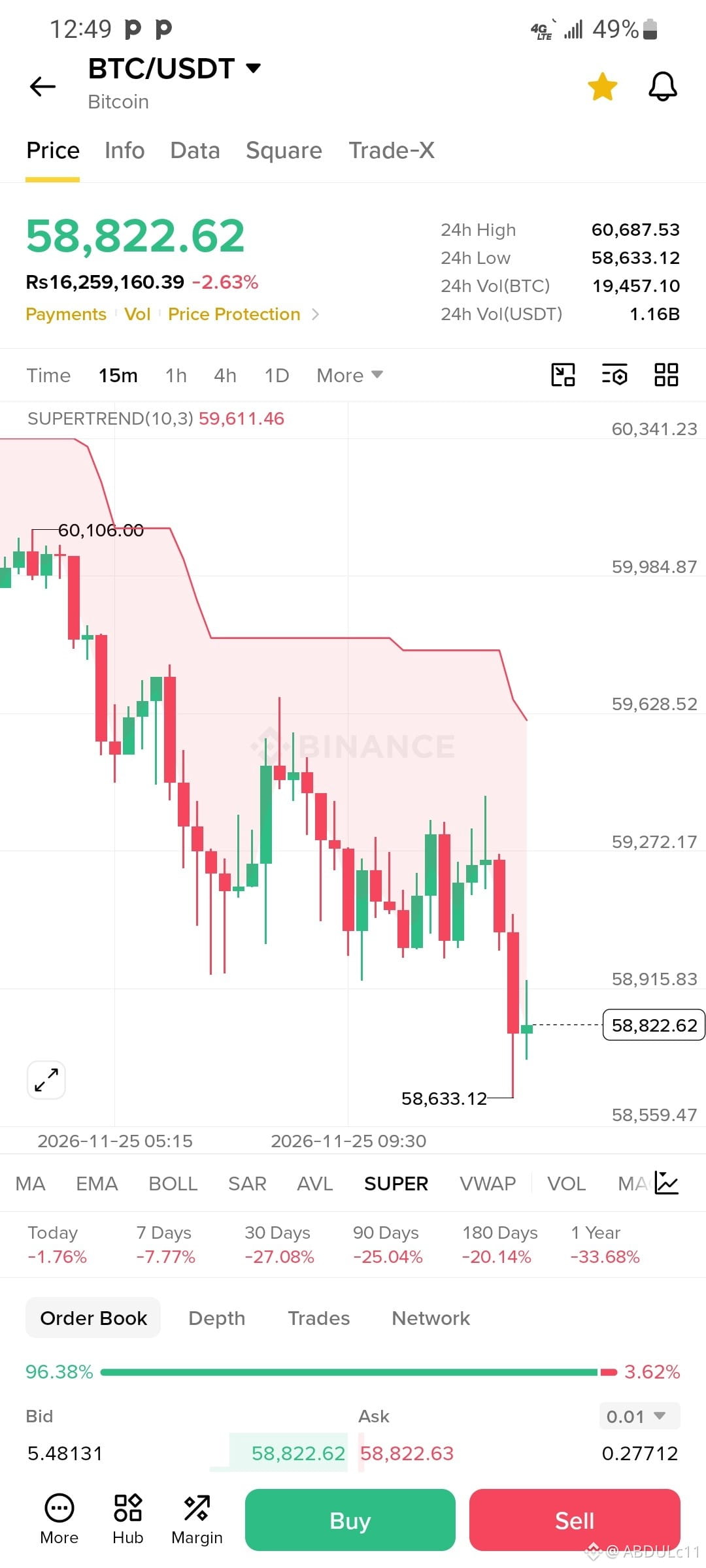
🔴 $BTC /USDT – Bitcoin Faces Strong Selling Pressure! Bitcoin is currently trading at $58,822.62, down 2.63% in the last 24 hours. 📉 BTC recently dropped to a low of $58,633.12, showing strong bearish momentum on the 15-minute chart. Key Levels to Watch: - 🔴 Resistance: $59,272 – $59,611 - 🟢 Support: $58,633 - Current Price: $58,822.62 The Supertrend indicator remains bearish at $59,611.46. If BTC breaks below $58,633, further downside could follow. However, holding this support may trigger a short-term recovery. What's next for Bitcoin? Will BTC break below $58,600 or bounce back toward $59,600? 👀 #Bitcoin #BTC #Crypto #CryptoTrading #BTCUSDT #Binance #BitcoinAnalysis
🔴 $BTC /USDT – Bitcoin Faces Strong Selling Pressure!

Bitcoin is currently trading at $58,822.62, down 2.63% in the last 24 hours.

📉 BTC recently dropped to a low of $58,633.12, showing strong bearish momentum on the 15-minute chart.

Key Levels to Watch:

- 🔴 Resistance: $59,272 – $59,611
- 🟢 Support: $58,633
- Current Price: $58,822.62

The Supertrend indicator remains bearish at $59,611.46. If BTC breaks below $58,633, further downside could follow. However, holding this support may trigger a short-term recovery.

What's next for Bitcoin? Will BTC break below $58,600 or bounce back toward $59,600? 👀

#Bitcoin #BTC #Crypto #CryptoTrading #BTCUSDT #Binance #BitcoinAnalysis
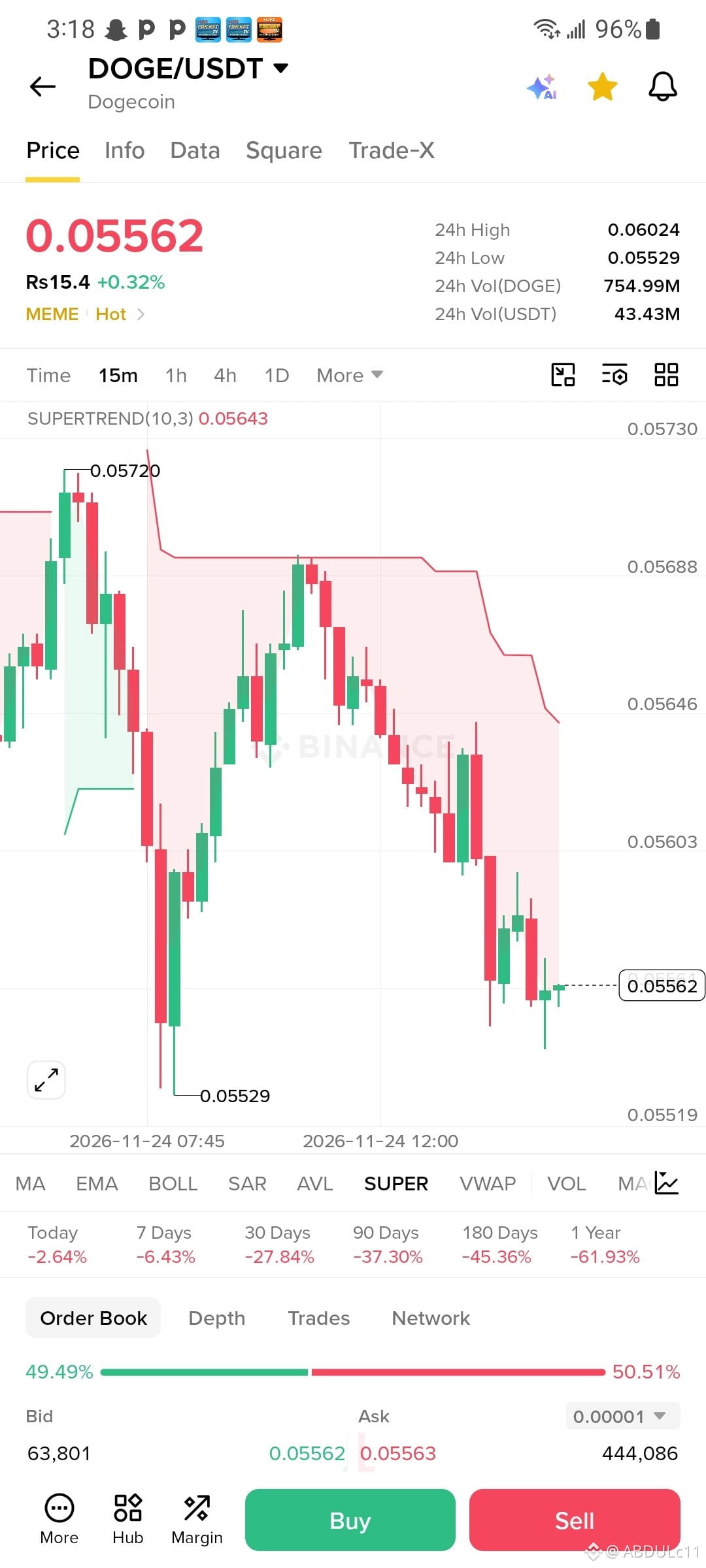
🐕 $DOGE /USDT – Bearish Momentum Continues! 🔴 Dogecoin is currently trading around $0.05562, showing continued selling pressure on the 15-minute chart. 📉 Key Market Levels: - Current Price: $0.05562 - Immediate Support: $0.05529 - Resistance: $0.05603 – $0.05643 - 24H High: $0.06024 - 24H Low: $0.05529 🔍 Market Analysis: The Supertrend indicator remains bearish, with DOGE trading below $0.05643. Sellers currently have a slight advantage in the order book. A breakdown below $0.05529 could trigger further downside, while a move above $0.05643 may signal a potential bullish recovery. 🎯 What’s Next? Will DOGE break below support and continue its downward move, or will buyers step in and push the price higher? 💬 What's your prediction – BULLISH 🟢 or BEARISH 🔴? #DOGE #Dogecoin #Crypto #Trading #Binance #TechnicalAnalysis #CryptoMarket
🐕 $DOGE /USDT – Bearish Momentum Continues! 🔴

Dogecoin is currently trading around $0.05562, showing continued selling pressure on the 15-minute chart.

📉 Key Market Levels:

- Current Price: $0.05562
- Immediate Support: $0.05529
- Resistance: $0.05603 – $0.05643
- 24H High: $0.06024
- 24H Low: $0.05529

🔍 Market Analysis:
The Supertrend indicator remains bearish, with DOGE trading below $0.05643. Sellers currently have a slight advantage in the order book. A breakdown below $0.05529 could trigger further downside, while a move above $0.05643 may signal a potential bullish recovery.

🎯 What’s Next?
Will DOGE break below support and continue its downward move, or will buyers step in and push the price higher?

💬 What's your prediction – BULLISH 🟢 or BEARISH 🔴?

#DOGE #Dogecoin #Crypto #Trading #Binance #TechnicalAnalysis #CryptoMarket
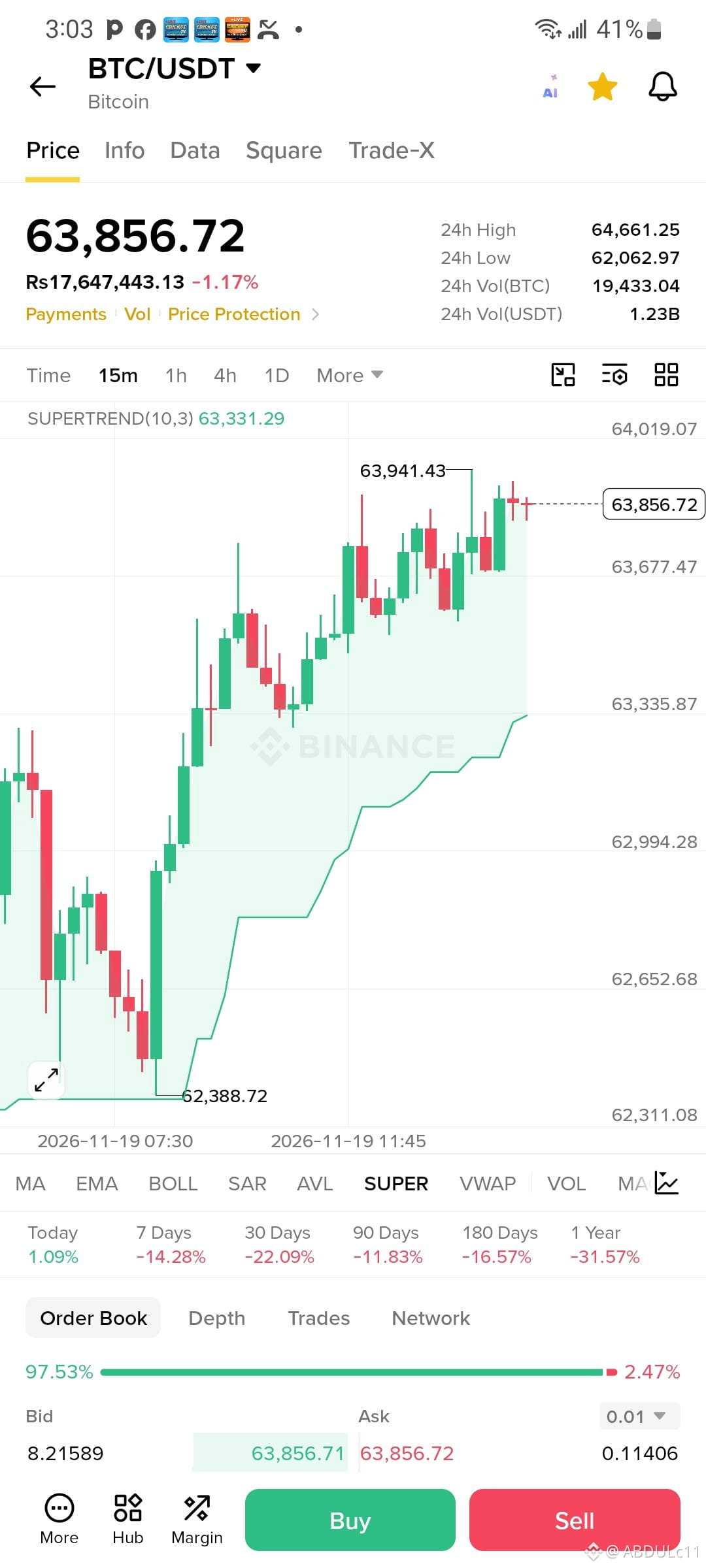
🚀 **#$BTC /USDT – Bitcoin Market Update** Bitcoin is currently trading at **$63,856.72**, showing a 1.17% decline over the last 24 hours. 📊 **15-Minute Chart Analysis:** BTC has recovered strongly from the $62,388 low and is now consolidating near $63,856. 🔑 **Key Resistance:** $63,941 – $64,019 🟢 🟢 Key Support: $63,331 – $63,335 📈 Supertrend: Bullish at $63,331.29 Market Outlook: Buyers are maintaining short-term control, but BTC needs a strong breakout above $63,941–$64,019 to target higher levels. A rejection could bring another pullback toward support. ⚡ Watch Closely: Will Bitcoin break above $64K or face another correction? #BTC #Bitcoin #BTCUSDT #CryptoMarket #Trading #TechnicalAnalysis #Binance
🚀 **#$BTC /USDT – Bitcoin Market Update**

Bitcoin is currently trading at **$63,856.72**, showing a 1.17% decline over the last 24 hours.

📊 **15-Minute Chart Analysis:**
BTC has recovered strongly from the $62,388 low and is now consolidating near $63,856.

🔑 **Key Resistance:** $63,941 – $64,019
🟢

🟢 Key Support: $63,331 – $63,335 📈 Supertrend: Bullish at $63,331.29

Market Outlook: Buyers are maintaining short-term control, but BTC needs a strong breakout above $63,941–$64,019 to target higher levels. A rejection could bring another pullback toward support.

⚡ Watch Closely: Will Bitcoin break above $64K or face another correction?

#BTC #Bitcoin #BTCUSDT #CryptoMarket #Trading #TechnicalAnalysis #Binance
$DJTB is sitting at $9.61, down 1.94% today. 📊 24H High: $9.92 | Low: $9.45 24H Volume: $639.57K Supertrend support: $9.58 Price is holding just above $9.58, but $9.62–$9.69 remains the key resistance zone. A clean break could bring $9.92 back into focus; losing $9.58 may weaken the setup. 👀 #Trading #Crypto
$DJTB is sitting at $9.61, down 1.94% today. 📊
24H High: $9.92 | Low: $9.45
24H Volume: $639.57K
Supertrend support: $9.58
Price is holding just above $9.58, but $9.62–$9.69 remains the key resistance zone. A clean break could bring $9.92 back into focus; losing $9.58 may weaken the setup. 👀
#Trading #Crypto
check this
check this
Muhammad乃缦
·
--
උසබ තත්ත්වය
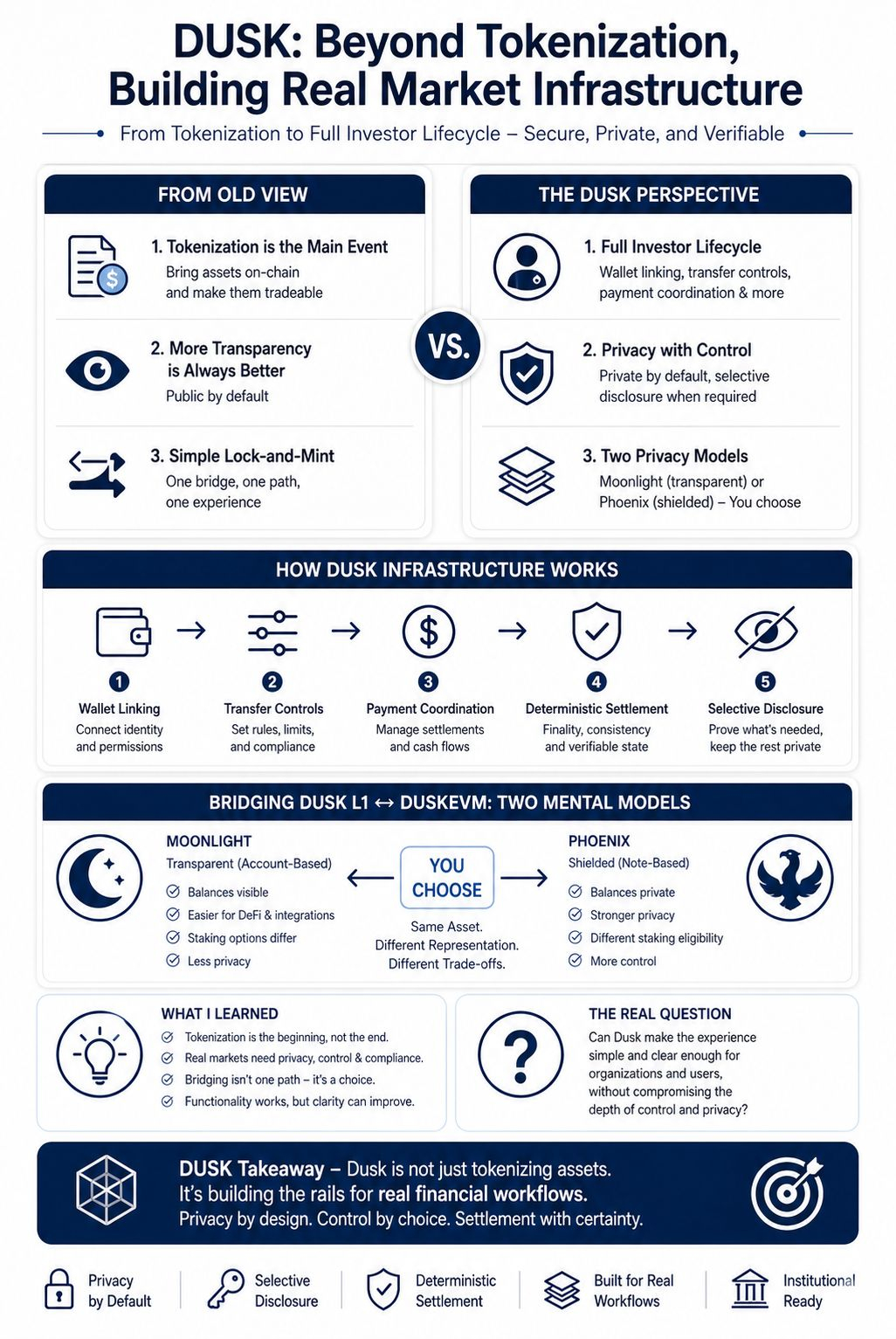
I used to think a finance blockchain only needed two things: bring assets on-chain and make them easy to trade. That view made the RWA numbers look convincing on their own. Tokenization felt like the main event.

Spending more time with Dusk changed that. The harder problems start after the token exists. Dusk Trade isn’t just about trading—it’s built around the full investor flow: wallet linking, transfer controls, payment coordination. Tokenization suddenly looked like a small piece of the real market.

What stayed with me is the attempt to keep these processes in one infrastructure, with deterministic settlement and privacy through selective disclosure. I once assumed more transparency was always better. For managed assets it often isn’t. Investors need privacy; institutions and regulators still need the ability to verify when required. Dusk seems to be bringing more of an asset’s lifecycle on-chain while keeping the control layers traditional markets expect
That same gap between surface and substance showed up when I walked through the bridge instead of just reading the guide. Native Dusk L1 is live, with over 210 million DUSK staked. Cross into DuskEVM and the execution layer is still Testnet. Bridging isn’t one bridge it’s two mental models. Your DUSK can live as Moonlight (transparent, account-based) or Phoenix shielded, note-based. Moving between them means choosing which representation you want. The wallet doesn’t explain the tradeoff clearly you discover it midflow.

I expected a simple lock-and-mint. Instead I re-read the Moonlight/Phoenix distinction more than once. The wrong choice isn’t catastrophic, but it changes staking eligibility, privacy, and what you can do next. Marketing calls it seamless. Functionally it works. Seamless and legible, though, aren’t the same thing.
Both experiences point to the same question. privacy and control those processes need. ends up simple enough for organizations—and clear enough for the people using it still feels like the part worth watching.
@Dusk #dusk $DUSK
check this
check this
Muhammad乃缦
·
--
උසබ තත්ත්වය
I used to think a finance blockchain only needed two things: bring assets on-chain and make them easy to trade. That view made the RWA numbers look convincing on their own. Tokenization felt like the main event.

Spending more time with Dusk changed that. The harder problems start after the token exists. Dusk Trade isn’t just about trading—it’s built around the full investor flow: wallet linking, transfer controls, payment coordination. Tokenization suddenly looked like a small piece of the real market.

What stayed with me is the attempt to keep these processes in one infrastructure, with deterministic settlement and privacy through selective disclosure. I once assumed more transparency was always better. For managed assets it often isn’t. Investors need privacy; institutions and regulators still need the ability to verify when required. Dusk seems to be bringing more of an asset’s lifecycle on-chain while keeping the control layers traditional markets expect
That same gap between surface and substance showed up when I walked through the bridge instead of just reading the guide. Native Dusk L1 is live, with over 210 million DUSK staked. Cross into DuskEVM and the execution layer is still Testnet. Bridging isn’t one bridge it’s two mental models. Your DUSK can live as Moonlight (transparent, account-based) or Phoenix shielded, note-based. Moving between them means choosing which representation you want. The wallet doesn’t explain the tradeoff clearly you discover it midflow.

I expected a simple lock-and-mint. Instead I re-read the Moonlight/Phoenix distinction more than once. The wrong choice isn’t catastrophic, but it changes staking eligibility, privacy, and what you can do next. Marketing calls it seamless. Functionally it works. Seamless and legible, though, aren’t the same thing.
Both experiences point to the same question. privacy and control those processes need. ends up simple enough for organizations—and clear enough for the people using it still feels like the part worth watching.
@Dusk #dusk $DUSK

AI and blockchain together can reshape the future of decentralized technology, and @Openledger is pushing this vision forward in a smart way. The project focuses on unlocking liquidity for AI data, models, and agents, creating real utility instead of empty hype. I believe $OPEN has strong potential because the demand for decentralized AI infrastructure keeps growing rapidly. The ecosystem, innovation, and long-term vision behind#OpenLedger make this project worth watching closely in the next crypto cycle.
AI and blockchain together can reshape the future of decentralized technology, and @OpenLedger is pushing this vision forward in a smart way. The project focuses on unlocking liquidity for AI data, models, and agents, creating real utility instead of empty hype. I believe $OPEN has strong potential because the demand for decentralized AI infrastructure keeps growing rapidly. The ecosystem, innovation, and long-term vision behind#OpenLedger make this project worth watching closely in the next crypto cycle.
check this artic
check this artic
Muhammad乃缦
·
--
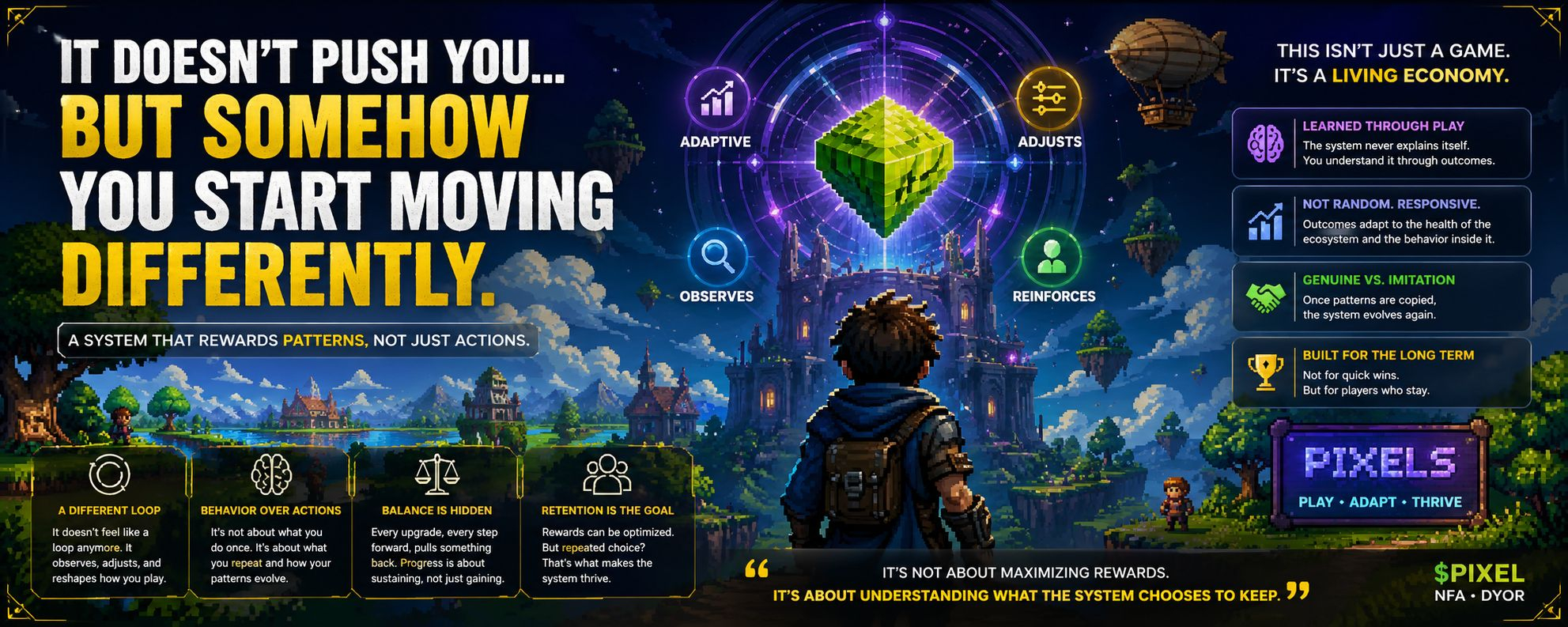
It Doesn’t Push You… But Somehow You Start Moving Differently
I used to think that if I followed a clean and efficient loop, the system would respond in predictable ways. There’s usually a point in any game where effort feels aligned with outcome — where doing things “right” starts to feel consistent. But here, that alignment never felt fully stable.
Some sessions felt smooth. Others felt slightly off, even when I was doing the exact same things. Nothing was clearly wrong, but the results didn’t match the effort in a way I could explain. It wasn’t failure — it was inconsistency that didn’t explain itself.
At first, I assumed it was on me. That’s the default mindset. If something doesn’t work, you optimize. So I refined everything — cleaner routes, less wasted motion, more structured play. For a while, it felt like I had figured it out. The system started responding the way I expected.
But then the same disconnect appeared again.
That’s when I started noticing something else. Not everyone playing “efficiently” was getting similar results. Some players moved with less structure, but still progressed smoothly. Not faster — just smoother. And that made efficiency feel incomplete, like it was only part of what the system responds to.
That’s when the perspective started shifting.
Inside Pixels, it stops feeling like a game of actions and starts feeling like a system reacting to behavior. Not what you do once, but what you repeat. Not just how optimized you are, but how your patterns settle over time.
Rewards don’t scale in a straight line. Sometimes they compress, sometimes they stretch, and sometimes they disconnect from expectation entirely. It doesn’t feel random — it feels adaptive.
Inside Pixels, consistency matters more than intensity.
At the same time, nothing is completely free. Progression has friction. Crafting, upgrades, participation — everything slowly pulls value back out of circulation. You don’t notice it immediately, but you feel it in how carefully you start making decisions.
The system isn’t just distributing value.
It’s balancing it continuously.
With $PIXEL evolving through its broader supply and activity cycles, the economy naturally becomes sensitive to behavior patterns. If everything were linear, it would be easy to drain or distort. So instead, behavior itself becomes part of the control layer — not just how much is happening, but what kind of participation keeps the system stable.
$PIXEL doesn’t reward movement — it responds to patterns.
What stands out most is how subtle this feels from the outside. There’s no clear moment where you’re told something changed. But over time, outcomes begin to separate players who look identical on paper.
The system doesn’t announce differences — it produces them.
And the longer you stay, the clearer it becomes.
Once behavior is readable, it becomes replicable. Once it’s replicable, it changes the system again. That creates tension between genuine participation and optimized imitation.
At some point, rewards stop being the main focus.
It becomes about retention.
Because no system survives on one-time actions. It survives on repeated choice — on return behavior. That’s where everything eventually converges.
So the loop doesn’t feel like a loop anymore. It feels like something that observes, adjusts, and gradually reshapes how you move through it.
Not through instructions — but through outcomes.
I don’t really see Pixels as just a game or a token system anymore. It feels more like an environment that learns what kind of behavior it wants to sustain, and then reinforces it quietly through results.
Whether that holds at scale is still uncertain. Systems evolve. Players evolve. And neither side stays fixed.
For now, the design still feels ahead of certainty.
And maybe that uncertainty is the point.
Because in the end, it’s not about maximizing rewards.
It’s about understanding what the system chooses to keep.
@Pixels #pixel $PIXEL
🎙️ K线本无形,指标亦是空。 裸盘观走势,心定则神通。
avatar
නිමාව
05 පැ 59 මි 59 ත
11.1k
6
3
🎙️ DDY Scammers Exposed LIVE – Don’t Fall for Trap!
avatar
නිමාව
03 පැ 43 මි 10 ත
667
6
7
Beyond Farming: The Hidden Progression of PixelsOn the surface, Pixels looks like a calm, familiar world — plant your crops, explore the map, build your space, and repeat. It’s the kind of game that feels easy to pick up, almost relaxing in its simplicity. But the longer you stay, the more you begin to notice that something deeper is happening beneath that cozy layer. Pixels (PIXEL), built on the Ronin Network, isn’t just about farming mechanics or casual gameplay loops. It’s about how the game slowly starts responding to you as a player. In the early stages, everything feels the same for everyone — limited access, basic interactions, and a steady grind. But over time, that experience begins to shift in subtle ways. You might notice that navigating the marketplace feels smoother. Certain opportunities start appearing more naturally. Roles, access points, and advantages that once felt distant begin to open up without forcing them. It doesn’t feel random — it feels earned, but not in the traditional sense of just doing more work. That’s where Pixels separates itself. Progress here isn’t only about how much you produce or how long you play. It’s about how the system begins to recognize your consistency and presence. The game quietly builds a level of trust with you, and that trust changes how efficiently you move through its world. Instead of pushing players to simply grind harder, Pixels creates a sense of progression tied to access. The more the game “leans on you,” the less friction you feel. Actions become smoother, decisions become faster, and your overall experience starts to feel more refined. This is what gives Pixels its unique edge. It may look like a farming game, but it doesn’t behave like one. Underneath, it’s closer to a system where players gradually qualify for better positioning, rather than just earning rewards in a linear way. In that sense, Pixels shifts the narrative. It’s no longer just about play-to-earn. It starts to feel like play-to-qualify — where your real progress is measured by how much the game is willing to open up to you. @pixels $PIXEL #Pixel

Beyond Farming: The Hidden Progression of Pixels

On the surface, Pixels looks like a calm, familiar world — plant your crops, explore the map, build your space, and repeat. It’s the kind of game that feels easy to pick up, almost relaxing in its simplicity. But the longer you stay, the more you begin to notice that something deeper is happening beneath that cozy layer.
Pixels (PIXEL), built on the Ronin Network, isn’t just about farming mechanics or casual gameplay loops. It’s about how the game slowly starts responding to you as a player. In the early stages, everything feels the same for everyone — limited access, basic interactions, and a steady grind. But over time, that experience begins to shift in subtle ways.
You might notice that navigating the marketplace feels smoother. Certain opportunities start appearing more naturally. Roles, access points, and advantages that once felt distant begin to open up without forcing them. It doesn’t feel random — it feels earned, but not in the traditional sense of just doing more work.
That’s where Pixels separates itself. Progress here isn’t only about how much you produce or how long you play. It’s about how the system begins to recognize your consistency and presence. The game quietly builds a level of trust with you, and that trust changes how efficiently you move through its world.
Instead of pushing players to simply grind harder, Pixels creates a sense of progression tied to access. The more the game “leans on you,” the less friction you feel. Actions become smoother, decisions become faster, and your overall experience starts to feel more refined.
This is what gives Pixels its unique edge. It may look like a farming game, but it doesn’t behave like one. Underneath, it’s closer to a system where players gradually qualify for better positioning, rather than just earning rewards in a linear way.
In that sense, Pixels shifts the narrative. It’s no longer just about play-to-earn. It starts to feel like play-to-qualify — where your real progress is measured by how much the game is willing to open up to you.
@Pixels $PIXEL #Pixel
@pixels #pixel $PIXEL Most people still look at Pixels like it’s just a farming loop — grow, collect, repeat. But the longer you stay, the more you realize the game is actually responding to you, not just your actions. In the beginning, everything feels limited. You’re doing the same basic tasks as everyone else. Then slowly, things start shifting. Access feels easier, certain opportunities show up, and the overall flow just becomes smoother. It’s not random — it feels like the system is getting more comfortable with you. That’s the part many miss. Progress here isn’t only about how much you grind, it’s about how the game starts to recognize your presence. Once that changes, everything else becomes more efficient without forcing it. So while it looks simple on the surface, underneath it’s more about earning that level of access over time — not just chasing rewards.
@Pixels #pixel $PIXEL Most people still look at Pixels like it’s just a farming loop — grow, collect, repeat. But the longer you stay, the more you realize the game is actually responding to you, not just your actions.
In the beginning, everything feels limited. You’re doing the same basic tasks as everyone else. Then slowly, things start shifting. Access feels easier, certain opportunities show up, and the overall flow just becomes smoother. It’s not random — it feels like the system is getting more comfortable with you.
That’s the part many miss. Progress here isn’t only about how much you grind, it’s about how the game starts to recognize your presence. Once that changes, everything else becomes more efficient without forcing it.
So while it looks simple on the surface, underneath it’s more about earning that level of access over time — not just chasing rewards.
Title: Comfort First, Economy Later: The Subtle Design of Pixels (PIXEL)When you first enter Pixels (PIXEL), it does not feel like an economy. It feels like a place. The atmosphere is calm, the visuals are soft, and the pace is slow. Nothing pushes you to rush, and nothing demands immediate optimization. That quiet introduction is not just aesthetic—it is intentional. The cozy design is not only about making the game approachable. It plays a deeper role. Pixels uses comfort to make structure feel natural. Systems that might seem restrictive in another environment are accepted here without resistance because they are wrapped in familiarity and ease. Beneath that surface, the game is carefully structured. Progression is controlled, production is guided, and rewards are distributed with purpose. Even the value of your time is shaped. But it does not feel like control. It feels like routine, and that distinction changes everything. In many Web3 games, the economy becomes visible too quickly. Players begin to notice the grind, the imbalance, and the extraction. Once that happens, the experience starts to feel like work. Pixels avoids that early break. It introduces players to familiar actions like farming, crafting, and exploring, allowing repetition to feel normal rather than forced. You find yourself repeating tasks not because the rewards are extraordinary, but because the environment makes it feel acceptable. That is the quiet strength of the design. It lowers resistance before asking for effort. As a result, progression systems feel like goals instead of restrictions. Daily tasks feel like structure instead of pressure. Even reliance on other players feels social rather than necessary. The system turns coordination into something that resembles community. This is not accidental. It is deliberate framing. Pixels understands that building an economy is not enough. The real challenge is getting players to exist within it comfortably. By softening the experience, the game makes its systems easier to accept, easier to stay in, and easier to return to. There is also a psychological element. In a pleasant environment, players become more patient. They accept slower progress and question less. The atmosphere gives the system time to adjust and guide behavior without resistance. However, this balance is fragile. If the routine ever shifts from calming to demanding, the illusion can break. What once felt relaxing can become an obligation. And when that happens, the softness no longer hides the system—it reveals it. That tension defines Pixels. It is not just a game built on incentives. It is a system that shapes how those incentives are felt. Pixels does not remove its economy—it cushions it.

Title: Comfort First, Economy Later: The Subtle Design of Pixels (PIXEL)

When you first enter Pixels (PIXEL), it does not feel like an economy. It feels like a place. The atmosphere is calm, the visuals are soft, and the pace is slow. Nothing pushes you to rush, and nothing demands immediate optimization. That quiet introduction is not just aesthetic—it is intentional.
The cozy design is not only about making the game approachable. It plays a deeper role. Pixels uses comfort to make structure feel natural. Systems that might seem restrictive in another environment are accepted here without resistance because they are wrapped in familiarity and ease.
Beneath that surface, the game is carefully structured. Progression is controlled, production is guided, and rewards are distributed with purpose. Even the value of your time is shaped. But it does not feel like control. It feels like routine, and that distinction changes everything.
In many Web3 games, the economy becomes visible too quickly. Players begin to notice the grind, the imbalance, and the extraction. Once that happens, the experience starts to feel like work. Pixels avoids that early break. It introduces players to familiar actions like farming, crafting, and exploring, allowing repetition to feel normal rather than forced.
You find yourself repeating tasks not because the rewards are extraordinary, but because the environment makes it feel acceptable. That is the quiet strength of the design. It lowers resistance before asking for effort.
As a result, progression systems feel like goals instead of restrictions. Daily tasks feel like structure instead of pressure. Even reliance on other players feels social rather than necessary. The system turns coordination into something that resembles community.
This is not accidental. It is deliberate framing.
Pixels understands that building an economy is not enough. The real challenge is getting players to exist within it comfortably. By softening the experience, the game makes its systems easier to accept, easier to stay in, and easier to return to.
There is also a psychological element. In a pleasant environment, players become more patient. They accept slower progress and question less. The atmosphere gives the system time to adjust and guide behavior without resistance.
However, this balance is fragile.
If the routine ever shifts from calming to demanding, the illusion can break. What once felt relaxing can become an obligation. And when that happens, the softness no longer hides the system—it reveals it.
That tension defines Pixels.
It is not just a game built on incentives. It is a system that shapes how those incentives are felt. Pixels does not remove its economy—it cushions it.
🌱 Pixels (PIXEL): Where Web3 Gaming Finally Feels AliveIn a space filled with overpromises and underwhelming gameplay, Pixels (PIXEL) stands out as a refreshing shift toward what Web3 gaming was always meant to be — fun, social, and rewarding. Built on the Ronin Network, Pixels isn’t just another blockchain game trying to “add value.” It’s a living, breathing open-world experience where players can farm, explore, build, and actually enjoy the process — not just chase tokens. 🎮 A Game First, Crypto Second One of the biggest problems in Web3 gaming has always been this: games feel like financial tools instead of entertainment. Pixels flips that narrative. Here, you’re not just grinding for rewards — you’re building your own land, growing crops, interacting with other players, and becoming part of a digital ecosystem that feels alive. The game mechanics are simple, but that’s where the magic is — it’s accessible, addictive, and genuinely enjoyable. 🌍 A Social Economy That Actually Works Pixels is more than a solo experience. It thrives on community. Players trade resources, collaborate, and engage in a shared economy powered by the $PIXEL token. This creates a real sense of ownership — not just of assets, but of your time and effort inside the game. Unlike many projects, Pixels doesn’t force complexity. It allows organic growth, where both casual players and serious participants can find their place. 🚀 Powered by Ronin — Built to Scale Being part of the Ronin ecosystem gives Pixels a massive advantage. Ronin has already proven itself with successful Web3 titles, and Pixels leverages that infrastructure to deliver smooth gameplay, low fees, and scalability — things that many blockchain games still struggle with. This isn’t just a project. It’s part of a larger vision for the future of gaming. 💰 The $PIXEL Token — Utility Meets Engagement The $PIXEL token isn’t just there for speculation. It’s integrated into the core gameplay loop — from transactions to progression — making it meaningful without being overwhelming. This balance is critical, and Pixels handles it well. As adoption grows, so does the potential value of participation. 📈 Why Pixels Is Gaining Attention Let’s be real — the Web3 gaming space is crowded. But Pixels is gaining traction for a reason: Simple yet engaging gameplay Strong social and economic layer Backed by a proven network (Ronin) Real player retention, not just hype This is the kind of project that doesn’t just trend — it builds. 🔥 Final Thoughts Pixels isn’t trying to reinvent gaming overnight. Instead, it’s doing something smarter — combining familiar gameplay with blockchain benefits in a way that feels natural. And that’s exactly why it’s working. If Web3 gaming is going to succeed long-term, it won’t be through complexity or hype — it will be through experiences like Pixels.@pixels #Pixel #Web3Gaming #Ronin #CryptoGaming #Web3Gaming #Ronin #CryptoGaming #PIXEL

🌱 Pixels (PIXEL): Where Web3 Gaming Finally Feels Alive

In a space filled with overpromises and underwhelming gameplay, Pixels (PIXEL) stands out as a refreshing shift toward what Web3 gaming was always meant to be — fun, social, and rewarding.
Built on the Ronin Network, Pixels isn’t just another blockchain game trying to “add value.” It’s a living, breathing open-world experience where players can farm, explore, build, and actually enjoy the process — not just chase tokens.
🎮 A Game First, Crypto Second
One of the biggest problems in Web3 gaming has always been this: games feel like financial tools instead of entertainment.
Pixels flips that narrative.
Here, you’re not just grinding for rewards — you’re building your own land, growing crops, interacting with other players, and becoming part of a digital ecosystem that feels alive. The game mechanics are simple, but that’s where the magic is — it’s accessible, addictive, and genuinely enjoyable.
🌍 A Social Economy That Actually Works
Pixels is more than a solo experience. It thrives on community.
Players trade resources, collaborate, and engage in a shared economy powered by the $PIXEL token. This creates a real sense of ownership — not just of assets, but of your time and effort inside the game.
Unlike many projects, Pixels doesn’t force complexity. It allows organic growth, where both casual players and serious participants can find their place.
🚀 Powered by Ronin — Built to Scale
Being part of the Ronin ecosystem gives Pixels a massive advantage.
Ronin has already proven itself with successful Web3 titles, and Pixels leverages that infrastructure to deliver smooth gameplay, low fees, and scalability — things that many blockchain games still struggle with.
This isn’t just a project. It’s part of a larger vision for the future of gaming.
💰 The $PIXEL Token — Utility Meets Engagement
The $PIXEL token isn’t just there for speculation.
It’s integrated into the core gameplay loop — from transactions to progression — making it meaningful without being overwhelming. This balance is critical, and Pixels handles it well.
As adoption grows, so does the potential value of participation.
📈 Why Pixels Is Gaining Attention
Let’s be real — the Web3 gaming space is crowded. But Pixels is gaining traction for a reason:
Simple yet engaging gameplay
Strong social and economic layer
Backed by a proven network (Ronin)
Real player retention, not just hype
This is the kind of project that doesn’t just trend — it builds.
🔥 Final Thoughts
Pixels isn’t trying to reinvent gaming overnight. Instead, it’s doing something smarter — combining familiar gameplay with blockchain benefits in a way that feels natural.
And that’s exactly why it’s working.
If Web3 gaming is going to succeed long-term, it won’t be through complexity or hype — it will be through experiences like Pixels.@Pixels
#Pixel #Web3Gaming #Ronin #CryptoGaming #Web3Gaming #Ronin #CryptoGaming #PIXEL
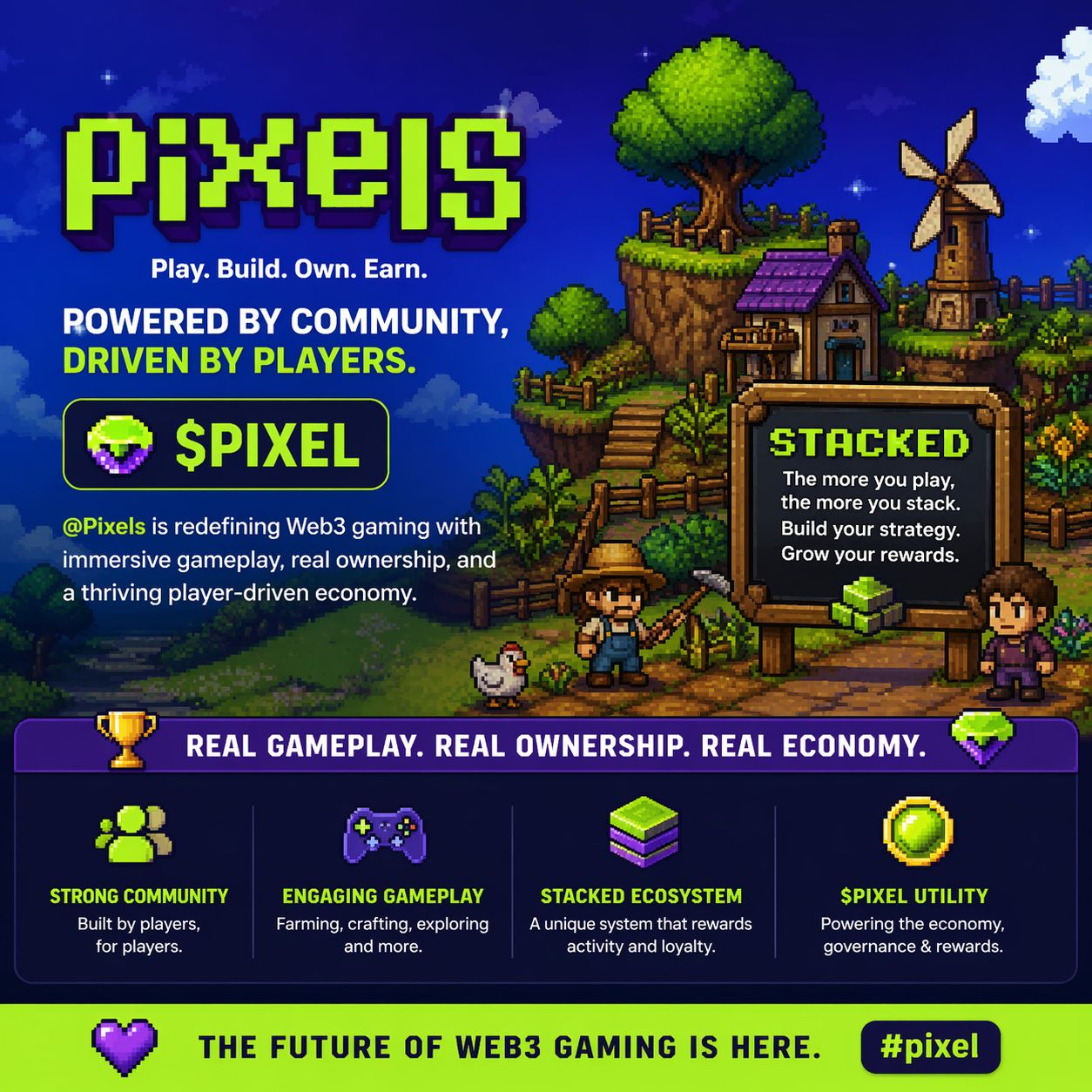
🚀 Exploring the evolution of Web3 gaming through @pixels — the way the $PIXEL ecosystem is integrating gameplay with real economic value is impressive. The Stacked system adds a deeper layer of strategy, rewarding active players and long-term holders alike. This isn’t just a game, it’s a growing digital economy where time, skill, and smart decisions truly matter. The future of GameFi is being built right here. 🎮💰 #Pixel
🚀 Exploring the evolution of Web3 gaming through @Pixels — the way the $PIXEL ecosystem is integrating gameplay with real economic value is impressive. The Stacked system adds a deeper layer of strategy, rewarding active players and long-term holders alike. This isn’t just a game, it’s a growing digital economy where time, skill, and smart decisions truly matter. The future of GameFi is being built right here. 🎮💰
#Pixel
Title: Pixels (PIXEL) — A Strong Long-Term Play in the Evolution of Web3 GamingIn a market where most Web3 games struggle to survive beyond hype cycles, Pixels (PIXEL) stands out as a project built on sustainability, usability, and real player engagement. Rather than relying on short-term incentives, Pixels is quietly positioning itself as a long-term leader in the GameFi sector. At its foundation, Pixels delivers a simple yet highly effective gameplay model centered around farming, exploration, and crafting. This design choice is strategic. By keeping mechanics easy to understand, the game attracts a broader audience — including users with no prior crypto experience. This accessibility directly translates into higher user retention, which is one of the most critical metrics for any Web3 ecosystem. What makes Pixels fundamentally strong is its balanced economic structure. Unlike many play-to-earn projects that collapse under token inflation, Pixels integrates its native token, $PIXEL, into essential gameplay functions. Players need the token for upgrades, progression, and in-game utility, creating organic demand instead of artificial reward pressure. This approach supports a healthier and more sustainable token economy over time. The decision to build on the Ronin Network further strengthens the project’s long-term outlook. Ronin provides low transaction fees and fast execution, eliminating one of the biggest barriers in blockchain gaming. This allows players to interact with the ecosystem seamlessly, making the experience feel closer to traditional gaming while still benefiting from Web3 ownership. From a macro perspective, Pixels is aligned with the next phase of GameFi evolution — shifting from “earn-first” models to “fun-first, economy-second” systems. This transition is crucial because only games that are genuinely enjoyable will retain users during market downturns. Pixels already demonstrates this resilience through its growing player base and active community. Another key strength is its social layer. Pixels is not just a solo farming game; it is a shared digital environment where players trade, collaborate, and build together. This social interaction increases engagement time and strengthens the in-game economy, both of which are essential for long-term success. However, like any developing project, there are risks. The sustainability of rewards, the balance of token supply, and competition within the Web3 gaming space remain factors to watch. That said, Pixels appears to be managing these challenges more effectively than most projects in its category. In conclusion, Pixels (PIXEL) is not built for short-term hype — it is designed for long-term growth and adoption. With strong fundamentals, a scalable ecosystem, and a focus on real user experience, it holds the potential to become one of the defining projects in the future of Web3 gaming. @pixels $PIXEL #Pixel

Title: Pixels (PIXEL) — A Strong Long-Term Play in the Evolution of Web3 Gaming

In a market where most Web3 games struggle to survive beyond hype cycles, Pixels (PIXEL) stands out as a project built on sustainability, usability, and real player engagement. Rather than relying on short-term incentives, Pixels is quietly positioning itself as a long-term leader in the GameFi sector.
At its foundation, Pixels delivers a simple yet highly effective gameplay model centered around farming, exploration, and crafting. This design choice is strategic. By keeping mechanics easy to understand, the game attracts a broader audience — including users with no prior crypto experience. This accessibility directly translates into higher user retention, which is one of the most critical metrics for any Web3 ecosystem.
What makes Pixels fundamentally strong is its balanced economic structure. Unlike many play-to-earn projects that collapse under token inflation, Pixels integrates its native token, $PIXEL , into essential gameplay functions. Players need the token for upgrades, progression, and in-game utility, creating organic demand instead of artificial reward pressure. This approach supports a healthier and more sustainable token economy over time.
The decision to build on the Ronin Network further strengthens the project’s long-term outlook. Ronin provides low transaction fees and fast execution, eliminating one of the biggest barriers in blockchain gaming. This allows players to interact with the ecosystem seamlessly, making the experience feel closer to traditional gaming while still benefiting from Web3 ownership.
From a macro perspective, Pixels is aligned with the next phase of GameFi evolution — shifting from “earn-first” models to “fun-first, economy-second” systems. This transition is crucial because only games that are genuinely enjoyable will retain users during market downturns. Pixels already demonstrates this resilience through its growing player base and active community.
Another key strength is its social layer. Pixels is not just a solo farming game; it is a shared digital environment where players trade, collaborate, and build together. This social interaction increases engagement time and strengthens the in-game economy, both of which are essential for long-term success.
However, like any developing project, there are risks. The sustainability of rewards, the balance of token supply, and competition within the Web3 gaming space remain factors to watch. That said, Pixels appears to be managing these challenges more effectively than most projects in its category.
In conclusion, Pixels (PIXEL) is not built for short-term hype — it is designed for long-term growth and adoption. With strong fundamentals, a scalable ecosystem, and a focus on real user experience, it holds the potential to become one of the defining projects in the future of Web3 gaming.
@Pixels $PIXEL #Pixel
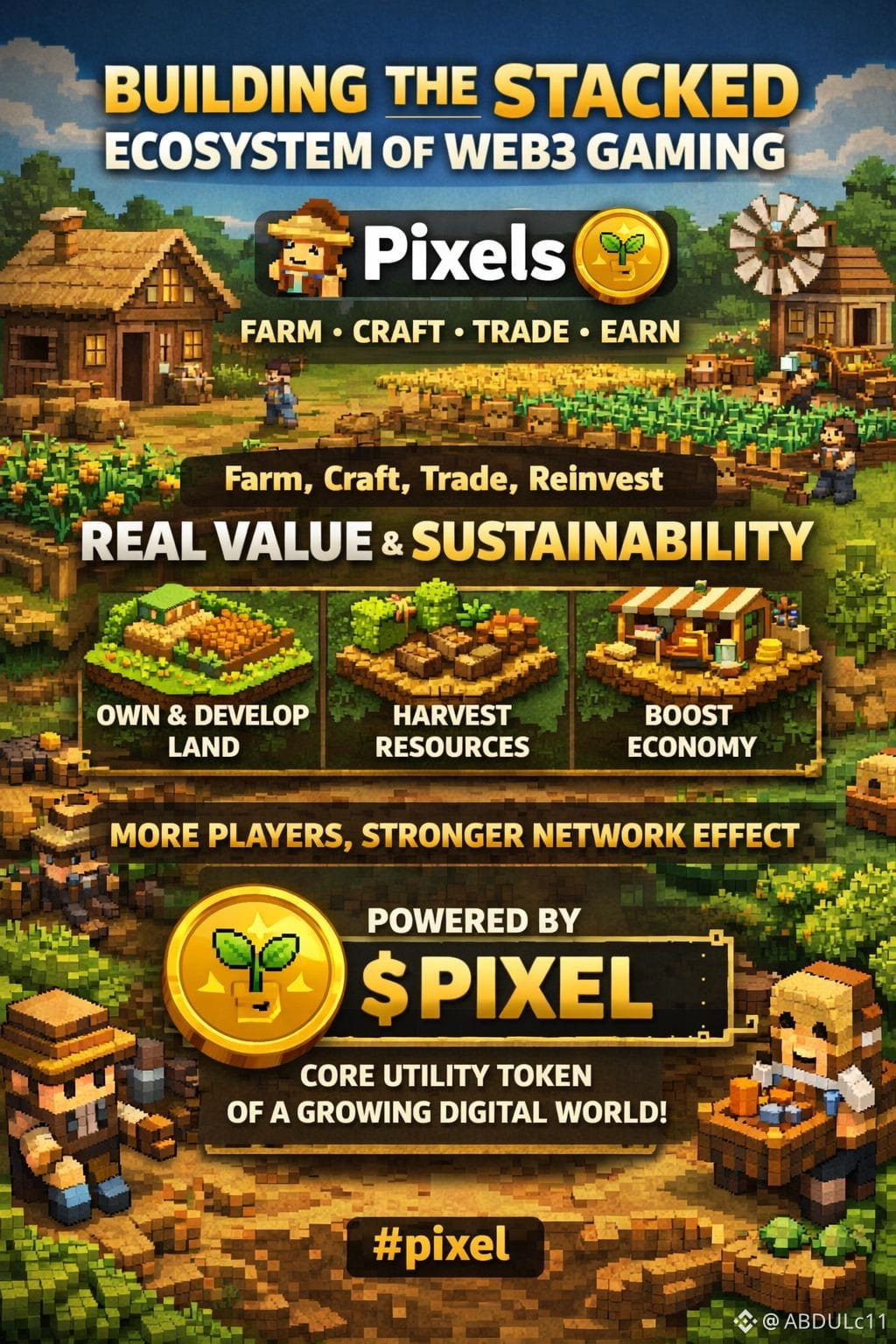
Pixels is quietly building one of the most engaging Web3 gaming ecosystems right now. @pixels isn’t just a game — it’s a full stacked economy where land, resources, and player activity directly connect to real value through $PIXEL What makes the Pixels ecosystem stand out is its sustainability. The stacked mechanics create continuous demand: players farm, craft, trade, and reinvest, keeping the in-game economy alive instead of relying on hype alone. As more users onboard, the network effect strengthens, making $PIXEL not just a token, but a core utility asset within a growing digital world. #Pixel
Pixels is quietly building one of the most engaging Web3 gaming ecosystems right now. @Pixels isn’t just a game — it’s a full stacked economy where land, resources, and player activity directly connect to real value through $PIXEL

What makes the Pixels ecosystem stand out is its sustainability. The stacked mechanics create continuous demand: players farm, craft, trade, and reinvest, keeping the in-game economy alive instead of relying on hype alone.

As more users onboard, the network effect strengthens, making $PIXEL not just a token, but a core utility asset within a growing digital world.

#Pixel
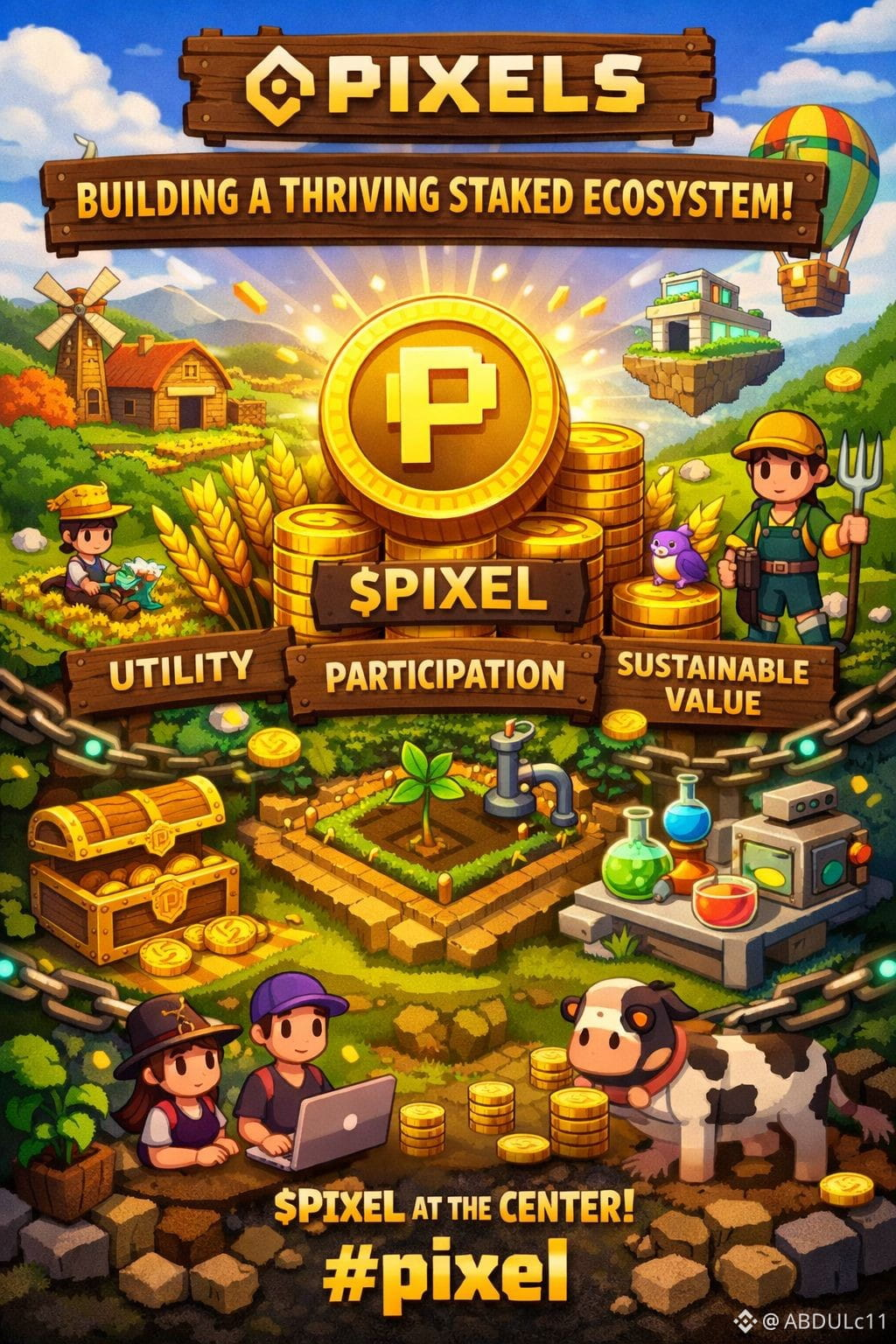
@pixels is building more than a game — it is shaping a stronger Staked ecosystem where long-term holders can stay engaged, support the project, and grow with the community. With $PIXEL at the center, the focus is shifting toward utility, participation, and sustainable value. #Pixel
@Pixels is building more than a game — it is shaping a stronger Staked ecosystem where long-term holders can stay engaged, support the project, and grow with the community. With $PIXEL at the center, the focus is shifting toward utility, participation, and sustainable value. #Pixel
Title: Pixels (PIXEL) — A New Era of Social Web3 Gaming on RoninIn the rapidly evolving world of blockchain gaming, Pixels (PIXEL) stands out as a refreshing blend of simplicity, strategy, and social interaction. Built on the Ronin Network, Pixels is not just another play-to-earn experiment—it’s a carefully designed open-world experience where gameplay comes first, and earning becomes a natural outcome of engagement. At its core, Pixels delivers a familiar yet deeply engaging farming experience. Players cultivate crops, gather resources, and craft valuable items, all while progressing through a system that rewards consistency and smart decision-making. Unlike traditional farming games, every action in Pixels carries potential value, as in-game assets and rewards are integrated into a real blockchain economy. What truly sets Pixels apart is its living, breathing world. This is not a solo experience confined to isolated gameplay loops. Instead, players enter a shared environment where exploration, interaction, and collaboration play a central role. Whether it’s discovering new areas, trading resources, or simply engaging with other players, the game creates a sense of community that many Web3 projects often fail to achieve. The integration of the PIXEL token adds another layer of depth. Rather than forcing monetization, Pixels allows players to earn organically through gameplay. Time, effort, and strategy translate into real digital value, making the experience both enjoyable and potentially rewarding. Importantly, the use of the Ronin Network ensures smooth transactions, low fees, and a user-friendly onboarding process—key factors for long-term adoption. Beyond mechanics and rewards, Pixels succeeds in something more important: balance. It avoids the common trap of prioritizing profit over player experience. The result is a game that feels approachable for newcomers while still offering depth for dedicated players. In a space often dominated by hype, Pixels represents a shift toward sustainability and genuine engagement. It proves that Web3 gaming doesn’t have to sacrifice fun for functionality—it can deliver both. For players and investors alike, Pixels (PIXEL) is more than a game. It’s a glimpse into the future of interactive digital economies, where ownership, creativity, and community come together seamlessly. @pixels $PIXEL #Pixel

Title: Pixels (PIXEL) — A New Era of Social Web3 Gaming on Ronin

In the rapidly evolving world of blockchain gaming, Pixels (PIXEL) stands out as a refreshing blend of simplicity, strategy, and social interaction. Built on the Ronin Network, Pixels is not just another play-to-earn experiment—it’s a carefully designed open-world experience where gameplay comes first, and earning becomes a natural outcome of engagement.
At its core, Pixels delivers a familiar yet deeply engaging farming experience. Players cultivate crops, gather resources, and craft valuable items, all while progressing through a system that rewards consistency and smart decision-making. Unlike traditional farming games, every action in Pixels carries potential value, as in-game assets and rewards are integrated into a real blockchain economy.
What truly sets Pixels apart is its living, breathing world. This is not a solo experience confined to isolated gameplay loops. Instead, players enter a shared environment where exploration, interaction, and collaboration play a central role. Whether it’s discovering new areas, trading resources, or simply engaging with other players, the game creates a sense of community that many Web3 projects often fail to achieve.
The integration of the PIXEL token adds another layer of depth. Rather than forcing monetization, Pixels allows players to earn organically through gameplay. Time, effort, and strategy translate into real digital value, making the experience both enjoyable and potentially rewarding. Importantly, the use of the Ronin Network ensures smooth transactions, low fees, and a user-friendly onboarding process—key factors for long-term adoption.
Beyond mechanics and rewards, Pixels succeeds in something more important: balance. It avoids the common trap of prioritizing profit over player experience. The result is a game that feels approachable for newcomers while still offering depth for dedicated players.
In a space often dominated by hype, Pixels represents a shift toward sustainability and genuine engagement. It proves that Web3 gaming doesn’t have to sacrifice fun for functionality—it can deliver both.
For players and investors alike, Pixels (PIXEL) is more than a game. It’s a glimpse into the future of interactive digital economies, where ownership, creativity, and community come together seamlessly.
@Pixels $PIXEL #Pixel
Pixels (PIXEL): Where Gaming Feels Alive in a Web3 WorldIn a space where gaming is constantly evolving, Pixels (PIXEL) stands out as more than just another blockchain-based project. Built on the Ronin Network, Pixels brings a refreshing and human-centered approach to Web3 gaming—one that feels simple, social, and genuinely fun. At its core, Pixels is an open-world game that invites players to slow down and enjoy the process. Instead of intense competition or complex mechanics, the game focuses on farming, exploration, and creation. You can plant crops, gather resources, craft items, and shape your own little corner of the world. It’s the kind of experience that feels relaxing, yet rewarding at the same time. What makes Pixels truly special is its social layer. This isn’t a game you play alone in isolation. Players interact, collaborate, trade, and build connections within the game world. It creates a sense of community that many modern games often miss. You’re not just progressing individually—you’re growing alongside others. Another key element is digital ownership. Thanks to Web3 integration, what you earn or create in Pixels actually belongs to you. The PIXEL token plays a central role in this ecosystem, enabling in-game transactions, rewards, and progression. This adds real value to the time and effort players invest. The use of Ronin Network also ensures that the experience remains smooth and accessible. Fast transactions and low fees remove the usual friction seen in blockchain games, making it easier for players to focus on what really matters—enjoying the game. In the end, Pixels (PIXEL) feels less like a traditional game and more like a living digital world. It blends creativity, community, and ownership into one seamless experience. As Web3 gaming continues to grow, Pixels is quietly proving that games don’t need to be complicated to be meaningful—they just need to feel real. @pixels $PIXEL #Pixel

Pixels (PIXEL): Where Gaming Feels Alive in a Web3 World

In a space where gaming is constantly evolving, Pixels (PIXEL) stands out as more than just another blockchain-based project. Built on the Ronin Network, Pixels brings a refreshing and human-centered approach to Web3 gaming—one that feels simple, social, and genuinely fun.
At its core, Pixels is an open-world game that invites players to slow down and enjoy the process. Instead of intense competition or complex mechanics, the game focuses on farming, exploration, and creation. You can plant crops, gather resources, craft items, and shape your own little corner of the world. It’s the kind of experience that feels relaxing, yet rewarding at the same time.
What makes Pixels truly special is its social layer. This isn’t a game you play alone in isolation. Players interact, collaborate, trade, and build connections within the game world. It creates a sense of community that many modern games often miss. You’re not just progressing individually—you’re growing alongside others.
Another key element is digital ownership. Thanks to Web3 integration, what you earn or create in Pixels actually belongs to you. The PIXEL token plays a central role in this ecosystem, enabling in-game transactions, rewards, and progression. This adds real value to the time and effort players invest.
The use of Ronin Network also ensures that the experience remains smooth and accessible. Fast transactions and low fees remove the usual friction seen in blockchain games, making it easier for players to focus on what really matters—enjoying the game.
In the end, Pixels (PIXEL) feels less like a traditional game and more like a living digital world. It blends creativity, community, and ownership into one seamless experience. As Web3 gaming continues to grow, Pixels is quietly proving that games don’t need to be complicated to be meaningful—they just need to feel real.
@Pixels $PIXEL #Pixel
තවත් අන්තර්ගතයන් ගවේෂණය කිරීමට ඇතුල් වන්න
Binance චතුරශ්‍රය හි ගෝලීය ක්‍රිප්ටෝ පරිශීලකයින් හා එක්වන්න
⚡️ ක්‍රිප්ටෝ පිළිබඳ නවතම සහ ප්‍රයෝජනවත් තොරතුරු ලබා ගන්න.
💬 ලොව විශාලතම ක්‍රිප්ටෝ හුවමාරුව මගින් විශ්වාස කෙරේ.
👍 සත්‍යායනය කරන ලද නිර්මාණකරුවන්ගෙන් සැබෑ විදසුන් සොයා ගන්න.
විද්‍යුත් තැපෑල / දුරකථන අංකය
අඩවි සිතියම
කුකී මනාපයන්
වේදිකා කොන්දේසි සහ නියමයන්