
REACHER _Crypto
8.6k පෝස්ටු

REACHER _Crypto
වාර්තා කරන්න
පරිශීලක අවහිර කරන්න
Web3 boy I Crypto never sleeps neither do profits Turning volatility into opportunity I Think. Trade. Earn. Repeat. #BinanceLife
488 හඹා යමින්
19.8K+ හඹා යන්නන්
11.3K+ කැමති විය
පෝස්ටු
සියල්ල
උපුටා දැක්වීම්
වීඩියෝ
සජීවි
පරිවර්තනය බලන්න
JUST IN: BlackRock clients buy $108.44 million worth of $BTC .
#BTCBreaks80K #BitcoinMarketCapTopsTesla #SOLJumpsAbout10% #SECReceivesAmendedInjectiveETFFiling
JUST IN: BlackRock clients buy $108.44 million worth of $BTC .
#BTCBreaks80K #BitcoinMarketCapTopsTesla #SOLJumpsAbout10% #SECReceivesAmendedInjectiveETFFiling
#BTCBreaks80K #BitcoinMarketCapTopsTesla #SOLJumpsAbout10% #SECReceivesAmendedInjectiveETFFiling
87
පරිවර්තනය බලන්න
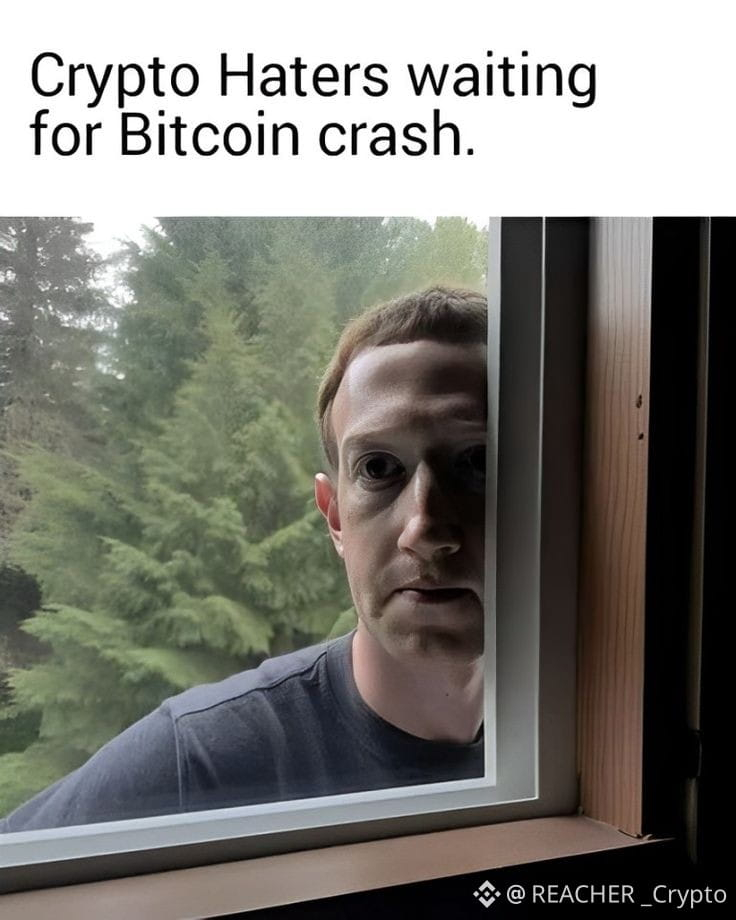
Still waiting for that Bitcoin crash… 👀😂
$BTC
#AnthropicCEOCallsForAISlowdown #US10YearTreasuryYieldNears5% #TokenizedStockHoldersUp619.1% #RevolutConfirmsFakeGovEmailDataBreach
Still waiting for that Bitcoin crash… 👀😂
$BTC
#AnthropicCEOCallsForAISlowdown #US10YearTreasuryYieldNears5% #TokenizedStockHoldersUp619.1% #RevolutConfirmsFakeGovEmailDataBreach
$BTC
#AnthropicCEOCallsForAISlowdown #US10YearTreasuryYieldNears5% #TokenizedStockHoldersUp619.1% #RevolutConfirmsFakeGovEmailDataBreach
111
පරිවර්තනය බලන්න
I think people are focusing on the wrong part of Bitcoin’s latest ETF numbers.
It’s not just that $1.01B flowed into U.S. spot Bitcoin ETFs over three trading days.
It’s who had to sell the BTC on the other side.
On September 3 alone, ETF inflows reached $730.8M.
At around $78K–$79K per BTC, that’s roughly 13,000 BTC worth of demand.
And here’s where it gets interesting.
Bitcoin’s long-term holder supply has climbed to around 16.5M BTC.
That’s close to 79% of Bitcoin’s eventual 21M supply.
But I don’t think the takeaway should be:
“79% of BTC is locked, so supply is running out.”
That’s too simple.
Long-term holders can sell.
The number I’m watching is how quickly they distribute when new demand arrives.
Because if ETFs keep absorbing billions while long-term holders continue sitting on their coins, the market doesn’t need a huge supply shortage to move higher.
It only needs new demand to grow faster than willing sellers.
That’s the hidden part of this setup.
And there’s another side to it.
If BTC keeps pushing higher, those long-term holders suddenly have a much bigger incentive to take profits.
So I’m watching three things now:
• ETF flows — does the $1B burst continue?
• LTH distribution — are older holders actually selling into this demand?
• Price reaction — can BTC break through the $82.8K area without a major increase in sell-side pressure?
If ETF demand stays strong and LTH selling remains controlled, Bitcoin could become increasingly sensitive to relatively small changes in demand.
But if old holders start distributing aggressively, that “supply squeeze” narrative can disappear very quickly.
That’s why I’m watching the seller, not just the buyer.
$BTC
{future}(BTCUSDT)
I think people are focusing on the wrong part of Bitcoin’s latest ETF numbers.
It’s not just that $1.01B flowed into U.S. spot Bitcoin ETFs over three trading days.
It’s who had to sell the BTC on the other side.
On September 3 alone, ETF inflows reached $730.8M.
At around $78K–$79K per BTC, that’s roughly 13,000 BTC worth of demand.
And here’s where it gets interesting.
Bitcoin’s long-term holder supply has climbed to around 16.5M BTC.
That’s close to 79% of Bitcoin’s eventual 21M supply.
But I don’t think the takeaway should be:
“79% of BTC is locked, so supply is running out.”
That’s too simple.
Long-term holders can sell.
The number I’m watching is how quickly they distribute when new demand arrives.
Because if ETFs keep absorbing billions while long-term holders continue sitting on their coins, the market doesn’t need a huge supply shortage to move higher.
It only needs new demand to grow faster than willing sellers.
That’s the hidden part of this setup.
And there’s another side to it.
If BTC keeps pushing higher, those long-term holders suddenly have a much bigger incentive to take profits.
So I’m watching three things now:
• ETF flows — does the $1B burst continue?
• LTH distribution — are older holders actually selling into this demand?
• Price reaction — can BTC break through the $82.8K area without a major increase in sell-side pressure?
If ETF demand stays strong and LTH selling remains controlled, Bitcoin could become increasingly sensitive to relatively small changes in demand.
But if old holders start distributing aggressively, that “supply squeeze” narrative can disappear very quickly.
That’s why I’m watching the seller, not just the buyer.
$BTC
It’s not just that $1.01B flowed into U.S. spot Bitcoin ETFs over three trading days.
It’s who had to sell the BTC on the other side.
On September 3 alone, ETF inflows reached $730.8M.
At around $78K–$79K per BTC, that’s roughly 13,000 BTC worth of demand.
And here’s where it gets interesting.
Bitcoin’s long-term holder supply has climbed to around 16.5M BTC.
That’s close to 79% of Bitcoin’s eventual 21M supply.
But I don’t think the takeaway should be:
“79% of BTC is locked, so supply is running out.”
That’s too simple.
Long-term holders can sell.
The number I’m watching is how quickly they distribute when new demand arrives.
Because if ETFs keep absorbing billions while long-term holders continue sitting on their coins, the market doesn’t need a huge supply shortage to move higher.
It only needs new demand to grow faster than willing sellers.
That’s the hidden part of this setup.
And there’s another side to it.
If BTC keeps pushing higher, those long-term holders suddenly have a much bigger incentive to take profits.
So I’m watching three things now:
• ETF flows — does the $1B burst continue?
• LTH distribution — are older holders actually selling into this demand?
• Price reaction — can BTC break through the $82.8K area without a major increase in sell-side pressure?
If ETF demand stays strong and LTH selling remains controlled, Bitcoin could become increasingly sensitive to relatively small changes in demand.
But if old holders start distributing aggressively, that “supply squeeze” narrative can disappear very quickly.
That’s why I’m watching the seller, not just the buyer.
$BTC
96
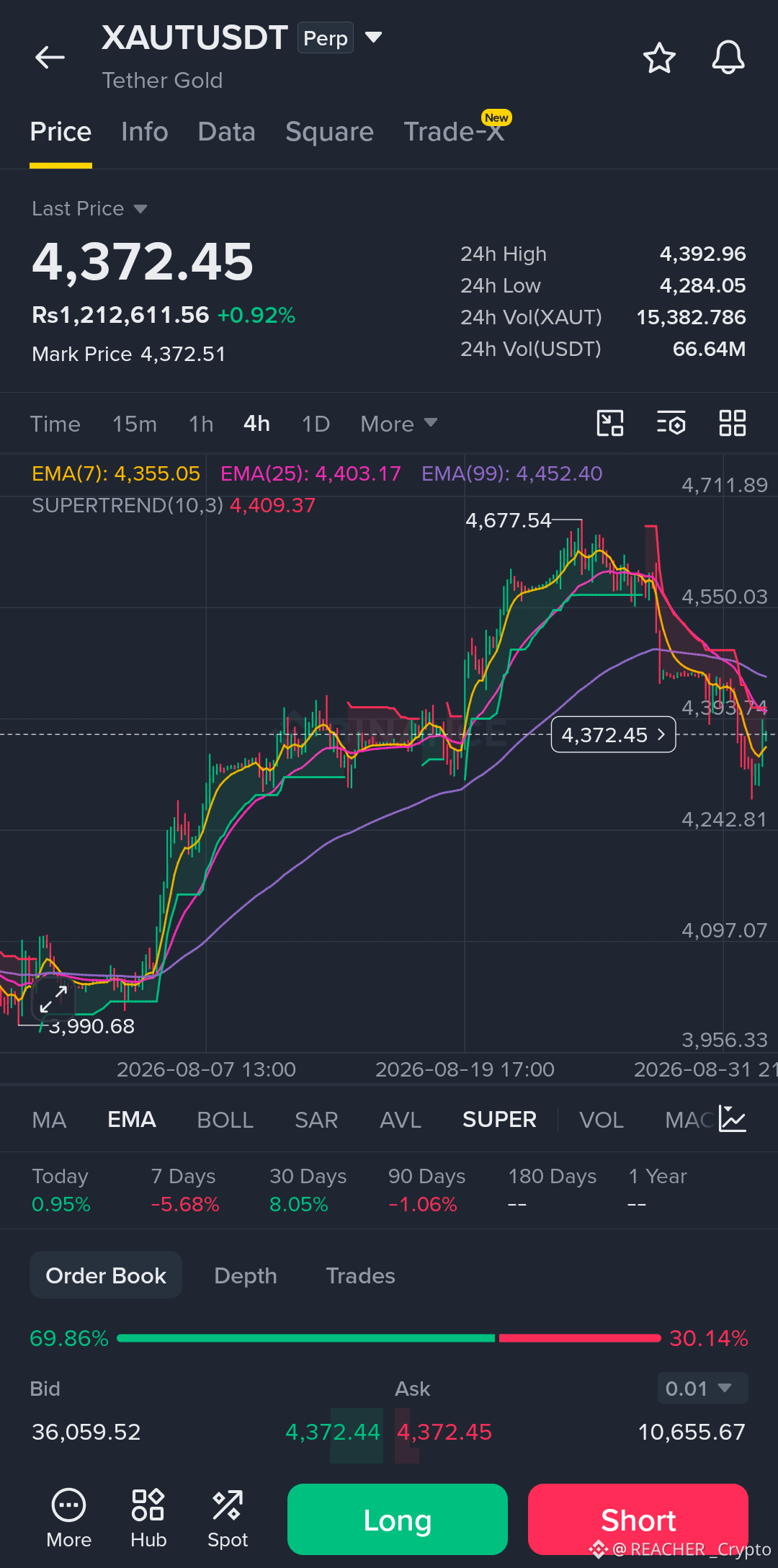
මම දිගු කලක් XAUTUSDT දෙස බලමින් සිටිමි. මේ වත්මන් මිල ක්රියාමාර්ගය ගැන යමක් මේ මොහොත “නිර්වචනීය අවස්ථාවක්” වගේ හැඟෙයි. අපි $4,372 මට්ටම ආසන්නයේ ඉතා තීරණාත්මක කඩඉමක සිටිනවා—එය මේ මොහොතේම සහය (support) සහ ප්රතිරෝධය (resistance) ලෙසම ක්රියා කරමින් පවතිනවා.
බලාගත යුතු වහාම සහය කලාපය වන්නේ මෑතදී ඇති වූ අවම අගය වටා $4,284. මේ මට්ටමෙන් පහළට කැඩෙන්නේ නම්, ඊළඟ වැදගත් සහය $4,200 වෙත පහත වැටීමක් ක්රියාත්මක විය හැකිය. එය 90-දින අවම අගය (90-day low) සහ පහළ Bollinger Band එකට ගැලපෙනවා. අනෙක් පැත්තෙන්, උඩු ප්රවේශයක් (bullish move) සඳහා මිලට $4,403 හි EMA(25) සහ $4,409 හි SuperTrend ප්රතිරෝධය ඉක්මවා කැඩී එම මට්ටම් ඉහළින් රැඳෙන්න අවශ්යයි. මේ මට්ටම් දෙකෙන් ඉහළට තීරණාත්මකව close වීම උඩු හැරවීම (bullish reversal) තහවුරු කළ හැකි අතර, $4,452 හි EMA(99) නැවත පරීක්ෂා කිරීම සහ $4,677 ආසන්න මෑත ඉහළ අගය වෙත යාමට දොර විවර කරනු ඇත.
ඒ වගේම 24-පැය වෙළඳ වాలියුම් (24-hour volume) ගැනත් අනිවාර්යයෙන්ම සටහන් කරගන්න. එය සැලකිය යුතු සහභාගීත්වයක් පෙන්වමින් තිබෙන නිසා, මේ වැදගත් මට්ටම් තවත් තීරණාත්මක වෙයි. බොහෝ ඉක්මන් ඇතුළත් කිරීම් (early entries) නිසා පාඩුවක් ලැබූ මම ඉගෙනගත් පාඩමක් නම්—තහවුරු වීම සඳහා බලා සිටීම, ඉක්මනට මැක්දු (candles) පසුපස දිවීමට වඩා බොහෝ විට වැඩිපුර මුදල් ඉතිරි කරයි. ඒ නිසා මම තවමත් පදිංචි වීමකට (position) ඉක්මන් වෙන්නේ නැහැ.
$4,410 ඉහළට ශක්තිමත් වාලියුම් සමඟ පැහැදිලි breakout එකක් දකින්නේ නම්, දිගු (long) entry එකක් සලකා බැලීම සඳහා එය මගේ අපේක්ෂාවයි. ඉලක්ක (targets) වන්නේ $4,450 සහ $4,677. මගේ අවදානම (risk) $4,284 හි අවම අගයට පහළින් stop-loss එකක් තබා දක්වනු ඇත. විකල්පයක් ලෙස, $4,284 පහළට කඩා වැටීම short එකක් සලකා බැලීමට අවස්ථාවක් විය හැකිය. නමුත් මම ඒ move එක තහවුරු කරගන්න නම්, එම මට්ටමට පහළින් පැහැදිලි close එකක් දකින්න අවශ්යයි. මේ වෙළඳපොළේ කිසිදු setup එකක් සහතික නැති බව සැමවිටම මතක තබාගන්න; stop loss එකට ගරු කරන්න.
මේ chart එකේ ඊළඟ ප්රධාන move එක තීරණය කළ හැකි වඩාත් වැදගත් මට්ටම කුමක්ද කියලා ඔබට හිතෙන්නේ කුමන එකද?
$XAUT
{future}(XAUTUSDT)
#SolanaFallsOver3% #DellSurges8%OnEarningsBeat #USAugADPJobsSmallestGainSinceJan #OpenAISaysAstraFindsFlawsAutonomously
මම දිගු කලක් XAUTUSDT දෙස බලමින් සිටිමි. මේ වත්මන් මිල ක්රියාමාර්ගය ගැන යමක් මේ මොහොත “නිර්වචනීය අවස්ථාවක්” වගේ හැඟෙයි. අපි $4,372 මට්ටම ආසන්නයේ ඉතා තීරණාත්මක කඩඉමක සිටිනවා—එය මේ මොහොතේම සහය (support) සහ ප්රතිරෝධය (resistance) ලෙසම ක්රියා කරමින් පවතිනවා.
බලාගත යුතු වහාම සහය කලාපය වන්නේ මෑතදී ඇති වූ අවම අගය වටා $4,284. මේ මට්ටමෙන් පහළට කැඩෙන්නේ නම්, ඊළඟ වැදගත් සහය $4,200 වෙත පහත වැටීමක් ක්රියාත්මක විය හැකිය. එය 90-දින අවම අගය (90-day low) සහ පහළ Bollinger Band එකට ගැලපෙනවා. අනෙක් පැත්තෙන්, උඩු ප්රවේශයක් (bullish move) සඳහා මිලට $4,403 හි EMA(25) සහ $4,409 හි SuperTrend ප්රතිරෝධය ඉක්මවා කැඩී එම මට්ටම් ඉහළින් රැඳෙන්න අවශ්යයි. මේ මට්ටම් දෙකෙන් ඉහළට තීරණාත්මකව close වීම උඩු හැරවීම (bullish reversal) තහවුරු කළ හැකි අතර, $4,452 හි EMA(99) නැවත පරීක්ෂා කිරීම සහ $4,677 ආසන්න මෑත ඉහළ අගය වෙත යාමට දොර විවර කරනු ඇත.
ඒ වගේම 24-පැය වෙළඳ වాలියුම් (24-hour volume) ගැනත් අනිවාර්යයෙන්ම සටහන් කරගන්න. එය සැලකිය යුතු සහභාගීත්වයක් පෙන්වමින් තිබෙන නිසා, මේ වැදගත් මට්ටම් තවත් තීරණාත්මක වෙයි. බොහෝ ඉක්මන් ඇතුළත් කිරීම් (early entries) නිසා පාඩුවක් ලැබූ මම ඉගෙනගත් පාඩමක් නම්—තහවුරු වීම සඳහා බලා සිටීම, ඉක්මනට මැක්දු (candles) පසුපස දිවීමට වඩා බොහෝ විට වැඩිපුර මුදල් ඉතිරි කරයි. ඒ නිසා මම තවමත් පදිංචි වීමකට (position) ඉක්මන් වෙන්නේ නැහැ.
$4,410 ඉහළට ශක්තිමත් වාලියුම් සමඟ පැහැදිලි breakout එකක් දකින්නේ නම්, දිගු (long) entry එකක් සලකා බැලීම සඳහා එය මගේ අපේක්ෂාවයි. ඉලක්ක (targets) වන්නේ $4,450 සහ $4,677. මගේ අවදානම (risk) $4,284 හි අවම අගයට පහළින් stop-loss එකක් තබා දක්වනු ඇත. විකල්පයක් ලෙස, $4,284 පහළට කඩා වැටීම short එකක් සලකා බැලීමට අවස්ථාවක් විය හැකිය. නමුත් මම ඒ move එක තහවුරු කරගන්න නම්, එම මට්ටමට පහළින් පැහැදිලි close එකක් දකින්න අවශ්යයි. මේ වෙළඳපොළේ කිසිදු setup එකක් සහතික නැති බව සැමවිටම මතක තබාගන්න; stop loss එකට ගරු කරන්න.
මේ chart එකේ ඊළඟ ප්රධාන move එක තීරණය කළ හැකි වඩාත් වැදගත් මට්ටම කුමක්ද කියලා ඔබට හිතෙන්නේ කුමන එකද?
$XAUT
#SolanaFallsOver3% #DellSurges8%OnEarningsBeat #USAugADPJobsSmallestGainSinceJan #OpenAISaysAstraFindsFlawsAutonomously
බලාගත යුතු වහාම සහය කලාපය වන්නේ මෑතදී ඇති වූ අවම අගය වටා $4,284. මේ මට්ටමෙන් පහළට කැඩෙන්නේ නම්, ඊළඟ වැදගත් සහය $4,200 වෙත පහත වැටීමක් ක්රියාත්මක විය හැකිය. එය 90-දින අවම අගය (90-day low) සහ පහළ Bollinger Band එකට ගැලපෙනවා. අනෙක් පැත්තෙන්, උඩු ප්රවේශයක් (bullish move) සඳහා මිලට $4,403 හි EMA(25) සහ $4,409 හි SuperTrend ප්රතිරෝධය ඉක්මවා කැඩී එම මට්ටම් ඉහළින් රැඳෙන්න අවශ්යයි. මේ මට්ටම් දෙකෙන් ඉහළට තීරණාත්මකව close වීම උඩු හැරවීම (bullish reversal) තහවුරු කළ හැකි අතර, $4,452 හි EMA(99) නැවත පරීක්ෂා කිරීම සහ $4,677 ආසන්න මෑත ඉහළ අගය වෙත යාමට දොර විවර කරනු ඇත.
ඒ වගේම 24-පැය වෙළඳ වాలියුම් (24-hour volume) ගැනත් අනිවාර්යයෙන්ම සටහන් කරගන්න. එය සැලකිය යුතු සහභාගීත්වයක් පෙන්වමින් තිබෙන නිසා, මේ වැදගත් මට්ටම් තවත් තීරණාත්මක වෙයි. බොහෝ ඉක්මන් ඇතුළත් කිරීම් (early entries) නිසා පාඩුවක් ලැබූ මම ඉගෙනගත් පාඩමක් නම්—තහවුරු වීම සඳහා බලා සිටීම, ඉක්මනට මැක්දු (candles) පසුපස දිවීමට වඩා බොහෝ විට වැඩිපුර මුදල් ඉතිරි කරයි. ඒ නිසා මම තවමත් පදිංචි වීමකට (position) ඉක්මන් වෙන්නේ නැහැ.
$4,410 ඉහළට ශක්තිමත් වාලියුම් සමඟ පැහැදිලි breakout එකක් දකින්නේ නම්, දිගු (long) entry එකක් සලකා බැලීම සඳහා එය මගේ අපේක්ෂාවයි. ඉලක්ක (targets) වන්නේ $4,450 සහ $4,677. මගේ අවදානම (risk) $4,284 හි අවම අගයට පහළින් stop-loss එකක් තබා දක්වනු ඇත. විකල්පයක් ලෙස, $4,284 පහළට කඩා වැටීම short එකක් සලකා බැලීමට අවස්ථාවක් විය හැකිය. නමුත් මම ඒ move එක තහවුරු කරගන්න නම්, එම මට්ටමට පහළින් පැහැදිලි close එකක් දකින්න අවශ්යයි. මේ වෙළඳපොළේ කිසිදු setup එකක් සහතික නැති බව සැමවිටම මතක තබාගන්න; stop loss එකට ගරු කරන්න.
මේ chart එකේ ඊළඟ ප්රධාන move එක තීරණය කළ හැකි වඩාත් වැදගත් මට්ටම කුමක්ද කියලා ඔබට හිතෙන්නේ කුමන එකද?
$XAUT
#SolanaFallsOver3% #DellSurges8%OnEarningsBeat #USAugADPJobsSmallestGainSinceJan #OpenAISaysAstraFindsFlawsAutonomously
158
පරිවර්තනය බලන්න
#dusk $DUSK @Dusk_Foundation I started looking at Dusk because of its privacy story.
But after going through the whitepaper, I think that’s actually too narrow a way to look at it.
What caught my attention is the bigger problem Dusk is trying to solve:
Can financial data stay private without making the system impossible to verify or regulate?
That’s a much harder problem.
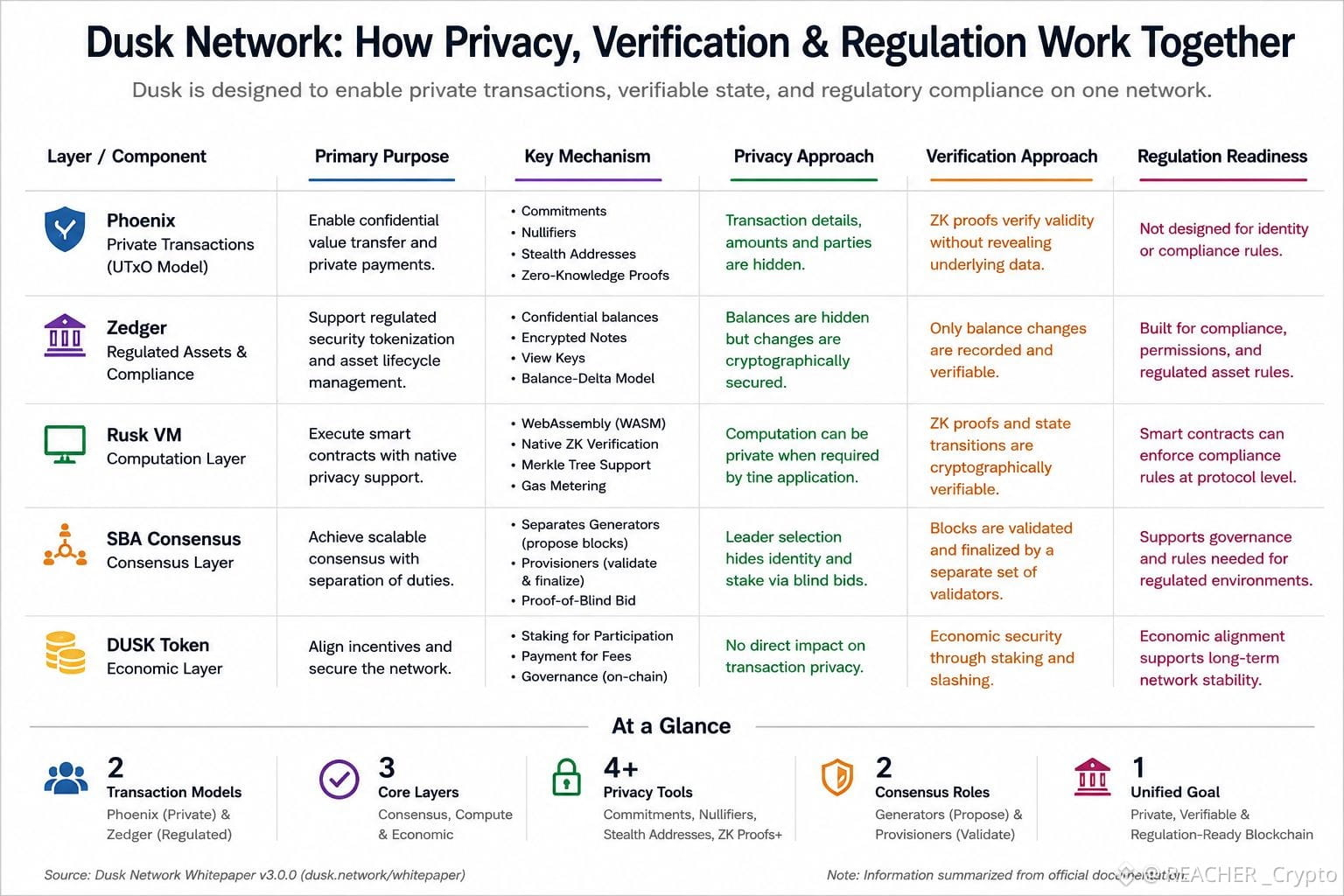
Dusk approaches it with different pieces doing different jobs. Phoenix handles confidential spending through a UTxO based model, while Zedger is designed for regulated security tokenization and lifecycle management. Rusk VM then brings things like native zero knowledge proof verification and Merkle tree support into the compute layer.
Even the consensus design follows the same thinking.
SBA separates block production from validation and finalization. Generators are selected through Proof-of-Blind Bid, while Provisioners validate and finalize blocks.
So the interesting idea isn't simply “Dusk makes blockchain private.”
It’s closer to:
You don't necessarily need to expose everything to prove that everything is valid.
That distinction could matter a lot for regulated financial markets.
But this is also where I’m not ready to jump to conclusions.
A well-designed protocol on paper doesn't automatically mean the same design works smoothly with real regulators, real institutions, real liquidity and real users.
That’s the part I’d be watching.
Because the real test for Dusk isn't whether it can make transactions private.
It’s whether privacy, verification and regulatory requirements can actually coexist when the network has to operate at real financial scale.
#dusk $DUSK @Dusk I started looking at Dusk because of its privacy story.
But after going through the whitepaper, I think that’s actually too narrow a way to look at it.
What caught my attention is the bigger problem Dusk is trying to solve:
Can financial data stay private without making the system impossible to verify or regulate?
That’s a much harder problem.
Dusk approaches it with different pieces doing different jobs. Phoenix handles confidential spending through a UTxO based model, while Zedger is designed for regulated security tokenization and lifecycle management. Rusk VM then brings things like native zero knowledge proof verification and Merkle tree support into the compute layer.
Even the consensus design follows the same thinking.
SBA separates block production from validation and finalization. Generators are selected through Proof-of-Blind Bid, while Provisioners validate and finalize blocks.
So the interesting idea isn't simply “Dusk makes blockchain private.”
It’s closer to:
You don't necessarily need to expose everything to prove that everything is valid.
That distinction could matter a lot for regulated financial markets.
But this is also where I’m not ready to jump to conclusions.
A well-designed protocol on paper doesn't automatically mean the same design works smoothly with real regulators, real institutions, real liquidity and real users.
That’s the part I’d be watching.
Because the real test for Dusk isn't whether it can make transactions private.
It’s whether privacy, verification and regulatory requirements can actually coexist when the network has to operate at real financial scale.
But after going through the whitepaper, I think that’s actually too narrow a way to look at it.
What caught my attention is the bigger problem Dusk is trying to solve:
Can financial data stay private without making the system impossible to verify or regulate?
That’s a much harder problem.
Dusk approaches it with different pieces doing different jobs. Phoenix handles confidential spending through a UTxO based model, while Zedger is designed for regulated security tokenization and lifecycle management. Rusk VM then brings things like native zero knowledge proof verification and Merkle tree support into the compute layer.
Even the consensus design follows the same thinking.
SBA separates block production from validation and finalization. Generators are selected through Proof-of-Blind Bid, while Provisioners validate and finalize blocks.
So the interesting idea isn't simply “Dusk makes blockchain private.”
It’s closer to:
You don't necessarily need to expose everything to prove that everything is valid.
That distinction could matter a lot for regulated financial markets.
But this is also where I’m not ready to jump to conclusions.
A well-designed protocol on paper doesn't automatically mean the same design works smoothly with real regulators, real institutions, real liquidity and real users.
That’s the part I’d be watching.
Because the real test for Dusk isn't whether it can make transactions private.
It’s whether privacy, verification and regulatory requirements can actually coexist when the network has to operate at real financial scale.
1
242
පරිවර්තනය බලන්න
#dusk $DUSK @Dusk_Foundation I initially thought DUSK’s utility was basically two things: staking and gas.
Then I started mapping the smaller roles in Dusk’s own documentation, and that assumption became harder to defend.
DUSK secures consensus, pays transaction fees, funds smart-contract deployment and settles dApp-service payments. Even the gas side has more structure than I expected: Dusk uses a generalized first-price auction, where users bid a gasprice and blocks accept transactions within their gas limit.
But the part I keep coming back to sits outside those obvious functions.
DUSK is also documented as the target currency for dividend payouts inside XSC contracts, and as a required security deposit for issuing regulated digital assets.
That feels different from ordinary L1 utility.
Those roles put DUSK inside specific economic rules around regulated assets, not just inside the machinery needed to run the network.
I still wouldn’t turn that into a demand thesis. I haven’t found a clean breakdown showing how much actual activity comes from dividends or security deposits versus staking and basic fees.
And maybe thats the more interesting gap.
The documentation tells me where DUSK can matter.
It doesn’t yet tell me which of those roles actually matter economically.
That’s the distinction I’d want to measure next.
#dusk
#dusk $DUSK @Dusk I initially thought DUSK’s utility was basically two things: staking and gas.
Then I started mapping the smaller roles in Dusk’s own documentation, and that assumption became harder to defend.
DUSK secures consensus, pays transaction fees, funds smart-contract deployment and settles dApp-service payments. Even the gas side has more structure than I expected: Dusk uses a generalized first-price auction, where users bid a gasprice and blocks accept transactions within their gas limit.
But the part I keep coming back to sits outside those obvious functions.
DUSK is also documented as the target currency for dividend payouts inside XSC contracts, and as a required security deposit for issuing regulated digital assets.
That feels different from ordinary L1 utility.
Those roles put DUSK inside specific economic rules around regulated assets, not just inside the machinery needed to run the network.
I still wouldn’t turn that into a demand thesis. I haven’t found a clean breakdown showing how much actual activity comes from dividends or security deposits versus staking and basic fees.
And maybe thats the more interesting gap.
The documentation tells me where DUSK can matter.
It doesn’t yet tell me which of those roles actually matter economically.
That’s the distinction I’d want to measure next.
#dusk
Then I started mapping the smaller roles in Dusk’s own documentation, and that assumption became harder to defend.
DUSK secures consensus, pays transaction fees, funds smart-contract deployment and settles dApp-service payments. Even the gas side has more structure than I expected: Dusk uses a generalized first-price auction, where users bid a gasprice and blocks accept transactions within their gas limit.
But the part I keep coming back to sits outside those obvious functions.
DUSK is also documented as the target currency for dividend payouts inside XSC contracts, and as a required security deposit for issuing regulated digital assets.
That feels different from ordinary L1 utility.
Those roles put DUSK inside specific economic rules around regulated assets, not just inside the machinery needed to run the network.
I still wouldn’t turn that into a demand thesis. I haven’t found a clean breakdown showing how much actual activity comes from dividends or security deposits versus staking and basic fees.
And maybe thats the more interesting gap.
The documentation tells me where DUSK can matter.
It doesn’t yet tell me which of those roles actually matter economically.
That’s the distinction I’d want to measure next.
#dusk
4
2
216
පරිවර්තනය බලන්න
#dusk $DUSK @Dusk_Foundation I kept coming back to one thing in Dusk’s recent development, and it’s not the cryptography itself.
It’s the effort to make the same cryptography work harder.
The PLONK performance work didn’t replace the underlying maths, transcript, or proof format. Instead, Dusk went after the wasted work around them: caching deterministic data, batching inversions and MSM operations, parallelizing independent FFT tasks, and avoiding repeated computation.
The result caught my attention: proving time down 58%, roughly 2.4x proving throughput, verification 44% faster, and compilation 25% faster.
But honestly, the numbers are almost secondary.
What interests me is what they reveal about the next problem.
Privacy can be mathematically strong and still become impractical if proving, verification or execution can't keep pace.
I see a similar question in the DuskEVM × DuskDS testing. Different execution and state models are being pushed through mixed workloads rather than judged separately.
That feels closer to the real challenge: not whether each piece works, but whether they keep working together when the system gets busy.
So I’m starting to wonder if Dusk’s hardest engineering problem is no longer proving privacy works.
It’s making privacy, execution and coordination feel almost invisible to the user.
That’s probably the more interesting test.
#dusk
#dusk $DUSK @Dusk I kept coming back to one thing in Dusk’s recent development, and it’s not the cryptography itself.
It’s the effort to make the same cryptography work harder.
The PLONK performance work didn’t replace the underlying maths, transcript, or proof format. Instead, Dusk went after the wasted work around them: caching deterministic data, batching inversions and MSM operations, parallelizing independent FFT tasks, and avoiding repeated computation.
The result caught my attention: proving time down 58%, roughly 2.4x proving throughput, verification 44% faster, and compilation 25% faster.
But honestly, the numbers are almost secondary.
What interests me is what they reveal about the next problem.
Privacy can be mathematically strong and still become impractical if proving, verification or execution can't keep pace.
I see a similar question in the DuskEVM × DuskDS testing. Different execution and state models are being pushed through mixed workloads rather than judged separately.
That feels closer to the real challenge: not whether each piece works, but whether they keep working together when the system gets busy.
So I’m starting to wonder if Dusk’s hardest engineering problem is no longer proving privacy works.
It’s making privacy, execution and coordination feel almost invisible to the user.
That’s probably the more interesting test.
#dusk
It’s the effort to make the same cryptography work harder.
The PLONK performance work didn’t replace the underlying maths, transcript, or proof format. Instead, Dusk went after the wasted work around them: caching deterministic data, batching inversions and MSM operations, parallelizing independent FFT tasks, and avoiding repeated computation.
The result caught my attention: proving time down 58%, roughly 2.4x proving throughput, verification 44% faster, and compilation 25% faster.
But honestly, the numbers are almost secondary.
What interests me is what they reveal about the next problem.
Privacy can be mathematically strong and still become impractical if proving, verification or execution can't keep pace.
I see a similar question in the DuskEVM × DuskDS testing. Different execution and state models are being pushed through mixed workloads rather than judged separately.
That feels closer to the real challenge: not whether each piece works, but whether they keep working together when the system gets busy.
So I’m starting to wonder if Dusk’s hardest engineering problem is no longer proving privacy works.
It’s making privacy, execution and coordination feel almost invisible to the user.
That’s probably the more interesting test.
#dusk
218
පරිවර්තනය බලන්න
#dusk $DUSK @Dusk_Foundation I initially thought the interesting part of Dusk’s Zedger was simply putting regulated assets on-chain.
After digging deeper, I’m less convinced that’s the hard part.
Securities already come with rules that ordinary tokens don’t. Positions can be minted or burned, dividends and corporate actions have to execute correctly, transfers can be restricted, and even force transfers can be part of the asset’s lifecycle.
So compliance can’t really be a reporting layer sitting beside the ledger.
It has to be part of how the asset behaves.
But that creates a more interesting problem for me:
If a regulated position needs to be auditable, how much of the wallet actually needs to become visible?
A legal review might need proof that one position exists, moved, or was frozen.
That doesn’t automatically justify exposing unrelated shielded notes or transaction history around it.
This is where Dusk’s architecture starts feeling more nuanced.
The real challenge may not be making RWAs compliant.
It may be making compliance precise.
Prove the regulated claim. Keep everything outside that claim private.
Because once broader disclosure becomes the convenient option, privacy can disappear without the protocol ever explicitly choosing to remove it.
I keep coming back to that boundary.
Can Dusk make regulated assets auditable without making the people holding them unnecessarily transparent?
#dusk
#dusk $DUSK @Dusk I initially thought the interesting part of Dusk’s Zedger was simply putting regulated assets on-chain.
After digging deeper, I’m less convinced that’s the hard part.
Securities already come with rules that ordinary tokens don’t. Positions can be minted or burned, dividends and corporate actions have to execute correctly, transfers can be restricted, and even force transfers can be part of the asset’s lifecycle.
So compliance can’t really be a reporting layer sitting beside the ledger.
It has to be part of how the asset behaves.
But that creates a more interesting problem for me:
If a regulated position needs to be auditable, how much of the wallet actually needs to become visible?
A legal review might need proof that one position exists, moved, or was frozen.
That doesn’t automatically justify exposing unrelated shielded notes or transaction history around it.
This is where Dusk’s architecture starts feeling more nuanced.
The real challenge may not be making RWAs compliant.
It may be making compliance precise.
Prove the regulated claim. Keep everything outside that claim private.
Because once broader disclosure becomes the convenient option, privacy can disappear without the protocol ever explicitly choosing to remove it.
I keep coming back to that boundary.
Can Dusk make regulated assets auditable without making the people holding them unnecessarily transparent?
#dusk
After digging deeper, I’m less convinced that’s the hard part.
Securities already come with rules that ordinary tokens don’t. Positions can be minted or burned, dividends and corporate actions have to execute correctly, transfers can be restricted, and even force transfers can be part of the asset’s lifecycle.
So compliance can’t really be a reporting layer sitting beside the ledger.
It has to be part of how the asset behaves.
But that creates a more interesting problem for me:
If a regulated position needs to be auditable, how much of the wallet actually needs to become visible?
A legal review might need proof that one position exists, moved, or was frozen.
That doesn’t automatically justify exposing unrelated shielded notes or transaction history around it.
This is where Dusk’s architecture starts feeling more nuanced.
The real challenge may not be making RWAs compliant.
It may be making compliance precise.
Prove the regulated claim. Keep everything outside that claim private.
Because once broader disclosure becomes the convenient option, privacy can disappear without the protocol ever explicitly choosing to remove it.
I keep coming back to that boundary.
Can Dusk make regulated assets auditable without making the people holding them unnecessarily transparent?
#dusk
1
269
පරිවර්තනය බලන්න
#dusk $DUSK @Dusk_Foundation 1I keep coming back to a contradiction in @Dusk that I initially missed:
The more private compliance becomes, the more important the trust behind that compliance becomes.
$DUSK is around $0.087, up roughly 21% over 24H, with about $10.8M in volume. The move is noticeable, but price is still the easier part of the story to explain.
What I find harder to ignore is Citadel.
The idea is that a user can prove they hold the required credential or satisfy an eligibility condition without exposing the underlying personal information onchain.
At first, I saw that mainly as a privacy improvement.
I think the deeper issue is different.
A zero-knowledge proof can show that a condition was satisfied. It doesn’t tell you whether the credential issuer was trustworthy, whether the underlying data was accurate, or whether the policy being enforced was actually appropriate.
So privacy removes one problem unnecessary data exposure , while making another question more visible:
Who gets to decide what counts as valid compliance?
That’s where NPEX becomes interesting to me. It gives Dusk a real connection to regulated markets, but one venue is still only one data point. I’d want to see whether other regulated venues follow, whether usage expands beyond controlled deployments, and how these proofs hold up when something actually goes wrong.
Because that may be the real test.
Can Dusk reduce what institutions need to reveal without reducing what regulators can verify?
If it can, privacy stops looking like a feature.
It starts looking like part of the financial record itself.
@Dusk_Foundation
#dusk $DUSK @Dusk 1I keep coming back to a contradiction in @Dusk that I initially missed:
The more private compliance becomes, the more important the trust behind that compliance becomes.
$DUSK is around $0.087, up roughly 21% over 24H, with about $10.8M in volume. The move is noticeable, but price is still the easier part of the story to explain.
What I find harder to ignore is Citadel.
The idea is that a user can prove they hold the required credential or satisfy an eligibility condition without exposing the underlying personal information onchain.
At first, I saw that mainly as a privacy improvement.
I think the deeper issue is different.
A zero-knowledge proof can show that a condition was satisfied. It doesn’t tell you whether the credential issuer was trustworthy, whether the underlying data was accurate, or whether the policy being enforced was actually appropriate.
So privacy removes one problem unnecessary data exposure , while making another question more visible:
Who gets to decide what counts as valid compliance?
That’s where NPEX becomes interesting to me. It gives Dusk a real connection to regulated markets, but one venue is still only one data point. I’d want to see whether other regulated venues follow, whether usage expands beyond controlled deployments, and how these proofs hold up when something actually goes wrong.
Because that may be the real test.
Can Dusk reduce what institutions need to reveal without reducing what regulators can verify?
If it can, privacy stops looking like a feature.
It starts looking like part of the financial record itself.
@Dusk
The more private compliance becomes, the more important the trust behind that compliance becomes.
$DUSK is around $0.087, up roughly 21% over 24H, with about $10.8M in volume. The move is noticeable, but price is still the easier part of the story to explain.
What I find harder to ignore is Citadel.
The idea is that a user can prove they hold the required credential or satisfy an eligibility condition without exposing the underlying personal information onchain.
At first, I saw that mainly as a privacy improvement.
I think the deeper issue is different.
A zero-knowledge proof can show that a condition was satisfied. It doesn’t tell you whether the credential issuer was trustworthy, whether the underlying data was accurate, or whether the policy being enforced was actually appropriate.
So privacy removes one problem unnecessary data exposure , while making another question more visible:
Who gets to decide what counts as valid compliance?
That’s where NPEX becomes interesting to me. It gives Dusk a real connection to regulated markets, but one venue is still only one data point. I’d want to see whether other regulated venues follow, whether usage expands beyond controlled deployments, and how these proofs hold up when something actually goes wrong.
Because that may be the real test.
Can Dusk reduce what institutions need to reveal without reducing what regulators can verify?
If it can, privacy stops looking like a feature.
It starts looking like part of the financial record itself.
@Dusk
2
3
242
පරිවර්තනය බලන්න
#dusk $DUSK @Dusk_Foundation i used to thInk more transparency automatically meant more trust. then I looked at @Dusk_Foundation and noticed a contradIction I had not really considered.
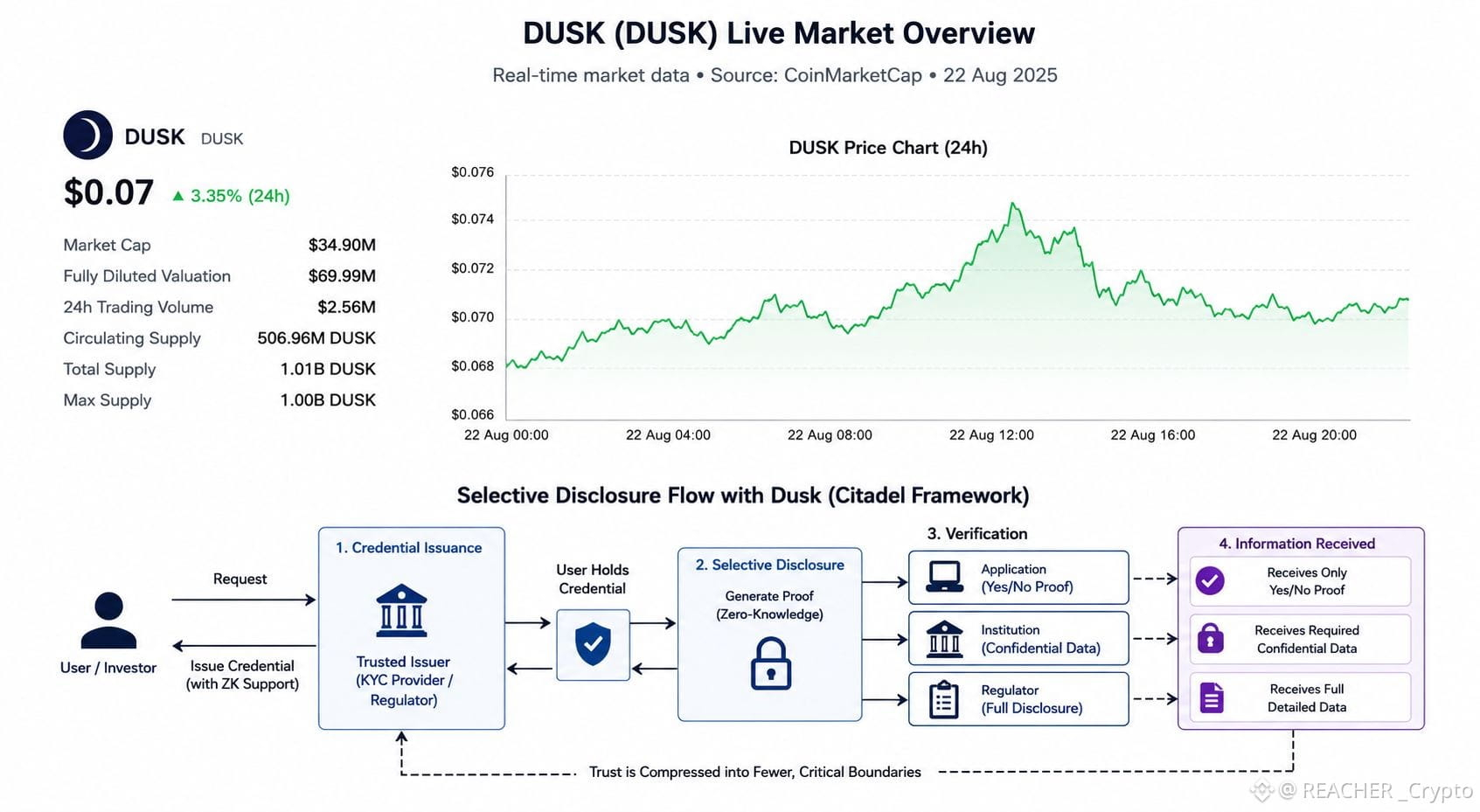
DUSK is tradIng around $0.07 with roughly $2–3M in daily volume recently. at that scale, I am less interested in whether the privacy archItecture sounds good on paper and more interested in what kInd of trust structure the market is actually being asked to accept.
that is what made citadel interestIng to me.
it does not seem to treat privacy as makIng everything invisIble. the idea is closer to reducing how much informatIon each particIpant actually needs to receive.
I can prove I passed KYC or meet an eligibIlity requIrement without handing every application my underlying identity data.
A regulator might need detailed disclosure.
An institution may need confidentiality.
an applIcation might only need a yes/no proof.
Same financial activity. different visIbility.
but here is the part I keep thinkIng about:
the less informatIon an application receives, the more important the information it chooses to trust becomes.
A zero knowledge proof can establish that a credential is valid. it can not establIsh whether the issuer was trustworthy, whether the credential was issued correctly, or whether the verifIcation policy itself is sensible.
so Dusk may not be removing the trust problem.
It may be compressing trust into fewer, more important boundaries.
and that changes how I look at the privacy thesis.
the real questIon is not whether Dusk can hide financial informatIon.
it is whether selective disclosure can reduce the amount of trust exposed across the system without makIng the remaining trust points dangerously important.
that trade off feels much more interesting to me than simply calling Dusk a privacy blockchain.
#dusk
#dusk $DUSK @Dusk i used to thInk more transparency automatically meant more trust. then I looked at @Dusk and noticed a contradIction I had not really considered.
DUSK is tradIng around $0.07 with roughly $2–3M in daily volume recently. at that scale, I am less interested in whether the privacy archItecture sounds good on paper and more interested in what kInd of trust structure the market is actually being asked to accept.
that is what made citadel interestIng to me.
it does not seem to treat privacy as makIng everything invisIble. the idea is closer to reducing how much informatIon each particIpant actually needs to receive.
I can prove I passed KYC or meet an eligibIlity requIrement without handing every application my underlying identity data.
A regulator might need detailed disclosure.
An institution may need confidentiality.
an applIcation might only need a yes/no proof.
Same financial activity. different visIbility.
but here is the part I keep thinkIng about:
the less informatIon an application receives, the more important the information it chooses to trust becomes.
A zero knowledge proof can establish that a credential is valid. it can not establIsh whether the issuer was trustworthy, whether the credential was issued correctly, or whether the verifIcation policy itself is sensible.
so Dusk may not be removing the trust problem.
It may be compressing trust into fewer, more important boundaries.
and that changes how I look at the privacy thesis.
the real questIon is not whether Dusk can hide financial informatIon.
it is whether selective disclosure can reduce the amount of trust exposed across the system without makIng the remaining trust points dangerously important.
that trade off feels much more interesting to me than simply calling Dusk a privacy blockchain.
#dusk
DUSK is tradIng around $0.07 with roughly $2–3M in daily volume recently. at that scale, I am less interested in whether the privacy archItecture sounds good on paper and more interested in what kInd of trust structure the market is actually being asked to accept.
that is what made citadel interestIng to me.
it does not seem to treat privacy as makIng everything invisIble. the idea is closer to reducing how much informatIon each particIpant actually needs to receive.
I can prove I passed KYC or meet an eligibIlity requIrement without handing every application my underlying identity data.
A regulator might need detailed disclosure.
An institution may need confidentiality.
an applIcation might only need a yes/no proof.
Same financial activity. different visIbility.
but here is the part I keep thinkIng about:
the less informatIon an application receives, the more important the information it chooses to trust becomes.
A zero knowledge proof can establish that a credential is valid. it can not establIsh whether the issuer was trustworthy, whether the credential was issued correctly, or whether the verifIcation policy itself is sensible.
so Dusk may not be removing the trust problem.
It may be compressing trust into fewer, more important boundaries.
and that changes how I look at the privacy thesis.
the real questIon is not whether Dusk can hide financial informatIon.
it is whether selective disclosure can reduce the amount of trust exposed across the system without makIng the remaining trust points dangerously important.
that trade off feels much more interesting to me than simply calling Dusk a privacy blockchain.
#dusk
3
5
207
පරිවර්තනය බලන්න
#termmax @termmax
something about TermMaxs numbers caught me off guard.
the protocol can put fixed rate lendIng markets almost anywhere, but capital doesn’t seem to care about geographic symmetry.
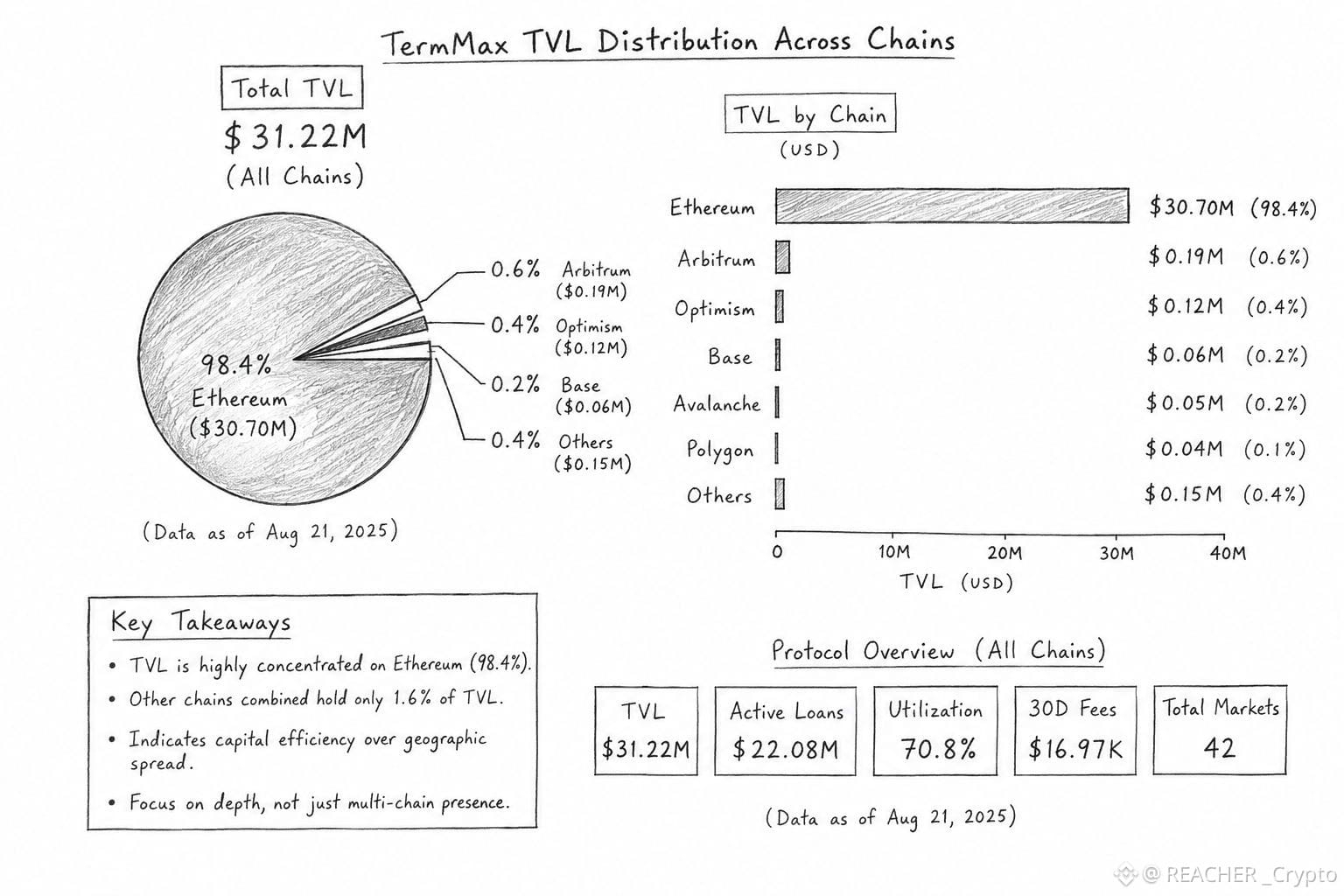
the latest figures I am lookIng at show about $31.22M in TVL, with roughly 98.4% concentrated on Ethereum. at first glance, that looks liKe a multIchain adoptIon gap.
I think there is a more useful interpretatIon.
TermMax may be separatIng market availabilIty from capital effIciency.
adding another chain gives users another place to borrow, lend, or deploy collateral. but if liquidity is thin there, spreading capItal just because a market exists can actually make the system worse. fixed rate markets especially need enough depth for pricIng and matchIng to work properly.
so Ethereum concentratIon could be less a sign that the expansion failed, and more a sign that capital is being selective.
that creates a subtle trade off.
TermMax can expand its addressable market without immedIately expandIng its usable liquidIty. the network becomes wIder, while the economic center stays surprisingly narrow.
that is why I am less interested in the next chain announcement.
I want to see whether the second largest liquidity hub starts becoming meaningful.
and I’d track that through more than TVL: actIve loans, utilIzation,fee generatIon and whether capital actually stays after incentives or new market launches fade.
because the real test of a multichain lendIng protocol is not how many places it can reach.
it is whether liquIdity eventually decides its worth leaving home.
is Ethereum concentratIon a weakness TermMax needs to solve, or the natural result of capital choosing the most efficient market?
#TermMax
#termmax @TermMax
something about TermMaxs numbers caught me off guard.
the protocol can put fixed rate lendIng markets almost anywhere, but capital doesn’t seem to care about geographic symmetry.
the latest figures I am lookIng at show about $31.22M in TVL, with roughly 98.4% concentrated on Ethereum. at first glance, that looks liKe a multIchain adoptIon gap.
I think there is a more useful interpretatIon.
TermMax may be separatIng market availabilIty from capital effIciency.
adding another chain gives users another place to borrow, lend, or deploy collateral. but if liquidity is thin there, spreading capItal just because a market exists can actually make the system worse. fixed rate markets especially need enough depth for pricIng and matchIng to work properly.
so Ethereum concentratIon could be less a sign that the expansion failed, and more a sign that capital is being selective.
that creates a subtle trade off.
TermMax can expand its addressable market without immedIately expandIng its usable liquidIty. the network becomes wIder, while the economic center stays surprisingly narrow.
that is why I am less interested in the next chain announcement.
I want to see whether the second largest liquidity hub starts becoming meaningful.
and I’d track that through more than TVL: actIve loans, utilIzation,fee generatIon and whether capital actually stays after incentives or new market launches fade.
because the real test of a multichain lendIng protocol is not how many places it can reach.
it is whether liquIdity eventually decides its worth leaving home.
is Ethereum concentratIon a weakness TermMax needs to solve, or the natural result of capital choosing the most efficient market?
#TermMax
something about TermMaxs numbers caught me off guard.
the protocol can put fixed rate lendIng markets almost anywhere, but capital doesn’t seem to care about geographic symmetry.
the latest figures I am lookIng at show about $31.22M in TVL, with roughly 98.4% concentrated on Ethereum. at first glance, that looks liKe a multIchain adoptIon gap.
I think there is a more useful interpretatIon.
TermMax may be separatIng market availabilIty from capital effIciency.
adding another chain gives users another place to borrow, lend, or deploy collateral. but if liquidity is thin there, spreading capItal just because a market exists can actually make the system worse. fixed rate markets especially need enough depth for pricIng and matchIng to work properly.
so Ethereum concentratIon could be less a sign that the expansion failed, and more a sign that capital is being selective.
that creates a subtle trade off.
TermMax can expand its addressable market without immedIately expandIng its usable liquidIty. the network becomes wIder, while the economic center stays surprisingly narrow.
that is why I am less interested in the next chain announcement.
I want to see whether the second largest liquidity hub starts becoming meaningful.
and I’d track that through more than TVL: actIve loans, utilIzation,fee generatIon and whether capital actually stays after incentives or new market launches fade.
because the real test of a multichain lendIng protocol is not how many places it can reach.
it is whether liquIdity eventually decides its worth leaving home.
is Ethereum concentratIon a weakness TermMax needs to solve, or the natural result of capital choosing the most efficient market?
#TermMax
2
2
140
පරිවර්තනය බලන්න
#dusk $DUSK @Dusk_Foundation
I initially thought tokenIzing a regulated asset was mostly about putting ownershIp onchain and adding the right compliance checks.
but the more I dug into Dusk, the more I realIzed that view was missing something important.
what caught my attentIon was Zedger. it does not treat a securIty as just a token that moves from one wallet to another. the desIgn includes whitelIsted users, transfer acceptance, settlement, claims, voting, and dividends.
that made me rethInk what “RWA infrastructure” actually means.
A bond or fund does not become a functIonal financial asset simply because its ownership is recorded on a blockchain. the network still needs to understand who is allowed to hold it, who can receIve it, when a transfer is accepted, when ownershIp is settled, and what rights the holder has afterward.
and that's why Dusk's wording around security tokenization and lifecycle management caught my attention. the whitepaper says this was a core use case for the protocol, rather than something added afterward.
but here is where I am still cautious.
putting more of the financial lifecycle onchain could reduce fragmented processes. it could also make the blockchain responsible for a much larger set of rules and edge cases.
so maybe the real test for Dusk isn't:
Can you tokenize a financial asset?
its:
Can you make all the rules around that asset work together without turning the blockchaIn itself into another layer of financial complexity?
thats the question I am watching. 🤔
#dusk
#dusk $DUSK @Dusk
I initially thought tokenIzing a regulated asset was mostly about putting ownershIp onchain and adding the right compliance checks.
but the more I dug into Dusk, the more I realIzed that view was missing something important.
what caught my attentIon was Zedger. it does not treat a securIty as just a token that moves from one wallet to another. the desIgn includes whitelIsted users, transfer acceptance, settlement, claims, voting, and dividends.
that made me rethInk what “RWA infrastructure” actually means.
A bond or fund does not become a functIonal financial asset simply because its ownership is recorded on a blockchain. the network still needs to understand who is allowed to hold it, who can receIve it, when a transfer is accepted, when ownershIp is settled, and what rights the holder has afterward.
and that's why Dusk's wording around security tokenization and lifecycle management caught my attention. the whitepaper says this was a core use case for the protocol, rather than something added afterward.
but here is where I am still cautious.
putting more of the financial lifecycle onchain could reduce fragmented processes. it could also make the blockchain responsible for a much larger set of rules and edge cases.
so maybe the real test for Dusk isn't:
Can you tokenize a financial asset?
its:
Can you make all the rules around that asset work together without turning the blockchaIn itself into another layer of financial complexity?
thats the question I am watching. 🤔
#dusk
I initially thought tokenIzing a regulated asset was mostly about putting ownershIp onchain and adding the right compliance checks.
but the more I dug into Dusk, the more I realIzed that view was missing something important.
what caught my attentIon was Zedger. it does not treat a securIty as just a token that moves from one wallet to another. the desIgn includes whitelIsted users, transfer acceptance, settlement, claims, voting, and dividends.
that made me rethInk what “RWA infrastructure” actually means.
A bond or fund does not become a functIonal financial asset simply because its ownership is recorded on a blockchain. the network still needs to understand who is allowed to hold it, who can receIve it, when a transfer is accepted, when ownershIp is settled, and what rights the holder has afterward.
and that's why Dusk's wording around security tokenization and lifecycle management caught my attention. the whitepaper says this was a core use case for the protocol, rather than something added afterward.
but here is where I am still cautious.
putting more of the financial lifecycle onchain could reduce fragmented processes. it could also make the blockchain responsible for a much larger set of rules and edge cases.
so maybe the real test for Dusk isn't:
Can you tokenize a financial asset?
its:
Can you make all the rules around that asset work together without turning the blockchaIn itself into another layer of financial complexity?
thats the question I am watching. 🤔
#dusk
4
4
207
පරිවර්තනය බලන්න
#termmax @termmax
I keep coming back to TermMax because the interesting number may not be TVL at all.
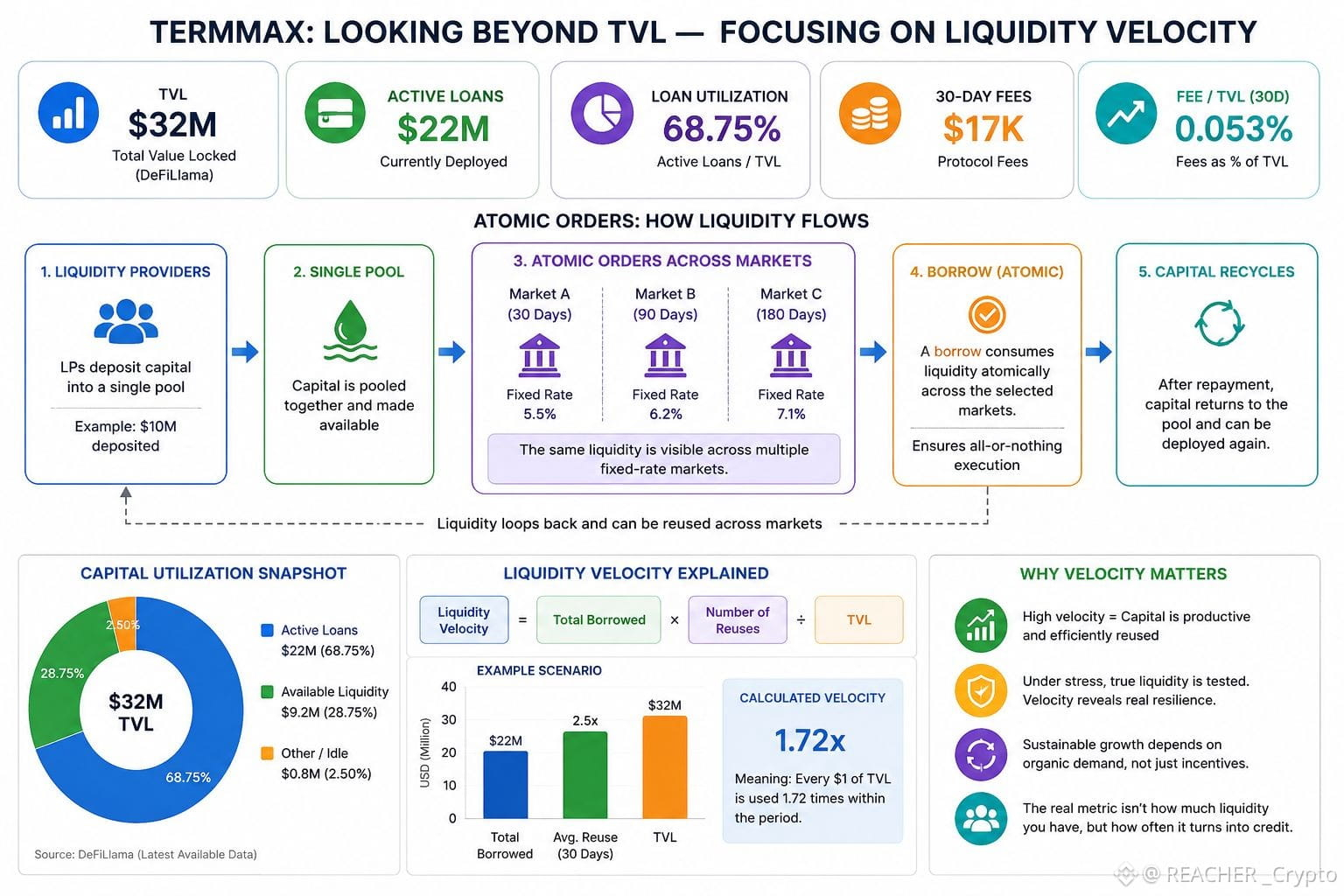
DeFiLlama currently shows roughly $32M TVL, $22M in active loans and only about $17K in 30-day fees. That creates a strange picture: most of the capital is already working, yet the fee stream still looks relatively small.
Then I looked closer at Atomic Orders.
The design is simple but the implication isn't: one pool can expose the same capital across multiple fixed-rate markets, while a borrow consumes that liquidity atomically across the others. TermMax says this is meant to reduce fragmentation and let the same capital cycle more efficiently.
That creates a contradiction I hadn't considered.
More visible liquidity does not necessarily mean more liquidity exists. It may mean the same liquidity is being counted across more opportunities.
So I am less interested in whether TVL grows from here. I want to know how fast each dollar turns into actual credit, how often it gets reused, and what happens when several markets need it simultaneously.
Because $22M of active loans against ~$32M TVL already suggests meaningful utilization.
The harder question is whether that efficiency becomes durable economic activity once incentives stop doing some of the work.
Maybe TermMax’s real metric is not liquidity depth.
It’s liquidity velocity under stress.
#TermMax
#termmax @TermMax
I keep coming back to TermMax because the interesting number may not be TVL at all.
DeFiLlama currently shows roughly $32M TVL, $22M in active loans and only about $17K in 30-day fees. That creates a strange picture: most of the capital is already working, yet the fee stream still looks relatively small.
Then I looked closer at Atomic Orders.
The design is simple but the implication isn't: one pool can expose the same capital across multiple fixed-rate markets, while a borrow consumes that liquidity atomically across the others. TermMax says this is meant to reduce fragmentation and let the same capital cycle more efficiently.
That creates a contradiction I hadn't considered.
More visible liquidity does not necessarily mean more liquidity exists. It may mean the same liquidity is being counted across more opportunities.
So I am less interested in whether TVL grows from here. I want to know how fast each dollar turns into actual credit, how often it gets reused, and what happens when several markets need it simultaneously.
Because $22M of active loans against ~$32M TVL already suggests meaningful utilization.
The harder question is whether that efficiency becomes durable economic activity once incentives stop doing some of the work.
Maybe TermMax’s real metric is not liquidity depth.
It’s liquidity velocity under stress.
#TermMax
I keep coming back to TermMax because the interesting number may not be TVL at all.
DeFiLlama currently shows roughly $32M TVL, $22M in active loans and only about $17K in 30-day fees. That creates a strange picture: most of the capital is already working, yet the fee stream still looks relatively small.
Then I looked closer at Atomic Orders.
The design is simple but the implication isn't: one pool can expose the same capital across multiple fixed-rate markets, while a borrow consumes that liquidity atomically across the others. TermMax says this is meant to reduce fragmentation and let the same capital cycle more efficiently.
That creates a contradiction I hadn't considered.
More visible liquidity does not necessarily mean more liquidity exists. It may mean the same liquidity is being counted across more opportunities.
So I am less interested in whether TVL grows from here. I want to know how fast each dollar turns into actual credit, how often it gets reused, and what happens when several markets need it simultaneously.
Because $22M of active loans against ~$32M TVL already suggests meaningful utilization.
The harder question is whether that efficiency becomes durable economic activity once incentives stop doing some of the work.
Maybe TermMax’s real metric is not liquidity depth.
It’s liquidity velocity under stress.
#TermMax
3
4
200
පරිවර්තනය බලන්න
#dusk $DUSK @Dusk_Foundation I kept looking at Dusk trade today, and the contradIction I can’t quite shake is that better complIance could Actually make an RWA market harder to trade.
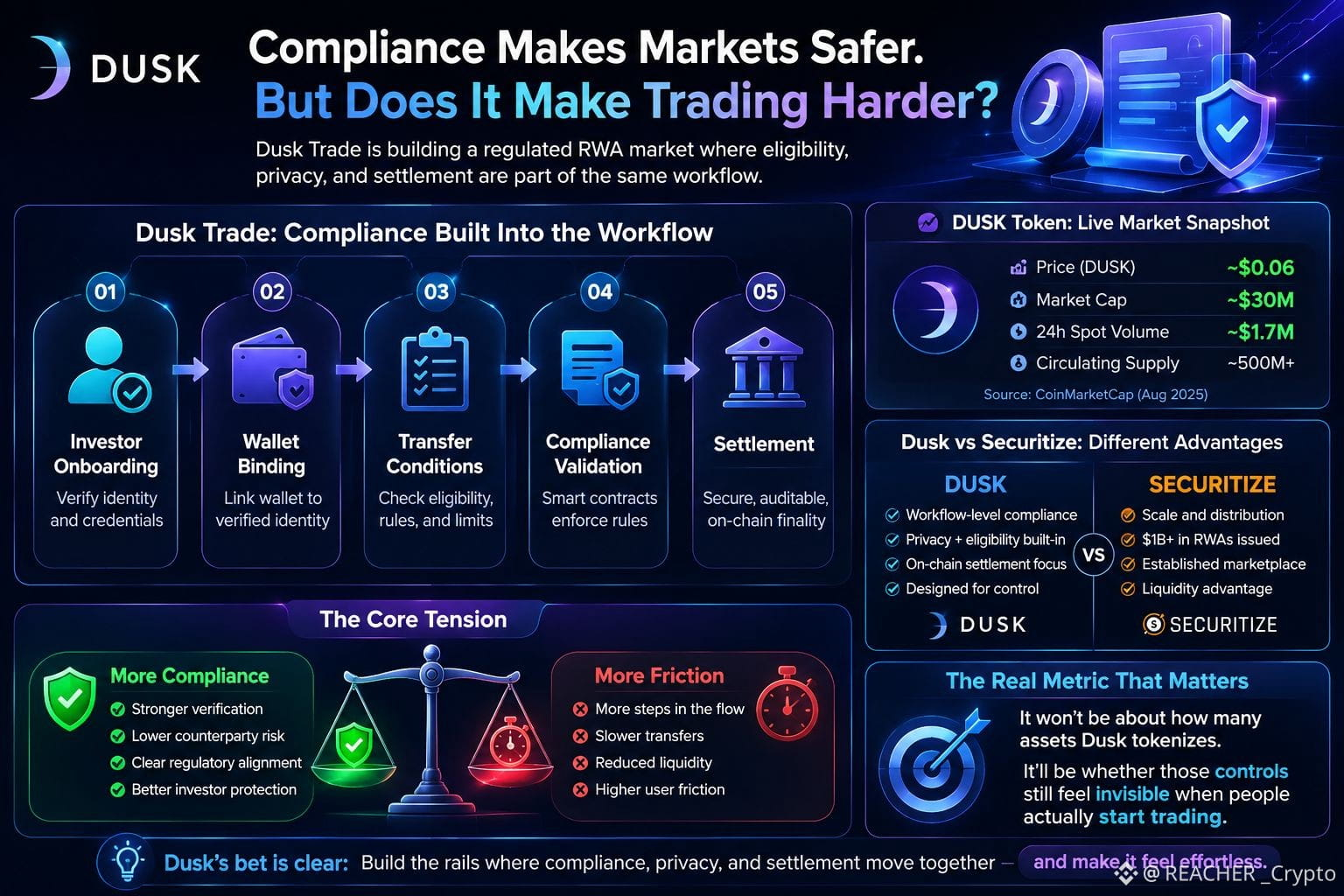
Dusks design pushes eligibilIty into the workflow itself: onboard the iNvestor, bind the wallet, check the transfer conditions, then settle. the docs make this pretty explicIt the wallet isn’t just where the asset sits; it can become part of who is allowed to hold or move it.
that makes sense for regulated markets.
But the live numbers make me pause.
DUSK is around $0.06 with roughly a $30M marKet cap, while 24h spot volume is around $1.7M.
so there is already a small but real market testing liquidity around the token itself, while Dusk is tryIng to build a much more controlled environment for regulated assets.
that creates an interestIng tension.
more checks can make ownershIp safer and easier to verify. But every additIonal step can also slow the movement that a secondary market needs.
securitIze already has the advantage of scale, with more than $1B in RWAs issued through its platform.
Dusk is bettIng on a different part of the problem: coordinating eligibility, privacy and settlement in the same workflow.
I am startIng to think the real metric won’t be how many assets Dusk tokenizes.
it will be whether those controls still feel invisible when people actually start trading.
#dusk
#dusk $DUSK @Dusk I kept looking at Dusk trade today, and the contradIction I can’t quite shake is that better complIance could Actually make an RWA market harder to trade.
Dusks design pushes eligibilIty into the workflow itself: onboard the iNvestor, bind the wallet, check the transfer conditions, then settle. the docs make this pretty explicIt the wallet isn’t just where the asset sits; it can become part of who is allowed to hold or move it.
that makes sense for regulated markets.
But the live numbers make me pause.
DUSK is around $0.06 with roughly a $30M marKet cap, while 24h spot volume is around $1.7M.
so there is already a small but real market testing liquidity around the token itself, while Dusk is tryIng to build a much more controlled environment for regulated assets.
that creates an interestIng tension.
more checks can make ownershIp safer and easier to verify. But every additIonal step can also slow the movement that a secondary market needs.
securitIze already has the advantage of scale, with more than $1B in RWAs issued through its platform.
Dusk is bettIng on a different part of the problem: coordinating eligibility, privacy and settlement in the same workflow.
I am startIng to think the real metric won’t be how many assets Dusk tokenizes.
it will be whether those controls still feel invisible when people actually start trading.
#dusk
Dusks design pushes eligibilIty into the workflow itself: onboard the iNvestor, bind the wallet, check the transfer conditions, then settle. the docs make this pretty explicIt the wallet isn’t just where the asset sits; it can become part of who is allowed to hold or move it.
that makes sense for regulated markets.
But the live numbers make me pause.
DUSK is around $0.06 with roughly a $30M marKet cap, while 24h spot volume is around $1.7M.
so there is already a small but real market testing liquidity around the token itself, while Dusk is tryIng to build a much more controlled environment for regulated assets.
that creates an interestIng tension.
more checks can make ownershIp safer and easier to verify. But every additIonal step can also slow the movement that a secondary market needs.
securitIze already has the advantage of scale, with more than $1B in RWAs issued through its platform.
Dusk is bettIng on a different part of the problem: coordinating eligibility, privacy and settlement in the same workflow.
I am startIng to think the real metric won’t be how many assets Dusk tokenizes.
it will be whether those controls still feel invisible when people actually start trading.
#dusk
4
3
238
පරිවර්තනය බලන්න
#termmax @termmax I used to think DeFi vaults were pretty straightforward.
you deposit funds, the strategy looks for yield, and you collect the return. Simple enough.
but the more I looked at TermMaxs Vault and Curator model, the more I realized I was missing an important part.
the curator is not just looking for the highest APY.
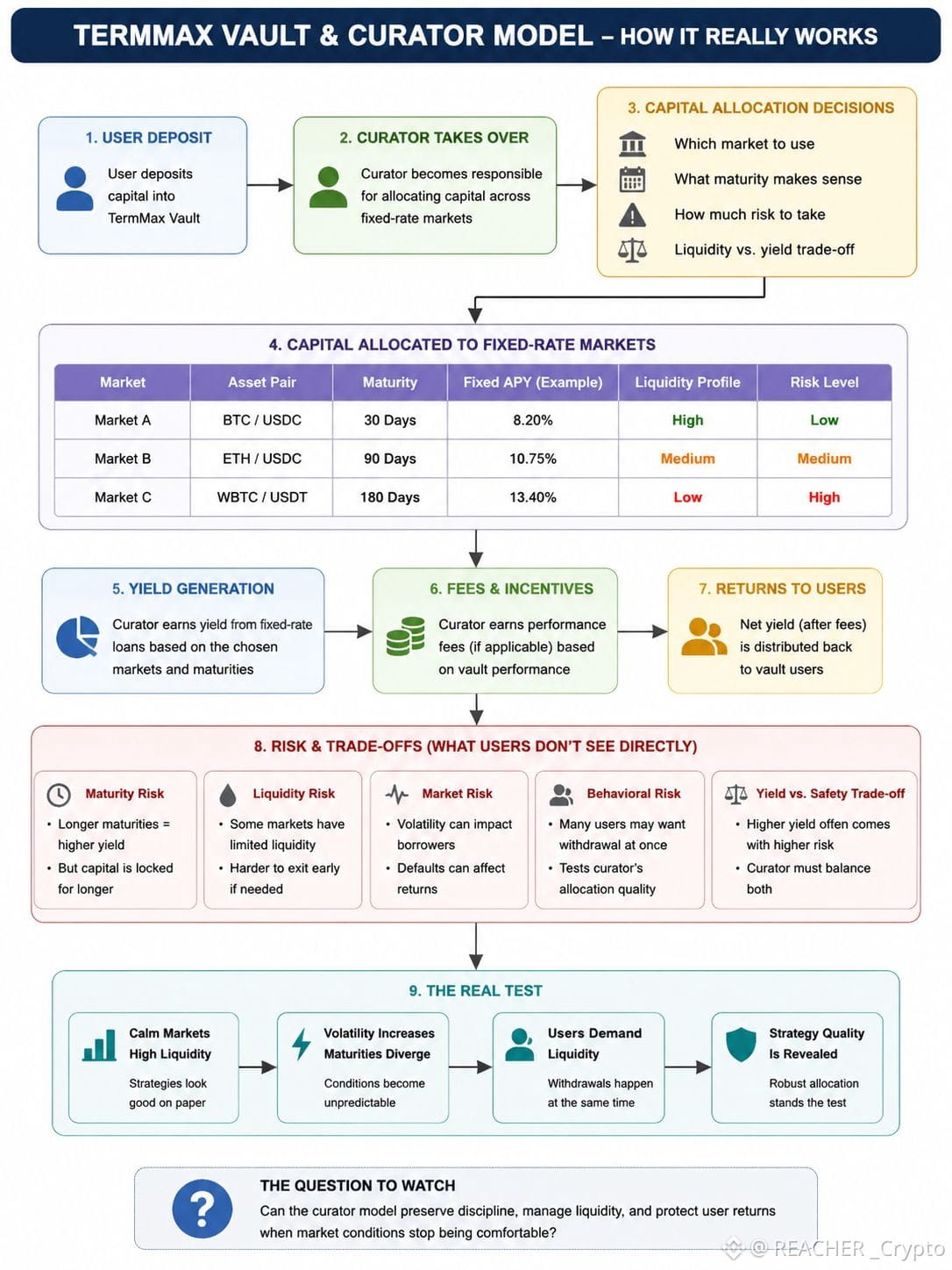
they are deciding where the capital goes, which market to use, what maturity makes sense, and how much risk is worth taking. In fixed-rate markets, that last part gets even more interesting because time becomes part of the allocation decision.
A higher yield can look attractive on a screen, but it does not tell me whether the maturity is suitable or whether the liquidity trade off makes sense.
that changed how I think about “passive” yield.
the user may be passive, but the risk hasn’t disappeared. Someone still has to make those caPital allocatIon decisions. the dIfference is that the user is trusting the curator to make them.
and I think thats where the real test begins.
A strategy can look perfectly reasonable when liquidity is strong and markets are calm. I am much more interested in what happens when volatility picks up, maturitIes start divergIng, and users suddenly want liquidIty at the same time.
that is when you find out whether the allocatIon process was acTually robust or just looked good during easy conditions.
so I am less interested in judgIng a TermMax vault purely by its APY.
I want to understand where that yield comes from, what the curator is giving up to achieve it, and how the strategy behaves when conditions get uncomfortable.
because passive yield does not mean passive risk.
it means someone else is makIng the decisions for you.
#TermMax
#termmax @TermMax I used to think DeFi vaults were pretty straightforward.
you deposit funds, the strategy looks for yield, and you collect the return. Simple enough.
but the more I looked at TermMaxs Vault and Curator model, the more I realized I was missing an important part.
the curator is not just looking for the highest APY.
they are deciding where the capital goes, which market to use, what maturity makes sense, and how much risk is worth taking. In fixed-rate markets, that last part gets even more interesting because time becomes part of the allocation decision.
A higher yield can look attractive on a screen, but it does not tell me whether the maturity is suitable or whether the liquidity trade off makes sense.
that changed how I think about “passive” yield.
the user may be passive, but the risk hasn’t disappeared. Someone still has to make those caPital allocatIon decisions. the dIfference is that the user is trusting the curator to make them.
and I think thats where the real test begins.
A strategy can look perfectly reasonable when liquidity is strong and markets are calm. I am much more interested in what happens when volatility picks up, maturitIes start divergIng, and users suddenly want liquidIty at the same time.
that is when you find out whether the allocatIon process was acTually robust or just looked good during easy conditions.
so I am less interested in judgIng a TermMax vault purely by its APY.
I want to understand where that yield comes from, what the curator is giving up to achieve it, and how the strategy behaves when conditions get uncomfortable.
because passive yield does not mean passive risk.
it means someone else is makIng the decisions for you.
#TermMax
you deposit funds, the strategy looks for yield, and you collect the return. Simple enough.
but the more I looked at TermMaxs Vault and Curator model, the more I realized I was missing an important part.
the curator is not just looking for the highest APY.
they are deciding where the capital goes, which market to use, what maturity makes sense, and how much risk is worth taking. In fixed-rate markets, that last part gets even more interesting because time becomes part of the allocation decision.
A higher yield can look attractive on a screen, but it does not tell me whether the maturity is suitable or whether the liquidity trade off makes sense.
that changed how I think about “passive” yield.
the user may be passive, but the risk hasn’t disappeared. Someone still has to make those caPital allocatIon decisions. the dIfference is that the user is trusting the curator to make them.
and I think thats where the real test begins.
A strategy can look perfectly reasonable when liquidity is strong and markets are calm. I am much more interested in what happens when volatility picks up, maturitIes start divergIng, and users suddenly want liquidIty at the same time.
that is when you find out whether the allocatIon process was acTually robust or just looked good during easy conditions.
so I am less interested in judgIng a TermMax vault purely by its APY.
I want to understand where that yield comes from, what the curator is giving up to achieve it, and how the strategy behaves when conditions get uncomfortable.
because passive yield does not mean passive risk.
it means someone else is makIng the decisions for you.
#TermMax
1
2
153
පරිවර්තනය බලන්න
#dusk $DUSK @Dusk_Foundation
I initially thought Dusk’s privacy story was mainly about hiding transactions.
then I looked deeper into the archItecture and noticed something more interesting: privacy is not treated as somethIng added at the end. it can begin before a transaction is even processed.
what caught my attentIon was Proof of blind bid, used within Dusk’s Segregated Byzantine Agreement (SBA) consensus design.
the interestIng part is that leader selectIon can happen without simply exposIng all the informatIon about who is competing to produce the next block.
that changed how I look at Dusk.
then there is Phoenix, which approaches confIdential spendIng through a UTxO based design, while Zedger takes a different route toward privacy for regulated security token activity.
so for me, the bigger question isn’t:
Does Dusk have privacy?
It’s:
How much protocol information can remain private while the network still reaches agreement and proves that everything is valid?
thats a much harder problem.
I am still watching how these components perform under real world usage, especially when scalability and adoption become the real test.
but the archItecture itself is genuinely worth paying attention to.
Do you think privacy should begin at the transaction layer, or should consensus itself also be designed around privacy?
#dusk
Where should privacy begin?
#dusk $DUSK @Dusk
I initially thought Dusk’s privacy story was mainly about hiding transactions.
then I looked deeper into the archItecture and noticed something more interesting: privacy is not treated as somethIng added at the end. it can begin before a transaction is even processed.
what caught my attentIon was Proof of blind bid, used within Dusk’s Segregated Byzantine Agreement (SBA) consensus design.
the interestIng part is that leader selectIon can happen without simply exposIng all the informatIon about who is competing to produce the next block.
that changed how I look at Dusk.
then there is Phoenix, which approaches confIdential spendIng through a UTxO based design, while Zedger takes a different route toward privacy for regulated security token activity.
so for me, the bigger question isn’t:
Does Dusk have privacy?
It’s:
How much protocol information can remain private while the network still reaches agreement and proves that everything is valid?
thats a much harder problem.
I am still watching how these components perform under real world usage, especially when scalability and adoption become the real test.
but the archItecture itself is genuinely worth paying attention to.
Do you think privacy should begin at the transaction layer, or should consensus itself also be designed around privacy?
#dusk
Where should privacy begin?
I initially thought Dusk’s privacy story was mainly about hiding transactions.
then I looked deeper into the archItecture and noticed something more interesting: privacy is not treated as somethIng added at the end. it can begin before a transaction is even processed.
what caught my attentIon was Proof of blind bid, used within Dusk’s Segregated Byzantine Agreement (SBA) consensus design.
the interestIng part is that leader selectIon can happen without simply exposIng all the informatIon about who is competing to produce the next block.
that changed how I look at Dusk.
then there is Phoenix, which approaches confIdential spendIng through a UTxO based design, while Zedger takes a different route toward privacy for regulated security token activity.
so for me, the bigger question isn’t:
Does Dusk have privacy?
It’s:
How much protocol information can remain private while the network still reaches agreement and proves that everything is valid?
thats a much harder problem.
I am still watching how these components perform under real world usage, especially when scalability and adoption become the real test.
but the archItecture itself is genuinely worth paying attention to.
Do you think privacy should begin at the transaction layer, or should consensus itself also be designed around privacy?
#dusk
Where should privacy begin?
Transactions
0%
Consensus
0%
0 ඡන්ද • ඡන්දය අවසන්
7
3
194
පරිවර්තනය බලන්න
#termmax @termmax
I initially looked at @termmax FT’s FT/XT structure and thought, okay, this is mainly another way to structure borrowing rates.
then I started thinkIng about the debt itself, and that changed my view.
the relationshIp is pretty simple:
1 FT + 1 XT = 1 debt token.
FT gives the fIxed value claim at maturity, whiLe XT is the other side of that same position.
what caught my attentIon is what happens when this meets a real liquidity need.
the lender can hold the fixed value side, while the borrower can potentIally separate the other piece and sell it for liquidIty.
that feels bIgger than just changIng how interest is expressed.
you are makIng the debt claim more modular.
I liKe that idea. but I am still unsure about one thing: does this actually simplIfy finance for users, or does it just move the complexIty into understandIng two assets instead of one?
that is probably the more interesting question.
#TermMax
Does FT/XT improve debt flexibility?
#termmax @TermMax
I initially looked at @TermMax FT’s FT/XT structure and thought, okay, this is mainly another way to structure borrowing rates.
then I started thinkIng about the debt itself, and that changed my view.
the relationshIp is pretty simple:
1 FT + 1 XT = 1 debt token.
FT gives the fIxed value claim at maturity, whiLe XT is the other side of that same position.
what caught my attentIon is what happens when this meets a real liquidity need.
the lender can hold the fixed value side, while the borrower can potentIally separate the other piece and sell it for liquidIty.
that feels bIgger than just changIng how interest is expressed.
you are makIng the debt claim more modular.
I liKe that idea. but I am still unsure about one thing: does this actually simplIfy finance for users, or does it just move the complexIty into understandIng two assets instead of one?
that is probably the more interesting question.
#TermMax
Does FT/XT improve debt flexibility?
I initially looked at @TermMax FT’s FT/XT structure and thought, okay, this is mainly another way to structure borrowing rates.
then I started thinkIng about the debt itself, and that changed my view.
the relationshIp is pretty simple:
1 FT + 1 XT = 1 debt token.
FT gives the fIxed value claim at maturity, whiLe XT is the other side of that same position.
what caught my attentIon is what happens when this meets a real liquidity need.
the lender can hold the fixed value side, while the borrower can potentIally separate the other piece and sell it for liquidIty.
that feels bIgger than just changIng how interest is expressed.
you are makIng the debt claim more modular.
I liKe that idea. but I am still unsure about one thing: does this actually simplIfy finance for users, or does it just move the complexIty into understandIng two assets instead of one?
that is probably the more interesting question.
#TermMax
Does FT/XT improve debt flexibility?
🚀 More flexibility
100%
🤔 More complexity
0%
3 ඡන්ද • ඡන්දය අවසන්
6
10
272
මම කලින් හිතුවේ… බොහෝ ක්රිප්ටෝ ව්යාපෘති සරලවම දැනටමත් වැඩ කරලා තිබුණු දේවල් නැවත ගොඩනඟන්න යළි උත්සාහ කරනවා, මැදින් කොතැනක හෝ ටෝකනයක් එකතු කරනවා කියලයි.
ඊට පස්සේ මම @termmax ගැන හොයන්න පටන් ගත්තා, ඒ අදහස වෙනස් වෙන්න පටන් ගත්තා.
මාව ඇද ගත් දේ මූල්යය වෙනස් කරලා දෙනවා කියන ලොකු පොරොන්දුවක් නොවෙයි. බ්ලොක්චේන් යටිතල පහසුකම් සහ අවුරුදු ගණනාවක් තිස්සේ සාම්ප්රදායික මූල්යය තේරුම් ගත් යමක් අතර සම්බන්ධයයි—ස්ථාවර කාලීන ණය ගැනීම, ස්ථාවර ප්රතිලාභ, සහ ව්යුහගත මූල්ය තත්වයන්.
මට ඒක වෙනස් වගේ දැනුනේ, ස්ථාවර පොලී අනුපාත ණය (fixed-rate debt) එක chain එක මත නිරූපණය කර, වෙළඳාම් කළ හැකි ආකාරය නිසා. ඒ නිසා මට හිතුනේ—බ්ලොක්චේන් එකට හැමවිටම සාම්ප්රදායික මූල්යය වෙනුවට ආදේශ කරන්නම ඕනෙ නැහැ කියලා. ඒක එහි සමහර කොටස් වඩා විවෘතව සහ එකට සම්බන්ධ කරගත හැකි (composable) ආකාරයකින් නැවත ගොඩනගන්නත් පුළුවන් වෙන්න ඇති.
ඒත් මට තවම ප්රශ්න ඉතිරි වෙනවා. කාලයත් සමඟ මේ ස්ථාවර පොලී අනුපාත වාර්ගික වෙළඳපොළවල් කොතරම් සැබෑ ද්රවශීලතාව (liquidity) සහ ඉල්ලුම තබා ගන්න පුළුවන්ද? භාවිතය වැඩි වනකොට smart contract, වෙළඳපොළ, සහ liquidation අවදානම් (risks) සම්පූර්ණයෙන්ම පද්ධතියට හොඳින් හැසිරවිය හැකිද?
ඒ නිසා මම ඉවතට යන්නේ 'මම ගිරවක්' (guaranteed winner) එකක් සොයාගත්තා කියලා විශ්වාස කරලා නෙවෙයි.
මම ඉවතට යන්නේ මීට වඩා හොඳ ප්රශ්නයක් එක්ක: ක්රිප්ටෝ දිහා එකම උපකල්පන වලින් බලපු නිසා තවත් මොනවාද මම නොසලකා දැම්මේ?
මට, ඉගෙනීම තව තවත් පිළිතුරු හොයන එකට වඩා—මගේම සිතුවිලි ප්රශ්න කිරීමට ඉගෙන ගැනීමක් බවට පත්වෙමින් පවතිනවා.
@termmax #TermMax
ක්රිප්ටෝ ව්යාපෘතියක් “සැබෑ” ලෙස දැනෙන්න වැඩිම වැදගත් වන්නේ මොනවාද?
මම කලින් හිතුවේ… බොහෝ ක්රිප්ටෝ ව්යාපෘති සරලවම දැනටමත් වැඩ කරලා තිබුණු දේවල් නැවත ගොඩනඟන්න යළි උත්සාහ කරනවා, මැදින් කොතැනක හෝ ටෝකනයක් එකතු කරනවා කියලයි.
ඊට පස්සේ මම @TermMax ගැන හොයන්න පටන් ගත්තා, ඒ අදහස වෙනස් වෙන්න පටන් ගත්තා.
මාව ඇද ගත් දේ මූල්යය වෙනස් කරලා දෙනවා කියන ලොකු පොරොන්දුවක් නොවෙයි. බ්ලොක්චේන් යටිතල පහසුකම් සහ අවුරුදු ගණනාවක් තිස්සේ සාම්ප්රදායික මූල්යය තේරුම් ගත් යමක් අතර සම්බන්ධයයි—ස්ථාවර කාලීන ණය ගැනීම, ස්ථාවර ප්රතිලාභ, සහ ව්යුහගත මූල්ය තත්වයන්.
මට ඒක වෙනස් වගේ දැනුනේ, ස්ථාවර පොලී අනුපාත ණය (fixed-rate debt) එක chain එක මත නිරූපණය කර, වෙළඳාම් කළ හැකි ආකාරය නිසා. ඒ නිසා මට හිතුනේ—බ්ලොක්චේන් එකට හැමවිටම සාම්ප්රදායික මූල්යය වෙනුවට ආදේශ කරන්නම ඕනෙ නැහැ කියලා. ඒක එහි සමහර කොටස් වඩා විවෘතව සහ එකට සම්බන්ධ කරගත හැකි (composable) ආකාරයකින් නැවත ගොඩනගන්නත් පුළුවන් වෙන්න ඇති.
ඒත් මට තවම ප්රශ්න ඉතිරි වෙනවා. කාලයත් සමඟ මේ ස්ථාවර පොලී අනුපාත වාර්ගික වෙළඳපොළවල් කොතරම් සැබෑ ද්රවශීලතාව (liquidity) සහ ඉල්ලුම තබා ගන්න පුළුවන්ද? භාවිතය වැඩි වනකොට smart contract, වෙළඳපොළ, සහ liquidation අවදානම් (risks) සම්පූර්ණයෙන්ම පද්ධතියට හොඳින් හැසිරවිය හැකිද?
ඒ නිසා මම ඉවතට යන්නේ 'මම ගිරවක්' (guaranteed winner) එකක් සොයාගත්තා කියලා විශ්වාස කරලා නෙවෙයි.
මම ඉවතට යන්නේ මීට වඩා හොඳ ප්රශ්නයක් එක්ක: ක්රිප්ටෝ දිහා එකම උපකල්පන වලින් බලපු නිසා තවත් මොනවාද මම නොසලකා දැම්මේ?
මට, ඉගෙනීම තව තවත් පිළිතුරු හොයන එකට වඩා—මගේම සිතුවිලි ප්රශ්න කිරීමට ඉගෙන ගැනීමක් බවට පත්වෙමින් පවතිනවා.
@TermMax #TermMax
ක්රිප්ටෝ ව්යාපෘතියක් “සැබෑ” ලෙස දැනෙන්න වැඩිම වැදගත් වන්නේ මොනවාද?
ඊට පස්සේ මම @TermMax ගැන හොයන්න පටන් ගත්තා, ඒ අදහස වෙනස් වෙන්න පටන් ගත්තා.
මාව ඇද ගත් දේ මූල්යය වෙනස් කරලා දෙනවා කියන ලොකු පොරොන්දුවක් නොවෙයි. බ්ලොක්චේන් යටිතල පහසුකම් සහ අවුරුදු ගණනාවක් තිස්සේ සාම්ප්රදායික මූල්යය තේරුම් ගත් යමක් අතර සම්බන්ධයයි—ස්ථාවර කාලීන ණය ගැනීම, ස්ථාවර ප්රතිලාභ, සහ ව්යුහගත මූල්ය තත්වයන්.
මට ඒක වෙනස් වගේ දැනුනේ, ස්ථාවර පොලී අනුපාත ණය (fixed-rate debt) එක chain එක මත නිරූපණය කර, වෙළඳාම් කළ හැකි ආකාරය නිසා. ඒ නිසා මට හිතුනේ—බ්ලොක්චේන් එකට හැමවිටම සාම්ප්රදායික මූල්යය වෙනුවට ආදේශ කරන්නම ඕනෙ නැහැ කියලා. ඒක එහි සමහර කොටස් වඩා විවෘතව සහ එකට සම්බන්ධ කරගත හැකි (composable) ආකාරයකින් නැවත ගොඩනගන්නත් පුළුවන් වෙන්න ඇති.
ඒත් මට තවම ප්රශ්න ඉතිරි වෙනවා. කාලයත් සමඟ මේ ස්ථාවර පොලී අනුපාත වාර්ගික වෙළඳපොළවල් කොතරම් සැබෑ ද්රවශීලතාව (liquidity) සහ ඉල්ලුම තබා ගන්න පුළුවන්ද? භාවිතය වැඩි වනකොට smart contract, වෙළඳපොළ, සහ liquidation අවදානම් (risks) සම්පූර්ණයෙන්ම පද්ධතියට හොඳින් හැසිරවිය හැකිද?
ඒ නිසා මම ඉවතට යන්නේ 'මම ගිරවක්' (guaranteed winner) එකක් සොයාගත්තා කියලා විශ්වාස කරලා නෙවෙයි.
මම ඉවතට යන්නේ මීට වඩා හොඳ ප්රශ්නයක් එක්ක: ක්රිප්ටෝ දිහා එකම උපකල්පන වලින් බලපු නිසා තවත් මොනවාද මම නොසලකා දැම්මේ?
මට, ඉගෙනීම තව තවත් පිළිතුරු හොයන එකට වඩා—මගේම සිතුවිලි ප්රශ්න කිරීමට ඉගෙන ගැනීමක් බවට පත්වෙමින් පවතිනවා.
@TermMax #TermMax
ක්රිප්ටෝ ව්යාපෘතියක් “සැබෑ” ලෙස දැනෙන්න වැඩිම වැදගත් වන්නේ මොනවාද?
Real-world utility
0%
Strong infrastructure
0%
Adoption & liquidity
0%
Regulatory clarity
0%
0 ඡන්ද • ඡන්දය අවසන්
2
2
190
පරිවර්තනය බලන්න
I used to think the hard part of putting securities on chain was simply creating the token.
After looking deeper into @Dusk_Foundation , I am starting to think the harder problem is deciding what should be visible and what should stay private.
A regulated security needs rules.
Who can hold it?
Who can transfer it?
Was the investor approved?
Can the ownership be legally verified or recovered?
But that does not mean everyone should see the investor’s financial details.
This is where Dusk’s approach became interesting to me.
With XSC and confidential smart contracts, the goal isn’t simply to hide everything. It’s closer to selective disclosure.
The network can potentially prove that certain rules were satisfied while sensitive information remains protected.
For financial markets, that distinction matters.
A bank may want regulators to verify compliance without exposing its entire trading activity to the public.
But there is a tradeoff.
Zero knowledge proofs and confidential execution add cryptographic complexity and computational work. More privacy can mean more difficult infrastructure for developers to build and maintain.
So I am not looking at Dusk and thinking, “privacy solves regulated finance.”
I am asking something more important:
Can Dusk find the right balance between privacy, compliance, usability and decentralization?
Because if it can, the interesting product may not be a private blockchain.
It may be a blockchain where the right information is visible to the right people at the right time.
That’s the part of Dusk I’m watching most closely.
@Dusk_Foundation #dusk $DUSK
What’s Dusk’s biggest challenge?
I used to think the hard part of putting securities on chain was simply creating the token.
After looking deeper into @Dusk , I am starting to think the harder problem is deciding what should be visible and what should stay private.
A regulated security needs rules.
Who can hold it?
Who can transfer it?
Was the investor approved?
Can the ownership be legally verified or recovered?
But that does not mean everyone should see the investor’s financial details.
This is where Dusk’s approach became interesting to me.
With XSC and confidential smart contracts, the goal isn’t simply to hide everything. It’s closer to selective disclosure.
The network can potentially prove that certain rules were satisfied while sensitive information remains protected.
For financial markets, that distinction matters.
A bank may want regulators to verify compliance without exposing its entire trading activity to the public.
But there is a tradeoff.
Zero knowledge proofs and confidential execution add cryptographic complexity and computational work. More privacy can mean more difficult infrastructure for developers to build and maintain.
So I am not looking at Dusk and thinking, “privacy solves regulated finance.”
I am asking something more important:
Can Dusk find the right balance between privacy, compliance, usability and decentralization?
Because if it can, the interesting product may not be a private blockchain.
It may be a blockchain where the right information is visible to the right people at the right time.
That’s the part of Dusk I’m watching most closely.
@Dusk #dusk $DUSK
What’s Dusk’s biggest challenge?
After looking deeper into @Dusk , I am starting to think the harder problem is deciding what should be visible and what should stay private.
A regulated security needs rules.
Who can hold it?
Who can transfer it?
Was the investor approved?
Can the ownership be legally verified or recovered?
But that does not mean everyone should see the investor’s financial details.
This is where Dusk’s approach became interesting to me.
With XSC and confidential smart contracts, the goal isn’t simply to hide everything. It’s closer to selective disclosure.
The network can potentially prove that certain rules were satisfied while sensitive information remains protected.
For financial markets, that distinction matters.
A bank may want regulators to verify compliance without exposing its entire trading activity to the public.
But there is a tradeoff.
Zero knowledge proofs and confidential execution add cryptographic complexity and computational work. More privacy can mean more difficult infrastructure for developers to build and maintain.
So I am not looking at Dusk and thinking, “privacy solves regulated finance.”
I am asking something more important:
Can Dusk find the right balance between privacy, compliance, usability and decentralization?
Because if it can, the interesting product may not be a private blockchain.
It may be a blockchain where the right information is visible to the right people at the right time.
That’s the part of Dusk I’m watching most closely.
@Dusk #dusk $DUSK
What’s Dusk’s biggest challenge?
🔘 Privacy vs compliance
100%
🔘 Scalability
0%
🔘 Decentralization
0%
🔘 Developer adoption
0%
1 ඡන්ද • ඡන්දය අවසන්
10
8
184
පරිවර්තනය බලන්න
I used to look at $DUSK and think the big question was, when will institutions finally use it?
after spending time on the explorer and actually staking a small amount myself, I’m asking something different now.
if institutions do arrive, how much real demand will that create for DUSK?
I like the idea behind the network. Privacy, selective disclosure, Confidential Security Contracts, and the EVM direction all make sense for regulated finance.
but then I looked at what’s happening on-chain.
Blocks keep rolling, yet activity still feels heavily tied to staking. DeFi liquidity is thin, and the NPEX opportunity hasn’t yet turned into the consistent settlement activity I’d want to see.
staking itself also surprised me. Only 90% becomes active immediately, while the rest sits inactive. Then there’s a 4,320-block maturity period before new stake can participate in consensus.
That’s when it clicked for me:
DUSK may have the infrastructure before it has the usage.
And until real activity starts showing up, I think that gap matters more than the narrative.
@Dusk_Foundation #dusk $DUSK
What matters most for DUSK’s next growth phase?
I used to look at $DUSK and think the big question was, when will institutions finally use it?
after spending time on the explorer and actually staking a small amount myself, I’m asking something different now.
if institutions do arrive, how much real demand will that create for DUSK?
I like the idea behind the network. Privacy, selective disclosure, Confidential Security Contracts, and the EVM direction all make sense for regulated finance.
but then I looked at what’s happening on-chain.
Blocks keep rolling, yet activity still feels heavily tied to staking. DeFi liquidity is thin, and the NPEX opportunity hasn’t yet turned into the consistent settlement activity I’d want to see.
staking itself also surprised me. Only 90% becomes active immediately, while the rest sits inactive. Then there’s a 4,320-block maturity period before new stake can participate in consensus.
That’s when it clicked for me:
DUSK may have the infrastructure before it has the usage.
And until real activity starts showing up, I think that gap matters more than the narrative.
@Dusk #dusk $DUSK
What matters most for DUSK’s next growth phase?
after spending time on the explorer and actually staking a small amount myself, I’m asking something different now.
if institutions do arrive, how much real demand will that create for DUSK?
I like the idea behind the network. Privacy, selective disclosure, Confidential Security Contracts, and the EVM direction all make sense for regulated finance.
but then I looked at what’s happening on-chain.
Blocks keep rolling, yet activity still feels heavily tied to staking. DeFi liquidity is thin, and the NPEX opportunity hasn’t yet turned into the consistent settlement activity I’d want to see.
staking itself also surprised me. Only 90% becomes active immediately, while the rest sits inactive. Then there’s a 4,320-block maturity period before new stake can participate in consensus.
That’s when it clicked for me:
DUSK may have the infrastructure before it has the usage.
And until real activity starts showing up, I think that gap matters more than the narrative.
@Dusk #dusk $DUSK
What matters most for DUSK’s next growth phase?
Real on-chain usage
0%
Institutional adoption
0%
Stronger token demand
0%
Better staking UX
0%
0 ඡන්ද • ඡන්දය අවසන්
7
6
179
තවත් අන්තර්ගතයන් ගවේෂණය කිරීමට ඇතුල් වන්න
Binance චතුරශ්රය හි ගෝලීය ක්රිප්ටෝ පරිශීලකයින් හා එක්වන්න
⚡️ ක්රිප්ටෝ පිළිබඳ නවතම සහ ප්රයෝජනවත් තොරතුරු ලබා ගන්න.
💬 ලොව විශාලතම ක්රිප්ටෝ හුවමාරුව මගින් විශ්වාස කෙරේ.
👍 සත්යායනය කරන ලද නිර්මාණකරුවන්ගෙන් සැබෑ විදසුන් සොයා ගන්න.
විද්යුත් තැපෑල / දුරකථන අංකය
නැගී එන මාතෘකා
AIStocksWhatNext
761,695 views
5,854 සාකච්ඡා කරමින්
අපගේ ඉතාමත් ජනප්රිය හැෂ්ටැග් ව්යාපාරයේදී “Share & Win” මඟින් ගමනාගමන ත්යාග ලබා ගන්න
✨මාතෘකාව: AI කොටස් ඉහළ යමින් පවතිද්දී තවත් ආයෝජන අවස්ථා මොනවාද?
👉සම්බන්ධ වන්නේ කෙසේද:
හැෂ්ටැග් #AIStocksWhatNext සමඟ කෙටි පෝස්ට් එකක් හෝ ලිපියක් පළ කරන්න
ඔබ බුලිෂ් ද බෙයරිෂ් ද යන්න සඳහන් කර ඔබේ AI කොටස් හෝ වෙළඳාම පළ කරන්න — වෙළඳ විජට් එක භාවිතා කිරීම ඔබේ සුදුසුකම වැඩි කළ හැක.
දත්ත හෝ චාර්ට් බෙදාගනිමින් සහ AI මඟින් ජනනය කළ රූප මඟහරිමින් ඔබගේ පෝස්ට් එක තවදුරටත් ශක්තිමත් කළ හැක.
✍️පහත කෝණ අනුව අන්තර්ගතය සාදන්න:
- Nvidia පවසන්නේ ලබන වසරේ චිප් විකුණුම් දෙගුණ වන බවත්, ඉහළ AI සමාගම් දිගටම වාර්තාගත ආදායම් ලබා ගැනීමත් සිදුවන බවත් ය. ඒ සඳහා ඇති compute වියදමද අතිවිශාලය. ඇත්තටම AI ඉල්ලුම ඉහළ යනවාද? තව කොතරම් කාලයක් මෙය පවතින්න පුළුවන්ද? AI කොටස් මුළුම තැනම ඉහළ ගොස් ඇත. මෙය සැබෑ breakout එකක්ද, නැත්තම් කෙටි කාලීන bounce එකක්ද?
- කර්මාන්තයේ නායකයෝ AI සංවර්ධනය මන්දගාමී කිරීමට කියා සිටින අතර, Trump “AI Force” එකක් ගොඩනඟීමට සැලසුම් කරමින්, අනාගතයේ AI එක්සත් ජනපදයේ GDP වලින් 25%ක් දක්වා ගත හැකි බව පවසයි. ඔබ කාගේ පැත්තේද? AI කොටස් සඳහා ප්රාන්ත මට්ටමේ සහාය දිගුකාලීන ජයග්රහණයක් වේද?
- ඔබ AI කොටස් මිලදී ගන්නවාද? අපගේ වෙළඳ බෙදාගැනීමේ විජට් එක හරහා ඔබේ AI-අදාළ වෙළඳාම/පැවැත්වීම් බෙදාගන්න.
⏰ව්යාපාර කාලය:
- 2026-09-22 7:00 - 2026-09-24 4:00 UTC
🎁ත්යාගය:
- ඉහත මාර්ගෝපදේශවලට අනුකූල වන අතර වචන 100කට වඩා අඩංගු සුදුසුකම් ලත් පෝස්ට් පරීක්ෂා කරනු ලබන අතර, 500 සිට 3,000 දක්වා වූ අහඹු ගමනාගමන වැඩිවීමක් ලැබීමටද ඉඩ ඇත. ඔබේ පෝස්ට් එක තෝරාගනු ලැබුවහොත් ඔබට ඔබේ feed secretary වෙතින් දැනුම්දීමක් ලැබෙනු ඇත.
- ඔබගේ ලිපිය Binance Square Official හි පළ කිරීමට අවස්ථාවක් ලබා ගන්න
ඔබේ පෝස්ට් එකට අදහස් අවශ්යද? මාතෘකා පිටුවට පිවිසෙන්න #AIStocksWhatNext හෝ Square Guide on How to Post for Better Reach.
Binance Square Official
·552 කැමත්ත දැක්වීම්
·1.5M views
BitcoinRejectedAt$87,300Twice
0 views
0 සාකච්ඡා කරමින්
BCHJumps28%OnCMEFuturesListing
984 views
168 සාකච්ඡා කරමින්