
Alex Khvoinitskii
129 පෝස්ටු
Alex Khvoinitskii
වාර්තා කරන්න
පරිශීලක අවහිර කරන්න
Founder @ BuildAConf | Scaling / Growth / Revenue | Fractional CMO w/ Numbers Addiction | Speaker | FinTech / Web3 / iGaming / SaaS
3 හඹා යමින්
3 හඹා යන්නන්
29 කැමති විය
පෝස්ටු
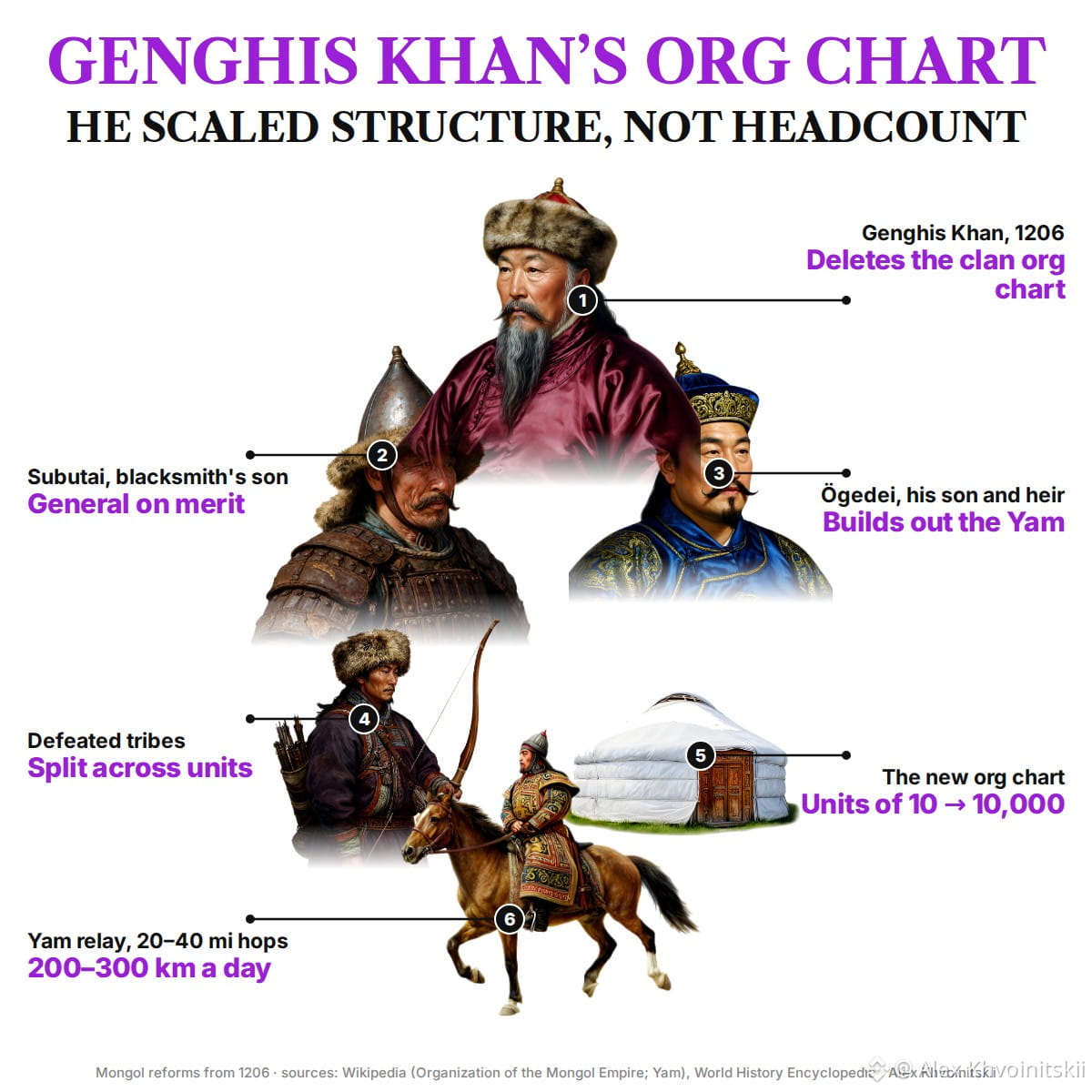
Genghis Khan didn't scale an army. He scaled an org chart.
🏕️ 1206: at the kurultai on the Onon River he replaces tribes and clans with decimal units: 10, 100, 1,000, 10,000.
🔀 Warriors of defeated tribes are dispersed across different units, so no clan can act as a bloc.
⚒️ Promotion by merit and loyalty, not birth. Subutai, a blacksmith's son, later leads campaigns from China to Hungary.
🐎 The Yam: relay stations ~20–40 miles apart, messengers covering 200–300 km a day.
Crypto keeps relearning this. Most DAOs and communities scale by adding holders to a structure built for a group chat: loyalty by "clan", decisions by whoever is loudest, information arriving late. What scales is small accountable units, clear owners and fast, reliable data.
Is your favorite DAO organized like a horde or like a clan?
#History #Crypto #DAO
69
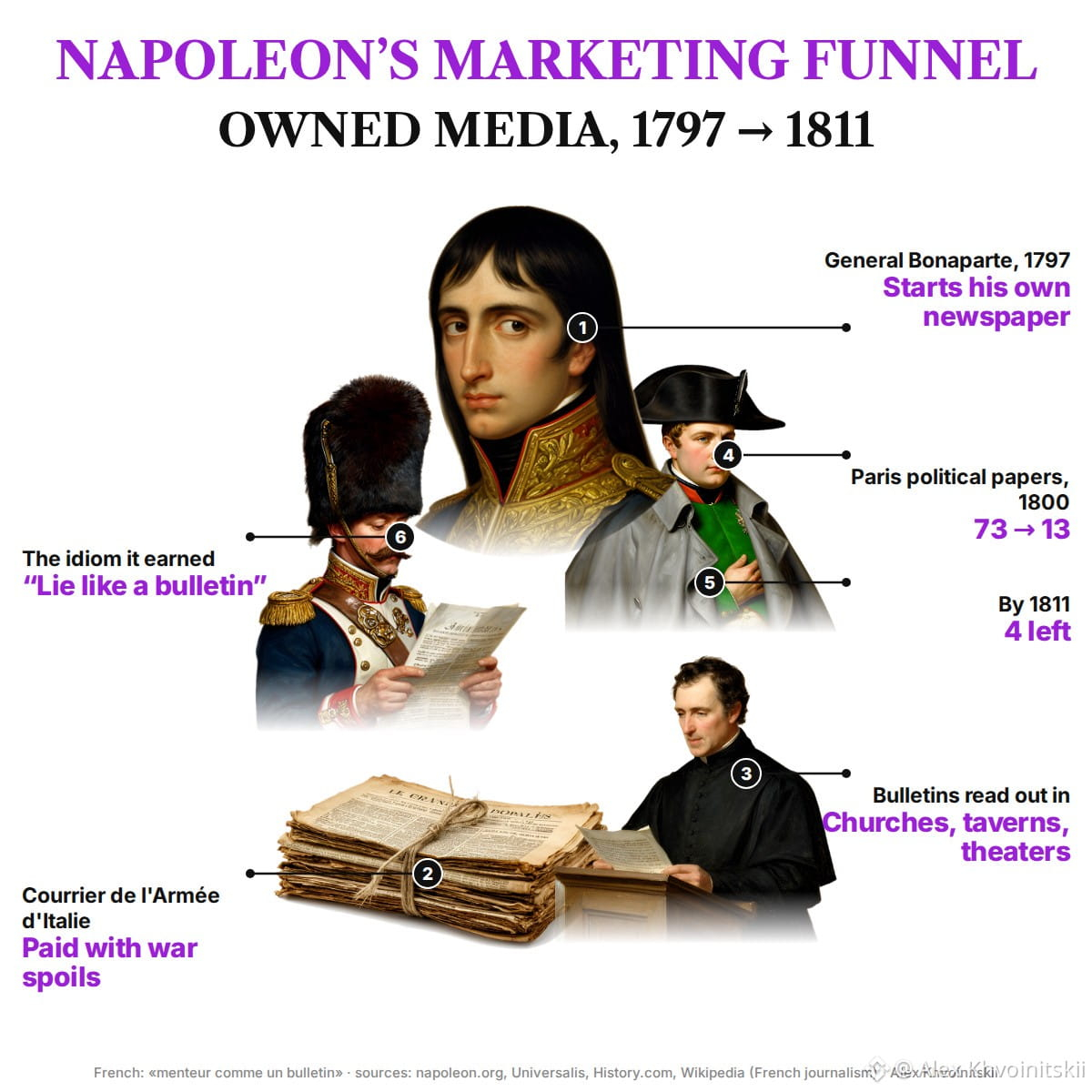
Napoleon ran the first owned-media funnel. And the market priced in the spin.
📰 1797: mid-campaign, Bonaparte launches his own army newspaper in Milan, paid for with war spoils.
📢 The Bulletins of the Grande Armée: posted on walls, read in churches, taverns and theaters.
✂️ 1800: 60 of 73 political papers in Paris shut down. By 1811, four were left.
🤥 Result: "menteur comme un bulletin" (lying like a bulletin) became a French saying.
Crypto has its own bulletins: self-reported reserves, self-reported TVL, self-reported "partnerships". The lesson from 1811 is that controlling the message works until the audience starts applying a discount to every number you publish. That's why verifiable data (on-chain proofs, audited reserves) beats a louder bulletin.
Reach is buyable. Trust isn't. Which metric do you trust least in crypto right now?
#History #Crypto #Marketing
44
Binance just put trader leaderboards in one place: Smart Money, Copy Trading and Shared Trades, plus posters to share your rank.
I spent years building mathematical models of economic processes, so the first thing I look at in any ranking is survivorship. A board sorted by PNL over a short window will always be topped by whoever took the most risk in a lucky week. That is not a flaw of this board, it is how every ranking of noisy returns behaves.
The good news: the FAQ says max drawdown, days active and win rate are on the board too. That is exactly the data you need to separate skill from variance.
How I would read it before copying anyone:
- Return per unit of drawdown, not raw PNL
- Consistency across both the 7D and 30D views, not one spike
- Days active: a long record beats a hot streak
- Position size versus account size, if you can see it
Leaderboards are a great discovery tool. They are a weak selection tool unless you add risk to the picture.
What metric do you check first before following a trader?
#BinanceLeaderboard #CopyTrading $BNB $BTC
74
Everyone asks what AI agents will be able to buy with crypto. The better question is who said they could.
An agent with a wallet is easy. An agent with a mandate is hard: which counterparties, what limits, and a record of why every payment was allowed.
Card networks already do this with tokens that carry their own limits. Onchain, the same idea is a smart account with spending rules, not a hot key pasted into a prompt.
My bet: the first big agent loss will not be a model bug. It will be a key that was allowed to do anything.
Would you give an agent your keys, or only a budget?
#AI #AIAgents #Crypto
83
Tonight MSCI publishes its November index review, and Strategy is on the draft list marked for deletion. The rule targets companies whose assets are mainly held for investment rather than used in an operating business: fail the operating-asset test plus most of the extra financial ratios in two consecutive annual filings, and you are out of the Global Investable Market Indexes, effective at the close of November 30.
What it is not: removal doesn't delist the stock, and nothing in the rules forces Strategy to sell bitcoin. The selling would come from index funds that mirror the index, and JPMorgan's outflow estimate was built on MSCI's earlier proposal. As someone who models economic processes, I see a flow with a known date and a known direction, and markets usually trade that kind of flow before the date, not on it. The bigger question is the funding loop: buying $BTC by issuing stock works best when passive demand for that stock is automatic.
Does an index exclusion change how you look at bitcoin treasury companies? #Strategy #MSCI #BitcoinTreasury $BTC
47
Chile's state copper giant booked copper as produced that wasn't. For anyone investing in Andean mining, that matters more than the copper price.
📌 Codelco has preliminarily identified about 42,100 tonnes of copper improperly recorded in 2024 and 2025 (roughly 24,000 and 18,100). Audits with KPMG and EY are still ongoing.
📌 On October 30 the board dismissed eight executives and professionals from Chuquicamata, Ministro Hales, Salvador and headquarters.
📌 On November 9, executive chairman Bernardo Fontaine told La Tercera they expect around 1.2 million tonnes in 2026 and 2027. Getting back to 1.3 million would take about four years and depends on reactivating El Teniente.
📌 Context: Cochilco projects Chile at 4.935 million tonnes in 2026, 8.4% below 2025 and the lowest level since 2003.
My read, as someone who models economic processes:
1. The copper bottleneck isn't price. It's lower ore grades, projects that don't arrive, and numbers you can trust.
2. For a buyer or an investor, reported production is an asset. If it can't be audited, it gets discounted in the price and in the contract.
3. Bolivia is now debating its new Mining Code, with traceability in the draft. That's the moment to make production data from the state, cooperatives and private operators verifiable from day one, not after a scandal.
Crypto people will recognize the pattern: a balance nobody can verify is worth less than a smaller one you can prove.
What attracts more capital to Andean mining: bigger reserves or auditable production data?
Sources: Emol, Energiminas, Reporte Minero / La Tercera, Cochilco.
#Copper #Mining #Bolivia #LatAm
26
The future of crypto won't be decided by charts. It will be decided at a cash register in a mid-sized city.
Since April 2026, Binance Pay QR works in Bolivia. What I find interesting is how ordinary the use case is: scan, pay, done. No need to explain blockchains to the shop owner.
My opinion: mass adoption looks boring from the inside. It's a payment that works, a clear screen, a receipt. The ideology can come later, or never.
Bolivia is a good test because the pain is real and daily, not theoretical. If a payment rail works there, it can work in many places that global headlines forget.
What small, everyday crypto use have you seen actually working where you live?
#CryptoPayments #BinancePay #Bolivia #Adoption $BNB
61
Antimony just became strategic, and in Potosí people are already fighting over it on the ground.
What happened:
⛏️ On October 30, Bolivia's mining authority AJAM, with police support, found illegal antimony extraction in Jupichaque, Potosí: an excavator loading material and piles of dark grey ore.
📄 According to AJAM, the people working there had no mining rights over the area, which belongs to a legally recognized title holder.
🚧 A group blocked the exit and held officials and police for about six hours. The commission had to withdraw.
🌏 Global context: in November 2025 China suspended its ban on antimony, gallium and germanium exports to the US. That suspension expires on November 27, 2026, and export licenses are still required.
My read:
1. When a mineral gains geopolitical weight, pressure on concessions rises too. Legal certainty stops being a lawyers' topic and becomes price.
2. Serious buyers in the US, Europe or Japan don't just buy antimony. They buy provable origin. A lot from a disputed area won't pass due diligence.
3. That's the opportunity: operators with clean titles, traceability and a working relationship with the authority are worth more than tonnage.
Is Bolivian antimony an entry opportunity today, or a risk that isn't priced in yet?
#Bolivia #CriticalMinerals
59
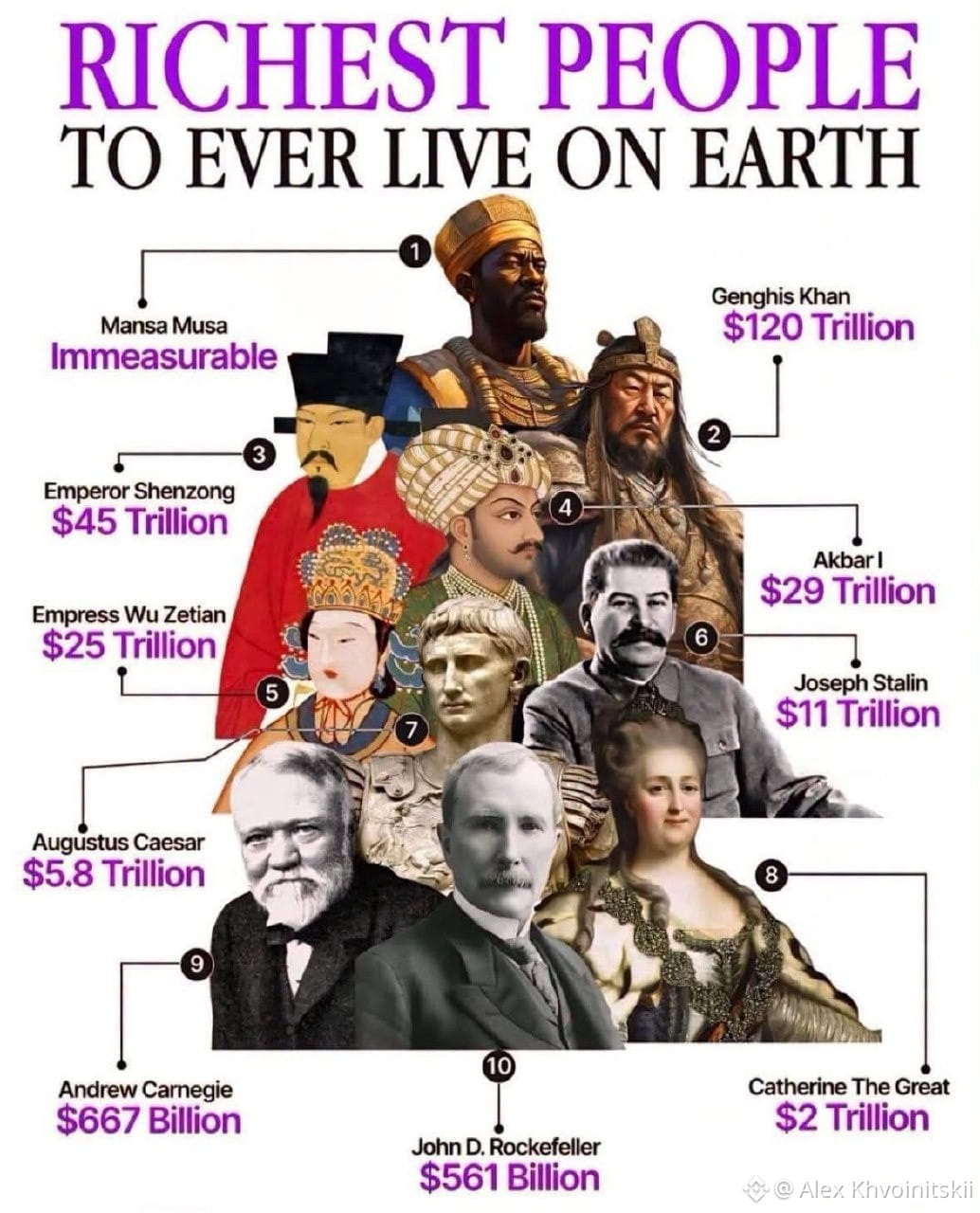
Someone made a ranking of the richest people to ever live, and I have questions.
Genghis Khan: $120 trillion.
Mansa Musa: "immeasurable".
Rockefeller: a modest $561 billion. Poor guy.
I would genuinely love to see the methodology. How do you put a dollar value on owning half of Eurasia? Did someone mark-to-market the steppe? What is the discount rate on a horse army?
The marketing lesson though: a ranking with huge bold numbers and zero methodology beats a careful, sourced chart every single time. "Wait, that can't be right" is the strongest share trigger there is. People don't repost to agree, they repost to argue.
Crypto runs on the same trigger. The charts that spread are rarely the accurate ones.
Who would you add to the list?
#Marketing #History
69
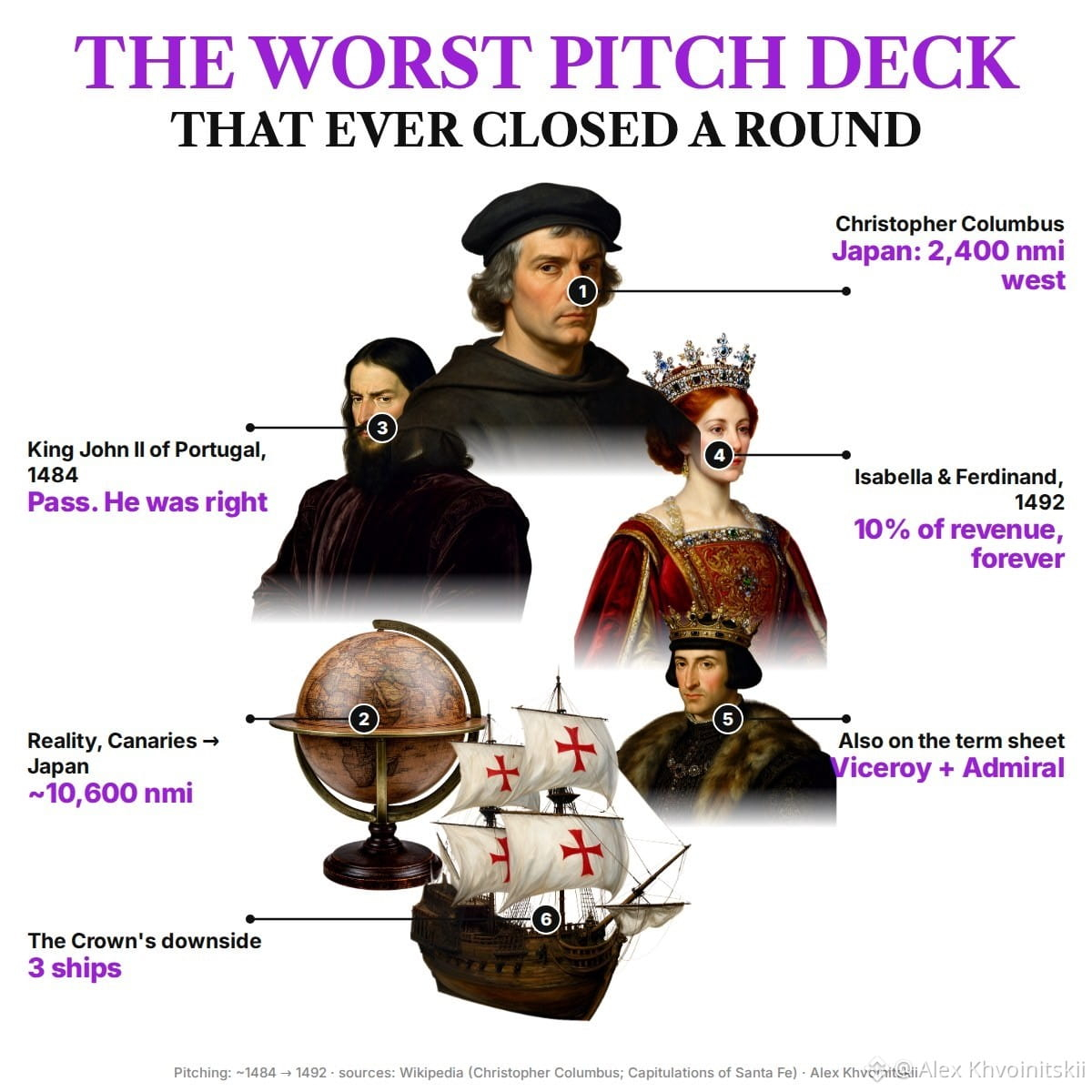
Columbus had the worst pitch deck in history and still closed the round.
📉 His model: Japan ~2,400 nautical miles west of the Canaries. Reality: ~10,600. A 4x error.
🚫 Portugal's experts checked the math around 1484 and passed. They were right.
⏳ ~8 years of pitching later, Spain signed (Santa Fe, April 1492): 10% of all revenues from the new lands in perpetuity + Admiral and Viceroy titles.
⛵ The Crown's exposure: three ships.
He found a continent nobody had in the model.
Crypto runs on the same math. Most early bets are wrong on paper and the analysts are usually right. What matters is position sizing: risk three ships, not the kingdom. Capped downside, open upside.
Would you have backed Columbus, or sided with Portugal's experts?
#History #Startups #Crypto
55
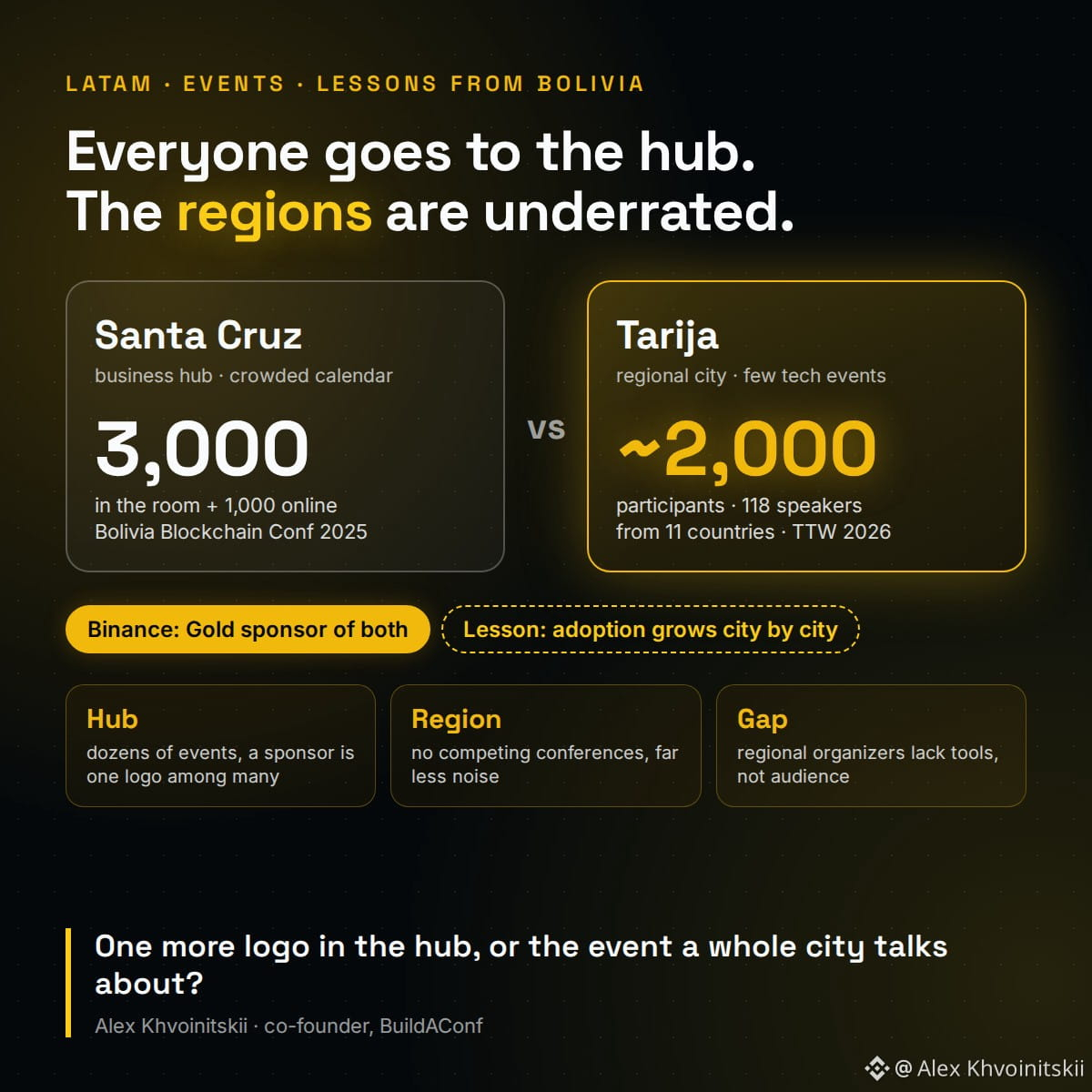
Santa Cruz vs Tarija: what two Binance-sponsored conferences taught me about LatAm
Most event money in Bolivia goes to Santa Cruz, the business center. From what I see, there are dozens of conferences and dozens of sponsors there, and many of the events look alike.
We ran one there too. Bolivia Blockchain Conference 2025: 3,000 people in the room + 1,000 online, with Binance as Gold sponsor. Real scale.
Then Tarija, a regional city where serious tech events rarely happen. Tarija Tech Week 2026: ~2,000 participants, 118 speakers from 11 countries, Binance again as Gold sponsor.
My takeaway: in a hub, a sponsor is one logo among many. In a region with no competing conferences, it's the event the city talks about. Users don't live only in capitals; adoption grows city by city, in rooms where people can ask questions face to face.
Thanks @richardteng @Square-Creator-ee5136e1e9f8 and the Binance team for backing builders outside the usual hubs.
We built buildaconf.com so any organizer can launch a strong conference in any city.
#Binance #LatAm #Bolivia #CryptoAdoption #Web3
Santa Cruz vs Tarija: what two Binance-sponsored conferences taught me about LatAm
Most event money in Bolivia goes to Santa Cruz, the business center. From what I see, there are dozens of conferences and dozens of sponsors there, and many of the events look alike.
We ran one there too. Bolivia Blockchain Conference 2025: 3,000 people in the room + 1,000 online, with Binance as Gold sponsor. Real scale.
Then Tarija, a regional city where serious tech events rarely happen. Tarija Tech Week 2026: ~2,000 participants, 118 speakers from 11 countries, Binance again as Gold sponsor.
My takeaway: in a hub, a sponsor is one logo among many. In a region with no competing conferences, it's the event the city talks about. Users don't live only in capitals; adoption grows city by city, in rooms where people can ask questions face to face.
Thanks @Richard Teng @heyi and the Binance team for backing builders outside the usual hubs.
We built buildaconf.com so any organizer can launch a strong conference in any city.
#Binance #LatAm #Bolivia #CryptoAdoption #Web3
78
UK banks can now apply to do crypto business. The more interesting part is the calendar.
What happened: in its latest wholesale banking supervisory outlook, the FCA says wholesale banks can apply to vary their permissions to add regulated cryptoasset activities. The application window opened on 30 September 2026 and runs to 28 February 2027. The new regime starts on 25 October 2027. Approval is not automatic, and existing permissions don't convert on their own.
My view as someone who models economic processes: this is a queue with a hard deadline. Queues like that rarely fill evenly. Most applications arrive near the cutoff, and that is where review delays pile up. Early filers get the regulator's attention while it is still available.
For users, the real change is not "banks love crypto". It's that crypto services can sit inside regulated balance sheets, with capital and conduct rules attached.
Would you rather hold crypto with a bank or with an exchange?
#UKBanksCanNowApplyToConductCryptoAssetBusiness #CryptoRegulation $BTC
64
Trust in an exchange is built in unglamorous moments, and early November is one of them for Binance.
After the security incident reported on 29 October, withdrawals were reopened in phases from 1 November. Binance also published a proof of reserves snapshot as of 31 October, built with Merkle trees and zk-SNARKs, and said the losses will not be passed on to users.
A proof of reserves is not a full audit, and it doesn't answer every question. But it is a verifiable step, and I think this is the direction the industry should go: less "trust us", more "check it yourself".
I'd like to see regular proofs, clear communication and a full account of what happened. @Yi He, as co-CEO you have a real chance to make transparency the default, not the exception.
Users will judge by actions over the coming months, and that's fair.
#Binance #ProofOfReserves #Transparency #Crypto $BNB
{spot}(BNBUSDT)
Trust in an exchange is built in unglamorous moments, and early November is one of them for Binance.
After the security incident reported on 29 October, withdrawals were reopened in phases from 1 November. Binance also published a proof of reserves snapshot as of 31 October, built with Merkle trees and zk-SNARKs, and said the losses will not be passed on to users.
A proof of reserves is not a full audit, and it doesn't answer every question. But it is a verifiable step, and I think this is the direction the industry should go: less "trust us", more "check it yourself".
I'd like to see regular proofs, clear communication and a full account of what happened. @Yi He, as co-CEO you have a real chance to make transparency the default, not the exception.
Users will judge by actions over the coming months, and that's fair.
#Binance #ProofOfReserves #Transparency #Crypto $BNB
114
Headlines say "MEXC got sanctioned". The primary source says something more specific, and the difference matters for users.
What happened (Nov 6): FinCEN, a bureau of the US Treasury, issued an order under Section 9714 of the Combating Russian Money Laundering Act. Once it takes effect (30 days after publication in the Federal Register), US financial institutions may not send or receive funds transfers involving MEXC Global. Treasury alleges at least $16B in illicit flows through the exchange between May 2021 and May 2026, linked to Iran, North Korea, Russia and cybercrime. These are allegations, not a court ruling.
What it is not: an OFAC designation. The order does not freeze assets and does not ban trading on the platform. MEXC says it is operating normally, reviewing the order, and has launched an independent review of its AML and sanctions controls.
What on-chain data shows (DefiLlama, tracked wallets, excluding MEXC's own MX token): $4.48B on Nov 6, 00:00 UTC vs $4.20B on Nov 8, 17:49 UTC. Part of that is price. Stablecoins alone (USDT + USDC): about $2.00B → $1.84B, roughly −$156M, before the order is even in force.
As someone who models economic processes, I read this as a banking-access shock first and a liquidity question second. What to watch next is fiat on/off-ramps and counterparties, not the headline.
Do you check where your exchange is licensed before you deposit?
#MEXC #FinCEN #CryptoRegulation #CryptoNews $BTC $USDT
73
@heyi respect from a long-time user in LatAm 🙏 honest question, not hate:
users in France, Spain, Italy and Poland are getting emails: accounts close Dec 31, and from Nov 29 a monthly fee of 0.025% or 10 USDC, whichever is higher. For someone holding 50 USDC that's 20% a month.
Closing is MiCA, understood. But why charge the people who are already leaving? A clear "withdraw free until Dec 31" would buy a lot of trust.
And for the rest of us: what's the MiCA timeline? 👀
#Binance #MiCA #CryptoNews
@Yi He respect from a long-time user in LatAm 🙏 honest question, not hate:
users in France, Spain, Italy and Poland are getting emails: accounts close Dec 31, and from Nov 29 a monthly fee of 0.025% or 10 USDC, whichever is higher. For someone holding 50 USDC that's 20% a month.
Closing is MiCA, understood. But why charge the people who are already leaving? A clear "withdraw free until Dec 31" would buy a lot of trust.
And for the rest of us: what's the MiCA timeline? 👀
#Binance #MiCA #CryptoNews
111
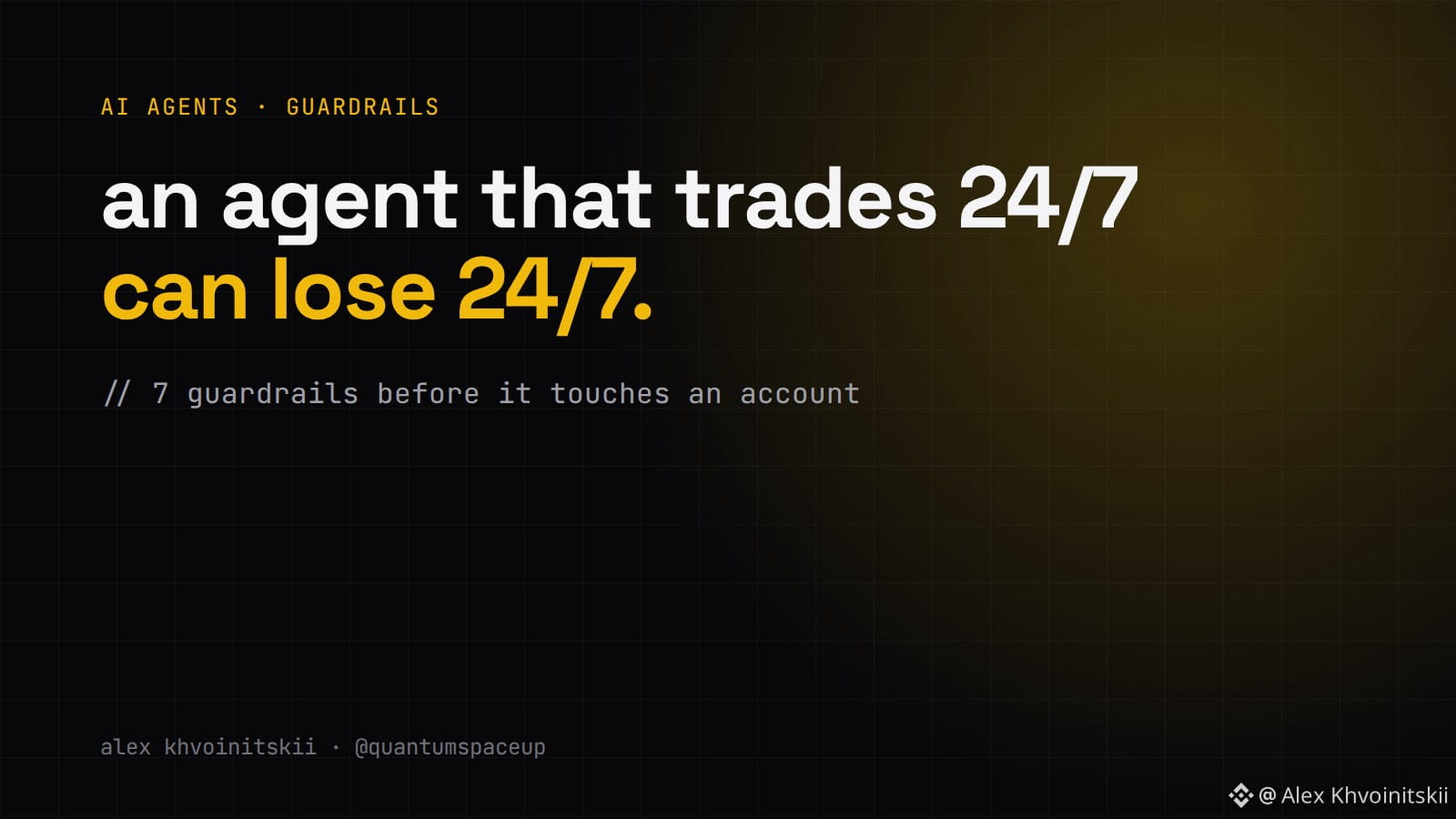
My feed is full of "build a 24/7 AI trading agent" guides this week. I built AI trading bots, and then archived them. No returns here and no signals. Just the guardrails I'd demand before any agent touches a real account.
1. The model never owns the stop-loss. Stops are hardcoded. The AI can say "hold" or "exit", never move the stop.
2. Never trust the model's math. Mine reported risk/reward the trade didn't have. Recompute every number in code and reject anything below your minimum.
3. Watch the prompt. When I pushed the model to "find entries", it signalled on 97.5% of checks. If "wait" isn't a normal answer, it won't wait.
4. Thresholds must match. If the prompt says one confidence level and the code enforces another, you'll get trades just under the bar.
5. Cooldowns. With zero cooldown after a stop, one bot made 66 trades in 16 hours. A short pause killed that loop.
6. Separate the brain from the hands. The model proposes; a plain program validates and executes.
7. Logs for every decision. Without them you can't tell bad luck from a bug.
An agent that can trade 24/7 can also lose 24/7. Limits first, strategy second.
What would you never let an AI decide on its own?
#AI #AIAgents #TradingBots $BTC $BNB
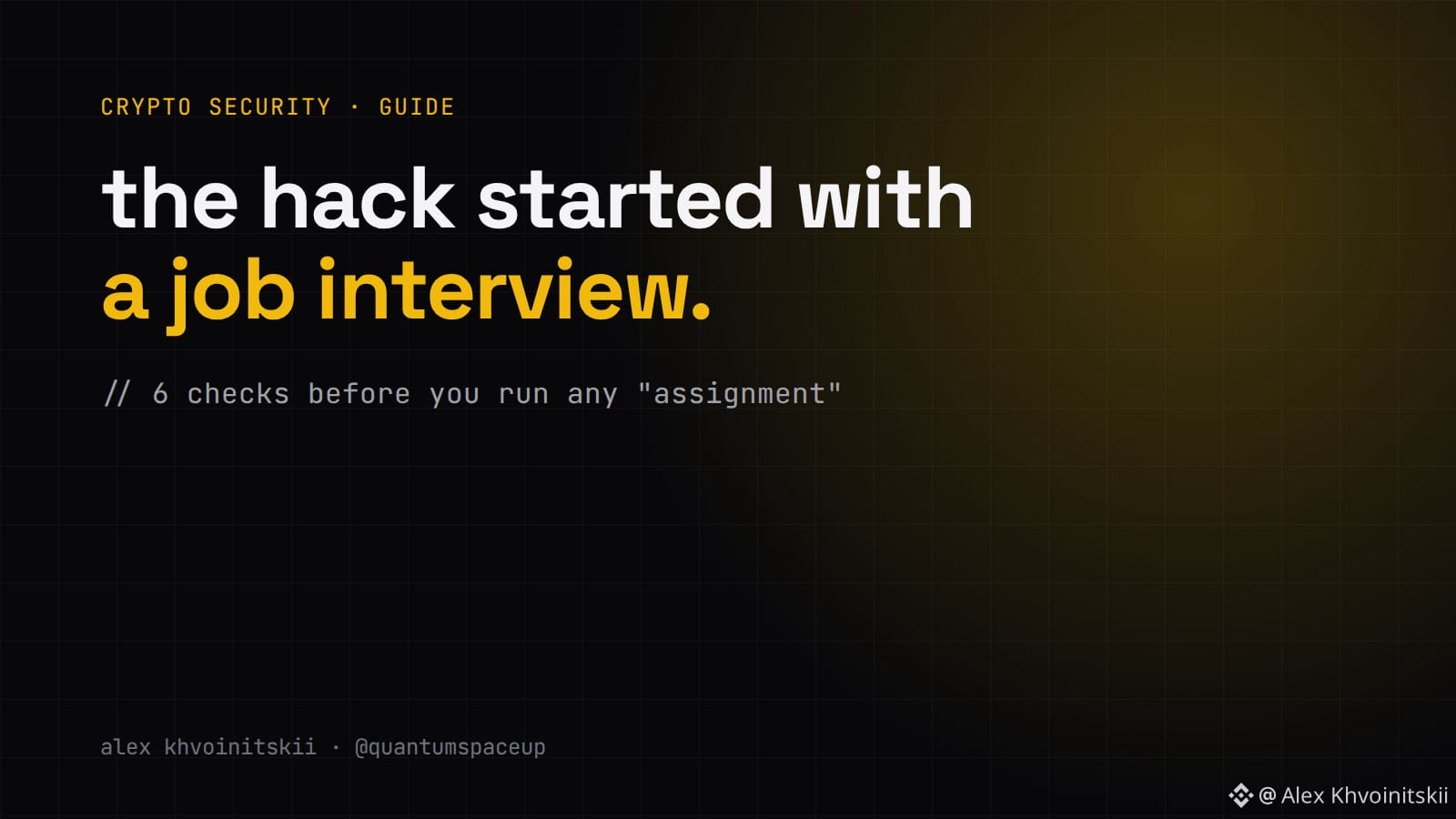
The biggest exchange hack of the year didn't start with code. It started with a job interview.
Binance's initial report on the 29 October incident (published 3 Nov) describes the chain: a fake recruiter on a real job platform, a "CEO" interview in a chat app, and at the end an "assignment" repo to download. Malicious code ran during setup. The report attributes the incident to North Korea-linked actors, per the FBI.
If you work in crypto, or just look for jobs in it, here's the beginner checklist:
1. A real company sends a take-home task as a doc, not as code you must run on your work laptop.
2. Never install or run a test repo on a machine that has wallet, exchange or work access. Use a throwaway VM or nothing.
3. Trust-building is the tell. Personal photos, a friendly HR call, then urgency at the end of the call.
4. Verify the company outside the chat: website, registry, a person you know there.
5. Moving from the job platform into a private chat app is a red flag, not a detail.
6. If you already ran it: disconnect, tell security, rotate every credential from that device.
Binance says its team stopped 57 suspected DPRK-linked cases in 2026. Attackers go after people because people have the keys.
Have you ever received an "assignment" like this?
#CyberSecurity #CryptoSecurity #Binance $BNB $BTC
97
The $6.3B Binance hack is now a stress test, and I'm watching the queue, not the headlines.
Facts so far: roughly $6.3B stolen, the FBI blamed North Korean operatives, Binance said it had replenished 90% of the stolen assets by Oct 31, and withdrawals reopened in phases from Nov 1, starting with the $BTC network. This week a new ZK proof of reserves went live.
As a mathematical modeler of economic processes, I see a bank run as a coordination game: everyone withdraws if they think everyone else will. The only thing that breaks that loop is boring, verifiable evidence that the money is there.
My position: phased reopening plus self-checkable PoR is the right playbook. The real test is not this week. It's whether reserves proofs stay regular when nobody is panicking.
Did you verify your balance, or just read about it?
#Binance #ProofOfReserves #CryptoSecurity $BTC $ETH $BNB
89
I'm a nuclear engineer by training, and one habit from that world never left me: you don't wait for the failure to start designing the safety margin.
That's how I read the quantum computing conversation in crypto. Nobody can honestly say when a machine capable of breaking today's signatures will exist. But migrations take years, so the lead time is the real variable.
What's already concrete: in August 2024 NIST published FIPS 203 (ML-KEM, key exchange), FIPS 204 (ML-DSA) and FIPS 205 (SLH-DSA), the last two being post-quantum signature standards. On the Bitcoin side, BIP-360 is a draft proposal, not an activated upgrade.
My view: the boring work of crypto-agility, meaning the ability to swap signature schemes without drama, will matter more than any single prediction about qubits.
Not a forecast, just engineering instinct. Do you think wallets and exchanges are planning for this early enough?
#Quantum #PostQuantum #Bitcoin #Crypto $BTC
1
216
BBC 2025 × Binance: what a conference outside the capital looks like
In 2025 I co-organized Bolivia Blockchain Conference: 3,000 people in the room and 1,000 online, with Binance as Gold sponsor. In 2026 Tarija Tech Week followed: ~1,500 offline + 500 on stream, 118 speakers from 11 countries, Binance as main sponsor.
What I took from both: adoption in LatAm happens city by city, in rooms where people can ask questions face to face. Binance Pay QR has worked in Bolivia since April 2026, and events are where people first see it used.
Most organizers outside the big hubs don't lack an audience; they lack tools. So we built BuildAConf (buildaconf.com), live since 29.10.2026 in Spanish, English and Portuguese: a platform where any organizer can launch a conference outside the capitals.
Thanks @heyi and the Binance team for backing builders in places most people skip.
#Binance #Bolivia #LatAm #CryptoAdoption #BuildAConf $BNB
BBC 2025 × Binance: what a conference outside the capital looks like
In 2025 I co-organized Bolivia Blockchain Conference: 3,000 people in the room and 1,000 online, with Binance as Gold sponsor. In 2026 Tarija Tech Week followed: ~1,500 offline + 500 on stream, 118 speakers from 11 countries, Binance as main sponsor.
What I took from both: adoption in LatAm happens city by city, in rooms where people can ask questions face to face. Binance Pay QR has worked in Bolivia since April 2026, and events are where people first see it used.
Most organizers outside the big hubs don't lack an audience; they lack tools. So we built BuildAConf (buildaconf.com), live since 29.10.2026 in Spanish, English and Portuguese: a platform where any organizer can launch a conference outside the capitals.
Thanks @Yi He and the Binance team for backing builders in places most people skip.
#Binance #Bolivia #LatAm #CryptoAdoption #BuildAConf $BNB
1
95
තවත් අන්තර්ගතයන් ගවේෂණය කිරීමට ඇතුල් වන්න
Binance චතුරශ්රය හි ගෝලීය ක්රිප්ටෝ පරිශීලකයින් හා එක්වන්න
⚡️ ක්රිප්ටෝ පිළිබඳ නවතම සහ ප්රයෝජනවත් තොරතුරු ලබා ගන්න.
💬 ලොව විශාලතම ක්රිප්ටෝ හුවමාරුව මගින් විශ්වාස කෙරේ.
👍 සත්යායනය කරන ලද නිර්මාණකරුවන්ගෙන් සැබෑ විදසුන් සොයා ගන්න.
විද්යුත් තැපෑල / දුරකථන අංකය
නැගී එන මාතෘකා
WhatWillDriveCryptoandStocks’NextRebound?
7,612 නැරඹීම්
176 සාකච්ඡා කරමින්
Bitcoin Slips Below $70,000 as Dollar Index Hits 19-Month High
Binance News
·8 කැමත්ත දැක්වීම්
·11.1k නැරඹීම්
Anthropic’s6xIPODemandSignalsPotentialRecordRaise
2,503 නැරඹීම්
80 සාකච්ඡා කරමින්
HuangExitNvidiaStrategyInFocus
142,758 නැරඹීම්
1,389 සාකච්ඡා කරමින්