
Petrex Tips
133 පෝස්ටු

Petrex Tips
Crypto enthusiasts ||
21 හඹා යමින්
73 හඹා යන්නන්
161 කැමති විය
පෝස්ටු
සියල්ල
උපුටා දැක්වීම්
one of the biggest risks in DeFi isn't just a bad price. it's who controls that price.
with a fixed-rate oracle, if the multisig controlling the feed fails to update after an asset takes losses, DeFi protocols can continue treating impaired collateral as if nothing happened. that can allow borrowing against a valuation that no longer reflects reality.
this is why oracle design matters.
DIA takes a different approach: data is sourced directly, submitted to Lasernet, and processed onchain through transparent, auditable smart contracts rather than relying on an opaque price-setting process. (diadata.org)
for lending markets especially, verifiable pricing isn't just better data infrastructure. it's part of the risk management layer.
#Dia
with a fixed-rate oracle, if the multisig controlling the feed fails to update after an asset takes losses, DeFi protocols can continue treating impaired collateral as if nothing happened. that can allow borrowing against a valuation that no longer reflects reality.
this is why oracle design matters.
DIA takes a different approach: data is sourced directly, submitted to Lasernet, and processed onchain through transparent, auditable smart contracts rather than relying on an opaque price-setting process. (diadata.org)
for lending markets especially, verifiable pricing isn't just better data infrastructure. it's part of the risk management layer.
#Dia
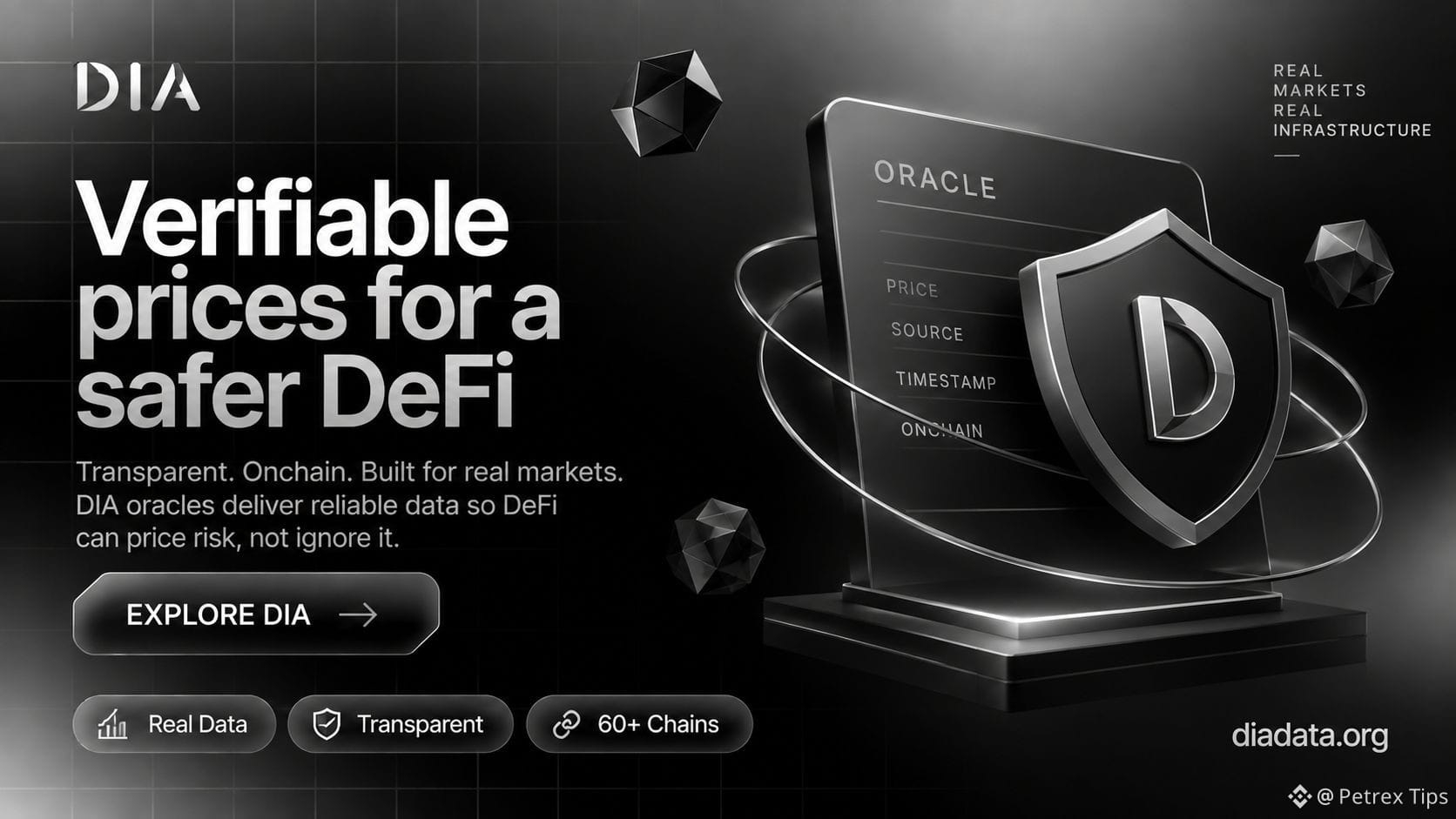
this is a smart move because good infrastructure still has a developer experience problem if integrating it requires constantly digging through documentation.
connecting DIA Docs to MCP-enabled LLMs reduces that friction. developers can move from “how does this work?” to “how do i implement this?” much faster without leaving their AI workflow.
the bigger opportunity imo is making oracle infrastructure increasingly AI-native, where AI agents can understand the documentation and help developers build around verifiable onchain data more efficiently.
connecting DIA Docs to MCP-enabled LLMs reduces that friction. developers can move from “how does this work?” to “how do i implement this?” much faster without leaving their AI workflow.
the bigger opportunity imo is making oracle infrastructure increasingly AI-native, where AI agents can understand the documentation and help developers build around verifiable onchain data more efficiently.
one interesting thing about oracle pricing is that market price isn't always the right price.
Vetro has two assets, VUSD and sVUSD, and DIA prices each based on what actually determines its value.
VUSD is backed by a basket of USDC, USDT and frxUSD, so DIA's fundamental feed calculates its value from the treasury reserves relative to supply, capped at its $1 target.
sVUSD is different. it's an ERC-4626 yield vault, so DIA reads its price per share directly from the vault contract using total underlying assets relative to total shares. its value increases as yield is distributed.
why does this matter?
both assets trade in relatively thin markets. using the last few trades to determine their value could produce a price that doesn't accurately represent what's backing them. that's particularly important for sVUSD because it has a 7-day withdrawal cooldown.
DIA's approach is basically:
price the asset from what fundamentally gives it value, not simply from where it last traded.
for DeFi lending and collateral, that's an important distinction between market pricing and fundamental pricing.
Vetro has two assets, VUSD and sVUSD, and DIA prices each based on what actually determines its value.
VUSD is backed by a basket of USDC, USDT and frxUSD, so DIA's fundamental feed calculates its value from the treasury reserves relative to supply, capped at its $1 target.
sVUSD is different. it's an ERC-4626 yield vault, so DIA reads its price per share directly from the vault contract using total underlying assets relative to total shares. its value increases as yield is distributed.
why does this matter?
both assets trade in relatively thin markets. using the last few trades to determine their value could produce a price that doesn't accurately represent what's backing them. that's particularly important for sVUSD because it has a 7-day withdrawal cooldown.
DIA's approach is basically:
price the asset from what fundamentally gives it value, not simply from where it last traded.
for DeFi lending and collateral, that's an important distinction between market pricing and fundamental pricing.
the tweet is strong overall, but one thing i’d improve is specificity.
it explains what DIA provides for RWAs, but not enough about why verifiability becomes difficult with RWAs in particular. unlike crypto-native assets, a lot of RWA information originates offchain, so putting that data onchain doesn’t automatically make the underlying information trustworthy.
adding a concrete example—such as proving a tokenized fund’s NAV or verifying that reserves actually back a stablecoin—would make the argument more tangible.
also, “better assets need better data” sounds good, but “better assets” is slightly vague. something like “as more assets move onchain, the infrastructure verifying their data becomes just as important as the tokenization itself” would reinforce the main thesis more clearly.
it explains what DIA provides for RWAs, but not enough about why verifiability becomes difficult with RWAs in particular. unlike crypto-native assets, a lot of RWA information originates offchain, so putting that data onchain doesn’t automatically make the underlying information trustworthy.
adding a concrete example—such as proving a tokenized fund’s NAV or verifying that reserves actually back a stablecoin—would make the argument more tangible.
also, “better assets need better data” sounds good, but “better assets” is slightly vague. something like “as more assets move onchain, the infrastructure verifying their data becomes just as important as the tokenization itself” would reinforce the main thesis more clearly.
this is the part of DIA i think is easy to underestimate.
as onchain finance expands beyond crypto-native assets into RWAs, stablecoins and more complex financial products, the demand for reliable data expands with it.
the opportunity isn't just providing another price feed.
it's becoming the data infrastructure that applications can build around, customize and verify.
as onchain finance expands beyond crypto-native assets into RWAs, stablecoins and more complex financial products, the demand for reliable data expands with it.
the opportunity isn't just providing another price feed.
it's becoming the data infrastructure that applications can build around, customize and verify.
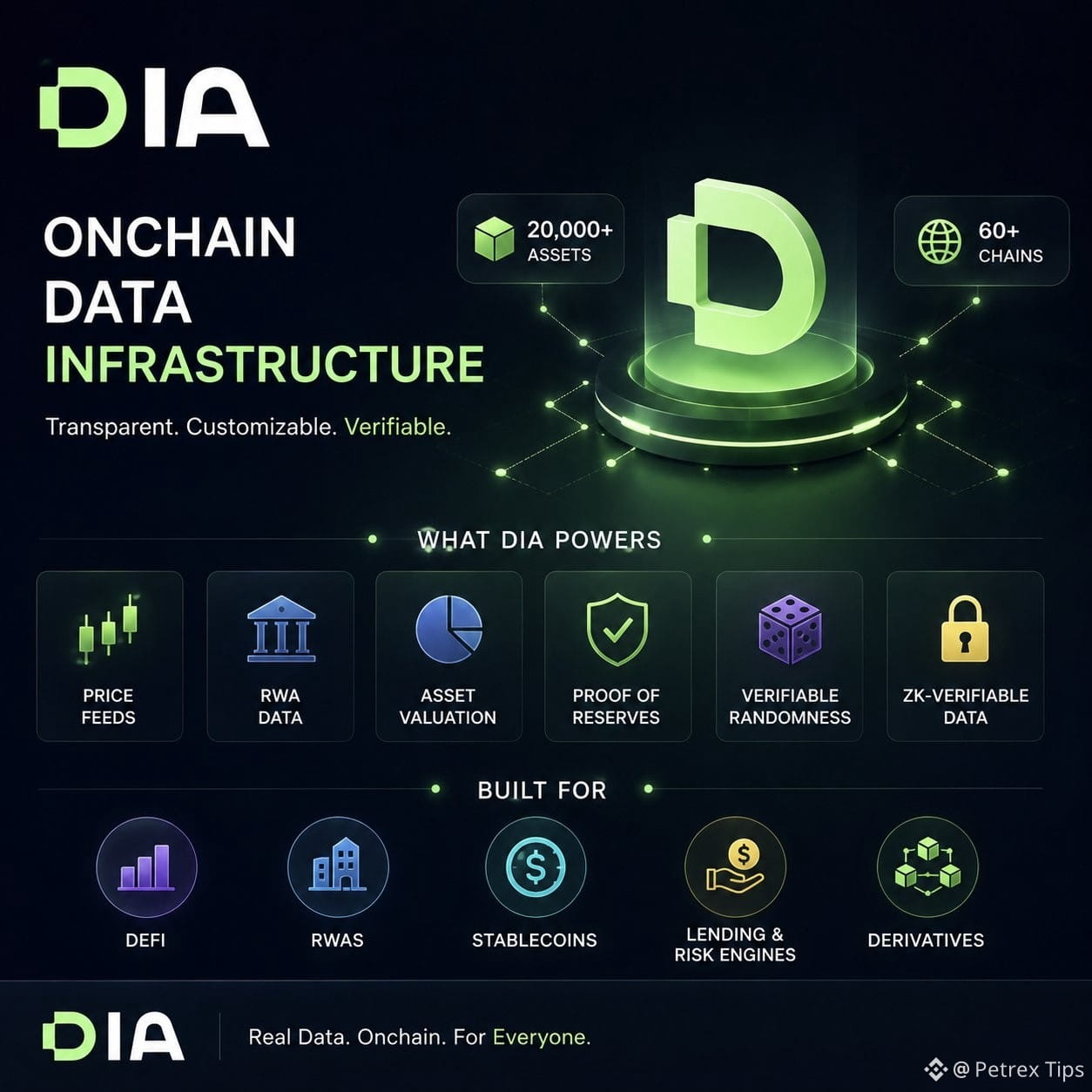
I wonder the direction the market will go for the last quarter of the year.
I've got my eyes on $DIA, $HYPE, and $SOL.
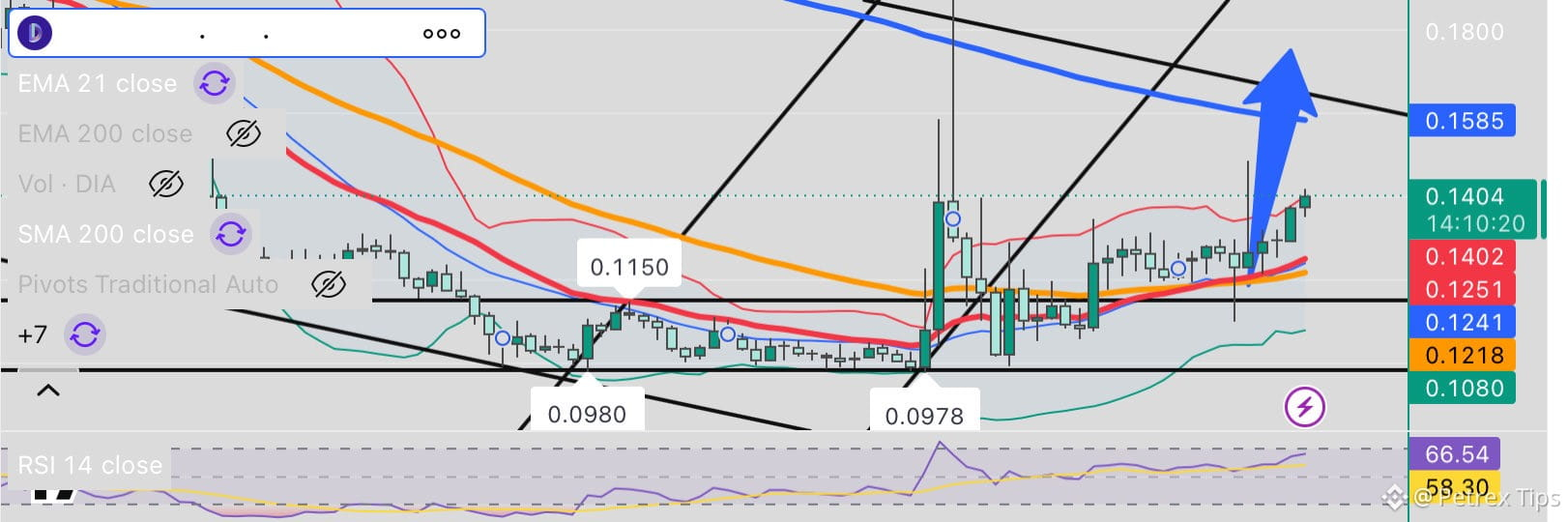
Here is a short update on $DIA
DIA continues to trade above the 21 EMA and 50 EMA, keeping the short-term structure bullish.
support sits around $0.134 → $0.128, while resistance is at $0.149 → $0.155.
RSI is around 55, suggesting neutral-to-bullish momentum.
a clean breakout above $0.155 could open the move toward $0.20 → $0.24. a drop below $0.128 would weaken the current setup.
for now, bullish bias remains intact imo.
NAFA
I've got my eyes on $DIA, $HYPE, and $SOL.
Here is a short update on $DIA
DIA continues to trade above the 21 EMA and 50 EMA, keeping the short-term structure bullish.
support sits around $0.134 → $0.128, while resistance is at $0.149 → $0.155.
RSI is around 55, suggesting neutral-to-bullish momentum.
a clean breakout above $0.155 could open the move toward $0.20 → $0.24. a drop below $0.128 would weaken the current setup.
for now, bullish bias remains intact imo.
NAFA
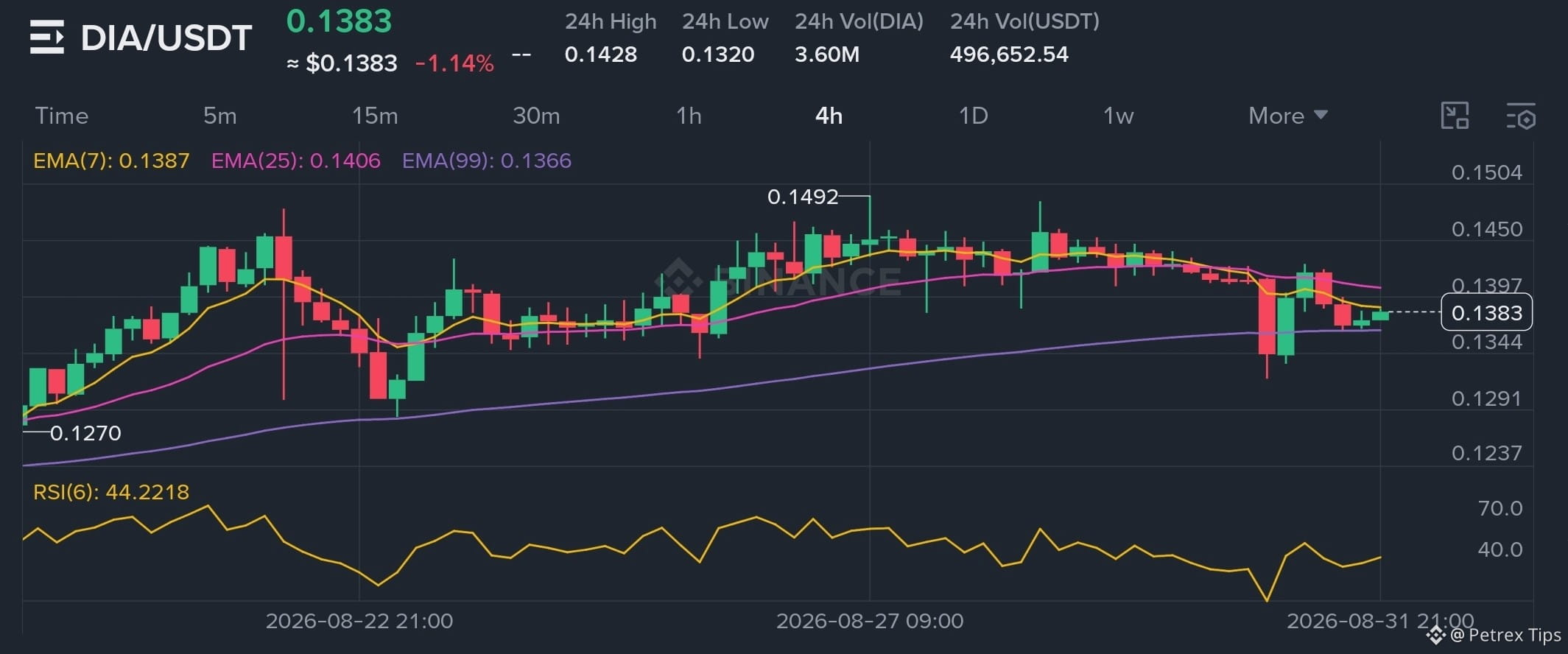
Why does fundamental valuation matter?
Not every asset has a liquid market.
A tokenized Treasury might represent government securities but have almost no secondary trading.
A fund token might represent a portfolio whose NAV is calculated from its underlying holdings.
A liquid staking token might derive its value from the amount of ETH redeemable through its protocol.
In these cases, looking at the last trade alone tells an incomplete story.
@DIAdata_org Value looks underneath the token.
$DIA
Not every asset has a liquid market.
A tokenized Treasury might represent government securities but have almost no secondary trading.
A fund token might represent a portfolio whose NAV is calculated from its underlying holdings.
A liquid staking token might derive its value from the amount of ETH redeemable through its protocol.
In these cases, looking at the last trade alone tells an incomplete story.
@DIAdata_org Value looks underneath the token.
$DIA
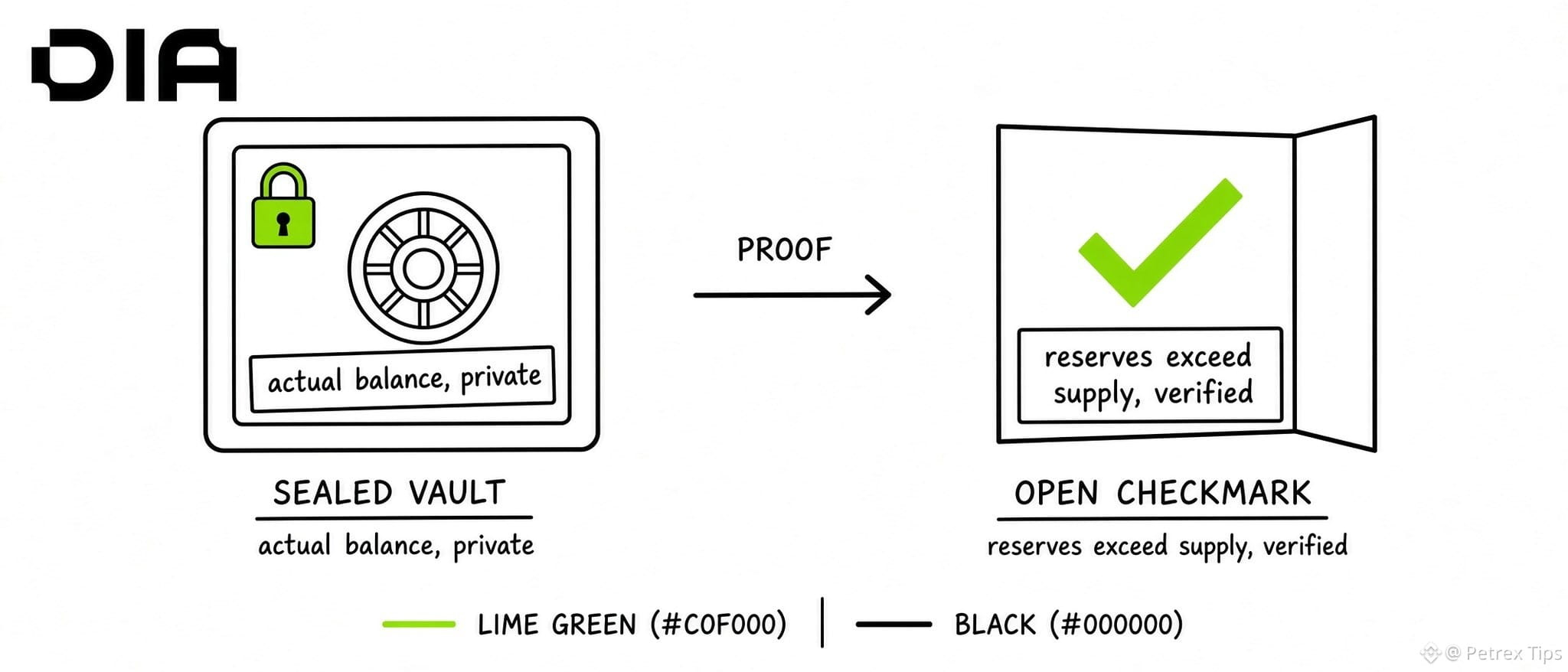
proving reserves doesn't have to mean exposing everything behind them.
DIA ZK can prove what actually matters, like reserves being greater than supply, without revealing the underlying balances.
the proof is verified onchain rather than depending solely on the word of a single verification provider.
for institutions, privacy-preserving proof of reserves could make transparency much easier to adopt without sacrificing sensitive financial information.
#bitcoin
DIA ZK can prove what actually matters, like reserves being greater than supply, without revealing the underlying balances.
the proof is verified onchain rather than depending solely on the word of a single verification provider.
for institutions, privacy-preserving proof of reserves could make transparency much easier to adopt without sacrificing sensitive financial information.
#bitcoin
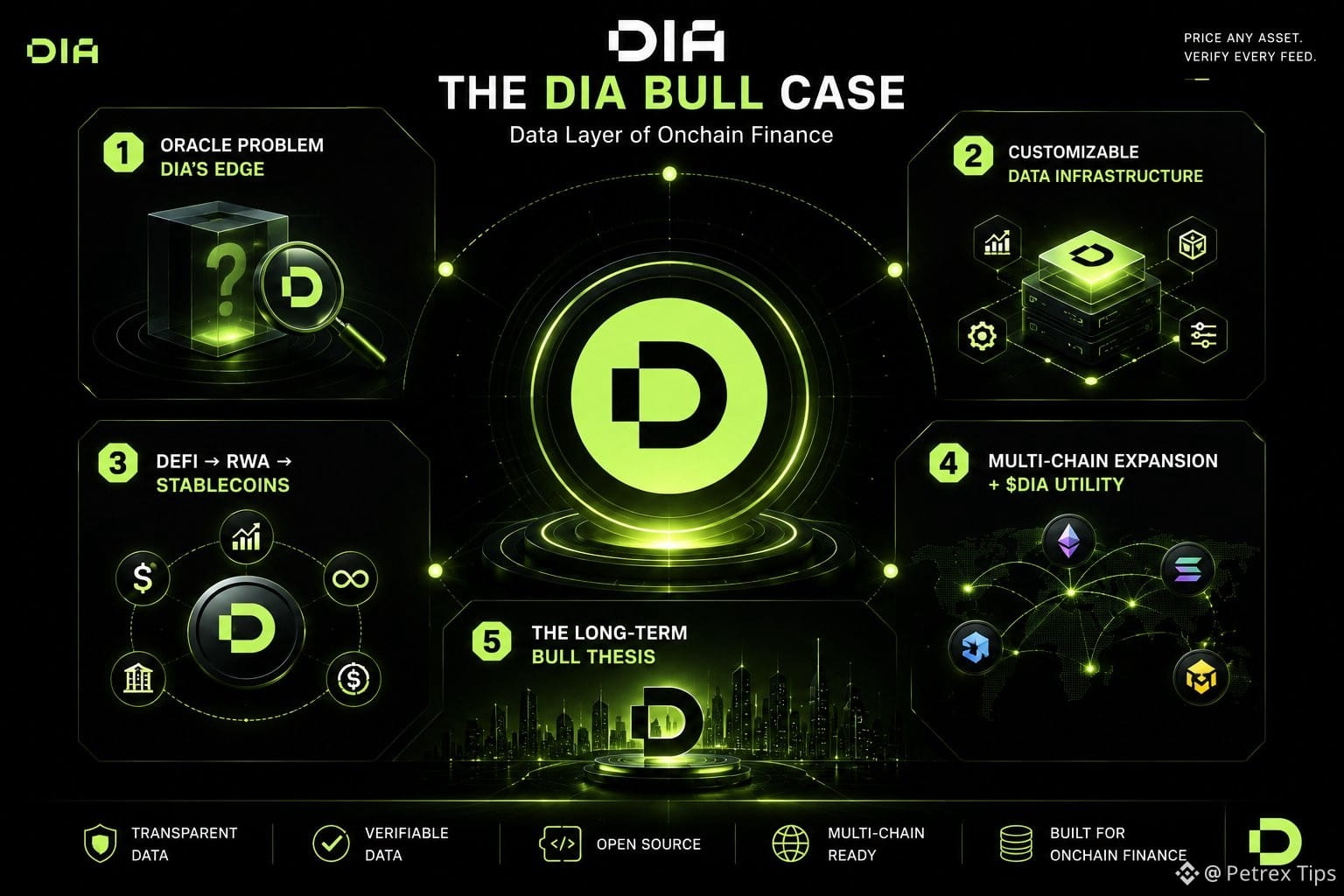
i think the strongest part of this bull case is that it looks beyond DIA as simply another price oracle.
the bigger opportunity is becoming a data infrastructure layer for onchain finance. as DeFi expands into stablecoins, RWAs, tokenized assets and more complex financial products, the type of data these applications need becomes broader and more specialized.
that makes DIA's focus on transparent sourcing, customizable oracle infrastructure and multichain delivery particularly interesting.
if onchain finance keeps growing, the demand won't just be for more data. it will be for data that applications can actually trace, verify and customize around their own requirements.
that's where i think the DIA thesis becomes much bigger than price feeds.
the bigger opportunity is becoming a data infrastructure layer for onchain finance. as DeFi expands into stablecoins, RWAs, tokenized assets and more complex financial products, the type of data these applications need becomes broader and more specialized.
that makes DIA's focus on transparent sourcing, customizable oracle infrastructure and multichain delivery particularly interesting.
if onchain finance keeps growing, the demand won't just be for more data. it will be for data that applications can actually trace, verify and customize around their own requirements.
that's where i think the DIA thesis becomes much bigger than price feeds.
a price feed isn't much use as oracle infrastructure if it stays on just one chain.
once DIA computes a feed on Lasernet, that data still needs to reach the networks where protocols are actually built, including Ethereum, Base and Arbitrum.
Spectra handles that cross-chain delivery.
once DIA computes a feed on Lasernet, that data still needs to reach the networks where protocols are actually built, including Ethereum, Base and Arbitrum.
Spectra handles that cross-chain delivery.
why is $DIA worth paying attention to?
here are 5 reasons:
1. transparent data
DIA sources first-party data from 100+ sources instead of depending on opaque data feeds.
2. infrastructure built for DeFi
lending markets, perps, stablecoins, vaults, RWAs and tokenized assets all depend on reliable data.
3. multichain infrastructure
DIA already supports 250+ dApps across 60+ blockchain networks.
4. more than traditional price feeds
DIA is expanding into fundamental data, Proof of Reserves and DIA ZK, bringing verifiable offchain data onchain.
5. growing ecosystem adoption
integrations with TeQoin, Folks Finance and ST0x show DIA's infrastructure expanding further across DeFi and tokenized assets.
the bigger picture is simple:
DeFi can't scale on unreliable data.
DIA is building the verifiable data infrastructure underneath it.
here are 5 reasons:
1. transparent data
DIA sources first-party data from 100+ sources instead of depending on opaque data feeds.
2. infrastructure built for DeFi
lending markets, perps, stablecoins, vaults, RWAs and tokenized assets all depend on reliable data.
3. multichain infrastructure
DIA already supports 250+ dApps across 60+ blockchain networks.
4. more than traditional price feeds
DIA is expanding into fundamental data, Proof of Reserves and DIA ZK, bringing verifiable offchain data onchain.
5. growing ecosystem adoption
integrations with TeQoin, Folks Finance and ST0x show DIA's infrastructure expanding further across DeFi and tokenized assets.
the bigger picture is simple:
DeFi can't scale on unreliable data.
DIA is building the verifiable data infrastructure underneath it.
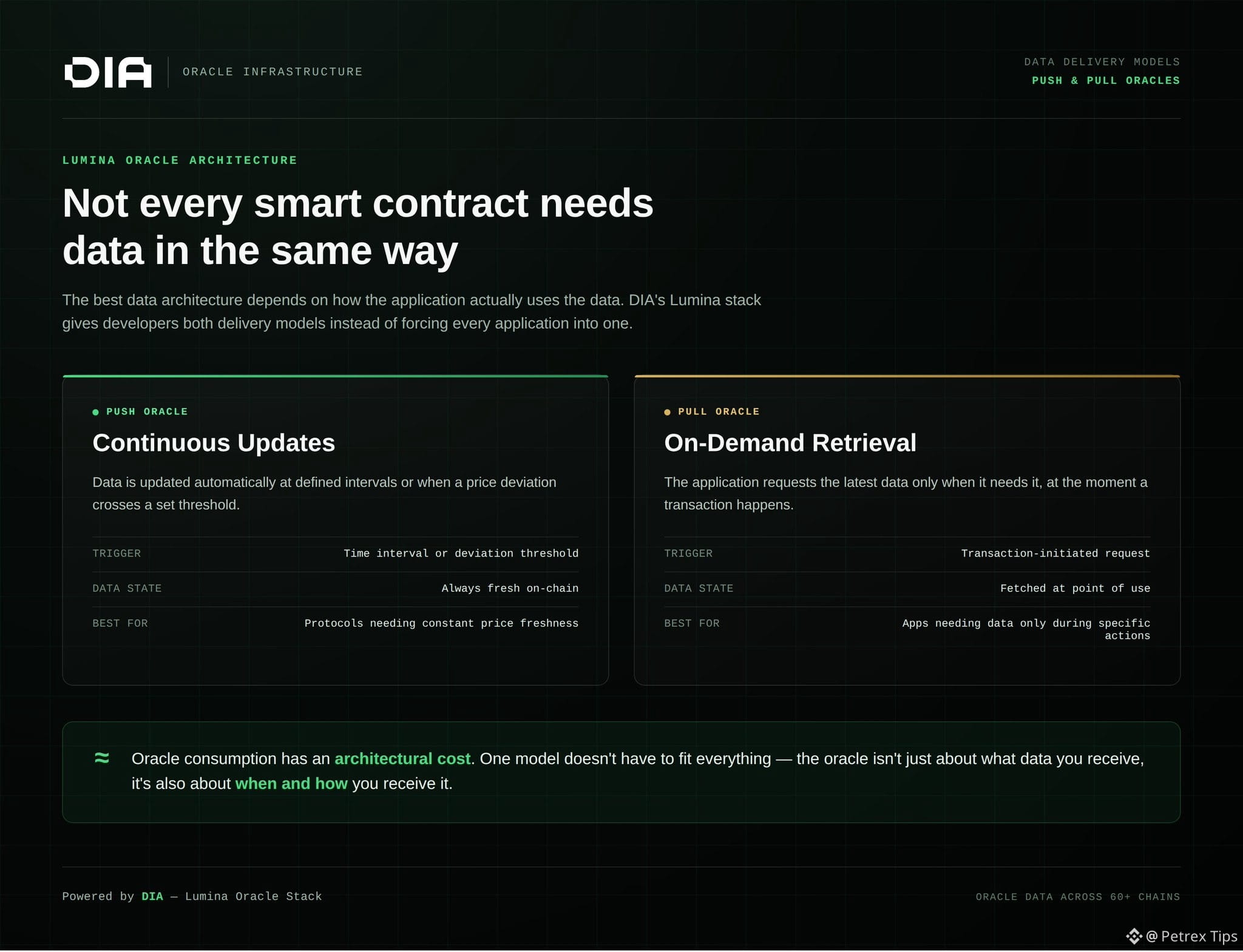
not every application needs oracle data delivered the same way.
DIA supports two models:
push oracles automatically update data at set intervals or when a defined price deviation is reached.
pull oracles provide the latest data only when an application requests it.
the difference matters because data delivery comes with architectural costs. protocols that constantly need fresh prices may benefit from push updates, while applications that only need data for specific transactions can use pull oracles.
the point is simple: oracle infrastructure shouldn't be one-size-fits-all.
DIA's Lumina stack gives developers flexibility over not just what data they use, but also when and how that data reaches their application.
DIA supports two models:
push oracles automatically update data at set intervals or when a defined price deviation is reached.
pull oracles provide the latest data only when an application requests it.
the difference matters because data delivery comes with architectural costs. protocols that constantly need fresh prices may benefit from push updates, while applications that only need data for specific transactions can use pull oracles.
the point is simple: oracle infrastructure shouldn't be one-size-fits-all.
DIA's Lumina stack gives developers flexibility over not just what data they use, but also when and how that data reaches their application.
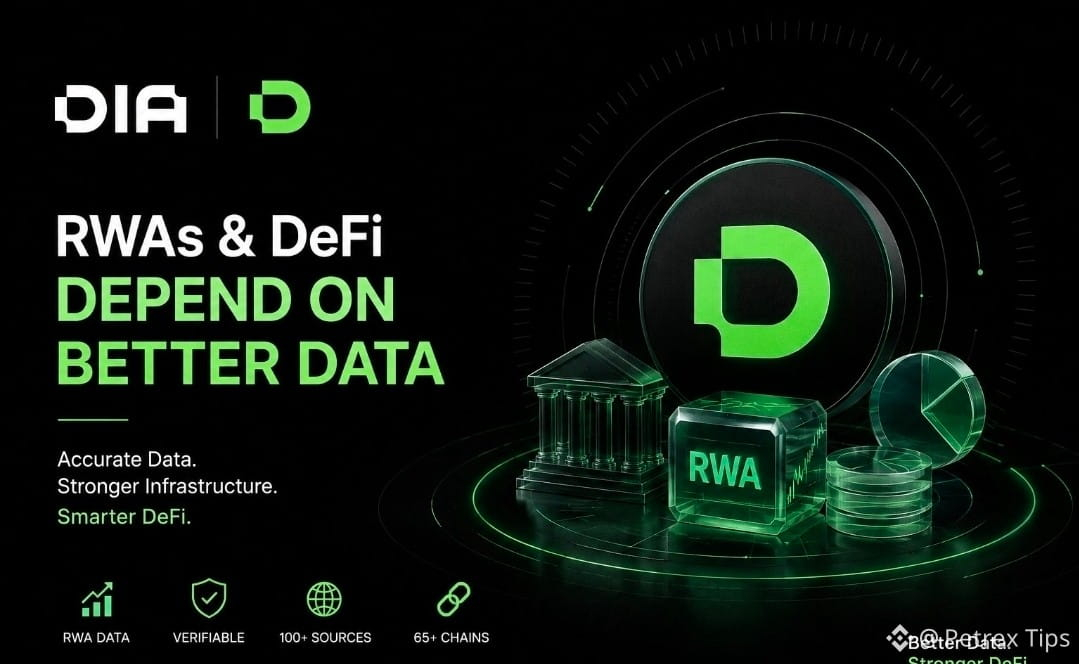
DeFi’s next phase isn’t just about adding more liquidity.
it’s also about improving the data everything runs on.
lending markets, stablecoins, perps, vaults and tokenized assets all rely on external information like prices, collateral values, NAVs, reserves and market conditions.
when that data is unreliable, the applications using it inherit the same risk.
this is where @DIAdata_org comes in.
DIA is building a verifiable oracle infrastructure that sources data first-hand, processes it through transparent pipelines and delivers it onchain.
and the data layer keeps expanding across:
• crypto price feeds
• RWA data
• fundamental feeds
• proof of reserves
• fair-value pricing
• verifiable ZK data
• randomness
as DeFi expands across more assets, chains and real-world markets, reliable data infrastructure becomes even more important.
trustless execution still needs trustworthy data.
that’s the role DIA is building for.
BTCReaches$80000
it’s also about improving the data everything runs on.
lending markets, stablecoins, perps, vaults and tokenized assets all rely on external information like prices, collateral values, NAVs, reserves and market conditions.
when that data is unreliable, the applications using it inherit the same risk.
this is where @DIAdata_org comes in.
DIA is building a verifiable oracle infrastructure that sources data first-hand, processes it through transparent pipelines and delivers it onchain.
and the data layer keeps expanding across:
• crypto price feeds
• RWA data
• fundamental feeds
• proof of reserves
• fair-value pricing
• verifiable ZK data
• randomness
as DeFi expands across more assets, chains and real-world markets, reliable data infrastructure becomes even more important.
trustless execution still needs trustworthy data.
that’s the role DIA is building for.
BTCReaches$80000
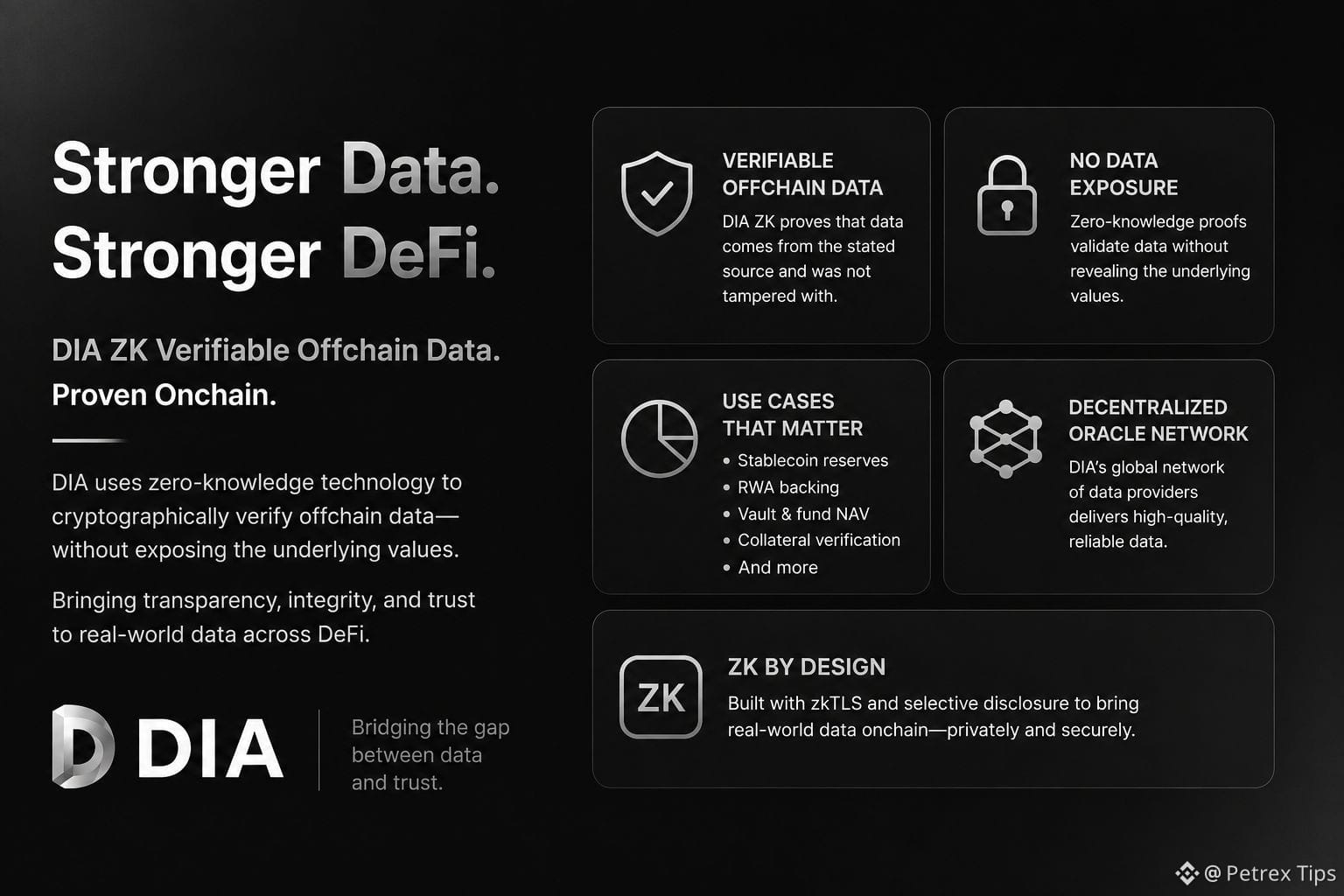
lot of DeFi assets live onchain, but the information backing them doesn't.
stablecoin reserves, RWA backing, fund NAVs and vault collateral can all sit offchain, leaving protocols dependent on information they can't independently verify.
@DIAdata_org ZK is built to close that gap.
using zkTLS, DIA ZK can cryptographically prove that offchain data came from the stated source and wasn't altered before reaching onchain applications.
Selective disclosure takes this further by allowing protocols to verify a condition without exposing the underlying numbers.
for example, instead of revealing the exact reserve balance of a stablecoin, an issuer can simply prove that reserves exceed supply. the same model can be applied to collateral ratios, treasury balances, NAVs and liquidity thresholds.
this gives stablecoins, RWAs, vaults, lending markets and derivatives a way to use offchain data that is source-authenticated, privacy-preserving and verifiable onchain.
that's essentially the idea behind DIA ZK: prove what matters without revealing everything.
stablecoin reserves, RWA backing, fund NAVs and vault collateral can all sit offchain, leaving protocols dependent on information they can't independently verify.
@DIAdata_org ZK is built to close that gap.
using zkTLS, DIA ZK can cryptographically prove that offchain data came from the stated source and wasn't altered before reaching onchain applications.
Selective disclosure takes this further by allowing protocols to verify a condition without exposing the underlying numbers.
for example, instead of revealing the exact reserve balance of a stablecoin, an issuer can simply prove that reserves exceed supply. the same model can be applied to collateral ratios, treasury balances, NAVs and liquidity thresholds.
this gives stablecoins, RWAs, vaults, lending markets and derivatives a way to use offchain data that is source-authenticated, privacy-preserving and verifiable onchain.
that's essentially the idea behind DIA ZK: prove what matters without revealing everything.
The market has been looking super bullish so far this week.
I've got a few tokens on my radar. $DIA and $HYPE has seen over 40% this week and still on the rise
$HYPE easily went from $55 to above $70, with $80 insight due to is bullish community and recent integrations
Then we have $DIA that has been steadily climbing this month. Amidst the previous bearish market, @DIAdata_org community sentiments have been ever bullish.
You should get DIA today, but as usual, this isn't a financial advice.
Trade carefully 💯
I've got a few tokens on my radar. $DIA and $HYPE has seen over 40% this week and still on the rise
$HYPE easily went from $55 to above $70, with $80 insight due to is bullish community and recent integrations
Then we have $DIA that has been steadily climbing this month. Amidst the previous bearish market, @DIAdata_org community sentiments have been ever bullish.
You should get DIA today, but as usual, this isn't a financial advice.
Trade carefully 💯
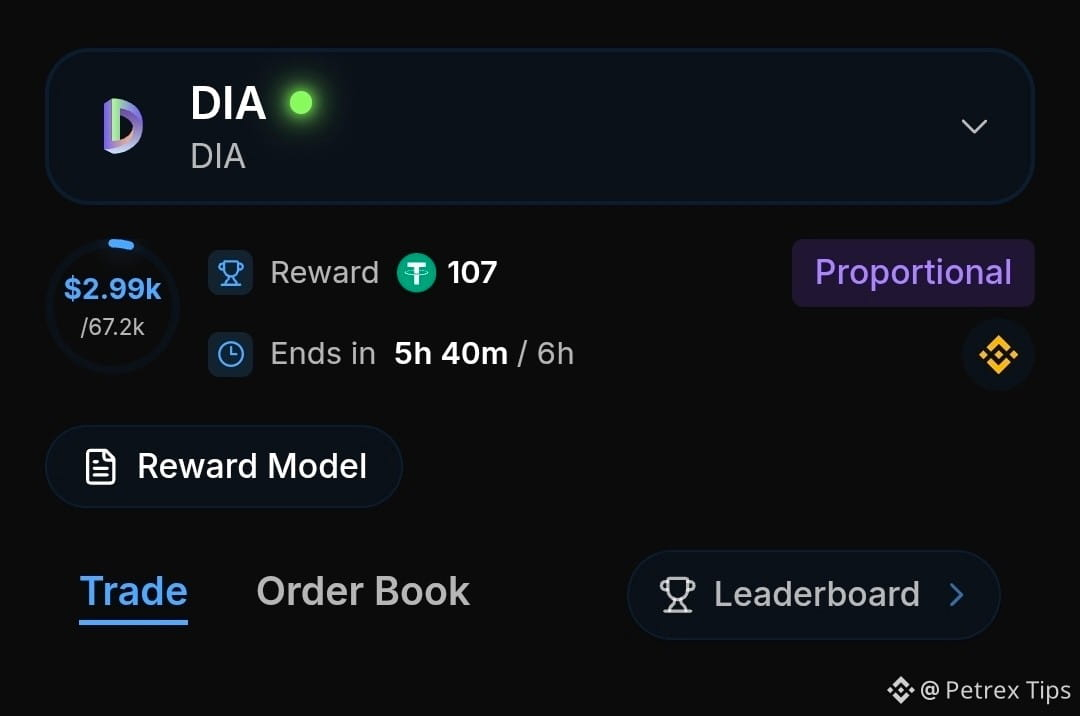
we're officially halfway through the $DIA Trading Competition on @cedehub!
📊 1,000+ participating traders
💸 $5.16M+ $DIA traded
🏆 $12,000 in prizes
we're only halfway there, and there's still $12k left in rewards to win
join the competition👇
📊 1,000+ participating traders
💸 $5.16M+ $DIA traded
🏆 $12,000 in prizes
we're only halfway there, and there's still $12k left in rewards to win
join the competition👇
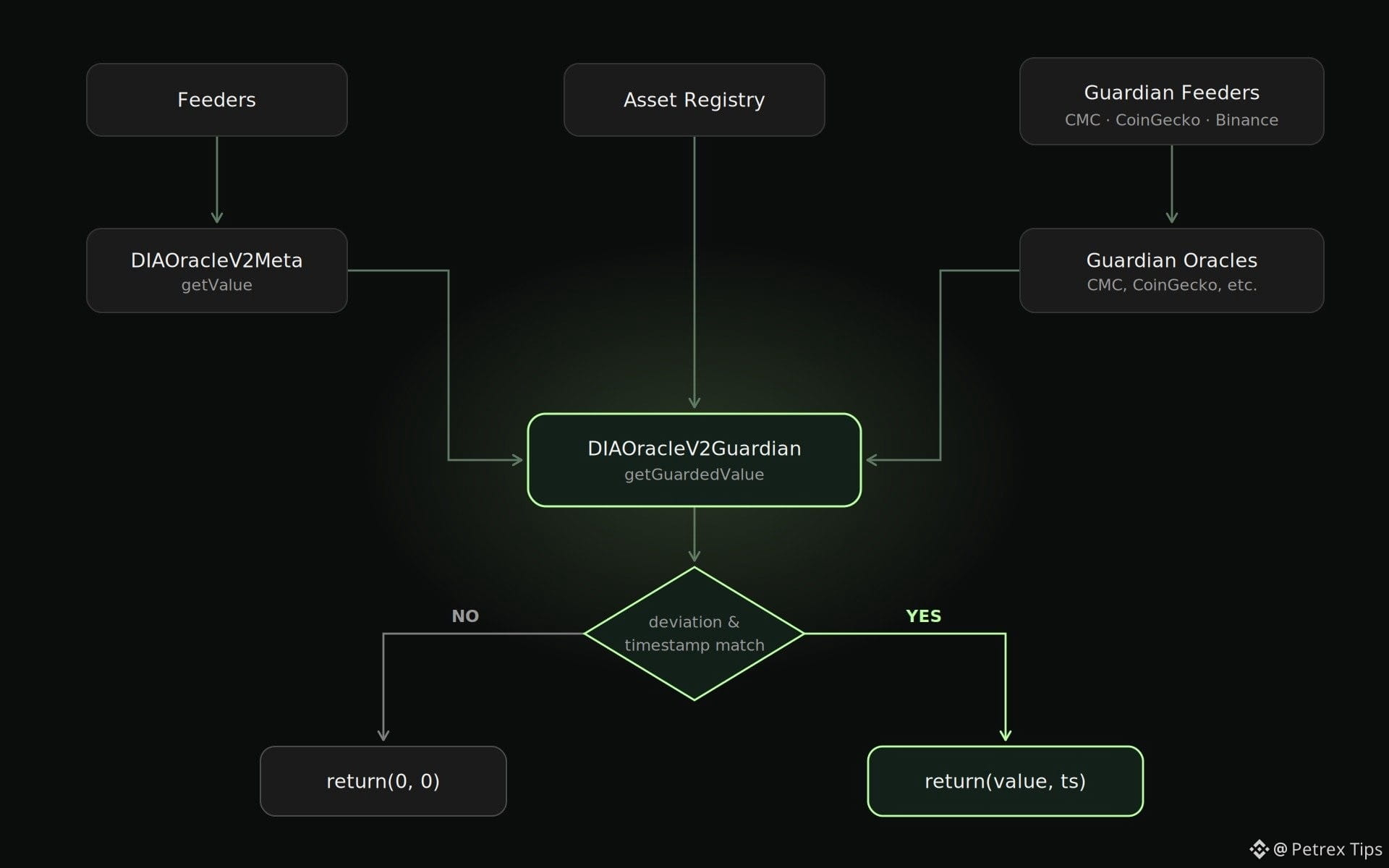
DIA’s architecture is pretty simple when you break it down:
Feeders collect raw market data from different sources.
Pods store the data on-chain.
Aggregators combine the different values to produce the final price.
Spectra delivers that data to applications across different blockchains.
basically:
data sources → Feeders → Pods → Aggregator → Spectra → dApps
the interesting part is that the entire process is transparent and verifiable on-chain, rather than simply asking users to trust the final price.
Feeders collect raw market data from different sources.
Pods store the data on-chain.
Aggregators combine the different values to produce the final price.
Spectra delivers that data to applications across different blockchains.
basically:
data sources → Feeders → Pods → Aggregator → Spectra → dApps
the interesting part is that the entire process is transparent and verifiable on-chain, rather than simply asking users to trust the final price.
Don't skip
Petrex Tips
·
--
උසබ තත්ත්වයA lot of DeFi today depends on data that lives offchain, like stablecoin reserves, vault collateral, or fund balances.
The problem is users have to trust reports or third-party auditors because smart contracts can't verify that data themselves.
@DIAdata_org ZK changes that by letting protocols prove offchain data is real without exposing the sensitive information behind it. Using zero-knowledge proofs, it can prove things like "reserves are greater than supply" or "collateral meets the required ratio" without revealing the actual numbers.
Another key part is proving where the data came from. Instead of trusting a dashboard or PDF, the proof is cryptographically tied to the original source, making it verifiable onchain. That means lending protocols, RWAs, stablecoins, and derivatives can rely on authenticated data instead of blind trust.
One important point: DIA ZK doesn't guarantee the source itself is honest. If a custodian reports false data, the proof will faithfully prove that false data came from that source. What it guarantees is that the data wasn't tampered with between the source and the blockchain. In simple terms, DIA ZK isn't replacing oracles.
It's adding a verification layer that lets protocols prove offchain data is authentic and meets certain conditions, without sacrificing privacy. That's especially useful as more value moves into RWAs, tokenized funds, and yield-bearing stablecoins. (DIA)
The problem is users have to trust reports or third-party auditors because smart contracts can't verify that data themselves.
@DIAdata_org ZK changes that by letting protocols prove offchain data is real without exposing the sensitive information behind it. Using zero-knowledge proofs, it can prove things like "reserves are greater than supply" or "collateral meets the required ratio" without revealing the actual numbers.
Another key part is proving where the data came from. Instead of trusting a dashboard or PDF, the proof is cryptographically tied to the original source, making it verifiable onchain. That means lending protocols, RWAs, stablecoins, and derivatives can rely on authenticated data instead of blind trust.
One important point: DIA ZK doesn't guarantee the source itself is honest. If a custodian reports false data, the proof will faithfully prove that false data came from that source. What it guarantees is that the data wasn't tampered with between the source and the blockchain. In simple terms, DIA ZK isn't replacing oracles.
It's adding a verification layer that lets protocols prove offchain data is authentic and meets certain conditions, without sacrificing privacy. That's especially useful as more value moves into RWAs, tokenized funds, and yield-bearing stablecoins. (DIA)
Read this folks!
Petrex Tips
·
--
උසබ තත්ත්වය🎙️How @st0x_io Uses @DIAdata_org Oracles for Tokenized Equity Trading:
Think of it this way:
ST0x lets people trade tokenized versions of real stocks and ETFs on Base, 24/7. These tokens are backed 1:1 by actual shares held with a regulated broker, and an ST0x token can be redeemed for the underlying share itself.
The problem is that stocks and crypto don't work on the same clock. Crypto trades 24/7, but stocks like Tesla or Nvidia have normal market hours, pre-market, after-hours, weekends, and holidays. So ST0x needs to know not only the price of a stock, but whether that price is actually current for the market session happening at that moment.
That's where DIA's oracle comes in.
Imagine Nvidia is trading at $180 in the real stock market. ST0x needs a reliable way of bringing that information onto Base because the blockchain itself doesn't know Nvidia's real-world price.
DIA basically acts as the bridge between the traditional stock market and ST0x. It provides ST0x with equity and ETF price feeds, including assets like NVDA, TSLA, COIN and MSTR. (DIA)
But there's an important detail: ST0x doesn't simply execute your trade at DIA's price.
DIA's price acts more like a reference point or midpoint. ST0x's liquidity is quoted around that price, and you trade against the resulting order book. So if DIA says the current market reference for a stock is around $180, ST0x can use that information to keep its buy and sell quotes aligned with the real market. (DIA)
DIA also tells ST0x when that price was actually observed and distinguishes between regular trading, pre-market and post-market prices. That's important because a price written to the blockchain five seconds ago could still contain stock-market data from hours earlier. (DIA)
So the simplest way to remember it is:
real stock market → DIA oracle → reliable price + market-session information → ST0x → tokenized stock trading on Base
DIA is essentially helping ST0x answer: "what is this real-world stock actually worth right now, and what market session does that price belong to?"
Think of it this way:
ST0x lets people trade tokenized versions of real stocks and ETFs on Base, 24/7. These tokens are backed 1:1 by actual shares held with a regulated broker, and an ST0x token can be redeemed for the underlying share itself.
The problem is that stocks and crypto don't work on the same clock. Crypto trades 24/7, but stocks like Tesla or Nvidia have normal market hours, pre-market, after-hours, weekends, and holidays. So ST0x needs to know not only the price of a stock, but whether that price is actually current for the market session happening at that moment.
That's where DIA's oracle comes in.
Imagine Nvidia is trading at $180 in the real stock market. ST0x needs a reliable way of bringing that information onto Base because the blockchain itself doesn't know Nvidia's real-world price.
DIA basically acts as the bridge between the traditional stock market and ST0x. It provides ST0x with equity and ETF price feeds, including assets like NVDA, TSLA, COIN and MSTR. (DIA)
But there's an important detail: ST0x doesn't simply execute your trade at DIA's price.
DIA's price acts more like a reference point or midpoint. ST0x's liquidity is quoted around that price, and you trade against the resulting order book. So if DIA says the current market reference for a stock is around $180, ST0x can use that information to keep its buy and sell quotes aligned with the real market. (DIA)
DIA also tells ST0x when that price was actually observed and distinguishes between regular trading, pre-market and post-market prices. That's important because a price written to the blockchain five seconds ago could still contain stock-market data from hours earlier. (DIA)
So the simplest way to remember it is:
real stock market → DIA oracle → reliable price + market-session information → ST0x → tokenized stock trading on Base
DIA is essentially helping ST0x answer: "what is this real-world stock actually worth right now, and what market session does that price belong to?"
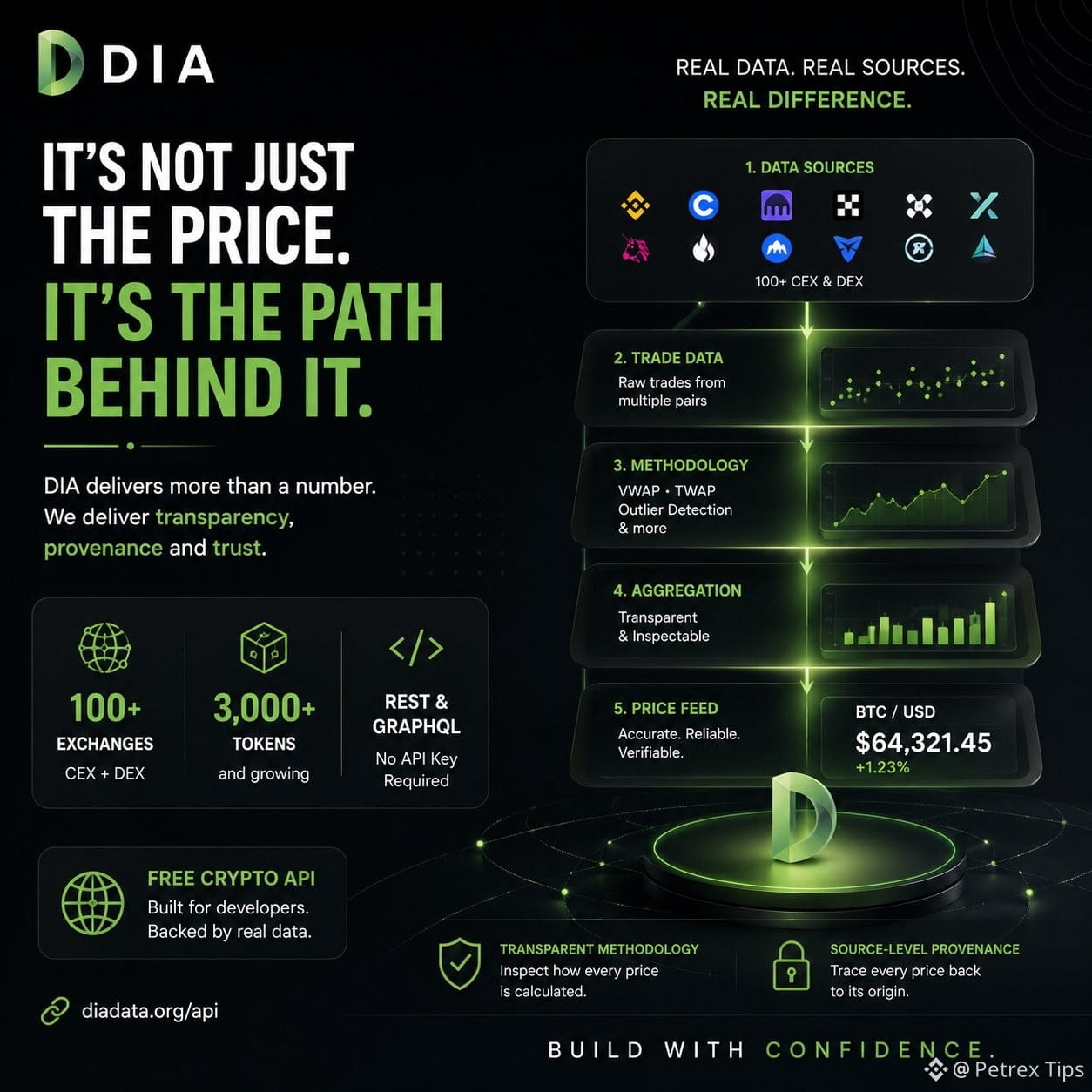
DIA’s free API provides more than crypto prices.
it shows where the data comes from. It covers 3,000+ tokens, sources trades from 100+ CEXs and DEXs, and lets developers trace each price from exchange and trading pair through aggregation.
This transparency makes the data easier to verify and useful for trading tools, analytics, portfolio trackers, and DeFi apps.
it shows where the data comes from. It covers 3,000+ tokens, sources trades from 100+ CEXs and DEXs, and lets developers trace each price from exchange and trading pair through aggregation.
This transparency makes the data easier to verify and useful for trading tools, analytics, portfolio trackers, and DeFi apps.
තවත් අන්තර්ගතයන් ගවේෂණය කිරීමට ඇතුල් වන්න