

Cryptopolitan
58.3k පෝස්ටු

Cryptopolitan
 Binance චතුරශ්ර සත්යාපිත+
වාර්තා කරන්න
පරිශීලක අවහිර කරන්න
Crypto news that doesn't waste your time. Breaking updates, market analysis, on-chain insights. Building the smartest crypto community.

Creator of the Year
1 හඹා යමින්
161.5K+ හඹා යන්නන්
573.4K+ කැමති විය
1 ලාංජනය
පෝස්ටු
අමුණා ඇත
At Cryptopolitan, we research, analyze, and deliver news—daily.
From breaking updates to in-depth analysis, educational guides, and market insights, we’re here to keep you informed with neutral and authentic news.
Thank you for trusting us to be your go-to source!
At Cryptopolitan, we research, analyze, and deliver news—daily.
From breaking updates to in-depth analysis, educational guides, and market insights, we’re here to keep you informed with neutral and authentic news.
Thank you for trusting us to be your go-to source!
From breaking updates to in-depth analysis, educational guides, and market insights, we’re here to keep you informed with neutral and authentic news.
Thank you for trusting us to be your go-to source!
120
68
343
1.8k
ලිපිය
CoinDCX admits $16M USDT loss days after CEO dismissed hack alertsOn October 25, 2026, CoinDCX confirmed that it lost 15.99 million USDT from retired wallets. Before that, on October 22, CEO Sumit Gupta had dismissed the breach warnings as just a possible “false alarm.” The turnaround brings into doubt how the exchange kept track of those wallets and conveyed information to its customers.
A sweeping failure the exchange says it absorbed
In a post, CoinDCX said that customers were still sending deposits to wallets that were retired due to the hack in July 2025. The platform’s automated sweeping service was supposed to transfer those deposits into active wallets. However, according to the exchange, it “had failed for a particular period.”
The exchange claimed to have compensated all deposits and taken the hit. Trading and withdrawals proceeded as normal. CoinDCX has committed to keeping a better eye on its old systems.
From ‘false alarm’ to admission
The controversy began on October 22, when researcher Darcy flagged suspicious TRON transfers. Gupta thinks that hackers have been reusing wallets that were compromised in 2025. CoinDCX claimed that certain reports were found to be misleading.
The explanation was questioned by investigator ZachXBT, who pointed out that the allegedly retired wallets were used to transfer deposits recently in April and May 2026. Cryptopolitan reported on the denial.
What the chain shows versus what CoinDCX says
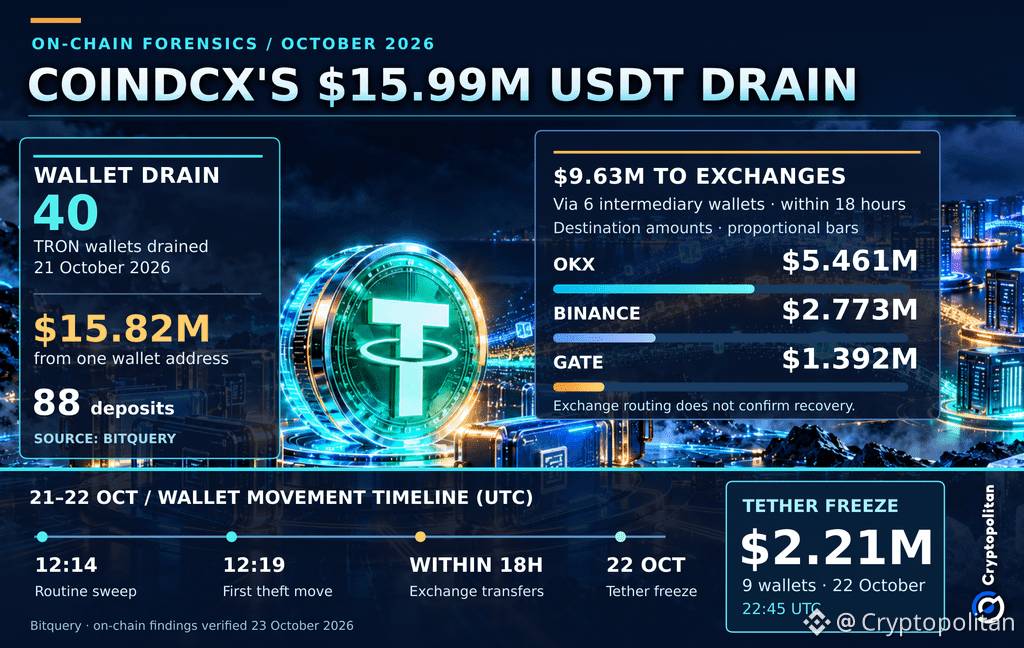
On October 21, Bitquery found out that 15.99 million USDT was transferred from a number of 40 wallets associated with CoinDCX. One of those wallets controlled $15.82 million, which came from 88 transactions.
The last regular transfer was made at 12:14 UTC, while the first move of the thief happened at 12:19 UTC. Bitquery also discovered 276 fee top-ups since August and sweeping activity after the theft. The information contradicts the statement that the wallets were inactive.
Approximately $9.63 million has been transferred using six intermediate wallets to OKX, Binance and Gate within a time frame of 18 hours. Tether has frozen $2.21 million in nine wallets on October 22. At least $30,000 still exists in the thief’s wallets, according to Bitquery’s snapshot taken on October 23. The blockchain is unable to provide information about how the perpetrator accessed the wallets.
SEO title: CoinDCX $16M USDT Drain: Wallet Timeline, Exchange Transfers and Tether Freeze
A small exchange with a troubled year
On October 26, DefiLlama listed CoinDCX’s reserves at $173.3 million and its 24-hour spot trading volume at $1.47 million. The numbers stand for different things: reserves indicate reported assets, while trading volume reflects market activity. Neither reveals how much CoinDCX owes customers, making it impossible to know from these numbers alone whether customer deposits are fully backed.
CoinDCX’s September report recorded 23.1 million registered users and a ₹57.07 crore Crypto Investor Protection Fund. The fund provides an additional safeguard, but it does not guarantee coverage for every loss. That distinction matters because CoinDCX had already lost roughly $44 million in a July 2025 hack, before the latest $16 million incident.
Why the governance questions travel
CoinDCX’s case reflects a wider weakness in crypto security. TRM Labs found that infrastructure and operational compromises caused roughly 76% of crypto hack losses in the first half of 2026, despite accounting for just 15% of incidents. Such failures may be relatively uncommon, but their financial consequences can be severe.
The questions surrounding CoinDCX’s response also extend beyond its customers. Coinbase invested in the exchange in October 2025 as part of its expansion into India and the Middle East. Chainalysis ranks India sixth globally for grassroots crypto adoption. With growing interest in the region, CoinDCX’s handling of the incident matters. Covering the loss was necessary, but restoring trust requires something more: explaining why it initially dismissed an active wallet drain as a “false alarm.”
The smartest crypto minds already read our newsletter. Want in? Join them.
CoinDCX admits $16M USDT loss days after CEO dismissed hack alerts
On October 25, 2026, CoinDCX confirmed that it lost 15.99 million USDT from retired wallets. Before that, on October 22, CEO Sumit Gupta had dismissed the breach warnings as just a possible “false alarm.” The turnaround brings into doubt how the exchange kept track of those wallets and conveyed information to its customers.
A sweeping failure the exchange says it absorbed
In a post, CoinDCX said that customers were still sending deposits to wallets that were retired due to the hack in July 2025. The platform’s automated sweeping service was supposed to transfer those deposits into active wallets. However, according to the exchange, it “had failed for a particular period.”
The exchange claimed to have compensated all deposits and taken the hit. Trading and withdrawals proceeded as normal. CoinDCX has committed to keeping a better eye on its old systems.
From ‘false alarm’ to admission
The controversy began on October 22, when researcher Darcy flagged suspicious TRON transfers. Gupta thinks that hackers have been reusing wallets that were compromised in 2025. CoinDCX claimed that certain reports were found to be misleading.
The explanation was questioned by investigator ZachXBT, who pointed out that the allegedly retired wallets were used to transfer deposits recently in April and May 2026. Cryptopolitan reported on the denial.
What the chain shows versus what CoinDCX says
On October 21, Bitquery found out that 15.99 million USDT was transferred from a number of 40 wallets associated with CoinDCX. One of those wallets controlled $15.82 million, which came from 88 transactions.
The last regular transfer was made at 12:14 UTC, while the first move of the thief happened at 12:19 UTC. Bitquery also discovered 276 fee top-ups since August and sweeping activity after the theft. The information contradicts the statement that the wallets were inactive.
Approximately $9.63 million has been transferred using six intermediate wallets to OKX, Binance and Gate within a time frame of 18 hours. Tether has frozen $2.21 million in nine wallets on October 22. At least $30,000 still exists in the thief’s wallets, according to Bitquery’s snapshot taken on October 23. The blockchain is unable to provide information about how the perpetrator accessed the wallets.
SEO title: CoinDCX $16M USDT Drain: Wallet Timeline, Exchange Transfers and Tether Freeze
A small exchange with a troubled year
On October 26, DefiLlama listed CoinDCX’s reserves at $173.3 million and its 24-hour spot trading volume at $1.47 million. The numbers stand for different things: reserves indicate reported assets, while trading volume reflects market activity. Neither reveals how much CoinDCX owes customers, making it impossible to know from these numbers alone whether customer deposits are fully backed.
CoinDCX’s September report recorded 23.1 million registered users and a ₹57.07 crore Crypto Investor Protection Fund. The fund provides an additional safeguard, but it does not guarantee coverage for every loss. That distinction matters because CoinDCX had already lost roughly $44 million in a July 2025 hack, before the latest $16 million incident.
Why the governance questions travel
CoinDCX’s case reflects a wider weakness in crypto security. TRM Labs found that infrastructure and operational compromises caused roughly 76% of crypto hack losses in the first half of 2026, despite accounting for just 15% of incidents. Such failures may be relatively uncommon, but their financial consequences can be severe.
The questions surrounding CoinDCX’s response also extend beyond its customers. Coinbase invested in the exchange in October 2025 as part of its expansion into India and the Middle East. Chainalysis ranks India sixth globally for grassroots crypto adoption. With growing interest in the region, CoinDCX’s handling of the incident matters. Covering the loss was necessary, but restoring trust requires something more: explaining why it initially dismissed an active wallet drain as a “false alarm.”
The smartest crypto minds already read our newsletter. Want in? Join them.
A sweeping failure the exchange says it absorbed
In a post, CoinDCX said that customers were still sending deposits to wallets that were retired due to the hack in July 2025. The platform’s automated sweeping service was supposed to transfer those deposits into active wallets. However, according to the exchange, it “had failed for a particular period.”
The exchange claimed to have compensated all deposits and taken the hit. Trading and withdrawals proceeded as normal. CoinDCX has committed to keeping a better eye on its old systems.
From ‘false alarm’ to admission
The controversy began on October 22, when researcher Darcy flagged suspicious TRON transfers. Gupta thinks that hackers have been reusing wallets that were compromised in 2025. CoinDCX claimed that certain reports were found to be misleading.
The explanation was questioned by investigator ZachXBT, who pointed out that the allegedly retired wallets were used to transfer deposits recently in April and May 2026. Cryptopolitan reported on the denial.
What the chain shows versus what CoinDCX says
On October 21, Bitquery found out that 15.99 million USDT was transferred from a number of 40 wallets associated with CoinDCX. One of those wallets controlled $15.82 million, which came from 88 transactions.
The last regular transfer was made at 12:14 UTC, while the first move of the thief happened at 12:19 UTC. Bitquery also discovered 276 fee top-ups since August and sweeping activity after the theft. The information contradicts the statement that the wallets were inactive.
Approximately $9.63 million has been transferred using six intermediate wallets to OKX, Binance and Gate within a time frame of 18 hours. Tether has frozen $2.21 million in nine wallets on October 22. At least $30,000 still exists in the thief’s wallets, according to Bitquery’s snapshot taken on October 23. The blockchain is unable to provide information about how the perpetrator accessed the wallets.
SEO title: CoinDCX $16M USDT Drain: Wallet Timeline, Exchange Transfers and Tether Freeze
A small exchange with a troubled year
On October 26, DefiLlama listed CoinDCX’s reserves at $173.3 million and its 24-hour spot trading volume at $1.47 million. The numbers stand for different things: reserves indicate reported assets, while trading volume reflects market activity. Neither reveals how much CoinDCX owes customers, making it impossible to know from these numbers alone whether customer deposits are fully backed.
CoinDCX’s September report recorded 23.1 million registered users and a ₹57.07 crore Crypto Investor Protection Fund. The fund provides an additional safeguard, but it does not guarantee coverage for every loss. That distinction matters because CoinDCX had already lost roughly $44 million in a July 2025 hack, before the latest $16 million incident.
Why the governance questions travel
CoinDCX’s case reflects a wider weakness in crypto security. TRM Labs found that infrastructure and operational compromises caused roughly 76% of crypto hack losses in the first half of 2026, despite accounting for just 15% of incidents. Such failures may be relatively uncommon, but their financial consequences can be severe.
The questions surrounding CoinDCX’s response also extend beyond its customers. Coinbase invested in the exchange in October 2025 as part of its expansion into India and the Middle East. Chainalysis ranks India sixth globally for grassroots crypto adoption. With growing interest in the region, CoinDCX’s handling of the incident matters. Covering the loss was necessary, but restoring trust requires something more: explaining why it initially dismissed an active wallet drain as a “false alarm.”
The smartest crypto minds already read our newsletter. Want in? Join them.
7
ලිපිය
Passport maker Foundation says compromised Cloudflare API keys sent phishing from its domainsThere have been scam emails sent from Foundation’s domains. The company that made the Passport Bitcoin hardware wallet has traced them to at least one leaked Cloudflare API key.
It revoked all API keys late on October 25 and said that Passport devices and the Bitcoin they hold are safe.
Passport funds are safe, the company said at 11:47 p.m. ET
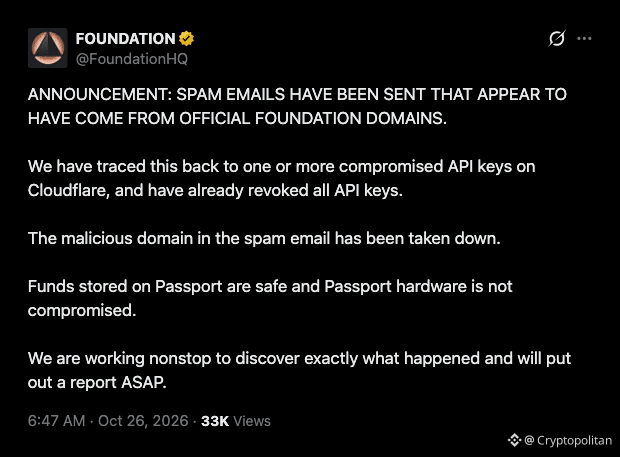
At 11:47 p.m. ET, Foundation put the warning on X. Spam that seemed to come from official Foundation domains had already been going around, and the bad domain it contained was shut down.
Foundation’s warning about the spam emails, posted by @FoundationHQ on X on October 26, 2026.
Software can use an API key to access an account without a password. With just one leak, whoever has it can get in.
“Funds stored on Passport are safe and Passport hardware is not compromised,” the company said. It said it was working round the clock to get to the bottom of exactly what happened and would publish a report.
Foundation’s setup guide says that Passport Core is an offline device used to store keys and sign transactions. Each transaction is built by a paired software wallet, and the device approves it.
Passport buyers say the messages carried their names and addresses
X user @crisisdot said at 11:29 p.m. ET that they received a message from hello@foundation.xyz “saying my Passport funds are at risk and asking me to move to a new recovery phrase.”
The same user said a site at incident.foundation.xyz was also live and that Foundation’s “email and DNS are compromised.” Three posts from recipients came in between 11:29 p.m. ET and 11:44 p.m. ET.
All of them were before Foundation spoke.
One customer said the message was about a purchase in the middle of 2025 and got through spam filters.
The same buyer said it looked like the con artists had a shipping address, name, email address and purchase information. Another recipient said that their name, address and email were in the email.
Foundation has not said if order information from customers was accessed or where the senders got the information. Its privacy policy states Foundation cannot retrieve lost seed phrases or private keys and “will never ask you to disclose them.”
Trezor took a similar hit in September. The wallet maker warned users of a phony “Critical Security Alert” sent through its third-party email provider on September 9, Cryptopolitan reported.
One recipient reported that the message passed DKIM, SPF and DMARC checks. Trezor took down the domain used to send it.
Casa CEO Nick Neuman said BitBox users seemed to be receiving similar emails and that a shared marketing email provider may have been compromised.
A list of Trezor’s buyers had been leaked weeks before. Because of the breach at shipping partner ShipMonk, the names, addresses, phone numbers, emails and order data of around 80,700 users were exposed.
Trezor said that no devices, private keys or wallet backups were compromised.
Don’t just read crypto news. Understand it. Subscribe to our newsletter. It's free.
Passport maker Foundation says compromised Cloudflare API keys sent phishing from its domains
There have been scam emails sent from Foundation’s domains. The company that made the Passport Bitcoin hardware wallet has traced them to at least one leaked Cloudflare API key.
It revoked all API keys late on October 25 and said that Passport devices and the Bitcoin they hold are safe.
Passport funds are safe, the company said at 11:47 p.m. ET
At 11:47 p.m. ET, Foundation put the warning on X. Spam that seemed to come from official Foundation domains had already been going around, and the bad domain it contained was shut down.
Foundation’s warning about the spam emails, posted by @FoundationHQ on X on October 26, 2026.
Software can use an API key to access an account without a password. With just one leak, whoever has it can get in.
“Funds stored on Passport are safe and Passport hardware is not compromised,” the company said. It said it was working round the clock to get to the bottom of exactly what happened and would publish a report.
Foundation’s setup guide says that Passport Core is an offline device used to store keys and sign transactions. Each transaction is built by a paired software wallet, and the device approves it.
Passport buyers say the messages carried their names and addresses
X user @crisisdot said at 11:29 p.m. ET that they received a message from hello@foundation.xyz “saying my Passport funds are at risk and asking me to move to a new recovery phrase.”
The same user said a site at incident.foundation.xyz was also live and that Foundation’s “email and DNS are compromised.” Three posts from recipients came in between 11:29 p.m. ET and 11:44 p.m. ET.
All of them were before Foundation spoke.
One customer said the message was about a purchase in the middle of 2025 and got through spam filters.
The same buyer said it looked like the con artists had a shipping address, name, email address and purchase information. Another recipient said that their name, address and email were in the email.
Foundation has not said if order information from customers was accessed or where the senders got the information. Its privacy policy states Foundation cannot retrieve lost seed phrases or private keys and “will never ask you to disclose them.”
Trezor took a similar hit in September. The wallet maker warned users of a phony “Critical Security Alert” sent through its third-party email provider on September 9, Cryptopolitan reported.
One recipient reported that the message passed DKIM, SPF and DMARC checks. Trezor took down the domain used to send it.
Casa CEO Nick Neuman said BitBox users seemed to be receiving similar emails and that a shared marketing email provider may have been compromised.
A list of Trezor’s buyers had been leaked weeks before. Because of the breach at shipping partner ShipMonk, the names, addresses, phone numbers, emails and order data of around 80,700 users were exposed.
Trezor said that no devices, private keys or wallet backups were compromised.
Don’t just read crypto news. Understand it. Subscribe to our newsletter. It's free.
It revoked all API keys late on October 25 and said that Passport devices and the Bitcoin they hold are safe.
Passport funds are safe, the company said at 11:47 p.m. ET
At 11:47 p.m. ET, Foundation put the warning on X. Spam that seemed to come from official Foundation domains had already been going around, and the bad domain it contained was shut down.
Foundation’s warning about the spam emails, posted by @FoundationHQ on X on October 26, 2026.
Software can use an API key to access an account without a password. With just one leak, whoever has it can get in.
“Funds stored on Passport are safe and Passport hardware is not compromised,” the company said. It said it was working round the clock to get to the bottom of exactly what happened and would publish a report.
Foundation’s setup guide says that Passport Core is an offline device used to store keys and sign transactions. Each transaction is built by a paired software wallet, and the device approves it.
Passport buyers say the messages carried their names and addresses
X user @crisisdot said at 11:29 p.m. ET that they received a message from hello@foundation.xyz “saying my Passport funds are at risk and asking me to move to a new recovery phrase.”
The same user said a site at incident.foundation.xyz was also live and that Foundation’s “email and DNS are compromised.” Three posts from recipients came in between 11:29 p.m. ET and 11:44 p.m. ET.
All of them were before Foundation spoke.
One customer said the message was about a purchase in the middle of 2025 and got through spam filters.
The same buyer said it looked like the con artists had a shipping address, name, email address and purchase information. Another recipient said that their name, address and email were in the email.
Foundation has not said if order information from customers was accessed or where the senders got the information. Its privacy policy states Foundation cannot retrieve lost seed phrases or private keys and “will never ask you to disclose them.”
Trezor took a similar hit in September. The wallet maker warned users of a phony “Critical Security Alert” sent through its third-party email provider on September 9, Cryptopolitan reported.
One recipient reported that the message passed DKIM, SPF and DMARC checks. Trezor took down the domain used to send it.
Casa CEO Nick Neuman said BitBox users seemed to be receiving similar emails and that a shared marketing email provider may have been compromised.
A list of Trezor’s buyers had been leaked weeks before. Because of the breach at shipping partner ShipMonk, the names, addresses, phone numbers, emails and order data of around 80,700 users were exposed.
Trezor said that no devices, private keys or wallet backups were compromised.
Don’t just read crypto news. Understand it. Subscribe to our newsletter. It's free.
6
Chinese automakers overtake Japanese rivals in Europe for the first timeChina’s carmakers have officially outsold their Japanese rivals in Europe over an entire quarter for the first time, and the numbers show just how quickly the market is changing.
BYD and Chery, among others, are winning customers in a place where companies such as Toyota and Nissan have been operating for many years to date.
Dataforce reported that Chinese brand sales have almost doubled in September from last year, accounting for 12.7% of all car sales in Europe, against 11.9% for Japanese brands. The sales increase was largely due to hybrid vehicles; however, Volkswagen, Renault, and other European brands dominate the market.
China’s automakers are winning European customers faster than expected
Five years ago, Chinese brands barely accounted for 1% of European vehicle sales. Today, they’re challenging manufacturers that have been around for generations.
Toyota started selling cars in Europe in 1963 and now operates factories across the continent. Nissan has manufactured vehicles at its Sunderland plant in Britain since 1986.
The UK has become a particularly important market for Chinese companies. Chery’s Jaecoo 7 SUV was Britain’s best-selling model in both March and September.
The figures measure new vehicle registrations rather than factory production, making them an indication of what European customers are actually buying.
Meanwhile, things aren’t going particularly well for foreign automakers back in China.
Drivers in China are shunning Volkswagen and BMW cars to favor their local counterparts. The reason is that local carmakers are designing and selling new cars at a faster rate and more cheaply than their competitors.
The falling demand among the locals has forced manufacturers to look for foreign markets.
In the recent car show held in Paris, Chinese car brands such as Chery, BYD and Geely Zeekr unveiled various cars designed specifically for Europeans.
BYD Dolphin G DM-i was one of those cars that the Chinese carmaker revealed at the Paris auto show.
It was designed specifically for European drivers as it was an inexpensive plug-in hybrid car made by BYD.
Europe moves to restrict Chinese imports as BYD faces higher costs
The European Union is trying to slow the expansion, partly because Chinese manufacturers benefit from government subsidies.
Brussels has already introduced additional tariffs on battery-electric vehicles manufactured in China.
This month, European officials also reached a preliminary agreement to restrict Chinese hybrid imports to 350,000 vehicles annually.
But shipments of hybrids have actually accelerated as manufacturers prepare for possible additional restrictions.
The EU is considering another approach that would make locally manufactured vehicles eligible for certain subsidies and incentives.
One proposal would connect company-car tax benefits to European production. That could matter considerably in Germany, where businesses and fleet operators account for substantial vehicle purchases.
China is also introducing changes that could hurt its own exporters.
On October 12, Beijing announced that the VAT rebate on new-energy vehicle exports will fall from 13% to 9% starting April 1, 2027.
JPMorgan warned in a note on Tuesday that the smaller rebate, combined with the reinstated battery consumption tax, could damage industry profitability faster than previously expected.
BYD executive Liu said the company’s existing factories in Southeast Asia should limit the effect of the rebate reduction on regional sales.
Liu also expects BYD to expand its international manufacturing operations as the global oil shock strengthens demand for electric vehicles.
However, he said BYD has not decided whether to raise overseas selling prices to recover the additional tax costs, especially as competition between manufacturers becomes more aggressive.
Morgan Stanley estimated in an October 13 research note that BYD’s planned manufacturing capacity outside mainland China had reached one million electric vehicles, with Europe accounting for just 30%.
The expansion comes while the company faces considerable financial pressure at home.
BYD’s first-half net profit dropped more than 20% from a year earlier to 12.3 billion yuan ($1.84 billion), weighed down by declining domestic demand.
Chinese manufacturers are already preparing to build more vehicles directly inside Europe, potentially reducing their dependence on imported cars.
Chery is preparing manufacturing operations in Barcelona, while BYD is approaching completion of its new factory in Hungary.
Meanwhile, Zhejiang Leapmotor has started producing its B10 SUV at Stellantis’ Zaragoza factory in Spain, under a joint venture between the two companies.
If you're reading this, you’re already ahead. Stay there with our newsletter.
Chinese automakers overtake Japanese rivals in Europe for the first time
China’s carmakers have officially outsold their Japanese rivals in Europe over an entire quarter for the first time, and the numbers show just how quickly the market is changing.
BYD and Chery, among others, are winning customers in a place where companies such as Toyota and Nissan have been operating for many years to date.
Dataforce reported that Chinese brand sales have almost doubled in September from last year, accounting for 12.7% of all car sales in Europe, against 11.9% for Japanese brands. The sales increase was largely due to hybrid vehicles; however, Volkswagen, Renault, and other European brands dominate the market.
China’s automakers are winning European customers faster than expected
Five years ago, Chinese brands barely accounted for 1% of European vehicle sales. Today, they’re challenging manufacturers that have been around for generations.
Toyota started selling cars in Europe in 1963 and now operates factories across the continent. Nissan has manufactured vehicles at its Sunderland plant in Britain since 1986.
The UK has become a particularly important market for Chinese companies. Chery’s Jaecoo 7 SUV was Britain’s best-selling model in both March and September.
The figures measure new vehicle registrations rather than factory production, making them an indication of what European customers are actually buying.
Meanwhile, things aren’t going particularly well for foreign automakers back in China.
Drivers in China are shunning Volkswagen and BMW cars to favor their local counterparts. The reason is that local carmakers are designing and selling new cars at a faster rate and more cheaply than their competitors.
The falling demand among the locals has forced manufacturers to look for foreign markets.
In the recent car show held in Paris, Chinese car brands such as Chery, BYD and Geely Zeekr unveiled various cars designed specifically for Europeans.
BYD Dolphin G DM-i was one of those cars that the Chinese carmaker revealed at the Paris auto show.
It was designed specifically for European drivers as it was an inexpensive plug-in hybrid car made by BYD.
Europe moves to restrict Chinese imports as BYD faces higher costs
The European Union is trying to slow the expansion, partly because Chinese manufacturers benefit from government subsidies.
Brussels has already introduced additional tariffs on battery-electric vehicles manufactured in China.
This month, European officials also reached a preliminary agreement to restrict Chinese hybrid imports to 350,000 vehicles annually.
But shipments of hybrids have actually accelerated as manufacturers prepare for possible additional restrictions.
The EU is considering another approach that would make locally manufactured vehicles eligible for certain subsidies and incentives.
One proposal would connect company-car tax benefits to European production. That could matter considerably in Germany, where businesses and fleet operators account for substantial vehicle purchases.
China is also introducing changes that could hurt its own exporters.
On October 12, Beijing announced that the VAT rebate on new-energy vehicle exports will fall from 13% to 9% starting April 1, 2027.
JPMorgan warned in a note on Tuesday that the smaller rebate, combined with the reinstated battery consumption tax, could damage industry profitability faster than previously expected.
BYD executive Liu said the company’s existing factories in Southeast Asia should limit the effect of the rebate reduction on regional sales.
Liu also expects BYD to expand its international manufacturing operations as the global oil shock strengthens demand for electric vehicles.
However, he said BYD has not decided whether to raise overseas selling prices to recover the additional tax costs, especially as competition between manufacturers becomes more aggressive.
Morgan Stanley estimated in an October 13 research note that BYD’s planned manufacturing capacity outside mainland China had reached one million electric vehicles, with Europe accounting for just 30%.
The expansion comes while the company faces considerable financial pressure at home.
BYD’s first-half net profit dropped more than 20% from a year earlier to 12.3 billion yuan ($1.84 billion), weighed down by declining domestic demand.
Chinese manufacturers are already preparing to build more vehicles directly inside Europe, potentially reducing their dependence on imported cars.
Chery is preparing manufacturing operations in Barcelona, while BYD is approaching completion of its new factory in Hungary.
Meanwhile, Zhejiang Leapmotor has started producing its B10 SUV at Stellantis’ Zaragoza factory in Spain, under a joint venture between the two companies.
If you're reading this, you’re already ahead. Stay there with our newsletter.
BYD and Chery, among others, are winning customers in a place where companies such as Toyota and Nissan have been operating for many years to date.
Dataforce reported that Chinese brand sales have almost doubled in September from last year, accounting for 12.7% of all car sales in Europe, against 11.9% for Japanese brands. The sales increase was largely due to hybrid vehicles; however, Volkswagen, Renault, and other European brands dominate the market.
China’s automakers are winning European customers faster than expected
Five years ago, Chinese brands barely accounted for 1% of European vehicle sales. Today, they’re challenging manufacturers that have been around for generations.
Toyota started selling cars in Europe in 1963 and now operates factories across the continent. Nissan has manufactured vehicles at its Sunderland plant in Britain since 1986.
The UK has become a particularly important market for Chinese companies. Chery’s Jaecoo 7 SUV was Britain’s best-selling model in both March and September.
The figures measure new vehicle registrations rather than factory production, making them an indication of what European customers are actually buying.
Meanwhile, things aren’t going particularly well for foreign automakers back in China.
Drivers in China are shunning Volkswagen and BMW cars to favor their local counterparts. The reason is that local carmakers are designing and selling new cars at a faster rate and more cheaply than their competitors.
The falling demand among the locals has forced manufacturers to look for foreign markets.
In the recent car show held in Paris, Chinese car brands such as Chery, BYD and Geely Zeekr unveiled various cars designed specifically for Europeans.
BYD Dolphin G DM-i was one of those cars that the Chinese carmaker revealed at the Paris auto show.
It was designed specifically for European drivers as it was an inexpensive plug-in hybrid car made by BYD.
Europe moves to restrict Chinese imports as BYD faces higher costs
The European Union is trying to slow the expansion, partly because Chinese manufacturers benefit from government subsidies.
Brussels has already introduced additional tariffs on battery-electric vehicles manufactured in China.
This month, European officials also reached a preliminary agreement to restrict Chinese hybrid imports to 350,000 vehicles annually.
But shipments of hybrids have actually accelerated as manufacturers prepare for possible additional restrictions.
The EU is considering another approach that would make locally manufactured vehicles eligible for certain subsidies and incentives.
One proposal would connect company-car tax benefits to European production. That could matter considerably in Germany, where businesses and fleet operators account for substantial vehicle purchases.
China is also introducing changes that could hurt its own exporters.
On October 12, Beijing announced that the VAT rebate on new-energy vehicle exports will fall from 13% to 9% starting April 1, 2027.
JPMorgan warned in a note on Tuesday that the smaller rebate, combined with the reinstated battery consumption tax, could damage industry profitability faster than previously expected.
BYD executive Liu said the company’s existing factories in Southeast Asia should limit the effect of the rebate reduction on regional sales.
Liu also expects BYD to expand its international manufacturing operations as the global oil shock strengthens demand for electric vehicles.
However, he said BYD has not decided whether to raise overseas selling prices to recover the additional tax costs, especially as competition between manufacturers becomes more aggressive.
Morgan Stanley estimated in an October 13 research note that BYD’s planned manufacturing capacity outside mainland China had reached one million electric vehicles, with Europe accounting for just 30%.
The expansion comes while the company faces considerable financial pressure at home.
BYD’s first-half net profit dropped more than 20% from a year earlier to 12.3 billion yuan ($1.84 billion), weighed down by declining domestic demand.
Chinese manufacturers are already preparing to build more vehicles directly inside Europe, potentially reducing their dependence on imported cars.
Chery is preparing manufacturing operations in Barcelona, while BYD is approaching completion of its new factory in Hungary.
Meanwhile, Zhejiang Leapmotor has started producing its B10 SUV at Stellantis’ Zaragoza factory in Spain, under a joint venture between the two companies.
If you're reading this, you’re already ahead. Stay there with our newsletter.
25
ලිපිය
Moonshot resets Kimi K3.1 Pro quotas after rate-limit apologyMoonshot AI has apologized to Kimi K3.1 Pro users after their paid service was interrupted by a cap on its use and wasted quota. They have reset their counters and given users back 25% of their monthly quotas. The incident reveals a serious challenge in the area of autonomous AI agents: the responsibility of operating them is becoming costly.
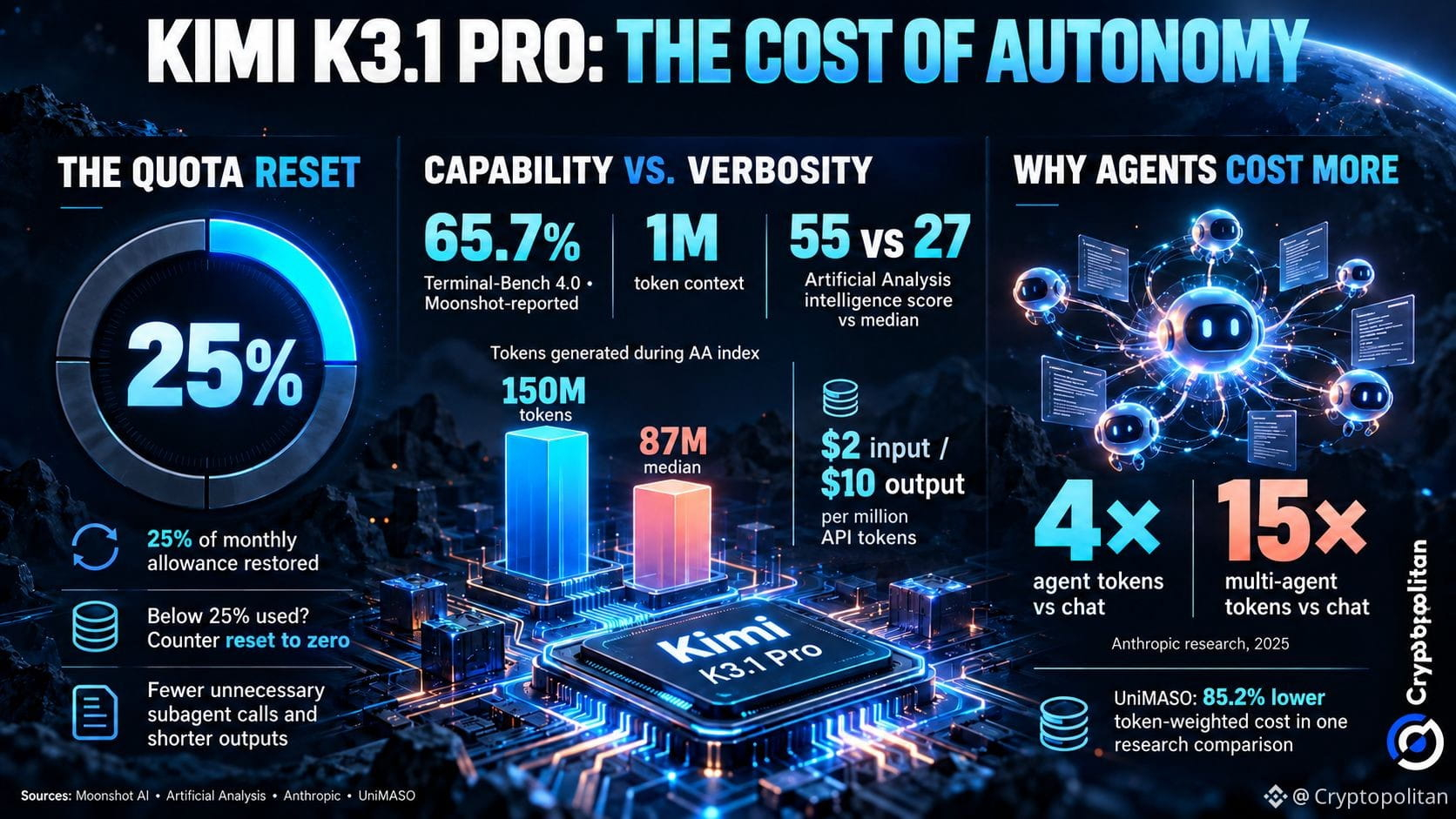
On Sunday, October 25, 2026 (UTC), Moonshot stated that the problems happened due to the company’s fault and noted it “should have fixed them sooner.” All active users received a one-off restoration equal to 25% of the monthly quota regardless of what tier they are on. Users whose allowances were smaller than 25% got their counters reset.
Moonshot also cut unnecessary subagent calls as well as long responses that consumed allowances. The matter of GPU shortage was not mentioned in its October apology.
A capable model that is slow and verbose
Kimi K3.1 Pro was launched on October 23, 2026. It is the most powerful model in the 3T category of Moonshot, featuring a million-token context window. It is available on Kimi.ai, Kimi Work, Kimi Code, and the API. Its Highspeed version works around two to three times faster than the normal one. Its complete model weights are expected to become available on November 4, 2026.
We’re sorry for the rate limits and unnecessary quota consumption on the K3.1 Pro subscription plan. These were our issues, and we should have fixed them sooner. Today, every subscriber on every plan gets a one-time usage reset, restoring 25% of their monthly quota (usage below 25% resets to zero), equal to one week of usage. Your usage bar will reflect this adjustment by end of day PST. We’ve also adjusted the plan’s parameters and are reducing unnecessary subagent calls and output length, so your quota goes further. Thank you for your patience while we put this right.
— Kimi.ai (@Kimi_Moonshot) October 25, 2026
According to Moonshot, the score of Kimi K3.1 Pro on Terminal-Bench 4.0 is 65.7%, outperforming the results of GPT-6 Astra (58.2%) and coming very close to that of Claude Opus 5.5 (66.4%).
Moonshot AI has apologized to Kimi K3.1 Pro users after their paid service was interrupted by a cap on its use and wasted quota. They have reset their counters and given users back 25% of their monthly quotas. The incident reveals a serious challenge in the area of autonomous AI agents: the responsibility of operating them is becoming costly.
Why autonomous agents drain quotas
When tasks are assigned through one AI agent to another, token utilization can get even bigger. According to Anthropic’s research released in 2025, agents require four times more tokens than regular chat usage, while multi-agent systems require around 15 times more tokens. The contribution of tokens to the performance of the system was about 80% in one experiment conducted by the researchers.
The research did not involve Kimi, but it helps explain why Moonshot cut unnecessary subagent calls. A separate 2026 study from Harbin Institute of Technology explored another way to control costs. By assigning less expensive models to simpler tasks, its framework reduced token-weighted deployment costs by 85.2% compared with its baseline.
Kimi K3.1 Pro Quota Reset: 25% Restoration and AI Agent Token Costs
GPU strain in July, and a wider US–China contest
Moonshot faced a different capacity problem on July 19, 2026, when it reported that overwhelming Kimi K3 demand had strained its GPUs, forcing a temporary halt to new subscriptions. It has not connected that shortage to October’s quota problems.
Meanwhile, Cryptopolitan has reported Moonshot’s pending open-weight release, reduced cyber capabilities and a roughly $700 million shareholder arbitration claim.
The stakes extend beyond Moonshot. BCG’s June 2026 analysis finds cost-efficient AI as a Chinese strength, while the US leads in frontier models, talent and capital.
K3.1 Pro’s benchmarks and pricing show that Moonshot can compete on capability and cost. But subscribers also need reliability. A powerful, affordable model offers little value if users exhaust their allowances before their agents finish the job.
Don’t just read crypto news. Understand it. Subscribe to our newsletter. It's free.
Moonshot resets Kimi K3.1 Pro quotas after rate-limit apology
Moonshot AI has apologized to Kimi K3.1 Pro users after their paid service was interrupted by a cap on its use and wasted quota. They have reset their counters and given users back 25% of their monthly quotas. The incident reveals a serious challenge in the area of autonomous AI agents: the responsibility of operating them is becoming costly.
On Sunday, October 25, 2026 (UTC), Moonshot stated that the problems happened due to the company’s fault and noted it “should have fixed them sooner.” All active users received a one-off restoration equal to 25% of the monthly quota regardless of what tier they are on. Users whose allowances were smaller than 25% got their counters reset.
Moonshot also cut unnecessary subagent calls as well as long responses that consumed allowances. The matter of GPU shortage was not mentioned in its October apology.
A capable model that is slow and verbose
Kimi K3.1 Pro was launched on October 23, 2026. It is the most powerful model in the 3T category of Moonshot, featuring a million-token context window. It is available on Kimi.ai, Kimi Work, Kimi Code, and the API. Its Highspeed version works around two to three times faster than the normal one. Its complete model weights are expected to become available on November 4, 2026.
We’re sorry for the rate limits and unnecessary quota consumption on the K3.1 Pro subscription plan. These were our issues, and we should have fixed them sooner. Today, every subscriber on every plan gets a one-time usage reset, restoring 25% of their monthly quota (usage below 25% resets to zero), equal to one week of usage. Your usage bar will reflect this adjustment by end of day PST. We’ve also adjusted the plan’s parameters and are reducing unnecessary subagent calls and output length, so your quota goes further. Thank you for your patience while we put this right.
— Kimi.ai (@Kimi_Moonshot) October 25, 2026
According to Moonshot, the score of Kimi K3.1 Pro on Terminal-Bench 4.0 is 65.7%, outperforming the results of GPT-6 Astra (58.2%) and coming very close to that of Claude Opus 5.5 (66.4%).
Moonshot AI has apologized to Kimi K3.1 Pro users after their paid service was interrupted by a cap on its use and wasted quota. They have reset their counters and given users back 25% of their monthly quotas. The incident reveals a serious challenge in the area of autonomous AI agents: the responsibility of operating them is becoming costly.
Why autonomous agents drain quotas
When tasks are assigned through one AI agent to another, token utilization can get even bigger. According to Anthropic’s research released in 2025, agents require four times more tokens than regular chat usage, while multi-agent systems require around 15 times more tokens. The contribution of tokens to the performance of the system was about 80% in one experiment conducted by the researchers.
The research did not involve Kimi, but it helps explain why Moonshot cut unnecessary subagent calls. A separate 2026 study from Harbin Institute of Technology explored another way to control costs. By assigning less expensive models to simpler tasks, its framework reduced token-weighted deployment costs by 85.2% compared with its baseline.
Kimi K3.1 Pro Quota Reset: 25% Restoration and AI Agent Token Costs
GPU strain in July, and a wider US–China contest
Moonshot faced a different capacity problem on July 19, 2026, when it reported that overwhelming Kimi K3 demand had strained its GPUs, forcing a temporary halt to new subscriptions. It has not connected that shortage to October’s quota problems.
Meanwhile, Cryptopolitan has reported Moonshot’s pending open-weight release, reduced cyber capabilities and a roughly $700 million shareholder arbitration claim.
The stakes extend beyond Moonshot. BCG’s June 2026 analysis finds cost-efficient AI as a Chinese strength, while the US leads in frontier models, talent and capital.
K3.1 Pro’s benchmarks and pricing show that Moonshot can compete on capability and cost. But subscribers also need reliability. A powerful, affordable model offers little value if users exhaust their allowances before their agents finish the job.
Don’t just read crypto news. Understand it. Subscribe to our newsletter. It's free.
On Sunday, October 25, 2026 (UTC), Moonshot stated that the problems happened due to the company’s fault and noted it “should have fixed them sooner.” All active users received a one-off restoration equal to 25% of the monthly quota regardless of what tier they are on. Users whose allowances were smaller than 25% got their counters reset.
Moonshot also cut unnecessary subagent calls as well as long responses that consumed allowances. The matter of GPU shortage was not mentioned in its October apology.
A capable model that is slow and verbose
Kimi K3.1 Pro was launched on October 23, 2026. It is the most powerful model in the 3T category of Moonshot, featuring a million-token context window. It is available on Kimi.ai, Kimi Work, Kimi Code, and the API. Its Highspeed version works around two to three times faster than the normal one. Its complete model weights are expected to become available on November 4, 2026.
We’re sorry for the rate limits and unnecessary quota consumption on the K3.1 Pro subscription plan. These were our issues, and we should have fixed them sooner. Today, every subscriber on every plan gets a one-time usage reset, restoring 25% of their monthly quota (usage below 25% resets to zero), equal to one week of usage. Your usage bar will reflect this adjustment by end of day PST. We’ve also adjusted the plan’s parameters and are reducing unnecessary subagent calls and output length, so your quota goes further. Thank you for your patience while we put this right.
— Kimi.ai (@Kimi_Moonshot) October 25, 2026
According to Moonshot, the score of Kimi K3.1 Pro on Terminal-Bench 4.0 is 65.7%, outperforming the results of GPT-6 Astra (58.2%) and coming very close to that of Claude Opus 5.5 (66.4%).
Moonshot AI has apologized to Kimi K3.1 Pro users after their paid service was interrupted by a cap on its use and wasted quota. They have reset their counters and given users back 25% of their monthly quotas. The incident reveals a serious challenge in the area of autonomous AI agents: the responsibility of operating them is becoming costly.
Why autonomous agents drain quotas
When tasks are assigned through one AI agent to another, token utilization can get even bigger. According to Anthropic’s research released in 2025, agents require four times more tokens than regular chat usage, while multi-agent systems require around 15 times more tokens. The contribution of tokens to the performance of the system was about 80% in one experiment conducted by the researchers.
The research did not involve Kimi, but it helps explain why Moonshot cut unnecessary subagent calls. A separate 2026 study from Harbin Institute of Technology explored another way to control costs. By assigning less expensive models to simpler tasks, its framework reduced token-weighted deployment costs by 85.2% compared with its baseline.
Kimi K3.1 Pro Quota Reset: 25% Restoration and AI Agent Token Costs
GPU strain in July, and a wider US–China contest
Moonshot faced a different capacity problem on July 19, 2026, when it reported that overwhelming Kimi K3 demand had strained its GPUs, forcing a temporary halt to new subscriptions. It has not connected that shortage to October’s quota problems.
Meanwhile, Cryptopolitan has reported Moonshot’s pending open-weight release, reduced cyber capabilities and a roughly $700 million shareholder arbitration claim.
The stakes extend beyond Moonshot. BCG’s June 2026 analysis finds cost-efficient AI as a Chinese strength, while the US leads in frontier models, talent and capital.
K3.1 Pro’s benchmarks and pricing show that Moonshot can compete on capability and cost. But subscribers also need reliability. A powerful, affordable model offers little value if users exhaust their allowances before their agents finish the job.
Don’t just read crypto news. Understand it. Subscribe to our newsletter. It's free.
11
ලිපිය
Dogecoin Foundation breakup forces House of Doge into a corporate renameHouse of Doge and its U.S. subsidiary have until Dec. 31, 2026, to remove “Doge” from their corporate names.
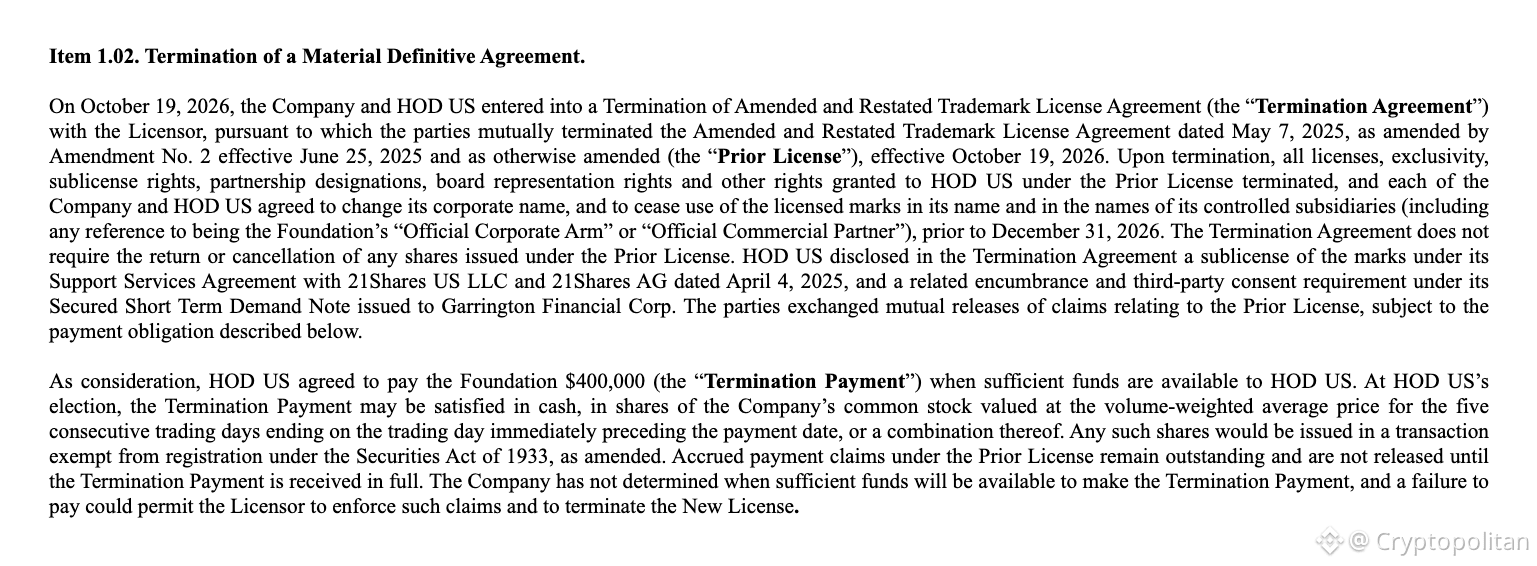
The deadline is part of the price of unwinding an exclusive trademark deal with the Dogecoin Foundation, as outlined in a Form 8-K filed with the SEC on October 23.
A new license covers only three 21Shares products until 2029
On October 19, the exclusive license was mutually terminated by both sides. It canceled the exclusivity, sub-licensing rights and partnership titles.
Neither company can any longer refer to itself as the Foundation’s “Official Corporate Arm” or “Official Commercial Partner.” Each must also scrub the marks from the names of its controlled subsidiaries.
House of Doge Inc. is the parent company, and trades on Nasdaq under HODO. Its Texas subsidiary, House of Doge (U.S.) Inc., was previously known as House of Doge Inc.
The company is contemplating a corporate rebrand, the filing says. It also plans to seek shareholder approval for a reverse stock split at its annual meeting.
CEO Marco Margiotta and CFO Charles Park resigned October 22. McQueen Labs chief executive Curt Hopkins took on both jobs on an interim basis.
On October 21, Dogecoin Labs was launched as the Foundation’s official commercial partner under CEO Jordan Jefferson.
The Dogecoin Foundation and MadeUpNumbers Ltd. grant the subsidiary a non-exclusive license to use the DOGECOIN and DOGE marks on only three products, as they existed on October 19, 2026.
They are the 21Shares Dogecoin ETF (TDOG), 21Shares Dogecoin ETP (DOGE) and 21Shares 2x Long Dogecoin ETF (TXXD). Any other product needs written approval from the Foundation, one product at a time.
Marks may not be used in corporate names, goods, payment products and unrelated financial products. New approved products pay the Foundation a percentage of net revenue, on a product-by-product basis, paid quarterly, with no minimum royalty and no up-front fee.
License expires October 19, 2029, with no automatic renewal. The 21Shares Dogecoin ETP has been trading in euros on Xetra and Gettex since April 8, 2025, with assets of around $9.49 million.
An unpaid $400,000 exit fee puts the new license at risk
The subsidiary agreed to pay the Foundation $400,000 to terminate the old deal, when it has enough money. Payment can be in cash, HODO shares, or both.
If a missed payment is not received within ten business days of notice, the Foundation may terminate the new license.
Accrued claims under the old license persist until the full $400,000 is collected.
Item 1.02 of House of Doge’s Form 8-K filed with the SEC on October 23, 2026, setting the name-change deadline and the $400,000 termination payment.
Separately, the subsidiary is moving Such App’s software, source code, domains and cloud infrastructure to Dogecoin Labs. In return, it obtains $4 million worth of Labs stock, valued at a $120 million fully diluted pre-money valuation.
Dogecoin Labs does not assume any of the subsidiary’s liabilities or contracts. Closing requires consents and lien releases from secured lenders, and either side can walk if nothing closes within 30 days of October 19, which is November 18.
The same filing also included a binding letter of intent to purchase McQueen Labs’ MCQ Markets token platform for $15 million, plus its microlending business. The LOI shall expire automatically if no definitive agreement is executed by December 15, 2026.
House of Doge built its identity on the brand Dogecoin. It went public on Nasdaq through a reverse merger with Brag House Holdings, a deal that received backing from 98% of votes cast by Brag House shareholders in April 2026.
House of Doge partnered with Paxos, the firm that manages crypto backends for PayPal, Venmo and Interactive Brokers, in June, according to Cryptopolitan. As of October 2025, it held more than 837 million DOGE with 21Shares.
Dogecoin Labs plans to merge DogeOS application infrastructure with the MyDoge wallet and Such App.
On October 25, DOGE shed 1.2% over 24 hours to about $0.077. U.S. Dogecoin funds saw net outflows of around $538,000 that week.
The smartest crypto minds already read our newsletter. Want in? Join them.
Dogecoin Foundation breakup forces House of Doge into a corporate rename
House of Doge and its U.S. subsidiary have until Dec. 31, 2026, to remove “Doge” from their corporate names.
The deadline is part of the price of unwinding an exclusive trademark deal with the Dogecoin Foundation, as outlined in a Form 8-K filed with the SEC on October 23.
A new license covers only three 21Shares products until 2029
On October 19, the exclusive license was mutually terminated by both sides. It canceled the exclusivity, sub-licensing rights and partnership titles.
Neither company can any longer refer to itself as the Foundation’s “Official Corporate Arm” or “Official Commercial Partner.” Each must also scrub the marks from the names of its controlled subsidiaries.
House of Doge Inc. is the parent company, and trades on Nasdaq under HODO. Its Texas subsidiary, House of Doge (U.S.) Inc., was previously known as House of Doge Inc.
The company is contemplating a corporate rebrand, the filing says. It also plans to seek shareholder approval for a reverse stock split at its annual meeting.
CEO Marco Margiotta and CFO Charles Park resigned October 22. McQueen Labs chief executive Curt Hopkins took on both jobs on an interim basis.
On October 21, Dogecoin Labs was launched as the Foundation’s official commercial partner under CEO Jordan Jefferson.
The Dogecoin Foundation and MadeUpNumbers Ltd. grant the subsidiary a non-exclusive license to use the DOGECOIN and DOGE marks on only three products, as they existed on October 19, 2026.
They are the 21Shares Dogecoin ETF (TDOG), 21Shares Dogecoin ETP (DOGE) and 21Shares 2x Long Dogecoin ETF (TXXD). Any other product needs written approval from the Foundation, one product at a time.
Marks may not be used in corporate names, goods, payment products and unrelated financial products. New approved products pay the Foundation a percentage of net revenue, on a product-by-product basis, paid quarterly, with no minimum royalty and no up-front fee.
License expires October 19, 2029, with no automatic renewal. The 21Shares Dogecoin ETP has been trading in euros on Xetra and Gettex since April 8, 2025, with assets of around $9.49 million.
An unpaid $400,000 exit fee puts the new license at risk
The subsidiary agreed to pay the Foundation $400,000 to terminate the old deal, when it has enough money. Payment can be in cash, HODO shares, or both.
If a missed payment is not received within ten business days of notice, the Foundation may terminate the new license.
Accrued claims under the old license persist until the full $400,000 is collected.
Item 1.02 of House of Doge’s Form 8-K filed with the SEC on October 23, 2026, setting the name-change deadline and the $400,000 termination payment.
Separately, the subsidiary is moving Such App’s software, source code, domains and cloud infrastructure to Dogecoin Labs. In return, it obtains $4 million worth of Labs stock, valued at a $120 million fully diluted pre-money valuation.
Dogecoin Labs does not assume any of the subsidiary’s liabilities or contracts. Closing requires consents and lien releases from secured lenders, and either side can walk if nothing closes within 30 days of October 19, which is November 18.
The same filing also included a binding letter of intent to purchase McQueen Labs’ MCQ Markets token platform for $15 million, plus its microlending business. The LOI shall expire automatically if no definitive agreement is executed by December 15, 2026.
House of Doge built its identity on the brand Dogecoin. It went public on Nasdaq through a reverse merger with Brag House Holdings, a deal that received backing from 98% of votes cast by Brag House shareholders in April 2026.
House of Doge partnered with Paxos, the firm that manages crypto backends for PayPal, Venmo and Interactive Brokers, in June, according to Cryptopolitan. As of October 2025, it held more than 837 million DOGE with 21Shares.
Dogecoin Labs plans to merge DogeOS application infrastructure with the MyDoge wallet and Such App.
On October 25, DOGE shed 1.2% over 24 hours to about $0.077. U.S. Dogecoin funds saw net outflows of around $538,000 that week.
The smartest crypto minds already read our newsletter. Want in? Join them.
The deadline is part of the price of unwinding an exclusive trademark deal with the Dogecoin Foundation, as outlined in a Form 8-K filed with the SEC on October 23.
A new license covers only three 21Shares products until 2029
On October 19, the exclusive license was mutually terminated by both sides. It canceled the exclusivity, sub-licensing rights and partnership titles.
Neither company can any longer refer to itself as the Foundation’s “Official Corporate Arm” or “Official Commercial Partner.” Each must also scrub the marks from the names of its controlled subsidiaries.
House of Doge Inc. is the parent company, and trades on Nasdaq under HODO. Its Texas subsidiary, House of Doge (U.S.) Inc., was previously known as House of Doge Inc.
The company is contemplating a corporate rebrand, the filing says. It also plans to seek shareholder approval for a reverse stock split at its annual meeting.
CEO Marco Margiotta and CFO Charles Park resigned October 22. McQueen Labs chief executive Curt Hopkins took on both jobs on an interim basis.
On October 21, Dogecoin Labs was launched as the Foundation’s official commercial partner under CEO Jordan Jefferson.
The Dogecoin Foundation and MadeUpNumbers Ltd. grant the subsidiary a non-exclusive license to use the DOGECOIN and DOGE marks on only three products, as they existed on October 19, 2026.
They are the 21Shares Dogecoin ETF (TDOG), 21Shares Dogecoin ETP (DOGE) and 21Shares 2x Long Dogecoin ETF (TXXD). Any other product needs written approval from the Foundation, one product at a time.
Marks may not be used in corporate names, goods, payment products and unrelated financial products. New approved products pay the Foundation a percentage of net revenue, on a product-by-product basis, paid quarterly, with no minimum royalty and no up-front fee.
License expires October 19, 2029, with no automatic renewal. The 21Shares Dogecoin ETP has been trading in euros on Xetra and Gettex since April 8, 2025, with assets of around $9.49 million.
An unpaid $400,000 exit fee puts the new license at risk
The subsidiary agreed to pay the Foundation $400,000 to terminate the old deal, when it has enough money. Payment can be in cash, HODO shares, or both.
If a missed payment is not received within ten business days of notice, the Foundation may terminate the new license.
Accrued claims under the old license persist until the full $400,000 is collected.
Item 1.02 of House of Doge’s Form 8-K filed with the SEC on October 23, 2026, setting the name-change deadline and the $400,000 termination payment.
Separately, the subsidiary is moving Such App’s software, source code, domains and cloud infrastructure to Dogecoin Labs. In return, it obtains $4 million worth of Labs stock, valued at a $120 million fully diluted pre-money valuation.
Dogecoin Labs does not assume any of the subsidiary’s liabilities or contracts. Closing requires consents and lien releases from secured lenders, and either side can walk if nothing closes within 30 days of October 19, which is November 18.
The same filing also included a binding letter of intent to purchase McQueen Labs’ MCQ Markets token platform for $15 million, plus its microlending business. The LOI shall expire automatically if no definitive agreement is executed by December 15, 2026.
House of Doge built its identity on the brand Dogecoin. It went public on Nasdaq through a reverse merger with Brag House Holdings, a deal that received backing from 98% of votes cast by Brag House shareholders in April 2026.
House of Doge partnered with Paxos, the firm that manages crypto backends for PayPal, Venmo and Interactive Brokers, in June, according to Cryptopolitan. As of October 2025, it held more than 837 million DOGE with 21Shares.
Dogecoin Labs plans to merge DogeOS application infrastructure with the MyDoge wallet and Such App.
On October 25, DOGE shed 1.2% over 24 hours to about $0.077. U.S. Dogecoin funds saw net outflows of around $538,000 that week.
The smartest crypto minds already read our newsletter. Want in? Join them.
DOGE+1.00%
TXXDETF-0.89%
36
Bitcoin and gold are 2026’s worst-performing major assetsBitcoin and gold are having the kind of year their biggest supporters usually warn everyone else about. Both are sitting at the bottom of the major investment rankings for 2026, while cash parked in short-term US Treasury bills is actually making money.
Creative Planning strategist Charlie Bilello puts Bitcoin’s loss at 7.3% and gold’s at 7.5% through October 25. He says his records have never shown the two ranking together in last place during any calendar year.
Bitcoin and gold are losing while stocks and commodities climb
The comparison gets worse when you look at what else investors could have owned. A broad commodities basket has jumped 52.5% this year. Large US stocks have gained 12.3%, and short-term Treasury bills have returned 2.9%.
That last number is particularly painful for anyone who bought Bitcoin or bullion to escape the problems of ordinary money.
Bilello tracks 21 asset classes going back to 2011. Only 57% are showing positive returns in 2026, so it hasn’t been an easy year across the board. Still, the two assets often sold as protection against inflation and economic chaos have ended up trailing even conservative investments.
Source: Charlie Bilello/X
Gold’s reversal has been especially sharp. It surged 63.7% in 2025, the strongest year in Bilello’s table, then climbed above $5,400 an ounce early in 2026. By Friday, spot prices had dropped to $3,995.81, slipping under $4,000 for the first time since July.
Bullion recovered slightly on Monday. Spot gold rose 0.3% to $4,008.70 by 0755 GMT, while US gold futures for December delivery advanced 0.3% to $4,021.90. That came after a 4% weekly decline, the steepest since June, and a move to the lowest spot price since mid-July.
Bitcoin hasn’t offered much comfort either. The crypto is priced at $80,472, around 35% below its record above $126,000 last October. If its losses hold, 2026 will become its second consecutive negative year, following a 6.3% decline in 2025.
That doesn’t erase its longer history. Since 2011, Bilello calculates an average yearly return of 120.6% for Bitcoin, compared with 6.3% for gold. But historical averages don’t pay this year’s bills.
Oil prices and Fed expectations are making things harder
This is the challenge facing both assets, since neither earns interest. When US interest rates are expected to go higher, bonds along with all other interest-earning investments become more attractive. Holding on to either gold or Bitcoin therefore becomes even more costly.
And there’s also oil putting additional pressure on inflation expectations. Brent crude reached $116 per barrel on Friday as tensions escalated between the US and Iran. High energy prices could increase consumer prices and give the Fed another reason to maintain tight monetary policy.
ING analysts said the precious metal couldn’t even benefit from a selloff in technology shares. Instead, they said the market:
“…appears more focused on higher oil prices and what it could mean for inflation.”
There are efforts to cool the situation. Qatari mediators were in Tehran on Sunday, coordinating with the United States to ease regional tensions.
The October 27-28 FOMC meeting is another important event to look out for. Investors expect interest rates to remain unchanged for now; however, expectations for an increase in December have increased significantly: according to one CME FedWatch estimate, the probability is currently 68%, whereas another one is as high as 79%.
Another event to keep an eye on is the PCE inflation data release scheduled for Thursday, which is one of the indicators used by the Fed in its efforts to reach 2% inflation rate target.
There is another wrinkle in Bitcoin’s story. Despite Wall Street’s growing involvement, researchers still cannot identify the owners of most coins. Galaxy’s October snapshot classified 11.1 million BTC, roughly 55% of total supply, as unattributed.
Galaxy research head Alex Thorn wrote on X:
“More than half of all BTC supply is sitting in addresses with no known attribution despite all the institutionalization and centralized ownership over the years, still a ton of bitcoin (maybe even most) is held by individuals in self-custody.”
This number is not conclusive evidence that every unknown wallet is owned by individuals. This could be institutional accounts that were unidentified by Galaxy, and also coins whose private keys were lost by their owners.
In other metals trading, silver climbed by 0.2% to reach $54, platinum declined by 0.3% to $1,546.18 and palladium declined by 0.5% to $1,038.85. There are only two months left before the end of 2026.
The smartest crypto minds already read our newsletter. Want in? Join them.
Bitcoin and gold are 2026’s worst-performing major assets
Bitcoin and gold are having the kind of year their biggest supporters usually warn everyone else about. Both are sitting at the bottom of the major investment rankings for 2026, while cash parked in short-term US Treasury bills is actually making money.
Creative Planning strategist Charlie Bilello puts Bitcoin’s loss at 7.3% and gold’s at 7.5% through October 25. He says his records have never shown the two ranking together in last place during any calendar year.
Bitcoin and gold are losing while stocks and commodities climb
The comparison gets worse when you look at what else investors could have owned. A broad commodities basket has jumped 52.5% this year. Large US stocks have gained 12.3%, and short-term Treasury bills have returned 2.9%.
That last number is particularly painful for anyone who bought Bitcoin or bullion to escape the problems of ordinary money.
Bilello tracks 21 asset classes going back to 2011. Only 57% are showing positive returns in 2026, so it hasn’t been an easy year across the board. Still, the two assets often sold as protection against inflation and economic chaos have ended up trailing even conservative investments.
Source: Charlie Bilello/X
Gold’s reversal has been especially sharp. It surged 63.7% in 2025, the strongest year in Bilello’s table, then climbed above $5,400 an ounce early in 2026. By Friday, spot prices had dropped to $3,995.81, slipping under $4,000 for the first time since July.
Bullion recovered slightly on Monday. Spot gold rose 0.3% to $4,008.70 by 0755 GMT, while US gold futures for December delivery advanced 0.3% to $4,021.90. That came after a 4% weekly decline, the steepest since June, and a move to the lowest spot price since mid-July.
Bitcoin hasn’t offered much comfort either. The crypto is priced at $80,472, around 35% below its record above $126,000 last October. If its losses hold, 2026 will become its second consecutive negative year, following a 6.3% decline in 2025.
That doesn’t erase its longer history. Since 2011, Bilello calculates an average yearly return of 120.6% for Bitcoin, compared with 6.3% for gold. But historical averages don’t pay this year’s bills.
Oil prices and Fed expectations are making things harder
This is the challenge facing both assets, since neither earns interest. When US interest rates are expected to go higher, bonds along with all other interest-earning investments become more attractive. Holding on to either gold or Bitcoin therefore becomes even more costly.
And there’s also oil putting additional pressure on inflation expectations. Brent crude reached $116 per barrel on Friday as tensions escalated between the US and Iran. High energy prices could increase consumer prices and give the Fed another reason to maintain tight monetary policy.
ING analysts said the precious metal couldn’t even benefit from a selloff in technology shares. Instead, they said the market:
“…appears more focused on higher oil prices and what it could mean for inflation.”
There are efforts to cool the situation. Qatari mediators were in Tehran on Sunday, coordinating with the United States to ease regional tensions.
The October 27-28 FOMC meeting is another important event to look out for. Investors expect interest rates to remain unchanged for now; however, expectations for an increase in December have increased significantly: according to one CME FedWatch estimate, the probability is currently 68%, whereas another one is as high as 79%.
Another event to keep an eye on is the PCE inflation data release scheduled for Thursday, which is one of the indicators used by the Fed in its efforts to reach 2% inflation rate target.
There is another wrinkle in Bitcoin’s story. Despite Wall Street’s growing involvement, researchers still cannot identify the owners of most coins. Galaxy’s October snapshot classified 11.1 million BTC, roughly 55% of total supply, as unattributed.
Galaxy research head Alex Thorn wrote on X:
“More than half of all BTC supply is sitting in addresses with no known attribution despite all the institutionalization and centralized ownership over the years, still a ton of bitcoin (maybe even most) is held by individuals in self-custody.”
This number is not conclusive evidence that every unknown wallet is owned by individuals. This could be institutional accounts that were unidentified by Galaxy, and also coins whose private keys were lost by their owners.
In other metals trading, silver climbed by 0.2% to reach $54, platinum declined by 0.3% to $1,546.18 and palladium declined by 0.5% to $1,038.85. There are only two months left before the end of 2026.
The smartest crypto minds already read our newsletter. Want in? Join them.
Creative Planning strategist Charlie Bilello puts Bitcoin’s loss at 7.3% and gold’s at 7.5% through October 25. He says his records have never shown the two ranking together in last place during any calendar year.
Bitcoin and gold are losing while stocks and commodities climb
The comparison gets worse when you look at what else investors could have owned. A broad commodities basket has jumped 52.5% this year. Large US stocks have gained 12.3%, and short-term Treasury bills have returned 2.9%.
That last number is particularly painful for anyone who bought Bitcoin or bullion to escape the problems of ordinary money.
Bilello tracks 21 asset classes going back to 2011. Only 57% are showing positive returns in 2026, so it hasn’t been an easy year across the board. Still, the two assets often sold as protection against inflation and economic chaos have ended up trailing even conservative investments.
Source: Charlie Bilello/X
Gold’s reversal has been especially sharp. It surged 63.7% in 2025, the strongest year in Bilello’s table, then climbed above $5,400 an ounce early in 2026. By Friday, spot prices had dropped to $3,995.81, slipping under $4,000 for the first time since July.
Bullion recovered slightly on Monday. Spot gold rose 0.3% to $4,008.70 by 0755 GMT, while US gold futures for December delivery advanced 0.3% to $4,021.90. That came after a 4% weekly decline, the steepest since June, and a move to the lowest spot price since mid-July.
Bitcoin hasn’t offered much comfort either. The crypto is priced at $80,472, around 35% below its record above $126,000 last October. If its losses hold, 2026 will become its second consecutive negative year, following a 6.3% decline in 2025.
That doesn’t erase its longer history. Since 2011, Bilello calculates an average yearly return of 120.6% for Bitcoin, compared with 6.3% for gold. But historical averages don’t pay this year’s bills.
Oil prices and Fed expectations are making things harder
This is the challenge facing both assets, since neither earns interest. When US interest rates are expected to go higher, bonds along with all other interest-earning investments become more attractive. Holding on to either gold or Bitcoin therefore becomes even more costly.
And there’s also oil putting additional pressure on inflation expectations. Brent crude reached $116 per barrel on Friday as tensions escalated between the US and Iran. High energy prices could increase consumer prices and give the Fed another reason to maintain tight monetary policy.
ING analysts said the precious metal couldn’t even benefit from a selloff in technology shares. Instead, they said the market:
“…appears more focused on higher oil prices and what it could mean for inflation.”
There are efforts to cool the situation. Qatari mediators were in Tehran on Sunday, coordinating with the United States to ease regional tensions.
The October 27-28 FOMC meeting is another important event to look out for. Investors expect interest rates to remain unchanged for now; however, expectations for an increase in December have increased significantly: according to one CME FedWatch estimate, the probability is currently 68%, whereas another one is as high as 79%.
Another event to keep an eye on is the PCE inflation data release scheduled for Thursday, which is one of the indicators used by the Fed in its efforts to reach 2% inflation rate target.
There is another wrinkle in Bitcoin’s story. Despite Wall Street’s growing involvement, researchers still cannot identify the owners of most coins. Galaxy’s October snapshot classified 11.1 million BTC, roughly 55% of total supply, as unattributed.
Galaxy research head Alex Thorn wrote on X:
“More than half of all BTC supply is sitting in addresses with no known attribution despite all the institutionalization and centralized ownership over the years, still a ton of bitcoin (maybe even most) is held by individuals in self-custody.”
This number is not conclusive evidence that every unknown wallet is owned by individuals. This could be institutional accounts that were unidentified by Galaxy, and also coins whose private keys were lost by their owners.
In other metals trading, silver climbed by 0.2% to reach $54, platinum declined by 0.3% to $1,546.18 and palladium declined by 0.5% to $1,038.85. There are only two months left before the end of 2026.
The smartest crypto minds already read our newsletter. Want in? Join them.
32
Grok Imagine's Odyssey shows up as a seven-minute first episode of Musk's promised filmGrok Imagine dropped the first seven minutes of an AI-generated “Odyssey” on Friday, three months after Elon Musk vowed a full-length feature of Homer’s epic.
The account brands the clip as “Episode 1 of our Odyssey series.”
Wonder Studios and director Dev Walker share credit on the 4K release
In July, Musk wrote on X, “Before this year ends, Grok Imagine will make a full-length movie of The Odyssey that is historically accurate and true to the art of Homer.” In his post he quoted a short dialogue scene built with the tool.
The release was uploaded in 4K on Oct. 23 and is just over seven minutes long. Wonder Studios and director Dev Walker are credited as creative collaborators by SpaceXSI’s image and video generator Grok Imagine.
That night Musk shared the episode with a four-word caption: “Odyssey with Grok Imagine.”
Wonder Studios, which makes films and commercials, reposted the clip. “Homer didn’t have Grok… we do,” the studio wrote.
In the comments, Grok Imagine asked viewers if they wanted “a full breakdown of how it was done.”
The post for Episode 1 had picked up more than 19,000 likes and 2,100 reposts and some 6 million views by Monday.
Watch Episode 1 of our Odyssey series made with Grok Imagine.
Let us know in the comments if you’d like a full breakdown of how it was done!
Creative collaboration with @WonderStudiosX and director Dev Walker @glumlot_ https://t.co/xpgpkqSCpq
— Grok Imagine (@imagine) October 23, 2026
Reviewer Anthony Ha finds no artistry in the AI footage
Musk had denounced Christopher Nolan’s take on “The Odyssey” for casting transgender and nonwhite actors. Nolan said he had never seen a technology “so completely rejected by the public” before AI.
Nolan’s movie was released in July, after filming in six countries, mostly with practical effects. IMAX tickets were sold out for months and the film is a favorite to win at the next Academy Awards.
Anthony Ha, a reviewer, said some of Grok’s shots could look like real actors on a real sea. “What the footage really lacks is any sense of artistry, inspiration, or human interest,” Ha wrote.
Nolan’s movie is about three hours long and he took it in without a hitch. He glanced at his watch before it was halfway through with Grok’s clip.
He also took a shot at the cast being all one color, and the narrator having a British accent.
The Odyssey series is within a bigger push for Grok. SpaceXSI set up a partner network last week to bring Grok to big business.
A Tesla engineer said Grok helped tune the Cybertruck’s new rear-view camera view.
Grok Imagine is also under the legal gun. As Cryptopolitan reported in September, a federal judge upheld Minnesota’s ban on AI nudification tools and denied xAI’s request to block it.
Minnesota Attorney General Keith Ellison said the law prevents products such as Grok Imagine from producing sexualized images. Musk wants the full feature ready by the end of 2026.
Don’t just read crypto news. Understand it. Subscribe to our newsletter. It's free.
Grok Imagine's Odyssey shows up as a seven-minute first episode of Musk's promised film
Grok Imagine dropped the first seven minutes of an AI-generated “Odyssey” on Friday, three months after Elon Musk vowed a full-length feature of Homer’s epic.
The account brands the clip as “Episode 1 of our Odyssey series.”
Wonder Studios and director Dev Walker share credit on the 4K release
In July, Musk wrote on X, “Before this year ends, Grok Imagine will make a full-length movie of The Odyssey that is historically accurate and true to the art of Homer.” In his post he quoted a short dialogue scene built with the tool.
The release was uploaded in 4K on Oct. 23 and is just over seven minutes long. Wonder Studios and director Dev Walker are credited as creative collaborators by SpaceXSI’s image and video generator Grok Imagine.
That night Musk shared the episode with a four-word caption: “Odyssey with Grok Imagine.”
Wonder Studios, which makes films and commercials, reposted the clip. “Homer didn’t have Grok… we do,” the studio wrote.
In the comments, Grok Imagine asked viewers if they wanted “a full breakdown of how it was done.”
The post for Episode 1 had picked up more than 19,000 likes and 2,100 reposts and some 6 million views by Monday.
Watch Episode 1 of our Odyssey series made with Grok Imagine.
Let us know in the comments if you’d like a full breakdown of how it was done!
Creative collaboration with @WonderStudiosX and director Dev Walker @glumlot_ https://t.co/xpgpkqSCpq
— Grok Imagine (@imagine) October 23, 2026
Reviewer Anthony Ha finds no artistry in the AI footage
Musk had denounced Christopher Nolan’s take on “The Odyssey” for casting transgender and nonwhite actors. Nolan said he had never seen a technology “so completely rejected by the public” before AI.
Nolan’s movie was released in July, after filming in six countries, mostly with practical effects. IMAX tickets were sold out for months and the film is a favorite to win at the next Academy Awards.
Anthony Ha, a reviewer, said some of Grok’s shots could look like real actors on a real sea. “What the footage really lacks is any sense of artistry, inspiration, or human interest,” Ha wrote.
Nolan’s movie is about three hours long and he took it in without a hitch. He glanced at his watch before it was halfway through with Grok’s clip.
He also took a shot at the cast being all one color, and the narrator having a British accent.
The Odyssey series is within a bigger push for Grok. SpaceXSI set up a partner network last week to bring Grok to big business.
A Tesla engineer said Grok helped tune the Cybertruck’s new rear-view camera view.
Grok Imagine is also under the legal gun. As Cryptopolitan reported in September, a federal judge upheld Minnesota’s ban on AI nudification tools and denied xAI’s request to block it.
Minnesota Attorney General Keith Ellison said the law prevents products such as Grok Imagine from producing sexualized images. Musk wants the full feature ready by the end of 2026.
Don’t just read crypto news. Understand it. Subscribe to our newsletter. It's free.
The account brands the clip as “Episode 1 of our Odyssey series.”
Wonder Studios and director Dev Walker share credit on the 4K release
In July, Musk wrote on X, “Before this year ends, Grok Imagine will make a full-length movie of The Odyssey that is historically accurate and true to the art of Homer.” In his post he quoted a short dialogue scene built with the tool.
The release was uploaded in 4K on Oct. 23 and is just over seven minutes long. Wonder Studios and director Dev Walker are credited as creative collaborators by SpaceXSI’s image and video generator Grok Imagine.
That night Musk shared the episode with a four-word caption: “Odyssey with Grok Imagine.”
Wonder Studios, which makes films and commercials, reposted the clip. “Homer didn’t have Grok… we do,” the studio wrote.
In the comments, Grok Imagine asked viewers if they wanted “a full breakdown of how it was done.”
The post for Episode 1 had picked up more than 19,000 likes and 2,100 reposts and some 6 million views by Monday.
Watch Episode 1 of our Odyssey series made with Grok Imagine.
Let us know in the comments if you’d like a full breakdown of how it was done!
Creative collaboration with @WonderStudiosX and director Dev Walker @glumlot_ https://t.co/xpgpkqSCpq
— Grok Imagine (@imagine) October 23, 2026
Reviewer Anthony Ha finds no artistry in the AI footage
Musk had denounced Christopher Nolan’s take on “The Odyssey” for casting transgender and nonwhite actors. Nolan said he had never seen a technology “so completely rejected by the public” before AI.
Nolan’s movie was released in July, after filming in six countries, mostly with practical effects. IMAX tickets were sold out for months and the film is a favorite to win at the next Academy Awards.
Anthony Ha, a reviewer, said some of Grok’s shots could look like real actors on a real sea. “What the footage really lacks is any sense of artistry, inspiration, or human interest,” Ha wrote.
Nolan’s movie is about three hours long and he took it in without a hitch. He glanced at his watch before it was halfway through with Grok’s clip.
He also took a shot at the cast being all one color, and the narrator having a British accent.
The Odyssey series is within a bigger push for Grok. SpaceXSI set up a partner network last week to bring Grok to big business.
A Tesla engineer said Grok helped tune the Cybertruck’s new rear-view camera view.
Grok Imagine is also under the legal gun. As Cryptopolitan reported in September, a federal judge upheld Minnesota’s ban on AI nudification tools and denied xAI’s request to block it.
Minnesota Attorney General Keith Ellison said the law prevents products such as Grok Imagine from producing sexualized images. Musk wants the full feature ready by the end of 2026.
Don’t just read crypto news. Understand it. Subscribe to our newsletter. It's free.
28
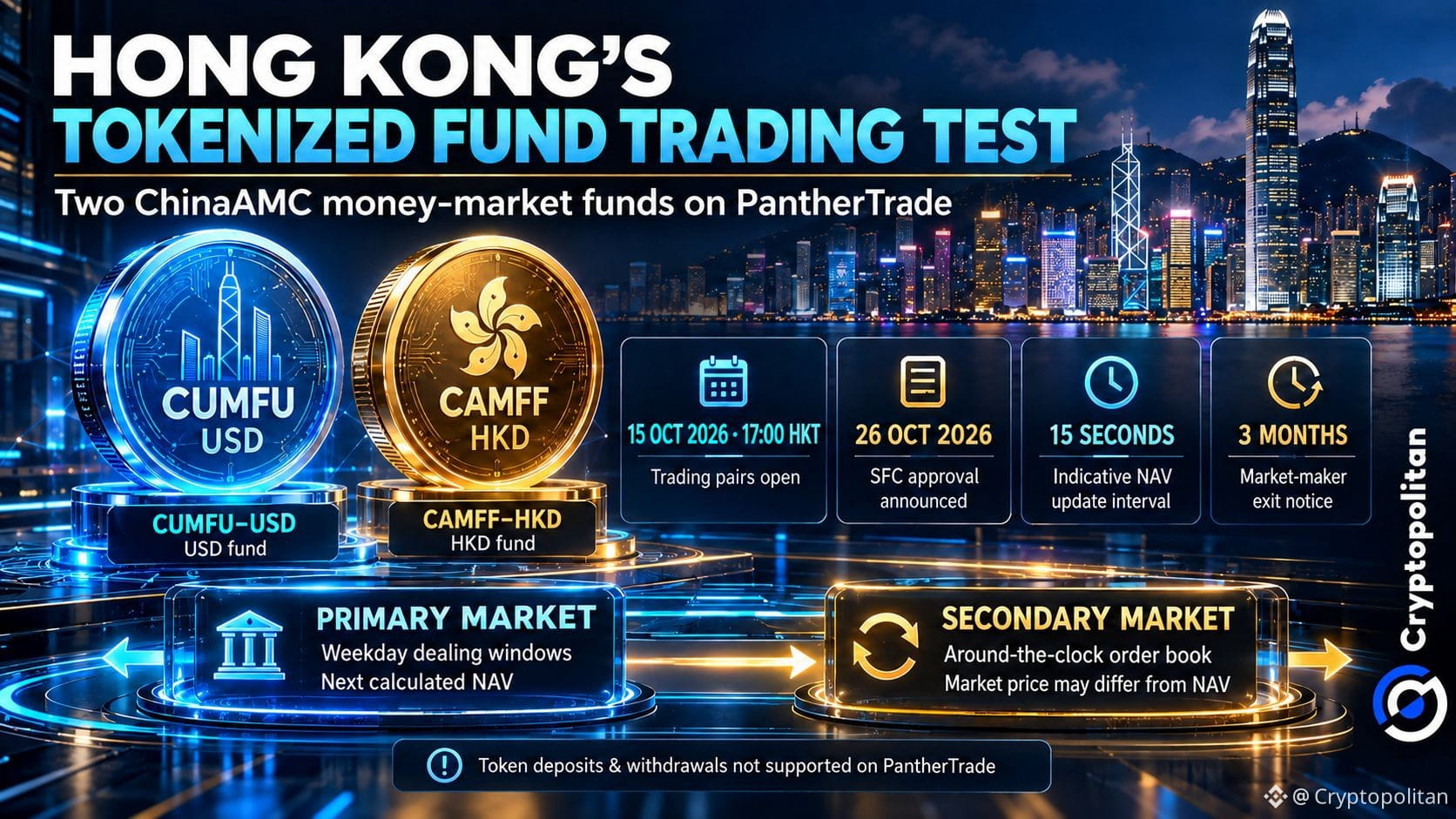
ලිපිය
Hong Kong clears secondary trading of tokenized money-market fundsThe Securities and Futures Commission (SFC) of Hong Kong has granted approval for its inaugural secondary market trading involving tokenized public funds on October 26, 2026. Two ChinaAMC money-market funds can now trade on a licensed exchange, allowing investors greater flexibility in managing their investments. The focus now remains on whether extended trading hours will really provide liquidity.
From an April rulebook to a working market
In its circular dated April 20, 2026, the SFC extended the application of its November 2023 tokenization guidelines beyond primary subscriptions and redemptions. As per lawyers at King & Wood Mallesons, the applied framework has its roots in the rules governing ETFs.
SFC chief executive Julia Leung explained the goal:
“This initiative allows a traditional securities product, once tokenised, to be traded in the evening and on weekends”
— Julia Leung, in an April 20 statement.
Two ChinaAMC funds live on PantherTrade
As reported by PantherTrade, CUMFU-USD and CAMFF-HKD began trading on October 15, 2026, at 17:00 HKT. Both tokens are categorized as suitable for individual as well as institutional investors.
Each token represents a full or fractional share in ChinaAMC’s USD or HKD Digital Money Market Fund. Ownership is officially recorded off-chain, while PantherTrade does not allow users to deposit or withdraw the tokens.
Based on HKEX’s website, ChinaAMC’s fund in USD has reportedly been valued at US$564.33 million while that in HKD has US$98.40 million, yielding a total of US$662.73 million for both funds. However, this total refers to the whole funds rather than their tokenized share classes or trading on PantherTrade.
What secondary trading actually changes
In the primary market, investors subscribe to or redeem shares directly with the funds. These transactions generally take place during weekday dealing windows and use the next calculated NAV.
In the secondary market, investors buy and sell tokenized shares through PantherTrade. Trading can continue outside regular dealing windows. However, prices depend on market demand and may differ from NAV.
Trading volume and order-book depth for both pairs could not be independently verified. Without these figures, it remains difficult to assess how much trading activity and liquidity the funds have attracted.
Market makers, NAV alerts, and kill switches
Under the SFC’s rules, fund providers must make every effort to arrange at least one market maker for each product. At least one must give three months’ notice before leaving.
In order to avoid price exploitation of investors, platforms need to show indicative NAV values at least every 15 seconds. If a proposed trade deviates considerably from the indicative NAV, alerts are generated. Alerts are not generated every 15 seconds.
There are other safeguards including trade bands, cooling-off periods and risk disclosures.
Hong Kong’s Tokenized Fund Trading Test: ChinaAMC on PantherTrade
Why global asset managers are watching
Investor interest motivates asset managers to pay close attention to the tokenized fund industry in Hong Kong. An October 2025 survey by BCG/Aptos indicated that out of the respondents, 61% planned to increase their fund allocation because of the benefits of tokenization. However, interest alone is not sufficient to guarantee that trading will take place.
Hong Kong has been working on the infrastructure necessary for this market. The HKMA’s pilot in October 2025 investigated the use of digital currency for settlement of tokenized funds. According to Cryptopolitan, the HKMA revealed its intention to apply round-the-clock on-chain settlement on September 23, 2026. Also, Standard Chartered decided to use HKDAP for the settlement of tokenized money market funds in the last quarter of 2026. The question for global asset managers is whether these innovations will create real liquidity out of investors’ interest.
24/7 does not mean instant liquidity
Round-the-clock trading gives investors more opportunities to buy and sell, but it cannot guarantee that buyers will be available. Market makers help provide liquidity, although they can leave after giving notice. Trading can also be halted, while PantherTrade’s restrictions on token deposits and withdrawals limit investors’ flexibility.
Hong Kong’s real test is whether these markets can attract enough trading activity to provide reliable liquidity, particularly outside regular market hours.
The smartest crypto minds already read our newsletter. Want in? Join them.
Hong Kong clears secondary trading of tokenized money-market funds
The Securities and Futures Commission (SFC) of Hong Kong has granted approval for its inaugural secondary market trading involving tokenized public funds on October 26, 2026. Two ChinaAMC money-market funds can now trade on a licensed exchange, allowing investors greater flexibility in managing their investments. The focus now remains on whether extended trading hours will really provide liquidity.
From an April rulebook to a working market
In its circular dated April 20, 2026, the SFC extended the application of its November 2023 tokenization guidelines beyond primary subscriptions and redemptions. As per lawyers at King & Wood Mallesons, the applied framework has its roots in the rules governing ETFs.
SFC chief executive Julia Leung explained the goal:
“This initiative allows a traditional securities product, once tokenised, to be traded in the evening and on weekends”
— Julia Leung, in an April 20 statement.
Two ChinaAMC funds live on PantherTrade
As reported by PantherTrade, CUMFU-USD and CAMFF-HKD began trading on October 15, 2026, at 17:00 HKT. Both tokens are categorized as suitable for individual as well as institutional investors.
Each token represents a full or fractional share in ChinaAMC’s USD or HKD Digital Money Market Fund. Ownership is officially recorded off-chain, while PantherTrade does not allow users to deposit or withdraw the tokens.
Based on HKEX’s website, ChinaAMC’s fund in USD has reportedly been valued at US$564.33 million while that in HKD has US$98.40 million, yielding a total of US$662.73 million for both funds. However, this total refers to the whole funds rather than their tokenized share classes or trading on PantherTrade.
What secondary trading actually changes
In the primary market, investors subscribe to or redeem shares directly with the funds. These transactions generally take place during weekday dealing windows and use the next calculated NAV.
In the secondary market, investors buy and sell tokenized shares through PantherTrade. Trading can continue outside regular dealing windows. However, prices depend on market demand and may differ from NAV.
Trading volume and order-book depth for both pairs could not be independently verified. Without these figures, it remains difficult to assess how much trading activity and liquidity the funds have attracted.
Market makers, NAV alerts, and kill switches
Under the SFC’s rules, fund providers must make every effort to arrange at least one market maker for each product. At least one must give three months’ notice before leaving.
In order to avoid price exploitation of investors, platforms need to show indicative NAV values at least every 15 seconds. If a proposed trade deviates considerably from the indicative NAV, alerts are generated. Alerts are not generated every 15 seconds.
There are other safeguards including trade bands, cooling-off periods and risk disclosures.
Hong Kong’s Tokenized Fund Trading Test: ChinaAMC on PantherTrade
Why global asset managers are watching
Investor interest motivates asset managers to pay close attention to the tokenized fund industry in Hong Kong. An October 2025 survey by BCG/Aptos indicated that out of the respondents, 61% planned to increase their fund allocation because of the benefits of tokenization. However, interest alone is not sufficient to guarantee that trading will take place.
Hong Kong has been working on the infrastructure necessary for this market. The HKMA’s pilot in October 2025 investigated the use of digital currency for settlement of tokenized funds. According to Cryptopolitan, the HKMA revealed its intention to apply round-the-clock on-chain settlement on September 23, 2026. Also, Standard Chartered decided to use HKDAP for the settlement of tokenized money market funds in the last quarter of 2026. The question for global asset managers is whether these innovations will create real liquidity out of investors’ interest.
24/7 does not mean instant liquidity
Round-the-clock trading gives investors more opportunities to buy and sell, but it cannot guarantee that buyers will be available. Market makers help provide liquidity, although they can leave after giving notice. Trading can also be halted, while PantherTrade’s restrictions on token deposits and withdrawals limit investors’ flexibility.
Hong Kong’s real test is whether these markets can attract enough trading activity to provide reliable liquidity, particularly outside regular market hours.
The smartest crypto minds already read our newsletter. Want in? Join them.
From an April rulebook to a working market
In its circular dated April 20, 2026, the SFC extended the application of its November 2023 tokenization guidelines beyond primary subscriptions and redemptions. As per lawyers at King & Wood Mallesons, the applied framework has its roots in the rules governing ETFs.
SFC chief executive Julia Leung explained the goal:
“This initiative allows a traditional securities product, once tokenised, to be traded in the evening and on weekends”
— Julia Leung, in an April 20 statement.
Two ChinaAMC funds live on PantherTrade
As reported by PantherTrade, CUMFU-USD and CAMFF-HKD began trading on October 15, 2026, at 17:00 HKT. Both tokens are categorized as suitable for individual as well as institutional investors.
Each token represents a full or fractional share in ChinaAMC’s USD or HKD Digital Money Market Fund. Ownership is officially recorded off-chain, while PantherTrade does not allow users to deposit or withdraw the tokens.
Based on HKEX’s website, ChinaAMC’s fund in USD has reportedly been valued at US$564.33 million while that in HKD has US$98.40 million, yielding a total of US$662.73 million for both funds. However, this total refers to the whole funds rather than their tokenized share classes or trading on PantherTrade.
What secondary trading actually changes
In the primary market, investors subscribe to or redeem shares directly with the funds. These transactions generally take place during weekday dealing windows and use the next calculated NAV.
In the secondary market, investors buy and sell tokenized shares through PantherTrade. Trading can continue outside regular dealing windows. However, prices depend on market demand and may differ from NAV.
Trading volume and order-book depth for both pairs could not be independently verified. Without these figures, it remains difficult to assess how much trading activity and liquidity the funds have attracted.
Market makers, NAV alerts, and kill switches
Under the SFC’s rules, fund providers must make every effort to arrange at least one market maker for each product. At least one must give three months’ notice before leaving.
In order to avoid price exploitation of investors, platforms need to show indicative NAV values at least every 15 seconds. If a proposed trade deviates considerably from the indicative NAV, alerts are generated. Alerts are not generated every 15 seconds.
There are other safeguards including trade bands, cooling-off periods and risk disclosures.
Hong Kong’s Tokenized Fund Trading Test: ChinaAMC on PantherTrade
Why global asset managers are watching
Investor interest motivates asset managers to pay close attention to the tokenized fund industry in Hong Kong. An October 2025 survey by BCG/Aptos indicated that out of the respondents, 61% planned to increase their fund allocation because of the benefits of tokenization. However, interest alone is not sufficient to guarantee that trading will take place.
Hong Kong has been working on the infrastructure necessary for this market. The HKMA’s pilot in October 2025 investigated the use of digital currency for settlement of tokenized funds. According to Cryptopolitan, the HKMA revealed its intention to apply round-the-clock on-chain settlement on September 23, 2026. Also, Standard Chartered decided to use HKDAP for the settlement of tokenized money market funds in the last quarter of 2026. The question for global asset managers is whether these innovations will create real liquidity out of investors’ interest.
24/7 does not mean instant liquidity
Round-the-clock trading gives investors more opportunities to buy and sell, but it cannot guarantee that buyers will be available. Market makers help provide liquidity, although they can leave after giving notice. Trading can also be halted, while PantherTrade’s restrictions on token deposits and withdrawals limit investors’ flexibility.
Hong Kong’s real test is whether these markets can attract enough trading activity to provide reliable liquidity, particularly outside regular market hours.
The smartest crypto minds already read our newsletter. Want in? Join them.
81
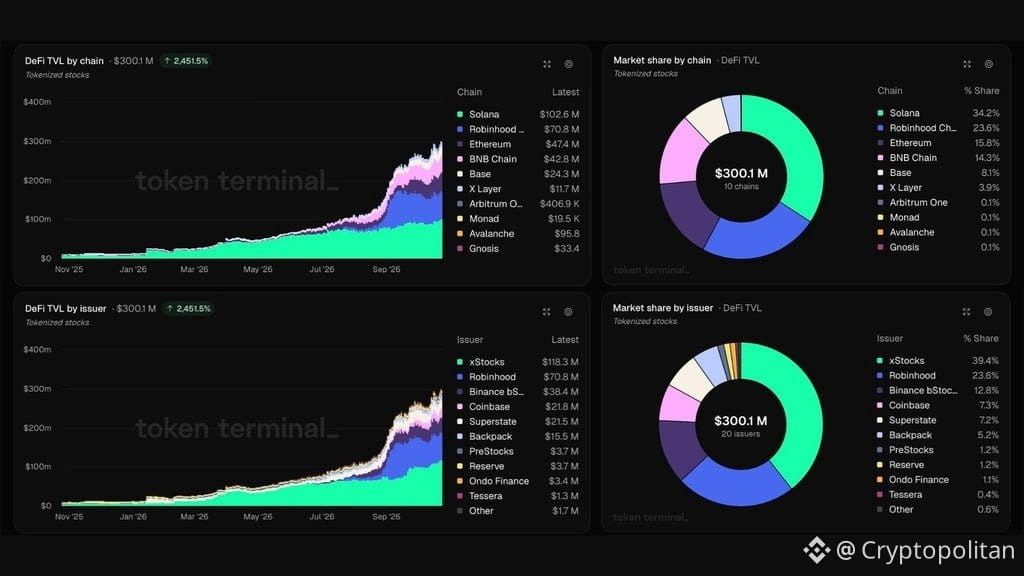
ලිපිය
Tokenized Stocks in DeFi Top $300 Million, Up 25x in a YearTokenized stocks deposited in DeFi protocols have crossed $300 million, according to the latest data from Token Terminal. Last month, we covered the year to date growth here and, at the time, this number stood at $262 million. Tokenized equities being put to work in DeFi have now grown by 2,451.5% from a year ago, when deposits were at around $11.8 million. For months, the growth in this space was gradual until August came along.
Deposits are now spread across 20 issuers and 10 chains. That said, the market is concentrated amongst a handful of names. The growth in tokenized equity holders pledging their assets as collateral, supplying them to liquidity pools and putting them to work for yield is no longer a speculative trend.
Most of the Growth Came After July
Tokenized stock total value locked (TVL) did not move much throughout the first half of 2026. It was only until August when there was a sharp climb in activity. At the start of Q3, it stood at $80.1 million and by September 30, this number had grown to $265 million. That’s an increase of around 230% in that quarter alone.
The timing lines up with two big launches beginning to gain traction. Binance enabled bStocks in June and Robinhood Chain’s public blockchain went live in July. Since then, Robinhood Chain has become the second largest chain for tokenized stock deposits in about three months, a clear sign of how quickly brokerage-scale distribution can reshape onchain market share.
Solana and xStocks Hold the Top Spots
In terms of Tokenized Stocks DeFi TVL by chain, Solana leads the pack with $102.6 million, or 34.2% market share. In second and third place are Robinhood Chain and Ethereum respectively. With BNB chain at $42.8 million and Base at $24.3 million, the top five chains make up about 96% of all deposits.
The issuer side is just heavily concentrated. xStocks holds over 39% of the market with $102.6 million ahead of Robinhood at $70.8 million and Binance’s bStocks at $38.4 million. Ondo Finance, one of the better known names in tokenized equities, accounts for just $3.4 million.
xStocks got there early. Its tokens are issued natively on Solana and have been plugged into lending markets like Kamino since July 2025, alongside liquidity pools on AMMs like Raydium. bStocks has grown past $1 billion in assets, yet only about $38 million of it sits in DeFi. Most bStocks are minted inside Binance accounts and appear to stay there, and the exchange now accepts them as margin for futures trading, none of which shows up in DeFi data.
Only 6.8% of Tokenized Stocks Are Being Put to Work
The total tokenized stock market is worth $4.4 billion, up 254.3% over the past 180 days and spread over 13,411 stocks from 36 issuers on 18 different chains. DeFi deposits make up only about 6.8% of that. If utilization climbs even modestly, DeFi deposits could grow faster than issuance itself.
The race for this collateral is turning into a contest between distribution models. Solana brings crypto-native liquidity and Robinhood Chain has a retail brokerage base behind it. BNB Chain leans on Binance’s exchange users, while Base has Coinbase.
There’s also a use case brokerages can’t offer. Stocks that trade around the clock and plug into lending protocols mean someone could borrow against NVDA on a Sunday or LP TSLA while Wall Street is closed. For now, only a small slice of the market is doing that.
If you're reading this, you’re already ahead. Stay there with our newsletter.
Tokenized Stocks in DeFi Top $300 Million, Up 25x in a Year
Tokenized stocks deposited in DeFi protocols have crossed $300 million, according to the latest data from Token Terminal. Last month, we covered the year to date growth here and, at the time, this number stood at $262 million. Tokenized equities being put to work in DeFi have now grown by 2,451.5% from a year ago, when deposits were at around $11.8 million. For months, the growth in this space was gradual until August came along.
Deposits are now spread across 20 issuers and 10 chains. That said, the market is concentrated amongst a handful of names. The growth in tokenized equity holders pledging their assets as collateral, supplying them to liquidity pools and putting them to work for yield is no longer a speculative trend.
Most of the Growth Came After July
Tokenized stock total value locked (TVL) did not move much throughout the first half of 2026. It was only until August when there was a sharp climb in activity. At the start of Q3, it stood at $80.1 million and by September 30, this number had grown to $265 million. That’s an increase of around 230% in that quarter alone.
The timing lines up with two big launches beginning to gain traction. Binance enabled bStocks in June and Robinhood Chain’s public blockchain went live in July. Since then, Robinhood Chain has become the second largest chain for tokenized stock deposits in about three months, a clear sign of how quickly brokerage-scale distribution can reshape onchain market share.
Solana and xStocks Hold the Top Spots
In terms of Tokenized Stocks DeFi TVL by chain, Solana leads the pack with $102.6 million, or 34.2% market share. In second and third place are Robinhood Chain and Ethereum respectively. With BNB chain at $42.8 million and Base at $24.3 million, the top five chains make up about 96% of all deposits.
The issuer side is just heavily concentrated. xStocks holds over 39% of the market with $102.6 million ahead of Robinhood at $70.8 million and Binance’s bStocks at $38.4 million. Ondo Finance, one of the better known names in tokenized equities, accounts for just $3.4 million.
xStocks got there early. Its tokens are issued natively on Solana and have been plugged into lending markets like Kamino since July 2025, alongside liquidity pools on AMMs like Raydium. bStocks has grown past $1 billion in assets, yet only about $38 million of it sits in DeFi. Most bStocks are minted inside Binance accounts and appear to stay there, and the exchange now accepts them as margin for futures trading, none of which shows up in DeFi data.
Only 6.8% of Tokenized Stocks Are Being Put to Work
The total tokenized stock market is worth $4.4 billion, up 254.3% over the past 180 days and spread over 13,411 stocks from 36 issuers on 18 different chains. DeFi deposits make up only about 6.8% of that. If utilization climbs even modestly, DeFi deposits could grow faster than issuance itself.
The race for this collateral is turning into a contest between distribution models. Solana brings crypto-native liquidity and Robinhood Chain has a retail brokerage base behind it. BNB Chain leans on Binance’s exchange users, while Base has Coinbase.
There’s also a use case brokerages can’t offer. Stocks that trade around the clock and plug into lending protocols mean someone could borrow against NVDA on a Sunday or LP TSLA while Wall Street is closed. For now, only a small slice of the market is doing that.
If you're reading this, you’re already ahead. Stay there with our newsletter.
Deposits are now spread across 20 issuers and 10 chains. That said, the market is concentrated amongst a handful of names. The growth in tokenized equity holders pledging their assets as collateral, supplying them to liquidity pools and putting them to work for yield is no longer a speculative trend.
Most of the Growth Came After July
Tokenized stock total value locked (TVL) did not move much throughout the first half of 2026. It was only until August when there was a sharp climb in activity. At the start of Q3, it stood at $80.1 million and by September 30, this number had grown to $265 million. That’s an increase of around 230% in that quarter alone.
The timing lines up with two big launches beginning to gain traction. Binance enabled bStocks in June and Robinhood Chain’s public blockchain went live in July. Since then, Robinhood Chain has become the second largest chain for tokenized stock deposits in about three months, a clear sign of how quickly brokerage-scale distribution can reshape onchain market share.
Solana and xStocks Hold the Top Spots
In terms of Tokenized Stocks DeFi TVL by chain, Solana leads the pack with $102.6 million, or 34.2% market share. In second and third place are Robinhood Chain and Ethereum respectively. With BNB chain at $42.8 million and Base at $24.3 million, the top five chains make up about 96% of all deposits.
The issuer side is just heavily concentrated. xStocks holds over 39% of the market with $102.6 million ahead of Robinhood at $70.8 million and Binance’s bStocks at $38.4 million. Ondo Finance, one of the better known names in tokenized equities, accounts for just $3.4 million.
xStocks got there early. Its tokens are issued natively on Solana and have been plugged into lending markets like Kamino since July 2025, alongside liquidity pools on AMMs like Raydium. bStocks has grown past $1 billion in assets, yet only about $38 million of it sits in DeFi. Most bStocks are minted inside Binance accounts and appear to stay there, and the exchange now accepts them as margin for futures trading, none of which shows up in DeFi data.
Only 6.8% of Tokenized Stocks Are Being Put to Work
The total tokenized stock market is worth $4.4 billion, up 254.3% over the past 180 days and spread over 13,411 stocks from 36 issuers on 18 different chains. DeFi deposits make up only about 6.8% of that. If utilization climbs even modestly, DeFi deposits could grow faster than issuance itself.
The race for this collateral is turning into a contest between distribution models. Solana brings crypto-native liquidity and Robinhood Chain has a retail brokerage base behind it. BNB Chain leans on Binance’s exchange users, while Base has Coinbase.
There’s also a use case brokerages can’t offer. Stocks that trade around the clock and plug into lending protocols mean someone could borrow against NVDA on a Sunday or LP TSLA while Wall Street is closed. For now, only a small slice of the market is doing that.
If you're reading this, you’re already ahead. Stay there with our newsletter.
184
Cryptopolitan Daily newsletter has reached 1 million monthly impressions and is expanding into em...The daily newsletter from Cryptopolitan now reaches 250,000 subscribers.
Cryptopolitan Daily, the daily email subscription service provided by the technology media outlet Cryptopolitan, achieved over one million total impressions per month during August 2026. The daily had 1.06 million total impressions across all 24 editions published in August 2026 and currently has 250,000 subscribers.
The newsletter has a brief overview of cryptocurrency, markets, technology, macro, and artificial intelligence for users to read in approximately four minutes. The concept is straightforward: the newsletter reads everything on behalf of its readers and provides them with the most significant news of each day.
From crypto to emerging tech
Cryptopolitan Daily is now producing specialized editions for each of its five focus areas of emerging technology: Artificial Intelligence (AI), Longevity, Space, Quantum Computing, and Robotics. The AI editions are published every Friday, with the other four alternating on Saturdays.
The move follows where its readers’ attention is going. Crypto investors and builders are increasingly tracking AI and frontier tech, and the special editions provide them with that coverage in the same place they already get their crypto and markets news. Reader response has been strong, and the newsletter intends to continue providing additional content to subscribers.
“We had readers who were interested in AI and frontier technologies, therefore we began covering those areas. The feedback from our early editions of emerging technology content has been positive, and we intend to expand upon this,” said Adi, Head of Operations at Cryptopolitan.
Readers can subscribe at: cryptopolitan.beehiiv.com
Cryptopolitan Daily newsletter has reached 1 million monthly impressions and is expanding into em...
The daily newsletter from Cryptopolitan now reaches 250,000 subscribers.
Cryptopolitan Daily, the daily email subscription service provided by the technology media outlet Cryptopolitan, achieved over one million total impressions per month during August 2026. The daily had 1.06 million total impressions across all 24 editions published in August 2026 and currently has 250,000 subscribers.
The newsletter has a brief overview of cryptocurrency, markets, technology, macro, and artificial intelligence for users to read in approximately four minutes. The concept is straightforward: the newsletter reads everything on behalf of its readers and provides them with the most significant news of each day.
From crypto to emerging tech
Cryptopolitan Daily is now producing specialized editions for each of its five focus areas of emerging technology: Artificial Intelligence (AI), Longevity, Space, Quantum Computing, and Robotics. The AI editions are published every Friday, with the other four alternating on Saturdays.
The move follows where its readers’ attention is going. Crypto investors and builders are increasingly tracking AI and frontier tech, and the special editions provide them with that coverage in the same place they already get their crypto and markets news. Reader response has been strong, and the newsletter intends to continue providing additional content to subscribers.
“We had readers who were interested in AI and frontier technologies, therefore we began covering those areas. The feedback from our early editions of emerging technology content has been positive, and we intend to expand upon this,” said Adi, Head of Operations at Cryptopolitan.
Readers can subscribe at: cryptopolitan.beehiiv.com
Cryptopolitan Daily, the daily email subscription service provided by the technology media outlet Cryptopolitan, achieved over one million total impressions per month during August 2026. The daily had 1.06 million total impressions across all 24 editions published in August 2026 and currently has 250,000 subscribers.
The newsletter has a brief overview of cryptocurrency, markets, technology, macro, and artificial intelligence for users to read in approximately four minutes. The concept is straightforward: the newsletter reads everything on behalf of its readers and provides them with the most significant news of each day.
From crypto to emerging tech
Cryptopolitan Daily is now producing specialized editions for each of its five focus areas of emerging technology: Artificial Intelligence (AI), Longevity, Space, Quantum Computing, and Robotics. The AI editions are published every Friday, with the other four alternating on Saturdays.
The move follows where its readers’ attention is going. Crypto investors and builders are increasingly tracking AI and frontier tech, and the special editions provide them with that coverage in the same place they already get their crypto and markets news. Reader response has been strong, and the newsletter intends to continue providing additional content to subscribers.
“We had readers who were interested in AI and frontier technologies, therefore we began covering those areas. The feedback from our early editions of emerging technology content has been positive, and we intend to expand upon this,” said Adi, Head of Operations at Cryptopolitan.
Readers can subscribe at: cryptopolitan.beehiiv.com
76
සත්යායනය කළ
LIVE: Markets surge to begin the week as Israel prepares to strike IranU.S. stock futures rise: S&P 500 futures gain 0.25%, Dow futures add 155 points, and Nasdaq-100 futures climb 0.29%.
Central banks take center stage: The Fed announces its rate decision Wednesday, followed by the ECB Thursday and Bank of Japan Friday.
Asian markets trade mixed: Hong Kong’s Hang Seng and Japan’s Topix advance, while the Nikkei, Kospi, Kosdaq and CSI 300 decline.
Oil retreats as Iran tensions grow: Brent falls to $114.52 and WTI to $101.03 after fears of possible strikes helped fuel Friday’s Wall Street sell-off and a second straight weekly loss for the S&P 500 and Nasdaq.
LIVE: Markets surge to begin the week as Israel prepares to strike Iran
U.S. stock futures rise: S&P 500 futures gain 0.25%, Dow futures add 155 points, and Nasdaq-100 futures climb 0.29%.
Central banks take center stage: The Fed announces its rate decision Wednesday, followed by the ECB Thursday and Bank of Japan Friday.
Asian markets trade mixed: Hong Kong’s Hang Seng and Japan’s Topix advance, while the Nikkei, Kospi, Kosdaq and CSI 300 decline.
Oil retreats as Iran tensions grow: Brent falls to $114.52 and WTI to $101.03 after fears of possible strikes helped fuel Friday’s Wall Street sell-off and a second straight weekly loss for the S&P 500 and Nasdaq.
Central banks take center stage: The Fed announces its rate decision Wednesday, followed by the ECB Thursday and Bank of Japan Friday.
Asian markets trade mixed: Hong Kong’s Hang Seng and Japan’s Topix advance, while the Nikkei, Kospi, Kosdaq and CSI 300 decline.
Oil retreats as Iran tensions grow: Brent falls to $114.52 and WTI to $101.03 after fears of possible strikes helped fuel Friday’s Wall Street sell-off and a second straight weekly loss for the S&P 500 and Nasdaq.
612
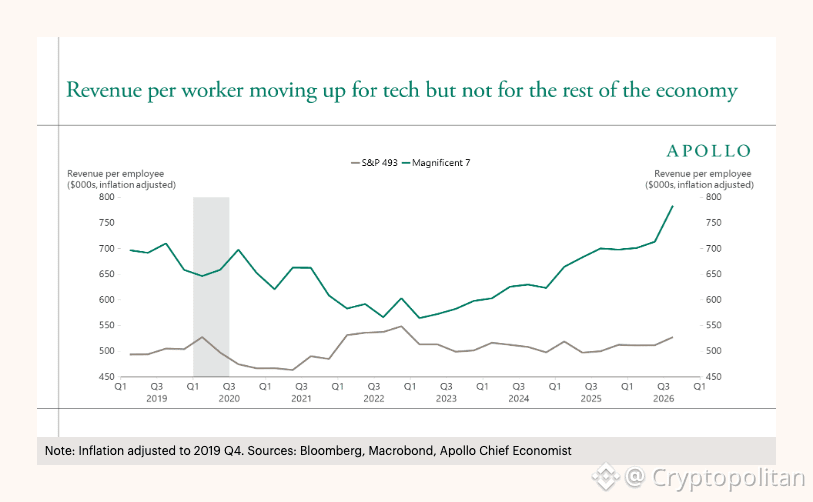
ලිපිය
Apollo's Torsten Slok sees zero AI payoff outside the Magnificent 7Apollo Global Management Chief Economist Torsten Slok determined that AI has boosted revenue and margins only for the Magnificent 7, while the rest of corporate America has seen no financial benefit.
He notes that other S&P 500 companies have flat revenue per worker and flat profit margins with no increase in productivity.
Slok put out the note, “No Signs of AI Payoff Outside the Tech Sector,” Saturday in Apollo’s Daily Spark.
Top 10% of firms account for 99.5% of inference spending
Slok splits the index in two. The Magnificent 7 are Alphabet, Amazon, Apple, Meta, Microsoft, Nvidia and Tesla.
The S&P 493 is everything else in the S&P 500.
For the Mag 7, inflation-adjusted revenue per employee is up to about $780,000. The S&P 493 is around $525,000 and has not budged.
Inflation-adjusted revenue per employee for the Magnificent 7 and the S&P 493 since 2019, from Apollo’s Daily Spark note of October 24, 2026.
Margins divided the same way. The seven giants are close to 30%, with about 10% for the other 493 firms.
“Despite massive investments and widespread hype around artificial intelligence, the technology has delivered zero financial payoff to corporate America outside of tech,” Slok wrote.
His total factor productivity chart uses the utilization-adjusted series from the San Francisco Fed. No acceleration there, despite all the AI money.
In Slok’s data, the top decile of firms represent 99.5% of model serving and inference expenses and 99% of neocloud expenses.
The same 10% accounts for over 95% of money tied to OpenAI and Anthropic and 95.7% of cloud computing.
Venture money rules the biggest users. 80.4% of the top 1% of AI spenders are backed by VCs compared to 13.1% of the median spender.
Mainstream companies are now treating token spending like a cost center that is harming their margins and pulling back, Slok wrote.
Corporate America doesn’t need the latest model and won’t pay for it, he said. “As long as agentic AI and token spending are confined to a small part of the economy, the macroeconomic effects of AI will be very limited,” he wrote.
The S&P 493 will decide the story, the economist concludes
His spending charts are based on Ramp AI Index and Ramp Chief Economist, Ara Kharazian. Cryptopolitan reported this month that corporate AI spending has dropped since July even as usage jumped about 50% to a record, as price competition between OpenAI and Anthropic made models cheaper.
Slok doesn’t think the stragglers just need time. Models continue to get cheaper and more commoditized, and he wonders whether ordinary companies can use them to drive faster revenue growth or wider margins.
“AI may be a great calculator, but in business, intelligence is mostly judgment,” he wrote. Judgment is contextual, Slok said, and the answer depends on which human or model gets asked.
He also wrote that AI “does not understand accountability, trust, culture, unwritten rules, ethical trade-offs or fairness.” He regards those elements as drivers of reputational risk, and ultimately, revenue and profit margins.
“The AI story will be decided in the S&P 493, not the Mag 7,” Slok concluded. He found no evidence yet of better revenue growth or margins outside of tech.
By April, AI-related stocks had hit about 45% of the S&P 500’s market value. During the last 12 months, the Global X Artificial Intelligence & Technology ETF (AIQ) has risen about 20% and the iShares U.S. Technology ETF (IYW) is up about 23%.
The smartest crypto minds already read our newsletter. Want in? Join them.
Apollo's Torsten Slok sees zero AI payoff outside the Magnificent 7
Apollo Global Management Chief Economist Torsten Slok determined that AI has boosted revenue and margins only for the Magnificent 7, while the rest of corporate America has seen no financial benefit.
He notes that other S&P 500 companies have flat revenue per worker and flat profit margins with no increase in productivity.
Slok put out the note, “No Signs of AI Payoff Outside the Tech Sector,” Saturday in Apollo’s Daily Spark.
Top 10% of firms account for 99.5% of inference spending
Slok splits the index in two. The Magnificent 7 are Alphabet, Amazon, Apple, Meta, Microsoft, Nvidia and Tesla.
The S&P 493 is everything else in the S&P 500.
For the Mag 7, inflation-adjusted revenue per employee is up to about $780,000. The S&P 493 is around $525,000 and has not budged.
Inflation-adjusted revenue per employee for the Magnificent 7 and the S&P 493 since 2019, from Apollo’s Daily Spark note of October 24, 2026.
Margins divided the same way. The seven giants are close to 30%, with about 10% for the other 493 firms.
“Despite massive investments and widespread hype around artificial intelligence, the technology has delivered zero financial payoff to corporate America outside of tech,” Slok wrote.
His total factor productivity chart uses the utilization-adjusted series from the San Francisco Fed. No acceleration there, despite all the AI money.
In Slok’s data, the top decile of firms represent 99.5% of model serving and inference expenses and 99% of neocloud expenses.
The same 10% accounts for over 95% of money tied to OpenAI and Anthropic and 95.7% of cloud computing.
Venture money rules the biggest users. 80.4% of the top 1% of AI spenders are backed by VCs compared to 13.1% of the median spender.
Mainstream companies are now treating token spending like a cost center that is harming their margins and pulling back, Slok wrote.
Corporate America doesn’t need the latest model and won’t pay for it, he said. “As long as agentic AI and token spending are confined to a small part of the economy, the macroeconomic effects of AI will be very limited,” he wrote.
The S&P 493 will decide the story, the economist concludes
His spending charts are based on Ramp AI Index and Ramp Chief Economist, Ara Kharazian. Cryptopolitan reported this month that corporate AI spending has dropped since July even as usage jumped about 50% to a record, as price competition between OpenAI and Anthropic made models cheaper.
Slok doesn’t think the stragglers just need time. Models continue to get cheaper and more commoditized, and he wonders whether ordinary companies can use them to drive faster revenue growth or wider margins.
“AI may be a great calculator, but in business, intelligence is mostly judgment,” he wrote. Judgment is contextual, Slok said, and the answer depends on which human or model gets asked.
He also wrote that AI “does not understand accountability, trust, culture, unwritten rules, ethical trade-offs or fairness.” He regards those elements as drivers of reputational risk, and ultimately, revenue and profit margins.
“The AI story will be decided in the S&P 493, not the Mag 7,” Slok concluded. He found no evidence yet of better revenue growth or margins outside of tech.
By April, AI-related stocks had hit about 45% of the S&P 500’s market value. During the last 12 months, the Global X Artificial Intelligence & Technology ETF (AIQ) has risen about 20% and the iShares U.S. Technology ETF (IYW) is up about 23%.
The smartest crypto minds already read our newsletter. Want in? Join them.
He notes that other S&P 500 companies have flat revenue per worker and flat profit margins with no increase in productivity.
Slok put out the note, “No Signs of AI Payoff Outside the Tech Sector,” Saturday in Apollo’s Daily Spark.
Top 10% of firms account for 99.5% of inference spending
Slok splits the index in two. The Magnificent 7 are Alphabet, Amazon, Apple, Meta, Microsoft, Nvidia and Tesla.
The S&P 493 is everything else in the S&P 500.
For the Mag 7, inflation-adjusted revenue per employee is up to about $780,000. The S&P 493 is around $525,000 and has not budged.
Inflation-adjusted revenue per employee for the Magnificent 7 and the S&P 493 since 2019, from Apollo’s Daily Spark note of October 24, 2026.
Margins divided the same way. The seven giants are close to 30%, with about 10% for the other 493 firms.
“Despite massive investments and widespread hype around artificial intelligence, the technology has delivered zero financial payoff to corporate America outside of tech,” Slok wrote.
His total factor productivity chart uses the utilization-adjusted series from the San Francisco Fed. No acceleration there, despite all the AI money.
In Slok’s data, the top decile of firms represent 99.5% of model serving and inference expenses and 99% of neocloud expenses.
The same 10% accounts for over 95% of money tied to OpenAI and Anthropic and 95.7% of cloud computing.
Venture money rules the biggest users. 80.4% of the top 1% of AI spenders are backed by VCs compared to 13.1% of the median spender.
Mainstream companies are now treating token spending like a cost center that is harming their margins and pulling back, Slok wrote.
Corporate America doesn’t need the latest model and won’t pay for it, he said. “As long as agentic AI and token spending are confined to a small part of the economy, the macroeconomic effects of AI will be very limited,” he wrote.
The S&P 493 will decide the story, the economist concludes
His spending charts are based on Ramp AI Index and Ramp Chief Economist, Ara Kharazian. Cryptopolitan reported this month that corporate AI spending has dropped since July even as usage jumped about 50% to a record, as price competition between OpenAI and Anthropic made models cheaper.
Slok doesn’t think the stragglers just need time. Models continue to get cheaper and more commoditized, and he wonders whether ordinary companies can use them to drive faster revenue growth or wider margins.
“AI may be a great calculator, but in business, intelligence is mostly judgment,” he wrote. Judgment is contextual, Slok said, and the answer depends on which human or model gets asked.
He also wrote that AI “does not understand accountability, trust, culture, unwritten rules, ethical trade-offs or fairness.” He regards those elements as drivers of reputational risk, and ultimately, revenue and profit margins.
“The AI story will be decided in the S&P 493, not the Mag 7,” Slok concluded. He found no evidence yet of better revenue growth or margins outside of tech.
By April, AI-related stocks had hit about 45% of the S&P 500’s market value. During the last 12 months, the Global X Artificial Intelligence & Technology ETF (AIQ) has risen about 20% and the iShares U.S. Technology ETF (IYW) is up about 23%.
The smartest crypto minds already read our newsletter. Want in? Join them.
1
1
394
අර්ධ වශයෙන් සත්යයි
Kevin Hassett says US-Canada trade negotiations are gaining momentumKevin Hassett, the US director of the National Economic Council, says trade talks between the United States and Canada are gaining speed, suggesting that the two neighbors may be getting closer to putting their dispute behind them.
Kevin defended Donald Trump’s management of the US economy on Sunday, right when Republicans start making their final attempts to appeal to voters ahead of the mid-term elections.
During an interview on Fox News, he argued that the overall numbers tell a much better story than complaints about living costs suggest. The problem for the White House is that people don’t pay their bills with GDP figures.
Kevin says economic growth is strong, but everyday prices tell another story
Kevin said, “So the great big picture about the economy is that it’s about the best economy we’ve ever seen.”
Economic strength is indicated by 3% to 4% growth each year, low unemployment rates, and industrial output at its highest since the pandemic. The American economy is also growing faster compared to economies in other G7 countries. However, none of these metrics give any indication of how much a trip to the supermarket costs this week.
“Now, I’m sure there are going to be pockets that need some repairs or that, hopefully, as President Trump said, energy prices will drop like a rock, then the 3 or 4 percent growth that we have right now will go even higher.”
Inflation has moved in the wrong direction lately. The annual consumer price index rose from 3.4% in August to 3.7% in September, while food inflation reached 4.4%, up from 3.5% under the previous administration.
Some grocery products have been seen to be becoming quite expensive as well. Coffee prices have increased by 22%, ground beef prices have increased by 25%, while cereals and baked products have gone up by 3.7%. According to an analysis done by The Telegraph, a family of four is spending an extra $23.84 each month.
It’s not only food. An average American household now spends $77 more each month on fuel than it did in February. And for someone buying a house in October with a 20% down payment, the yearly cost of a 30-year fixed-rate mortgage is about $1,866 higher than it was before the Iran war.
So far during Trump’s administration, the inflation rate has been 5.4%, while during Biden’s administration for the last 20 months, it is only 3.8%.
Iran war keeps gasoline expensive as midterm voters grow frustrated
The war with Iran has made energy a particularly sensitive issue. Iran’s effective shutdown of the Strait of Hormuz, the route used for roughly 20% of global oil exports, has unsettled supplies and helped keep prices elevated.
The price of gas on Sunday, according to AAA, was $4.29 per gallon. This was down 20 cents from what it cost a month ago, and the price had been fairly stable for the past weeks. Nevertheless, this price was way above the $3.06 average a year back.
Trump has repeatedly said gasoline prices should fall after the US wins the conflict. At a Saturday rally in Perry, Georgia, he campaigned for Republican Senate nominee Mike Collins and gubernatorial nominee Rick Jackson, while addressing criticism surrounding fuel costs.
“I can just see the fake headlines. ‘President Trump is talking about all the money they’re making while people are suffering at the pump.’ I don’t give a damn. We’re making a freaking fortune,” said Trump.
However, that message is accompanied by some tough polling numbers. As reported by The Financial Times/Focaldata, a poll conducted earlier this month showed that roughly a quarter of those surveyed approve of Trump’s handling of the economy. Even fewer, two out of ten people, approve of his handling of inflation.
Meanwhile, a Siena University/New York Times poll, released Tuesday, shows 36% of voting adults approve of Trump’s job performance versus 59% who do not approve.
If you're reading this, you’re already ahead. Stay there with our newsletter.
Kevin Hassett says US-Canada trade negotiations are gaining momentum
Kevin Hassett, the US director of the National Economic Council, says trade talks between the United States and Canada are gaining speed, suggesting that the two neighbors may be getting closer to putting their dispute behind them.
Kevin defended Donald Trump’s management of the US economy on Sunday, right when Republicans start making their final attempts to appeal to voters ahead of the mid-term elections.
During an interview on Fox News, he argued that the overall numbers tell a much better story than complaints about living costs suggest. The problem for the White House is that people don’t pay their bills with GDP figures.
Kevin says economic growth is strong, but everyday prices tell another story
Kevin said, “So the great big picture about the economy is that it’s about the best economy we’ve ever seen.”
Economic strength is indicated by 3% to 4% growth each year, low unemployment rates, and industrial output at its highest since the pandemic. The American economy is also growing faster compared to economies in other G7 countries. However, none of these metrics give any indication of how much a trip to the supermarket costs this week.
“Now, I’m sure there are going to be pockets that need some repairs or that, hopefully, as President Trump said, energy prices will drop like a rock, then the 3 or 4 percent growth that we have right now will go even higher.”
Inflation has moved in the wrong direction lately. The annual consumer price index rose from 3.4% in August to 3.7% in September, while food inflation reached 4.4%, up from 3.5% under the previous administration.
Some grocery products have been seen to be becoming quite expensive as well. Coffee prices have increased by 22%, ground beef prices have increased by 25%, while cereals and baked products have gone up by 3.7%. According to an analysis done by The Telegraph, a family of four is spending an extra $23.84 each month.
It’s not only food. An average American household now spends $77 more each month on fuel than it did in February. And for someone buying a house in October with a 20% down payment, the yearly cost of a 30-year fixed-rate mortgage is about $1,866 higher than it was before the Iran war.
So far during Trump’s administration, the inflation rate has been 5.4%, while during Biden’s administration for the last 20 months, it is only 3.8%.
Iran war keeps gasoline expensive as midterm voters grow frustrated
The war with Iran has made energy a particularly sensitive issue. Iran’s effective shutdown of the Strait of Hormuz, the route used for roughly 20% of global oil exports, has unsettled supplies and helped keep prices elevated.
The price of gas on Sunday, according to AAA, was $4.29 per gallon. This was down 20 cents from what it cost a month ago, and the price had been fairly stable for the past weeks. Nevertheless, this price was way above the $3.06 average a year back.
Trump has repeatedly said gasoline prices should fall after the US wins the conflict. At a Saturday rally in Perry, Georgia, he campaigned for Republican Senate nominee Mike Collins and gubernatorial nominee Rick Jackson, while addressing criticism surrounding fuel costs.
“I can just see the fake headlines. ‘President Trump is talking about all the money they’re making while people are suffering at the pump.’ I don’t give a damn. We’re making a freaking fortune,” said Trump.
However, that message is accompanied by some tough polling numbers. As reported by The Financial Times/Focaldata, a poll conducted earlier this month showed that roughly a quarter of those surveyed approve of Trump’s handling of the economy. Even fewer, two out of ten people, approve of his handling of inflation.
Meanwhile, a Siena University/New York Times poll, released Tuesday, shows 36% of voting adults approve of Trump’s job performance versus 59% who do not approve.
If you're reading this, you’re already ahead. Stay there with our newsletter.
Kevin defended Donald Trump’s management of the US economy on Sunday, right when Republicans start making their final attempts to appeal to voters ahead of the mid-term elections.
During an interview on Fox News, he argued that the overall numbers tell a much better story than complaints about living costs suggest. The problem for the White House is that people don’t pay their bills with GDP figures.
Kevin says economic growth is strong, but everyday prices tell another story
Kevin said, “So the great big picture about the economy is that it’s about the best economy we’ve ever seen.”
Economic strength is indicated by 3% to 4% growth each year, low unemployment rates, and industrial output at its highest since the pandemic. The American economy is also growing faster compared to economies in other G7 countries. However, none of these metrics give any indication of how much a trip to the supermarket costs this week.
“Now, I’m sure there are going to be pockets that need some repairs or that, hopefully, as President Trump said, energy prices will drop like a rock, then the 3 or 4 percent growth that we have right now will go even higher.”
Inflation has moved in the wrong direction lately. The annual consumer price index rose from 3.4% in August to 3.7% in September, while food inflation reached 4.4%, up from 3.5% under the previous administration.
Some grocery products have been seen to be becoming quite expensive as well. Coffee prices have increased by 22%, ground beef prices have increased by 25%, while cereals and baked products have gone up by 3.7%. According to an analysis done by The Telegraph, a family of four is spending an extra $23.84 each month.
It’s not only food. An average American household now spends $77 more each month on fuel than it did in February. And for someone buying a house in October with a 20% down payment, the yearly cost of a 30-year fixed-rate mortgage is about $1,866 higher than it was before the Iran war.
So far during Trump’s administration, the inflation rate has been 5.4%, while during Biden’s administration for the last 20 months, it is only 3.8%.
Iran war keeps gasoline expensive as midterm voters grow frustrated
The war with Iran has made energy a particularly sensitive issue. Iran’s effective shutdown of the Strait of Hormuz, the route used for roughly 20% of global oil exports, has unsettled supplies and helped keep prices elevated.
The price of gas on Sunday, according to AAA, was $4.29 per gallon. This was down 20 cents from what it cost a month ago, and the price had been fairly stable for the past weeks. Nevertheless, this price was way above the $3.06 average a year back.
Trump has repeatedly said gasoline prices should fall after the US wins the conflict. At a Saturday rally in Perry, Georgia, he campaigned for Republican Senate nominee Mike Collins and gubernatorial nominee Rick Jackson, while addressing criticism surrounding fuel costs.
“I can just see the fake headlines. ‘President Trump is talking about all the money they’re making while people are suffering at the pump.’ I don’t give a damn. We’re making a freaking fortune,” said Trump.
However, that message is accompanied by some tough polling numbers. As reported by The Financial Times/Focaldata, a poll conducted earlier this month showed that roughly a quarter of those surveyed approve of Trump’s handling of the economy. Even fewer, two out of ten people, approve of his handling of inflation.
Meanwhile, a Siena University/New York Times poll, released Tuesday, shows 36% of voting adults approve of Trump’s job performance versus 59% who do not approve.
If you're reading this, you’re already ahead. Stay there with our newsletter.
224
Elon Musk faces Republican criticism over restrictions on Ukraine’s Starlink accessElon Musk is taking heat from Republicans over his decision to restrict Ukraine’s access to Starlink, the satellite internet service that has become a big part of its fight against Russia.
Texas Representative Dan Crenshaw says Elon’s explanation makes little sense when Ukrainian troops are using drones to stop an invasion.
This raises a more far-reaching issue for Washington to consider as well: Why does one company have such control over communications during an ongoing war?
This situation has pulled Trump back into yet another conflict with the President of Ukraine, Volodymyr Zelenskyy. There was already an ongoing spat between the two countries due to the new deal the United States had made with Russia, and this further complicates matters.
Republicans push back against Elon’s explanation for the Starlink limits
Crenshaw, a member of the House Intelligence Committee, disagrees with Elon’s statement about a violation of SpaceX service conditions by Ukraine. In his statements on social media, Elon accused Ukraine of using SpaceX’s network to conduct offensive drone attacks on civilians.
However, Crenshaw finds it obvious that the line cannot be drawn at that point when a country is fighting in a war.
“What do you think defending your country is? Of course these drones have been used to kill people. They’ve been used to kill Russians for years, but inside Ukraine.”
Ukraine relies on satellite links to connect troops, pass battlefield information, and operate equipment where ordinary communications can fail. This month, users experienced slower connections on both Starlink and Starshield, the military-focused version of SpaceX’s system. For a while, there was no clear public answer about who had imposed the limits or why.
However, Elon Musk finally tried to sort out part of the problem through the Internet, but those in power in support of Kyiv remained unsatisfied with the answer provided.
Thom Tillis, a Republican senator from North Carolina and another one not seeking re-election, expressed his opinion about why the Western countries’ alliances started to depend on the technologies that could be disabled by the decision of a single company.
“Are you telling me that we don’t know something as important as a tool that’s being used by our Western nations is subject to the whims of one CEO. Shame on whoever is responsible for it ever having a lapse.”
Crenshaw, whose term ends in January, was careful not to turn the issue into a personal attack on Elon. His concern is the lack of a workable backup if SpaceX changes how its products can be used.
“What I worry about is an entire conflict, an entire defense of a sovereign country like Ukraine being dependent on one company.”
Trump’s diesel deal with Putin fuels another dispute with Kyiv
Earlier this month, Trump struck an agreement with Russian President Vladimir Putin that would hold off further tightening of US sanctions on Russia in return for diesel shipments meant to bring down fuel costs.
Today, Russia has already offered to sell as much diesel fuel as desired by customers, up to the total volume that Russia can export. This was stated by Deputy Prime Minister Alexander Novak in an interview with journalist Pavel Zarubin.
“As much as our partners want, frankly, from the volume we will be exporting. We can supply all of it.”
Russian outlet RIA Novosti reported that Alexander had previously estimated possible October shipments to the United States and other markets at 500,000 metric tons.
Trump announced the deal on October 9 after speaking with Putin. His timetable called for more than 300,000 tons to enter US and global markets immediately, another 500,000 tons in November, and 1 million tons after that.
Prices of diesel in the United States were going for more than six dollars per gallon when the first Russian cargo was expected to reach New York. Trump is looking forward to reducing costs of fuel before the November 3rd midterm elections, especially for farmers, ranchers, and truck drivers who rely on diesel daily.
Zelenskyy accused Trump in a Bloomberg interview last weekend of trying to force Kyiv to give in to Moscow. Trump denied ordering the Starlink speed restrictions and complained that Zelenskyy was more difficult to deal with than Putin.
On Thursday, The Wall Street Journal reported that Trump had spoken directly to Elon and asked him to lift the restrictions on Starlink services in Ukraine.
If you're reading this, you’re already ahead. Stay there with our newsletter.
Elon Musk faces Republican criticism over restrictions on Ukraine’s Starlink access
Elon Musk is taking heat from Republicans over his decision to restrict Ukraine’s access to Starlink, the satellite internet service that has become a big part of its fight against Russia.
Texas Representative Dan Crenshaw says Elon’s explanation makes little sense when Ukrainian troops are using drones to stop an invasion.
This raises a more far-reaching issue for Washington to consider as well: Why does one company have such control over communications during an ongoing war?
This situation has pulled Trump back into yet another conflict with the President of Ukraine, Volodymyr Zelenskyy. There was already an ongoing spat between the two countries due to the new deal the United States had made with Russia, and this further complicates matters.
Republicans push back against Elon’s explanation for the Starlink limits
Crenshaw, a member of the House Intelligence Committee, disagrees with Elon’s statement about a violation of SpaceX service conditions by Ukraine. In his statements on social media, Elon accused Ukraine of using SpaceX’s network to conduct offensive drone attacks on civilians.
However, Crenshaw finds it obvious that the line cannot be drawn at that point when a country is fighting in a war.
“What do you think defending your country is? Of course these drones have been used to kill people. They’ve been used to kill Russians for years, but inside Ukraine.”
Ukraine relies on satellite links to connect troops, pass battlefield information, and operate equipment where ordinary communications can fail. This month, users experienced slower connections on both Starlink and Starshield, the military-focused version of SpaceX’s system. For a while, there was no clear public answer about who had imposed the limits or why.
However, Elon Musk finally tried to sort out part of the problem through the Internet, but those in power in support of Kyiv remained unsatisfied with the answer provided.
Thom Tillis, a Republican senator from North Carolina and another one not seeking re-election, expressed his opinion about why the Western countries’ alliances started to depend on the technologies that could be disabled by the decision of a single company.
“Are you telling me that we don’t know something as important as a tool that’s being used by our Western nations is subject to the whims of one CEO. Shame on whoever is responsible for it ever having a lapse.”
Crenshaw, whose term ends in January, was careful not to turn the issue into a personal attack on Elon. His concern is the lack of a workable backup if SpaceX changes how its products can be used.
“What I worry about is an entire conflict, an entire defense of a sovereign country like Ukraine being dependent on one company.”
Trump’s diesel deal with Putin fuels another dispute with Kyiv
Earlier this month, Trump struck an agreement with Russian President Vladimir Putin that would hold off further tightening of US sanctions on Russia in return for diesel shipments meant to bring down fuel costs.
Today, Russia has already offered to sell as much diesel fuel as desired by customers, up to the total volume that Russia can export. This was stated by Deputy Prime Minister Alexander Novak in an interview with journalist Pavel Zarubin.
“As much as our partners want, frankly, from the volume we will be exporting. We can supply all of it.”
Russian outlet RIA Novosti reported that Alexander had previously estimated possible October shipments to the United States and other markets at 500,000 metric tons.
Trump announced the deal on October 9 after speaking with Putin. His timetable called for more than 300,000 tons to enter US and global markets immediately, another 500,000 tons in November, and 1 million tons after that.
Prices of diesel in the United States were going for more than six dollars per gallon when the first Russian cargo was expected to reach New York. Trump is looking forward to reducing costs of fuel before the November 3rd midterm elections, especially for farmers, ranchers, and truck drivers who rely on diesel daily.
Zelenskyy accused Trump in a Bloomberg interview last weekend of trying to force Kyiv to give in to Moscow. Trump denied ordering the Starlink speed restrictions and complained that Zelenskyy was more difficult to deal with than Putin.
On Thursday, The Wall Street Journal reported that Trump had spoken directly to Elon and asked him to lift the restrictions on Starlink services in Ukraine.
If you're reading this, you’re already ahead. Stay there with our newsletter.
Texas Representative Dan Crenshaw says Elon’s explanation makes little sense when Ukrainian troops are using drones to stop an invasion.
This raises a more far-reaching issue for Washington to consider as well: Why does one company have such control over communications during an ongoing war?
This situation has pulled Trump back into yet another conflict with the President of Ukraine, Volodymyr Zelenskyy. There was already an ongoing spat between the two countries due to the new deal the United States had made with Russia, and this further complicates matters.
Republicans push back against Elon’s explanation for the Starlink limits
Crenshaw, a member of the House Intelligence Committee, disagrees with Elon’s statement about a violation of SpaceX service conditions by Ukraine. In his statements on social media, Elon accused Ukraine of using SpaceX’s network to conduct offensive drone attacks on civilians.
However, Crenshaw finds it obvious that the line cannot be drawn at that point when a country is fighting in a war.
“What do you think defending your country is? Of course these drones have been used to kill people. They’ve been used to kill Russians for years, but inside Ukraine.”
Ukraine relies on satellite links to connect troops, pass battlefield information, and operate equipment where ordinary communications can fail. This month, users experienced slower connections on both Starlink and Starshield, the military-focused version of SpaceX’s system. For a while, there was no clear public answer about who had imposed the limits or why.
However, Elon Musk finally tried to sort out part of the problem through the Internet, but those in power in support of Kyiv remained unsatisfied with the answer provided.
Thom Tillis, a Republican senator from North Carolina and another one not seeking re-election, expressed his opinion about why the Western countries’ alliances started to depend on the technologies that could be disabled by the decision of a single company.
“Are you telling me that we don’t know something as important as a tool that’s being used by our Western nations is subject to the whims of one CEO. Shame on whoever is responsible for it ever having a lapse.”
Crenshaw, whose term ends in January, was careful not to turn the issue into a personal attack on Elon. His concern is the lack of a workable backup if SpaceX changes how its products can be used.
“What I worry about is an entire conflict, an entire defense of a sovereign country like Ukraine being dependent on one company.”
Trump’s diesel deal with Putin fuels another dispute with Kyiv
Earlier this month, Trump struck an agreement with Russian President Vladimir Putin that would hold off further tightening of US sanctions on Russia in return for diesel shipments meant to bring down fuel costs.
Today, Russia has already offered to sell as much diesel fuel as desired by customers, up to the total volume that Russia can export. This was stated by Deputy Prime Minister Alexander Novak in an interview with journalist Pavel Zarubin.
“As much as our partners want, frankly, from the volume we will be exporting. We can supply all of it.”
Russian outlet RIA Novosti reported that Alexander had previously estimated possible October shipments to the United States and other markets at 500,000 metric tons.
Trump announced the deal on October 9 after speaking with Putin. His timetable called for more than 300,000 tons to enter US and global markets immediately, another 500,000 tons in November, and 1 million tons after that.
Prices of diesel in the United States were going for more than six dollars per gallon when the first Russian cargo was expected to reach New York. Trump is looking forward to reducing costs of fuel before the November 3rd midterm elections, especially for farmers, ranchers, and truck drivers who rely on diesel daily.
Zelenskyy accused Trump in a Bloomberg interview last weekend of trying to force Kyiv to give in to Moscow. Trump denied ordering the Starlink speed restrictions and complained that Zelenskyy was more difficult to deal with than Putin.
On Thursday, The Wall Street Journal reported that Trump had spoken directly to Elon and asked him to lift the restrictions on Starlink services in Ukraine.
If you're reading this, you’re already ahead. Stay there with our newsletter.
1
179
Trump announces a $4.2 billion Audi factory in Georgia ahead of the November 3 midtermsTrump says Audi is putting billions into a new factory in Georgia, and he wants voters to see it as evidence that his tariffs are working.
The German luxury auto maker will produce up to 200,000 SUVs annually near Macon, putting an important part of its operations in America on American soil for the very first time.
The announcement was made Saturday during a GOP rally in Perry, just days before the November 3 midterm election. Georgia has a highly competitive gubernatorial and U.S. Senate race this year. Trump has been telling automakers for months that they should be making more cars in America. But now he can cite a plant announcement even though the whole story is much more complicated.
Trump points to Audi’s Georgia investment as a win for tariffs
Audi, part of Volkswagen, puts the Georgia project at roughly $4 billion and expects it to support about 4,500 jobs. Building work is due to start in 2027, with the first vehicles expected in the early 2030s. A US official told Reuters that the factory should handle the Q7, Q8 and Q9, three of Audi’s larger SUVs.
Audi chief executive Gernot Doellner attended the rally as the company outlined its plans.
“We are planning to bring our biggest and most premium SUVs and produce them here in Macon, Georgia.
“This is a long-term investment because we believe in the American market.”
The move could help Audi avoid some of the import costs that have been eating into its business. It currently brings every vehicle sold in the United States from Europe or Mexico. Last year alone, Trump’s tariffs cost the company €1.2 billion, or around $1.4 billion.
These responsibilities go further than just the manufactured vehicles to cover steel, aluminum, and car parts. Supporters claim that this will make manufacturing within the country more attractive. The opposing camp claims that these same taxes increase vehicle costs and deter companies from investing due to changing trade regulations.
In addition to this, Audi has another small production setup plan for South Carolina. This will allow 25,000 cars a year to be produced here. Cars produced in Europe now can be shipped to other markets using the United States. This production will be done at the $2 billion Scout Motors plant of Volkswagen in Blythewood near Columbia.
Ohio’s Republican senator Bernie Moreno went even further by claiming that Audi will eventually manufacture all of its SUVs in America. According to him, the whole agreement was contingent upon tariffs, less stringent regulations, and cessation of California’s control over fuel efficiency laws. Apart from this, outside the rally, an expensive Audi, decorated with its own license plates, added some theatricality to the situation.
Audi’s struggles show why the factory is a bigger gamble
There is a practical reason Audi wants more American production, beyond anything said on a campaign stage. Its global sales have fallen for two straight years. Deliveries dropped another 7% in the first half of 2026, and its US sales are down 16% this year.
It has been particularly difficult for the company in China, while Volkswagen’s loss of business to competitors in Europe such as BYD and Geely continues. The German company is now contemplating either shutting down or selling four of its manufacturing facilities in Europe. This includes Audi’s Neckarsulm facility in southwest Germany.
The US is looking attractive not only due to the lack of competition from China, since tariffs over 100% ensure that their cars do not appear in the market, but also because a new manufacturing facility is no guarantee of profits. There are several facilities in operation that run at less than full capacity.
Other automakers also try to balance costs of manufacturing with the risk of fluctuating trade policies. In July, Toyota announced that it will be investing $3.6 billion in a 2.5-million-square-foot truck assembly line at its San Antonio campus, moving some production from Mexico and hiring 2,000 employees by 2030.
Honda is considering another US plant but wants the US-Mexico-Canada Agreement extended first. Hyundai has said clearer rules could release more than $20 billion in American investment.
Meanwhile, Trump’s cuts to electric vehicle incentives have slowed US EV and battery production. Employment in American vehicle and parts manufacturing has also fallen since he took office last year, even as he promotes projects like Audi’s as victories for his tariff strategy.
The smartest crypto minds already read our newsletter. Want in? Join them.
Trump announces a $4.2 billion Audi factory in Georgia ahead of the November 3 midterms
Trump says Audi is putting billions into a new factory in Georgia, and he wants voters to see it as evidence that his tariffs are working.
The German luxury auto maker will produce up to 200,000 SUVs annually near Macon, putting an important part of its operations in America on American soil for the very first time.
The announcement was made Saturday during a GOP rally in Perry, just days before the November 3 midterm election. Georgia has a highly competitive gubernatorial and U.S. Senate race this year. Trump has been telling automakers for months that they should be making more cars in America. But now he can cite a plant announcement even though the whole story is much more complicated.
Trump points to Audi’s Georgia investment as a win for tariffs
Audi, part of Volkswagen, puts the Georgia project at roughly $4 billion and expects it to support about 4,500 jobs. Building work is due to start in 2027, with the first vehicles expected in the early 2030s. A US official told Reuters that the factory should handle the Q7, Q8 and Q9, three of Audi’s larger SUVs.
Audi chief executive Gernot Doellner attended the rally as the company outlined its plans.
“We are planning to bring our biggest and most premium SUVs and produce them here in Macon, Georgia.
“This is a long-term investment because we believe in the American market.”
The move could help Audi avoid some of the import costs that have been eating into its business. It currently brings every vehicle sold in the United States from Europe or Mexico. Last year alone, Trump’s tariffs cost the company €1.2 billion, or around $1.4 billion.
These responsibilities go further than just the manufactured vehicles to cover steel, aluminum, and car parts. Supporters claim that this will make manufacturing within the country more attractive. The opposing camp claims that these same taxes increase vehicle costs and deter companies from investing due to changing trade regulations.
In addition to this, Audi has another small production setup plan for South Carolina. This will allow 25,000 cars a year to be produced here. Cars produced in Europe now can be shipped to other markets using the United States. This production will be done at the $2 billion Scout Motors plant of Volkswagen in Blythewood near Columbia.
Ohio’s Republican senator Bernie Moreno went even further by claiming that Audi will eventually manufacture all of its SUVs in America. According to him, the whole agreement was contingent upon tariffs, less stringent regulations, and cessation of California’s control over fuel efficiency laws. Apart from this, outside the rally, an expensive Audi, decorated with its own license plates, added some theatricality to the situation.
Audi’s struggles show why the factory is a bigger gamble
There is a practical reason Audi wants more American production, beyond anything said on a campaign stage. Its global sales have fallen for two straight years. Deliveries dropped another 7% in the first half of 2026, and its US sales are down 16% this year.
It has been particularly difficult for the company in China, while Volkswagen’s loss of business to competitors in Europe such as BYD and Geely continues. The German company is now contemplating either shutting down or selling four of its manufacturing facilities in Europe. This includes Audi’s Neckarsulm facility in southwest Germany.
The US is looking attractive not only due to the lack of competition from China, since tariffs over 100% ensure that their cars do not appear in the market, but also because a new manufacturing facility is no guarantee of profits. There are several facilities in operation that run at less than full capacity.
Other automakers also try to balance costs of manufacturing with the risk of fluctuating trade policies. In July, Toyota announced that it will be investing $3.6 billion in a 2.5-million-square-foot truck assembly line at its San Antonio campus, moving some production from Mexico and hiring 2,000 employees by 2030.
Honda is considering another US plant but wants the US-Mexico-Canada Agreement extended first. Hyundai has said clearer rules could release more than $20 billion in American investment.
Meanwhile, Trump’s cuts to electric vehicle incentives have slowed US EV and battery production. Employment in American vehicle and parts manufacturing has also fallen since he took office last year, even as he promotes projects like Audi’s as victories for his tariff strategy.
The smartest crypto minds already read our newsletter. Want in? Join them.
The German luxury auto maker will produce up to 200,000 SUVs annually near Macon, putting an important part of its operations in America on American soil for the very first time.
The announcement was made Saturday during a GOP rally in Perry, just days before the November 3 midterm election. Georgia has a highly competitive gubernatorial and U.S. Senate race this year. Trump has been telling automakers for months that they should be making more cars in America. But now he can cite a plant announcement even though the whole story is much more complicated.
Trump points to Audi’s Georgia investment as a win for tariffs
Audi, part of Volkswagen, puts the Georgia project at roughly $4 billion and expects it to support about 4,500 jobs. Building work is due to start in 2027, with the first vehicles expected in the early 2030s. A US official told Reuters that the factory should handle the Q7, Q8 and Q9, three of Audi’s larger SUVs.
Audi chief executive Gernot Doellner attended the rally as the company outlined its plans.
“We are planning to bring our biggest and most premium SUVs and produce them here in Macon, Georgia.
“This is a long-term investment because we believe in the American market.”
The move could help Audi avoid some of the import costs that have been eating into its business. It currently brings every vehicle sold in the United States from Europe or Mexico. Last year alone, Trump’s tariffs cost the company €1.2 billion, or around $1.4 billion.
These responsibilities go further than just the manufactured vehicles to cover steel, aluminum, and car parts. Supporters claim that this will make manufacturing within the country more attractive. The opposing camp claims that these same taxes increase vehicle costs and deter companies from investing due to changing trade regulations.
In addition to this, Audi has another small production setup plan for South Carolina. This will allow 25,000 cars a year to be produced here. Cars produced in Europe now can be shipped to other markets using the United States. This production will be done at the $2 billion Scout Motors plant of Volkswagen in Blythewood near Columbia.
Ohio’s Republican senator Bernie Moreno went even further by claiming that Audi will eventually manufacture all of its SUVs in America. According to him, the whole agreement was contingent upon tariffs, less stringent regulations, and cessation of California’s control over fuel efficiency laws. Apart from this, outside the rally, an expensive Audi, decorated with its own license plates, added some theatricality to the situation.
Audi’s struggles show why the factory is a bigger gamble
There is a practical reason Audi wants more American production, beyond anything said on a campaign stage. Its global sales have fallen for two straight years. Deliveries dropped another 7% in the first half of 2026, and its US sales are down 16% this year.
It has been particularly difficult for the company in China, while Volkswagen’s loss of business to competitors in Europe such as BYD and Geely continues. The German company is now contemplating either shutting down or selling four of its manufacturing facilities in Europe. This includes Audi’s Neckarsulm facility in southwest Germany.
The US is looking attractive not only due to the lack of competition from China, since tariffs over 100% ensure that their cars do not appear in the market, but also because a new manufacturing facility is no guarantee of profits. There are several facilities in operation that run at less than full capacity.
Other automakers also try to balance costs of manufacturing with the risk of fluctuating trade policies. In July, Toyota announced that it will be investing $3.6 billion in a 2.5-million-square-foot truck assembly line at its San Antonio campus, moving some production from Mexico and hiring 2,000 employees by 2030.
Honda is considering another US plant but wants the US-Mexico-Canada Agreement extended first. Hyundai has said clearer rules could release more than $20 billion in American investment.
Meanwhile, Trump’s cuts to electric vehicle incentives have slowed US EV and battery production. Employment in American vehicle and parts manufacturing has also fallen since he took office last year, even as he promotes projects like Audi’s as victories for his tariff strategy.
The smartest crypto minds already read our newsletter. Want in? Join them.
147
ලිපිය
Google's privacy policy lets connected Gmail and Photos data personalize adsGoogle has updated its privacy policy so that content in Gmail, Google Drive, and Google Photos can now affect the ads it serves.
The opening is only for users linking those apps to the company’s AI tools. The new language took effect Oct. 16.
An October 16 clause ends the flat Drive and Photos pledge
Inbox, cloud files, and picture libraries are not things that Google would use to personalize ads. The company has said this for years. Now there is a catch to the promise. On October 23, the change was seen for the first time.
“We don’t show you personalized ads based on your content from Drive, Gmail, or Google Photos, unless you choose to make data from these services available to other Google services that support personalized ads,” the policy says. But the October 1 version, which took effect two weeks earlier, ended that sentence at Photos without exception.
A ban on ads built from sensitive categories like race, religion, sexual orientation or health is unaltered.
Ads can now also use “personalized content from Google services,” whereas the text of Oct. 1 cited only interests and activity across Google services.
Ad rules in Google’s privacy policy, effective October 16, 2026.
The switch is Personal Intelligence. The feature allows AI Mode in Search and Gemini to use a user’s connected apps to customize answers.
Connected to Gmail, Search can turn up a hotel booking and recommend nearby restaurants. The new language also allows that same linked data to drive the ads a person views.
Search Services History can keep data after apps disconnect
Google says it has set limits. By default, Gmail, Drive and Photos content isn’t used to target ads, and advertisers never see what’s inside those accounts.
The company said it doesn’t share names, email addresses, or other identifying information with advertisers without permission.
Users can opt out in Data & privacy in the Google Account. From Personalization & activity, Personalization settings lead to Manage Personalized Recommendations in Search Services.
Users can disconnect Google Workspace and Google Photos from the Connected Content apps menu in the Additional Personal Intelligence section there. Users can also turn off Personalized Recommendations entirely.
Disconnecting doesn’t always get rid of what Google already has, though. The information in Search Services History can stay there even if an app is disconnected or the original email or picture is deleted.
Google already permits advertisers to embed products in AI Mode answers, with Direct Offers attaching discounts to them.
Cryptopolitan says that Gemini released Personal Intelligence in January as an optional tool for paid AI Pro and Ultra subscribers. Google had been criticized in November 2025 over claims that Gmail fed Gemini by default through Smart Features. By February, Google was testing Personal Intelligence for free users in AI Mode Search.
Don’t just read crypto news. Understand it. Subscribe to our newsletter. It's free.
Google's privacy policy lets connected Gmail and Photos data personalize ads
Google has updated its privacy policy so that content in Gmail, Google Drive, and Google Photos can now affect the ads it serves.
The opening is only for users linking those apps to the company’s AI tools. The new language took effect Oct. 16.
An October 16 clause ends the flat Drive and Photos pledge
Inbox, cloud files, and picture libraries are not things that Google would use to personalize ads. The company has said this for years. Now there is a catch to the promise. On October 23, the change was seen for the first time.
“We don’t show you personalized ads based on your content from Drive, Gmail, or Google Photos, unless you choose to make data from these services available to other Google services that support personalized ads,” the policy says. But the October 1 version, which took effect two weeks earlier, ended that sentence at Photos without exception.
A ban on ads built from sensitive categories like race, religion, sexual orientation or health is unaltered.
Ads can now also use “personalized content from Google services,” whereas the text of Oct. 1 cited only interests and activity across Google services.
Ad rules in Google’s privacy policy, effective October 16, 2026.
The switch is Personal Intelligence. The feature allows AI Mode in Search and Gemini to use a user’s connected apps to customize answers.
Connected to Gmail, Search can turn up a hotel booking and recommend nearby restaurants. The new language also allows that same linked data to drive the ads a person views.
Search Services History can keep data after apps disconnect
Google says it has set limits. By default, Gmail, Drive and Photos content isn’t used to target ads, and advertisers never see what’s inside those accounts.
The company said it doesn’t share names, email addresses, or other identifying information with advertisers without permission.
Users can opt out in Data & privacy in the Google Account. From Personalization & activity, Personalization settings lead to Manage Personalized Recommendations in Search Services.
Users can disconnect Google Workspace and Google Photos from the Connected Content apps menu in the Additional Personal Intelligence section there. Users can also turn off Personalized Recommendations entirely.
Disconnecting doesn’t always get rid of what Google already has, though. The information in Search Services History can stay there even if an app is disconnected or the original email or picture is deleted.
Google already permits advertisers to embed products in AI Mode answers, with Direct Offers attaching discounts to them.
Cryptopolitan says that Gemini released Personal Intelligence in January as an optional tool for paid AI Pro and Ultra subscribers. Google had been criticized in November 2025 over claims that Gmail fed Gemini by default through Smart Features. By February, Google was testing Personal Intelligence for free users in AI Mode Search.
Don’t just read crypto news. Understand it. Subscribe to our newsletter. It's free.
The opening is only for users linking those apps to the company’s AI tools. The new language took effect Oct. 16.
An October 16 clause ends the flat Drive and Photos pledge
Inbox, cloud files, and picture libraries are not things that Google would use to personalize ads. The company has said this for years. Now there is a catch to the promise. On October 23, the change was seen for the first time.
“We don’t show you personalized ads based on your content from Drive, Gmail, or Google Photos, unless you choose to make data from these services available to other Google services that support personalized ads,” the policy says. But the October 1 version, which took effect two weeks earlier, ended that sentence at Photos without exception.
A ban on ads built from sensitive categories like race, religion, sexual orientation or health is unaltered.
Ads can now also use “personalized content from Google services,” whereas the text of Oct. 1 cited only interests and activity across Google services.
Ad rules in Google’s privacy policy, effective October 16, 2026.
The switch is Personal Intelligence. The feature allows AI Mode in Search and Gemini to use a user’s connected apps to customize answers.
Connected to Gmail, Search can turn up a hotel booking and recommend nearby restaurants. The new language also allows that same linked data to drive the ads a person views.
Search Services History can keep data after apps disconnect
Google says it has set limits. By default, Gmail, Drive and Photos content isn’t used to target ads, and advertisers never see what’s inside those accounts.
The company said it doesn’t share names, email addresses, or other identifying information with advertisers without permission.
Users can opt out in Data & privacy in the Google Account. From Personalization & activity, Personalization settings lead to Manage Personalized Recommendations in Search Services.
Users can disconnect Google Workspace and Google Photos from the Connected Content apps menu in the Additional Personal Intelligence section there. Users can also turn off Personalized Recommendations entirely.
Disconnecting doesn’t always get rid of what Google already has, though. The information in Search Services History can stay there even if an app is disconnected or the original email or picture is deleted.
Google already permits advertisers to embed products in AI Mode answers, with Direct Offers attaching discounts to them.
Cryptopolitan says that Gemini released Personal Intelligence in January as an optional tool for paid AI Pro and Ultra subscribers. Google had been criticized in November 2025 over claims that Gmail fed Gemini by default through Smart Features. By February, Google was testing Personal Intelligence for free users in AI Mode Search.
Don’t just read crypto news. Understand it. Subscribe to our newsletter. It's free.
1
322
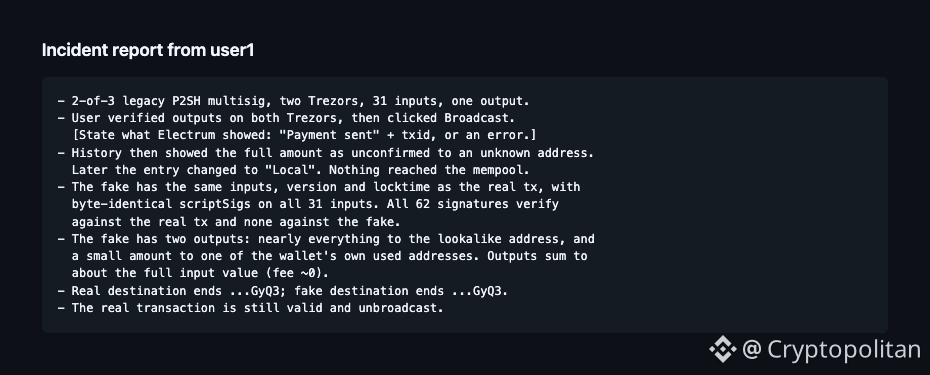
ලිපිය
Electrum servers trick wallet users into signing fake zero-fee paymentsMalicious Electrum servers replaced users’ just-broadcast bitcoin payments with fake zero-fee transactions paying lookalike addresses.
Servers apparently bet victims would raise the fee and sign the fake.
Electrum released version 4.8.3 on October 24 to address the high-severity flaw. Maintainer SomberNight released advisory GHSA-6jp4-8v48-cc5v the same day and requested users to upgrade.
Forged address shared a GyQ3 ending with the legitimate destination
Electrum is a light client. It doesn’t have a full bitcoin node and relies on its server for unconfirmed mempool transactions. Its own documentation explains how it works.
Someone signs and sends tx1. A bad server stops it and sends a different tx2 to the wallet that sends the money to an attacker’s address.
Tx2 has invalid signatures. Older Electrum didn’t verify signatures of mempool transactions, so the wallet showed tx2 as pending and hid tx1.
Replace-By-Fee, or RBF, permits a sender to rebroadcast an unconfirmed transaction with a higher fee. If the fee on the fake is increased, the wallet signs the attacker’s version with a valid signature.
One of the targets, known as dannydeezy, documented the attack. A 2-of-3 legacy P2SH multisig with two Trezors, 31 inputs, and one output.
User checked output on both Trezors then broadcast. Wallet history then displayed the full amount going to an unknown address unconfirmed, and the entry later flipped to “Local.”
The fake replicated the real transaction’s inputs, version and locktime, with byte identical scriptSigs on all 31 inputs.
All 62 of the signatures checked out against the real transaction. None checked out against the fake.
Almost all of it was sent to a lookalike address, with a small amount being sent back to one of the wallet’s own used addresses.
The fake ended in GyQ3. So did the real endpoint.
The attacker had figured out an address which matched the last four characters of the correct address.
Incident report from user1 in Electrum’s security advisory, published October 24, 2026, on GitHub.
ZachXBT has also called out a similar address-poisoning scam affecting Phantom wallet users. Spoofed addresses are made impervious to a glance at the first and last characters.
Version 4.8.3 checks signatures only on wallet-owned inputs
Another user, Raju-K12, privately reported on Oct. 18 that they bumped the fee on the fake and lost money. Some servers are running the attack in the wild, the maintainers say.
Commit 90fe308 adds a check for signatures on wallet-owned “is_mine” inputs before adding a mempool transaction to local history. Version 4.8.3 was git-tagged on October 23 and binaries were released the next day.
Electrum still checks only inputs the wallet controls. So unconfirmed incoming transactions go unchecked.
This is because the client has no full script interpreter.
Electrum’s workaround for anyone who can’t upgrade is to verify output addresses and amounts before signing anything, including fee bumps. Those users who connected only to their own servers were never affected.
Electrum has shipped emergency fixes in the past. In January 2018, it closed down a JSON RPC interface that had been left open for some two years, after Google researcher Tavis Ormandy found that a website could detect the port and drain funds.
Cryptopolitan reported that a Coldcard seed-generation bug warning came in July, the same day approximately 594 BTC, ~$38 million, was drained from about 500 wallets.
If you're reading this, you’re already ahead. Stay there with our newsletter.
Electrum servers trick wallet users into signing fake zero-fee payments
Malicious Electrum servers replaced users’ just-broadcast bitcoin payments with fake zero-fee transactions paying lookalike addresses.
Servers apparently bet victims would raise the fee and sign the fake.
Electrum released version 4.8.3 on October 24 to address the high-severity flaw. Maintainer SomberNight released advisory GHSA-6jp4-8v48-cc5v the same day and requested users to upgrade.
Forged address shared a GyQ3 ending with the legitimate destination
Electrum is a light client. It doesn’t have a full bitcoin node and relies on its server for unconfirmed mempool transactions. Its own documentation explains how it works.
Someone signs and sends tx1. A bad server stops it and sends a different tx2 to the wallet that sends the money to an attacker’s address.
Tx2 has invalid signatures. Older Electrum didn’t verify signatures of mempool transactions, so the wallet showed tx2 as pending and hid tx1.
Replace-By-Fee, or RBF, permits a sender to rebroadcast an unconfirmed transaction with a higher fee. If the fee on the fake is increased, the wallet signs the attacker’s version with a valid signature.
One of the targets, known as dannydeezy, documented the attack. A 2-of-3 legacy P2SH multisig with two Trezors, 31 inputs, and one output.
User checked output on both Trezors then broadcast. Wallet history then displayed the full amount going to an unknown address unconfirmed, and the entry later flipped to “Local.”
The fake replicated the real transaction’s inputs, version and locktime, with byte identical scriptSigs on all 31 inputs.
All 62 of the signatures checked out against the real transaction. None checked out against the fake.
Almost all of it was sent to a lookalike address, with a small amount being sent back to one of the wallet’s own used addresses.
The fake ended in GyQ3. So did the real endpoint.
The attacker had figured out an address which matched the last four characters of the correct address.
Incident report from user1 in Electrum’s security advisory, published October 24, 2026, on GitHub.
ZachXBT has also called out a similar address-poisoning scam affecting Phantom wallet users. Spoofed addresses are made impervious to a glance at the first and last characters.
Version 4.8.3 checks signatures only on wallet-owned inputs
Another user, Raju-K12, privately reported on Oct. 18 that they bumped the fee on the fake and lost money. Some servers are running the attack in the wild, the maintainers say.
Commit 90fe308 adds a check for signatures on wallet-owned “is_mine” inputs before adding a mempool transaction to local history. Version 4.8.3 was git-tagged on October 23 and binaries were released the next day.
Electrum still checks only inputs the wallet controls. So unconfirmed incoming transactions go unchecked.
This is because the client has no full script interpreter.
Electrum’s workaround for anyone who can’t upgrade is to verify output addresses and amounts before signing anything, including fee bumps. Those users who connected only to their own servers were never affected.
Electrum has shipped emergency fixes in the past. In January 2018, it closed down a JSON RPC interface that had been left open for some two years, after Google researcher Tavis Ormandy found that a website could detect the port and drain funds.
Cryptopolitan reported that a Coldcard seed-generation bug warning came in July, the same day approximately 594 BTC, ~$38 million, was drained from about 500 wallets.
If you're reading this, you’re already ahead. Stay there with our newsletter.
Servers apparently bet victims would raise the fee and sign the fake.
Electrum released version 4.8.3 on October 24 to address the high-severity flaw. Maintainer SomberNight released advisory GHSA-6jp4-8v48-cc5v the same day and requested users to upgrade.
Forged address shared a GyQ3 ending with the legitimate destination
Electrum is a light client. It doesn’t have a full bitcoin node and relies on its server for unconfirmed mempool transactions. Its own documentation explains how it works.
Someone signs and sends tx1. A bad server stops it and sends a different tx2 to the wallet that sends the money to an attacker’s address.
Tx2 has invalid signatures. Older Electrum didn’t verify signatures of mempool transactions, so the wallet showed tx2 as pending and hid tx1.
Replace-By-Fee, or RBF, permits a sender to rebroadcast an unconfirmed transaction with a higher fee. If the fee on the fake is increased, the wallet signs the attacker’s version with a valid signature.
One of the targets, known as dannydeezy, documented the attack. A 2-of-3 legacy P2SH multisig with two Trezors, 31 inputs, and one output.
User checked output on both Trezors then broadcast. Wallet history then displayed the full amount going to an unknown address unconfirmed, and the entry later flipped to “Local.”
The fake replicated the real transaction’s inputs, version and locktime, with byte identical scriptSigs on all 31 inputs.
All 62 of the signatures checked out against the real transaction. None checked out against the fake.
Almost all of it was sent to a lookalike address, with a small amount being sent back to one of the wallet’s own used addresses.
The fake ended in GyQ3. So did the real endpoint.
The attacker had figured out an address which matched the last four characters of the correct address.
Incident report from user1 in Electrum’s security advisory, published October 24, 2026, on GitHub.
ZachXBT has also called out a similar address-poisoning scam affecting Phantom wallet users. Spoofed addresses are made impervious to a glance at the first and last characters.
Version 4.8.3 checks signatures only on wallet-owned inputs
Another user, Raju-K12, privately reported on Oct. 18 that they bumped the fee on the fake and lost money. Some servers are running the attack in the wild, the maintainers say.
Commit 90fe308 adds a check for signatures on wallet-owned “is_mine” inputs before adding a mempool transaction to local history. Version 4.8.3 was git-tagged on October 23 and binaries were released the next day.
Electrum still checks only inputs the wallet controls. So unconfirmed incoming transactions go unchecked.
This is because the client has no full script interpreter.
Electrum’s workaround for anyone who can’t upgrade is to verify output addresses and amounts before signing anything, including fee bumps. Those users who connected only to their own servers were never affected.
Electrum has shipped emergency fixes in the past. In January 2018, it closed down a JSON RPC interface that had been left open for some two years, after Google researcher Tavis Ormandy found that a website could detect the port and drain funds.
Cryptopolitan reported that a Coldcard seed-generation bug warning came in July, the same day approximately 594 BTC, ~$38 million, was drained from about 500 wallets.
If you're reading this, you’re already ahead. Stay there with our newsletter.
1
1.9k
Block builds Dessa voice AI from human audio alone on a single Nvidia rackJack Dorsey’s Block trained its new voice model, Dessa, on human speech only, not on any text or any pre-trained models.
Block says that the finished model can be run locally on a MacBook Pro M4 Max or better. The lab trained it on a single rack of Nvidia servers.
Block says Dessa is the first AI it knows of that can carry on a lifelike live conversation and has been trained only on human speech. The tiny research lab behind it reports directly to Dorsey.
Full-duplex model talks with OpenAI’s GPT-Live-1 in unsteered demos
A lot of voice assistants take what people say, turn it into text, run it through a language model, and then turn the text back into speech. As Block puts it, the pipeline throws out emotion, sarcasm, laughter, and a sad voice that cracks.
Dessa is a model that turns speech into speech, with no text in between. Like two people, it talks and hears at the same time.
It knows when to cut in and when to chime in with a “yeah!” or “got it!” Block said. It runs faster than real time.
Block says no one guides the AI model in the recordings. It chooses what to say, when and how.
In the recordings, Dessa laughs mid-sentence, gasps at a surprise and gets louder when asked to speak up. In one of the recordings, Dessa spoke to OpenAI’s GPT-Live-1.
Block says the developer of GPT-Live-1 has not vetted or endorsed Dessa.
We made the first AI model you can have a realistic conversation with that was trained entirely on speech!
Dessa is a full-duplex speech-to-speech model that you can run on consumer GPUs.
This is a GPT3 moment for speech. pic.twitter.com/XVD8sSyJn8
— Ragavan Thurairatnam (@RagavanThurair) October 23, 2026
A GB200 NVL72 taught the model language from hundreds of times fewer words
Dessa trained on a single Nvidia GB200 NVL72, a rack-scale system. The lab says the model learned language from “hundreds of times fewer words” than a text-based LLM needs.
Speech made the job tougher, said Block. A spoken word is thousands of times more bytes than the same word in print.
The lab was founded by former members of Toronto deep learning startup Dessa. The team has been building generative speech models for over eight years.
Ragavan Thurairatnam heads the project, and he called the release “a GPT3 moment for speech” on X.
Dessa is not publicly available. Block is running a waitlist and giving early access to a small group of AI safety researchers to surface risks the team hasn’t foreseen.
Three things led Block to build the model. Two are curiosity and better understanding between humans and AI.
The third reason? Safety.
Block imagines a person who is in a lot of pain, but a voice AI doesn’t notice and keeps talking.
Cryptopolitan reported that in February, Block (NYSE: XYZ) laid off 40% of its staff.
Block Inc. put out Buzz in July. It’s a chat app for the workplace where humans and AI agents can share channels.
The smartest crypto minds already read our newsletter. Want in? Join them.
Block builds Dessa voice AI from human audio alone on a single Nvidia rack
Jack Dorsey’s Block trained its new voice model, Dessa, on human speech only, not on any text or any pre-trained models.
Block says that the finished model can be run locally on a MacBook Pro M4 Max or better. The lab trained it on a single rack of Nvidia servers.
Block says Dessa is the first AI it knows of that can carry on a lifelike live conversation and has been trained only on human speech. The tiny research lab behind it reports directly to Dorsey.
Full-duplex model talks with OpenAI’s GPT-Live-1 in unsteered demos
A lot of voice assistants take what people say, turn it into text, run it through a language model, and then turn the text back into speech. As Block puts it, the pipeline throws out emotion, sarcasm, laughter, and a sad voice that cracks.
Dessa is a model that turns speech into speech, with no text in between. Like two people, it talks and hears at the same time.
It knows when to cut in and when to chime in with a “yeah!” or “got it!” Block said. It runs faster than real time.
Block says no one guides the AI model in the recordings. It chooses what to say, when and how.
In the recordings, Dessa laughs mid-sentence, gasps at a surprise and gets louder when asked to speak up. In one of the recordings, Dessa spoke to OpenAI’s GPT-Live-1.
Block says the developer of GPT-Live-1 has not vetted or endorsed Dessa.
We made the first AI model you can have a realistic conversation with that was trained entirely on speech!
Dessa is a full-duplex speech-to-speech model that you can run on consumer GPUs.
This is a GPT3 moment for speech. pic.twitter.com/XVD8sSyJn8
— Ragavan Thurairatnam (@RagavanThurair) October 23, 2026
A GB200 NVL72 taught the model language from hundreds of times fewer words
Dessa trained on a single Nvidia GB200 NVL72, a rack-scale system. The lab says the model learned language from “hundreds of times fewer words” than a text-based LLM needs.
Speech made the job tougher, said Block. A spoken word is thousands of times more bytes than the same word in print.
The lab was founded by former members of Toronto deep learning startup Dessa. The team has been building generative speech models for over eight years.
Ragavan Thurairatnam heads the project, and he called the release “a GPT3 moment for speech” on X.
Dessa is not publicly available. Block is running a waitlist and giving early access to a small group of AI safety researchers to surface risks the team hasn’t foreseen.
Three things led Block to build the model. Two are curiosity and better understanding between humans and AI.
The third reason? Safety.
Block imagines a person who is in a lot of pain, but a voice AI doesn’t notice and keeps talking.
Cryptopolitan reported that in February, Block (NYSE: XYZ) laid off 40% of its staff.
Block Inc. put out Buzz in July. It’s a chat app for the workplace where humans and AI agents can share channels.
The smartest crypto minds already read our newsletter. Want in? Join them.
Block says that the finished model can be run locally on a MacBook Pro M4 Max or better. The lab trained it on a single rack of Nvidia servers.
Block says Dessa is the first AI it knows of that can carry on a lifelike live conversation and has been trained only on human speech. The tiny research lab behind it reports directly to Dorsey.
Full-duplex model talks with OpenAI’s GPT-Live-1 in unsteered demos
A lot of voice assistants take what people say, turn it into text, run it through a language model, and then turn the text back into speech. As Block puts it, the pipeline throws out emotion, sarcasm, laughter, and a sad voice that cracks.
Dessa is a model that turns speech into speech, with no text in between. Like two people, it talks and hears at the same time.
It knows when to cut in and when to chime in with a “yeah!” or “got it!” Block said. It runs faster than real time.
Block says no one guides the AI model in the recordings. It chooses what to say, when and how.
In the recordings, Dessa laughs mid-sentence, gasps at a surprise and gets louder when asked to speak up. In one of the recordings, Dessa spoke to OpenAI’s GPT-Live-1.
Block says the developer of GPT-Live-1 has not vetted or endorsed Dessa.
We made the first AI model you can have a realistic conversation with that was trained entirely on speech!
Dessa is a full-duplex speech-to-speech model that you can run on consumer GPUs.
This is a GPT3 moment for speech. pic.twitter.com/XVD8sSyJn8
— Ragavan Thurairatnam (@RagavanThurair) October 23, 2026
A GB200 NVL72 taught the model language from hundreds of times fewer words
Dessa trained on a single Nvidia GB200 NVL72, a rack-scale system. The lab says the model learned language from “hundreds of times fewer words” than a text-based LLM needs.
Speech made the job tougher, said Block. A spoken word is thousands of times more bytes than the same word in print.
The lab was founded by former members of Toronto deep learning startup Dessa. The team has been building generative speech models for over eight years.
Ragavan Thurairatnam heads the project, and he called the release “a GPT3 moment for speech” on X.
Dessa is not publicly available. Block is running a waitlist and giving early access to a small group of AI safety researchers to surface risks the team hasn’t foreseen.
Three things led Block to build the model. Two are curiosity and better understanding between humans and AI.
The third reason? Safety.
Block imagines a person who is in a lot of pain, but a voice AI doesn’t notice and keeps talking.
Cryptopolitan reported that in February, Block (NYSE: XYZ) laid off 40% of its staff.
Block Inc. put out Buzz in July. It’s a chat app for the workplace where humans and AI agents can share channels.
The smartest crypto minds already read our newsletter. Want in? Join them.
1
4
544
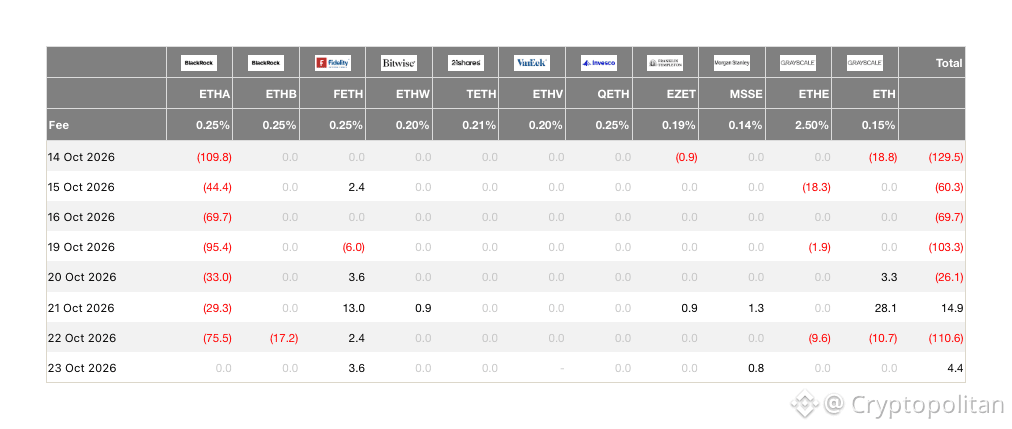
ලිපිය
Ether falls about 13% over 30 days as bitcoin loses under 5%Ether has fallen around 13% over the last 30 days, almost three times Bitcoin’s 4.7% decline. The token fell below $2,300 on Oct. 24.
ETH traded at $2,342.08 late on October 24, down 12.96% over 30 days, CoinGecko data indicates. The weakest price in the 30-day window came in at a 24-hour low of $2,286.76.
Bitcoin changed hands at $80,537, down 4.71% over the same period. Ether opened the window close to $2,684 and Bitcoin close to $84,249.
ETH/BTC ratio slides to 0.0291 from 0.0319
Over seven days, ETH dropped 3.33%, bitcoin 1.48%.
The ETH/BTC ratio, or the price of Ether in Bitcoin, lingered around 0.0291. It began the 30-day window near 0.0319.
Ether fell about 0.7% on the day to the late-session price, and bitcoin about 0.1%.
Ether crested for the window near $2,754 on Oct. 2. It has since lost about 15% and is down about 53% from its record high of $4,946.05 in August 2025.
Bitcoin is trading ~36% below its own $126,080 peak set in October 2025. Late October 24, Ether’s market cap was about $286 billion.
BlackRock’s ETHA drives a $110.6 million exit on October 22
US spot ether exchange-traded funds registered net outflows of $110.6 million on October 22, data from Farside showed.
BlackRock’s iShares Ethereum Trust, ETHA, saw $75.5 million lost of that total. Fidelity’s FETH gained $2.4 million.
On the same day, BlackRock’s ETHB lost $17.2 million. Grayscale’s ETHE lost $9.6 million, while its Ethereum Staking Mini ETF lost $10.7 million.
The exit on October 22 followed $14.9 million in inflows on October 21. Grayscale’s staking mini fund saw inflows of $28.1 million on Oct. 21, while FETH took in $13 million, with ETHA shedding $29.3 million.
Five successive sessions of outflows from Oct. 14 to 20 drained $388.9 million from the funds, while the seven sessions through Oct. 22 cost $484.6 million.
$129.5 million left on Oct. 14, the heaviest day of that run. October 19 added $103.3 million more.
Daily net flows for US spot ether ETFs from October 14 to 23, 2026, in US$ millions, per Farside data.
The October 23 tally showed net inflows of $4.4 million, but the ETHV fund’s figure was still absent.
According to Cryptopolitan, Ether ETFs experienced an outflow of $1.08 billion in October by October 21, marking the largest monthly outflow in 2026. The outflows erased ~$832 million of inflows from September, leaving net inflows for the year-to-date at about $485 million.
October was the worst month for the funds since November 2025. Total net assets stood at $14.98 billion as of Oct. 20, or 5.01% of the market value of ether.
Bitcoin ETFs bled only ~$67m in the same October period. They still had net inflows of ~$809 million in 2026.
A six-session streak that began on September 29 sapped ~$408 million, and ETHA alone lost $201.89 million on October 6.
The smartest crypto minds already read our newsletter. Want in? Join them.
Ether falls about 13% over 30 days as bitcoin loses under 5%
Ether has fallen around 13% over the last 30 days, almost three times Bitcoin’s 4.7% decline. The token fell below $2,300 on Oct. 24.
ETH traded at $2,342.08 late on October 24, down 12.96% over 30 days, CoinGecko data indicates. The weakest price in the 30-day window came in at a 24-hour low of $2,286.76.
Bitcoin changed hands at $80,537, down 4.71% over the same period. Ether opened the window close to $2,684 and Bitcoin close to $84,249.
ETH/BTC ratio slides to 0.0291 from 0.0319
Over seven days, ETH dropped 3.33%, bitcoin 1.48%.
The ETH/BTC ratio, or the price of Ether in Bitcoin, lingered around 0.0291. It began the 30-day window near 0.0319.
Ether fell about 0.7% on the day to the late-session price, and bitcoin about 0.1%.
Ether crested for the window near $2,754 on Oct. 2. It has since lost about 15% and is down about 53% from its record high of $4,946.05 in August 2025.
Bitcoin is trading ~36% below its own $126,080 peak set in October 2025. Late October 24, Ether’s market cap was about $286 billion.
BlackRock’s ETHA drives a $110.6 million exit on October 22
US spot ether exchange-traded funds registered net outflows of $110.6 million on October 22, data from Farside showed.
BlackRock’s iShares Ethereum Trust, ETHA, saw $75.5 million lost of that total. Fidelity’s FETH gained $2.4 million.
On the same day, BlackRock’s ETHB lost $17.2 million. Grayscale’s ETHE lost $9.6 million, while its Ethereum Staking Mini ETF lost $10.7 million.
The exit on October 22 followed $14.9 million in inflows on October 21. Grayscale’s staking mini fund saw inflows of $28.1 million on Oct. 21, while FETH took in $13 million, with ETHA shedding $29.3 million.
Five successive sessions of outflows from Oct. 14 to 20 drained $388.9 million from the funds, while the seven sessions through Oct. 22 cost $484.6 million.
$129.5 million left on Oct. 14, the heaviest day of that run. October 19 added $103.3 million more.
Daily net flows for US spot ether ETFs from October 14 to 23, 2026, in US$ millions, per Farside data.
The October 23 tally showed net inflows of $4.4 million, but the ETHV fund’s figure was still absent.
According to Cryptopolitan, Ether ETFs experienced an outflow of $1.08 billion in October by October 21, marking the largest monthly outflow in 2026. The outflows erased ~$832 million of inflows from September, leaving net inflows for the year-to-date at about $485 million.
October was the worst month for the funds since November 2025. Total net assets stood at $14.98 billion as of Oct. 20, or 5.01% of the market value of ether.
Bitcoin ETFs bled only ~$67m in the same October period. They still had net inflows of ~$809 million in 2026.
A six-session streak that began on September 29 sapped ~$408 million, and ETHA alone lost $201.89 million on October 6.
The smartest crypto minds already read our newsletter. Want in? Join them.
ETH traded at $2,342.08 late on October 24, down 12.96% over 30 days, CoinGecko data indicates. The weakest price in the 30-day window came in at a 24-hour low of $2,286.76.
Bitcoin changed hands at $80,537, down 4.71% over the same period. Ether opened the window close to $2,684 and Bitcoin close to $84,249.
ETH/BTC ratio slides to 0.0291 from 0.0319
Over seven days, ETH dropped 3.33%, bitcoin 1.48%.
The ETH/BTC ratio, or the price of Ether in Bitcoin, lingered around 0.0291. It began the 30-day window near 0.0319.
Ether fell about 0.7% on the day to the late-session price, and bitcoin about 0.1%.
Ether crested for the window near $2,754 on Oct. 2. It has since lost about 15% and is down about 53% from its record high of $4,946.05 in August 2025.
Bitcoin is trading ~36% below its own $126,080 peak set in October 2025. Late October 24, Ether’s market cap was about $286 billion.
BlackRock’s ETHA drives a $110.6 million exit on October 22
US spot ether exchange-traded funds registered net outflows of $110.6 million on October 22, data from Farside showed.
BlackRock’s iShares Ethereum Trust, ETHA, saw $75.5 million lost of that total. Fidelity’s FETH gained $2.4 million.
On the same day, BlackRock’s ETHB lost $17.2 million. Grayscale’s ETHE lost $9.6 million, while its Ethereum Staking Mini ETF lost $10.7 million.
The exit on October 22 followed $14.9 million in inflows on October 21. Grayscale’s staking mini fund saw inflows of $28.1 million on Oct. 21, while FETH took in $13 million, with ETHA shedding $29.3 million.
Five successive sessions of outflows from Oct. 14 to 20 drained $388.9 million from the funds, while the seven sessions through Oct. 22 cost $484.6 million.
$129.5 million left on Oct. 14, the heaviest day of that run. October 19 added $103.3 million more.
Daily net flows for US spot ether ETFs from October 14 to 23, 2026, in US$ millions, per Farside data.
The October 23 tally showed net inflows of $4.4 million, but the ETHV fund’s figure was still absent.
According to Cryptopolitan, Ether ETFs experienced an outflow of $1.08 billion in October by October 21, marking the largest monthly outflow in 2026. The outflows erased ~$832 million of inflows from September, leaving net inflows for the year-to-date at about $485 million.
October was the worst month for the funds since November 2025. Total net assets stood at $14.98 billion as of Oct. 20, or 5.01% of the market value of ether.
Bitcoin ETFs bled only ~$67m in the same October period. They still had net inflows of ~$809 million in 2026.
A six-session streak that began on September 29 sapped ~$408 million, and ETHA alone lost $201.89 million on October 6.
The smartest crypto minds already read our newsletter. Want in? Join them.
2
495
තවත් අන්තර්ගතයන් ගවේෂණය කිරීමට ඇතුල් වන්න
Binance චතුරශ්රය හි ගෝලීය ක්රිප්ටෝ පරිශීලකයින් හා එක්වන්න
⚡️ ක්රිප්ටෝ පිළිබඳ නවතම සහ ප්රයෝජනවත් තොරතුරු ලබා ගන්න.
💬 ලොව විශාලතම ක්රිප්ටෝ හුවමාරුව මගින් විශ්වාස කෙරේ.
👍 සත්යායනය කරන ලද නිර්මාණකරුවන්ගෙන් සැබෑ විදසුන් සොයා ගන්න.
විද්යුත් තැපෑල / දුරකථන අංකය
නැගී එන මාතෘකා
BinancePick
2.6M නැරඹීම්
140,373 සාකච්ඡා කරමින්
Join #EarningsSeason: Predict Earnings on Binance Pick, Share Your Take on Binance Square!
Binance Square Official
·400 කැමත්ත දැක්වීම්
·338k නැරඹීම්
EarningsSeason
5M නැරඹීම්
24,233 සාකච්ඡා කරමින්
FranklinTempletonFilesForTwoDividendToBitcoinETFs
24 නැරඹීම්
31 සාකච්ඡා කරමින්