
Crypto_Vazima
4.9k පෝස්ටු
Crypto_Vazima
වාර්තා කරන්න
පරිශීලක අවහිර කරන්න
Fresh crypto news EVERY DAY! Subscribe now! Official STON.fi Ambassador! @crypto_vazima
29 හඹා යමින්
869 හඹා යන්නන්
4.7K+ කැමති විය
පෝස්ටු
සියල්ල
උපුටා දැක්වීම්
ලිපිය
පරිවර්තනය බලන්න
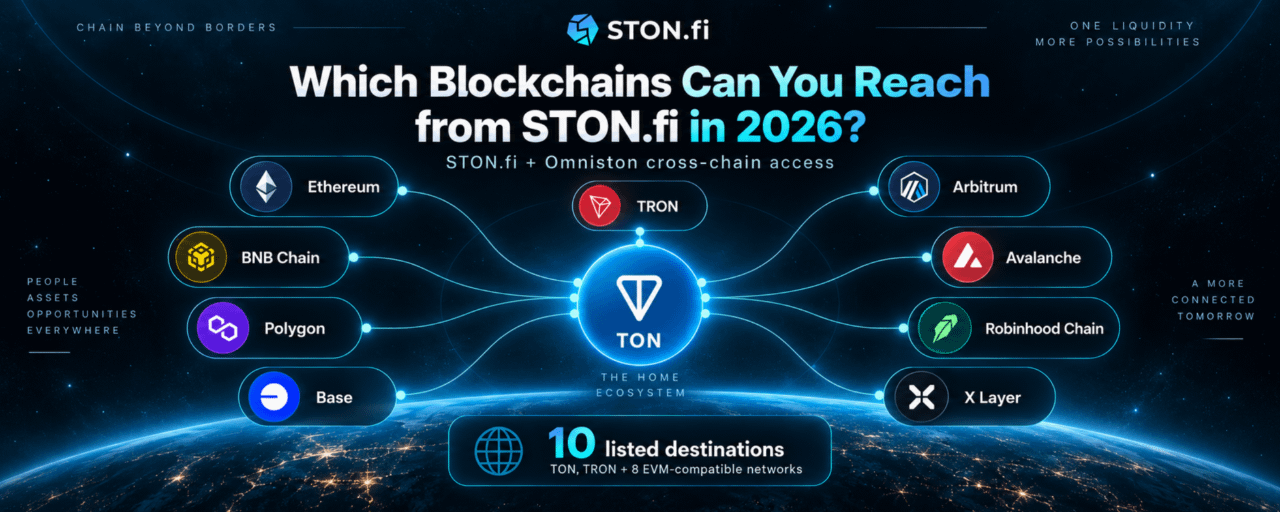
Which Blockchains Can You Reach from STON.fi in 2026?TON remains the home of STON.fi, but its cross-chain interface now reaches TRON and a growing group of EVM networks.
In 2026, STON.fi is no longer limited to swapping assets inside TON. Its cross-chain layer, Omniston, lets you move between TON, TRON, and multiple EVM-compatible networks from the same interface. As of September 15, 2026, the current STON.fi cross-chain page names TON, TRON, Ethereum, BNB Chain, Polygon, Base, Arbitrum, Avalanche, X Layer, and Robinhood Chain.
There is one important distinction, though. Reaching a blockchain through STON.fi does not necessarily mean the STON.fi AMM itself has been deployed there. Pools, farming, and the core STON.fi DeFi environment remain centered on TON. Cross-chain access uses Omniston to coordinate swaps between separate networks.
That difference is the key to understanding what "multi-chain STON.fi" actually means in 2026.
The current STON.fi network map
The simplest way to look at STON.fi today is to separate its home chain from the networks its cross-chain execution layer can reach.
STON.fi's public cross-chain page currently presents all ten as destinations and even includes a campaign task for completing swaps across "all 10 destinations."
The Omniston product page, however, currently labels TON, TRON, Ethereum, Base, BNB Chain, Polygon, Arbitrum, Avalanche, and Robinhood as "Live on," leaving X Layer out of that particular list.
That difference matters. The consumer-facing cross-chain page appears to be ahead of the main Omniston integration page for X Layer. If X Layer is your target, the safest practical test is simple: open the STON.fi dApp, select your intended assets and networks, and confirm that Omniston returns an executable quote before planning around the route.
Reaching another chain is not the same as deploying STON.fi there
A common assumption about multi-chain DeFi is that a protocol must launch a complete copy of itself on every blockchain it supports.
That is not what STON.fi is doing.
STON.fi remains fundamentally based on TON. Its native automated market maker, liquidity pools, farming products, and TON-side token ecosystem operate there. The main STON.fi website explicitly distinguishes cross-chain swaps from these products, stating that swaps can move between TON, TRON, and EVM networks while pools, farming, and staking run on TON.
Omniston adds a separate execution layer on top.
Instead of requiring a STON.fi liquidity pool to exist on every destination blockchain, Omniston sends a request for quote to resolvers. A resolver willing to fill the order supplies destination-side liquidity. Funds on the two chains are then coordinated through linked Hashed Timelock Contracts, or HTLCs.
The flow is roughly:
You choose a source chain, input asset, destination chain, and output asset.Omniston sends an RFQ to available resolvers.Resolvers compete by returning executable quotes.The winning route locks the relevant funds through linked HTLC contracts.The swap settles across both chains, or the contract logic refunds the parties if settlement cannot complete.
STON.fi describes Omniston as a bridge-free execution layer in which the cross-chain swap settles atomically or each party receives a refund.
This architecture is why STON.fi can expand its network reach without turning every supported blockchain into another full STON.fi DEX deployment.
What the major destinations give you
The chain list becomes more useful when you stop treating every destination as interchangeable.
TON is still the center
TON is where STON.fi offers the broadest product experience.
If your funds and the asset you want are already on TON, you do not need a cross-chain route at all. You can use TON-side liquidity directly, including the large number of Jettons that exist specifically within the TON ecosystem.
Cross-chain execution becomes relevant when either your starting capital is elsewhere or the asset you want sits on another blockchain.
Ethereum connects STON.fi to the main EVM liquidity environment
Ethereum was one of the first EVM networks activated for STON.fi cross-chain swaps.
When TON-to-EVM swaps went live in June 2026, STON.fi initially supported TON, Ethereum, Base, BNB Chain, and Polygon in different chain-to-chain combinations. Launch assets included USDT and USDC on Ethereum.
Ethereum therefore gives a TON user a direct route toward assets and liquidity in the largest established EVM ecosystem without first depositing to a centralized exchange.
The trade-off is network cost. STON.fi cannot eliminate Ethereum gas conditions simply because the route begins inside the STON.fi interface.
Base, BNB Chain, and Polygon broaden the EVM choice
These networks were also part of STON.fi's early EVM rollout.
Base gives users an Ethereum-compatible environment where transaction costs are generally much lighter than on Ethereum mainnet. BNB Chain adds access to another major EVM ecosystem with large stablecoin and retail trading activity. Polygon provides another low-cost destination for supported assets.
STON.fi also supports EVM-to-EVM routing. You do not necessarily need TON to be one side of the transaction.
For example, STON.fi documents a flow in which a user connects an EVM wallet, selects one EVM network as the source and another as the destination, reviews the quote, and lets Omniston coordinate settlement underneath.
That makes the interface relevant not only for someone leaving or entering TON, but also for a trader whose real goal is to reposition between supported EVM chains.
Arbitrum and Avalanche extend the map further
The 2026 network set has expanded beyond the original Ethereum, Base, BNB Chain, and Polygon group.
Arbitrum and Avalanche now appear in the official STON.fi cross-chain network list. The Robinhood Chain guide also confirms supported stablecoin availability including USDT0 and USDC on Arbitrum and USDT and USDC on Avalanche.
For users, the significance is straightforward: more destination networks create more possible paths between isolated pools of capital without requiring a separate bridge interface for each move.
Asset coverage still matters, however. Supporting a blockchain does not mean every token on that chain can automatically be swapped through Omniston.
TRON changes the picture beyond EVM
TRON is especially important because it shows that STON.fi's cross-chain ambitions are not limited to EVM-compatible networks.
TRON has a major stablecoin economy, particularly around USDT. Adding it gives users a path between three distinct environments:
TONEVM-compatible networksTRON
STON.fi's current homepage describes routes such as TON to EVM, TON to TRON, and EVM to TRON as part of one cross-chain workflow.
That is a more meaningful form of multi-chain access than simply adding another Ethereum-compatible Layer 2. An EVM wallet cannot natively behave like a TRON wallet, just as a TON wallet does not automatically become an Ethereum wallet. STON.fi therefore surfaces separate TON, EVM, and TRON wallet connections in its cross-chain experience.
For someone who holds USDT on TRON but wants to move into the TON ecosystem, this removes several manual steps that would otherwise involve an exchange or a separate bridge and swap sequence.
Robinhood Chain shows how new networks can be added
Robinhood Chain became available through STON.fi cross-chain swaps in August 2026.
STON.fi currently positions USDG as the destination asset for Robinhood Chain. Its own guide says users can access USDG there from TON, TRON, and supported EVM networks through the same cross-chain interface.
The supported stablecoin set described in that guide gives a useful snapshot of how chain support works in reality:
USDT on TONUSDT on TRONUSDG on Robinhood ChainUSDT and USDC on Ethereum, BNB Chain, Base, and AvalancheUSDT0 and USDC on ArbitrumPUSD and USDC on Polygon
This is why asking only "Which chains are supported?" is not enough.
A blockchain may be connected while the actual executable market is limited to a much smaller set of assets. The useful question is always the combination of source chain + source token + destination chain + destination token.
What you should verify before choosing a route
Cross-chain support changes quickly. A network name on a supported-chain list is only the first check.
Before signing, verify:
Source network: Make sure the wallet is connected to the chain where the asset actually exists.Destination network: Check that you selected the intended version of the chain, especially when working across several EVM networks.Asset identity: USDT on TON, TRON, Ethereum, and BNB Chain are separate on-chain assets even when they track the same dollar value.Quoted output: Review how much of the destination asset you are expected to receive.Fees: Network conditions and the route itself can affect the final economics.Price impact: A supported route may still be unattractive if available liquidity is weak.Transaction limits: New routes can launch with temporary size limits.Actual quote availability: A listed chain does not guarantee that a resolver will quote every possible asset pair at every moment.
The final item is particularly important for newer additions such as X Layer. STON.fi's latest public cross-chain page includes X Layer, while the Omniston developer page currently does not include it in its "Live on" line.
A live executable quote is therefore more useful than assuming every theoretical combination in a network list must be available.
Following one STON.fi cross-chain swap
Consider a simple scenario: you hold USDT on TON but want USDC on Base.
You connect the appropriate wallet or wallets and choose TON as the source network. Then you select USDT as the input, Base as the destination, and USDC as the output.
Omniston requests quotes from resolvers. If an acceptable route is available, STON.fi shows you the expected destination amount and relevant transaction details before confirmation.
Underneath the interface, the source and destination sides are coordinated through linked HTLCs rather than a traditional lock-and-mint bridge that issues a wrapped representation of the source asset. TON documentation describes the traditional bridge model as locking an asset on one chain and minting an equivalent wrapped token on another. Omniston instead coordinates a swap into the asset available on the destination side.
Once settlement succeeds, your goal is not to hold a representation of TON-side USDT on Base. You asked for USDC on Base, and that destination asset is what the route is designed to deliver.
That distinction explains the real value of the growing blockchain list. STON.fi is not merely transporting one token representation across ten networks. It is trying to turn separate pools of liquidity into executable asset-to-asset routes.
Practical takeaway: when you want to know whether STON.fi can reach a particular blockchain, first check the current network list, then test your exact token pair in the dApp. Network support tells you where Omniston can operate. A live quote tells you whether the particular route you actually need is available now.
Frequently Asked Questions
Which blockchains does STON.fi support in 2026?
STON.fi's current cross-chain page lists TON, TRON, Ethereum, BNB Chain, Polygon, Base, Arbitrum, Avalanche, X Layer, and Robinhood Chain. The separate Omniston product page currently lists the same group except X Layer in its "Live on" section, so X Layer availability should be checked directly in the dApp before relying on a specific route.
Is STON.fi deployed as a DEX on all of those blockchains?
No. STON.fi's native DeFi environment remains centered on TON. Its pools, farming, staking, and TON-native AMM activity are different from Omniston cross-chain execution. The other networks can be reached through cross-chain swaps without requiring a complete STON.fi AMM deployment on each chain.
Can I swap from one EVM chain directly to another?
Yes, supported EVM-to-EVM routes can be handled through STON.fi. For example, the protocol has documented flows between Ethereum, BNB Chain, Base, and Polygon. You select the source network and destination network in the same interface, while Omniston handles RFQ routing and cross-chain settlement underneath.
Can I use STON.fi to reach Solana?
Solana is not included in the current official STON.fi cross-chain list reviewed for this article. The supported set can expand over time, so future availability should be checked against the current STON.fi or Omniston interface rather than assuming the 2026 list is permanent.
Does support for a blockchain mean every token on it is supported?
No. Chain support and asset support are separate. A network can be connected while Omniston offers only selected assets or pairs there. Robinhood Chain, for example, currently uses USDG in the STON.fi cross-chain flow. Always test the exact source asset and destination asset you want rather than relying on the network name alone.
Do I have to start or finish on TON?
No. STON.fi now supports cross-chain workflows that do not require TON to be one side of the route. Official material describes EVM-to-EVM swaps and the main STON.fi site also presents EVM-to-TRON routing. TON remains the protocol's home ecosystem, but Omniston's execution layer reaches beyond TON-only flows.
How do I check whether my exact STON.fi cross-chain route works?
Open the STON.fi dApp, connect the wallet required for your source and destination networks, select the exact source token and destination token, and request a quote. Check the output, fees, price impact, networks, asset identities, and any transaction limit before signing. A valid current quote is the clearest confirmation that your specific route is executable.
Sources and Further Reading
STON.fi Cross-chain - One Swap. Across Chains. Current consumer-facing list of cross-chain destinations and explanation of the atomic swap flowOmniston by STON.fi - Cross-Chain Swap API & SDK. Current Omniston architecture, RFQ and HTLC execution model, and "Live on" network listSTON.fi main website. Overview of the distinction between cross-chain swapping and TON-native pools, farming, and stakingSTON.fi goes cross-chain: TON x EVM swaps are live. June 2026 announcement covering the first live TON and EVM network set and launch asset supportEVM-to-EVM swaps without leaving STON.fi: a guide for multi-chain traders. Explanation of cross-chain routing between supported EVM networks through OmnistonWhat is Robinhood Chain, and how to swap into it on STON.fi. August 2026 update covering Robinhood Chain, USDG, and supported stablecoins across current networksCross-chain swaps is not a feature - it's the new default for DeFi. STON.fi explanation of resolver-based HTLC execution and the difference between bridge and atomic-swap architecturesTON Docs - Bridges. TON's explanation of cross-chain bridges, isolated blockchain networks, and lock-and-mint asset transfers
$BTC $GRAM
Which Blockchains Can You Reach from STON.fi in 2026?
TON remains the home of STON.fi, but its cross-chain interface now reaches TRON and a growing group of EVM networks.
In 2026, STON.fi is no longer limited to swapping assets inside TON. Its cross-chain layer, Omniston, lets you move between TON, TRON, and multiple EVM-compatible networks from the same interface. As of September 15, 2026, the current STON.fi cross-chain page names TON, TRON, Ethereum, BNB Chain, Polygon, Base, Arbitrum, Avalanche, X Layer, and Robinhood Chain.
There is one important distinction, though. Reaching a blockchain through STON.fi does not necessarily mean the STON.fi AMM itself has been deployed there. Pools, farming, and the core STON.fi DeFi environment remain centered on TON. Cross-chain access uses Omniston to coordinate swaps between separate networks.
That difference is the key to understanding what "multi-chain STON.fi" actually means in 2026.
The current STON.fi network map
The simplest way to look at STON.fi today is to separate its home chain from the networks its cross-chain execution layer can reach.
STON.fi's public cross-chain page currently presents all ten as destinations and even includes a campaign task for completing swaps across "all 10 destinations."
The Omniston product page, however, currently labels TON, TRON, Ethereum, Base, BNB Chain, Polygon, Arbitrum, Avalanche, and Robinhood as "Live on," leaving X Layer out of that particular list.
That difference matters. The consumer-facing cross-chain page appears to be ahead of the main Omniston integration page for X Layer. If X Layer is your target, the safest practical test is simple: open the STON.fi dApp, select your intended assets and networks, and confirm that Omniston returns an executable quote before planning around the route.
Reaching another chain is not the same as deploying STON.fi there
A common assumption about multi-chain DeFi is that a protocol must launch a complete copy of itself on every blockchain it supports.
That is not what STON.fi is doing.
STON.fi remains fundamentally based on TON. Its native automated market maker, liquidity pools, farming products, and TON-side token ecosystem operate there. The main STON.fi website explicitly distinguishes cross-chain swaps from these products, stating that swaps can move between TON, TRON, and EVM networks while pools, farming, and staking run on TON.
Omniston adds a separate execution layer on top.
Instead of requiring a STON.fi liquidity pool to exist on every destination blockchain, Omniston sends a request for quote to resolvers. A resolver willing to fill the order supplies destination-side liquidity. Funds on the two chains are then coordinated through linked Hashed Timelock Contracts, or HTLCs.
The flow is roughly:
You choose a source chain, input asset, destination chain, and output asset.Omniston sends an RFQ to available resolvers.Resolvers compete by returning executable quotes.The winning route locks the relevant funds through linked HTLC contracts.The swap settles across both chains, or the contract logic refunds the parties if settlement cannot complete.
STON.fi describes Omniston as a bridge-free execution layer in which the cross-chain swap settles atomically or each party receives a refund.
This architecture is why STON.fi can expand its network reach without turning every supported blockchain into another full STON.fi DEX deployment.
What the major destinations give you
The chain list becomes more useful when you stop treating every destination as interchangeable.
TON is still the center
TON is where STON.fi offers the broadest product experience.
If your funds and the asset you want are already on TON, you do not need a cross-chain route at all. You can use TON-side liquidity directly, including the large number of Jettons that exist specifically within the TON ecosystem.
Cross-chain execution becomes relevant when either your starting capital is elsewhere or the asset you want sits on another blockchain.
Ethereum connects STON.fi to the main EVM liquidity environment
Ethereum was one of the first EVM networks activated for STON.fi cross-chain swaps.
When TON-to-EVM swaps went live in June 2026, STON.fi initially supported TON, Ethereum, Base, BNB Chain, and Polygon in different chain-to-chain combinations. Launch assets included USDT and USDC on Ethereum.
Ethereum therefore gives a TON user a direct route toward assets and liquidity in the largest established EVM ecosystem without first depositing to a centralized exchange.
The trade-off is network cost. STON.fi cannot eliminate Ethereum gas conditions simply because the route begins inside the STON.fi interface.
Base, BNB Chain, and Polygon broaden the EVM choice
These networks were also part of STON.fi's early EVM rollout.
Base gives users an Ethereum-compatible environment where transaction costs are generally much lighter than on Ethereum mainnet. BNB Chain adds access to another major EVM ecosystem with large stablecoin and retail trading activity. Polygon provides another low-cost destination for supported assets.
STON.fi also supports EVM-to-EVM routing. You do not necessarily need TON to be one side of the transaction.
For example, STON.fi documents a flow in which a user connects an EVM wallet, selects one EVM network as the source and another as the destination, reviews the quote, and lets Omniston coordinate settlement underneath.
That makes the interface relevant not only for someone leaving or entering TON, but also for a trader whose real goal is to reposition between supported EVM chains.
Arbitrum and Avalanche extend the map further
The 2026 network set has expanded beyond the original Ethereum, Base, BNB Chain, and Polygon group.
Arbitrum and Avalanche now appear in the official STON.fi cross-chain network list. The Robinhood Chain guide also confirms supported stablecoin availability including USDT0 and USDC on Arbitrum and USDT and USDC on Avalanche.
For users, the significance is straightforward: more destination networks create more possible paths between isolated pools of capital without requiring a separate bridge interface for each move.
Asset coverage still matters, however. Supporting a blockchain does not mean every token on that chain can automatically be swapped through Omniston.
TRON changes the picture beyond EVM
TRON is especially important because it shows that STON.fi's cross-chain ambitions are not limited to EVM-compatible networks.
TRON has a major stablecoin economy, particularly around USDT. Adding it gives users a path between three distinct environments:
TONEVM-compatible networksTRON
STON.fi's current homepage describes routes such as TON to EVM, TON to TRON, and EVM to TRON as part of one cross-chain workflow.
That is a more meaningful form of multi-chain access than simply adding another Ethereum-compatible Layer 2. An EVM wallet cannot natively behave like a TRON wallet, just as a TON wallet does not automatically become an Ethereum wallet. STON.fi therefore surfaces separate TON, EVM, and TRON wallet connections in its cross-chain experience.
For someone who holds USDT on TRON but wants to move into the TON ecosystem, this removes several manual steps that would otherwise involve an exchange or a separate bridge and swap sequence.
Robinhood Chain shows how new networks can be added
Robinhood Chain became available through STON.fi cross-chain swaps in August 2026.
STON.fi currently positions USDG as the destination asset for Robinhood Chain. Its own guide says users can access USDG there from TON, TRON, and supported EVM networks through the same cross-chain interface.
The supported stablecoin set described in that guide gives a useful snapshot of how chain support works in reality:
USDT on TONUSDT on TRONUSDG on Robinhood ChainUSDT and USDC on Ethereum, BNB Chain, Base, and AvalancheUSDT0 and USDC on ArbitrumPUSD and USDC on Polygon
This is why asking only "Which chains are supported?" is not enough.
A blockchain may be connected while the actual executable market is limited to a much smaller set of assets. The useful question is always the combination of source chain + source token + destination chain + destination token.
What you should verify before choosing a route
Cross-chain support changes quickly. A network name on a supported-chain list is only the first check.
Before signing, verify:
Source network: Make sure the wallet is connected to the chain where the asset actually exists.Destination network: Check that you selected the intended version of the chain, especially when working across several EVM networks.Asset identity: USDT on TON, TRON, Ethereum, and BNB Chain are separate on-chain assets even when they track the same dollar value.Quoted output: Review how much of the destination asset you are expected to receive.Fees: Network conditions and the route itself can affect the final economics.Price impact: A supported route may still be unattractive if available liquidity is weak.Transaction limits: New routes can launch with temporary size limits.Actual quote availability: A listed chain does not guarantee that a resolver will quote every possible asset pair at every moment.
The final item is particularly important for newer additions such as X Layer. STON.fi's latest public cross-chain page includes X Layer, while the Omniston developer page currently does not include it in its "Live on" line.
A live executable quote is therefore more useful than assuming every theoretical combination in a network list must be available.
Following one STON.fi cross-chain swap
Consider a simple scenario: you hold USDT on TON but want USDC on Base.
You connect the appropriate wallet or wallets and choose TON as the source network. Then you select USDT as the input, Base as the destination, and USDC as the output.
Omniston requests quotes from resolvers. If an acceptable route is available, STON.fi shows you the expected destination amount and relevant transaction details before confirmation.
Underneath the interface, the source and destination sides are coordinated through linked HTLCs rather than a traditional lock-and-mint bridge that issues a wrapped representation of the source asset. TON documentation describes the traditional bridge model as locking an asset on one chain and minting an equivalent wrapped token on another. Omniston instead coordinates a swap into the asset available on the destination side.
Once settlement succeeds, your goal is not to hold a representation of TON-side USDT on Base. You asked for USDC on Base, and that destination asset is what the route is designed to deliver.
That distinction explains the real value of the growing blockchain list. STON.fi is not merely transporting one token representation across ten networks. It is trying to turn separate pools of liquidity into executable asset-to-asset routes.
Practical takeaway: when you want to know whether STON.fi can reach a particular blockchain, first check the current network list, then test your exact token pair in the dApp. Network support tells you where Omniston can operate. A live quote tells you whether the particular route you actually need is available now.
Frequently Asked Questions
Which blockchains does STON.fi support in 2026?
STON.fi's current cross-chain page lists TON, TRON, Ethereum, BNB Chain, Polygon, Base, Arbitrum, Avalanche, X Layer, and Robinhood Chain. The separate Omniston product page currently lists the same group except X Layer in its "Live on" section, so X Layer availability should be checked directly in the dApp before relying on a specific route.
Is STON.fi deployed as a DEX on all of those blockchains?
No. STON.fi's native DeFi environment remains centered on TON. Its pools, farming, staking, and TON-native AMM activity are different from Omniston cross-chain execution. The other networks can be reached through cross-chain swaps without requiring a complete STON.fi AMM deployment on each chain.
Can I swap from one EVM chain directly to another?
Yes, supported EVM-to-EVM routes can be handled through STON.fi. For example, the protocol has documented flows between Ethereum, BNB Chain, Base, and Polygon. You select the source network and destination network in the same interface, while Omniston handles RFQ routing and cross-chain settlement underneath.
Can I use STON.fi to reach Solana?
Solana is not included in the current official STON.fi cross-chain list reviewed for this article. The supported set can expand over time, so future availability should be checked against the current STON.fi or Omniston interface rather than assuming the 2026 list is permanent.
Does support for a blockchain mean every token on it is supported?
No. Chain support and asset support are separate. A network can be connected while Omniston offers only selected assets or pairs there. Robinhood Chain, for example, currently uses USDG in the STON.fi cross-chain flow. Always test the exact source asset and destination asset you want rather than relying on the network name alone.
Do I have to start or finish on TON?
No. STON.fi now supports cross-chain workflows that do not require TON to be one side of the route. Official material describes EVM-to-EVM swaps and the main STON.fi site also presents EVM-to-TRON routing. TON remains the protocol's home ecosystem, but Omniston's execution layer reaches beyond TON-only flows.
How do I check whether my exact STON.fi cross-chain route works?
Open the STON.fi dApp, connect the wallet required for your source and destination networks, select the exact source token and destination token, and request a quote. Check the output, fees, price impact, networks, asset identities, and any transaction limit before signing. A valid current quote is the clearest confirmation that your specific route is executable.
Sources and Further Reading
STON.fi Cross-chain - One Swap. Across Chains. Current consumer-facing list of cross-chain destinations and explanation of the atomic swap flowOmniston by STON.fi - Cross-Chain Swap API & SDK. Current Omniston architecture, RFQ and HTLC execution model, and "Live on" network listSTON.fi main website. Overview of the distinction between cross-chain swapping and TON-native pools, farming, and stakingSTON.fi goes cross-chain: TON x EVM swaps are live. June 2026 announcement covering the first live TON and EVM network set and launch asset supportEVM-to-EVM swaps without leaving STON.fi: a guide for multi-chain traders. Explanation of cross-chain routing between supported EVM networks through OmnistonWhat is Robinhood Chain, and how to swap into it on STON.fi. August 2026 update covering Robinhood Chain, USDG, and supported stablecoins across current networksCross-chain swaps is not a feature - it's the new default for DeFi. STON.fi explanation of resolver-based HTLC execution and the difference between bridge and atomic-swap architecturesTON Docs - Bridges. TON's explanation of cross-chain bridges, isolated blockchain networks, and lock-and-mint asset transfers
$BTC $GRAM
In 2026, STON.fi is no longer limited to swapping assets inside TON. Its cross-chain layer, Omniston, lets you move between TON, TRON, and multiple EVM-compatible networks from the same interface. As of September 15, 2026, the current STON.fi cross-chain page names TON, TRON, Ethereum, BNB Chain, Polygon, Base, Arbitrum, Avalanche, X Layer, and Robinhood Chain.
There is one important distinction, though. Reaching a blockchain through STON.fi does not necessarily mean the STON.fi AMM itself has been deployed there. Pools, farming, and the core STON.fi DeFi environment remain centered on TON. Cross-chain access uses Omniston to coordinate swaps between separate networks.
That difference is the key to understanding what "multi-chain STON.fi" actually means in 2026.
The current STON.fi network map
The simplest way to look at STON.fi today is to separate its home chain from the networks its cross-chain execution layer can reach.
STON.fi's public cross-chain page currently presents all ten as destinations and even includes a campaign task for completing swaps across "all 10 destinations."
The Omniston product page, however, currently labels TON, TRON, Ethereum, Base, BNB Chain, Polygon, Arbitrum, Avalanche, and Robinhood as "Live on," leaving X Layer out of that particular list.
That difference matters. The consumer-facing cross-chain page appears to be ahead of the main Omniston integration page for X Layer. If X Layer is your target, the safest practical test is simple: open the STON.fi dApp, select your intended assets and networks, and confirm that Omniston returns an executable quote before planning around the route.
Reaching another chain is not the same as deploying STON.fi there
A common assumption about multi-chain DeFi is that a protocol must launch a complete copy of itself on every blockchain it supports.
That is not what STON.fi is doing.
STON.fi remains fundamentally based on TON. Its native automated market maker, liquidity pools, farming products, and TON-side token ecosystem operate there. The main STON.fi website explicitly distinguishes cross-chain swaps from these products, stating that swaps can move between TON, TRON, and EVM networks while pools, farming, and staking run on TON.
Omniston adds a separate execution layer on top.
Instead of requiring a STON.fi liquidity pool to exist on every destination blockchain, Omniston sends a request for quote to resolvers. A resolver willing to fill the order supplies destination-side liquidity. Funds on the two chains are then coordinated through linked Hashed Timelock Contracts, or HTLCs.
The flow is roughly:
You choose a source chain, input asset, destination chain, and output asset.Omniston sends an RFQ to available resolvers.Resolvers compete by returning executable quotes.The winning route locks the relevant funds through linked HTLC contracts.The swap settles across both chains, or the contract logic refunds the parties if settlement cannot complete.
STON.fi describes Omniston as a bridge-free execution layer in which the cross-chain swap settles atomically or each party receives a refund.
This architecture is why STON.fi can expand its network reach without turning every supported blockchain into another full STON.fi DEX deployment.
What the major destinations give you
The chain list becomes more useful when you stop treating every destination as interchangeable.
TON is still the center
TON is where STON.fi offers the broadest product experience.
If your funds and the asset you want are already on TON, you do not need a cross-chain route at all. You can use TON-side liquidity directly, including the large number of Jettons that exist specifically within the TON ecosystem.
Cross-chain execution becomes relevant when either your starting capital is elsewhere or the asset you want sits on another blockchain.
Ethereum connects STON.fi to the main EVM liquidity environment
Ethereum was one of the first EVM networks activated for STON.fi cross-chain swaps.
When TON-to-EVM swaps went live in June 2026, STON.fi initially supported TON, Ethereum, Base, BNB Chain, and Polygon in different chain-to-chain combinations. Launch assets included USDT and USDC on Ethereum.
Ethereum therefore gives a TON user a direct route toward assets and liquidity in the largest established EVM ecosystem without first depositing to a centralized exchange.
The trade-off is network cost. STON.fi cannot eliminate Ethereum gas conditions simply because the route begins inside the STON.fi interface.
Base, BNB Chain, and Polygon broaden the EVM choice
These networks were also part of STON.fi's early EVM rollout.
Base gives users an Ethereum-compatible environment where transaction costs are generally much lighter than on Ethereum mainnet. BNB Chain adds access to another major EVM ecosystem with large stablecoin and retail trading activity. Polygon provides another low-cost destination for supported assets.
STON.fi also supports EVM-to-EVM routing. You do not necessarily need TON to be one side of the transaction.
For example, STON.fi documents a flow in which a user connects an EVM wallet, selects one EVM network as the source and another as the destination, reviews the quote, and lets Omniston coordinate settlement underneath.
That makes the interface relevant not only for someone leaving or entering TON, but also for a trader whose real goal is to reposition between supported EVM chains.
Arbitrum and Avalanche extend the map further
The 2026 network set has expanded beyond the original Ethereum, Base, BNB Chain, and Polygon group.
Arbitrum and Avalanche now appear in the official STON.fi cross-chain network list. The Robinhood Chain guide also confirms supported stablecoin availability including USDT0 and USDC on Arbitrum and USDT and USDC on Avalanche.
For users, the significance is straightforward: more destination networks create more possible paths between isolated pools of capital without requiring a separate bridge interface for each move.
Asset coverage still matters, however. Supporting a blockchain does not mean every token on that chain can automatically be swapped through Omniston.
TRON changes the picture beyond EVM
TRON is especially important because it shows that STON.fi's cross-chain ambitions are not limited to EVM-compatible networks.
TRON has a major stablecoin economy, particularly around USDT. Adding it gives users a path between three distinct environments:
TONEVM-compatible networksTRON
STON.fi's current homepage describes routes such as TON to EVM, TON to TRON, and EVM to TRON as part of one cross-chain workflow.
That is a more meaningful form of multi-chain access than simply adding another Ethereum-compatible Layer 2. An EVM wallet cannot natively behave like a TRON wallet, just as a TON wallet does not automatically become an Ethereum wallet. STON.fi therefore surfaces separate TON, EVM, and TRON wallet connections in its cross-chain experience.
For someone who holds USDT on TRON but wants to move into the TON ecosystem, this removes several manual steps that would otherwise involve an exchange or a separate bridge and swap sequence.
Robinhood Chain shows how new networks can be added
Robinhood Chain became available through STON.fi cross-chain swaps in August 2026.
STON.fi currently positions USDG as the destination asset for Robinhood Chain. Its own guide says users can access USDG there from TON, TRON, and supported EVM networks through the same cross-chain interface.
The supported stablecoin set described in that guide gives a useful snapshot of how chain support works in reality:
USDT on TONUSDT on TRONUSDG on Robinhood ChainUSDT and USDC on Ethereum, BNB Chain, Base, and AvalancheUSDT0 and USDC on ArbitrumPUSD and USDC on Polygon
This is why asking only "Which chains are supported?" is not enough.
A blockchain may be connected while the actual executable market is limited to a much smaller set of assets. The useful question is always the combination of source chain + source token + destination chain + destination token.
What you should verify before choosing a route
Cross-chain support changes quickly. A network name on a supported-chain list is only the first check.
Before signing, verify:
Source network: Make sure the wallet is connected to the chain where the asset actually exists.Destination network: Check that you selected the intended version of the chain, especially when working across several EVM networks.Asset identity: USDT on TON, TRON, Ethereum, and BNB Chain are separate on-chain assets even when they track the same dollar value.Quoted output: Review how much of the destination asset you are expected to receive.Fees: Network conditions and the route itself can affect the final economics.Price impact: A supported route may still be unattractive if available liquidity is weak.Transaction limits: New routes can launch with temporary size limits.Actual quote availability: A listed chain does not guarantee that a resolver will quote every possible asset pair at every moment.
The final item is particularly important for newer additions such as X Layer. STON.fi's latest public cross-chain page includes X Layer, while the Omniston developer page currently does not include it in its "Live on" line.
A live executable quote is therefore more useful than assuming every theoretical combination in a network list must be available.
Following one STON.fi cross-chain swap
Consider a simple scenario: you hold USDT on TON but want USDC on Base.
You connect the appropriate wallet or wallets and choose TON as the source network. Then you select USDT as the input, Base as the destination, and USDC as the output.
Omniston requests quotes from resolvers. If an acceptable route is available, STON.fi shows you the expected destination amount and relevant transaction details before confirmation.
Underneath the interface, the source and destination sides are coordinated through linked HTLCs rather than a traditional lock-and-mint bridge that issues a wrapped representation of the source asset. TON documentation describes the traditional bridge model as locking an asset on one chain and minting an equivalent wrapped token on another. Omniston instead coordinates a swap into the asset available on the destination side.
Once settlement succeeds, your goal is not to hold a representation of TON-side USDT on Base. You asked for USDC on Base, and that destination asset is what the route is designed to deliver.
That distinction explains the real value of the growing blockchain list. STON.fi is not merely transporting one token representation across ten networks. It is trying to turn separate pools of liquidity into executable asset-to-asset routes.
Practical takeaway: when you want to know whether STON.fi can reach a particular blockchain, first check the current network list, then test your exact token pair in the dApp. Network support tells you where Omniston can operate. A live quote tells you whether the particular route you actually need is available now.
Frequently Asked Questions
Which blockchains does STON.fi support in 2026?
STON.fi's current cross-chain page lists TON, TRON, Ethereum, BNB Chain, Polygon, Base, Arbitrum, Avalanche, X Layer, and Robinhood Chain. The separate Omniston product page currently lists the same group except X Layer in its "Live on" section, so X Layer availability should be checked directly in the dApp before relying on a specific route.
Is STON.fi deployed as a DEX on all of those blockchains?
No. STON.fi's native DeFi environment remains centered on TON. Its pools, farming, staking, and TON-native AMM activity are different from Omniston cross-chain execution. The other networks can be reached through cross-chain swaps without requiring a complete STON.fi AMM deployment on each chain.
Can I swap from one EVM chain directly to another?
Yes, supported EVM-to-EVM routes can be handled through STON.fi. For example, the protocol has documented flows between Ethereum, BNB Chain, Base, and Polygon. You select the source network and destination network in the same interface, while Omniston handles RFQ routing and cross-chain settlement underneath.
Can I use STON.fi to reach Solana?
Solana is not included in the current official STON.fi cross-chain list reviewed for this article. The supported set can expand over time, so future availability should be checked against the current STON.fi or Omniston interface rather than assuming the 2026 list is permanent.
Does support for a blockchain mean every token on it is supported?
No. Chain support and asset support are separate. A network can be connected while Omniston offers only selected assets or pairs there. Robinhood Chain, for example, currently uses USDG in the STON.fi cross-chain flow. Always test the exact source asset and destination asset you want rather than relying on the network name alone.
Do I have to start or finish on TON?
No. STON.fi now supports cross-chain workflows that do not require TON to be one side of the route. Official material describes EVM-to-EVM swaps and the main STON.fi site also presents EVM-to-TRON routing. TON remains the protocol's home ecosystem, but Omniston's execution layer reaches beyond TON-only flows.
How do I check whether my exact STON.fi cross-chain route works?
Open the STON.fi dApp, connect the wallet required for your source and destination networks, select the exact source token and destination token, and request a quote. Check the output, fees, price impact, networks, asset identities, and any transaction limit before signing. A valid current quote is the clearest confirmation that your specific route is executable.
Sources and Further Reading
STON.fi Cross-chain - One Swap. Across Chains. Current consumer-facing list of cross-chain destinations and explanation of the atomic swap flowOmniston by STON.fi - Cross-Chain Swap API & SDK. Current Omniston architecture, RFQ and HTLC execution model, and "Live on" network listSTON.fi main website. Overview of the distinction between cross-chain swapping and TON-native pools, farming, and stakingSTON.fi goes cross-chain: TON x EVM swaps are live. June 2026 announcement covering the first live TON and EVM network set and launch asset supportEVM-to-EVM swaps without leaving STON.fi: a guide for multi-chain traders. Explanation of cross-chain routing between supported EVM networks through OmnistonWhat is Robinhood Chain, and how to swap into it on STON.fi. August 2026 update covering Robinhood Chain, USDG, and supported stablecoins across current networksCross-chain swaps is not a feature - it's the new default for DeFi. STON.fi explanation of resolver-based HTLC execution and the difference between bridge and atomic-swap architecturesTON Docs - Bridges. TON's explanation of cross-chain bridges, isolated blockchain networks, and lock-and-mint asset transfers
$BTC $GRAM
12
පරිවර්තනය බලන්න
STON.fi Cross-Chain Reach in 2026: TON, TRON and EVM Networks
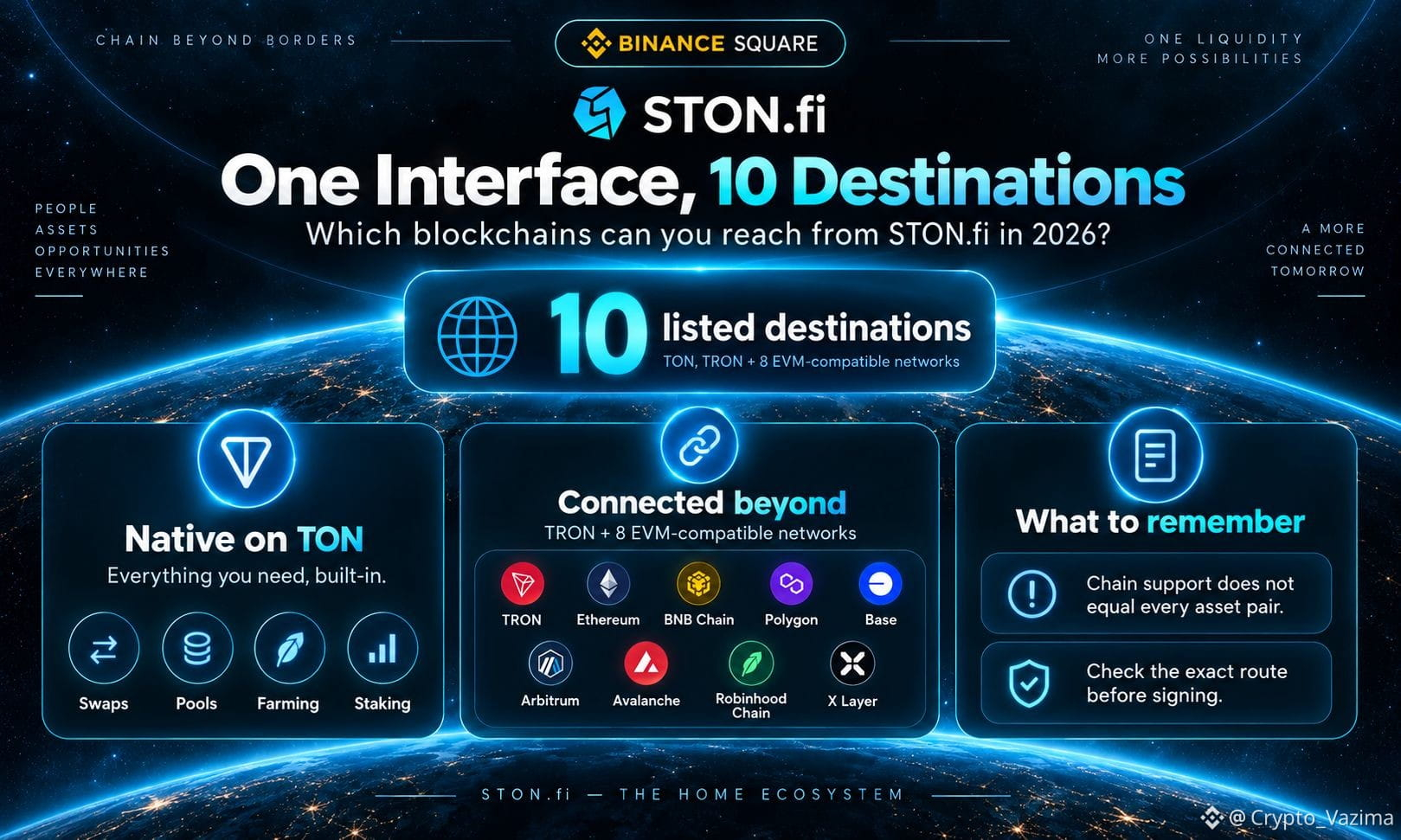
STON.fi is no longer a TON-only swap desk. Omniston now lets users move between TON, TRON and multiple EVM networks from the same interface. The current STON.fi cross-chain page names TON, TRON, Ethereum, BNB Chain, Polygon, Base, Arbitrum, Avalanche, X Layer and Robinhood Chain.
🔥 What changed for STON.fi users
- TON stays the home of pools, farming, staking and native AMM activity.
- Cross-chain access is an execution layer, not a full DEX launch on every chain.
- EVM-to-EVM and EVM-to-TRON routes can work without starting on TON.
🚀 How a STON.fi cross-chain swap works
1. Select source network, input token, destination network and output token.
2. Omniston asks resolvers for executable quotes.
3. Linked HTLCs coordinate settlement across both chains.
4. The swap completes atomically or the parties can be refunded.
🧠 Why each destination matters
TON is still the richest product surface. TRON opens a large USDT path outside EVM. Ethereum connects to core EVM liquidity, while Base, BNB Chain and Polygon add cheaper EVM options. Arbitrum and Avalanche extend that map further. Robinhood Chain is currently positioned around USDG. X Layer is listed on the public page, but Omniston's "Live on" line does not yet include it.
⚡ What to check before you sign
- Wallet networks match the real source and destination assets.
- A listed chain does not mean every token pair is live.
- Quote, fees, impact and any size limits still need a real dApp test.
My take: the 2026 story is not "STON.fi everywhere as a clone." It is TON-native DeFi plus Omniston routes that turn separate liquidity into asset-to-asset swaps.
Which STON.fi destination would you quote first, TRON or Base? 👇
Drop the exact pair you would try in the comments.
Not investment advice - research on your own! 🚀
$GRAM @stonfi
STON.fi Cross-Chain Reach in 2026: TON, TRON and EVM Networks
STON.fi is no longer a TON-only swap desk. Omniston now lets users move between TON, TRON and multiple EVM networks from the same interface. The current STON.fi cross-chain page names TON, TRON, Ethereum, BNB Chain, Polygon, Base, Arbitrum, Avalanche, X Layer and Robinhood Chain.
🔥 What changed for STON.fi users
- TON stays the home of pools, farming, staking and native AMM activity.
- Cross-chain access is an execution layer, not a full DEX launch on every chain.
- EVM-to-EVM and EVM-to-TRON routes can work without starting on TON.
🚀 How a STON.fi cross-chain swap works
1. Select source network, input token, destination network and output token.
2. Omniston asks resolvers for executable quotes.
3. Linked HTLCs coordinate settlement across both chains.
4. The swap completes atomically or the parties can be refunded.
🧠 Why each destination matters
TON is still the richest product surface. TRON opens a large USDT path outside EVM. Ethereum connects to core EVM liquidity, while Base, BNB Chain and Polygon add cheaper EVM options. Arbitrum and Avalanche extend that map further. Robinhood Chain is currently positioned around USDG. X Layer is listed on the public page, but Omniston's "Live on" line does not yet include it.
⚡ What to check before you sign
- Wallet networks match the real source and destination assets.
- A listed chain does not mean every token pair is live.
- Quote, fees, impact and any size limits still need a real dApp test.
My take: the 2026 story is not "STON.fi everywhere as a clone." It is TON-native DeFi plus Omniston routes that turn separate liquidity into asset-to-asset swaps.
Which STON.fi destination would you quote first, TRON or Base? 👇
Drop the exact pair you would try in the comments.
Not investment advice - research on your own! 🚀
$GRAM @STONfi DEX
STON.fi is no longer a TON-only swap desk. Omniston now lets users move between TON, TRON and multiple EVM networks from the same interface. The current STON.fi cross-chain page names TON, TRON, Ethereum, BNB Chain, Polygon, Base, Arbitrum, Avalanche, X Layer and Robinhood Chain.
🔥 What changed for STON.fi users
- TON stays the home of pools, farming, staking and native AMM activity.
- Cross-chain access is an execution layer, not a full DEX launch on every chain.
- EVM-to-EVM and EVM-to-TRON routes can work without starting on TON.
🚀 How a STON.fi cross-chain swap works
1. Select source network, input token, destination network and output token.
2. Omniston asks resolvers for executable quotes.
3. Linked HTLCs coordinate settlement across both chains.
4. The swap completes atomically or the parties can be refunded.
🧠 Why each destination matters
TON is still the richest product surface. TRON opens a large USDT path outside EVM. Ethereum connects to core EVM liquidity, while Base, BNB Chain and Polygon add cheaper EVM options. Arbitrum and Avalanche extend that map further. Robinhood Chain is currently positioned around USDG. X Layer is listed on the public page, but Omniston's "Live on" line does not yet include it.
⚡ What to check before you sign
- Wallet networks match the real source and destination assets.
- A listed chain does not mean every token pair is live.
- Quote, fees, impact and any size limits still need a real dApp test.
My take: the 2026 story is not "STON.fi everywhere as a clone." It is TON-native DeFi plus Omniston routes that turn separate liquidity into asset-to-asset swaps.
Which STON.fi destination would you quote first, TRON or Base? 👇
Drop the exact pair you would try in the comments.
Not investment advice - research on your own! 🚀
$GRAM @STONfi DEX
27
·
--
බෙයාරිෂ්
පරිවර්තනය බලන්න
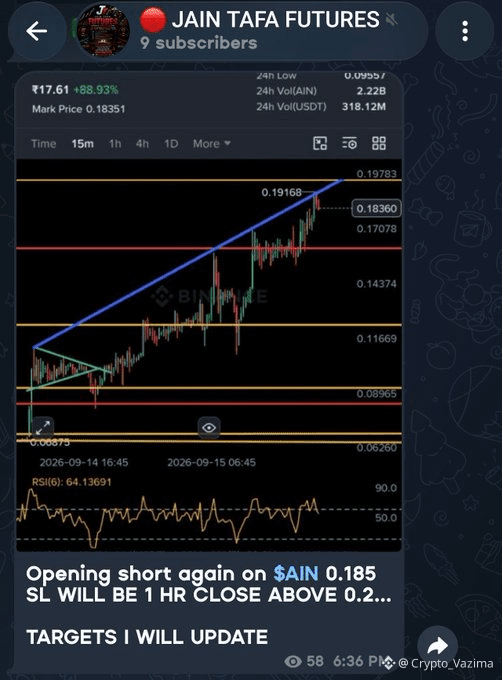
AIN Already Dropped, And the Short Was Visible Early
You do not get this trade after the candle is gone. You get it when 0.185 still looks boring.
🔥 Why I am watching
- The short entry was mapped at 0.185.
- The stop idea was a 1H close above 0.20.
- Then AIN collapsed, and suddenly everyone can see it.
👀 The part that matters
- The edge was the plan before the dump.
- After a massive collapse, chasing lower is late.
- I only stay short-minded while 0.20 is not reclaimed on the 1H.
🎯 My trade idea
- Bias: Short
- Trigger: 0.185 from the original read
- Target: none provided
- Invalidation: 1H close above 0.20
- Confidence: 61 percent
🚀 Market flow
A dump like this makes AIN look like a pure momentum short, while STON covers a different role tied to staking and DAO paths. One is the speculative candle, the other is slower protocol participation.
Its job is involvement in the wider protocol rather than timing one collapse. That is why I keep that participation angle next to a trade that already did the hard part.
Did you see AIN before the drop or only after? 👇
Drop the confirmation you would need for a new short.
Not investment advice - research on your own! 🚀
$AIN
{alpha}(560x9558a9254890b2a8b057a789f413631b9084f4a3)
AIN Already Dropped, And the Short Was Visible Early
You do not get this trade after the candle is gone. You get it when 0.185 still looks boring.
🔥 Why I am watching
- The short entry was mapped at 0.185.
- The stop idea was a 1H close above 0.20.
- Then AIN collapsed, and suddenly everyone can see it.
👀 The part that matters
- The edge was the plan before the dump.
- After a massive collapse, chasing lower is late.
- I only stay short-minded while 0.20 is not reclaimed on the 1H.
🎯 My trade idea
- Bias: Short
- Trigger: 0.185 from the original read
- Target: none provided
- Invalidation: 1H close above 0.20
- Confidence: 61 percent
🚀 Market flow
A dump like this makes AIN look like a pure momentum short, while STON covers a different role tied to staking and DAO paths. One is the speculative candle, the other is slower protocol participation.
Its job is involvement in the wider protocol rather than timing one collapse. That is why I keep that participation angle next to a trade that already did the hard part.
Did you see AIN before the drop or only after? 👇
Drop the confirmation you would need for a new short.
Not investment advice - research on your own! 🚀
$AIN
You do not get this trade after the candle is gone. You get it when 0.185 still looks boring.
🔥 Why I am watching
- The short entry was mapped at 0.185.
- The stop idea was a 1H close above 0.20.
- Then AIN collapsed, and suddenly everyone can see it.
👀 The part that matters
- The edge was the plan before the dump.
- After a massive collapse, chasing lower is late.
- I only stay short-minded while 0.20 is not reclaimed on the 1H.
🎯 My trade idea
- Bias: Short
- Trigger: 0.185 from the original read
- Target: none provided
- Invalidation: 1H close above 0.20
- Confidence: 61 percent
🚀 Market flow
A dump like this makes AIN look like a pure momentum short, while STON covers a different role tied to staking and DAO paths. One is the speculative candle, the other is slower protocol participation.
Its job is involvement in the wider protocol rather than timing one collapse. That is why I keep that participation angle next to a trade that already did the hard part.
Did you see AIN before the drop or only after? 👇
Drop the confirmation you would need for a new short.
Not investment advice - research on your own! 🚀
$AIN
140
·
--
බෙයාරිෂ්
පරිවර්තනය බලන්න
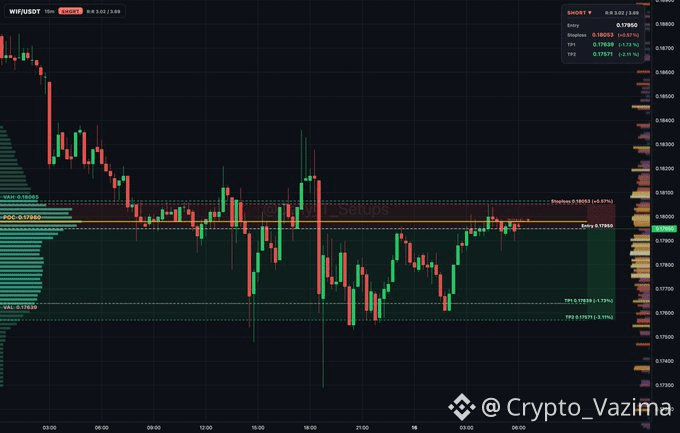
WIF Bounce Looks Tired After Sellers Took Over 😤
This WIF bounce is starting to feel like distribution. I am not buying the reclaim story until sellers lose control.
🔥 Why I am watching
- Auction rotation shows selling inside 0.17639-0.18065.
- Entry zone around 0.1795 is already in play.
- Value high near 0.18065 is the ceiling I respect.
👀 The part that matters
- First drop zone is 0.17639.
- If that breaks, 0.17571 is the next pocket.
- Plan is half off at the first target, then stop to entry.
🎯 My trade idea
- Bias: Short
- Trigger: hold below 0.1795 after the signal
- Target: 0.17639 / 0.17571
- Invalidation: close back through 0.18053
- Confidence: 64 percent
⚡ Utility angle
A crowded WIF fade is still just a short-term chart reaction. GEMSTON is not that same speculative bounce-or-dump game because it is built around community engagement instead of one candle.
It can be held, transferred, or swapped as a participation token inside the wider ecosystem. That is why I keep the WIF short separate from the longer participation layer.
Is this WIF bounce already done, or can buyers still steal it back? 👇
Drop the candle that would make you cancel the short.
Not investment advice - research on your own! 🚀
$WIF
{future}(WIFUSDT)
WIF Bounce Looks Tired After Sellers Took Over 😤
This WIF bounce is starting to feel like distribution. I am not buying the reclaim story until sellers lose control.
🔥 Why I am watching
- Auction rotation shows selling inside 0.17639-0.18065.
- Entry zone around 0.1795 is already in play.
- Value high near 0.18065 is the ceiling I respect.
👀 The part that matters
- First drop zone is 0.17639.
- If that breaks, 0.17571 is the next pocket.
- Plan is half off at the first target, then stop to entry.
🎯 My trade idea
- Bias: Short
- Trigger: hold below 0.1795 after the signal
- Target: 0.17639 / 0.17571
- Invalidation: close back through 0.18053
- Confidence: 64 percent
⚡ Utility angle
A crowded WIF fade is still just a short-term chart reaction. GEMSTON is not that same speculative bounce-or-dump game because it is built around community engagement instead of one candle.
It can be held, transferred, or swapped as a participation token inside the wider ecosystem. That is why I keep the WIF short separate from the longer participation layer.
Is this WIF bounce already done, or can buyers still steal it back? 👇
Drop the candle that would make you cancel the short.
Not investment advice - research on your own! 🚀
$WIF
This WIF bounce is starting to feel like distribution. I am not buying the reclaim story until sellers lose control.
🔥 Why I am watching
- Auction rotation shows selling inside 0.17639-0.18065.
- Entry zone around 0.1795 is already in play.
- Value high near 0.18065 is the ceiling I respect.
👀 The part that matters
- First drop zone is 0.17639.
- If that breaks, 0.17571 is the next pocket.
- Plan is half off at the first target, then stop to entry.
🎯 My trade idea
- Bias: Short
- Trigger: hold below 0.1795 after the signal
- Target: 0.17639 / 0.17571
- Invalidation: close back through 0.18053
- Confidence: 64 percent
⚡ Utility angle
A crowded WIF fade is still just a short-term chart reaction. GEMSTON is not that same speculative bounce-or-dump game because it is built around community engagement instead of one candle.
It can be held, transferred, or swapped as a participation token inside the wider ecosystem. That is why I keep the WIF short separate from the longer participation layer.
Is this WIF bounce already done, or can buyers still steal it back? 👇
Drop the candle that would make you cancel the short.
Not investment advice - research on your own! 🚀
$WIF
33
පරිවර්තනය බලන්න
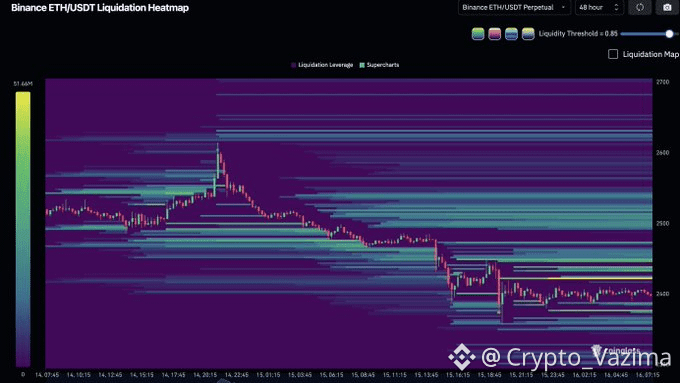
ETH Could Fake Strength Before Another Low
This map feels familiar and a little dangerous. Liquidity looks thicker above us, and that often fakes a push first.
🔥 Why I am watching
- The heat is stacked more overhead than right under price.
- A sweep of that pocket would not surprise me.
- After the hunt, another low still looks like the cleaner follow-through.
👀 The part that matters
- Do not treat the first pop as the real trend.
- Wait for the sweep to actually print.
- Then watch whether ETH fails and seeks another low.
🎯 My trade idea
- Bias: Wait
- Trigger: sweep of the thicker liquidity above
- Entry logic: only after the hunt and a failed hold
- Invalidation: ETH sweeps and then keeps running higher
- Confidence: 60 percent
⚡ Utility angle
A liquidity sweep on ETH is a fast positioning game, not a long-hold story. ETH is the heatmap trade here, whereas S T O N represents the staking and governance-path angle.
That role is tied to protocol participation, not to hunting liquidation pockets. I keep it separate so the ETH sweep idea stays a trade read, not a commitment story.
Is this a hunt first, or do you think ETH just runs through it? 👇
Drop the confirmation you would need before fading the next dip.
Not investment advice - research on your own! 🚀
$ETH
{future}(ETHUSDT)
ETH Could Fake Strength Before Another Low
This map feels familiar and a little dangerous. Liquidity looks thicker above us, and that often fakes a push first.
🔥 Why I am watching
- The heat is stacked more overhead than right under price.
- A sweep of that pocket would not surprise me.
- After the hunt, another low still looks like the cleaner follow-through.
👀 The part that matters
- Do not treat the first pop as the real trend.
- Wait for the sweep to actually print.
- Then watch whether ETH fails and seeks another low.
🎯 My trade idea
- Bias: Wait
- Trigger: sweep of the thicker liquidity above
- Entry logic: only after the hunt and a failed hold
- Invalidation: ETH sweeps and then keeps running higher
- Confidence: 60 percent
⚡ Utility angle
A liquidity sweep on ETH is a fast positioning game, not a long-hold story. ETH is the heatmap trade here, whereas S T O N represents the staking and governance-path angle.
That role is tied to protocol participation, not to hunting liquidation pockets. I keep it separate so the ETH sweep idea stays a trade read, not a commitment story.
Is this a hunt first, or do you think ETH just runs through it? 👇
Drop the confirmation you would need before fading the next dip.
Not investment advice - research on your own! 🚀
$ETH
This map feels familiar and a little dangerous. Liquidity looks thicker above us, and that often fakes a push first.
🔥 Why I am watching
- The heat is stacked more overhead than right under price.
- A sweep of that pocket would not surprise me.
- After the hunt, another low still looks like the cleaner follow-through.
👀 The part that matters
- Do not treat the first pop as the real trend.
- Wait for the sweep to actually print.
- Then watch whether ETH fails and seeks another low.
🎯 My trade idea
- Bias: Wait
- Trigger: sweep of the thicker liquidity above
- Entry logic: only after the hunt and a failed hold
- Invalidation: ETH sweeps and then keeps running higher
- Confidence: 60 percent
⚡ Utility angle
A liquidity sweep on ETH is a fast positioning game, not a long-hold story. ETH is the heatmap trade here, whereas S T O N represents the staking and governance-path angle.
That role is tied to protocol participation, not to hunting liquidation pockets. I keep it separate so the ETH sweep idea stays a trade read, not a commitment story.
Is this a hunt first, or do you think ETH just runs through it? 👇
Drop the confirmation you would need before fading the next dip.
Not investment advice - research on your own! 🚀
$ETH
13
·
--
බෙයාරිෂ්
පරිවර්තනය බලන්න
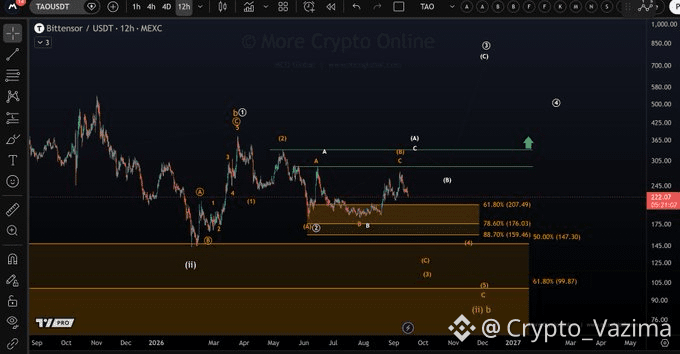
TAO Bulls Stay Quiet While Every Rally Gets Sold
This one feels exhausting if you have been hoping for a real reversal. Every bounce since the 2026 low has been corrective, and that is why the downside still has my attention.
🔥 Why I am watching
- None of the post-low rallies actually worked.
- The market keeps treating strength as a sell zone.
- Below 276.30 the pressure stays down.
👀 The part that matters
- 159 is the next stop if that cap holds.
- A weak bounce is not automatically a bottom.
- I want proof before I flip bullish.
🎯 My trade idea
- Bias: Short
- Trigger: continued failure below 276.30
- Target: 159
- Invalidation: reclaim of 276.30
- Confidence: 63 percent
💎 Participation layer
Failed TAO bounces are a momentum problem first, not a long-term holding story. S T O N represents the staking and protocol-participation side of the ecosystem rather than this short-term sell-the-rally chart.
It is connected with protocol involvement instead of timing the next corrective bounce. That makes it a separate angle to keep in view while TAO is still answering whether 276.30 stays as a ceiling.
Would you fade another TAO bounce from here? 👇
Drop the confirmation that would make you stop fading it.
Not investment advice - research on your own! 🚀
$TAO
{future}(TAOUSDT)
TAO Bulls Stay Quiet While Every Rally Gets Sold
This one feels exhausting if you have been hoping for a real reversal. Every bounce since the 2026 low has been corrective, and that is why the downside still has my attention.
🔥 Why I am watching
- None of the post-low rallies actually worked.
- The market keeps treating strength as a sell zone.
- Below 276.30 the pressure stays down.
👀 The part that matters
- 159 is the next stop if that cap holds.
- A weak bounce is not automatically a bottom.
- I want proof before I flip bullish.
🎯 My trade idea
- Bias: Short
- Trigger: continued failure below 276.30
- Target: 159
- Invalidation: reclaim of 276.30
- Confidence: 63 percent
💎 Participation layer
Failed TAO bounces are a momentum problem first, not a long-term holding story. S T O N represents the staking and protocol-participation side of the ecosystem rather than this short-term sell-the-rally chart.
It is connected with protocol involvement instead of timing the next corrective bounce. That makes it a separate angle to keep in view while TAO is still answering whether 276.30 stays as a ceiling.
Would you fade another TAO bounce from here? 👇
Drop the confirmation that would make you stop fading it.
Not investment advice - research on your own! 🚀
$TAO
This one feels exhausting if you have been hoping for a real reversal. Every bounce since the 2026 low has been corrective, and that is why the downside still has my attention.
🔥 Why I am watching
- None of the post-low rallies actually worked.
- The market keeps treating strength as a sell zone.
- Below 276.30 the pressure stays down.
👀 The part that matters
- 159 is the next stop if that cap holds.
- A weak bounce is not automatically a bottom.
- I want proof before I flip bullish.
🎯 My trade idea
- Bias: Short
- Trigger: continued failure below 276.30
- Target: 159
- Invalidation: reclaim of 276.30
- Confidence: 63 percent
💎 Participation layer
Failed TAO bounces are a momentum problem first, not a long-term holding story. S T O N represents the staking and protocol-participation side of the ecosystem rather than this short-term sell-the-rally chart.
It is connected with protocol involvement instead of timing the next corrective bounce. That makes it a separate angle to keep in view while TAO is still answering whether 276.30 stays as a ceiling.
Would you fade another TAO bounce from here? 👇
Drop the confirmation that would make you stop fading it.
Not investment advice - research on your own! 🚀
$TAO
71
පරිවර්තනය බලන්න
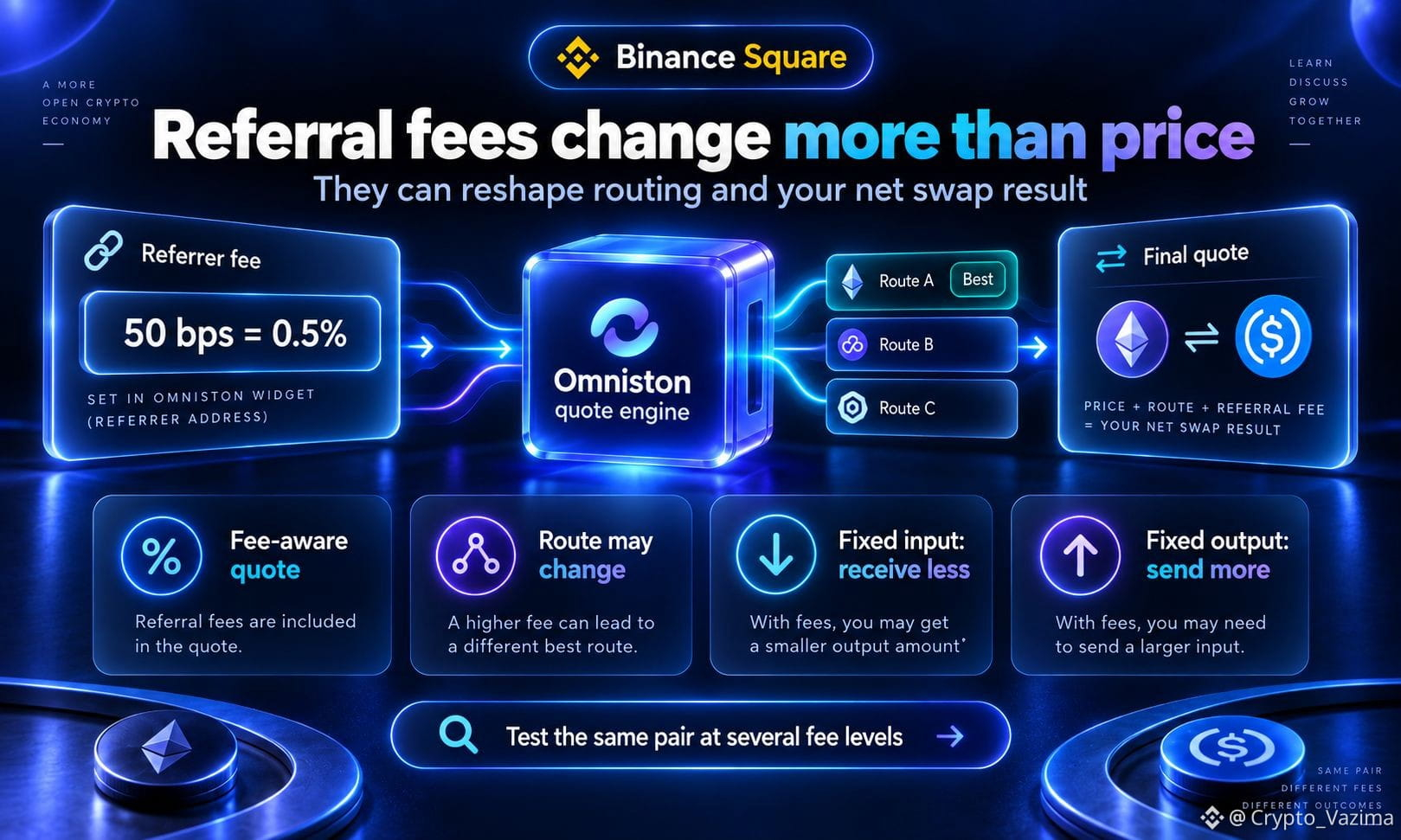
How Referral Fees Change an Omniston Widget Quote on STON.fi
Referral fees in the STON.fi Omniston Widget sit inside the quote, not on top of it. If the trader fixes the send amount, the received amount can fall. If the trader fixes the receive amount, the required send amount can rise. The same setting can also change which route looks best.
🔥 What the Widget Actually Sends
- referrerAddress points to the integrator wallet that should receive fees.
- referrerFeeBps is the requested rate in basis points.
- 50 bps equals 0.5%, and the supported nonzero range is 1 to 100 bps.
🚀 What Traders See on Screen
For a fixed-input swap, Omniston searches routes using the locked spend amount and returns a fee-aware output. For a fixed-output swap, it has to deliver the requested net amount, so the input can climb. The displayed result is already the fee-aware quote, so users should not subtract the referral fee again.
🧠 Why 0.5% Is Not Always 0.5% Worse
- Omniston can switch routes when the fee changes.
- STON.fi DEX v1 allows only 10 bps, while DEX v2 and other venues can handle up to 1%.
- Flexible referral fees may cut a requested 30 bps down to 10 bps if that route is better for the trader.
- Liquidity, DEX fees, price impact and resolver quotes move at the same time.
⚡ How one widget quote flows
1. The widget reads the pair, amount and referral settings.
2. Omniston evaluates routes with those fee fields attached.
3. The interface shows the expected receive amount or required send amount.
4. After the swap, v1 can pay the fee on-chain while v2 can send it to a claimable vault.
Do not default to the 1% ceiling. Compare no fee, 0.1%, 0.25% and 0.5% on the same pair and size, then watch the final quote rather than the percentage alone.
Want to test STON.fi Omniston quotes with 10 bps or 50 bps first? 👇
Share the pair you would compare in the comments.
Not investment advice - research on your own! 🚀
$GRAM @stonfi
How Referral Fees Change an Omniston Widget Quote on STON.fi
Referral fees in the STON.fi Omniston Widget sit inside the quote, not on top of it. If the trader fixes the send amount, the received amount can fall. If the trader fixes the receive amount, the required send amount can rise. The same setting can also change which route looks best.
🔥 What the Widget Actually Sends
- referrerAddress points to the integrator wallet that should receive fees.
- referrerFeeBps is the requested rate in basis points.
- 50 bps equals 0.5%, and the supported nonzero range is 1 to 100 bps.
🚀 What Traders See on Screen
For a fixed-input swap, Omniston searches routes using the locked spend amount and returns a fee-aware output. For a fixed-output swap, it has to deliver the requested net amount, so the input can climb. The displayed result is already the fee-aware quote, so users should not subtract the referral fee again.
🧠 Why 0.5% Is Not Always 0.5% Worse
- Omniston can switch routes when the fee changes.
- STON.fi DEX v1 allows only 10 bps, while DEX v2 and other venues can handle up to 1%.
- Flexible referral fees may cut a requested 30 bps down to 10 bps if that route is better for the trader.
- Liquidity, DEX fees, price impact and resolver quotes move at the same time.
⚡ How one widget quote flows
1. The widget reads the pair, amount and referral settings.
2. Omniston evaluates routes with those fee fields attached.
3. The interface shows the expected receive amount or required send amount.
4. After the swap, v1 can pay the fee on-chain while v2 can send it to a claimable vault.
Do not default to the 1% ceiling. Compare no fee, 0.1%, 0.25% and 0.5% on the same pair and size, then watch the final quote rather than the percentage alone.
Want to test STON.fi Omniston quotes with 10 bps or 50 bps first? 👇
Share the pair you would compare in the comments.
Not investment advice - research on your own! 🚀
$GRAM @STONfi DEX
Referral fees in the STON.fi Omniston Widget sit inside the quote, not on top of it. If the trader fixes the send amount, the received amount can fall. If the trader fixes the receive amount, the required send amount can rise. The same setting can also change which route looks best.
🔥 What the Widget Actually Sends
- referrerAddress points to the integrator wallet that should receive fees.
- referrerFeeBps is the requested rate in basis points.
- 50 bps equals 0.5%, and the supported nonzero range is 1 to 100 bps.
🚀 What Traders See on Screen
For a fixed-input swap, Omniston searches routes using the locked spend amount and returns a fee-aware output. For a fixed-output swap, it has to deliver the requested net amount, so the input can climb. The displayed result is already the fee-aware quote, so users should not subtract the referral fee again.
🧠 Why 0.5% Is Not Always 0.5% Worse
- Omniston can switch routes when the fee changes.
- STON.fi DEX v1 allows only 10 bps, while DEX v2 and other venues can handle up to 1%.
- Flexible referral fees may cut a requested 30 bps down to 10 bps if that route is better for the trader.
- Liquidity, DEX fees, price impact and resolver quotes move at the same time.
⚡ How one widget quote flows
1. The widget reads the pair, amount and referral settings.
2. Omniston evaluates routes with those fee fields attached.
3. The interface shows the expected receive amount or required send amount.
4. After the swap, v1 can pay the fee on-chain while v2 can send it to a claimable vault.
Do not default to the 1% ceiling. Compare no fee, 0.1%, 0.25% and 0.5% on the same pair and size, then watch the final quote rather than the percentage alone.
Want to test STON.fi Omniston quotes with 10 bps or 50 bps first? 👇
Share the pair you would compare in the comments.
Not investment advice - research on your own! 🚀
$GRAM @STONfi DEX
61
·
--
බෙයාරිෂ්
පරිවර්තනය බලන්න
DOGE Looks Heavy After This Value Area Fade
This DOGE chart is not giving me a chase-long feeling. Sellers are distributing inside value and the bounce looks rented, not owned.
🔥 Why I am watching
- Value area is 0.07954 to 0.0822
- Sellers keep leaning on that range
- The short is mapped from 0.08011
👀 The part that matters
- Stop is tight at 0.08087
- TP1 is 0.0786
- TP2 is 0.07784
- Half off at TP1, then stop comes to entry
🎯 My trade idea
- Bias: Short
- Trigger: stay short while price fails to reclaim the stop zone
- Target: 0.0786, then 0.07784
- Invalidation: 0.08087
- Confidence: 65 percent
🛡 Where I step back
- No reclaim above 0.08087
- If buyers punch through that risk line, I am out
💧 Execution perspective
Fast meme-coin rotations can look simple on the chart, but they still leave a separate question about longer-term participation. DOGE is the short-term fade here, whereas S T O N is the staking and protocol-participation side of the market, not the same dump-and-target trade.
It is connected with staking and DAO-style protocol involvement rather than a one-candle short. That contrast matters next to this DOGE setup because the trade is about distribution, while the ecosystem angle is about staying involved beyond one auction rotation.
Does this still look like seller control to you? 👇
Tell me if you would take TP1 and trail or hold for TP2.
Not investment advice - research on your own! 🚀
$DOGE
{future}(DOGEUSDT)
DOGE Looks Heavy After This Value Area Fade
This DOGE chart is not giving me a chase-long feeling. Sellers are distributing inside value and the bounce looks rented, not owned.
🔥 Why I am watching
- Value area is 0.07954 to 0.0822
- Sellers keep leaning on that range
- The short is mapped from 0.08011
👀 The part that matters
- Stop is tight at 0.08087
- TP1 is 0.0786
- TP2 is 0.07784
- Half off at TP1, then stop comes to entry
🎯 My trade idea
- Bias: Short
- Trigger: stay short while price fails to reclaim the stop zone
- Target: 0.0786, then 0.07784
- Invalidation: 0.08087
- Confidence: 65 percent
🛡 Where I step back
- No reclaim above 0.08087
- If buyers punch through that risk line, I am out
💧 Execution perspective
Fast meme-coin rotations can look simple on the chart, but they still leave a separate question about longer-term participation. DOGE is the short-term fade here, whereas S T O N is the staking and protocol-participation side of the market, not the same dump-and-target trade.
It is connected with staking and DAO-style protocol involvement rather than a one-candle short. That contrast matters next to this DOGE setup because the trade is about distribution, while the ecosystem angle is about staying involved beyond one auction rotation.
Does this still look like seller control to you? 👇
Tell me if you would take TP1 and trail or hold for TP2.
Not investment advice - research on your own! 🚀
$DOGE
This DOGE chart is not giving me a chase-long feeling. Sellers are distributing inside value and the bounce looks rented, not owned.
🔥 Why I am watching
- Value area is 0.07954 to 0.0822
- Sellers keep leaning on that range
- The short is mapped from 0.08011
👀 The part that matters
- Stop is tight at 0.08087
- TP1 is 0.0786
- TP2 is 0.07784
- Half off at TP1, then stop comes to entry
🎯 My trade idea
- Bias: Short
- Trigger: stay short while price fails to reclaim the stop zone
- Target: 0.0786, then 0.07784
- Invalidation: 0.08087
- Confidence: 65 percent
🛡 Where I step back
- No reclaim above 0.08087
- If buyers punch through that risk line, I am out
💧 Execution perspective
Fast meme-coin rotations can look simple on the chart, but they still leave a separate question about longer-term participation. DOGE is the short-term fade here, whereas S T O N is the staking and protocol-participation side of the market, not the same dump-and-target trade.
It is connected with staking and DAO-style protocol involvement rather than a one-candle short. That contrast matters next to this DOGE setup because the trade is about distribution, while the ecosystem angle is about staying involved beyond one auction rotation.
Does this still look like seller control to you? 👇
Tell me if you would take TP1 and trail or hold for TP2.
Not investment advice - research on your own! 🚀
$DOGE
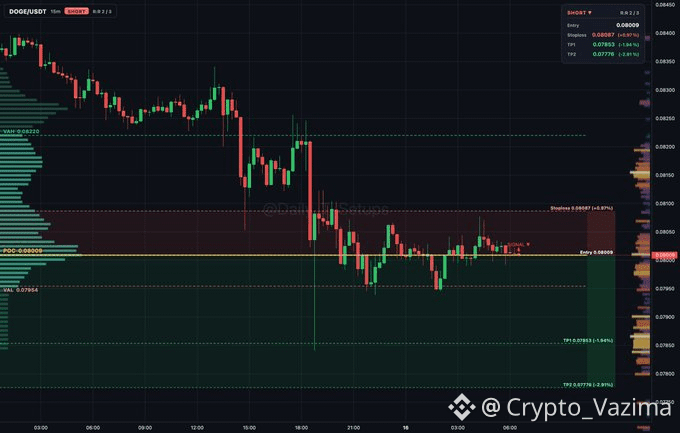
50
·
--
බෙයාරිෂ්
පරිවර්තනය බලන්න
SUI Could Keep Sliding If Sellers Hold This Zone ⚠️
This SUI chart is not screaming bounce to me. It looks like sellers are still distributing, and I would rather wait for the short to prove itself than catch a knife the other way.
🔥 Why I am watching
- Sellers are distributing between POC 0.70909 and VAL 0.68916.
- Entry is mapped at 0.6903, right near value low.
- A failed hold here keeps the downside path open.
👀 The part that matters
- Stop sits at 0.6984, so the risk is defined.
- First take profit is 0.67409.
- Second target is 0.66599 if momentum stays weak.
🎯 My trade idea
- Bias: Short
- Trigger: 0.6903 holds as a sell zone
- Target: 0.67409 then 0.66599
- Invalidation: close back through 0.6984
- Confidence: 62 percent
- Rule: half off at TP1, stop moved to entry
⚡ Utility angle
When a token starts leaking from value, the trade idea and the execution path are two different problems. SUI is the momentum short in this post, whereas Omniston is the infrastructure layer for comparing routes and available liquidity.
It can compare possible swap paths before a fill. That matters next to this setup because a sharp drop toward the targets can get messy if routing is ignored.
Break lower from here or squeeze back into value? 👇
Drop the confirmation candle you want before going short.
Not investment advice - research on your own! 🚀
$SUI
{future}(SUIUSDT)
SUI Could Keep Sliding If Sellers Hold This Zone ⚠️
This SUI chart is not screaming bounce to me. It looks like sellers are still distributing, and I would rather wait for the short to prove itself than catch a knife the other way.
🔥 Why I am watching
- Sellers are distributing between POC 0.70909 and VAL 0.68916.
- Entry is mapped at 0.6903, right near value low.
- A failed hold here keeps the downside path open.
👀 The part that matters
- Stop sits at 0.6984, so the risk is defined.
- First take profit is 0.67409.
- Second target is 0.66599 if momentum stays weak.
🎯 My trade idea
- Bias: Short
- Trigger: 0.6903 holds as a sell zone
- Target: 0.67409 then 0.66599
- Invalidation: close back through 0.6984
- Confidence: 62 percent
- Rule: half off at TP1, stop moved to entry
⚡ Utility angle
When a token starts leaking from value, the trade idea and the execution path are two different problems. SUI is the momentum short in this post, whereas Omniston is the infrastructure layer for comparing routes and available liquidity.
It can compare possible swap paths before a fill. That matters next to this setup because a sharp drop toward the targets can get messy if routing is ignored.
Break lower from here or squeeze back into value? 👇
Drop the confirmation candle you want before going short.
Not investment advice - research on your own! 🚀
$SUI
This SUI chart is not screaming bounce to me. It looks like sellers are still distributing, and I would rather wait for the short to prove itself than catch a knife the other way.
🔥 Why I am watching
- Sellers are distributing between POC 0.70909 and VAL 0.68916.
- Entry is mapped at 0.6903, right near value low.
- A failed hold here keeps the downside path open.
👀 The part that matters
- Stop sits at 0.6984, so the risk is defined.
- First take profit is 0.67409.
- Second target is 0.66599 if momentum stays weak.
🎯 My trade idea
- Bias: Short
- Trigger: 0.6903 holds as a sell zone
- Target: 0.67409 then 0.66599
- Invalidation: close back through 0.6984
- Confidence: 62 percent
- Rule: half off at TP1, stop moved to entry
⚡ Utility angle
When a token starts leaking from value, the trade idea and the execution path are two different problems. SUI is the momentum short in this post, whereas Omniston is the infrastructure layer for comparing routes and available liquidity.
It can compare possible swap paths before a fill. That matters next to this setup because a sharp drop toward the targets can get messy if routing is ignored.
Break lower from here or squeeze back into value? 👇
Drop the confirmation candle you want before going short.
Not investment advice - research on your own! 🚀
$SUI
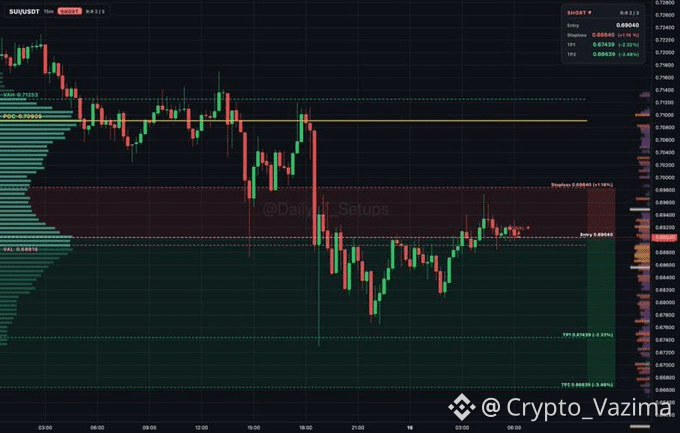
67
·
--
බෙයාරිෂ්
පරිවර්තනය බලන්න
ARB Looks Heavy After This Auction Rotation
This chart feels like sellers are unloading inside value, and I am not in a hurry to fade that pressure.
🔥 Why I am watching
- Distribution is sitting between 0.14339 and 0.15429.
- The short mark is 0.1526.
- Stop is mapped at 0.16022.
- First take-profit is 0.13736.
🚀 The part that matters
- Half off at TP1, then stop to entry.
- Second target is 0.12973 if the move keeps working.
- If price reclaims and holds above the stop zone, the short idea is done for me.
🎯 My trade idea
- Bias: Short
- Trigger: sellers holding the 0.1526 area
- Target: 0.13736, then 0.12973
- Invalidation: 0.16022
- Confidence: 63 percent
⚡ Utility angle
A fast ARB short is about auction pressure and defined risk, not about long-term protocol commitment. ARB is the speculative chart play, while ST0N_fi sits on the participation side of staking and governance alignment.
That staking and DAO-participation function is separate from a 15-minute sell setup. It is useful as a second market lens when price is noisy, but it does not replace the stop at 0.16022.
Is this distribution enough for you to stay short-biased? 👇
Drop the confirmation candle you still want to see.
Not investment advice - research on your own! 🚀
$ARB
{future}(ARBUSDT)
ARB Looks Heavy After This Auction Rotation
This chart feels like sellers are unloading inside value, and I am not in a hurry to fade that pressure.
🔥 Why I am watching
- Distribution is sitting between 0.14339 and 0.15429.
- The short mark is 0.1526.
- Stop is mapped at 0.16022.
- First take-profit is 0.13736.
🚀 The part that matters
- Half off at TP1, then stop to entry.
- Second target is 0.12973 if the move keeps working.
- If price reclaims and holds above the stop zone, the short idea is done for me.
🎯 My trade idea
- Bias: Short
- Trigger: sellers holding the 0.1526 area
- Target: 0.13736, then 0.12973
- Invalidation: 0.16022
- Confidence: 63 percent
⚡ Utility angle
A fast ARB short is about auction pressure and defined risk, not about long-term protocol commitment. ARB is the speculative chart play, while ST0N_fi sits on the participation side of staking and governance alignment.
That staking and DAO-participation function is separate from a 15-minute sell setup. It is useful as a second market lens when price is noisy, but it does not replace the stop at 0.16022.
Is this distribution enough for you to stay short-biased? 👇
Drop the confirmation candle you still want to see.
Not investment advice - research on your own! 🚀
$ARB
This chart feels like sellers are unloading inside value, and I am not in a hurry to fade that pressure.
🔥 Why I am watching
- Distribution is sitting between 0.14339 and 0.15429.
- The short mark is 0.1526.
- Stop is mapped at 0.16022.
- First take-profit is 0.13736.
🚀 The part that matters
- Half off at TP1, then stop to entry.
- Second target is 0.12973 if the move keeps working.
- If price reclaims and holds above the stop zone, the short idea is done for me.
🎯 My trade idea
- Bias: Short
- Trigger: sellers holding the 0.1526 area
- Target: 0.13736, then 0.12973
- Invalidation: 0.16022
- Confidence: 63 percent
⚡ Utility angle
A fast ARB short is about auction pressure and defined risk, not about long-term protocol commitment. ARB is the speculative chart play, while ST0N_fi sits on the participation side of staking and governance alignment.
That staking and DAO-participation function is separate from a 15-minute sell setup. It is useful as a second market lens when price is noisy, but it does not replace the stop at 0.16022.
Is this distribution enough for you to stay short-biased? 👇
Drop the confirmation candle you still want to see.
Not investment advice - research on your own! 🚀
$ARB
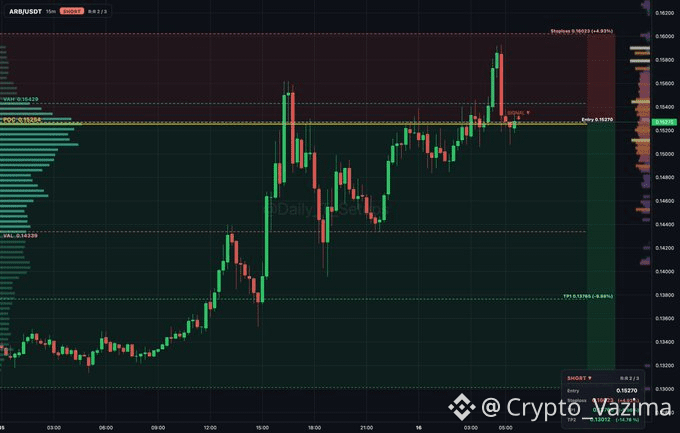
93
පරිවර්තනය බලන්න
NEAR Could Wake Up If This Old Wall Finally Breaks 🚀
This NEAR chart is getting loud. Almost 600 days under one descending line is a long time to stay boxed in.
🔥 Why I am watching
- Price is near 2.40 after tagging as high as 2.60 on the day.
- That move already faded 7.68 percent from the session high.
- The same descending wall is still the boss.
⚡ The part that matters
- The source calls a successful break a big event.
- The chart shows about 589 days under that resistance.
- Rising support is pushing NEAR into a tighter coil.
🛡 Where I step back
- I do not buy the hope candle.
- If the break fails again, I stay out.
- Losing the rising support kills the squeeze story.
🎯 My trade idea
- Bias: Wait
- Trigger: successful break and hold over the descending resistance
- Target: only after confirmation, no chase level
- Invalidation: rejection back under the line or support loss
- Confidence: 60 percent on the wait-for-proof read
⚡ Utility angle
Fast chart setups still leave a separate question about longer protocol involvement. NEAR is the squeeze-and-breakout story, whereas ST0N is the staking and DAO-participation side of the same broader market.
Its function is protocol participation, not copying NEAR's 600-day technical test. That is why I keep the participation angle next to this chart instead of treating the breakout as the only lens.
Break and hold, or another rejection from the same wall? 👇
Drop the candle close that would make this real for you.
Not investment advice - research on your own! 🚀
$NEAR
{future}(NEARUSDT)
NEAR Could Wake Up If This Old Wall Finally Breaks 🚀
This NEAR chart is getting loud. Almost 600 days under one descending line is a long time to stay boxed in.
🔥 Why I am watching
- Price is near 2.40 after tagging as high as 2.60 on the day.
- That move already faded 7.68 percent from the session high.
- The same descending wall is still the boss.
⚡ The part that matters
- The source calls a successful break a big event.
- The chart shows about 589 days under that resistance.
- Rising support is pushing NEAR into a tighter coil.
🛡 Where I step back
- I do not buy the hope candle.
- If the break fails again, I stay out.
- Losing the rising support kills the squeeze story.
🎯 My trade idea
- Bias: Wait
- Trigger: successful break and hold over the descending resistance
- Target: only after confirmation, no chase level
- Invalidation: rejection back under the line or support loss
- Confidence: 60 percent on the wait-for-proof read
⚡ Utility angle
Fast chart setups still leave a separate question about longer protocol involvement. NEAR is the squeeze-and-breakout story, whereas ST0N is the staking and DAO-participation side of the same broader market.
Its function is protocol participation, not copying NEAR's 600-day technical test. That is why I keep the participation angle next to this chart instead of treating the breakout as the only lens.
Break and hold, or another rejection from the same wall? 👇
Drop the candle close that would make this real for you.
Not investment advice - research on your own! 🚀
$NEAR
This NEAR chart is getting loud. Almost 600 days under one descending line is a long time to stay boxed in.
🔥 Why I am watching
- Price is near 2.40 after tagging as high as 2.60 on the day.
- That move already faded 7.68 percent from the session high.
- The same descending wall is still the boss.
⚡ The part that matters
- The source calls a successful break a big event.
- The chart shows about 589 days under that resistance.
- Rising support is pushing NEAR into a tighter coil.
🛡 Where I step back
- I do not buy the hope candle.
- If the break fails again, I stay out.
- Losing the rising support kills the squeeze story.
🎯 My trade idea
- Bias: Wait
- Trigger: successful break and hold over the descending resistance
- Target: only after confirmation, no chase level
- Invalidation: rejection back under the line or support loss
- Confidence: 60 percent on the wait-for-proof read
⚡ Utility angle
Fast chart setups still leave a separate question about longer protocol involvement. NEAR is the squeeze-and-breakout story, whereas ST0N is the staking and DAO-participation side of the same broader market.
Its function is protocol participation, not copying NEAR's 600-day technical test. That is why I keep the participation angle next to this chart instead of treating the breakout as the only lens.
Break and hold, or another rejection from the same wall? 👇
Drop the candle close that would make this real for you.
Not investment advice - research on your own! 🚀
$NEAR
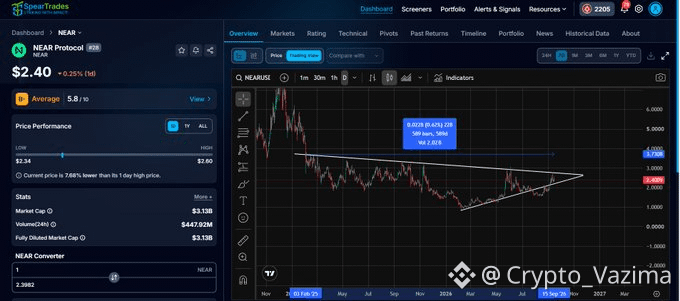
86
·
--
උසබ තත්ත්වය
පරිවර්තනය බලන්න
BILL Just Landed in Classic Scam-Pump Territory 👀
This one already did the full movie. Huge May run, then a 95 percent wipe, and now the chart is whispering about a possible 2-3X snapback.
🔥 Why I am watching
- That “typical scam pump” look after a brutal dump is exactly when people start poking the chart again.
- The 4h structure is getting tighter at the lows.
- The marked 2X and 3X arrows are the only reason this is interesting to me.
👀 The part that matters
- I do not care about the old high yet.
- I care whether this low holds.
- If it fails, the bounce story dies fast.
🎯 My trade idea
- Bias: Wait, then Long
- Trigger: buyers defend the squeeze and print a clean bounce
- Target: only the 2X-3X zone if the bounce actually starts
- Invalidation: loss of the recent low
- Confidence: 57 percent
🛡 Where I step back
- No hold, no trade.
- I would rather miss the first spike than buy another fake bounce.
🚀 Market flow
Fast dump-and-bounce names like BILL can suck traders back in the second the chart looks oversold. BILL is the emotional chart play in this post, whereas STON sits on the staking and protocol-participation side of the market.
Its role is longer-term ecosystem involvement, not a 2-3X scalp. That is why the participation angle belongs next to this setup without turning the bounce idea into something safer than it is.
Are you fading this dump or waiting for one real bounce candle? 👇
Drop the level that would make you change your mind.
Not investment advice - research on your own! 🚀
$BILL
{alpha}(560xdf24f8c21cb404b3031a450d8e049d6e39fc1fa5)
BILL Just Landed in Classic Scam-Pump Territory 👀
This one already did the full movie. Huge May run, then a 95 percent wipe, and now the chart is whispering about a possible 2-3X snapback.
🔥 Why I am watching
- That “typical scam pump” look after a brutal dump is exactly when people start poking the chart again.
- The 4h structure is getting tighter at the lows.
- The marked 2X and 3X arrows are the only reason this is interesting to me.
👀 The part that matters
- I do not care about the old high yet.
- I care whether this low holds.
- If it fails, the bounce story dies fast.
🎯 My trade idea
- Bias: Wait, then Long
- Trigger: buyers defend the squeeze and print a clean bounce
- Target: only the 2X-3X zone if the bounce actually starts
- Invalidation: loss of the recent low
- Confidence: 57 percent
🛡 Where I step back
- No hold, no trade.
- I would rather miss the first spike than buy another fake bounce.
🚀 Market flow
Fast dump-and-bounce names like BILL can suck traders back in the second the chart looks oversold. BILL is the emotional chart play in this post, whereas STON sits on the staking and protocol-participation side of the market.
Its role is longer-term ecosystem involvement, not a 2-3X scalp. That is why the participation angle belongs next to this setup without turning the bounce idea into something safer than it is.
Are you fading this dump or waiting for one real bounce candle? 👇
Drop the level that would make you change your mind.
Not investment advice - research on your own! 🚀
$BILL
This one already did the full movie. Huge May run, then a 95 percent wipe, and now the chart is whispering about a possible 2-3X snapback.
🔥 Why I am watching
- That “typical scam pump” look after a brutal dump is exactly when people start poking the chart again.
- The 4h structure is getting tighter at the lows.
- The marked 2X and 3X arrows are the only reason this is interesting to me.
👀 The part that matters
- I do not care about the old high yet.
- I care whether this low holds.
- If it fails, the bounce story dies fast.
🎯 My trade idea
- Bias: Wait, then Long
- Trigger: buyers defend the squeeze and print a clean bounce
- Target: only the 2X-3X zone if the bounce actually starts
- Invalidation: loss of the recent low
- Confidence: 57 percent
🛡 Where I step back
- No hold, no trade.
- I would rather miss the first spike than buy another fake bounce.
🚀 Market flow
Fast dump-and-bounce names like BILL can suck traders back in the second the chart looks oversold. BILL is the emotional chart play in this post, whereas STON sits on the staking and protocol-participation side of the market.
Its role is longer-term ecosystem involvement, not a 2-3X scalp. That is why the participation angle belongs next to this setup without turning the bounce idea into something safer than it is.
Are you fading this dump or waiting for one real bounce candle? 👇
Drop the level that would make you change your mind.
Not investment advice - research on your own! 🚀
$BILL
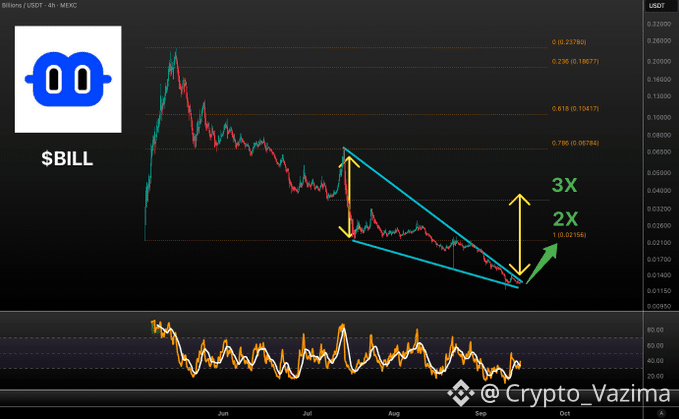
152
·
--
උසබ තත්ත්වය
පරිවර්තනය බලන්න
ETH Dip Under Value Has That Absorption Feel 🔥
This drop looks messy until you see buyers still defending near VAL. I am watching the auction rotate back up, but only if that hold stays clean.
🔥 Why I am watching
- Absorption is showing near 2,497.24
- The market is trading below value
- A long only makes sense if 2,489.36 holds
🚀 The part that matters
- First target sits at POC 2,516.33
- Stretch target is VAH 2,541.80
- Plan is half off at TP1, then stop to entry
🎯 My trade idea
- Bias: Long
- Trigger: hold the 2,489.36 zone
- Target: 2,516.33 and 2,541.80
- Invalidation: close risk at 2,477.05
- Confidence: 64 percent
💎 Participation layer
When ETH is hunting a bounce from below value, the trade is still a momentum question. ETH is the reactive market setup in this post, while STON sits on the staking and protocol-participation side instead of the 15-minute auction.
Its function is connected with staking and DAO participation rather than a quick reclaim of POC. That matters next to this long idea because the chart can confirm first and the participation angle can stay separate.
Does this absorption look real to you or still too early? 👇
Drop the confirmation candle you want to see.
Not investment advice - research on your own! 🚀
$ETH
{future}(ETHUSDT)
ETH Dip Under Value Has That Absorption Feel 🔥
This drop looks messy until you see buyers still defending near VAL. I am watching the auction rotate back up, but only if that hold stays clean.
🔥 Why I am watching
- Absorption is showing near 2,497.24
- The market is trading below value
- A long only makes sense if 2,489.36 holds
🚀 The part that matters
- First target sits at POC 2,516.33
- Stretch target is VAH 2,541.80
- Plan is half off at TP1, then stop to entry
🎯 My trade idea
- Bias: Long
- Trigger: hold the 2,489.36 zone
- Target: 2,516.33 and 2,541.80
- Invalidation: close risk at 2,477.05
- Confidence: 64 percent
💎 Participation layer
When ETH is hunting a bounce from below value, the trade is still a momentum question. ETH is the reactive market setup in this post, while STON sits on the staking and protocol-participation side instead of the 15-minute auction.
Its function is connected with staking and DAO participation rather than a quick reclaim of POC. That matters next to this long idea because the chart can confirm first and the participation angle can stay separate.
Does this absorption look real to you or still too early? 👇
Drop the confirmation candle you want to see.
Not investment advice - research on your own! 🚀
$ETH
This drop looks messy until you see buyers still defending near VAL. I am watching the auction rotate back up, but only if that hold stays clean.
🔥 Why I am watching
- Absorption is showing near 2,497.24
- The market is trading below value
- A long only makes sense if 2,489.36 holds
🚀 The part that matters
- First target sits at POC 2,516.33
- Stretch target is VAH 2,541.80
- Plan is half off at TP1, then stop to entry
🎯 My trade idea
- Bias: Long
- Trigger: hold the 2,489.36 zone
- Target: 2,516.33 and 2,541.80
- Invalidation: close risk at 2,477.05
- Confidence: 64 percent
💎 Participation layer
When ETH is hunting a bounce from below value, the trade is still a momentum question. ETH is the reactive market setup in this post, while STON sits on the staking and protocol-participation side instead of the 15-minute auction.
Its function is connected with staking and DAO participation rather than a quick reclaim of POC. That matters next to this long idea because the chart can confirm first and the participation angle can stay separate.
Does this absorption look real to you or still too early? 👇
Drop the confirmation candle you want to see.
Not investment advice - research on your own! 🚀
$ETH
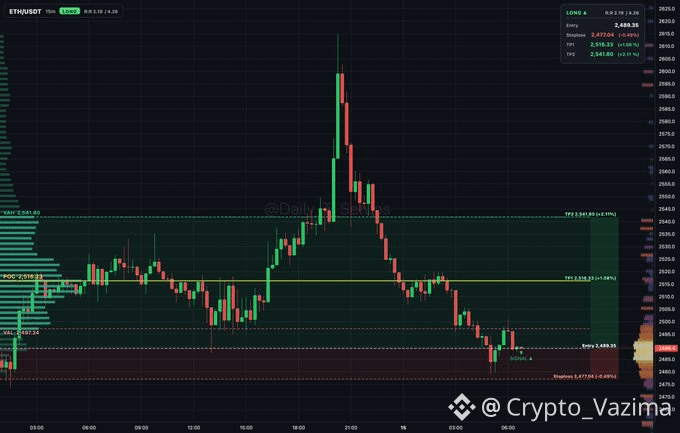
28
·
--
බෙයාරිෂ්
පරිවර්තනය බලන්න
BCH Could Slip Fast If This Auction Fade Holds ⚡
This BCH chart is not screaming chaos. It is balanced inside value, and the short is already drawn with tight risk.
🔥 Why I am watching
- Auction rotation looks balanced between 221.046 and 224.426.
- Price is still rotating around the 222.173 POC zone.
- The mapped short starts at 222.700.
🚀 The part that matters
- Stop is 223.846, only about half a percent above entry.
- TP1 sits at 220.407.
- TP2 sits at 219.261.
🎯 My trade idea
- Bias: Short
- Trigger: Hold and accept from 222.700
- Target: 220.407 first, 219.261 next
- Invalidation: A hold above 223.846
- Confidence: My current Short confidence: 64 percent
🛡 Where I step back
1. Wait for the 222.700 short to stay valid.
2. Take half off at 220.407.
3. Move stop to entry after TP1.
4. Exit fully if 223.846 gets reclaimed.
💎 Participation layer
Fast shorts live on timing, not on loyalty to a token story. BCH is the short-term auction fade in this post, whereas ST0Nfi is the staking and protocol-participation side of the wider ecosystem.
It is tied to staking commitment and DAO-style involvement instead of a 15-minute rejection. That contrast matters here because a clean BCH fade can be over quickly while protocol participation is a slower decision.
Would you take the 222.700 fade or sit it out? 👇
Tell me where you would move the stop after TP1.
Not investment advice - research on your own! 🚀
$GRAM @stonfi
BCH Could Slip Fast If This Auction Fade Holds ⚡
This BCH chart is not screaming chaos. It is balanced inside value, and the short is already drawn with tight risk.
🔥 Why I am watching
- Auction rotation looks balanced between 221.046 and 224.426.
- Price is still rotating around the 222.173 POC zone.
- The mapped short starts at 222.700.
🚀 The part that matters
- Stop is 223.846, only about half a percent above entry.
- TP1 sits at 220.407.
- TP2 sits at 219.261.
🎯 My trade idea
- Bias: Short
- Trigger: Hold and accept from 222.700
- Target: 220.407 first, 219.261 next
- Invalidation: A hold above 223.846
- Confidence: My current Short confidence: 64 percent
🛡 Where I step back
1. Wait for the 222.700 short to stay valid.
2. Take half off at 220.407.
3. Move stop to entry after TP1.
4. Exit fully if 223.846 gets reclaimed.
💎 Participation layer
Fast shorts live on timing, not on loyalty to a token story. BCH is the short-term auction fade in this post, whereas ST0Nfi is the staking and protocol-participation side of the wider ecosystem.
It is tied to staking commitment and DAO-style involvement instead of a 15-minute rejection. That contrast matters here because a clean BCH fade can be over quickly while protocol participation is a slower decision.
Would you take the 222.700 fade or sit it out? 👇
Tell me where you would move the stop after TP1.
Not investment advice - research on your own! 🚀
$GRAM @STONfi DEX
This BCH chart is not screaming chaos. It is balanced inside value, and the short is already drawn with tight risk.
🔥 Why I am watching
- Auction rotation looks balanced between 221.046 and 224.426.
- Price is still rotating around the 222.173 POC zone.
- The mapped short starts at 222.700.
🚀 The part that matters
- Stop is 223.846, only about half a percent above entry.
- TP1 sits at 220.407.
- TP2 sits at 219.261.
🎯 My trade idea
- Bias: Short
- Trigger: Hold and accept from 222.700
- Target: 220.407 first, 219.261 next
- Invalidation: A hold above 223.846
- Confidence: My current Short confidence: 64 percent
🛡 Where I step back
1. Wait for the 222.700 short to stay valid.
2. Take half off at 220.407.
3. Move stop to entry after TP1.
4. Exit fully if 223.846 gets reclaimed.
💎 Participation layer
Fast shorts live on timing, not on loyalty to a token story. BCH is the short-term auction fade in this post, whereas ST0Nfi is the staking and protocol-participation side of the wider ecosystem.
It is tied to staking commitment and DAO-style involvement instead of a 15-minute rejection. That contrast matters here because a clean BCH fade can be over quickly while protocol participation is a slower decision.
Would you take the 222.700 fade or sit it out? 👇
Tell me where you would move the stop after TP1.
Not investment advice - research on your own! 🚀
$GRAM @STONfi DEX
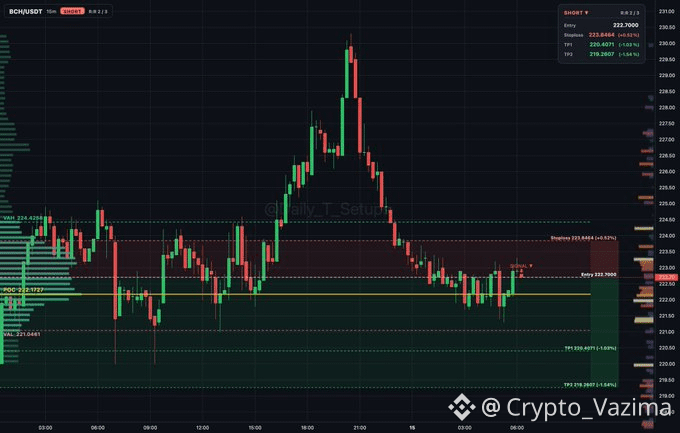
16
·
--
උසබ තත්ත්වය
පරිවර්තනය බලන්න
FET Could Snap Back If This Zone Holds 🔥
This drop looks messy, but the auction read is not random. Buyers are absorbing near VAL and the long levels are already mapped.
🔥 Why I am watching
- Price dumped under value and is sitting in a demand pocket.
- VAL at 0.16482 is the first reclaim that would feel cleaner.
- The marked signal is sitting right at 0.1611.
🚀 The bounce path
- TP1 is 0.16876 at POC.
- TP2 is 0.1723 at VAH.
- Plan is half off at TP1, then stop to entry.
🎯 My trade idea
- Bias: Long
- Trigger: absorption holds around 0.1611
- Target: 0.16876 then 0.1723
- Invalidation: 0.15971
- Confidence: 64 percent
⚡ Utility angle
When a token gets dumped below value, traders still need a reason to stay involved after the scalp. FET is the immediate bounce setup in this post, whereas S T O N is the separate staking and protocol-participation path.
Its role is centered on protocol involvement and governance routes rather than a 15m rotation. Watching both keeps the short FET trade and the longer participation angle from getting mixed up.
Would this bounce feel real only after VAL is reclaimed? 👇
Drop the confirmation candle you want to see.
Not investment advice - research on your own! 🚀
$FET
{future}(FETUSDT)
FET Could Snap Back If This Zone Holds 🔥
This drop looks messy, but the auction read is not random. Buyers are absorbing near VAL and the long levels are already mapped.
🔥 Why I am watching
- Price dumped under value and is sitting in a demand pocket.
- VAL at 0.16482 is the first reclaim that would feel cleaner.
- The marked signal is sitting right at 0.1611.
🚀 The bounce path
- TP1 is 0.16876 at POC.
- TP2 is 0.1723 at VAH.
- Plan is half off at TP1, then stop to entry.
🎯 My trade idea
- Bias: Long
- Trigger: absorption holds around 0.1611
- Target: 0.16876 then 0.1723
- Invalidation: 0.15971
- Confidence: 64 percent
⚡ Utility angle
When a token gets dumped below value, traders still need a reason to stay involved after the scalp. FET is the immediate bounce setup in this post, whereas S T O N is the separate staking and protocol-participation path.
Its role is centered on protocol involvement and governance routes rather than a 15m rotation. Watching both keeps the short FET trade and the longer participation angle from getting mixed up.
Would this bounce feel real only after VAL is reclaimed? 👇
Drop the confirmation candle you want to see.
Not investment advice - research on your own! 🚀
$FET
This drop looks messy, but the auction read is not random. Buyers are absorbing near VAL and the long levels are already mapped.
🔥 Why I am watching
- Price dumped under value and is sitting in a demand pocket.
- VAL at 0.16482 is the first reclaim that would feel cleaner.
- The marked signal is sitting right at 0.1611.
🚀 The bounce path
- TP1 is 0.16876 at POC.
- TP2 is 0.1723 at VAH.
- Plan is half off at TP1, then stop to entry.
🎯 My trade idea
- Bias: Long
- Trigger: absorption holds around 0.1611
- Target: 0.16876 then 0.1723
- Invalidation: 0.15971
- Confidence: 64 percent
⚡ Utility angle
When a token gets dumped below value, traders still need a reason to stay involved after the scalp. FET is the immediate bounce setup in this post, whereas S T O N is the separate staking and protocol-participation path.
Its role is centered on protocol involvement and governance routes rather than a 15m rotation. Watching both keeps the short FET trade and the longer participation angle from getting mixed up.
Would this bounce feel real only after VAL is reclaimed? 👇
Drop the confirmation candle you want to see.
Not investment advice - research on your own! 🚀
$FET
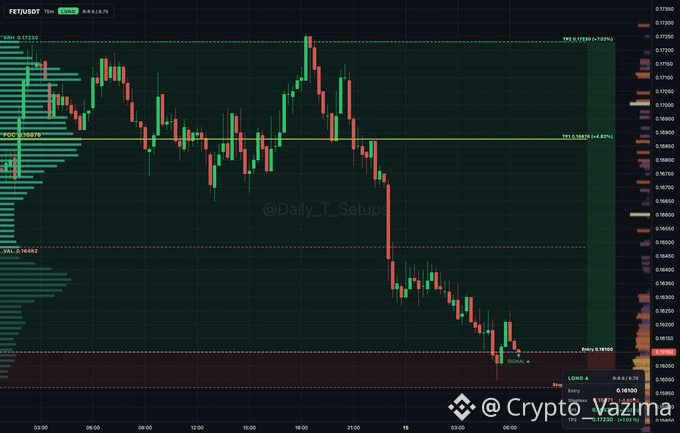
136
පරිවර්තනය බලන්න
How to Check STON.fi Pool Volume Before You Swap
On STON.fi, Volume, 24h tells you how active a pool has been during the previous day. It does not tell you how much liquidity the pool holds now. Use that activity signal with TVL and the live quote for your actual trade size.
🔥 What the 24h Volume Number Shows
- Volume measures recent trading activity through that exact pair.
- TVL measures the value currently locked as liquidity.
- The swap quote measures rate, price impact and minimum received for your amount now.
🚀 A Simple Pre-Trade Flow on STON.fi
1. Open the STON.fi app and go to Pools.
2. Select the exact token pair you want to trade, not just familiar symbols.
3. Read Volume, 24h and compare it with TVL.
4. Enter your real swap amount and review rate, price impact, minimum received and fees before signing.
🧠 Why Busy Pools Can Still Slip
- Yesterday's volume cannot guarantee today's execution quality.
- A large order versus current reserves can still create high price impact.
- A 24h total can hide a burst that already passed, so refresh before you confirm.
⚡ Common Volume Mistakes
- Treating 24h volume as if it were liquidity.
- Judging one pool from protocol-wide DEX volume.
- Assuming high historical volume means low price impact.
- Checking once and signing much later without a fresh quote.
💬 My take
Treat STON.fi 24h volume as context, not a green light. A quick volume / TVL ratio can show whether activity looks large relative to that pool, but it is not an official score. Verify the right pool, then let the live quote decide.
Would you skip a STON.fi swap if price impact looked worse than the volume suggested? 👇
Share the first pool field you scan before confirming.
Not investment advice - research on your own! 🚀
$GRAM @stonfi
How to Check STON.fi Pool Volume Before You Swap
On STON.fi, Volume, 24h tells you how active a pool has been during the previous day. It does not tell you how much liquidity the pool holds now. Use that activity signal with TVL and the live quote for your actual trade size.
🔥 What the 24h Volume Number Shows
- Volume measures recent trading activity through that exact pair.
- TVL measures the value currently locked as liquidity.
- The swap quote measures rate, price impact and minimum received for your amount now.
🚀 A Simple Pre-Trade Flow on STON.fi
1. Open the STON.fi app and go to Pools.
2. Select the exact token pair you want to trade, not just familiar symbols.
3. Read Volume, 24h and compare it with TVL.
4. Enter your real swap amount and review rate, price impact, minimum received and fees before signing.
🧠 Why Busy Pools Can Still Slip
- Yesterday's volume cannot guarantee today's execution quality.
- A large order versus current reserves can still create high price impact.
- A 24h total can hide a burst that already passed, so refresh before you confirm.
⚡ Common Volume Mistakes
- Treating 24h volume as if it were liquidity.
- Judging one pool from protocol-wide DEX volume.
- Assuming high historical volume means low price impact.
- Checking once and signing much later without a fresh quote.
💬 My take
Treat STON.fi 24h volume as context, not a green light. A quick volume / TVL ratio can show whether activity looks large relative to that pool, but it is not an official score. Verify the right pool, then let the live quote decide.
Would you skip a STON.fi swap if price impact looked worse than the volume suggested? 👇
Share the first pool field you scan before confirming.
Not investment advice - research on your own! 🚀
$GRAM @STONfi DEX
On STON.fi, Volume, 24h tells you how active a pool has been during the previous day. It does not tell you how much liquidity the pool holds now. Use that activity signal with TVL and the live quote for your actual trade size.
🔥 What the 24h Volume Number Shows
- Volume measures recent trading activity through that exact pair.
- TVL measures the value currently locked as liquidity.
- The swap quote measures rate, price impact and minimum received for your amount now.
🚀 A Simple Pre-Trade Flow on STON.fi
1. Open the STON.fi app and go to Pools.
2. Select the exact token pair you want to trade, not just familiar symbols.
3. Read Volume, 24h and compare it with TVL.
4. Enter your real swap amount and review rate, price impact, minimum received and fees before signing.
🧠 Why Busy Pools Can Still Slip
- Yesterday's volume cannot guarantee today's execution quality.
- A large order versus current reserves can still create high price impact.
- A 24h total can hide a burst that already passed, so refresh before you confirm.
⚡ Common Volume Mistakes
- Treating 24h volume as if it were liquidity.
- Judging one pool from protocol-wide DEX volume.
- Assuming high historical volume means low price impact.
- Checking once and signing much later without a fresh quote.
💬 My take
Treat STON.fi 24h volume as context, not a green light. A quick volume / TVL ratio can show whether activity looks large relative to that pool, but it is not an official score. Verify the right pool, then let the live quote decide.
Would you skip a STON.fi swap if price impact looked worse than the volume suggested? 👇
Share the first pool field you scan before confirming.
Not investment advice - research on your own! 🚀
$GRAM @STONfi DEX
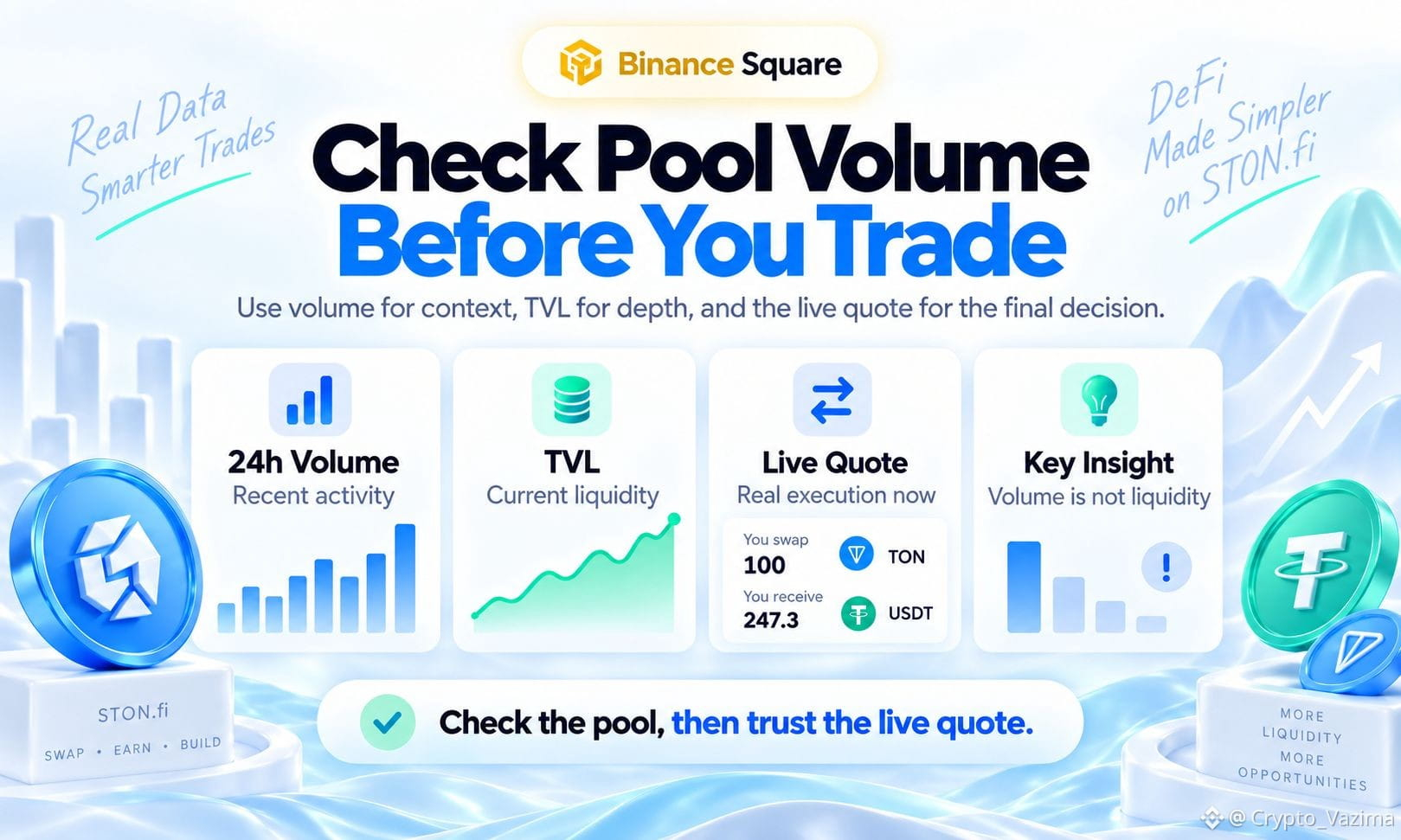
159
·
--
උසබ තත්ත්වය
පරිවර්තනය බලන්න
NEAR Buyers Are Eating This Rotation Alive 🔥
This NEAR auction look is getting interesting because buyers keep absorbing near value instead of letting it slide.
🔥 Why I am watching
- The rotation is stuck inside value around the 2.425 POC.
- Buyers keep showing up near 2.431.
- That absorption is the whole story for me right now.
🚀 Breakout trigger
- I want the zone to hold, not a hopeful wick.
- First target sits at 2.520.
- Next stretch is 2.535 if momentum stays.
🎯 My trade idea
- Bias: Long
- Trigger: clean hold of the 2.431 area
- Target: 2.520 then 2.535
- Invalidation: 2.409
- Confidence: 64 percent
🚀 Market flow
When a chart like NEAR starts absorbing inside value, the next move can feel sudden, but protocol participation lives on a different timeline. NEAR is the emotional auction trade in this post, while STON stands for staking and protocol-participation rather than a quick long scalp.
That staking and DAO-participation role does not try to replace the 15m signal. It simply adds a slower involvement angle next to the NEAR absorption setup.
Is this absorption enough for you or do you still want more proof? 👇
Tell me the level that would make you jump in.
Not investment advice - research on your own! 🚀
$NEAR
{future}(NEARUSDT)
NEAR Buyers Are Eating This Rotation Alive 🔥
This NEAR auction look is getting interesting because buyers keep absorbing near value instead of letting it slide.
🔥 Why I am watching
- The rotation is stuck inside value around the 2.425 POC.
- Buyers keep showing up near 2.431.
- That absorption is the whole story for me right now.
🚀 Breakout trigger
- I want the zone to hold, not a hopeful wick.
- First target sits at 2.520.
- Next stretch is 2.535 if momentum stays.
🎯 My trade idea
- Bias: Long
- Trigger: clean hold of the 2.431 area
- Target: 2.520 then 2.535
- Invalidation: 2.409
- Confidence: 64 percent
🚀 Market flow
When a chart like NEAR starts absorbing inside value, the next move can feel sudden, but protocol participation lives on a different timeline. NEAR is the emotional auction trade in this post, while STON stands for staking and protocol-participation rather than a quick long scalp.
That staking and DAO-participation role does not try to replace the 15m signal. It simply adds a slower involvement angle next to the NEAR absorption setup.
Is this absorption enough for you or do you still want more proof? 👇
Tell me the level that would make you jump in.
Not investment advice - research on your own! 🚀
$NEAR
This NEAR auction look is getting interesting because buyers keep absorbing near value instead of letting it slide.
🔥 Why I am watching
- The rotation is stuck inside value around the 2.425 POC.
- Buyers keep showing up near 2.431.
- That absorption is the whole story for me right now.
🚀 Breakout trigger
- I want the zone to hold, not a hopeful wick.
- First target sits at 2.520.
- Next stretch is 2.535 if momentum stays.
🎯 My trade idea
- Bias: Long
- Trigger: clean hold of the 2.431 area
- Target: 2.520 then 2.535
- Invalidation: 2.409
- Confidence: 64 percent
🚀 Market flow
When a chart like NEAR starts absorbing inside value, the next move can feel sudden, but protocol participation lives on a different timeline. NEAR is the emotional auction trade in this post, while STON stands for staking and protocol-participation rather than a quick long scalp.
That staking and DAO-participation role does not try to replace the 15m signal. It simply adds a slower involvement angle next to the NEAR absorption setup.
Is this absorption enough for you or do you still want more proof? 👇
Tell me the level that would make you jump in.
Not investment advice - research on your own! 🚀
$NEAR
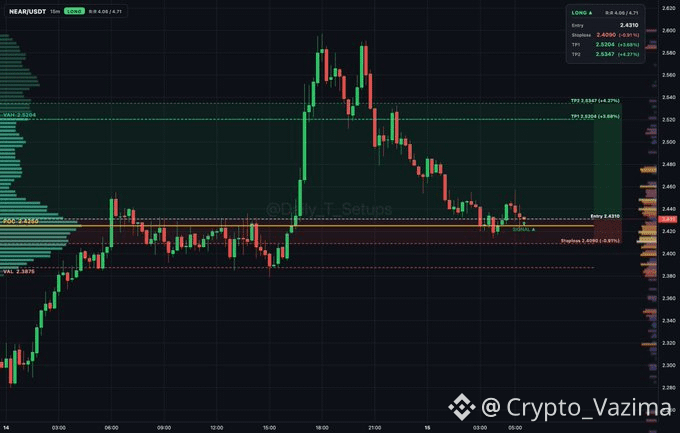
53
·
--
උසබ තත්ත්වය
පරිවර්තනය බලන්න
DOGE Could Snap Back If This Absorb Holds 🔥
This DOGE chart is getting interesting. Buyers keep stepping in near the value low and I do not want to ignore that.
🔥 Why I am watching
- Auction rotation is showing absorption near VAL 0.08362.
- Price is still below value, but the defense looks active.
- The next rotation target is the POC at 0.08417.
🎯 My trade idea
- Bias: Long
- Trigger: continued absorb around 0.083
- Target: 0.08417 first, then 0.08482
- Invalidation: 0.08259
- Manage: half off at TP1, stop to entry
- Confidence: 62 percent
🛡 Where I step back
- If the stop at 0.08259 breaks, the long is done.
- I would not chase if buyers fail to hold this zone.
⚡ Utility angle
Fast rotations can look clean on the chart and still get messy on the way in. DOGE is the momentum trade in this post, whereas Omniston is the execution layer for comparing routes through available liquidity.
It can compare possible paths before a swap goes through. That matters next to this DOGE setup because a tight stop needs practical routing if the bounce starts moving.
Is this absorb enough for you to look long? 👇
Drop the level that would flip your DOGE bias.
Not investment advice - research on your own! 🚀
$DOGE
{future}(DOGEUSDT)
DOGE Could Snap Back If This Absorb Holds 🔥
This DOGE chart is getting interesting. Buyers keep stepping in near the value low and I do not want to ignore that.
🔥 Why I am watching
- Auction rotation is showing absorption near VAL 0.08362.
- Price is still below value, but the defense looks active.
- The next rotation target is the POC at 0.08417.
🎯 My trade idea
- Bias: Long
- Trigger: continued absorb around 0.083
- Target: 0.08417 first, then 0.08482
- Invalidation: 0.08259
- Manage: half off at TP1, stop to entry
- Confidence: 62 percent
🛡 Where I step back
- If the stop at 0.08259 breaks, the long is done.
- I would not chase if buyers fail to hold this zone.
⚡ Utility angle
Fast rotations can look clean on the chart and still get messy on the way in. DOGE is the momentum trade in this post, whereas Omniston is the execution layer for comparing routes through available liquidity.
It can compare possible paths before a swap goes through. That matters next to this DOGE setup because a tight stop needs practical routing if the bounce starts moving.
Is this absorb enough for you to look long? 👇
Drop the level that would flip your DOGE bias.
Not investment advice - research on your own! 🚀
$DOGE
This DOGE chart is getting interesting. Buyers keep stepping in near the value low and I do not want to ignore that.
🔥 Why I am watching
- Auction rotation is showing absorption near VAL 0.08362.
- Price is still below value, but the defense looks active.
- The next rotation target is the POC at 0.08417.
🎯 My trade idea
- Bias: Long
- Trigger: continued absorb around 0.083
- Target: 0.08417 first, then 0.08482
- Invalidation: 0.08259
- Manage: half off at TP1, stop to entry
- Confidence: 62 percent
🛡 Where I step back
- If the stop at 0.08259 breaks, the long is done.
- I would not chase if buyers fail to hold this zone.
⚡ Utility angle
Fast rotations can look clean on the chart and still get messy on the way in. DOGE is the momentum trade in this post, whereas Omniston is the execution layer for comparing routes through available liquidity.
It can compare possible paths before a swap goes through. That matters next to this DOGE setup because a tight stop needs practical routing if the bounce starts moving.
Is this absorb enough for you to look long? 👇
Drop the level that would flip your DOGE bias.
Not investment advice - research on your own! 🚀
$DOGE
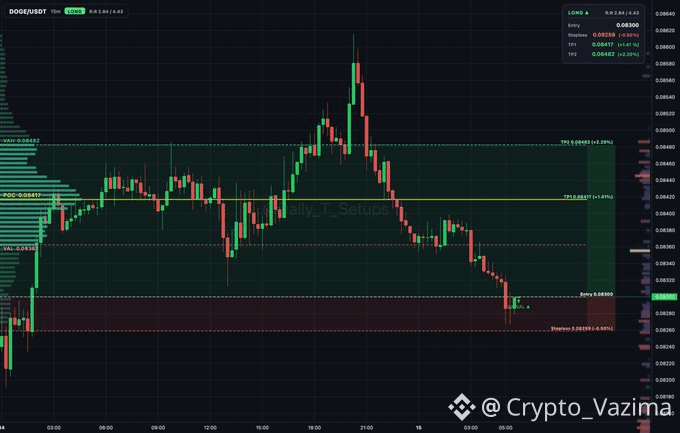
54
·
--
උසබ තත්ත්වය
පරිවර්තනය බලන්න
BTC Break Looks Juicy, But Fakeouts Still Haunt This Chart ⚡
This BTC push through the falling line has me watching hard. The arrow on the chart is pointing up, yet I am not celebrating until the break stays intact.
🔥 Why I am watching
- Sellers owned that yellow trendline for days.
- Price finally punched through it.
- The blue box toward 83,132 is the obvious magnet if buyers keep control.
🛡 Where I step back
- A failed hold under the line kills the idea.
- Losing 77,047 would look messy.
- One wick is not a trend change.
🎯 My trade idea
- Bias: Long
- Trigger: hold the breakout zone near 77,534
- Target: 83,132
- Invalidation: drop back under the trendline and 77,047
- Confidence: 62 percent
💎 Participation layer
Fast BTC candles make people want action right now, but not every market decision is a breakout trade. BTC is the heat on this chart, whereas ST0N_fi is the slower protocol-participation route connected with staking.
Its function is about staying involved in the protocol rather than catching one yellow-line break. That contrast sits next to this BTC setup because hype moves and staking-style commitment do not follow the same clock.
Is this the real flip or just another tease? 👇
Drop the confirmation candle you still need to see.
Not investment advice - research on your own! 🚀
$BTC
{future}(BTCUSDT)
BTC Break Looks Juicy, But Fakeouts Still Haunt This Chart ⚡
This BTC push through the falling line has me watching hard. The arrow on the chart is pointing up, yet I am not celebrating until the break stays intact.
🔥 Why I am watching
- Sellers owned that yellow trendline for days.
- Price finally punched through it.
- The blue box toward 83,132 is the obvious magnet if buyers keep control.
🛡 Where I step back
- A failed hold under the line kills the idea.
- Losing 77,047 would look messy.
- One wick is not a trend change.
🎯 My trade idea
- Bias: Long
- Trigger: hold the breakout zone near 77,534
- Target: 83,132
- Invalidation: drop back under the trendline and 77,047
- Confidence: 62 percent
💎 Participation layer
Fast BTC candles make people want action right now, but not every market decision is a breakout trade. BTC is the heat on this chart, whereas ST0N_fi is the slower protocol-participation route connected with staking.
Its function is about staying involved in the protocol rather than catching one yellow-line break. That contrast sits next to this BTC setup because hype moves and staking-style commitment do not follow the same clock.
Is this the real flip or just another tease? 👇
Drop the confirmation candle you still need to see.
Not investment advice - research on your own! 🚀
$BTC
This BTC push through the falling line has me watching hard. The arrow on the chart is pointing up, yet I am not celebrating until the break stays intact.
🔥 Why I am watching
- Sellers owned that yellow trendline for days.
- Price finally punched through it.
- The blue box toward 83,132 is the obvious magnet if buyers keep control.
🛡 Where I step back
- A failed hold under the line kills the idea.
- Losing 77,047 would look messy.
- One wick is not a trend change.
🎯 My trade idea
- Bias: Long
- Trigger: hold the breakout zone near 77,534
- Target: 83,132
- Invalidation: drop back under the trendline and 77,047
- Confidence: 62 percent
💎 Participation layer
Fast BTC candles make people want action right now, but not every market decision is a breakout trade. BTC is the heat on this chart, whereas ST0N_fi is the slower protocol-participation route connected with staking.
Its function is about staying involved in the protocol rather than catching one yellow-line break. That contrast sits next to this BTC setup because hype moves and staking-style commitment do not follow the same clock.
Is this the real flip or just another tease? 👇
Drop the confirmation candle you still need to see.
Not investment advice - research on your own! 🚀
$BTC
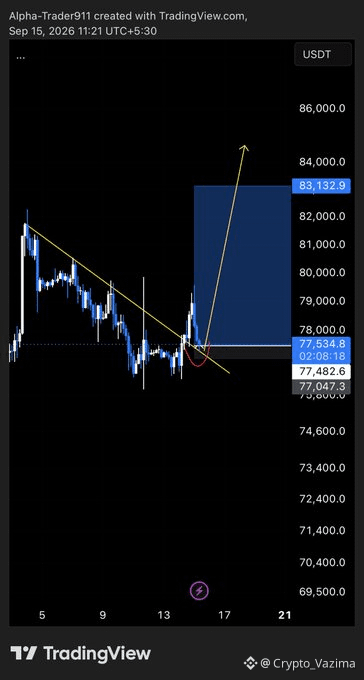
60
·
--
උසබ තත්ත්වය
පරිවර්තනය බලන්න
TRX Looks Like It Stopped Bleeding Under Value 🔥
This TRX drop did not just keep falling. Buyers showed up below value and started absorbing near VAL, and that is the part that got my attention.
🚀 Why I am watching
- Price is still below value after the selloff.
- Buyers are absorbing near VAL at 0.33905.
- The bounce attempt is coming from a defined low, not from hope at resistance.
⚡ The part that matters
- Entry sits around 0.3376.
- First magnet is 0.34074.
- Next magnet is 0.34111 if the reclaim keeps going.
🎯 My trade idea
- Bias: Long
- Trigger: absorption holds around 0.3376
- Target: 0.34074 then 0.34111
- Invalidation: 0.33721
- Confidence: 64 percent
🛡 Where I step back
- If 0.33721 breaks, the absorption story is done.
- I take half off at TP1 and lock the rest to entry.
💎 Participation layer
A fast TRX bounce can feel exciting when sellers finally get absorbed, but that is still just a short-term auction trade. TRX is the chart reaction here, whereas S T O N is the slower protocol-participation side connected with staking and DAO paths.
That participation role is about staying involved in the protocol rather than timing one tight long. It sits beside this TRX setup as a different reason to follow the wider market, not as a replacement for the chart trigger.
Would you take the bounce or wait for value to be reclaimed first? 👇
Tell me where you would cut this if buyers fail.
Not investment advice - research on your own! 🚀
$TRX
{future}(TRXUSDT)
TRX Looks Like It Stopped Bleeding Under Value 🔥
This TRX drop did not just keep falling. Buyers showed up below value and started absorbing near VAL, and that is the part that got my attention.
🚀 Why I am watching
- Price is still below value after the selloff.
- Buyers are absorbing near VAL at 0.33905.
- The bounce attempt is coming from a defined low, not from hope at resistance.
⚡ The part that matters
- Entry sits around 0.3376.
- First magnet is 0.34074.
- Next magnet is 0.34111 if the reclaim keeps going.
🎯 My trade idea
- Bias: Long
- Trigger: absorption holds around 0.3376
- Target: 0.34074 then 0.34111
- Invalidation: 0.33721
- Confidence: 64 percent
🛡 Where I step back
- If 0.33721 breaks, the absorption story is done.
- I take half off at TP1 and lock the rest to entry.
💎 Participation layer
A fast TRX bounce can feel exciting when sellers finally get absorbed, but that is still just a short-term auction trade. TRX is the chart reaction here, whereas S T O N is the slower protocol-participation side connected with staking and DAO paths.
That participation role is about staying involved in the protocol rather than timing one tight long. It sits beside this TRX setup as a different reason to follow the wider market, not as a replacement for the chart trigger.
Would you take the bounce or wait for value to be reclaimed first? 👇
Tell me where you would cut this if buyers fail.
Not investment advice - research on your own! 🚀
$TRX
This TRX drop did not just keep falling. Buyers showed up below value and started absorbing near VAL, and that is the part that got my attention.
🚀 Why I am watching
- Price is still below value after the selloff.
- Buyers are absorbing near VAL at 0.33905.
- The bounce attempt is coming from a defined low, not from hope at resistance.
⚡ The part that matters
- Entry sits around 0.3376.
- First magnet is 0.34074.
- Next magnet is 0.34111 if the reclaim keeps going.
🎯 My trade idea
- Bias: Long
- Trigger: absorption holds around 0.3376
- Target: 0.34074 then 0.34111
- Invalidation: 0.33721
- Confidence: 64 percent
🛡 Where I step back
- If 0.33721 breaks, the absorption story is done.
- I take half off at TP1 and lock the rest to entry.
💎 Participation layer
A fast TRX bounce can feel exciting when sellers finally get absorbed, but that is still just a short-term auction trade. TRX is the chart reaction here, whereas S T O N is the slower protocol-participation side connected with staking and DAO paths.
That participation role is about staying involved in the protocol rather than timing one tight long. It sits beside this TRX setup as a different reason to follow the wider market, not as a replacement for the chart trigger.
Would you take the bounce or wait for value to be reclaimed first? 👇
Tell me where you would cut this if buyers fail.
Not investment advice - research on your own! 🚀
$TRX
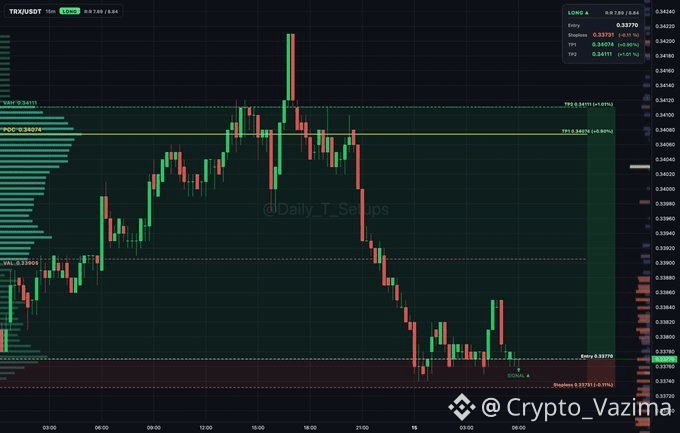
61
තවත් අන්තර්ගතයන් ගවේෂණය කිරීමට ඇතුල් වන්න
Binance චතුරශ්රය හි ගෝලීය ක්රිප්ටෝ පරිශීලකයින් හා එක්වන්න
⚡️ ක්රිප්ටෝ පිළිබඳ නවතම සහ ප්රයෝජනවත් තොරතුරු ලබා ගන්න.
💬 ලොව විශාලතම ක්රිප්ටෝ හුවමාරුව මගින් විශ්වාස කෙරේ.
👍 සත්යායනය කරන ලද නිර්මාණකරුවන්ගෙන් සැබෑ විදසුන් සොයා ගන්න.
විද්යුත් තැපෑල / දුරකථන අංකය
නැගී එන මාතෘකා
FedRateWatch
912,596 views
4,380 සාකච්ඡා කරමින්
எங்கள் டிரெண்டிங் ஹாஷ்டாக் பிரச்சாரத்தில் போக்குவரத்து ரிவார்டை பகிர்ந்து வெல்லுங்கள்
✨தலைப்பு: FOMC செப்டம்பர், பெடின் அடுத்த நடவடிக்கை என்ன?
👉சேருவது எப்படி:
ஹாஷ்டாக் #FedRateWatch உடன் ஒரு குறுகிய பதிவையோ அல்லது கட்டுரையையோ வெளியிடுங்கள்
கீழுள்ள கோணங்களின் அடிப்படையில் உள்ளடக்கத்தை உருவாக்குங்கள்:
- ஆகஸ்ட் கோர் CPI மாதந்தோறும் 0.3% உயர்ந்தது; இந்த வாரம் 25bp உயர்வுக்கான வாய்ப்புகள் இப்போது சுமார் 90% ஆக உள்ளன. இந்த வாரம் வட்டி உயர்வு நடக்குமென நீங்கள் எதிர்பார்க்கிறீர்களா? அது ஒருமுறைதானா, அல்லது இன்னும் நீளமான வட்டி உயர்வு சுழற்சியின் தொடக்கமா?
- உயர்வு நடந்தால், BTC, டெக் பங்குகள், மற்றும் தங்கம் ஆகியவற்றுக்கு அது எப்படி தாக்கம் காட்டும்? உயர்ச்சியா அல்லது சரிவா?
- நீங்கள் அடுத்ததாக எப்படி டிரேடு செய்ய திட்டமிடுகிறீர்கள்? எங்களின் டிரேடு பகிர்வு வித்ஜெட்டின் மூலம் உங்கள் BTC, பங்குகள் அல்லது தங்க டிரேடு/உடைமைகளைப் பகிருங்கள்.
⏰பிரச்சார காலம்:
- 2026-09-15 11:00 - 2026-09-17 3:00 UTC
🎁ரிவார்டு:
- மேலுள்ள வழிகாட்டுதல்களுக்கு இணங்கவும் 100 வார்த்தைகளுக்கு மேல் உள்ள தகுதிபெற்ற பதிவுகள் மதிப்பாய்வு செய்யப்படும்; மேலும் 500 முதல் 3,000 பார்வைகள் வரை சீரற்ற (ரேண்டம்) போக்குவரத்து அதிகரிப்பு கிடைக்கலாம். உங்கள் பதிவு தேர்ந்தெடுக்கப்பட்டால், உங்கள் feed secretary மூலம் ஒரு அறிவிப்பு கிடைக்கும்.
- Binance Square Official-ல் உங்கள் கட்டுரை இடம்பெற வாய்ப்பு பெறுங்கள்
உங்கள் பதிவுக்கான யோசனைகள் வேண்டுமா? தலைப்புப் பக்கத்தை #FedRateWatch அல்லது Square Guide on How to Post for Better Reach-ஐ பாருங்கள்.
Binance Square Official
·526 කැමත්ත දැක්වීම්
·1.2M views
MSTRTradingVolumeSurpassesMorganStanley
1,747 views
98 සාකච්ඡා කරමින්
BitcoinFalls4%
9,404 views
348 සාකච්ඡා කරමින්