

Coinstelegram
4k පෝස්ටු

Coinstelegram
 Binance චතුරශ්ර සත්යාපිත+
වාර්තා කරන්න
පරිශීලක අවහිර කරන්න
Coinstelegram is a leading blockchain & altcoins cryptocurrency media
0 හඹා යමින්
19.6K+ හඹා යන්නන්
3.2K+ කැමති විය
පෝස්ටු
ලිපිය
MEXC Ends Services for Russia and Belarus Users As Netherlands Exit Adds to RestrictionsMEXC is discontinuing services for users in Russia and Belarus, further narrowing access to international crypto trading platforms for customers in both countries. The exchange announced the decision on October 20, citing its efforts to strengthen global compliance.
Affected customers will receive individual instructions for closing positions and withdrawing assets. MEXC says accounts that have not received a notification remain unaffected by this change and can continue operating under its Terms of Service. The announcement does not provide a universal withdrawal deadline.
The decision comes as MEXC also winds down Dutch services, while European licensing requirements reshape which exchanges can legally serve customers.
What MEXC Users in Russia and Belarus Should Know
MEXC says customer assets remain secure, although that assurance is the company’s statement rather than an independent assessment.
Its notice directs affected users to follow account-specific timelines. It does not disclose how many customers are affected or explain precisely how nationality, residence and other account information determine eligibility.
The absence of a notification should therefore not be interpreted as permanent permission to trade regardless of the exchange’s rules. MEXC’s current User Agreement explicitly includes Russia and Belarus among prohibited jurisdictions.
A narrower restrictions summary reads:
MEXC does not accept users from 13 jurisdictions named in its User Agreement: the United States, Canada, the United Kingdom, Singapore, Hong Kong, Mainland China, Malaysia, Kazakhstan, North Korea, Cuba, Iran, Sudan and the Russian-controlled regions of Ukraine, plus countries under comprehensive EU or US sanctions or on the FATF call-for-action list.
That wording is incomplete against the current agreement because it omits Russia and Belarus. MEXC’s educational country guide still separates those two markets as winding down, illustrating why contractual terms and individual notices matter more than general availability summaries.
How Large Are the Russian and Belarusian Crypto Markets?
Russia represents a substantial crypto market. Chainalysis estimated that it received $376.3 billion in cryptocurrency between July 2024 and June 2025, making it Europe’s largest market by that measure, ahead of the United Kingdom’s $273.2 billion.
These figures measure estimated cryptocurrency value received. They do not represent exchange revenue, household holdings or the amount MEXC stands to lose.
Belarus has a smaller, differently measured market. In September 2025, Alexander Lukashenko said external payments through Belarusian crypto exchanges reached $1.7 billion during the first seven months of 2025, according to Interfax. He cited projections that the figure could reach $3 billion for the full year.
The $3 billion figure was a forecast, not a verified year-end result. It also cannot be directly compared with Chainalysis’s Russian estimate because the periods and methodologies differ.
Neither figure establishes MEXC’s local market share. The exchange has not disclosed country-specific customer balances or revenue in its exit announcement.
How Many Crypto Exchanges Have Restricted Russia?
There is no verified, comprehensive count of centralized exchanges that have completely left Russia since its full-scale invasion of Ukraine. Business sales, account closures and restrictions on particular services are different actions.
However, six identifiable platforms illustrate the contraction in access: Binance, Kraken, Crypto.com, Blockchain.com, Bitget and MEXC.
Binance announced the sale of its entire Russian business to CommEX in September 2023, describing the decision as a full exit and outlining an offboarding process lasting up to one year.
Kraken, Crypto.com and Blockchain.com imposed Russia-linked account or service restrictions in October 2022 following EU sanctions. Contemporary reporting documented those restrictions, but their scope differed between providers.
Bitget’s current terms also list Russia, Belarus and Kazakhstan as prohibited countries.
This is a documented set of examples, not a claim that exactly six exchanges have permanently banned every Russian customer. MEXC itself cites compliance without identifying a particular sanctions measure as the direct trigger.
MEXC’s Netherlands Exit Comes With Conflicting Dates
MEXC is separately withdrawing services from Netherlands-linked accounts. The Dutch regulator AFM warned in September 2025 that the platform was operating without the required authorization.
MEXC’s general country guide lists October 31, 2026 as the asset-movement deadline, November 16 as final offboarding, and March 20 as the suspension date for fiat services.
However, its dedicated offboarding announcement provides a different, four-batch schedule. For the final batch, it lists October 23 as the action deadline, October 24 as the start of restrictions and October 31 as completion. Earlier batches had earlier deadlines.
These conflicting public pages mean November 16 should not be presented as a universally available withdrawal deadline. The dedicated notice instructs customers to consult their assigned batch and email notifications.
It also warns that MEXC may process remaining positions and liabilities, potentially generating losses or fees, and says residual assets will move to a regulated custodian.
What MiCA Requires and Which Exchanges Have Approval
MiCA establishes an EU authorization framework for crypto-asset service providers. Requirements include safeguarding and segregating customer assets, managing conflicts of interest, handling complaints and providing clear information.
ESMA says the final transition period ended on July 1, 2026. Unauthorized providers must stop onboarding and soliciting EU customers, restricting remaining services to an orderly wind-down rather than continuing normal business.
Examples of exchanges that obtained authorization through European entities include Coinbase in Luxembourg, Kraken in Ireland and Bybit EU in Austria. Austria’s FMA granted Bybit EU authorization on May 28, 2025.
MEXC’s own country guide states that it lacks MiCA authorization. Licenses attach to specific legal entities and approved services; they do not automatically cover every product offered under a global exchange brand. European licensing and Russia-related restrictions therefore remain separate compliance questions.
MEXC Ends Services for Russia and Belarus Users As Netherlands Exit Adds to Restrictions
MEXC is discontinuing services for users in Russia and Belarus, further narrowing access to international crypto trading platforms for customers in both countries. The exchange announced the decision on October 20, citing its efforts to strengthen global compliance.
Affected customers will receive individual instructions for closing positions and withdrawing assets. MEXC says accounts that have not received a notification remain unaffected by this change and can continue operating under its Terms of Service. The announcement does not provide a universal withdrawal deadline.
The decision comes as MEXC also winds down Dutch services, while European licensing requirements reshape which exchanges can legally serve customers.
What MEXC Users in Russia and Belarus Should Know
MEXC says customer assets remain secure, although that assurance is the company’s statement rather than an independent assessment.
Its notice directs affected users to follow account-specific timelines. It does not disclose how many customers are affected or explain precisely how nationality, residence and other account information determine eligibility.
The absence of a notification should therefore not be interpreted as permanent permission to trade regardless of the exchange’s rules. MEXC’s current User Agreement explicitly includes Russia and Belarus among prohibited jurisdictions.
A narrower restrictions summary reads:
MEXC does not accept users from 13 jurisdictions named in its User Agreement: the United States, Canada, the United Kingdom, Singapore, Hong Kong, Mainland China, Malaysia, Kazakhstan, North Korea, Cuba, Iran, Sudan and the Russian-controlled regions of Ukraine, plus countries under comprehensive EU or US sanctions or on the FATF call-for-action list.
That wording is incomplete against the current agreement because it omits Russia and Belarus. MEXC’s educational country guide still separates those two markets as winding down, illustrating why contractual terms and individual notices matter more than general availability summaries.
How Large Are the Russian and Belarusian Crypto Markets?
Russia represents a substantial crypto market. Chainalysis estimated that it received $376.3 billion in cryptocurrency between July 2024 and June 2025, making it Europe’s largest market by that measure, ahead of the United Kingdom’s $273.2 billion.
These figures measure estimated cryptocurrency value received. They do not represent exchange revenue, household holdings or the amount MEXC stands to lose.
Belarus has a smaller, differently measured market. In September 2025, Alexander Lukashenko said external payments through Belarusian crypto exchanges reached $1.7 billion during the first seven months of 2025, according to Interfax. He cited projections that the figure could reach $3 billion for the full year.
The $3 billion figure was a forecast, not a verified year-end result. It also cannot be directly compared with Chainalysis’s Russian estimate because the periods and methodologies differ.
Neither figure establishes MEXC’s local market share. The exchange has not disclosed country-specific customer balances or revenue in its exit announcement.
How Many Crypto Exchanges Have Restricted Russia?
There is no verified, comprehensive count of centralized exchanges that have completely left Russia since its full-scale invasion of Ukraine. Business sales, account closures and restrictions on particular services are different actions.
However, six identifiable platforms illustrate the contraction in access: Binance, Kraken, Crypto.com, Blockchain.com, Bitget and MEXC.
Binance announced the sale of its entire Russian business to CommEX in September 2023, describing the decision as a full exit and outlining an offboarding process lasting up to one year.
Kraken, Crypto.com and Blockchain.com imposed Russia-linked account or service restrictions in October 2022 following EU sanctions. Contemporary reporting documented those restrictions, but their scope differed between providers.
Bitget’s current terms also list Russia, Belarus and Kazakhstan as prohibited countries.
This is a documented set of examples, not a claim that exactly six exchanges have permanently banned every Russian customer. MEXC itself cites compliance without identifying a particular sanctions measure as the direct trigger.
MEXC’s Netherlands Exit Comes With Conflicting Dates
MEXC is separately withdrawing services from Netherlands-linked accounts. The Dutch regulator AFM warned in September 2025 that the platform was operating without the required authorization.
MEXC’s general country guide lists October 31, 2026 as the asset-movement deadline, November 16 as final offboarding, and March 20 as the suspension date for fiat services.
However, its dedicated offboarding announcement provides a different, four-batch schedule. For the final batch, it lists October 23 as the action deadline, October 24 as the start of restrictions and October 31 as completion. Earlier batches had earlier deadlines.
These conflicting public pages mean November 16 should not be presented as a universally available withdrawal deadline. The dedicated notice instructs customers to consult their assigned batch and email notifications.
It also warns that MEXC may process remaining positions and liabilities, potentially generating losses or fees, and says residual assets will move to a regulated custodian.
What MiCA Requires and Which Exchanges Have Approval
MiCA establishes an EU authorization framework for crypto-asset service providers. Requirements include safeguarding and segregating customer assets, managing conflicts of interest, handling complaints and providing clear information.
ESMA says the final transition period ended on July 1, 2026. Unauthorized providers must stop onboarding and soliciting EU customers, restricting remaining services to an orderly wind-down rather than continuing normal business.
Examples of exchanges that obtained authorization through European entities include Coinbase in Luxembourg, Kraken in Ireland and Bybit EU in Austria. Austria’s FMA granted Bybit EU authorization on May 28, 2025.
MEXC’s own country guide states that it lacks MiCA authorization. Licenses attach to specific legal entities and approved services; they do not automatically cover every product offered under a global exchange brand. European licensing and Russia-related restrictions therefore remain separate compliance questions.
Affected customers will receive individual instructions for closing positions and withdrawing assets. MEXC says accounts that have not received a notification remain unaffected by this change and can continue operating under its Terms of Service. The announcement does not provide a universal withdrawal deadline.
The decision comes as MEXC also winds down Dutch services, while European licensing requirements reshape which exchanges can legally serve customers.
What MEXC Users in Russia and Belarus Should Know
MEXC says customer assets remain secure, although that assurance is the company’s statement rather than an independent assessment.
Its notice directs affected users to follow account-specific timelines. It does not disclose how many customers are affected or explain precisely how nationality, residence and other account information determine eligibility.
The absence of a notification should therefore not be interpreted as permanent permission to trade regardless of the exchange’s rules. MEXC’s current User Agreement explicitly includes Russia and Belarus among prohibited jurisdictions.
A narrower restrictions summary reads:
MEXC does not accept users from 13 jurisdictions named in its User Agreement: the United States, Canada, the United Kingdom, Singapore, Hong Kong, Mainland China, Malaysia, Kazakhstan, North Korea, Cuba, Iran, Sudan and the Russian-controlled regions of Ukraine, plus countries under comprehensive EU or US sanctions or on the FATF call-for-action list.
That wording is incomplete against the current agreement because it omits Russia and Belarus. MEXC’s educational country guide still separates those two markets as winding down, illustrating why contractual terms and individual notices matter more than general availability summaries.
How Large Are the Russian and Belarusian Crypto Markets?
Russia represents a substantial crypto market. Chainalysis estimated that it received $376.3 billion in cryptocurrency between July 2024 and June 2025, making it Europe’s largest market by that measure, ahead of the United Kingdom’s $273.2 billion.
These figures measure estimated cryptocurrency value received. They do not represent exchange revenue, household holdings or the amount MEXC stands to lose.
Belarus has a smaller, differently measured market. In September 2025, Alexander Lukashenko said external payments through Belarusian crypto exchanges reached $1.7 billion during the first seven months of 2025, according to Interfax. He cited projections that the figure could reach $3 billion for the full year.
The $3 billion figure was a forecast, not a verified year-end result. It also cannot be directly compared with Chainalysis’s Russian estimate because the periods and methodologies differ.
Neither figure establishes MEXC’s local market share. The exchange has not disclosed country-specific customer balances or revenue in its exit announcement.
How Many Crypto Exchanges Have Restricted Russia?
There is no verified, comprehensive count of centralized exchanges that have completely left Russia since its full-scale invasion of Ukraine. Business sales, account closures and restrictions on particular services are different actions.
However, six identifiable platforms illustrate the contraction in access: Binance, Kraken, Crypto.com, Blockchain.com, Bitget and MEXC.
Binance announced the sale of its entire Russian business to CommEX in September 2023, describing the decision as a full exit and outlining an offboarding process lasting up to one year.
Kraken, Crypto.com and Blockchain.com imposed Russia-linked account or service restrictions in October 2022 following EU sanctions. Contemporary reporting documented those restrictions, but their scope differed between providers.
Bitget’s current terms also list Russia, Belarus and Kazakhstan as prohibited countries.
This is a documented set of examples, not a claim that exactly six exchanges have permanently banned every Russian customer. MEXC itself cites compliance without identifying a particular sanctions measure as the direct trigger.
MEXC’s Netherlands Exit Comes With Conflicting Dates
MEXC is separately withdrawing services from Netherlands-linked accounts. The Dutch regulator AFM warned in September 2025 that the platform was operating without the required authorization.
MEXC’s general country guide lists October 31, 2026 as the asset-movement deadline, November 16 as final offboarding, and March 20 as the suspension date for fiat services.
However, its dedicated offboarding announcement provides a different, four-batch schedule. For the final batch, it lists October 23 as the action deadline, October 24 as the start of restrictions and October 31 as completion. Earlier batches had earlier deadlines.
These conflicting public pages mean November 16 should not be presented as a universally available withdrawal deadline. The dedicated notice instructs customers to consult their assigned batch and email notifications.
It also warns that MEXC may process remaining positions and liabilities, potentially generating losses or fees, and says residual assets will move to a regulated custodian.
What MiCA Requires and Which Exchanges Have Approval
MiCA establishes an EU authorization framework for crypto-asset service providers. Requirements include safeguarding and segregating customer assets, managing conflicts of interest, handling complaints and providing clear information.
ESMA says the final transition period ended on July 1, 2026. Unauthorized providers must stop onboarding and soliciting EU customers, restricting remaining services to an orderly wind-down rather than continuing normal business.
Examples of exchanges that obtained authorization through European entities include Coinbase in Luxembourg, Kraken in Ireland and Bybit EU in Austria. Austria’s FMA granted Bybit EU authorization on May 28, 2025.
MEXC’s own country guide states that it lacks MiCA authorization. Licenses attach to specific legal entities and approved services; they do not automatically cover every product offered under a global exchange brand. European licensing and Russia-related restrictions therefore remain separate compliance questions.
69
MEXC Ends Services for Russia and Belarus Users as Netherlands Exit Adds to RestrictionsMEXC is discontinuing services for users in Russia and Belarus, further narrowing access to international crypto trading platforms for customers in both countries. The exchange announced the decision on October 20, citing its efforts to strengthen global compliance.
Affected customers will receive individual instructions for closing positions and withdrawing assets. MEXC says accounts that have not received a notification remain unaffected by this change and can continue operating under its Terms of Service. The announcement does not provide a universal withdrawal deadline.
The decision comes as MEXC also winds down Dutch services, while European licensing requirements reshape which exchanges can legally serve customers.
What MEXC Users in Russia and Belarus Should Know
MEXC says customer assets remain secure, although that assurance is the company’s statement rather than an independent assessment.
Its notice directs affected users to follow account-specific timelines. It does not disclose how many customers are affected or explain precisely how nationality, residence and other account information determine eligibility.
The absence of a notification should therefore not be interpreted as permanent permission to trade regardless of the exchange’s rules. MEXC’s current User Agreement explicitly includes Russia and Belarus among prohibited jurisdictions.
A narrower restrictions summary reads:
MEXC does not accept users from 13 jurisdictions named in its User Agreement: the United States, Canada, the United Kingdom, Singapore, Hong Kong, Mainland China, Malaysia, Kazakhstan, North Korea, Cuba, Iran, Sudan and the Russian-controlled regions of Ukraine, plus countries under comprehensive EU or US sanctions or on the FATF call-for-action list.
That wording is incomplete against the current agreement because it omits Russia and Belarus. MEXC’s educational country guide still separates those two markets as winding down, illustrating why contractual terms and individual notices matter more than general availability summaries.
How Large Are the Russian and Belarusian Crypto Markets?
Russia represents a substantial crypto market. Chainalysis estimated that it received $376.3 billion in cryptocurrency between July 2024 and June 2025, making it Europe’s largest market by that measure, ahead of the United Kingdom’s $273.2 billion.
These figures measure estimated cryptocurrency value received. They do not represent exchange revenue, household holdings or the amount MEXC stands to lose.
Belarus has a smaller, differently measured market. In September 2025, Alexander Lukashenko said external payments through Belarusian crypto exchanges reached $1.7 billion during the first seven months of 2025, according to Interfax. He cited projections that the figure could reach $3 billion for the full year.
The $3 billion figure was a forecast, not a verified year-end result. It also cannot be directly compared with Chainalysis’s Russian estimate because the periods and methodologies differ.
Neither figure establishes MEXC’s local market share. The exchange has not disclosed country-specific customer balances or revenue in its exit announcement.
How Many Crypto Exchanges Have Restricted Russia?
There is no verified, comprehensive count of centralized exchanges that have completely left Russia since its full-scale invasion of Ukraine. Business sales, account closures and restrictions on particular services are different actions.
However, six identifiable platforms illustrate the contraction in access: Binance, Kraken, Crypto.com, Blockchain.com, Bitget and MEXC.
Binance announced the sale of its entire Russian business to CommEX in September 2023, describing the decision as a full exit and outlining an offboarding process lasting up to one year.
Kraken, Crypto.com and Blockchain.com imposed Russia-linked account or service restrictions in October 2022 following EU sanctions. Contemporary reporting documented those restrictions, but their scope differed between providers.
Bitget’s current terms also list Russia, Belarus and Kazakhstan as prohibited countries.
This is a documented set of examples, not a claim that exactly six exchanges have permanently banned every Russian customer. MEXC itself cites compliance without identifying a particular sanctions measure as the direct trigger.
MEXC’s Netherlands Exit Comes With Conflicting Dates
MEXC is separately withdrawing services from Netherlands-linked accounts. The Dutch regulator AFM warned in September 2025 that the platform was operating without the required authorization.
MEXC’s general country guide lists October 31, 2026 as the asset-movement deadline, November 16 as final offboarding, and March 20 as the suspension date for fiat services.
However, its dedicated offboarding announcement provides a different, four-batch schedule. For the final batch, it lists October 23 as the action deadline, October 24 as the start of restrictions and October 31 as completion. Earlier batches had earlier deadlines.
These conflicting public pages mean November 16 should not be presented as a universally available withdrawal deadline. The dedicated notice instructs customers to consult their assigned batch and email notifications.
It also warns that MEXC may process remaining positions and liabilities, potentially generating losses or fees, and says residual assets will move to a regulated custodian.
What MiCA Requires and Which Exchanges Have Approval
MiCA establishes an EU authorization framework for crypto-asset service providers. Requirements include safeguarding and segregating customer assets, managing conflicts of interest, handling complaints and providing clear information.
ESMA says the final transition period ended on July 1, 2026. Unauthorized providers must stop onboarding and soliciting EU customers, restricting remaining services to an orderly wind-down rather than continuing normal business.
Examples of exchanges that obtained authorization through European entities include Coinbase in Luxembourg, Kraken in Ireland and Bybit EU in Austria. Austria’s FMA granted Bybit EU authorization on May 28, 2025.
MEXC’s own country guide states that it lacks MiCA authorization. Licenses attach to specific legal entities and approved services; they do not automatically cover every product offered under a global exchange brand. European licensing and Russia-related restrictions therefore remain separate compliance questions.
MEXC Ends Services for Russia and Belarus Users as Netherlands Exit Adds to Restrictions
MEXC is discontinuing services for users in Russia and Belarus, further narrowing access to international crypto trading platforms for customers in both countries. The exchange announced the decision on October 20, citing its efforts to strengthen global compliance.
Affected customers will receive individual instructions for closing positions and withdrawing assets. MEXC says accounts that have not received a notification remain unaffected by this change and can continue operating under its Terms of Service. The announcement does not provide a universal withdrawal deadline.
The decision comes as MEXC also winds down Dutch services, while European licensing requirements reshape which exchanges can legally serve customers.
What MEXC Users in Russia and Belarus Should Know
MEXC says customer assets remain secure, although that assurance is the company’s statement rather than an independent assessment.
Its notice directs affected users to follow account-specific timelines. It does not disclose how many customers are affected or explain precisely how nationality, residence and other account information determine eligibility.
The absence of a notification should therefore not be interpreted as permanent permission to trade regardless of the exchange’s rules. MEXC’s current User Agreement explicitly includes Russia and Belarus among prohibited jurisdictions.
A narrower restrictions summary reads:
MEXC does not accept users from 13 jurisdictions named in its User Agreement: the United States, Canada, the United Kingdom, Singapore, Hong Kong, Mainland China, Malaysia, Kazakhstan, North Korea, Cuba, Iran, Sudan and the Russian-controlled regions of Ukraine, plus countries under comprehensive EU or US sanctions or on the FATF call-for-action list.
That wording is incomplete against the current agreement because it omits Russia and Belarus. MEXC’s educational country guide still separates those two markets as winding down, illustrating why contractual terms and individual notices matter more than general availability summaries.
How Large Are the Russian and Belarusian Crypto Markets?
Russia represents a substantial crypto market. Chainalysis estimated that it received $376.3 billion in cryptocurrency between July 2024 and June 2025, making it Europe’s largest market by that measure, ahead of the United Kingdom’s $273.2 billion.
These figures measure estimated cryptocurrency value received. They do not represent exchange revenue, household holdings or the amount MEXC stands to lose.
Belarus has a smaller, differently measured market. In September 2025, Alexander Lukashenko said external payments through Belarusian crypto exchanges reached $1.7 billion during the first seven months of 2025, according to Interfax. He cited projections that the figure could reach $3 billion for the full year.
The $3 billion figure was a forecast, not a verified year-end result. It also cannot be directly compared with Chainalysis’s Russian estimate because the periods and methodologies differ.
Neither figure establishes MEXC’s local market share. The exchange has not disclosed country-specific customer balances or revenue in its exit announcement.
How Many Crypto Exchanges Have Restricted Russia?
There is no verified, comprehensive count of centralized exchanges that have completely left Russia since its full-scale invasion of Ukraine. Business sales, account closures and restrictions on particular services are different actions.
However, six identifiable platforms illustrate the contraction in access: Binance, Kraken, Crypto.com, Blockchain.com, Bitget and MEXC.
Binance announced the sale of its entire Russian business to CommEX in September 2023, describing the decision as a full exit and outlining an offboarding process lasting up to one year.
Kraken, Crypto.com and Blockchain.com imposed Russia-linked account or service restrictions in October 2022 following EU sanctions. Contemporary reporting documented those restrictions, but their scope differed between providers.
Bitget’s current terms also list Russia, Belarus and Kazakhstan as prohibited countries.
This is a documented set of examples, not a claim that exactly six exchanges have permanently banned every Russian customer. MEXC itself cites compliance without identifying a particular sanctions measure as the direct trigger.
MEXC’s Netherlands Exit Comes With Conflicting Dates
MEXC is separately withdrawing services from Netherlands-linked accounts. The Dutch regulator AFM warned in September 2025 that the platform was operating without the required authorization.
MEXC’s general country guide lists October 31, 2026 as the asset-movement deadline, November 16 as final offboarding, and March 20 as the suspension date for fiat services.
However, its dedicated offboarding announcement provides a different, four-batch schedule. For the final batch, it lists October 23 as the action deadline, October 24 as the start of restrictions and October 31 as completion. Earlier batches had earlier deadlines.
These conflicting public pages mean November 16 should not be presented as a universally available withdrawal deadline. The dedicated notice instructs customers to consult their assigned batch and email notifications.
It also warns that MEXC may process remaining positions and liabilities, potentially generating losses or fees, and says residual assets will move to a regulated custodian.
What MiCA Requires and Which Exchanges Have Approval
MiCA establishes an EU authorization framework for crypto-asset service providers. Requirements include safeguarding and segregating customer assets, managing conflicts of interest, handling complaints and providing clear information.
ESMA says the final transition period ended on July 1, 2026. Unauthorized providers must stop onboarding and soliciting EU customers, restricting remaining services to an orderly wind-down rather than continuing normal business.
Examples of exchanges that obtained authorization through European entities include Coinbase in Luxembourg, Kraken in Ireland and Bybit EU in Austria. Austria’s FMA granted Bybit EU authorization on May 28, 2025.
MEXC’s own country guide states that it lacks MiCA authorization. Licenses attach to specific legal entities and approved services; they do not automatically cover every product offered under a global exchange brand. European licensing and Russia-related restrictions therefore remain separate compliance questions.
Affected customers will receive individual instructions for closing positions and withdrawing assets. MEXC says accounts that have not received a notification remain unaffected by this change and can continue operating under its Terms of Service. The announcement does not provide a universal withdrawal deadline.
The decision comes as MEXC also winds down Dutch services, while European licensing requirements reshape which exchanges can legally serve customers.
What MEXC Users in Russia and Belarus Should Know
MEXC says customer assets remain secure, although that assurance is the company’s statement rather than an independent assessment.
Its notice directs affected users to follow account-specific timelines. It does not disclose how many customers are affected or explain precisely how nationality, residence and other account information determine eligibility.
The absence of a notification should therefore not be interpreted as permanent permission to trade regardless of the exchange’s rules. MEXC’s current User Agreement explicitly includes Russia and Belarus among prohibited jurisdictions.
A narrower restrictions summary reads:
MEXC does not accept users from 13 jurisdictions named in its User Agreement: the United States, Canada, the United Kingdom, Singapore, Hong Kong, Mainland China, Malaysia, Kazakhstan, North Korea, Cuba, Iran, Sudan and the Russian-controlled regions of Ukraine, plus countries under comprehensive EU or US sanctions or on the FATF call-for-action list.
That wording is incomplete against the current agreement because it omits Russia and Belarus. MEXC’s educational country guide still separates those two markets as winding down, illustrating why contractual terms and individual notices matter more than general availability summaries.
How Large Are the Russian and Belarusian Crypto Markets?
Russia represents a substantial crypto market. Chainalysis estimated that it received $376.3 billion in cryptocurrency between July 2024 and June 2025, making it Europe’s largest market by that measure, ahead of the United Kingdom’s $273.2 billion.
These figures measure estimated cryptocurrency value received. They do not represent exchange revenue, household holdings or the amount MEXC stands to lose.
Belarus has a smaller, differently measured market. In September 2025, Alexander Lukashenko said external payments through Belarusian crypto exchanges reached $1.7 billion during the first seven months of 2025, according to Interfax. He cited projections that the figure could reach $3 billion for the full year.
The $3 billion figure was a forecast, not a verified year-end result. It also cannot be directly compared with Chainalysis’s Russian estimate because the periods and methodologies differ.
Neither figure establishes MEXC’s local market share. The exchange has not disclosed country-specific customer balances or revenue in its exit announcement.
How Many Crypto Exchanges Have Restricted Russia?
There is no verified, comprehensive count of centralized exchanges that have completely left Russia since its full-scale invasion of Ukraine. Business sales, account closures and restrictions on particular services are different actions.
However, six identifiable platforms illustrate the contraction in access: Binance, Kraken, Crypto.com, Blockchain.com, Bitget and MEXC.
Binance announced the sale of its entire Russian business to CommEX in September 2023, describing the decision as a full exit and outlining an offboarding process lasting up to one year.
Kraken, Crypto.com and Blockchain.com imposed Russia-linked account or service restrictions in October 2022 following EU sanctions. Contemporary reporting documented those restrictions, but their scope differed between providers.
Bitget’s current terms also list Russia, Belarus and Kazakhstan as prohibited countries.
This is a documented set of examples, not a claim that exactly six exchanges have permanently banned every Russian customer. MEXC itself cites compliance without identifying a particular sanctions measure as the direct trigger.
MEXC’s Netherlands Exit Comes With Conflicting Dates
MEXC is separately withdrawing services from Netherlands-linked accounts. The Dutch regulator AFM warned in September 2025 that the platform was operating without the required authorization.
MEXC’s general country guide lists October 31, 2026 as the asset-movement deadline, November 16 as final offboarding, and March 20 as the suspension date for fiat services.
However, its dedicated offboarding announcement provides a different, four-batch schedule. For the final batch, it lists October 23 as the action deadline, October 24 as the start of restrictions and October 31 as completion. Earlier batches had earlier deadlines.
These conflicting public pages mean November 16 should not be presented as a universally available withdrawal deadline. The dedicated notice instructs customers to consult their assigned batch and email notifications.
It also warns that MEXC may process remaining positions and liabilities, potentially generating losses or fees, and says residual assets will move to a regulated custodian.
What MiCA Requires and Which Exchanges Have Approval
MiCA establishes an EU authorization framework for crypto-asset service providers. Requirements include safeguarding and segregating customer assets, managing conflicts of interest, handling complaints and providing clear information.
ESMA says the final transition period ended on July 1, 2026. Unauthorized providers must stop onboarding and soliciting EU customers, restricting remaining services to an orderly wind-down rather than continuing normal business.
Examples of exchanges that obtained authorization through European entities include Coinbase in Luxembourg, Kraken in Ireland and Bybit EU in Austria. Austria’s FMA granted Bybit EU authorization on May 28, 2025.
MEXC’s own country guide states that it lacks MiCA authorization. Licenses attach to specific legal entities and approved services; they do not automatically cover every product offered under a global exchange brand. European licensing and Russia-related restrictions therefore remain separate compliance questions.
116

ලිපිය
Digital Assets Forum Launches Its First US Edition in New York on November 13About the Event
DAF New York is a closed-door, institutional-only gathering bringing together the leaders shaping the future of digital assets. Set against the backdrop of the European Blockchain Convention, the event convenes over 800 senior decision-makers from asset management, banking, and private wealth for a day of high-signal dialogue on tokenization, institutional adoption, market infrastructure, and regulation. With 100+ speakers across 40 sessions, DAF New York is designed for depth over breadth — candid conversations among the people actually building and allocating in this space, away from the noise of the broader conference circuit.
Key Facts
Date: November 13, 2026Location: Convene, 360 Madison Avenue, 5th Floor, New York, NYFormat: Closed-door, institutional-onlyAttendees: 800+ senior institutional attendeesSpeakers: 100+ confirmed and invited speakersSessions: 40 sessionsPresented alongside: The European Blockchain ConventionWebsite: https://eblockchainconvention.com/digital-assets-forum-new-york/
Confirmed Speakers
A growing roster of institutional leaders, with additional slots still being finalized:
– Sandy Kaul, Executive Vice President, Head of Digital Assets & Innovation, Franklin Templeton – Maxwell Stein, Director, Digital Assets, BlackRock – Sebastian Pulido, Head of Onchain Asset Management, Grayscale – Ryan Rugg, Global Head of Digital Assets, Citi – Anthony Scaramucci, Founder, Managing Partner Skybridge Capital – Kathleen Wrynn, Global Head of Digital Assets, Invesco – Michelle Neal, Group CEO, Fnality
Programming Focus
Across 40 sessions, programming is mapped against the full digital asset value chain — who is participating, how value moves, what instruments are involved, and why it matters to institutional allocators. Confirmed session themes include:
– Tokenization of real-world assets (RWAs) – Institutional adoption pathways – Digital asset infrastructure – Private banking portfolio evolution – Regulatory navigation – Stablecoins as institutional infrastructure
Audience
800+ senior institutional attendees, including asset managers, banks, and private banking clients — a closed, curated audience rather than an open-registration crowd.
Digital Assets Forum Launches Its First US Edition in New York on November 13
About the Event
DAF New York is a closed-door, institutional-only gathering bringing together the leaders shaping the future of digital assets. Set against the backdrop of the European Blockchain Convention, the event convenes over 800 senior decision-makers from asset management, banking, and private wealth for a day of high-signal dialogue on tokenization, institutional adoption, market infrastructure, and regulation. With 100+ speakers across 40 sessions, DAF New York is designed for depth over breadth — candid conversations among the people actually building and allocating in this space, away from the noise of the broader conference circuit.
Key Facts
Date: November 13, 2026Location: Convene, 360 Madison Avenue, 5th Floor, New York, NYFormat: Closed-door, institutional-onlyAttendees: 800+ senior institutional attendeesSpeakers: 100+ confirmed and invited speakersSessions: 40 sessionsPresented alongside: The European Blockchain ConventionWebsite: https://eblockchainconvention.com/digital-assets-forum-new-york/
Confirmed Speakers
A growing roster of institutional leaders, with additional slots still being finalized:
– Sandy Kaul, Executive Vice President, Head of Digital Assets & Innovation, Franklin Templeton – Maxwell Stein, Director, Digital Assets, BlackRock – Sebastian Pulido, Head of Onchain Asset Management, Grayscale – Ryan Rugg, Global Head of Digital Assets, Citi – Anthony Scaramucci, Founder, Managing Partner Skybridge Capital – Kathleen Wrynn, Global Head of Digital Assets, Invesco – Michelle Neal, Group CEO, Fnality
Programming Focus
Across 40 sessions, programming is mapped against the full digital asset value chain — who is participating, how value moves, what instruments are involved, and why it matters to institutional allocators. Confirmed session themes include:
– Tokenization of real-world assets (RWAs) – Institutional adoption pathways – Digital asset infrastructure – Private banking portfolio evolution – Regulatory navigation – Stablecoins as institutional infrastructure
Audience
800+ senior institutional attendees, including asset managers, banks, and private banking clients — a closed, curated audience rather than an open-registration crowd.
DAF New York is a closed-door, institutional-only gathering bringing together the leaders shaping the future of digital assets. Set against the backdrop of the European Blockchain Convention, the event convenes over 800 senior decision-makers from asset management, banking, and private wealth for a day of high-signal dialogue on tokenization, institutional adoption, market infrastructure, and regulation. With 100+ speakers across 40 sessions, DAF New York is designed for depth over breadth — candid conversations among the people actually building and allocating in this space, away from the noise of the broader conference circuit.
Key Facts
Date: November 13, 2026Location: Convene, 360 Madison Avenue, 5th Floor, New York, NYFormat: Closed-door, institutional-onlyAttendees: 800+ senior institutional attendeesSpeakers: 100+ confirmed and invited speakersSessions: 40 sessionsPresented alongside: The European Blockchain ConventionWebsite: https://eblockchainconvention.com/digital-assets-forum-new-york/
Confirmed Speakers
A growing roster of institutional leaders, with additional slots still being finalized:
– Sandy Kaul, Executive Vice President, Head of Digital Assets & Innovation, Franklin Templeton – Maxwell Stein, Director, Digital Assets, BlackRock – Sebastian Pulido, Head of Onchain Asset Management, Grayscale – Ryan Rugg, Global Head of Digital Assets, Citi – Anthony Scaramucci, Founder, Managing Partner Skybridge Capital – Kathleen Wrynn, Global Head of Digital Assets, Invesco – Michelle Neal, Group CEO, Fnality
Programming Focus
Across 40 sessions, programming is mapped against the full digital asset value chain — who is participating, how value moves, what instruments are involved, and why it matters to institutional allocators. Confirmed session themes include:
– Tokenization of real-world assets (RWAs) – Institutional adoption pathways – Digital asset infrastructure – Private banking portfolio evolution – Regulatory navigation – Stablecoins as institutional infrastructure
Audience
800+ senior institutional attendees, including asset managers, banks, and private banking clients — a closed, curated audience rather than an open-registration crowd.
65

ලිපිය
CoinFerenceX the Best Event Singapore 2026 Concludes Two-Day Web3 Summit, Bringing Together 3,000...Singapore, October 2026 — CoinFerenceX The Best Event Singapore 2026 brought together founders, investors, blockchain innovators, institutional leaders and Web3 professionals for a two-day summit on October 5–6 at Flower Field Hall, Gardens by the Bay. Held during TOKEN2049 week, the event convened participants from across the global digital asset ecosystem for discussions on blockchain infrastructure, institutional adoption, tokenised real-world assets (RWAs), decentralised finance (DeFi), artificial intelligence (AI) and the evolving digital economy.
With 3,000+ attendees, subject to final attendance verification, the Singapore edition marked a major milestone for CoinFerenceX, reinforcing its position as a platform for connecting Web3 businesses, investors, builders and ecosystem partners through industry discussions, networking and collaboration.
A Global Gathering of Web3 Leaders
CoinFerenceX Singapore 2026 featured a high-profile lineup of industry executives, entrepreneurs, investors and technology leaders representing leading organisations across the digital asset sector.
Among the headline speakers were:
– Arthur Hayes, Chief Investment Officer at Maelstrom – Raoul Pal, Co-Founder and CEO of Real Vision – Yat Siu, Co-Founder and Executive Chairman of Animoca Brands – Sandeep Nailwal, Co-Founder and CEO of Polygon Labs – Andrei Grachev, Managing Partner at DWF Labs – Michael Heinrich, Co-Founder and CEO of OG Labs – Vugar Usi, CEO of MEXC – Luuk Strijers, Head of Exchanges at Coinbase – Jessica Walker, Global Media and Content Lead at Binance
The wider speaker lineup included representatives from organisations such as BNB Chain, BingX, Gate, Crypto.com, CertiK, MetaMask, Base, Berachain, Aethir, RedStone, Spartan Group and other companies working across the Web3 ecosystem.
Across its conference programme, the event created opportunities to examine the business models, technologies and investment themes influencing the industry’s direction.
From Digital Asset Markets to Real-World Adoption
The summit’s programme explored several themes shaping the future of Web3, with discussions extending beyond market speculation to practical business applications and infrastructure development. Institutional adoption and tokenised real-world assets: Speakers examined the development of tokenised funds, treasuries, private credit and other financial instruments, alongside the infrastructure required to connect traditional capital markets with blockchain networks.
Stablecoins and digital payments: Discussions explored how stablecoins and blockchain-based payment systems could support settlement, cross-border transactions and other financial use cases. Artificial intelligence and autonomous agents: Sessions considered the intersection of AI and crypto, including autonomous agents, machine-driven payments, digital identity and the implications of AI-powered economic activity.
DeFi and financial infrastructure: Industry participants discussed the evolution of decentralised finance, institutional-grade infrastructure, on-chain credit and new approaches to digital asset liquidity.
Blockchain security and institutional trust: The programme also addressed cybersecurity, custody, smart-contract vulnerabilities and the safeguards needed to support broader participation in digital asset markets.
Together, these conversations reflected the industry’s continuing shift towards practical applications, sustainable business models and infrastructure capable of supporting wider adoption.
CoinFerenceX Singapore 2026 Sponsors and Partners
The summit was supported by sponsors and ecosystem partners whose participation contributed to the event’s industry reach and programme.
Powered by: Liquid LoansFeatured Sponsors: ZIG Finance and Golden Ratio Group
Other Sponsors: M5Dex, RealX, AWS, AEON, Hamieverse, Hashlock, VulSight, TiDB, Coinut, CT and DigiMaaya.
The participating organisations represented a range of sectors, including digital asset finance, blockchain infrastructure, decentralised applications, payments, data technology, Web3 entertainment and security.
Their involvement also reflected the importance of collaboration between technology providers, financial platforms, infrastructure companies and emerging Web3 businesses.
CoinFerenceX also partnered with The Best Event to deliver the Singapore edition, combining conference programming with opportunities for networking and industry engagement.
The event’s broader ecosystem included media, community and conference partners. The full sponsor and partner directory is available at CoinFerenceX Singapore Partners.
Leadership Perspectives: A Milestone for the Global Web3 Community
“CoinFerenceX Singapore 2026 marks an important milestone in our mission to unite the global Web3 community, foster meaningful connections and drive innovation. We are grateful to our speakers, sponsors, partners and attendees for making this edition a success. We look forward to building on this momentum and creating even greater opportunities for collaboration in our future editions,” said Radhe Gupta, Founder of CoinFerenceX
“CoinFerenceX The Best Event Singapore proved that it’s not just the biggest rooms with the best voices,” shared Brent Fulfer, Co-Founder of The Best Event and Investor at TBV. “Connecting the community is how The Best Event began, so we’re glad we could bring together an event that fosters innovation, collaboration and meaningful partnerships. We thank everyone involved and look forward to creating more impactful experiences for the global Web3 community,”
Building on the Momentum: What’s Next for CoinFerenceX?
Following the success of CoinFerenceX Singapore 2026, the team is preparing for its upcoming international editions, including CoinFerenceX Dubai on 19–20 April 2027 and the next Singapore edition on 4-5 October 2027.
The upcoming editions will continue to bring together Web3 founders, investors, blockchain innovators and industry leaders, creating opportunities for networking, knowledge sharing and strategic partnerships across the global digital asset ecosystem.
Further details regarding speakers, sponsorships and participation opportunities will be announced through the official CoinFerenceX website.
With its expanding international presence, CoinFerenceX remains committed to connecting the global Web3 community and creating meaningful opportunities for collaboration and innovation.
About CoinFerenceX
CoinFerenceX is an international Web3 summit series connecting founders, investors, blockchain innovators, institutions and ecosystem leaders. Its events focus on the developments shaping the digital asset economy, including blockchain infrastructure, decentralised finance, tokenisation, institutional adoption and emerging technologies.
Through its conferences and ecosystem partnerships, CoinFerenceX aims to facilitate industry dialogue, business networking and collaboration across the global Web3 community.
About The Best Event
The Best Event (TBE) is an event series focused on bringing together founders, investors, operators, protocols and brands through curated experiences and industry gatherings. Its collaboration with CoinFerenceX supported the delivery of the Singapore 2026 summit.
For event updates and partnership information, visit CoinFerenceX.
Contact Details:Prince Gupta Chair/Co-Founder prince@coinferencex.com
CoinFerenceX the Best Event Singapore 2026 Concludes Two-Day Web3 Summit, Bringing Together 3,000...
Singapore, October 2026 — CoinFerenceX The Best Event Singapore 2026 brought together founders, investors, blockchain innovators, institutional leaders and Web3 professionals for a two-day summit on October 5–6 at Flower Field Hall, Gardens by the Bay. Held during TOKEN2049 week, the event convened participants from across the global digital asset ecosystem for discussions on blockchain infrastructure, institutional adoption, tokenised real-world assets (RWAs), decentralised finance (DeFi), artificial intelligence (AI) and the evolving digital economy.
With 3,000+ attendees, subject to final attendance verification, the Singapore edition marked a major milestone for CoinFerenceX, reinforcing its position as a platform for connecting Web3 businesses, investors, builders and ecosystem partners through industry discussions, networking and collaboration.
A Global Gathering of Web3 Leaders
CoinFerenceX Singapore 2026 featured a high-profile lineup of industry executives, entrepreneurs, investors and technology leaders representing leading organisations across the digital asset sector.
Among the headline speakers were:
– Arthur Hayes, Chief Investment Officer at Maelstrom – Raoul Pal, Co-Founder and CEO of Real Vision – Yat Siu, Co-Founder and Executive Chairman of Animoca Brands – Sandeep Nailwal, Co-Founder and CEO of Polygon Labs – Andrei Grachev, Managing Partner at DWF Labs – Michael Heinrich, Co-Founder and CEO of OG Labs – Vugar Usi, CEO of MEXC – Luuk Strijers, Head of Exchanges at Coinbase – Jessica Walker, Global Media and Content Lead at Binance
The wider speaker lineup included representatives from organisations such as BNB Chain, BingX, Gate, Crypto.com, CertiK, MetaMask, Base, Berachain, Aethir, RedStone, Spartan Group and other companies working across the Web3 ecosystem.
Across its conference programme, the event created opportunities to examine the business models, technologies and investment themes influencing the industry’s direction.
From Digital Asset Markets to Real-World Adoption
The summit’s programme explored several themes shaping the future of Web3, with discussions extending beyond market speculation to practical business applications and infrastructure development. Institutional adoption and tokenised real-world assets: Speakers examined the development of tokenised funds, treasuries, private credit and other financial instruments, alongside the infrastructure required to connect traditional capital markets with blockchain networks.
Stablecoins and digital payments: Discussions explored how stablecoins and blockchain-based payment systems could support settlement, cross-border transactions and other financial use cases. Artificial intelligence and autonomous agents: Sessions considered the intersection of AI and crypto, including autonomous agents, machine-driven payments, digital identity and the implications of AI-powered economic activity.
DeFi and financial infrastructure: Industry participants discussed the evolution of decentralised finance, institutional-grade infrastructure, on-chain credit and new approaches to digital asset liquidity.
Blockchain security and institutional trust: The programme also addressed cybersecurity, custody, smart-contract vulnerabilities and the safeguards needed to support broader participation in digital asset markets.
Together, these conversations reflected the industry’s continuing shift towards practical applications, sustainable business models and infrastructure capable of supporting wider adoption.
CoinFerenceX Singapore 2026 Sponsors and Partners
The summit was supported by sponsors and ecosystem partners whose participation contributed to the event’s industry reach and programme.
Powered by: Liquid LoansFeatured Sponsors: ZIG Finance and Golden Ratio Group
Other Sponsors: M5Dex, RealX, AWS, AEON, Hamieverse, Hashlock, VulSight, TiDB, Coinut, CT and DigiMaaya.
The participating organisations represented a range of sectors, including digital asset finance, blockchain infrastructure, decentralised applications, payments, data technology, Web3 entertainment and security.
Their involvement also reflected the importance of collaboration between technology providers, financial platforms, infrastructure companies and emerging Web3 businesses.
CoinFerenceX also partnered with The Best Event to deliver the Singapore edition, combining conference programming with opportunities for networking and industry engagement.
The event’s broader ecosystem included media, community and conference partners. The full sponsor and partner directory is available at CoinFerenceX Singapore Partners.
Leadership Perspectives: A Milestone for the Global Web3 Community
“CoinFerenceX Singapore 2026 marks an important milestone in our mission to unite the global Web3 community, foster meaningful connections and drive innovation. We are grateful to our speakers, sponsors, partners and attendees for making this edition a success. We look forward to building on this momentum and creating even greater opportunities for collaboration in our future editions,” said Radhe Gupta, Founder of CoinFerenceX
“CoinFerenceX The Best Event Singapore proved that it’s not just the biggest rooms with the best voices,” shared Brent Fulfer, Co-Founder of The Best Event and Investor at TBV. “Connecting the community is how The Best Event began, so we’re glad we could bring together an event that fosters innovation, collaboration and meaningful partnerships. We thank everyone involved and look forward to creating more impactful experiences for the global Web3 community,”
Building on the Momentum: What’s Next for CoinFerenceX?
Following the success of CoinFerenceX Singapore 2026, the team is preparing for its upcoming international editions, including CoinFerenceX Dubai on 19–20 April 2027 and the next Singapore edition on 4-5 October 2027.
The upcoming editions will continue to bring together Web3 founders, investors, blockchain innovators and industry leaders, creating opportunities for networking, knowledge sharing and strategic partnerships across the global digital asset ecosystem.
Further details regarding speakers, sponsorships and participation opportunities will be announced through the official CoinFerenceX website.
With its expanding international presence, CoinFerenceX remains committed to connecting the global Web3 community and creating meaningful opportunities for collaboration and innovation.
About CoinFerenceX
CoinFerenceX is an international Web3 summit series connecting founders, investors, blockchain innovators, institutions and ecosystem leaders. Its events focus on the developments shaping the digital asset economy, including blockchain infrastructure, decentralised finance, tokenisation, institutional adoption and emerging technologies.
Through its conferences and ecosystem partnerships, CoinFerenceX aims to facilitate industry dialogue, business networking and collaboration across the global Web3 community.
About The Best Event
The Best Event (TBE) is an event series focused on bringing together founders, investors, operators, protocols and brands through curated experiences and industry gatherings. Its collaboration with CoinFerenceX supported the delivery of the Singapore 2026 summit.
For event updates and partnership information, visit CoinFerenceX.
Contact Details:Prince Gupta Chair/Co-Founder prince@coinferencex.com
With 3,000+ attendees, subject to final attendance verification, the Singapore edition marked a major milestone for CoinFerenceX, reinforcing its position as a platform for connecting Web3 businesses, investors, builders and ecosystem partners through industry discussions, networking and collaboration.
A Global Gathering of Web3 Leaders
CoinFerenceX Singapore 2026 featured a high-profile lineup of industry executives, entrepreneurs, investors and technology leaders representing leading organisations across the digital asset sector.
Among the headline speakers were:
– Arthur Hayes, Chief Investment Officer at Maelstrom – Raoul Pal, Co-Founder and CEO of Real Vision – Yat Siu, Co-Founder and Executive Chairman of Animoca Brands – Sandeep Nailwal, Co-Founder and CEO of Polygon Labs – Andrei Grachev, Managing Partner at DWF Labs – Michael Heinrich, Co-Founder and CEO of OG Labs – Vugar Usi, CEO of MEXC – Luuk Strijers, Head of Exchanges at Coinbase – Jessica Walker, Global Media and Content Lead at Binance
The wider speaker lineup included representatives from organisations such as BNB Chain, BingX, Gate, Crypto.com, CertiK, MetaMask, Base, Berachain, Aethir, RedStone, Spartan Group and other companies working across the Web3 ecosystem.
Across its conference programme, the event created opportunities to examine the business models, technologies and investment themes influencing the industry’s direction.
From Digital Asset Markets to Real-World Adoption
The summit’s programme explored several themes shaping the future of Web3, with discussions extending beyond market speculation to practical business applications and infrastructure development. Institutional adoption and tokenised real-world assets: Speakers examined the development of tokenised funds, treasuries, private credit and other financial instruments, alongside the infrastructure required to connect traditional capital markets with blockchain networks.
Stablecoins and digital payments: Discussions explored how stablecoins and blockchain-based payment systems could support settlement, cross-border transactions and other financial use cases. Artificial intelligence and autonomous agents: Sessions considered the intersection of AI and crypto, including autonomous agents, machine-driven payments, digital identity and the implications of AI-powered economic activity.
DeFi and financial infrastructure: Industry participants discussed the evolution of decentralised finance, institutional-grade infrastructure, on-chain credit and new approaches to digital asset liquidity.
Blockchain security and institutional trust: The programme also addressed cybersecurity, custody, smart-contract vulnerabilities and the safeguards needed to support broader participation in digital asset markets.
Together, these conversations reflected the industry’s continuing shift towards practical applications, sustainable business models and infrastructure capable of supporting wider adoption.
CoinFerenceX Singapore 2026 Sponsors and Partners
The summit was supported by sponsors and ecosystem partners whose participation contributed to the event’s industry reach and programme.
Powered by: Liquid LoansFeatured Sponsors: ZIG Finance and Golden Ratio Group
Other Sponsors: M5Dex, RealX, AWS, AEON, Hamieverse, Hashlock, VulSight, TiDB, Coinut, CT and DigiMaaya.
The participating organisations represented a range of sectors, including digital asset finance, blockchain infrastructure, decentralised applications, payments, data technology, Web3 entertainment and security.
Their involvement also reflected the importance of collaboration between technology providers, financial platforms, infrastructure companies and emerging Web3 businesses.
CoinFerenceX also partnered with The Best Event to deliver the Singapore edition, combining conference programming with opportunities for networking and industry engagement.
The event’s broader ecosystem included media, community and conference partners. The full sponsor and partner directory is available at CoinFerenceX Singapore Partners.
Leadership Perspectives: A Milestone for the Global Web3 Community
“CoinFerenceX Singapore 2026 marks an important milestone in our mission to unite the global Web3 community, foster meaningful connections and drive innovation. We are grateful to our speakers, sponsors, partners and attendees for making this edition a success. We look forward to building on this momentum and creating even greater opportunities for collaboration in our future editions,” said Radhe Gupta, Founder of CoinFerenceX
“CoinFerenceX The Best Event Singapore proved that it’s not just the biggest rooms with the best voices,” shared Brent Fulfer, Co-Founder of The Best Event and Investor at TBV. “Connecting the community is how The Best Event began, so we’re glad we could bring together an event that fosters innovation, collaboration and meaningful partnerships. We thank everyone involved and look forward to creating more impactful experiences for the global Web3 community,”
Building on the Momentum: What’s Next for CoinFerenceX?
Following the success of CoinFerenceX Singapore 2026, the team is preparing for its upcoming international editions, including CoinFerenceX Dubai on 19–20 April 2027 and the next Singapore edition on 4-5 October 2027.
The upcoming editions will continue to bring together Web3 founders, investors, blockchain innovators and industry leaders, creating opportunities for networking, knowledge sharing and strategic partnerships across the global digital asset ecosystem.
Further details regarding speakers, sponsorships and participation opportunities will be announced through the official CoinFerenceX website.
With its expanding international presence, CoinFerenceX remains committed to connecting the global Web3 community and creating meaningful opportunities for collaboration and innovation.
About CoinFerenceX
CoinFerenceX is an international Web3 summit series connecting founders, investors, blockchain innovators, institutions and ecosystem leaders. Its events focus on the developments shaping the digital asset economy, including blockchain infrastructure, decentralised finance, tokenisation, institutional adoption and emerging technologies.
Through its conferences and ecosystem partnerships, CoinFerenceX aims to facilitate industry dialogue, business networking and collaboration across the global Web3 community.
About The Best Event
The Best Event (TBE) is an event series focused on bringing together founders, investors, operators, protocols and brands through curated experiences and industry gatherings. Its collaboration with CoinFerenceX supported the delivery of the Singapore 2026 summit.
For event updates and partnership information, visit CoinFerenceX.
Contact Details:Prince Gupta Chair/Co-Founder prince@coinferencex.com
51

ලිපිය
CoinFerenceX The Best Event Singapore 2026 Concludes Two-Day Web3 Summit, Bringing Together 3,000...Singapore, October 2026 — CoinFerenceX The Best Event Singapore 2026 brought together founders, investors, blockchain innovators, institutional leaders and Web3 professionals for a two-day summit on October 5–6 at Flower Field Hall, Gardens by the Bay. Held during TOKEN2049 week, the event convened participants from across the global digital asset ecosystem for discussions on blockchain infrastructure, institutional adoption, tokenised real-world assets (RWAs), decentralised finance (DeFi), artificial intelligence (AI) and the evolving digital economy.
With 3,000+ attendees, subject to final attendance verification, the Singapore edition marked a major milestone for CoinFerenceX, reinforcing its position as a platform for connecting Web3 businesses, investors, builders and ecosystem partners through industry discussions, networking and collaboration.
A Global Gathering of Web3 Leaders
CoinFerenceX Singapore 2026 featured a high-profile lineup of industry executives, entrepreneurs, investors and technology leaders representing leading organisations across the digital asset sector.
Among the headline speakers were:
– Arthur Hayes, Chief Investment Officer at Maelstrom
– Raoul Pal, Co-Founder and CEO of Real Vision
– Yat Siu, Co-Founder and Executive Chairman of Animoca Brands
– Sandeep Nailwal, Co-Founder and CEO of Polygon Labs
– Andrei Grachev, Managing Partner at DWF Labs
– Michael Heinrich, Co-Founder and CEO of OG Labs
– Vugar Usi, CEO of MEXC
– Luuk Strijers, Head of Exchanges at Coinbase
– Jessica Walker, Global Media and Content Lead at Binance
The wider speaker lineup included representatives from organisations such as BNB Chain, BingX, Gate, Crypto.com, CertiK, MetaMask, Base, Berachain, Aethir, RedStone, Spartan Group and other companies working across the Web3 ecosystem.
Across its conference programme, the event created opportunities to examine the business models, technologies and investment themes influencing the industry’s direction.
From Digital Asset Markets to Real-World Adoption
The summit’s programme explored several themes shaping the future of Web3, with discussions extending beyond market speculation to practical business applications and infrastructure development.
Institutional adoption and tokenised real-world assets: Speakers examined the development of tokenised funds, treasuries, private credit and other financial instruments, alongside the infrastructure required to connect traditional capital markets with blockchain networks.
Stablecoins and digital payments: Discussions explored how stablecoins and blockchain-based payment systems could support settlement, cross-border transactions and other financial use cases.
Artificial intelligence and autonomous agents: Sessions considered the intersection of AI and crypto, including autonomous agents, machine-driven payments, digital identity and the implications of AI-powered economic activity.
DeFi and financial infrastructure: Industry participants discussed the evolution of decentralised finance, institutional-grade infrastructure, on-chain credit and new approaches to digital asset liquidity.
Blockchain security and institutional trust: The programme also addressed cybersecurity, custody, smart-contract vulnerabilities and the safeguards needed to support broader participation in digital asset markets.
Together, these conversations reflected the industry’s continuing shift towards practical applications, sustainable business models and infrastructure capable of supporting wider adoption.
CoinFerenceX Singapore 2026 Sponsors and Partners
The summit was supported by sponsors and ecosystem partners whose participation contributed to the event’s industry reach and programme.
Powered by: Liquid Loans
Featured Sponsors: ZIG Finance and Golden Ratio Group
Other Sponsors: M5Dex, RealX, AWS, AEON, Hamieverse, Hashlock, VulSight, TiDB, Coinut, CT and DigiMaaya.
The participating organisations represented a range of sectors, including digital asset finance, blockchain infrastructure, decentralised applications, payments, data technology, Web3 entertainment and security.
Their involvement also reflected the importance of collaboration between technology providers, financial platforms, infrastructure companies and emerging Web3 businesses.
CoinFerenceX also partnered with The Best Event to deliver the Singapore edition, combining conference programming with opportunities for networking and industry engagement.
The event’s broader ecosystem included media, community and conference partners. The full sponsor and partner directory is available at CoinFerenceX Singapore Partners.
Leadership Perspectives: A Milestone for the Global Web3 Community
“CoinFerenceX Singapore 2026 marks an important milestone in our mission to unite the global Web3 community, foster meaningful connections and drive innovation. We are grateful to our speakers, sponsors, partners and attendees for making this edition a success. We look forward to building on this momentum and creating even greater opportunities for collaboration in our future editions,” said Radhe Gupta, Founder of CoinFerenceX
“CoinFerenceX The Best Event Singapore proved that it’s not just the biggest rooms with the best voices,” shared Brent Fulfer, Co-Founder of The Best Event and Investor at TBV. “Connecting the community is how The Best Event began, so we’re glad we could bring together an event that fosters innovation, collaboration and meaningful partnerships. We thank everyone involved and look forward to creating more impactful experiences for the global Web3 community,”
Building on the Momentum: What’s Next for CoinFerenceX?
Following the success of CoinFerenceX Singapore 2026, the team is preparing for its upcoming international editions, including CoinFerenceX Dubai on 19–20 April 2027 and the next Singapore edition on 4-5 October 2027.
The upcoming editions will continue to bring together Web3 founders, investors, blockchain innovators and industry leaders, creating opportunities for networking, knowledge sharing and strategic partnerships across the global digital asset ecosystem.
Further details regarding speakers, sponsorships and participation opportunities will be announced through the official CoinFerenceX website.
With its expanding international presence, CoinFerenceX remains committed to connecting the global Web3 community and creating meaningful opportunities for collaboration and innovation.
About CoinFerenceX
CoinFerenceX is an international Web3 summit series connecting founders, investors, blockchain innovators, institutions and ecosystem leaders. Its events focus on the developments shaping the digital asset economy, including blockchain infrastructure, decentralised finance, tokenisation, institutional adoption and emerging technologies.
Through its conferences and ecosystem partnerships, CoinFerenceX aims to facilitate industry dialogue, business networking and collaboration across the global Web3 community.
About The Best Event
The Best Event (TBE) is an event series focused on bringing together founders, investors, operators, protocols and brands through curated experiences and industry gatherings. Its collaboration with CoinFerenceX supported the delivery of the Singapore 2026 summit.
For event updates and partnership information, visit CoinFerenceX.
Contact Details:
Prince Gupta
Chair/Co-Founder
prince@coinferencex.com
CoinFerenceX The Best Event Singapore 2026 Concludes Two-Day Web3 Summit, Bringing Together 3,000...
Singapore, October 2026 — CoinFerenceX The Best Event Singapore 2026 brought together founders, investors, blockchain innovators, institutional leaders and Web3 professionals for a two-day summit on October 5–6 at Flower Field Hall, Gardens by the Bay. Held during TOKEN2049 week, the event convened participants from across the global digital asset ecosystem for discussions on blockchain infrastructure, institutional adoption, tokenised real-world assets (RWAs), decentralised finance (DeFi), artificial intelligence (AI) and the evolving digital economy.
With 3,000+ attendees, subject to final attendance verification, the Singapore edition marked a major milestone for CoinFerenceX, reinforcing its position as a platform for connecting Web3 businesses, investors, builders and ecosystem partners through industry discussions, networking and collaboration.
A Global Gathering of Web3 Leaders
CoinFerenceX Singapore 2026 featured a high-profile lineup of industry executives, entrepreneurs, investors and technology leaders representing leading organisations across the digital asset sector.
Among the headline speakers were:
– Arthur Hayes, Chief Investment Officer at Maelstrom
– Raoul Pal, Co-Founder and CEO of Real Vision
– Yat Siu, Co-Founder and Executive Chairman of Animoca Brands
– Sandeep Nailwal, Co-Founder and CEO of Polygon Labs
– Andrei Grachev, Managing Partner at DWF Labs
– Michael Heinrich, Co-Founder and CEO of OG Labs
– Vugar Usi, CEO of MEXC
– Luuk Strijers, Head of Exchanges at Coinbase
– Jessica Walker, Global Media and Content Lead at Binance
The wider speaker lineup included representatives from organisations such as BNB Chain, BingX, Gate, Crypto.com, CertiK, MetaMask, Base, Berachain, Aethir, RedStone, Spartan Group and other companies working across the Web3 ecosystem.
Across its conference programme, the event created opportunities to examine the business models, technologies and investment themes influencing the industry’s direction.
From Digital Asset Markets to Real-World Adoption
The summit’s programme explored several themes shaping the future of Web3, with discussions extending beyond market speculation to practical business applications and infrastructure development.
Institutional adoption and tokenised real-world assets: Speakers examined the development of tokenised funds, treasuries, private credit and other financial instruments, alongside the infrastructure required to connect traditional capital markets with blockchain networks.
Stablecoins and digital payments: Discussions explored how stablecoins and blockchain-based payment systems could support settlement, cross-border transactions and other financial use cases.
Artificial intelligence and autonomous agents: Sessions considered the intersection of AI and crypto, including autonomous agents, machine-driven payments, digital identity and the implications of AI-powered economic activity.
DeFi and financial infrastructure: Industry participants discussed the evolution of decentralised finance, institutional-grade infrastructure, on-chain credit and new approaches to digital asset liquidity.
Blockchain security and institutional trust: The programme also addressed cybersecurity, custody, smart-contract vulnerabilities and the safeguards needed to support broader participation in digital asset markets.
Together, these conversations reflected the industry’s continuing shift towards practical applications, sustainable business models and infrastructure capable of supporting wider adoption.
CoinFerenceX Singapore 2026 Sponsors and Partners
The summit was supported by sponsors and ecosystem partners whose participation contributed to the event’s industry reach and programme.
Powered by: Liquid Loans
Featured Sponsors: ZIG Finance and Golden Ratio Group
Other Sponsors: M5Dex, RealX, AWS, AEON, Hamieverse, Hashlock, VulSight, TiDB, Coinut, CT and DigiMaaya.
The participating organisations represented a range of sectors, including digital asset finance, blockchain infrastructure, decentralised applications, payments, data technology, Web3 entertainment and security.
Their involvement also reflected the importance of collaboration between technology providers, financial platforms, infrastructure companies and emerging Web3 businesses.
CoinFerenceX also partnered with The Best Event to deliver the Singapore edition, combining conference programming with opportunities for networking and industry engagement.
The event’s broader ecosystem included media, community and conference partners. The full sponsor and partner directory is available at CoinFerenceX Singapore Partners.
Leadership Perspectives: A Milestone for the Global Web3 Community
“CoinFerenceX Singapore 2026 marks an important milestone in our mission to unite the global Web3 community, foster meaningful connections and drive innovation. We are grateful to our speakers, sponsors, partners and attendees for making this edition a success. We look forward to building on this momentum and creating even greater opportunities for collaboration in our future editions,” said Radhe Gupta, Founder of CoinFerenceX
“CoinFerenceX The Best Event Singapore proved that it’s not just the biggest rooms with the best voices,” shared Brent Fulfer, Co-Founder of The Best Event and Investor at TBV. “Connecting the community is how The Best Event began, so we’re glad we could bring together an event that fosters innovation, collaboration and meaningful partnerships. We thank everyone involved and look forward to creating more impactful experiences for the global Web3 community,”
Building on the Momentum: What’s Next for CoinFerenceX?
Following the success of CoinFerenceX Singapore 2026, the team is preparing for its upcoming international editions, including CoinFerenceX Dubai on 19–20 April 2027 and the next Singapore edition on 4-5 October 2027.
The upcoming editions will continue to bring together Web3 founders, investors, blockchain innovators and industry leaders, creating opportunities for networking, knowledge sharing and strategic partnerships across the global digital asset ecosystem.
Further details regarding speakers, sponsorships and participation opportunities will be announced through the official CoinFerenceX website.
With its expanding international presence, CoinFerenceX remains committed to connecting the global Web3 community and creating meaningful opportunities for collaboration and innovation.
About CoinFerenceX
CoinFerenceX is an international Web3 summit series connecting founders, investors, blockchain innovators, institutions and ecosystem leaders. Its events focus on the developments shaping the digital asset economy, including blockchain infrastructure, decentralised finance, tokenisation, institutional adoption and emerging technologies.
Through its conferences and ecosystem partnerships, CoinFerenceX aims to facilitate industry dialogue, business networking and collaboration across the global Web3 community.
About The Best Event
The Best Event (TBE) is an event series focused on bringing together founders, investors, operators, protocols and brands through curated experiences and industry gatherings. Its collaboration with CoinFerenceX supported the delivery of the Singapore 2026 summit.
For event updates and partnership information, visit CoinFerenceX.
Contact Details:
Prince Gupta
Chair/Co-Founder
prince@coinferencex.com
With 3,000+ attendees, subject to final attendance verification, the Singapore edition marked a major milestone for CoinFerenceX, reinforcing its position as a platform for connecting Web3 businesses, investors, builders and ecosystem partners through industry discussions, networking and collaboration.
A Global Gathering of Web3 Leaders
CoinFerenceX Singapore 2026 featured a high-profile lineup of industry executives, entrepreneurs, investors and technology leaders representing leading organisations across the digital asset sector.
Among the headline speakers were:
– Arthur Hayes, Chief Investment Officer at Maelstrom
– Raoul Pal, Co-Founder and CEO of Real Vision
– Yat Siu, Co-Founder and Executive Chairman of Animoca Brands
– Sandeep Nailwal, Co-Founder and CEO of Polygon Labs
– Andrei Grachev, Managing Partner at DWF Labs
– Michael Heinrich, Co-Founder and CEO of OG Labs
– Vugar Usi, CEO of MEXC
– Luuk Strijers, Head of Exchanges at Coinbase
– Jessica Walker, Global Media and Content Lead at Binance
The wider speaker lineup included representatives from organisations such as BNB Chain, BingX, Gate, Crypto.com, CertiK, MetaMask, Base, Berachain, Aethir, RedStone, Spartan Group and other companies working across the Web3 ecosystem.
Across its conference programme, the event created opportunities to examine the business models, technologies and investment themes influencing the industry’s direction.
From Digital Asset Markets to Real-World Adoption
The summit’s programme explored several themes shaping the future of Web3, with discussions extending beyond market speculation to practical business applications and infrastructure development.
Institutional adoption and tokenised real-world assets: Speakers examined the development of tokenised funds, treasuries, private credit and other financial instruments, alongside the infrastructure required to connect traditional capital markets with blockchain networks.
Stablecoins and digital payments: Discussions explored how stablecoins and blockchain-based payment systems could support settlement, cross-border transactions and other financial use cases.
Artificial intelligence and autonomous agents: Sessions considered the intersection of AI and crypto, including autonomous agents, machine-driven payments, digital identity and the implications of AI-powered economic activity.
DeFi and financial infrastructure: Industry participants discussed the evolution of decentralised finance, institutional-grade infrastructure, on-chain credit and new approaches to digital asset liquidity.
Blockchain security and institutional trust: The programme also addressed cybersecurity, custody, smart-contract vulnerabilities and the safeguards needed to support broader participation in digital asset markets.
Together, these conversations reflected the industry’s continuing shift towards practical applications, sustainable business models and infrastructure capable of supporting wider adoption.
CoinFerenceX Singapore 2026 Sponsors and Partners
The summit was supported by sponsors and ecosystem partners whose participation contributed to the event’s industry reach and programme.
Powered by: Liquid Loans
Featured Sponsors: ZIG Finance and Golden Ratio Group
Other Sponsors: M5Dex, RealX, AWS, AEON, Hamieverse, Hashlock, VulSight, TiDB, Coinut, CT and DigiMaaya.
The participating organisations represented a range of sectors, including digital asset finance, blockchain infrastructure, decentralised applications, payments, data technology, Web3 entertainment and security.
Their involvement also reflected the importance of collaboration between technology providers, financial platforms, infrastructure companies and emerging Web3 businesses.
CoinFerenceX also partnered with The Best Event to deliver the Singapore edition, combining conference programming with opportunities for networking and industry engagement.
The event’s broader ecosystem included media, community and conference partners. The full sponsor and partner directory is available at CoinFerenceX Singapore Partners.
Leadership Perspectives: A Milestone for the Global Web3 Community
“CoinFerenceX Singapore 2026 marks an important milestone in our mission to unite the global Web3 community, foster meaningful connections and drive innovation. We are grateful to our speakers, sponsors, partners and attendees for making this edition a success. We look forward to building on this momentum and creating even greater opportunities for collaboration in our future editions,” said Radhe Gupta, Founder of CoinFerenceX
“CoinFerenceX The Best Event Singapore proved that it’s not just the biggest rooms with the best voices,” shared Brent Fulfer, Co-Founder of The Best Event and Investor at TBV. “Connecting the community is how The Best Event began, so we’re glad we could bring together an event that fosters innovation, collaboration and meaningful partnerships. We thank everyone involved and look forward to creating more impactful experiences for the global Web3 community,”
Building on the Momentum: What’s Next for CoinFerenceX?
Following the success of CoinFerenceX Singapore 2026, the team is preparing for its upcoming international editions, including CoinFerenceX Dubai on 19–20 April 2027 and the next Singapore edition on 4-5 October 2027.
The upcoming editions will continue to bring together Web3 founders, investors, blockchain innovators and industry leaders, creating opportunities for networking, knowledge sharing and strategic partnerships across the global digital asset ecosystem.
Further details regarding speakers, sponsorships and participation opportunities will be announced through the official CoinFerenceX website.
With its expanding international presence, CoinFerenceX remains committed to connecting the global Web3 community and creating meaningful opportunities for collaboration and innovation.
About CoinFerenceX
CoinFerenceX is an international Web3 summit series connecting founders, investors, blockchain innovators, institutions and ecosystem leaders. Its events focus on the developments shaping the digital asset economy, including blockchain infrastructure, decentralised finance, tokenisation, institutional adoption and emerging technologies.
Through its conferences and ecosystem partnerships, CoinFerenceX aims to facilitate industry dialogue, business networking and collaboration across the global Web3 community.
About The Best Event
The Best Event (TBE) is an event series focused on bringing together founders, investors, operators, protocols and brands through curated experiences and industry gatherings. Its collaboration with CoinFerenceX supported the delivery of the Singapore 2026 summit.
For event updates and partnership information, visit CoinFerenceX.
Contact Details:
Prince Gupta
Chair/Co-Founder
prince@coinferencex.com
67
Digital Assets Forum launches its first US edition in New York on November 13About the Event
DAF New York is a closed-door, institutional-only gathering bringing together the leaders shaping the future of digital assets. Set against the backdrop of the European Blockchain Convention, the event convenes over 800 senior decision-makers from asset management, banking, and private wealth for a day of high-signal dialogue on tokenization, institutional adoption, market infrastructure, and regulation. With 100+ speakers across 40 sessions, DAF New York is designed for depth over breadth — candid conversations among the people actually building and allocating in this space, away from the noise of the broader conference circuit.
Key Facts
Date: November 13, 2026
Location: Convene, 360 Madison Avenue, 5th Floor, New York, NY
Format: Closed-door, institutional-only
Attendees: 800+ senior institutional attendees
Speakers: 100+ confirmed and invited speakers
Sessions: 40 sessions
Presented alongside: The European Blockchain Convention
Website: https://eblockchainconvention.com/digital-assets-forum-new-york/
Confirmed Speakers
A growing roster of institutional leaders, with additional slots still being finalized:
– Sandy Kaul, Executive Vice President, Head of Digital Assets & Innovation, Franklin Templeton
– Maxwell Stein, Director, Digital Assets, BlackRock
– Sebastian Pulido, Head of Onchain Asset Management, Grayscale
– Ryan Rugg, Global Head of Digital Assets, Citi
– Anthony Scaramucci, Founder, Managing Partner Skybridge Capital
– Kathleen Wrynn, Global Head of Digital Assets, Invesco
– Michelle Neal, Group CEO, Fnality
Programming Focus
Across 40 sessions, programming is mapped against the full digital asset value chain — who is participating, how value moves, what instruments are involved, and why it matters to institutional allocators. Confirmed session themes include:
– Tokenization of real-world assets (RWAs)
– Institutional adoption pathways
– Digital asset infrastructure
– Private banking portfolio evolution
– Regulatory navigation
– Stablecoins as institutional infrastructure
Audience
800+ senior institutional attendees, including asset managers, banks, and private banking clients — a closed, curated audience rather than an open-registration crowd.
Digital Assets Forum launches its first US edition in New York on November 13
About the Event
DAF New York is a closed-door, institutional-only gathering bringing together the leaders shaping the future of digital assets. Set against the backdrop of the European Blockchain Convention, the event convenes over 800 senior decision-makers from asset management, banking, and private wealth for a day of high-signal dialogue on tokenization, institutional adoption, market infrastructure, and regulation. With 100+ speakers across 40 sessions, DAF New York is designed for depth over breadth — candid conversations among the people actually building and allocating in this space, away from the noise of the broader conference circuit.
Key Facts
Date: November 13, 2026
Location: Convene, 360 Madison Avenue, 5th Floor, New York, NY
Format: Closed-door, institutional-only
Attendees: 800+ senior institutional attendees
Speakers: 100+ confirmed and invited speakers
Sessions: 40 sessions
Presented alongside: The European Blockchain Convention
Website: https://eblockchainconvention.com/digital-assets-forum-new-york/
Confirmed Speakers
A growing roster of institutional leaders, with additional slots still being finalized:
– Sandy Kaul, Executive Vice President, Head of Digital Assets & Innovation, Franklin Templeton
– Maxwell Stein, Director, Digital Assets, BlackRock
– Sebastian Pulido, Head of Onchain Asset Management, Grayscale
– Ryan Rugg, Global Head of Digital Assets, Citi
– Anthony Scaramucci, Founder, Managing Partner Skybridge Capital
– Kathleen Wrynn, Global Head of Digital Assets, Invesco
– Michelle Neal, Group CEO, Fnality
Programming Focus
Across 40 sessions, programming is mapped against the full digital asset value chain — who is participating, how value moves, what instruments are involved, and why it matters to institutional allocators. Confirmed session themes include:
– Tokenization of real-world assets (RWAs)
– Institutional adoption pathways
– Digital asset infrastructure
– Private banking portfolio evolution
– Regulatory navigation
– Stablecoins as institutional infrastructure
Audience
800+ senior institutional attendees, including asset managers, banks, and private banking clients — a closed, curated audience rather than an open-registration crowd.
DAF New York is a closed-door, institutional-only gathering bringing together the leaders shaping the future of digital assets. Set against the backdrop of the European Blockchain Convention, the event convenes over 800 senior decision-makers from asset management, banking, and private wealth for a day of high-signal dialogue on tokenization, institutional adoption, market infrastructure, and regulation. With 100+ speakers across 40 sessions, DAF New York is designed for depth over breadth — candid conversations among the people actually building and allocating in this space, away from the noise of the broader conference circuit.
Key Facts
Date: November 13, 2026
Location: Convene, 360 Madison Avenue, 5th Floor, New York, NY
Format: Closed-door, institutional-only
Attendees: 800+ senior institutional attendees
Speakers: 100+ confirmed and invited speakers
Sessions: 40 sessions
Presented alongside: The European Blockchain Convention
Website: https://eblockchainconvention.com/digital-assets-forum-new-york/
Confirmed Speakers
A growing roster of institutional leaders, with additional slots still being finalized:
– Sandy Kaul, Executive Vice President, Head of Digital Assets & Innovation, Franklin Templeton
– Maxwell Stein, Director, Digital Assets, BlackRock
– Sebastian Pulido, Head of Onchain Asset Management, Grayscale
– Ryan Rugg, Global Head of Digital Assets, Citi
– Anthony Scaramucci, Founder, Managing Partner Skybridge Capital
– Kathleen Wrynn, Global Head of Digital Assets, Invesco
– Michelle Neal, Group CEO, Fnality
Programming Focus
Across 40 sessions, programming is mapped against the full digital asset value chain — who is participating, how value moves, what instruments are involved, and why it matters to institutional allocators. Confirmed session themes include:
– Tokenization of real-world assets (RWAs)
– Institutional adoption pathways
– Digital asset infrastructure
– Private banking portfolio evolution
– Regulatory navigation
– Stablecoins as institutional infrastructure
Audience
800+ senior institutional attendees, including asset managers, banks, and private banking clients — a closed, curated audience rather than an open-registration crowd.
108
ලිපිය
Solana Launches Alpenglow, Claiming the Fastest Blockchain Finality At Just 150 MillisecondsSolana has activated Alpenglow, a major overhaul of the mechanism its validators use to agree on transactions. The upgrade targets finality of approximately 150 milliseconds, potentially shortening the wait before applications can treat payments and trades as settled.
Anza, the engineering team behind the upgrade, announced the mainnet launch on October 21. The transition replaces TowerBFT, the consensus protocol Solana had used since its launch in 2020, and changes how the network reaches agreement without requiring users to move their assets.
For crypto users, the development matters most when certainty is essential: a merchant releasing goods, an exchange crediting a deposit or an application acting on a completed transfer.
What the Solana Alpenglow Upgrade Changes
Under Solana’s previous system, validators submitted their votes as blockchain transactions. Finality depended on those votes accumulating over successive slots, creating a gap between an early confirmation and the network’s final commitment.
Alpenglow changes that process. Validators communicate votes directly and combine approvals into certificates, allowing agreement to be reached through one or two voting rounds.
The component responsible for this is Votor. Anza’s design allows a block to finalize in one round when votes represent 80% of stake, or through a two-round path involving 60%. Both paths operate concurrently, with finalization occurring when either completes. These thresholds refer to stake, rather than a simple count of validators.
This is a change to consensus: how participants agree on the blockchain’s state. It does not require users to learn a new transaction format or replace the wallets they already use.
What 150-Millisecond Finality Actually Means
Finality is the point at which a transaction is considered irreversible under the network’s consensus rules. It differs from seeing a transaction appear in a wallet or receiving an initial confirmation.
That distinction explains why Solana could already feel fast before Alpenglow. Applications could display success before the underlying transaction reached full finality.
The widely cited comparison is approximately 150 milliseconds versus TowerBFT’s historical 12.8 seconds. However, that baseline needs context. Galaxy, which operated an Alpenglow test validator, reported that separate reductions in slot duration had already lowered TowerBFT finality to around six seconds before the migration.
The 150-millisecond figure should also be understood as a target, not a promise covering every transaction. Anza’s original research described a median estimate derived from simulations, with network geography and communication delays affecting results. Those simulations excluded computation overhead.
Nor does finality measure the entire journey from clicking “send” to seeing a credited exchange balance. Transaction submission, inclusion, data delivery and an application’s own processing can contribute additional delays.
How Faster Settlement Could Help Payments and Trading
The clearest potential benefit is reducing the interval between receiving a transaction and confidently acting on it.
For example, a merchant accepting a stablecoin payment could receive final settlement assurance sooner before releasing a purchase. An exchange could reduce the blockchain-related portion of its deposit-processing time. These are potential operational improvements, rather than guarantees that every service will immediately change its policies.
Trading applications could also respond more quickly to settled balances. Where one action depends on a previous transfer becoming final, a shorter consensus delay can reduce waiting between steps.
However, faster finality does not automatically mean every transaction executes faster or that trading fees fall. Those are separate questions involving execution capacity, demand and application design.
Users do not need to migrate tokens or create new wallets for Alpenglow. Solana’s official documentation says signing, sending and approving transactions continue to work as before. The execution environment, transaction formats and fee mechanics are unchanged by this consensus upgrade.
The practical improvement will therefore depend partly on how wallets, exchanges and other services incorporate the new settlement behavior.
Why Network Activity Metrics May Look Different
Alpenglow also changes how observers should interpret Solana’s transaction statistics.
Validator votes previously appeared as onchain transactions. Because voting now happens through direct messages, those individual vote transactions no longer appear in blocks. A dashboard counting both votes and user activity can therefore show a substantial decline without demonstrating that people are using Solana less.
For analysts, comparisons across the upgrade should separate user transactions from consensus activity. Otherwise, a change in accounting could be mistaken for falling demand or deteriorating throughput.
Infrastructure providers face more work than ordinary wallet users. Data consumers must adapt to changes in how blocks and finality are represented. Alchemy’s implementation guidance notes that the “confirmed” and “finalized” commitment states now converge, while “processed” remains an earlier observation that should not be treated as final.
That distinction matters for services deciding when to credit balances, update records or trigger another action.
What Comes Next After the Mainnet Launch
The current rollout does not complete every element of Alpenglow’s broader design. Votor handles voting and finalization, while Rotor, a separate block-data distribution component, is planned for a later release without a scheduled date, according to Solana’s documentation.
Anza says the upgrade underwent security testing and repeated migration rehearsals before mainnet activation. Galaxy’s account of its own testing describes network resets, a failed migration and a rollback, illustrating the operational work involved in replacing consensus on a running blockchain.
The next meaningful test is sustained production performance across different conditions. Finality measurements, reliability and the experience delivered by applications will provide stronger evidence than an isolated headline speed.
Calling Solana the “fastest blockchain” requires a defined metric and comparable measurements across networks. Alpenglow’s verified milestone is more specific: its new consensus system is live, with a target of bringing final settlement into a fraction of a second.
Solana Launches Alpenglow, Claiming the Fastest Blockchain Finality At Just 150 Milliseconds
Solana has activated Alpenglow, a major overhaul of the mechanism its validators use to agree on transactions. The upgrade targets finality of approximately 150 milliseconds, potentially shortening the wait before applications can treat payments and trades as settled.
Anza, the engineering team behind the upgrade, announced the mainnet launch on October 21. The transition replaces TowerBFT, the consensus protocol Solana had used since its launch in 2020, and changes how the network reaches agreement without requiring users to move their assets.
For crypto users, the development matters most when certainty is essential: a merchant releasing goods, an exchange crediting a deposit or an application acting on a completed transfer.
What the Solana Alpenglow Upgrade Changes
Under Solana’s previous system, validators submitted their votes as blockchain transactions. Finality depended on those votes accumulating over successive slots, creating a gap between an early confirmation and the network’s final commitment.
Alpenglow changes that process. Validators communicate votes directly and combine approvals into certificates, allowing agreement to be reached through one or two voting rounds.
The component responsible for this is Votor. Anza’s design allows a block to finalize in one round when votes represent 80% of stake, or through a two-round path involving 60%. Both paths operate concurrently, with finalization occurring when either completes. These thresholds refer to stake, rather than a simple count of validators.
This is a change to consensus: how participants agree on the blockchain’s state. It does not require users to learn a new transaction format or replace the wallets they already use.
What 150-Millisecond Finality Actually Means
Finality is the point at which a transaction is considered irreversible under the network’s consensus rules. It differs from seeing a transaction appear in a wallet or receiving an initial confirmation.
That distinction explains why Solana could already feel fast before Alpenglow. Applications could display success before the underlying transaction reached full finality.
The widely cited comparison is approximately 150 milliseconds versus TowerBFT’s historical 12.8 seconds. However, that baseline needs context. Galaxy, which operated an Alpenglow test validator, reported that separate reductions in slot duration had already lowered TowerBFT finality to around six seconds before the migration.
The 150-millisecond figure should also be understood as a target, not a promise covering every transaction. Anza’s original research described a median estimate derived from simulations, with network geography and communication delays affecting results. Those simulations excluded computation overhead.
Nor does finality measure the entire journey from clicking “send” to seeing a credited exchange balance. Transaction submission, inclusion, data delivery and an application’s own processing can contribute additional delays.
How Faster Settlement Could Help Payments and Trading
The clearest potential benefit is reducing the interval between receiving a transaction and confidently acting on it.
For example, a merchant accepting a stablecoin payment could receive final settlement assurance sooner before releasing a purchase. An exchange could reduce the blockchain-related portion of its deposit-processing time. These are potential operational improvements, rather than guarantees that every service will immediately change its policies.
Trading applications could also respond more quickly to settled balances. Where one action depends on a previous transfer becoming final, a shorter consensus delay can reduce waiting between steps.
However, faster finality does not automatically mean every transaction executes faster or that trading fees fall. Those are separate questions involving execution capacity, demand and application design.
Users do not need to migrate tokens or create new wallets for Alpenglow. Solana’s official documentation says signing, sending and approving transactions continue to work as before. The execution environment, transaction formats and fee mechanics are unchanged by this consensus upgrade.
The practical improvement will therefore depend partly on how wallets, exchanges and other services incorporate the new settlement behavior.
Why Network Activity Metrics May Look Different
Alpenglow also changes how observers should interpret Solana’s transaction statistics.
Validator votes previously appeared as onchain transactions. Because voting now happens through direct messages, those individual vote transactions no longer appear in blocks. A dashboard counting both votes and user activity can therefore show a substantial decline without demonstrating that people are using Solana less.
For analysts, comparisons across the upgrade should separate user transactions from consensus activity. Otherwise, a change in accounting could be mistaken for falling demand or deteriorating throughput.
Infrastructure providers face more work than ordinary wallet users. Data consumers must adapt to changes in how blocks and finality are represented. Alchemy’s implementation guidance notes that the “confirmed” and “finalized” commitment states now converge, while “processed” remains an earlier observation that should not be treated as final.
That distinction matters for services deciding when to credit balances, update records or trigger another action.
What Comes Next After the Mainnet Launch
The current rollout does not complete every element of Alpenglow’s broader design. Votor handles voting and finalization, while Rotor, a separate block-data distribution component, is planned for a later release without a scheduled date, according to Solana’s documentation.
Anza says the upgrade underwent security testing and repeated migration rehearsals before mainnet activation. Galaxy’s account of its own testing describes network resets, a failed migration and a rollback, illustrating the operational work involved in replacing consensus on a running blockchain.
The next meaningful test is sustained production performance across different conditions. Finality measurements, reliability and the experience delivered by applications will provide stronger evidence than an isolated headline speed.
Calling Solana the “fastest blockchain” requires a defined metric and comparable measurements across networks. Alpenglow’s verified milestone is more specific: its new consensus system is live, with a target of bringing final settlement into a fraction of a second.
Anza, the engineering team behind the upgrade, announced the mainnet launch on October 21. The transition replaces TowerBFT, the consensus protocol Solana had used since its launch in 2020, and changes how the network reaches agreement without requiring users to move their assets.
For crypto users, the development matters most when certainty is essential: a merchant releasing goods, an exchange crediting a deposit or an application acting on a completed transfer.
What the Solana Alpenglow Upgrade Changes
Under Solana’s previous system, validators submitted their votes as blockchain transactions. Finality depended on those votes accumulating over successive slots, creating a gap between an early confirmation and the network’s final commitment.
Alpenglow changes that process. Validators communicate votes directly and combine approvals into certificates, allowing agreement to be reached through one or two voting rounds.
The component responsible for this is Votor. Anza’s design allows a block to finalize in one round when votes represent 80% of stake, or through a two-round path involving 60%. Both paths operate concurrently, with finalization occurring when either completes. These thresholds refer to stake, rather than a simple count of validators.
This is a change to consensus: how participants agree on the blockchain’s state. It does not require users to learn a new transaction format or replace the wallets they already use.
What 150-Millisecond Finality Actually Means
Finality is the point at which a transaction is considered irreversible under the network’s consensus rules. It differs from seeing a transaction appear in a wallet or receiving an initial confirmation.
That distinction explains why Solana could already feel fast before Alpenglow. Applications could display success before the underlying transaction reached full finality.
The widely cited comparison is approximately 150 milliseconds versus TowerBFT’s historical 12.8 seconds. However, that baseline needs context. Galaxy, which operated an Alpenglow test validator, reported that separate reductions in slot duration had already lowered TowerBFT finality to around six seconds before the migration.
The 150-millisecond figure should also be understood as a target, not a promise covering every transaction. Anza’s original research described a median estimate derived from simulations, with network geography and communication delays affecting results. Those simulations excluded computation overhead.
Nor does finality measure the entire journey from clicking “send” to seeing a credited exchange balance. Transaction submission, inclusion, data delivery and an application’s own processing can contribute additional delays.
How Faster Settlement Could Help Payments and Trading
The clearest potential benefit is reducing the interval between receiving a transaction and confidently acting on it.
For example, a merchant accepting a stablecoin payment could receive final settlement assurance sooner before releasing a purchase. An exchange could reduce the blockchain-related portion of its deposit-processing time. These are potential operational improvements, rather than guarantees that every service will immediately change its policies.
Trading applications could also respond more quickly to settled balances. Where one action depends on a previous transfer becoming final, a shorter consensus delay can reduce waiting between steps.
However, faster finality does not automatically mean every transaction executes faster or that trading fees fall. Those are separate questions involving execution capacity, demand and application design.
Users do not need to migrate tokens or create new wallets for Alpenglow. Solana’s official documentation says signing, sending and approving transactions continue to work as before. The execution environment, transaction formats and fee mechanics are unchanged by this consensus upgrade.
The practical improvement will therefore depend partly on how wallets, exchanges and other services incorporate the new settlement behavior.
Why Network Activity Metrics May Look Different
Alpenglow also changes how observers should interpret Solana’s transaction statistics.
Validator votes previously appeared as onchain transactions. Because voting now happens through direct messages, those individual vote transactions no longer appear in blocks. A dashboard counting both votes and user activity can therefore show a substantial decline without demonstrating that people are using Solana less.
For analysts, comparisons across the upgrade should separate user transactions from consensus activity. Otherwise, a change in accounting could be mistaken for falling demand or deteriorating throughput.
Infrastructure providers face more work than ordinary wallet users. Data consumers must adapt to changes in how blocks and finality are represented. Alchemy’s implementation guidance notes that the “confirmed” and “finalized” commitment states now converge, while “processed” remains an earlier observation that should not be treated as final.
That distinction matters for services deciding when to credit balances, update records or trigger another action.
What Comes Next After the Mainnet Launch
The current rollout does not complete every element of Alpenglow’s broader design. Votor handles voting and finalization, while Rotor, a separate block-data distribution component, is planned for a later release without a scheduled date, according to Solana’s documentation.
Anza says the upgrade underwent security testing and repeated migration rehearsals before mainnet activation. Galaxy’s account of its own testing describes network resets, a failed migration and a rollback, illustrating the operational work involved in replacing consensus on a running blockchain.
The next meaningful test is sustained production performance across different conditions. Finality measurements, reliability and the experience delivered by applications will provide stronger evidence than an isolated headline speed.
Calling Solana the “fastest blockchain” requires a defined metric and comparable measurements across networks. Alpenglow’s verified milestone is more specific: its new consensus system is live, with a target of bringing final settlement into a fraction of a second.
99
Solana Launches Alpenglow, Claiming the Fastest Blockchain Finality at Just 150 MillisecondsSolana has activated Alpenglow, a major overhaul of the mechanism its validators use to agree on transactions. The upgrade targets finality of approximately 150 milliseconds, potentially shortening the wait before applications can treat payments and trades as settled.
Anza, the engineering team behind the upgrade, announced the mainnet launch on October 21. The transition replaces TowerBFT, the consensus protocol Solana had used since its launch in 2020, and changes how the network reaches agreement without requiring users to move their assets.
For crypto users, the development matters most when certainty is essential: a merchant releasing goods, an exchange crediting a deposit or an application acting on a completed transfer.
What the Solana Alpenglow Upgrade Changes
Under Solana’s previous system, validators submitted their votes as blockchain transactions. Finality depended on those votes accumulating over successive slots, creating a gap between an early confirmation and the network’s final commitment.
Alpenglow changes that process. Validators communicate votes directly and combine approvals into certificates, allowing agreement to be reached through one or two voting rounds.
The component responsible for this is Votor. Anza’s design allows a block to finalize in one round when votes represent 80% of stake, or through a two-round path involving 60%. Both paths operate concurrently, with finalization occurring when either completes. These thresholds refer to stake, rather than a simple count of validators.
This is a change to consensus: how participants agree on the blockchain’s state. It does not require users to learn a new transaction format or replace the wallets they already use.
What 150-Millisecond Finality Actually Means
Finality is the point at which a transaction is considered irreversible under the network’s consensus rules. It differs from seeing a transaction appear in a wallet or receiving an initial confirmation.
That distinction explains why Solana could already feel fast before Alpenglow. Applications could display success before the underlying transaction reached full finality.
The widely cited comparison is approximately 150 milliseconds versus TowerBFT’s historical 12.8 seconds. However, that baseline needs context. Galaxy, which operated an Alpenglow test validator, reported that separate reductions in slot duration had already lowered TowerBFT finality to around six seconds before the migration.
The 150-millisecond figure should also be understood as a target, not a promise covering every transaction. Anza’s original research described a median estimate derived from simulations, with network geography and communication delays affecting results. Those simulations excluded computation overhead.
Nor does finality measure the entire journey from clicking “send” to seeing a credited exchange balance. Transaction submission, inclusion, data delivery and an application’s own processing can contribute additional delays.
How Faster Settlement Could Help Payments and Trading
The clearest potential benefit is reducing the interval between receiving a transaction and confidently acting on it.
For example, a merchant accepting a stablecoin payment could receive final settlement assurance sooner before releasing a purchase. An exchange could reduce the blockchain-related portion of its deposit-processing time. These are potential operational improvements, rather than guarantees that every service will immediately change its policies.
Trading applications could also respond more quickly to settled balances. Where one action depends on a previous transfer becoming final, a shorter consensus delay can reduce waiting between steps.
However, faster finality does not automatically mean every transaction executes faster or that trading fees fall. Those are separate questions involving execution capacity, demand and application design.
Users do not need to migrate tokens or create new wallets for Alpenglow. Solana’s official documentation says signing, sending and approving transactions continue to work as before. The execution environment, transaction formats and fee mechanics are unchanged by this consensus upgrade.
The practical improvement will therefore depend partly on how wallets, exchanges and other services incorporate the new settlement behavior.
Why Network Activity Metrics May Look Different
Alpenglow also changes how observers should interpret Solana’s transaction statistics.
Validator votes previously appeared as onchain transactions. Because voting now happens through direct messages, those individual vote transactions no longer appear in blocks. A dashboard counting both votes and user activity can therefore show a substantial decline without demonstrating that people are using Solana less.
For analysts, comparisons across the upgrade should separate user transactions from consensus activity. Otherwise, a change in accounting could be mistaken for falling demand or deteriorating throughput.
Infrastructure providers face more work than ordinary wallet users. Data consumers must adapt to changes in how blocks and finality are represented. Alchemy’s implementation guidance notes that the “confirmed” and “finalized” commitment states now converge, while “processed” remains an earlier observation that should not be treated as final.
That distinction matters for services deciding when to credit balances, update records or trigger another action.
What Comes Next After the Mainnet Launch
The current rollout does not complete every element of Alpenglow’s broader design. Votor handles voting and finalization, while Rotor, a separate block-data distribution component, is planned for a later release without a scheduled date, according to Solana’s documentation.
Anza says the upgrade underwent security testing and repeated migration rehearsals before mainnet activation. Galaxy’s account of its own testing describes network resets, a failed migration and a rollback, illustrating the operational work involved in replacing consensus on a running blockchain.
The next meaningful test is sustained production performance across different conditions. Finality measurements, reliability and the experience delivered by applications will provide stronger evidence than an isolated headline speed.
Calling Solana the “fastest blockchain” requires a defined metric and comparable measurements across networks. Alpenglow’s verified milestone is more specific: its new consensus system is live, with a target of bringing final settlement into a fraction of a second.
Solana Launches Alpenglow, Claiming the Fastest Blockchain Finality at Just 150 Milliseconds
Solana has activated Alpenglow, a major overhaul of the mechanism its validators use to agree on transactions. The upgrade targets finality of approximately 150 milliseconds, potentially shortening the wait before applications can treat payments and trades as settled.
Anza, the engineering team behind the upgrade, announced the mainnet launch on October 21. The transition replaces TowerBFT, the consensus protocol Solana had used since its launch in 2020, and changes how the network reaches agreement without requiring users to move their assets.
For crypto users, the development matters most when certainty is essential: a merchant releasing goods, an exchange crediting a deposit or an application acting on a completed transfer.
What the Solana Alpenglow Upgrade Changes
Under Solana’s previous system, validators submitted their votes as blockchain transactions. Finality depended on those votes accumulating over successive slots, creating a gap between an early confirmation and the network’s final commitment.
Alpenglow changes that process. Validators communicate votes directly and combine approvals into certificates, allowing agreement to be reached through one or two voting rounds.
The component responsible for this is Votor. Anza’s design allows a block to finalize in one round when votes represent 80% of stake, or through a two-round path involving 60%. Both paths operate concurrently, with finalization occurring when either completes. These thresholds refer to stake, rather than a simple count of validators.
This is a change to consensus: how participants agree on the blockchain’s state. It does not require users to learn a new transaction format or replace the wallets they already use.
What 150-Millisecond Finality Actually Means
Finality is the point at which a transaction is considered irreversible under the network’s consensus rules. It differs from seeing a transaction appear in a wallet or receiving an initial confirmation.
That distinction explains why Solana could already feel fast before Alpenglow. Applications could display success before the underlying transaction reached full finality.
The widely cited comparison is approximately 150 milliseconds versus TowerBFT’s historical 12.8 seconds. However, that baseline needs context. Galaxy, which operated an Alpenglow test validator, reported that separate reductions in slot duration had already lowered TowerBFT finality to around six seconds before the migration.
The 150-millisecond figure should also be understood as a target, not a promise covering every transaction. Anza’s original research described a median estimate derived from simulations, with network geography and communication delays affecting results. Those simulations excluded computation overhead.
Nor does finality measure the entire journey from clicking “send” to seeing a credited exchange balance. Transaction submission, inclusion, data delivery and an application’s own processing can contribute additional delays.
How Faster Settlement Could Help Payments and Trading
The clearest potential benefit is reducing the interval between receiving a transaction and confidently acting on it.
For example, a merchant accepting a stablecoin payment could receive final settlement assurance sooner before releasing a purchase. An exchange could reduce the blockchain-related portion of its deposit-processing time. These are potential operational improvements, rather than guarantees that every service will immediately change its policies.
Trading applications could also respond more quickly to settled balances. Where one action depends on a previous transfer becoming final, a shorter consensus delay can reduce waiting between steps.
However, faster finality does not automatically mean every transaction executes faster or that trading fees fall. Those are separate questions involving execution capacity, demand and application design.
Users do not need to migrate tokens or create new wallets for Alpenglow. Solana’s official documentation says signing, sending and approving transactions continue to work as before. The execution environment, transaction formats and fee mechanics are unchanged by this consensus upgrade.
The practical improvement will therefore depend partly on how wallets, exchanges and other services incorporate the new settlement behavior.
Why Network Activity Metrics May Look Different
Alpenglow also changes how observers should interpret Solana’s transaction statistics.
Validator votes previously appeared as onchain transactions. Because voting now happens through direct messages, those individual vote transactions no longer appear in blocks. A dashboard counting both votes and user activity can therefore show a substantial decline without demonstrating that people are using Solana less.
For analysts, comparisons across the upgrade should separate user transactions from consensus activity. Otherwise, a change in accounting could be mistaken for falling demand or deteriorating throughput.
Infrastructure providers face more work than ordinary wallet users. Data consumers must adapt to changes in how blocks and finality are represented. Alchemy’s implementation guidance notes that the “confirmed” and “finalized” commitment states now converge, while “processed” remains an earlier observation that should not be treated as final.
That distinction matters for services deciding when to credit balances, update records or trigger another action.
What Comes Next After the Mainnet Launch
The current rollout does not complete every element of Alpenglow’s broader design. Votor handles voting and finalization, while Rotor, a separate block-data distribution component, is planned for a later release without a scheduled date, according to Solana’s documentation.
Anza says the upgrade underwent security testing and repeated migration rehearsals before mainnet activation. Galaxy’s account of its own testing describes network resets, a failed migration and a rollback, illustrating the operational work involved in replacing consensus on a running blockchain.
The next meaningful test is sustained production performance across different conditions. Finality measurements, reliability and the experience delivered by applications will provide stronger evidence than an isolated headline speed.
Calling Solana the “fastest blockchain” requires a defined metric and comparable measurements across networks. Alpenglow’s verified milestone is more specific: its new consensus system is live, with a target of bringing final settlement into a fraction of a second.
Anza, the engineering team behind the upgrade, announced the mainnet launch on October 21. The transition replaces TowerBFT, the consensus protocol Solana had used since its launch in 2020, and changes how the network reaches agreement without requiring users to move their assets.
For crypto users, the development matters most when certainty is essential: a merchant releasing goods, an exchange crediting a deposit or an application acting on a completed transfer.
What the Solana Alpenglow Upgrade Changes
Under Solana’s previous system, validators submitted their votes as blockchain transactions. Finality depended on those votes accumulating over successive slots, creating a gap between an early confirmation and the network’s final commitment.
Alpenglow changes that process. Validators communicate votes directly and combine approvals into certificates, allowing agreement to be reached through one or two voting rounds.
The component responsible for this is Votor. Anza’s design allows a block to finalize in one round when votes represent 80% of stake, or through a two-round path involving 60%. Both paths operate concurrently, with finalization occurring when either completes. These thresholds refer to stake, rather than a simple count of validators.
This is a change to consensus: how participants agree on the blockchain’s state. It does not require users to learn a new transaction format or replace the wallets they already use.
What 150-Millisecond Finality Actually Means
Finality is the point at which a transaction is considered irreversible under the network’s consensus rules. It differs from seeing a transaction appear in a wallet or receiving an initial confirmation.
That distinction explains why Solana could already feel fast before Alpenglow. Applications could display success before the underlying transaction reached full finality.
The widely cited comparison is approximately 150 milliseconds versus TowerBFT’s historical 12.8 seconds. However, that baseline needs context. Galaxy, which operated an Alpenglow test validator, reported that separate reductions in slot duration had already lowered TowerBFT finality to around six seconds before the migration.
The 150-millisecond figure should also be understood as a target, not a promise covering every transaction. Anza’s original research described a median estimate derived from simulations, with network geography and communication delays affecting results. Those simulations excluded computation overhead.
Nor does finality measure the entire journey from clicking “send” to seeing a credited exchange balance. Transaction submission, inclusion, data delivery and an application’s own processing can contribute additional delays.
How Faster Settlement Could Help Payments and Trading
The clearest potential benefit is reducing the interval between receiving a transaction and confidently acting on it.
For example, a merchant accepting a stablecoin payment could receive final settlement assurance sooner before releasing a purchase. An exchange could reduce the blockchain-related portion of its deposit-processing time. These are potential operational improvements, rather than guarantees that every service will immediately change its policies.
Trading applications could also respond more quickly to settled balances. Where one action depends on a previous transfer becoming final, a shorter consensus delay can reduce waiting between steps.
However, faster finality does not automatically mean every transaction executes faster or that trading fees fall. Those are separate questions involving execution capacity, demand and application design.
Users do not need to migrate tokens or create new wallets for Alpenglow. Solana’s official documentation says signing, sending and approving transactions continue to work as before. The execution environment, transaction formats and fee mechanics are unchanged by this consensus upgrade.
The practical improvement will therefore depend partly on how wallets, exchanges and other services incorporate the new settlement behavior.
Why Network Activity Metrics May Look Different
Alpenglow also changes how observers should interpret Solana’s transaction statistics.
Validator votes previously appeared as onchain transactions. Because voting now happens through direct messages, those individual vote transactions no longer appear in blocks. A dashboard counting both votes and user activity can therefore show a substantial decline without demonstrating that people are using Solana less.
For analysts, comparisons across the upgrade should separate user transactions from consensus activity. Otherwise, a change in accounting could be mistaken for falling demand or deteriorating throughput.
Infrastructure providers face more work than ordinary wallet users. Data consumers must adapt to changes in how blocks and finality are represented. Alchemy’s implementation guidance notes that the “confirmed” and “finalized” commitment states now converge, while “processed” remains an earlier observation that should not be treated as final.
That distinction matters for services deciding when to credit balances, update records or trigger another action.
What Comes Next After the Mainnet Launch
The current rollout does not complete every element of Alpenglow’s broader design. Votor handles voting and finalization, while Rotor, a separate block-data distribution component, is planned for a later release without a scheduled date, according to Solana’s documentation.
Anza says the upgrade underwent security testing and repeated migration rehearsals before mainnet activation. Galaxy’s account of its own testing describes network resets, a failed migration and a rollback, illustrating the operational work involved in replacing consensus on a running blockchain.
The next meaningful test is sustained production performance across different conditions. Finality measurements, reliability and the experience delivered by applications will provide stronger evidence than an isolated headline speed.
Calling Solana the “fastest blockchain” requires a defined metric and comparable measurements across networks. Alpenglow’s verified milestone is more specific: its new consensus system is live, with a target of bringing final settlement into a fraction of a second.
1
236
French Lawmakers Approve Proposal to Tax Profits From Crypto-to-Stablecoin Swaps at 31.4%France’s National Assembly has approved a budget amendment that would make certain crypto-to-stablecoin swaps taxable from January 1, 2027. If enacted, investors could face the country’s default 31.4% capital gains tax when moving into qualifying stablecoins, even without withdrawing money to a bank account.
Lawmakers adopted amendment I-3898 on October 16 by 38 votes to 37, with 25 abstentions, according to the Assembly’s official voting record. The measure still needs to survive the remaining budget process before becoming law.
For traders, the proposal could change the economics of moving out of volatile assets. A separate amendment would introduce reporting obligations for substantial self-custodied holdings.
What the France Stablecoin Tax Would Change
French tax guidance currently allows crypto-to-crypto exchanges without an additional cash payment to benefit from tax deferral. For private investors, taxable crypto gains generally face a default rate of 31.4%, comprising 12.8% income tax and 18.6% social contributions. An option to use the progressive income-tax scale also exists.
The amendment would remove that deferral when an investor receives an electronic money token, or EMT, as defined under the EU’s Markets in Crypto-Assets regulation.
MiCA defines this category by reference to a single official currency. The legal classification matters: “stablecoin” is a broader market term, and the proposal should not automatically be described as covering every token marketed that way. Nor does the definition alone establish that a particular issuer has regulatory authorization.
The change would therefore expand the transactions that trigger taxation rather than create a separate 31.4% tax on the gross value of each swap.
What Traders Could Owe: A Simple Example
Consider a simplified hypothetical transaction. An investor buys cryptocurrency for €10,000 and later exchanges the entire position for qualifying stablecoins worth €15,000.
Assuming a taxable gain of €5,000 and application of the 31.4% rate, the resulting tax would be €1,570—not €4,710 on the full €15,000 conversion. Fees, other transactions, losses and the investor’s tax treatment could change the final calculation.
That illustrates the main cash-flow consequence: an investor could crystallize a tax liability while keeping the proceeds in crypto.
Moving into stablecoins would still reduce exposure to the original asset’s price movements. However, the investor would need to account for the tax liability before deciding how much capital remained available for another trade.
The proposal also changes the calculation method. Instead of France’s portfolio-wide approach, it would use the acquisition cost of the assets sold, with a weighted average for units of the same cryptocurrency purchased at different prices. That would make accurate acquisition records particularly important.
Why Approval Could Change Trading Behavior
One possible consequence is greater hesitation before rotating profitable positions into stablecoins. Traders would have to weigh the benefit of reducing market exposure against the timing of a taxable disposal.
This does not mean every conversion would generate a tax bill: a trade must produce taxable gains under the applicable rules. It also does not establish that investors would necessarily trade less. Some might change their holding periods, execution strategies or choice of assets instead.
There is a second potential problem when traders reinvest. A profitable stablecoin conversion could establish a liability, while subsequent investments could fall in value. Whether losses offset earlier gains depends on the applicable rules and timing. French tax guidance currently limits crypto loss offsets to gains of the same nature in the same year, without carrying those losses into later years.
Industry participants have also warned about migration toward less transparent venues. Chainalysis’ France regional sales director, Francois Volpoet, told CoinDesk the proposal could encourage DeFi, peer-to-peer trading and offshore platforms outside international reporting arrangements. That is a warning about possible behavior, not evidence that an exodus has already occurred.
These potential responses should not be confused with a legal exemption. Neither using a decentralized interface nor keeping funds off a bank account, by itself, establishes that a transaction falls outside the proposed rule.
Self-Custody Wallets Face a Separate Reporting Proposal
Another budget amendment, I-2701, targets disclosure of directly held crypto-assets rather than gains from stablecoin conversions.
Its text would require reporting where relevant self-custodied holdings have a total value of at least €100,000 on December 31 of the reporting year. The explanatory note describes penalties of up to €10,000 for non-declaration. The Assembly page lists the amendment as being processed, rather than enacted.
This is not specifically a tax on hardware wallets. The proposed distinction concerns whether assets are held directly or with a crypto-asset service provider. Self-custody can involve either a hardware device or a software wallet.
If adopted, the reporting obligation could require affected holders to maintain reliable year-end valuations alongside transaction histories. Holding assets without selling them could become relevant for disclosure even when no capital gain had been realized.
That reporting duty and the stablecoin tax proposal are separate measures. Approval of one does not automatically enact the other.
What Happens Before the Rules Can Take Effect?
The October 16 vote approved an amendment during the budget’s first reading; it did not complete the legislative process. Cointelegraph reported on October 20 that the Assembly’s vote on the budget’s revenue section had been postponed. The stablecoin measure could still change or disappear during subsequent proceedings.
For investors and platforms, the decisive document will be the final enacted text. Its scope, commencement provisions and implementation guidance would determine how transactions must be recorded and reported.
Until then, January 1, 2027 remains a proposed start date. The immediate development is that taxing gains on qualifying stablecoin swaps has advanced in the Assembly—not that France has already introduced a tax on every stablecoin conversion.
French Lawmakers Approve Proposal to Tax Profits From Crypto-to-Stablecoin Swaps at 31.4%
France’s National Assembly has approved a budget amendment that would make certain crypto-to-stablecoin swaps taxable from January 1, 2027. If enacted, investors could face the country’s default 31.4% capital gains tax when moving into qualifying stablecoins, even without withdrawing money to a bank account.
Lawmakers adopted amendment I-3898 on October 16 by 38 votes to 37, with 25 abstentions, according to the Assembly’s official voting record. The measure still needs to survive the remaining budget process before becoming law.
For traders, the proposal could change the economics of moving out of volatile assets. A separate amendment would introduce reporting obligations for substantial self-custodied holdings.
What the France Stablecoin Tax Would Change
French tax guidance currently allows crypto-to-crypto exchanges without an additional cash payment to benefit from tax deferral. For private investors, taxable crypto gains generally face a default rate of 31.4%, comprising 12.8% income tax and 18.6% social contributions. An option to use the progressive income-tax scale also exists.
The amendment would remove that deferral when an investor receives an electronic money token, or EMT, as defined under the EU’s Markets in Crypto-Assets regulation.
MiCA defines this category by reference to a single official currency. The legal classification matters: “stablecoin” is a broader market term, and the proposal should not automatically be described as covering every token marketed that way. Nor does the definition alone establish that a particular issuer has regulatory authorization.
The change would therefore expand the transactions that trigger taxation rather than create a separate 31.4% tax on the gross value of each swap.
What Traders Could Owe: A Simple Example
Consider a simplified hypothetical transaction. An investor buys cryptocurrency for €10,000 and later exchanges the entire position for qualifying stablecoins worth €15,000.
Assuming a taxable gain of €5,000 and application of the 31.4% rate, the resulting tax would be €1,570—not €4,710 on the full €15,000 conversion. Fees, other transactions, losses and the investor’s tax treatment could change the final calculation.
That illustrates the main cash-flow consequence: an investor could crystallize a tax liability while keeping the proceeds in crypto.
Moving into stablecoins would still reduce exposure to the original asset’s price movements. However, the investor would need to account for the tax liability before deciding how much capital remained available for another trade.
The proposal also changes the calculation method. Instead of France’s portfolio-wide approach, it would use the acquisition cost of the assets sold, with a weighted average for units of the same cryptocurrency purchased at different prices. That would make accurate acquisition records particularly important.
Why Approval Could Change Trading Behavior
One possible consequence is greater hesitation before rotating profitable positions into stablecoins. Traders would have to weigh the benefit of reducing market exposure against the timing of a taxable disposal.
This does not mean every conversion would generate a tax bill: a trade must produce taxable gains under the applicable rules. It also does not establish that investors would necessarily trade less. Some might change their holding periods, execution strategies or choice of assets instead.
There is a second potential problem when traders reinvest. A profitable stablecoin conversion could establish a liability, while subsequent investments could fall in value. Whether losses offset earlier gains depends on the applicable rules and timing. French tax guidance currently limits crypto loss offsets to gains of the same nature in the same year, without carrying those losses into later years.
Industry participants have also warned about migration toward less transparent venues. Chainalysis’ France regional sales director, Francois Volpoet, told CoinDesk the proposal could encourage DeFi, peer-to-peer trading and offshore platforms outside international reporting arrangements. That is a warning about possible behavior, not evidence that an exodus has already occurred.
These potential responses should not be confused with a legal exemption. Neither using a decentralized interface nor keeping funds off a bank account, by itself, establishes that a transaction falls outside the proposed rule.
Self-Custody Wallets Face a Separate Reporting Proposal
Another budget amendment, I-2701, targets disclosure of directly held crypto-assets rather than gains from stablecoin conversions.
Its text would require reporting where relevant self-custodied holdings have a total value of at least €100,000 on December 31 of the reporting year. The explanatory note describes penalties of up to €10,000 for non-declaration. The Assembly page lists the amendment as being processed, rather than enacted.
This is not specifically a tax on hardware wallets. The proposed distinction concerns whether assets are held directly or with a crypto-asset service provider. Self-custody can involve either a hardware device or a software wallet.
If adopted, the reporting obligation could require affected holders to maintain reliable year-end valuations alongside transaction histories. Holding assets without selling them could become relevant for disclosure even when no capital gain had been realized.
That reporting duty and the stablecoin tax proposal are separate measures. Approval of one does not automatically enact the other.
What Happens Before the Rules Can Take Effect?
The October 16 vote approved an amendment during the budget’s first reading; it did not complete the legislative process. Cointelegraph reported on October 20 that the Assembly’s vote on the budget’s revenue section had been postponed. The stablecoin measure could still change or disappear during subsequent proceedings.
For investors and platforms, the decisive document will be the final enacted text. Its scope, commencement provisions and implementation guidance would determine how transactions must be recorded and reported.
Until then, January 1, 2027 remains a proposed start date. The immediate development is that taxing gains on qualifying stablecoin swaps has advanced in the Assembly—not that France has already introduced a tax on every stablecoin conversion.
Lawmakers adopted amendment I-3898 on October 16 by 38 votes to 37, with 25 abstentions, according to the Assembly’s official voting record. The measure still needs to survive the remaining budget process before becoming law.
For traders, the proposal could change the economics of moving out of volatile assets. A separate amendment would introduce reporting obligations for substantial self-custodied holdings.
What the France Stablecoin Tax Would Change
French tax guidance currently allows crypto-to-crypto exchanges without an additional cash payment to benefit from tax deferral. For private investors, taxable crypto gains generally face a default rate of 31.4%, comprising 12.8% income tax and 18.6% social contributions. An option to use the progressive income-tax scale also exists.
The amendment would remove that deferral when an investor receives an electronic money token, or EMT, as defined under the EU’s Markets in Crypto-Assets regulation.
MiCA defines this category by reference to a single official currency. The legal classification matters: “stablecoin” is a broader market term, and the proposal should not automatically be described as covering every token marketed that way. Nor does the definition alone establish that a particular issuer has regulatory authorization.
The change would therefore expand the transactions that trigger taxation rather than create a separate 31.4% tax on the gross value of each swap.
What Traders Could Owe: A Simple Example
Consider a simplified hypothetical transaction. An investor buys cryptocurrency for €10,000 and later exchanges the entire position for qualifying stablecoins worth €15,000.
Assuming a taxable gain of €5,000 and application of the 31.4% rate, the resulting tax would be €1,570—not €4,710 on the full €15,000 conversion. Fees, other transactions, losses and the investor’s tax treatment could change the final calculation.
That illustrates the main cash-flow consequence: an investor could crystallize a tax liability while keeping the proceeds in crypto.
Moving into stablecoins would still reduce exposure to the original asset’s price movements. However, the investor would need to account for the tax liability before deciding how much capital remained available for another trade.
The proposal also changes the calculation method. Instead of France’s portfolio-wide approach, it would use the acquisition cost of the assets sold, with a weighted average for units of the same cryptocurrency purchased at different prices. That would make accurate acquisition records particularly important.
Why Approval Could Change Trading Behavior
One possible consequence is greater hesitation before rotating profitable positions into stablecoins. Traders would have to weigh the benefit of reducing market exposure against the timing of a taxable disposal.
This does not mean every conversion would generate a tax bill: a trade must produce taxable gains under the applicable rules. It also does not establish that investors would necessarily trade less. Some might change their holding periods, execution strategies or choice of assets instead.
There is a second potential problem when traders reinvest. A profitable stablecoin conversion could establish a liability, while subsequent investments could fall in value. Whether losses offset earlier gains depends on the applicable rules and timing. French tax guidance currently limits crypto loss offsets to gains of the same nature in the same year, without carrying those losses into later years.
Industry participants have also warned about migration toward less transparent venues. Chainalysis’ France regional sales director, Francois Volpoet, told CoinDesk the proposal could encourage DeFi, peer-to-peer trading and offshore platforms outside international reporting arrangements. That is a warning about possible behavior, not evidence that an exodus has already occurred.
These potential responses should not be confused with a legal exemption. Neither using a decentralized interface nor keeping funds off a bank account, by itself, establishes that a transaction falls outside the proposed rule.
Self-Custody Wallets Face a Separate Reporting Proposal
Another budget amendment, I-2701, targets disclosure of directly held crypto-assets rather than gains from stablecoin conversions.
Its text would require reporting where relevant self-custodied holdings have a total value of at least €100,000 on December 31 of the reporting year. The explanatory note describes penalties of up to €10,000 for non-declaration. The Assembly page lists the amendment as being processed, rather than enacted.
This is not specifically a tax on hardware wallets. The proposed distinction concerns whether assets are held directly or with a crypto-asset service provider. Self-custody can involve either a hardware device or a software wallet.
If adopted, the reporting obligation could require affected holders to maintain reliable year-end valuations alongside transaction histories. Holding assets without selling them could become relevant for disclosure even when no capital gain had been realized.
That reporting duty and the stablecoin tax proposal are separate measures. Approval of one does not automatically enact the other.
What Happens Before the Rules Can Take Effect?
The October 16 vote approved an amendment during the budget’s first reading; it did not complete the legislative process. Cointelegraph reported on October 20 that the Assembly’s vote on the budget’s revenue section had been postponed. The stablecoin measure could still change or disappear during subsequent proceedings.
For investors and platforms, the decisive document will be the final enacted text. Its scope, commencement provisions and implementation guidance would determine how transactions must be recorded and reported.
Until then, January 1, 2027 remains a proposed start date. The immediate development is that taxing gains on qualifying stablecoin swaps has advanced in the Assembly—not that France has already introduced a tax on every stablecoin conversion.
113
ලිපිය
French Lawmakers Approve Proposal to Tax Profits From Crypto-to-Stablecoin Swaps At 31.4%France’s National Assembly has approved a budget amendment that would make certain crypto-to-stablecoin swaps taxable from January 1, 2027. If enacted, investors could face the country’s default 31.4% capital gains tax when moving into qualifying stablecoins, even without withdrawing money to a bank account.
Lawmakers adopted amendment I-3898 on October 16 by 38 votes to 37, with 25 abstentions, according to the Assembly’s official voting record. The measure still needs to survive the remaining budget process before becoming law.
For traders, the proposal could change the economics of moving out of volatile assets. A separate amendment would introduce reporting obligations for substantial self-custodied holdings.
What the France Stablecoin Tax Would Change
French tax guidance currently allows crypto-to-crypto exchanges without an additional cash payment to benefit from tax deferral. For private investors, taxable crypto gains generally face a default rate of 31.4%, comprising 12.8% income tax and 18.6% social contributions. An option to use the progressive income-tax scale also exists.
The amendment would remove that deferral when an investor receives an electronic money token, or EMT, as defined under the EU’s Markets in Crypto-Assets regulation.
MiCA defines this category by reference to a single official currency. The legal classification matters: “stablecoin” is a broader market term, and the proposal should not automatically be described as covering every token marketed that way. Nor does the definition alone establish that a particular issuer has regulatory authorization.
The change would therefore expand the transactions that trigger taxation rather than create a separate 31.4% tax on the gross value of each swap.
What Traders Could Owe: A Simple Example
Consider a simplified hypothetical transaction. An investor buys cryptocurrency for €10,000 and later exchanges the entire position for qualifying stablecoins worth €15,000.
Assuming a taxable gain of €5,000 and application of the 31.4% rate, the resulting tax would be €1,570—not €4,710 on the full €15,000 conversion. Fees, other transactions, losses and the investor’s tax treatment could change the final calculation.
That illustrates the main cash-flow consequence: an investor could crystallize a tax liability while keeping the proceeds in crypto.
Moving into stablecoins would still reduce exposure to the original asset’s price movements. However, the investor would need to account for the tax liability before deciding how much capital remained available for another trade.
The proposal also changes the calculation method. Instead of France’s portfolio-wide approach, it would use the acquisition cost of the assets sold, with a weighted average for units of the same cryptocurrency purchased at different prices. That would make accurate acquisition records particularly important.
Why Approval Could Change Trading Behavior
One possible consequence is greater hesitation before rotating profitable positions into stablecoins. Traders would have to weigh the benefit of reducing market exposure against the timing of a taxable disposal.
This does not mean every conversion would generate a tax bill: a trade must produce taxable gains under the applicable rules. It also does not establish that investors would necessarily trade less. Some might change their holding periods, execution strategies or choice of assets instead.
There is a second potential problem when traders reinvest. A profitable stablecoin conversion could establish a liability, while subsequent investments could fall in value. Whether losses offset earlier gains depends on the applicable rules and timing. French tax guidance currently limits crypto loss offsets to gains of the same nature in the same year, without carrying those losses into later years.
Industry participants have also warned about migration toward less transparent venues. Chainalysis’ France regional sales director, Francois Volpoet, told CoinDesk the proposal could encourage DeFi, peer-to-peer trading and offshore platforms outside international reporting arrangements. That is a warning about possible behavior, not evidence that an exodus has already occurred.
These potential responses should not be confused with a legal exemption. Neither using a decentralized interface nor keeping funds off a bank account, by itself, establishes that a transaction falls outside the proposed rule.
Self-Custody Wallets Face a Separate Reporting Proposal
Another budget amendment, I-2701, targets disclosure of directly held crypto-assets rather than gains from stablecoin conversions.
Its text would require reporting where relevant self-custodied holdings have a total value of at least €100,000 on December 31 of the reporting year. The explanatory note describes penalties of up to €10,000 for non-declaration. The Assembly page lists the amendment as being processed, rather than enacted.
This is not specifically a tax on hardware wallets. The proposed distinction concerns whether assets are held directly or with a crypto-asset service provider. Self-custody can involve either a hardware device or a software wallet.
If adopted, the reporting obligation could require affected holders to maintain reliable year-end valuations alongside transaction histories. Holding assets without selling them could become relevant for disclosure even when no capital gain had been realized.
That reporting duty and the stablecoin tax proposal are separate measures. Approval of one does not automatically enact the other.
What Happens Before the Rules Can Take Effect?
The October 16 vote approved an amendment during the budget’s first reading; it did not complete the legislative process. Cointelegraph reported on October 20 that the Assembly’s vote on the budget’s revenue section had been postponed. The stablecoin measure could still change or disappear during subsequent proceedings.
For investors and platforms, the decisive document will be the final enacted text. Its scope, commencement provisions and implementation guidance would determine how transactions must be recorded and reported.
Until then, January 1, 2027 remains a proposed start date. The immediate development is that taxing gains on qualifying stablecoin swaps has advanced in the Assembly—not that France has already introduced a tax on every stablecoin conversion.
French Lawmakers Approve Proposal to Tax Profits From Crypto-to-Stablecoin Swaps At 31.4%
France’s National Assembly has approved a budget amendment that would make certain crypto-to-stablecoin swaps taxable from January 1, 2027. If enacted, investors could face the country’s default 31.4% capital gains tax when moving into qualifying stablecoins, even without withdrawing money to a bank account.
Lawmakers adopted amendment I-3898 on October 16 by 38 votes to 37, with 25 abstentions, according to the Assembly’s official voting record. The measure still needs to survive the remaining budget process before becoming law.
For traders, the proposal could change the economics of moving out of volatile assets. A separate amendment would introduce reporting obligations for substantial self-custodied holdings.
What the France Stablecoin Tax Would Change
French tax guidance currently allows crypto-to-crypto exchanges without an additional cash payment to benefit from tax deferral. For private investors, taxable crypto gains generally face a default rate of 31.4%, comprising 12.8% income tax and 18.6% social contributions. An option to use the progressive income-tax scale also exists.
The amendment would remove that deferral when an investor receives an electronic money token, or EMT, as defined under the EU’s Markets in Crypto-Assets regulation.
MiCA defines this category by reference to a single official currency. The legal classification matters: “stablecoin” is a broader market term, and the proposal should not automatically be described as covering every token marketed that way. Nor does the definition alone establish that a particular issuer has regulatory authorization.
The change would therefore expand the transactions that trigger taxation rather than create a separate 31.4% tax on the gross value of each swap.
What Traders Could Owe: A Simple Example
Consider a simplified hypothetical transaction. An investor buys cryptocurrency for €10,000 and later exchanges the entire position for qualifying stablecoins worth €15,000.
Assuming a taxable gain of €5,000 and application of the 31.4% rate, the resulting tax would be €1,570—not €4,710 on the full €15,000 conversion. Fees, other transactions, losses and the investor’s tax treatment could change the final calculation.
That illustrates the main cash-flow consequence: an investor could crystallize a tax liability while keeping the proceeds in crypto.
Moving into stablecoins would still reduce exposure to the original asset’s price movements. However, the investor would need to account for the tax liability before deciding how much capital remained available for another trade.
The proposal also changes the calculation method. Instead of France’s portfolio-wide approach, it would use the acquisition cost of the assets sold, with a weighted average for units of the same cryptocurrency purchased at different prices. That would make accurate acquisition records particularly important.
Why Approval Could Change Trading Behavior
One possible consequence is greater hesitation before rotating profitable positions into stablecoins. Traders would have to weigh the benefit of reducing market exposure against the timing of a taxable disposal.
This does not mean every conversion would generate a tax bill: a trade must produce taxable gains under the applicable rules. It also does not establish that investors would necessarily trade less. Some might change their holding periods, execution strategies or choice of assets instead.
There is a second potential problem when traders reinvest. A profitable stablecoin conversion could establish a liability, while subsequent investments could fall in value. Whether losses offset earlier gains depends on the applicable rules and timing. French tax guidance currently limits crypto loss offsets to gains of the same nature in the same year, without carrying those losses into later years.
Industry participants have also warned about migration toward less transparent venues. Chainalysis’ France regional sales director, Francois Volpoet, told CoinDesk the proposal could encourage DeFi, peer-to-peer trading and offshore platforms outside international reporting arrangements. That is a warning about possible behavior, not evidence that an exodus has already occurred.
These potential responses should not be confused with a legal exemption. Neither using a decentralized interface nor keeping funds off a bank account, by itself, establishes that a transaction falls outside the proposed rule.
Self-Custody Wallets Face a Separate Reporting Proposal
Another budget amendment, I-2701, targets disclosure of directly held crypto-assets rather than gains from stablecoin conversions.
Its text would require reporting where relevant self-custodied holdings have a total value of at least €100,000 on December 31 of the reporting year. The explanatory note describes penalties of up to €10,000 for non-declaration. The Assembly page lists the amendment as being processed, rather than enacted.
This is not specifically a tax on hardware wallets. The proposed distinction concerns whether assets are held directly or with a crypto-asset service provider. Self-custody can involve either a hardware device or a software wallet.
If adopted, the reporting obligation could require affected holders to maintain reliable year-end valuations alongside transaction histories. Holding assets without selling them could become relevant for disclosure even when no capital gain had been realized.
That reporting duty and the stablecoin tax proposal are separate measures. Approval of one does not automatically enact the other.
What Happens Before the Rules Can Take Effect?
The October 16 vote approved an amendment during the budget’s first reading; it did not complete the legislative process. Cointelegraph reported on October 20 that the Assembly’s vote on the budget’s revenue section had been postponed. The stablecoin measure could still change or disappear during subsequent proceedings.
For investors and platforms, the decisive document will be the final enacted text. Its scope, commencement provisions and implementation guidance would determine how transactions must be recorded and reported.
Until then, January 1, 2027 remains a proposed start date. The immediate development is that taxing gains on qualifying stablecoin swaps has advanced in the Assembly—not that France has already introduced a tax on every stablecoin conversion.
Lawmakers adopted amendment I-3898 on October 16 by 38 votes to 37, with 25 abstentions, according to the Assembly’s official voting record. The measure still needs to survive the remaining budget process before becoming law.
For traders, the proposal could change the economics of moving out of volatile assets. A separate amendment would introduce reporting obligations for substantial self-custodied holdings.
What the France Stablecoin Tax Would Change
French tax guidance currently allows crypto-to-crypto exchanges without an additional cash payment to benefit from tax deferral. For private investors, taxable crypto gains generally face a default rate of 31.4%, comprising 12.8% income tax and 18.6% social contributions. An option to use the progressive income-tax scale also exists.
The amendment would remove that deferral when an investor receives an electronic money token, or EMT, as defined under the EU’s Markets in Crypto-Assets regulation.
MiCA defines this category by reference to a single official currency. The legal classification matters: “stablecoin” is a broader market term, and the proposal should not automatically be described as covering every token marketed that way. Nor does the definition alone establish that a particular issuer has regulatory authorization.
The change would therefore expand the transactions that trigger taxation rather than create a separate 31.4% tax on the gross value of each swap.
What Traders Could Owe: A Simple Example
Consider a simplified hypothetical transaction. An investor buys cryptocurrency for €10,000 and later exchanges the entire position for qualifying stablecoins worth €15,000.
Assuming a taxable gain of €5,000 and application of the 31.4% rate, the resulting tax would be €1,570—not €4,710 on the full €15,000 conversion. Fees, other transactions, losses and the investor’s tax treatment could change the final calculation.
That illustrates the main cash-flow consequence: an investor could crystallize a tax liability while keeping the proceeds in crypto.
Moving into stablecoins would still reduce exposure to the original asset’s price movements. However, the investor would need to account for the tax liability before deciding how much capital remained available for another trade.
The proposal also changes the calculation method. Instead of France’s portfolio-wide approach, it would use the acquisition cost of the assets sold, with a weighted average for units of the same cryptocurrency purchased at different prices. That would make accurate acquisition records particularly important.
Why Approval Could Change Trading Behavior
One possible consequence is greater hesitation before rotating profitable positions into stablecoins. Traders would have to weigh the benefit of reducing market exposure against the timing of a taxable disposal.
This does not mean every conversion would generate a tax bill: a trade must produce taxable gains under the applicable rules. It also does not establish that investors would necessarily trade less. Some might change their holding periods, execution strategies or choice of assets instead.
There is a second potential problem when traders reinvest. A profitable stablecoin conversion could establish a liability, while subsequent investments could fall in value. Whether losses offset earlier gains depends on the applicable rules and timing. French tax guidance currently limits crypto loss offsets to gains of the same nature in the same year, without carrying those losses into later years.
Industry participants have also warned about migration toward less transparent venues. Chainalysis’ France regional sales director, Francois Volpoet, told CoinDesk the proposal could encourage DeFi, peer-to-peer trading and offshore platforms outside international reporting arrangements. That is a warning about possible behavior, not evidence that an exodus has already occurred.
These potential responses should not be confused with a legal exemption. Neither using a decentralized interface nor keeping funds off a bank account, by itself, establishes that a transaction falls outside the proposed rule.
Self-Custody Wallets Face a Separate Reporting Proposal
Another budget amendment, I-2701, targets disclosure of directly held crypto-assets rather than gains from stablecoin conversions.
Its text would require reporting where relevant self-custodied holdings have a total value of at least €100,000 on December 31 of the reporting year. The explanatory note describes penalties of up to €10,000 for non-declaration. The Assembly page lists the amendment as being processed, rather than enacted.
This is not specifically a tax on hardware wallets. The proposed distinction concerns whether assets are held directly or with a crypto-asset service provider. Self-custody can involve either a hardware device or a software wallet.
If adopted, the reporting obligation could require affected holders to maintain reliable year-end valuations alongside transaction histories. Holding assets without selling them could become relevant for disclosure even when no capital gain had been realized.
That reporting duty and the stablecoin tax proposal are separate measures. Approval of one does not automatically enact the other.
What Happens Before the Rules Can Take Effect?
The October 16 vote approved an amendment during the budget’s first reading; it did not complete the legislative process. Cointelegraph reported on October 20 that the Assembly’s vote on the budget’s revenue section had been postponed. The stablecoin measure could still change or disappear during subsequent proceedings.
For investors and platforms, the decisive document will be the final enacted text. Its scope, commencement provisions and implementation guidance would determine how transactions must be recorded and reported.
Until then, January 1, 2027 remains a proposed start date. The immediate development is that taxing gains on qualifying stablecoin swaps has advanced in the Assembly—not that France has already introduced a tax on every stablecoin conversion.
142
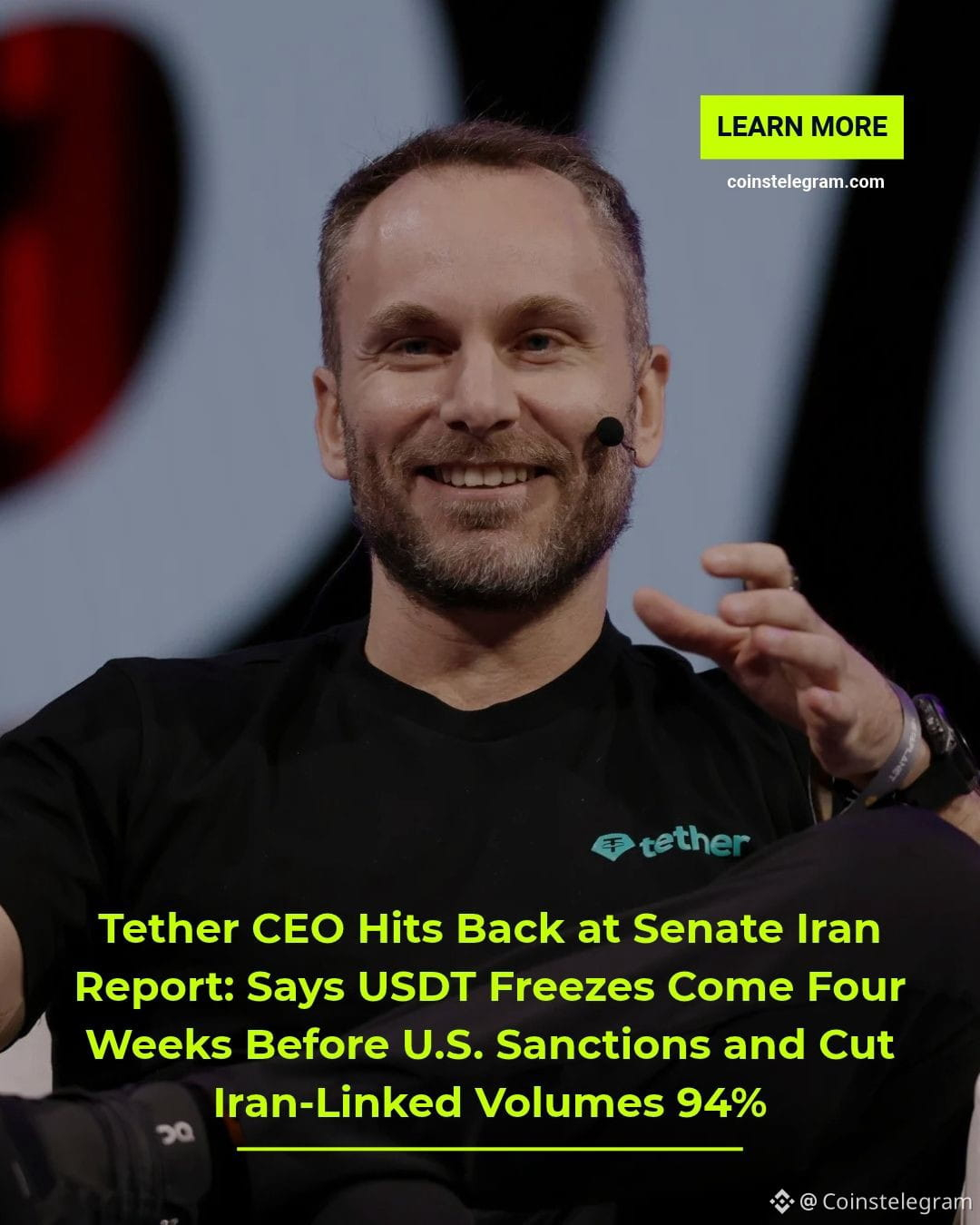
ලිපිය
Tether CEO Hits Back At Senate Iran Report: Says USDT Freezes Come Four Weeks Before U.S. Sanctio...Tether CEO Paolo Ardoino has publicly challenged a Senate Democratic report that accuses the stablecoin issuer of being a lifeline for Iran’s sanctions evasion.
In a post on X, Ardoino argued that Tether freezes flagged addresses weeks before official U.S. and Israeli sanctions, that it acts before blockchain analytics firms label wallets, and that its actions have cut Iran-linked stablecoin volumes by 94%. The report’s authors dispute that picture, and federal pressure on Iran-linked crypto is still growing.
What the Senate Report Found
On September 28, Democratic staff of the Senate Permanent Subcommittee on Investigations published a 28-page report titled “Tethered to Terrorism: Crypto & Iran’s Shadow Banking Network.” Senator Richard Blumenthal is the subcommittee’s top Democrat. Investigators analyzed 846 wallets that either Israel’s National Bureau for Counter Terror Financing (NBCTF) or the U.S. Treasury’s Office of Foreign Assets Control (OFAC) had sanctioned or targeted for seizure between June 2021 and August 2026, over ties to Iran and its proxies.
The headline finding: 84% of those wallets transacted exclusively or almost exclusively in USDT. Among 757 wallets tied specifically to terrorism financing, the share rose to 87%. The report also cited two Iranian oil smugglers who allegedly moved more than $603 million through USDT, and described an Iranian shadow banking network worth an estimated $20 billion in cross-border transactions over the past year.
It also pointed to a specific case: 39 addresses that Israel linked in June 2023 to a Hezbollah money launderer. According to the report, Tether froze five early but left the other 34 untouched until March 2024, and more than $34.6 million in USDT left those wallets after a seizure notice became public. The report argued that before 2024 Tether did not “comprehensively and consistently freeze” wallets designated by counter-terrorism agencies, and that “solely relying on the reactive freezing of wallets after designations will not work.”
Referral and Political Questions
Blumenthal sent the findings to Treasury Secretary Scott Bessent and Attorney General Todd Blanche, asking them to examine whether Tether violated sanctions law and anti-money-laundering rules. The report also raised questions about Tether’s ties to the U.S. government: Cantor Fitzgerald, which was run by Commerce Secretary Howard Lutnick until recently and is now controlled by his children, owns about 5% of Tether, and Blumenthal asked whether that relationship has meant looser oversight. Ardoino’s Response
Ardoino answered on X, rejecting the report’s reading of the data:
“Senator Blumenthal’s ‘analysis’ of Tether’s sanctions report misses that, since 2023, Tether froze on average 4 weeks prior to OFAC & NBCTF official sanction designation and for 99% of the times Tether froze the reported addresses before Chainalysis labelled them. Tether actions led to Iran-linked stablecoin volumes declining by 94%. The reality shows that Tether acts fast on new threats thanks to its law enforcement partnerships.”
He added that Tether has worked with authorities worldwide to freeze more than $4.9 billion in assets. On the day the report came out, Tether said it had helped freeze nearly $550 million in Iran-linked USDT during 2026, including more than $344 million across two addresses in April (tied to Iran’s Central Bank and the Revolutionary Guard, according to reporting) and over $130 million across four TRON wallets in July. In that statement, Ardoino said:
“Tether has consistently demonstrated that USDT is not a haven for sanctioned actors, terrorist organizations or criminal networks.”
The Timing Dispute
The central disagreement is when a freeze counts as early. Footnote 56 of the Senate report notes that Israeli orders sometimes became public weeks or months after they were signed. That means a wallet could have been officially designated long before anyone outside the government knew.
Ardoino’s claim of freezing four weeks before the public designation could therefore still mean freezing months after the order was signed. The report does not dispute that Tether froze funds. It argues that it did so too slowly on some wallets, and Tether’s statements do not address the wallets the subcommittee says were left unfrozen.
Washington Keeps Pushing
The Senate report arrives amid a broader crackdown. Bessent said in early October that the U.S. would “probably” seize about $1 billion in Iran-linked crypto within the week, adding that “we know where it is.” That is nearly double what Tether says it helped freeze this year. It is not the first time he has cited that number: in May he said about $1 billion had been seized, while a later Treasury statement cited a lower, earlier estimate of nearly $500 million, so the actual total remains unclear.
Separately, blockchain analytics firm Elliptic linked $507 million in USDT directly to the Central Bank of Iran, which it said was using the funds to prop up a collapsing rial. OFAC also sanctioned Iranian exchanges including Nobitex, Wallex, Bitpin, and Ramzinex in June, followed by Shelbit and Aban Tether in August.
Why It Matters
USDT is the world’s most-used stablecoin, which makes its compliance record a central question for stablecoin regulation. Tether’s argument is that fast cooperation with law enforcement works. The report’s argument is that a reactive approach leaves gaps that sanctioned networks exploit. Both sides agree on one fact: Iran-linked actors have used USDT heavily.
What Comes Next
Watch for any response from Treasury or the Justice Department to the referral, the results of the promised Iran-linked seizures, and whether Congress uses the report in stablecoin and sanctions debates. For Tether, the practical test will be how quickly it freezes new wallets after designation, and whether independent data supports its 94% claim.
Tether CEO Hits Back At Senate Iran Report: Says USDT Freezes Come Four Weeks Before U.S. Sanctio...
Tether CEO Paolo Ardoino has publicly challenged a Senate Democratic report that accuses the stablecoin issuer of being a lifeline for Iran’s sanctions evasion.
In a post on X, Ardoino argued that Tether freezes flagged addresses weeks before official U.S. and Israeli sanctions, that it acts before blockchain analytics firms label wallets, and that its actions have cut Iran-linked stablecoin volumes by 94%. The report’s authors dispute that picture, and federal pressure on Iran-linked crypto is still growing.
What the Senate Report Found
On September 28, Democratic staff of the Senate Permanent Subcommittee on Investigations published a 28-page report titled “Tethered to Terrorism: Crypto & Iran’s Shadow Banking Network.” Senator Richard Blumenthal is the subcommittee’s top Democrat. Investigators analyzed 846 wallets that either Israel’s National Bureau for Counter Terror Financing (NBCTF) or the U.S. Treasury’s Office of Foreign Assets Control (OFAC) had sanctioned or targeted for seizure between June 2021 and August 2026, over ties to Iran and its proxies.
The headline finding: 84% of those wallets transacted exclusively or almost exclusively in USDT. Among 757 wallets tied specifically to terrorism financing, the share rose to 87%. The report also cited two Iranian oil smugglers who allegedly moved more than $603 million through USDT, and described an Iranian shadow banking network worth an estimated $20 billion in cross-border transactions over the past year.
It also pointed to a specific case: 39 addresses that Israel linked in June 2023 to a Hezbollah money launderer. According to the report, Tether froze five early but left the other 34 untouched until March 2024, and more than $34.6 million in USDT left those wallets after a seizure notice became public. The report argued that before 2024 Tether did not “comprehensively and consistently freeze” wallets designated by counter-terrorism agencies, and that “solely relying on the reactive freezing of wallets after designations will not work.”
Referral and Political Questions
Blumenthal sent the findings to Treasury Secretary Scott Bessent and Attorney General Todd Blanche, asking them to examine whether Tether violated sanctions law and anti-money-laundering rules. The report also raised questions about Tether’s ties to the U.S. government: Cantor Fitzgerald, which was run by Commerce Secretary Howard Lutnick until recently and is now controlled by his children, owns about 5% of Tether, and Blumenthal asked whether that relationship has meant looser oversight. Ardoino’s Response
Ardoino answered on X, rejecting the report’s reading of the data:
“Senator Blumenthal’s ‘analysis’ of Tether’s sanctions report misses that, since 2023, Tether froze on average 4 weeks prior to OFAC & NBCTF official sanction designation and for 99% of the times Tether froze the reported addresses before Chainalysis labelled them. Tether actions led to Iran-linked stablecoin volumes declining by 94%. The reality shows that Tether acts fast on new threats thanks to its law enforcement partnerships.”
He added that Tether has worked with authorities worldwide to freeze more than $4.9 billion in assets. On the day the report came out, Tether said it had helped freeze nearly $550 million in Iran-linked USDT during 2026, including more than $344 million across two addresses in April (tied to Iran’s Central Bank and the Revolutionary Guard, according to reporting) and over $130 million across four TRON wallets in July. In that statement, Ardoino said:
“Tether has consistently demonstrated that USDT is not a haven for sanctioned actors, terrorist organizations or criminal networks.”
The Timing Dispute
The central disagreement is when a freeze counts as early. Footnote 56 of the Senate report notes that Israeli orders sometimes became public weeks or months after they were signed. That means a wallet could have been officially designated long before anyone outside the government knew.
Ardoino’s claim of freezing four weeks before the public designation could therefore still mean freezing months after the order was signed. The report does not dispute that Tether froze funds. It argues that it did so too slowly on some wallets, and Tether’s statements do not address the wallets the subcommittee says were left unfrozen.
Washington Keeps Pushing
The Senate report arrives amid a broader crackdown. Bessent said in early October that the U.S. would “probably” seize about $1 billion in Iran-linked crypto within the week, adding that “we know where it is.” That is nearly double what Tether says it helped freeze this year. It is not the first time he has cited that number: in May he said about $1 billion had been seized, while a later Treasury statement cited a lower, earlier estimate of nearly $500 million, so the actual total remains unclear.
Separately, blockchain analytics firm Elliptic linked $507 million in USDT directly to the Central Bank of Iran, which it said was using the funds to prop up a collapsing rial. OFAC also sanctioned Iranian exchanges including Nobitex, Wallex, Bitpin, and Ramzinex in June, followed by Shelbit and Aban Tether in August.
Why It Matters
USDT is the world’s most-used stablecoin, which makes its compliance record a central question for stablecoin regulation. Tether’s argument is that fast cooperation with law enforcement works. The report’s argument is that a reactive approach leaves gaps that sanctioned networks exploit. Both sides agree on one fact: Iran-linked actors have used USDT heavily.
What Comes Next
Watch for any response from Treasury or the Justice Department to the referral, the results of the promised Iran-linked seizures, and whether Congress uses the report in stablecoin and sanctions debates. For Tether, the practical test will be how quickly it freezes new wallets after designation, and whether independent data supports its 94% claim.
In a post on X, Ardoino argued that Tether freezes flagged addresses weeks before official U.S. and Israeli sanctions, that it acts before blockchain analytics firms label wallets, and that its actions have cut Iran-linked stablecoin volumes by 94%. The report’s authors dispute that picture, and federal pressure on Iran-linked crypto is still growing.
What the Senate Report Found
On September 28, Democratic staff of the Senate Permanent Subcommittee on Investigations published a 28-page report titled “Tethered to Terrorism: Crypto & Iran’s Shadow Banking Network.” Senator Richard Blumenthal is the subcommittee’s top Democrat. Investigators analyzed 846 wallets that either Israel’s National Bureau for Counter Terror Financing (NBCTF) or the U.S. Treasury’s Office of Foreign Assets Control (OFAC) had sanctioned or targeted for seizure between June 2021 and August 2026, over ties to Iran and its proxies.
The headline finding: 84% of those wallets transacted exclusively or almost exclusively in USDT. Among 757 wallets tied specifically to terrorism financing, the share rose to 87%. The report also cited two Iranian oil smugglers who allegedly moved more than $603 million through USDT, and described an Iranian shadow banking network worth an estimated $20 billion in cross-border transactions over the past year.
It also pointed to a specific case: 39 addresses that Israel linked in June 2023 to a Hezbollah money launderer. According to the report, Tether froze five early but left the other 34 untouched until March 2024, and more than $34.6 million in USDT left those wallets after a seizure notice became public. The report argued that before 2024 Tether did not “comprehensively and consistently freeze” wallets designated by counter-terrorism agencies, and that “solely relying on the reactive freezing of wallets after designations will not work.”
Referral and Political Questions
Blumenthal sent the findings to Treasury Secretary Scott Bessent and Attorney General Todd Blanche, asking them to examine whether Tether violated sanctions law and anti-money-laundering rules. The report also raised questions about Tether’s ties to the U.S. government: Cantor Fitzgerald, which was run by Commerce Secretary Howard Lutnick until recently and is now controlled by his children, owns about 5% of Tether, and Blumenthal asked whether that relationship has meant looser oversight. Ardoino’s Response
Ardoino answered on X, rejecting the report’s reading of the data:
“Senator Blumenthal’s ‘analysis’ of Tether’s sanctions report misses that, since 2023, Tether froze on average 4 weeks prior to OFAC & NBCTF official sanction designation and for 99% of the times Tether froze the reported addresses before Chainalysis labelled them. Tether actions led to Iran-linked stablecoin volumes declining by 94%. The reality shows that Tether acts fast on new threats thanks to its law enforcement partnerships.”
He added that Tether has worked with authorities worldwide to freeze more than $4.9 billion in assets. On the day the report came out, Tether said it had helped freeze nearly $550 million in Iran-linked USDT during 2026, including more than $344 million across two addresses in April (tied to Iran’s Central Bank and the Revolutionary Guard, according to reporting) and over $130 million across four TRON wallets in July. In that statement, Ardoino said:
“Tether has consistently demonstrated that USDT is not a haven for sanctioned actors, terrorist organizations or criminal networks.”
The Timing Dispute
The central disagreement is when a freeze counts as early. Footnote 56 of the Senate report notes that Israeli orders sometimes became public weeks or months after they were signed. That means a wallet could have been officially designated long before anyone outside the government knew.
Ardoino’s claim of freezing four weeks before the public designation could therefore still mean freezing months after the order was signed. The report does not dispute that Tether froze funds. It argues that it did so too slowly on some wallets, and Tether’s statements do not address the wallets the subcommittee says were left unfrozen.
Washington Keeps Pushing
The Senate report arrives amid a broader crackdown. Bessent said in early October that the U.S. would “probably” seize about $1 billion in Iran-linked crypto within the week, adding that “we know where it is.” That is nearly double what Tether says it helped freeze this year. It is not the first time he has cited that number: in May he said about $1 billion had been seized, while a later Treasury statement cited a lower, earlier estimate of nearly $500 million, so the actual total remains unclear.
Separately, blockchain analytics firm Elliptic linked $507 million in USDT directly to the Central Bank of Iran, which it said was using the funds to prop up a collapsing rial. OFAC also sanctioned Iranian exchanges including Nobitex, Wallex, Bitpin, and Ramzinex in June, followed by Shelbit and Aban Tether in August.
Why It Matters
USDT is the world’s most-used stablecoin, which makes its compliance record a central question for stablecoin regulation. Tether’s argument is that fast cooperation with law enforcement works. The report’s argument is that a reactive approach leaves gaps that sanctioned networks exploit. Both sides agree on one fact: Iran-linked actors have used USDT heavily.
What Comes Next
Watch for any response from Treasury or the Justice Department to the referral, the results of the promised Iran-linked seizures, and whether Congress uses the report in stablecoin and sanctions debates. For Tether, the practical test will be how quickly it freezes new wallets after designation, and whether independent data supports its 94% claim.
94
Tether CEO Hits Back at Senate Iran Report: Says USDT Freezes Come Four Weeks Before U.S. Sanctio...Tether CEO Paolo Ardoino has publicly challenged a Senate Democratic report that accuses the stablecoin issuer of being a lifeline for Iran’s sanctions evasion.
In a post on X, Ardoino argued that Tether freezes flagged addresses weeks before official U.S. and Israeli sanctions, that it acts before blockchain analytics firms label wallets, and that its actions have cut Iran-linked stablecoin volumes by 94%. The report’s authors dispute that picture, and federal pressure on Iran-linked crypto is still growing.
What the Senate Report Found
On September 28, Democratic staff of the Senate Permanent Subcommittee on Investigations published a 28-page report titled “Tethered to Terrorism: Crypto & Iran’s Shadow Banking Network.” Senator Richard Blumenthal is the subcommittee’s top Democrat. Investigators analyzed 846 wallets that either Israel’s National Bureau for Counter Terror Financing (NBCTF) or the U.S. Treasury’s Office of Foreign Assets Control (OFAC) had sanctioned or targeted for seizure between June 2021 and August 2026, over ties to Iran and its proxies.
The headline finding: 84% of those wallets transacted exclusively or almost exclusively in USDT. Among 757 wallets tied specifically to terrorism financing, the share rose to 87%. The report also cited two Iranian oil smugglers who allegedly moved more than $603 million through USDT, and described an Iranian shadow banking network worth an estimated $20 billion in cross-border transactions over the past year.
It also pointed to a specific case: 39 addresses that Israel linked in June 2023 to a Hezbollah money launderer. According to the report, Tether froze five early but left the other 34 untouched until March 2024, and more than $34.6 million in USDT left those wallets after a seizure notice became public. The report argued that before 2024 Tether did not “comprehensively and consistently freeze” wallets designated by counter-terrorism agencies, and that “solely relying on the reactive freezing of wallets after designations will not work.”
Referral and Political Questions
Blumenthal sent the findings to Treasury Secretary Scott Bessent and Attorney General Todd Blanche, asking them to examine whether Tether violated sanctions law and anti-money-laundering rules. The report also raised questions about Tether’s ties to the U.S. government: Cantor Fitzgerald, which was run by Commerce Secretary Howard Lutnick until recently and is now controlled by his children, owns about 5% of Tether, and Blumenthal asked whether that relationship has meant looser oversight.
Ardoino’s Response
Ardoino answered on X, rejecting the report’s reading of the data:
“Senator Blumenthal’s ‘analysis’ of Tether’s sanctions report misses that, since 2023, Tether froze on average 4 weeks prior to OFAC & NBCTF official sanction designation and for 99% of the times Tether froze the reported addresses before Chainalysis labelled them. Tether actions led to Iran-linked stablecoin volumes declining by 94%. The reality shows that Tether acts fast on new threats thanks to its law enforcement partnerships.”
He added that Tether has worked with authorities worldwide to freeze more than $4.9 billion in assets. On the day the report came out, Tether said it had helped freeze nearly $550 million in Iran-linked USDT during 2026, including more than $344 million across two addresses in April (tied to Iran’s Central Bank and the Revolutionary Guard, according to reporting) and over $130 million across four TRON wallets in July. In that statement, Ardoino said:
“Tether has consistently demonstrated that USDT is not a haven for sanctioned actors, terrorist organizations or criminal networks.”
The Timing Dispute
The central disagreement is when a freeze counts as early. Footnote 56 of the Senate report notes that Israeli orders sometimes became public weeks or months after they were signed. That means a wallet could have been officially designated long before anyone outside the government knew.
Ardoino’s claim of freezing four weeks before the public designation could therefore still mean freezing months after the order was signed. The report does not dispute that Tether froze funds. It argues that it did so too slowly on some wallets, and Tether’s statements do not address the wallets the subcommittee says were left unfrozen.
Washington Keeps Pushing
The Senate report arrives amid a broader crackdown. Bessent said in early October that the U.S. would “probably” seize about $1 billion in Iran-linked crypto within the week, adding that “we know where it is.” That is nearly double what Tether says it helped freeze this year. It is not the first time he has cited that number: in May he said about $1 billion had been seized, while a later Treasury statement cited a lower, earlier estimate of nearly $500 million, so the actual total remains unclear.
Separately, blockchain analytics firm Elliptic linked $507 million in USDT directly to the Central Bank of Iran, which it said was using the funds to prop up a collapsing rial. OFAC also sanctioned Iranian exchanges including Nobitex, Wallex, Bitpin, and Ramzinex in June, followed by Shelbit and Aban Tether in August.
Why It Matters
USDT is the world’s most-used stablecoin, which makes its compliance record a central question for stablecoin regulation. Tether’s argument is that fast cooperation with law enforcement works. The report’s argument is that a reactive approach leaves gaps that sanctioned networks exploit. Both sides agree on one fact: Iran-linked actors have used USDT heavily.
What Comes Next
Watch for any response from Treasury or the Justice Department to the referral, the results of the promised Iran-linked seizures, and whether Congress uses the report in stablecoin and sanctions debates. For Tether, the practical test will be how quickly it freezes new wallets after designation, and whether independent data supports its 94% claim.
Tether CEO Hits Back at Senate Iran Report: Says USDT Freezes Come Four Weeks Before U.S. Sanctio...
Tether CEO Paolo Ardoino has publicly challenged a Senate Democratic report that accuses the stablecoin issuer of being a lifeline for Iran’s sanctions evasion.
In a post on X, Ardoino argued that Tether freezes flagged addresses weeks before official U.S. and Israeli sanctions, that it acts before blockchain analytics firms label wallets, and that its actions have cut Iran-linked stablecoin volumes by 94%. The report’s authors dispute that picture, and federal pressure on Iran-linked crypto is still growing.
What the Senate Report Found
On September 28, Democratic staff of the Senate Permanent Subcommittee on Investigations published a 28-page report titled “Tethered to Terrorism: Crypto & Iran’s Shadow Banking Network.” Senator Richard Blumenthal is the subcommittee’s top Democrat. Investigators analyzed 846 wallets that either Israel’s National Bureau for Counter Terror Financing (NBCTF) or the U.S. Treasury’s Office of Foreign Assets Control (OFAC) had sanctioned or targeted for seizure between June 2021 and August 2026, over ties to Iran and its proxies.
The headline finding: 84% of those wallets transacted exclusively or almost exclusively in USDT. Among 757 wallets tied specifically to terrorism financing, the share rose to 87%. The report also cited two Iranian oil smugglers who allegedly moved more than $603 million through USDT, and described an Iranian shadow banking network worth an estimated $20 billion in cross-border transactions over the past year.
It also pointed to a specific case: 39 addresses that Israel linked in June 2023 to a Hezbollah money launderer. According to the report, Tether froze five early but left the other 34 untouched until March 2024, and more than $34.6 million in USDT left those wallets after a seizure notice became public. The report argued that before 2024 Tether did not “comprehensively and consistently freeze” wallets designated by counter-terrorism agencies, and that “solely relying on the reactive freezing of wallets after designations will not work.”
Referral and Political Questions
Blumenthal sent the findings to Treasury Secretary Scott Bessent and Attorney General Todd Blanche, asking them to examine whether Tether violated sanctions law and anti-money-laundering rules. The report also raised questions about Tether’s ties to the U.S. government: Cantor Fitzgerald, which was run by Commerce Secretary Howard Lutnick until recently and is now controlled by his children, owns about 5% of Tether, and Blumenthal asked whether that relationship has meant looser oversight.
Ardoino’s Response
Ardoino answered on X, rejecting the report’s reading of the data:
“Senator Blumenthal’s ‘analysis’ of Tether’s sanctions report misses that, since 2023, Tether froze on average 4 weeks prior to OFAC & NBCTF official sanction designation and for 99% of the times Tether froze the reported addresses before Chainalysis labelled them. Tether actions led to Iran-linked stablecoin volumes declining by 94%. The reality shows that Tether acts fast on new threats thanks to its law enforcement partnerships.”
He added that Tether has worked with authorities worldwide to freeze more than $4.9 billion in assets. On the day the report came out, Tether said it had helped freeze nearly $550 million in Iran-linked USDT during 2026, including more than $344 million across two addresses in April (tied to Iran’s Central Bank and the Revolutionary Guard, according to reporting) and over $130 million across four TRON wallets in July. In that statement, Ardoino said:
“Tether has consistently demonstrated that USDT is not a haven for sanctioned actors, terrorist organizations or criminal networks.”
The Timing Dispute
The central disagreement is when a freeze counts as early. Footnote 56 of the Senate report notes that Israeli orders sometimes became public weeks or months after they were signed. That means a wallet could have been officially designated long before anyone outside the government knew.
Ardoino’s claim of freezing four weeks before the public designation could therefore still mean freezing months after the order was signed. The report does not dispute that Tether froze funds. It argues that it did so too slowly on some wallets, and Tether’s statements do not address the wallets the subcommittee says were left unfrozen.
Washington Keeps Pushing
The Senate report arrives amid a broader crackdown. Bessent said in early October that the U.S. would “probably” seize about $1 billion in Iran-linked crypto within the week, adding that “we know where it is.” That is nearly double what Tether says it helped freeze this year. It is not the first time he has cited that number: in May he said about $1 billion had been seized, while a later Treasury statement cited a lower, earlier estimate of nearly $500 million, so the actual total remains unclear.
Separately, blockchain analytics firm Elliptic linked $507 million in USDT directly to the Central Bank of Iran, which it said was using the funds to prop up a collapsing rial. OFAC also sanctioned Iranian exchanges including Nobitex, Wallex, Bitpin, and Ramzinex in June, followed by Shelbit and Aban Tether in August.
Why It Matters
USDT is the world’s most-used stablecoin, which makes its compliance record a central question for stablecoin regulation. Tether’s argument is that fast cooperation with law enforcement works. The report’s argument is that a reactive approach leaves gaps that sanctioned networks exploit. Both sides agree on one fact: Iran-linked actors have used USDT heavily.
What Comes Next
Watch for any response from Treasury or the Justice Department to the referral, the results of the promised Iran-linked seizures, and whether Congress uses the report in stablecoin and sanctions debates. For Tether, the practical test will be how quickly it freezes new wallets after designation, and whether independent data supports its 94% claim.
In a post on X, Ardoino argued that Tether freezes flagged addresses weeks before official U.S. and Israeli sanctions, that it acts before blockchain analytics firms label wallets, and that its actions have cut Iran-linked stablecoin volumes by 94%. The report’s authors dispute that picture, and federal pressure on Iran-linked crypto is still growing.
What the Senate Report Found
On September 28, Democratic staff of the Senate Permanent Subcommittee on Investigations published a 28-page report titled “Tethered to Terrorism: Crypto & Iran’s Shadow Banking Network.” Senator Richard Blumenthal is the subcommittee’s top Democrat. Investigators analyzed 846 wallets that either Israel’s National Bureau for Counter Terror Financing (NBCTF) or the U.S. Treasury’s Office of Foreign Assets Control (OFAC) had sanctioned or targeted for seizure between June 2021 and August 2026, over ties to Iran and its proxies.
The headline finding: 84% of those wallets transacted exclusively or almost exclusively in USDT. Among 757 wallets tied specifically to terrorism financing, the share rose to 87%. The report also cited two Iranian oil smugglers who allegedly moved more than $603 million through USDT, and described an Iranian shadow banking network worth an estimated $20 billion in cross-border transactions over the past year.
It also pointed to a specific case: 39 addresses that Israel linked in June 2023 to a Hezbollah money launderer. According to the report, Tether froze five early but left the other 34 untouched until March 2024, and more than $34.6 million in USDT left those wallets after a seizure notice became public. The report argued that before 2024 Tether did not “comprehensively and consistently freeze” wallets designated by counter-terrorism agencies, and that “solely relying on the reactive freezing of wallets after designations will not work.”
Referral and Political Questions
Blumenthal sent the findings to Treasury Secretary Scott Bessent and Attorney General Todd Blanche, asking them to examine whether Tether violated sanctions law and anti-money-laundering rules. The report also raised questions about Tether’s ties to the U.S. government: Cantor Fitzgerald, which was run by Commerce Secretary Howard Lutnick until recently and is now controlled by his children, owns about 5% of Tether, and Blumenthal asked whether that relationship has meant looser oversight.
Ardoino’s Response
Ardoino answered on X, rejecting the report’s reading of the data:
“Senator Blumenthal’s ‘analysis’ of Tether’s sanctions report misses that, since 2023, Tether froze on average 4 weeks prior to OFAC & NBCTF official sanction designation and for 99% of the times Tether froze the reported addresses before Chainalysis labelled them. Tether actions led to Iran-linked stablecoin volumes declining by 94%. The reality shows that Tether acts fast on new threats thanks to its law enforcement partnerships.”
He added that Tether has worked with authorities worldwide to freeze more than $4.9 billion in assets. On the day the report came out, Tether said it had helped freeze nearly $550 million in Iran-linked USDT during 2026, including more than $344 million across two addresses in April (tied to Iran’s Central Bank and the Revolutionary Guard, according to reporting) and over $130 million across four TRON wallets in July. In that statement, Ardoino said:
“Tether has consistently demonstrated that USDT is not a haven for sanctioned actors, terrorist organizations or criminal networks.”
The Timing Dispute
The central disagreement is when a freeze counts as early. Footnote 56 of the Senate report notes that Israeli orders sometimes became public weeks or months after they were signed. That means a wallet could have been officially designated long before anyone outside the government knew.
Ardoino’s claim of freezing four weeks before the public designation could therefore still mean freezing months after the order was signed. The report does not dispute that Tether froze funds. It argues that it did so too slowly on some wallets, and Tether’s statements do not address the wallets the subcommittee says were left unfrozen.
Washington Keeps Pushing
The Senate report arrives amid a broader crackdown. Bessent said in early October that the U.S. would “probably” seize about $1 billion in Iran-linked crypto within the week, adding that “we know where it is.” That is nearly double what Tether says it helped freeze this year. It is not the first time he has cited that number: in May he said about $1 billion had been seized, while a later Treasury statement cited a lower, earlier estimate of nearly $500 million, so the actual total remains unclear.
Separately, blockchain analytics firm Elliptic linked $507 million in USDT directly to the Central Bank of Iran, which it said was using the funds to prop up a collapsing rial. OFAC also sanctioned Iranian exchanges including Nobitex, Wallex, Bitpin, and Ramzinex in June, followed by Shelbit and Aban Tether in August.
Why It Matters
USDT is the world’s most-used stablecoin, which makes its compliance record a central question for stablecoin regulation. Tether’s argument is that fast cooperation with law enforcement works. The report’s argument is that a reactive approach leaves gaps that sanctioned networks exploit. Both sides agree on one fact: Iran-linked actors have used USDT heavily.
What Comes Next
Watch for any response from Treasury or the Justice Department to the referral, the results of the promised Iran-linked seizures, and whether Congress uses the report in stablecoin and sanctions debates. For Tether, the practical test will be how quickly it freezes new wallets after designation, and whether independent data supports its 94% claim.
157

ලිපිය
FINNOVEX Oman Brings Senior Banking Leaders Together for a Focused 2027 Leadership AgendaAn invitation-only Executive Leadership Lunch at The Chedi Muscat built around one clear proposition: One Leader. One Goal. One 2027 Agenda.
Event: FINNOVEX Oman Executive Leadership LunchDate: 21 October 2026Venue: The Chedi MuscatFormat: Invitation-only leadership lunch
MUSCAT, OMAN — FINNOVEX will convene an invitation-only Executive Leadership Lunch at The Chedi Muscat on 21 October 2026, bringing together senior banking and financial-services leaders for a focused conversation on the priorities that should shape 2027.
Built around the signature dialogue “One Leader. One Goal. One 2027 Agenda.”, the lunch is designed as a concentrated leadership exchange rather than a conventional conference. The format places executive perspectives, practical priorities and meaningful peer interaction at the centre of the room.
The leadership gathering is intended for senior banking decision-makers and policy stakeholders from Oman’s financial ecosystem. The discussion will focus on the decisions institutions need to make now across digital transformation, customer experience, payments, resilience, data, artificial intelligence and responsible growth.
Each participating leadership voice will be invited to contribute one clear priority for the year ahead, helping create a concise collective picture of the issues that matter most to Oman’s banking sector as institutions prepare for 2027.
“The strength of this leadership lunch is not in scale, but in relevance. We are bringing together a carefully selected group of senior banking leaders so every conversation has purpose, context and a clear reason to continue beyond the room,” said Habeeb Anwar, Head of Delegates, FINNOVEX Global Series.
The programme will combine leadership perspectives, a focused agenda exchange and a hosted networking lunch in a private setting designed to encourage candid and useful conversation among senior peers.
The Oman Executive Leadership Lunch forms part of the FINNOVEX leadership platform, which connects financial institutions, technology partners and industry stakeholders through focused regional conversations. FINNOVEX is an Exibex portfolio and is organised by Exibex.
Lunch Partners: Enqura and Fimple FINNOVEX — An Exibex portfolio | Organised by Exibex
MEDIA & PARTNERSHIP ENQUIRIES FINNOVEX Global Series | Exibex FZ LLE info@exibex.com
FINNOVEX Oman Brings Senior Banking Leaders Together for a Focused 2027 Leadership Agenda
An invitation-only Executive Leadership Lunch at The Chedi Muscat built around one clear proposition: One Leader. One Goal. One 2027 Agenda.
Event: FINNOVEX Oman Executive Leadership LunchDate: 21 October 2026Venue: The Chedi MuscatFormat: Invitation-only leadership lunch
MUSCAT, OMAN — FINNOVEX will convene an invitation-only Executive Leadership Lunch at The Chedi Muscat on 21 October 2026, bringing together senior banking and financial-services leaders for a focused conversation on the priorities that should shape 2027.
Built around the signature dialogue “One Leader. One Goal. One 2027 Agenda.”, the lunch is designed as a concentrated leadership exchange rather than a conventional conference. The format places executive perspectives, practical priorities and meaningful peer interaction at the centre of the room.
The leadership gathering is intended for senior banking decision-makers and policy stakeholders from Oman’s financial ecosystem. The discussion will focus on the decisions institutions need to make now across digital transformation, customer experience, payments, resilience, data, artificial intelligence and responsible growth.
Each participating leadership voice will be invited to contribute one clear priority for the year ahead, helping create a concise collective picture of the issues that matter most to Oman’s banking sector as institutions prepare for 2027.
“The strength of this leadership lunch is not in scale, but in relevance. We are bringing together a carefully selected group of senior banking leaders so every conversation has purpose, context and a clear reason to continue beyond the room,” said Habeeb Anwar, Head of Delegates, FINNOVEX Global Series.
The programme will combine leadership perspectives, a focused agenda exchange and a hosted networking lunch in a private setting designed to encourage candid and useful conversation among senior peers.
The Oman Executive Leadership Lunch forms part of the FINNOVEX leadership platform, which connects financial institutions, technology partners and industry stakeholders through focused regional conversations. FINNOVEX is an Exibex portfolio and is organised by Exibex.
Lunch Partners: Enqura and Fimple FINNOVEX — An Exibex portfolio | Organised by Exibex
MEDIA & PARTNERSHIP ENQUIRIES FINNOVEX Global Series | Exibex FZ LLE info@exibex.com
Event: FINNOVEX Oman Executive Leadership LunchDate: 21 October 2026Venue: The Chedi MuscatFormat: Invitation-only leadership lunch
MUSCAT, OMAN — FINNOVEX will convene an invitation-only Executive Leadership Lunch at The Chedi Muscat on 21 October 2026, bringing together senior banking and financial-services leaders for a focused conversation on the priorities that should shape 2027.
Built around the signature dialogue “One Leader. One Goal. One 2027 Agenda.”, the lunch is designed as a concentrated leadership exchange rather than a conventional conference. The format places executive perspectives, practical priorities and meaningful peer interaction at the centre of the room.
The leadership gathering is intended for senior banking decision-makers and policy stakeholders from Oman’s financial ecosystem. The discussion will focus on the decisions institutions need to make now across digital transformation, customer experience, payments, resilience, data, artificial intelligence and responsible growth.
Each participating leadership voice will be invited to contribute one clear priority for the year ahead, helping create a concise collective picture of the issues that matter most to Oman’s banking sector as institutions prepare for 2027.
“The strength of this leadership lunch is not in scale, but in relevance. We are bringing together a carefully selected group of senior banking leaders so every conversation has purpose, context and a clear reason to continue beyond the room,” said Habeeb Anwar, Head of Delegates, FINNOVEX Global Series.
The programme will combine leadership perspectives, a focused agenda exchange and a hosted networking lunch in a private setting designed to encourage candid and useful conversation among senior peers.
The Oman Executive Leadership Lunch forms part of the FINNOVEX leadership platform, which connects financial institutions, technology partners and industry stakeholders through focused regional conversations. FINNOVEX is an Exibex portfolio and is organised by Exibex.
Lunch Partners: Enqura and Fimple FINNOVEX — An Exibex portfolio | Organised by Exibex
MEDIA & PARTNERSHIP ENQUIRIES FINNOVEX Global Series | Exibex FZ LLE info@exibex.com
70
ලිපිය
Hacker Steals About $1.3M From 1,404 Qubic Wallets Using Weak Seed Phrases Generated on Apple Dev...The Qubic blockchain paused itself on October 18 after an attacker emptied 1,404 wallets of about 2.94 trillion QU, worth roughly $1.3 million to $1.4 million depending on the source.
Qubic says the cause was weak, predictable wallet seeds created on Apple devices, not a flaw in the network’s protocol. The emergency halt kept most of the stolen funds from moving, and MEXC froze the portion that reached its platform.
What Happened
According to Qubic’s official statement on X, the attacker drained the wallets between 23:42 UTC on October 17 and 01:26 UTC on October 18, a window of about 104 minutes. The network’s validators, known as Computors, coordinated a protective halt at tick 85,371,949. With no transactions processing, the drained funds cannot be moved or sold while the team works on a resolution.
Qubic said 87.1% of the drained tokens (about 2.56 trillion QU) never left the network and remain frozen in place. The other 12.9% (about 379 billion QU) was sent to MEXC, whose team froze the receiving account within about an hour. Exchanges were notified and suspended QUBIC deposits and withdrawals. MEXC said the pause was requested by the project team, and Bitget suspended deposits and withdrawals citing wallet maintenance.
The Cause: Not Enough Randomness
Qubic said some wallet seeds were generated with insufficient randomness, making them weaker than they should be, and that the attacker exploited this to access the wallets. A seed is the secret from which a wallet’s keys are derived, so if it can be predicted, so can the keys. The project stressed that the issue was in seed generation, not in the Qubic protocol itself.
Seeds are affected if they were created: – on an iPhone or iPad, in any browser, before October 18, 2026 – on a Mac using Safari, before October 18, 2026 – in the Qubic iOS app, before July 2025
The team fixed seed generation in version 4.26.4, released October 18, so no new weak seeds can be created. The fix does not strengthen seeds that already exist, so wallets created in the affected environments remain at risk until their funds are moved to a wallet created with the corrected software.
What Happens to the Frozen Funds
Qubic said any resolution is a decision for the Computor quorum under the network’s own rules. The core team is identifying every affected identity and preparing options for the quorum, and a community poll is open on Discord so the Computors can see where users stand. Qubic’s design uses 676 Computors, and a supermajority is needed for network decisions, so the outcome will come from a validator vote rather than a single company’s decision.
What Affected Users Should Do
Qubic advised anyone who lost funds to file a report with police or cybercrime authorities in their country, including the wallet ID, the amount lost, and the transaction link from explorer.qubic.org. Formal reports help exchanges keep funds frozen.
Analysts also warn to expect “recovery service” scams. Qubic says it will never message users first, ask for a seed, or charge for recovery. As general guidance, anyone who created a Qubic wallet in the affected environments should treat that seed as compromised and move funds to a new wallet created with updated software once the network resumes.
Who Is Behind Qubic
Qubic describes itself as a decentralized network that combines blockchain with AI computation. It was created by Sergey Ivancheglo, known as Come-from-Beyond, who also co-founded IOTA and NXT. Its “useful proof of work” directs mining power toward training neural networks, and ordinary transfers carry no fee.
A Familiar Failure Pattern
This attack belongs to the same class as the Coldcard hardware wallet incident earlier this year, where predictable seed phrases let attackers reconstruct private keys offline. In both cases the cryptography was not broken. The randomness that should have protected the seed was missing. Self-custody security depends on trusting that wallet software generates truly random seeds, which users have almost no way to check on their own.
The Bigger Picture: Hacks in 2026
Qubic’s loss is small by 2026 standards, but the year has been punishing:
– CertiK counts about 656 to 658 security incidents and roughly $2.68 billion in losses through September, with about $420.4 million frozen or returned, bringing its adjusted total to about $2.26 billion. Trackers differ: Finbold puts the year-to-date total near $2.1 billion. – TRM Labs recorded $972 million across 207 hacks in the first half, and CertiK counted $1.26 billion across 247 incidents in the third quarter. – September was the worst month, with PeckShield counting 55 major hacks and $766.5 million stolen. The largest incidents were the Bitget exchange hack ($387.5 million), Liquid Network (about $320 million, mostly returned), KelpDAO (about $292 million), and Drift (about $285 million). – North Korea-linked thefts exceeded $1 billion this year, according to Elliptic. Bitcoin gained 40% in the third quarter even as hacks climbed, a reminder that security problems have persisted alongside the market rally.
What Comes Next
The network remains paused. The key developments to watch are the Computor vote on the frozen funds, a restart date, and whether exchanges resume QUBIC deposits and withdrawals. Users with Apple-generated seeds should plan to migrate as soon as it is safe to do so.
Hacker Steals About $1.3M From 1,404 Qubic Wallets Using Weak Seed Phrases Generated on Apple Dev...
The Qubic blockchain paused itself on October 18 after an attacker emptied 1,404 wallets of about 2.94 trillion QU, worth roughly $1.3 million to $1.4 million depending on the source.
Qubic says the cause was weak, predictable wallet seeds created on Apple devices, not a flaw in the network’s protocol. The emergency halt kept most of the stolen funds from moving, and MEXC froze the portion that reached its platform.
What Happened
According to Qubic’s official statement on X, the attacker drained the wallets between 23:42 UTC on October 17 and 01:26 UTC on October 18, a window of about 104 minutes. The network’s validators, known as Computors, coordinated a protective halt at tick 85,371,949. With no transactions processing, the drained funds cannot be moved or sold while the team works on a resolution.
Qubic said 87.1% of the drained tokens (about 2.56 trillion QU) never left the network and remain frozen in place. The other 12.9% (about 379 billion QU) was sent to MEXC, whose team froze the receiving account within about an hour. Exchanges were notified and suspended QUBIC deposits and withdrawals. MEXC said the pause was requested by the project team, and Bitget suspended deposits and withdrawals citing wallet maintenance.
The Cause: Not Enough Randomness
Qubic said some wallet seeds were generated with insufficient randomness, making them weaker than they should be, and that the attacker exploited this to access the wallets. A seed is the secret from which a wallet’s keys are derived, so if it can be predicted, so can the keys. The project stressed that the issue was in seed generation, not in the Qubic protocol itself.
Seeds are affected if they were created: – on an iPhone or iPad, in any browser, before October 18, 2026 – on a Mac using Safari, before October 18, 2026 – in the Qubic iOS app, before July 2025
The team fixed seed generation in version 4.26.4, released October 18, so no new weak seeds can be created. The fix does not strengthen seeds that already exist, so wallets created in the affected environments remain at risk until their funds are moved to a wallet created with the corrected software.
What Happens to the Frozen Funds
Qubic said any resolution is a decision for the Computor quorum under the network’s own rules. The core team is identifying every affected identity and preparing options for the quorum, and a community poll is open on Discord so the Computors can see where users stand. Qubic’s design uses 676 Computors, and a supermajority is needed for network decisions, so the outcome will come from a validator vote rather than a single company’s decision.
What Affected Users Should Do
Qubic advised anyone who lost funds to file a report with police or cybercrime authorities in their country, including the wallet ID, the amount lost, and the transaction link from explorer.qubic.org. Formal reports help exchanges keep funds frozen.
Analysts also warn to expect “recovery service” scams. Qubic says it will never message users first, ask for a seed, or charge for recovery. As general guidance, anyone who created a Qubic wallet in the affected environments should treat that seed as compromised and move funds to a new wallet created with updated software once the network resumes.
Who Is Behind Qubic
Qubic describes itself as a decentralized network that combines blockchain with AI computation. It was created by Sergey Ivancheglo, known as Come-from-Beyond, who also co-founded IOTA and NXT. Its “useful proof of work” directs mining power toward training neural networks, and ordinary transfers carry no fee.
A Familiar Failure Pattern
This attack belongs to the same class as the Coldcard hardware wallet incident earlier this year, where predictable seed phrases let attackers reconstruct private keys offline. In both cases the cryptography was not broken. The randomness that should have protected the seed was missing. Self-custody security depends on trusting that wallet software generates truly random seeds, which users have almost no way to check on their own.
The Bigger Picture: Hacks in 2026
Qubic’s loss is small by 2026 standards, but the year has been punishing:
– CertiK counts about 656 to 658 security incidents and roughly $2.68 billion in losses through September, with about $420.4 million frozen or returned, bringing its adjusted total to about $2.26 billion. Trackers differ: Finbold puts the year-to-date total near $2.1 billion. – TRM Labs recorded $972 million across 207 hacks in the first half, and CertiK counted $1.26 billion across 247 incidents in the third quarter. – September was the worst month, with PeckShield counting 55 major hacks and $766.5 million stolen. The largest incidents were the Bitget exchange hack ($387.5 million), Liquid Network (about $320 million, mostly returned), KelpDAO (about $292 million), and Drift (about $285 million). – North Korea-linked thefts exceeded $1 billion this year, according to Elliptic. Bitcoin gained 40% in the third quarter even as hacks climbed, a reminder that security problems have persisted alongside the market rally.
What Comes Next
The network remains paused. The key developments to watch are the Computor vote on the frozen funds, a restart date, and whether exchanges resume QUBIC deposits and withdrawals. Users with Apple-generated seeds should plan to migrate as soon as it is safe to do so.
Qubic says the cause was weak, predictable wallet seeds created on Apple devices, not a flaw in the network’s protocol. The emergency halt kept most of the stolen funds from moving, and MEXC froze the portion that reached its platform.
What Happened
According to Qubic’s official statement on X, the attacker drained the wallets between 23:42 UTC on October 17 and 01:26 UTC on October 18, a window of about 104 minutes. The network’s validators, known as Computors, coordinated a protective halt at tick 85,371,949. With no transactions processing, the drained funds cannot be moved or sold while the team works on a resolution.
Qubic said 87.1% of the drained tokens (about 2.56 trillion QU) never left the network and remain frozen in place. The other 12.9% (about 379 billion QU) was sent to MEXC, whose team froze the receiving account within about an hour. Exchanges were notified and suspended QUBIC deposits and withdrawals. MEXC said the pause was requested by the project team, and Bitget suspended deposits and withdrawals citing wallet maintenance.
The Cause: Not Enough Randomness
Qubic said some wallet seeds were generated with insufficient randomness, making them weaker than they should be, and that the attacker exploited this to access the wallets. A seed is the secret from which a wallet’s keys are derived, so if it can be predicted, so can the keys. The project stressed that the issue was in seed generation, not in the Qubic protocol itself.
Seeds are affected if they were created: – on an iPhone or iPad, in any browser, before October 18, 2026 – on a Mac using Safari, before October 18, 2026 – in the Qubic iOS app, before July 2025
The team fixed seed generation in version 4.26.4, released October 18, so no new weak seeds can be created. The fix does not strengthen seeds that already exist, so wallets created in the affected environments remain at risk until their funds are moved to a wallet created with the corrected software.
What Happens to the Frozen Funds
Qubic said any resolution is a decision for the Computor quorum under the network’s own rules. The core team is identifying every affected identity and preparing options for the quorum, and a community poll is open on Discord so the Computors can see where users stand. Qubic’s design uses 676 Computors, and a supermajority is needed for network decisions, so the outcome will come from a validator vote rather than a single company’s decision.
What Affected Users Should Do
Qubic advised anyone who lost funds to file a report with police or cybercrime authorities in their country, including the wallet ID, the amount lost, and the transaction link from explorer.qubic.org. Formal reports help exchanges keep funds frozen.
Analysts also warn to expect “recovery service” scams. Qubic says it will never message users first, ask for a seed, or charge for recovery. As general guidance, anyone who created a Qubic wallet in the affected environments should treat that seed as compromised and move funds to a new wallet created with updated software once the network resumes.
Who Is Behind Qubic
Qubic describes itself as a decentralized network that combines blockchain with AI computation. It was created by Sergey Ivancheglo, known as Come-from-Beyond, who also co-founded IOTA and NXT. Its “useful proof of work” directs mining power toward training neural networks, and ordinary transfers carry no fee.
A Familiar Failure Pattern
This attack belongs to the same class as the Coldcard hardware wallet incident earlier this year, where predictable seed phrases let attackers reconstruct private keys offline. In both cases the cryptography was not broken. The randomness that should have protected the seed was missing. Self-custody security depends on trusting that wallet software generates truly random seeds, which users have almost no way to check on their own.
The Bigger Picture: Hacks in 2026
Qubic’s loss is small by 2026 standards, but the year has been punishing:
– CertiK counts about 656 to 658 security incidents and roughly $2.68 billion in losses through September, with about $420.4 million frozen or returned, bringing its adjusted total to about $2.26 billion. Trackers differ: Finbold puts the year-to-date total near $2.1 billion. – TRM Labs recorded $972 million across 207 hacks in the first half, and CertiK counted $1.26 billion across 247 incidents in the third quarter. – September was the worst month, with PeckShield counting 55 major hacks and $766.5 million stolen. The largest incidents were the Bitget exchange hack ($387.5 million), Liquid Network (about $320 million, mostly returned), KelpDAO (about $292 million), and Drift (about $285 million). – North Korea-linked thefts exceeded $1 billion this year, according to Elliptic. Bitcoin gained 40% in the third quarter even as hacks climbed, a reminder that security problems have persisted alongside the market rally.
What Comes Next
The network remains paused. The key developments to watch are the Computor vote on the frozen funds, a restart date, and whether exchanges resume QUBIC deposits and withdrawals. Users with Apple-generated seeds should plan to migrate as soon as it is safe to do so.
66
Hacker Steals About $1.3M from 1,404 Qubic Wallets Using Weak Seed Phrases Generated on Apple Dev...The Qubic blockchain paused itself on October 18 after an attacker emptied 1,404 wallets of about 2.94 trillion QU, worth roughly $1.3 million to $1.4 million depending on the source.
Qubic says the cause was weak, predictable wallet seeds created on Apple devices, not a flaw in the network’s protocol. The emergency halt kept most of the stolen funds from moving, and MEXC froze the portion that reached its platform.
What Happened
According to Qubic’s official statement on X, the attacker drained the wallets between 23:42 UTC on October 17 and 01:26 UTC on October 18, a window of about 104 minutes. The network’s validators, known as Computors, coordinated a protective halt at tick 85,371,949. With no transactions processing, the drained funds cannot be moved or sold while the team works on a resolution.
Qubic said 87.1% of the drained tokens (about 2.56 trillion QU) never left the network and remain frozen in place. The other 12.9% (about 379 billion QU) was sent to MEXC, whose team froze the receiving account within about an hour. Exchanges were notified and suspended QUBIC deposits and withdrawals. MEXC said the pause was requested by the project team, and Bitget suspended deposits and withdrawals citing wallet maintenance.
The Cause: Not Enough Randomness
Qubic said some wallet seeds were generated with insufficient randomness, making them weaker than they should be, and that the attacker exploited this to access the wallets. A seed is the secret from which a wallet’s keys are derived, so if it can be predicted, so can the keys. The project stressed that the issue was in seed generation, not in the Qubic protocol itself.
Seeds are affected if they were created:
– on an iPhone or iPad, in any browser, before October 18, 2026
– on a Mac using Safari, before October 18, 2026
– in the Qubic iOS app, before July 2025
The team fixed seed generation in version 4.26.4, released October 18, so no new weak seeds can be created. The fix does not strengthen seeds that already exist, so wallets created in the affected environments remain at risk until their funds are moved to a wallet created with the corrected software.
What Happens to the Frozen Funds
Qubic said any resolution is a decision for the Computor quorum under the network’s own rules. The core team is identifying every affected identity and preparing options for the quorum, and a community poll is open on Discord so the Computors can see where users stand. Qubic’s design uses 676 Computors, and a supermajority is needed for network decisions, so the outcome will come from a validator vote rather than a single company’s decision.
What Affected Users Should Do
Qubic advised anyone who lost funds to file a report with police or cybercrime authorities in their country, including the wallet ID, the amount lost, and the transaction link from explorer.qubic.org. Formal reports help exchanges keep funds frozen.
Analysts also warn to expect “recovery service” scams. Qubic says it will never message users first, ask for a seed, or charge for recovery.
As general guidance, anyone who created a Qubic wallet in the affected environments should treat that seed as compromised and move funds to a new wallet created with updated software once the network resumes.
Who Is Behind Qubic
Qubic describes itself as a decentralized network that combines blockchain with AI computation. It was created by Sergey Ivancheglo, known as Come-from-Beyond, who also co-founded IOTA and NXT. Its “useful proof of work” directs mining power toward training neural networks, and ordinary transfers carry no fee.
A Familiar Failure Pattern
This attack belongs to the same class as the Coldcard hardware wallet incident earlier this year, where predictable seed phrases let attackers reconstruct private keys offline. In both cases the cryptography was not broken. The randomness that should have protected the seed was missing. Self-custody security depends on trusting that wallet software generates truly random seeds, which users have almost no way to check on their own.
The Bigger Picture: Hacks in 2026
Qubic’s loss is small by 2026 standards, but the year has been punishing:
– CertiK counts about 656 to 658 security incidents and roughly $2.68 billion in losses through September, with about $420.4 million frozen or returned, bringing its adjusted total to about $2.26 billion. Trackers differ: Finbold puts the year-to-date total near $2.1 billion.
– TRM Labs recorded $972 million across 207 hacks in the first half, and CertiK counted $1.26 billion across 247 incidents in the third quarter.
– September was the worst month, with PeckShield counting 55 major hacks and $766.5 million stolen.
The largest incidents were the Bitget exchange hack ($387.5 million), Liquid Network (about $320 million, mostly returned), KelpDAO (about $292 million), and Drift (about $285 million).
– North Korea-linked thefts exceeded $1 billion this year, according to Elliptic.
Bitcoin gained 40% in the third quarter even as hacks climbed, a reminder that security problems have persisted alongside the market rally.
What Comes Next
The network remains paused. The key developments to watch are the Computor vote on the frozen funds, a restart date, and whether exchanges resume QUBIC deposits and withdrawals. Users with Apple-generated seeds should plan to migrate as soon as it is safe to do so.
Hacker Steals About $1.3M from 1,404 Qubic Wallets Using Weak Seed Phrases Generated on Apple Dev...
The Qubic blockchain paused itself on October 18 after an attacker emptied 1,404 wallets of about 2.94 trillion QU, worth roughly $1.3 million to $1.4 million depending on the source.
Qubic says the cause was weak, predictable wallet seeds created on Apple devices, not a flaw in the network’s protocol. The emergency halt kept most of the stolen funds from moving, and MEXC froze the portion that reached its platform.
What Happened
According to Qubic’s official statement on X, the attacker drained the wallets between 23:42 UTC on October 17 and 01:26 UTC on October 18, a window of about 104 minutes. The network’s validators, known as Computors, coordinated a protective halt at tick 85,371,949. With no transactions processing, the drained funds cannot be moved or sold while the team works on a resolution.
Qubic said 87.1% of the drained tokens (about 2.56 trillion QU) never left the network and remain frozen in place. The other 12.9% (about 379 billion QU) was sent to MEXC, whose team froze the receiving account within about an hour. Exchanges were notified and suspended QUBIC deposits and withdrawals. MEXC said the pause was requested by the project team, and Bitget suspended deposits and withdrawals citing wallet maintenance.
The Cause: Not Enough Randomness
Qubic said some wallet seeds were generated with insufficient randomness, making them weaker than they should be, and that the attacker exploited this to access the wallets. A seed is the secret from which a wallet’s keys are derived, so if it can be predicted, so can the keys. The project stressed that the issue was in seed generation, not in the Qubic protocol itself.
Seeds are affected if they were created:
– on an iPhone or iPad, in any browser, before October 18, 2026
– on a Mac using Safari, before October 18, 2026
– in the Qubic iOS app, before July 2025
The team fixed seed generation in version 4.26.4, released October 18, so no new weak seeds can be created. The fix does not strengthen seeds that already exist, so wallets created in the affected environments remain at risk until their funds are moved to a wallet created with the corrected software.
What Happens to the Frozen Funds
Qubic said any resolution is a decision for the Computor quorum under the network’s own rules. The core team is identifying every affected identity and preparing options for the quorum, and a community poll is open on Discord so the Computors can see where users stand. Qubic’s design uses 676 Computors, and a supermajority is needed for network decisions, so the outcome will come from a validator vote rather than a single company’s decision.
What Affected Users Should Do
Qubic advised anyone who lost funds to file a report with police or cybercrime authorities in their country, including the wallet ID, the amount lost, and the transaction link from explorer.qubic.org. Formal reports help exchanges keep funds frozen.
Analysts also warn to expect “recovery service” scams. Qubic says it will never message users first, ask for a seed, or charge for recovery.
As general guidance, anyone who created a Qubic wallet in the affected environments should treat that seed as compromised and move funds to a new wallet created with updated software once the network resumes.
Who Is Behind Qubic
Qubic describes itself as a decentralized network that combines blockchain with AI computation. It was created by Sergey Ivancheglo, known as Come-from-Beyond, who also co-founded IOTA and NXT. Its “useful proof of work” directs mining power toward training neural networks, and ordinary transfers carry no fee.
A Familiar Failure Pattern
This attack belongs to the same class as the Coldcard hardware wallet incident earlier this year, where predictable seed phrases let attackers reconstruct private keys offline. In both cases the cryptography was not broken. The randomness that should have protected the seed was missing. Self-custody security depends on trusting that wallet software generates truly random seeds, which users have almost no way to check on their own.
The Bigger Picture: Hacks in 2026
Qubic’s loss is small by 2026 standards, but the year has been punishing:
– CertiK counts about 656 to 658 security incidents and roughly $2.68 billion in losses through September, with about $420.4 million frozen or returned, bringing its adjusted total to about $2.26 billion. Trackers differ: Finbold puts the year-to-date total near $2.1 billion.
– TRM Labs recorded $972 million across 207 hacks in the first half, and CertiK counted $1.26 billion across 247 incidents in the third quarter.
– September was the worst month, with PeckShield counting 55 major hacks and $766.5 million stolen.
The largest incidents were the Bitget exchange hack ($387.5 million), Liquid Network (about $320 million, mostly returned), KelpDAO (about $292 million), and Drift (about $285 million).
– North Korea-linked thefts exceeded $1 billion this year, according to Elliptic.
Bitcoin gained 40% in the third quarter even as hacks climbed, a reminder that security problems have persisted alongside the market rally.
What Comes Next
The network remains paused. The key developments to watch are the Computor vote on the frozen funds, a restart date, and whether exchanges resume QUBIC deposits and withdrawals. Users with Apple-generated seeds should plan to migrate as soon as it is safe to do so.
Qubic says the cause was weak, predictable wallet seeds created on Apple devices, not a flaw in the network’s protocol. The emergency halt kept most of the stolen funds from moving, and MEXC froze the portion that reached its platform.
What Happened
According to Qubic’s official statement on X, the attacker drained the wallets between 23:42 UTC on October 17 and 01:26 UTC on October 18, a window of about 104 minutes. The network’s validators, known as Computors, coordinated a protective halt at tick 85,371,949. With no transactions processing, the drained funds cannot be moved or sold while the team works on a resolution.
Qubic said 87.1% of the drained tokens (about 2.56 trillion QU) never left the network and remain frozen in place. The other 12.9% (about 379 billion QU) was sent to MEXC, whose team froze the receiving account within about an hour. Exchanges were notified and suspended QUBIC deposits and withdrawals. MEXC said the pause was requested by the project team, and Bitget suspended deposits and withdrawals citing wallet maintenance.
The Cause: Not Enough Randomness
Qubic said some wallet seeds were generated with insufficient randomness, making them weaker than they should be, and that the attacker exploited this to access the wallets. A seed is the secret from which a wallet’s keys are derived, so if it can be predicted, so can the keys. The project stressed that the issue was in seed generation, not in the Qubic protocol itself.
Seeds are affected if they were created:
– on an iPhone or iPad, in any browser, before October 18, 2026
– on a Mac using Safari, before October 18, 2026
– in the Qubic iOS app, before July 2025
The team fixed seed generation in version 4.26.4, released October 18, so no new weak seeds can be created. The fix does not strengthen seeds that already exist, so wallets created in the affected environments remain at risk until their funds are moved to a wallet created with the corrected software.
What Happens to the Frozen Funds
Qubic said any resolution is a decision for the Computor quorum under the network’s own rules. The core team is identifying every affected identity and preparing options for the quorum, and a community poll is open on Discord so the Computors can see where users stand. Qubic’s design uses 676 Computors, and a supermajority is needed for network decisions, so the outcome will come from a validator vote rather than a single company’s decision.
What Affected Users Should Do
Qubic advised anyone who lost funds to file a report with police or cybercrime authorities in their country, including the wallet ID, the amount lost, and the transaction link from explorer.qubic.org. Formal reports help exchanges keep funds frozen.
Analysts also warn to expect “recovery service” scams. Qubic says it will never message users first, ask for a seed, or charge for recovery.
As general guidance, anyone who created a Qubic wallet in the affected environments should treat that seed as compromised and move funds to a new wallet created with updated software once the network resumes.
Who Is Behind Qubic
Qubic describes itself as a decentralized network that combines blockchain with AI computation. It was created by Sergey Ivancheglo, known as Come-from-Beyond, who also co-founded IOTA and NXT. Its “useful proof of work” directs mining power toward training neural networks, and ordinary transfers carry no fee.
A Familiar Failure Pattern
This attack belongs to the same class as the Coldcard hardware wallet incident earlier this year, where predictable seed phrases let attackers reconstruct private keys offline. In both cases the cryptography was not broken. The randomness that should have protected the seed was missing. Self-custody security depends on trusting that wallet software generates truly random seeds, which users have almost no way to check on their own.
The Bigger Picture: Hacks in 2026
Qubic’s loss is small by 2026 standards, but the year has been punishing:
– CertiK counts about 656 to 658 security incidents and roughly $2.68 billion in losses through September, with about $420.4 million frozen or returned, bringing its adjusted total to about $2.26 billion. Trackers differ: Finbold puts the year-to-date total near $2.1 billion.
– TRM Labs recorded $972 million across 207 hacks in the first half, and CertiK counted $1.26 billion across 247 incidents in the third quarter.
– September was the worst month, with PeckShield counting 55 major hacks and $766.5 million stolen.
The largest incidents were the Bitget exchange hack ($387.5 million), Liquid Network (about $320 million, mostly returned), KelpDAO (about $292 million), and Drift (about $285 million).
– North Korea-linked thefts exceeded $1 billion this year, according to Elliptic.
Bitcoin gained 40% in the third quarter even as hacks climbed, a reminder that security problems have persisted alongside the market rally.
What Comes Next
The network remains paused. The key developments to watch are the Computor vote on the frozen funds, a restart date, and whether exchanges resume QUBIC deposits and withdrawals. Users with Apple-generated seeds should plan to migrate as soon as it is safe to do so.
213
ලිපිය
FINNOVEX Oman Brings Senior Banking Leaders Together for a Focused 2027 Leadership AgendaAn invitation-only Executive Leadership Lunch at The Chedi Muscat built around one clear proposition: One Leader. One Goal. One 2027 Agenda.
Event: FINNOVEX Oman Executive Leadership Lunch
Date: 21 October 2026
Venue: The Chedi Muscat
Format: Invitation-only leadership lunch
MUSCAT, OMAN — FINNOVEX will convene an invitation-only Executive Leadership Lunch at The Chedi Muscat on 21 October 2026, bringing together senior banking and financial-services leaders for a focused conversation on the priorities that should shape 2027.
Built around the signature dialogue “One Leader. One Goal. One 2027 Agenda.”, the lunch is designed as a concentrated leadership exchange rather than a conventional conference. The format places executive perspectives, practical priorities and meaningful peer interaction at the centre of the room.
The leadership gathering is intended for senior banking decision-makers and policy stakeholders from Oman’s financial ecosystem. The discussion will focus on the decisions institutions need to make now across digital transformation, customer experience, payments, resilience, data, artificial intelligence and responsible growth.
Each participating leadership voice will be invited to contribute one clear priority for the year ahead, helping create a concise collective picture of the issues that matter most to Oman’s banking sector as institutions prepare for 2027.
“The strength of this leadership lunch is not in scale, but in relevance. We are bringing together a carefully selected group of senior banking leaders so every conversation has purpose, context and a clear reason to continue beyond the room,” said Habeeb Anwar, Head of Delegates, FINNOVEX Global Series.
The programme will combine leadership perspectives, a focused agenda exchange and a hosted networking lunch in a private setting designed to encourage candid and useful conversation among senior peers.
The Oman Executive Leadership Lunch forms part of the FINNOVEX leadership platform, which connects financial institutions, technology partners and industry stakeholders through focused regional conversations. FINNOVEX is an Exibex portfolio and is organised by Exibex.
Lunch Partners: Enqura and Fimple FINNOVEX — An Exibex portfolio | Organised by Exibex
MEDIA & PARTNERSHIP ENQUIRIES
FINNOVEX Global Series | Exibex FZ LLE
info@exibex.com
FINNOVEX Oman Brings Senior Banking Leaders Together for a Focused 2027 Leadership Agenda
An invitation-only Executive Leadership Lunch at The Chedi Muscat built around one clear proposition: One Leader. One Goal. One 2027 Agenda.
Event: FINNOVEX Oman Executive Leadership Lunch
Date: 21 October 2026
Venue: The Chedi Muscat
Format: Invitation-only leadership lunch
MUSCAT, OMAN — FINNOVEX will convene an invitation-only Executive Leadership Lunch at The Chedi Muscat on 21 October 2026, bringing together senior banking and financial-services leaders for a focused conversation on the priorities that should shape 2027.
Built around the signature dialogue “One Leader. One Goal. One 2027 Agenda.”, the lunch is designed as a concentrated leadership exchange rather than a conventional conference. The format places executive perspectives, practical priorities and meaningful peer interaction at the centre of the room.
The leadership gathering is intended for senior banking decision-makers and policy stakeholders from Oman’s financial ecosystem. The discussion will focus on the decisions institutions need to make now across digital transformation, customer experience, payments, resilience, data, artificial intelligence and responsible growth.
Each participating leadership voice will be invited to contribute one clear priority for the year ahead, helping create a concise collective picture of the issues that matter most to Oman’s banking sector as institutions prepare for 2027.
“The strength of this leadership lunch is not in scale, but in relevance. We are bringing together a carefully selected group of senior banking leaders so every conversation has purpose, context and a clear reason to continue beyond the room,” said Habeeb Anwar, Head of Delegates, FINNOVEX Global Series.
The programme will combine leadership perspectives, a focused agenda exchange and a hosted networking lunch in a private setting designed to encourage candid and useful conversation among senior peers.
The Oman Executive Leadership Lunch forms part of the FINNOVEX leadership platform, which connects financial institutions, technology partners and industry stakeholders through focused regional conversations. FINNOVEX is an Exibex portfolio and is organised by Exibex.
Lunch Partners: Enqura and Fimple FINNOVEX — An Exibex portfolio | Organised by Exibex
MEDIA & PARTNERSHIP ENQUIRIES
FINNOVEX Global Series | Exibex FZ LLE
info@exibex.com
Event: FINNOVEX Oman Executive Leadership Lunch
Date: 21 October 2026
Venue: The Chedi Muscat
Format: Invitation-only leadership lunch
MUSCAT, OMAN — FINNOVEX will convene an invitation-only Executive Leadership Lunch at The Chedi Muscat on 21 October 2026, bringing together senior banking and financial-services leaders for a focused conversation on the priorities that should shape 2027.
Built around the signature dialogue “One Leader. One Goal. One 2027 Agenda.”, the lunch is designed as a concentrated leadership exchange rather than a conventional conference. The format places executive perspectives, practical priorities and meaningful peer interaction at the centre of the room.
The leadership gathering is intended for senior banking decision-makers and policy stakeholders from Oman’s financial ecosystem. The discussion will focus on the decisions institutions need to make now across digital transformation, customer experience, payments, resilience, data, artificial intelligence and responsible growth.
Each participating leadership voice will be invited to contribute one clear priority for the year ahead, helping create a concise collective picture of the issues that matter most to Oman’s banking sector as institutions prepare for 2027.
“The strength of this leadership lunch is not in scale, but in relevance. We are bringing together a carefully selected group of senior banking leaders so every conversation has purpose, context and a clear reason to continue beyond the room,” said Habeeb Anwar, Head of Delegates, FINNOVEX Global Series.
The programme will combine leadership perspectives, a focused agenda exchange and a hosted networking lunch in a private setting designed to encourage candid and useful conversation among senior peers.
The Oman Executive Leadership Lunch forms part of the FINNOVEX leadership platform, which connects financial institutions, technology partners and industry stakeholders through focused regional conversations. FINNOVEX is an Exibex portfolio and is organised by Exibex.
Lunch Partners: Enqura and Fimple FINNOVEX — An Exibex portfolio | Organised by Exibex
MEDIA & PARTNERSHIP ENQUIRIES
FINNOVEX Global Series | Exibex FZ LLE
info@exibex.com
94

ලිපිය
“Flying Cars Are Real”: Musk Unveils Tesla Roadster With SpaceX ThrustersTesla has finally revealed its long-delayed second-generation Roadster, and it arrived with a rocket-company twist. At a livestreamed event on Thursday, October 15, Elon Musk showed a prototype that drove upside down along a curved ramp, flipped in mid-air, landed on its wheels, and posted a claimed 0-60 mph time of 0.81 seconds. Tesla says production will begin in 2028 and confirmed three versions, including a one-seat “Rocket” with a flight system.
The Event
The reveal took place at SpaceX’s rocket test facility in McGregor, Texas, near Waco. Musk framed the car as the product of a partnership between “the world’s best car company and the world’s best rocket company,” and told the crowd it was “the culmination of incredible work by Tesla and SpaceX engineers working closely together to make something that you haven’t seen in any movie.”
During the demo, the Roadster drove up a tall, curved ramp until it was upside down, clung to the surface, left the end of the ramp, rolled 180 degrees in the air, and landed on its wheels as the audience cheered. Reports also describe it jumping over a line of Tesla vehicles, including the Model 3, Model Y, Cybertruck, Semi, and Cybercab.
“Flying cars are real,” Musk said, while adding that success was “not guaranteed” but “it will probably work.” He also told the audience they could say they saw it with their own eyes, because “what you see with your eyes, you will not believe.”
How It Works
Tesla explained the stunt with a mix of fans and SpaceX hardware. Lars Moravy, Tesla’s vice president of vehicle engineering, said the car uses a “fan suction system” on the underside that can pull up to 2 Gs, enough to hold it against a surface while upside down.
“Then we borrowed some technology from SpaceX to do the rest,” he said.
That technology is a set of cold-gas thrusters powered by compressed air rather than fuel. Reported specifications include 10 nozzles, two carbon-overwrapped tanks of about 600 liters holding roughly 250 kg of ultra-high-pressure air, and more than 80 kilonewtons of rear thrust. Tesla says the car can refill its air supply itself, and electric actuators provide precise thrust control and micro-adjustments within a fraction of a second. Musk said the Roadster has altitude control thrusters and main thrusters at the rear, so it can “basically fly like a rocket.”
Three Versions
After the event, Tesla confirmed three configurations:
– Performance: two seats, active aerodynamics, and the suction system for extra downforce. Tesla claims 0-60 mph in under 1.6 seconds. – Thrust: two seats plus rear-mounted cold-gas thrusters, a limited release. Claimed 0-60 mph in under 0.9 seconds. – Rocket: an invite-only, single-seat version with additional thrusters that can lift it off the ground and control it in flight. Tesla claims 0-60 mph in under 0.59 seconds. Tesla quotes a top speed above 230 mph (about 370 km/h) and range of more than 300 miles (about 480 km). Tesla’s own website says the Rocket variant is not approved for public road use.
The Numbers, With Caveats
The headline figure from the night was a 0-60 mph run of 0.81 seconds, roughly 96 km/h, displayed on the event’s own timer. It has not been independently verified. Reports describe two runs on stage, one at about a second and one at 0.8 seconds. The sub-0.9 and sub-0.59 second figures for the Thrust and Rocket versions are Tesla’s published targets rather than results shown on stage.
No vehicle price was announced. Tesla’s reservation page lists the Performance version with a reported $50,000 deposit and the Thrust version with a $250,000 deposit, while the Rocket is by invitation only.
A Very Long Wait
Tesla first showed the Roadster in 2017, promising deliveries in 2020. In November 2025, production was pushed to 2027 or 2028. The unveiling itself was postponed repeatedly, with reports counting at least seven different dates before October 15, and the event followed a two-week weather delay. Musk said production starts in 2028 and described the Roadster as the only manually driven car Tesla will make long term.
Is It Really a “Flying Car”?
Technical and regulatory hurdles have kept flying cars from becoming a mainstream product, and this one is no exception. The Rocket version is a limited, invite-only halo car that has not been approved for public roads, and what was shown on stage were controlled demonstrations on a SpaceX test site, not everyday flight. The first flying car prototype dates to 1917, and serious attempts have only recently become more plausible as electric motors and batteries have improved. Tesla has said it plans follow-up demonstrations, including a new attempt at Evel Knievel’s Snake River Canyon jump.
What Comes Next
Watch for official pricing, the independent testing of the 0-60 claims, regulatory answers about the Rocket version, and whether Tesla meets its 2028 production target after years of delays. Until then, the Roadster is best understood as a spectacular proof of concept from two of Musk’s companies, with the real test being whether it can reach customers.
“Flying Cars Are Real”: Musk Unveils Tesla Roadster With SpaceX Thrusters
Tesla has finally revealed its long-delayed second-generation Roadster, and it arrived with a rocket-company twist. At a livestreamed event on Thursday, October 15, Elon Musk showed a prototype that drove upside down along a curved ramp, flipped in mid-air, landed on its wheels, and posted a claimed 0-60 mph time of 0.81 seconds. Tesla says production will begin in 2028 and confirmed three versions, including a one-seat “Rocket” with a flight system.
The Event
The reveal took place at SpaceX’s rocket test facility in McGregor, Texas, near Waco. Musk framed the car as the product of a partnership between “the world’s best car company and the world’s best rocket company,” and told the crowd it was “the culmination of incredible work by Tesla and SpaceX engineers working closely together to make something that you haven’t seen in any movie.”
During the demo, the Roadster drove up a tall, curved ramp until it was upside down, clung to the surface, left the end of the ramp, rolled 180 degrees in the air, and landed on its wheels as the audience cheered. Reports also describe it jumping over a line of Tesla vehicles, including the Model 3, Model Y, Cybertruck, Semi, and Cybercab.
“Flying cars are real,” Musk said, while adding that success was “not guaranteed” but “it will probably work.” He also told the audience they could say they saw it with their own eyes, because “what you see with your eyes, you will not believe.”
How It Works
Tesla explained the stunt with a mix of fans and SpaceX hardware. Lars Moravy, Tesla’s vice president of vehicle engineering, said the car uses a “fan suction system” on the underside that can pull up to 2 Gs, enough to hold it against a surface while upside down.
“Then we borrowed some technology from SpaceX to do the rest,” he said.
That technology is a set of cold-gas thrusters powered by compressed air rather than fuel. Reported specifications include 10 nozzles, two carbon-overwrapped tanks of about 600 liters holding roughly 250 kg of ultra-high-pressure air, and more than 80 kilonewtons of rear thrust. Tesla says the car can refill its air supply itself, and electric actuators provide precise thrust control and micro-adjustments within a fraction of a second. Musk said the Roadster has altitude control thrusters and main thrusters at the rear, so it can “basically fly like a rocket.”
Three Versions
After the event, Tesla confirmed three configurations:
– Performance: two seats, active aerodynamics, and the suction system for extra downforce. Tesla claims 0-60 mph in under 1.6 seconds. – Thrust: two seats plus rear-mounted cold-gas thrusters, a limited release. Claimed 0-60 mph in under 0.9 seconds. – Rocket: an invite-only, single-seat version with additional thrusters that can lift it off the ground and control it in flight. Tesla claims 0-60 mph in under 0.59 seconds. Tesla quotes a top speed above 230 mph (about 370 km/h) and range of more than 300 miles (about 480 km). Tesla’s own website says the Rocket variant is not approved for public road use.
The Numbers, With Caveats
The headline figure from the night was a 0-60 mph run of 0.81 seconds, roughly 96 km/h, displayed on the event’s own timer. It has not been independently verified. Reports describe two runs on stage, one at about a second and one at 0.8 seconds. The sub-0.9 and sub-0.59 second figures for the Thrust and Rocket versions are Tesla’s published targets rather than results shown on stage.
No vehicle price was announced. Tesla’s reservation page lists the Performance version with a reported $50,000 deposit and the Thrust version with a $250,000 deposit, while the Rocket is by invitation only.
A Very Long Wait
Tesla first showed the Roadster in 2017, promising deliveries in 2020. In November 2025, production was pushed to 2027 or 2028. The unveiling itself was postponed repeatedly, with reports counting at least seven different dates before October 15, and the event followed a two-week weather delay. Musk said production starts in 2028 and described the Roadster as the only manually driven car Tesla will make long term.
Is It Really a “Flying Car”?
Technical and regulatory hurdles have kept flying cars from becoming a mainstream product, and this one is no exception. The Rocket version is a limited, invite-only halo car that has not been approved for public roads, and what was shown on stage were controlled demonstrations on a SpaceX test site, not everyday flight. The first flying car prototype dates to 1917, and serious attempts have only recently become more plausible as electric motors and batteries have improved. Tesla has said it plans follow-up demonstrations, including a new attempt at Evel Knievel’s Snake River Canyon jump.
What Comes Next
Watch for official pricing, the independent testing of the 0-60 claims, regulatory answers about the Rocket version, and whether Tesla meets its 2028 production target after years of delays. Until then, the Roadster is best understood as a spectacular proof of concept from two of Musk’s companies, with the real test being whether it can reach customers.
The Event
The reveal took place at SpaceX’s rocket test facility in McGregor, Texas, near Waco. Musk framed the car as the product of a partnership between “the world’s best car company and the world’s best rocket company,” and told the crowd it was “the culmination of incredible work by Tesla and SpaceX engineers working closely together to make something that you haven’t seen in any movie.”
During the demo, the Roadster drove up a tall, curved ramp until it was upside down, clung to the surface, left the end of the ramp, rolled 180 degrees in the air, and landed on its wheels as the audience cheered. Reports also describe it jumping over a line of Tesla vehicles, including the Model 3, Model Y, Cybertruck, Semi, and Cybercab.
“Flying cars are real,” Musk said, while adding that success was “not guaranteed” but “it will probably work.” He also told the audience they could say they saw it with their own eyes, because “what you see with your eyes, you will not believe.”
How It Works
Tesla explained the stunt with a mix of fans and SpaceX hardware. Lars Moravy, Tesla’s vice president of vehicle engineering, said the car uses a “fan suction system” on the underside that can pull up to 2 Gs, enough to hold it against a surface while upside down.
“Then we borrowed some technology from SpaceX to do the rest,” he said.
That technology is a set of cold-gas thrusters powered by compressed air rather than fuel. Reported specifications include 10 nozzles, two carbon-overwrapped tanks of about 600 liters holding roughly 250 kg of ultra-high-pressure air, and more than 80 kilonewtons of rear thrust. Tesla says the car can refill its air supply itself, and electric actuators provide precise thrust control and micro-adjustments within a fraction of a second. Musk said the Roadster has altitude control thrusters and main thrusters at the rear, so it can “basically fly like a rocket.”
Three Versions
After the event, Tesla confirmed three configurations:
– Performance: two seats, active aerodynamics, and the suction system for extra downforce. Tesla claims 0-60 mph in under 1.6 seconds. – Thrust: two seats plus rear-mounted cold-gas thrusters, a limited release. Claimed 0-60 mph in under 0.9 seconds. – Rocket: an invite-only, single-seat version with additional thrusters that can lift it off the ground and control it in flight. Tesla claims 0-60 mph in under 0.59 seconds. Tesla quotes a top speed above 230 mph (about 370 km/h) and range of more than 300 miles (about 480 km). Tesla’s own website says the Rocket variant is not approved for public road use.
The Numbers, With Caveats
The headline figure from the night was a 0-60 mph run of 0.81 seconds, roughly 96 km/h, displayed on the event’s own timer. It has not been independently verified. Reports describe two runs on stage, one at about a second and one at 0.8 seconds. The sub-0.9 and sub-0.59 second figures for the Thrust and Rocket versions are Tesla’s published targets rather than results shown on stage.
No vehicle price was announced. Tesla’s reservation page lists the Performance version with a reported $50,000 deposit and the Thrust version with a $250,000 deposit, while the Rocket is by invitation only.
A Very Long Wait
Tesla first showed the Roadster in 2017, promising deliveries in 2020. In November 2025, production was pushed to 2027 or 2028. The unveiling itself was postponed repeatedly, with reports counting at least seven different dates before October 15, and the event followed a two-week weather delay. Musk said production starts in 2028 and described the Roadster as the only manually driven car Tesla will make long term.
Is It Really a “Flying Car”?
Technical and regulatory hurdles have kept flying cars from becoming a mainstream product, and this one is no exception. The Rocket version is a limited, invite-only halo car that has not been approved for public roads, and what was shown on stage were controlled demonstrations on a SpaceX test site, not everyday flight. The first flying car prototype dates to 1917, and serious attempts have only recently become more plausible as electric motors and batteries have improved. Tesla has said it plans follow-up demonstrations, including a new attempt at Evel Knievel’s Snake River Canyon jump.
What Comes Next
Watch for official pricing, the independent testing of the 0-60 claims, regulatory answers about the Rocket version, and whether Tesla meets its 2028 production target after years of delays. Until then, the Roadster is best understood as a spectacular proof of concept from two of Musk’s companies, with the real test being whether it can reach customers.
117
“Flying Cars Are Real”: Musk Unveils Tesla Roadster With SpaceX ThrustersTesla has finally revealed its long-delayed second-generation Roadster, and it arrived with a rocket-company twist. At a livestreamed event on Thursday, October 15, Elon Musk showed a prototype that drove upside down along a curved ramp, flipped in mid-air, landed on its wheels, and posted a claimed 0-60 mph time of 0.81 seconds. Tesla says production will begin in 2028 and confirmed three versions, including a one-seat “Rocket” with a flight system.
The Event
The reveal took place at SpaceX’s rocket test facility in McGregor, Texas, near Waco. Musk framed the car as the product of a partnership between “the world’s best car company and the world’s best rocket company,” and told the crowd it was “the culmination of incredible work by Tesla and SpaceX engineers working closely together to make something that you haven’t seen in any movie.”
During the demo, the Roadster drove up a tall, curved ramp until it was upside down, clung to the surface, left the end of the ramp, rolled 180 degrees in the air, and landed on its wheels as the audience cheered. Reports also describe it jumping over a line of Tesla vehicles, including the Model 3, Model Y, Cybertruck, Semi, and Cybercab.
“Flying cars are real,” Musk said, while adding that success was “not guaranteed” but “it will probably work.” He also told the audience they could say they saw it with their own eyes, because “what you see with your eyes, you will not believe.”
How It Works
Tesla explained the stunt with a mix of fans and SpaceX hardware. Lars Moravy, Tesla’s vice president of vehicle engineering, said the car uses a “fan suction system” on the underside that can pull up to 2 Gs, enough to hold it against a surface while upside down.
“Then we borrowed some technology from SpaceX to do the rest,” he said.
That technology is a set of cold-gas thrusters powered by compressed air rather than fuel. Reported specifications include 10 nozzles, two carbon-overwrapped tanks of about 600 liters holding roughly 250 kg of ultra-high-pressure air, and more than 80 kilonewtons of rear thrust. Tesla says the car can refill its air supply itself, and electric actuators provide precise thrust control and micro-adjustments within a fraction of a second. Musk said the Roadster has altitude control thrusters and main thrusters at the rear, so it can “basically fly like a rocket.”
Three Versions
After the event, Tesla confirmed three configurations:
– Performance: two seats, active aerodynamics, and the suction system for extra downforce. Tesla claims 0-60 mph in under 1.6 seconds.
– Thrust: two seats plus rear-mounted cold-gas thrusters, a limited release. Claimed 0-60 mph in under 0.9 seconds.
– Rocket: an invite-only, single-seat version with additional thrusters that can lift it off the ground and control it in flight. Tesla claims 0-60 mph in under 0.59 seconds.
Tesla quotes a top speed above 230 mph (about 370 km/h) and range of more than 300 miles (about 480 km). Tesla’s own website says the Rocket variant is not approved for public road use.
The Numbers, With Caveats
The headline figure from the night was a 0-60 mph run of 0.81 seconds, roughly 96 km/h, displayed on the event’s own timer. It has not been independently verified. Reports describe two runs on stage, one at about a second and one at 0.8 seconds. The sub-0.9 and sub-0.59 second figures for the Thrust and Rocket versions are Tesla’s published targets rather than results shown on stage.
No vehicle price was announced. Tesla’s reservation page lists the Performance version with a reported $50,000 deposit and the Thrust version with a $250,000 deposit, while the Rocket is by invitation only.
A Very Long Wait
Tesla first showed the Roadster in 2017, promising deliveries in 2020. In November 2025, production was pushed to 2027 or 2028. The unveiling itself was postponed repeatedly, with reports counting at least seven different dates before October 15, and the event followed a two-week weather delay. Musk said production starts in 2028 and described the Roadster as the only manually driven car Tesla will make long term.
Is It Really a “Flying Car”?
Technical and regulatory hurdles have kept flying cars from becoming a mainstream product, and this one is no exception. The Rocket version is a limited, invite-only halo car that has not been approved for public roads, and what was shown on stage were controlled demonstrations on a SpaceX test site, not everyday flight. The first flying car prototype dates to 1917, and serious attempts have only recently become more plausible as electric motors and batteries have improved. Tesla has said it plans follow-up demonstrations, including a new attempt at Evel Knievel’s Snake River Canyon jump.
What Comes Next
Watch for official pricing, the independent testing of the 0-60 claims, regulatory answers about the Rocket version, and whether Tesla meets its 2028 production target after years of delays. Until then, the Roadster is best understood as a spectacular proof of concept from two of Musk’s companies, with the real test being whether it can reach customers.
“Flying Cars Are Real”: Musk Unveils Tesla Roadster With SpaceX Thrusters
Tesla has finally revealed its long-delayed second-generation Roadster, and it arrived with a rocket-company twist. At a livestreamed event on Thursday, October 15, Elon Musk showed a prototype that drove upside down along a curved ramp, flipped in mid-air, landed on its wheels, and posted a claimed 0-60 mph time of 0.81 seconds. Tesla says production will begin in 2028 and confirmed three versions, including a one-seat “Rocket” with a flight system.
The Event
The reveal took place at SpaceX’s rocket test facility in McGregor, Texas, near Waco. Musk framed the car as the product of a partnership between “the world’s best car company and the world’s best rocket company,” and told the crowd it was “the culmination of incredible work by Tesla and SpaceX engineers working closely together to make something that you haven’t seen in any movie.”
During the demo, the Roadster drove up a tall, curved ramp until it was upside down, clung to the surface, left the end of the ramp, rolled 180 degrees in the air, and landed on its wheels as the audience cheered. Reports also describe it jumping over a line of Tesla vehicles, including the Model 3, Model Y, Cybertruck, Semi, and Cybercab.
“Flying cars are real,” Musk said, while adding that success was “not guaranteed” but “it will probably work.” He also told the audience they could say they saw it with their own eyes, because “what you see with your eyes, you will not believe.”
How It Works
Tesla explained the stunt with a mix of fans and SpaceX hardware. Lars Moravy, Tesla’s vice president of vehicle engineering, said the car uses a “fan suction system” on the underside that can pull up to 2 Gs, enough to hold it against a surface while upside down.
“Then we borrowed some technology from SpaceX to do the rest,” he said.
That technology is a set of cold-gas thrusters powered by compressed air rather than fuel. Reported specifications include 10 nozzles, two carbon-overwrapped tanks of about 600 liters holding roughly 250 kg of ultra-high-pressure air, and more than 80 kilonewtons of rear thrust. Tesla says the car can refill its air supply itself, and electric actuators provide precise thrust control and micro-adjustments within a fraction of a second. Musk said the Roadster has altitude control thrusters and main thrusters at the rear, so it can “basically fly like a rocket.”
Three Versions
After the event, Tesla confirmed three configurations:
– Performance: two seats, active aerodynamics, and the suction system for extra downforce. Tesla claims 0-60 mph in under 1.6 seconds.
– Thrust: two seats plus rear-mounted cold-gas thrusters, a limited release. Claimed 0-60 mph in under 0.9 seconds.
– Rocket: an invite-only, single-seat version with additional thrusters that can lift it off the ground and control it in flight. Tesla claims 0-60 mph in under 0.59 seconds.
Tesla quotes a top speed above 230 mph (about 370 km/h) and range of more than 300 miles (about 480 km). Tesla’s own website says the Rocket variant is not approved for public road use.
The Numbers, With Caveats
The headline figure from the night was a 0-60 mph run of 0.81 seconds, roughly 96 km/h, displayed on the event’s own timer. It has not been independently verified. Reports describe two runs on stage, one at about a second and one at 0.8 seconds. The sub-0.9 and sub-0.59 second figures for the Thrust and Rocket versions are Tesla’s published targets rather than results shown on stage.
No vehicle price was announced. Tesla’s reservation page lists the Performance version with a reported $50,000 deposit and the Thrust version with a $250,000 deposit, while the Rocket is by invitation only.
A Very Long Wait
Tesla first showed the Roadster in 2017, promising deliveries in 2020. In November 2025, production was pushed to 2027 or 2028. The unveiling itself was postponed repeatedly, with reports counting at least seven different dates before October 15, and the event followed a two-week weather delay. Musk said production starts in 2028 and described the Roadster as the only manually driven car Tesla will make long term.
Is It Really a “Flying Car”?
Technical and regulatory hurdles have kept flying cars from becoming a mainstream product, and this one is no exception. The Rocket version is a limited, invite-only halo car that has not been approved for public roads, and what was shown on stage were controlled demonstrations on a SpaceX test site, not everyday flight. The first flying car prototype dates to 1917, and serious attempts have only recently become more plausible as electric motors and batteries have improved. Tesla has said it plans follow-up demonstrations, including a new attempt at Evel Knievel’s Snake River Canyon jump.
What Comes Next
Watch for official pricing, the independent testing of the 0-60 claims, regulatory answers about the Rocket version, and whether Tesla meets its 2028 production target after years of delays. Until then, the Roadster is best understood as a spectacular proof of concept from two of Musk’s companies, with the real test being whether it can reach customers.
The Event
The reveal took place at SpaceX’s rocket test facility in McGregor, Texas, near Waco. Musk framed the car as the product of a partnership between “the world’s best car company and the world’s best rocket company,” and told the crowd it was “the culmination of incredible work by Tesla and SpaceX engineers working closely together to make something that you haven’t seen in any movie.”
During the demo, the Roadster drove up a tall, curved ramp until it was upside down, clung to the surface, left the end of the ramp, rolled 180 degrees in the air, and landed on its wheels as the audience cheered. Reports also describe it jumping over a line of Tesla vehicles, including the Model 3, Model Y, Cybertruck, Semi, and Cybercab.
“Flying cars are real,” Musk said, while adding that success was “not guaranteed” but “it will probably work.” He also told the audience they could say they saw it with their own eyes, because “what you see with your eyes, you will not believe.”
How It Works
Tesla explained the stunt with a mix of fans and SpaceX hardware. Lars Moravy, Tesla’s vice president of vehicle engineering, said the car uses a “fan suction system” on the underside that can pull up to 2 Gs, enough to hold it against a surface while upside down.
“Then we borrowed some technology from SpaceX to do the rest,” he said.
That technology is a set of cold-gas thrusters powered by compressed air rather than fuel. Reported specifications include 10 nozzles, two carbon-overwrapped tanks of about 600 liters holding roughly 250 kg of ultra-high-pressure air, and more than 80 kilonewtons of rear thrust. Tesla says the car can refill its air supply itself, and electric actuators provide precise thrust control and micro-adjustments within a fraction of a second. Musk said the Roadster has altitude control thrusters and main thrusters at the rear, so it can “basically fly like a rocket.”
Three Versions
After the event, Tesla confirmed three configurations:
– Performance: two seats, active aerodynamics, and the suction system for extra downforce. Tesla claims 0-60 mph in under 1.6 seconds.
– Thrust: two seats plus rear-mounted cold-gas thrusters, a limited release. Claimed 0-60 mph in under 0.9 seconds.
– Rocket: an invite-only, single-seat version with additional thrusters that can lift it off the ground and control it in flight. Tesla claims 0-60 mph in under 0.59 seconds.
Tesla quotes a top speed above 230 mph (about 370 km/h) and range of more than 300 miles (about 480 km). Tesla’s own website says the Rocket variant is not approved for public road use.
The Numbers, With Caveats
The headline figure from the night was a 0-60 mph run of 0.81 seconds, roughly 96 km/h, displayed on the event’s own timer. It has not been independently verified. Reports describe two runs on stage, one at about a second and one at 0.8 seconds. The sub-0.9 and sub-0.59 second figures for the Thrust and Rocket versions are Tesla’s published targets rather than results shown on stage.
No vehicle price was announced. Tesla’s reservation page lists the Performance version with a reported $50,000 deposit and the Thrust version with a $250,000 deposit, while the Rocket is by invitation only.
A Very Long Wait
Tesla first showed the Roadster in 2017, promising deliveries in 2020. In November 2025, production was pushed to 2027 or 2028. The unveiling itself was postponed repeatedly, with reports counting at least seven different dates before October 15, and the event followed a two-week weather delay. Musk said production starts in 2028 and described the Roadster as the only manually driven car Tesla will make long term.
Is It Really a “Flying Car”?
Technical and regulatory hurdles have kept flying cars from becoming a mainstream product, and this one is no exception. The Rocket version is a limited, invite-only halo car that has not been approved for public roads, and what was shown on stage were controlled demonstrations on a SpaceX test site, not everyday flight. The first flying car prototype dates to 1917, and serious attempts have only recently become more plausible as electric motors and batteries have improved. Tesla has said it plans follow-up demonstrations, including a new attempt at Evel Knievel’s Snake River Canyon jump.
What Comes Next
Watch for official pricing, the independent testing of the 0-60 claims, regulatory answers about the Rocket version, and whether Tesla meets its 2028 production target after years of delays. Until then, the Roadster is best understood as a spectacular proof of concept from two of Musk’s companies, with the real test being whether it can reach customers.
1
321
ලිපිය
AI Frontier: Scale – Intelligence Draws a Full House in DubaiDUBAI, UAE – OCTOBER 14, 2026 — The AI Frontier:
Scale – Intelligence, hosted by CryptoMondays MENA, Scale, and Minds by Animoca Brands, successfully concluded yesterday afternoon before a standing-room-only crowd. Held on the 12th Floor of the Grand Millennium in Barsha Heights, Dubai, the event brought together founders, investors, developers, and technology leaders across AI, Web3, finance, and decentralized infrastructure.
Led by Vaibhavv Ali, who heads CryptoMondays MENA, the gathering highlighted Dubai’s growing role as a hub for emerging technologies and regional collaboration.
Key Panel: Exploring AI, Compliance, and the Future Horizon
The centerpoint of the afternoon was a dynamic panel discussion moderated by Sarah Fathima Ahmed. The panel featured industry leaders, including Elja Boom (Founder & CEO of Mars Holding), Amira Soliman (CEO & Founder of Time Guardian | Athar), Donald Lavoile (Founder & President of Venturis 13 Global Holdings LLC), Evin McMullen (Co-Founder of Amantrue), and Harly Zappino (Managing Partner at Neo Legal).
The discussion spanned key dimensions of artificial intelligence, including:
– Early Exploration: Panelists shared personal stories about their first encounters with artificial intelligence, reflecting on how early experiments evolved into full-scale enterprise strategies. – Compliance & Governance: The panel tackled the challenges of navigating legal frameworks, data sovereignty, regulatory alignment, and building ethical AI models across global and regional jurisdictions. – Future Capabilities: Speakers discussed future shifts in AI, focusing on autonomous AI agents, decentralized intelligence, real-world asset integration, and localized compute capabilities. – Advice to Younger Selves & Next-Gen Builders: Closing with personal reflections, panelists offered advice to their younger selves and the next generation, emphasizing adaptable learning, continuous curiosity, critical thinking, and ethical innovation.
High-Signal Networking & Full House Success
Following the main stage discussions, attendees enjoyed high-value networking over refreshments. The sold-out, full-house event delivered strategic conversations, investment leads, and ecosystem partnerships across the regional tech landscape.
Event Overview
Title: The AI Frontier – CryptoMondays MENA – Scale – Minds By Animoca Brands Date: Tuesday, 13th October 2026 Time: 3:00 PM – 7:00 PM GST Venue: 12th Floor, Grand Millennium, Barsha Heights, Dubai, UAE ( Event Link )
Presented By:
Enya Labs · Ghaf Labs · CryptoMondaysMENA · Nadmah · Rox Custody
In Collaboration With: Salad Labs · Minds by Animoca Brands
Event Partners & Supporters
This event was made possible through collaboration across the regional and global technology ecosystem:
– Presenting & Core Partners: Ghaf Labs, CryptoMondays MENA, Nadmah, Rox Custody, Salad Labs, Minds by Animoca Brands, Boba Network, and Enya Labs.
– Ecosystem & Media Partners: D2A2, CoinNewsExtra, AURA8, DSRPTD, ACCESS Blockchain Association, Asia Token Fund, Liberland, Washington Elite, Dats Awards , BitAngels, CoinTelegram, OffChain Global , Block Tides, CryptoniteUAE, CoinEasy, Proof of Collabs, Singapore Blockchain Week 2026, Coin Edition, Coin Gabbar, Venture Week, CryptoEventsGlobal , and AllConfsbot
Media Contact
For press inquiries, post-event media, or future chapter updates, please contact the team via official community channels: Website / Event Hub: https://luma.com/cryptomondaysdxb Telegram: https://t.me/+yKTz36KWeXhiN2I9
AI Frontier: Scale – Intelligence Draws a Full House in Dubai
DUBAI, UAE – OCTOBER 14, 2026 — The AI Frontier:
Scale – Intelligence, hosted by CryptoMondays MENA, Scale, and Minds by Animoca Brands, successfully concluded yesterday afternoon before a standing-room-only crowd. Held on the 12th Floor of the Grand Millennium in Barsha Heights, Dubai, the event brought together founders, investors, developers, and technology leaders across AI, Web3, finance, and decentralized infrastructure.
Led by Vaibhavv Ali, who heads CryptoMondays MENA, the gathering highlighted Dubai’s growing role as a hub for emerging technologies and regional collaboration.
Key Panel: Exploring AI, Compliance, and the Future Horizon
The centerpoint of the afternoon was a dynamic panel discussion moderated by Sarah Fathima Ahmed. The panel featured industry leaders, including Elja Boom (Founder & CEO of Mars Holding), Amira Soliman (CEO & Founder of Time Guardian | Athar), Donald Lavoile (Founder & President of Venturis 13 Global Holdings LLC), Evin McMullen (Co-Founder of Amantrue), and Harly Zappino (Managing Partner at Neo Legal).
The discussion spanned key dimensions of artificial intelligence, including:
– Early Exploration: Panelists shared personal stories about their first encounters with artificial intelligence, reflecting on how early experiments evolved into full-scale enterprise strategies. – Compliance & Governance: The panel tackled the challenges of navigating legal frameworks, data sovereignty, regulatory alignment, and building ethical AI models across global and regional jurisdictions. – Future Capabilities: Speakers discussed future shifts in AI, focusing on autonomous AI agents, decentralized intelligence, real-world asset integration, and localized compute capabilities. – Advice to Younger Selves & Next-Gen Builders: Closing with personal reflections, panelists offered advice to their younger selves and the next generation, emphasizing adaptable learning, continuous curiosity, critical thinking, and ethical innovation.
High-Signal Networking & Full House Success
Following the main stage discussions, attendees enjoyed high-value networking over refreshments. The sold-out, full-house event delivered strategic conversations, investment leads, and ecosystem partnerships across the regional tech landscape.
Event Overview
Title: The AI Frontier – CryptoMondays MENA – Scale – Minds By Animoca Brands Date: Tuesday, 13th October 2026 Time: 3:00 PM – 7:00 PM GST Venue: 12th Floor, Grand Millennium, Barsha Heights, Dubai, UAE ( Event Link )
Presented By:
Enya Labs · Ghaf Labs · CryptoMondaysMENA · Nadmah · Rox Custody
In Collaboration With: Salad Labs · Minds by Animoca Brands
Event Partners & Supporters
This event was made possible through collaboration across the regional and global technology ecosystem:
– Presenting & Core Partners: Ghaf Labs, CryptoMondays MENA, Nadmah, Rox Custody, Salad Labs, Minds by Animoca Brands, Boba Network, and Enya Labs.
– Ecosystem & Media Partners: D2A2, CoinNewsExtra, AURA8, DSRPTD, ACCESS Blockchain Association, Asia Token Fund, Liberland, Washington Elite, Dats Awards , BitAngels, CoinTelegram, OffChain Global , Block Tides, CryptoniteUAE, CoinEasy, Proof of Collabs, Singapore Blockchain Week 2026, Coin Edition, Coin Gabbar, Venture Week, CryptoEventsGlobal , and AllConfsbot
Media Contact
For press inquiries, post-event media, or future chapter updates, please contact the team via official community channels: Website / Event Hub: https://luma.com/cryptomondaysdxb Telegram: https://t.me/+yKTz36KWeXhiN2I9
Scale – Intelligence, hosted by CryptoMondays MENA, Scale, and Minds by Animoca Brands, successfully concluded yesterday afternoon before a standing-room-only crowd. Held on the 12th Floor of the Grand Millennium in Barsha Heights, Dubai, the event brought together founders, investors, developers, and technology leaders across AI, Web3, finance, and decentralized infrastructure.
Led by Vaibhavv Ali, who heads CryptoMondays MENA, the gathering highlighted Dubai’s growing role as a hub for emerging technologies and regional collaboration.
Key Panel: Exploring AI, Compliance, and the Future Horizon
The centerpoint of the afternoon was a dynamic panel discussion moderated by Sarah Fathima Ahmed. The panel featured industry leaders, including Elja Boom (Founder & CEO of Mars Holding), Amira Soliman (CEO & Founder of Time Guardian | Athar), Donald Lavoile (Founder & President of Venturis 13 Global Holdings LLC), Evin McMullen (Co-Founder of Amantrue), and Harly Zappino (Managing Partner at Neo Legal).
The discussion spanned key dimensions of artificial intelligence, including:
– Early Exploration: Panelists shared personal stories about their first encounters with artificial intelligence, reflecting on how early experiments evolved into full-scale enterprise strategies. – Compliance & Governance: The panel tackled the challenges of navigating legal frameworks, data sovereignty, regulatory alignment, and building ethical AI models across global and regional jurisdictions. – Future Capabilities: Speakers discussed future shifts in AI, focusing on autonomous AI agents, decentralized intelligence, real-world asset integration, and localized compute capabilities. – Advice to Younger Selves & Next-Gen Builders: Closing with personal reflections, panelists offered advice to their younger selves and the next generation, emphasizing adaptable learning, continuous curiosity, critical thinking, and ethical innovation.
High-Signal Networking & Full House Success
Following the main stage discussions, attendees enjoyed high-value networking over refreshments. The sold-out, full-house event delivered strategic conversations, investment leads, and ecosystem partnerships across the regional tech landscape.
Event Overview
Title: The AI Frontier – CryptoMondays MENA – Scale – Minds By Animoca Brands Date: Tuesday, 13th October 2026 Time: 3:00 PM – 7:00 PM GST Venue: 12th Floor, Grand Millennium, Barsha Heights, Dubai, UAE ( Event Link )
Presented By:
Enya Labs · Ghaf Labs · CryptoMondaysMENA · Nadmah · Rox Custody
In Collaboration With: Salad Labs · Minds by Animoca Brands
Event Partners & Supporters
This event was made possible through collaboration across the regional and global technology ecosystem:
– Presenting & Core Partners: Ghaf Labs, CryptoMondays MENA, Nadmah, Rox Custody, Salad Labs, Minds by Animoca Brands, Boba Network, and Enya Labs.
– Ecosystem & Media Partners: D2A2, CoinNewsExtra, AURA8, DSRPTD, ACCESS Blockchain Association, Asia Token Fund, Liberland, Washington Elite, Dats Awards , BitAngels, CoinTelegram, OffChain Global , Block Tides, CryptoniteUAE, CoinEasy, Proof of Collabs, Singapore Blockchain Week 2026, Coin Edition, Coin Gabbar, Venture Week, CryptoEventsGlobal , and AllConfsbot
Media Contact
For press inquiries, post-event media, or future chapter updates, please contact the team via official community channels: Website / Event Hub: https://luma.com/cryptomondaysdxb Telegram: https://t.me/+yKTz36KWeXhiN2I9
66
ලිපිය
HEX Founder Richard Heart Detained in Istanbul on Finnish Interpol Red Notice As HEX Token Plunge...Richard Heart, the founder of the crypto projects HEX, PulseChain, and PulseX, was reportedly detained in Istanbul on October 14 in a joint operation by Turkish police and intelligence officers acting on an Interpol Red Notice requested by Finland.
The HEX token fell almost 45% on the news, according to Protos. The reports come from Turkish media, and no Turkish or Finnish authority has publicly confirmed the detention yet.
What Happened in Istanbul
According to Daily Sabah, citing the Turkish news agency İhlas (IHA), police and Turkey’s National Intelligence Organization (MİT) detained Heart, whose legal name is Richard James Schueler, along with his wife on Wednesday morning. Officers had monitored his address in the Beşiktaş district through technical and physical surveillance before moving in. The operation was reportedly coordinated by Istanbul’s Chief Public Prosecutor’s Office, financial crimes investigators, and Interpol.
Reports on what was seized vary by outlet. İhlas described a dozen mobile phones, several laptops, graphics cards, rifles, pistols, two drones, gold bracelets, and a large amount of cash in different currencies. Other outlets mention luxury watches including Rolexes, and some report specific cash and weapon counts. Because those figures differ and have not been officially confirmed, treat them as reported rather than established.
Why Finland Wants Him
Interpol published the Red Notice in December 2024 at Finland’s request. A Finnish court had ordered his detention in absentia in September 2024. According to reporting, the notice concerns aggravated tax fraud involving alleged unpaid taxes of hundreds of millions of euros. Finnish authorities have also sought him over an alleged assault on a 16-year-old in 2021. One Turkish account described the notice as relating to high-value cryptocurrency fraud, and Interpol’s public search does not return the notice by name, so its exact wording rests on media reports.
It is worth being precise about what a Red Notice is. It is a request to law enforcement worldwide to locate a person and provisionally arrest them pending extradition or similar legal action. It is not an international arrest warrant, and each country decides how to act under its own laws.
Who Is Richard Heart?
Richard Heart is the public name of Richard James Schueler, 47, an American entrepreneur. He launched HEX in 2018, marketing it as a high-yield “blockchain certificate of deposit.” He later created PulseChain, an Ethereum fork, and PulseX, a decentralized exchange that runs on it. Heart became one of crypto’s most recognizable and divisive personalities, known for flamboyant promotion and a large online following.
The SEC Case That Is Now Closed
This arrest is a separate matter from his long-running dispute with U.S. regulators. In July 2023, the Securities and Exchange Commission charged Heart and three entities he controlled, Hex, PulseChain, and PulseX, with unregistered offerings of crypto asset securities that raised more than $1 billion. The SEC also accused Heart and PulseChain of misappropriating at least $12 million of offering proceeds on luxury goods, including sports cars, watches, and a 555-carat black diamond known as “The Enigma.”
That case ended in Heart’s favor: in February 2025, U.S. District Judge Carol Bagley Amon dismissed the SEC’s lawsuit. Wednesday’s detention stems from Finland’s request, not the U.S. case. Market Reaction
HEX plunged almost 45% following news of the arrest, according to Protos. FinanceFeeds noted that HEX and PulseChain operate on blockchain infrastructure that does not necessarily depend on Heart’s direct involvement, but legal uncertainty around a founder can still weigh on investor confidence. No statement from Heart, PulseChain, or Hex on the detention had appeared in the reports reviewed.
What Is Confirmed and What Is Not
– Reported by Turkish media: the detention of Heart and his wife in Beşiktaş on October 14, tied to a Finnish Red Notice. – Established background: the Red Notice published in December 2024 at Finland’s request, the 2023 SEC suit, and its dismissal in February 2025. – Not confirmed: official statements from Turkish or Finnish authorities, the exact charges on the notice, and the list and value of seized items. – Not established: any completed extradition. Whether Turkey would hand Heart to Finland is unclear and would follow Turkish legal procedure.
What Comes Next
The key questions are whether Turkish or Finnish authorities confirm the arrest, whether Finland files a formal extradition request, and how a Turkish court handles it. Extradition proceedings can take months, and Heart would have the right to contest them. For HEX and PulseChain holders, the near-term issues are price volatility and any statement from Heart’s team about how the projects will operate while he is in custody.
HEX Founder Richard Heart Detained in Istanbul on Finnish Interpol Red Notice As HEX Token Plunge...
Richard Heart, the founder of the crypto projects HEX, PulseChain, and PulseX, was reportedly detained in Istanbul on October 14 in a joint operation by Turkish police and intelligence officers acting on an Interpol Red Notice requested by Finland.
The HEX token fell almost 45% on the news, according to Protos. The reports come from Turkish media, and no Turkish or Finnish authority has publicly confirmed the detention yet.
What Happened in Istanbul
According to Daily Sabah, citing the Turkish news agency İhlas (IHA), police and Turkey’s National Intelligence Organization (MİT) detained Heart, whose legal name is Richard James Schueler, along with his wife on Wednesday morning. Officers had monitored his address in the Beşiktaş district through technical and physical surveillance before moving in. The operation was reportedly coordinated by Istanbul’s Chief Public Prosecutor’s Office, financial crimes investigators, and Interpol.
Reports on what was seized vary by outlet. İhlas described a dozen mobile phones, several laptops, graphics cards, rifles, pistols, two drones, gold bracelets, and a large amount of cash in different currencies. Other outlets mention luxury watches including Rolexes, and some report specific cash and weapon counts. Because those figures differ and have not been officially confirmed, treat them as reported rather than established.
Why Finland Wants Him
Interpol published the Red Notice in December 2024 at Finland’s request. A Finnish court had ordered his detention in absentia in September 2024. According to reporting, the notice concerns aggravated tax fraud involving alleged unpaid taxes of hundreds of millions of euros. Finnish authorities have also sought him over an alleged assault on a 16-year-old in 2021. One Turkish account described the notice as relating to high-value cryptocurrency fraud, and Interpol’s public search does not return the notice by name, so its exact wording rests on media reports.
It is worth being precise about what a Red Notice is. It is a request to law enforcement worldwide to locate a person and provisionally arrest them pending extradition or similar legal action. It is not an international arrest warrant, and each country decides how to act under its own laws.
Who Is Richard Heart?
Richard Heart is the public name of Richard James Schueler, 47, an American entrepreneur. He launched HEX in 2018, marketing it as a high-yield “blockchain certificate of deposit.” He later created PulseChain, an Ethereum fork, and PulseX, a decentralized exchange that runs on it. Heart became one of crypto’s most recognizable and divisive personalities, known for flamboyant promotion and a large online following.
The SEC Case That Is Now Closed
This arrest is a separate matter from his long-running dispute with U.S. regulators. In July 2023, the Securities and Exchange Commission charged Heart and three entities he controlled, Hex, PulseChain, and PulseX, with unregistered offerings of crypto asset securities that raised more than $1 billion. The SEC also accused Heart and PulseChain of misappropriating at least $12 million of offering proceeds on luxury goods, including sports cars, watches, and a 555-carat black diamond known as “The Enigma.”
That case ended in Heart’s favor: in February 2025, U.S. District Judge Carol Bagley Amon dismissed the SEC’s lawsuit. Wednesday’s detention stems from Finland’s request, not the U.S. case. Market Reaction
HEX plunged almost 45% following news of the arrest, according to Protos. FinanceFeeds noted that HEX and PulseChain operate on blockchain infrastructure that does not necessarily depend on Heart’s direct involvement, but legal uncertainty around a founder can still weigh on investor confidence. No statement from Heart, PulseChain, or Hex on the detention had appeared in the reports reviewed.
What Is Confirmed and What Is Not
– Reported by Turkish media: the detention of Heart and his wife in Beşiktaş on October 14, tied to a Finnish Red Notice. – Established background: the Red Notice published in December 2024 at Finland’s request, the 2023 SEC suit, and its dismissal in February 2025. – Not confirmed: official statements from Turkish or Finnish authorities, the exact charges on the notice, and the list and value of seized items. – Not established: any completed extradition. Whether Turkey would hand Heart to Finland is unclear and would follow Turkish legal procedure.
What Comes Next
The key questions are whether Turkish or Finnish authorities confirm the arrest, whether Finland files a formal extradition request, and how a Turkish court handles it. Extradition proceedings can take months, and Heart would have the right to contest them. For HEX and PulseChain holders, the near-term issues are price volatility and any statement from Heart’s team about how the projects will operate while he is in custody.
The HEX token fell almost 45% on the news, according to Protos. The reports come from Turkish media, and no Turkish or Finnish authority has publicly confirmed the detention yet.
What Happened in Istanbul
According to Daily Sabah, citing the Turkish news agency İhlas (IHA), police and Turkey’s National Intelligence Organization (MİT) detained Heart, whose legal name is Richard James Schueler, along with his wife on Wednesday morning. Officers had monitored his address in the Beşiktaş district through technical and physical surveillance before moving in. The operation was reportedly coordinated by Istanbul’s Chief Public Prosecutor’s Office, financial crimes investigators, and Interpol.
Reports on what was seized vary by outlet. İhlas described a dozen mobile phones, several laptops, graphics cards, rifles, pistols, two drones, gold bracelets, and a large amount of cash in different currencies. Other outlets mention luxury watches including Rolexes, and some report specific cash and weapon counts. Because those figures differ and have not been officially confirmed, treat them as reported rather than established.
Why Finland Wants Him
Interpol published the Red Notice in December 2024 at Finland’s request. A Finnish court had ordered his detention in absentia in September 2024. According to reporting, the notice concerns aggravated tax fraud involving alleged unpaid taxes of hundreds of millions of euros. Finnish authorities have also sought him over an alleged assault on a 16-year-old in 2021. One Turkish account described the notice as relating to high-value cryptocurrency fraud, and Interpol’s public search does not return the notice by name, so its exact wording rests on media reports.
It is worth being precise about what a Red Notice is. It is a request to law enforcement worldwide to locate a person and provisionally arrest them pending extradition or similar legal action. It is not an international arrest warrant, and each country decides how to act under its own laws.
Who Is Richard Heart?
Richard Heart is the public name of Richard James Schueler, 47, an American entrepreneur. He launched HEX in 2018, marketing it as a high-yield “blockchain certificate of deposit.” He later created PulseChain, an Ethereum fork, and PulseX, a decentralized exchange that runs on it. Heart became one of crypto’s most recognizable and divisive personalities, known for flamboyant promotion and a large online following.
The SEC Case That Is Now Closed
This arrest is a separate matter from his long-running dispute with U.S. regulators. In July 2023, the Securities and Exchange Commission charged Heart and three entities he controlled, Hex, PulseChain, and PulseX, with unregistered offerings of crypto asset securities that raised more than $1 billion. The SEC also accused Heart and PulseChain of misappropriating at least $12 million of offering proceeds on luxury goods, including sports cars, watches, and a 555-carat black diamond known as “The Enigma.”
That case ended in Heart’s favor: in February 2025, U.S. District Judge Carol Bagley Amon dismissed the SEC’s lawsuit. Wednesday’s detention stems from Finland’s request, not the U.S. case. Market Reaction
HEX plunged almost 45% following news of the arrest, according to Protos. FinanceFeeds noted that HEX and PulseChain operate on blockchain infrastructure that does not necessarily depend on Heart’s direct involvement, but legal uncertainty around a founder can still weigh on investor confidence. No statement from Heart, PulseChain, or Hex on the detention had appeared in the reports reviewed.
What Is Confirmed and What Is Not
– Reported by Turkish media: the detention of Heart and his wife in Beşiktaş on October 14, tied to a Finnish Red Notice. – Established background: the Red Notice published in December 2024 at Finland’s request, the 2023 SEC suit, and its dismissal in February 2025. – Not confirmed: official statements from Turkish or Finnish authorities, the exact charges on the notice, and the list and value of seized items. – Not established: any completed extradition. Whether Turkey would hand Heart to Finland is unclear and would follow Turkish legal procedure.
What Comes Next
The key questions are whether Turkish or Finnish authorities confirm the arrest, whether Finland files a formal extradition request, and how a Turkish court handles it. Extradition proceedings can take months, and Heart would have the right to contest them. For HEX and PulseChain holders, the near-term issues are price volatility and any statement from Heart’s team about how the projects will operate while he is in custody.
1
60
තවත් අන්තර්ගතයන් ගවේෂණය කිරීමට ඇතුල් වන්න
Binance චතුරශ්රය හි ගෝලීය ක්රිප්ටෝ පරිශීලකයින් හා එක්වන්න
⚡️ ක්රිප්ටෝ පිළිබඳ නවතම සහ ප්රයෝජනවත් තොරතුරු ලබා ගන්න.
💬 ලොව විශාලතම ක්රිප්ටෝ හුවමාරුව මගින් විශ්වාස කෙරේ.
👍 සත්යායනය කරන ලද නිර්මාණකරුවන්ගෙන් සැබෑ විදසුන් සොයා ගන්න.
විද්යුත් තැපෑල / දුරකථන අංකය
නැගී එන මාතෘකා
BinancePick
3M නැරඹීම්
151,907 සාකච්ඡා කරමින්
Join #EarningsSeason: Predict Earnings on Binance Pick, Share Your Take on Binance Square!
Binance Square Official
·408 කැමත්ත දැක්වීම්
·342.5k නැරඹීම්
EarningsSeason
5.2M නැරඹීම්
25,816 සාකච්ඡා කරමින්
AnthropicTTMRevenueGrewAbout1200%
20,994 නැරඹීම්
341 සාකච්ඡා කරමින්