

CoinsProbe
3.5k පෝස්ටු

CoinsProbe
 Binance චතුරශ්ර සත්යාපිත+
වාර්තා කරන්න
පරිශීලක අවහිර කරන්න
Coinsprobe is the leading cryptocurrency platform that provides the latest news, breakouts, price predictions, airdrops, events, and ICO presales.
1 හඹා යමින්
9.8K+ හඹා යන්නන්
12.7K+ කැමති විය
පෝස්ටු
·
--

ලිපිය
Bitcoin Trader Realized Price Rising Again — Dynamic Support in Bull CorrectionsKey Highlights
Bitcoin trades at $80,351 (+0.30% 24h) as CryptoQuant's @TraderGemin flags the Trader Realized Price rising againHistorically, the Trader Realized Price has acted as dynamic support during bull-phase BTC corrections — per @TraderGemin via CryptoQuantU.S. spot ETFs logged a $635.5M single-day outflow on Oct 22 (IBIT: -$110.3M), per SoSoValue — a macro test of support may be nearCore PCE and FOMC due Oct 28 with 90.6% rate-hold probability — key macro events that could trigger a correction toward the on-chain support level
Bitcoin is trading at $80,351 — up 0.30% in the past 24 hours, with a market cap of approximately $1.61 trillion — and a specific on-chain metric is now drawing institutional attention: the Trader Realized Price is rising again, and its historical behavior during bull market corrections makes it one of the most important levels to track if BTC pulls back from here.
The signal comes from @TraderGemin, a contributor at CryptoQuant, who published the observation via the platform’s official channel on October 26, 2026. His exact conclusion: “Historically, during bullish phases, this realized price has often acted as support when BTC corrected toward it.” The framing is conditional — support if BTC corrects, not a price target or purchase signal — but the pattern behind it is grounded in on-chain data spanning multiple cycles.
What the Trader Realized Price Actually Measures
The Trader Realized Price is not a technical indicator drawn from candlestick data. It is an on-chain metric derived from the average acquisition cost of short-to-medium-term Bitcoin holders — market participants who are actively trading rather than holding long-term. Unlike the broader Realized Price (which weights all coins ever moved), the Trader Realized Price isolates the cohort most likely to react to price changes, making it a live pulse of active-market cost basis.
When Bitcoin trades above this line, active traders are in aggregate profit — reducing sell pressure. When price dips toward it during a bull phase, it historically marks the zone where profit margins compress, traders reassess, and demand reappears. That is the mechanism behind @TraderGemin’s observation: not that the line is magic, but that it represents real-money cost basis for the most reactive participants in the market.
What the Chart Shows — Pattern Still Forming
The CryptoQuant chart shared by @cryptoquant_com covers Bitcoin’s price history from approximately mid-2019 through mid-2026. The Trader Realized Price (blue line) trends upward across the full timeframe — a rising dynamic support. Bitcoin’s price (white) oscillates above and below it cyclically, with an upper band (dotted orange) and max/min dashed lines forming an expanding channel around the blue line.
Bitcoin: Trader On-chain Realized Price Bands Analysis | Source: @cryptoquant_com (X)
Critically, at the most recent data point visible on the chart, Bitcoin is above the Trader Realized Price (blue line) and below the upper band (dotted orange line). The pattern is still forming — no breakout above the upper band or breakdown below the realized price line has occurred. Price is currently in the middle zone of the channel, trending upward. The rising slope of the Trader Realized Price itself is the signal @TraderGemin flags: it is moving higher again, meaning any correction that brings BTC back toward it would find a cost-basis floor that is itself advancing — not static.
Historical Behavior — Bull Phase Corrections
The value of this metric is most visible across prior bull phases visible in the chart. Across multiple cycle corrections — 2020, 2021, and 2023 — Bitcoin’s price has dipped toward the Trader Realized Price line before recovering. Each instance where BTC corrected to the blue line during a confirmed bull phase was followed by a resumption of the uptrend. The line did not hold during macro bear markets (2018–2019, mid-2022), which is an important caveat: the Trader Realized Price functions as support only when the broader market structure is bullish. It is a contextual tool, not an unconditional floor.
@TraderGemin’s qualifier — “during bullish phases” — is not a hedge. It is a defining condition. The indicator’s support behavior is regime-dependent. In the current context, with Bitcoin above $80,000 and the Trader Realized Price trending upward, the regime condition appears satisfied — but that determination requires ongoing verification against broader on-chain structure.
ETF Flow Context — Institutional Signal Divergence
Against this on-chain backdrop, spot Bitcoin ETF flows present a mixed picture worth noting. On October 22, 2026, U.S. spot ETFs logged a single-day net outflow of $635.5M — the largest recent outflow — with IBIT alone seeing $110.3M exit and FBTC shedding $31.8M, per data via SoSoValue. Total ETF net assets remain substantial at $104.71B, with cumulative net inflows since launch at $57.32B.
The divergence is worth flagging: the four-day window surrounding that outflow also produced $442.7M in net inflows across three positive days, suggesting the $635.5M figure may reflect rotation or single-fund rebalancing rather than structural institutional exit. Strategy (MSTR) added 267 BTC for $22.1M in its latest purchase, bringing total holdings to 848,517 BTC — a data point that sits firmly in the long-term conviction column regardless of short-term ETF mechanics.
That said, a $635.5M daily outflow is not noise. If ETF redemptions persist in the days following this signal, the Trader Realized Price support may face a more acute test than @TraderGemin’s base case anticipates. For context on Bitcoin’s broader technical structure at current levels, see our earlier analysis: Bitcoin Channel Breakdown — $82K Resistance, $72.5K Buy Zone: Analyst.
Macro Events This Week
The timing of this on-chain signal coincides with a dense macro calendar. Core PCE Price Index (MoM and YoY) and GDP (QoQ) data are due on October 28, the same day as the FOMC meeting where markets currently price a 90.6% probability of holding rates at 3.75%–4.00%, per SoSoValue. A surprise in either direction — an upside GDP print or a hotter PCE — could trigger the very BTC correction that would test the Trader Realized Price. The December 9 FOMC carries a 72.4% probability of moving to 4.00%–4.25%, meaning the rate path beyond October is not settled. These macro variables are the most likely near-term trigger for a test of the on-chain support @TraderGemin identifies.
Bullish Scenario
Bitcoin holds above the rising Trader Realized Price on any correction and resumes the uptrend toward the upper band (dotted orange) visible in the CryptoQuant chart. ETF inflows return to the three-day positive trend seen in the $442.7M rolling window, confirming institutional demand absorbs macro-driven selling. The pattern resolves to the upside within the expanding channel.
Bearish Scenario
A macro shock — hotter-than-expected Core PCE or GDP surprise on October 28 — drives BTC through the Trader Realized Price with sustained daily closes below it. @TraderGemin’s own framework conditions support on a bullish phase being intact; a breakdown below the blue line would invalidate that regime read and open the door to deeper correction toward lower realized price bands visible on the chart. Continued ETF outflows beyond the $635.5M single-day print would amplify this risk.
The Trader Realized Price is one tool among many. For a broader view of where altcoin risk sits in the current environment, see: AI Agent Altcoins Losing Momentum — VVV, TRAC, and ARC Face Key Breakdown Levels.
Bitcoin’s Trader Realized Price is rising, BTC is above it, and the historical pattern across bull-phase corrections is consistent: the line has repeatedly absorbed selling pressure when price pulled back toward it during confirmed uptrends. @TraderGemin’s signal from CryptoQuant is conditional — “during bullish phases” — and that condition must remain in force for the support to be meaningful.
With $635.5M in single-day ETF outflows logged October 22 and Core PCE plus FOMC due October 28, the test of this support may arrive sooner than the chart’s current calm suggests. The level to watch is the Trader Realized Price itself — its exact value is visible on the CryptoQuant chart and advances with each passing session.
**Disclaimer: **The views and analysis presented in this article are for informational purposes only and reflect the author’s perspective, not financial advice. Technical patterns and indicators discussed are subject to market volatility and may or may not yield the anticipated results. Investors are advised to exercise caution, conduct independent research, and make decisions aligned with their individual risk tolerance.
Bitcoin Trader Realized Price Rising Again — Dynamic Support in Bull Corrections
Key Highlights
Bitcoin trades at $80,351 (+0.30% 24h) as CryptoQuant's @TraderGemin flags the Trader Realized Price rising againHistorically, the Trader Realized Price has acted as dynamic support during bull-phase BTC corrections — per @TraderGemin via CryptoQuantU.S. spot ETFs logged a $635.5M single-day outflow on Oct 22 (IBIT: -$110.3M), per SoSoValue — a macro test of support may be nearCore PCE and FOMC due Oct 28 with 90.6% rate-hold probability — key macro events that could trigger a correction toward the on-chain support level
Bitcoin is trading at $80,351 — up 0.30% in the past 24 hours, with a market cap of approximately $1.61 trillion — and a specific on-chain metric is now drawing institutional attention: the Trader Realized Price is rising again, and its historical behavior during bull market corrections makes it one of the most important levels to track if BTC pulls back from here.
The signal comes from @TraderGemin, a contributor at CryptoQuant, who published the observation via the platform’s official channel on October 26, 2026. His exact conclusion: “Historically, during bullish phases, this realized price has often acted as support when BTC corrected toward it.” The framing is conditional — support if BTC corrects, not a price target or purchase signal — but the pattern behind it is grounded in on-chain data spanning multiple cycles.
What the Trader Realized Price Actually Measures
The Trader Realized Price is not a technical indicator drawn from candlestick data. It is an on-chain metric derived from the average acquisition cost of short-to-medium-term Bitcoin holders — market participants who are actively trading rather than holding long-term. Unlike the broader Realized Price (which weights all coins ever moved), the Trader Realized Price isolates the cohort most likely to react to price changes, making it a live pulse of active-market cost basis.
When Bitcoin trades above this line, active traders are in aggregate profit — reducing sell pressure. When price dips toward it during a bull phase, it historically marks the zone where profit margins compress, traders reassess, and demand reappears. That is the mechanism behind @TraderGemin’s observation: not that the line is magic, but that it represents real-money cost basis for the most reactive participants in the market.
What the Chart Shows — Pattern Still Forming
The CryptoQuant chart shared by @cryptoquant_com covers Bitcoin’s price history from approximately mid-2019 through mid-2026. The Trader Realized Price (blue line) trends upward across the full timeframe — a rising dynamic support. Bitcoin’s price (white) oscillates above and below it cyclically, with an upper band (dotted orange) and max/min dashed lines forming an expanding channel around the blue line.
Bitcoin: Trader On-chain Realized Price Bands Analysis | Source: @cryptoquant_com (X)
Critically, at the most recent data point visible on the chart, Bitcoin is above the Trader Realized Price (blue line) and below the upper band (dotted orange line). The pattern is still forming — no breakout above the upper band or breakdown below the realized price line has occurred. Price is currently in the middle zone of the channel, trending upward. The rising slope of the Trader Realized Price itself is the signal @TraderGemin flags: it is moving higher again, meaning any correction that brings BTC back toward it would find a cost-basis floor that is itself advancing — not static.
Historical Behavior — Bull Phase Corrections
The value of this metric is most visible across prior bull phases visible in the chart. Across multiple cycle corrections — 2020, 2021, and 2023 — Bitcoin’s price has dipped toward the Trader Realized Price line before recovering. Each instance where BTC corrected to the blue line during a confirmed bull phase was followed by a resumption of the uptrend. The line did not hold during macro bear markets (2018–2019, mid-2022), which is an important caveat: the Trader Realized Price functions as support only when the broader market structure is bullish. It is a contextual tool, not an unconditional floor.
@TraderGemin’s qualifier — “during bullish phases” — is not a hedge. It is a defining condition. The indicator’s support behavior is regime-dependent. In the current context, with Bitcoin above $80,000 and the Trader Realized Price trending upward, the regime condition appears satisfied — but that determination requires ongoing verification against broader on-chain structure.
ETF Flow Context — Institutional Signal Divergence
Against this on-chain backdrop, spot Bitcoin ETF flows present a mixed picture worth noting. On October 22, 2026, U.S. spot ETFs logged a single-day net outflow of $635.5M — the largest recent outflow — with IBIT alone seeing $110.3M exit and FBTC shedding $31.8M, per data via SoSoValue. Total ETF net assets remain substantial at $104.71B, with cumulative net inflows since launch at $57.32B.
The divergence is worth flagging: the four-day window surrounding that outflow also produced $442.7M in net inflows across three positive days, suggesting the $635.5M figure may reflect rotation or single-fund rebalancing rather than structural institutional exit. Strategy (MSTR) added 267 BTC for $22.1M in its latest purchase, bringing total holdings to 848,517 BTC — a data point that sits firmly in the long-term conviction column regardless of short-term ETF mechanics.
That said, a $635.5M daily outflow is not noise. If ETF redemptions persist in the days following this signal, the Trader Realized Price support may face a more acute test than @TraderGemin’s base case anticipates. For context on Bitcoin’s broader technical structure at current levels, see our earlier analysis: Bitcoin Channel Breakdown — $82K Resistance, $72.5K Buy Zone: Analyst.
Macro Events This Week
The timing of this on-chain signal coincides with a dense macro calendar. Core PCE Price Index (MoM and YoY) and GDP (QoQ) data are due on October 28, the same day as the FOMC meeting where markets currently price a 90.6% probability of holding rates at 3.75%–4.00%, per SoSoValue. A surprise in either direction — an upside GDP print or a hotter PCE — could trigger the very BTC correction that would test the Trader Realized Price. The December 9 FOMC carries a 72.4% probability of moving to 4.00%–4.25%, meaning the rate path beyond October is not settled. These macro variables are the most likely near-term trigger for a test of the on-chain support @TraderGemin identifies.
Bullish Scenario
Bitcoin holds above the rising Trader Realized Price on any correction and resumes the uptrend toward the upper band (dotted orange) visible in the CryptoQuant chart. ETF inflows return to the three-day positive trend seen in the $442.7M rolling window, confirming institutional demand absorbs macro-driven selling. The pattern resolves to the upside within the expanding channel.
Bearish Scenario
A macro shock — hotter-than-expected Core PCE or GDP surprise on October 28 — drives BTC through the Trader Realized Price with sustained daily closes below it. @TraderGemin’s own framework conditions support on a bullish phase being intact; a breakdown below the blue line would invalidate that regime read and open the door to deeper correction toward lower realized price bands visible on the chart. Continued ETF outflows beyond the $635.5M single-day print would amplify this risk.
The Trader Realized Price is one tool among many. For a broader view of where altcoin risk sits in the current environment, see: AI Agent Altcoins Losing Momentum — VVV, TRAC, and ARC Face Key Breakdown Levels.
Bitcoin’s Trader Realized Price is rising, BTC is above it, and the historical pattern across bull-phase corrections is consistent: the line has repeatedly absorbed selling pressure when price pulled back toward it during confirmed uptrends. @TraderGemin’s signal from CryptoQuant is conditional — “during bullish phases” — and that condition must remain in force for the support to be meaningful.
With $635.5M in single-day ETF outflows logged October 22 and Core PCE plus FOMC due October 28, the test of this support may arrive sooner than the chart’s current calm suggests. The level to watch is the Trader Realized Price itself — its exact value is visible on the CryptoQuant chart and advances with each passing session.
**Disclaimer: **The views and analysis presented in this article are for informational purposes only and reflect the author’s perspective, not financial advice. Technical patterns and indicators discussed are subject to market volatility and may or may not yield the anticipated results. Investors are advised to exercise caution, conduct independent research, and make decisions aligned with their individual risk tolerance.
Bitcoin trades at $80,351 (+0.30% 24h) as CryptoQuant's @TraderGemin flags the Trader Realized Price rising againHistorically, the Trader Realized Price has acted as dynamic support during bull-phase BTC corrections — per @TraderGemin via CryptoQuantU.S. spot ETFs logged a $635.5M single-day outflow on Oct 22 (IBIT: -$110.3M), per SoSoValue — a macro test of support may be nearCore PCE and FOMC due Oct 28 with 90.6% rate-hold probability — key macro events that could trigger a correction toward the on-chain support level
Bitcoin is trading at $80,351 — up 0.30% in the past 24 hours, with a market cap of approximately $1.61 trillion — and a specific on-chain metric is now drawing institutional attention: the Trader Realized Price is rising again, and its historical behavior during bull market corrections makes it one of the most important levels to track if BTC pulls back from here.
The signal comes from @TraderGemin, a contributor at CryptoQuant, who published the observation via the platform’s official channel on October 26, 2026. His exact conclusion: “Historically, during bullish phases, this realized price has often acted as support when BTC corrected toward it.” The framing is conditional — support if BTC corrects, not a price target or purchase signal — but the pattern behind it is grounded in on-chain data spanning multiple cycles.
What the Trader Realized Price Actually Measures
The Trader Realized Price is not a technical indicator drawn from candlestick data. It is an on-chain metric derived from the average acquisition cost of short-to-medium-term Bitcoin holders — market participants who are actively trading rather than holding long-term. Unlike the broader Realized Price (which weights all coins ever moved), the Trader Realized Price isolates the cohort most likely to react to price changes, making it a live pulse of active-market cost basis.
When Bitcoin trades above this line, active traders are in aggregate profit — reducing sell pressure. When price dips toward it during a bull phase, it historically marks the zone where profit margins compress, traders reassess, and demand reappears. That is the mechanism behind @TraderGemin’s observation: not that the line is magic, but that it represents real-money cost basis for the most reactive participants in the market.
What the Chart Shows — Pattern Still Forming
The CryptoQuant chart shared by @cryptoquant_com covers Bitcoin’s price history from approximately mid-2019 through mid-2026. The Trader Realized Price (blue line) trends upward across the full timeframe — a rising dynamic support. Bitcoin’s price (white) oscillates above and below it cyclically, with an upper band (dotted orange) and max/min dashed lines forming an expanding channel around the blue line.
Bitcoin: Trader On-chain Realized Price Bands Analysis | Source: @cryptoquant_com (X)
Critically, at the most recent data point visible on the chart, Bitcoin is above the Trader Realized Price (blue line) and below the upper band (dotted orange line). The pattern is still forming — no breakout above the upper band or breakdown below the realized price line has occurred. Price is currently in the middle zone of the channel, trending upward. The rising slope of the Trader Realized Price itself is the signal @TraderGemin flags: it is moving higher again, meaning any correction that brings BTC back toward it would find a cost-basis floor that is itself advancing — not static.
Historical Behavior — Bull Phase Corrections
The value of this metric is most visible across prior bull phases visible in the chart. Across multiple cycle corrections — 2020, 2021, and 2023 — Bitcoin’s price has dipped toward the Trader Realized Price line before recovering. Each instance where BTC corrected to the blue line during a confirmed bull phase was followed by a resumption of the uptrend. The line did not hold during macro bear markets (2018–2019, mid-2022), which is an important caveat: the Trader Realized Price functions as support only when the broader market structure is bullish. It is a contextual tool, not an unconditional floor.
@TraderGemin’s qualifier — “during bullish phases” — is not a hedge. It is a defining condition. The indicator’s support behavior is regime-dependent. In the current context, with Bitcoin above $80,000 and the Trader Realized Price trending upward, the regime condition appears satisfied — but that determination requires ongoing verification against broader on-chain structure.
ETF Flow Context — Institutional Signal Divergence
Against this on-chain backdrop, spot Bitcoin ETF flows present a mixed picture worth noting. On October 22, 2026, U.S. spot ETFs logged a single-day net outflow of $635.5M — the largest recent outflow — with IBIT alone seeing $110.3M exit and FBTC shedding $31.8M, per data via SoSoValue. Total ETF net assets remain substantial at $104.71B, with cumulative net inflows since launch at $57.32B.
The divergence is worth flagging: the four-day window surrounding that outflow also produced $442.7M in net inflows across three positive days, suggesting the $635.5M figure may reflect rotation or single-fund rebalancing rather than structural institutional exit. Strategy (MSTR) added 267 BTC for $22.1M in its latest purchase, bringing total holdings to 848,517 BTC — a data point that sits firmly in the long-term conviction column regardless of short-term ETF mechanics.
That said, a $635.5M daily outflow is not noise. If ETF redemptions persist in the days following this signal, the Trader Realized Price support may face a more acute test than @TraderGemin’s base case anticipates. For context on Bitcoin’s broader technical structure at current levels, see our earlier analysis: Bitcoin Channel Breakdown — $82K Resistance, $72.5K Buy Zone: Analyst.
Macro Events This Week
The timing of this on-chain signal coincides with a dense macro calendar. Core PCE Price Index (MoM and YoY) and GDP (QoQ) data are due on October 28, the same day as the FOMC meeting where markets currently price a 90.6% probability of holding rates at 3.75%–4.00%, per SoSoValue. A surprise in either direction — an upside GDP print or a hotter PCE — could trigger the very BTC correction that would test the Trader Realized Price. The December 9 FOMC carries a 72.4% probability of moving to 4.00%–4.25%, meaning the rate path beyond October is not settled. These macro variables are the most likely near-term trigger for a test of the on-chain support @TraderGemin identifies.
Bullish Scenario
Bitcoin holds above the rising Trader Realized Price on any correction and resumes the uptrend toward the upper band (dotted orange) visible in the CryptoQuant chart. ETF inflows return to the three-day positive trend seen in the $442.7M rolling window, confirming institutional demand absorbs macro-driven selling. The pattern resolves to the upside within the expanding channel.
Bearish Scenario
A macro shock — hotter-than-expected Core PCE or GDP surprise on October 28 — drives BTC through the Trader Realized Price with sustained daily closes below it. @TraderGemin’s own framework conditions support on a bullish phase being intact; a breakdown below the blue line would invalidate that regime read and open the door to deeper correction toward lower realized price bands visible on the chart. Continued ETF outflows beyond the $635.5M single-day print would amplify this risk.
The Trader Realized Price is one tool among many. For a broader view of where altcoin risk sits in the current environment, see: AI Agent Altcoins Losing Momentum — VVV, TRAC, and ARC Face Key Breakdown Levels.
Bitcoin’s Trader Realized Price is rising, BTC is above it, and the historical pattern across bull-phase corrections is consistent: the line has repeatedly absorbed selling pressure when price pulled back toward it during confirmed uptrends. @TraderGemin’s signal from CryptoQuant is conditional — “during bullish phases” — and that condition must remain in force for the support to be meaningful.
With $635.5M in single-day ETF outflows logged October 22 and Core PCE plus FOMC due October 28, the test of this support may arrive sooner than the chart’s current calm suggests. The level to watch is the Trader Realized Price itself — its exact value is visible on the CryptoQuant chart and advances with each passing session.
**Disclaimer: **The views and analysis presented in this article are for informational purposes only and reflect the author’s perspective, not financial advice. Technical patterns and indicators discussed are subject to market volatility and may or may not yield the anticipated results. Investors are advised to exercise caution, conduct independent research, and make decisions aligned with their individual risk tolerance.
84
·
--
ලිපිය
Bitcoin Channel Breakdown — $82K Resistance, $72.5K Buy Zone: AnalystKey Highlights
Bitcoin trades at $80,027 (-0.52%) after breaking below a 4-hour rising parallel channel per @alicharts$82,000 must hold as resistance for the correction to continue — a reclaim invalidates the breakdown thesisAli Charts identifies $72,500 as his next buying opportunity — roughly 9.4% below current priceSpot Bitcoin ETFs recorded a $635.5M single-day outflow on Oct 22, with IBIT leading at -$110.3M (SoSoValue)
Bitcoin is trading at $80,027 — down 0.52% in the past 24 hours — after breaking below a rising parallel channel on the 4-hour chart. That structural breakdown, if confirmed with $82,000 holding as resistance, sets the stage for a continued correction toward $72,500: the level where one prominent analyst is already positioning to buy.
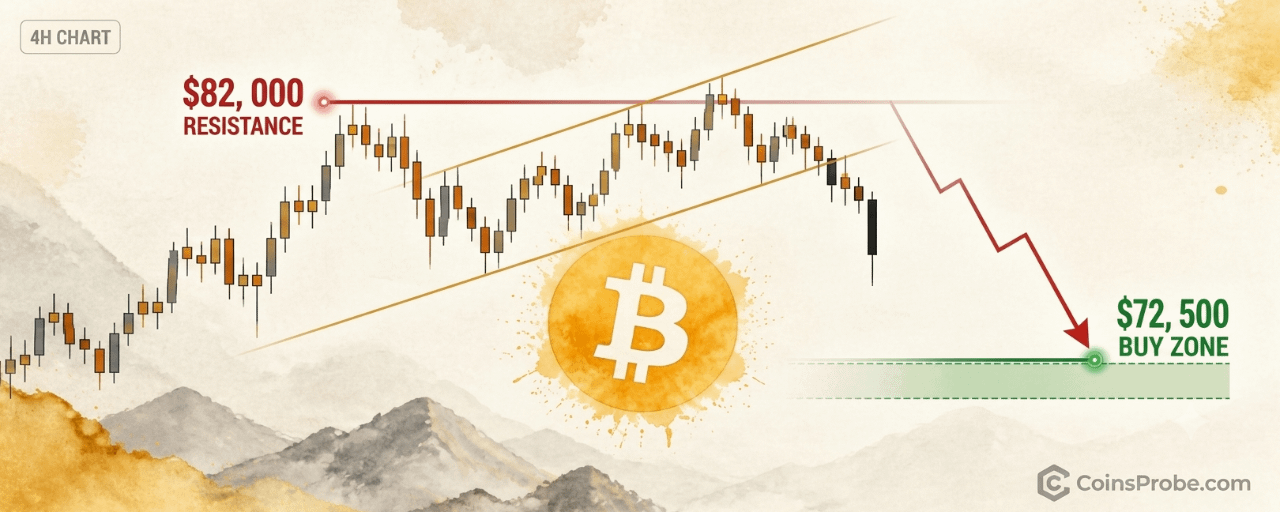
Analyst Ali Charts (@alicharts) flagged the breakdown on October 26, 2026, writing: “Bitcoin appears to have broken below a rising parallel channel on the 4-hour chart. As long as $82,000 holds as resistance, $BTC could continue correcting toward $72,500. That’s where I’ll be looking for the next buying opportunity.” The call is precise — not a range, not a zone. A single level where he intends to act.
The 4-Hour Channel Breakdown — What It Signals
A rising parallel channel on the 4-hour chart is a structure defined by two upward-sloping trendlines of equal gradient — one connecting swing lows, one connecting swing highs. When price breaks below the lower trendline with conviction, it signals that the sequence of higher lows sustaining the channel has been violated. The immediate implication: the market’s near-term bullish structure has broken down.
Ali Charts identifies $82,000 as the critical resistance level that must hold for the correction to continue. This is not a support-turned-resistance level in the classical sense — it is the structural significance of the broken channel’s lower boundary. A reclaim above $82,000 would invalidate the breakdown thesis and suggest the break was a false move. As long as that level caps any bounce, the corrective path toward $72,500 remains open.
BTC 4H Chart | Source: @alicharts (X)
Bitcoin is currently trading at $80,027 — already $1,973 below the $82,000 resistance threshold, meaning the resistance is already overhead, not ahead. The market has room to continue lower without first requiring a test of $82,000.
$72,500 — The Buy Zone
Ali Charts does not label $72,500 as a support level derived from a specific indicator. He identifies it as his next buying opportunity — a deliberate, pre-planned entry based on the measured move from the channel breakdown and prior structural context at that price area. The distance from current price ($80,027) to that level represents approximately 9.4% additional downside.
This framing matters. It separates a panic-driven sell target from a structured re-entry thesis. The analyst is not predicting capitulation — he is identifying a level where he believes risk/reward flips back in favor of bulls.
ETF Flows Add Context to the Sell Pressure
The channel breakdown does not exist in a vacuum. Spot Bitcoin ETF data via SoSoValue shows a $635.5M daily net outflow on the latest trading session (October 22), the heaviest single-day exit in recent sessions. IBIT alone recorded $110.3M in outflows, while FBTC shed another $31.8M. Total ETF net assets stand at $104.71B — still substantial, but the directional pressure from institutional redemptions is structurally consistent with the 4-hour chart’s message.
Over the past four trading sessions, the net ETF flow stands at +$442.7M (three inflow days, one outflow day), suggesting the trend is not a sustained institutional exit — but the magnitude of the single-day $635.5M outflow is notable context for why Bitcoin is struggling to hold structure above $80,000. For more on recent ETF redemption dynamics, see Bitcoin ETF Outflows Hit $137.9M on Oct 23 — Final Figure May Be Far Higher.
Macro Events This Week Could Accelerate the Move
Two macro data releases arrive on October 28 that could define near-term direction: Core PCE Price Index (MoM and YoY) and GDP (QoQ). These are the Federal Reserve’s preferred inflation and growth gauges. Markets currently price a 90.6% probability of a rate hold at the October 28 FOMC meeting (3.75%–4.00% target rate), per SoSoValue. A hotter-than-expected Core PCE print could pressure risk assets further, potentially accelerating Bitcoin’s path toward Ali Charts’ $72,500 target. A soft print could provide a relief bounce — but that bounce would need to stay below $82,000 to keep the bearish channel breakdown thesis intact.
It is also worth noting that Bitcoin’s behavior around macro-political cycles has precedent. Bitcoin’s Midterm Election Curse — Four Cycles, Four Crashes documents the historical pattern of Bitcoin underperforming into mid-term electoral windows — a backdrop that arguably adds structural context to this correction. Meanwhile, levered positions have already begun unwinding: Two Hyperliquid Whales were liquidated as Bitcoin dropped below $80K, a sign that the move below this psychological threshold carries real forced-selling consequences.
Strategy’s Conviction Provides an Institutional Counterpoint
Not all institutional actors are selling. Strategy (formerly MicroStrategy) added 267 BTC for $22.1M in its latest purchase, bringing total holdings to 848,517 BTC as of October 19. Over the past three weeks, Strategy acquired 851 BTC for $72.8M — a steady accumulation pace that reflects longer-term conviction regardless of near-term chart structure. This does not invalidate the 4-hour breakdown, but it does establish that at current price levels, at least one major institutional buyer remains active.
Bullish Scenario — Reclaim Above $82,000
A sustained 4-hour close above $82,000 would invalidate the channel breakdown thesis. It would suggest the lower trendline held as support on an intraday basis and that the break was a false move. In this scenario, the corrective setup toward $72,500 is off the table until price revisits and confirms the breakdown with a failed retest of $82,000 from below.
Bearish Scenario — $82,000 Caps and Correction Continues
If $82,000 continues to act as resistance on any bounce from current levels, Ali Charts’ base case plays out: Bitcoin continues lower toward $72,500, representing approximately 9.4% additional downside from the current $80,027 price. At that level, he has stated his intention to seek the next buying opportunity.
The 4-hour channel is broken. $82,000 is overhead resistance. Bitcoin at $80,027 is already 9.4% above the analyst’s stated buy zone. Two macro catalysts — Core PCE and GDP — arrive October 28 and will determine whether the correction accelerates or stalls. The level traders are watching: $82,000 to the upside as the invalidation point, and $72,500 to the downside as the structured re-entry.
**Disclaimer: **The views and analysis presented in this article are for informational purposes only and reflect the author’s perspective, not financial advice. Technical patterns and indicators discussed are subject to market volatility and may or may not yield the anticipated results. Investors are advised to exercise caution, conduct independent research, and make decisions aligned with their individual risk tolerance.
Bitcoin Channel Breakdown — $82K Resistance, $72.5K Buy Zone: Analyst
Key Highlights
Bitcoin trades at $80,027 (-0.52%) after breaking below a 4-hour rising parallel channel per @alicharts$82,000 must hold as resistance for the correction to continue — a reclaim invalidates the breakdown thesisAli Charts identifies $72,500 as his next buying opportunity — roughly 9.4% below current priceSpot Bitcoin ETFs recorded a $635.5M single-day outflow on Oct 22, with IBIT leading at -$110.3M (SoSoValue)
Bitcoin is trading at $80,027 — down 0.52% in the past 24 hours — after breaking below a rising parallel channel on the 4-hour chart. That structural breakdown, if confirmed with $82,000 holding as resistance, sets the stage for a continued correction toward $72,500: the level where one prominent analyst is already positioning to buy.
Analyst Ali Charts (@alicharts) flagged the breakdown on October 26, 2026, writing: “Bitcoin appears to have broken below a rising parallel channel on the 4-hour chart. As long as $82,000 holds as resistance, $BTC could continue correcting toward $72,500. That’s where I’ll be looking for the next buying opportunity.” The call is precise — not a range, not a zone. A single level where he intends to act.
The 4-Hour Channel Breakdown — What It Signals
A rising parallel channel on the 4-hour chart is a structure defined by two upward-sloping trendlines of equal gradient — one connecting swing lows, one connecting swing highs. When price breaks below the lower trendline with conviction, it signals that the sequence of higher lows sustaining the channel has been violated. The immediate implication: the market’s near-term bullish structure has broken down.
Ali Charts identifies $82,000 as the critical resistance level that must hold for the correction to continue. This is not a support-turned-resistance level in the classical sense — it is the structural significance of the broken channel’s lower boundary. A reclaim above $82,000 would invalidate the breakdown thesis and suggest the break was a false move. As long as that level caps any bounce, the corrective path toward $72,500 remains open.
BTC 4H Chart | Source: @alicharts (X)
Bitcoin is currently trading at $80,027 — already $1,973 below the $82,000 resistance threshold, meaning the resistance is already overhead, not ahead. The market has room to continue lower without first requiring a test of $82,000.
$72,500 — The Buy Zone
Ali Charts does not label $72,500 as a support level derived from a specific indicator. He identifies it as his next buying opportunity — a deliberate, pre-planned entry based on the measured move from the channel breakdown and prior structural context at that price area. The distance from current price ($80,027) to that level represents approximately 9.4% additional downside.
This framing matters. It separates a panic-driven sell target from a structured re-entry thesis. The analyst is not predicting capitulation — he is identifying a level where he believes risk/reward flips back in favor of bulls.
ETF Flows Add Context to the Sell Pressure
The channel breakdown does not exist in a vacuum. Spot Bitcoin ETF data via SoSoValue shows a $635.5M daily net outflow on the latest trading session (October 22), the heaviest single-day exit in recent sessions. IBIT alone recorded $110.3M in outflows, while FBTC shed another $31.8M. Total ETF net assets stand at $104.71B — still substantial, but the directional pressure from institutional redemptions is structurally consistent with the 4-hour chart’s message.
Over the past four trading sessions, the net ETF flow stands at +$442.7M (three inflow days, one outflow day), suggesting the trend is not a sustained institutional exit — but the magnitude of the single-day $635.5M outflow is notable context for why Bitcoin is struggling to hold structure above $80,000. For more on recent ETF redemption dynamics, see Bitcoin ETF Outflows Hit $137.9M on Oct 23 — Final Figure May Be Far Higher.
Macro Events This Week Could Accelerate the Move
Two macro data releases arrive on October 28 that could define near-term direction: Core PCE Price Index (MoM and YoY) and GDP (QoQ). These are the Federal Reserve’s preferred inflation and growth gauges. Markets currently price a 90.6% probability of a rate hold at the October 28 FOMC meeting (3.75%–4.00% target rate), per SoSoValue. A hotter-than-expected Core PCE print could pressure risk assets further, potentially accelerating Bitcoin’s path toward Ali Charts’ $72,500 target. A soft print could provide a relief bounce — but that bounce would need to stay below $82,000 to keep the bearish channel breakdown thesis intact.
It is also worth noting that Bitcoin’s behavior around macro-political cycles has precedent. Bitcoin’s Midterm Election Curse — Four Cycles, Four Crashes documents the historical pattern of Bitcoin underperforming into mid-term electoral windows — a backdrop that arguably adds structural context to this correction. Meanwhile, levered positions have already begun unwinding: Two Hyperliquid Whales were liquidated as Bitcoin dropped below $80K, a sign that the move below this psychological threshold carries real forced-selling consequences.
Strategy’s Conviction Provides an Institutional Counterpoint
Not all institutional actors are selling. Strategy (formerly MicroStrategy) added 267 BTC for $22.1M in its latest purchase, bringing total holdings to 848,517 BTC as of October 19. Over the past three weeks, Strategy acquired 851 BTC for $72.8M — a steady accumulation pace that reflects longer-term conviction regardless of near-term chart structure. This does not invalidate the 4-hour breakdown, but it does establish that at current price levels, at least one major institutional buyer remains active.
Bullish Scenario — Reclaim Above $82,000
A sustained 4-hour close above $82,000 would invalidate the channel breakdown thesis. It would suggest the lower trendline held as support on an intraday basis and that the break was a false move. In this scenario, the corrective setup toward $72,500 is off the table until price revisits and confirms the breakdown with a failed retest of $82,000 from below.
Bearish Scenario — $82,000 Caps and Correction Continues
If $82,000 continues to act as resistance on any bounce from current levels, Ali Charts’ base case plays out: Bitcoin continues lower toward $72,500, representing approximately 9.4% additional downside from the current $80,027 price. At that level, he has stated his intention to seek the next buying opportunity.
The 4-hour channel is broken. $82,000 is overhead resistance. Bitcoin at $80,027 is already 9.4% above the analyst’s stated buy zone. Two macro catalysts — Core PCE and GDP — arrive October 28 and will determine whether the correction accelerates or stalls. The level traders are watching: $82,000 to the upside as the invalidation point, and $72,500 to the downside as the structured re-entry.
**Disclaimer: **The views and analysis presented in this article are for informational purposes only and reflect the author’s perspective, not financial advice. Technical patterns and indicators discussed are subject to market volatility and may or may not yield the anticipated results. Investors are advised to exercise caution, conduct independent research, and make decisions aligned with their individual risk tolerance.
Bitcoin trades at $80,027 (-0.52%) after breaking below a 4-hour rising parallel channel per @alicharts$82,000 must hold as resistance for the correction to continue — a reclaim invalidates the breakdown thesisAli Charts identifies $72,500 as his next buying opportunity — roughly 9.4% below current priceSpot Bitcoin ETFs recorded a $635.5M single-day outflow on Oct 22, with IBIT leading at -$110.3M (SoSoValue)
Bitcoin is trading at $80,027 — down 0.52% in the past 24 hours — after breaking below a rising parallel channel on the 4-hour chart. That structural breakdown, if confirmed with $82,000 holding as resistance, sets the stage for a continued correction toward $72,500: the level where one prominent analyst is already positioning to buy.
Analyst Ali Charts (@alicharts) flagged the breakdown on October 26, 2026, writing: “Bitcoin appears to have broken below a rising parallel channel on the 4-hour chart. As long as $82,000 holds as resistance, $BTC could continue correcting toward $72,500. That’s where I’ll be looking for the next buying opportunity.” The call is precise — not a range, not a zone. A single level where he intends to act.
The 4-Hour Channel Breakdown — What It Signals
A rising parallel channel on the 4-hour chart is a structure defined by two upward-sloping trendlines of equal gradient — one connecting swing lows, one connecting swing highs. When price breaks below the lower trendline with conviction, it signals that the sequence of higher lows sustaining the channel has been violated. The immediate implication: the market’s near-term bullish structure has broken down.
Ali Charts identifies $82,000 as the critical resistance level that must hold for the correction to continue. This is not a support-turned-resistance level in the classical sense — it is the structural significance of the broken channel’s lower boundary. A reclaim above $82,000 would invalidate the breakdown thesis and suggest the break was a false move. As long as that level caps any bounce, the corrective path toward $72,500 remains open.
BTC 4H Chart | Source: @alicharts (X)
Bitcoin is currently trading at $80,027 — already $1,973 below the $82,000 resistance threshold, meaning the resistance is already overhead, not ahead. The market has room to continue lower without first requiring a test of $82,000.
$72,500 — The Buy Zone
Ali Charts does not label $72,500 as a support level derived from a specific indicator. He identifies it as his next buying opportunity — a deliberate, pre-planned entry based on the measured move from the channel breakdown and prior structural context at that price area. The distance from current price ($80,027) to that level represents approximately 9.4% additional downside.
This framing matters. It separates a panic-driven sell target from a structured re-entry thesis. The analyst is not predicting capitulation — he is identifying a level where he believes risk/reward flips back in favor of bulls.
ETF Flows Add Context to the Sell Pressure
The channel breakdown does not exist in a vacuum. Spot Bitcoin ETF data via SoSoValue shows a $635.5M daily net outflow on the latest trading session (October 22), the heaviest single-day exit in recent sessions. IBIT alone recorded $110.3M in outflows, while FBTC shed another $31.8M. Total ETF net assets stand at $104.71B — still substantial, but the directional pressure from institutional redemptions is structurally consistent with the 4-hour chart’s message.
Over the past four trading sessions, the net ETF flow stands at +$442.7M (three inflow days, one outflow day), suggesting the trend is not a sustained institutional exit — but the magnitude of the single-day $635.5M outflow is notable context for why Bitcoin is struggling to hold structure above $80,000. For more on recent ETF redemption dynamics, see Bitcoin ETF Outflows Hit $137.9M on Oct 23 — Final Figure May Be Far Higher.
Macro Events This Week Could Accelerate the Move
Two macro data releases arrive on October 28 that could define near-term direction: Core PCE Price Index (MoM and YoY) and GDP (QoQ). These are the Federal Reserve’s preferred inflation and growth gauges. Markets currently price a 90.6% probability of a rate hold at the October 28 FOMC meeting (3.75%–4.00% target rate), per SoSoValue. A hotter-than-expected Core PCE print could pressure risk assets further, potentially accelerating Bitcoin’s path toward Ali Charts’ $72,500 target. A soft print could provide a relief bounce — but that bounce would need to stay below $82,000 to keep the bearish channel breakdown thesis intact.
It is also worth noting that Bitcoin’s behavior around macro-political cycles has precedent. Bitcoin’s Midterm Election Curse — Four Cycles, Four Crashes documents the historical pattern of Bitcoin underperforming into mid-term electoral windows — a backdrop that arguably adds structural context to this correction. Meanwhile, levered positions have already begun unwinding: Two Hyperliquid Whales were liquidated as Bitcoin dropped below $80K, a sign that the move below this psychological threshold carries real forced-selling consequences.
Strategy’s Conviction Provides an Institutional Counterpoint
Not all institutional actors are selling. Strategy (formerly MicroStrategy) added 267 BTC for $22.1M in its latest purchase, bringing total holdings to 848,517 BTC as of October 19. Over the past three weeks, Strategy acquired 851 BTC for $72.8M — a steady accumulation pace that reflects longer-term conviction regardless of near-term chart structure. This does not invalidate the 4-hour breakdown, but it does establish that at current price levels, at least one major institutional buyer remains active.
Bullish Scenario — Reclaim Above $82,000
A sustained 4-hour close above $82,000 would invalidate the channel breakdown thesis. It would suggest the lower trendline held as support on an intraday basis and that the break was a false move. In this scenario, the corrective setup toward $72,500 is off the table until price revisits and confirms the breakdown with a failed retest of $82,000 from below.
Bearish Scenario — $82,000 Caps and Correction Continues
If $82,000 continues to act as resistance on any bounce from current levels, Ali Charts’ base case plays out: Bitcoin continues lower toward $72,500, representing approximately 9.4% additional downside from the current $80,027 price. At that level, he has stated his intention to seek the next buying opportunity.
The 4-hour channel is broken. $82,000 is overhead resistance. Bitcoin at $80,027 is already 9.4% above the analyst’s stated buy zone. Two macro catalysts — Core PCE and GDP — arrive October 28 and will determine whether the correction accelerates or stalls. The level traders are watching: $82,000 to the upside as the invalidation point, and $72,500 to the downside as the structured re-entry.
**Disclaimer: **The views and analysis presented in this article are for informational purposes only and reflect the author’s perspective, not financial advice. Technical patterns and indicators discussed are subject to market volatility and may or may not yield the anticipated results. Investors are advised to exercise caution, conduct independent research, and make decisions aligned with their individual risk tolerance.
115
·
--
ලිපිය
Smart Trader 0xe813 Opens $63.88M ETH Long After Market Drop — 100% Win RateKey Highlights
Wallet 0xe813 opened a 26,974 ETH long worth $63.88M immediately after ETH's liquidation-driven dropPosition already shows $842K in unrealized profit — trader holds a 100% win rate with $3.3M prior profit on NEARETH faced $184M in 24h liquidations including $166.7M in longs — key support zone: $2,181–$2,256Spot ETH ETFs logged $110.6M in net outflows on October 22, compounding downside pressure
BREAKING
Ethereum is navigating a volatile session following a sharp market-wide selloff that triggered $184 million in 24-hour liquidations across ETH derivatives — of which $166.7 million were long liquidations. Open interest remains elevated near $44.26 billion, reflecting the scale of leveraged exposure still active in the market. The broader pressure was compounded by $110.6 million in net spot ETF outflows on October 22, per available reporting, amplifying downside as institutional exits coincided with the derivatives cascade.
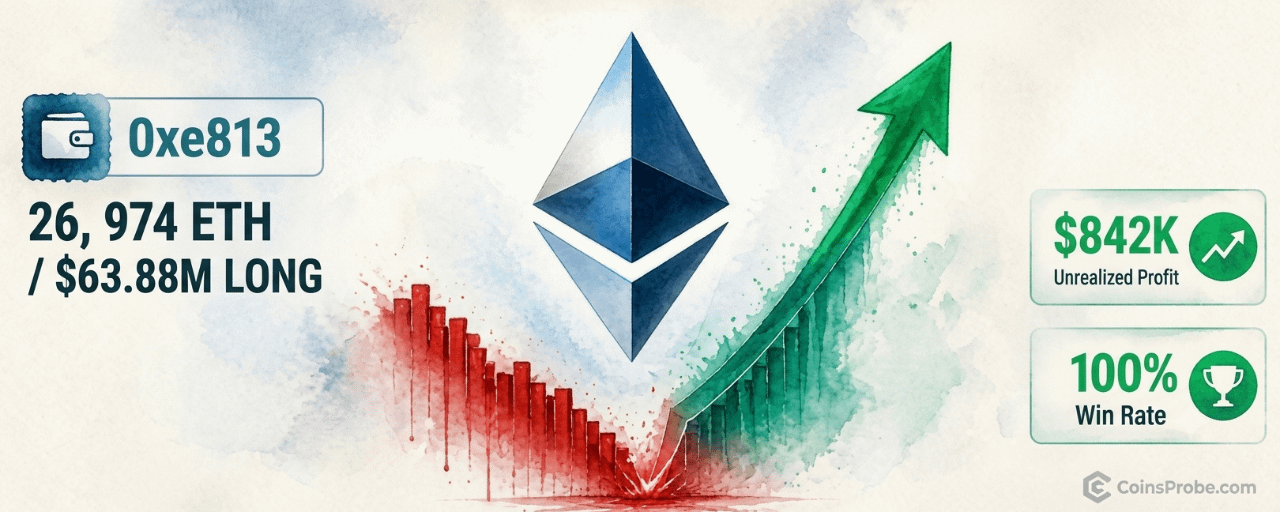
Into that liquidation-driven drop, on-chain tracker Lookonchain flagged a decisive counter-move: wallet 0xe81309ec9b79309e4d108ae3a92d1aa618cd6d74 (abbreviated 0xe813) opened a leveraged long position on 26,974 ETH with a notional value of $63.88 million. The position was entered directly after the market dip — a deliberate buy-the-dip execution rather than a pre-existing hold. At the time Lookonchain reported the move, the position carried $842,000 in unrealized profit, indicating the entry was well-timed relative to immediate price recovery.
Smart Trader 0xe813 Opens $63.88M ETH Long | Source: @lookonchain (Telegram)
This wallet carries a 100% win rate across its tracked history on Hyperbot and previously extracted $3.3 million in profit from a $NEAR trade.
Smart Trader 0xe813 $NEAR Profits | Source: @lookonchain (Telegram)
On-chain analysts interpret a $63.88M long opened at the bottom of a liquidation cascade as a high-conviction dip-buy signal — not noise.
The context matters:
This was not accumulation during calm conditions. Wallet 0xe813 entered during peak fear, when $166.7 million in long liquidations were flushing overleveraged positions out of the market. A separate large BTC/ETH whale was also reported adding $9.21 million in USDC margin during the same session to avoid liquidation — suggesting the ETH liquidation zone near $2,181–$2,256 was the contested range. The 0xe813 long, sized at 26,974 ETH, suggests the trader expected that range to hold as structural support.
The level to watch:
ETH must defend the lower bound of that liquidation cluster. A breach below $2,181 would directly threaten the position’s thesis and could trigger a second cascade. A sustained hold above that level, followed by reclaim of the prior range, would validate the entry as a precision dip-buy into exhausted selling. For further context on how whale accumulation signals interact with broader market structure, see our analysis of the Bitcoin Whale Accumulation Signal and Bull Score reading.
What to watch next:
The Hyperbot tracker for 0xe813 will show whether the position is held, scaled up, or closed — each outcome carries a different signal. If the wallet adds to the 26,974 ETH long during any further weakness, it would suggest the trader sees deeper value below current levels. If it exits with profit quickly, it signals a short-term bounce trade rather than a macro conviction hold.
The 100% win rate across this wallet’s tracked history means community reaction on Lookonchain has been attentive — Ethereum’s broader recovery depends on whether the $2,181 support holds and ETF outflow pressure reverses. The Glamsterdam testnet delay adds no immediate bullish catalyst, meaning price recovery will need to be driven by on-chain demand and derivatives positioning alone.
Disclaimer: The views and analysis presented in this article are for informational purposes only and reflect the author’s perspective, not financial advice. Technical patterns and indicators discussed are subject to market volatility and may or may not yield the anticipated results. Investors are advised to exercise caution, conduct independent research, and make decisions aligned with their individual risk tolerance.
Smart Trader 0xe813 Opens $63.88M ETH Long After Market Drop — 100% Win Rate
Key Highlights
Wallet 0xe813 opened a 26,974 ETH long worth $63.88M immediately after ETH's liquidation-driven dropPosition already shows $842K in unrealized profit — trader holds a 100% win rate with $3.3M prior profit on NEARETH faced $184M in 24h liquidations including $166.7M in longs — key support zone: $2,181–$2,256Spot ETH ETFs logged $110.6M in net outflows on October 22, compounding downside pressure
BREAKING
Ethereum is navigating a volatile session following a sharp market-wide selloff that triggered $184 million in 24-hour liquidations across ETH derivatives — of which $166.7 million were long liquidations. Open interest remains elevated near $44.26 billion, reflecting the scale of leveraged exposure still active in the market. The broader pressure was compounded by $110.6 million in net spot ETF outflows on October 22, per available reporting, amplifying downside as institutional exits coincided with the derivatives cascade.
Into that liquidation-driven drop, on-chain tracker Lookonchain flagged a decisive counter-move: wallet 0xe81309ec9b79309e4d108ae3a92d1aa618cd6d74 (abbreviated 0xe813) opened a leveraged long position on 26,974 ETH with a notional value of $63.88 million. The position was entered directly after the market dip — a deliberate buy-the-dip execution rather than a pre-existing hold. At the time Lookonchain reported the move, the position carried $842,000 in unrealized profit, indicating the entry was well-timed relative to immediate price recovery.
Smart Trader 0xe813 Opens $63.88M ETH Long | Source: @lookonchain (Telegram)
This wallet carries a 100% win rate across its tracked history on Hyperbot and previously extracted $3.3 million in profit from a $NEAR trade.
Smart Trader 0xe813 $NEAR Profits | Source: @lookonchain (Telegram)
On-chain analysts interpret a $63.88M long opened at the bottom of a liquidation cascade as a high-conviction dip-buy signal — not noise.
The context matters:
This was not accumulation during calm conditions. Wallet 0xe813 entered during peak fear, when $166.7 million in long liquidations were flushing overleveraged positions out of the market. A separate large BTC/ETH whale was also reported adding $9.21 million in USDC margin during the same session to avoid liquidation — suggesting the ETH liquidation zone near $2,181–$2,256 was the contested range. The 0xe813 long, sized at 26,974 ETH, suggests the trader expected that range to hold as structural support.
The level to watch:
ETH must defend the lower bound of that liquidation cluster. A breach below $2,181 would directly threaten the position’s thesis and could trigger a second cascade. A sustained hold above that level, followed by reclaim of the prior range, would validate the entry as a precision dip-buy into exhausted selling. For further context on how whale accumulation signals interact with broader market structure, see our analysis of the Bitcoin Whale Accumulation Signal and Bull Score reading.
What to watch next:
The Hyperbot tracker for 0xe813 will show whether the position is held, scaled up, or closed — each outcome carries a different signal. If the wallet adds to the 26,974 ETH long during any further weakness, it would suggest the trader sees deeper value below current levels. If it exits with profit quickly, it signals a short-term bounce trade rather than a macro conviction hold.
The 100% win rate across this wallet’s tracked history means community reaction on Lookonchain has been attentive — Ethereum’s broader recovery depends on whether the $2,181 support holds and ETF outflow pressure reverses. The Glamsterdam testnet delay adds no immediate bullish catalyst, meaning price recovery will need to be driven by on-chain demand and derivatives positioning alone.
Disclaimer: The views and analysis presented in this article are for informational purposes only and reflect the author’s perspective, not financial advice. Technical patterns and indicators discussed are subject to market volatility and may or may not yield the anticipated results. Investors are advised to exercise caution, conduct independent research, and make decisions aligned with their individual risk tolerance.
Wallet 0xe813 opened a 26,974 ETH long worth $63.88M immediately after ETH's liquidation-driven dropPosition already shows $842K in unrealized profit — trader holds a 100% win rate with $3.3M prior profit on NEARETH faced $184M in 24h liquidations including $166.7M in longs — key support zone: $2,181–$2,256Spot ETH ETFs logged $110.6M in net outflows on October 22, compounding downside pressure
BREAKING
Ethereum is navigating a volatile session following a sharp market-wide selloff that triggered $184 million in 24-hour liquidations across ETH derivatives — of which $166.7 million were long liquidations. Open interest remains elevated near $44.26 billion, reflecting the scale of leveraged exposure still active in the market. The broader pressure was compounded by $110.6 million in net spot ETF outflows on October 22, per available reporting, amplifying downside as institutional exits coincided with the derivatives cascade.
Into that liquidation-driven drop, on-chain tracker Lookonchain flagged a decisive counter-move: wallet 0xe81309ec9b79309e4d108ae3a92d1aa618cd6d74 (abbreviated 0xe813) opened a leveraged long position on 26,974 ETH with a notional value of $63.88 million. The position was entered directly after the market dip — a deliberate buy-the-dip execution rather than a pre-existing hold. At the time Lookonchain reported the move, the position carried $842,000 in unrealized profit, indicating the entry was well-timed relative to immediate price recovery.
Smart Trader 0xe813 Opens $63.88M ETH Long | Source: @lookonchain (Telegram)
This wallet carries a 100% win rate across its tracked history on Hyperbot and previously extracted $3.3 million in profit from a $NEAR trade.
Smart Trader 0xe813 $NEAR Profits | Source: @lookonchain (Telegram)
On-chain analysts interpret a $63.88M long opened at the bottom of a liquidation cascade as a high-conviction dip-buy signal — not noise.
The context matters:
This was not accumulation during calm conditions. Wallet 0xe813 entered during peak fear, when $166.7 million in long liquidations were flushing overleveraged positions out of the market. A separate large BTC/ETH whale was also reported adding $9.21 million in USDC margin during the same session to avoid liquidation — suggesting the ETH liquidation zone near $2,181–$2,256 was the contested range. The 0xe813 long, sized at 26,974 ETH, suggests the trader expected that range to hold as structural support.
The level to watch:
ETH must defend the lower bound of that liquidation cluster. A breach below $2,181 would directly threaten the position’s thesis and could trigger a second cascade. A sustained hold above that level, followed by reclaim of the prior range, would validate the entry as a precision dip-buy into exhausted selling. For further context on how whale accumulation signals interact with broader market structure, see our analysis of the Bitcoin Whale Accumulation Signal and Bull Score reading.
What to watch next:
The Hyperbot tracker for 0xe813 will show whether the position is held, scaled up, or closed — each outcome carries a different signal. If the wallet adds to the 26,974 ETH long during any further weakness, it would suggest the trader sees deeper value below current levels. If it exits with profit quickly, it signals a short-term bounce trade rather than a macro conviction hold.
The 100% win rate across this wallet’s tracked history means community reaction on Lookonchain has been attentive — Ethereum’s broader recovery depends on whether the $2,181 support holds and ETF outflow pressure reverses. The Glamsterdam testnet delay adds no immediate bullish catalyst, meaning price recovery will need to be driven by on-chain demand and derivatives positioning alone.
Disclaimer: The views and analysis presented in this article are for informational purposes only and reflect the author’s perspective, not financial advice. Technical patterns and indicators discussed are subject to market volatility and may or may not yield the anticipated results. Investors are advised to exercise caution, conduct independent research, and make decisions aligned with their individual risk tolerance.
393
·
--
ලිපිය
Arthur Hayes Sells $28.8M in Tokens Over 24 Hours, Books $6.65M ProfitKey Highlights
Arthur Hayes sold $28.8M across 7 tokens in 24 hours, booking $6.65M net profit per LookonchainLatest move: 14M ENA ($2.73M) transferred to Cumberland institutional desk for liquidationProfits concentrated in ENA and ETH; UNI, ETHFI, AERO, PENDLE, ZAMA exited near breakeven$14.15M USDC withdrawn from trading platforms — confirms completed sales, not transfers
Ethena (ENA) has faced sustained selling following a series of large transfers tracked on-chain over a 24-hour window, with Lookonchain flagging the activity as it unfolded. ENA’s price action reflects the overhang — supply hitting the market at scale from a single identifiable wallet creates a specific, measurable headwind that differs from broad sentiment shifts.
The Move:
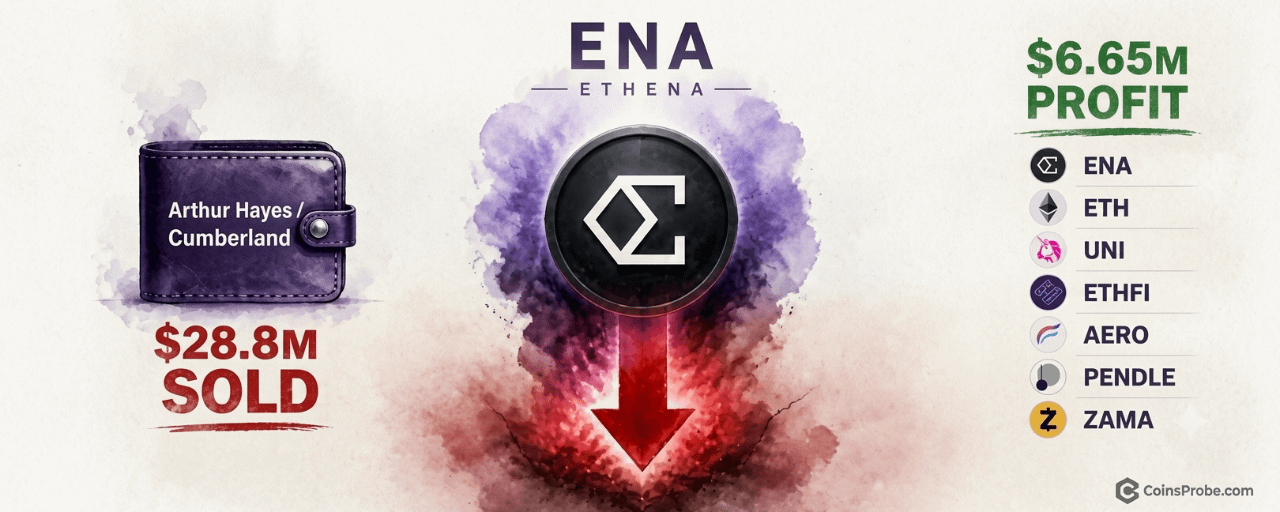
Arthur Hayes (@CryptoHayes), co-founder of BitMEX and managing partner of Maelstrom, transferred 14 million ENA — valued at approximately $2.73 million — to Cumberland, the institutional trading desk, for sale, according to data flagged by Lookonchain. This single transfer was the latest in a series of moves: over the preceding 24 hours, Hayes sent tokens worth a combined $28.81 million to trading platforms and subsequently withdrew approximately $14.15 million USDC — a withdrawal pattern consistent with completed sales rather than in-transit repositioning.
Arthur Hayes Sells $28.8M in Tokens Over 24 Hours | Source: @lookonchain (Telegram)
Full wallet activity is traceable via Arkham Intelligence. The seven tokens involved were ENA, ETH, UNI, ETHFI, AERO, PENDLE, and ZAMA. Hayes reported a net profit of $6.65 million on the combined activity, with the bulk of gains attributed to ENA and ETH; positions in UNI, ETHFI, AERO, PENDLE, and ZAMA were exited near breakeven. This follows a prior documented transfer that CoinsProbe covered separately: Arthur Hayes Moves $22.28M — ETH, ENA, UNI, ETHFI Among Seven Tokens Sent to Market Makers.
What This Signals:
Exchange inflows of this scale from a named, high-profile wallet represent a specific supply-side event — not a sentiment proxy. On-chain analysts interpret sustained transfers to a named institutional desk like Cumberland as active liquidation rather than strategic repositioning, particularly when paired with a near-equivalent USDC withdrawal confirming the loop is closed. The profit concentration in ENA and ETH suggests Hayes held meaningful unrealized gains in both and chose this window to realize them.
For ENA specifically, the key question is absorption: whether spot market buyers can absorb $2.73 million in fresh supply from this transfer alone — let alone the full 24-hour total — without sustained downward price pressure. On-chain analysts note that breakeven exits across UNI, ETHFI, AERO, PENDLE, and ZAMA indicate those positions were not part of a profit-taking thesis but rather a broader portfolio de-risking. The signal is unambiguously bearish for short-term $ENA price structure. The level to watch: any sustained bid below the price at time of transfer would confirm the market is unable to absorb the flow without concession.
Forward Outlook:
The Arkham wallet linked to Hayes remains active and trackable in real time. The next confirmation to monitor is whether additional ENA or ETH transfers to Cumberland or comparable institutional desks appear in the coming 24–48 hours — continued outflows would indicate the liquidation is ongoing rather than complete. Conversely, if no further transfers to exchanges appear and the USDC balance stabilizes, the distribution phase may be nearing an end.
Community reaction on-chain focused on the speed and scale of the exit — $28.81 million across seven tokens in a single 24-hour window is a coordinated unwind, not opportunistic dip selling. No new positions were flagged entering the wallet during this window, which rules out a simultaneous rotation into another asset as the motivation.
Disclaimer: The views and analysis presented in this article are for informational purposes only and reflect the author’s perspective, not financial advice. Technical patterns and indicators discussed are subject to market volatility and may or may not yield the anticipated results. Investors are advised to exercise caution, conduct independent research, and make decisions aligned with their individual risk tolerance.
Arthur Hayes Sells $28.8M in Tokens Over 24 Hours, Books $6.65M Profit
Key Highlights
Arthur Hayes sold $28.8M across 7 tokens in 24 hours, booking $6.65M net profit per LookonchainLatest move: 14M ENA ($2.73M) transferred to Cumberland institutional desk for liquidationProfits concentrated in ENA and ETH; UNI, ETHFI, AERO, PENDLE, ZAMA exited near breakeven$14.15M USDC withdrawn from trading platforms — confirms completed sales, not transfers
Ethena (ENA) has faced sustained selling following a series of large transfers tracked on-chain over a 24-hour window, with Lookonchain flagging the activity as it unfolded. ENA’s price action reflects the overhang — supply hitting the market at scale from a single identifiable wallet creates a specific, measurable headwind that differs from broad sentiment shifts.
The Move:
Arthur Hayes (@CryptoHayes), co-founder of BitMEX and managing partner of Maelstrom, transferred 14 million ENA — valued at approximately $2.73 million — to Cumberland, the institutional trading desk, for sale, according to data flagged by Lookonchain. This single transfer was the latest in a series of moves: over the preceding 24 hours, Hayes sent tokens worth a combined $28.81 million to trading platforms and subsequently withdrew approximately $14.15 million USDC — a withdrawal pattern consistent with completed sales rather than in-transit repositioning.
Arthur Hayes Sells $28.8M in Tokens Over 24 Hours | Source: @lookonchain (Telegram)
Full wallet activity is traceable via Arkham Intelligence. The seven tokens involved were ENA, ETH, UNI, ETHFI, AERO, PENDLE, and ZAMA. Hayes reported a net profit of $6.65 million on the combined activity, with the bulk of gains attributed to ENA and ETH; positions in UNI, ETHFI, AERO, PENDLE, and ZAMA were exited near breakeven. This follows a prior documented transfer that CoinsProbe covered separately: Arthur Hayes Moves $22.28M — ETH, ENA, UNI, ETHFI Among Seven Tokens Sent to Market Makers.
What This Signals:
Exchange inflows of this scale from a named, high-profile wallet represent a specific supply-side event — not a sentiment proxy. On-chain analysts interpret sustained transfers to a named institutional desk like Cumberland as active liquidation rather than strategic repositioning, particularly when paired with a near-equivalent USDC withdrawal confirming the loop is closed. The profit concentration in ENA and ETH suggests Hayes held meaningful unrealized gains in both and chose this window to realize them.
For ENA specifically, the key question is absorption: whether spot market buyers can absorb $2.73 million in fresh supply from this transfer alone — let alone the full 24-hour total — without sustained downward price pressure. On-chain analysts note that breakeven exits across UNI, ETHFI, AERO, PENDLE, and ZAMA indicate those positions were not part of a profit-taking thesis but rather a broader portfolio de-risking. The signal is unambiguously bearish for short-term $ENA price structure. The level to watch: any sustained bid below the price at time of transfer would confirm the market is unable to absorb the flow without concession.
Forward Outlook:
The Arkham wallet linked to Hayes remains active and trackable in real time. The next confirmation to monitor is whether additional ENA or ETH transfers to Cumberland or comparable institutional desks appear in the coming 24–48 hours — continued outflows would indicate the liquidation is ongoing rather than complete. Conversely, if no further transfers to exchanges appear and the USDC balance stabilizes, the distribution phase may be nearing an end.
Community reaction on-chain focused on the speed and scale of the exit — $28.81 million across seven tokens in a single 24-hour window is a coordinated unwind, not opportunistic dip selling. No new positions were flagged entering the wallet during this window, which rules out a simultaneous rotation into another asset as the motivation.
Disclaimer: The views and analysis presented in this article are for informational purposes only and reflect the author’s perspective, not financial advice. Technical patterns and indicators discussed are subject to market volatility and may or may not yield the anticipated results. Investors are advised to exercise caution, conduct independent research, and make decisions aligned with their individual risk tolerance.
Arthur Hayes sold $28.8M across 7 tokens in 24 hours, booking $6.65M net profit per LookonchainLatest move: 14M ENA ($2.73M) transferred to Cumberland institutional desk for liquidationProfits concentrated in ENA and ETH; UNI, ETHFI, AERO, PENDLE, ZAMA exited near breakeven$14.15M USDC withdrawn from trading platforms — confirms completed sales, not transfers
Ethena (ENA) has faced sustained selling following a series of large transfers tracked on-chain over a 24-hour window, with Lookonchain flagging the activity as it unfolded. ENA’s price action reflects the overhang — supply hitting the market at scale from a single identifiable wallet creates a specific, measurable headwind that differs from broad sentiment shifts.
The Move:
Arthur Hayes (@CryptoHayes), co-founder of BitMEX and managing partner of Maelstrom, transferred 14 million ENA — valued at approximately $2.73 million — to Cumberland, the institutional trading desk, for sale, according to data flagged by Lookonchain. This single transfer was the latest in a series of moves: over the preceding 24 hours, Hayes sent tokens worth a combined $28.81 million to trading platforms and subsequently withdrew approximately $14.15 million USDC — a withdrawal pattern consistent with completed sales rather than in-transit repositioning.
Arthur Hayes Sells $28.8M in Tokens Over 24 Hours | Source: @lookonchain (Telegram)
Full wallet activity is traceable via Arkham Intelligence. The seven tokens involved were ENA, ETH, UNI, ETHFI, AERO, PENDLE, and ZAMA. Hayes reported a net profit of $6.65 million on the combined activity, with the bulk of gains attributed to ENA and ETH; positions in UNI, ETHFI, AERO, PENDLE, and ZAMA were exited near breakeven. This follows a prior documented transfer that CoinsProbe covered separately: Arthur Hayes Moves $22.28M — ETH, ENA, UNI, ETHFI Among Seven Tokens Sent to Market Makers.
What This Signals:
Exchange inflows of this scale from a named, high-profile wallet represent a specific supply-side event — not a sentiment proxy. On-chain analysts interpret sustained transfers to a named institutional desk like Cumberland as active liquidation rather than strategic repositioning, particularly when paired with a near-equivalent USDC withdrawal confirming the loop is closed. The profit concentration in ENA and ETH suggests Hayes held meaningful unrealized gains in both and chose this window to realize them.
For ENA specifically, the key question is absorption: whether spot market buyers can absorb $2.73 million in fresh supply from this transfer alone — let alone the full 24-hour total — without sustained downward price pressure. On-chain analysts note that breakeven exits across UNI, ETHFI, AERO, PENDLE, and ZAMA indicate those positions were not part of a profit-taking thesis but rather a broader portfolio de-risking. The signal is unambiguously bearish for short-term $ENA price structure. The level to watch: any sustained bid below the price at time of transfer would confirm the market is unable to absorb the flow without concession.
Forward Outlook:
The Arkham wallet linked to Hayes remains active and trackable in real time. The next confirmation to monitor is whether additional ENA or ETH transfers to Cumberland or comparable institutional desks appear in the coming 24–48 hours — continued outflows would indicate the liquidation is ongoing rather than complete. Conversely, if no further transfers to exchanges appear and the USDC balance stabilizes, the distribution phase may be nearing an end.
Community reaction on-chain focused on the speed and scale of the exit — $28.81 million across seven tokens in a single 24-hour window is a coordinated unwind, not opportunistic dip selling. No new positions were flagged entering the wallet during this window, which rules out a simultaneous rotation into another asset as the motivation.
Disclaimer: The views and analysis presented in this article are for informational purposes only and reflect the author’s perspective, not financial advice. Technical patterns and indicators discussed are subject to market volatility and may or may not yield the anticipated results. Investors are advised to exercise caution, conduct independent research, and make decisions aligned with their individual risk tolerance.
1
1.2k
·
--
ලිපිය
Cardano Breaks Below Rising Channel — $0.166 in Focus After SuperTrend FlipKey Highlights
ADA trades at $0.2086 — down 3.36% — after breaking below a rising parallel channel that held since late June per @alichartsSuperTrend flipped bearish; last flip in May 2025 preceded a 46% correction on ADA$0.220 is the critical resistance — a sustained hold below targets $0.166, roughly 20% lowerWhale holdings (100M–1B ADA bracket) were flat over prior 10 days — no confirmed selling conviction yet
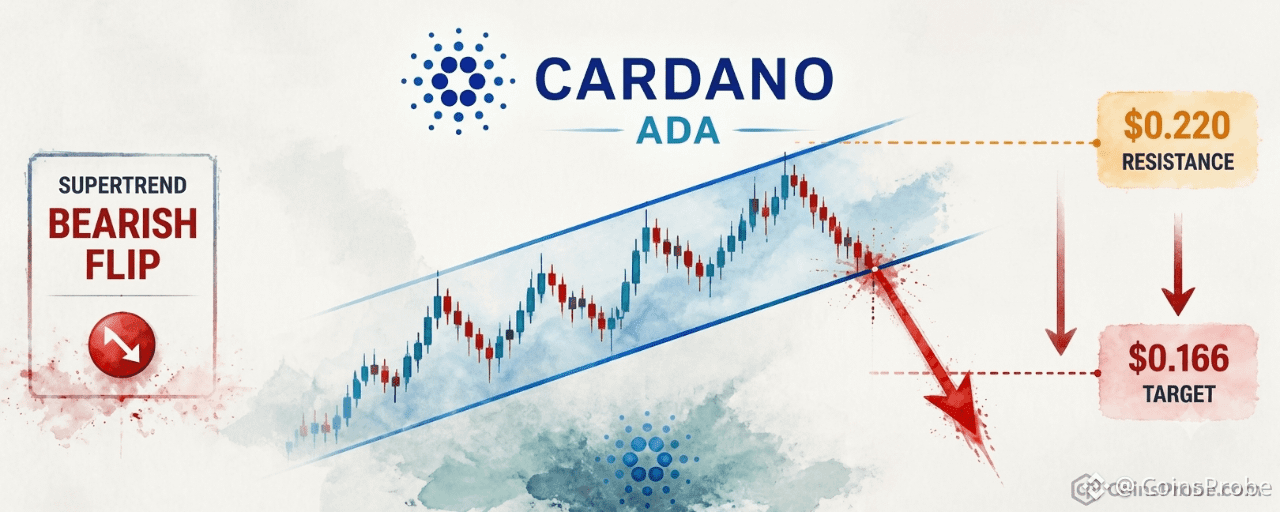
Cardano is trading at $0.2086 — down 3.36% in the last 24 hours — and the chart structure that supported the token since late June has now officially cracked. This is not a routine pullback. Analyst Ali Martinez (@alicharts) has confirmed a breakdown from the rising parallel channel that carried $ADA from $0.138 to $0.282 over four months, and the technicals now point toward a deeper leg lower.
“CARDANO BREAKDOWN CONFIRMED,” Martinez wrote on October 24, 2026, flagging that ADA has broken below the channel’s lower boundary — a level that, if it holds as resistance, sets up an approximately 20% decline from the $0.220 zone down to $0.166. This is the second bearish signal Martinez has flagged on Cardano within the same week, following a SuperTrend flip that he noted last flipped bearish in May 2025 — immediately preceding a 46% correction.
The Channel That Broke — Structure and Significance
From late June through mid-October 2026, ADA built a clean rising parallel channel — a structure defined by two parallel trendlines bounding price action on both sides. The lower boundary of this channel served as dynamic support through multiple retests, absorbing selling pressure each time price approached it. The channel’s range was substantial: a $0.144 swing from the $0.138 floor to the $0.282 peak, representing a 104% move at its peak.
ADA Daily Chart | Source: @alicharts (X)
That structure is now broken. Martinez’s analysis, published with a video chart illustrating the channel break, confirms that ADA has closed below the lower boundary. The breakdown is not an intraday wick — it is a confirmed structural breach. The prior support level near $0.21, which Martinez had identified in a referenced thread from October 20 as the critical daily close line, has been lost. At $0.2086 at time of writing, ADA is sitting just below that former boundary, which now acts as immediate overhead resistance.
SuperTrend Flips Bearish — The Last Time This Happened, ADA Fell 46%
The channel breakdown does not exist in isolation. In the October 20 thread (post 5 of 5), Martinez flagged that ADA’s SuperTrend indicator had flipped bearish — a signal he explicitly anchored to historical precedent. The last time the SuperTrend flipped bearish on ADA was May 22, 2025. What followed was a 46% correction.
The SuperTrend is a trend-following indicator built on Average True Range (ATR). It does not predict direction — it confirms it. When price closes below the SuperTrend line, the indicator flips from bullish to bearish, signaling that the prevailing trend has reversed. A flip is not noise. It is a structural regime change in trend momentum, and on ADA’s chart, it has now aligned with the channel breakdown — two independent signals pointing in the same direction simultaneously. The prior instance of this flip in May 2025 produced a 46% correction; the current setup places the next meaningful downside target at $0.166.
It is also worth noting the broader on-chain context. As covered previously on CoinsProbe, ADA whales had already dumped 110 million tokens as network activity fell 41% — a deterioration in fundamentals that makes the technical breakdown harder to dismiss as a temporary dip. Additionally, LINK, ADA, and SOL had already flashed bearish setups in earlier analyst flags, suggesting ADA’s current breakdown fits a pattern of coordinated technical deterioration across major altcoins.
Whale Activity — No Conviction Either Way, Yet
Martinez’s October 20 thread included an on-chain check on whale holdings in the 100 million–1 billion ADA bracket. His finding: flat over the prior 10 days — no significant accumulation, no significant distribution. At the time, this neutral reading meant neither bulls nor bears had whale-level conviction on their side. The breakdown since then has not yet been accompanied by confirmed whale selling, which Martinez cited as a secondary confirmation signal to watch alongside the $0.21 daily close criterion.
That $0.21 level has now been lost. Whether whales begin selling into this breakdown — or whether they accumulate into it — will determine the pace and depth of the correction. A spike in large-wallet outflows from ADA would validate the bearish scenario; renewed whale accumulation near current levels could slow the decline or produce a relief bounce.
The Levels That Matter From Here
Martinez’s analysis produces two specific numbers that define the trade structure going forward.
$0.220 — The Resistance That Must Hold. This is the level Martinez cites as the critical overhead zone. For the bearish thesis to remain intact, $0.220 must continue to reject price. A daily close back above $0.220 would put ADA back inside — or at least back in contact with — the channel’s lower boundary, materially weakening the breakdown case.
$0.166 — The Primary Downside Target. If $0.220 holds as resistance and the breakdown is sustained, Martinez’s target is approximately $0.166 — a decline of roughly 20% from the $0.220 resistance zone, and approximately 20.4% from current price ($0.2086). This level aligns with a prior consolidation zone from the channel’s early formation phase in late June and early July 2026.
Bullish Scenario — Reclaim of $0.220
If ADA reclaims $0.220 on a daily close, the breakdown is invalidated. Price would need to sustain above this level — not merely touch it — to re-engage the channel structure. A confirmed reclaim of $0.220 would shift the near-term bias back to neutral and open the path toward the mid-channel range near $0.24–$0.25. Previously, on-chain data had flagged coordinated spikes across BTC, XRP, and ADA that could complicate directional clarity — making the $0.220 close the definitive arbiter.
Bearish Scenario — Sustained Hold Below $0.220
If $0.220 acts as resistance and ADA continues to trade below it, the 20% correction path to $0.166 becomes the primary scenario. A break below $0.195 — the nearest intraday support — would accelerate selling pressure toward that target. The SuperTrend remains bearish unless price closes back above its dynamic line, which currently sits above $0.220.
Cardano’s breakdown from a four-month rising channel, confirmed by analyst Ali Martinez (@alicharts), coincides with a SuperTrend flip that last occurred in May 2025 — preceding a 46% correction. ADA is now trading at $0.2086, below the $0.21 threshold Martinez identified as the breakdown confirmation level. The $0.220 zone is the resistance line: every daily close below it keeps the correction thesis alive. The $0.166 target — approximately 20% below current price — is what Martinez’s framework points toward. Watch $0.220 on a daily close basis as the single level that either confirms or invalidates this breakdown.
Disclaimer: The views and analysis presented in this article are for informational purposes only and reflect the author’s perspective, not financial advice. Technical patterns and indicators discussed are subject to market volatility and may or may not yield the anticipated results. Investors are advised to exercise caution, conduct independent research, and make decisions aligned with their individual risk tolerance.
Cardano Breaks Below Rising Channel — $0.166 in Focus After SuperTrend Flip
Key Highlights
ADA trades at $0.2086 — down 3.36% — after breaking below a rising parallel channel that held since late June per @alichartsSuperTrend flipped bearish; last flip in May 2025 preceded a 46% correction on ADA$0.220 is the critical resistance — a sustained hold below targets $0.166, roughly 20% lowerWhale holdings (100M–1B ADA bracket) were flat over prior 10 days — no confirmed selling conviction yet
Cardano is trading at $0.2086 — down 3.36% in the last 24 hours — and the chart structure that supported the token since late June has now officially cracked. This is not a routine pullback. Analyst Ali Martinez (@alicharts) has confirmed a breakdown from the rising parallel channel that carried $ADA from $0.138 to $0.282 over four months, and the technicals now point toward a deeper leg lower.
“CARDANO BREAKDOWN CONFIRMED,” Martinez wrote on October 24, 2026, flagging that ADA has broken below the channel’s lower boundary — a level that, if it holds as resistance, sets up an approximately 20% decline from the $0.220 zone down to $0.166. This is the second bearish signal Martinez has flagged on Cardano within the same week, following a SuperTrend flip that he noted last flipped bearish in May 2025 — immediately preceding a 46% correction.
The Channel That Broke — Structure and Significance
From late June through mid-October 2026, ADA built a clean rising parallel channel — a structure defined by two parallel trendlines bounding price action on both sides. The lower boundary of this channel served as dynamic support through multiple retests, absorbing selling pressure each time price approached it. The channel’s range was substantial: a $0.144 swing from the $0.138 floor to the $0.282 peak, representing a 104% move at its peak.
ADA Daily Chart | Source: @alicharts (X)
That structure is now broken. Martinez’s analysis, published with a video chart illustrating the channel break, confirms that ADA has closed below the lower boundary. The breakdown is not an intraday wick — it is a confirmed structural breach. The prior support level near $0.21, which Martinez had identified in a referenced thread from October 20 as the critical daily close line, has been lost. At $0.2086 at time of writing, ADA is sitting just below that former boundary, which now acts as immediate overhead resistance.
SuperTrend Flips Bearish — The Last Time This Happened, ADA Fell 46%
The channel breakdown does not exist in isolation. In the October 20 thread (post 5 of 5), Martinez flagged that ADA’s SuperTrend indicator had flipped bearish — a signal he explicitly anchored to historical precedent. The last time the SuperTrend flipped bearish on ADA was May 22, 2025. What followed was a 46% correction.
The SuperTrend is a trend-following indicator built on Average True Range (ATR). It does not predict direction — it confirms it. When price closes below the SuperTrend line, the indicator flips from bullish to bearish, signaling that the prevailing trend has reversed. A flip is not noise. It is a structural regime change in trend momentum, and on ADA’s chart, it has now aligned with the channel breakdown — two independent signals pointing in the same direction simultaneously. The prior instance of this flip in May 2025 produced a 46% correction; the current setup places the next meaningful downside target at $0.166.
It is also worth noting the broader on-chain context. As covered previously on CoinsProbe, ADA whales had already dumped 110 million tokens as network activity fell 41% — a deterioration in fundamentals that makes the technical breakdown harder to dismiss as a temporary dip. Additionally, LINK, ADA, and SOL had already flashed bearish setups in earlier analyst flags, suggesting ADA’s current breakdown fits a pattern of coordinated technical deterioration across major altcoins.
Whale Activity — No Conviction Either Way, Yet
Martinez’s October 20 thread included an on-chain check on whale holdings in the 100 million–1 billion ADA bracket. His finding: flat over the prior 10 days — no significant accumulation, no significant distribution. At the time, this neutral reading meant neither bulls nor bears had whale-level conviction on their side. The breakdown since then has not yet been accompanied by confirmed whale selling, which Martinez cited as a secondary confirmation signal to watch alongside the $0.21 daily close criterion.
That $0.21 level has now been lost. Whether whales begin selling into this breakdown — or whether they accumulate into it — will determine the pace and depth of the correction. A spike in large-wallet outflows from ADA would validate the bearish scenario; renewed whale accumulation near current levels could slow the decline or produce a relief bounce.
The Levels That Matter From Here
Martinez’s analysis produces two specific numbers that define the trade structure going forward.
$0.220 — The Resistance That Must Hold. This is the level Martinez cites as the critical overhead zone. For the bearish thesis to remain intact, $0.220 must continue to reject price. A daily close back above $0.220 would put ADA back inside — or at least back in contact with — the channel’s lower boundary, materially weakening the breakdown case.
$0.166 — The Primary Downside Target. If $0.220 holds as resistance and the breakdown is sustained, Martinez’s target is approximately $0.166 — a decline of roughly 20% from the $0.220 resistance zone, and approximately 20.4% from current price ($0.2086). This level aligns with a prior consolidation zone from the channel’s early formation phase in late June and early July 2026.
Bullish Scenario — Reclaim of $0.220
If ADA reclaims $0.220 on a daily close, the breakdown is invalidated. Price would need to sustain above this level — not merely touch it — to re-engage the channel structure. A confirmed reclaim of $0.220 would shift the near-term bias back to neutral and open the path toward the mid-channel range near $0.24–$0.25. Previously, on-chain data had flagged coordinated spikes across BTC, XRP, and ADA that could complicate directional clarity — making the $0.220 close the definitive arbiter.
Bearish Scenario — Sustained Hold Below $0.220
If $0.220 acts as resistance and ADA continues to trade below it, the 20% correction path to $0.166 becomes the primary scenario. A break below $0.195 — the nearest intraday support — would accelerate selling pressure toward that target. The SuperTrend remains bearish unless price closes back above its dynamic line, which currently sits above $0.220.
Cardano’s breakdown from a four-month rising channel, confirmed by analyst Ali Martinez (@alicharts), coincides with a SuperTrend flip that last occurred in May 2025 — preceding a 46% correction. ADA is now trading at $0.2086, below the $0.21 threshold Martinez identified as the breakdown confirmation level. The $0.220 zone is the resistance line: every daily close below it keeps the correction thesis alive. The $0.166 target — approximately 20% below current price — is what Martinez’s framework points toward. Watch $0.220 on a daily close basis as the single level that either confirms or invalidates this breakdown.
Disclaimer: The views and analysis presented in this article are for informational purposes only and reflect the author’s perspective, not financial advice. Technical patterns and indicators discussed are subject to market volatility and may or may not yield the anticipated results. Investors are advised to exercise caution, conduct independent research, and make decisions aligned with their individual risk tolerance.
ADA trades at $0.2086 — down 3.36% — after breaking below a rising parallel channel that held since late June per @alichartsSuperTrend flipped bearish; last flip in May 2025 preceded a 46% correction on ADA$0.220 is the critical resistance — a sustained hold below targets $0.166, roughly 20% lowerWhale holdings (100M–1B ADA bracket) were flat over prior 10 days — no confirmed selling conviction yet
Cardano is trading at $0.2086 — down 3.36% in the last 24 hours — and the chart structure that supported the token since late June has now officially cracked. This is not a routine pullback. Analyst Ali Martinez (@alicharts) has confirmed a breakdown from the rising parallel channel that carried $ADA from $0.138 to $0.282 over four months, and the technicals now point toward a deeper leg lower.
“CARDANO BREAKDOWN CONFIRMED,” Martinez wrote on October 24, 2026, flagging that ADA has broken below the channel’s lower boundary — a level that, if it holds as resistance, sets up an approximately 20% decline from the $0.220 zone down to $0.166. This is the second bearish signal Martinez has flagged on Cardano within the same week, following a SuperTrend flip that he noted last flipped bearish in May 2025 — immediately preceding a 46% correction.
The Channel That Broke — Structure and Significance
From late June through mid-October 2026, ADA built a clean rising parallel channel — a structure defined by two parallel trendlines bounding price action on both sides. The lower boundary of this channel served as dynamic support through multiple retests, absorbing selling pressure each time price approached it. The channel’s range was substantial: a $0.144 swing from the $0.138 floor to the $0.282 peak, representing a 104% move at its peak.
ADA Daily Chart | Source: @alicharts (X)
That structure is now broken. Martinez’s analysis, published with a video chart illustrating the channel break, confirms that ADA has closed below the lower boundary. The breakdown is not an intraday wick — it is a confirmed structural breach. The prior support level near $0.21, which Martinez had identified in a referenced thread from October 20 as the critical daily close line, has been lost. At $0.2086 at time of writing, ADA is sitting just below that former boundary, which now acts as immediate overhead resistance.
SuperTrend Flips Bearish — The Last Time This Happened, ADA Fell 46%
The channel breakdown does not exist in isolation. In the October 20 thread (post 5 of 5), Martinez flagged that ADA’s SuperTrend indicator had flipped bearish — a signal he explicitly anchored to historical precedent. The last time the SuperTrend flipped bearish on ADA was May 22, 2025. What followed was a 46% correction.
The SuperTrend is a trend-following indicator built on Average True Range (ATR). It does not predict direction — it confirms it. When price closes below the SuperTrend line, the indicator flips from bullish to bearish, signaling that the prevailing trend has reversed. A flip is not noise. It is a structural regime change in trend momentum, and on ADA’s chart, it has now aligned with the channel breakdown — two independent signals pointing in the same direction simultaneously. The prior instance of this flip in May 2025 produced a 46% correction; the current setup places the next meaningful downside target at $0.166.
It is also worth noting the broader on-chain context. As covered previously on CoinsProbe, ADA whales had already dumped 110 million tokens as network activity fell 41% — a deterioration in fundamentals that makes the technical breakdown harder to dismiss as a temporary dip. Additionally, LINK, ADA, and SOL had already flashed bearish setups in earlier analyst flags, suggesting ADA’s current breakdown fits a pattern of coordinated technical deterioration across major altcoins.
Whale Activity — No Conviction Either Way, Yet
Martinez’s October 20 thread included an on-chain check on whale holdings in the 100 million–1 billion ADA bracket. His finding: flat over the prior 10 days — no significant accumulation, no significant distribution. At the time, this neutral reading meant neither bulls nor bears had whale-level conviction on their side. The breakdown since then has not yet been accompanied by confirmed whale selling, which Martinez cited as a secondary confirmation signal to watch alongside the $0.21 daily close criterion.
That $0.21 level has now been lost. Whether whales begin selling into this breakdown — or whether they accumulate into it — will determine the pace and depth of the correction. A spike in large-wallet outflows from ADA would validate the bearish scenario; renewed whale accumulation near current levels could slow the decline or produce a relief bounce.
The Levels That Matter From Here
Martinez’s analysis produces two specific numbers that define the trade structure going forward.
$0.220 — The Resistance That Must Hold. This is the level Martinez cites as the critical overhead zone. For the bearish thesis to remain intact, $0.220 must continue to reject price. A daily close back above $0.220 would put ADA back inside — or at least back in contact with — the channel’s lower boundary, materially weakening the breakdown case.
$0.166 — The Primary Downside Target. If $0.220 holds as resistance and the breakdown is sustained, Martinez’s target is approximately $0.166 — a decline of roughly 20% from the $0.220 resistance zone, and approximately 20.4% from current price ($0.2086). This level aligns with a prior consolidation zone from the channel’s early formation phase in late June and early July 2026.
Bullish Scenario — Reclaim of $0.220
If ADA reclaims $0.220 on a daily close, the breakdown is invalidated. Price would need to sustain above this level — not merely touch it — to re-engage the channel structure. A confirmed reclaim of $0.220 would shift the near-term bias back to neutral and open the path toward the mid-channel range near $0.24–$0.25. Previously, on-chain data had flagged coordinated spikes across BTC, XRP, and ADA that could complicate directional clarity — making the $0.220 close the definitive arbiter.
Bearish Scenario — Sustained Hold Below $0.220
If $0.220 acts as resistance and ADA continues to trade below it, the 20% correction path to $0.166 becomes the primary scenario. A break below $0.195 — the nearest intraday support — would accelerate selling pressure toward that target. The SuperTrend remains bearish unless price closes back above its dynamic line, which currently sits above $0.220.
Cardano’s breakdown from a four-month rising channel, confirmed by analyst Ali Martinez (@alicharts), coincides with a SuperTrend flip that last occurred in May 2025 — preceding a 46% correction. ADA is now trading at $0.2086, below the $0.21 threshold Martinez identified as the breakdown confirmation level. The $0.220 zone is the resistance line: every daily close below it keeps the correction thesis alive. The $0.166 target — approximately 20% below current price — is what Martinez’s framework points toward. Watch $0.220 on a daily close basis as the single level that either confirms or invalidates this breakdown.
Disclaimer: The views and analysis presented in this article are for informational purposes only and reflect the author’s perspective, not financial advice. Technical patterns and indicators discussed are subject to market volatility and may or may not yield the anticipated results. Investors are advised to exercise caution, conduct independent research, and make decisions aligned with their individual risk tolerance.
1
2
1k
·
--
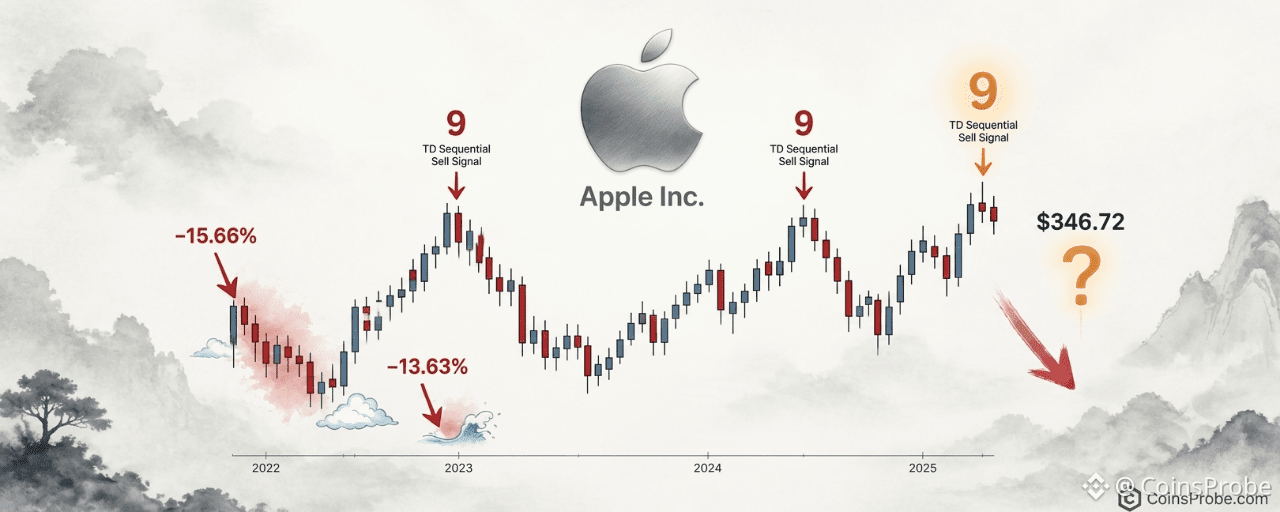
ලිපිය
Apple Prints TD Sequential Sell 9 — Last Two Led to 15.66% and 13.63% CorrectionsKey Highlights
AAPL weekly chart prints TD Sequential sell '9' signal at $346.72 per @alichartsPrior two weekly sell signals preceded corrections of −15.66% and −13.63% respectivelyChannel lower boundary at $339 is the first confirmation level; $332 is the failure targetPattern status: still forming — no breakdown confirmed, price remains near recent highs
Apple Inc. ($AAPL) is trading at approximately $346.72 on the weekly chart — and a technical signal with a two-for-two track record of preceding double-digit corrections has just fired again. The TD Sequential has printed a sell “9” on the weekly timeframe, the same configuration that preceded pullbacks of 15.66% and 13.63% in its two most recent appearances.
The warning comes from analyst Ali Martinez (@alicharts), who flagged the setup on October 23, 2026, framing it directly: “APPLE BLOW-OFF TOP? The TD Sequential has flashed a sell signal on the weekly chart, suggesting $AAPL could be due for a retracement. This signal is worth paying attention to.” Martinez has tracked Apple’s technical structure closely, and the recurrence of this specific signal at elevated price levels warrants a precise breakdown of the mechanism and the prior track record.
What the TD Sequential “9” Actually Measures
The TD Sequential is a momentum exhaustion indicator developed by Tom DeMark. It does not identify a specific price level as resistance — it identifies the duration of a directional move. A sell “9” prints when price closes higher than the corresponding close four bars earlier for nine consecutive candles. On the weekly chart, that means nine straight weeks of relative upside momentum — a condition that historically marks not a reversal in itself, but a high-probability zone of exhaustion where buying pressure has become statistically extended.
The critical distinction: the TD Sequential is a non-directional momentum exhaustion signal. It does not predict magnitude or guarantee a reversal. What it does is identify conditions under which price has historically been vulnerable to mean-reversion. The signal becomes meaningful precisely because of its historical batting average — and in Apple’s case on the weekly timeframe, that record is two-for-two.
The Track Record — Two-for-Two on the Weekly Chart
The weekly chart of $AAPL shared by @alicharts marks three TD Sequential sell “9” signals across the February–November timeframe. The first two are annotated with their confirmed outcomes — percentage declines that are historical facts, not projections. The third is the current signal, still forming.
Signal Instance Signal Type Correction Produced Status First weekly sell 9 TD Sequential Sell −15.66% Confirmed (historical) Second weekly sell 9 TD Sequential Sell −13.63% Confirmed (historical) Third weekly sell 9 TD Sequential Sell TBD Signal active, no breakdown confirmed
Source: @alicharts (X), Apple Weekly Chart — October 2026
The average correction across the two prior instances is approximately 14.6%. Applied mechanically from the current chart price of $346.72, that would imply a hypothetical retracement zone — but the TD Sequential does not generate price targets. The historical percentages are data observations, not forward projections, and Martinez does not attach a target to this signal.
Channel Context — $347 Rejection, $339 and $332 in Focus
In a prior post on October 22, 2026 (ID: 2113283856723779630), which Martinez’s October 23 post quotes for channel context, he identified a rejection at $347 as a structural reference. The channel’s lower boundary sits at $339, which becomes the immediate focus if selling pressure materializes. A failure to hold $339 would shift attention to $332 as the next structural level. These levels are drawn from Martinez’s channel analysis and represent the price architecture framing the current TD Sequential signal.
Apple’s concentration in equity indices adds a macro dimension worth noting here. As covered previously, Nvidia and Apple together represent 15% of the S&P 500 — a concentration that surpassed the 1999 dot-com peak. A double-digit correction in AAPL at these weights is not isolated stock risk — it carries index-level implications. Separately, the degree to which 10 stocks have driven 70% of the S&P 500’s gains since March 30 means any rotation out of mega-cap names would be felt broadly.
What the Signal Says — and What It Doesn’t
What it says: Apple’s weekly chart has printed a TD Sequential sell 9 at $346.72 — a momentum exhaustion condition that preceded corrections of 15.66% and 13.63% in its two most recent weekly occurrences. The signal is active.
What it doesn’t say: It does not confirm a reversal has begun. No breakdown has occurred. The pattern status is still forming — price remains near recent highs. The TD Sequential flags exhaustion zones; price can extend further before resolving, and not every sell 9 produces a correction of comparable magnitude.
What to watch for confirmation: A weekly close below $339 — the channel lower boundary Martinez identifies — would be the first structural confirmation that the sell signal is being validated. Loss of $332 would confirm a deeper correction is underway.
Bullish Scenario — Signal Fails, Extension Continues
If $AAPLB holds above $347 on a weekly closing basis and the TD Sequential signal is absorbed without a directional breakdown, the pattern fails to confirm. In prior cycles where sell 9 signals have not preceded meaningful corrections, price has often ground higher as bulls exhausted the residual selling pressure. No specific upside target is warranted by the current data.
Bearish Scenario — Channel Breakdown Confirms the Signal
A weekly close below $339 opens the path toward $332, the failure level Martinez identified in his October 22 channel analysis. Applying the average of the two prior TD Sequential corrections (−14.6%) from the $346.72 chart price produces a hypothetical zone near $296 — but this is a mechanical observation, not a stated target, and the analyst has not assigned a correction magnitude to the current signal.
Apple’s technical setup at $346.72 is a two-for-two warning with an unresolved outcome. The sell “9” is printed. The channel rejection at $347 is documented. The prior corrections of 15.66% and 13.63% are on record. What remains is price confirmation — and that answer arrives at $339 on a weekly closing basis.
Disclaimer: The views and analysis presented in this article are for informational purposes only and reflect the author’s perspective, not financial advice. Technical patterns and indicators discussed are subject to market volatility and may or may not yield the anticipated results. Investors are advised to exercise caution, conduct independent research, and make decisions aligned with their individual risk tolerance.
Apple Prints TD Sequential Sell 9 — Last Two Led to 15.66% and 13.63% Corrections
Key Highlights
AAPL weekly chart prints TD Sequential sell '9' signal at $346.72 per @alichartsPrior two weekly sell signals preceded corrections of −15.66% and −13.63% respectivelyChannel lower boundary at $339 is the first confirmation level; $332 is the failure targetPattern status: still forming — no breakdown confirmed, price remains near recent highs
Apple Inc. ($AAPL ) is trading at approximately $346.72 on the weekly chart — and a technical signal with a two-for-two track record of preceding double-digit corrections has just fired again. The TD Sequential has printed a sell “9” on the weekly timeframe, the same configuration that preceded pullbacks of 15.66% and 13.63% in its two most recent appearances.
The warning comes from analyst Ali Martinez (@alicharts), who flagged the setup on October 23, 2026, framing it directly: “APPLE BLOW-OFF TOP? The TD Sequential has flashed a sell signal on the weekly chart, suggesting $AAPL could be due for a retracement. This signal is worth paying attention to.” Martinez has tracked Apple’s technical structure closely, and the recurrence of this specific signal at elevated price levels warrants a precise breakdown of the mechanism and the prior track record.
What the TD Sequential “9” Actually Measures
The TD Sequential is a momentum exhaustion indicator developed by Tom DeMark. It does not identify a specific price level as resistance — it identifies the duration of a directional move. A sell “9” prints when price closes higher than the corresponding close four bars earlier for nine consecutive candles. On the weekly chart, that means nine straight weeks of relative upside momentum — a condition that historically marks not a reversal in itself, but a high-probability zone of exhaustion where buying pressure has become statistically extended.
The critical distinction: the TD Sequential is a non-directional momentum exhaustion signal. It does not predict magnitude or guarantee a reversal. What it does is identify conditions under which price has historically been vulnerable to mean-reversion. The signal becomes meaningful precisely because of its historical batting average — and in Apple’s case on the weekly timeframe, that record is two-for-two.
The Track Record — Two-for-Two on the Weekly Chart
The weekly chart of $AAPL shared by @alicharts marks three TD Sequential sell “9” signals across the February–November timeframe. The first two are annotated with their confirmed outcomes — percentage declines that are historical facts, not projections. The third is the current signal, still forming.
Signal Instance Signal Type Correction Produced Status First weekly sell 9 TD Sequential Sell −15.66% Confirmed (historical) Second weekly sell 9 TD Sequential Sell −13.63% Confirmed (historical) Third weekly sell 9 TD Sequential Sell TBD Signal active, no breakdown confirmed
Source: @alicharts (X), Apple Weekly Chart — October 2026
The average correction across the two prior instances is approximately 14.6%. Applied mechanically from the current chart price of $346.72, that would imply a hypothetical retracement zone — but the TD Sequential does not generate price targets. The historical percentages are data observations, not forward projections, and Martinez does not attach a target to this signal.
Channel Context — $347 Rejection, $339 and $332 in Focus
In a prior post on October 22, 2026 (ID: 2113283856723779630), which Martinez’s October 23 post quotes for channel context, he identified a rejection at $347 as a structural reference. The channel’s lower boundary sits at $339, which becomes the immediate focus if selling pressure materializes. A failure to hold $339 would shift attention to $332 as the next structural level. These levels are drawn from Martinez’s channel analysis and represent the price architecture framing the current TD Sequential signal.
Apple’s concentration in equity indices adds a macro dimension worth noting here. As covered previously, Nvidia and Apple together represent 15% of the S&P 500 — a concentration that surpassed the 1999 dot-com peak. A double-digit correction in AAPL at these weights is not isolated stock risk — it carries index-level implications. Separately, the degree to which 10 stocks have driven 70% of the S&P 500’s gains since March 30 means any rotation out of mega-cap names would be felt broadly.
What the Signal Says — and What It Doesn’t
What it says: Apple’s weekly chart has printed a TD Sequential sell 9 at $346.72 — a momentum exhaustion condition that preceded corrections of 15.66% and 13.63% in its two most recent weekly occurrences. The signal is active.
What it doesn’t say: It does not confirm a reversal has begun. No breakdown has occurred. The pattern status is still forming — price remains near recent highs. The TD Sequential flags exhaustion zones; price can extend further before resolving, and not every sell 9 produces a correction of comparable magnitude.
What to watch for confirmation: A weekly close below $339 — the channel lower boundary Martinez identifies — would be the first structural confirmation that the sell signal is being validated. Loss of $332 would confirm a deeper correction is underway.
Bullish Scenario — Signal Fails, Extension Continues
If $AAPLB holds above $347 on a weekly closing basis and the TD Sequential signal is absorbed without a directional breakdown, the pattern fails to confirm. In prior cycles where sell 9 signals have not preceded meaningful corrections, price has often ground higher as bulls exhausted the residual selling pressure. No specific upside target is warranted by the current data.
Bearish Scenario — Channel Breakdown Confirms the Signal
A weekly close below $339 opens the path toward $332, the failure level Martinez identified in his October 22 channel analysis. Applying the average of the two prior TD Sequential corrections (−14.6%) from the $346.72 chart price produces a hypothetical zone near $296 — but this is a mechanical observation, not a stated target, and the analyst has not assigned a correction magnitude to the current signal.
Apple’s technical setup at $346.72 is a two-for-two warning with an unresolved outcome. The sell “9” is printed. The channel rejection at $347 is documented. The prior corrections of 15.66% and 13.63% are on record. What remains is price confirmation — and that answer arrives at $339 on a weekly closing basis.
Disclaimer: The views and analysis presented in this article are for informational purposes only and reflect the author’s perspective, not financial advice. Technical patterns and indicators discussed are subject to market volatility and may or may not yield the anticipated results. Investors are advised to exercise caution, conduct independent research, and make decisions aligned with their individual risk tolerance.
AAPL weekly chart prints TD Sequential sell '9' signal at $346.72 per @alichartsPrior two weekly sell signals preceded corrections of −15.66% and −13.63% respectivelyChannel lower boundary at $339 is the first confirmation level; $332 is the failure targetPattern status: still forming — no breakdown confirmed, price remains near recent highs
Apple Inc. ($AAPL ) is trading at approximately $346.72 on the weekly chart — and a technical signal with a two-for-two track record of preceding double-digit corrections has just fired again. The TD Sequential has printed a sell “9” on the weekly timeframe, the same configuration that preceded pullbacks of 15.66% and 13.63% in its two most recent appearances.
The warning comes from analyst Ali Martinez (@alicharts), who flagged the setup on October 23, 2026, framing it directly: “APPLE BLOW-OFF TOP? The TD Sequential has flashed a sell signal on the weekly chart, suggesting $AAPL could be due for a retracement. This signal is worth paying attention to.” Martinez has tracked Apple’s technical structure closely, and the recurrence of this specific signal at elevated price levels warrants a precise breakdown of the mechanism and the prior track record.
What the TD Sequential “9” Actually Measures
The TD Sequential is a momentum exhaustion indicator developed by Tom DeMark. It does not identify a specific price level as resistance — it identifies the duration of a directional move. A sell “9” prints when price closes higher than the corresponding close four bars earlier for nine consecutive candles. On the weekly chart, that means nine straight weeks of relative upside momentum — a condition that historically marks not a reversal in itself, but a high-probability zone of exhaustion where buying pressure has become statistically extended.
The critical distinction: the TD Sequential is a non-directional momentum exhaustion signal. It does not predict magnitude or guarantee a reversal. What it does is identify conditions under which price has historically been vulnerable to mean-reversion. The signal becomes meaningful precisely because of its historical batting average — and in Apple’s case on the weekly timeframe, that record is two-for-two.
The Track Record — Two-for-Two on the Weekly Chart
The weekly chart of $AAPL shared by @alicharts marks three TD Sequential sell “9” signals across the February–November timeframe. The first two are annotated with their confirmed outcomes — percentage declines that are historical facts, not projections. The third is the current signal, still forming.
Signal Instance Signal Type Correction Produced Status First weekly sell 9 TD Sequential Sell −15.66% Confirmed (historical) Second weekly sell 9 TD Sequential Sell −13.63% Confirmed (historical) Third weekly sell 9 TD Sequential Sell TBD Signal active, no breakdown confirmed
Source: @alicharts (X), Apple Weekly Chart — October 2026
The average correction across the two prior instances is approximately 14.6%. Applied mechanically from the current chart price of $346.72, that would imply a hypothetical retracement zone — but the TD Sequential does not generate price targets. The historical percentages are data observations, not forward projections, and Martinez does not attach a target to this signal.
Channel Context — $347 Rejection, $339 and $332 in Focus
In a prior post on October 22, 2026 (ID: 2113283856723779630), which Martinez’s October 23 post quotes for channel context, he identified a rejection at $347 as a structural reference. The channel’s lower boundary sits at $339, which becomes the immediate focus if selling pressure materializes. A failure to hold $339 would shift attention to $332 as the next structural level. These levels are drawn from Martinez’s channel analysis and represent the price architecture framing the current TD Sequential signal.
Apple’s concentration in equity indices adds a macro dimension worth noting here. As covered previously, Nvidia and Apple together represent 15% of the S&P 500 — a concentration that surpassed the 1999 dot-com peak. A double-digit correction in AAPL at these weights is not isolated stock risk — it carries index-level implications. Separately, the degree to which 10 stocks have driven 70% of the S&P 500’s gains since March 30 means any rotation out of mega-cap names would be felt broadly.
What the Signal Says — and What It Doesn’t
What it says: Apple’s weekly chart has printed a TD Sequential sell 9 at $346.72 — a momentum exhaustion condition that preceded corrections of 15.66% and 13.63% in its two most recent weekly occurrences. The signal is active.
What it doesn’t say: It does not confirm a reversal has begun. No breakdown has occurred. The pattern status is still forming — price remains near recent highs. The TD Sequential flags exhaustion zones; price can extend further before resolving, and not every sell 9 produces a correction of comparable magnitude.
What to watch for confirmation: A weekly close below $339 — the channel lower boundary Martinez identifies — would be the first structural confirmation that the sell signal is being validated. Loss of $332 would confirm a deeper correction is underway.
Bullish Scenario — Signal Fails, Extension Continues
If $AAPLB holds above $347 on a weekly closing basis and the TD Sequential signal is absorbed without a directional breakdown, the pattern fails to confirm. In prior cycles where sell 9 signals have not preceded meaningful corrections, price has often ground higher as bulls exhausted the residual selling pressure. No specific upside target is warranted by the current data.
Bearish Scenario — Channel Breakdown Confirms the Signal
A weekly close below $339 opens the path toward $332, the failure level Martinez identified in his October 22 channel analysis. Applying the average of the two prior TD Sequential corrections (−14.6%) from the $346.72 chart price produces a hypothetical zone near $296 — but this is a mechanical observation, not a stated target, and the analyst has not assigned a correction magnitude to the current signal.
Apple’s technical setup at $346.72 is a two-for-two warning with an unresolved outcome. The sell “9” is printed. The channel rejection at $347 is documented. The prior corrections of 15.66% and 13.63% are on record. What remains is price confirmation — and that answer arrives at $339 on a weekly closing basis.
Disclaimer: The views and analysis presented in this article are for informational purposes only and reflect the author’s perspective, not financial advice. Technical patterns and indicators discussed are subject to market volatility and may or may not yield the anticipated results. Investors are advised to exercise caution, conduct independent research, and make decisions aligned with their individual risk tolerance.
159
·
--
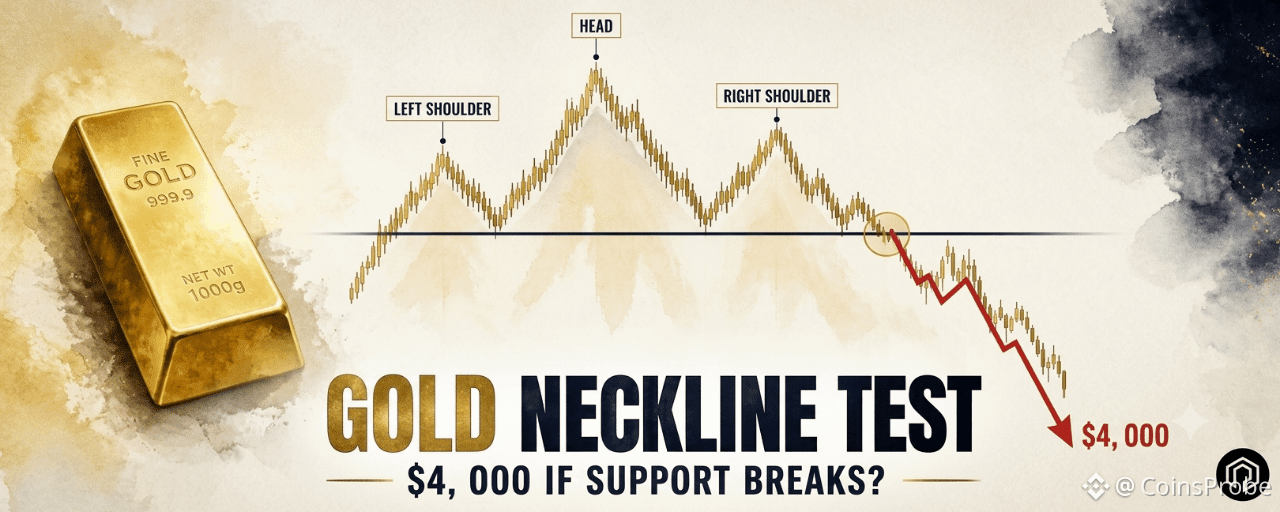
ලිපිය
Gold’s Head and Shoulders Tests Neckline — $4,000 in Focus If Support BreaksKey Highlights
Gold is testing a potential Head and Shoulders neckline near $4,022 — no confirmed breakdown yetAnalyst Ali Martinez notes market psychology stages, with $4,000 as a possible next support if the neckline failsA daily close below $4,022 would activate the pattern; a hold keeps the structure unconfirmedReclaim above $4,200 would invalidate the bearish setup
Gold is trading at approximately $4,037 — sitting directly on the neckline of a developing Head and Shoulders pattern that peaked at $5,418. Contrary to earlier reports of a confirmed breakdown, the daily chart has not yet closed decisively below the $4,022 neckline support. The pattern is under test, not resolved.
Analyst Ali Martinez (@alicharts) shared the chart on October 23, 2026, with the caption “gold is a safe haven, they said…” alongside a prior note outlining classic market psychology stages. His framework remains conditional: the structure is intact until price confirms a break.
The Head and Shoulders — Still Testing, Not Broken
Gold’s Head and Shoulders Pattern| Source: @alicharts (X)
The pattern shows a Left Shoulder during the prior rally, a Head at the $5,418 cycle peak, and a Right Shoulder that failed to make a new high. The neckline sits near $4,022. At the time of writing, price is holding around this level rather than closing below it.
Martinez’s earlier psychology-cycle post mapped potential stages if weakness continues: a move toward $4,000 (anger phase), followed by a possible relief rally into $4,100–$4,200, and only then a deeper decline if the pattern fully activates. These levels are contingent on a confirmed neckline break — which has not occurred.
The Roadmap Remains Conditional
Immediate support: $4,022 (neckline under test)Potential next downside if broken: $4,000Expected relief zone if $4,000 is reached: $4,100–$4,200Full measured-move targets (only if breakdown confirms): $3,085 and $2,843
A sustained daily close below $4,022 is required before the bearish measured move becomes active. Until that happens, the pattern is a potential setup, not a completed breakdown.
Bullish Scenario — Neckline Holds
Gold holds above $4,022 on a daily closing basis and reclaims $4,200. This would invalidate the Head and Shoulders structure and reopen the path toward higher levels, including the prior Right Shoulder zone near $4,500.
Bearish Scenario — Confirmed Break Below $4,022
A daily close below $4,022 activates the pattern. In that case, Martinez’s sequenced path toward $4,000, followed by a relief rally into $4,100–$4,200, and then deeper measured-move targets near $3,085 and $2,843 becomes the active roadmap.
Watch $4,022 on a daily close. That level remains the line between an unconfirmed pattern and a completed breakdown. A hold keeps the structure neutral; a break turns the measured-move thesis live.
Disclaimer: The views and analysis presented in this article are for informational purposes only and reflect the author’s perspective, not financial advice. Technical patterns and indicators discussed are subject to market volatility and may or may not yield the anticipated results. Investors are advised to exercise caution, conduct independent research, and make decisions aligned with their individual risk tolerance.
Gold’s Head and Shoulders Tests Neckline — $4,000 in Focus If Support Breaks
Key Highlights
Gold is testing a potential Head and Shoulders neckline near $4,022 — no confirmed breakdown yetAnalyst Ali Martinez notes market psychology stages, with $4,000 as a possible next support if the neckline failsA daily close below $4,022 would activate the pattern; a hold keeps the structure unconfirmedReclaim above $4,200 would invalidate the bearish setup
Gold is trading at approximately $4,037 — sitting directly on the neckline of a developing Head and Shoulders pattern that peaked at $5,418. Contrary to earlier reports of a confirmed breakdown, the daily chart has not yet closed decisively below the $4,022 neckline support. The pattern is under test, not resolved.
Analyst Ali Martinez (@alicharts) shared the chart on October 23, 2026, with the caption “gold is a safe haven, they said…” alongside a prior note outlining classic market psychology stages. His framework remains conditional: the structure is intact until price confirms a break.
The Head and Shoulders — Still Testing, Not Broken
Gold’s Head and Shoulders Pattern| Source: @alicharts (X)
The pattern shows a Left Shoulder during the prior rally, a Head at the $5,418 cycle peak, and a Right Shoulder that failed to make a new high. The neckline sits near $4,022. At the time of writing, price is holding around this level rather than closing below it.
Martinez’s earlier psychology-cycle post mapped potential stages if weakness continues: a move toward $4,000 (anger phase), followed by a possible relief rally into $4,100–$4,200, and only then a deeper decline if the pattern fully activates. These levels are contingent on a confirmed neckline break — which has not occurred.
The Roadmap Remains Conditional
Immediate support: $4,022 (neckline under test)Potential next downside if broken: $4,000Expected relief zone if $4,000 is reached: $4,100–$4,200Full measured-move targets (only if breakdown confirms): $3,085 and $2,843
A sustained daily close below $4,022 is required before the bearish measured move becomes active. Until that happens, the pattern is a potential setup, not a completed breakdown.
Bullish Scenario — Neckline Holds
Gold holds above $4,022 on a daily closing basis and reclaims $4,200. This would invalidate the Head and Shoulders structure and reopen the path toward higher levels, including the prior Right Shoulder zone near $4,500.
Bearish Scenario — Confirmed Break Below $4,022
A daily close below $4,022 activates the pattern. In that case, Martinez’s sequenced path toward $4,000, followed by a relief rally into $4,100–$4,200, and then deeper measured-move targets near $3,085 and $2,843 becomes the active roadmap.
Watch $4,022 on a daily close. That level remains the line between an unconfirmed pattern and a completed breakdown. A hold keeps the structure neutral; a break turns the measured-move thesis live.
Disclaimer: The views and analysis presented in this article are for informational purposes only and reflect the author’s perspective, not financial advice. Technical patterns and indicators discussed are subject to market volatility and may or may not yield the anticipated results. Investors are advised to exercise caution, conduct independent research, and make decisions aligned with their individual risk tolerance.
Gold is testing a potential Head and Shoulders neckline near $4,022 — no confirmed breakdown yetAnalyst Ali Martinez notes market psychology stages, with $4,000 as a possible next support if the neckline failsA daily close below $4,022 would activate the pattern; a hold keeps the structure unconfirmedReclaim above $4,200 would invalidate the bearish setup
Gold is trading at approximately $4,037 — sitting directly on the neckline of a developing Head and Shoulders pattern that peaked at $5,418. Contrary to earlier reports of a confirmed breakdown, the daily chart has not yet closed decisively below the $4,022 neckline support. The pattern is under test, not resolved.
Analyst Ali Martinez (@alicharts) shared the chart on October 23, 2026, with the caption “gold is a safe haven, they said…” alongside a prior note outlining classic market psychology stages. His framework remains conditional: the structure is intact until price confirms a break.
The Head and Shoulders — Still Testing, Not Broken
Gold’s Head and Shoulders Pattern| Source: @alicharts (X)
The pattern shows a Left Shoulder during the prior rally, a Head at the $5,418 cycle peak, and a Right Shoulder that failed to make a new high. The neckline sits near $4,022. At the time of writing, price is holding around this level rather than closing below it.
Martinez’s earlier psychology-cycle post mapped potential stages if weakness continues: a move toward $4,000 (anger phase), followed by a possible relief rally into $4,100–$4,200, and only then a deeper decline if the pattern fully activates. These levels are contingent on a confirmed neckline break — which has not occurred.
The Roadmap Remains Conditional
Immediate support: $4,022 (neckline under test)Potential next downside if broken: $4,000Expected relief zone if $4,000 is reached: $4,100–$4,200Full measured-move targets (only if breakdown confirms): $3,085 and $2,843
A sustained daily close below $4,022 is required before the bearish measured move becomes active. Until that happens, the pattern is a potential setup, not a completed breakdown.
Bullish Scenario — Neckline Holds
Gold holds above $4,022 on a daily closing basis and reclaims $4,200. This would invalidate the Head and Shoulders structure and reopen the path toward higher levels, including the prior Right Shoulder zone near $4,500.
Bearish Scenario — Confirmed Break Below $4,022
A daily close below $4,022 activates the pattern. In that case, Martinez’s sequenced path toward $4,000, followed by a relief rally into $4,100–$4,200, and then deeper measured-move targets near $3,085 and $2,843 becomes the active roadmap.
Watch $4,022 on a daily close. That level remains the line between an unconfirmed pattern and a completed breakdown. A hold keeps the structure neutral; a break turns the measured-move thesis live.
Disclaimer: The views and analysis presented in this article are for informational purposes only and reflect the author’s perspective, not financial advice. Technical patterns and indicators discussed are subject to market volatility and may or may not yield the anticipated results. Investors are advised to exercise caution, conduct independent research, and make decisions aligned with their individual risk tolerance.
384
·
--
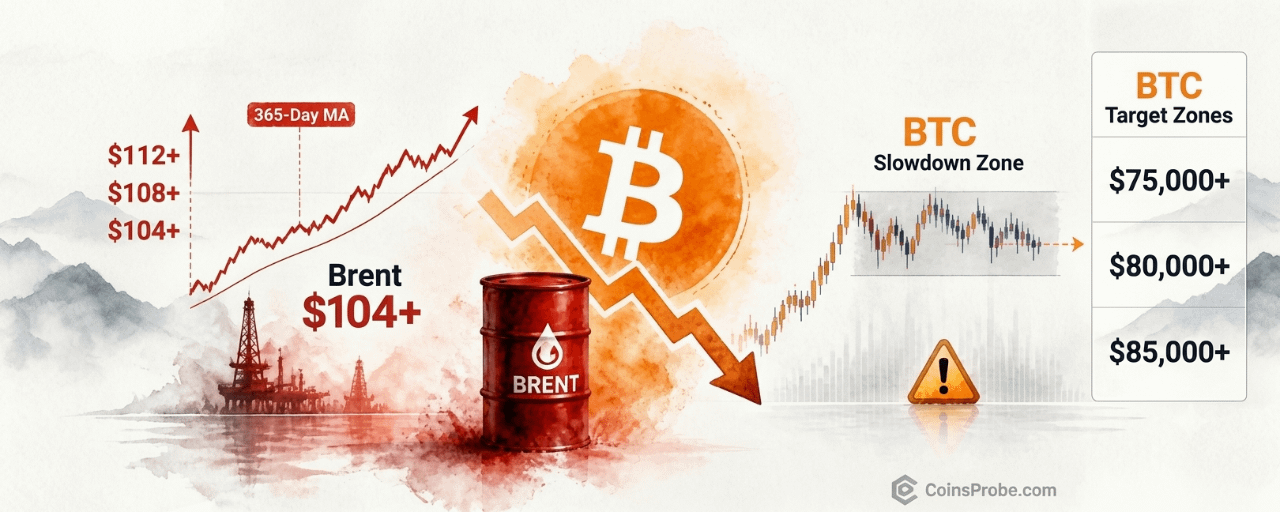
ලිපිය
Bitcoin Faces Macro Headwind as Brent Crude Holds Above $100Key Highlights
Bitcoin trades at $81,524 (-0.72% 24h) as Brent crude holds above $100, above its 365-day moving averageCryptoQuant analyst @Darkfost_Coc: "When Brent settles into a strong upward trend, above its annual average, Bitcoin has often slowed down"The headwind condition clears only when Brent sustains a move back below its 365-day moving average — not yet the case
Bitcoin is trading at $81,524 — down 0.72% in the past 24 hours — with a market capitalization of approximately $1.64 trillion, as a macro signal that has historically preceded periods of slowed BTC appreciation reasserts itself. Brent crude oil is holding above $100 per barrel, a level that CryptoQuant analyst @Darkfost_Coc identifies as a significant headwind for Bitcoin based on a decade-long correlation pattern.
In a note published via CryptoQuant’s Quicktake platform on October 23, 2026, Darkfost states directly: “Over the long term, we can see that when Brent settles into a strong upward trend, above its annual average, Bitcoin has often slowed down.” The operative condition here is not simply that oil is elevated — it is that Brent is trending above its 365-day moving average in a sustained, directional upward move. That is a structurally different environment from a brief oil spike.
The Signal — Brent Above Its 365-Day Moving Average
The mechanism Darkfost documents is a macro liquidity effect, not a direct Bitcoin correlation. When Brent crude trades in a sustained upward trend above its annual moving average, it signals persistent inflationary pressure in the global energy complex. That environment typically tightens real disposable income, raises input costs across industries, and pressures central banks toward restrictive monetary policy — all of which reduce the marginal appetite for risk assets, including Bitcoin.
The chart shared by @cryptoquant_com plots Bitcoin’s logarithmic price history against Brent crude from approximately 2014 through 2026. The gray shaded bars on the chart mark the periods when this condition — Brent sustaining a trend above its 365-day average — was active. The visual pattern is clear: those shaded periods cluster around Bitcoin consolidation phases and momentum slowdowns, not the explosive vertical legs of BTC bull markets. Brent’s current reading is annotated on the chart at approximately 104.2 on the left axis, placing it above the 365-day average line that is itself now trending upward.
Chart Analysis | Source: @cryptoquant_com (X)
This is not a claim that oil causes Bitcoin to fall. The analyst’s stated finding is more precise: Bitcoin has often slowed down in these environments. The implication for the current moment is a macro friction that does not support a clean continuation of Bitcoin’s prior upward momentum without resolution in the energy complex.
Why This Macro Backdrop Is Structurally Different
There is an important distinction between Brent being elevated and Brent being in a strong upward trend above its annual average. A single oil spike — caused by a geopolitical event, a hurricane, or a brief supply disruption — tends to be self-correcting and does not create the sustained macro drag that Darkfost’s model captures. What the current setup reflects is a durable trend: Brent’s 365-day moving average itself is now curving upward, meaning the benchmark is structurally rising, not just printing a one-time high.
That distinction matters for Bitcoin investors because it determines duration. If Brent were simply elevated on a transient shock, the macro friction would be temporary. A sustained trend above the annual average — the condition the chart specifically identifies — creates a persistent backdrop that has historically coincided with extended BTC consolidation, not a brief pause before resumption.
Bitcoin has not been immune to macro conditions in prior cycles. The long-term holder net position change, which hit +1.27M BTC but is already showing a pace slowdown, reflects a similar dynamic — accumulation exists, but momentum is decelerating at the macro level. Similarly, large-scale whale deposits of 949.7 BTC to Binance and Deribit in recent sessions suggest participants are actively managing exposure rather than adding with conviction.
What the Signal Says — and What It Doesn’t
Darkfost’s observation is directional, not a price target. The analyst does not provide a specific BTC downside level, a price at which Brent crude would stop being a headwind, or a numeric threshold for the oil condition to clear. The finding is explicitly a long-term pattern observation: when the condition is active, Bitcoin has often slowed down. “Often” is the analyst’s word — it is a statistical tendency, not a deterministic rule.
What the signal does not say: it does not predict an imminent Bitcoin collapse, assign a specific percentage drawdown, or establish a timeline. The chart covers over a decade of data, meaning the Brent-above-annual-average condition has appeared across multiple cycle phases, and Bitcoin’s response has varied in magnitude and duration. The consistent pattern is momentum attenuation — not outright reversal in every instance.
What to watch for a change in the macro setup: a sustained move by Brent crude back below its 365-day moving average would remove the headwind condition Darkfost identifies. Until that occurs, the structural macro friction remains active by the analyst’s own criteria.
Bullish Scenario
If Brent crude reverses below its 365-day moving average — removing the headwind condition Darkfost documents — Bitcoin’s historically observed drag from elevated oil prices would dissipate, potentially allowing momentum to resume. Any significant demand shock (demand destruction, OPEC production increase, or geopolitical resolution) that breaks Brent’s upward trend would change the macro backdrop identified in this analysis.
Bearish Scenario
If Brent crude continues trending above $100 and its 365-day moving average continues rising, the sustained headwind condition identified by Darkfost remains intact. Bitcoin at $81,524 would face the same macro friction that the chart shows has historically coincided with extended BTC consolidation periods rather than new all-time high extensions.
The core thesis here is macroeconomic, not technical. Darkfost’s analysis does not establish a Bitcoin price floor or a specific level at which the thesis fails — it documents an environmental condition. Traders watching this signal should track Brent crude’s relationship to its own 365-day moving average as the primary variable, not Bitcoin’s immediate price action. The condition is either active or it is not. At $100+ and trending, it is currently active.
Disclaimer: The views and analysis presented in this article are for informational purposes only and reflect the author’s perspective, not financial advice. Technical patterns and indicators discussed are subject to market volatility and may or may not yield the anticipated results. Investors are advised to exercise caution, conduct independent research, and make decisions aligned with their individual risk tolerance.
Bitcoin Faces Macro Headwind as Brent Crude Holds Above $100
Key Highlights
Bitcoin trades at $81,524 (-0.72% 24h) as Brent crude holds above $100, above its 365-day moving averageCryptoQuant analyst @Darkfost_Coc: "When Brent settles into a strong upward trend, above its annual average, Bitcoin has often slowed down"The headwind condition clears only when Brent sustains a move back below its 365-day moving average — not yet the case
Bitcoin is trading at $81,524 — down 0.72% in the past 24 hours — with a market capitalization of approximately $1.64 trillion, as a macro signal that has historically preceded periods of slowed BTC appreciation reasserts itself. Brent crude oil is holding above $100 per barrel, a level that CryptoQuant analyst @Darkfost_Coc identifies as a significant headwind for Bitcoin based on a decade-long correlation pattern.
In a note published via CryptoQuant’s Quicktake platform on October 23, 2026, Darkfost states directly: “Over the long term, we can see that when Brent settles into a strong upward trend, above its annual average, Bitcoin has often slowed down.” The operative condition here is not simply that oil is elevated — it is that Brent is trending above its 365-day moving average in a sustained, directional upward move. That is a structurally different environment from a brief oil spike.
The Signal — Brent Above Its 365-Day Moving Average
The mechanism Darkfost documents is a macro liquidity effect, not a direct Bitcoin correlation. When Brent crude trades in a sustained upward trend above its annual moving average, it signals persistent inflationary pressure in the global energy complex. That environment typically tightens real disposable income, raises input costs across industries, and pressures central banks toward restrictive monetary policy — all of which reduce the marginal appetite for risk assets, including Bitcoin.
The chart shared by @cryptoquant_com plots Bitcoin’s logarithmic price history against Brent crude from approximately 2014 through 2026. The gray shaded bars on the chart mark the periods when this condition — Brent sustaining a trend above its 365-day average — was active. The visual pattern is clear: those shaded periods cluster around Bitcoin consolidation phases and momentum slowdowns, not the explosive vertical legs of BTC bull markets. Brent’s current reading is annotated on the chart at approximately 104.2 on the left axis, placing it above the 365-day average line that is itself now trending upward.
Chart Analysis | Source: @cryptoquant_com (X)
This is not a claim that oil causes Bitcoin to fall. The analyst’s stated finding is more precise: Bitcoin has often slowed down in these environments. The implication for the current moment is a macro friction that does not support a clean continuation of Bitcoin’s prior upward momentum without resolution in the energy complex.
Why This Macro Backdrop Is Structurally Different
There is an important distinction between Brent being elevated and Brent being in a strong upward trend above its annual average. A single oil spike — caused by a geopolitical event, a hurricane, or a brief supply disruption — tends to be self-correcting and does not create the sustained macro drag that Darkfost’s model captures. What the current setup reflects is a durable trend: Brent’s 365-day moving average itself is now curving upward, meaning the benchmark is structurally rising, not just printing a one-time high.
That distinction matters for Bitcoin investors because it determines duration. If Brent were simply elevated on a transient shock, the macro friction would be temporary. A sustained trend above the annual average — the condition the chart specifically identifies — creates a persistent backdrop that has historically coincided with extended BTC consolidation, not a brief pause before resumption.
Bitcoin has not been immune to macro conditions in prior cycles. The long-term holder net position change, which hit +1.27M BTC but is already showing a pace slowdown, reflects a similar dynamic — accumulation exists, but momentum is decelerating at the macro level. Similarly, large-scale whale deposits of 949.7 BTC to Binance and Deribit in recent sessions suggest participants are actively managing exposure rather than adding with conviction.
What the Signal Says — and What It Doesn’t
Darkfost’s observation is directional, not a price target. The analyst does not provide a specific BTC downside level, a price at which Brent crude would stop being a headwind, or a numeric threshold for the oil condition to clear. The finding is explicitly a long-term pattern observation: when the condition is active, Bitcoin has often slowed down. “Often” is the analyst’s word — it is a statistical tendency, not a deterministic rule.
What the signal does not say: it does not predict an imminent Bitcoin collapse, assign a specific percentage drawdown, or establish a timeline. The chart covers over a decade of data, meaning the Brent-above-annual-average condition has appeared across multiple cycle phases, and Bitcoin’s response has varied in magnitude and duration. The consistent pattern is momentum attenuation — not outright reversal in every instance.
What to watch for a change in the macro setup: a sustained move by Brent crude back below its 365-day moving average would remove the headwind condition Darkfost identifies. Until that occurs, the structural macro friction remains active by the analyst’s own criteria.
Bullish Scenario
If Brent crude reverses below its 365-day moving average — removing the headwind condition Darkfost documents — Bitcoin’s historically observed drag from elevated oil prices would dissipate, potentially allowing momentum to resume. Any significant demand shock (demand destruction, OPEC production increase, or geopolitical resolution) that breaks Brent’s upward trend would change the macro backdrop identified in this analysis.
Bearish Scenario
If Brent crude continues trending above $100 and its 365-day moving average continues rising, the sustained headwind condition identified by Darkfost remains intact. Bitcoin at $81,524 would face the same macro friction that the chart shows has historically coincided with extended BTC consolidation periods rather than new all-time high extensions.
The core thesis here is macroeconomic, not technical. Darkfost’s analysis does not establish a Bitcoin price floor or a specific level at which the thesis fails — it documents an environmental condition. Traders watching this signal should track Brent crude’s relationship to its own 365-day moving average as the primary variable, not Bitcoin’s immediate price action. The condition is either active or it is not. At $100+ and trending, it is currently active.
Disclaimer: The views and analysis presented in this article are for informational purposes only and reflect the author’s perspective, not financial advice. Technical patterns and indicators discussed are subject to market volatility and may or may not yield the anticipated results. Investors are advised to exercise caution, conduct independent research, and make decisions aligned with their individual risk tolerance.
Bitcoin trades at $81,524 (-0.72% 24h) as Brent crude holds above $100, above its 365-day moving averageCryptoQuant analyst @Darkfost_Coc: "When Brent settles into a strong upward trend, above its annual average, Bitcoin has often slowed down"The headwind condition clears only when Brent sustains a move back below its 365-day moving average — not yet the case
Bitcoin is trading at $81,524 — down 0.72% in the past 24 hours — with a market capitalization of approximately $1.64 trillion, as a macro signal that has historically preceded periods of slowed BTC appreciation reasserts itself. Brent crude oil is holding above $100 per barrel, a level that CryptoQuant analyst @Darkfost_Coc identifies as a significant headwind for Bitcoin based on a decade-long correlation pattern.
In a note published via CryptoQuant’s Quicktake platform on October 23, 2026, Darkfost states directly: “Over the long term, we can see that when Brent settles into a strong upward trend, above its annual average, Bitcoin has often slowed down.” The operative condition here is not simply that oil is elevated — it is that Brent is trending above its 365-day moving average in a sustained, directional upward move. That is a structurally different environment from a brief oil spike.
The Signal — Brent Above Its 365-Day Moving Average
The mechanism Darkfost documents is a macro liquidity effect, not a direct Bitcoin correlation. When Brent crude trades in a sustained upward trend above its annual moving average, it signals persistent inflationary pressure in the global energy complex. That environment typically tightens real disposable income, raises input costs across industries, and pressures central banks toward restrictive monetary policy — all of which reduce the marginal appetite for risk assets, including Bitcoin.
The chart shared by @cryptoquant_com plots Bitcoin’s logarithmic price history against Brent crude from approximately 2014 through 2026. The gray shaded bars on the chart mark the periods when this condition — Brent sustaining a trend above its 365-day average — was active. The visual pattern is clear: those shaded periods cluster around Bitcoin consolidation phases and momentum slowdowns, not the explosive vertical legs of BTC bull markets. Brent’s current reading is annotated on the chart at approximately 104.2 on the left axis, placing it above the 365-day average line that is itself now trending upward.
Chart Analysis | Source: @cryptoquant_com (X)
This is not a claim that oil causes Bitcoin to fall. The analyst’s stated finding is more precise: Bitcoin has often slowed down in these environments. The implication for the current moment is a macro friction that does not support a clean continuation of Bitcoin’s prior upward momentum without resolution in the energy complex.
Why This Macro Backdrop Is Structurally Different
There is an important distinction between Brent being elevated and Brent being in a strong upward trend above its annual average. A single oil spike — caused by a geopolitical event, a hurricane, or a brief supply disruption — tends to be self-correcting and does not create the sustained macro drag that Darkfost’s model captures. What the current setup reflects is a durable trend: Brent’s 365-day moving average itself is now curving upward, meaning the benchmark is structurally rising, not just printing a one-time high.
That distinction matters for Bitcoin investors because it determines duration. If Brent were simply elevated on a transient shock, the macro friction would be temporary. A sustained trend above the annual average — the condition the chart specifically identifies — creates a persistent backdrop that has historically coincided with extended BTC consolidation, not a brief pause before resumption.
Bitcoin has not been immune to macro conditions in prior cycles. The long-term holder net position change, which hit +1.27M BTC but is already showing a pace slowdown, reflects a similar dynamic — accumulation exists, but momentum is decelerating at the macro level. Similarly, large-scale whale deposits of 949.7 BTC to Binance and Deribit in recent sessions suggest participants are actively managing exposure rather than adding with conviction.
What the Signal Says — and What It Doesn’t
Darkfost’s observation is directional, not a price target. The analyst does not provide a specific BTC downside level, a price at which Brent crude would stop being a headwind, or a numeric threshold for the oil condition to clear. The finding is explicitly a long-term pattern observation: when the condition is active, Bitcoin has often slowed down. “Often” is the analyst’s word — it is a statistical tendency, not a deterministic rule.
What the signal does not say: it does not predict an imminent Bitcoin collapse, assign a specific percentage drawdown, or establish a timeline. The chart covers over a decade of data, meaning the Brent-above-annual-average condition has appeared across multiple cycle phases, and Bitcoin’s response has varied in magnitude and duration. The consistent pattern is momentum attenuation — not outright reversal in every instance.
What to watch for a change in the macro setup: a sustained move by Brent crude back below its 365-day moving average would remove the headwind condition Darkfost identifies. Until that occurs, the structural macro friction remains active by the analyst’s own criteria.
Bullish Scenario
If Brent crude reverses below its 365-day moving average — removing the headwind condition Darkfost documents — Bitcoin’s historically observed drag from elevated oil prices would dissipate, potentially allowing momentum to resume. Any significant demand shock (demand destruction, OPEC production increase, or geopolitical resolution) that breaks Brent’s upward trend would change the macro backdrop identified in this analysis.
Bearish Scenario
If Brent crude continues trending above $100 and its 365-day moving average continues rising, the sustained headwind condition identified by Darkfost remains intact. Bitcoin at $81,524 would face the same macro friction that the chart shows has historically coincided with extended BTC consolidation periods rather than new all-time high extensions.
The core thesis here is macroeconomic, not technical. Darkfost’s analysis does not establish a Bitcoin price floor or a specific level at which the thesis fails — it documents an environmental condition. Traders watching this signal should track Brent crude’s relationship to its own 365-day moving average as the primary variable, not Bitcoin’s immediate price action. The condition is either active or it is not. At $100+ and trending, it is currently active.
Disclaimer: The views and analysis presented in this article are for informational purposes only and reflect the author’s perspective, not financial advice. Technical patterns and indicators discussed are subject to market volatility and may or may not yield the anticipated results. Investors are advised to exercise caution, conduct independent research, and make decisions aligned with their individual risk tolerance.
452
·
--
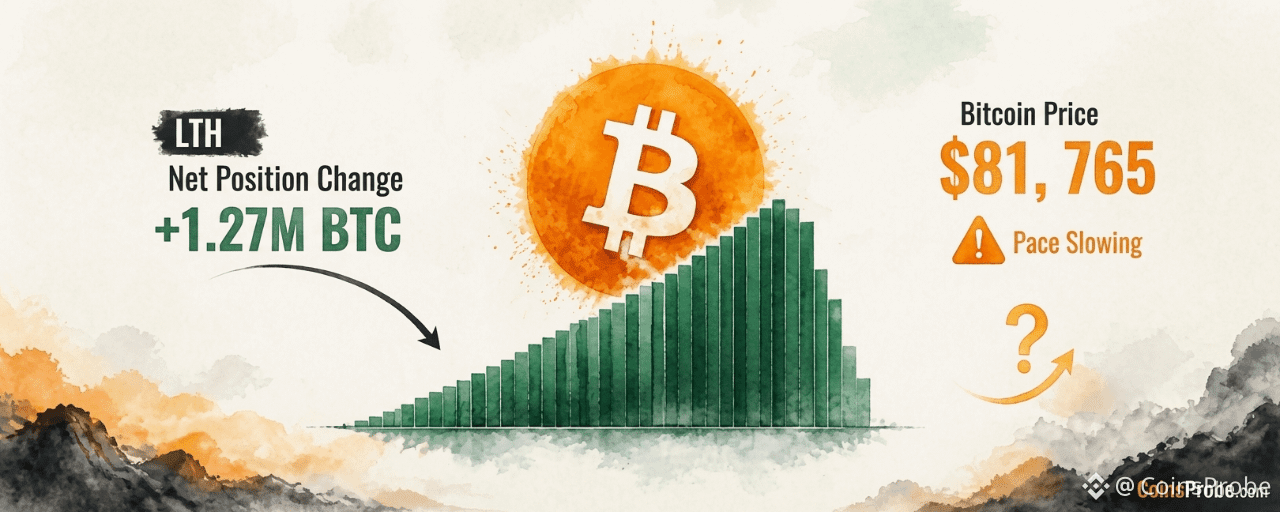
ලිපිය
Bitcoin LTH Net Position Change Hits +1.27M BTC — But the Pace Is SlowingKey Highlights
Bitcoin LTH Net Position Change is +1.27M BTC over 180 days — positive but decelerating, per @Alphractal (Oct 22, 2026)Slowing accumulation pace has historically preceded cycle tops — metric rollover to negative has aligned with every prior bear marketBTC is trading at $81,765 (-1.15% 24h) with a $1.64T market cap as the signal emergesWatch 180-day LTH Net Position Change trajectory: re-acceleration = mid-cycle pause; rollover toward zero = distribution phase beginning
Bitcoin is trading at $81,765 — down 1.15% in the past 24 hours — with a market cap of approximately $1.64 trillion. Beneath the price action, a critical on-chain shift is developing that has historically marked the boundary between accumulation and distribution in Bitcoin’s macro cycle.
On-chain analytics account @Alphractal flagged the dynamic on October 22, 2026: Bitcoin’s Long-Term Holder (LTH) Net Position Change remains positive at +1.27 million BTC over the past 180 days — but the pace of that growth is slowing significantly. The observation is not a buy or sell call. It is a structural warning: a metric that has historically signaled major cycle transitions is entering a zone of deceleration.
What the LTH Net Position Change Actually Measures
The Long-Term Holder Net Position Change tracks the 180-day rolling net accumulation or distribution of coins held by wallets that have not moved their BTC in at least 155 days — the threshold Glassnode and related platforms use to define a long-term holder. A positive reading means LTHs as a cohort are adding to their aggregate holdings. A negative reading means they are net sellers into the market.
Critically, it is not just the sign of the reading that matters — it is the rate of change. When the metric is positive but decelerating, it means LTHs are still accumulating in net terms, but the marginal pace of new coins being locked away is shrinking. Historically, that tapering precedes the phase where LTHs begin distributing into price strength — the exact mechanism that has capped every prior Bitcoin bull market cycle.
The Signal — +1.27M BTC Positive, But Momentum Decelerating
Bitcoin LTH Net Position Change | Source: @Alphractal (X)
As of October 22, 2026, the LTH Net Position Change stands at +1.27 million BTC on a 180-day rolling basis. The chart shared by @Alphractal — spanning Bitcoin’s full price history from 2013 to 2026 — shows alternating green accumulation bars and red distribution bars corresponding precisely to Bitcoin’s documented bull and bear cycles. The current reading is green, confirming net accumulation is still occurring. However, the visual shape of the bar at the far right of the chart is narrowing relative to prior green peaks, indicating the accumulation pace is tapering.
@Alphractal frames the core question directly: is this deceleration a temporary pause before another leg of accumulation resumes, or is it the early signal of the transition into a distribution phase? That distinction carries significant weight. In prior cycles, the metric crossing from positive to negative — or simply peaking and turning lower before going negative — has aligned with major market cycle tops. The current reading has not gone negative. But the slope is flattening.
Why Slowing Accumulation Matters More Than the Absolute Number
A common misreading of this metric is to focus only on whether it is positive or negative. That is incomplete. Long-term holders as a group tend to be the strongest-conviction participants in Bitcoin markets — accumulating through bear markets and gradually distributing as price climbs into euphoria. The velocity of their accumulation or distribution is the leading signal. A reading of +1.27 million BTC sounds strongly bullish in isolation. But if the same metric was at +2 million BTC sixty days ago and has been decelerating toward its current level, the direction of travel is as informative as the absolute level.
This dynamic has direct precedent. In prior cycles, LTH net accumulation peaked well before price peaked — with the distribution phase beginning as price continued to climb, meaning price and LTH behavior diverge at cycle tops. Retail and short-term speculators absorb the coins that LTHs are quietly offloading. If the current deceleration is the leading edge of that transition, Bitcoin at $81,765 could be in a later cycle stage than the price level alone suggests. For additional context on recent large-holder behavior, see Bitcoin Whale Liquidated for 121.33 BTC ($9.91M) as Market Drops.
What Alphractal’s Chart Reveals — Cycle Pattern Context
The full-history chart from @Alphractal places the current reading in explicit cycle context. Green bars — representing positive LTH net position change — dominated 2015–2017, 2019–2021, and again from late 2022 through the current period. Red bars representing net distribution coincided with the 2018 bear market, the mid-2021 correction, and the 2022 crash. The current green bar at the far right is still positive at +1.27 million BTC — but its visual height relative to the prior green peaks from 2020–2021 shows it is tapering, not accelerating. The chart’s left axis, labeled in increments of 1M BTC (3M, 2M, 1M, 0, -1M, -2M), places the current +1.27M reading at just above the midpoint of the prior accumulation range — not near its historical extreme.
That chart positioning matters. If the metric were at or near +2M to +3M and decelerating, the signal would be more urgently late-cycle. At +1.27M, there is room for the reading to re-accelerate — but the burden of evidence now sits with bulls to demonstrate that LTH accumulation is resuming, not ending. Recent large-holder rotation activity — such as the whale that dumped 1,917 BTC for $159M to rotate into ETH — adds texture to why the deceleration reading deserves scrutiny.
The Two Scenarios From Here
Bullish Scenario — Accumulation Re-Accelerates
If LTH Net Position Change stabilizes and begins re-accelerating from the +1.27M level, the deceleration would be classified as a mid-cycle consolidation rather than a cycle top signal. In prior instances where the metric briefly slowed before resuming, Bitcoin went on to register its highest prices of the cycle. A resumption of LTH accumulation velocity would shift the on-chain weight of evidence back toward continuation.
Bearish Scenario — Metric Rolls Over Toward Zero or Negative
If the 180-day rolling LTH Net Position Change continues to decelerate and approaches zero — or crosses negative — the historical pattern becomes unambiguous. Every prior instance of the metric transitioning from positive to negative has coincided with a major market cycle peak and subsequent bear market. At $81,765, a confirmed rollover in this metric would suggest distribution is underway at current price levels, with long-term holders offloading into market strength.
@Alphractal does not provide a specific price trigger — the signal here is metric-directional, not price-level dependent. Watch the 180-day LTH Net Position Change trajectory in the sessions and weeks ahead. That reading — not price action alone — will determine which of the two scenarios is playing out. For further reading on BTC relative to altcoin cycle signals, see SUI/BTC Holds August 2024 Low — Range High Is Now the Target.
The structure is this: +1.27 million BTC in net long-term holder accumulation over 180 days confirms the cohort has not yet become net sellers. But a decelerating positive reading, at this stage of the cycle, is historically the pre-distribution signal — the warning that appears before the inflection, not after it. Whether the current slowdown resolves into renewed accumulation or a genuine top-formation process is the single most consequential on-chain question Bitcoin faces at $81,765.
Disclaimer: The views and analysis presented in this article are for informational purposes only and reflect the author’s perspective, not financial advice. Technical patterns and indicators discussed are subject to market volatility and may or may not yield the anticipated results. Investors are advised to exercise caution, conduct independent research, and make decisions aligned with their individual risk tolerance.
Bitcoin LTH Net Position Change Hits +1.27M BTC — But the Pace Is Slowing
Key Highlights
Bitcoin LTH Net Position Change is +1.27M BTC over 180 days — positive but decelerating, per @Alphractal (Oct 22, 2026)Slowing accumulation pace has historically preceded cycle tops — metric rollover to negative has aligned with every prior bear marketBTC is trading at $81,765 (-1.15% 24h) with a $1.64T market cap as the signal emergesWatch 180-day LTH Net Position Change trajectory: re-acceleration = mid-cycle pause; rollover toward zero = distribution phase beginning
Bitcoin is trading at $81,765 — down 1.15% in the past 24 hours — with a market cap of approximately $1.64 trillion. Beneath the price action, a critical on-chain shift is developing that has historically marked the boundary between accumulation and distribution in Bitcoin’s macro cycle.
On-chain analytics account @Alphractal flagged the dynamic on October 22, 2026: Bitcoin’s Long-Term Holder (LTH) Net Position Change remains positive at +1.27 million BTC over the past 180 days — but the pace of that growth is slowing significantly. The observation is not a buy or sell call. It is a structural warning: a metric that has historically signaled major cycle transitions is entering a zone of deceleration.
What the LTH Net Position Change Actually Measures
The Long-Term Holder Net Position Change tracks the 180-day rolling net accumulation or distribution of coins held by wallets that have not moved their BTC in at least 155 days — the threshold Glassnode and related platforms use to define a long-term holder. A positive reading means LTHs as a cohort are adding to their aggregate holdings. A negative reading means they are net sellers into the market.
Critically, it is not just the sign of the reading that matters — it is the rate of change. When the metric is positive but decelerating, it means LTHs are still accumulating in net terms, but the marginal pace of new coins being locked away is shrinking. Historically, that tapering precedes the phase where LTHs begin distributing into price strength — the exact mechanism that has capped every prior Bitcoin bull market cycle.
The Signal — +1.27M BTC Positive, But Momentum Decelerating
Bitcoin LTH Net Position Change | Source: @Alphractal (X)
As of October 22, 2026, the LTH Net Position Change stands at +1.27 million BTC on a 180-day rolling basis. The chart shared by @Alphractal — spanning Bitcoin’s full price history from 2013 to 2026 — shows alternating green accumulation bars and red distribution bars corresponding precisely to Bitcoin’s documented bull and bear cycles. The current reading is green, confirming net accumulation is still occurring. However, the visual shape of the bar at the far right of the chart is narrowing relative to prior green peaks, indicating the accumulation pace is tapering.
@Alphractal frames the core question directly: is this deceleration a temporary pause before another leg of accumulation resumes, or is it the early signal of the transition into a distribution phase? That distinction carries significant weight. In prior cycles, the metric crossing from positive to negative — or simply peaking and turning lower before going negative — has aligned with major market cycle tops. The current reading has not gone negative. But the slope is flattening.
Why Slowing Accumulation Matters More Than the Absolute Number
A common misreading of this metric is to focus only on whether it is positive or negative. That is incomplete. Long-term holders as a group tend to be the strongest-conviction participants in Bitcoin markets — accumulating through bear markets and gradually distributing as price climbs into euphoria. The velocity of their accumulation or distribution is the leading signal. A reading of +1.27 million BTC sounds strongly bullish in isolation. But if the same metric was at +2 million BTC sixty days ago and has been decelerating toward its current level, the direction of travel is as informative as the absolute level.
This dynamic has direct precedent. In prior cycles, LTH net accumulation peaked well before price peaked — with the distribution phase beginning as price continued to climb, meaning price and LTH behavior diverge at cycle tops. Retail and short-term speculators absorb the coins that LTHs are quietly offloading. If the current deceleration is the leading edge of that transition, Bitcoin at $81,765 could be in a later cycle stage than the price level alone suggests. For additional context on recent large-holder behavior, see Bitcoin Whale Liquidated for 121.33 BTC ($9.91M) as Market Drops.
What Alphractal’s Chart Reveals — Cycle Pattern Context
The full-history chart from @Alphractal places the current reading in explicit cycle context. Green bars — representing positive LTH net position change — dominated 2015–2017, 2019–2021, and again from late 2022 through the current period. Red bars representing net distribution coincided with the 2018 bear market, the mid-2021 correction, and the 2022 crash. The current green bar at the far right is still positive at +1.27 million BTC — but its visual height relative to the prior green peaks from 2020–2021 shows it is tapering, not accelerating. The chart’s left axis, labeled in increments of 1M BTC (3M, 2M, 1M, 0, -1M, -2M), places the current +1.27M reading at just above the midpoint of the prior accumulation range — not near its historical extreme.
That chart positioning matters. If the metric were at or near +2M to +3M and decelerating, the signal would be more urgently late-cycle. At +1.27M, there is room for the reading to re-accelerate — but the burden of evidence now sits with bulls to demonstrate that LTH accumulation is resuming, not ending. Recent large-holder rotation activity — such as the whale that dumped 1,917 BTC for $159M to rotate into ETH — adds texture to why the deceleration reading deserves scrutiny.
The Two Scenarios From Here
Bullish Scenario — Accumulation Re-Accelerates
If LTH Net Position Change stabilizes and begins re-accelerating from the +1.27M level, the deceleration would be classified as a mid-cycle consolidation rather than a cycle top signal. In prior instances where the metric briefly slowed before resuming, Bitcoin went on to register its highest prices of the cycle. A resumption of LTH accumulation velocity would shift the on-chain weight of evidence back toward continuation.
Bearish Scenario — Metric Rolls Over Toward Zero or Negative
If the 180-day rolling LTH Net Position Change continues to decelerate and approaches zero — or crosses negative — the historical pattern becomes unambiguous. Every prior instance of the metric transitioning from positive to negative has coincided with a major market cycle peak and subsequent bear market. At $81,765, a confirmed rollover in this metric would suggest distribution is underway at current price levels, with long-term holders offloading into market strength.
@Alphractal does not provide a specific price trigger — the signal here is metric-directional, not price-level dependent. Watch the 180-day LTH Net Position Change trajectory in the sessions and weeks ahead. That reading — not price action alone — will determine which of the two scenarios is playing out. For further reading on BTC relative to altcoin cycle signals, see SUI/BTC Holds August 2024 Low — Range High Is Now the Target.
The structure is this: +1.27 million BTC in net long-term holder accumulation over 180 days confirms the cohort has not yet become net sellers. But a decelerating positive reading, at this stage of the cycle, is historically the pre-distribution signal — the warning that appears before the inflection, not after it. Whether the current slowdown resolves into renewed accumulation or a genuine top-formation process is the single most consequential on-chain question Bitcoin faces at $81,765.
Disclaimer: The views and analysis presented in this article are for informational purposes only and reflect the author’s perspective, not financial advice. Technical patterns and indicators discussed are subject to market volatility and may or may not yield the anticipated results. Investors are advised to exercise caution, conduct independent research, and make decisions aligned with their individual risk tolerance.
Bitcoin LTH Net Position Change is +1.27M BTC over 180 days — positive but decelerating, per @Alphractal (Oct 22, 2026)Slowing accumulation pace has historically preceded cycle tops — metric rollover to negative has aligned with every prior bear marketBTC is trading at $81,765 (-1.15% 24h) with a $1.64T market cap as the signal emergesWatch 180-day LTH Net Position Change trajectory: re-acceleration = mid-cycle pause; rollover toward zero = distribution phase beginning
Bitcoin is trading at $81,765 — down 1.15% in the past 24 hours — with a market cap of approximately $1.64 trillion. Beneath the price action, a critical on-chain shift is developing that has historically marked the boundary between accumulation and distribution in Bitcoin’s macro cycle.
On-chain analytics account @Alphractal flagged the dynamic on October 22, 2026: Bitcoin’s Long-Term Holder (LTH) Net Position Change remains positive at +1.27 million BTC over the past 180 days — but the pace of that growth is slowing significantly. The observation is not a buy or sell call. It is a structural warning: a metric that has historically signaled major cycle transitions is entering a zone of deceleration.
What the LTH Net Position Change Actually Measures
The Long-Term Holder Net Position Change tracks the 180-day rolling net accumulation or distribution of coins held by wallets that have not moved their BTC in at least 155 days — the threshold Glassnode and related platforms use to define a long-term holder. A positive reading means LTHs as a cohort are adding to their aggregate holdings. A negative reading means they are net sellers into the market.
Critically, it is not just the sign of the reading that matters — it is the rate of change. When the metric is positive but decelerating, it means LTHs are still accumulating in net terms, but the marginal pace of new coins being locked away is shrinking. Historically, that tapering precedes the phase where LTHs begin distributing into price strength — the exact mechanism that has capped every prior Bitcoin bull market cycle.
The Signal — +1.27M BTC Positive, But Momentum Decelerating
Bitcoin LTH Net Position Change | Source: @Alphractal (X)
As of October 22, 2026, the LTH Net Position Change stands at +1.27 million BTC on a 180-day rolling basis. The chart shared by @Alphractal — spanning Bitcoin’s full price history from 2013 to 2026 — shows alternating green accumulation bars and red distribution bars corresponding precisely to Bitcoin’s documented bull and bear cycles. The current reading is green, confirming net accumulation is still occurring. However, the visual shape of the bar at the far right of the chart is narrowing relative to prior green peaks, indicating the accumulation pace is tapering.
@Alphractal frames the core question directly: is this deceleration a temporary pause before another leg of accumulation resumes, or is it the early signal of the transition into a distribution phase? That distinction carries significant weight. In prior cycles, the metric crossing from positive to negative — or simply peaking and turning lower before going negative — has aligned with major market cycle tops. The current reading has not gone negative. But the slope is flattening.
Why Slowing Accumulation Matters More Than the Absolute Number
A common misreading of this metric is to focus only on whether it is positive or negative. That is incomplete. Long-term holders as a group tend to be the strongest-conviction participants in Bitcoin markets — accumulating through bear markets and gradually distributing as price climbs into euphoria. The velocity of their accumulation or distribution is the leading signal. A reading of +1.27 million BTC sounds strongly bullish in isolation. But if the same metric was at +2 million BTC sixty days ago and has been decelerating toward its current level, the direction of travel is as informative as the absolute level.
This dynamic has direct precedent. In prior cycles, LTH net accumulation peaked well before price peaked — with the distribution phase beginning as price continued to climb, meaning price and LTH behavior diverge at cycle tops. Retail and short-term speculators absorb the coins that LTHs are quietly offloading. If the current deceleration is the leading edge of that transition, Bitcoin at $81,765 could be in a later cycle stage than the price level alone suggests. For additional context on recent large-holder behavior, see Bitcoin Whale Liquidated for 121.33 BTC ($9.91M) as Market Drops.
What Alphractal’s Chart Reveals — Cycle Pattern Context
The full-history chart from @Alphractal places the current reading in explicit cycle context. Green bars — representing positive LTH net position change — dominated 2015–2017, 2019–2021, and again from late 2022 through the current period. Red bars representing net distribution coincided with the 2018 bear market, the mid-2021 correction, and the 2022 crash. The current green bar at the far right is still positive at +1.27 million BTC — but its visual height relative to the prior green peaks from 2020–2021 shows it is tapering, not accelerating. The chart’s left axis, labeled in increments of 1M BTC (3M, 2M, 1M, 0, -1M, -2M), places the current +1.27M reading at just above the midpoint of the prior accumulation range — not near its historical extreme.
That chart positioning matters. If the metric were at or near +2M to +3M and decelerating, the signal would be more urgently late-cycle. At +1.27M, there is room for the reading to re-accelerate — but the burden of evidence now sits with bulls to demonstrate that LTH accumulation is resuming, not ending. Recent large-holder rotation activity — such as the whale that dumped 1,917 BTC for $159M to rotate into ETH — adds texture to why the deceleration reading deserves scrutiny.
The Two Scenarios From Here
Bullish Scenario — Accumulation Re-Accelerates
If LTH Net Position Change stabilizes and begins re-accelerating from the +1.27M level, the deceleration would be classified as a mid-cycle consolidation rather than a cycle top signal. In prior instances where the metric briefly slowed before resuming, Bitcoin went on to register its highest prices of the cycle. A resumption of LTH accumulation velocity would shift the on-chain weight of evidence back toward continuation.
Bearish Scenario — Metric Rolls Over Toward Zero or Negative
If the 180-day rolling LTH Net Position Change continues to decelerate and approaches zero — or crosses negative — the historical pattern becomes unambiguous. Every prior instance of the metric transitioning from positive to negative has coincided with a major market cycle peak and subsequent bear market. At $81,765, a confirmed rollover in this metric would suggest distribution is underway at current price levels, with long-term holders offloading into market strength.
@Alphractal does not provide a specific price trigger — the signal here is metric-directional, not price-level dependent. Watch the 180-day LTH Net Position Change trajectory in the sessions and weeks ahead. That reading — not price action alone — will determine which of the two scenarios is playing out. For further reading on BTC relative to altcoin cycle signals, see SUI/BTC Holds August 2024 Low — Range High Is Now the Target.
The structure is this: +1.27 million BTC in net long-term holder accumulation over 180 days confirms the cohort has not yet become net sellers. But a decelerating positive reading, at this stage of the cycle, is historically the pre-distribution signal — the warning that appears before the inflection, not after it. Whether the current slowdown resolves into renewed accumulation or a genuine top-formation process is the single most consequential on-chain question Bitcoin faces at $81,765.
Disclaimer: The views and analysis presented in this article are for informational purposes only and reflect the author’s perspective, not financial advice. Technical patterns and indicators discussed are subject to market volatility and may or may not yield the anticipated results. Investors are advised to exercise caution, conduct independent research, and make decisions aligned with their individual risk tolerance.
120
·
--

ලිපිය
SpaceX-Tesla Merger Could Put 30,221 BTC on One Balance SheetKey Highlights
SpaceX holds 18,712 BTC; Tesla holds 11,509 BTC — combined 30,221 BTC per CryptoQuant on-chain dataCombined Q3 revenue of potential merged entity: $42.63B (SpaceX $14.58B + Tesla $28.05B)30,221 BTC consolidated figure is conditional on merger closing — currently two separate verified on-chain positionsBitcoin trading at $81,769 (-1.96% 24h) as corporate treasury story develops off-chart
Bitcoin is trading at $81,769 — down 1.96% in the past 24 hours — while the most consequential corporate crypto story of 2026 is unfolding entirely off the price chart. If a SpaceX-Tesla merger closes, it would create a single corporate entity holding more Bitcoin than any institution has ever consolidated on one balance sheet.
CryptoQuant (@cryptoquant_com) flagged the data on October 22, 2026: “SpaceX and Tesla are exploring a merger. SpaceX holds 18,712 BTC. Tesla holds 11,509 BTC. Combined, that’s 30,221 BTC on one balance sheet if the merger happens.” The framing is deliberate — this is not a price call. It is a structural observation about what a corporate consolidation would mean for Bitcoin’s institutional supply picture.
The Holdings: What Each Company Currently Holds
The numbers are not estimates. CryptoQuant’s on-chain dashboards track verified corporate addresses. SpaceX holds 18,712 BTC — the larger of the two positions. Tesla holds 11,509 BTC, a position that has been public knowledge since the company’s 2021 disclosure. Together, the two Elon Musk-controlled entities already hold 30,221 BTC in aggregate, even before any formal merger structure is finalized.
For context: MicroStrategy (now Strategy) has spent years accumulating Bitcoin as its primary treasury strategy and currently holds the largest single corporate Bitcoin position on record. A merged SpaceX-Tesla entity at 30,221 BTC would represent one of the most significant concentrations of corporate Bitcoin holdings in the asset’s history — achieved not through a dedicated accumulation strategy, but as a byproduct of two separate corporate treasuries combining.
SpaceX’s Holdings — The Chart Shows a Staircase of Reductions
The CryptoQuant chart tracking SpaceX’s Bitcoin address balance against BTC price — spanning mid-2020 through late 2026 — shows a staircase pattern of step-downs in the holdings balance, with discrete red markers indicating specific dates when the address balance decreased. The current verified balance sits at 18,712 BTC. Green markers on the chart indicate accumulation events; the overall pattern reflects a company that has actively managed its Bitcoin position rather than holding passively. The chart correlation places these balance changes against BTC’s price cycle — sharp decline mid-2022, prolonged recovery into the 2024–2025 peak, and the subsequent pullback to current levels near $81,769.
Chart 1 of 2: Chart Analysis | Source: @cryptoquant_com (X)
Tesla’s Holdings — Two Distinct Sell Events, Then Flat
Tesla’s CryptoQuant address balance chart tells a different story. The yellow balance line shows two distinct step-downs: a first reduction around early 2021 and a second around mid-2022, after which the balance has remained essentially flat through the remainder of the chart — through 2025 and into late 2026. This flatline suggests Tesla has not meaningfully added to or reduced its 11,509 BTC position in several years. The company sold a significant portion of its original Bitcoin purchase in 2022 but has held its remaining position without further liquidation. Tesla’s own stock price — shown as the pink oscillating line on the same chart — has recovered and trended upward through 2025–2026 after its prolonged trough period, a separate dynamic that has context given Tesla’s recent market cap expansion following the Flying Roadster unveil.
Source: @cryptoquant_com (X)
The Revenue Picture: Why This Merger Would Be Enormous
CryptoQuant’s post includes the Q3 quarterly revenue figures for both entities. SpaceX generated $14.58 billion in Q3 revenue. Tesla generated $28.05 billion in the same quarter. A combined entity would represent over $42 billion in quarterly revenue — making it one of the largest private-public hybrid conglomerates ever assembled, with Bitcoin embedded directly on the unified balance sheet.
The significance for Bitcoin is structural, not speculative. Corporate treasuries at this scale do not trade in and out of positions the way retail or hedge fund participants do. A 30,221 BTC position on a $42B+ quarterly revenue balance sheet would be a long-duration hold — effectively removing that supply from liquid circulation for years. The SPCX ascending triangle breakout and TSLA price action that analysts have been watching takes on additional dimension when the underlying entities are also the second and third largest corporate Bitcoin holders in the world.
What the Data Says — and What It Doesn’t
CryptoQuant’s post is explicit that this is a data observation, not a trading signal or price target. No price levels, upside targets, or on-chain flow metrics were cited in the note. The merger itself remains exploratory — the post uses the phrase “are exploring,” not “have agreed to” or “have announced.” The 30,221 BTC figure is a conditional number: it describes what would exist on a combined balance sheet if the merger closes, not a confirmed outcome.
What the data does confirm with certainty: both SpaceX and Tesla have already made Bitcoin a treasury asset independently. The on-chain addresses are tracked and verified by CryptoQuant. The 30,221 BTC aggregate is not a projection — it is the sum of two already-existing, on-chain-verified positions. Whether those positions end up on one entity’s balance sheet is the only open variable.
Bullish Scenario
If the merger closes and the 30,221 BTC consolidates onto a single balance sheet, it signals institutional permanence for Bitcoin as a corporate treasury asset at a scale not previously seen outside dedicated Bitcoin accumulation vehicles. A combined entity with $42B+ in quarterly revenue and no stated intention to reduce the Bitcoin position would represent one of the most durable long-duration Bitcoin holders in existence — removing 30,221 BTC from liquid supply for the foreseeable future.
Bearish Scenario
If the merger does not materialize, or if the combined entity chooses to rationalize its balance sheet by liquidating one or both Bitcoin positions, the market would face unexpected supply from two historically inactive holders. Tesla’s 2022 Bitcoin sale — which moved price — established a precedent that corporate Bitcoin positions are not permanent even when they appear stable.
The single number that defines this story is 30,221 BTC — the combined on-chain-verified holdings of SpaceX (18,712 BTC) and Tesla (11,509 BTC). No price target attaches to it. No timeline attaches to it. What attaches to it is a structural question: whether the largest potential corporate Bitcoin consolidation in history accelerates institutional adoption’s second phase or remains two separate line items on two separate balance sheets. CryptoQuant’s on-chain dashboards will register any movement in either address in real time. Watch those balances — not the merger headlines — for the first signal that something has changed.
Disclaimer: The views and analysis presented in this article are for informational purposes only and reflect the author’s perspective, not financial advice. Technical patterns and indicators discussed are subject to market volatility and may or may not yield anticipated results. Investors are advised to exercise caution, conduct independent research, and make decisions aligned with their individual risk tolerance.
SpaceX-Tesla Merger Could Put 30,221 BTC on One Balance Sheet
Key Highlights
SpaceX holds 18,712 BTC; Tesla holds 11,509 BTC — combined 30,221 BTC per CryptoQuant on-chain dataCombined Q3 revenue of potential merged entity: $42.63B (SpaceX $14.58B + Tesla $28.05B)30,221 BTC consolidated figure is conditional on merger closing — currently two separate verified on-chain positionsBitcoin trading at $81,769 (-1.96% 24h) as corporate treasury story develops off-chart
Bitcoin is trading at $81,769 — down 1.96% in the past 24 hours — while the most consequential corporate crypto story of 2026 is unfolding entirely off the price chart. If a SpaceX-Tesla merger closes, it would create a single corporate entity holding more Bitcoin than any institution has ever consolidated on one balance sheet.
CryptoQuant (@cryptoquant_com) flagged the data on October 22, 2026: “SpaceX and Tesla are exploring a merger. SpaceX holds 18,712 BTC. Tesla holds 11,509 BTC. Combined, that’s 30,221 BTC on one balance sheet if the merger happens.” The framing is deliberate — this is not a price call. It is a structural observation about what a corporate consolidation would mean for Bitcoin’s institutional supply picture.
The Holdings: What Each Company Currently Holds
The numbers are not estimates. CryptoQuant’s on-chain dashboards track verified corporate addresses. SpaceX holds 18,712 BTC — the larger of the two positions. Tesla holds 11,509 BTC, a position that has been public knowledge since the company’s 2021 disclosure. Together, the two Elon Musk-controlled entities already hold 30,221 BTC in aggregate, even before any formal merger structure is finalized.
For context: MicroStrategy (now Strategy) has spent years accumulating Bitcoin as its primary treasury strategy and currently holds the largest single corporate Bitcoin position on record. A merged SpaceX-Tesla entity at 30,221 BTC would represent one of the most significant concentrations of corporate Bitcoin holdings in the asset’s history — achieved not through a dedicated accumulation strategy, but as a byproduct of two separate corporate treasuries combining.
SpaceX’s Holdings — The Chart Shows a Staircase of Reductions
The CryptoQuant chart tracking SpaceX’s Bitcoin address balance against BTC price — spanning mid-2020 through late 2026 — shows a staircase pattern of step-downs in the holdings balance, with discrete red markers indicating specific dates when the address balance decreased. The current verified balance sits at 18,712 BTC. Green markers on the chart indicate accumulation events; the overall pattern reflects a company that has actively managed its Bitcoin position rather than holding passively. The chart correlation places these balance changes against BTC’s price cycle — sharp decline mid-2022, prolonged recovery into the 2024–2025 peak, and the subsequent pullback to current levels near $81,769.
Chart 1 of 2: Chart Analysis | Source: @cryptoquant_com (X)
Tesla’s Holdings — Two Distinct Sell Events, Then Flat
Tesla’s CryptoQuant address balance chart tells a different story. The yellow balance line shows two distinct step-downs: a first reduction around early 2021 and a second around mid-2022, after which the balance has remained essentially flat through the remainder of the chart — through 2025 and into late 2026. This flatline suggests Tesla has not meaningfully added to or reduced its 11,509 BTC position in several years. The company sold a significant portion of its original Bitcoin purchase in 2022 but has held its remaining position without further liquidation. Tesla’s own stock price — shown as the pink oscillating line on the same chart — has recovered and trended upward through 2025–2026 after its prolonged trough period, a separate dynamic that has context given Tesla’s recent market cap expansion following the Flying Roadster unveil.
Source: @cryptoquant_com (X)
The Revenue Picture: Why This Merger Would Be Enormous
CryptoQuant’s post includes the Q3 quarterly revenue figures for both entities. SpaceX generated $14.58 billion in Q3 revenue. Tesla generated $28.05 billion in the same quarter. A combined entity would represent over $42 billion in quarterly revenue — making it one of the largest private-public hybrid conglomerates ever assembled, with Bitcoin embedded directly on the unified balance sheet.
The significance for Bitcoin is structural, not speculative. Corporate treasuries at this scale do not trade in and out of positions the way retail or hedge fund participants do. A 30,221 BTC position on a $42B+ quarterly revenue balance sheet would be a long-duration hold — effectively removing that supply from liquid circulation for years. The SPCX ascending triangle breakout and TSLA price action that analysts have been watching takes on additional dimension when the underlying entities are also the second and third largest corporate Bitcoin holders in the world.
What the Data Says — and What It Doesn’t
CryptoQuant’s post is explicit that this is a data observation, not a trading signal or price target. No price levels, upside targets, or on-chain flow metrics were cited in the note. The merger itself remains exploratory — the post uses the phrase “are exploring,” not “have agreed to” or “have announced.” The 30,221 BTC figure is a conditional number: it describes what would exist on a combined balance sheet if the merger closes, not a confirmed outcome.
What the data does confirm with certainty: both SpaceX and Tesla have already made Bitcoin a treasury asset independently. The on-chain addresses are tracked and verified by CryptoQuant. The 30,221 BTC aggregate is not a projection — it is the sum of two already-existing, on-chain-verified positions. Whether those positions end up on one entity’s balance sheet is the only open variable.
Bullish Scenario
If the merger closes and the 30,221 BTC consolidates onto a single balance sheet, it signals institutional permanence for Bitcoin as a corporate treasury asset at a scale not previously seen outside dedicated Bitcoin accumulation vehicles. A combined entity with $42B+ in quarterly revenue and no stated intention to reduce the Bitcoin position would represent one of the most durable long-duration Bitcoin holders in existence — removing 30,221 BTC from liquid supply for the foreseeable future.
Bearish Scenario
If the merger does not materialize, or if the combined entity chooses to rationalize its balance sheet by liquidating one or both Bitcoin positions, the market would face unexpected supply from two historically inactive holders. Tesla’s 2022 Bitcoin sale — which moved price — established a precedent that corporate Bitcoin positions are not permanent even when they appear stable.
The single number that defines this story is 30,221 BTC — the combined on-chain-verified holdings of SpaceX (18,712 BTC) and Tesla (11,509 BTC). No price target attaches to it. No timeline attaches to it. What attaches to it is a structural question: whether the largest potential corporate Bitcoin consolidation in history accelerates institutional adoption’s second phase or remains two separate line items on two separate balance sheets. CryptoQuant’s on-chain dashboards will register any movement in either address in real time. Watch those balances — not the merger headlines — for the first signal that something has changed.
Disclaimer: The views and analysis presented in this article are for informational purposes only and reflect the author’s perspective, not financial advice. Technical patterns and indicators discussed are subject to market volatility and may or may not yield anticipated results. Investors are advised to exercise caution, conduct independent research, and make decisions aligned with their individual risk tolerance.
SpaceX holds 18,712 BTC; Tesla holds 11,509 BTC — combined 30,221 BTC per CryptoQuant on-chain dataCombined Q3 revenue of potential merged entity: $42.63B (SpaceX $14.58B + Tesla $28.05B)30,221 BTC consolidated figure is conditional on merger closing — currently two separate verified on-chain positionsBitcoin trading at $81,769 (-1.96% 24h) as corporate treasury story develops off-chart
Bitcoin is trading at $81,769 — down 1.96% in the past 24 hours — while the most consequential corporate crypto story of 2026 is unfolding entirely off the price chart. If a SpaceX-Tesla merger closes, it would create a single corporate entity holding more Bitcoin than any institution has ever consolidated on one balance sheet.
CryptoQuant (@cryptoquant_com) flagged the data on October 22, 2026: “SpaceX and Tesla are exploring a merger. SpaceX holds 18,712 BTC. Tesla holds 11,509 BTC. Combined, that’s 30,221 BTC on one balance sheet if the merger happens.” The framing is deliberate — this is not a price call. It is a structural observation about what a corporate consolidation would mean for Bitcoin’s institutional supply picture.
The Holdings: What Each Company Currently Holds
The numbers are not estimates. CryptoQuant’s on-chain dashboards track verified corporate addresses. SpaceX holds 18,712 BTC — the larger of the two positions. Tesla holds 11,509 BTC, a position that has been public knowledge since the company’s 2021 disclosure. Together, the two Elon Musk-controlled entities already hold 30,221 BTC in aggregate, even before any formal merger structure is finalized.
For context: MicroStrategy (now Strategy) has spent years accumulating Bitcoin as its primary treasury strategy and currently holds the largest single corporate Bitcoin position on record. A merged SpaceX-Tesla entity at 30,221 BTC would represent one of the most significant concentrations of corporate Bitcoin holdings in the asset’s history — achieved not through a dedicated accumulation strategy, but as a byproduct of two separate corporate treasuries combining.
SpaceX’s Holdings — The Chart Shows a Staircase of Reductions
The CryptoQuant chart tracking SpaceX’s Bitcoin address balance against BTC price — spanning mid-2020 through late 2026 — shows a staircase pattern of step-downs in the holdings balance, with discrete red markers indicating specific dates when the address balance decreased. The current verified balance sits at 18,712 BTC. Green markers on the chart indicate accumulation events; the overall pattern reflects a company that has actively managed its Bitcoin position rather than holding passively. The chart correlation places these balance changes against BTC’s price cycle — sharp decline mid-2022, prolonged recovery into the 2024–2025 peak, and the subsequent pullback to current levels near $81,769.
Chart 1 of 2: Chart Analysis | Source: @cryptoquant_com (X)
Tesla’s Holdings — Two Distinct Sell Events, Then Flat
Tesla’s CryptoQuant address balance chart tells a different story. The yellow balance line shows two distinct step-downs: a first reduction around early 2021 and a second around mid-2022, after which the balance has remained essentially flat through the remainder of the chart — through 2025 and into late 2026. This flatline suggests Tesla has not meaningfully added to or reduced its 11,509 BTC position in several years. The company sold a significant portion of its original Bitcoin purchase in 2022 but has held its remaining position without further liquidation. Tesla’s own stock price — shown as the pink oscillating line on the same chart — has recovered and trended upward through 2025–2026 after its prolonged trough period, a separate dynamic that has context given Tesla’s recent market cap expansion following the Flying Roadster unveil.
Source: @cryptoquant_com (X)
The Revenue Picture: Why This Merger Would Be Enormous
CryptoQuant’s post includes the Q3 quarterly revenue figures for both entities. SpaceX generated $14.58 billion in Q3 revenue. Tesla generated $28.05 billion in the same quarter. A combined entity would represent over $42 billion in quarterly revenue — making it one of the largest private-public hybrid conglomerates ever assembled, with Bitcoin embedded directly on the unified balance sheet.
The significance for Bitcoin is structural, not speculative. Corporate treasuries at this scale do not trade in and out of positions the way retail or hedge fund participants do. A 30,221 BTC position on a $42B+ quarterly revenue balance sheet would be a long-duration hold — effectively removing that supply from liquid circulation for years. The SPCX ascending triangle breakout and TSLA price action that analysts have been watching takes on additional dimension when the underlying entities are also the second and third largest corporate Bitcoin holders in the world.
What the Data Says — and What It Doesn’t
CryptoQuant’s post is explicit that this is a data observation, not a trading signal or price target. No price levels, upside targets, or on-chain flow metrics were cited in the note. The merger itself remains exploratory — the post uses the phrase “are exploring,” not “have agreed to” or “have announced.” The 30,221 BTC figure is a conditional number: it describes what would exist on a combined balance sheet if the merger closes, not a confirmed outcome.
What the data does confirm with certainty: both SpaceX and Tesla have already made Bitcoin a treasury asset independently. The on-chain addresses are tracked and verified by CryptoQuant. The 30,221 BTC aggregate is not a projection — it is the sum of two already-existing, on-chain-verified positions. Whether those positions end up on one entity’s balance sheet is the only open variable.
Bullish Scenario
If the merger closes and the 30,221 BTC consolidates onto a single balance sheet, it signals institutional permanence for Bitcoin as a corporate treasury asset at a scale not previously seen outside dedicated Bitcoin accumulation vehicles. A combined entity with $42B+ in quarterly revenue and no stated intention to reduce the Bitcoin position would represent one of the most durable long-duration Bitcoin holders in existence — removing 30,221 BTC from liquid supply for the foreseeable future.
Bearish Scenario
If the merger does not materialize, or if the combined entity chooses to rationalize its balance sheet by liquidating one or both Bitcoin positions, the market would face unexpected supply from two historically inactive holders. Tesla’s 2022 Bitcoin sale — which moved price — established a precedent that corporate Bitcoin positions are not permanent even when they appear stable.
The single number that defines this story is 30,221 BTC — the combined on-chain-verified holdings of SpaceX (18,712 BTC) and Tesla (11,509 BTC). No price target attaches to it. No timeline attaches to it. What attaches to it is a structural question: whether the largest potential corporate Bitcoin consolidation in history accelerates institutional adoption’s second phase or remains two separate line items on two separate balance sheets. CryptoQuant’s on-chain dashboards will register any movement in either address in real time. Watch those balances — not the merger headlines — for the first signal that something has changed.
Disclaimer: The views and analysis presented in this article are for informational purposes only and reflect the author’s perspective, not financial advice. Technical patterns and indicators discussed are subject to market volatility and may or may not yield anticipated results. Investors are advised to exercise caution, conduct independent research, and make decisions aligned with their individual risk tolerance.
209
·
--
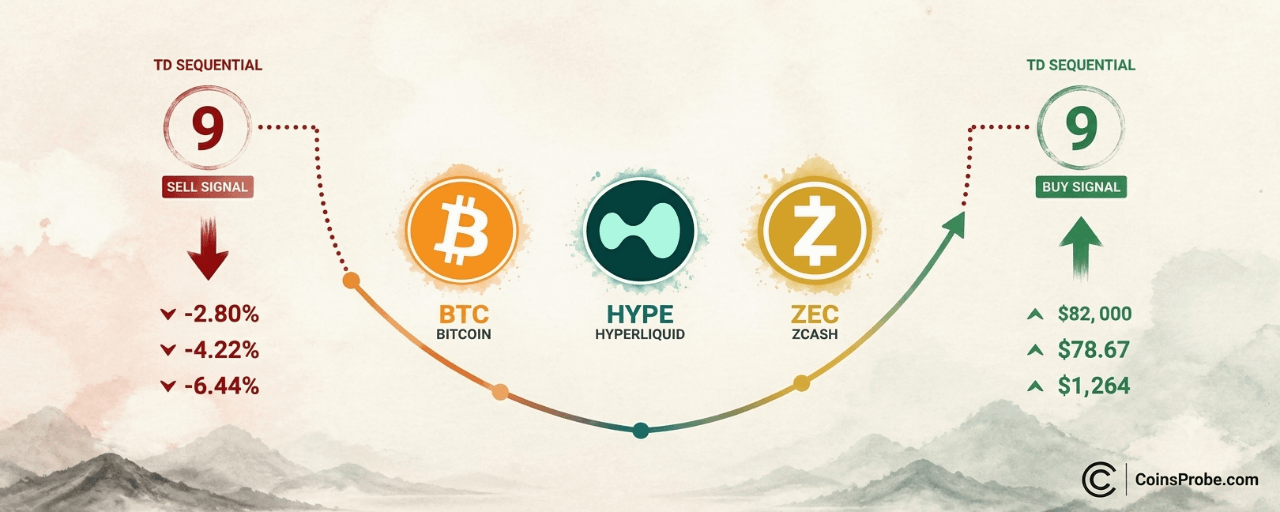
ලිපිය
BTC, HYPE, and ZEC Flash TD Sequential Buy Signals After 2.80%–6.44% PullbacksKey Highlights
Bitcoin TD Sequential sell-9 at $85,000 preceded a confirmed 2.80% drop to $82,000; buy-9 now active at $82,348HYPE dropped 4.22% from $82 local top; TD Sequential buy signal printed at $78.67 with $78 as key support per @alichartsZEC fell 6.44% from $1,350; buy signal active at $1,264 — analyst watching $1,250 as invalidation floor
Bitcoin is trading at $82,031 — down 1.22% in the last 24 hours and sitting on a market cap of $1.649 trillion — after a sharp pullback from the $85,000 zone. The decline was not random noise. It was preceded by a textbook TD Sequential sell signal, and now the same indicator has printed its mirror opposite: a buy signal at the lows.
Crypto analyst Ali Martinez (@alicharts) flagged the setup in a five-part thread, noting that Bitcoin, Hyperliquid, and Zcash all followed the same sequence — a sell signal near a local top, a measured correction, and a fresh buy signal at current lows. “Bitcoin, Hyperliquid, and Zcash retrace… but look ready to bounce back,” Martinez wrote, watching all three for buyer follow-through.
Signal 1 — Bitcoin: Sell at $85,000, Buy at $82,000
The TD Sequential indicator counts nine consecutive candles closing in the same direction — identifying momentum exhaustion rather than a price level. When a count of nine completes, it signals that the prevailing move has statistically run its course and a reversal or pause is likely.
On Bitcoin’s one-hour chart, the TD Sequential printed a sell-9 signal as price approached $85,000. What followed was precise: a 2.80% correction that brought BTC back toward the $82,000 zone — exactly where the chart now shows a completed buy-9 signal with an upward arrow near $82,348. The sell signal’s outcome is already printed on the chart; the -2.79% label is a realized move, not a projection. The buy signal is live.
BTC 1H TD Sequential Buy Signals | Source: @alicharts (X)
For broader context on where Bitcoin’s key rebound targets sit, CoinsProbe’s earlier analysis on BTC, ETH, XRP rebound targets — $86,500, $2,700, and $1.55 in focus remains directly relevant here.
Signal 2 — Hyperliquid: 4.22% Drop, Buy Signal Near $78.67
Hyperliquid (HYPE) followed an identical sequence on its one-hour chart. The TD Sequential printed a sell-9 near the local top around $82. A 4.22% correction followed — the label is already printed on the left side of the chart, marking a completed move. Price stairstepped lower in a sustained series of declining candles before a buy-9 signal appeared near current lows at approximately $78.67.
Per Martinez’s thread, the immediate support level to hold is $78, with a rebound target back toward $82+ if buyers step in at the buy signal. A count reset showing a “1” on the right side of the chart confirms the sequence has restarted — the structure is consistent with early-stage reversal positioning rather than continuation of the downtrend.
HYPE 1H Chart TD Sequential Buy Signal | Source: @alicharts (X)
Signal 3 — Zcash: 6.44% Correction, Buy Signal at $1,264
Zcash (ZEC) produced the largest correction of the three. The sell-9 appeared near the $1,350 local top on the one-hour chart. The subsequent decline measured 6.44% — again, already printed on the chart as a realized move. Price cascaded through $1,320 and $1,290 before the buy-9 signal appeared at the current low near $1,264.
Martinez is watching the $1,250 level as the key support — notably, this level is cited in the analyst’s thread and does not appear as a printed label on the chart itself. A hold above $1,250 with follow-through buying would target a rebound toward the prior top at $1,350.
ZEC 1H Chart Flash TD Sequential Buy Signal | Source: @alicharts (X)
Why Three Simultaneous Buy Signals Matter
Individually, a single TD Sequential buy signal on one asset’s hourly chart is a tactical observation. When the same setup — sell signal at top, measured correction, buy signal at lows — prints across three uncorrelated assets in the same session, the statistical weight increases. Bitcoin, Hyperliquid, and Zcash are structurally different assets with different market caps, use cases, and liquidity profiles. The fact that all three followed the same TD Sequential playbook in the same session is the core of Martinez’s thread.
The TD Sequential is a non-directional exhaustion indicator — it does not predict magnitude or guarantee reversal. What it confirms is that the selling pressure across a nine-candle sequence has statistically exhausted itself. Whether buyers respond is the variable that Martinez is explicitly watching: “all three assets show TD Sequential buy signals post-pullback; watching for buyer follow-through.”
For a comparable setup in a single asset, CoinsProbe’s analysis of PENGU’s 3-for-3 SuperTrend buy signal track record illustrates how technical exhaustion signals can precede measurable rebounds when follow-through confirms.
Bullish Scenario
Bitcoin holds the $82,000 zone and reclaims $83,000–$84,000 with volume — the buy-9 confirmation triggers a rebound attempt toward the prior $85,000 level. HYPE holds $78 and rebounds toward $82+. ZEC holds $1,250 and recovers toward $1,350. All three buy signals confirm simultaneously, consistent with the sell-signal pattern that preceded this pullback.
Bearish Scenario
Bitcoin loses the $82,000 level on a sustained hourly close, invalidating the buy-9 setup and opening a deeper test toward $80,000. HYPE loses $78, negating the support level Martinez identified. ZEC closes below $1,250, invalidating the buy signal’s primary support zone. A failure of all three setups would indicate the buy signals were absorbed without follow-through — a bearish continuation scenario.
The setup across Bitcoin, Hyperliquid, and Zcash is structurally clean: the TD Sequential’s sell signals called the corrections, the corrections printed the exact declines the signals warned of (2.80%, 4.22%, 6.44%), and buy signals have now appeared at the lows. The question Martinez is watching is whether buyers step in at these signal levels with enough conviction to initiate the symmetrical bounce. For Bitcoin, $82,000 is the level that keeps the buy signal intact — a sustained loss of that zone without recovery would be the first sign that the pattern is failing to hold.
Disclaimer: The views and analysis presented in this article are for informational purposes only and reflect the author’s perspective, not financial advice. Technical patterns and indicators discussed are subject to market volatility and may or may not yield anticipated results. Investors are advised to exercise caution, conduct independent research, and make decisions aligned with their individual risk tolerance.
BTC, HYPE, and ZEC Flash TD Sequential Buy Signals After 2.80%–6.44% Pullbacks
Key Highlights
Bitcoin TD Sequential sell-9 at $85,000 preceded a confirmed 2.80% drop to $82,000; buy-9 now active at $82,348HYPE dropped 4.22% from $82 local top; TD Sequential buy signal printed at $78.67 with $78 as key support per @alichartsZEC fell 6.44% from $1,350; buy signal active at $1,264 — analyst watching $1,250 as invalidation floor
Bitcoin is trading at $82,031 — down 1.22% in the last 24 hours and sitting on a market cap of $1.649 trillion — after a sharp pullback from the $85,000 zone. The decline was not random noise. It was preceded by a textbook TD Sequential sell signal, and now the same indicator has printed its mirror opposite: a buy signal at the lows.
Crypto analyst Ali Martinez (@alicharts) flagged the setup in a five-part thread, noting that Bitcoin, Hyperliquid, and Zcash all followed the same sequence — a sell signal near a local top, a measured correction, and a fresh buy signal at current lows. “Bitcoin, Hyperliquid, and Zcash retrace… but look ready to bounce back,” Martinez wrote, watching all three for buyer follow-through.
Signal 1 — Bitcoin: Sell at $85,000, Buy at $82,000
The TD Sequential indicator counts nine consecutive candles closing in the same direction — identifying momentum exhaustion rather than a price level. When a count of nine completes, it signals that the prevailing move has statistically run its course and a reversal or pause is likely.
On Bitcoin’s one-hour chart, the TD Sequential printed a sell-9 signal as price approached $85,000. What followed was precise: a 2.80% correction that brought BTC back toward the $82,000 zone — exactly where the chart now shows a completed buy-9 signal with an upward arrow near $82,348. The sell signal’s outcome is already printed on the chart; the -2.79% label is a realized move, not a projection. The buy signal is live.
BTC 1H TD Sequential Buy Signals | Source: @alicharts (X)
For broader context on where Bitcoin’s key rebound targets sit, CoinsProbe’s earlier analysis on BTC, ETH, XRP rebound targets — $86,500, $2,700, and $1.55 in focus remains directly relevant here.
Signal 2 — Hyperliquid: 4.22% Drop, Buy Signal Near $78.67
Hyperliquid (HYPE) followed an identical sequence on its one-hour chart. The TD Sequential printed a sell-9 near the local top around $82. A 4.22% correction followed — the label is already printed on the left side of the chart, marking a completed move. Price stairstepped lower in a sustained series of declining candles before a buy-9 signal appeared near current lows at approximately $78.67.
Per Martinez’s thread, the immediate support level to hold is $78, with a rebound target back toward $82+ if buyers step in at the buy signal. A count reset showing a “1” on the right side of the chart confirms the sequence has restarted — the structure is consistent with early-stage reversal positioning rather than continuation of the downtrend.
HYPE 1H Chart TD Sequential Buy Signal | Source: @alicharts (X)
Signal 3 — Zcash: 6.44% Correction, Buy Signal at $1,264
Zcash (ZEC) produced the largest correction of the three. The sell-9 appeared near the $1,350 local top on the one-hour chart. The subsequent decline measured 6.44% — again, already printed on the chart as a realized move. Price cascaded through $1,320 and $1,290 before the buy-9 signal appeared at the current low near $1,264.
Martinez is watching the $1,250 level as the key support — notably, this level is cited in the analyst’s thread and does not appear as a printed label on the chart itself. A hold above $1,250 with follow-through buying would target a rebound toward the prior top at $1,350.
ZEC 1H Chart Flash TD Sequential Buy Signal | Source: @alicharts (X)
Why Three Simultaneous Buy Signals Matter
Individually, a single TD Sequential buy signal on one asset’s hourly chart is a tactical observation. When the same setup — sell signal at top, measured correction, buy signal at lows — prints across three uncorrelated assets in the same session, the statistical weight increases. Bitcoin, Hyperliquid, and Zcash are structurally different assets with different market caps, use cases, and liquidity profiles. The fact that all three followed the same TD Sequential playbook in the same session is the core of Martinez’s thread.
The TD Sequential is a non-directional exhaustion indicator — it does not predict magnitude or guarantee reversal. What it confirms is that the selling pressure across a nine-candle sequence has statistically exhausted itself. Whether buyers respond is the variable that Martinez is explicitly watching: “all three assets show TD Sequential buy signals post-pullback; watching for buyer follow-through.”
For a comparable setup in a single asset, CoinsProbe’s analysis of PENGU’s 3-for-3 SuperTrend buy signal track record illustrates how technical exhaustion signals can precede measurable rebounds when follow-through confirms.
Bullish Scenario
Bitcoin holds the $82,000 zone and reclaims $83,000–$84,000 with volume — the buy-9 confirmation triggers a rebound attempt toward the prior $85,000 level. HYPE holds $78 and rebounds toward $82+. ZEC holds $1,250 and recovers toward $1,350. All three buy signals confirm simultaneously, consistent with the sell-signal pattern that preceded this pullback.
Bearish Scenario
Bitcoin loses the $82,000 level on a sustained hourly close, invalidating the buy-9 setup and opening a deeper test toward $80,000. HYPE loses $78, negating the support level Martinez identified. ZEC closes below $1,250, invalidating the buy signal’s primary support zone. A failure of all three setups would indicate the buy signals were absorbed without follow-through — a bearish continuation scenario.
The setup across Bitcoin, Hyperliquid, and Zcash is structurally clean: the TD Sequential’s sell signals called the corrections, the corrections printed the exact declines the signals warned of (2.80%, 4.22%, 6.44%), and buy signals have now appeared at the lows. The question Martinez is watching is whether buyers step in at these signal levels with enough conviction to initiate the symmetrical bounce. For Bitcoin, $82,000 is the level that keeps the buy signal intact — a sustained loss of that zone without recovery would be the first sign that the pattern is failing to hold.
Disclaimer: The views and analysis presented in this article are for informational purposes only and reflect the author’s perspective, not financial advice. Technical patterns and indicators discussed are subject to market volatility and may or may not yield anticipated results. Investors are advised to exercise caution, conduct independent research, and make decisions aligned with their individual risk tolerance.
Bitcoin TD Sequential sell-9 at $85,000 preceded a confirmed 2.80% drop to $82,000; buy-9 now active at $82,348HYPE dropped 4.22% from $82 local top; TD Sequential buy signal printed at $78.67 with $78 as key support per @alichartsZEC fell 6.44% from $1,350; buy signal active at $1,264 — analyst watching $1,250 as invalidation floor
Bitcoin is trading at $82,031 — down 1.22% in the last 24 hours and sitting on a market cap of $1.649 trillion — after a sharp pullback from the $85,000 zone. The decline was not random noise. It was preceded by a textbook TD Sequential sell signal, and now the same indicator has printed its mirror opposite: a buy signal at the lows.
Crypto analyst Ali Martinez (@alicharts) flagged the setup in a five-part thread, noting that Bitcoin, Hyperliquid, and Zcash all followed the same sequence — a sell signal near a local top, a measured correction, and a fresh buy signal at current lows. “Bitcoin, Hyperliquid, and Zcash retrace… but look ready to bounce back,” Martinez wrote, watching all three for buyer follow-through.
Signal 1 — Bitcoin: Sell at $85,000, Buy at $82,000
The TD Sequential indicator counts nine consecutive candles closing in the same direction — identifying momentum exhaustion rather than a price level. When a count of nine completes, it signals that the prevailing move has statistically run its course and a reversal or pause is likely.
On Bitcoin’s one-hour chart, the TD Sequential printed a sell-9 signal as price approached $85,000. What followed was precise: a 2.80% correction that brought BTC back toward the $82,000 zone — exactly where the chart now shows a completed buy-9 signal with an upward arrow near $82,348. The sell signal’s outcome is already printed on the chart; the -2.79% label is a realized move, not a projection. The buy signal is live.
BTC 1H TD Sequential Buy Signals | Source: @alicharts (X)
For broader context on where Bitcoin’s key rebound targets sit, CoinsProbe’s earlier analysis on BTC, ETH, XRP rebound targets — $86,500, $2,700, and $1.55 in focus remains directly relevant here.
Signal 2 — Hyperliquid: 4.22% Drop, Buy Signal Near $78.67
Hyperliquid (HYPE) followed an identical sequence on its one-hour chart. The TD Sequential printed a sell-9 near the local top around $82. A 4.22% correction followed — the label is already printed on the left side of the chart, marking a completed move. Price stairstepped lower in a sustained series of declining candles before a buy-9 signal appeared near current lows at approximately $78.67.
Per Martinez’s thread, the immediate support level to hold is $78, with a rebound target back toward $82+ if buyers step in at the buy signal. A count reset showing a “1” on the right side of the chart confirms the sequence has restarted — the structure is consistent with early-stage reversal positioning rather than continuation of the downtrend.
HYPE 1H Chart TD Sequential Buy Signal | Source: @alicharts (X)
Signal 3 — Zcash: 6.44% Correction, Buy Signal at $1,264
Zcash (ZEC) produced the largest correction of the three. The sell-9 appeared near the $1,350 local top on the one-hour chart. The subsequent decline measured 6.44% — again, already printed on the chart as a realized move. Price cascaded through $1,320 and $1,290 before the buy-9 signal appeared at the current low near $1,264.
Martinez is watching the $1,250 level as the key support — notably, this level is cited in the analyst’s thread and does not appear as a printed label on the chart itself. A hold above $1,250 with follow-through buying would target a rebound toward the prior top at $1,350.
ZEC 1H Chart Flash TD Sequential Buy Signal | Source: @alicharts (X)
Why Three Simultaneous Buy Signals Matter
Individually, a single TD Sequential buy signal on one asset’s hourly chart is a tactical observation. When the same setup — sell signal at top, measured correction, buy signal at lows — prints across three uncorrelated assets in the same session, the statistical weight increases. Bitcoin, Hyperliquid, and Zcash are structurally different assets with different market caps, use cases, and liquidity profiles. The fact that all three followed the same TD Sequential playbook in the same session is the core of Martinez’s thread.
The TD Sequential is a non-directional exhaustion indicator — it does not predict magnitude or guarantee reversal. What it confirms is that the selling pressure across a nine-candle sequence has statistically exhausted itself. Whether buyers respond is the variable that Martinez is explicitly watching: “all three assets show TD Sequential buy signals post-pullback; watching for buyer follow-through.”
For a comparable setup in a single asset, CoinsProbe’s analysis of PENGU’s 3-for-3 SuperTrend buy signal track record illustrates how technical exhaustion signals can precede measurable rebounds when follow-through confirms.
Bullish Scenario
Bitcoin holds the $82,000 zone and reclaims $83,000–$84,000 with volume — the buy-9 confirmation triggers a rebound attempt toward the prior $85,000 level. HYPE holds $78 and rebounds toward $82+. ZEC holds $1,250 and recovers toward $1,350. All three buy signals confirm simultaneously, consistent with the sell-signal pattern that preceded this pullback.
Bearish Scenario
Bitcoin loses the $82,000 level on a sustained hourly close, invalidating the buy-9 setup and opening a deeper test toward $80,000. HYPE loses $78, negating the support level Martinez identified. ZEC closes below $1,250, invalidating the buy signal’s primary support zone. A failure of all three setups would indicate the buy signals were absorbed without follow-through — a bearish continuation scenario.
The setup across Bitcoin, Hyperliquid, and Zcash is structurally clean: the TD Sequential’s sell signals called the corrections, the corrections printed the exact declines the signals warned of (2.80%, 4.22%, 6.44%), and buy signals have now appeared at the lows. The question Martinez is watching is whether buyers step in at these signal levels with enough conviction to initiate the symmetrical bounce. For Bitcoin, $82,000 is the level that keeps the buy signal intact — a sustained loss of that zone without recovery would be the first sign that the pattern is failing to hold.
Disclaimer: The views and analysis presented in this article are for informational purposes only and reflect the author’s perspective, not financial advice. Technical patterns and indicators discussed are subject to market volatility and may or may not yield anticipated results. Investors are advised to exercise caution, conduct independent research, and make decisions aligned with their individual risk tolerance.
618
·
--
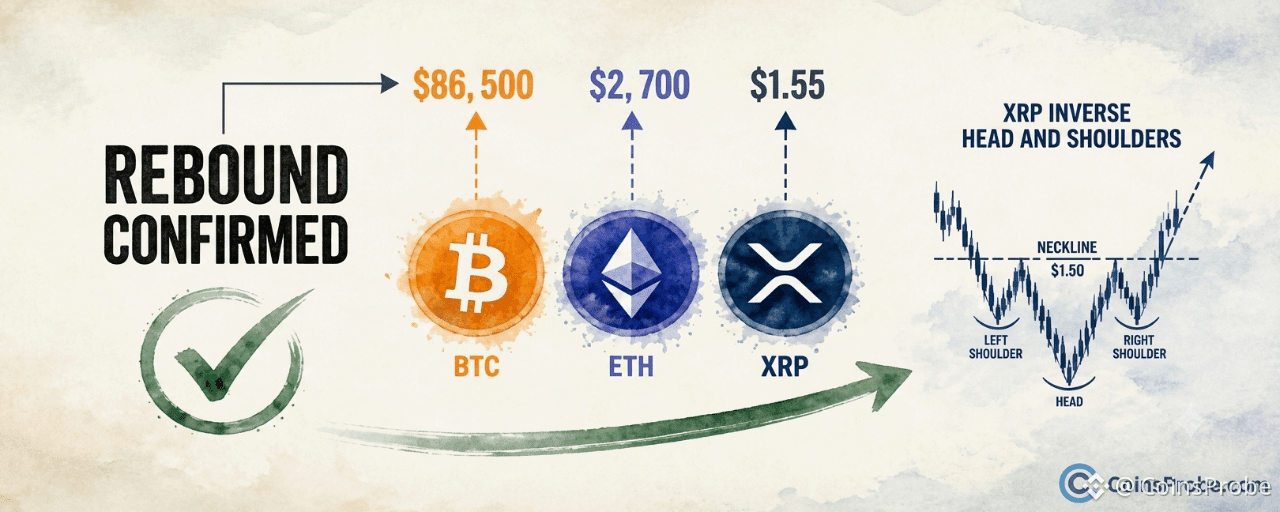
ලිපිය
BTC, ETH, XRP Rebound Targets: $86,500, $2,700, and $1.55 in FocusKey Highlights
BTC at $82,725 targets $86,500 — analyst Ali Martinez (@alicharts) confirmed rebound after October 18 support callETH bounced from $2,400 support to $2,512, with $2,700 as immediate target and $3,100 as channel extensionXRP inverse head and shoulders neckline at $1.50 — $1.55 close confirms breakout toward $2.00 measured moveMartinez: "Break these levels, and the rally extends further" — all three gates must clear for continuation
Bitcoin is trading at $82,725 — down 0.12% in the last 24 hours — while Ethereum holds near $2,512 and XRP sits at $1.39. The moves follow a market-wide rebound that chart analyst Ali Martinez (@alicharts) called in advance, with three specific support zones now confirmed as the floor for the next leg.
On October 21, Martinez posted: “MARKET REBOUND AS PREDICTED! Immediate targets: $BTC: $86,500 / $ETH: $2,700 / $XRP: $1.55. Break these levels, and the rally extends further.” The call follows his October 18 thread — titled “BITCOIN, ETHEREUM, XRP COULD REBOUND… But only if these levels hold” — in which he identified the exact support zones that have since acted as the base for the current bounce.
Bitcoin — $84,000 Reclaimed, $86,500 Is the Gate
The daily BTC chart shared by @alicharts shows price declining from the upper-left of the chart through mid-October, hitting a sharp trough around October 13 before recovering. The current price had reclaimed the $84,000 level at the time of the chart, with a dashed projection line pointing directly at $86,500 — Martinez’s stated immediate target. The $84,000 line is marked as the pivotal support-turned-floor on the chart, and $86,500 is annotated as the next resistance the rally must clear.
BTC Daily Chart | Source: @alicharts (X)
At $82,725 at the time of writing, Bitcoin is still below the $84,000 level visible on the chart as the reclaim zone. The analyst’s condition is explicit: a sustained break above $86,500 is what extends the rally further. Until that level is cleared, the bounce remains a recovery within the prior range rather than a confirmed continuation. Intermediate price labels on the chart include $85,250, $84,535, $84,000, $82,500, and $81,000 — with $82,500 serving as the closest visible support below the current spot price.
Ethereum — Bouncing From $2,400, Targeting $2,700 Then $3,100
The ETH daily chart reveals an ascending channel or rising wedge structure, with price testing the lower boundary near $2,400 before the bounce that brought it to approximately $2,512 — marked with a black label on the chart. Martinez’s dashed projection traces a zigzag path upward: first toward $2,700, then continuing toward $3,100 in alignment with the upper diagonal trendline of the channel.
ETH Daily Chart | Source: @alicharts (X)
The $2,700 level is Martinez’s stated immediate target for Ethereum. It represents the first meaningful resistance within the channel structure before the upper trendline at approximately $3,100. The bounce from $2,400 support — the level Martinez flagged on October 18 as the key zone that must hold — is what triggered the updated target confirmation in his October 21 post.
XRP — Inverse Head and Shoulders, Neckline at $1.50, Target $2.00
The XRP 3-day chart is the most structurally defined of the three. @alicharts annotates a completed inverse head and shoulders pattern, with the left shoulder, head (the deepest trough), and right shoulder all explicitly labeled. A horizontal neckline runs near $1.50. At the time of the chart, XRP was trading at $1.39 — just below neckline — with a dashed arrow projecting a breakout move toward $2.00.
XRP 3D Chart | Source: @alicharts (X)
Martinez’s stated immediate target of $1.55 for XRP is a neckline breakout confirmation level — sitting just above the $1.50 neckline drawn on the chart. The analyst’s logic: a sustained move above $1.55 confirms the inverse H&S breakout is live, opening the path to the $2.00 measured move target visible on the chart. Note the distinction: the chart’s neckline is drawn at $1.50, while the analyst explicitly states $1.55 as the level that confirms the break. Both figures refer to the same structural zone — $1.50 is the visual pattern boundary, $1.55 is his stated confirmation trigger.
The Condition That Determines Everything
Martinez’s framework across all three assets is identical in structure: the support levels held (as predicted October 18), the immediate bounce is now live, but the rally’s extension depends on breaking specific resistance levels — not merely bouncing from support. For Bitcoin that gate is $86,500. For Ethereum it is $2,700. For XRP it is $1.55. A failure to clear any of these levels converts the current move from a confirmed rally into a relief bounce within a broader downtrend.
This conditional structure matters. It is not a blanket all-clear signal — it is a staged thesis with explicit checkpoints. Traders watching this setup from a technical breakout perspective will recognize the pattern: support holds, bounce initiates, resistance becomes the next binary. Similar conditional setups have appeared across altcoins recently, including PENGU’s SuperTrend signals where each prior buy trigger required a specific confirmation level to validate the thesis.
Bullish Scenario
BTC closes above $86,500 with ETH simultaneously clearing $2,700 and XRP printing a daily close above $1.55. All three breaking their gates in sequence would confirm coordinated market-wide continuation, with XRP’s measured move pointing to $2.00 and ETH’s channel projecting toward $3,100 as extended targets per the chart annotations.
Bearish Scenario
Bitcoin fails to reclaim $84,000 on a sustained basis and rolls back below $82,500 — the nearest visible support on the daily chart. For XRP, a failure to break $1.55 and a drop back below the $1.39 right shoulder level would invalidate the inverse head and shoulders setup. For ETH, a loss of the $2,400 lower channel boundary reopens the $2,000 zone.
The rebound Martinez predicted on October 18 has materialized across Bitcoin, Ethereum, and XRP. The immediate targets — $86,500, $2,700, and $1.55 respectively — are not open-ended projections. They are the specific levels his analysis designates as rally-extension confirmations. Bitcoin at $82,725 remains the furthest from its gate. Watch $86,500 in BTC as the single level that determines whether this is a confirmed breakout or a bounce that exhausted itself before the next resistance.
Disclaimer: The views and analysis presented in this article are for informational purposes only and reflect the author’s perspective, not financial advice. Technical patterns and indicators discussed are subject to market volatility and may or may not yield anticipated results. Investors are advised to exercise caution, conduct independent research, and make decisions aligned with their individual risk tolerance.
BTC, ETH, XRP Rebound Targets: $86,500, $2,700, and $1.55 in Focus
Key Highlights
BTC at $82,725 targets $86,500 — analyst Ali Martinez (@alicharts) confirmed rebound after October 18 support callETH bounced from $2,400 support to $2,512, with $2,700 as immediate target and $3,100 as channel extensionXRP inverse head and shoulders neckline at $1.50 — $1.55 close confirms breakout toward $2.00 measured moveMartinez: "Break these levels, and the rally extends further" — all three gates must clear for continuation
Bitcoin is trading at $82,725 — down 0.12% in the last 24 hours — while Ethereum holds near $2,512 and XRP sits at $1.39. The moves follow a market-wide rebound that chart analyst Ali Martinez (@alicharts) called in advance, with three specific support zones now confirmed as the floor for the next leg.
On October 21, Martinez posted: “MARKET REBOUND AS PREDICTED! Immediate targets: $BTC: $86,500 / $ETH: $2,700 / $XRP: $1.55. Break these levels, and the rally extends further.” The call follows his October 18 thread — titled “BITCOIN, ETHEREUM, XRP COULD REBOUND… But only if these levels hold” — in which he identified the exact support zones that have since acted as the base for the current bounce.
Bitcoin — $84,000 Reclaimed, $86,500 Is the Gate
The daily BTC chart shared by @alicharts shows price declining from the upper-left of the chart through mid-October, hitting a sharp trough around October 13 before recovering. The current price had reclaimed the $84,000 level at the time of the chart, with a dashed projection line pointing directly at $86,500 — Martinez’s stated immediate target. The $84,000 line is marked as the pivotal support-turned-floor on the chart, and $86,500 is annotated as the next resistance the rally must clear.
BTC Daily Chart | Source: @alicharts (X)
At $82,725 at the time of writing, Bitcoin is still below the $84,000 level visible on the chart as the reclaim zone. The analyst’s condition is explicit: a sustained break above $86,500 is what extends the rally further. Until that level is cleared, the bounce remains a recovery within the prior range rather than a confirmed continuation. Intermediate price labels on the chart include $85,250, $84,535, $84,000, $82,500, and $81,000 — with $82,500 serving as the closest visible support below the current spot price.
Ethereum — Bouncing From $2,400, Targeting $2,700 Then $3,100
The ETH daily chart reveals an ascending channel or rising wedge structure, with price testing the lower boundary near $2,400 before the bounce that brought it to approximately $2,512 — marked with a black label on the chart. Martinez’s dashed projection traces a zigzag path upward: first toward $2,700, then continuing toward $3,100 in alignment with the upper diagonal trendline of the channel.
ETH Daily Chart | Source: @alicharts (X)
The $2,700 level is Martinez’s stated immediate target for Ethereum. It represents the first meaningful resistance within the channel structure before the upper trendline at approximately $3,100. The bounce from $2,400 support — the level Martinez flagged on October 18 as the key zone that must hold — is what triggered the updated target confirmation in his October 21 post.
XRP — Inverse Head and Shoulders, Neckline at $1.50, Target $2.00
The XRP 3-day chart is the most structurally defined of the three. @alicharts annotates a completed inverse head and shoulders pattern, with the left shoulder, head (the deepest trough), and right shoulder all explicitly labeled. A horizontal neckline runs near $1.50. At the time of the chart, XRP was trading at $1.39 — just below neckline — with a dashed arrow projecting a breakout move toward $2.00.
XRP 3D Chart | Source: @alicharts (X)
Martinez’s stated immediate target of $1.55 for XRP is a neckline breakout confirmation level — sitting just above the $1.50 neckline drawn on the chart. The analyst’s logic: a sustained move above $1.55 confirms the inverse H&S breakout is live, opening the path to the $2.00 measured move target visible on the chart. Note the distinction: the chart’s neckline is drawn at $1.50, while the analyst explicitly states $1.55 as the level that confirms the break. Both figures refer to the same structural zone — $1.50 is the visual pattern boundary, $1.55 is his stated confirmation trigger.
The Condition That Determines Everything
Martinez’s framework across all three assets is identical in structure: the support levels held (as predicted October 18), the immediate bounce is now live, but the rally’s extension depends on breaking specific resistance levels — not merely bouncing from support. For Bitcoin that gate is $86,500. For Ethereum it is $2,700. For XRP it is $1.55. A failure to clear any of these levels converts the current move from a confirmed rally into a relief bounce within a broader downtrend.
This conditional structure matters. It is not a blanket all-clear signal — it is a staged thesis with explicit checkpoints. Traders watching this setup from a technical breakout perspective will recognize the pattern: support holds, bounce initiates, resistance becomes the next binary. Similar conditional setups have appeared across altcoins recently, including PENGU’s SuperTrend signals where each prior buy trigger required a specific confirmation level to validate the thesis.
Bullish Scenario
BTC closes above $86,500 with ETH simultaneously clearing $2,700 and XRP printing a daily close above $1.55. All three breaking their gates in sequence would confirm coordinated market-wide continuation, with XRP’s measured move pointing to $2.00 and ETH’s channel projecting toward $3,100 as extended targets per the chart annotations.
Bearish Scenario
Bitcoin fails to reclaim $84,000 on a sustained basis and rolls back below $82,500 — the nearest visible support on the daily chart. For XRP, a failure to break $1.55 and a drop back below the $1.39 right shoulder level would invalidate the inverse head and shoulders setup. For ETH, a loss of the $2,400 lower channel boundary reopens the $2,000 zone.
The rebound Martinez predicted on October 18 has materialized across Bitcoin, Ethereum, and XRP. The immediate targets — $86,500, $2,700, and $1.55 respectively — are not open-ended projections. They are the specific levels his analysis designates as rally-extension confirmations. Bitcoin at $82,725 remains the furthest from its gate. Watch $86,500 in BTC as the single level that determines whether this is a confirmed breakout or a bounce that exhausted itself before the next resistance.
Disclaimer: The views and analysis presented in this article are for informational purposes only and reflect the author’s perspective, not financial advice. Technical patterns and indicators discussed are subject to market volatility and may or may not yield anticipated results. Investors are advised to exercise caution, conduct independent research, and make decisions aligned with their individual risk tolerance.
BTC at $82,725 targets $86,500 — analyst Ali Martinez (@alicharts) confirmed rebound after October 18 support callETH bounced from $2,400 support to $2,512, with $2,700 as immediate target and $3,100 as channel extensionXRP inverse head and shoulders neckline at $1.50 — $1.55 close confirms breakout toward $2.00 measured moveMartinez: "Break these levels, and the rally extends further" — all three gates must clear for continuation
Bitcoin is trading at $82,725 — down 0.12% in the last 24 hours — while Ethereum holds near $2,512 and XRP sits at $1.39. The moves follow a market-wide rebound that chart analyst Ali Martinez (@alicharts) called in advance, with three specific support zones now confirmed as the floor for the next leg.
On October 21, Martinez posted: “MARKET REBOUND AS PREDICTED! Immediate targets: $BTC: $86,500 / $ETH: $2,700 / $XRP: $1.55. Break these levels, and the rally extends further.” The call follows his October 18 thread — titled “BITCOIN, ETHEREUM, XRP COULD REBOUND… But only if these levels hold” — in which he identified the exact support zones that have since acted as the base for the current bounce.
Bitcoin — $84,000 Reclaimed, $86,500 Is the Gate
The daily BTC chart shared by @alicharts shows price declining from the upper-left of the chart through mid-October, hitting a sharp trough around October 13 before recovering. The current price had reclaimed the $84,000 level at the time of the chart, with a dashed projection line pointing directly at $86,500 — Martinez’s stated immediate target. The $84,000 line is marked as the pivotal support-turned-floor on the chart, and $86,500 is annotated as the next resistance the rally must clear.
BTC Daily Chart | Source: @alicharts (X)
At $82,725 at the time of writing, Bitcoin is still below the $84,000 level visible on the chart as the reclaim zone. The analyst’s condition is explicit: a sustained break above $86,500 is what extends the rally further. Until that level is cleared, the bounce remains a recovery within the prior range rather than a confirmed continuation. Intermediate price labels on the chart include $85,250, $84,535, $84,000, $82,500, and $81,000 — with $82,500 serving as the closest visible support below the current spot price.
Ethereum — Bouncing From $2,400, Targeting $2,700 Then $3,100
The ETH daily chart reveals an ascending channel or rising wedge structure, with price testing the lower boundary near $2,400 before the bounce that brought it to approximately $2,512 — marked with a black label on the chart. Martinez’s dashed projection traces a zigzag path upward: first toward $2,700, then continuing toward $3,100 in alignment with the upper diagonal trendline of the channel.
ETH Daily Chart | Source: @alicharts (X)
The $2,700 level is Martinez’s stated immediate target for Ethereum. It represents the first meaningful resistance within the channel structure before the upper trendline at approximately $3,100. The bounce from $2,400 support — the level Martinez flagged on October 18 as the key zone that must hold — is what triggered the updated target confirmation in his October 21 post.
XRP — Inverse Head and Shoulders, Neckline at $1.50, Target $2.00
The XRP 3-day chart is the most structurally defined of the three. @alicharts annotates a completed inverse head and shoulders pattern, with the left shoulder, head (the deepest trough), and right shoulder all explicitly labeled. A horizontal neckline runs near $1.50. At the time of the chart, XRP was trading at $1.39 — just below neckline — with a dashed arrow projecting a breakout move toward $2.00.
XRP 3D Chart | Source: @alicharts (X)
Martinez’s stated immediate target of $1.55 for XRP is a neckline breakout confirmation level — sitting just above the $1.50 neckline drawn on the chart. The analyst’s logic: a sustained move above $1.55 confirms the inverse H&S breakout is live, opening the path to the $2.00 measured move target visible on the chart. Note the distinction: the chart’s neckline is drawn at $1.50, while the analyst explicitly states $1.55 as the level that confirms the break. Both figures refer to the same structural zone — $1.50 is the visual pattern boundary, $1.55 is his stated confirmation trigger.
The Condition That Determines Everything
Martinez’s framework across all three assets is identical in structure: the support levels held (as predicted October 18), the immediate bounce is now live, but the rally’s extension depends on breaking specific resistance levels — not merely bouncing from support. For Bitcoin that gate is $86,500. For Ethereum it is $2,700. For XRP it is $1.55. A failure to clear any of these levels converts the current move from a confirmed rally into a relief bounce within a broader downtrend.
This conditional structure matters. It is not a blanket all-clear signal — it is a staged thesis with explicit checkpoints. Traders watching this setup from a technical breakout perspective will recognize the pattern: support holds, bounce initiates, resistance becomes the next binary. Similar conditional setups have appeared across altcoins recently, including PENGU’s SuperTrend signals where each prior buy trigger required a specific confirmation level to validate the thesis.
Bullish Scenario
BTC closes above $86,500 with ETH simultaneously clearing $2,700 and XRP printing a daily close above $1.55. All three breaking their gates in sequence would confirm coordinated market-wide continuation, with XRP’s measured move pointing to $2.00 and ETH’s channel projecting toward $3,100 as extended targets per the chart annotations.
Bearish Scenario
Bitcoin fails to reclaim $84,000 on a sustained basis and rolls back below $82,500 — the nearest visible support on the daily chart. For XRP, a failure to break $1.55 and a drop back below the $1.39 right shoulder level would invalidate the inverse head and shoulders setup. For ETH, a loss of the $2,400 lower channel boundary reopens the $2,000 zone.
The rebound Martinez predicted on October 18 has materialized across Bitcoin, Ethereum, and XRP. The immediate targets — $86,500, $2,700, and $1.55 respectively — are not open-ended projections. They are the specific levels his analysis designates as rally-extension confirmations. Bitcoin at $82,725 remains the furthest from its gate. Watch $86,500 in BTC as the single level that determines whether this is a confirmed breakout or a bounce that exhausted itself before the next resistance.
Disclaimer: The views and analysis presented in this article are for informational purposes only and reflect the author’s perspective, not financial advice. Technical patterns and indicators discussed are subject to market volatility and may or may not yield anticipated results. Investors are advised to exercise caution, conduct independent research, and make decisions aligned with their individual risk tolerance.
1
651
·
--

ලිපිය
PENGU Prints Another SuperTrend Buy Signal — 3-for-3 Track RecordKey Highlights
PENGU SuperTrend flips bullish above $0.0081 — signal that has preceded every prior rally on this asset per @alichartsPrior TD Sequential buys produced +77.64% (Aug 7) and +66.94% (Sep 15) rallies; sell signal produced −31.58% correctionTD Sequential and SuperTrend fired simultaneously — strongest confluence in PENGU's documented signal historyMartinez projects $0.013 target (~60% from $0.0081) based on average of two prior completed sequences
Pudgy Penguins (PENGU) is flashing another buy signal — and the indicator generating it has yet to be wrong on this asset. Analyst Ali Martinez (@alicharts) flagged on October 21, 2026, that the SuperTrend indicator has flipped bullish as PENGU pushes above $0.0081, marking what he identifies as the start of a new leg higher.
The signal carries weight not because of its name, but because of its documented track record on $PENGU specifically. Every prior bullish flip of the SuperTrend on this asset preceded a measurable rally. Every bearish flip preceded a steep correction. That is a clean, verified pattern — and it has just triggered again.
Signal 1 — SuperTrend Bullish Flip Above $0.0081
The SuperTrend indicator calculates dynamic support and resistance bands using Average True Range (ATR) and a multiplier. When price closes above the upper band, the indicator flips bullish — signaling that momentum has shifted from sellers to buyers. It is a trend-following tool, not a mean-reversion one, which means it performs best when an asset is beginning a sustained directional move rather than oscillating.
For PENGU, the SuperTrend has operated as a near-perfect regime filter. According to Martinez’s analysis, every bearish flip was followed by a steep correction, and every bullish flip marked the beginning of a new rally phase. The current flip occurred as price broke above $0.0081 — a level Martinez identifies as the key breakout threshold for this signal to be valid.
PENGU 12H Chart | Source: @alicharts (X)
Signal 2 — TD Sequential Daily Buy Signal (October 19, 2026)
Two days before the SuperTrend call, Martinez flagged a separate but reinforcing signal: the TD Sequential printed a new daily buy signal on PENGU. The TD Sequential counts nine consecutive closes in one direction — identifying momentum exhaustion rather than a price level. A completed nine-count on the bearish side signals that selling pressure has run its course and a reversal is statistically overdue.
With the structure of higher highs and higher lows intact on the daily chart, Martinez projected that if the ~70% average rally from prior TD Sequential buy signals repeats, PENGU targets $0.013. That projection is derived from the prior two completed sequences — not from a cycle average or arbitrary extension.
The Verified Track Record — Three Signals, Three Outcomes
PENGU Prints TD Sequential Buy Signal — Oct 20 2026 | Source: @alicharts (X)
This is not a case of pattern-fitting after the fact. The prior PENGU signals from Martinez carry documented, exact returns:
Signal Date Signal Type Outcome August 7, 2026 TD Sequential Buy +77.64% September 15, 2026 TD Sequential Buy +66.94% September 25, 2026 TD Sequential Sell −31.58%
Source: @alicharts (X), October 19–21, 2026
Two buys, two rallies averaging +72.29%. One sell, one correction of −31.58%. The sell signal’s accuracy is equally important — it validates the system bidirectionally, not just on the upside. A tool that is only right when bullish is useless. This one has been right in both directions on PENGU.
The current setup now aligns both the SuperTrend bullish flip and a TD Sequential buy signal simultaneously — a double confirmation that has not appeared together in the documented history above. If anything, the concurrent firing of two independent momentum signals makes the current setup structurally stronger than either of the prior individual buy signals.
The Fundamental Layer — SoFi Listing and 15M+ Member Base
Martinez also referenced PENGU’s structural fundamentals as a supporting factor. The token received a SoFi exchange listing alongside an existing community of over 15 million members in the Pudgy Penguins ecosystem. These are not price drivers on their own — exchange listings expand liquidity and accessibility, and large community bases provide retail distribution depth. But they function as demand-side infrastructure that can amplify a technically-triggered move once momentum initiates.
It is worth contextualizing this within the broader market environment. Traders tracking macro conditions can review whether Bitcoin’s equity correlation is returning — since NFT-adjacent tokens like PENGU tend to amplify Bitcoin’s directional moves, particularly to the upside.
The Target and the Invalidation
Martinez’s stated target, derived from averaging the two prior TD Sequential rallies, is $0.013. That represents approximately a 60% move from the $0.0081 breakout level. It is not a measured move from a chart pattern — it is an empirical projection from the two prior completed sequences on this specific asset.
The invalidation is implicit in the structure: a loss of the $0.0081 level on a closing basis would negate the SuperTrend bullish flip, reverting the indicator to neutral or bearish. That level is both the trigger and the line. Below it, the signal did not confirm. Above it, the two-signal confirmation is live.
Bullish Scenario — Hold Above $0.0081
PENGU sustains above $0.0081, SuperTrend remains in bullish regime. If the +70% average from prior TD Sequential buys (Aug 7: +77.64%, Sep 15: +66.94%) repeats, target is $0.013. Double confirmation from two independent signals makes this the strongest setup in PENGU’s documented signal history.
Bearish Scenario — Loss of $0.0081
A daily close below $0.0081 invalidates the SuperTrend bullish flip. The September 25 sell signal demonstrated what follows a failed bullish attempt: PENGU declined −31.58%. A breakdown here would reassert bearish regime control and negate both the SuperTrend and TD Sequential confluence.
For traders monitoring the NFT token space alongside broader altcoin activity, Hyperliquid’s $1.75M HYPE burn in 24 hours underscores the kind of protocol-level activity currently driving risk appetite across the market.
Two independent signals — SuperTrend bullish flip and TD Sequential buy — have fired simultaneously on PENGU above $0.0081. The prior two TD Sequential buys produced rallies of +77.64% and +66.94%. The prior sell signal produced a −31.58% correction. The track record is three-for-three across both directions. Whether the current signal becomes the fourth confirmed outcome will be determined at $0.0081 as the critical hold level and $0.013 as the stated target in sessions ahead. Watch $0.0081 — a close below it ends the bull case entirely.
Disclaimer: The views and analysis presented in this article are for informational purposes only and reflect the author’s perspective, not financial advice. Technical patterns and indicators discussed are subject to market volatility and may or may not yield anticipated results. Investors are advised to exercise caution, conduct independent research, and make decisions aligned with their individual risk tolerance.
PENGU Prints Another SuperTrend Buy Signal — 3-for-3 Track Record
Key Highlights
PENGU SuperTrend flips bullish above $0.0081 — signal that has preceded every prior rally on this asset per @alichartsPrior TD Sequential buys produced +77.64% (Aug 7) and +66.94% (Sep 15) rallies; sell signal produced −31.58% correctionTD Sequential and SuperTrend fired simultaneously — strongest confluence in PENGU's documented signal historyMartinez projects $0.013 target (~60% from $0.0081) based on average of two prior completed sequences
Pudgy Penguins (PENGU) is flashing another buy signal — and the indicator generating it has yet to be wrong on this asset. Analyst Ali Martinez (@alicharts) flagged on October 21, 2026, that the SuperTrend indicator has flipped bullish as PENGU pushes above $0.0081, marking what he identifies as the start of a new leg higher.
The signal carries weight not because of its name, but because of its documented track record on $PENGU specifically. Every prior bullish flip of the SuperTrend on this asset preceded a measurable rally. Every bearish flip preceded a steep correction. That is a clean, verified pattern — and it has just triggered again.
Signal 1 — SuperTrend Bullish Flip Above $0.0081
The SuperTrend indicator calculates dynamic support and resistance bands using Average True Range (ATR) and a multiplier. When price closes above the upper band, the indicator flips bullish — signaling that momentum has shifted from sellers to buyers. It is a trend-following tool, not a mean-reversion one, which means it performs best when an asset is beginning a sustained directional move rather than oscillating.
For PENGU, the SuperTrend has operated as a near-perfect regime filter. According to Martinez’s analysis, every bearish flip was followed by a steep correction, and every bullish flip marked the beginning of a new rally phase. The current flip occurred as price broke above $0.0081 — a level Martinez identifies as the key breakout threshold for this signal to be valid.
PENGU 12H Chart | Source: @alicharts (X)
Signal 2 — TD Sequential Daily Buy Signal (October 19, 2026)
Two days before the SuperTrend call, Martinez flagged a separate but reinforcing signal: the TD Sequential printed a new daily buy signal on PENGU. The TD Sequential counts nine consecutive closes in one direction — identifying momentum exhaustion rather than a price level. A completed nine-count on the bearish side signals that selling pressure has run its course and a reversal is statistically overdue.
With the structure of higher highs and higher lows intact on the daily chart, Martinez projected that if the ~70% average rally from prior TD Sequential buy signals repeats, PENGU targets $0.013. That projection is derived from the prior two completed sequences — not from a cycle average or arbitrary extension.
The Verified Track Record — Three Signals, Three Outcomes
PENGU Prints TD Sequential Buy Signal — Oct 20 2026 | Source: @alicharts (X)
This is not a case of pattern-fitting after the fact. The prior PENGU signals from Martinez carry documented, exact returns:
Signal Date Signal Type Outcome August 7, 2026 TD Sequential Buy +77.64% September 15, 2026 TD Sequential Buy +66.94% September 25, 2026 TD Sequential Sell −31.58%
Source: @alicharts (X), October 19–21, 2026
Two buys, two rallies averaging +72.29%. One sell, one correction of −31.58%. The sell signal’s accuracy is equally important — it validates the system bidirectionally, not just on the upside. A tool that is only right when bullish is useless. This one has been right in both directions on PENGU.
The current setup now aligns both the SuperTrend bullish flip and a TD Sequential buy signal simultaneously — a double confirmation that has not appeared together in the documented history above. If anything, the concurrent firing of two independent momentum signals makes the current setup structurally stronger than either of the prior individual buy signals.
The Fundamental Layer — SoFi Listing and 15M+ Member Base
Martinez also referenced PENGU’s structural fundamentals as a supporting factor. The token received a SoFi exchange listing alongside an existing community of over 15 million members in the Pudgy Penguins ecosystem. These are not price drivers on their own — exchange listings expand liquidity and accessibility, and large community bases provide retail distribution depth. But they function as demand-side infrastructure that can amplify a technically-triggered move once momentum initiates.
It is worth contextualizing this within the broader market environment. Traders tracking macro conditions can review whether Bitcoin’s equity correlation is returning — since NFT-adjacent tokens like PENGU tend to amplify Bitcoin’s directional moves, particularly to the upside.
The Target and the Invalidation
Martinez’s stated target, derived from averaging the two prior TD Sequential rallies, is $0.013. That represents approximately a 60% move from the $0.0081 breakout level. It is not a measured move from a chart pattern — it is an empirical projection from the two prior completed sequences on this specific asset.
The invalidation is implicit in the structure: a loss of the $0.0081 level on a closing basis would negate the SuperTrend bullish flip, reverting the indicator to neutral or bearish. That level is both the trigger and the line. Below it, the signal did not confirm. Above it, the two-signal confirmation is live.
Bullish Scenario — Hold Above $0.0081
PENGU sustains above $0.0081, SuperTrend remains in bullish regime. If the +70% average from prior TD Sequential buys (Aug 7: +77.64%, Sep 15: +66.94%) repeats, target is $0.013. Double confirmation from two independent signals makes this the strongest setup in PENGU’s documented signal history.
Bearish Scenario — Loss of $0.0081
A daily close below $0.0081 invalidates the SuperTrend bullish flip. The September 25 sell signal demonstrated what follows a failed bullish attempt: PENGU declined −31.58%. A breakdown here would reassert bearish regime control and negate both the SuperTrend and TD Sequential confluence.
For traders monitoring the NFT token space alongside broader altcoin activity, Hyperliquid’s $1.75M HYPE burn in 24 hours underscores the kind of protocol-level activity currently driving risk appetite across the market.
Two independent signals — SuperTrend bullish flip and TD Sequential buy — have fired simultaneously on PENGU above $0.0081. The prior two TD Sequential buys produced rallies of +77.64% and +66.94%. The prior sell signal produced a −31.58% correction. The track record is three-for-three across both directions. Whether the current signal becomes the fourth confirmed outcome will be determined at $0.0081 as the critical hold level and $0.013 as the stated target in sessions ahead. Watch $0.0081 — a close below it ends the bull case entirely.
Disclaimer: The views and analysis presented in this article are for informational purposes only and reflect the author’s perspective, not financial advice. Technical patterns and indicators discussed are subject to market volatility and may or may not yield anticipated results. Investors are advised to exercise caution, conduct independent research, and make decisions aligned with their individual risk tolerance.
PENGU SuperTrend flips bullish above $0.0081 — signal that has preceded every prior rally on this asset per @alichartsPrior TD Sequential buys produced +77.64% (Aug 7) and +66.94% (Sep 15) rallies; sell signal produced −31.58% correctionTD Sequential and SuperTrend fired simultaneously — strongest confluence in PENGU's documented signal historyMartinez projects $0.013 target (~60% from $0.0081) based on average of two prior completed sequences
Pudgy Penguins (PENGU) is flashing another buy signal — and the indicator generating it has yet to be wrong on this asset. Analyst Ali Martinez (@alicharts) flagged on October 21, 2026, that the SuperTrend indicator has flipped bullish as PENGU pushes above $0.0081, marking what he identifies as the start of a new leg higher.
The signal carries weight not because of its name, but because of its documented track record on $PENGU specifically. Every prior bullish flip of the SuperTrend on this asset preceded a measurable rally. Every bearish flip preceded a steep correction. That is a clean, verified pattern — and it has just triggered again.
Signal 1 — SuperTrend Bullish Flip Above $0.0081
The SuperTrend indicator calculates dynamic support and resistance bands using Average True Range (ATR) and a multiplier. When price closes above the upper band, the indicator flips bullish — signaling that momentum has shifted from sellers to buyers. It is a trend-following tool, not a mean-reversion one, which means it performs best when an asset is beginning a sustained directional move rather than oscillating.
For PENGU, the SuperTrend has operated as a near-perfect regime filter. According to Martinez’s analysis, every bearish flip was followed by a steep correction, and every bullish flip marked the beginning of a new rally phase. The current flip occurred as price broke above $0.0081 — a level Martinez identifies as the key breakout threshold for this signal to be valid.
PENGU 12H Chart | Source: @alicharts (X)
Signal 2 — TD Sequential Daily Buy Signal (October 19, 2026)
Two days before the SuperTrend call, Martinez flagged a separate but reinforcing signal: the TD Sequential printed a new daily buy signal on PENGU. The TD Sequential counts nine consecutive closes in one direction — identifying momentum exhaustion rather than a price level. A completed nine-count on the bearish side signals that selling pressure has run its course and a reversal is statistically overdue.
With the structure of higher highs and higher lows intact on the daily chart, Martinez projected that if the ~70% average rally from prior TD Sequential buy signals repeats, PENGU targets $0.013. That projection is derived from the prior two completed sequences — not from a cycle average or arbitrary extension.
The Verified Track Record — Three Signals, Three Outcomes
PENGU Prints TD Sequential Buy Signal — Oct 20 2026 | Source: @alicharts (X)
This is not a case of pattern-fitting after the fact. The prior PENGU signals from Martinez carry documented, exact returns:
Signal Date Signal Type Outcome August 7, 2026 TD Sequential Buy +77.64% September 15, 2026 TD Sequential Buy +66.94% September 25, 2026 TD Sequential Sell −31.58%
Source: @alicharts (X), October 19–21, 2026
Two buys, two rallies averaging +72.29%. One sell, one correction of −31.58%. The sell signal’s accuracy is equally important — it validates the system bidirectionally, not just on the upside. A tool that is only right when bullish is useless. This one has been right in both directions on PENGU.
The current setup now aligns both the SuperTrend bullish flip and a TD Sequential buy signal simultaneously — a double confirmation that has not appeared together in the documented history above. If anything, the concurrent firing of two independent momentum signals makes the current setup structurally stronger than either of the prior individual buy signals.
The Fundamental Layer — SoFi Listing and 15M+ Member Base
Martinez also referenced PENGU’s structural fundamentals as a supporting factor. The token received a SoFi exchange listing alongside an existing community of over 15 million members in the Pudgy Penguins ecosystem. These are not price drivers on their own — exchange listings expand liquidity and accessibility, and large community bases provide retail distribution depth. But they function as demand-side infrastructure that can amplify a technically-triggered move once momentum initiates.
It is worth contextualizing this within the broader market environment. Traders tracking macro conditions can review whether Bitcoin’s equity correlation is returning — since NFT-adjacent tokens like PENGU tend to amplify Bitcoin’s directional moves, particularly to the upside.
The Target and the Invalidation
Martinez’s stated target, derived from averaging the two prior TD Sequential rallies, is $0.013. That represents approximately a 60% move from the $0.0081 breakout level. It is not a measured move from a chart pattern — it is an empirical projection from the two prior completed sequences on this specific asset.
The invalidation is implicit in the structure: a loss of the $0.0081 level on a closing basis would negate the SuperTrend bullish flip, reverting the indicator to neutral or bearish. That level is both the trigger and the line. Below it, the signal did not confirm. Above it, the two-signal confirmation is live.
Bullish Scenario — Hold Above $0.0081
PENGU sustains above $0.0081, SuperTrend remains in bullish regime. If the +70% average from prior TD Sequential buys (Aug 7: +77.64%, Sep 15: +66.94%) repeats, target is $0.013. Double confirmation from two independent signals makes this the strongest setup in PENGU’s documented signal history.
Bearish Scenario — Loss of $0.0081
A daily close below $0.0081 invalidates the SuperTrend bullish flip. The September 25 sell signal demonstrated what follows a failed bullish attempt: PENGU declined −31.58%. A breakdown here would reassert bearish regime control and negate both the SuperTrend and TD Sequential confluence.
For traders monitoring the NFT token space alongside broader altcoin activity, Hyperliquid’s $1.75M HYPE burn in 24 hours underscores the kind of protocol-level activity currently driving risk appetite across the market.
Two independent signals — SuperTrend bullish flip and TD Sequential buy — have fired simultaneously on PENGU above $0.0081. The prior two TD Sequential buys produced rallies of +77.64% and +66.94%. The prior sell signal produced a −31.58% correction. The track record is three-for-three across both directions. Whether the current signal becomes the fourth confirmed outcome will be determined at $0.0081 as the critical hold level and $0.013 as the stated target in sessions ahead. Watch $0.0081 — a close below it ends the bull case entirely.
Disclaimer: The views and analysis presented in this article are for informational purposes only and reflect the author’s perspective, not financial advice. Technical patterns and indicators discussed are subject to market volatility and may or may not yield anticipated results. Investors are advised to exercise caution, conduct independent research, and make decisions aligned with their individual risk tolerance.
296
·
--
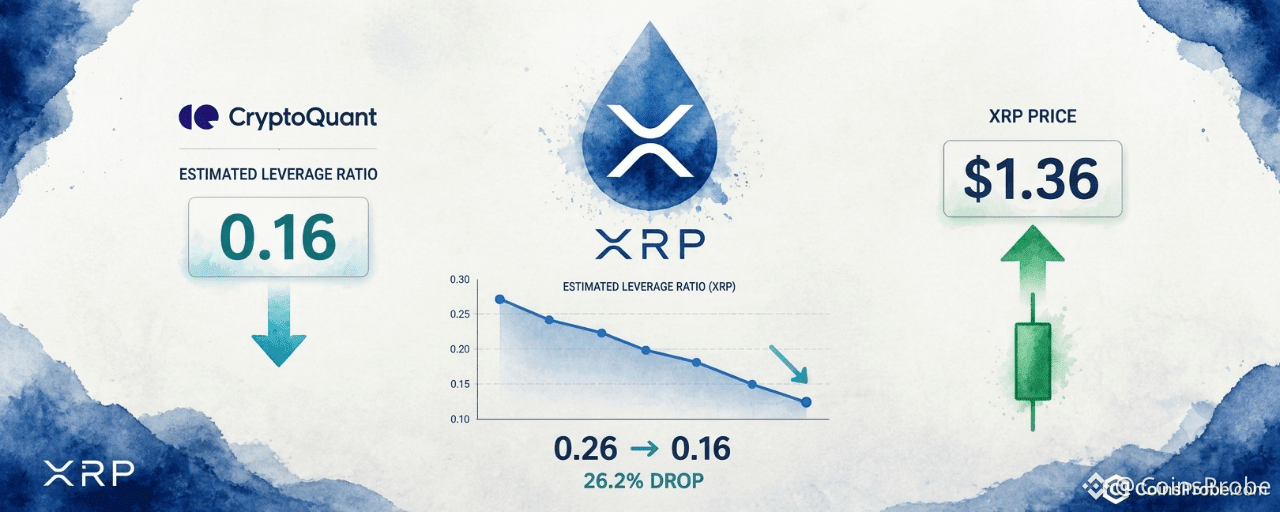
ලිපිය
XRP Leverage Ratio on Binance Drops 26.2% — What It Means for Liquidation RiskKey Highlights
XRP trades at $1.36 (+4.72% 24h), market cap $85.53B, as Binance leverage ratio hits multi-month lowsBinance XRP Estimated Leverage Ratio drops 26.2% in under one month — from ~0.26 peak (Jan 2026) to ~0.16 now, per CryptoQuant/@ArabxChainLower ELR reduces cascading liquidation risk; analyst notes: "potentially mitigating the risks associated with liquidations"Watch 0.16 ELR level — a reversal higher alongside rising open interest would signal returning derivatives fragility
XRP is trading at $1.36 — up 4.72% in the past 24 hours, with a market capitalization of $85.53 billion — as a structural shift in derivatives positioning quietly unfolds beneath the surface. The Binance XRP Estimated Leverage Ratio has fallen 26.2% in less than a month, according to CryptoQuant data published on October 21, 2026. That drop is not a neutral datapoint. It signals that traders have materially reduced their leveraged exposure to XRP on Binance, the largest derivatives venue for the asset.
CryptoQuant analyst @ArabxChain flagged the move in a published quicktake, concluding: “The decline may reflect a reduction in leveraged positioning, potentially mitigating the risks associated with liquidations.” The analyst’s language is measured — this is an observation about structural risk, not a directional price call. But the mechanism it describes has direct implications for how XRP trades from here.
What the Estimated Leverage Ratio Actually Measures
The Estimated Leverage Ratio (ELR) on CryptoQuant measures open interest relative to the exchange’s token reserves — specifically, it divides futures open interest by the exchange’s holdings of that token. A rising ELR means traders are taking on more leveraged positions relative to the available collateral base. A falling ELR means the opposite: leverage is being unwound, either through position closures, liquidations, or a shift toward spot exposure.
The current Binance XRP ELR reads approximately 0.16, per the chart annotations. This compares to a peak near 0.26 in late January 2026, marking the high-water mark for leveraged XRP positioning on Binance. From that January peak to the current reading, the ratio has compressed by a substantial margin — with the most recent leg lower (-26.2%) occurring in under 30 days.
XRP Ledger Estimated Leverage Ratio – Binance | Source: @cryptoquant_com (X)
Why a Falling Leverage Ratio Matters — The Mechanism
High leverage ratios create fragility. When a large share of open interest is concentrated in leveraged positions, a price move in either direction can trigger cascading liquidations — forced closures that amplify the initial move. XRP experienced this dynamic in early 2026, when the leverage ratio was near its peak of 0.26 and the asset saw sharp intraday dislocations.
A declining leverage ratio reverses that structure. With the ELR now at approximately 0.16 — near the lower boundary of its November 2025-to-October 2026 range — the derivatives stack on Binance is materially lighter. Fewer leveraged positions means fewer automatic liquidation triggers if price moves against those positions. This does not predict the direction of the next move, but it does reduce the probability of a disorderly, liquidation-driven cascade in either direction.
Put plainly: at 0.16, XRP’s derivatives market on Binance is structurally cleaner than it has been for most of 2026. That is a precondition — not a guarantee — for more orderly price discovery. For context on how whale-level positioning interacts with these dynamics, XRP whale outflows recently hit a 5-year low, a parallel signal worth tracking alongside leverage data.
What the Chart Shows — January Peak to October 2026 Low
The CryptoQuant chart covers November 2025 through October 2026 and overlays the leverage ratio (left axis, 0.13–0.26 range) against XRP’s spot price on the right axis ($1.0–$2.6). Both lines traced an almost identical trajectory: a sharp peak in late January 2026 — when XRP was trading near the upper end of its range and leverage was at its most elevated — followed by a sustained decline through mid-2026. A partial recovery in August and September 2026 was followed by a fresh rollover, with the leverage ratio now descending steeply back toward multi-month lows.
The current callout values printed on the chart are 0.16 for the leverage ratio and $1.2 for price — though at time of writing, XRP spot has since moved to $1.36 on the live market. The price label on the chart reflects a slightly earlier snapshot, while the leverage ratio reading of 0.16 represents the current structural state of derivatives positioning.
What This Is — And What It Is Not
@ArabxChain’s analysis does not attach a price target to this observation. The ELR drop is not framed as a buy signal, nor does it imply that a rally is imminent. What it establishes is a change in the risk architecture of XRP’s derivatives market. The asset had $1.58 billion in 24-hour trading volume at time of writing — a liquid market where the difference between an orderly decline and a liquidation cascade is precisely the kind of positioning data CryptoQuant tracks.
For broader context on liquidity conditions across the market, the recent development where USDT supply contracted by $1 billion is a relevant macro backdrop worth monitoring alongside any XRP derivatives read.
Scenarios From Here
Bullish Scenario
If spot demand continues to absorb sell pressure at current levels while the leverage ratio remains compressed near 0.16, any upside move encounters a cleaner derivatives stack — meaning fewer overhanging longs to liquidate on a dip and fewer shorts to squeeze on a rally. Price could trend more smoothly toward the $1.6–$1.8 resistance band visible on the chart without the amplification effect that high-leverage environments create.
Bearish Scenario
A declining leverage ratio does not eliminate downside risk. If spot selling pressure intensifies, a lower ELR simply means the cascade would be smaller — not absent. A sustained close below $1.20 (the chart’s lower right-axis reference level) would put XRP back into the congestion zone where it spent much of mid-2026, and the reduced leverage would offer limited structural support in a spot-driven decline.
The single most important development in XRP’s derivatives market over the past month is the 26.2% compression in Binance’s Estimated Leverage Ratio, as identified by @ArabxChain via CryptoQuant. The ratio now sits at approximately 0.16 — down from a January 2026 peak near 0.26 — and according to the analyst, this decline “may reflect a reduction in leveraged positioning, potentially mitigating the risks associated with liquidations.” At $1.36 spot with $1.58 billion in daily volume, XRP is trading into a structurally lighter derivatives environment than it has seen for most of this cycle.
Watch the 0.16 ELR level — if it holds or continues declining, liquidation cascade risk remains suppressed. If it begins climbing again alongside rising open interest, the fragility that characterized January 2026 would be returning.
Disclaimer: The views and analysis presented in this article are for informational purposes only and reflect the author’s perspective, not financial advice. Technical patterns and indicators discussed are subject to market volatility and may or may not yield anticipated results. Investors are advised to exercise caution, conduct independent research, and make decisions aligned with their individual risk tolerance.
XRP Leverage Ratio on Binance Drops 26.2% — What It Means for Liquidation Risk
Key Highlights
XRP trades at $1.36 (+4.72% 24h), market cap $85.53B, as Binance leverage ratio hits multi-month lowsBinance XRP Estimated Leverage Ratio drops 26.2% in under one month — from ~0.26 peak (Jan 2026) to ~0.16 now, per CryptoQuant/@ArabxChainLower ELR reduces cascading liquidation risk; analyst notes: "potentially mitigating the risks associated with liquidations"Watch 0.16 ELR level — a reversal higher alongside rising open interest would signal returning derivatives fragility
XRP is trading at $1.36 — up 4.72% in the past 24 hours, with a market capitalization of $85.53 billion — as a structural shift in derivatives positioning quietly unfolds beneath the surface. The Binance XRP Estimated Leverage Ratio has fallen 26.2% in less than a month, according to CryptoQuant data published on October 21, 2026. That drop is not a neutral datapoint. It signals that traders have materially reduced their leveraged exposure to XRP on Binance, the largest derivatives venue for the asset.
CryptoQuant analyst @ArabxChain flagged the move in a published quicktake, concluding: “The decline may reflect a reduction in leveraged positioning, potentially mitigating the risks associated with liquidations.” The analyst’s language is measured — this is an observation about structural risk, not a directional price call. But the mechanism it describes has direct implications for how XRP trades from here.
What the Estimated Leverage Ratio Actually Measures
The Estimated Leverage Ratio (ELR) on CryptoQuant measures open interest relative to the exchange’s token reserves — specifically, it divides futures open interest by the exchange’s holdings of that token. A rising ELR means traders are taking on more leveraged positions relative to the available collateral base. A falling ELR means the opposite: leverage is being unwound, either through position closures, liquidations, or a shift toward spot exposure.
The current Binance XRP ELR reads approximately 0.16, per the chart annotations. This compares to a peak near 0.26 in late January 2026, marking the high-water mark for leveraged XRP positioning on Binance. From that January peak to the current reading, the ratio has compressed by a substantial margin — with the most recent leg lower (-26.2%) occurring in under 30 days.
XRP Ledger Estimated Leverage Ratio – Binance | Source: @cryptoquant_com (X)
Why a Falling Leverage Ratio Matters — The Mechanism
High leverage ratios create fragility. When a large share of open interest is concentrated in leveraged positions, a price move in either direction can trigger cascading liquidations — forced closures that amplify the initial move. XRP experienced this dynamic in early 2026, when the leverage ratio was near its peak of 0.26 and the asset saw sharp intraday dislocations.
A declining leverage ratio reverses that structure. With the ELR now at approximately 0.16 — near the lower boundary of its November 2025-to-October 2026 range — the derivatives stack on Binance is materially lighter. Fewer leveraged positions means fewer automatic liquidation triggers if price moves against those positions. This does not predict the direction of the next move, but it does reduce the probability of a disorderly, liquidation-driven cascade in either direction.
Put plainly: at 0.16, XRP’s derivatives market on Binance is structurally cleaner than it has been for most of 2026. That is a precondition — not a guarantee — for more orderly price discovery. For context on how whale-level positioning interacts with these dynamics, XRP whale outflows recently hit a 5-year low, a parallel signal worth tracking alongside leverage data.
What the Chart Shows — January Peak to October 2026 Low
The CryptoQuant chart covers November 2025 through October 2026 and overlays the leverage ratio (left axis, 0.13–0.26 range) against XRP’s spot price on the right axis ($1.0–$2.6). Both lines traced an almost identical trajectory: a sharp peak in late January 2026 — when XRP was trading near the upper end of its range and leverage was at its most elevated — followed by a sustained decline through mid-2026. A partial recovery in August and September 2026 was followed by a fresh rollover, with the leverage ratio now descending steeply back toward multi-month lows.
The current callout values printed on the chart are 0.16 for the leverage ratio and $1.2 for price — though at time of writing, XRP spot has since moved to $1.36 on the live market. The price label on the chart reflects a slightly earlier snapshot, while the leverage ratio reading of 0.16 represents the current structural state of derivatives positioning.
What This Is — And What It Is Not
@ArabxChain’s analysis does not attach a price target to this observation. The ELR drop is not framed as a buy signal, nor does it imply that a rally is imminent. What it establishes is a change in the risk architecture of XRP’s derivatives market. The asset had $1.58 billion in 24-hour trading volume at time of writing — a liquid market where the difference between an orderly decline and a liquidation cascade is precisely the kind of positioning data CryptoQuant tracks.
For broader context on liquidity conditions across the market, the recent development where USDT supply contracted by $1 billion is a relevant macro backdrop worth monitoring alongside any XRP derivatives read.
Scenarios From Here
Bullish Scenario
If spot demand continues to absorb sell pressure at current levels while the leverage ratio remains compressed near 0.16, any upside move encounters a cleaner derivatives stack — meaning fewer overhanging longs to liquidate on a dip and fewer shorts to squeeze on a rally. Price could trend more smoothly toward the $1.6–$1.8 resistance band visible on the chart without the amplification effect that high-leverage environments create.
Bearish Scenario
A declining leverage ratio does not eliminate downside risk. If spot selling pressure intensifies, a lower ELR simply means the cascade would be smaller — not absent. A sustained close below $1.20 (the chart’s lower right-axis reference level) would put XRP back into the congestion zone where it spent much of mid-2026, and the reduced leverage would offer limited structural support in a spot-driven decline.
The single most important development in XRP’s derivatives market over the past month is the 26.2% compression in Binance’s Estimated Leverage Ratio, as identified by @ArabxChain via CryptoQuant. The ratio now sits at approximately 0.16 — down from a January 2026 peak near 0.26 — and according to the analyst, this decline “may reflect a reduction in leveraged positioning, potentially mitigating the risks associated with liquidations.” At $1.36 spot with $1.58 billion in daily volume, XRP is trading into a structurally lighter derivatives environment than it has seen for most of this cycle.
Watch the 0.16 ELR level — if it holds or continues declining, liquidation cascade risk remains suppressed. If it begins climbing again alongside rising open interest, the fragility that characterized January 2026 would be returning.
Disclaimer: The views and analysis presented in this article are for informational purposes only and reflect the author’s perspective, not financial advice. Technical patterns and indicators discussed are subject to market volatility and may or may not yield anticipated results. Investors are advised to exercise caution, conduct independent research, and make decisions aligned with their individual risk tolerance.
XRP trades at $1.36 (+4.72% 24h), market cap $85.53B, as Binance leverage ratio hits multi-month lowsBinance XRP Estimated Leverage Ratio drops 26.2% in under one month — from ~0.26 peak (Jan 2026) to ~0.16 now, per CryptoQuant/@ArabxChainLower ELR reduces cascading liquidation risk; analyst notes: "potentially mitigating the risks associated with liquidations"Watch 0.16 ELR level — a reversal higher alongside rising open interest would signal returning derivatives fragility
XRP is trading at $1.36 — up 4.72% in the past 24 hours, with a market capitalization of $85.53 billion — as a structural shift in derivatives positioning quietly unfolds beneath the surface. The Binance XRP Estimated Leverage Ratio has fallen 26.2% in less than a month, according to CryptoQuant data published on October 21, 2026. That drop is not a neutral datapoint. It signals that traders have materially reduced their leveraged exposure to XRP on Binance, the largest derivatives venue for the asset.
CryptoQuant analyst @ArabxChain flagged the move in a published quicktake, concluding: “The decline may reflect a reduction in leveraged positioning, potentially mitigating the risks associated with liquidations.” The analyst’s language is measured — this is an observation about structural risk, not a directional price call. But the mechanism it describes has direct implications for how XRP trades from here.
What the Estimated Leverage Ratio Actually Measures
The Estimated Leverage Ratio (ELR) on CryptoQuant measures open interest relative to the exchange’s token reserves — specifically, it divides futures open interest by the exchange’s holdings of that token. A rising ELR means traders are taking on more leveraged positions relative to the available collateral base. A falling ELR means the opposite: leverage is being unwound, either through position closures, liquidations, or a shift toward spot exposure.
The current Binance XRP ELR reads approximately 0.16, per the chart annotations. This compares to a peak near 0.26 in late January 2026, marking the high-water mark for leveraged XRP positioning on Binance. From that January peak to the current reading, the ratio has compressed by a substantial margin — with the most recent leg lower (-26.2%) occurring in under 30 days.
XRP Ledger Estimated Leverage Ratio – Binance | Source: @cryptoquant_com (X)
Why a Falling Leverage Ratio Matters — The Mechanism
High leverage ratios create fragility. When a large share of open interest is concentrated in leveraged positions, a price move in either direction can trigger cascading liquidations — forced closures that amplify the initial move. XRP experienced this dynamic in early 2026, when the leverage ratio was near its peak of 0.26 and the asset saw sharp intraday dislocations.
A declining leverage ratio reverses that structure. With the ELR now at approximately 0.16 — near the lower boundary of its November 2025-to-October 2026 range — the derivatives stack on Binance is materially lighter. Fewer leveraged positions means fewer automatic liquidation triggers if price moves against those positions. This does not predict the direction of the next move, but it does reduce the probability of a disorderly, liquidation-driven cascade in either direction.
Put plainly: at 0.16, XRP’s derivatives market on Binance is structurally cleaner than it has been for most of 2026. That is a precondition — not a guarantee — for more orderly price discovery. For context on how whale-level positioning interacts with these dynamics, XRP whale outflows recently hit a 5-year low, a parallel signal worth tracking alongside leverage data.
What the Chart Shows — January Peak to October 2026 Low
The CryptoQuant chart covers November 2025 through October 2026 and overlays the leverage ratio (left axis, 0.13–0.26 range) against XRP’s spot price on the right axis ($1.0–$2.6). Both lines traced an almost identical trajectory: a sharp peak in late January 2026 — when XRP was trading near the upper end of its range and leverage was at its most elevated — followed by a sustained decline through mid-2026. A partial recovery in August and September 2026 was followed by a fresh rollover, with the leverage ratio now descending steeply back toward multi-month lows.
The current callout values printed on the chart are 0.16 for the leverage ratio and $1.2 for price — though at time of writing, XRP spot has since moved to $1.36 on the live market. The price label on the chart reflects a slightly earlier snapshot, while the leverage ratio reading of 0.16 represents the current structural state of derivatives positioning.
What This Is — And What It Is Not
@ArabxChain’s analysis does not attach a price target to this observation. The ELR drop is not framed as a buy signal, nor does it imply that a rally is imminent. What it establishes is a change in the risk architecture of XRP’s derivatives market. The asset had $1.58 billion in 24-hour trading volume at time of writing — a liquid market where the difference between an orderly decline and a liquidation cascade is precisely the kind of positioning data CryptoQuant tracks.
For broader context on liquidity conditions across the market, the recent development where USDT supply contracted by $1 billion is a relevant macro backdrop worth monitoring alongside any XRP derivatives read.
Scenarios From Here
Bullish Scenario
If spot demand continues to absorb sell pressure at current levels while the leverage ratio remains compressed near 0.16, any upside move encounters a cleaner derivatives stack — meaning fewer overhanging longs to liquidate on a dip and fewer shorts to squeeze on a rally. Price could trend more smoothly toward the $1.6–$1.8 resistance band visible on the chart without the amplification effect that high-leverage environments create.
Bearish Scenario
A declining leverage ratio does not eliminate downside risk. If spot selling pressure intensifies, a lower ELR simply means the cascade would be smaller — not absent. A sustained close below $1.20 (the chart’s lower right-axis reference level) would put XRP back into the congestion zone where it spent much of mid-2026, and the reduced leverage would offer limited structural support in a spot-driven decline.
The single most important development in XRP’s derivatives market over the past month is the 26.2% compression in Binance’s Estimated Leverage Ratio, as identified by @ArabxChain via CryptoQuant. The ratio now sits at approximately 0.16 — down from a January 2026 peak near 0.26 — and according to the analyst, this decline “may reflect a reduction in leveraged positioning, potentially mitigating the risks associated with liquidations.” At $1.36 spot with $1.58 billion in daily volume, XRP is trading into a structurally lighter derivatives environment than it has seen for most of this cycle.
Watch the 0.16 ELR level — if it holds or continues declining, liquidation cascade risk remains suppressed. If it begins climbing again alongside rising open interest, the fragility that characterized January 2026 would be returning.
Disclaimer: The views and analysis presented in this article are for informational purposes only and reflect the author’s perspective, not financial advice. Technical patterns and indicators discussed are subject to market volatility and may or may not yield anticipated results. Investors are advised to exercise caution, conduct independent research, and make decisions aligned with their individual risk tolerance.
98
·
--
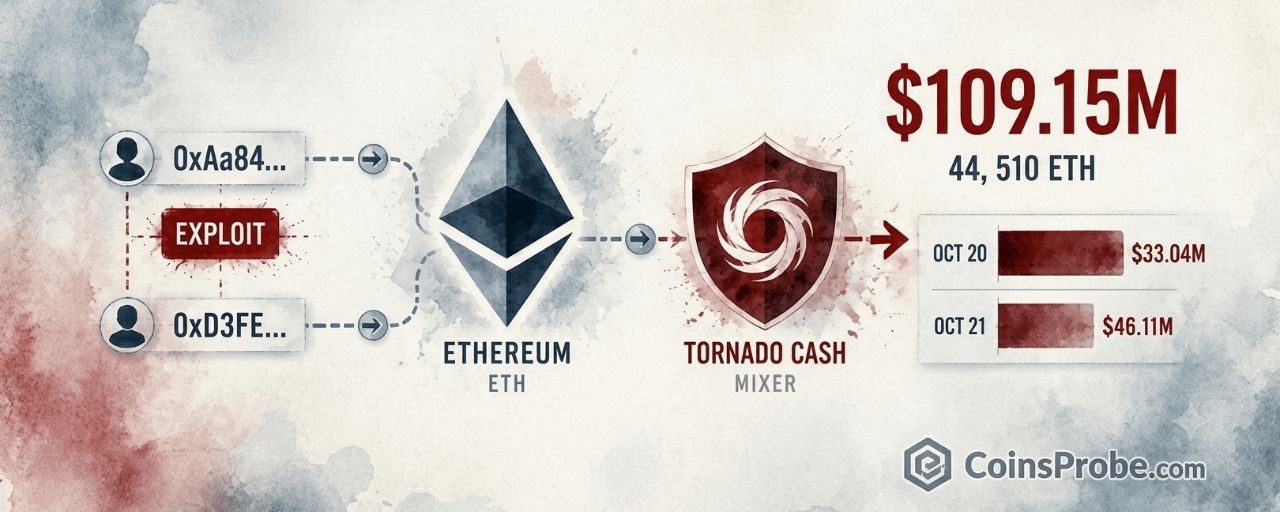
ලිපිය
Drift Protocol Exploiter Moves $109M ETH to Tornado Cash in 48 HoursKey Highlights
Drift Protocol exploiter transferred 44,510 ETH (~$109.15M) to Tornado Cash across Oct 20–21, per OnchainLensOct 20 tranche: 25,710 ETH (~$63.04M)Oct 21 tranche: 18,800 ETH (~$46.11M) — two identified wallet addressesFunds entered mixer, not exchange — direct spot sell pressure is deferred, not immediateWatch for unlabeled large ETH deposits to centralized exchanges as the post-mixer off-ramp signal
BREAKING
The Drift Protocol exploiter — a wallet cluster tied to a prior protocol breach — moved 44,510 ETH valued at approximately $109.15 million into Tornado Cash over a 48-hour window, according to OnchainLens. The transfer represents one of the largest single exploit-fund laundering events routed through the mixer in recent memory, and it arrives at a time when Ethereum’s price action and regulatory environment are both under active scrutiny. For broader context on ETH’s current market structure, see Ethereum After the Binance Leverage Flush — What the Data Says Now.
The Move:
The funds were split across two identified wallet addresses — 0xAa843eD65C1f061F111B5289169731351c5e57C1 and 0xD3FEEd5DA83D8e8c449d6CB96ff1eb06ED1cF6C7 — and routed into Tornado Cash in two discrete tranches. On October 20, 25,710 ETH (~$63.04M) was transferred. The following day, October 21, a second batch of 18,800 ETH (~$46.11M) followed. The alert was published by @OnchainLens at 08:26 GMT on October 21, 2026. No exchange deposit was flagged — the destination in both cases was Tornado Cash, the Ethereum-based privacy mixer that obfuscates transaction trails by pooling and re-routing funds.
DRIFT EXPLOITER MOVES $109M $ETH | Source: @OnchainLens (X)
What This Signals:
This is not a standard whale accumulation or distribution event — it is an exploit wallet actively attempting to obscure the origin of stolen funds. On-chain analysts interpret Tornado Cash inflows of this scale as a laundering sequence: the exploiter is breaking the traceable link between the original breach and eventual liquidation.
The two-day structure — large first tranche, smaller follow-up — is consistent with testing mixer throughput before committing the full balance. Critically, this move does not directly signal a spot sell pressure on ETH markets, since the funds are entering a mixer rather than a centralized exchange. However, the risk is deferred, not eliminated: once funds clear the mixer, they can re-emerge as untraceable ETH and be sold on any venue. On-chain watchers will now monitor for large, unlabeled wallet deposits to major exchanges — particularly Binance, Coinbase, and Kraken — as the post-mixer off-ramp. A sustained ETH price hold above its current range would suggest this pressure has not yet materialized in spot markets.
What to Watch Next:
The critical follow-on signal is whether additional ETH exits from either address — 0xAa843eD65C1f061F111B5289169731351c5e57C1 or 0xD3FEEd5DA83D8e8c449d6CB96ff1eb06ED1cF6C7 — in coming days. If the two identified wallets still hold residual ETH beyond the 44.51K already moved, a third tranche cannot be ruled out. Law enforcement agencies and blockchain analytics firms including Chainalysis and TRM Labs have historically tracked post-Tornado Cash fund flows by probabilistic clustering — meaning this movement is unlikely to fully evade scrutiny despite the mixer.
The Drift Protocol community and its broader DeFi stakeholders will be watching for any protocol-level response, insurance fund activation, or recovery announcements tied to the original exploit. Until a confirmed exchange deposit from a post-mixer wallet appears on-chain, the direct sell pressure on ETH from this event remains latent rather than immediate.
Disclaimer: The views and analysis presented in this article are for informational purposes only and reflect the author’s perspective, not financial advice. Technical patterns and indicators discussed are subject to market volatility and may or may not yield anticipated results. Investors are advised to exercise caution, conduct independent research, and make decisions aligned with their individual risk tolerance.
Drift Protocol Exploiter Moves $109M ETH to Tornado Cash in 48 Hours
Key Highlights
Drift Protocol exploiter transferred 44,510 ETH (~$109.15M) to Tornado Cash across Oct 20–21, per OnchainLensOct 20 tranche: 25,710 ETH (~$63.04M)Oct 21 tranche: 18,800 ETH (~$46.11M) — two identified wallet addressesFunds entered mixer, not exchange — direct spot sell pressure is deferred, not immediateWatch for unlabeled large ETH deposits to centralized exchanges as the post-mixer off-ramp signal
BREAKING
The Drift Protocol exploiter — a wallet cluster tied to a prior protocol breach — moved 44,510 ETH valued at approximately $109.15 million into Tornado Cash over a 48-hour window, according to OnchainLens. The transfer represents one of the largest single exploit-fund laundering events routed through the mixer in recent memory, and it arrives at a time when Ethereum’s price action and regulatory environment are both under active scrutiny. For broader context on ETH’s current market structure, see Ethereum After the Binance Leverage Flush — What the Data Says Now.
The Move:
The funds were split across two identified wallet addresses — 0xAa843eD65C1f061F111B5289169731351c5e57C1 and 0xD3FEEd5DA83D8e8c449d6CB96ff1eb06ED1cF6C7 — and routed into Tornado Cash in two discrete tranches. On October 20, 25,710 ETH (~$63.04M) was transferred. The following day, October 21, a second batch of 18,800 ETH (~$46.11M) followed. The alert was published by @OnchainLens at 08:26 GMT on October 21, 2026. No exchange deposit was flagged — the destination in both cases was Tornado Cash, the Ethereum-based privacy mixer that obfuscates transaction trails by pooling and re-routing funds.
DRIFT EXPLOITER MOVES $109M $ETH | Source: @OnchainLens (X)
What This Signals:
This is not a standard whale accumulation or distribution event — it is an exploit wallet actively attempting to obscure the origin of stolen funds. On-chain analysts interpret Tornado Cash inflows of this scale as a laundering sequence: the exploiter is breaking the traceable link between the original breach and eventual liquidation.
The two-day structure — large first tranche, smaller follow-up — is consistent with testing mixer throughput before committing the full balance. Critically, this move does not directly signal a spot sell pressure on ETH markets, since the funds are entering a mixer rather than a centralized exchange. However, the risk is deferred, not eliminated: once funds clear the mixer, they can re-emerge as untraceable ETH and be sold on any venue. On-chain watchers will now monitor for large, unlabeled wallet deposits to major exchanges — particularly Binance, Coinbase, and Kraken — as the post-mixer off-ramp. A sustained ETH price hold above its current range would suggest this pressure has not yet materialized in spot markets.
What to Watch Next:
The critical follow-on signal is whether additional ETH exits from either address — 0xAa843eD65C1f061F111B5289169731351c5e57C1 or 0xD3FEEd5DA83D8e8c449d6CB96ff1eb06ED1cF6C7 — in coming days. If the two identified wallets still hold residual ETH beyond the 44.51K already moved, a third tranche cannot be ruled out. Law enforcement agencies and blockchain analytics firms including Chainalysis and TRM Labs have historically tracked post-Tornado Cash fund flows by probabilistic clustering — meaning this movement is unlikely to fully evade scrutiny despite the mixer.
The Drift Protocol community and its broader DeFi stakeholders will be watching for any protocol-level response, insurance fund activation, or recovery announcements tied to the original exploit. Until a confirmed exchange deposit from a post-mixer wallet appears on-chain, the direct sell pressure on ETH from this event remains latent rather than immediate.
Disclaimer: The views and analysis presented in this article are for informational purposes only and reflect the author’s perspective, not financial advice. Technical patterns and indicators discussed are subject to market volatility and may or may not yield anticipated results. Investors are advised to exercise caution, conduct independent research, and make decisions aligned with their individual risk tolerance.
Drift Protocol exploiter transferred 44,510 ETH (~$109.15M) to Tornado Cash across Oct 20–21, per OnchainLensOct 20 tranche: 25,710 ETH (~$63.04M)Oct 21 tranche: 18,800 ETH (~$46.11M) — two identified wallet addressesFunds entered mixer, not exchange — direct spot sell pressure is deferred, not immediateWatch for unlabeled large ETH deposits to centralized exchanges as the post-mixer off-ramp signal
BREAKING
The Drift Protocol exploiter — a wallet cluster tied to a prior protocol breach — moved 44,510 ETH valued at approximately $109.15 million into Tornado Cash over a 48-hour window, according to OnchainLens. The transfer represents one of the largest single exploit-fund laundering events routed through the mixer in recent memory, and it arrives at a time when Ethereum’s price action and regulatory environment are both under active scrutiny. For broader context on ETH’s current market structure, see Ethereum After the Binance Leverage Flush — What the Data Says Now.
The Move:
The funds were split across two identified wallet addresses — 0xAa843eD65C1f061F111B5289169731351c5e57C1 and 0xD3FEEd5DA83D8e8c449d6CB96ff1eb06ED1cF6C7 — and routed into Tornado Cash in two discrete tranches. On October 20, 25,710 ETH (~$63.04M) was transferred. The following day, October 21, a second batch of 18,800 ETH (~$46.11M) followed. The alert was published by @OnchainLens at 08:26 GMT on October 21, 2026. No exchange deposit was flagged — the destination in both cases was Tornado Cash, the Ethereum-based privacy mixer that obfuscates transaction trails by pooling and re-routing funds.
DRIFT EXPLOITER MOVES $109M $ETH | Source: @OnchainLens (X)
What This Signals:
This is not a standard whale accumulation or distribution event — it is an exploit wallet actively attempting to obscure the origin of stolen funds. On-chain analysts interpret Tornado Cash inflows of this scale as a laundering sequence: the exploiter is breaking the traceable link between the original breach and eventual liquidation.
The two-day structure — large first tranche, smaller follow-up — is consistent with testing mixer throughput before committing the full balance. Critically, this move does not directly signal a spot sell pressure on ETH markets, since the funds are entering a mixer rather than a centralized exchange. However, the risk is deferred, not eliminated: once funds clear the mixer, they can re-emerge as untraceable ETH and be sold on any venue. On-chain watchers will now monitor for large, unlabeled wallet deposits to major exchanges — particularly Binance, Coinbase, and Kraken — as the post-mixer off-ramp. A sustained ETH price hold above its current range would suggest this pressure has not yet materialized in spot markets.
What to Watch Next:
The critical follow-on signal is whether additional ETH exits from either address — 0xAa843eD65C1f061F111B5289169731351c5e57C1 or 0xD3FEEd5DA83D8e8c449d6CB96ff1eb06ED1cF6C7 — in coming days. If the two identified wallets still hold residual ETH beyond the 44.51K already moved, a third tranche cannot be ruled out. Law enforcement agencies and blockchain analytics firms including Chainalysis and TRM Labs have historically tracked post-Tornado Cash fund flows by probabilistic clustering — meaning this movement is unlikely to fully evade scrutiny despite the mixer.
The Drift Protocol community and its broader DeFi stakeholders will be watching for any protocol-level response, insurance fund activation, or recovery announcements tied to the original exploit. Until a confirmed exchange deposit from a post-mixer wallet appears on-chain, the direct sell pressure on ETH from this event remains latent rather than immediate.
Disclaimer: The views and analysis presented in this article are for informational purposes only and reflect the author’s perspective, not financial advice. Technical patterns and indicators discussed are subject to market volatility and may or may not yield anticipated results. Investors are advised to exercise caution, conduct independent research, and make decisions aligned with their individual risk tolerance.
553
·
--

ලිපිය
Hyperliquid Burns $1.75M HYPE in 24 Hours — $4.05B Lifetime BuybackKey Highlights
Hyperliquid burned 21,790 HYPE at avg $80.27 in 24h — total burn value $1.75M per @OnchainLensLifetime burn: 49.69M HYPE (~$4.05B) — 4.97% of 1B max supply permanently removed24h burn value ($1.75M) exceeded same-period estimated fees ($1.65M) — protocol deploying reservesKey level: $80.27 avg burn price acts as implicit protocol support — watch for sustained hold
BREAKING
HYPE is one of the few large-cap tokens operating an active, protocol-funded buyback-and-burn program — and the latest 24-hour window produced one of the most direct deflationary data points of the current cycle. The token has been trading around the $80 level as Hyperliquid continues deploying fee revenue directly into open-market purchases and permanent token destruction.
According to @OnchainLens, Hyperliquid’s protocol bought and burned 21,790 $HYPE tokens over the past 24 hours at an average price of $80.27 per token — a total burn value of $1.75 million in a single day.
This was not a one-time event or a whale wallet decision: it is the protocol’s automated buyback mechanism converting trading fee revenue into permanent supply reduction. The estimated platform fees that funded the burn totalled $1.65 million in the same 24-hour window — meaning the burn dollar value actually exceeded the day’s reported fee haul, a dynamic one reply in the thread described as “real buyback pressure.” Cumulatively, the program has now burned 49.69 million HYPE, worth approximately $4.05 billion at current prices, permanently removing 4.97% of the protocol’s 1 billion token maximum supply.
HYPERLIQUID BURNS $1.75M $HYPE | Source: @OnchainLens (X)
On-chain analysts interpret a sustained burn rate of this scale as structurally deflationary — the protocol is mechanically reducing circulating supply every day the platform generates fees. What makes this particularly significant is the burn-to-fee ratio: when the 24-hour burn value of $1.75M outpaces the same-period fee estimate of $1.65M, it signals that either accumulated reserves are being deployed or the average burn price captured a favorable intraday dip below the day’s fee rate.
Either interpretation points to an aggressive buyback posture. For price structure, the $80.27 average burn price serves as an implicit near-term anchor — the protocol was actively buying at that level, which on-chain observers treat as a form of protocol-level support. The key level to watch on the downside is whether HYPE holds above the $80 zone; a sustained break below it would push future burns to a lower average cost basis but would also signal demand deterioration despite the mechanical bid.
The wallet to watch is the protocol’s own burn address, which has now accumulated a 49.69 million HYPE lifetime burn record. Forward confirmation of the bullish supply thesis rests on two metrics: whether daily fee generation sustains or grows above the $1.65M baseline — which would keep the burn engine funded — and whether the burn rate per day continues to exceed or match the fee output.
Any significant drop in daily fees without a corresponding slowdown in burns would imply reserve drawdown rather than organic revenue-driven deflation, a distinction worth monitoring. For broader Hyperliquid on-chain context, see the platform’s recent activity including two whales opening $37.57M in 10x ZEC longs on Hyperliquid in 15 hours and the Hyperliquid gambler whose ETH long was liquidated for $1.08M while a $110.85M BTC bet remains open — both illustrating the scale of activity generating the fee revenue that funds these burns.
Disclaimer: This article is for informational purposes only and does not constitute financial advice. Always conduct your own research before making any investment decisions.
Hyperliquid Burns $1.75M HYPE in 24 Hours — $4.05B Lifetime Buyback
Key Highlights
Hyperliquid burned 21,790 HYPE at avg $80.27 in 24h — total burn value $1.75M per @OnchainLensLifetime burn: 49.69M HYPE (~$4.05B) — 4.97% of 1B max supply permanently removed24h burn value ($1.75M) exceeded same-period estimated fees ($1.65M) — protocol deploying reservesKey level: $80.27 avg burn price acts as implicit protocol support — watch for sustained hold
BREAKING
HYPE is one of the few large-cap tokens operating an active, protocol-funded buyback-and-burn program — and the latest 24-hour window produced one of the most direct deflationary data points of the current cycle. The token has been trading around the $80 level as Hyperliquid continues deploying fee revenue directly into open-market purchases and permanent token destruction.
According to @OnchainLens, Hyperliquid’s protocol bought and burned 21,790 $HYPE tokens over the past 24 hours at an average price of $80.27 per token — a total burn value of $1.75 million in a single day.
This was not a one-time event or a whale wallet decision: it is the protocol’s automated buyback mechanism converting trading fee revenue into permanent supply reduction. The estimated platform fees that funded the burn totalled $1.65 million in the same 24-hour window — meaning the burn dollar value actually exceeded the day’s reported fee haul, a dynamic one reply in the thread described as “real buyback pressure.” Cumulatively, the program has now burned 49.69 million HYPE, worth approximately $4.05 billion at current prices, permanently removing 4.97% of the protocol’s 1 billion token maximum supply.
HYPERLIQUID BURNS $1.75M $HYPE | Source: @OnchainLens (X)
On-chain analysts interpret a sustained burn rate of this scale as structurally deflationary — the protocol is mechanically reducing circulating supply every day the platform generates fees. What makes this particularly significant is the burn-to-fee ratio: when the 24-hour burn value of $1.75M outpaces the same-period fee estimate of $1.65M, it signals that either accumulated reserves are being deployed or the average burn price captured a favorable intraday dip below the day’s fee rate.
Either interpretation points to an aggressive buyback posture. For price structure, the $80.27 average burn price serves as an implicit near-term anchor — the protocol was actively buying at that level, which on-chain observers treat as a form of protocol-level support. The key level to watch on the downside is whether HYPE holds above the $80 zone; a sustained break below it would push future burns to a lower average cost basis but would also signal demand deterioration despite the mechanical bid.
The wallet to watch is the protocol’s own burn address, which has now accumulated a 49.69 million HYPE lifetime burn record. Forward confirmation of the bullish supply thesis rests on two metrics: whether daily fee generation sustains or grows above the $1.65M baseline — which would keep the burn engine funded — and whether the burn rate per day continues to exceed or match the fee output.
Any significant drop in daily fees without a corresponding slowdown in burns would imply reserve drawdown rather than organic revenue-driven deflation, a distinction worth monitoring. For broader Hyperliquid on-chain context, see the platform’s recent activity including two whales opening $37.57M in 10x ZEC longs on Hyperliquid in 15 hours and the Hyperliquid gambler whose ETH long was liquidated for $1.08M while a $110.85M BTC bet remains open — both illustrating the scale of activity generating the fee revenue that funds these burns.
Disclaimer: This article is for informational purposes only and does not constitute financial advice. Always conduct your own research before making any investment decisions.
Hyperliquid burned 21,790 HYPE at avg $80.27 in 24h — total burn value $1.75M per @OnchainLensLifetime burn: 49.69M HYPE (~$4.05B) — 4.97% of 1B max supply permanently removed24h burn value ($1.75M) exceeded same-period estimated fees ($1.65M) — protocol deploying reservesKey level: $80.27 avg burn price acts as implicit protocol support — watch for sustained hold
BREAKING
HYPE is one of the few large-cap tokens operating an active, protocol-funded buyback-and-burn program — and the latest 24-hour window produced one of the most direct deflationary data points of the current cycle. The token has been trading around the $80 level as Hyperliquid continues deploying fee revenue directly into open-market purchases and permanent token destruction.
According to @OnchainLens, Hyperliquid’s protocol bought and burned 21,790 $HYPE tokens over the past 24 hours at an average price of $80.27 per token — a total burn value of $1.75 million in a single day.
This was not a one-time event or a whale wallet decision: it is the protocol’s automated buyback mechanism converting trading fee revenue into permanent supply reduction. The estimated platform fees that funded the burn totalled $1.65 million in the same 24-hour window — meaning the burn dollar value actually exceeded the day’s reported fee haul, a dynamic one reply in the thread described as “real buyback pressure.” Cumulatively, the program has now burned 49.69 million HYPE, worth approximately $4.05 billion at current prices, permanently removing 4.97% of the protocol’s 1 billion token maximum supply.
HYPERLIQUID BURNS $1.75M $HYPE | Source: @OnchainLens (X)
On-chain analysts interpret a sustained burn rate of this scale as structurally deflationary — the protocol is mechanically reducing circulating supply every day the platform generates fees. What makes this particularly significant is the burn-to-fee ratio: when the 24-hour burn value of $1.75M outpaces the same-period fee estimate of $1.65M, it signals that either accumulated reserves are being deployed or the average burn price captured a favorable intraday dip below the day’s fee rate.
Either interpretation points to an aggressive buyback posture. For price structure, the $80.27 average burn price serves as an implicit near-term anchor — the protocol was actively buying at that level, which on-chain observers treat as a form of protocol-level support. The key level to watch on the downside is whether HYPE holds above the $80 zone; a sustained break below it would push future burns to a lower average cost basis but would also signal demand deterioration despite the mechanical bid.
The wallet to watch is the protocol’s own burn address, which has now accumulated a 49.69 million HYPE lifetime burn record. Forward confirmation of the bullish supply thesis rests on two metrics: whether daily fee generation sustains or grows above the $1.65M baseline — which would keep the burn engine funded — and whether the burn rate per day continues to exceed or match the fee output.
Any significant drop in daily fees without a corresponding slowdown in burns would imply reserve drawdown rather than organic revenue-driven deflation, a distinction worth monitoring. For broader Hyperliquid on-chain context, see the platform’s recent activity including two whales opening $37.57M in 10x ZEC longs on Hyperliquid in 15 hours and the Hyperliquid gambler whose ETH long was liquidated for $1.08M while a $110.85M BTC bet remains open — both illustrating the scale of activity generating the fee revenue that funds these burns.
Disclaimer: This article is for informational purposes only and does not constitute financial advice. Always conduct your own research before making any investment decisions.
252
·
--
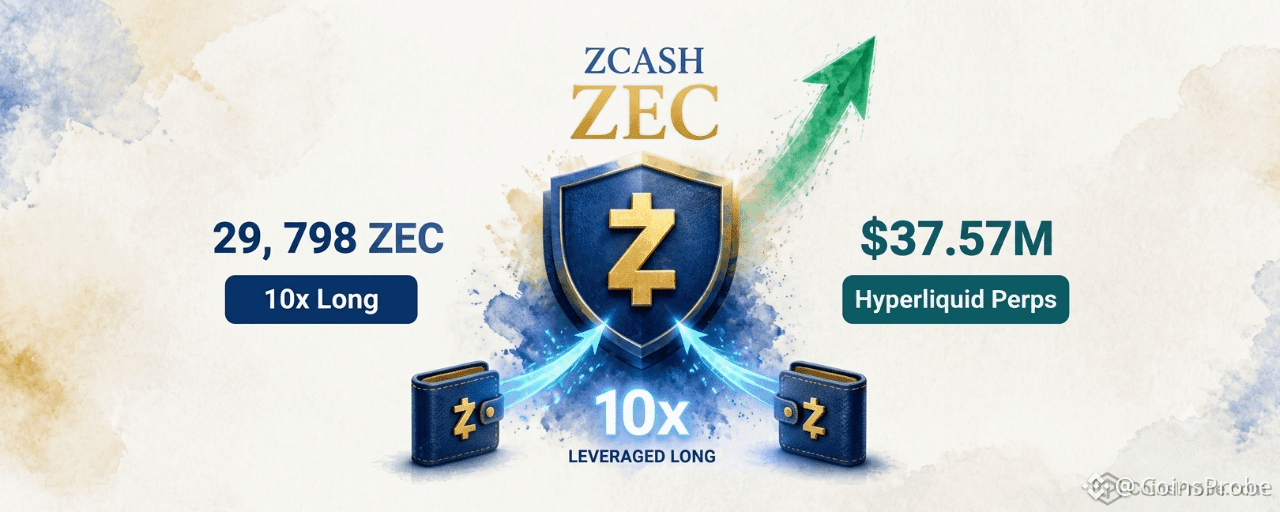
ලිපිය
Two Whales Open $37.57M in 10x ZEC Longs on Hyperliquid in 15 HoursKey Highlights
Two wallets opened 29,798 ZEC in 10x longs worth $37.57M on Hyperliquid perps within 15 hoursPositions entered near spot with no disclosed liquidation threshold — roughly 10% adverse move risks liquidationZEC surged over 25% in the prior week amid privacy-coin rotation as Monero faced regulatory pressureWatch wallets 0x30af...393e and 0xbf73...d58 on Hypurrscan for position additions or exchange inflows
BREAKING
Zcash (ZEC) has surged more than 25% over the prior week, riding a rotation into privacy-coin assets as regulatory scrutiny on Monero intensified and broader risk appetite in crypto perpetuals markets expanded. That momentum has now attracted significant leveraged conviction from at least two large on-chain actors.
Over a 15-hour window, two wallets opened 10x leveraged long positions on Hyperliquid’s ZEC perpetuals market totaling 29,798 $ZEC — valued at $37.57 million at entry. The positions were flagged by Lookonchain and independently verifiable on Hypurrscan.
Wallet one — 0x30af…393e — and wallet two — 0xbf73…d58 — both entered near current spot levels with average entries unhedged and no disclosed stop or liquidation threshold made public. The exchange is Hyperliquid; the instrument is ZEC perpetuals.
ZEC Whale 1 | Source: @lookonchain (X)
On-chain analysts interpret a coordinated 10x long of this size — $37.57M notional across two wallets inside a single 15-hour session — as a directional conviction bet, not passive accumulation.
ZEC Whale 2 | Source: @lookonchain (X)
At 10x leverage, a roughly 10% adverse move against the position would approach liquidation territory, meaning these wallets are wagering on continued near-term upside rather than a slow grind. The privacy-coin narrative context matters here: with Monero facing renewed regulatory pressure, capital rotating toward ZEC as a liquid alternative has been the primary structural driver of this week’s move.
The level to watch is the entry zone itself — if ZEC fails to hold spot prices near current levels, leveraged longs of this size face cascading liquidation risk that could amplify any pullback. Conversely, a sustained hold above the entry zone keeps the positions solvent and may attract further long-side interest. For broader context on how leveraged whale positioning on Hyperliquid has played out recently, see Hyperliquid Gambler’s ETH Long Liquidated for $1.08M — $110.85M BTC Bet Remains.
The next confirmation signal to track is whether these two wallets add to their positions, reduce exposure, or hold flat as ZEC price evolves. An increase in position size from either 0x30af…393e or 0xbf73…d58 would signal escalating conviction; a partial close would indicate profit-taking or risk reduction. On-chain activity that would deny the bullish read: large ZEC inflows to centralized exchanges from either wallet — that would suggest a hedge or an intent to unwind. No statements from the Zcash Foundation or core developers have been identified in connection with these trades. The positions remain live and trackable in real time via Hypurrscan.
Disclaimer: This article is for informational purposes only and does not constitute financial advice. Always conduct your own research before making any investment decisions.
Two Whales Open $37.57M in 10x ZEC Longs on Hyperliquid in 15 Hours
Key Highlights
Two wallets opened 29,798 ZEC in 10x longs worth $37.57M on Hyperliquid perps within 15 hoursPositions entered near spot with no disclosed liquidation threshold — roughly 10% adverse move risks liquidationZEC surged over 25% in the prior week amid privacy-coin rotation as Monero faced regulatory pressureWatch wallets 0x30af...393e and 0xbf73...d58 on Hypurrscan for position additions or exchange inflows
BREAKING
Zcash (ZEC) has surged more than 25% over the prior week, riding a rotation into privacy-coin assets as regulatory scrutiny on Monero intensified and broader risk appetite in crypto perpetuals markets expanded. That momentum has now attracted significant leveraged conviction from at least two large on-chain actors.
Over a 15-hour window, two wallets opened 10x leveraged long positions on Hyperliquid’s ZEC perpetuals market totaling 29,798 $ZEC — valued at $37.57 million at entry. The positions were flagged by Lookonchain and independently verifiable on Hypurrscan.
Wallet one — 0x30af…393e — and wallet two — 0xbf73…d58 — both entered near current spot levels with average entries unhedged and no disclosed stop or liquidation threshold made public. The exchange is Hyperliquid; the instrument is ZEC perpetuals.
ZEC Whale 1 | Source: @lookonchain (X)
On-chain analysts interpret a coordinated 10x long of this size — $37.57M notional across two wallets inside a single 15-hour session — as a directional conviction bet, not passive accumulation.
ZEC Whale 2 | Source: @lookonchain (X)
At 10x leverage, a roughly 10% adverse move against the position would approach liquidation territory, meaning these wallets are wagering on continued near-term upside rather than a slow grind. The privacy-coin narrative context matters here: with Monero facing renewed regulatory pressure, capital rotating toward ZEC as a liquid alternative has been the primary structural driver of this week’s move.
The level to watch is the entry zone itself — if ZEC fails to hold spot prices near current levels, leveraged longs of this size face cascading liquidation risk that could amplify any pullback. Conversely, a sustained hold above the entry zone keeps the positions solvent and may attract further long-side interest. For broader context on how leveraged whale positioning on Hyperliquid has played out recently, see Hyperliquid Gambler’s ETH Long Liquidated for $1.08M — $110.85M BTC Bet Remains.
The next confirmation signal to track is whether these two wallets add to their positions, reduce exposure, or hold flat as ZEC price evolves. An increase in position size from either 0x30af…393e or 0xbf73…d58 would signal escalating conviction; a partial close would indicate profit-taking or risk reduction. On-chain activity that would deny the bullish read: large ZEC inflows to centralized exchanges from either wallet — that would suggest a hedge or an intent to unwind. No statements from the Zcash Foundation or core developers have been identified in connection with these trades. The positions remain live and trackable in real time via Hypurrscan.
Disclaimer: This article is for informational purposes only and does not constitute financial advice. Always conduct your own research before making any investment decisions.
Two wallets opened 29,798 ZEC in 10x longs worth $37.57M on Hyperliquid perps within 15 hoursPositions entered near spot with no disclosed liquidation threshold — roughly 10% adverse move risks liquidationZEC surged over 25% in the prior week amid privacy-coin rotation as Monero faced regulatory pressureWatch wallets 0x30af...393e and 0xbf73...d58 on Hypurrscan for position additions or exchange inflows
BREAKING
Zcash (ZEC) has surged more than 25% over the prior week, riding a rotation into privacy-coin assets as regulatory scrutiny on Monero intensified and broader risk appetite in crypto perpetuals markets expanded. That momentum has now attracted significant leveraged conviction from at least two large on-chain actors.
Over a 15-hour window, two wallets opened 10x leveraged long positions on Hyperliquid’s ZEC perpetuals market totaling 29,798 $ZEC — valued at $37.57 million at entry. The positions were flagged by Lookonchain and independently verifiable on Hypurrscan.
Wallet one — 0x30af…393e — and wallet two — 0xbf73…d58 — both entered near current spot levels with average entries unhedged and no disclosed stop or liquidation threshold made public. The exchange is Hyperliquid; the instrument is ZEC perpetuals.
ZEC Whale 1 | Source: @lookonchain (X)
On-chain analysts interpret a coordinated 10x long of this size — $37.57M notional across two wallets inside a single 15-hour session — as a directional conviction bet, not passive accumulation.
ZEC Whale 2 | Source: @lookonchain (X)
At 10x leverage, a roughly 10% adverse move against the position would approach liquidation territory, meaning these wallets are wagering on continued near-term upside rather than a slow grind. The privacy-coin narrative context matters here: with Monero facing renewed regulatory pressure, capital rotating toward ZEC as a liquid alternative has been the primary structural driver of this week’s move.
The level to watch is the entry zone itself — if ZEC fails to hold spot prices near current levels, leveraged longs of this size face cascading liquidation risk that could amplify any pullback. Conversely, a sustained hold above the entry zone keeps the positions solvent and may attract further long-side interest. For broader context on how leveraged whale positioning on Hyperliquid has played out recently, see Hyperliquid Gambler’s ETH Long Liquidated for $1.08M — $110.85M BTC Bet Remains.
The next confirmation signal to track is whether these two wallets add to their positions, reduce exposure, or hold flat as ZEC price evolves. An increase in position size from either 0x30af…393e or 0xbf73…d58 would signal escalating conviction; a partial close would indicate profit-taking or risk reduction. On-chain activity that would deny the bullish read: large ZEC inflows to centralized exchanges from either wallet — that would suggest a hedge or an intent to unwind. No statements from the Zcash Foundation or core developers have been identified in connection with these trades. The positions remain live and trackable in real time via Hypurrscan.
Disclaimer: This article is for informational purposes only and does not constitute financial advice. Always conduct your own research before making any investment decisions.
1
718
·
--
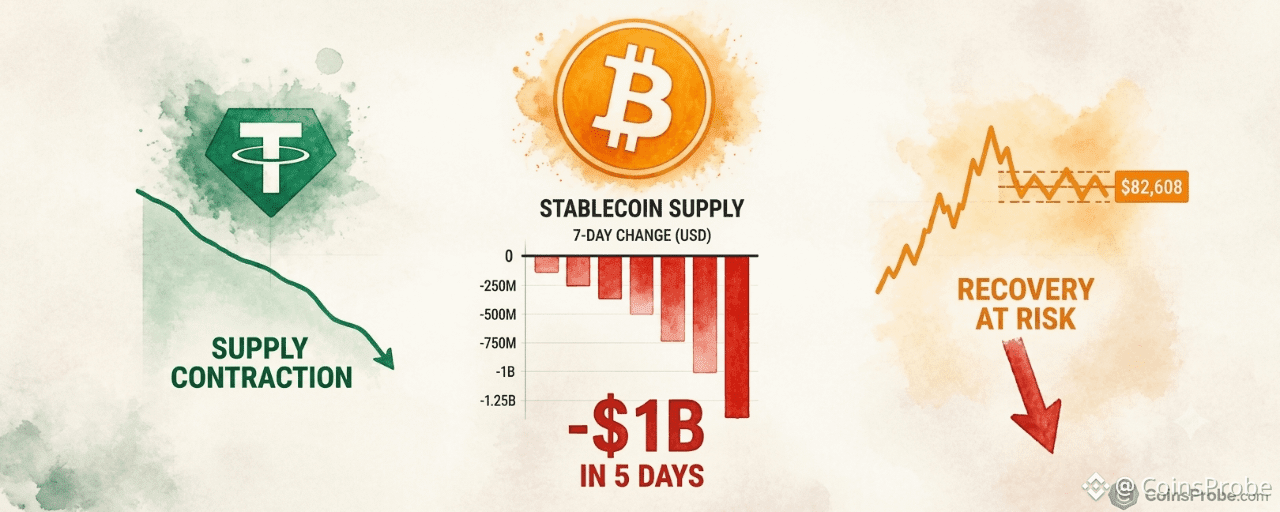
ලිපිය
USDT Supply Shrinks $1B as Bitcoin’s Recovery Faces a Liquidity TestKey Highlights
Bitcoin trades at $82,608 (+1.24% 24h) as USDT supply contracts nearly $1B in 5 consecutive days per CryptoQuantCryptoQuant analyst @MorenoDV_ warns: recovery loses momentum if USDT supply keeps shrinking while BTC stalls60-day USDT market cap change SMA is trending negative — a pattern last seen during the 2022 bear market trough near $20KKey metric to watch: CryptoQuant's daily USDT market cap change — net expansion required to confirm demand recovery
Bitcoin is attempting a recovery — but the fuel powering that recovery may be draining faster than the price suggests. At the time of writing, Bitcoin is trading at approximately $82,608, up 1.24% over the past 24 hours, with a market cap of $1.66 trillion. The critical variable is not on Bitcoin’s chart. It is on USDT’s.
CryptoQuant analyst @MorenoDV_, writing on the CryptoQuant platform, issued a pointed warning on October 20, 2026: “If supply keeps shrinking while BTC stalls, the risk is that the recovery loses momentum before demand becomes strong enough to absorb renewed selling.” The trigger for that warning is a measurable, on-chain contraction — USDT has lost nearly $1 billion in supply over five consecutive days.
The Signal — $1 Billion in USDT Supply Vanishes in 5 Days
Stablecoin supply is not an abstract sentiment indicator. It is the literal stock of purchasing power sitting on-chain, available to flow into Bitcoin and other crypto assets. When USDT supply expands, it means more dollars are being tokenized and positioned for deployment. When it contracts, the opposite is true — holders are redeeming USDT back to fiat, reducing available buying capacity across the market.
The CryptoQuant chart shared by @cryptoquant_com shows USDT’s daily market cap change over the period from approximately November 2025 through October 2026. A cluster of negative bars — circled in blue by the analyst — marks the most recent five-day window. The 60-day moving average of USDT market cap change, which had been trending positive through much of 2025’s bull run, has now turned and is trending downward. The annotation printed directly on the chart reads: “USDT has lost nearly $1 billion in 5 days.”
Chart 1 of 3: Chart Analysis | Source: @cryptoquant_com (X)
The longer-term chart extends the view back to July 2022, placing the current contraction in cycle context. During Bitcoin’s 2022 bear market trough — when BTC traded near the $20,000 level marked by the dashed reference line — USDT supply was also contracting sharply. The current negative bars in the daily market cap change series mirror that earlier episode, while Bitcoin’s price line shows a sharp rise from its late-2024 cycle peak, followed by a plateau and the current stall. The 30-day SMA of USDT daily market cap change is trending downward, consistent with the short-term signal.
Source: @cryptoquant_com (X)
The third chart in the series overlays the 60-day USDT market cap change as a shaded area against Bitcoin’s price, from July 2022 through mid-2026. The purple 60-day area turns sharply negative in the most recent period, forming a deep trough — while Bitcoin’s price shows only a modest recovery bounce from its local low. This divergence is the analyst’s core concern: Bitcoin is attempting to recover, but the stablecoin fuel that would need to absorb renewed selling is simultaneously shrinking.
Source: @cryptoquant_com (X)
Why Stablecoin Contraction Matters More at a Stall Than at a Peak
The mechanism is straightforward. A Bitcoin recovery requires net buying pressure to sustain upward momentum — buyers need to continuously outpace sellers. Stablecoin supply is the clearest proxy for latent buying demand, because USDT on-chain represents capital that has already moved into the crypto ecosystem but has not yet been deployed into BTC or other assets.
When Bitcoin is rising strongly, stablecoin contraction is less alarming — it often means USDT is being converted directly into BTC, driving the rally. But when Bitcoin stalls — as it is doing now at $82,608 — and stablecoin supply contracts simultaneously, the picture is different. It means capital is leaving the ecosystem without being deployed into Bitcoin. The pool of available buyers is shrinking, not converting.
This is the specific risk @MorenoDV_ identifies: the recovery loses momentum not because of aggressive selling, but because buying demand fails to materialize at sufficient scale to absorb whatever selling pressure returns. This dynamic is what distinguishes a stalled recovery from a genuine consolidation before continuation. For broader context on what post-leverage-flush data shows for crypto’s largest assets, see Ethereum After the Binance Leverage Flush — What the Data Says Now.
What Confirms or Refutes the Risk
The analyst’s warning is conditional, not declarative. The phrase “if supply keeps shrinking” is the operative condition. A single five-day contraction of $1 billion in USDT supply does not guarantee Bitcoin’s recovery fails — it flags the risk that failure becomes more probable if the trend continues.
The metric to track is CryptoQuant’s USDT daily market cap change series. A reversal — USDT supply returning to net daily expansion — would indicate fresh capital entering the ecosystem and rebuilding the demand buffer. A continuation of negative daily bars would extend the supply drain and increase the probability that Bitcoin’s current stall becomes a reversal rather than a consolidation.
CryptoQuant updates this data in near-real time. At the time of writing, the trend is negative. Whether it stabilizes or deepens is the single most important on-chain question for Bitcoin’s near-term trajectory.
Bullish Scenario
USDT daily market cap change returns to positive territory — signaling fresh capital inflows — while Bitcoin holds above current levels. A reversal in the 60-day USDT SMA would confirm that the demand pool is rebuilding, providing the absorption capacity needed to sustain recovery momentum through renewed selling pressure.
Bearish Scenario
USDT supply contraction continues for additional sessions while Bitcoin fails to break above its current stall zone. Under this scenario, @MorenoDV_’s stated risk materializes: recovery momentum fades, and Bitcoin becomes vulnerable to losing ground before sufficient buying demand accumulates. No specific downside price level was stated by the analyst.
The on-chain picture right now is not a buy signal or a sell signal. It is a warning about the structural prerequisite for continuation — and that prerequisite is currently moving in the wrong direction. Bitcoin at $82,608 is attempting a recovery. USDT supply losing nearly $1 billion in five days is the precise condition that makes that attempt fragile. Watch CryptoQuant’s USDT market cap change series: a return to net daily expansion is the confirmation the recovery needs.
Disclaimer: The views and analysis presented in this article are for informational purposes only and reflect the author’s perspective, not financial advice. Technical patterns and indicators discussed are subject to market volatility and may or may not yield anticipated results. Investors are advised to exercise caution, conduct independent research, and make decisions aligned with their individual risk tolerance.
USDT Supply Shrinks $1B as Bitcoin’s Recovery Faces a Liquidity Test
Key Highlights
Bitcoin trades at $82,608 (+1.24% 24h) as USDT supply contracts nearly $1B in 5 consecutive days per CryptoQuantCryptoQuant analyst @MorenoDV_ warns: recovery loses momentum if USDT supply keeps shrinking while BTC stalls60-day USDT market cap change SMA is trending negative — a pattern last seen during the 2022 bear market trough near $20KKey metric to watch: CryptoQuant's daily USDT market cap change — net expansion required to confirm demand recovery
Bitcoin is attempting a recovery — but the fuel powering that recovery may be draining faster than the price suggests. At the time of writing, Bitcoin is trading at approximately $82,608, up 1.24% over the past 24 hours, with a market cap of $1.66 trillion. The critical variable is not on Bitcoin’s chart. It is on USDT’s.
CryptoQuant analyst @MorenoDV_, writing on the CryptoQuant platform, issued a pointed warning on October 20, 2026: “If supply keeps shrinking while BTC stalls, the risk is that the recovery loses momentum before demand becomes strong enough to absorb renewed selling.” The trigger for that warning is a measurable, on-chain contraction — USDT has lost nearly $1 billion in supply over five consecutive days.
The Signal — $1 Billion in USDT Supply Vanishes in 5 Days
Stablecoin supply is not an abstract sentiment indicator. It is the literal stock of purchasing power sitting on-chain, available to flow into Bitcoin and other crypto assets. When USDT supply expands, it means more dollars are being tokenized and positioned for deployment. When it contracts, the opposite is true — holders are redeeming USDT back to fiat, reducing available buying capacity across the market.
The CryptoQuant chart shared by @cryptoquant_com shows USDT’s daily market cap change over the period from approximately November 2025 through October 2026. A cluster of negative bars — circled in blue by the analyst — marks the most recent five-day window. The 60-day moving average of USDT market cap change, which had been trending positive through much of 2025’s bull run, has now turned and is trending downward. The annotation printed directly on the chart reads: “USDT has lost nearly $1 billion in 5 days.”
Chart 1 of 3: Chart Analysis | Source: @cryptoquant_com (X)
The longer-term chart extends the view back to July 2022, placing the current contraction in cycle context. During Bitcoin’s 2022 bear market trough — when BTC traded near the $20,000 level marked by the dashed reference line — USDT supply was also contracting sharply. The current negative bars in the daily market cap change series mirror that earlier episode, while Bitcoin’s price line shows a sharp rise from its late-2024 cycle peak, followed by a plateau and the current stall. The 30-day SMA of USDT daily market cap change is trending downward, consistent with the short-term signal.
Source: @cryptoquant_com (X)
The third chart in the series overlays the 60-day USDT market cap change as a shaded area against Bitcoin’s price, from July 2022 through mid-2026. The purple 60-day area turns sharply negative in the most recent period, forming a deep trough — while Bitcoin’s price shows only a modest recovery bounce from its local low. This divergence is the analyst’s core concern: Bitcoin is attempting to recover, but the stablecoin fuel that would need to absorb renewed selling is simultaneously shrinking.
Source: @cryptoquant_com (X)
Why Stablecoin Contraction Matters More at a Stall Than at a Peak
The mechanism is straightforward. A Bitcoin recovery requires net buying pressure to sustain upward momentum — buyers need to continuously outpace sellers. Stablecoin supply is the clearest proxy for latent buying demand, because USDT on-chain represents capital that has already moved into the crypto ecosystem but has not yet been deployed into BTC or other assets.
When Bitcoin is rising strongly, stablecoin contraction is less alarming — it often means USDT is being converted directly into BTC, driving the rally. But when Bitcoin stalls — as it is doing now at $82,608 — and stablecoin supply contracts simultaneously, the picture is different. It means capital is leaving the ecosystem without being deployed into Bitcoin. The pool of available buyers is shrinking, not converting.
This is the specific risk @MorenoDV_ identifies: the recovery loses momentum not because of aggressive selling, but because buying demand fails to materialize at sufficient scale to absorb whatever selling pressure returns. This dynamic is what distinguishes a stalled recovery from a genuine consolidation before continuation. For broader context on what post-leverage-flush data shows for crypto’s largest assets, see Ethereum After the Binance Leverage Flush — What the Data Says Now.
What Confirms or Refutes the Risk
The analyst’s warning is conditional, not declarative. The phrase “if supply keeps shrinking” is the operative condition. A single five-day contraction of $1 billion in USDT supply does not guarantee Bitcoin’s recovery fails — it flags the risk that failure becomes more probable if the trend continues.
The metric to track is CryptoQuant’s USDT daily market cap change series. A reversal — USDT supply returning to net daily expansion — would indicate fresh capital entering the ecosystem and rebuilding the demand buffer. A continuation of negative daily bars would extend the supply drain and increase the probability that Bitcoin’s current stall becomes a reversal rather than a consolidation.
CryptoQuant updates this data in near-real time. At the time of writing, the trend is negative. Whether it stabilizes or deepens is the single most important on-chain question for Bitcoin’s near-term trajectory.
Bullish Scenario
USDT daily market cap change returns to positive territory — signaling fresh capital inflows — while Bitcoin holds above current levels. A reversal in the 60-day USDT SMA would confirm that the demand pool is rebuilding, providing the absorption capacity needed to sustain recovery momentum through renewed selling pressure.
Bearish Scenario
USDT supply contraction continues for additional sessions while Bitcoin fails to break above its current stall zone. Under this scenario, @MorenoDV_’s stated risk materializes: recovery momentum fades, and Bitcoin becomes vulnerable to losing ground before sufficient buying demand accumulates. No specific downside price level was stated by the analyst.
The on-chain picture right now is not a buy signal or a sell signal. It is a warning about the structural prerequisite for continuation — and that prerequisite is currently moving in the wrong direction. Bitcoin at $82,608 is attempting a recovery. USDT supply losing nearly $1 billion in five days is the precise condition that makes that attempt fragile. Watch CryptoQuant’s USDT market cap change series: a return to net daily expansion is the confirmation the recovery needs.
Disclaimer: The views and analysis presented in this article are for informational purposes only and reflect the author’s perspective, not financial advice. Technical patterns and indicators discussed are subject to market volatility and may or may not yield anticipated results. Investors are advised to exercise caution, conduct independent research, and make decisions aligned with their individual risk tolerance.
Bitcoin trades at $82,608 (+1.24% 24h) as USDT supply contracts nearly $1B in 5 consecutive days per CryptoQuantCryptoQuant analyst @MorenoDV_ warns: recovery loses momentum if USDT supply keeps shrinking while BTC stalls60-day USDT market cap change SMA is trending negative — a pattern last seen during the 2022 bear market trough near $20KKey metric to watch: CryptoQuant's daily USDT market cap change — net expansion required to confirm demand recovery
Bitcoin is attempting a recovery — but the fuel powering that recovery may be draining faster than the price suggests. At the time of writing, Bitcoin is trading at approximately $82,608, up 1.24% over the past 24 hours, with a market cap of $1.66 trillion. The critical variable is not on Bitcoin’s chart. It is on USDT’s.
CryptoQuant analyst @MorenoDV_, writing on the CryptoQuant platform, issued a pointed warning on October 20, 2026: “If supply keeps shrinking while BTC stalls, the risk is that the recovery loses momentum before demand becomes strong enough to absorb renewed selling.” The trigger for that warning is a measurable, on-chain contraction — USDT has lost nearly $1 billion in supply over five consecutive days.
The Signal — $1 Billion in USDT Supply Vanishes in 5 Days
Stablecoin supply is not an abstract sentiment indicator. It is the literal stock of purchasing power sitting on-chain, available to flow into Bitcoin and other crypto assets. When USDT supply expands, it means more dollars are being tokenized and positioned for deployment. When it contracts, the opposite is true — holders are redeeming USDT back to fiat, reducing available buying capacity across the market.
The CryptoQuant chart shared by @cryptoquant_com shows USDT’s daily market cap change over the period from approximately November 2025 through October 2026. A cluster of negative bars — circled in blue by the analyst — marks the most recent five-day window. The 60-day moving average of USDT market cap change, which had been trending positive through much of 2025’s bull run, has now turned and is trending downward. The annotation printed directly on the chart reads: “USDT has lost nearly $1 billion in 5 days.”
Chart 1 of 3: Chart Analysis | Source: @cryptoquant_com (X)
The longer-term chart extends the view back to July 2022, placing the current contraction in cycle context. During Bitcoin’s 2022 bear market trough — when BTC traded near the $20,000 level marked by the dashed reference line — USDT supply was also contracting sharply. The current negative bars in the daily market cap change series mirror that earlier episode, while Bitcoin’s price line shows a sharp rise from its late-2024 cycle peak, followed by a plateau and the current stall. The 30-day SMA of USDT daily market cap change is trending downward, consistent with the short-term signal.
Source: @cryptoquant_com (X)
The third chart in the series overlays the 60-day USDT market cap change as a shaded area against Bitcoin’s price, from July 2022 through mid-2026. The purple 60-day area turns sharply negative in the most recent period, forming a deep trough — while Bitcoin’s price shows only a modest recovery bounce from its local low. This divergence is the analyst’s core concern: Bitcoin is attempting to recover, but the stablecoin fuel that would need to absorb renewed selling is simultaneously shrinking.
Source: @cryptoquant_com (X)
Why Stablecoin Contraction Matters More at a Stall Than at a Peak
The mechanism is straightforward. A Bitcoin recovery requires net buying pressure to sustain upward momentum — buyers need to continuously outpace sellers. Stablecoin supply is the clearest proxy for latent buying demand, because USDT on-chain represents capital that has already moved into the crypto ecosystem but has not yet been deployed into BTC or other assets.
When Bitcoin is rising strongly, stablecoin contraction is less alarming — it often means USDT is being converted directly into BTC, driving the rally. But when Bitcoin stalls — as it is doing now at $82,608 — and stablecoin supply contracts simultaneously, the picture is different. It means capital is leaving the ecosystem without being deployed into Bitcoin. The pool of available buyers is shrinking, not converting.
This is the specific risk @MorenoDV_ identifies: the recovery loses momentum not because of aggressive selling, but because buying demand fails to materialize at sufficient scale to absorb whatever selling pressure returns. This dynamic is what distinguishes a stalled recovery from a genuine consolidation before continuation. For broader context on what post-leverage-flush data shows for crypto’s largest assets, see Ethereum After the Binance Leverage Flush — What the Data Says Now.
What Confirms or Refutes the Risk
The analyst’s warning is conditional, not declarative. The phrase “if supply keeps shrinking” is the operative condition. A single five-day contraction of $1 billion in USDT supply does not guarantee Bitcoin’s recovery fails — it flags the risk that failure becomes more probable if the trend continues.
The metric to track is CryptoQuant’s USDT daily market cap change series. A reversal — USDT supply returning to net daily expansion — would indicate fresh capital entering the ecosystem and rebuilding the demand buffer. A continuation of negative daily bars would extend the supply drain and increase the probability that Bitcoin’s current stall becomes a reversal rather than a consolidation.
CryptoQuant updates this data in near-real time. At the time of writing, the trend is negative. Whether it stabilizes or deepens is the single most important on-chain question for Bitcoin’s near-term trajectory.
Bullish Scenario
USDT daily market cap change returns to positive territory — signaling fresh capital inflows — while Bitcoin holds above current levels. A reversal in the 60-day USDT SMA would confirm that the demand pool is rebuilding, providing the absorption capacity needed to sustain recovery momentum through renewed selling pressure.
Bearish Scenario
USDT supply contraction continues for additional sessions while Bitcoin fails to break above its current stall zone. Under this scenario, @MorenoDV_’s stated risk materializes: recovery momentum fades, and Bitcoin becomes vulnerable to losing ground before sufficient buying demand accumulates. No specific downside price level was stated by the analyst.
The on-chain picture right now is not a buy signal or a sell signal. It is a warning about the structural prerequisite for continuation — and that prerequisite is currently moving in the wrong direction. Bitcoin at $82,608 is attempting a recovery. USDT supply losing nearly $1 billion in five days is the precise condition that makes that attempt fragile. Watch CryptoQuant’s USDT market cap change series: a return to net daily expansion is the confirmation the recovery needs.
Disclaimer: The views and analysis presented in this article are for informational purposes only and reflect the author’s perspective, not financial advice. Technical patterns and indicators discussed are subject to market volatility and may or may not yield anticipated results. Investors are advised to exercise caution, conduct independent research, and make decisions aligned with their individual risk tolerance.
131
·
--
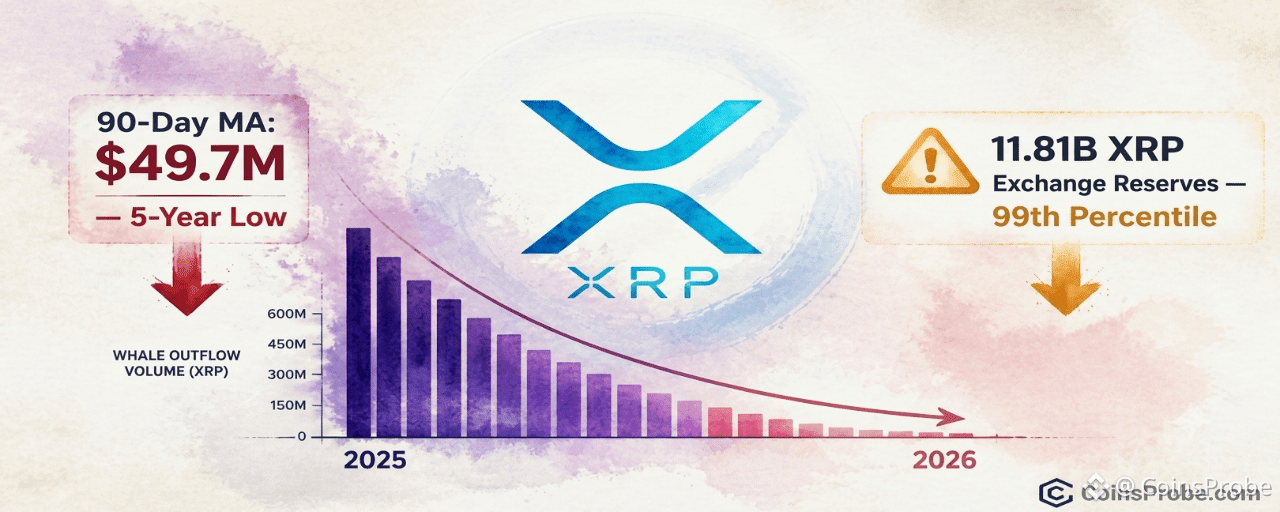
ලිපිය
XRP Whale Outflows Hit a 5-Year Low — What It Means for Buying VolumeKey Highlights
XRP trades at $1.32 (+1.16% 24h) as CryptoQuant flags whale outflows hitting a 5-year low90-day MA of XRP whale outflows on Binance has collapsed to $49.7M — down 98.6% from the February 2025 peak30-day whale inflows to Binance hit a 7-month high of 1.669B XRP while exchange reserves sit at the 99th percentile (11.81B XRP)Analyst @Darkfost_Coc: "XRP could lack buying volume without whale support" — a structural long-term risk, not an immediate reversal signal
XRP is trading at $1.32 (+1.16% in 24 hours) with a market cap of approximately $83.2 billion — but a structural data point published by CryptoQuant on October 20, 2026 raises a pointed question about what sustains that price from here.
CryptoQuant analyst @Darkfost_Coc flagged that XRP whale outflows from Binance have collapsed to their lowest level in five years. His conclusion is direct: “From a long-term perspective, this suggests XRP could lack buying volume without whale support.”
The Signal — Whale Outflows at a 5-Year Low
Whale outflows measure the volume of XRP moving out of Binance in large-denomination transactions — typically interpreted as institutional or high-net-worth participants withdrawing assets, often to hold or deploy elsewhere. When this metric is elevated, it signals active large-wallet participation on the buy side. When it collapses, it indicates whales are not accumulating at current prices in meaningful volume.
XRP Whale Outflows (Binance) Analysis | Source: @cryptoquant_com (X)
The 90-day moving average of XRP whale outflows in USD terms has fallen to $49.7 million. That is a 98.6% decline from the February 2025 peak. The chart published by @cryptoquant_com spans July 2021 through mid-2026 — and at no point during that five-year window has the 90-day MA been this compressed. The chart also shows a secondary annotation of $10.7 million, indicating the lower boundary of recent outflow activity, consistent with near-total withdrawal of whale selling and buying participation alike.
The Counterpoint — Inflows Are Surging
Here is where the picture splits. While whale outflows have dried up, whale inflows to Binance over the past 30 days have reached 1.669 billion XRP — a seven-month high. Simultaneously, XRP exchange reserves stand at 11.81 billion XRP, placing them at the 99th percentile historically. As covered in depth in XRP Reserves Hit 11.81B Near Yearly High as Binance Leverage Unwinds, the reserve build-up at Binance has been accompanied by leverage unwinding — a configuration that warrants attention.
Rising inflows at seven-month highs combined with near-record exchange reserves, set against a backdrop of minimal outflows, produces a specific structural condition: large amounts of XRP are arriving at Binance, but very little is being pulled off. That is not inherently bullish. It suggests supply is accumulating on the exchange — available for sale — without a corresponding wave of whale-sized buyers withdrawing coins into cold storage or long-term custody.
Why Low Outflows Are the Critical Variable
The standard narrative around low whale outflows is ambiguous — it can mean whales aren’t selling, which appears positive. But @Darkfost_Coc’s interpretation cuts deeper. Outflows represent exit of coins from exchange custody. When outflows are high, it means large participants are buying and removing XRP from liquid supply. When outflows collapse to a five-year low, it means that withdrawal activity — the mechanism that tightens exchange supply and supports price — has essentially stopped.
The implication is that without a resumption of whale-scale buying, XRP’s price momentum depends on retail and mid-tier participants absorbing an exchange reserve sitting at the 99th percentile historically. That is a structurally demanding condition. For additional context on the broader market backdrop, see Bitcoin’s Recovery Has Three Conditions — October Charts Show None Are Fully Met.
What the Data Table Shows
Metric Current Reading Context 90-Day MA Whale Outflows (USD) $49.7M 5-year low; down 98.6% from Feb 2025 peak Lower Outflow Boundary (chart annotation) $10.7M Visual floor of recent outflow activity 30-Day Whale Inflows to Binance 1.669B XRP 7-month high XRP Exchange Reserves 11.81B XRP 99th percentile historically XRP Price (at time of writing) $1.32 +1.16% in 24 hours
Source: CryptoQuant / @cryptoquant_com (X), October 20, 2026
The Scenario Split
Bullish Scenario
If whale outflows recover from the five-year low and large participants resume withdrawing XRP from Binance into cold storage, that would signal genuine accumulation — tightening available supply against the current 11.81 billion XRP sitting on exchange. A recovery in the 90-day MA toward prior cycle levels would confirm renewed whale demand and provide the buying volume @Darkfost_Coc identifies as currently absent. Per the analyst’s framework, that is the condition required for price support to become structurally durable.
Bearish Scenario
If whale outflows remain compressed at or near the five-year low while inflows continue arriving at a seven-month high pace, supply pressure on Binance builds without a corresponding absorption mechanism. In that configuration, XRP’s current price of $1.32 is sustained without the structural buying volume that historically underpinned rallies — and any catalyst-driven selling into the 11.81 billion XRP reserve pool would face limited whale-size demand to absorb it. The analyst notes this risk explicitly as a long-term concern, not an immediate reversal signal.
As context for XRP’s broader technical picture, ETH Loses the 200-Week MA — Analyst Marks $2,000–$2,300 as the Dip Zone illustrates how structural on-chain weakness can precede major technical breakdowns across large-cap assets.
The signal from @Darkfost_Coc is not a short-term timing call. It is a structural caution: the mechanism that historically supplies XRP with whale-driven buying volume — outflows from exchanges into custody — has reached a five-year low. With the 90-day moving average of USD outflows at $49.7 million (down 98.6% from peak) and exchange reserves at the 99th percentile, the burden of price support falls disproportionately on non-whale participants. The metric to track in real time is CryptoQuant’s 90-day moving average of XRP whale outflows — a sustained recovery above recent levels is the condition that would change the structural picture.
Disclaimer: The views and analysis presented in this article are for informational purposes only and reflect the author’s perspective, not financial advice. Technical patterns and indicators discussed are subject to market volatility and may or may not yield anticipated results. Investors are advised to exercise caution, conduct independent research, and make decisions aligned with their individual risk tolerance.
XRP Whale Outflows Hit a 5-Year Low — What It Means for Buying Volume
Key Highlights
XRP trades at $1.32 (+1.16% 24h) as CryptoQuant flags whale outflows hitting a 5-year low90-day MA of XRP whale outflows on Binance has collapsed to $49.7M — down 98.6% from the February 2025 peak30-day whale inflows to Binance hit a 7-month high of 1.669B XRP while exchange reserves sit at the 99th percentile (11.81B XRP)Analyst @Darkfost_Coc: "XRP could lack buying volume without whale support" — a structural long-term risk, not an immediate reversal signal
XRP is trading at $1.32 (+1.16% in 24 hours) with a market cap of approximately $83.2 billion — but a structural data point published by CryptoQuant on October 20, 2026 raises a pointed question about what sustains that price from here.
CryptoQuant analyst @Darkfost_Coc flagged that XRP whale outflows from Binance have collapsed to their lowest level in five years. His conclusion is direct: “From a long-term perspective, this suggests XRP could lack buying volume without whale support.”
The Signal — Whale Outflows at a 5-Year Low
Whale outflows measure the volume of XRP moving out of Binance in large-denomination transactions — typically interpreted as institutional or high-net-worth participants withdrawing assets, often to hold or deploy elsewhere. When this metric is elevated, it signals active large-wallet participation on the buy side. When it collapses, it indicates whales are not accumulating at current prices in meaningful volume.
XRP Whale Outflows (Binance) Analysis | Source: @cryptoquant_com (X)
The 90-day moving average of XRP whale outflows in USD terms has fallen to $49.7 million. That is a 98.6% decline from the February 2025 peak. The chart published by @cryptoquant_com spans July 2021 through mid-2026 — and at no point during that five-year window has the 90-day MA been this compressed. The chart also shows a secondary annotation of $10.7 million, indicating the lower boundary of recent outflow activity, consistent with near-total withdrawal of whale selling and buying participation alike.
The Counterpoint — Inflows Are Surging
Here is where the picture splits. While whale outflows have dried up, whale inflows to Binance over the past 30 days have reached 1.669 billion XRP — a seven-month high. Simultaneously, XRP exchange reserves stand at 11.81 billion XRP, placing them at the 99th percentile historically. As covered in depth in XRP Reserves Hit 11.81B Near Yearly High as Binance Leverage Unwinds, the reserve build-up at Binance has been accompanied by leverage unwinding — a configuration that warrants attention.
Rising inflows at seven-month highs combined with near-record exchange reserves, set against a backdrop of minimal outflows, produces a specific structural condition: large amounts of XRP are arriving at Binance, but very little is being pulled off. That is not inherently bullish. It suggests supply is accumulating on the exchange — available for sale — without a corresponding wave of whale-sized buyers withdrawing coins into cold storage or long-term custody.
Why Low Outflows Are the Critical Variable
The standard narrative around low whale outflows is ambiguous — it can mean whales aren’t selling, which appears positive. But @Darkfost_Coc’s interpretation cuts deeper. Outflows represent exit of coins from exchange custody. When outflows are high, it means large participants are buying and removing XRP from liquid supply. When outflows collapse to a five-year low, it means that withdrawal activity — the mechanism that tightens exchange supply and supports price — has essentially stopped.
The implication is that without a resumption of whale-scale buying, XRP’s price momentum depends on retail and mid-tier participants absorbing an exchange reserve sitting at the 99th percentile historically. That is a structurally demanding condition. For additional context on the broader market backdrop, see Bitcoin’s Recovery Has Three Conditions — October Charts Show None Are Fully Met.
What the Data Table Shows
Metric Current Reading Context 90-Day MA Whale Outflows (USD) $49.7M 5-year low; down 98.6% from Feb 2025 peak Lower Outflow Boundary (chart annotation) $10.7M Visual floor of recent outflow activity 30-Day Whale Inflows to Binance 1.669B XRP 7-month high XRP Exchange Reserves 11.81B XRP 99th percentile historically XRP Price (at time of writing) $1.32 +1.16% in 24 hours
Source: CryptoQuant / @cryptoquant_com (X), October 20, 2026
The Scenario Split
Bullish Scenario
If whale outflows recover from the five-year low and large participants resume withdrawing XRP from Binance into cold storage, that would signal genuine accumulation — tightening available supply against the current 11.81 billion XRP sitting on exchange. A recovery in the 90-day MA toward prior cycle levels would confirm renewed whale demand and provide the buying volume @Darkfost_Coc identifies as currently absent. Per the analyst’s framework, that is the condition required for price support to become structurally durable.
Bearish Scenario
If whale outflows remain compressed at or near the five-year low while inflows continue arriving at a seven-month high pace, supply pressure on Binance builds without a corresponding absorption mechanism. In that configuration, XRP’s current price of $1.32 is sustained without the structural buying volume that historically underpinned rallies — and any catalyst-driven selling into the 11.81 billion XRP reserve pool would face limited whale-size demand to absorb it. The analyst notes this risk explicitly as a long-term concern, not an immediate reversal signal.
As context for XRP’s broader technical picture, ETH Loses the 200-Week MA — Analyst Marks $2,000–$2,300 as the Dip Zone illustrates how structural on-chain weakness can precede major technical breakdowns across large-cap assets.
The signal from @Darkfost_Coc is not a short-term timing call. It is a structural caution: the mechanism that historically supplies XRP with whale-driven buying volume — outflows from exchanges into custody — has reached a five-year low. With the 90-day moving average of USD outflows at $49.7 million (down 98.6% from peak) and exchange reserves at the 99th percentile, the burden of price support falls disproportionately on non-whale participants. The metric to track in real time is CryptoQuant’s 90-day moving average of XRP whale outflows — a sustained recovery above recent levels is the condition that would change the structural picture.
Disclaimer: The views and analysis presented in this article are for informational purposes only and reflect the author’s perspective, not financial advice. Technical patterns and indicators discussed are subject to market volatility and may or may not yield anticipated results. Investors are advised to exercise caution, conduct independent research, and make decisions aligned with their individual risk tolerance.
XRP trades at $1.32 (+1.16% 24h) as CryptoQuant flags whale outflows hitting a 5-year low90-day MA of XRP whale outflows on Binance has collapsed to $49.7M — down 98.6% from the February 2025 peak30-day whale inflows to Binance hit a 7-month high of 1.669B XRP while exchange reserves sit at the 99th percentile (11.81B XRP)Analyst @Darkfost_Coc: "XRP could lack buying volume without whale support" — a structural long-term risk, not an immediate reversal signal
XRP is trading at $1.32 (+1.16% in 24 hours) with a market cap of approximately $83.2 billion — but a structural data point published by CryptoQuant on October 20, 2026 raises a pointed question about what sustains that price from here.
CryptoQuant analyst @Darkfost_Coc flagged that XRP whale outflows from Binance have collapsed to their lowest level in five years. His conclusion is direct: “From a long-term perspective, this suggests XRP could lack buying volume without whale support.”
The Signal — Whale Outflows at a 5-Year Low
Whale outflows measure the volume of XRP moving out of Binance in large-denomination transactions — typically interpreted as institutional or high-net-worth participants withdrawing assets, often to hold or deploy elsewhere. When this metric is elevated, it signals active large-wallet participation on the buy side. When it collapses, it indicates whales are not accumulating at current prices in meaningful volume.
XRP Whale Outflows (Binance) Analysis | Source: @cryptoquant_com (X)
The 90-day moving average of XRP whale outflows in USD terms has fallen to $49.7 million. That is a 98.6% decline from the February 2025 peak. The chart published by @cryptoquant_com spans July 2021 through mid-2026 — and at no point during that five-year window has the 90-day MA been this compressed. The chart also shows a secondary annotation of $10.7 million, indicating the lower boundary of recent outflow activity, consistent with near-total withdrawal of whale selling and buying participation alike.
The Counterpoint — Inflows Are Surging
Here is where the picture splits. While whale outflows have dried up, whale inflows to Binance over the past 30 days have reached 1.669 billion XRP — a seven-month high. Simultaneously, XRP exchange reserves stand at 11.81 billion XRP, placing them at the 99th percentile historically. As covered in depth in XRP Reserves Hit 11.81B Near Yearly High as Binance Leverage Unwinds, the reserve build-up at Binance has been accompanied by leverage unwinding — a configuration that warrants attention.
Rising inflows at seven-month highs combined with near-record exchange reserves, set against a backdrop of minimal outflows, produces a specific structural condition: large amounts of XRP are arriving at Binance, but very little is being pulled off. That is not inherently bullish. It suggests supply is accumulating on the exchange — available for sale — without a corresponding wave of whale-sized buyers withdrawing coins into cold storage or long-term custody.
Why Low Outflows Are the Critical Variable
The standard narrative around low whale outflows is ambiguous — it can mean whales aren’t selling, which appears positive. But @Darkfost_Coc’s interpretation cuts deeper. Outflows represent exit of coins from exchange custody. When outflows are high, it means large participants are buying and removing XRP from liquid supply. When outflows collapse to a five-year low, it means that withdrawal activity — the mechanism that tightens exchange supply and supports price — has essentially stopped.
The implication is that without a resumption of whale-scale buying, XRP’s price momentum depends on retail and mid-tier participants absorbing an exchange reserve sitting at the 99th percentile historically. That is a structurally demanding condition. For additional context on the broader market backdrop, see Bitcoin’s Recovery Has Three Conditions — October Charts Show None Are Fully Met.
What the Data Table Shows
Metric Current Reading Context 90-Day MA Whale Outflows (USD) $49.7M 5-year low; down 98.6% from Feb 2025 peak Lower Outflow Boundary (chart annotation) $10.7M Visual floor of recent outflow activity 30-Day Whale Inflows to Binance 1.669B XRP 7-month high XRP Exchange Reserves 11.81B XRP 99th percentile historically XRP Price (at time of writing) $1.32 +1.16% in 24 hours
Source: CryptoQuant / @cryptoquant_com (X), October 20, 2026
The Scenario Split
Bullish Scenario
If whale outflows recover from the five-year low and large participants resume withdrawing XRP from Binance into cold storage, that would signal genuine accumulation — tightening available supply against the current 11.81 billion XRP sitting on exchange. A recovery in the 90-day MA toward prior cycle levels would confirm renewed whale demand and provide the buying volume @Darkfost_Coc identifies as currently absent. Per the analyst’s framework, that is the condition required for price support to become structurally durable.
Bearish Scenario
If whale outflows remain compressed at or near the five-year low while inflows continue arriving at a seven-month high pace, supply pressure on Binance builds without a corresponding absorption mechanism. In that configuration, XRP’s current price of $1.32 is sustained without the structural buying volume that historically underpinned rallies — and any catalyst-driven selling into the 11.81 billion XRP reserve pool would face limited whale-size demand to absorb it. The analyst notes this risk explicitly as a long-term concern, not an immediate reversal signal.
As context for XRP’s broader technical picture, ETH Loses the 200-Week MA — Analyst Marks $2,000–$2,300 as the Dip Zone illustrates how structural on-chain weakness can precede major technical breakdowns across large-cap assets.
The signal from @Darkfost_Coc is not a short-term timing call. It is a structural caution: the mechanism that historically supplies XRP with whale-driven buying volume — outflows from exchanges into custody — has reached a five-year low. With the 90-day moving average of USD outflows at $49.7 million (down 98.6% from peak) and exchange reserves at the 99th percentile, the burden of price support falls disproportionately on non-whale participants. The metric to track in real time is CryptoQuant’s 90-day moving average of XRP whale outflows — a sustained recovery above recent levels is the condition that would change the structural picture.
Disclaimer: The views and analysis presented in this article are for informational purposes only and reflect the author’s perspective, not financial advice. Technical patterns and indicators discussed are subject to market volatility and may or may not yield anticipated results. Investors are advised to exercise caution, conduct independent research, and make decisions aligned with their individual risk tolerance.
120
·
--
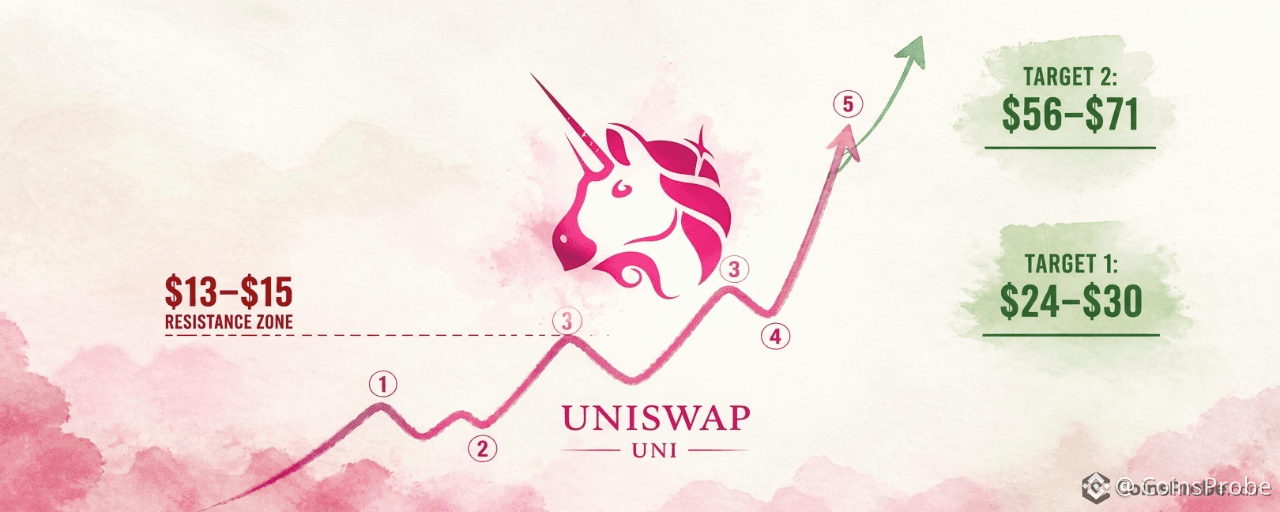
ලිපිය
UNI Macro Chart: Resistance at $13–$15, Targets at $24–$30 and $56–$71Key Highlights
UNI trading at ~$7.38, up 37.58% over 30 days, identified by CryptoBullet1 as a wave (2) pullback baseMajor Resistance at $13–$15 — monthly close above $15 required to activate macro targetsMacro Target 1: $24–$30 (0.786 Fib, ~3.2x–4.1x from current); Macro Target 2: $56–$71 (1.618 Fib, ~7.6x–9.6x)Uniswap processes $1–$2B daily volume; UNI supply burns mechanically tied to protocol usage
Uniswap’s governance token is trading at approximately $7.38 — down 16.90% on the monthly candle per the chart’s OHLC bar — yet analyst CryptoBullet1 (@CryptoBullet1) is publishing one of the most structurally specific macro calls on UNI seen this cycle. The thesis is not a near-term trade setup. It is a multi-year Elliott Wave projection anchored in one non-negotiable fundamental: Uniswap is the largest decentralized exchange on-chain, and its token supply is mechanically tied to protocol usage through burns.
CryptoBullet1 identifies the current price action as a wave (2) pullback bottom — the corrective phase in a five-wave Elliott Wave impulse structure — on the monthly candle chart. The projection maps five sequential waves off the current base, with each target zone derived from Fibonacci extension levels printed directly on the chart. Two macro targets are stated explicitly: Macro Target 1 at $24–$30 (near the 0.786 Fibonacci zone) and Macro Target 2 at $56–$71 (near the 1.618 extension). Standing between UNI and those targets is a single clearly-labeled resistance band: $13–$15.
The Fundamental Anchor — Burn Mechanics Tie UNI Supply to Protocol Revenue
Before addressing the chart levels, the mechanism matters. CryptoBullet1 explicitly flags Uniswap’s supply burn as the fundamental support for a macro bullish thesis. Uniswap processes $1–$2 billion in daily trading volume, making it the dominant DEX by volume. Each incremental unit of protocol usage reduces UNI’s circulating supply. This is not a speculative correlation — it is a direct mechanical link between protocol activity and token scarcity. Unlike governance tokens that derive value purely from voting rights, UNI has a structural deflationary pressure tied to one of crypto’s most durable on-chain businesses. As broader DeFi activity scales — and derivatives open interest has grown 570% since 2021, reflecting the depth of crypto market infrastructure — Uniswap’s position as the primary spot DEX becomes increasingly load-bearing.
The Elliott Wave Structure — Wave (2) Bottom and a Five-Wave Projection
Chart Analysis: UNI/USDT | Source: @CryptoBullet1 (X)
The monthly chart shared by CryptoBullet1 displays a classic five-wave Elliott Wave impulse labeled (1) through (5). The analyst places UNI currently at the base of wave (2) — the corrective pullback that precedes what Elliott theory defines as the strongest and longest leg of the structure, wave (3). The chart’s OHLC data for the current monthly candle reads: Open $8.881, High $9.324, Low $6.742, Close $7.381. The wave structure is drawn as a curved blue arrow sequence ascending through successive peaks, projecting a multi-year rally from current levels through two discrete Fibonacci-derived targets.
The Fibonacci levels printed on the chart are 0.786, 1.272, and 1.618. The analyst maps Macro Target 1 ($24–$30) to the 0.786 zone and Macro Target 2 ($56–$71) to the 1.618 extension. These are not arbitrary numbers — they are derived from the measured move of the prior wave structure extended forward. The $24–$30 zone represents approximately a 3.2x–4.1x move from current levels. The $56–$71 zone represents a 7.6x–9.6x move from the current $7.38 print.
The Critical Level — $13–$15 Major Resistance
CryptoBullet1 does not bury the critical threshold. The post labels it plainly: Major Resistance at $13–$15. This band corresponds to a prior structural high zone on the monthly chart and sits between the current price and Macro Target 1. The wave (3) projection cannot be validated without a confirmed breakout above this zone. Until UNI produces a monthly close above $15, the Elliott Wave count remains a projection — not a confirmed impulse. A monthly close above $15 would clear the only labeled resistance on CryptoBullet1’s map and open the path toward $24–$30 in wave (3) and $56–$71 in wave (5).
Level / Zone Price Range Significance Current Price ~$7.38 Wave (2) pullback base per CryptoBullet1 Major Resistance $13–$15 Must break for macro thesis to activate Macro Target 1 $24–$30 0.786 Fibonacci extension (~3.2x–4.1x) Macro Target 2 $56–$71 1.618 Fibonacci extension (~7.6x–9.6x)
Source: @CryptoBullet1 (X), October 20 2026
30-Day Performance Context
Despite the current monthly candle’s drawdown shown on the chart, UNI has gained 37.58% over the past 30 days. The current monthly candle is open and does not represent a completed close — the chart’s -16.90% reflects price action from the candle’s open at $8.881, not a finalized monthly return. The 30-day gain reflects the rally that preceded this candle’s pullback, and CryptoBullet1’s wave (2) thesis is consistent with exactly this type of corrective retracement following an initial advance.
Bullish Scenario — Monthly Close Above $15
A confirmed monthly close above $15 clears the sole labeled resistance on CryptoBullet1’s macro map. This activates the wave (3) projection toward Macro Target 1 ($24–$30). From $24–$30, the wave (4) correction would precede a final wave (5) advance into Macro Target 2 ($56–$71). The burn mechanics accelerate this path if Uniswap’s $1–$2 billion daily volume continues or expands, reducing circulating supply into each successive rally leg.
Bearish Scenario — Failure to Reclaim $13
If UNI fails to reclaim the $13 level on a monthly closing basis, the wave (2) bottom is not confirmed and the Elliott count is not validated. Monthly closes below the current $6.742 candle low would invalidate the wave (2) base reading and shift the structure into a deeper corrective phase — putting the macro thesis on hold without a clear timeline for reactivation.
The macro setup CryptoBullet1 presents is structurally clean: the largest DEX by volume, a burn mechanism tying token supply to protocol usage, and a monthly chart projecting five waves from what the analyst identifies as a wave (2) base. The entire structure activates or fails at one address — $13–$15. A monthly close above $15 opens $24–$30. A monthly close above $30 opens $56–$71. The DeFi volume data from Uniswap’s protocol will answer in real time whether the fundamental engine behind the thesis is running at sufficient capacity. Watch $13 as the first confirmation level the market must deliver.
Disclaimer: The views and analysis presented in this article are for informational purposes only and reflect the author’s perspective, not financial advice. Technical patterns and indicators discussed are subject to market volatility and may or may not yield anticipated results. Investors are advised to exercise caution, conduct independent research, and make decisions aligned with their individual risk tolerance.
UNI Macro Chart: Resistance at $13–$15, Targets at $24–$30 and $56–$71
Key Highlights
UNI trading at ~$7.38, up 37.58% over 30 days, identified by CryptoBullet1 as a wave (2) pullback baseMajor Resistance at $13–$15 — monthly close above $15 required to activate macro targetsMacro Target 1: $24–$30 (0.786 Fib, ~3.2x–4.1x from current); Macro Target 2: $56–$71 (1.618 Fib, ~7.6x–9.6x)Uniswap processes $1–$2B daily volume; UNI supply burns mechanically tied to protocol usage
Uniswap’s governance token is trading at approximately $7.38 — down 16.90% on the monthly candle per the chart’s OHLC bar — yet analyst CryptoBullet1 (@CryptoBullet1) is publishing one of the most structurally specific macro calls on UNI seen this cycle. The thesis is not a near-term trade setup. It is a multi-year Elliott Wave projection anchored in one non-negotiable fundamental: Uniswap is the largest decentralized exchange on-chain, and its token supply is mechanically tied to protocol usage through burns.
CryptoBullet1 identifies the current price action as a wave (2) pullback bottom — the corrective phase in a five-wave Elliott Wave impulse structure — on the monthly candle chart. The projection maps five sequential waves off the current base, with each target zone derived from Fibonacci extension levels printed directly on the chart. Two macro targets are stated explicitly: Macro Target 1 at $24–$30 (near the 0.786 Fibonacci zone) and Macro Target 2 at $56–$71 (near the 1.618 extension). Standing between UNI and those targets is a single clearly-labeled resistance band: $13–$15.
The Fundamental Anchor — Burn Mechanics Tie UNI Supply to Protocol Revenue
Before addressing the chart levels, the mechanism matters. CryptoBullet1 explicitly flags Uniswap’s supply burn as the fundamental support for a macro bullish thesis. Uniswap processes $1–$2 billion in daily trading volume, making it the dominant DEX by volume. Each incremental unit of protocol usage reduces UNI’s circulating supply. This is not a speculative correlation — it is a direct mechanical link between protocol activity and token scarcity. Unlike governance tokens that derive value purely from voting rights, UNI has a structural deflationary pressure tied to one of crypto’s most durable on-chain businesses. As broader DeFi activity scales — and derivatives open interest has grown 570% since 2021, reflecting the depth of crypto market infrastructure — Uniswap’s position as the primary spot DEX becomes increasingly load-bearing.
The Elliott Wave Structure — Wave (2) Bottom and a Five-Wave Projection
Chart Analysis: UNI/USDT | Source: @CryptoBullet1 (X)
The monthly chart shared by CryptoBullet1 displays a classic five-wave Elliott Wave impulse labeled (1) through (5). The analyst places UNI currently at the base of wave (2) — the corrective pullback that precedes what Elliott theory defines as the strongest and longest leg of the structure, wave (3). The chart’s OHLC data for the current monthly candle reads: Open $8.881, High $9.324, Low $6.742, Close $7.381. The wave structure is drawn as a curved blue arrow sequence ascending through successive peaks, projecting a multi-year rally from current levels through two discrete Fibonacci-derived targets.
The Fibonacci levels printed on the chart are 0.786, 1.272, and 1.618. The analyst maps Macro Target 1 ($24–$30) to the 0.786 zone and Macro Target 2 ($56–$71) to the 1.618 extension. These are not arbitrary numbers — they are derived from the measured move of the prior wave structure extended forward. The $24–$30 zone represents approximately a 3.2x–4.1x move from current levels. The $56–$71 zone represents a 7.6x–9.6x move from the current $7.38 print.
The Critical Level — $13–$15 Major Resistance
CryptoBullet1 does not bury the critical threshold. The post labels it plainly: Major Resistance at $13–$15. This band corresponds to a prior structural high zone on the monthly chart and sits between the current price and Macro Target 1. The wave (3) projection cannot be validated without a confirmed breakout above this zone. Until UNI produces a monthly close above $15, the Elliott Wave count remains a projection — not a confirmed impulse. A monthly close above $15 would clear the only labeled resistance on CryptoBullet1’s map and open the path toward $24–$30 in wave (3) and $56–$71 in wave (5).
Level / Zone Price Range Significance Current Price ~$7.38 Wave (2) pullback base per CryptoBullet1 Major Resistance $13–$15 Must break for macro thesis to activate Macro Target 1 $24–$30 0.786 Fibonacci extension (~3.2x–4.1x) Macro Target 2 $56–$71 1.618 Fibonacci extension (~7.6x–9.6x)
Source: @CryptoBullet1 (X), October 20 2026
30-Day Performance Context
Despite the current monthly candle’s drawdown shown on the chart, UNI has gained 37.58% over the past 30 days. The current monthly candle is open and does not represent a completed close — the chart’s -16.90% reflects price action from the candle’s open at $8.881, not a finalized monthly return. The 30-day gain reflects the rally that preceded this candle’s pullback, and CryptoBullet1’s wave (2) thesis is consistent with exactly this type of corrective retracement following an initial advance.
Bullish Scenario — Monthly Close Above $15
A confirmed monthly close above $15 clears the sole labeled resistance on CryptoBullet1’s macro map. This activates the wave (3) projection toward Macro Target 1 ($24–$30). From $24–$30, the wave (4) correction would precede a final wave (5) advance into Macro Target 2 ($56–$71). The burn mechanics accelerate this path if Uniswap’s $1–$2 billion daily volume continues or expands, reducing circulating supply into each successive rally leg.
Bearish Scenario — Failure to Reclaim $13
If UNI fails to reclaim the $13 level on a monthly closing basis, the wave (2) bottom is not confirmed and the Elliott count is not validated. Monthly closes below the current $6.742 candle low would invalidate the wave (2) base reading and shift the structure into a deeper corrective phase — putting the macro thesis on hold without a clear timeline for reactivation.
The macro setup CryptoBullet1 presents is structurally clean: the largest DEX by volume, a burn mechanism tying token supply to protocol usage, and a monthly chart projecting five waves from what the analyst identifies as a wave (2) base. The entire structure activates or fails at one address — $13–$15. A monthly close above $15 opens $24–$30. A monthly close above $30 opens $56–$71. The DeFi volume data from Uniswap’s protocol will answer in real time whether the fundamental engine behind the thesis is running at sufficient capacity. Watch $13 as the first confirmation level the market must deliver.
Disclaimer: The views and analysis presented in this article are for informational purposes only and reflect the author’s perspective, not financial advice. Technical patterns and indicators discussed are subject to market volatility and may or may not yield anticipated results. Investors are advised to exercise caution, conduct independent research, and make decisions aligned with their individual risk tolerance.
UNI trading at ~$7.38, up 37.58% over 30 days, identified by CryptoBullet1 as a wave (2) pullback baseMajor Resistance at $13–$15 — monthly close above $15 required to activate macro targetsMacro Target 1: $24–$30 (0.786 Fib, ~3.2x–4.1x from current); Macro Target 2: $56–$71 (1.618 Fib, ~7.6x–9.6x)Uniswap processes $1–$2B daily volume; UNI supply burns mechanically tied to protocol usage
Uniswap’s governance token is trading at approximately $7.38 — down 16.90% on the monthly candle per the chart’s OHLC bar — yet analyst CryptoBullet1 (@CryptoBullet1) is publishing one of the most structurally specific macro calls on UNI seen this cycle. The thesis is not a near-term trade setup. It is a multi-year Elliott Wave projection anchored in one non-negotiable fundamental: Uniswap is the largest decentralized exchange on-chain, and its token supply is mechanically tied to protocol usage through burns.
CryptoBullet1 identifies the current price action as a wave (2) pullback bottom — the corrective phase in a five-wave Elliott Wave impulse structure — on the monthly candle chart. The projection maps five sequential waves off the current base, with each target zone derived from Fibonacci extension levels printed directly on the chart. Two macro targets are stated explicitly: Macro Target 1 at $24–$30 (near the 0.786 Fibonacci zone) and Macro Target 2 at $56–$71 (near the 1.618 extension). Standing between UNI and those targets is a single clearly-labeled resistance band: $13–$15.
The Fundamental Anchor — Burn Mechanics Tie UNI Supply to Protocol Revenue
Before addressing the chart levels, the mechanism matters. CryptoBullet1 explicitly flags Uniswap’s supply burn as the fundamental support for a macro bullish thesis. Uniswap processes $1–$2 billion in daily trading volume, making it the dominant DEX by volume. Each incremental unit of protocol usage reduces UNI’s circulating supply. This is not a speculative correlation — it is a direct mechanical link between protocol activity and token scarcity. Unlike governance tokens that derive value purely from voting rights, UNI has a structural deflationary pressure tied to one of crypto’s most durable on-chain businesses. As broader DeFi activity scales — and derivatives open interest has grown 570% since 2021, reflecting the depth of crypto market infrastructure — Uniswap’s position as the primary spot DEX becomes increasingly load-bearing.
The Elliott Wave Structure — Wave (2) Bottom and a Five-Wave Projection
Chart Analysis: UNI/USDT | Source: @CryptoBullet1 (X)
The monthly chart shared by CryptoBullet1 displays a classic five-wave Elliott Wave impulse labeled (1) through (5). The analyst places UNI currently at the base of wave (2) — the corrective pullback that precedes what Elliott theory defines as the strongest and longest leg of the structure, wave (3). The chart’s OHLC data for the current monthly candle reads: Open $8.881, High $9.324, Low $6.742, Close $7.381. The wave structure is drawn as a curved blue arrow sequence ascending through successive peaks, projecting a multi-year rally from current levels through two discrete Fibonacci-derived targets.
The Fibonacci levels printed on the chart are 0.786, 1.272, and 1.618. The analyst maps Macro Target 1 ($24–$30) to the 0.786 zone and Macro Target 2 ($56–$71) to the 1.618 extension. These are not arbitrary numbers — they are derived from the measured move of the prior wave structure extended forward. The $24–$30 zone represents approximately a 3.2x–4.1x move from current levels. The $56–$71 zone represents a 7.6x–9.6x move from the current $7.38 print.
The Critical Level — $13–$15 Major Resistance
CryptoBullet1 does not bury the critical threshold. The post labels it plainly: Major Resistance at $13–$15. This band corresponds to a prior structural high zone on the monthly chart and sits between the current price and Macro Target 1. The wave (3) projection cannot be validated without a confirmed breakout above this zone. Until UNI produces a monthly close above $15, the Elliott Wave count remains a projection — not a confirmed impulse. A monthly close above $15 would clear the only labeled resistance on CryptoBullet1’s map and open the path toward $24–$30 in wave (3) and $56–$71 in wave (5).
Level / Zone Price Range Significance Current Price ~$7.38 Wave (2) pullback base per CryptoBullet1 Major Resistance $13–$15 Must break for macro thesis to activate Macro Target 1 $24–$30 0.786 Fibonacci extension (~3.2x–4.1x) Macro Target 2 $56–$71 1.618 Fibonacci extension (~7.6x–9.6x)
Source: @CryptoBullet1 (X), October 20 2026
30-Day Performance Context
Despite the current monthly candle’s drawdown shown on the chart, UNI has gained 37.58% over the past 30 days. The current monthly candle is open and does not represent a completed close — the chart’s -16.90% reflects price action from the candle’s open at $8.881, not a finalized monthly return. The 30-day gain reflects the rally that preceded this candle’s pullback, and CryptoBullet1’s wave (2) thesis is consistent with exactly this type of corrective retracement following an initial advance.
Bullish Scenario — Monthly Close Above $15
A confirmed monthly close above $15 clears the sole labeled resistance on CryptoBullet1’s macro map. This activates the wave (3) projection toward Macro Target 1 ($24–$30). From $24–$30, the wave (4) correction would precede a final wave (5) advance into Macro Target 2 ($56–$71). The burn mechanics accelerate this path if Uniswap’s $1–$2 billion daily volume continues or expands, reducing circulating supply into each successive rally leg.
Bearish Scenario — Failure to Reclaim $13
If UNI fails to reclaim the $13 level on a monthly closing basis, the wave (2) bottom is not confirmed and the Elliott count is not validated. Monthly closes below the current $6.742 candle low would invalidate the wave (2) base reading and shift the structure into a deeper corrective phase — putting the macro thesis on hold without a clear timeline for reactivation.
The macro setup CryptoBullet1 presents is structurally clean: the largest DEX by volume, a burn mechanism tying token supply to protocol usage, and a monthly chart projecting five waves from what the analyst identifies as a wave (2) base. The entire structure activates or fails at one address — $13–$15. A monthly close above $15 opens $24–$30. A monthly close above $30 opens $56–$71. The DeFi volume data from Uniswap’s protocol will answer in real time whether the fundamental engine behind the thesis is running at sufficient capacity. Watch $13 as the first confirmation level the market must deliver.
Disclaimer: The views and analysis presented in this article are for informational purposes only and reflect the author’s perspective, not financial advice. Technical patterns and indicators discussed are subject to market volatility and may or may not yield anticipated results. Investors are advised to exercise caution, conduct independent research, and make decisions aligned with their individual risk tolerance.
4
1.1k
තවත් අන්තර්ගතයන් ගවේෂණය කිරීමට ඇතුල් වන්න
Binance චතුරශ්රය හි ගෝලීය ක්රිප්ටෝ පරිශීලකයින් හා එක්වන්න
⚡️ ක්රිප්ටෝ පිළිබඳ නවතම සහ ප්රයෝජනවත් තොරතුරු ලබා ගන්න.
💬 ලොව විශාලතම ක්රිප්ටෝ හුවමාරුව මගින් විශ්වාස කෙරේ.
👍 සත්යායනය කරන ලද නිර්මාණකරුවන්ගෙන් සැබෑ විදසුන් සොයා ගන්න.
විද්යුත් තැපෑල / දුරකථන අංකය
නැගී එන මාතෘකා
BinancePick
2.6M නැරඹීම්
141,426 සාකච්ඡා කරමින්
Join #EarningsSeason: Predict Earnings on Binance Pick, Share Your Take on Binance Square!
Binance Square Official
·401 කැමත්ත දැක්වීම්
·338.5k නැරඹීම්
EarningsSeason
5M නැරඹීම්
24,334 සාකච්ඡා කරමින්
FranklinTempletonFilesForTwoDividendToBitcoinETFs
1,564 නැරඹීම්
88 සාකච්ඡා කරමින්