
YohannaOlva 1
97 පෝස්ටු

YohannaOlva 1
Verified BS creator || KOL || TG~ @YohannaOlva56 24/7 Dm me
0 හඹා යමින්
6 හඹා යන්නන්
30 කැමති විය
පෝස්ටු
Kaito Pulse Is the FOMO Trading Layer for X
Crypto has always been social - traders discover new assets through posts, follow influential accounts and watch narratives spread across the timeline. The problem is that social trading has mostly relied on trust.
You may have seen Poorgoat_ on X hold a 7 figure bag of the memecoin $CATE , but this was purely relied on with screenshots rather than anyone doing due diligence and checking his wallet.
Anyone can post a winning screenshot or claim they entered before a move.
$KAITO Pulse introduces something more useful: verifiable context to these claims.
With Pulse, users can connect and verify their Hyperliquid or Polymarket activity, bringing public positions and trading history directly into the X experience. Instead of judging a trader only by what they say, you can examine whether their activity supports their commentary.
That changes how FOMO works. When an asset begins taking over the timeline, Pulse can help you identify who has genuine exposure, who has a credible history and who may simply be chasing engagement.
For Hyperliquid traders, prediction market participants and crypto researchers, this creates a more transparent form of social trading, one where reputation is increasingly supported by receipts.
Kaito Pulse turns the X timeline from a feed of opinions into a layer of verifiable market context.
With Kaito Pulse, the timeline is becoming part of the trading interface.
#Altcoin Season# #Meme Alpha#
Crypto has always been social - traders discover new assets through posts, follow influential accounts and watch narratives spread across the timeline. The problem is that social trading has mostly relied on trust.
You may have seen Poorgoat_ on X hold a 7 figure bag of the memecoin $CATE , but this was purely relied on with screenshots rather than anyone doing due diligence and checking his wallet.
Anyone can post a winning screenshot or claim they entered before a move.
$KAITO Pulse introduces something more useful: verifiable context to these claims.
With Pulse, users can connect and verify their Hyperliquid or Polymarket activity, bringing public positions and trading history directly into the X experience. Instead of judging a trader only by what they say, you can examine whether their activity supports their commentary.
That changes how FOMO works. When an asset begins taking over the timeline, Pulse can help you identify who has genuine exposure, who has a credible history and who may simply be chasing engagement.
For Hyperliquid traders, prediction market participants and crypto researchers, this creates a more transparent form of social trading, one where reputation is increasingly supported by receipts.
Kaito Pulse turns the X timeline from a feed of opinions into a layer of verifiable market context.
With Kaito Pulse, the timeline is becoming part of the trading interface.
#Altcoin Season# #Meme Alpha#
Tokenized Stock Volume Just Jumped 415% 📈
The distance between a culture trade like $ANSEM and the RWA infrastructure around $XDC is collapsing as both become programmable assets in the same market.
Over the 30 days ending August 29, tokenized equity transfer volume reached $29.5B, an increase of more than 415%.
Traders are using these assets for more than passive exposure.
The memestock trend turns stocks into liquidity, identity, and raw material for entirely new markets.
A tokenized stock can now sit underneath a meme as its paired asset.
The missing layer was somewhere anyone could create those combinations.
That is where Zora enters the picture.
Custom Pairs let creators build markets around supported assets across Base, Robinhood Chain, and Solana.
More than 4,000 pairs have already been created.
Most will fade, which is the natural cost of open experimentation.
The important part is that thousands of new markets can now test what earns attention, liquidity, and staying power.
Zora is becoming the bridge between meme culture and the expanding RWA economy.
It deserves far more visibility for how early it is to this convergence.
Anyone following the memestock narrative should be watching what gets paired on Zora next.
#RWA #Altcoin Season#
The distance between a culture trade like $ANSEM and the RWA infrastructure around $XDC is collapsing as both become programmable assets in the same market.
Over the 30 days ending August 29, tokenized equity transfer volume reached $29.5B, an increase of more than 415%.
Traders are using these assets for more than passive exposure.
The memestock trend turns stocks into liquidity, identity, and raw material for entirely new markets.
A tokenized stock can now sit underneath a meme as its paired asset.
The missing layer was somewhere anyone could create those combinations.
That is where Zora enters the picture.
Custom Pairs let creators build markets around supported assets across Base, Robinhood Chain, and Solana.
More than 4,000 pairs have already been created.
Most will fade, which is the natural cost of open experimentation.
The important part is that thousands of new markets can now test what earns attention, liquidity, and staying power.
Zora is becoming the bridge between meme culture and the expanding RWA economy.
It deserves far more visibility for how early it is to this convergence.
Anyone following the memestock narrative should be watching what gets paired on Zora next.
#RWA #Altcoin Season#
The Fee You Never Agreed To 👀
Gas is the number you approve before you sign, and it is not the one that decides your fill.
That gets decided in the gap between broadcasting an order and having it settle, where anyone reading the mempool can price against you.
And none of it shows up as a fee anywhere.
Most of the aggregator volume on Solana routes through $JUP , so most of the order flow worth reading crosses a single surface.
That surface is valuable enough that Jupiter spent real engineering on MEV protection and Jito bundles to narrow the window, while the institutional side went the other way entirely and $CC now settles size on domains where a counterparty only receives its own slice of a deal.
Two completely different markets, both paying to close the same exposure.
That is the part I keep coming back to.
Not a rounding error, when a retail router and a network run by Goldman Sachs, BNP Paribas and Nasdaq are both spending money on the same problem.
Arcium works one level below both of them.
A computation splits across a cluster of nodes and each node only holds a fragment of the input, so no operator assembles the whole thing at any point.
So an order book can match on that basis without the venue reading the orders it is matching.
The trade that comes out still settles on Solana as an ordinary public transaction anyone can verify.
But I want to be precise about what is live.
Sealing a computation has run on Mainnet Alpha since February 2, with more than 4,000 nodes and over 30 apps in production.
Sealing a transfer amount is C-SPL, and that has not shipped.
Which means the confidential order book everyone talks about is half built, and the half that exists is the harder half.
My read is, whoever ships confidential matching on Solana first takes the size that has never come onchain, because an order nobody can read is an order nobody can trade ahead of.
#DeFi #Solana
Gas is the number you approve before you sign, and it is not the one that decides your fill.
That gets decided in the gap between broadcasting an order and having it settle, where anyone reading the mempool can price against you.
And none of it shows up as a fee anywhere.
Most of the aggregator volume on Solana routes through $JUP , so most of the order flow worth reading crosses a single surface.
That surface is valuable enough that Jupiter spent real engineering on MEV protection and Jito bundles to narrow the window, while the institutional side went the other way entirely and $CC now settles size on domains where a counterparty only receives its own slice of a deal.
Two completely different markets, both paying to close the same exposure.
That is the part I keep coming back to.
Not a rounding error, when a retail router and a network run by Goldman Sachs, BNP Paribas and Nasdaq are both spending money on the same problem.
Arcium works one level below both of them.
A computation splits across a cluster of nodes and each node only holds a fragment of the input, so no operator assembles the whole thing at any point.
So an order book can match on that basis without the venue reading the orders it is matching.
The trade that comes out still settles on Solana as an ordinary public transaction anyone can verify.
But I want to be precise about what is live.
Sealing a computation has run on Mainnet Alpha since February 2, with more than 4,000 nodes and over 30 apps in production.
Sealing a transfer amount is C-SPL, and that has not shipped.
Which means the confidential order book everyone talks about is half built, and the half that exists is the harder half.
My read is, whoever ships confidential matching on Solana first takes the size that has never come onchain, because an order nobody can read is an order nobody can trade ahead of.
#DeFi #Solana
Agents Are Managing Stock Liquidity Now 🤖
$PENDLE made yield itself tradable, letting users participate in the strategy instead of simply holding the underlying asset.
$MORPHO pushed capital management further by packaging allocation into vaults that do the work for depositors.
The part I’m watching is how quickly that same idea moves into tokenized stocks.
We have had equities trading onchain before, but most users could only participate by buying and holding the exposure.
The liquidity side was still handled by whoever knew how to configure pools, select ranges and rebalance positions manually.
That kept one of the most important parts of the market away from the same users tokenization was supposed to bring in.
Bankr’s new Aerodrome Stock LP skill gives an AI agent control over that management process.
A user can describe the position in plain English and let the agent deploy the capital into a stock-paired pool.
The agent handles the parts that normally require active attention.
• Selecting the stock pair and capital amount
• Opening the concentrated-liquidity position on Aerodrome
• Managing the position as the market moves
AAPL, NVDA, META and GOOGL are the first supported stock assets on Base, giving this model recognizable markets to start with.
The first phase of tokenized stocks was owning the asset. This next phase lets users own part of the liquidity those trades move through and earn fees from that activity.
Those pools remain active overnight and on weekends, which gives agent-managed positions a reason to operate beyond traditional market hours.
LPing still carries impermanent loss and automation cannot remove market risk, but it can remove the technical workload that kept many users out.
I think stock-paired LPs are starting to form their own meta, and the projects that make the liquidity side accessible could matter as much as the platforms issuing the stocks.
#AI #RWA
$PENDLE made yield itself tradable, letting users participate in the strategy instead of simply holding the underlying asset.
$MORPHO pushed capital management further by packaging allocation into vaults that do the work for depositors.
The part I’m watching is how quickly that same idea moves into tokenized stocks.
We have had equities trading onchain before, but most users could only participate by buying and holding the exposure.
The liquidity side was still handled by whoever knew how to configure pools, select ranges and rebalance positions manually.
That kept one of the most important parts of the market away from the same users tokenization was supposed to bring in.
Bankr’s new Aerodrome Stock LP skill gives an AI agent control over that management process.
A user can describe the position in plain English and let the agent deploy the capital into a stock-paired pool.
The agent handles the parts that normally require active attention.
• Selecting the stock pair and capital amount
• Opening the concentrated-liquidity position on Aerodrome
• Managing the position as the market moves
AAPL, NVDA, META and GOOGL are the first supported stock assets on Base, giving this model recognizable markets to start with.
The first phase of tokenized stocks was owning the asset. This next phase lets users own part of the liquidity those trades move through and earn fees from that activity.
Those pools remain active overnight and on weekends, which gives agent-managed positions a reason to operate beyond traditional market hours.
LPing still carries impermanent loss and automation cannot remove market risk, but it can remove the technical workload that kept many users out.
I think stock-paired LPs are starting to form their own meta, and the projects that make the liquidity side accessible could matter as much as the platforms issuing the stocks.
#AI #RWA
Is Perena's token launch back on? 📈
This chart just clawed its way back from a real low point, and it caught my attention immediately.
24% chance right now, up 5%. It dropped hard to the mid teens before breaking out again, and it's holding most of that bounce.
$218,253 in volume means real size is watching this recovery closely, not just a handful of side bets.
I'm taking Yes here, even as the underdog. A recovery this strong off a real dip usually has legs.
Positions on this side have leaned on $HYPE a fair amount, a much better use of the coin than just sitting on it hoping.
$SOL tends to fund the other half of trades like this, and both keep showing up more across this platform every month.
You're never locked into this either, exit whenever the read changes for you.
Polymarket is genuinely becoming the place to trade whatever you're good at reading.
#Altcoin Season#
This chart just clawed its way back from a real low point, and it caught my attention immediately.
24% chance right now, up 5%. It dropped hard to the mid teens before breaking out again, and it's holding most of that bounce.
$218,253 in volume means real size is watching this recovery closely, not just a handful of side bets.
I'm taking Yes here, even as the underdog. A recovery this strong off a real dip usually has legs.
Positions on this side have leaned on $HYPE a fair amount, a much better use of the coin than just sitting on it hoping.
$SOL tends to fund the other half of trades like this, and both keep showing up more across this platform every month.
You're never locked into this either, exit whenever the read changes for you.
Polymarket is genuinely becoming the place to trade whatever you're good at reading.
#Altcoin Season#
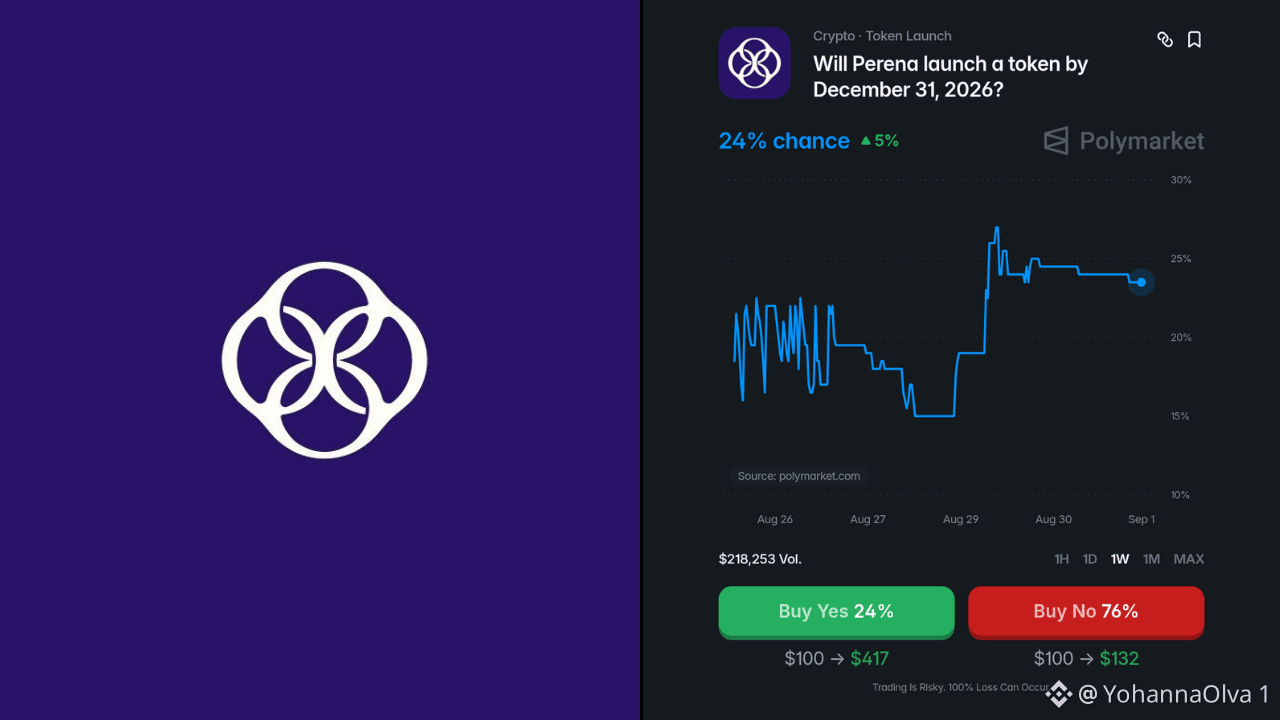
Is Perena's token launch back on? 📈
This chart just clawed its way back from a real low point, and it caught my attention immediately.
24% chance right now, up 5%. It dropped hard to the mid teens before breaking out again, and it's holding most of that bounce.
$218,253 in volume means real size is watching this recovery closely, not just a handful of side bets.
I'm taking Yes here, even as the underdog. A recovery this strong off a real dip usually has legs.
Positions on this side have leaned on $TRUMP a fair amount, a much better use of the coin than just sitting on it hoping.
$DOGE tends to fund the other half of trades like this, and both keep showing up more across this platform every month.
You're never locked into this either, exit whenever the read changes for you.
Polymarket is genuinely becoming the place to trade whatever you're good at reading.
#Altcoin Season#
This chart just clawed its way back from a real low point, and it caught my attention immediately.
24% chance right now, up 5%. It dropped hard to the mid teens before breaking out again, and it's holding most of that bounce.
$218,253 in volume means real size is watching this recovery closely, not just a handful of side bets.
I'm taking Yes here, even as the underdog. A recovery this strong off a real dip usually has legs.
Positions on this side have leaned on $TRUMP a fair amount, a much better use of the coin than just sitting on it hoping.
$DOGE tends to fund the other half of trades like this, and both keep showing up more across this platform every month.
You're never locked into this either, exit whenever the read changes for you.
Polymarket is genuinely becoming the place to trade whatever you're good at reading.
#Altcoin Season#
The AI That Tells You When Your Trade Sucks 👀
Most AI will help you justify a trade. Agent Pear will actually tell you when the quant data and market sentiment say it's a bad idea.
Then it'll show you how to make it better.
Pear Protocol's free trading agent can pressure-test your thesis, find a higher-conviction setup, optimize the hedge and sizing around your risk tolerance, and execute the final trade for you.
And now in addition to $HYPE , it's available across $LIT , giving traders a wide range of tokens to build long-short strategies around and cheaper execution costs at the Lighter level.
Every trade also gets you closer to Pear's weekly leaderboard rewards, where five top traders split 10% of Pear's treasury take.
So Agent Pear helps you build better trades, you get cheaper execution on Lighter, and those same trades can put you in the running for even more rewards.
That's a double win, baby! 🍐
#Altcoin Season#
Most AI will help you justify a trade. Agent Pear will actually tell you when the quant data and market sentiment say it's a bad idea.
Then it'll show you how to make it better.
Pear Protocol's free trading agent can pressure-test your thesis, find a higher-conviction setup, optimize the hedge and sizing around your risk tolerance, and execute the final trade for you.
And now in addition to $HYPE , it's available across $LIT , giving traders a wide range of tokens to build long-short strategies around and cheaper execution costs at the Lighter level.
Every trade also gets you closer to Pear's weekly leaderboard rewards, where five top traders split 10% of Pear's treasury take.
So Agent Pear helps you build better trades, you get cheaper execution on Lighter, and those same trades can put you in the running for even more rewards.
That's a double win, baby! 🍐
#Altcoin Season#
$20 To Verify Two Milliseconds Of Math 👎
$RENDER represents the rise of decentralized compute.
But compute markets create a harder question for AI. If a machine says it ran a model, completed a task, or followed an instruction, who checks the claim?
A zero-knowledge proof can make that work independently checkable without exposing the private inputs.
The strange part is that checking the proof takes about 2 milliseconds on a laptop.
On Ethereum, the same check can cost $20 to $60 because every node repeats it and stores the result.
That cost is manageable for proofs securing huge pools of capital. It breaks the economics of high-volume actions worth only cents each.
zkVerify is a blockchain built for that verification step.
It keeps general-purpose smart contracts out of the block, then gives different proof systems their own native verifiers.
That opens a much wider set of practical checks:
• AI agents proving they completed paid work
• Credentials proving age or eligibility without exposing documents
• Games proving an outcome was fair
Horizen Labs built the network, and mainnet has been live since September 2025.
$VFY pays for each verification, so demand is tied to proofs moving through the network.
My take is that proof generation gets most of the attention, while verification is the part every application eventually has to pay for.
More machines will make more claims. The valuable layer will be the one that can check them cheaply.
#AI #Altcoin Season#
$RENDER represents the rise of decentralized compute.
But compute markets create a harder question for AI. If a machine says it ran a model, completed a task, or followed an instruction, who checks the claim?
A zero-knowledge proof can make that work independently checkable without exposing the private inputs.
The strange part is that checking the proof takes about 2 milliseconds on a laptop.
On Ethereum, the same check can cost $20 to $60 because every node repeats it and stores the result.
That cost is manageable for proofs securing huge pools of capital. It breaks the economics of high-volume actions worth only cents each.
zkVerify is a blockchain built for that verification step.
It keeps general-purpose smart contracts out of the block, then gives different proof systems their own native verifiers.
That opens a much wider set of practical checks:
• AI agents proving they completed paid work
• Credentials proving age or eligibility without exposing documents
• Games proving an outcome was fair
Horizen Labs built the network, and mainnet has been live since September 2025.
$VFY pays for each verification, so demand is tied to proofs moving through the network.
My take is that proof generation gets most of the attention, while verification is the part every application eventually has to pay for.
More machines will make more claims. The valuable layer will be the one that can check them cheaply.
#AI #Altcoin Season#

Stock Liquidity Pools Don't Close 🌙 $UNI proved permissionless liquidity provision could replace market makers entirely, letting anyone with capital earn fees instead of leaving that role to institutions with the right licenses. That model never fully reached real-world assets though. Tokenized RWA versions of stocks started trading onchain, but the liquidity behind them still needed someone who knew how to actually run a pool. $AERO already runs one of Base's biggest AMMs, and it just partnered with Bankr to bring permissionless LPing to tokenized stocks specifically. Aerodrome runs on a vote-escrow model that funnels trading incentives toward whichever pools the community votes for, so stock pairs now compete for that same attention. Anyone can open a position in plain English now instead of configuring a pool manually. The Bankr agent handles the actual mechanics. The first version of this trade was simply buying exposure to AAPL or NVDA onchain. This is the next layer, owning the liquidity those trades actually run through. Bankr already has AAPL, NVDA, META, and GOOGL live as stock-paired tokens on Base, the same four names most retail investors already recognize. The agent now opens and manages an Aerodrome LP position for any of them from a single prompt, no separate dashboard, no manual rebalancing. That position earns fees around the clock, including the hours NYSE and Nasdaq are fully closed. Onchain liquidity doesn't observe a trading session, which is the actual gap traditional market-making structurally can't close. LPing still carries impermanent loss risk the same way it always has. Automation doesn't remove that, it just removes the manual setup. I'd rather track who's actually earning fees during off-hours than who simply listed a tokenized stock. That's the number that actually tells you if this sticks. #RWA #Altcoin Season#
A proof can be useless if nobody can verify it efficiently. $RENDER is pushing decentralized compute by turning idle GPU capacity into a marketplace for rendering and AI workloads. But as computation moves away from the chain, the verification problem moves with it. The network needs to know the work was actually completed correctly without rerunning the entire workload itself. That is where proof verification becomes infrastructure. A zero-knowledge proof can attest that a computation was executed according to the required conditions without exposing the underlying workload. $VFY is purpose-built for the step that comes after proving: verification. zkVerify can verify proofs from multiple proving systems and record the result for applications to use. Decentralized compute gives you more machines. Proof verification gives you a way to know those machines actually did the work. #Altcoin Season#
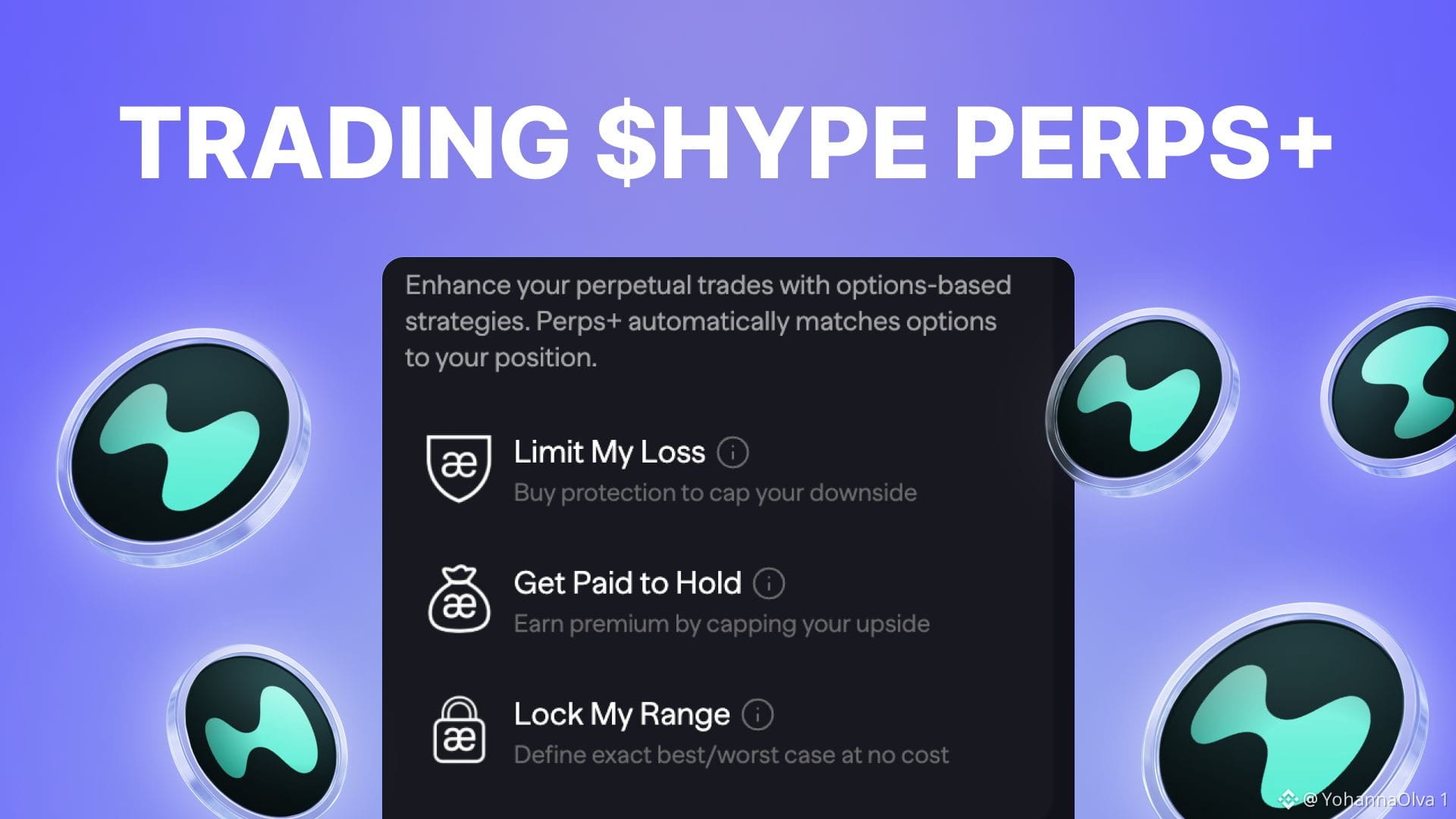
Trading HYPE perps is now different! 🧠 $ETH and $HYPE have both been central to where the action's been this month, and I've been using PERPS+ for my ETH trades from day one: cap the downside before entry, get paid to hold while you wait for the move, lock a range and collect premium on a sideways spell. But every time I wanted the same structure on a HYPE position I had to go back to a naked perp. Today that closed. Same three outcomes, now on HYPE. Fix the max loss before the position opens. Take a premium upfront and cap the profit ceiling in exchange. Set a range and collect for price staying inside it. A banger addition from Aevo 🔥 #Altcoin Season#
Four things. One still missing. 🤯 $TAO is building the AI intelligence layer autonomous agents will draw from and $VIRTUAL is building the rails they will run on. Both ecosystems are solving identity, authorization, and settlement beautifully. But they are all missing the same fourth thing. Verification of the data the agent actually acted on. Here is why the first three were straightforward: each one gave the agent a capability it could carry itself. Identity: the agent holds a verifiable credential. Authorization: the agent's scope is cryptographically signed. Settlement: payment is embedded directly in the request. Every answer lives on the agent's side of the interaction. But whether the data it read was actually accurate is a fact about the world, not about the agent. It comes from sources the agent does not own. An agent asked to prove its authorization holds up its mandate. An agent asked to prove the price it acted on was real has nothing to hold up. That answer was never its to give. Space and Time sits on the data side, the only place that proof can actually come from. Every query returns with its proof. Not from the agent, from the source. #Altcoin Season# #AI
Idle $BTC Becomes Collateral On $SUI 🔥 Most of Bitcoin's supply has never generated a single basis point of yield. Every bull run resets the same narrative: store of value, digital gold, the hardest asset, while the capital stays idle. The attempts to put it to work have not been encouraging. Wrapped Bitcoin products have existed for years, and the trust requirement sitting underneath each one has consistently been the ceiling on adoption. Hashi seems to have the answer though…Native Bitcoin becomes programmable collateral on Sui while the Bitcoin itself stays on its own chain, with the custody risk that defined every previous iteration simply removed. DeFi's first cycle ran almost entirely on ETH and stablecoin collateral. The total addressable market for on-chain lending and liquidity changes significantly when Bitcoin becomes usable collateral without leaving its native chain. Hashi has recorded 2M+ deposits on testnet with mainnet deployment approaching. The infrastructure for productive Bitcoin capital is already live. If Bitcoin dominance is returning at the same time native BTC collateral becomes available on-chain, the capital flowing into DeFi this cycle will look different from the last one. Hashi is the infrastructure for that shift. I'm watching this closely. #Bitcoin #DeFi

Your Coins Pay Their Own Fees ⛽ Gas is the tax nobody signed up for, and on $TAO it swings hard. The cost to register a new subnet roughly doubles each time somebody registers one, then falls back when things slow down. $XRP went the other way and keeps fees tiny, though the ledger still logged 222.4 million transactions last quarter. And about a quarter of those failed, which still costs the sender every time. Midnight handles this differently, and it is the part that made me read the docs twice. Holding NIGHT generates DUST, and DUST is what pays for private transactions. You cannot buy DUST and you cannot trade it. It refills on its own, and how much you get tracks how much NIGHT you hold. So your fees come out of your bag instead of out of your pocket. For a retail holder that kills the thing I hate most about DeFi. No topping up before a trade, and no getting priced out because the network got busy that afternoon. Holding the asset is what pays for using it, and I think other chains copy that model once users feel the difference. #Privacy #DeFi
Cheap Compute Never Fixed The Data Problem 🔐 $TAO has scaled past 128 active subnets selling paid AI work, and every job still hands the assigned miner the raw content it is meant to process. $RENDER built a real market for spare GPU power, and it works because rendering a frame never requires trusting a stranger with a loan book. Ask anyone holding a patient list or a credit file whether they have pasted it into a model. The answer is no, and no amount of GPU supply moves it. Arcium runs the computation across a cluster of nodes where each node only ever holds a fragment of the input, so the answer comes back without any single node assembling the question. That is the part I keep circling, because it is a statement about what is mechanically possible rather than a promise not to look. ZINC made it concrete for me. A Solana game where every tile pick stays sealed while the round runs, now sitting at the top of Solana by transaction count on a workload that cannot exist when inputs are readable. This has been live since February 2, with more than 2.5 million computations run on it. Whoever can show nobody read the input gets access to the data that was never for sale. #AI #DeFi
Tokenized Equities Just Got Native Rails 📈 $ONDO ’s yield-bearing treasuries trade onchain with the same liquidity TradFi investors expect. $XDC has spent years extending into enterprise rails and letting regulated real-world value settle onchain. When I look at these examples and the current state of the market there’s a pattern I keep seeing. Prove the rails first, and only then let recognizable assets actually ride them. Institutions didn't need convincing that real-world assets belong onchain. Anyone who watched the WEF this year would agree. What they needed was proof that the rails could carry regulated value without breaking anything, and RWA infrastructure has spent this whole cycle building exactly that. I've watched that infrastructure argument play out for over a year now, but what it still doesn't solve is retail's ability to access specific assets that already have real demand. Wanting AAPL or NVDA exposure has always meant having a brokerage account, KYC, and custody sitting entirely off-chain. Bankr just put their first stock-paired tokens live on Base, with an agent that runs the entire loop instead of a brokerage login: - AAPL, NVDA, META and GOOGL trading as stock-paired tokens on Base - Launch a new stock-paired token directly through the agent - Buy the exposure or manage the whole position from the same interface That fixes the exact issue the RWA infrastructure has failed to properly address. The rails already worked, and now they're paired with names retail actually wants to hold, and in a way that actually allows them to participate in a natural onchain capacity.. I'm watching how fast the rest of the RWA category follows this pattern instead of staying infrastructure-only. The category graduates from infrastructure to something people actually hold the moment the assets they already recognize start showing up onchain and in accessible liquidity pools. #RWA #Altcoin Season#
Tokenized Equities Just Got Native Rails 📈 $ONDO ’s yield-bearing treasuries trade onchain with the same liquidity TradFi investors expect. $XDC has spent years extending into enterprise rails and letting regulated real-world value settle onchain. When I look at these examples and the current state of the market there’s a pattern I keep seeing. Prove the rails first, and only then let recognizable assets actually ride them. Institutions didn't need convincing that real-world assets belong onchain. Anyone who watched the WEF this year would agree. What they needed was proof that the rails could carry regulated value without breaking anything, and RWA infrastructure has spent this whole cycle building exactly that. I've watched that infrastructure argument play out for over a year now, but what it still doesn't solve is retail's ability to access specific assets that already have real demand. Wanting AAPL or NVDA exposure has always meant having a brokerage account, KYC, and custody sitting entirely off-chain. Bankr just put their first stock-paired tokens live on Base, with an agent that runs the entire loop instead of a brokerage login: - AAPL, NVDA, META and GOOGL trading as stock-paired tokens on Base - Launch a new stock-paired token directly through the agent - Buy the exposure or manage the whole position from the same interface That fixes the exact issue the RWA infrastructure has failed to properly address. The rails already worked, and now they're paired with names retail actually wants to hold, and in a way that actually allows them to participate in a natural onchain capacity.. I'm watching how fast the rest of the RWA category follows this pattern instead of staying infrastructure-only. The category graduates from infrastructure to something people actually hold the moment the assets they already recognize start showing up onchain and in accessible liquidity pools. #RWA #Altcoin Season#
Enterprise doesn't need convincing. It needs an icon. $POL has been building enterprise infrastructure. The rails that serious organizations use when they decide blockchain is part of their future. Enterprise moves slowly. But it moves in one direction once it decides. $DMC is the IP that enterprise already understands. The DeLorean needs no briefing document. No cultural context. No explanation of why it matters. Forty years of films and global presence handled that already. When enterprise-grade infrastructure meets enterprise-grade IP, serious attention follows. The rails are ready. The icon is onchain. #Altcoin Season#
Billions Lost To Bugs Prevented 🔥 Most of DeFi's biggest exploits happened on $ETH because Solidity doesn't prevent reentrancy by design. Move on $SUI closes that attack vector at the compiler level. Reentrancy attacks, asset duplication bugs, and integer overflows are not black swan events. They are predictable consequences of an execution model that allows contracts to call back into themselves before state changes are recorded. The DAO hack, Poly Network, and dozens of protocol drains since all share the same root cause. Solidity doesn't block these attack vectors, and auditing is an imperfect defense against attacks the language itself permits. Move enforces resource types. Assets in Move can only exist once, cannot be copied without explicit permission, and cannot be created from nothing. A reentrancy attack requires duplicating or redirecting an asset mid-execution. Move makes that impossible to write, and the compiler rejects it before the code is ever deployed. This is not a stronger auditing process. It is a different model of what an asset is. Every billion dollars flowing into DeFi infrastructure is exposed to whatever the execution environment permits. A compiler that rejects the exploit outright is a fundamentally stronger guarantee than auditors working against a language that allows it. Sui's throughput numbers get the attention, but it’s the security architecture part I keep coming back to. #DeFi #Altcoin Season#

This Airdrop Cannot Be Farmed ❌ $JUP distributed 200 million tokens through Jupuary this year, down from 700 million in prior editions, which is the clearest signal yet that reward waves have a ceiling. $VIRTUAL went the other direction entirely, embedding its agent infrastructure natively into Robinhood Chain so any user there can launch and fund an agent without touching a crypto native product. One bought distribution inside infrastructure millions already trust. The other is paying an audience it already has. Both work, and both pull in the farming behavior that never turns into a real user base. A wallet that claims once and leaves is a cost, not a user. Arcium took a third route that I keep coming back to. RTG converts actual ecosystem contribution into credits that pay out in ARX monthly, with manual filtering built in to strip bot farms and extractive wallets. Solflare interaction is required as proof of eligibility, which is a far higher bar than showing up once to claim. The portal has been live since May, ahead of both moves above. Slower than buying placement or running a reward wave, and the only one of the three that filters for who is worth keeping. ARX is what gets distributed through it. #AI #Airdrop
තවත් අන්තර්ගතයන් ගවේෂණය කිරීමට ඇතුල් වන්න