
AREWA CRYPTO
2.6k පෝස්ටු

AREWA CRYPTO
 චතුරශ්රය සත්යාපිත
වාර්තා කරන්න
පරිශීලක අවහිර කරන්න
BP-93A252D397EA Trusted Voice that Connect Projects with People, Helping Crypto Projects Grow & Engage Communities | Verified on Binance, CMC & Bitgét.

Level 2 Creator
විවෘත වෙළෙඳාම

{ටෝකන්} දරන්නා
නිතර වෙළෙන්දා
{වේලාව} වසර
90 හඹා යමින්
54.0K+ හඹා යන්නන්
92.9K+ කැමති විය
1 ලාංජනය
පෝස්ටු
ආයෝජන කළඹ
සියල්ල
උපුටා දැක්වීම්
වීඩියෝ
සජීවි
අමුණා ඇත
·
--
සත්යායනය කළ
#nil $NIL @nillionnetwork
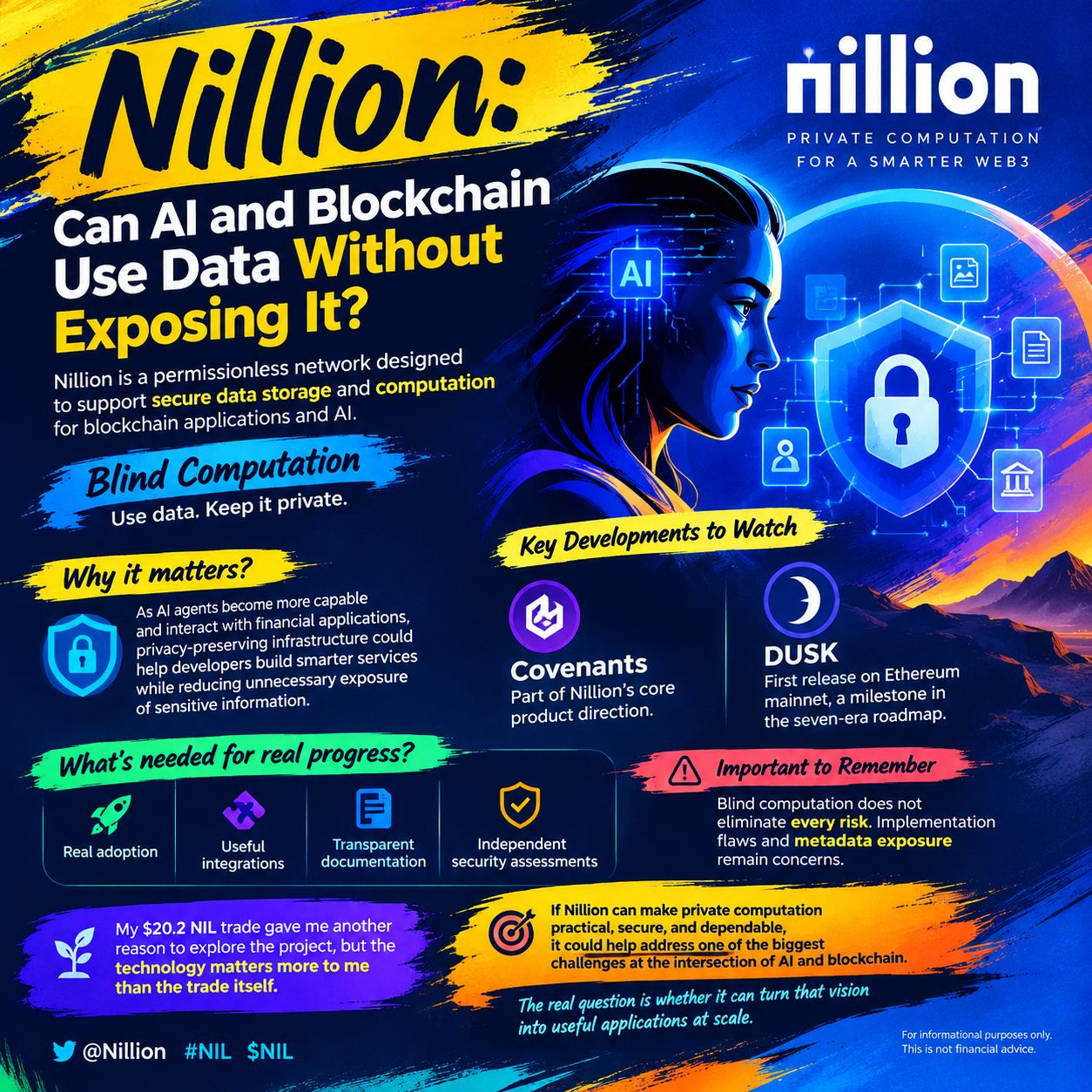
Can AI and Blockchain Use Data Without Exposing It?
After making a $20.2 trade in $NIL, I became more interested in the technology behind Nillion and the problem it aims to solve.
For me, one of Web3’s biggest challenges is finding ways to use sensitive data without unnecessarily exposing it. Blockchains offer transparency, but financial information, personal records, and private AI interactions require stronger privacy considerations.
This is where Nillion’s concept of blind computation stands out.
Nillion is a permissionless network designed to support secure data storage and computation for blockchain applications and AI. Its approach aims to enable computation on protected data without exposing the underlying information in ordinary readable form.
I find this particularly relevant as AI agents become more capable and interact with financial applications. Privacy-preserving infrastructure could help developers build useful services while reducing unnecessary exposure of sensitive information.
Two developments worth watching are Covenants and DUSK.
Covenants is part of Nillion’s core product direction, while DUSK, its first release on Ethereum mainnet, marks a milestone in the project’s seven-era roadmap.
What interests me most is how these developments could help developers build practical applications around protected data. However, announcements alone are not enough. Real adoption, useful integrations, transparent documentation, and independent security assessments will be important measures of progress.
Blind computation also does not eliminate every risk. Implementation flaws and metadata exposure remain concerns that developers must consider.
My $20.2 NIL trade gave me another reason to examine the project, but the technology matters more to me than the trade itself.
If Nillion can make private computation practical and dependable, it could help address a growing challenge at the intersection of blockchain and AI.
#nil
#GrayscaleAndRepublicLaunchThreeCryptoFunds
#nil $NIL @Nillion
Can AI and Blockchain Use Data Without Exposing It?
After making a $20.2 trade in $NIL , I became more interested in the technology behind Nillion and the problem it aims to solve.
For me, one of Web3’s biggest challenges is finding ways to use sensitive data without unnecessarily exposing it. Blockchains offer transparency, but financial information, personal records, and private AI interactions require stronger privacy considerations.
This is where Nillion’s concept of blind computation stands out.
Nillion is a permissionless network designed to support secure data storage and computation for blockchain applications and AI. Its approach aims to enable computation on protected data without exposing the underlying information in ordinary readable form.
I find this particularly relevant as AI agents become more capable and interact with financial applications. Privacy-preserving infrastructure could help developers build useful services while reducing unnecessary exposure of sensitive information.
Two developments worth watching are Covenants and DUSK.
Covenants is part of Nillion’s core product direction, while DUSK, its first release on Ethereum mainnet, marks a milestone in the project’s seven-era roadmap.
What interests me most is how these developments could help developers build practical applications around protected data. However, announcements alone are not enough. Real adoption, useful integrations, transparent documentation, and independent security assessments will be important measures of progress.
Blind computation also does not eliminate every risk. Implementation flaws and metadata exposure remain concerns that developers must consider.
My $20.2 NIL trade gave me another reason to examine the project, but the technology matters more to me than the trade itself.
If Nillion can make private computation practical and dependable, it could help address a growing challenge at the intersection of blockchain and AI.
#nil
#GrayscaleAndRepublicLaunchThreeCryptoFunds
13
1
36
25.7k
අමුණා ඇත
·
--
බෙයාරිෂ්
“I lost everything…
From something Nothing
Futures trading wiped my portfolio…
Future finishes me
No stop loss….”
😭😭😭
😭😭😭
😭😭😭
Not me Ooo. . . .
Honestly, this is the kind of story I keep seeing over and over again 😂🤣
Market moves small… account goes to zero.
Leverage high… discipline low… outcome predictable 😹
Couldn’t be me though.
I stay on SPOT — simple, controlled, and most importantly… protected.
Every trade has a plan, every entry has a stop loss.
Because in this market, survival isn’t luck… it’s structure.
Trade smart… or learn the hard way 😂📉

91
7
186
125.2k
·
--
Nigeria Gives Crypto Exchanges a Deadline
Nigeria's Revenue Service has ordered crypto exchanges and other virtual asset providers to register by November 30, 2026.
Providers must also integrate with its new VASP Tax Portal by December 31. The portal will support transaction reporting and existing tax collection.
The rules cover local and foreign firms serving Nigerian residents. Missing either deadline could trigger penalties.
The NRS says it does not introduce new taxes.

1
131
·
--
බෙයාරිෂ්
🚨 HERE’S WHY BITCOIN IS NONSTOP DUMPING RIGHT NOW
If you still think $BTC trades purely on supply and demand, you need to understand what's happening beneath the surface.
$BTC is around $62,000, down 28.8% in 49 days. The $76,326 support has broken, with $57,800 (July's low) now in focus.
This isn't simply weak hands or retail panic.
The bigger issue is the growing influence of derivatives in Bitcoin's price discovery.
Bitcoin's original thesis was built on two principles: → A fixed supply of 21 million BTC. → No rehypothecation.
But Wall Street has introduced layers of financial products: → Cash-settled futures → Perpetual swaps → Options → ETFs → Prime broker lending → Wrapped BTC → Total return swaps
These instruments create synthetic exposure to Bitcoin without requiring equivalent amounts of actual BTC.
This is where things get interesting.
The Synthetic Float Ratio (SFR) concept highlights how synthetic exposure can grow relative to real Bitcoin supply.
When paper exposure becomes dominant, price movements can increasingly reflect positioning, hedging and liquidation flows rather than straightforward spot demand.
The cycle can become brutal:
1️⃣ Build synthetic BTC exposure. 2️⃣ Short into rallies. 3️⃣ Trigger leveraged liquidations. 4️⃣ Cover positions at lower prices. 5️⃣ Repeat.
One real BTC can support multiple financial claims across ETFs, futures, options, lending and structured products.
This doesn't mean Bitcoin's 21 million supply cap has disappeared. It means derivatives can significantly influence its market price.
The bigger question is: Are we still watching genuine Bitcoin price discovery, or a derivatives-driven market?
Ignore this structural shift at your own risk.
Follow and turn on notifications for more crypto market insights.
3
2.4k
·
--
📰 US Opens Crypto Scam-Tracing Center Powered by TRM Labs
The US government has launched the Threat Disruption Center, a new hub designed to trace crypto funds tied to scams and disrupt criminal networks in real time.
Built on TRM Labs software, the center connects federal investigators with crypto exchanges, payment platforms and social media companies — enabling them to pause victim payments and ban scam accounts before funds disappear for good.
The feds finally have a group chat with the people who can actually freeze the money.

334
·
--
සත්යායනය කළ
#sxt $SXT
#sxt $SXT
Space and Time: Making Data Verifiable for AI, Tokenization and DeFi
One thing I find interesting about blockchain innovation is that transparency alone is not enough. As AI and decentralized finance evolve, another challenge becomes increasingly important: how can applications prove that the data behind their decisions is accurate?
Imagine a DeFi protocol calculating collateral, an AI agent analysing financial information, or a tokenization platform tracking asset ownership. If the underlying data is unreliable, even the smartest application can produce misleading results.
This is where Space and Time comes into the picture.
Backed by Microsoft, Space and Time is building infrastructure that makes data verifiable for AI, tokenization, and DeFi. Its goal is to help applications access and process information while providing cryptographic evidence that calculations have been performed correctly.
One technology that stands out is Proof of SQL. It allows SQL queries to be executed alongside zero-knowledge proofs, enabling applications to verify query results without blindly trusting the database operator.
I believe this approach has meaningful potential. AI agents could work with more verifiable information, tokenized assets could benefit from reliable data records, and DeFi protocols could make better use of complex datasets for lending, collateral management, and risk assessment.
The native token, $SXT, plays a role in the ecosystem's query infrastructure, including payments associated with executing and verifying queries. Its long-term relevance will depend on actual network usage and adoption, not just its intended utility.
However, there are challenges. Proof generation costs, performance, data quality, security, and developer adoption will determine how practical this infrastructure becomes. A valid proof also does not automatically guarantee that the original data is truthful.
The future of blockchain and AI will require more than access to information; it will require ways to verify it.
@SpaceandTimeDB #SXT $SXT
#sxt $SXT
#sxt $SXT
Space and Time: Making Data Verifiable for AI, Tokenization and DeFi
One thing I find interesting about blockchain innovation is that transparency alone is not enough. As AI and decentralized finance evolve, another challenge becomes increasingly important: how can applications prove that the data behind their decisions is accurate?
Imagine a DeFi protocol calculating collateral, an AI agent analysing financial information, or a tokenization platform tracking asset ownership. If the underlying data is unreliable, even the smartest application can produce misleading results.
This is where Space and Time comes into the picture.
Backed by Microsoft, Space and Time is building infrastructure that makes data verifiable for AI, tokenization, and DeFi. Its goal is to help applications access and process information while providing cryptographic evidence that calculations have been performed correctly.
One technology that stands out is Proof of SQL. It allows SQL queries to be executed alongside zero-knowledge proofs, enabling applications to verify query results without blindly trusting the database operator.
I believe this approach has meaningful potential. AI agents could work with more verifiable information, tokenized assets could benefit from reliable data records, and DeFi protocols could make better use of complex datasets for lending, collateral management, and risk assessment.
The native token, $SXT , plays a role in the ecosystem's query infrastructure, including payments associated with executing and verifying queries. Its long-term relevance will depend on actual network usage and adoption, not just its intended utility.
However, there are challenges. Proof generation costs, performance, data quality, security, and developer adoption will determine how practical this infrastructure becomes. A valid proof also does not automatically guarantee that the original data is truthful.
The future of blockchain and AI will require more than access to information; it will require ways to verify it.
@SpaceandTime #SXT $SXT

3
9
4.4k
·
--
🚨 CZ Warns AI Is Outpacing Crypto's Cyber Defenses
After Binance suffered a $6.3 billion hack, CZ sounded the alarm: AI is accelerating cyberattacks faster than crypto firms can shore up their defenses. Binance also warned users to watch for post-hack scams targeting the rattled.
Elsewhere, Strategy's STRC repriced back to $100 after the firm shifted to daily dividends, and Bitmine moved 99% of its treasury into ETH — a bold institutional bet on Ethereum as a reserve asset.
A busy week for security headlines and treasury pivots. Perhaps the real question is whether the industry can build walls faster than AI can find the doors.
1
890
·
--
🔐 Crypto hacks hit $9.2B in losses this year
Bitfinex has raised alarms over mounting security risks in the crypto industry, citing $9.2 billion in total losses from hacks recorded so far this year.
The warning underscores the scale of threats facing both centralized and decentralized platforms as bad actors continue to exploit vulnerabilities across the ecosystem.
1
431
·
--
📊 Weekly Crypto Recap: Binance Hack Explained, US Crypto Bill Talks, Bitcoin ETF Outflows
Binance detailed how attackers stole $6.34 billion, Democrats weighed an alternative approach to U.S. crypto regulation, and Bitcoin ETFs returned to net outflows during the Nov. 1–7 news cycle.
The week also saw developments on crypto in retirement plans, as lawmakers and industry participants continued debating the regulatory path forward in Washington.
316
·
--
🚨 BINANCE SECURITY INCIDENT: WHAT HAPPENED, WHAT WE KNOW, AND WHAT IT MEANS FOR USERS
A major security incident involving Binance has raised important questions about exchange security, operational risks, and the protection of user funds.
According to Binance's latest update (October 30, 02:40 UTC), the exchange has assured users that their funds are safe and that it will cover all losses using its SAFU fund and company reserves.
Here are the key developments:
🔹 How the incident happened
Initial findings suggest that an attacker compromised the laptop of a DevOps engineer, gaining access to a service container that was subsequently used to initiate unauthorized withdrawals.
Importantly, Binance reports no evidence that wallet private keys were compromised.
🔹 Estimated financial impact
The estimated total impact is approximately $6.3 billion, making this an extremely significant security incident.
🔹 Recovery efforts
Approximately $3 billion in assets have reportedly been frozen on-chain, with assistance from blockchain partners, including Tether, Circle, Ripple, World Liberty, and Paxos.
🔹 Temporary security measures
Binance temporarily suspended deposits and withdrawals as a precautionary measure and revoked the affected address authorization.
🔹 Investigation and transparency
Law enforcement agencies and blockchain intelligence partners are working to trace and recover the funds.
Binance has also committed to publishing an updated Proof of Reserves after remediation, alongside a comprehensive technical post-mortem.
This incident highlights an important reality about cryptocurrency security: protecting digital assets goes beyond securing private keys.
A compromised employee device, weak operational controls, or unauthorized access to internal infrastructure can potentially create serious security vulnerabilities, even within major cryptocurrency exchanges.
For users, this is also a reminder that exchange security should never be taken for granted.
#Binance #CryptoSecurity #SAFU #Bitcoin #CryptoNews #Blockchain
2
5
15.5k
·
--
1
358
·
--
711
·
--
US spot Bitcoin ETFs drew $526.6M in net inflows on Monday, the most since Sept. 22, with BlackRock’s IBIT pulling in $665.2M to offset outflows from FBTC and GBTC.
US spot Bitcoin ETFs drew $526.6M in net inflows on Monday, the most since Sept. 22, with BlackRock’s IBIT pulling in $665.2M to offset outflows from FBTC and GBTC.

NIL-5.88%
IBITETF-4.95%
1
258
·
--
Participate in $NIL competition to receive reward
👇
👇
👇
Participate in $NIL competition to receive reward
👇
👇
👇
👇
👇
👇
AREWA CRYPTO
·
--
#nil $NIL @Nillion
Can AI and Blockchain Use Data Without Exposing It?
After making a $20.2 trade in $NIL, I became more interested in the technology behind Nillion and the problem it aims to solve.
For me, one of Web3’s biggest challenges is finding ways to use sensitive data without unnecessarily exposing it. Blockchains offer transparency, but financial information, personal records, and private AI interactions require stronger privacy considerations.
This is where Nillion’s concept of blind computation stands out.
Nillion is a permissionless network designed to support secure data storage and computation for blockchain applications and AI. Its approach aims to enable computation on protected data without exposing the underlying information in ordinary readable form.
I find this particularly relevant as AI agents become more capable and interact with financial applications. Privacy-preserving infrastructure could help developers build useful services while reducing unnecessary exposure of sensitive information.
Two developments worth watching are Covenants and DUSK.
Covenants is part of Nillion’s core product direction, while DUSK, its first release on Ethereum mainnet, marks a milestone in the project’s seven-era roadmap.
What interests me most is how these developments could help developers build practical applications around protected data. However, announcements alone are not enough. Real adoption, useful integrations, transparent documentation, and independent security assessments will be important measures of progress.
Blind computation also does not eliminate every risk. Implementation flaws and metadata exposure remain concerns that developers must consider.
My $20.2 NIL trade gave me another reason to examine the project, but the technology matters more to me than the trade itself.
If Nillion can make private computation practical and dependable, it could help address a growing challenge at the intersection of blockchain and AI.
#nil
#GrayscaleAndRepublicLaunchThreeCryptoFunds

PARTICIPATE IN $NIL
AREWA CRYPTO වෙතින්
2
257
·
--
People who lose money on memecoins today aren’t necessarily stupid.
Sometimes, they lose because they think they’re smarter than the game.
Crypto investors are more informed than ever.
Everyone knows KOLs can be paid to shill.
Everyone knows insiders exist.
Everyone knows narratives can be manufactured.
Everyone knows early buyers can dump on late buyers.
Everyone knows they could become someone else’s exit liquidity.
And yet…
People still lose money.
Because knowing how the game works doesn’t mean you won’t play it.
You see a KOL start pushing a coin.
You already know something might be going on.
Then it goes +30%.
You start paying attention.
+70%.
Now you regret not buying.
Then your X feed becomes a wall of PnLs.
Someone made 2x.
Someone made 3x.
Another KOL says, “We’re just getting started.”
Suddenly, everything you knew goes out the window.
You tell yourself:
“I’ll just put in a little, catch the next leg, and get out.”
That’s where the problem starts.
Because everyone thinks they’ll be the one who gets out in time.
You buy.
You’re up 50%.
But you don’t sell.
“Let it run a little more.”
Then the price comes back to your entry.
You still don’t sell.
Because you can’t accept giving back a profit you never actually locked in.
-20%.
You go back to X looking for bullish posts.
-50%.
“The KOLs are still holding.”
-80%.
Now it’s the insiders.
The KOLs.
The market.
The manipulation.
Everyone is to blame except you.
Until there’s almost nothing left.
And then you’re forced to face the uncomfortable truth:
No KOL grabbed your hand and pressed the buy button.
The most expensive mistake in memecoins isn’t knowing nothing.
It’s knowing exactly what’s happening…
and still believing you’re smart enough to be the one who gets out before everyone else.
Because in every trade where someone is making money by selling to someone else…
someone eventually becomes the exit liquidity.
If you’re not careful,
it could be you.
#NFPWatch

1
790
·
--
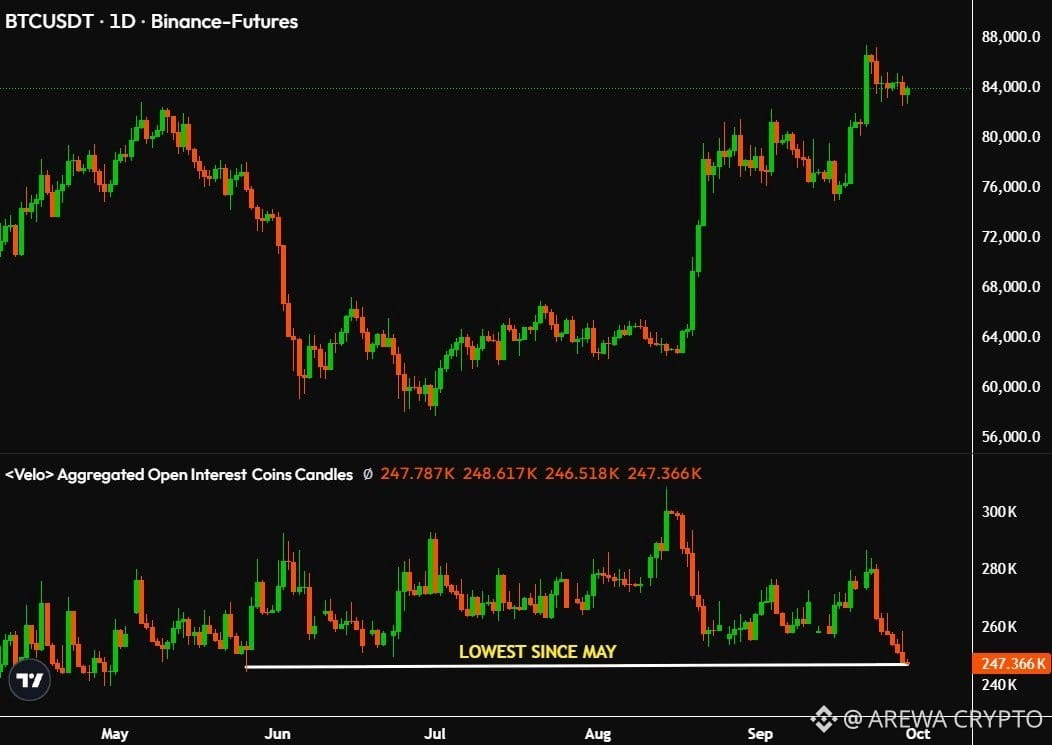
$BTC leverage has been largely flushed out.
That can be healthy for the market.
When excessive leverage gets wiped out, forced selling pressure can cool down and the market gets a chance to reset on more sustainable positioning.
Less crowded trades. Less forced liquidation risk. More room for price to move based on actual demand.
It doesn’t guarantee the next move is up, but a leverage reset can create a healthier foundation for the market.
Stay patient. Watch spot demand and positioning closely.
240
තවත් අන්තර්ගතයන් ගවේෂණය කිරීමට ඇතුල් වන්න
Binance චතුරශ්රය හි ගෝලීය ක්රිප්ටෝ පරිශීලකයින් හා එක්වන්න
⚡️ ක්රිප්ටෝ පිළිබඳ නවතම සහ ප්රයෝජනවත් තොරතුරු ලබා ගන්න.
💬 ලොව විශාලතම ක්රිප්ටෝ හුවමාරුව මගින් විශ්වාස කෙරේ.
👍 සත්යායනය කරන ලද නිර්මාණකරුවන්ගෙන් සැබෑ විදසුන් සොයා ගන්න.
විද්යුත් තැපෑල / දුරකථන අංකය
නැගී එන මාතෘකා
CanBTCReboundAfterFallingBelow60K?
369,886 නැරඹීම්
1,555 සාකච්ඡා කරමින්
Bitcoin News | Bitcoin Falls Below $60,000 for the First Time Since July as IBIT Posts Record $541 Million Outflow
Binance News
·53 කැමත්ත දැක්වීම්
·100k නැරඹීම්
GlobalStocksFaceLongestLosingStreakSince2023
122,357 නැරඹීම්
1,094 සාකච්ඡා කරමින්
BlackRockIBITPostsRecord$541MSingleDayOutflow
692 නැරඹීම්
17 සාකච්ඡා කරමින්